


This is an excerpt from the upcoming expanded edition of Ghostwalker: Tracking a Mountain Lion’s Soul through Science and Story. (University of Nebraska Press, Fall 2024 release)
Just days after my arrival in California, a friend sent me a photo from a door camera of a collared lion in her neighborhood. The lion was standing in a driveway in the early morning hours. Only Dr. Quinton Martins who was running a study north of Marin was collaring cats so this lion had to be one of his. The news media quickly blew up, using the same photo as evidence. Reviewing the GPS data, Dr. Martins told the Press the young male lion known as P36 had crossed busy highway 101 five times. When the cougar encountered the crowded business area of southern Marin, he quickly hightailed it back north.
I met with Martins a few days later, curious what he’d discovered about cougars in Sonoma. Both Sonoma and Marin counties are the end of the road for cougars traveling along the North Coast, but Sonoma County has a larger suitable land base for cougars and more linkages north. Sonoma County is considered an agricultural and farming community, although in the last several decades the area has become more gentrified, with small acreage vineyards that serve as tax write-offs, mega-mansions, and commuters to points south. The semi-rural, mixed habitat region also has a ballooning number of hobby ranchers who own a few small animals like goats and sheep.

From South Africa, Martins was an experienced safari guide with a particular interest in leopards and lions. He became intrigued with the mountain leopards of the Cape in South Africa and began a 10-year research study which contributed to his PhD, learning more about this elusive mountain cat and inventing innovative ways to trap and collar them. In 2016, Martins introduced a mountain lion project to Audubon Canyon Ranch, a local and established San Francisco North Bay environmental non-profit. The proposal was accepted and called Living with Lions Project.
I ask Martins to describe P36’s journey. Martins shows me a map with P36’s GPS pings on them. It looks like a drawing of a billiard game with dots everywhere, some clustered, others far-flung. P36 hadn’t just arrived south into Marin, but previously roamed through three counties looking for a territory to call his own, at one-point landing in a parking lot by the ocean

“Ah, so that’s the Pacific. Always wanted to see that,” Martins jokes. “Then P36 heads down the coast all the way to Point Reyes, ending up overlooking the Golden Gate bridge. Back tracks and pops over to Tiburon. The last GPS reading indicates he’s hightailed it out of Marin and crossed the Russian River heading back north through Sonoma County.”
So far P36 has been lucky, crossing busy highway 101 several times without injury. He explored three counties of suitable habitat, all probably occupied by resident males. Like the findings in Santa Cruz, Martins says these young dispersers seem to use sub-optimal fringe habitat while they move about, staying under the radar of any resident males. Dispersers typically use creeks as corridors, killing small prey like raccoons as they navigate to a permanent territory. Habitat near human dominated areas is rich with small prey that cougars can live on.
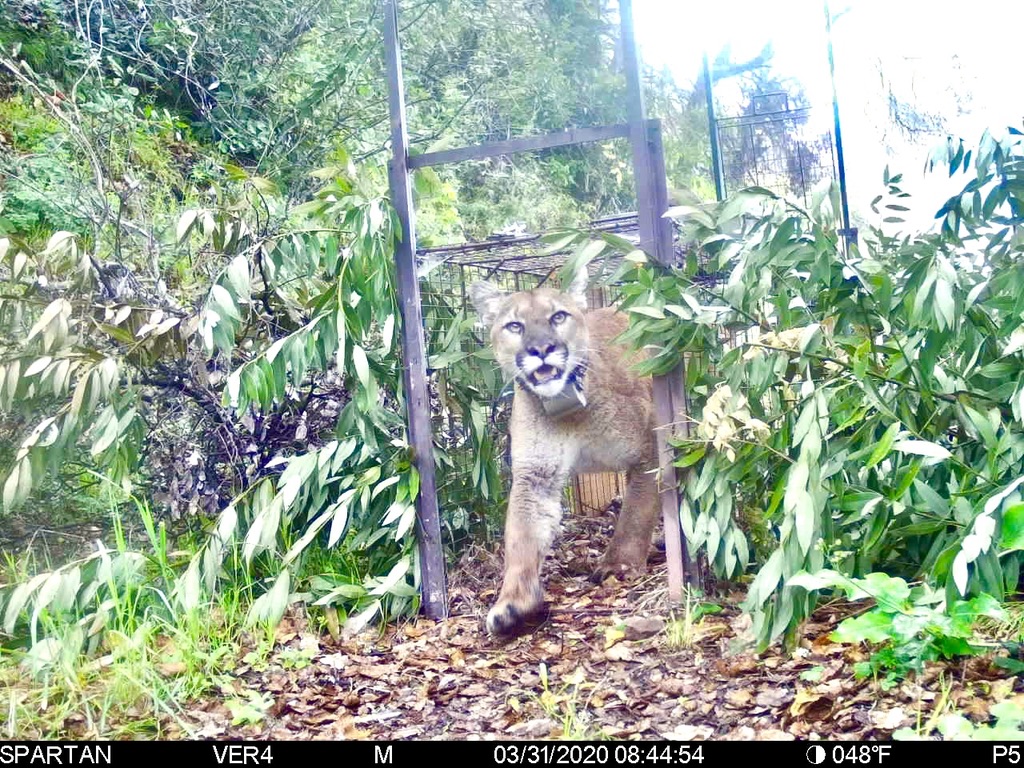
“P36, his diet has been amazing,” Martins tells me. “We recorded him since March last year killing 37 deer, 6 wild boar, 2 badgers, an otter and a squirrel. No livestock. And we’ve had him on properties where there is livestock around like calves and he’s made a deer kill right there. You get a day bed reading where he’s walked back through the livestock area, hangs out there, then goes back to feed on the deer he’s killed.”
Given that the North Coast region is still considered an excellent source of genetic diversity, I was curious about the success of Martins’ male dispersers. P36 was doing well, but what about his other cats. Martins shows me a map of his eastern Sonoma study region where two males have successful territories. Considering the majority of suitable habitat in the area is likely already occupied, dispersing males are going to have to head north into Mendocino or beyond.
“There is clearly connectivity in our landscape, which means that any cat can come down here, or get out of here. The key source areas are really important; then ensuring connectivity in the landscape is the next thing. We’ve got all that (in Sonoma County). We’ve got great source populations up north, from Oregon, Mendocino. But cats coming south get to the end of the road in the North Bay area.”
Filed under: New ideas |
 Leslie Patten Books: Wild Places, Sacred Spaces
Leave a comment