


“She’s close.”
Mountain lion biologist Quinton Martins holds up an antenna while listening to a series of beeps from his hand-held receiver. Martins is searching for a female mountain lion wearing a failing GPS collar that needs replacing. As he leads us across a stream towards the oak and bay hillside, these locator pings indicate she’s alternating between two areas on either side of the creek. Martins thinks she may have a kill, which would be great news. If she does, then he can place a cage trap to recollar her.
Sharon Negri of the Mountain Lion Foundation and I are tagging along, hoping to catch a glimpse of this elusive animal. The hillside is steep with no clear trail as we trudge through tight brush and poison oak, occasionally stopping as Martins rechecks the lion’s location.
“She’s very close. On the other side now, maybe forty meters away in those trees.”
This particular cat, Martins tells us, had at least one kitten who would be eight months old. But the resident male recently died of bacterial bronchial pneumonia linked to Feline Leukemia Virus, opening the territory for a new male. If that’s the case, it could mean this new male might kill the kitten in order to entice the female to breed again.
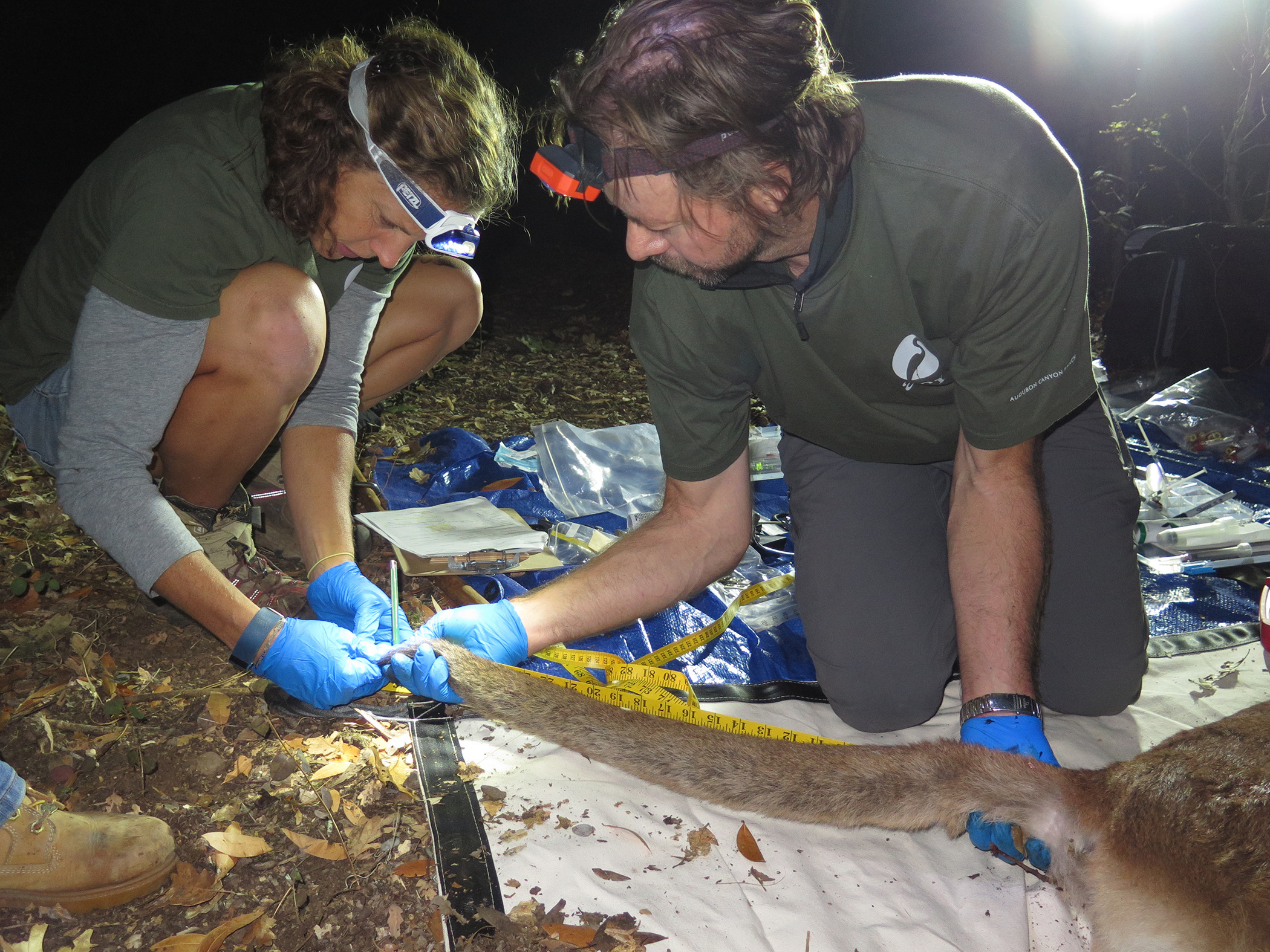
Martins has been running a mountain lion study in partnership with the Audubon Canyon Ranch in Sonoma County since 2016. True Wild, his company with his wife, focuses on coexistence with wildlife and offers customized African safaris as part of their conservation efforts, connecting people to nature in a profound way and working with participants to become more involved in conservation initiatives where possible.
We stop again for another location check. Now Martins’ receiver displays a significantly stronger signal, indicating the cat is on the opposite bank exactly where the second ping showed up on his computer yesterday. Sharon and I carefully navigate the streambed around an enormous jumble of jagged boulders, possibly dumped from soil preparations for the vineyard whose private lands we have permissions to be on. At the ping site there is no indication of a kill while the cat has disappeared through thick bush and over a rise. Knowing this female was so close, yet we never saw her, leaves us frustrated. It is a repeat of a common scenario: cougars watch people yet we humans never see them.
Heading back to the car, Martins points out fresh tracks in the soft dirt. “She’s been here, going back and forth. This cat has been incredibly difficult to find.”
Luckily, Martins has one other lion he wants to sleuth out. P49 has a good working collar that indicates she might have a kill. Martins’ goal with this cat is to find out if she has kittens. As we drive 45 minutes west to the opposite end of Sonoma County, Martins lays out the unique difficulty of doing a wildlife study in a highly populated rural area.
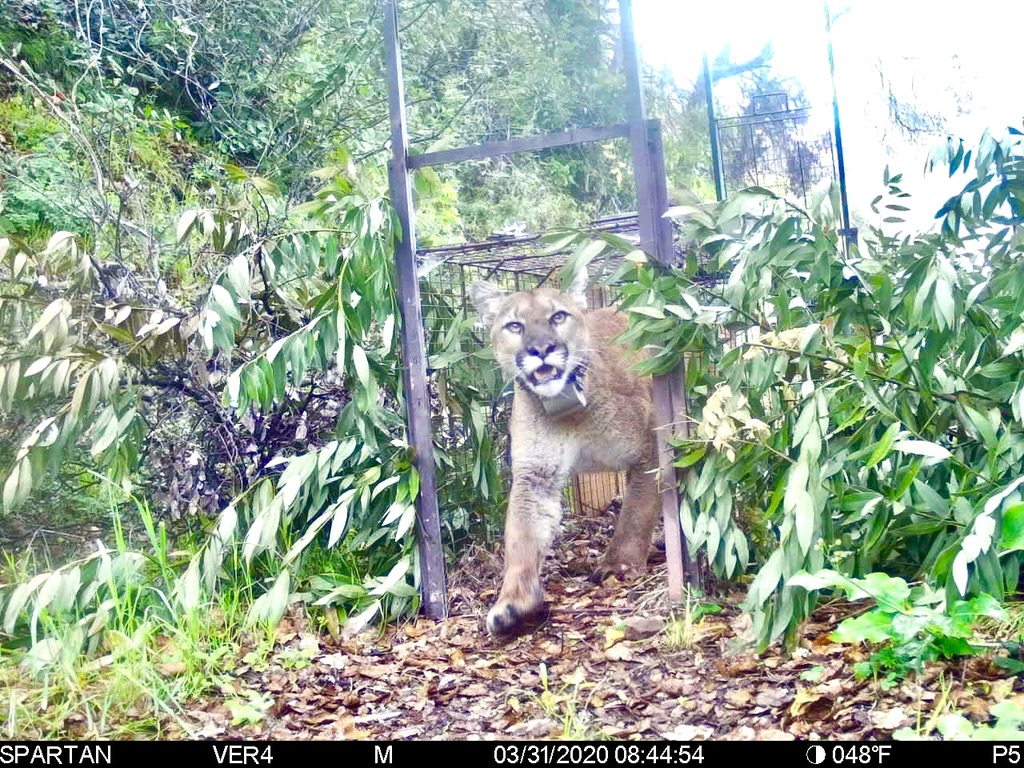
“The males we have collared—P5 has 17,000 private properties in his territory. P31 has 11,000 private properties. How do you contact that many people and access all those properties to inspect fences or signs of prey? This dilemma is confounded by an increase in weekend private property owners. When you overlap a land parcel map it is as if you are looking at 50,000 or 100,000 mini ecosystems, so you can’t just throw a vegetation layer over it and say ‘OK, this is what the cats are doing.’ As their primary prey is deer, it might look like great deer habitat on a map, but in many cases these properties are fenced to keep deer out. So there might be no deer in areas where you expect deer, but cannot tell because you can’t access the properties very easily. And walking each individual land parcel, one finds different plant and animal resources, a variety of fence types that block or allow animals to move through, and each parcel managed differently to some degree.”
Martins tell us lions are using fences of any type to strategically block or corner and kill deer. In fact, when we approached the previous property, Martins pointed out a cougar-killed deer carcass hanging against the fence that enclosed the vineyard.
Our second property owner is an animal lover excited to discover there’s a lion hanging around his property. He has a large piece of wooded land, over 200 acres, nestled in the hills of Sebastopol. He greets us at his main house and we follow him down the road to where Martins recorded a series of GPS fixes the night before. The dense cluster of pings is a hopeful sign this cat has made a kill and is still hanging around. Cougars can spend up to three days or more consuming an adult deer. They will cover their kill to preserve its freshness as well as deter scavengers while they rest nearby.
The GPS telemetry data indicates the cat traveled along a hillside where an overgrown two-track is still visible. A short hike leads us to her kill—a yearling deer. Cougars kill with a bite to the neck, then consume the internal organs first. Big cats, along with their small domestic cousins, lost the ability somewhere in evolutionary time to convert carotenoids like beta carotene into Vitamin A, so they have to obtain it directly from these nutritious organ meats. That’s exactly what this cat has done. I also see she has begun to pull the fur away with her incisors. Although this is a small deer, Martins thinks there’s enough meat on the carcass that the cat will return, and if she does we’ll find out if she has kittens. The VHF radio signal from her collar indicates she is resting on the opposite hillside only a few hundred yards away.
“She’ll return under cover of night,” Martins tells us as he sets up three trail cameras focused on the carcass.
Even though we never did see a mountain lion, the day was exciting as well as instructive. Conducting a mountain lion study in an urban/rural area has tremendous challenges and complexities that studies in vast wilderness areas like where I live in Wyoming do not. First there is no snow, so finding tracks is as elusive as the animal itself. Second, most mountain lion studies rely on dogs to do the tracking and treeing of the animal. Once treed, biologists can easily dart the lion and lower him to the ground to be collared and released. Obviously dogs can’t be utilized in areas where there are so many people on small private land parcels. In addition, while there are some public lands in Sonoma County—mostly small county parks dotted throughout his study area—Martins’ lions live in territories encompassed by thousands of private properties, meaning he has to obtain permissions from each owner before visiting. Most, but not all owners are happy to help, but even when he has their cooperation, each visit requires one or several phone calls to gain access. It’s a lot of human PR work.
A few days later, Martins relays the good news. P49 has two healthy cubs with her and sends us a photo of the family dining on the carcass. I realize that instead of one lion, there were three nearby, none of whom we saw. But to be fair, mountain lion mothers sometimes stash their kittens while they hunt, then bring them to the kill site afterwards.

These kittens are highly dependent upon their mother’s hunting skills throughout their first year. The span between six and eighteen months is especially important for the cubs because they are learning the art of hunting and killing prey. In addition they are exploring their natal range and learning how to deal with potential enemies. Dispersal occurs usually between 12 and 24 months. Lion dispersal is critically important for genetic diversity, as well as for geographic expansion. Females tend to stay close to their birth mother’s range, while males need to find an empty slot devoid of a dominant male. The odds are tough for dispersing males, who roam much farther than females and have to contend with other territorial males. In an urban/rural landscape, these kittens will need to learn to avoic livestock plus they have a higher chance of contacting diseases from domestic cats like Feline Leukemia Virus and the H5N1 virus, commonly referred to as bird flu which cats have a higher than 70% chance of dying from.
Through Martins work we hope to have a better understanding of mountain lions living in a unique situation sharing their territories with a high density of people in a complex urban/rural landscape. Plus, this coexistence with California’s communities work will hopefully give these iconic cats increased odds of survival, ensuring their vital role in helping ecosystem integrity is maintained.
More info on Martins work and California mountain lions can be found in my book Ghostwalker
If you want to follow updates of Martins’ Sonoma study…
True Wild’s work stems from our love for wild places. We are driven to find ways for people to appreciate and make an effort to protect wild places and the wildlife that shares the world with us. We believe that people can coexist with wildlife through practical and achievable methods and in doing so, serve people, domestic animals, wildlife and the environment we are all living in.
True Wild (www.truewild.org) and Audubon Canyon Ranch in partnership with Sonoma County Wildlife Rescue , are spearheading an essential mountain lion research and education project in California’s San Francisco North Bay Region. We are a key community resource for people to be able to coexist with wildlife, particularly mountain lions. In Africa, we support high impact, coexistence-focused projects that will protect large wild places while benefitting local communities.
We want to maximize impact with minimum overhead, seeking to achieve win-win situations for everyone involved. Donations become investments, involvement leads to tangible returns. We encourage and actively seek both intellectual and financial support to offer solutions to the growing ecological issues our world is facing.
We offer impactful and extraordinary safari opportunities, connecting people to nature in the most profound way in some of the most beautiful places in the world. We view our safaris as a platform for providing a valuable life experience as well as highlighting the significance of wild places that need protection. Each safari is tailor-made to maximize the personal experience.
Filed under: New ideas | Tagged: animals, conservation, Cougars, mountain lions, mountain-lions-in-california, nature, sonoma-county-mountain-lions, Wildlife, writing |
 Leslie Patten Books: Wild Places, Sacred Spaces
Leave a comment