• MY BOOKS ON WILDLIFE, GARDENING AND MORE

  • The Wild Excellence

  • True stories of wildlife encounters around the Greater Yellowstone
  • Award winning eBook on Decomposed Granite, tips, how to's, what to watch for
  • Children's book. True stories of a dog and wolves. In a dog's voice
  • Written for dry Mediterranean climates in California, north and south

Grizzlies and elk calves

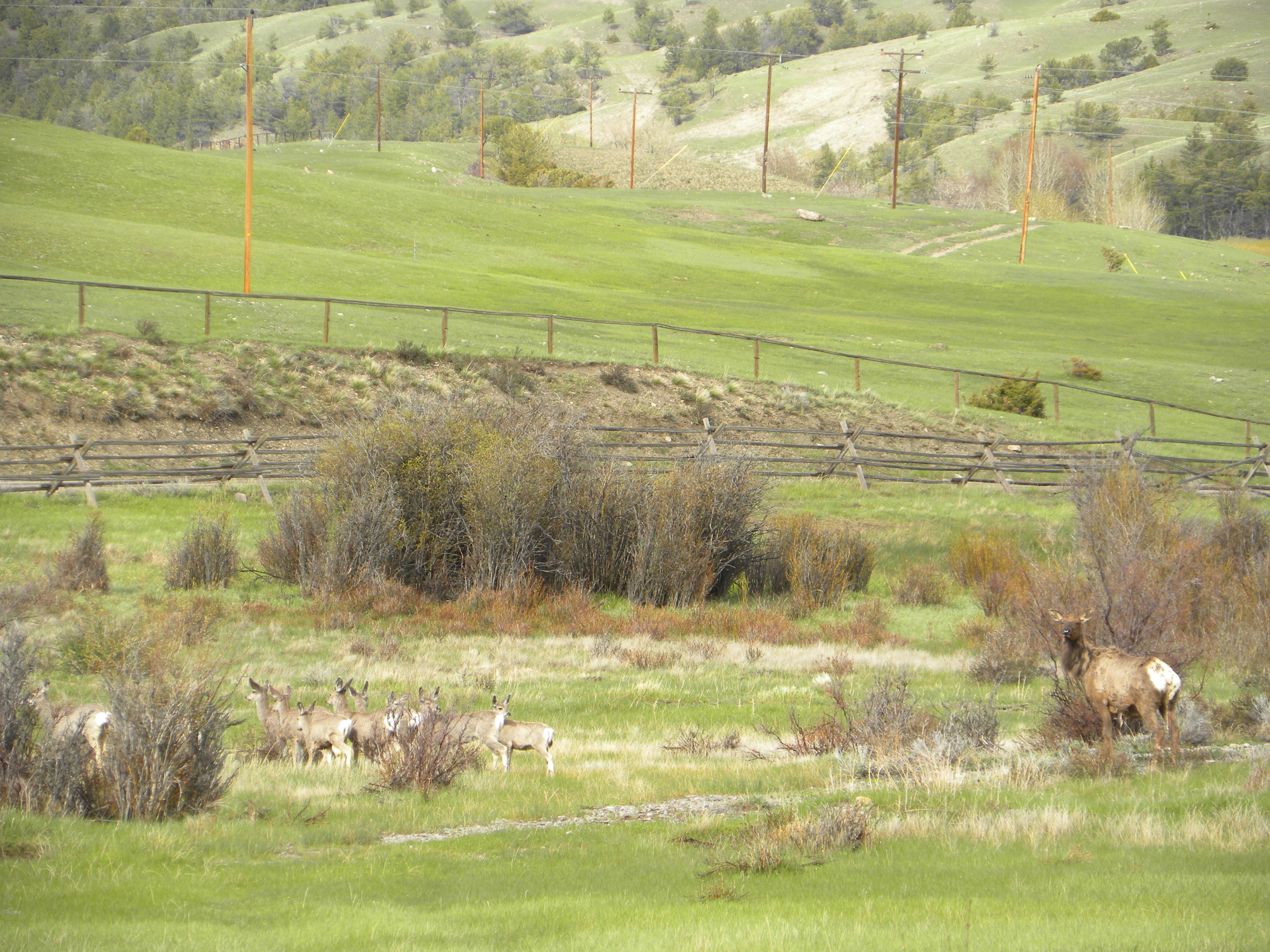
Its unusual to see  the Cody backcountry herd grazing every morning and night this time of year.  Usually, by now, they’re headed over the passes to calve in the Lamar. But the snows in the high country are still too deep and the melt hasn’t even begun.

I’ve been watching this small herd from my window.  They come early morning and evening.

Elk May 20, 2011 still in Sunlight

The other morning I spied a lone elk.  I watched her for a few days going back and forth between the herd in the pasture and a patch of willows in the nearby forest.  She’d disappear into the willows and the forest by the road and seemed concerned.  I had a feeling she had a calf hidden in the brush there.

The lone cow with deer

But last night something strange happened which made me wonder if I was correct.  Instead of just this lone cow wandering over to this marshy area, a cadre of about 7 elk wandered over there with her and disappeared into the forest.

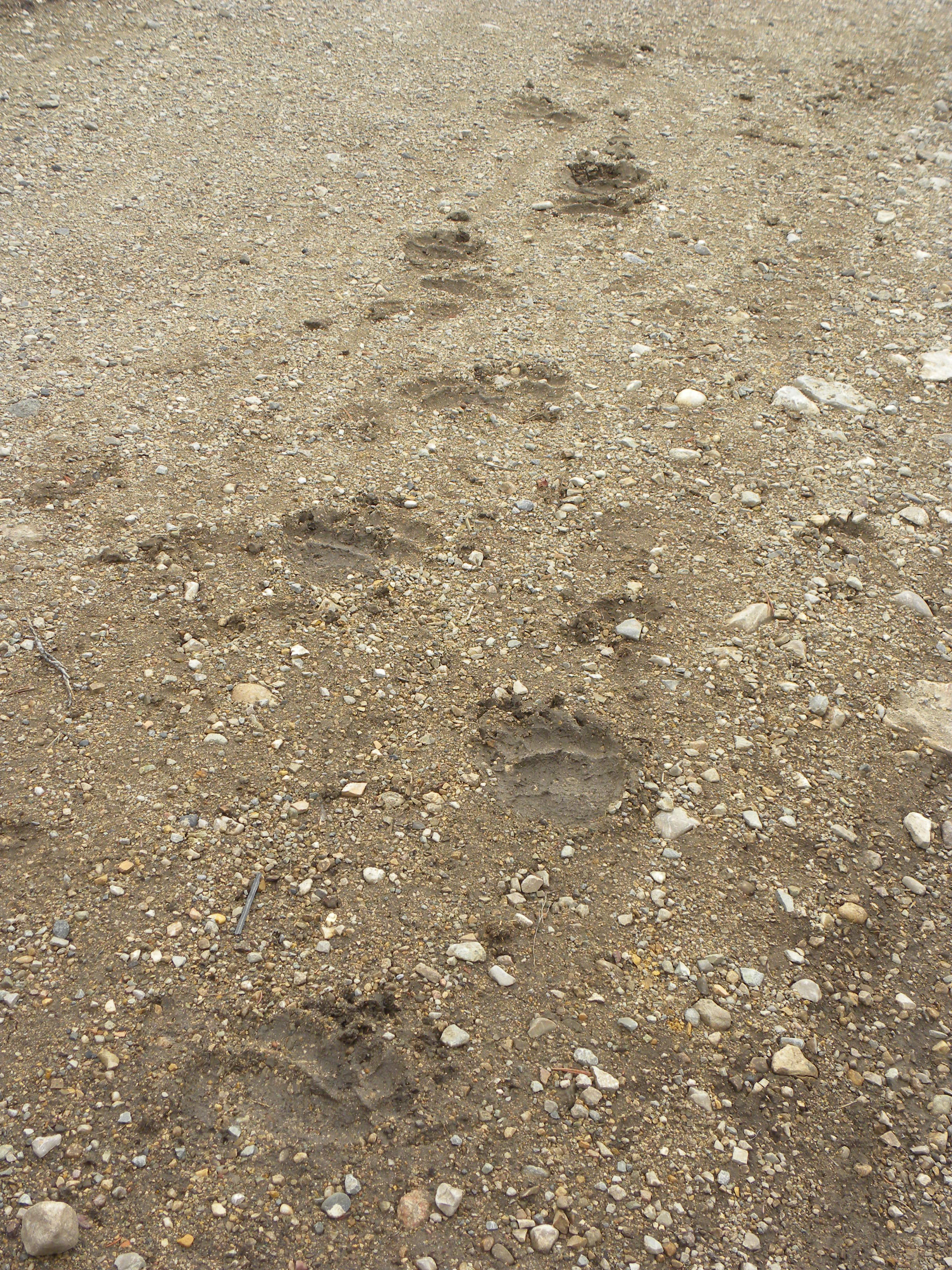
So this afternoon I took my bear spray and cautiously investigated while the elk were grazing.  In a muddy area of the creek, now widened by slash and blow downs from the logging last year, I spied a grizzly track moving in the direction of a small clearing.  A few yards up from the track, there was the calf, completely consumed.  Only the skin and legs remained.   It had been predated right where it had lain, for it was in a heap in the grass by a freshly fallen spruce bough.  I inspected the little legs and skin.  The small thing was deftly and perfectly skinned.  Certainly a bear, and my guess is it was that grizzly who made the track just a few feet away.

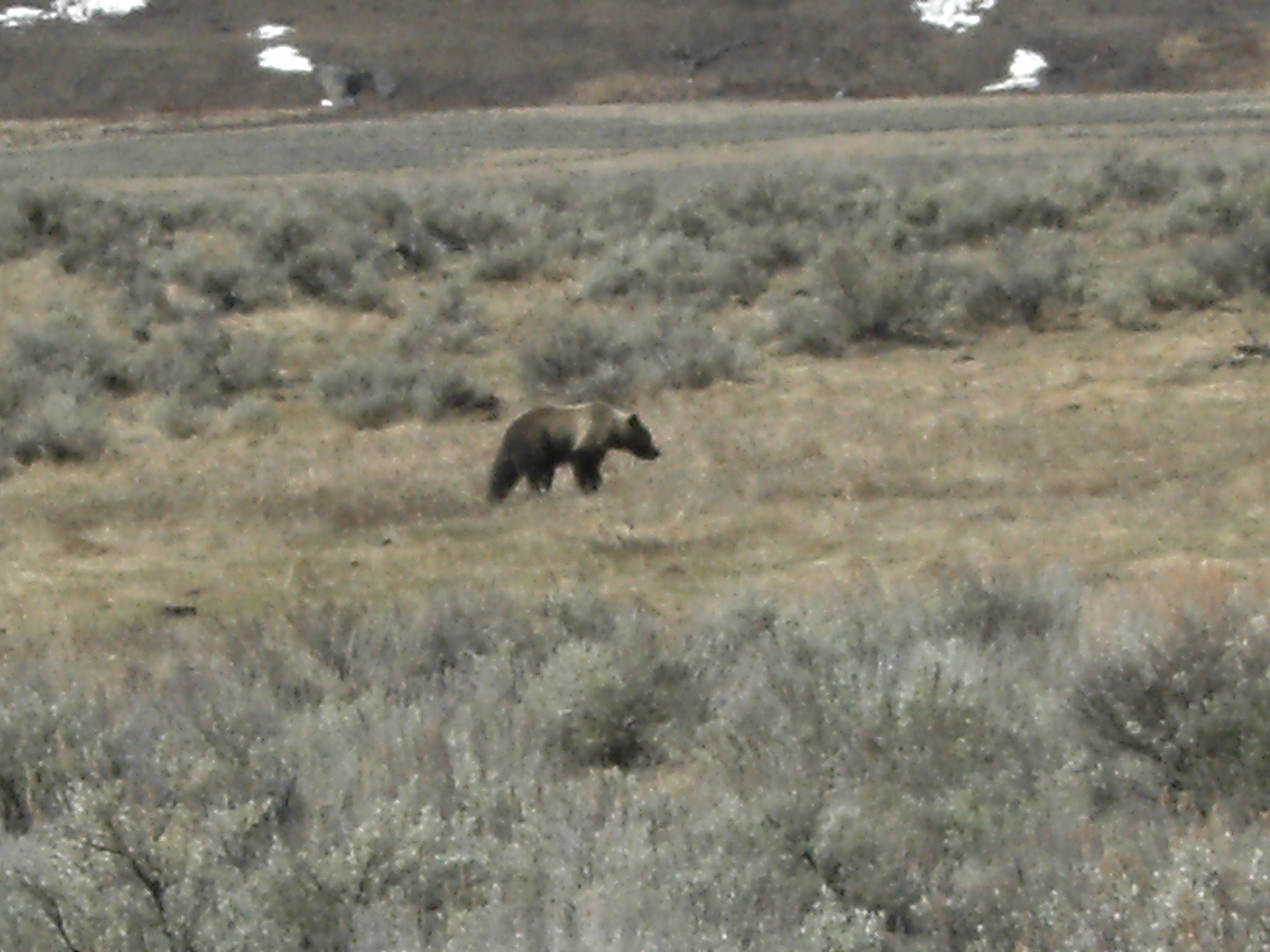
Grizzly in the Lamar feeding amongst the willows

I had hoped to spy a living calf, so I had a sicken and sad feeling.

Six out of 10 elk calves are predated within their first 10 days.  They are fairly helpless for those first two weeks.  Many people say the calves don’t have a scent, but I would disagree. I haven’t seen tracks in those marshy areas and this griz went directly to that calf.  The calf was not too far from the road, but at the edge of a wide swath of logged forest that includes a lot of swampy areas.  That bear did not wander about through the open woods looking for an elk, but clearly walked from the nearby meadow into the woods right to the calf.  Handling the calf’s skin, I could smell it on my hands.  It doesn’t have a strong smell, and staying on the ground low keeps it’s smell down.  But it does have a smell and to a grizzly, I’m sure its pretty strong.

I was in the Lamar Valley a few days ago and within an hour saw three grizzly boars in the valley. A friend told me in 2 days she saw 20 bears just in Lamar Valley.  The Lamar is becoming a favorite of the grizzlies.  I have wondered if these migratory elk, who usually calve in the Lamar, might have better success here.  Certainly there are bears here, but not as many as in the Lamar.  That’s a question I can’t answer.  Unfortunately for this little elk, it wasn’t the case.

And one more question I had:  Why, last night, did I see 7 or 8 elk accompany mama elk into the willows, not a route the elk ever take around here?  Was that a show of sympathy and support?  After that, the lone elk has not been alone anymore, and I haven’t seen her nor any of the others wander into the willows.

My heart felt saddened for that little calf and her mother.  But I can’t blame the grizzly.  How could I…I went home and enjoyed a BBQ’d bison steak myself.

Sleeping grizzly.

Stories from the field

Since last September I’ve been having troubles with my Bushnell trail camera.   After one year, the infared pooped out.  So I sent it in under their 2 year warranty.  Finally after 6 weeks, they sent me a replacement.  But come to find out they’ve been having troubles with their 2010 models and my replacement was defective.  So they sent me another replacement, which also was defective.  I decided to wait an extra six weeks for their 2011 models.  Finally one arrived last week and I’ve been anxious to use it.

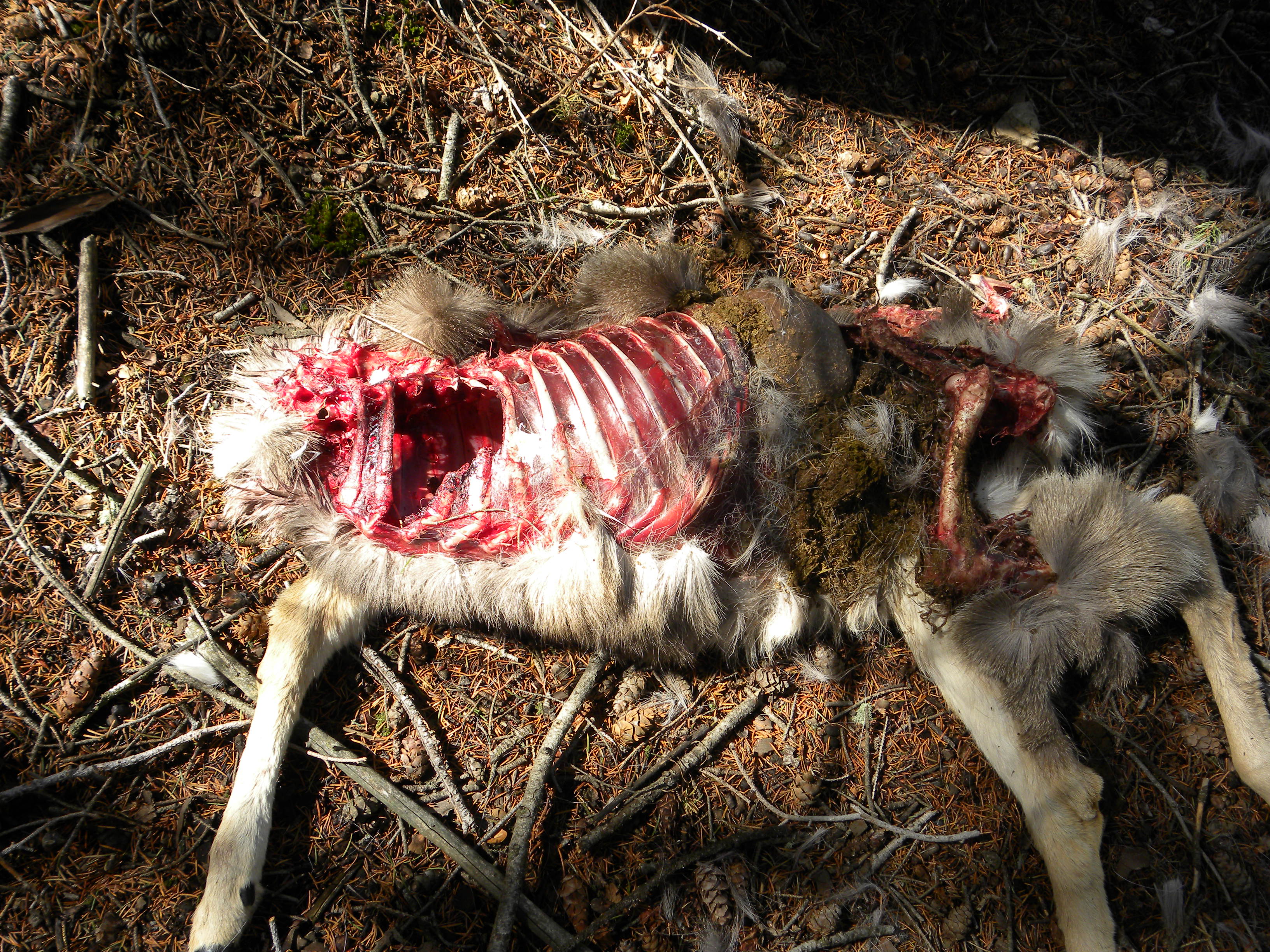
The other day I came across an odd deer kill at the meadow/forest interface.  The deer, lying on its side, had all its fur torn off on one side, a hole in its ribs, and its organs eaten out.  Its head was missing and no where to be found.  Other than that it still had lots of meat on it, the rumen was still there and it didn’t show any disturbance in its hindquarters where wolves and coyotes usually bring an animal down.

Only a hole in the ribs and the organs were eaten

The days are warming up and I’ve been sure the bears are out and about even though I hadn’t seen any sign yet.  A neighbor five miles down the road saw a grizzly last week.  I put my third replacement trail camera on the carcass and left it there for a week.  I didn’t want to disturb it much as I was afraid of running into a bear.  When I finally approached to check things out, I took my bear spray.

Lo and behold, the carcass was completely gone.  Nothing left.  I went to retrieve the trail camera and the infared cover was bashed in, like it had been pummeled by a rock.  This was perplexing.  Could a person have moved the carcass, then sent me a message about putting my trail camera on it?  Sounded weird but why would an animal move the carcass and bash my trail camera?

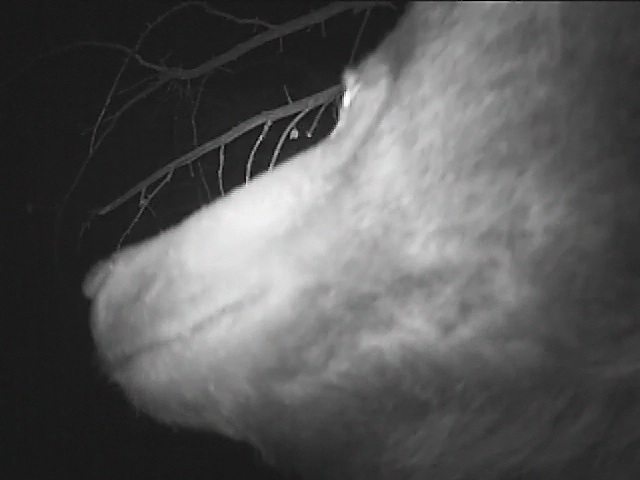
Bear eating my trail camera

The SD card was still in tact so I loaded the movies onto my computer.  I figured maybe my last photo would be the photo of the person who vandalized my camera.  Well it was there alright.  The trail camera terrorist was a bear!  (TO SEE THE WHOLE VIDEO WITH SOUND GO TO HERE)

Oddly, he decided to mess up the camera first before dragging the carcass up the hillside and far away as possible from my dogs on the other side of the meadow.  Bears are a curious lot and this just goes to prove it.  I’d been thinking it was some malicious person when it was just a curious bear, or maybe a smart one who didn’t want to be on camera.  So much for the new trail camera.

I don’t think the bear is the culprit who killed the deer, and I’m still wondering about that.  In the meantime, I better order a bear proof model for my next camera.

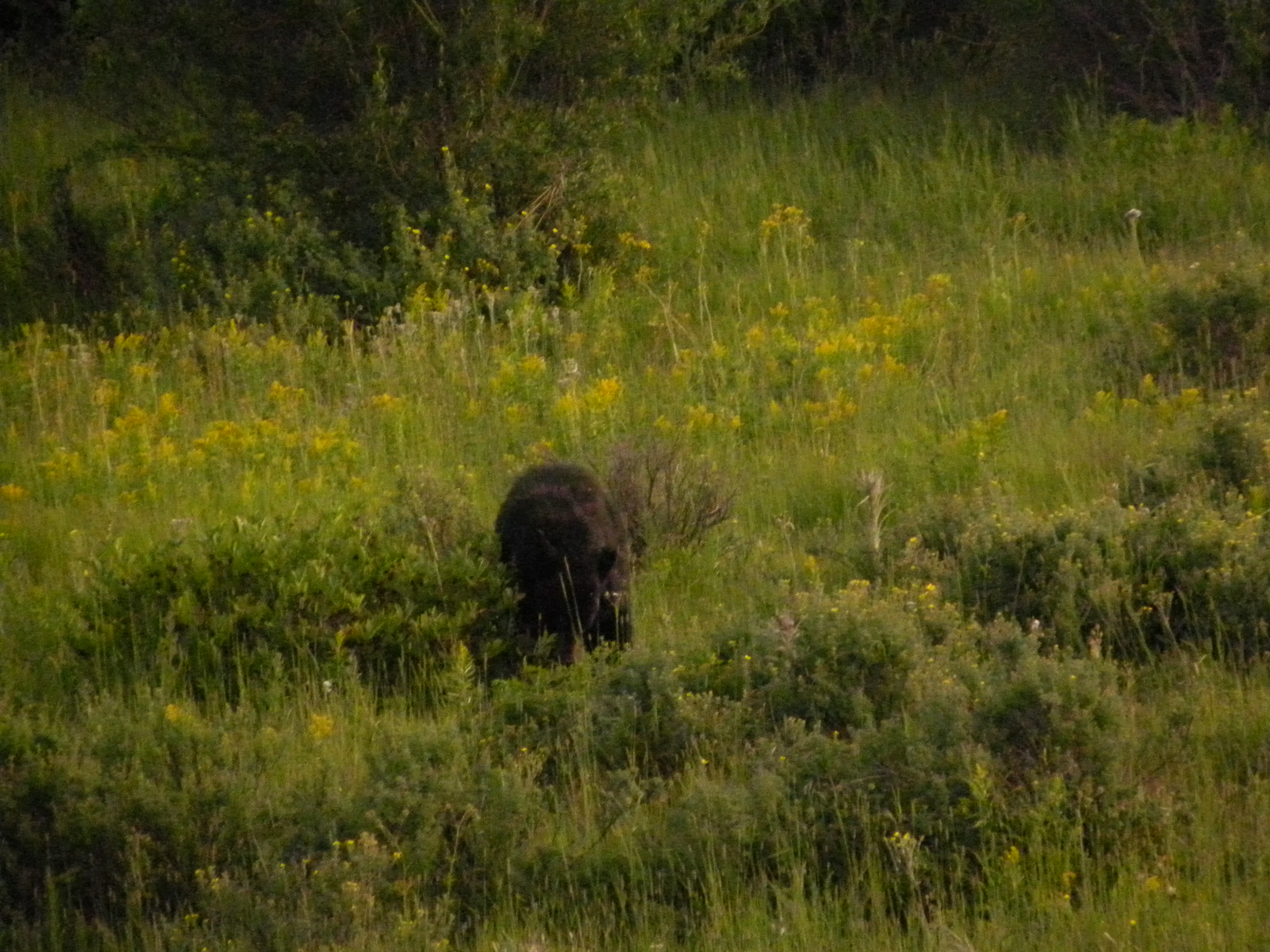
Bear ambling along. Is this my bear?

Becoming Bear

This fall I followed bears around so much I began to feel that I was becoming sympathetic with ‘bear consciousness’.

Its not that I was actually seeing lots of bears, although I did see a black bear as well as a Mama Grizzly (not Sarah Palin by the way) and her 3 cubs, but I was tracking and back-tracking them, exploring their sign and where they’d been feeding.

This fall was a lean year for the bears.  Poor pine nut crop combined with a lousy spring made for difficult foraging.  In addition, the ecosystem is full and their habitat needs to expand.  But every time a Grizzly tries to move into range not outlined in the ESA as reintroduction habitat, he gets moved.  I’d swear that the WG&F Grizzly guys must spend their entire summer moving bears–from Jackson to Crandall, Crandall to Dubois, Dubois to Gardiner.  Its really crazy, and there is plenty of good habitat beyond the designated reoccupation areas–habitat that has few people, but may have a lot of forest service grazing allotments–in other words, cattle and sheep.  Our government at work protecting cattle on our public lands.  A negative cash flow investment every year and meanwhile our nation’s grizzlies are caged in a large ‘zoo’ called the GYE.

So, that being said, there was more bear activity and close encounters reported this year than any other year.  Hungry bears were coming around looking for anything they could find.

In September, on my quest in the Wind Rivers, I had a profound dream-image of a Black bear who pointed the way for me.  Soon after that, Black bears began leaving sign everywhere around my property.  Almost every afternoon I backtracked a black bear and watched him dig up every Limber Pine middens on the flats above me.  Limber pines are not bears’ favorite pine nut.  They are smaller than White Bark Pine nuts and so carry less bang for the buck.  Also White Bark pine cones easily shatter or dehisce when they open, while Limber pine cones are difficult to open and full of sticky sap.  That means the bears must rely on the squirrels to do all the work instead of doing some of it themselves.  Robbing Limber middens in the spring is usual, but not as much in the fall when the bears prefer the White Bark at the higher elevations.  But this little black bear robbed every midden he could find.  His scat was full of pine nuts, mostly.  Occasionally I’d find one with rose hips, another favorite fall bear food.  Bears need lots of fat in the fall to get ready for hibernation.  Nuts do that, rose hips don’t.
Black bear in my driveway

One evening after tracking this bear I walked up my driveway to find a roll of barbed wire in my neighbors yard displaced about 10′.  After inspection I saw some bear hair and realized the bear had gotten tangled and dragged the roll of wire along until he’d gotten loose.  I tried to haul the wire back to its location but couldn’t make it budge.  That roll must have weighed 75 pounds!  I was duly impressed with this bears strength.

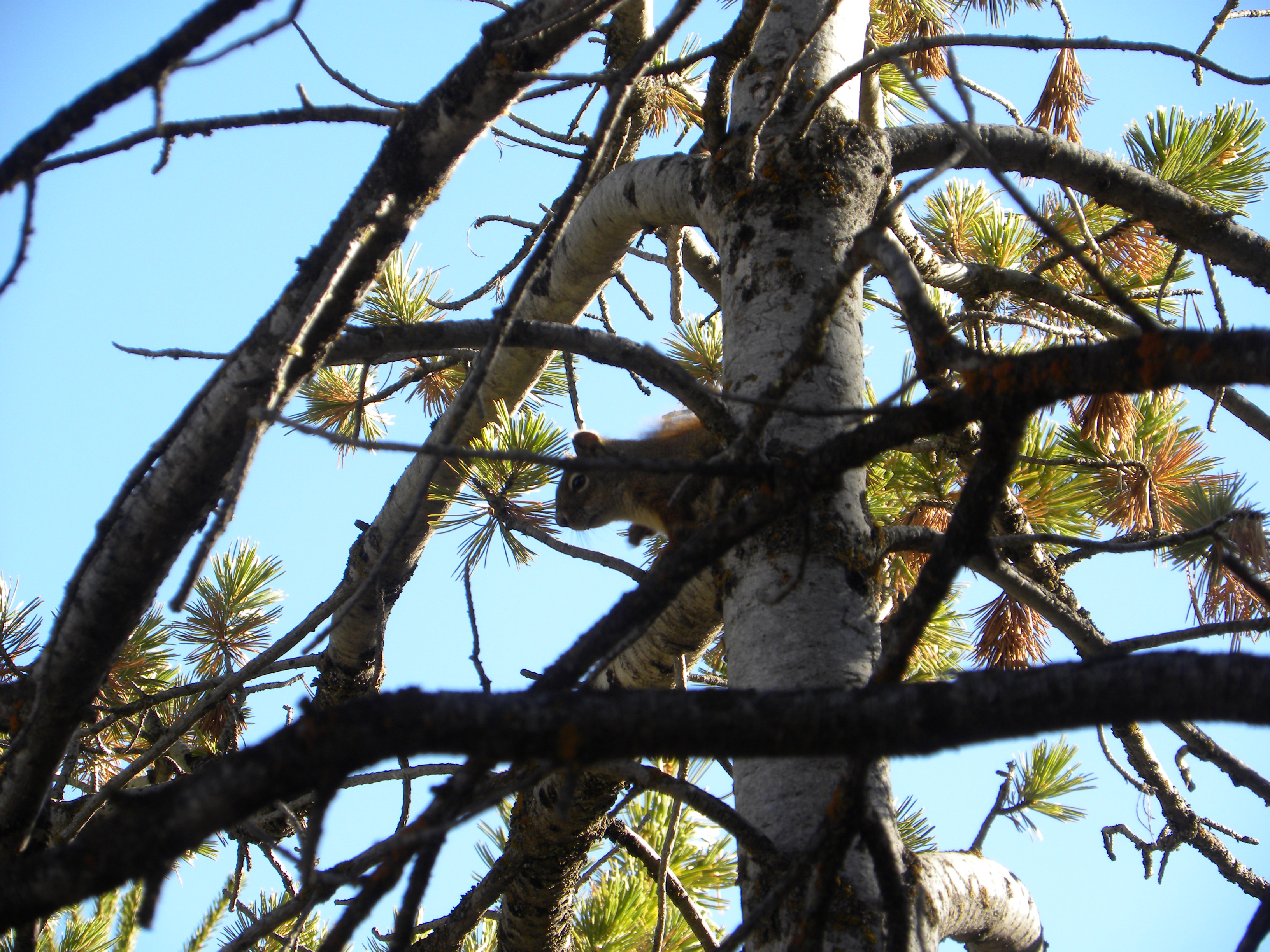
On another occasion I was driving out the driveway, came around a corner and there was a huge log in the road.  I stopped and got out to move it off the driveway.  The log had obviously rolled down a steep embankment.  As I pushed it out of the way, I noticed from where it had come:  a gargantuan old midden way up at the top of the hill.  This midden was surrounded by logs and that bear had pawed his way through the stumps and completely devastated the middens.  A squirrel chattered away at me.  “I’m not your culprit”  I told her.

Those two incidents taught me about Bear Power.

October was an unusually hot month here in Sunlight and Cody.  Days were in the high 60’s.  One afternoon I took the car up a draw on a bad dirt road.  As the road got more and more rutted, I decided to walk the rest of the way. The view was wide as the gradual uphill was surrounded by sagebrush.  The road paralleled a narrow gulch where spring runoff once flowed before our 10 year drought.  A lone pine tree grew in the dry stream bed.  Koda was in front of me as we walked up the road.  Koda the sentinel, the sign talker I call him, as he is my alert signal, watching for sign along the way.

Koda suddenly stopped, sniffed the air and looked around.  I stopped too.  But after a few moments he continued on his way, and I suspected all danger had passed.  But to my right, from under that lone tree, a black bear appeared.  He must have smelled Koda and I because we had made no noise.  That bear took off roly-poly as fast as he could across the sagebrush and straight up a hill.  He was the bear of my dream from a few weeks previous.

I was at the grocery store in Cody when I ran into my neighbor.  “My son heard a noise on the porch of his cabin in the middle of the night.  He looked out and saw a grizzly and 3 cubs.”  I had heard about this bear but hadn’t seen, after over 2 months of walking my woods and land, any sign of grizzly, just sign of my black bear friend.  I doubled my attention-efforts, always mindful of sign, noise, and bear spray close bye, but saw nothing after several weeks.

One day late in October a hunter illegally shot a buck by my property (I say illegally because the buck was shot less than 25 feet from the road and dragged across my neighbors property).  Then he gutted the deer out and left the gut pile right by my mail box.  That was no picnic.  Although I enjoy tracking bears, even ones on my property, I’m not interested in feeding and drawing them here with gut piles.  Nevertheless, I saw it as a rare photo opportunity and set up my trail camera.  Next morning the gut pile was gone with bear tracks around it but the camera was conveniently broken!  That was a double cursing moment.

Bear sign was everywhere this fall hunting season.  I went with the Forest Service archeologist up a dirt road to a nearby old Indian hunting grounds.  Koda found a gut pile by the road and grizzly tracks were everywhere.

It was only at the end of October that I saw her.  It was my birthday.  Koda had finally lost all of his tennis balls.  It was near dusk and I decided to help him find balls, so we walked into the meadow by my house.  I didn’t have my bear spray with me as I wasn’t going anywhere.  I walked along the meadow, our usual route to my nearby stream when something caught the corner of my eye.  It was a stump that, like so many stumps, looked like a bear.  Usually I pay those stumps no mind and since all the logging that was done last year in those woods, there are plenty of those stumps that fool me all the time. But for some reason I morphed that peripheral glance into my full direct attention and by golly, it was a bear!  And a grizzly at that.  Then I noticed the 3 cubs with her.  They were all quietly feeding in the woods about 75 yards away.  Strangely, they hadn’t noticed me nor the dog, nor had the dog noticed or smelled them.  I called Koda to me and we began slowly and deliberately walking back towards the house.  And we were getting pretty close too, except Koda realized we were going back so soon and began to balk.  He was crying and jumping “Let’s play”, and it was then, when I had to reprimand him, that that Mama Grizzly took notice of us.

I saw at once her moment of decision.  She had that question of “Flight, or Fight” going through her body.  I could feel it.  I handled the dog and we kept slowly walking back towards the house, me without my one time of bear spray!  But she decided we weren’t a threat, her cubs were close, and they all loped towards the forest.  I got back to the house with even enough time to get a fuzzy photo of  two cubs before they disappeared into the woods.

Fuzzy Wuzzy was a bear photograph

A few days later I went to check what those bears were digging for at this time of the year.  That Mama had to feed 3 hungry cubs.  Those bears weren’t digging middens, but digging up thistle roots.  Hungry bears and not much nutrients there.

The denouement of this long story comes in CA.  Just after my birthday bear sighting, I left for 6 weeks of work in CA.  One evening I was relaying a few bear facts and stories to some friends at a party.  I then walked into their kitchen to see the headlines of the local Independent Journal:  Bear spotted at Point Reyes. Now this is a big deal because although there are bears up the coast in northern counties, there haven’t been bears around the Marin/Point Reyes area for over 100 years.  The article said not to worry, as its only one black bear and there’s thousands of wild acreage out there.

I saved the article and a few weeks later was visiting a friend who is the head of the Marin tracking club at his home in Point Reyes Station, the town near the National Seashore.  Interestingly enough, he told me that along with biologists and Forest Service people, he was called out to verify that this was a bear track (although how you can mistake a bear track for any thing else, I can’t figure).  So he actually saw the track!  In addition, two different people gave him scat that they wanted to have verified as from a bear.  One person was in Inverness which is part of Point Reyes, but the other person lived in Lagunitas, a good 15 miles away inland.  Richard brought out two baggies with the sample scats and yes, there were both bear scat.  In his analysis, the one bear from Point Reyes had lots of bird seed in his scat, probably from a bird feeder on the person’s property.  The other scat was full of apple peel and seed, from that womans orchard.  Clearly if suburbanites are going to live around bears, they are going to have to change some of their habits.

So that ends my fall bear saga.  Something about tracking bears, following their flow, gets one into a bear mindset.  One night while I lay down to sleep, after days and weeks of tracking bears and seeing bears, I almost could ‘feel’ the consciousness of a bear.  It wasn’t that I now ‘know’ about bears.  But it was more like the beginnings of a ‘feeling’ sense, a bear feeling sense.  That was good.

Tell Bear stories

Its a perfect time to tell bear stories.  The bears have been foraging around, soon to bed down for the winter.  Last week a mama griz and her three cubs wandered through my adjacent forest.  Its been a bad year for bear food…lack of fattening pine nuts, the late cool spring, has made for poor forage.  These bears were digging up thistles and eating the tops of the roots.

But for me they were ‘birthday bears’ because I saw them on my birthday…signs of luck and power, and they all looked healthy with winter coats.  I felt as if I was walking close to a bear village, so many bears right by me and Koda.  I was reminded of this wonderful myth by the Haida peoples of Canada.

HAIDA BEAR STORY

Long ago, a group of girls of the tribe were out gathering huckleberries. One among them was a bit of a chatterbox, who should have been singing to tell the bears of her presence instead of laughing and talking. The bears, who could hear her even though some distance away, wondered if she was mocking them in her babbling. By the time the berry-pickers started home, the bears were watching.

As she followed at the end of the group, the girl’s foot slipped in some bear dung and her forehead strap, which held the pack filled with berries to her back, broke. She let out an angry laugh. The others went on. Again she should have sung, but she only complained. The bears noted this and said, “Does she speak of us?” It was growing dark. Near her appeared two young men who looked like brothers. One said, “Come with us and we will help you with your berries”. As the aristocratic young lady followed the, she saw that they wore bear robes.

It was dark when they arrived at a large house near a rock slide high on the mountain slope. All the people inside, sitting around a small fire, were wearing bearskins also. Grandmother Mouse ran up to the girl and squeaked to her that she had been taken into the bear den and was to become one of them. The hair on her robe was already longer and more like a bear’s. She was frightened. One of the young bears, the son of a chief, came up to her and said, “You will live if you become my wife. Otherwise you will die.”

She lived on as the wife of the bear, tending the fire in the dark house. She noticed that whenever the Bear People went outside they put on their bear coats and became like the animal. In the winter she was pregnant, and her husband took her to a cliff cave near the old home, where she gave birth to twins, which were half human and half bear.

One day her brothers came searching for her, and the Bear Wife knew she must reveal her presence. She rolled a snowball down the mountainside to draw their attention, and they climbed up the rock slide. The Bear Husband knew that he must die, but before he was killed by the woman’s brothers, he taught her and the Bear Sons the songs that the hunters must use over his dead body to ensure their good luck. He willed his skin to her father, who was a tribal chief. The young men then killed the bear, smoking him out of the cave and spearing him. They spared the two children, taking them with the Bear Wife back to her People.

The Bear Sons removed their bear coats and became great hunters. They guided their kinsmen to bear dens in the mountains and showed them how to set snares, and they instructed the people in singing the ritual songs. Many years later, when their mother died, they put on their coats again and went back to live with the Bear People, but the tribe continued to have good fortune with their hunting.

__________

Bear walking

“…myth-makers were trying to raise human existence to a greater level of participation in the total context of natural existence. Therefore, myths were, originally, psychic tools for the achievement of magical, mystical, and Spiritual “intoxication” and ecstasy, or the Realization of a psychic state of non-separateness, non-fear, and Ultimate Unity.”

–Adi Da Samraj

Squirrels, Bears, and birds: What’s the connection?

The Clark’s Nutcrackers have been very busy over the last month.  So have the squirrels.  They’re both competing for the Limber Pine seeds that grow around here.  The birds extract and stash seeds.  The squirrels create middens with stored seeds and cones.  The bears let these animals do their work, then rob the middens.

Clark's Nutcracker

It is really amazing to watch the Nutcrackers.  They are so adept at using their beak to extract the seed.  Limber pine cones are full of sap, really sticky.  I’ve watched a bird work a cone, sometimes to just get sap or a bad seed.  The bird cleans it’s beak quickly and works another seed hole.

Squirrels too can work a cone very quickly and efficiently.  Both squirrels and Nutcrackers seem to know exactly which seed is viable or not.  I’m sure it has something to do with its weight.  Sometimes I find a cone on the ground with a few seeds left in it.  Invariably those seeds are empty, either with worm holes or they just didn’t mature.

Meanwhile, after working hard on caching all these seeds, the bears are coming around robbing all the caches they can find.

There’s a black bear working my neighborhood intensely, day after day.  His scat is everywhere,  mostly full of pine shells.  The scat even smells like pine nuts…you can smell the rich fatty odors.

Loaded with pine nut debris

Yesterday I drove down my driveway only to find a huge stump in the middle of the road.  I got out to move it, I looked up the hillside where it had rolled down from, and saw that this bear had completely worked over an old middens.  He’d turned over the soil so much that the chickadees were having a field day.

Dug out middens on my hillside near the house

What a nice circle of feeding and robbing…birds and squirrels feed the bears who feed the birds.

Squirrel above robbed middens angry at me. "I didn't do it" I told him

The Bear Facts

When I took Jim Halfpenny’s tracking class last year, he gave me a small pamphlet entitled  Bear Ecology.  Yellowstone Ecosystem. The pamphlet consists of lots of charts, so I’ll try and digest a few for you, literally.

Since I’ve been watching bear evidence and their scats a lot lately, here are a few facts:  About 80% of the nutritive value of Grizzly bear food comes from herbs. From this they get mostly protein.  Less than 20& comes from animals, where they get fat and protein.  The rest comes from shrubs and pine nuts.

Of the plants that Grizzlies in Yellowstone National Park consume:  78% or more of their plant diet comes from Sedges and grasses.  A whopping 6% comes from Claytonia lanceolata or Spring Beauties.  Further down in value importance are Cirsium (thistle), Clovers, Yampa, Biscuit root, onion grass, horsetail, and whitebark pine.  But if you look at the nutritive values of food, the only two that provide fat as well as protein are animal and pine nuts.  Therefore, they need these to increase their brown fat for winter hibernation.

On this chart, as far as animal foods, cutthroat trout are at the top of importance.  After that comes gopher, voles and marmots, elk, deer, and bison.  Below that are ants.

Another interesting chart is about the differences between Black Bear and Grizzly Bear den types.

Black Bears evenly split their types of dens between boulders, crevices, and outcrops.  They only dig 13% of their dens.

black bear digging for ?

Grizzlies, on the other hand, dig 86% of their dens and rarely use caves.  Which might explain why in these charts, which are not that up to date, Black bears were denning almost a month earlier than Grizzlies.  Grizzlies need to wait for more snow cover.

I’ve been intrigued with bear diet this year especially since I know that the White Bark Pine Crop is poor.  I keep wondering how these bears, that are so huge and strong, survive on mostly vegetarian diets.  These breakdowns help explain some of how they are able to use plants and convert them into useable proteins.  

So far, living at 7000′, we’ve had no snow yet on the eastern side of the Absarokas.  Today it rained some, October 17th.  I wonder how global warming will affect the denning times of black and grizzlies.  I wonder what plants they will find when its not cold enough to den but not warm enough, nor the days long enough, for good plant growth.

Mark Bruscino was on Wyoming PBS friday night.  He said an interesting thing.  He said that Grizzly bears are as intelligent as the Great Apes, making them the most intelligent wild animal in North America.  Surely they are an animal worth protecting, and giving more room to move into habitat that supports their needs as we, and the bears, face new challenges ahead.

The Year of the Poor Pine Harvest

Well, what a drag.  After a week of frustration with my Bushnell Trophy Cam, I finally diagnosed that the camera is broken.  And the reason it’s a drag is because yesterday someone left a gut pile at the bottom of my driveway.  Here’s the story:

Early yesterday morning some deer came out to graze in the private pasture across the road.  It’s deer hunting season and I noticed a nice 3 point buck hanging with the does.   Around 1 pm I heard 2 shots coming from behind my property.  At sunset, Koda and I took a walk beyond my back acreage and returned via the main dirt road.  It was almost dark when we crossed over the cattle guard marking the forest service boundary line.  I petted the horses on one side of the road while Koda was busy in the ditch on the other side.  I went to investigate and in the dark I could see the gut pile left from the buck, lying by the roadside.  With my camera not working, all I could do was check the area in the morning, knowing that probably a grizzly would be bye during the night.  With the pile so close to the house, I made sure Koda and I stayed inside that night.

In the morning, after walking around the area, from the blood evidence, this hunter illegally shot from the road.  He waited till the deer wasn’t on private property, then shot him.  But the easy access was through private property, so he dragged the deer under the boundary fence and through my neighbors’ property to the nearby road just about 25 feet away.  I can’t say I hate hunters because I know quite a few.  Many are ethical and kill for the meat.  I myself like elk and deer meat.  But I do despise the ones that break the law, or are too lazy to walk or ride in, or hunt just for trophy, or complain incessantly about wolves making it harder for them to find elk.

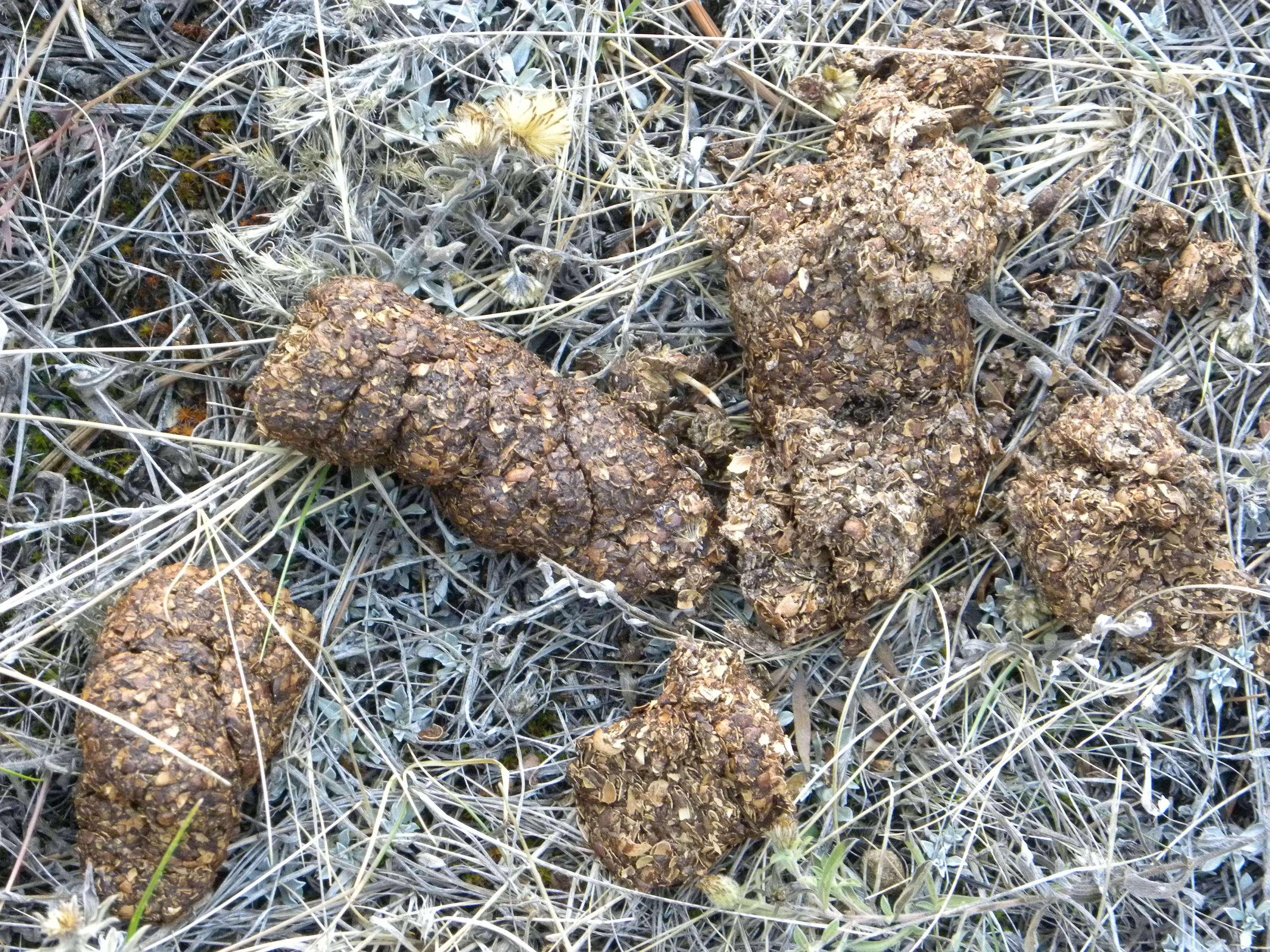
What giveth, taketh away, and then giveth again.  My little buck friend saw its last day and had its last meal this morning.  But grizzlies are hungry this year.  It is the Year of the Poor Pine Nut Crop, and that is what fattens grizzlies up for their long winter sleep.  This grizzly gorged himself on the gut pile, then left a scat of his last meal or meals, which clearly consisted of rose hips.  His scat was full of rose leaves and fruit, and although rose hips don’t taste too bad, especially after a frost or two, they’re not gonna put much weight on the bear.


Bear scat consisting of lots of wild rose and hips


I felt sad for the buck, but it was a nice stroke of luck for this grizzly and I was glad for him.

After checking the area, I went for a hike down a spectacular secret slot canyon.  Its secret because most of the year there’s a stream running through it.  In summer the brush is so thick you can’t paw your way through.  But in the late fall, the leaves of the Cornus (Dogwood) shrubs are gone and the stream has dried up.  Its only about 50 yards through the 5′ wide canyon to the main creek.  The creek, surrounded by high canyon walls, is inaccessible except for this narrow slot canyon.  But the game know the way and there were grizzly tracks down through the muddy canyon floor.  I crossed the creek and came into a wide wooded valley surrounded by high granite walls.  Large Junipers, Douglas Firs and a few Pines populated the area.  Exploring the canyon, it was obvious a grizzly had been hanging around here for quite some time.  He too was eating rose hips, but he had been spending a lot of time invading middens for pine nuts.  These aren’t from Pinus albicaulis, the White Bark Pine, but Pinus flexilis which is also in the white bark family.  The grizzlies seem to have been eating quite a lot of these this year.  Even the grizzly who ate the gut pile had old scat nearby with Limber Pine shells in it.   Although Limber Pine has been hit heavily by blister rust and beetles, we still have large stands around here and apparently the grizzlies are taking advantage of them in a bad White Bark year.  They certainly are not as big and fat as White Bark, but they’ll do in a bad year.

I’ve been thinking a lot about the bears, how resourceful they must be, how they’re mostly herbivores, how they have to spend so much of their energy foraging for food with so little calories.  I’ve been thinking about those reports I’ve read this summer about undernourished bears.  I am amazed how they are able to make a living out there.  What a wondrous animal.

The magnificent and endangered grizzly

There’s been plenty of hubbub regarding bears this summer in the Greater Yellowstone Ecosystem, mainly grizzlies.  If you haven’t followed it, we had two deaths just on the eastern side of the Absarokas from grizzlies this summer, one of them occurred just up the road from where I live.  In addition, there’s been 38 grizzly deaths just this year, 31 on those caused by humans.  And many of the bears causing trouble have been found to be underweight, or their cubs were malnourished.  Grizzlies were put back on the Endangered Species list just this summer because one of their main food sources, White Bark pine nuts, is also in trouble and in major decline.

Grizzlies have been coming down into hay fields, down into the flats where there are towns and farms.  Why? Because they need more habitat, they need food.  Let’s not forget that grizzlies were actually plains animals, following the Bison and ‘Buffalo Wolves’ on the prairie.  Grizzlies can’t climb trees and their enormous claws are adapted for digging.


Grizzly rooting around


On the other hand, the smaller Black Bear is a forest bear.  It can climb trees.

It’s not just that ‘we have too many bears’.  Its that we’ve decided Grizzlies can only be in places where people don’t want to live year round–the high mountains–or where we’ve protected the land, such as Yellowstone Park.  And even in those places we barely tolerant them, calling on the feds to move or kill a bear (Grizzlies get three strikes before they’re out, dead out that is) that interferes with our ‘rights’.  In an area north of Gardiner, a sow with her two underweight cubs were moved for raiding a chicken coup.  Chickens are bear bait, and having one just north of the north entrance to the Park makes your chickens a restaurant for a bear.  I don’t understand why we have to waste good tax dollars and federal employees’ time on moving bears for stupid people.

My valley happens to be one of the places the U.S. Fish and Wildlife Service moves bad bears, with the hopes they’ll go into Yellowstone.  My valley has good access into the Park, but most of these bears just quickly ‘home’ or return to their territory.  This I’ve been told by one of the bear coordinators. (“You don’t have to worry about the relocated bears.  They leave fairly quickly.”)

So why relocate?  These dedicated federal employees seem to spend a lot of their summer moving ‘bad’ bears here and there–from Jackson to the East Entrance, from Dubois to Cooke City, from Cody area back to Jackson–or they have the dirty and terrible job of euthanizing ‘problem’ bears.  Problem hardly ever means human/bear conflicts, but mostly cattle/sheep/horse/chicken conflicts or just too-darn-close-for-comfort conflicts.

We just have to begin to make a concerted effort to live with bears and give them more habitat.  A few things I can suggest (and there are many more that could be added to the list by people ‘in the know’):

1.  Use bear-proof garbage cans and food containers.  Several bears were euthanized in 2010 because of ‘food rewards’.  The article above said that after euthanizing a bear roaming around West Yellowstone, the feds discovered lots of unsecured food containers.  That’s just a crime!  West Yellowstone is exactly adjacent to the Park.  If you want to live there, secure your food or pay the consequences.  Should the bears pay the consequences for stupid people?

2.  We need contiguous wildlife corridors from here to the Canadian Border, with planned wildlife crossings over highways.  This is very important.  These bears and other wildlife need to be able to migrate out into other food sources when their own territories get too cramped.  And for God’s sake, at least slow down in Yellowstone.  This summer alone there were several bears killed by cars in the Park.

California is now putting the grizzly bear on all CDL.  If you hold your license up to the light, there’s a bear there; the same bear that’s on their flag and the exact same one that was shot to extinction in the early 1900’s.  If you’re going to tout it, then bring it back.  California has good habitat for grizzlies.  Let’s move some there.

3.  We need prairie where Grizzlies and Bison and wolves can roam again.  Grizzlies are already moving into eastern Montana.  Support the American Prairie Foundation and tell them to not just bring Bison back (already beginning to happen there) but wolves and grizzlies as well.  With the extinction of the White Bark Pine by the end of this next decade, bears will need a different food source.  We need to be thinking about recreating some of the kinds of habitat they lived in when Lewis & Clark were here.  L&C didn’t find game in the mountains; the game was abundant in the prairies.  Restoring bison to the prairies along with wolves makes for more game for grizzlies, along with all the small mammals and roots they like to dig for.

This summer I was fortunate enough to see three grizzlies–2 in the Park and the other one we slowed down while the bear crossed the road near here.  What a beautiful magnificent animal.  There is nothing like hiking in grizzly county, knowing that you are not at the top of the food chain.  It makes you alert, alive and aware.  Let’s preserve that.  It keeps our human ‘hubris’ in check.


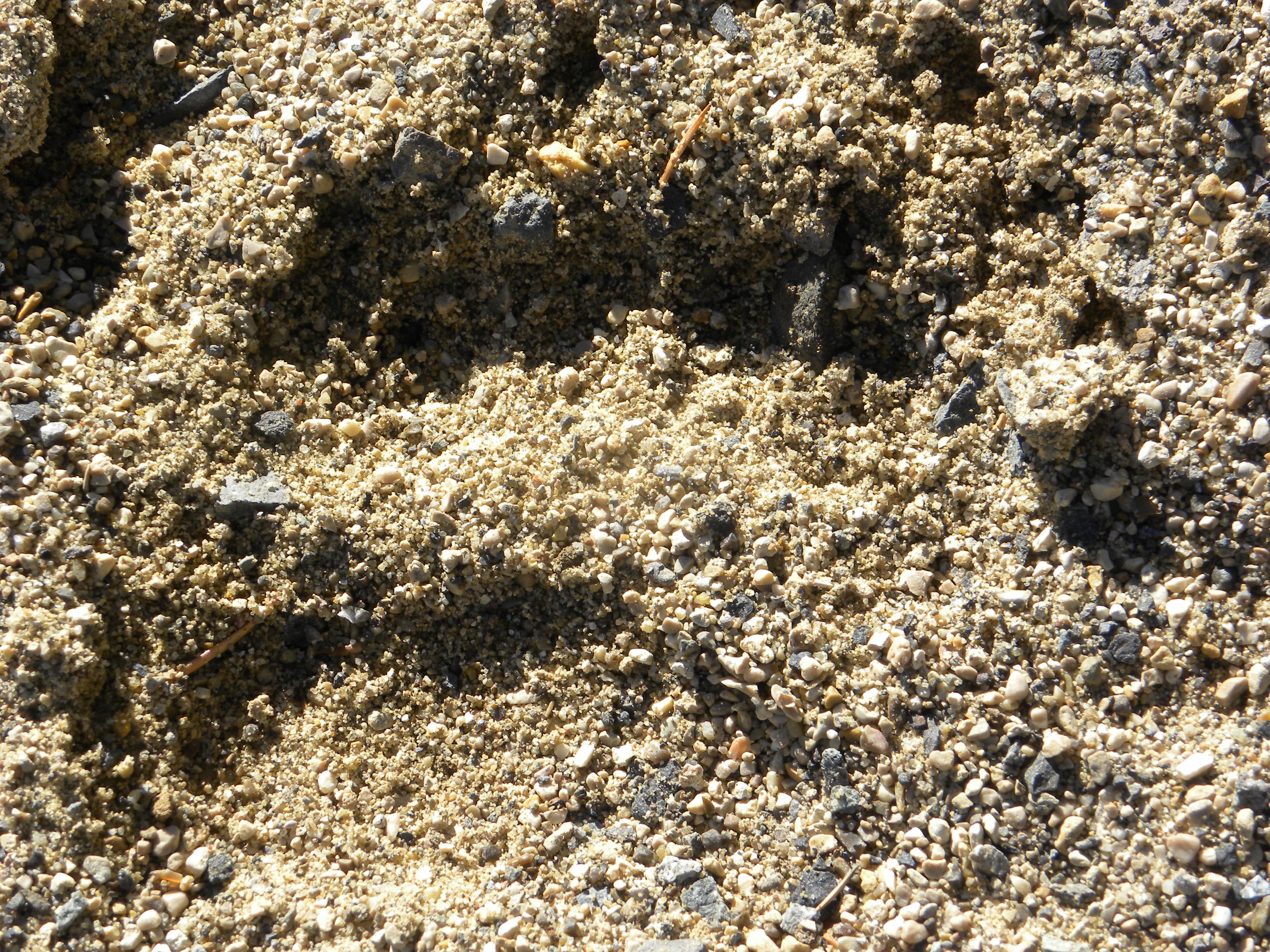
Grizzly track with penny for sizing


Mothers: Bears and Elk

Last week an elk calf was killed right in the little meadow by my house.  Koda discovered the leg, lying in the disturbed grass near a solitary aspen.  The mother elk had been hanging around all morning, calling and calling for her baby.

Now, almost a week later, I heard her early this morning, still calling.

Cow elk sniffs where calf was killed

It breaks my heart to hear her.  I saw her last week quite a lot, coming closer and closer into the meadow, unperturbed by my presence or the dog, obviously confused as to where her baby might be.

Koda and I walked the trail through the little adjacent forest.  Fresh black bear tracks, a mother and her cubs, had wandered amongst the springs.  I set up my trail camera and found another leg from the calf.

The little elk had disappeared almost without a trace.  I’ve walked and walked around the area looking for more evidence.  One leg in the meadow; one in the woods; where’s the rest of her remains?  She barely lived, barely had a chance.

Yet, maybe these two little bear cubs will now have a chance.

Black Bear cubs

Its bear hunting season and although you can’t shoot a mother or her cubs, the young male whose been hanging around, digging for roots and insects, is fair game so to speak.

Its sad, but yet true.  One life feeds another.  I sing for the bear mother.  I cry for the elk mother.  One does not negate the other nor hold more value than the other.  Its’ the old and ancient dance.  Don’t be fooled.  Despite all the latest new fangled technologies, extended life, genetic transformations, new pills, greed on Wall Street, fat cat politicians and the usual rhetoric, we too are dancing.

A Grizzly story

Elk from the trail camera

I set up my trail camera for the last two weeks, hoping to catch some bears or wolves.  Mostly I got a lot of elk.  But I did capture 3 bighorn rams and a coyote.

The crazy part is that on the way up there I was following a grizzly’s perfect tracks in the snow.  The tracks were actually solid ice and super clear.  I was trying to figure out how they turned to ice.  I thought “Maybe he went up in the early morning or evening over thin snow that melted under his heat and then iced over.”  The ranch hand neighbor thought he just melted actual ice with his heat.  But everywhere around the tracks was snow, except for his tracks.  Any enlightening thoughts would be gladly accepted folks.

I chatted with J___ at the nearby ranch on my return.  He told me that that same grizz had walked right through the cows, looking for their mineral lick that they used to keep every year.  Its gone this year but probably its the same grizzly.

Then he told me a great grizzly story:

“You remember last year they were trapping and collaring.  They caught 3 grizzlies on our property all in one morning.  The traps are just 55 gallon barrels.  The bear goes in for the meat and the door closes behind him.  The doors on both ends are just metal grates.”

“Well Mark Bruscino was there (note: he’s the G&F Bear specialist in Wyoming) and asked if I wanted to come see as this was unusual.  They’d never trapped 3 bears all at once and it was 2 sows and one cub, so it was going to be interesting which bear belonged to the cub.  They trap the bears, then dart them with a light sedative.  Mark said ‘look inside that barrel at that grizzly’, so I looked.  And the bear, instead of looking out the grate, was looking sideways at the wall of the can.  I looked from one end, then I looked from the other end.  But each time I looked, the bear looked away, as if shy or something.

” ‘What’s going on?’ ” I asked Mark.

” ‘That bear is embarrassed.  She’s been caught before and she’s embarrassed that she got caught again.’ ”

“Well Mark sedated her and looked at her ear tag.  That bear, Mark said, was the first bear he’d ever caught and collared, 11 years back. She was 3 years old then.”

” ‘That bear has only been handled by people twice, both of them me.  She remembers me.  Bears are smart.  Most people would be shocked to learn how smart bears are,’  Mark said”

“You know the bear can hear you when they’re sedated.  And Mark was talking to that bear saying things like “Hi, you remember me.”  She’d be sure to remember something like being caught in a trap.

“Mark said that that bear had been in Dubois, caught and transferred for cattle killing.  She was put here and didn’t get into any trouble for all those years, until last year when she killed our pigs.  A year later she was tracked, by her collar, down in Dubois, but since then the collar’s fallen off.  When you think about it, how does a bear know, after being trapped in Dubois, then flown here by helicopter, not even driven here, but flown…how can they know how to get back to Dubois.  They don’t go the same route, she had to cross 3 highways, and its really rugged country between here and there.”

“Mark said we had about 1/2 hour before those bears woke up.  I helped them pull them out of the cans.  I was trying to be really gentle so as not to twist her paw or whatever.  Mark said there’s no handles on the bears, you just pull on their fur. ‘Don’t worry about hurting them.  These are massive creatures.  They’ve been over rock cliffs and in all kinds of situations.’

I told J___ that was a great story. Next time they’re trapping I hope to get a photo or maybe even ‘pet’ a sleeping bear.  J___ got too and so did all their dudes that day.