


It seems that nature study comes to a person in batches. In other words, what you think you want to study might not be what presents itself.
Last week on my way to town there was a road kill Great Horned Owl. He seemed in good shape so I called the museum where I volunteer preparing specimens and asked if they wanted it. Since they already have plenty of Great Horneds, they passed, but this owl was a sign of what was to be a week full of owls.
The next morning, at 6am, I heard a strange owl call from the nearby forest. I thought it might be a Great Gray, and sure enough, when I listened to its call, it was. He was passing through on his way to a location north of here–maybe Reef creek or even Yellowstone.
The following week at the museum I was given a Long-eared Owl to prepare. The tag said it was found in my area in Sunlight. Her wing was broken and she’d died in rehab. I suspected it had been struck by a car. But when I saw the Game Warden the following day he told me he’d found a Long-eared Owl on the road before the area was opened to the public May 1st.
“That’s the owl I just prepared. Unfortunately, it died in rehab.” I told him. Who knows how it broke its’ wing.

Long eared owl
With all this owl activity, I decided to walk through my nearby woods with the intent of finding a roost. A pair of Great Horneds live there. Last year I watched one being mobbed by a Cooper’s Hawk. Great Horneds are considered the ‘Lions of the Forest’. They eat a lot of different foods, large and small. When I was helping with a Spotted Owl study in California, we learned that Great Horneds kill Spotted Owls. Watching that Coopers Hawk continuously swoop and peck at the Great Horned sitting on a dead fallen log confirmed how tough these owls are. That Great Horned was unperturbed; in fact, he acted like the Coopers was an inconvenient fly.

Great Horned Owl
It didn’t take long before I found a large cache of pellets beneath a dead spruce. The tree even had some owl feathers hanging from a high branch. I threw them all into a bag and brought them home for inspection.

My stash of pellets
Just the week before my boss at the museum, Curator Chuck Preston, put a vole skull under a microscope to demonstrate how to determine its’ species. The secret is to count the middle set of upper molars. One species has four closed triangles while the other species in our area has three.
I dissected all the pellets and found that this owl was feasting on voles. Dozens of voles and just voles were in these pellets. Using a hand lens to see the molars, I determined these were all Montane voles (Microtus montanus).

Montane vole
With over 30 Montane voles in these pellets, there were two other distinct skulls, much larger, and from a different species of vole. This was the Water vole (Microtus richardsonii).
Yesterday on a hike up Tipi Gulch, I came across another Great Horned Owl roost with some recent (seemed like that mornings) pellets. Inside were several Montane voles and one Water vole. Voles must be on the upswing and doing fine here this year. Voles also don’t hibernate and are active at night. Rabbits on the other hand have been scarce.
It was fun, and interesting, to check out what these owls are eating. So much activity in such a tiny forest nearby. Yesterday I retrieved my trail camera that was set up by my spring where I get my water. Look what else is traveling through these woods. As Thoreau says, you can spend a lifetime exploring a twenty mile radius.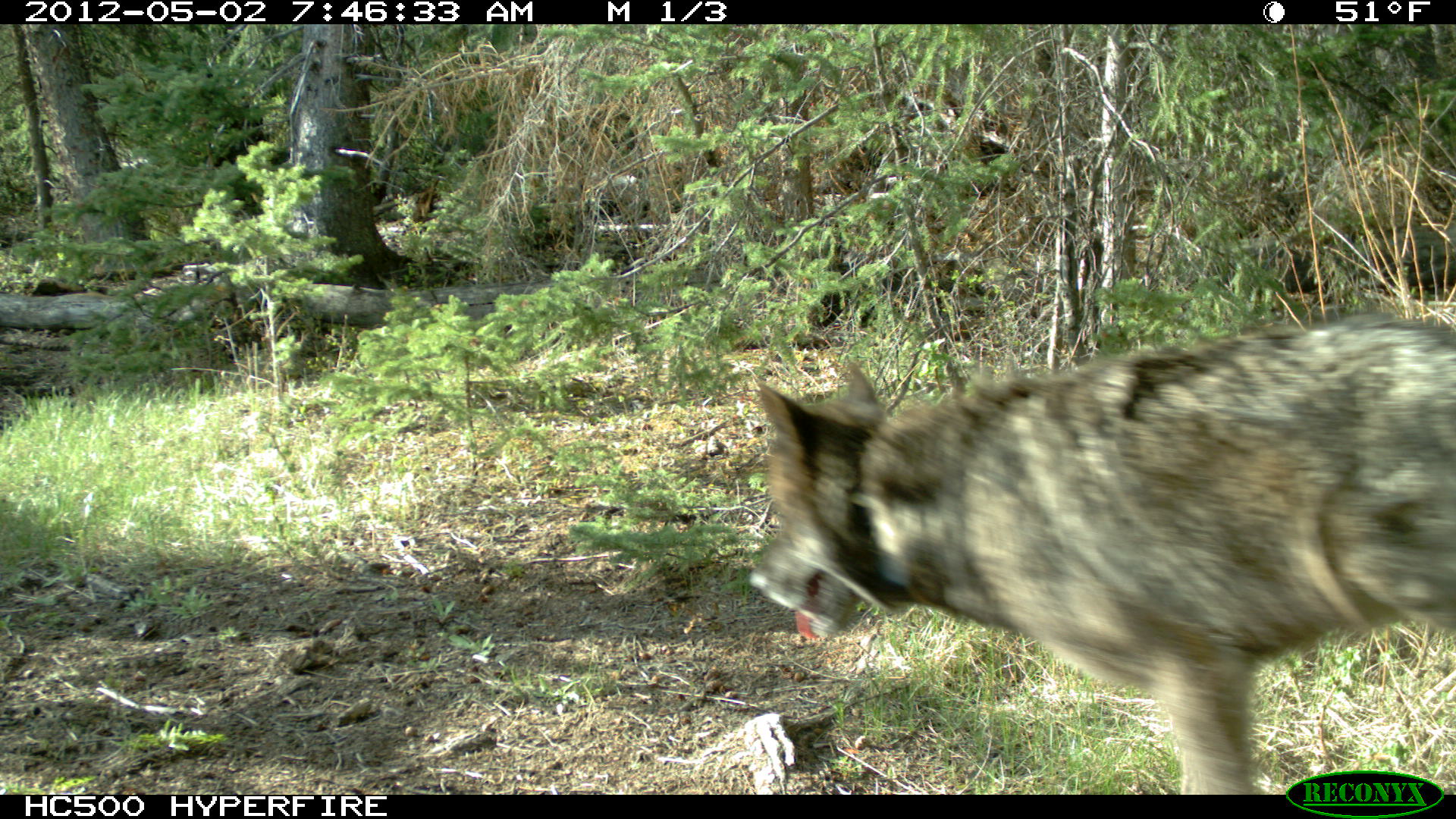

Wolf with bad left hind leg
Filed under: Owls | Tagged: Great Horned Owl, Long eared owl, Montane vole, Owl pellets, Water vole, Wolf, Wolf pictures, Wolves | 1 Comment »
 I’ve looked for this before in those little woods and easily found the roosts of Great Horned Owls and their pellets. Pellets are not owl scat but the undigested parts of their food, regurgitated up in a large pellet. If you open the pellet up, the evidence of their meal(s) is right there in the form of bones and hair.
 I sat down on a log, watched and talked to the bird. I found a pellet beside the log, about 1/2 the size of a Great Horned pellet. After a long time, I crawled around and hung out with the bird from a closer and better angle.
  The owl wasn’t afraid at all. In fact, he reminded me of Spotted Owls. When we did our study, I was sworn to secrecy as to where the owls were located. Spotted Owls are so tame that they can easily be approached and because they are endangered, we were especially careful. This owl even started falling asleep while the dog and I sat there (Spotteds spend a lot of time sleeping too).
 Leslie Patten Books: Wild Places, Sacred Spaces