• MY BOOKS ON WILDLIFE, GARDENING AND MORE

  • The Wild Excellence

  • True stories of wildlife encounters around the Greater Yellowstone
  • Award winning eBook on Decomposed Granite, tips, how to's, what to watch for
  • Children's book. True stories of a dog and wolves. In a dog's voice
  • Written for dry Mediterranean climates in California, north and south

The Fox and the Study Area

I’ve been itching to start the rounds in my study area again, but winter hasn’t set in and so there is no consistent snow on the ground.  One day its’ 50 degrees, the next a few inches of snow that melts off.  Last winter I began in earnest a systemic, almost daily, investigation of a specific area near my home.  Using tracking methods, I plotted out where the martens lived, the size of an ermine’s territory, the population of squirrels and voles and deer mice.

Vole bound.  You can see it's tail drag

Vole bound. You can see it’s tail drag

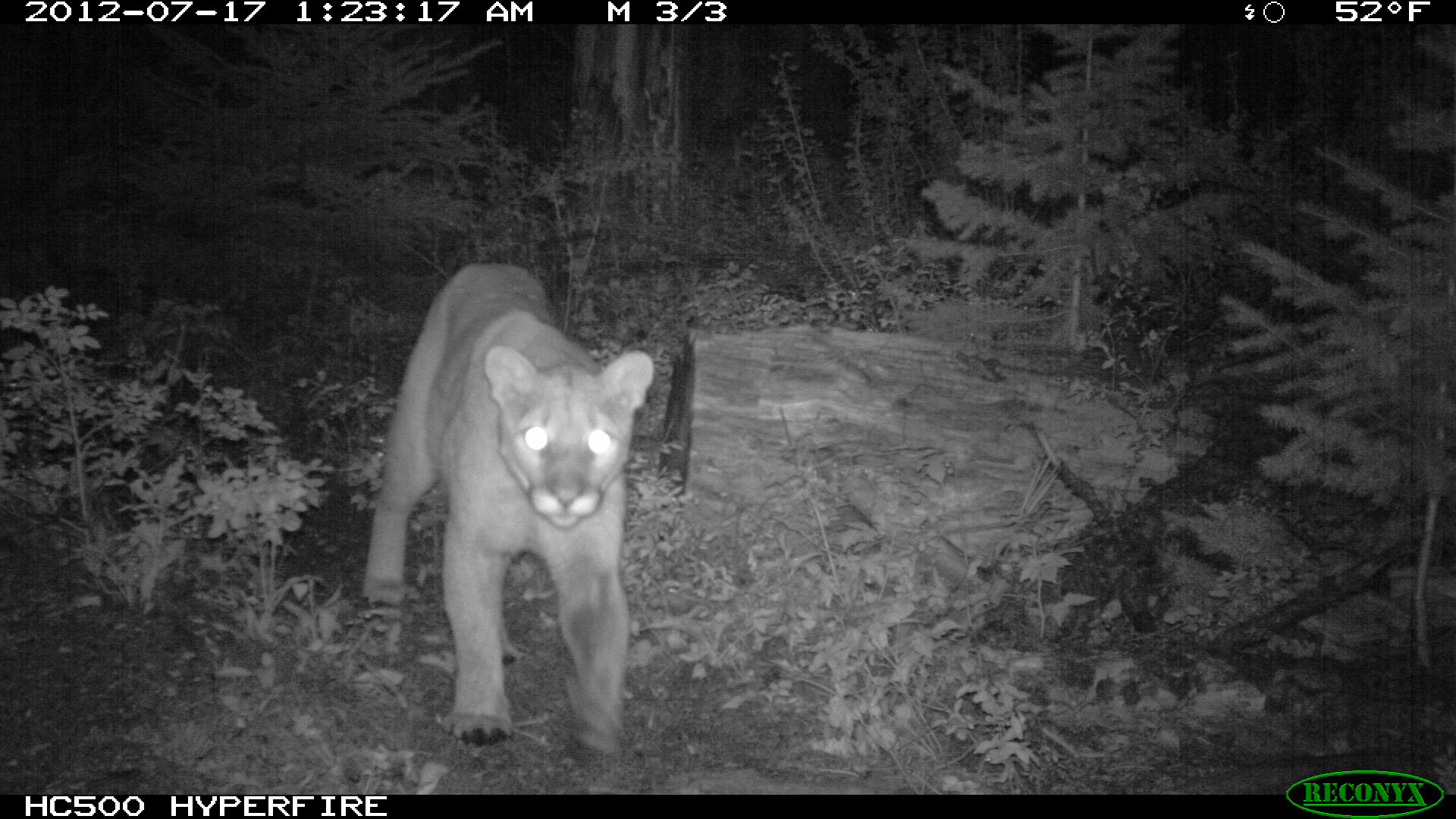
I followed a resident cougar who lead me several times to the end of her trail where a pack of wolves obscured her tracks.  One time at the end of the trail lay a dead deer, maybe killed by the cougar who was driven off her prize by the wolves.

cougar

So I’ve been content to lay out a camera bait trap and see who’s around.  Hunting season is still on, but the general deer season is over here and the quotas for elk and deer are very limited for the next month or two.  The animals will start to come down within the next few weeks as the weather turns and the traffic subsides.

Trapping season has started .  There are a few people who trap martens here.  Bobcat trapping season begins on the 15th.  For these reasons, I would never reveal where my camera traps are set, nor where my study area is.

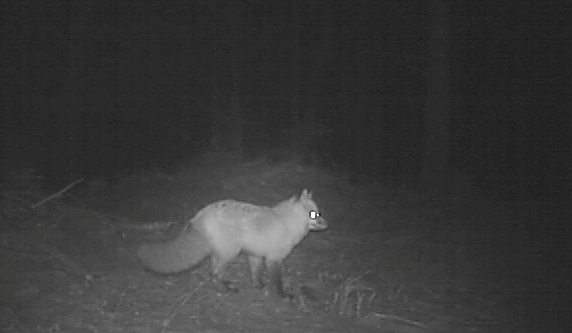
After a week, I went to check my camera trap and was surprised to see a beautiful fox.Here is the link for the fox video.  You can see she’s digging for the deer liver I set in a covered hole.

And a few stills

fox

What a great tail

Red fox

Digging around for the deer liver treats I left

Another positive effect of having wolves in the valley is that they keep the coyote population under control, and by doing that, foxes are returning.  I’ve talked with some old timers here who told me that in all the time they lived here, they never saw foxes.  Yet I’ve seen them, or their sign, now every year. With fewer coyotes, there is room for foxes.

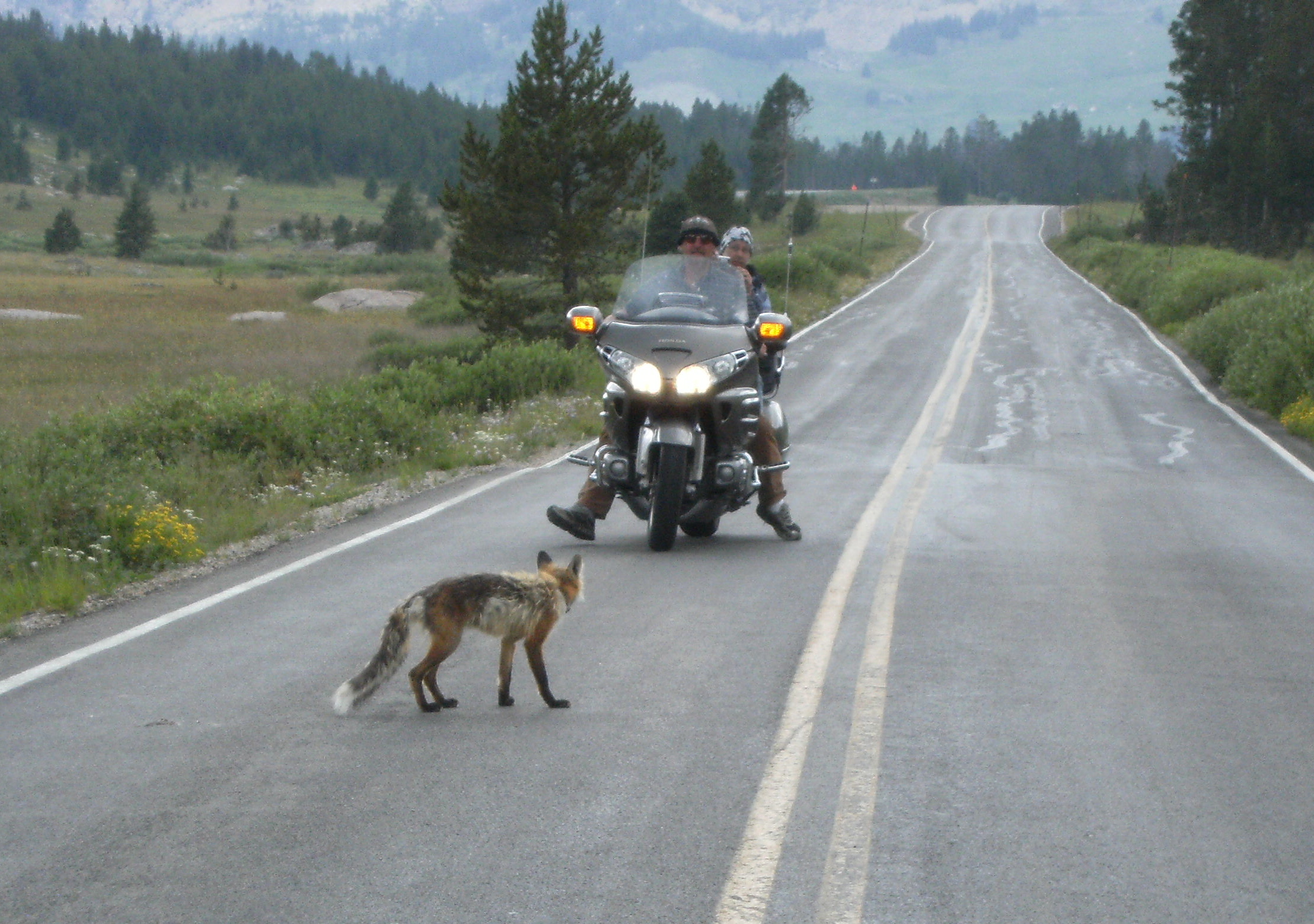
Fox on Beartooth Highway

Fox on Beartooth Highway

Using my study area last year, I began to notice the interrelationships of  wildlife.  Wildlife are all finely attuned to each other.  They know the comings and goings, the patterns of movement, the subtle changes. Even with this camera trap of covered meat, once the fox stole the food, the resident mother deer with her two fawns stopped bye and spent a long time smelling the empty hole and upturned dirt.  Then she walked over and looked at the camera.  Something was just not right for her.   I think she sensed this was a ‘human event’.

Nature is a dance, an interplay of relationships. As humans we’ve disconnected ourselves for so long from the dance that we are no longer  part of the music, no longer have a feeling for its rhythm.  My hope with this study area project is to wander again onto the dance floor and pick up, with some luck and intuition, a bit of the cadence and beat that wildlife so naturally swings to.

Wyoming’s wolf hunt hits hard

I’ve been checking the kill data sheets on the Wyoming Game and Fish predator site every day.  The data is divided into zones, with a quota in each except for the ‘predator zone’.  In the Predator area, which constitutes over 85% of Wyoming, a wolf can be killed, by any means, any time of the year.  In the Trophy Area, its October through December.

My zone is zone 2.  We’ve had early snows, which drives the game further down from the high meadows.  It also makes tracking easier.  Wolves follow elk and so do hunters.  The quota in my zone has been 4 wolves total.wolf

With the large quota of 8 wolves last year that dispersed and mostly destroyed the existing pack, there have been few wolves here.  Park wolves moved in this winter, although their pack was hit hard when several of the members moved outside the Park boundary and were killed, among them the Alpha female. Come spring the Lamar pack dispersed, a few had small litters, and although I’d watched a few lone wolves here and there, the wolf watching here, as well as Lamar valley in the Park, was poor.  Summer in general is a time when wolves are tending their pups and not running in packs.  Fall and winter they ‘pack up’.

This wolf, from my valley, was by the road two years ago.  With the hunts you will no longer see wolves so easily

This morning I looked at the Wyoming Game and Fish ‘harvest’ data (I hate that euphemism.  I ‘harvest’ vegetables and fruits; I ‘kill’ animals), and it appears that over the weekend five (5) wolves were killed in my zone–one over the quota even.  I don’t yet know the details, but I might assume they were running together, adults and pups, and all ‘harvested’ by elk hunters working high up with wolf tags in their pockets.

I find the whole wolf hunt, and how its being handled in Wyoming (as well as Montana and Idaho) a sad state of affairs.  The Wyoming Game and Fish wolf site is extremely lean on data and statistics which makes me distrust what their final count for 2013 will be.  They say they will have, at the end of this hunt, a total of 160 wolves.  Yet with 50 wolves killed this year already in the predator zone and as control, these additional 26 wolves for the hunt amounts to approximately 75 wolves harvested. Wyoming’s final data report for 2012 estimated 186 wolves as of December 2012.  Even with new pups, a kill rate of over 75 wolves will be cutting it close to the agreement with USF&W below:

Under the terms of the delisting agreement between Wyoming and USFWS, the state of Wyoming is required to maintain wolves at or above the minimum delisting criteria of ≥100 wolves and ≥10 breeding pairs in WYO, with YNP and WRR (Wind River Reservation) providing the additional buffer of ≥50 wolves and ≥5 breeding pairs necessary to meet the ≥150 wolf and ≥15 breeding pair requirement for the state.

My valley which is directly adjacent to the Lamar Valley, is a rich corridor that allows for genetic exchange.  The Lamar elk herd migrates here in the winter, returning to the Park in the spring.  The herd has been studied for its low cow-calf ratio, but the results of this study are not being used to make management decisions.  The study shows the biggest impact to this herd has been compressed ‘green-up’ reducing feed quality (think climate change and drought), and to a lesser extent, grizzly take on young as the bears food (specifically cutthroat trout) has been reduced.  With zone 2 as one of the largest quotas in the state for wolves, WG&F is trying to eliminate wolves in this area in order to build up the elk herd population–even though their own studies indicate wolves are not the herd’s main problem.

What must be said, that isn’t being said enough, is what is a landscape devoid of its full suite, bereft of predators, lacking that intricate network of fundamental relationships? Wolves operate as a family unit; they have emotions like ours.  There is something magnificent and whole about having an abundance of wildlife, all of the members of one’s ecosystem, present.  The Land itself becomes alive.  That is why I love living here, and not in a ‘wilderness’ of only pretty views.wolf

I end this post with a quote from Joe Hutto.  He spent a year raising a brood of wild turkeys.  Here he reflects upon his youth when he hunted turkeys for food.  I would like to believe that this is what motivates hunters to kill for trophy or sport, killing an animal that you don’t even eat.  I like to think these wolf hunters are attempting, unknowingly, to touch something magnificent, more alive, and more fully conscious.  And possibly one day they might wake up and instead of killers of wolves, they will be advocates.

“I try to recall whether in my young mind, at that moment, I could have imagined, anticipated, or even longed for the irony of the present moment and this strange continuity.  Like an arrow shot high and blind, it seems as though I have traveled very far although my path was peregrine.  It appears, in retrospect, that my trajectory could only have brought me eventually to this singular experience.  I realize now that as a young hunter, my intent was not merely to kill for food this elusive bird, but was rather my clumsy way of reaching toward something that enchanted and mystified me.”

Wolf Watching

Now that wolf hunting is a reality in Wyoming, I’m always loathe to write a post about wolves.  Frankly, I don’t want to give out any information that will help hunters during the fall hunt season.  Last year, the first wolf hunt season, the Wyoming Game and Fish had a quota of eight wolves in my hunt area.  Eight!  There barely were eight wolves here.  The Hoodoo pack had, the year before, driven off most of the other competing packs and were dominating the valley.  So what happened on that hunt last October-December?  Eight wolves were taken, yes, but three of them were from the Lamar Pack in the Park, including the Alpha female of that pack.  During the winter, the entire Lamar Pack, disrupted after loosing their strongest hunter, spent most of their time here, mostly consuming deer, an easy prey. But come spring and mating season, the Pack fragmented, with only three, sometimes four, returning to the Park full time.

A disrupted Lamar Canyon pack in the valley this winter

A disrupted Lamar Canyon pack in the valley this winter

What used to be the best most reliable wolf watching area in the country, the Lamar Valley of Yellowstone National Park, is now quite lean. Its a rare day in the Lamar when tourists can view wolves there.  Only three, sometimes, four, adult wolves are left in the valley, although they’ve produced a small litter of pups.  The remainder of the pack has dispersed.

Here in the valley, some of those Lamar wolves remain this summer, and a few have pups in various locations.  Its unclear at this point how many are here, and what will happen to them in terms of new pack formations, nor how many of these wolves will venture back into the Park come September.

Wyoming Game and Fish has a much lower quota this year and that’s because they are getting dangerously close to their relisting number of 100 wolves outside the park, and 50 wolves inside.  As of this writing 23 wolves have been killed in the predator zone alone.   Taken together with the 67 wolves killed last fall, that’s almost 100 wolves out of about 212 before the hunt outside the Park.  Between wolves that are killed naturally, and wolves that are killed by WG&F as predator control, even with new pup counts the line is getting thin.

wolf

This years’ quota is set for four wolves in my area.  So far, I’ve seen several lone wolves and a few reports of a wolf with a pup.  Once again, this fall could easily decimate and disrupt the wolf population here.

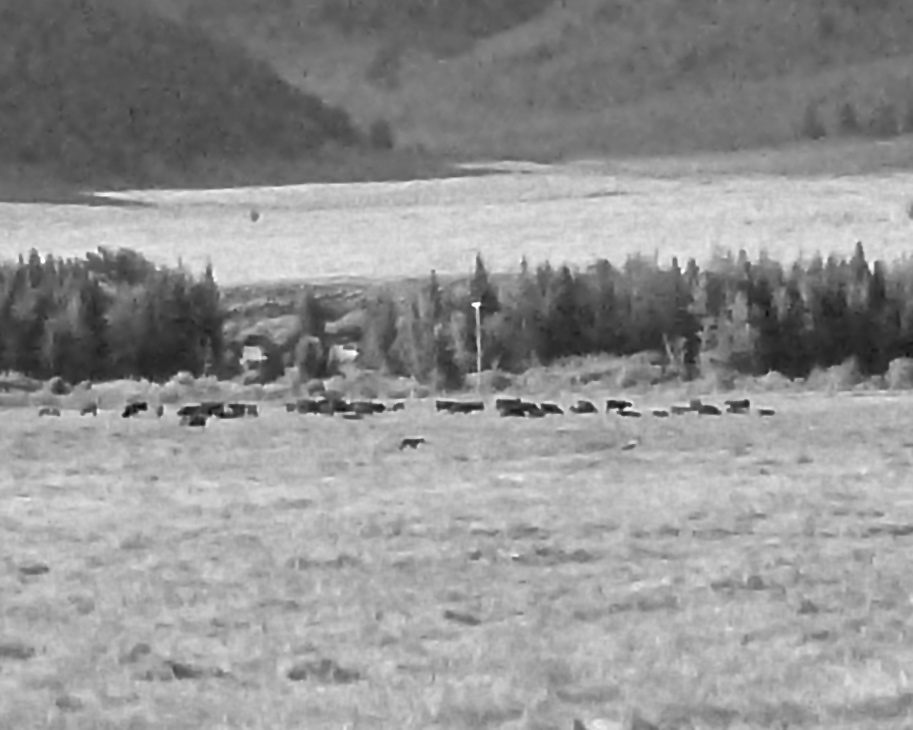
Last week I had a wonderful thrill.  Upon returning from a creek expedition I spied a lone wolf mousing in a field next to over 75 cows with calves.  I watched her for over an hour, deftly reducing the ground squirrel population.  She was incredibly focused on her task and I suspect she would be returning to feed some hungry pups with this small meal.  When she got too close in her endeavor to the cows, a large mama would come over and push her further away.  Otherwise, the cows paid her no mind and went about their business grazing undisturbed.  The good news is that these cows are removed to lower pastures come October when wolves tend to hunt in packs and could easily take down a cow.

Hard to see, but the small dot in the foreground is the wolf mousing amongst the cattle

Hard to see, but the small figure in the foreground is the wolf mousing amongst the cattle

I like wolves; and I like seeing them in the landscape.  They are finally re-inhabiting their old nation where they once roamed freely.  Where there are few problems and livestock conflicts, where the habitat is good, where there is room for genetic exchange, it makes little sense to even hunt wolves in these areas.  The wolves here have self-regulated for a long time.  It’s a tough and short life being a wolf.  They fight and kill for territory, and their territory is defined by how many wolves can actually be sustained.  They also work as a family with a close-knit social order.  Disrupting that order continuously exacerbates problems with livestock.   Given the human social and political climate, I don’t see much change for wolves in the immediate future.

Co-existing with Predators

In helping homeowners over the years deal in natural ways with small critters like moles and gophers, as well as larger animals like deer, I found that there is one necessary ingredient–the homeowner has to want to co-exist rather than resort  to lethal controls.

That same principle applies to larger predators in the landscape such as cougars, wolves, bears, or coyotes.  The wolf reintroduction has generated a lot of fear.  But if we want wolves to remain in the landscape, then ranchers will need to learn new methods.  I have always advocated that, just like the homeowners I helped and educated, ranchers need and deserve a helping hand.  This should include public and private monies for education and training.  Instead of ranchers just given a ‘kill tag’ or being reimbursed ad infinitum for predations, they need to be aided in new protection methods with the goal of incorporating those techniques into their regular routine.

There are several private organizations doing just that:  working with ranchers to discover ways to protect their herds and flocks.  Below is a fantastic informative video I hope you’ll watch.  Well produced with the added benefit of wonderful scenery and wildlife footage, ‘A Season of Predators’ gives you a vision of where we must be headed if we are to have bears and wolves remain in the landscape.

One additional note I’d make:  Although this video concentrates on wolf management, we, the public, are spending millions of dollars a year funding government killing of predators and ‘nuisance’ animals.  This arm of the USF&W is called Wildlife Services and its main job, unlike its title, is killing predators.  One local man who works for WS told me that he trapped and killed 400 raccoons last year for one farmer.  He also had to kill dozens of feral cats as part of his job.  Ironically, he was also killing the local coyotes that would have kept the raccoon and feral cat population in check.  This is the kind of government subsidization that is ‘old school’.  Instead of simply killing wildlife as well as throwing away all that money that not only doesn’t teach the farmer any practices, but doesn’t teach the local wildlife anything, Wildlife Services could have used those dollars exploring new methods and instructing this farmer in sustainable practices in co-existence.

Having worked with over-populations of deer in suburban areas, I know that deer damage can be controlled.  For instance, deer actually are trainable.  Does teach their fawns what to eat.  Deer can be browsing on one type of flower in the landscape, but miles away won’t touch that plant but prefer another.  Through a variety of means that don’t even include fencing, deer can be ‘taught’ not to eat a particular plant.  As you’ll see in this video, wolves can be taught too, but it takes a bit more work than simply a trap, a gun, or a poison.  This is the kind of ‘work’ where your psyche and body meld into the land.  You’ll have some loss, but the goal is to minimize.  You are working with the wild, not against it, and in doing so there is great pleasure and satisfaction, with the rewards being a feeling of oneness with the Land.


The Cry Heard Around the World

With wolf hunts now taking place in all three states around Yellowstone, new issues are coming up.  Although Montana and Idaho had a hunt last year, this fall is Wyoming’s first wolf hunt.

At least 10 collared Yellowstone Park and Grand Teton wolves have been killed in this years’ hunt, and more than half of them occurred in Wyoming.  The last collared wolf killed was taken in my area, hunt area 2, and she was the eighth wolf and so closed the zone.  And this wolf, wolf 832F (F for female), dubbed ‘o6 by Park wolf watchers, was perhaps the most famous wolf in the world, and most loved.  She’d been highly visible in the Lamar Valley since she was born in 2006, and was the alpha female of her pack.

'06 this summer  hightails it away from Molly Pack

’06 this summer hightails it away from Molly Pack

Last spring on a May morning I went to the Lamar and watched her with her son try and scare a grizzly off a dead bison.  On the other side of the grizzly were two wolves of Molly’s Pack, a formidable pack in the Park that had been threatening to kill 06’s pups.  Another wolf from the Lamar Pack, 754, was shot in my hunt zone in November.  At least 2 collared wolves from Grand Teton have been shot, and there’s speculation that as many as 13 uncollared from GT have been taken in the hunt.

’06’s death has been highly publicized all around the world, from PRI to European newspapers.  People from all over the world watched and knew ’06.  In response to public opinion, Montana, who is about to begin their first wolf trapping season, has created a buffer zone around the Park’s northern border.  Just for this hunt/trap season only.  Next year is a different story perhaps.  Although Idaho’s wolf hunting and trapping season is almost endless, the expansive Madison Valley  sits in the way of many wolves migrating from the Park in that direction.

'06 swims the Lamar river, emerges onto the road right in front of tourists.

’06 swims the Lamar river, emerges onto the road right in front of tourists.

Wyoming is another story.  Most of the Park is in WY, as is all of Grand Teton.  85% of the state has been approved by the Obama administration as a predator zone which means shoot on sight (or trap, or bait, or whatever) anytime, anywhere.  So the managed hunt zone, called the Trophy Zone, is essentially the ‘buffer’ zone around the Park.  With the loss of so many study wolves, is the era of Park research over?  And with the hoards of wolf watchers habituating these wolves to a benign human presence, is the era of wolf watching in the Park about to change?  Will it be harder to see wolves in the Park?  And will that bring in less visitors?  And should Wyoming manage their ‘buffer zone’ around the Park with Park research in mind?

I can say that my zone, hunt zone 2, had the highest quota of all the zones.  If you take zone 2 and 3 together, they make up the entire Absaroka eastern side of YNP, with a quota of 16 out of 52 wolves.  This is a rich area for genetic exchange, mostly Shoshone designated wilderness area, and wolves travel frequently in and out of the Park in this area following their prime food, elk.  Those two areas alone, which are a prime buffer zone, make up 1/3 of the state’s quota for 2012!

Hopefully ’06’s death will bring some good and highlight what is wrong with the hunts the way they are managed now.

First, the quotas of 100 wolves and 10 breeding pairs per state was set a long time ago when no one knew how wolves would adapt to the Rocky Mountains.  Although Montana is setting their own quota at 400, Idaho which has prime territory and over 70% federal lands, is in a frenzy to eliminate wolves, hunting and trapping 10 months of the year with no quotas.  Wyoming, which has few wolves outside the Park, before the hunt it was around 230, is not only mostly predator status, but is also eyeing that 100 mark as their quota.  These quotas are simply ridiculously low for the amount of good habitat and prey.  Wyoming in many areas is trying to reduce their elk counts by giving hunters numerous tags, but at the same time reducing the predator that could do that job in a better, more effective and selective manner.
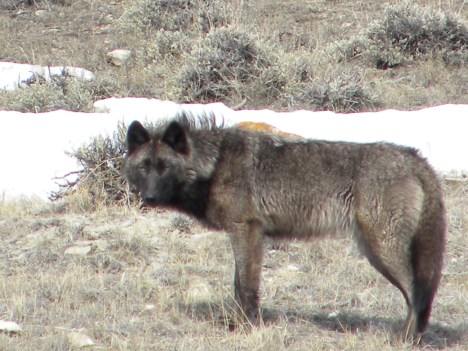
This wolf, from my valley, was by the road two years ago.  With the hunts you will no longer see wolves so easily

This wolf, from my valley, was by the road two years ago. With the hunts you will no longer see wolves so easily

Second, trapping is simply anathema to the 21st century.  It is cruel and poses dangers to not only other wildlife, but to pets.  Pelts are sold mostly to the Chinese market, which enrages me more.  This is what happened with our beaver and bison in the 19th century, when European demand had hunters and trappers eradicating our wildlife for hats and coats.  Wildlife as a commodity is simply wrong, just as human trafficking is.

Third, until the predator status is changed so that all of Wyoming is designated trophy status, the Trophy zone around the Park needs to be changed.  Quotas in sensitive areas right around the Park need to be decreased, hunt zones readjusted, and hunt times changed for each area.  Instead of hunting the entire trophy zone Sept or October through December, zones near the Park need to close earlier as the elk begin to come down from the high country and the Park wolves follow.  Once Wyoming predator status is eliminated, wolf hunts should take place only in areas where there are conflicts with ranchers, not in areas with no conflict and lots of wilderness.

Finally, personally I disagree with hunting predators–wolves, coyotes, foxes, cougars, bears, martens, you name it.  Being able to shoot a predator that is eating your sheep or cattle is one thing, hunting them for sport is another.  On the other hand, just seeing a wolf or coyote passing your property doesn’t mean they’re going to cause trouble; and ranchers who are far-sighted and conscious are trying new methods for protecting their flocks and herds.  Yet that being said, for now the delisting not only calls for a hunt, but in the short run of the next ten years, it may be the only way to quiet the loud and contentious opposition to wolves.  Let’s just not undo all the good hard work that brought them here over these last 15 years.

If you want to comment and have your voice heard on the wolf situation in Wyoming, here is a link.   Wyoming wolf hunt 

Two wolves side trot down the road

Two wolves side trot down the road


A farewell to a wonderfully curious wolf pup of the Hoodoo Pack

I have been randomly calling the Wyoming Mortality Hot Line or going to the online link to find out how many wolves have been killed (let’s not call it by the euphemism ‘harvested’).  I am especially interested in my Area (area 1).  As of today, 3 of the quota of 8 have been taken.

Today, I just found out that one of those wolves was the yearling pup I’ve seen many times over the last year.

Yearling pup this spring

He was born a year ago spring.  I first saw him with his mom last fall.  She is a black alpha female (not sure if she’s still around) and she was harassing a cow as her pup tried to help.  The cow didn’t run, but just kept turning around and chasing her down.  Finally she gave up.  If prey don’t give chase, wolves usually get confused.  They can too easily get kicked and hurt by confronting large prey from in front.

The pair seemed inseparable and the next time I saw the pup was around January.  He was with his mom loping up a nearby ridgeline.  Mom turned, looked, and sprinted off.  But the yearling was curious and watched me for awhile.  We shared a moment from afar on that cold winter early morning.

The last time I saw him was this spring.  I was hiking down a draw, following a cougar track.  Koda lagged behind.  I was above a creek on a thin deer trail when I spied something odd behind a tree about 20′ ahead.  I stopped and his grey head peeked out.  He’d been curious, watching Koda and I.  When he saw that I noticed him, he ran off to join his mom in the meadow a few hundred yards away.   I sprinted up beyond the trees to catch a glimpse again of the Alpha female. (I was able to snap the photo below of her).  She eyed me warily for a bit then took off with her pup.

Alpha female; mom of yearling pup killed this week

Last spring I went to a WY G&F information meeting about the hunt.  It was clear that it would go through, starting this October 1.  The quotas were already set, with my area having the largest.  Immediately I knew that this curious youngster would be amongst the first to die.  Wolves have been hunted by helicopters around here for years, but not by hunters on foot.  Although these wolves were wary, they were not yet scared of humans.  The opportunity I’ve had over these last seven years to see wolves over and over again fairly close (I’ve had at least three occasions where I’ve seen wolves 25′ away, eye to eye, both of us curious about one another), has come to a close.  It will be better that way for the wolves.  Within a year or two of these hunts, wolves will not be seen casually in these parts.

Predators by nature and design must be smart.  They need to think and strategize. Wolves cooperate when they hunt and that takes smarts.  Prey are given the gift of speed.  They look, listen and run.  But predators must be more cunning than that.

If you share a moment with one of these magnificent creatures, you realize how intelligent, how full of Life they are.  They embody everything that is wild and free. When they look you in the eye, they see right through you, much deeper than you see into them.   In the end, though I am saddened by the loss of these wolves in Sunlight,  the hot button issues surrounding wolves is not really about wolves at all.

I am reading ‘Shadow Mountain’ by Renee Askins, one of the spearheaders of bringing wolves back to Yellowstone National Park.  I highly recommend this engaging, personal and well-written book.  I end this entry with a quote from Askins book and a fond farewell to that magnificent and curious pup who shared with me not only his inquisitive nature, but his wild and free spirit.

“It soon became clear that in most discussions wolves merely provided a pretext to talk about much deeper and more personal political views, invariably those having to do with control–control of land and control of animals.  Who controlled the “rights” to the animals, who could kill the elk that the wolves would prey upon, who could kill the wolves that killed “too many” elk, who could control which prey species and which predators and where and when and how.  In truth, all of it was a discussion about killing and control veiled in the professional shibboleth of “wildlife management.” Wildlife management is, of course, an oxymoron.  Animals that are truly “wild” are, by definition, not managed.  Yet I would discover…over the next several years a troubling trend toward complete control or manipulation of many “wildlife” populations even within national parks.

Alpha male of the Hoodoo pack

What does a wolf den look like?

A friend of mine stumbled upon a wolf den with pups while shed hunting a month ago. The pups were about four weeks old, he said.  Apparently, his inadvertent presence caused the wolves to move their pups to another location, for although I put my trail camera on the den site.

I never saw any activity and only got this one photo of a male wolf returning to the area to investigate.

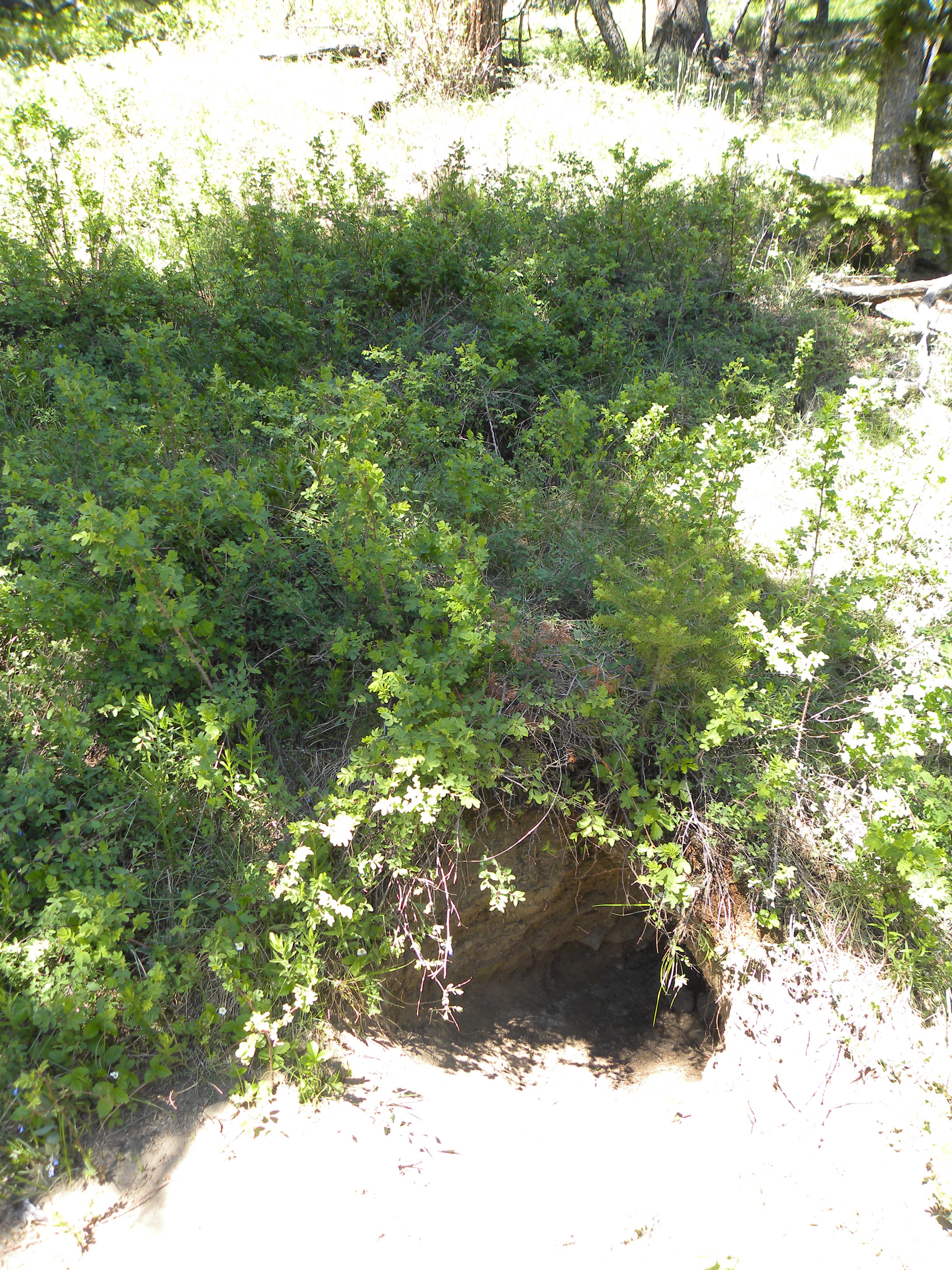
I waited a month to be sure that the pups were old enough to have left and inspected the site.  What a feat of engineering.  The den was on a hillside in a small drainage.

The den was essentially a tunnel with an entrance above and below.  My dog is 90 pounds and he was big enough to crawl inside the tunnel entrances, but too big to enter the tunnel connector.  Here he is for size at the lower entrance.

Koda for size

Although this site had been abandoned for several weeks with overgrown vegetation, it was perfectly clean inside and out.  I looked around for bones. There were some deer bones but quite a ways down hill from the den site.

Upper entrance demonstrates cleanliness

I tried to shine a light as far down as I could, but the den tunnel made a right turn downhill and exited at this bottom hole.

View of lower entrance. Upper entrance is visible directly above

The chosen site was not near an animal trail.  In fact, the trail made by the wolves going back and forth to the den was now overgrown.  Yet I caught a wide variety of animals on my camera.

Of course, the supercilious coyote appeared several times, even spending a long time peeing nearby on a log.  A young black bear ambled bye.

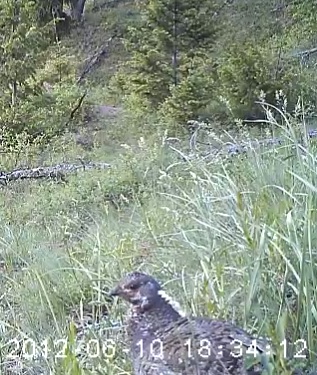
A blue grouse with chicks appeared;

Find her chick!

a cow elk explored the site; and a yet to be identified weasel-like animal that looks suspiciously like a wolverine–all these animals in just a few weeks visited this den site area.

How lucky we are to have such a wealth of animal life in this special place we call the Greater Yellowstone Ecosystem.

Also Read:- Sacred Sites and Mountain Lions

More Cougars with some Wolves thrown in

I’ve said it before and I’ll write it again:  animals present themselves to you, not the other way around.  And for the last six months, cougars are what have been presenting themselves to me to learn about.

If you’ve been reading my blog, you’ve seen that cougars have been constantly coming into my awareness now since the winter.  Last winter I tracked a cougar in the snows and found over 5 of her kill sites.  Then the last several weeks I found some cougar scat on the edge of the little forest by me.  A week later I found a fairly fresh kill site, just 25 feet from my trail camera.  Too bad cougars don’t use trails.  The kill site was just off-camera by a little bit.

Last week I hiked up a drainage located  within a smallish draw.  I climbed high, then worked my way horizontally around the draw, finally descending via a creek with snow-melt in it.  As I was climbing to the ridgeline that was a rocky crescent, I pushed aside some brush and saw a large cave rock shelter.

Koda guards a cougar densite

Koda was ever anxious to run right in and stick his nose inside.  I called him off.  There might be something dangerous inside.

After determining all was quiet, I went to investigate.  This had been a cougar den, and one used this year.  I could tell from the smelly scat at the entrance.  The sticks and duff had all been pushed consciously to the front, and at the farthest rear of the cave was a neat round bed.  This was really exciting.

Den site of a cougar. Duff in front.  Bed at back end (where it’s dark in photo)

I began pushing farther uphill towards the rocks, looking out for sign of kills along the way.  Sure enough, there was a lot of evidence of deer predation here.

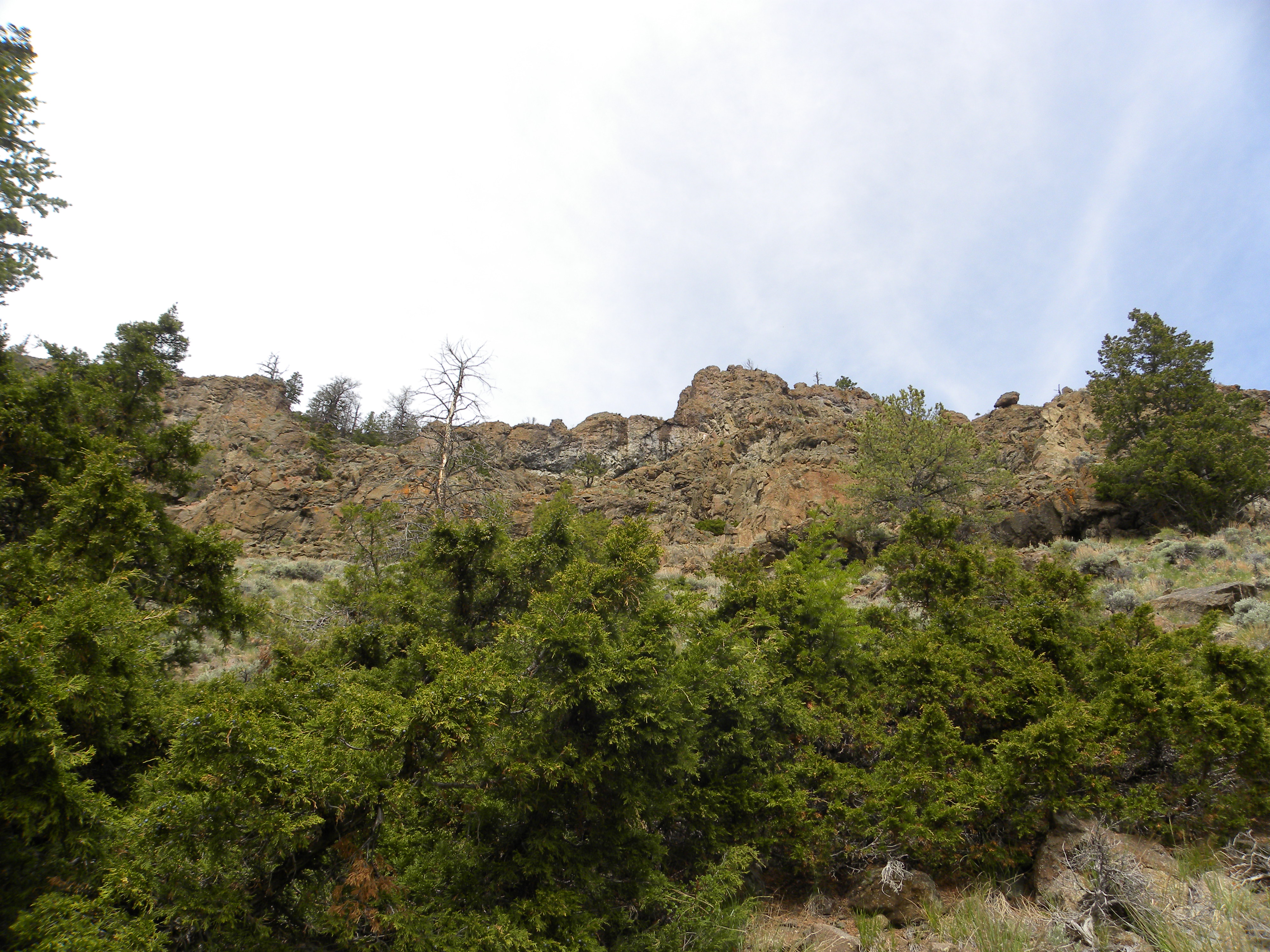
Rocky ridge I hiked to.

One thing I pondered was the lack of water.  A small creek was running several drainages over with snowmelt, but all the other drainages were bone-dry.  The canid dens I’ve seen are all close to a water source.  I thought about cougars in the Southwest, a super-dry area, and wondered about their use of water, especially with kittens.

Eventually I worked my way over to the drainage with water.

Drainage with some water I followed and found lion tracks

Coming round a curve, I found a large cougar print in the mud.  I understand that instead of following trails, like bears or wolves, cougars like to follow drainages.  I wished I could have taken a cast of that.

I followed the drainage down until I came to a downed large tree .  I went one way and Koda went around the tree on the opposite side. Above the creek,  I was following a deer trail now and called the dog back to me.  As he came across the creek, I noticed something move behind a tree about 25 feet ahead on the trail.  It was grey.  I peered to get a better look and there was the  yearling wolf I’d caught on the trail camera just days before.

This curious yearling wolf was watching me from behind a tree.  

She’d been curious, watching me.  When she noticed I’d seen her, she bolted.  I called the dog, who luckily was behind me, to a ‘heel’ and we moved ahead until we had a view of the hillside meadows.  There was her collared mom.  I kept the dog beside me, tried to take some photos while I walked out of the area, all the while we kept our eyes on each other.  She’d move a bit away, then stop and eye me.

Female collared wolf.  She’d move uphill, then stop to see where I was

I thought about how curious wolves are, and how these wolves, though cautious, are fairly used to people.  Most of the time I see wolves around here, they prance ahead, then stop to watch; easy targets once hunting season on wolves will begin next fall.  I fear these two wolves won’t live to see another spring.

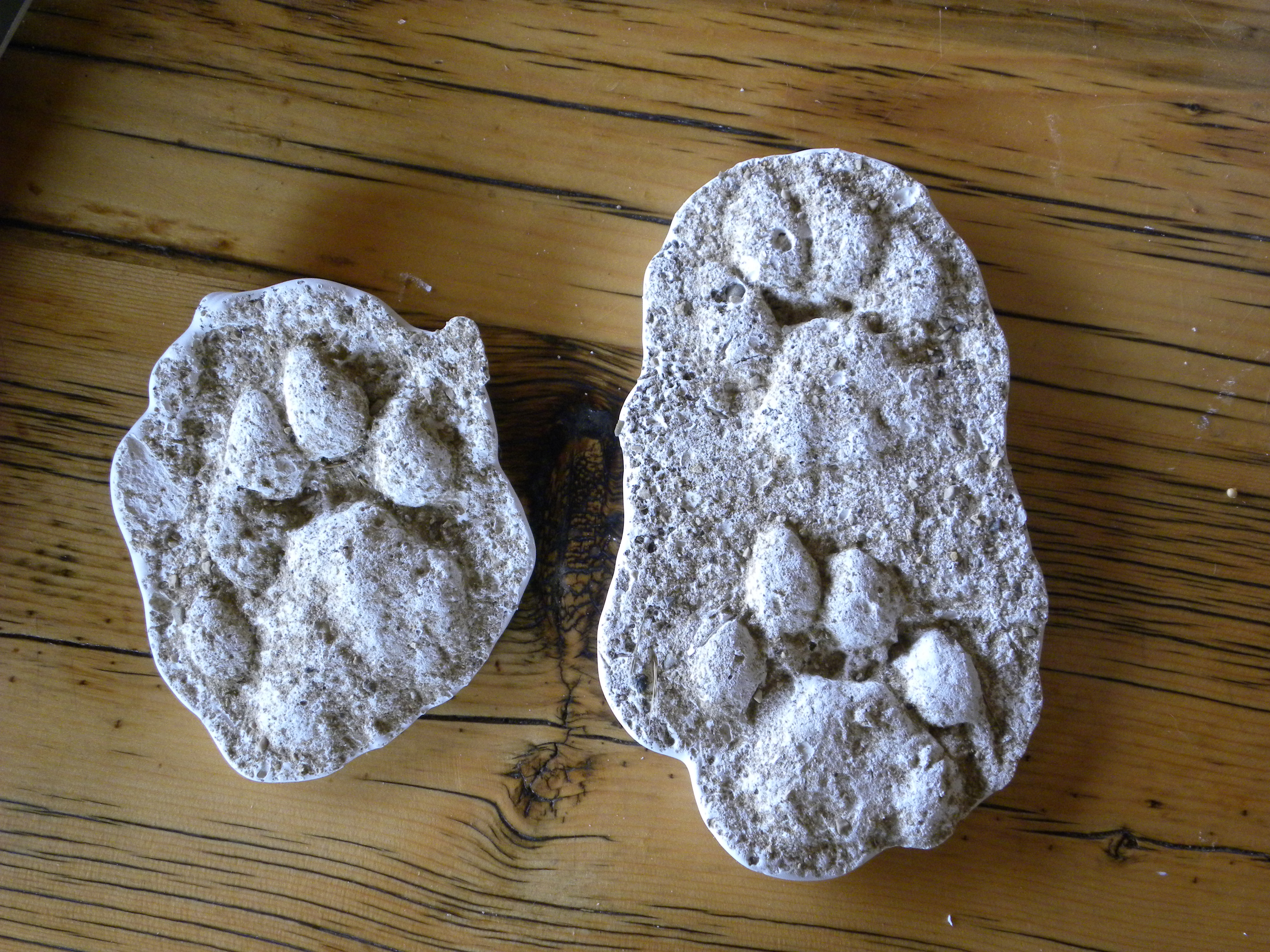
I was still stoked from that morning for several days.  What a lot of wonderful wildlife adventures.  Then just a few days later, I walked at dusk to the mailbox.  Cougar prints crossed the driveway, still damp from recent rains.  Now I had my casts!  A perfect week and a lot of cougar lessons besides.

Cast of cougar prints–right side is rear on top, front on bottom. Cougar was going at a fast trot. Left print is a direct register


Wolves, cougars, and the little woods

There is so much wildlife activity in the little piece of woods and meadows next to my home that I don’t need to venture much farther than ‘around the block’.  Sometimes just sitting on my front patio is enough.

Besides the nesting bluebirds and house wrens, the red-tailed hawk making its’ rounds, and the pair of Golden Eagles soaring above, there are morning and evening visits from does and bucks in velvet, and an occasional turkey.

But the unseen action is taking place when I’m sleeping.  Now I’ve caught two different wolves on my trail camera set up in the woods.  On the 2nd of May I clocked this black female passing south early morning.

Solitary female probably from the old Sunlight Pack that was killed off last year by another pack

And now on the 12th I caught another wolf, unknown, heading north almost at the same time in the morning.

first shot from trail camera

Yearling pup from the pack presently occupying the valley

Of course, coyote is always running through the woods so trail photos of him abound.

Coyote. Easy to tell wolf and coyote apart

Usually when I retrieve my trail camera I’m expecting to see dozens of only deer photos so I have been pleasantly surprised.  Here’s a nice buck photo.

Lastly though, here’s the most unexpected.  Last week Koda dragged me over to some strong smelling scat.  It was a large pile on top of an older pile, definitely cat, and I mean big cat.  The deer are still low and some must be having their fawns.  Of course, this winter I spent tracking a cougar and understanding in greater depth their sign.  Yet I was surprised to see that a cougar was this low and so close to the houses.  Granted, the summer residents aren’t here yet, but there is the occasional activity still.  I made a mental note of where the scat was–on the far side of the woods–but saw nothing else.

Then today while returning the chip to the trail camera, Koda got a sudden urge.  I’ve learned to trust his instincts and smeller so I followed him.  And not more than 50 feet off trail from my camera was a cat kill.  The deer had already been consumed with just its legs left, but there was the tell-tale mound of the formerly covered carcass, the plucked fur, and another smelly scat on top of it all.

Cougars pluck their carcasses. Bears pull the skin back.

I found a jaw of a young deer, although the legs were too big to be a fawn, so maybe this deer had been a yearling.  This is the first time I’ve seen cougar sign in the woods or a cougar kill so low.  The crazy thing is those cougars are so stealthy that there were no tracks, and besides, my trail camera was almost right there and I didn’t get any photos.  The cat, you see, didn’t use the game trail like the Canids and Ungulates do.

Telltale sign of where a cougar covered its’ kill. Plucked fur abounds.

Last chance to have your voice heard on Wyomings’ wolf delisting plan

Comments to the U.S. Fish and Wildlife Service regarding Wyoming’s wolf delisting plan MUST be received within a 100 days on or before January 13, 2012.  This is our last chance to be heard regarding this plan.  I sent a letter to Wyoming Game and Fish before the comment closing date which was on a Thursday.  The following tuesday they announced their acceptance of the plan.  Had they read my comments?  I doubt they were reading over the weekend.

But these are the Feds and the ones who have initiated the deal and done the science.  The more comments, maybe we can actually hold them to the science instead of the back door political deal Secretary of the Interior Ken Salazar maneuvered with Wyoming Governor Matt Mead.

Folks,  wolves do not belong to Wyoming and Wyoming politics.  Wolf recovery and management shouldn’t be based on the demands of the Elk Foundation, the NRA, or the Safari Club International.

In the USF&W website maze, I found it hard to locate the information as to where to send comments so I will print it here.  I am also copying an attachment from a letter from the Sierra Club Resilient Habitat department regarding talking points you might include in your letter.  Please take a moment and have your voices heard.  Thank you.

A majestic predator that deserves to take its place in the ecosystem

Tell the U.S. Fish and Wildlife Service (USFWS) that its draft rule to delist wolves in Wyoming is flawed and should be withdrawn. Submit your comment today!


Written comments can be submitted by one of the following methods:

1) Federal eRulemaking Portal: http://www.regulations.gov. Enter “FWS-R6-ES-2011-0039” in the “Keyword” box and check “Proposed Rule” in the “Document Type” box.

2) U.S. mail or hand-delivery: Public Comments Processing, Attn: Docket No. [FWS–R6–ES–2011–0039]; Division of Policy and Directives Management; U.S. Fish and Wildlife Service; 4401 N. Fairfax Drive, MS 2042-PDM; Arlington, VA 22203.


Consider making the following points in your comments:

  • This plan is virtually identical to multiple plans that have been rejected previously by both USFWS and federal courts because of their unacceptable impacts to wolves and the lack of regulatory mechanisms to conserve wolves as required by the Endangered Species Act.
  • Wolves should be managed by the Wyoming Game and Fish Department across the entire state, not as “predator” in 88% of the state (where they can be killed by any means by anyone, without a license) and “trophy game” in an arbitrary zone around the national parks. No unregulated killing of wolves should be allowed.
  • The proposed “flex-zone” area south of Grand Teton National Park is not grounded in sound science. The USFWS has arbitrarily drawn this line where wolves will receive limited protection as ‘trophy game” for only 4 months of the year. The USFWS admits that this will only likely protect half of the seasonal dispersal of wolves and that only 35% of dispersing wolves will probably reproduce. This proposed zone will almost certainly not protect effective dispersal because wolves will be hunted during the period of protection and very likely be eradicated (through unlicensed killing) from the area for the remaining 8 months of the year.
  • The USFWS will allow Wyoming to define “unacceptable impacts” of wolves on elk and other ungulates (which will almost certainly result in wolves being killed), yet Wyoming’s plan has not defined any criteria for determining “unacceptable impacts” by wolves. Currently, all of Wyoming’s 35 elk management units are at or above the Wyoming Game and Fish Department’s numeric objectives for those herds.
  • The USFWS disingenuously concludes that the Wyoming dual classification (trophy game/predator) plan is biologically sound because the remainder of the state is unsuitable wolf habitat. However, the proposed predator zone has contributed 3 breeding pairs, and 6 of the state’s 30 packs have entire or partial territories within this zone.
  • Relying on the indiscriminate shooting of wolves as the primary management tool to reduce wolf conflicts is not a strategy for success. Wyoming should work with stakeholders to promote tolerance and prevent conflict by implementing nonlethal, proactive wolf deterrents and livestock husbandry practices. There are active and successful programs working with ranchers and wolf managers in other states and this could be expanded to Wyoming if state and federal agencies are willing to work collaboratively and support these management tools.
  • Wolves play a key role in maintaining a healthy ecosystem. Since wolves were reintroduced to Yellowstone, beavers, songbirds and many other species are making a comeback. These benefits must be recognized in any management plan.
  • Millions of people come to Wyoming every year for the chance to see a wolf in the wild. Wolves in Yellowstone alone generate an estimated $70 million annually in cumulative impacts from wildlife viewing.