


W___ says we’re having a ‘false spring’. It was in the high 50’s today. “Don’t get too used to it” he told me. For a Mediterranean girl like me, the 50’s are the new 70’s! The solar and dryness made it downright hot. Still, the snow cover makes for great tracking. I’ve been learning about tracking for several years, and even was in a tracking club in California where, of course, they don’t have wolves and bears.
I decided to go hiking up Elk Creek. My neighbor put down a horse last week and right away I saw tracks of two wolves. (Note: Tracks below are wolf and the smaller ones coyote for size. My 85 lb. dog, Koda, would have tracks more in keeping with the coyote! See that photo below) 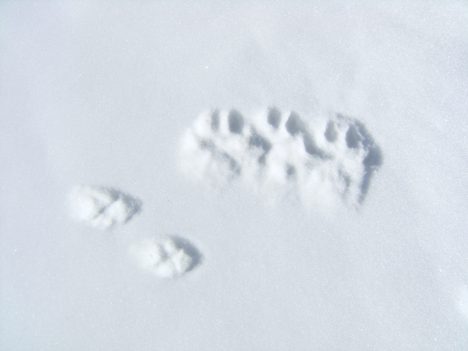 I followed them for a while until they went down a steep wooded slope. But later picked them up and, along with coyote tracks, they were headed straight for the dead horse. Seemed like they weren’t too interested in much of the horse though, as just its organs were gone and the rest of the carcass remained intact. Even the birds weren’t on it.
Yesterday I found a dead coyote. It was in an area where lots of elk graze every evening. I couldn’t find any sign of a kill, even though wolves had passed through the area not too long before. Its front leg was exposed down to the bone. I wondered if it had bleed to death from a trap although I couldn’t find any sign of a trap either. I took some photos and plan to show it to the ‘elk boys’, the students who are doing the elk studies out here. They’re very knowledgeable plus they are both hunters and trappers. The other day when I lead them to two elk kills I found near Game and Fish, they were explaining how to age a kill, what to look for to determine what killed the animal, and what animal parts the lab needs for various stats such as age, health, and diet.
Seeing that coyote reminded me of a fellow I ran into last spring at the small campground down the valley. This man had raised a coyote. He knew a fellow that had killed a coyote with pups, so he took one of them.
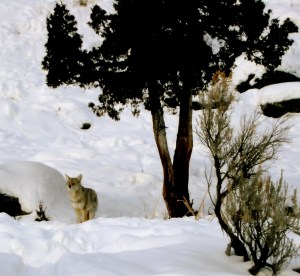 “They say you can’t raise a coyote, but I did” he told me. “The coyote used to disappear for days or a week at a time. Sometimes other coyotes would come around and howl, trying to entice the baby out to join them, and sometimes she would. But she’d always come back. It was four years before I could pet her. She’d sleep against my leg, but wouldn’t let me touch her. Finally, after four years, she’d let me love her. Smarter than any dog I ever had.”
“I was working with Fish and Game building a road. My boss on the project would come up and we’d talk across in our trucks. I didn’t like this man. He was always down on the work I was doing, which was good work. And the coyote didn’t like him either. We’d be talking and when we’d finish and drive away, you know how you have your arm laying on the window. Well, the coyote would nip at his hand when we’d pass, every time. And she didn’t do that to no one else. So that warden started keeping his arms inside. One day I was working way up on the mountain and here comes the warden. I don’t know how that coyote recognized him, but she did and she started chasing him down the mountain. The warden ran down and into his truck and got away as fast as he could. There was something wrong with that man and the coyote sensed it.”
I went back to look at that coyote again today. Nothing was eating it. I felt bad for it. I’ve seen that coyote many times. I feel like I’ve lost a neighbor.


Filed under: Coyotes, Wolf | Tagged: Coyotes, Elk, Tracking, Wolf | 2 Comments »

 Leslie Patten Books: Wild Places, Sacred Spaces