• MY BOOKS ON WILDLIFE, GARDENING AND MORE

  • The Wild Excellence

  • True stories of wildlife encounters around the Greater Yellowstone
  • Award winning eBook on Decomposed Granite, tips, how to's, what to watch for
  • Children's book. True stories of a dog and wolves. In a dog's voice
  • Written for dry Mediterranean climates in California, north and south

Trail Cameras

Trail cameras for wildlife spying have become a popular pastime. Not only has the video and photo quality improved, but the price point for high quality cameras is lower every year. I’ve been using trail cameras since around 2010. I thought it would be interesting to do a short post on my personal evolution of my use and what I’ve discovered.

Professional photographers and folks that are handy with manual camera adjustments have switched from store-bought trail cams to DSLR cameras. Using a DSLR camera trap requires a lot of knowledge of not just wildlife tracking but lighting positioning and camera settings, but the payoff is great. For my expanded Ghostwalker book out this year from University of Nebraska, even though I have thousands of great mountain lion photos and video, I needed to engage these experts for high quality photos that would reproduce in print. I’ve never been great with manual adjustments so point/shoot cameras, like trail cams, are my go-to.
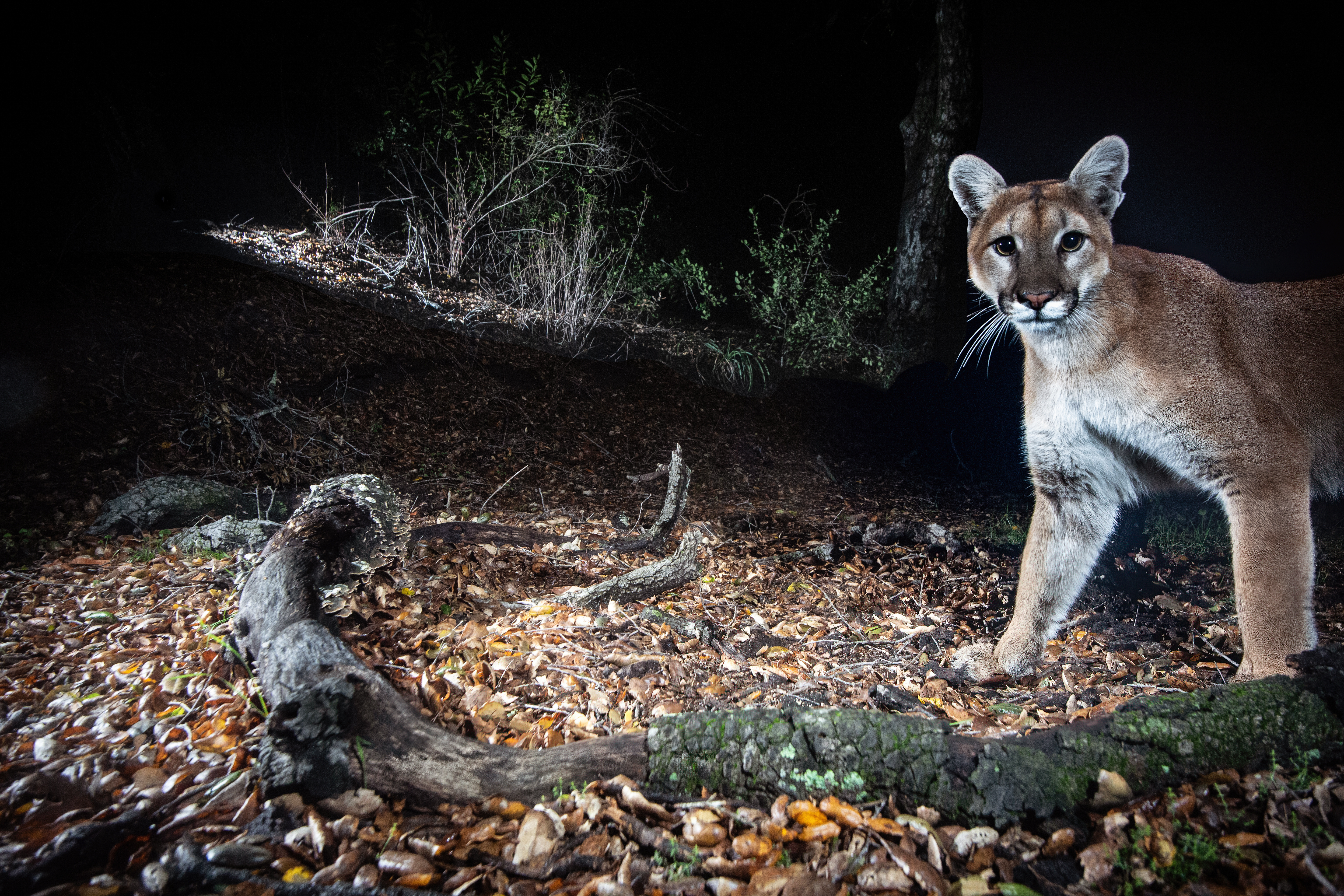
Amazing capture by Jeff Wirth using a DSLR. Wirth graciously consented to let me use some of his photos in Ghostwalker: Tracking a Mountain Lion’s Soul through Science and Story

When I first started using trail cameras their quality was very poor, but I was mainly interested in who was visiting the nearby forest. I caught grizzly and black bears on the animal trails, along with deer, coyotes, and wolves. I was anxious to catch martens who don’t follow trails. To that end I built a box trappers use, baited it, and put a camera on it (of course I didn’t put a trap inside!). Bobcats also don’t follow trails very much and since I do have bobcat trapping in my area in winter, the animals were rare on the landscape. I hung shiny objects to attract the cats with a camera positioned on it. Still, I almost never captured a photo of a bobcat.

After two years of camera trapping, I had several epiphanies that changed the course my experiments. First, after watching trapping in my area, I became aware that my baiting was contributing to these animals becoming less wary of actual kill traps. Therefore I stopped all baiting and scenting. But the biggest revelation was how to reliably capture animals on camera.

Elk on frozen river at a crossing point. I could see the crossing using track I.D.

I had been lucky to capture several mountain lions, and found lion tracks in different areas. That piqued my interest so I attended a class on mountain lions by researcher Toni Ruth in Yellowstone. During that class I watched a video of wildlife on a mountain lion scrape site. I knew about scrapes but had never seen one nor did I know how to find them. A scrape is made by a male lion with his back feet, usually urinated on, to mark territory. Lion scrapes apparently are big attractants for all sorts of wildlife. Once I learned where to find scrapes, I sought these out and placed cameras on them. Scrapes draw almost all the prey and predators in an ecosystem. By continuing to use these same locations for over 15 years, I’ve captured amazing photos, but the real gold here is monitoring sites for so long that you get a read on the ebb and flow of wildlife activity.

(ABOVE VIDEO OF WOLVES HAD CAMERA PLACED ON A TRAIL HEAVY WITH SCRAPE SITES)

A friend who is a feline researcher told me keeping cameras at the same location for many years provides a good indication of the health of the local mountain lion population. Houndsmen and researchers use dogs to find lions, which gives a good clue to the waxing and waning of lions in a designated area. Would monitoring scrape sites alone give me a general idea of lion health?

Lions are impossible to identify. Puma concolor, their latin name, means cat of one color. Unless they have scars such as nicks in an ear, etc. they look alike. And in a hunted area, males usually don’t last long; but another young male will come to fill the void. I did get an indication that I could monitor lions this way a few years ago. In 2015-2016 we had record snows. Our mule deer population crashed. By early spring when the first grass emerged, the landscape was littered with dead deer. Predator populations lag behind prey drop, but it wasn’t long before I noticed I wasn’t catching females with kittens on my camera. Without sufficient prey, females will have smaller litters or none at all. 2017 was the last photo of a mom with young kittens. Although I did catch young dispersers, there seemed to be a dearth of females in my area until 2021. coinciding with a rebound in the mule deer population.
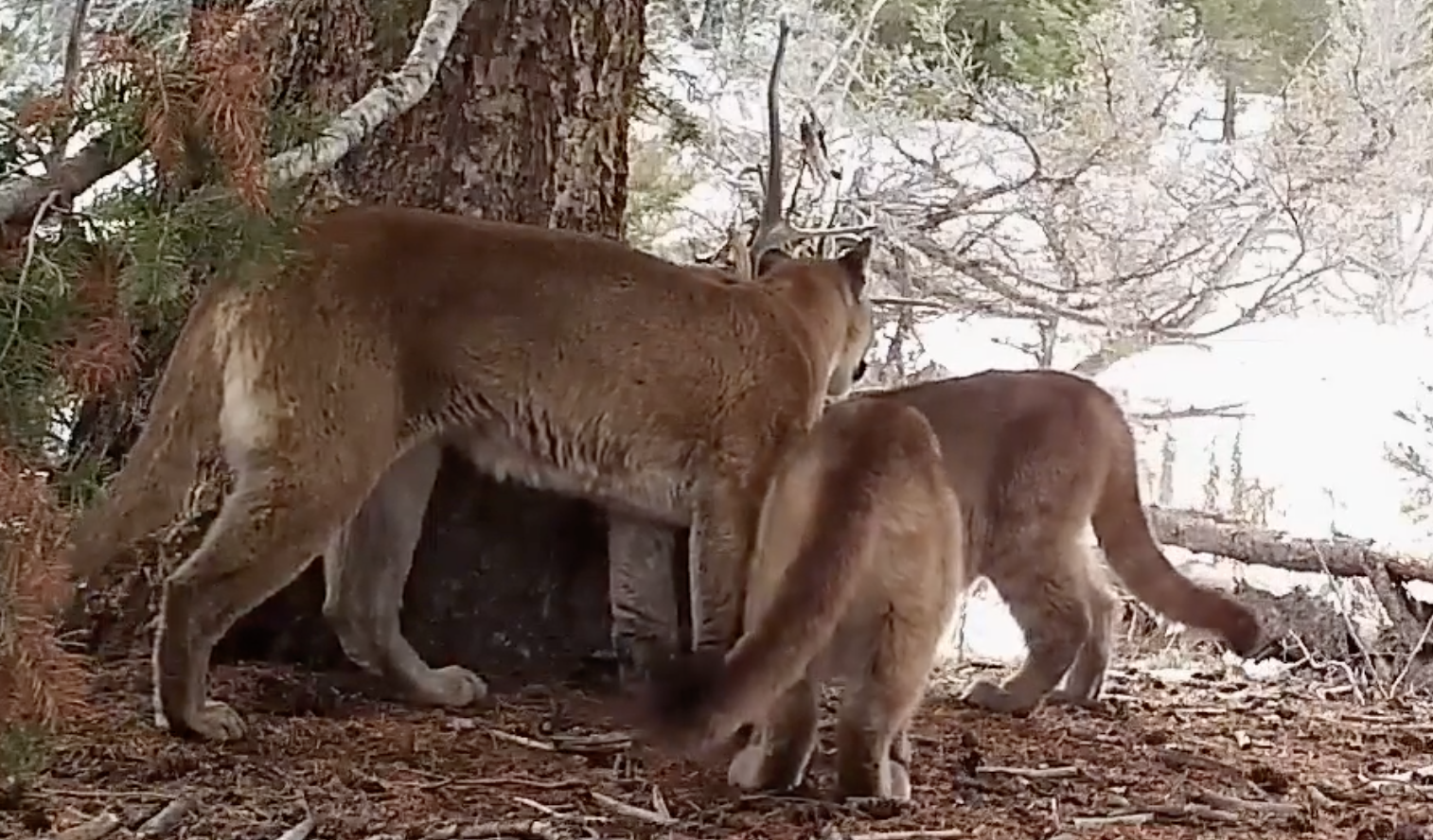
Additionally, the same thing was going on with cottontails and bobcats. Bobcats also visit lion scrape sites, and male bobcats like to scrape over lion scrapes. Rabbits go through seven year cycles and sometime around 2014 I noticed fewer and fewer rabbit tracks in my study area. I also stopped picking up bobcats on my cameras. The rabbit population had crashed and with it bobcat food. Then around 2020 a rabbit took up residence at one of my camera sites. Within a year, more rabbits at other sites, and soon there were rabbits everywhere. The bobcat population rebounded. Now I was catching bobcats with kittens frequently. An indication of how keeping cameras in situ for an extended period can tell the story of the land’s health.
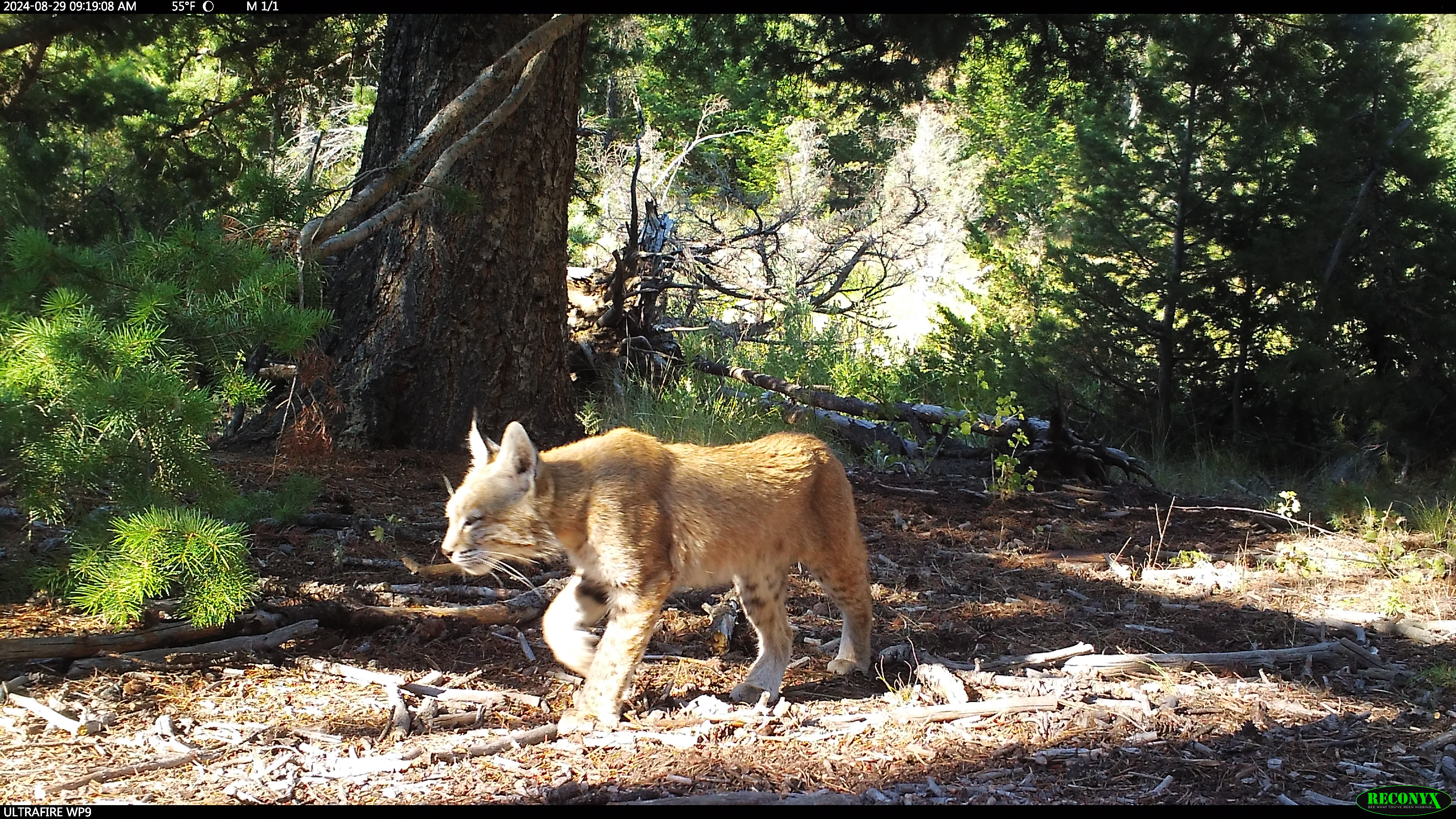
Bobcat visits lion scrape site

In summary, there are many ways to use trail cams. Research, exploration, pleasure. For me it’s become a tool not just to see who is visiting, but to monitor over time the swings of the ecosystem: how weather patterns, food availability, habitat health, and natural cycles affect the wildlife in my study area.

For more videos from my trail camera captures, see my YouTube site

New Release: Ghostwalker: Tracking a Mountain Lion’s Soul – Expanded Edition

I’m very excited to announce the fall release of Ghostwalker: Tracking a Mountain Lion’s Soul through Science and Story published through University of Nebraska Press. This is an expanded edition of the independently published version in 2018. So what’s new?

  1. A new chapter on mountain lions and desert bighorn sheep in the Southwest, a very sticky topic. Bighorn sheep are always teetering into the vulnerable category due to diseases transmitted by domestic sheep that have infected all bighorn herds throughout the Western states. But desert bighorn, who live in isolated sky islands with small herds, are particularly at risk. Predation from mountain lions is targeted as a high risk for desert bighorns. I explore and contrast management attitudes and policies towards mountain lions and bighorns in three states in particular: New Mexico, Arizona, and California. I spent time interviewing and traveling throughout the SW to better understand this gordian knot of a problem.
  2. California! So many new things are happening with mountain lions in California. The California chapter is completely rewritten with a series of new interviews. Biologists Quintons Martins who is doing a study in Sonoma County fills us in on North Coast issues, while Justin Dellinger with CDFW dives deep into isolated populations throughout the state. Kristeen Penrod provides maps of connectors needed throughout Southern California in order to save mountain lions for the future.
  3. What’s happening out there that’s new for mountain lions? We need a new model to replace the North American Model of Wildlife Conservation. I explain what it is and why it needs updating. I speak with Wildlife for All, an organization determined to change the present wildlife management model to be more inclusive. Panthera is studying non-lethal predator protection methods in California that will help ranchers throughout the West. Plus new information on the value of mountain lions for mitigating climate change and as an indicator species.
  4. New stories sprinkled throughout the book along with updated and new information on mountain lion research.
  5. Lastly, almost every photo in the book has been replaced with new ones. Many thanks to several photographers who are doing camera trapping with high-end equipment. Although I have hundreds of photos of mountain lions from over 14 years of using store-bought trail cameras, these images, though great quality for the internet, do not reproduce well in a book. Several professional photographers generously donated some extraordinary photos that will appear in the new edition. Unfortunately the paperback will not be in color.

That’s a summary of what’s new. I’m so pleased to have several new endorsements for this edition.

Author Dan Flores writes:  Leslie Patten has written the most fully-realized mountain lion book I have ever read. Cutting-edge science and interviews are her bedrock, but first Patten is an observer of the lion world as well as a writer whose prose pulls like a river’s current. 

Jim Williams M.S., retired Montana Fish, Wildlife & Parks wildlife biologist and author of Path of the Puma writes: I finished your fantastic book todayYour penchant for unedited and unbridled truth to science is amazing.

Author Ben Goldfarb writes: In Ghostwalker, Leslie Patten braids history, biology, and wildlife management to reveal this elusive cat in all its contradictory glory 

I hope to do some presentations once the book comes out. If you or your organization would like to discuss this, please contact me.

What’s the Story? Cougars, Wolves, Grizzlies

There’s one place in my area where I’ve seen Glacier Lilies, but as soon as the melt starts the access road usually closes due to flooding. Since the weather has been cool, and next week predictions say it will be in the 70s, I decided to check out the spot to see if the lilies are up yet before the road closure. It’s a fairly remote less traveled trail and this time of year grizzlies are down low foraging while wolves are denning. The trail begins at the road’s end with a stream crossing, winds through a burnt valley before turning up a small drainage where the trail heads to a ridgeline pass.

Immediately grizzly tracks began faintly appearing on the dry ground.

When I turned into the forest drainage, the wet ground revealed two grizzly bears. That could only mean a mom and cub. The grizzly cub footprint appeared to be at least a one year old. I became more alert, unlocked my bear spray.

Smaller bear on the left

The area I’d seen the lilies years before was about a mile up the trail near the pass. Bear tracks followed the trail plus revealed a 2 day old scat that said they’d been eating grass mixed with fur.

Closing in on my lily hillside, I found a clear wolf print in the mud. I hadn’t seen wolf tracks earlier on the trail.

wolf track

About 150 yards before the lily area , I came upon what these bears (and wolves) were doing here. An elk kill right by the trail, completely consumed but about a week or less old. Clearly a cougar kill. I searched around the site a bit. No skull, only one leg left plus the spine and pelvis.

What a cougar kill looks like. Rumen pulled out to the left. The fur in a neat circular pattern cut off with the cat’s incisors

What did the tracks and the kill sign say about the story here? Of course, the only thing I can be certain of was this elk was killed by a cougar. But let’s think about what might have happened. Wolves and bears (grizzlies and black) push lions off their kill. With only one leg, and few fresh wolf prints, I imagined the wolves kicked the lion off the kill site, and hauled the other legs off, maybe to their den site over the ridge. The wolves probably consumed most of the elk before the grizzly mom and cub came along (their tracks fairly fresh) to finish off what was left. The fresh wolf track I found was probably a wolf returning to check on any left-overs, and maybe even encountering the grizzlies.

Unfortunately, I didn’t find my Glacier Lilies. Maybe just too early or maybe those bears ate them. But here is some other cool bear sign I found along the trail.

Bears use their claws to strip bark from a tree, then feed on the sapwood by scraping it from the heartwood with their teeth. 

To learn more about mountain lions and their interactions with wolves and bears, read my upcoming book Ghostwalker: Tracking a Mountain Lion’s Soul through Science and Story out this fall University of Nebraska Bison Books. To pre-order a copy and receive a 40% discount, go to this link and use the code 6AF24 

Mountain Lion News

I recently attended a presentation by Wyoming Game and Fish large carnivore biologist Luke Ellsbury on, what else, large carnivores. I was mostly interested to know any results from Justin Clapp’s study on CWD and mountain lions. The field research is done but the analysis hasn’t been published yet. Luke confirmed that mountain lions were definitely targeting CWD deer and elk.

Another study measured the amount of prions in scat from mountain lions intentionally fed CWD infested deer meat. On the first defecation, the meat contained only 3% prions. And no detection on defecations after that. Luke said with these results in hand, the Service is definitely looking at adjusting mountain lion quotas in areas where they want to target reducing CWD in deer and elk. They are also planning on repeating this study with other predators—wolves and bears—and are presently testing CWD meat on bobcats in the field.

The study also corroborated findings from Elbroch’s Jackson study that as lions age they tend to prey switch to elk more heavily. That means if WGF wants to reduce elk CWD through mountain lion predation, reducing hunt quotas will allow more older mountain lions on the landscape. The critical age for prey switching seems to be five years old.

In other more personal mountain lion news, Luke confirmed for me that my one-eyed female lion was not harvested this year. In my area which is the northern end of Hunt Area 19, only one female was harvested this winter. I showed Luke the last video I captured of one of One-Eyed cubs. I thought he looked pretty rough. Luke agreed he didn’t look in good shape, confirming to me that most likely the mother and other cub are dead. And this cub, probably a male because he was always the bigger of the two cubs, isn’t likely to survive either. Cubs under one year old that lose their mother have a very low survival rate as they haven’t developed their hunting skills yet.

Lone Kitten of One-Eye captured early March 2024

Luke told me that this winter one lion was killed by wolves in my area, and that he had a call about another lion recently killed by wolves. Lions in my area aren’t collared, so these would be lions that hunters or hikers encounter and report. We’ve also had one report of a mountain lion dying of bird flu in the North Fork area of Cody.

Happier times. One-eye with her family in December 2023

I’ll continue to check cameras and hope to see One-Eye. I’ve followed her since she arrived in my area in 2021 as a young lion. She was probably born with her blindness. This was her second litter and I thought she was going to be really successful. The last time I saw the family together, those cubs looked happy and healthy at probably around seven or eight months old. Life is definitely rough out in the wild.

To pre-order the expanded edition of Ghostwalker out this fall, and to be receive a 40% discount, go to https://www.nebraskapress.unl.edu/bison-books/9781496238474/ and enter code 6AF24

2021 This is One-Eye caterwauling when she first arrived into my valley as a young lion looking for a mate

Cougar Action

The deer population in my zone has crashed over the last several years due to a series of very hard winters. Deer are about at 50% of what they were 4 or 5 years ago. Wyoming Game & Fish completed their mountain lion quota review, done every three years, this past summer. G&F decided to increase the cougar quota in our zone (zone 19) from 20 to 25 lions. Their logic was they’d adjusted the unit’s parameters, creating one unit that hugs along the Absaroka front, instead of two smaller units which went from mountains to desert. G&F figured the mountain area could withstand a higher kill rate, while the desert, zone 20, would be a ginormous year-round kill zone where lions wouldn’t be tolerated.

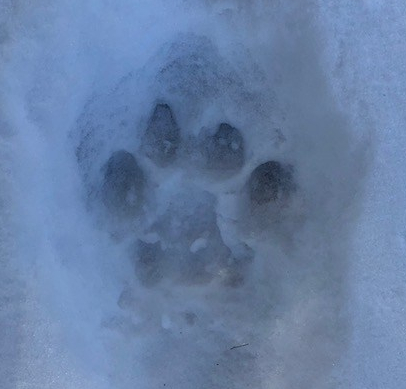
Lion print

Lion track

Unsaid at the review spring meeting was the hope killing more lions would increase deer–a logic that has been soundly debunked via scientific research. And although the G&F biologists know this, they also are placating deer hunters who don’t follow the science, but just know lions eat deer.

Apart from the “growing more deer” argument, a deep flaw in raising our quota is this: Zone 19 is considered by G&F a “source” zone. Wyoming uses a management tool for lions called source-sink-stable.  It works pretty much how it sounds. Sink is a zone where lions are not tolerated–in areas with more population. Stable just keeps the population as it is, and source is where lions disperse from to fill the rest of the state where they deem appropriate.  As a source zone, zone 19 abuts Yellowstone National Park, so it is a logical place for a “Source” population to come from.  Yet at our season setting information meeting last spring, when several houndsmen protested they were no longer seeing large males, that they’d been over-hunted, the G&F replied “You’re just not going to see what you used to before 2008.”  2008 was when the G&F cracked down on lions with higher quotas. With that reply, G&F pretty much admitted they were no longer managing zone 19 as a source population, that they’d abandoned their own management constraints.

G&F Lion quotas

A snapshot of today’s hunt quotas. Column 1 indicates zone. Column 2 is the quota for that zone. Column 3 is what has been killed so far in that zone. Column 4 are kills not counted towards quota. For instance, zone 26 is closed with a quota of 15 and kills of 17, with 1 not counted towards quota. Zone 20 is shaded because it is open year-round. Otherwise the lion season is Sept. 1-March 31.

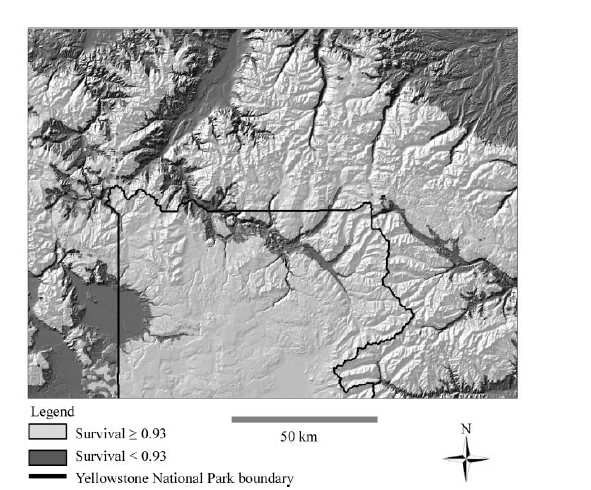
Dr. Toni Ruth did a study in Yellowstone’s northern range. One of her findings was that road density outside the park determined quota fulfillment.

Lower elevations and increasing density of roads, particularly in areas open to cougar hunting north of Yellowstone National Park (YNP), increased mortality risks for cougars on the GYNR.

Here is a map from that study. You can see that the drainages east of the Park, where there is easy road access, is where kills are highest:

Ruth map source sink

If G&F were managing for a true “source” population, they would close off road access to vehicles, create walk-in access only, limit areas in zone 19 to photography only, have a zero quota on females, and other rules; not raise the quota. I requested a map from G&F showing where the three years of kills were approximately made in zone 19.  I did this before their review of quotas at the commission meeting last July. Predictably all the kills clustered around the main road in my valley and roads elsewhere in the zone.

I’ve been using trail cameras for over ten years in reliable cougar travel corridors. The last two winter seasons it has been obvious our cougar population is down. Where once a dominant male was regularly making scrapes, only bobcats now come. Where I’d always catch females with cubs, I haven’t caught any in several years, nor have I encountered many tracks. With the deer population down, it would follow our lion population would too. Females just wouldn’t be producing cubs or not very many at least.

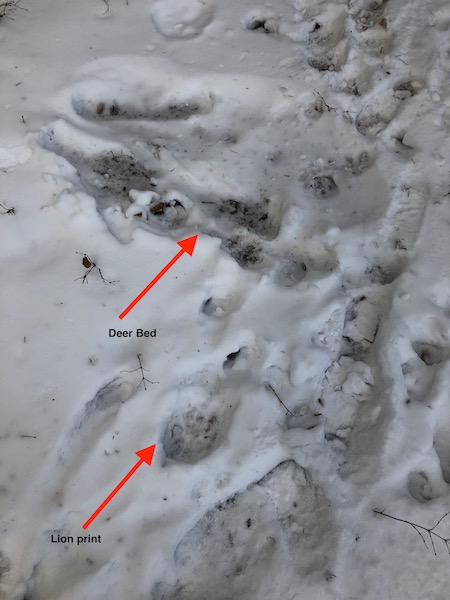
Deer bed with lion print

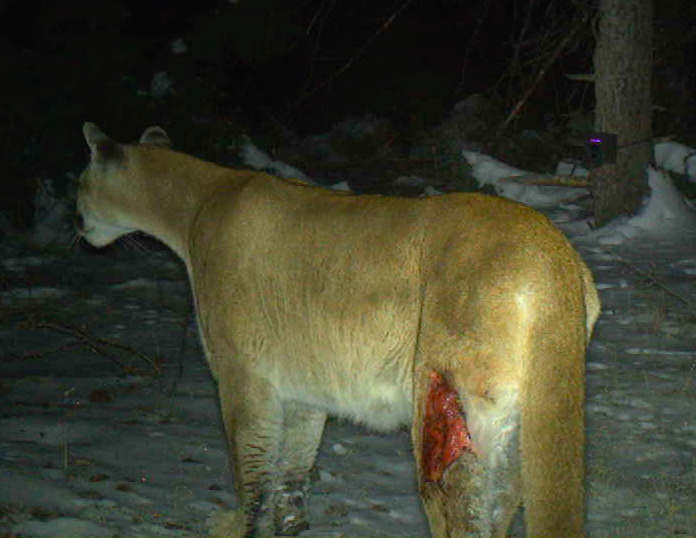
Today I was thrilled to find a male lion track and follow him. I’d caught him briefly on my camera, but in a very different location than I’d seen before. I also found one of his kills. In addition, I filmed a wounded female last month at a site where in past years males made scrapes, yet there hasn’t scrapes at that site for three years. Here are a few photos.  Because of the sensitive nature of these cats, I will not reveal any location data.

Screen Shot 2020-02-13 at 3.56.58 PM

Wounded female at an old scrape site

Screen Shot 2020-02-13 at 4.01.35 PM.png

Here is the male I was following. I’ll be trying to get a better photo of him.

Following a lion to find a kill

A few days ago I found a pile of freshly collected dirt and pine needles under a large fir. It had the obvious signs of the only animal around here that covers its scat–felines.

I pushed aside the dirt and found cougar scat, so fresh that it was obvious this cat had just killed and eaten.

cougar scat

Fresh Cougar Scat

In researching my book, Ghostwalker, expert cougar biologist Toni Ruth described to me a typical lion-kill scene—the cougar will drag his kill usually under a tree and cover it. This aides in hiding the smell to keep scavengers away and helps keep it fresh.

A deer can take several days to consume. The cat eats, sleeps and sets up a latrine nearby.  Sometimes cougars will just eat the organs and leave. They need the nutritious organs since they lost the ability somewhere in evolutionary time to convert carotenoids like beta carotene into Vitamin A.

cougar kill

Buck in velvet killed by mountain lion. Lion covered the kill after it had entered through the rib cage and eaten the organs

Armed with this knowledge, I began hunting around in an ever-widening circle looking for the kill site. Yet I found nothing.  Giving up, I walked into the nearby forest where a light wet snow still covered the ground from the previous evening. There I found the cat’s prints.

I backtracked the cougar, who had crossed through several properties. I found the kill, a young buck, close to a garage whose owners are absentee most all the year.

I could see the cat had entered through the rib cage (typical) and only eaten out the organs so far. I ran home and placed a trail camera at the kill site.

My home is amongst a small cluster of 6-9 acre properties, all bordering National Forest. The valley is a patchwork of a few large ranches interspersed with public lands.

Most everywhere one looks is National Forest. A few miles directly west are the Absaroka mountains, the border of Yellowstone National Park. Deer are getting ready for their annual walk-about, following the green-up to the high country of Yellowstone.

They are a bit late this year as it’s been cold, green-up a bit late, and the snows still deep where they are headed, so bucks and does are still hanging around, many close to homes.

Sunlight in winter

The Basin in early winter from the pass. Public lands in all directions.

Another neighbor who owns a large horse ranch told me they’d spotted a young grizzly scouting their hay fields not far from this cat’s hidden kill.

It got me wondering if the bear would bounce the cougar off his kill. Cougars are subordinate predators, and bears kick them off their kills 50% of the time. A bear can smell a carcass up to 20 miles away. I was betting on the bear.

Grizzly

Young grizzly in the meadows by my house

But I had other questions. First, this cougar seemed to be acting somewhat like cougars that live in urban-wildland settings–its latrine was about 1/4 mile away and not used over and over; it was coming and going to its kill, returning only under cover of darkness.

With most homeowners gone in early spring, I believe this cat would have acted different. But this is Memorial Day weekend, and some of the nearby vacation homes are occupied. Even the usually vacant property where the deer stashed the kill, the owners had come out from the east coast for the weekend. Additionally, noise factor on the dirt road for the holiday weekend was spooking the cat.

So I asked myself “Would this cat return to its kill to finish up or just be satisfied with the organs it already ate?” “Would the grizzly bear overtake it?”  I waited a few days and went to retrieve the memory card in the camera.

3:45 a.m. First visitor: A lone coyote stays for about 15 minutes

IMG_0002

First visitor to the kill site

4:30 a.m. Cougar shows up. Leaves 40 minutes later

IMG_0029

9:28 p.m. Cougar returns. Leaves and comes back at 2:15 a.m. next morning.

IMG_0037

IMG_0045

cougar burying kill

Here the cougar is re-burying it’s kill with its back legs.

So after the initial kill and eating the organs, this cougar has returned three times over the course of two nights. The bear apparently has moved on down the valley, more interested in grass and grains than meat. If this was fall, that bear would have definitely been on the carcass during hyperphagia.

Today was warm. This carcass was buried in a wet swampy area amidst trees. The flies were on it, but there is still plenty of meat. So now I wonder if that cougar will return again, even with the flesh beginning to spoil a bit. Or will the bear be back? Coyotes for sure, and maybe some wolves will come by as they are feeding pups now.  I added another camera that takes video, so, To be continued…

IMG_0001

Reviewing my photos. 3rd day and it is warm (63 degrees). The cougar wasn’t able to cover the carcass very well due to location and there are flies on it, but still plenty of meat.

Also Read:-

Mountain Lions: Masters of Invisibility

I gave a presentation at the Buffalo Bill Center of the West in Cody, WY. With excellent quality equipment, the museum video taped the presentation. About 45 minutes if you want to watch it: https://youtu.be/l2TMldiC4-w

Cougar Kitten 1:2016

Cougar Kitten 6 months old

Fishers, Neo-Cortex, The Killer Claw. What wasn’t in Ghostwalker.

What didn’t get into my new book Ghostwalker: Tracking a Mountain Lion’s Soul through Science and Story? A lot of fascinating information trackers, researchers, and others told me just couldn’t squeeze into the narrative. Here are some excerpts from interviews with trackers and a researcher I interviewed.

From Jim Sullivan, Sonoma County Tracker:

badger tracks dune slack

Our language causes us to think that when you say something you really ‘have’ it. It’s always in flux. I’ve studied lots of science, and one thing that’s really important to understand is that things don’t follow laws. Laws are like a grid we put on it in order to understand what’s happening. Not necessarily the way it is, it’s how it moves.

I’ll tell you a little about my teaching in my class. I teach a traditional native  style tracking. The native trackers tracked in sacred time and I started asking myself what that meant and what their spiritual life was like. What I understand about it is to make it into a spiritual practice and a meaningful part of your life, you got to look at tracking as a metaphor. So all the different things you do in tracking actually took place at a time when our neo-cortex was forming 2 million years ago. Our brain is designed to work that way because it came into being in order to solve tracking problems. You know how in tracking you have the four views? You have the eagle’s view, then you have the standing view, the kneeling view, and you are also instructed to go around the object so you can see it from different lights. That’s a metaphor to learning anything. A way of expressing it is that you have to look at everything from all the different sides. Most people tend to have kind of a laser focus. They know one version of it real well and then they speak with authority about it. But you’re not really an authority until you know all the main opinions. So that’s how I look at tracking. Even applying that to mountain lions. Things change depending upon your point of view, and also your presence and also other presences. When you make statements about wolves are a certain way, bobcats are a certain way, you have to do that, but it’s just a grid you’re putting on what the animals are actually doing. Takes the edge off it.

Matt Nelson told me how they set traps and tracked on Mark Elbroch’s Colorado study:

3TrishCarney_PUC_092817_G7A5514-2sm

It was pretty neat. We would set these traps where the cat had to set its foot exactly where you wanted it. It would jerk a little cable snare tight around its wrist and the cat was stuck there. One of the neat things about these methods nowadays is they have transmitters on them, both cage traps and snares. So as soon as that animal was captured, we’d get a signal on our radio and we would hustle in there and minimize the time that animal was trapped. Those were the three methods: Hounds, cage traps and snares.

The sooner we could get cameras into a kill, the more information we could get. We’d try and recognize the GPS data. We got pretty good; we knew the cat was on a kill the very next morning. We’d hike in there real quick. Typically you never saw the cat. But what we started doing was we started sneaking in. Real quietly and just trying to see them. And sure enough, we started seeing them. We’d watch a mama creep out with kittens and sneak away from us. Then we’d go back to the GPS data, and you’d see she had walked out a little ways, wait for us to leave, then walk right back down to their kill, the next hour. GPS collars are very accurate within a meter, but hand-held ones are not that good. Every time we walked into a kill was a tracking adventure. We’d find where the animal came in, and try to read the story of the kill as best we could depending upon what kind of sign there was. Then we’d piece it all together amongst ourselves. It was a lot of fun. I learned a lot in those months. Science is invasive. Darting an animal and collaring it is extremely invasive. Mark’s idea was if we’re going to be invading an animal’s life this much, let’s get all we can. Let’s make it pay as best we can to honor the cat.

I worked one winter and part of one summer. Obviously the snow holds tracks, but sometimes we were in waist deep snow and its not easy. In the summertime, if the substrate was good, we’d go out, take numerous GPS points from where the cat had been the previous day. We’d start at one point and trail the animal, and if we ever lost it we’d know know where to pick it up at the next GPS point. Sometimes you could follow an animal a great distance if the substrate was good and the conditions right. GPS was back up in case we lost the trail.

Jim Halfpenny, mammalogist and tracker from Gardiner Montana told me lots of great tracking stories:

My real interest in cougars started in 1982; I got called into Nederland, CO. A bear had mauled a horse inside the town of Nederland. Forest Service called me and I went in and looked at it. I looked around a little bit and I said This is not a bear that mauled a horse. It’s a cougar. Which really shocked people; a cougar in the middle of town. On the edge of the horse there were five claw marks, and Forest Service said it has to be a bear it has five claws. On a cougar, the dew claw doesn’t show on a print and it’s not bone attached, it’s tendon attached. It’s called the killer claw because it will wrap around something. If you ever have a house cat wrap around, you’ll get five marks. And the claw marks were thin not fat. Hey guys, I’m sorry. Cats leave five claw marks, you don’t realize this. I went home that night and started thinking about it. What is a cougar doing in a town? That’s what started a project.

Research ecologist Peter Stine based out of Northern California worked with Carl Koford who did some of the original estimates on mountain lion populations in the 1980s using track lines. Koford drove hundreds and hundreds of miles of dirt roads around the state to determine tracks per linear mile. Here Peter talks with me about fisher populations in the Southern Sierras and mountain lions:

DSCN1846

We started the study because the fisher is a forest carnivore, and the assumption is that fisher population are affected by forest management. We wanted to better understand how many fisher are there and how they are relating to their habitat. There’s a detailed study that was started just south of Yosemite. To cut to the chase, turns out the number one cause of mortality is predation and mostly mountain lions. Typically it appears they’re killing them but not eating them. Why and what’s the impact of predation on the fisher population? Fishers in the southern Sierra are very rare. They were petitioned for listing as an endangered species but that petition was ultimately denied. But the point is they’re rare and apparently declining, and predation by mountain lions appears to be a pretty significant factor. This prompted some more detailed work that’s going on right now in the Sierras to look at the whole predator complex in the Sierra Nevada and predator relationship to one another. Mountain lions much prefer deer over other prey species. The big question is: Is there enough deer in the Sierras for lions or are deer populations declining or at a low level because of forest management and densification of forests.? Does that have an influence on mountain lions and their behavior towards other predators?These are all questions that are important for us to understand, especially if we are going to address fisher population in its apparent imperiled status. Data we have on fisher is that they like closed forest, they like multi-layered canopy, they need den sites and rest sites distributed across their home range which is quite large. We don’t still understand what a healthy viable landscape should look like when you consider both fisher habitat requirements and other species like spotted owls, how that juxtaposes with resilient forests that have experienced frequent fire and that you’d normally consider to be a heterogeneous landscape that has dense forest and patches of opening which presumably based on everything we know was what forests looked like prior to heavy influence from European people.

There’s so much more great info I can share in future posts from interviews for Ghostwalker that I could not include in the book. Stay tuned.

cougar

Predator control: Does it really work?

A few weeks ago our local Wyoming Game & Fish ungulate biologist held a public meeting to discuss the startling decline in our mule deer numbers. We’ve had several hard winters in a row, the worst being 2016-2017, a winter snowpack that locals hadn’t seen in over forty years. That winter was so difficult on our mule deer that as spring emerged, the amount of dead deer across the landscape was phenomenal. I hiked areas where every quarter mile I’d see a dead deer. And so it was a feast for emerging bears. The video below was taken mid-April 2017, just as bears were leaving their dens. This bear is so well-fed he looks like he’s going into hibernation, not coming out of.


Even this winter, although our snowpack was light December and January, February was intensely cold, with few days that cracked zero. The word from Game and Fish is that our herd objective (3 hunt areas) is 4000-6000 but the estimate is 2,900. An adjacent herd (6 hunt areas) objective of 9,600-14,400 is estimated at 6,900. And, according to G&F, the decline began even two years before winter 2016-2017.


Mule deer

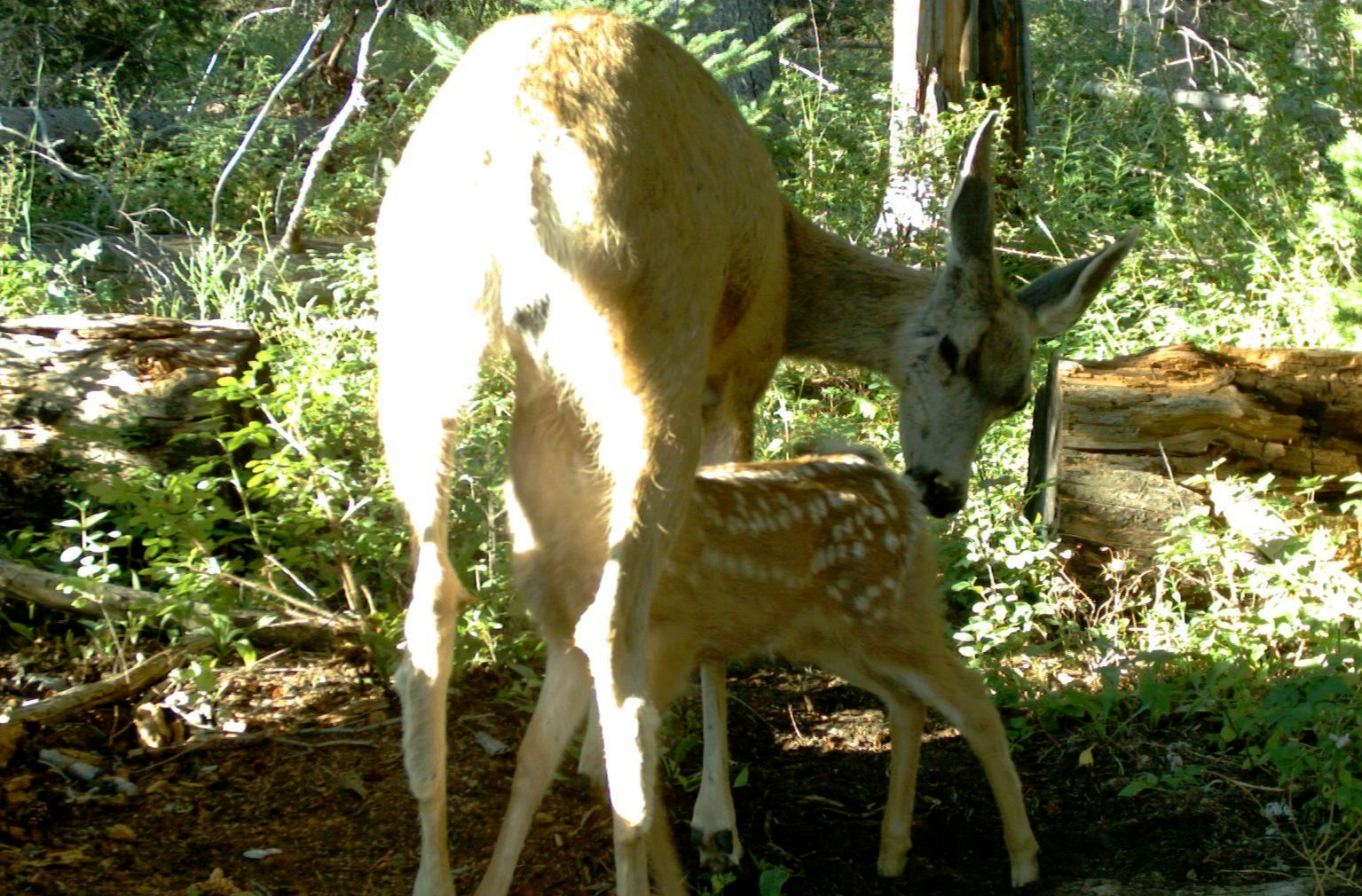
Mule deer with fawn

Since I was snowed in and could not attend the public meeting, I spoke directly with the G&F biologist Tony Mong. Hard winters, and especially 2016, was acknowledged to be a major factor in the decline. I also found out that these two herds have never been robust, for reasons scientists have only recently discovered why—long migrations. In the last few years, these deer have been radio-collared as part of the Wyoming Migration Initiative. Researchers found they undertake a very long migration twice yearly into and out of the Park, among the longest in Wyoming mule deer herds. That alone takes its toll. I asked Mong if there had been a study on the low doe/fawn ratio to determine all factors. “Not yet.”

The following week I saw snowmobile tracks behind a locked Forest Service gate (foot traffic is allowed, though not vehicular traffic) that leads to winter elk habitat. I followed the tracks and found Wildlife Services (WS) was laying out bait on a small private inholding that’s surrounded by Forest Service lands. This is high country with windswept meadows, an area that bull elk especially like to frequent during winter months.

DSC01896.JPG

Some friends that were shed hunting told me WS was baiting for coyotes, then planned to return and helicopter shoot them. These efforts to kill coyotes in this area will continue on foot through June, although our deer leave the valley late April/early May for their migration. The WS coordinator for Cody told me a dozen coyotes were killed by helicopter last week.

Coyote hunting

Coyote hunting ground squirrels

Concerned, I again spoke with Mong. He told me G&F usually likes to do controls where deer drop their fawns, but these deer fawn in the Park or in wilderness so they cannot do controls there. This was their best shot, literally. Who was funding this? Not Game and Fish. Private sportsmen organizations, at least one of them from Pennsylvania.

Mong’s explanation made no sense. These coyotes weren’t even the ones living in the fawning areas, so why the effort for little to no return? Even the WS chief told me they might save 20-40 adult deer this year from predation out of the 2,900 in the herd.

coyote

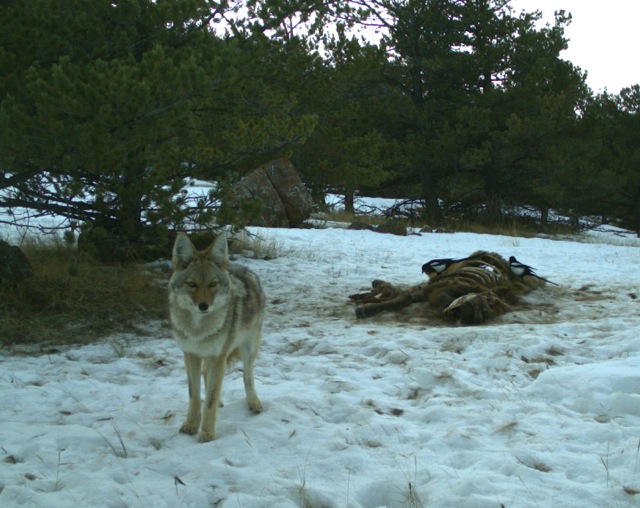
Coyote on wolf-killed elk carcass

Coyotes in Wyoming are considered predators and don’t come under the purview of G&F, but under APHIS, Department of Agriculture. That means they are the easiest targets. Next though on the predator list, would be mountain lions and their three year review is coming up this year with the G&F Commission. The zone that encompasses both herds has a consistent yearly quota of 20 lions and is supposed to be a  “Source” zone for lions, which means exactly what it says (Source, Sink, and Stable are the three types of management for mountain lion zones in Wyoming). And I have to wonder if what’s next will be hunters crying out for more wolves to be killed in our zone which is a trophy hunt area next to Yellowstone?


Obviously there are a lot of factors that control deer populations, weather and habitat probably being the most significant. As these deer migrate into the Park, surfing the spring green wave, quality of habitat is of special importance. One biologist reminded me how the ’88 fires created lush habitat for deer and elk. Now, thirty years later, young trees have crowded out many of those areas. And massive beetle-kill has created forests of impassible downed timber.

Beetle kill

Beetle-killed white bark pines dead on high trail in the valley

Panthera Teton Cougar Project recently published a timely study on this subject. Mark Elbroch and his team looked at how age structure in mountain lions determines food preference. The PTCP found that younger lions tend to specialize on smaller prey and deer. While cats five years and older specialize on elk. His conclusion:

Since younger cats specialize on deer, rather than elk, heavily hunted populations of pumas may put more pressure on deer populations than an un-hunted population with a higher average cat age. (Elbroch’s emphasis)

Another long term study was done in Idaho from 1997-2003 where researchers systematically targeted removal of coyotes and mountain lions in order to grow a mule deer population, one which had similarly low doe/fawn ratio as in my area. The study increased hunting on lions and coyotes, employed WS to kill coyotes winter through spring, targeted coyote killing in fawning areas, and decreased human hunting on deer. In other words, it was very intensive as to predator control along with other factors analyzed. Their results in a nutshell:

Our experimental efforts to change mule deer demography through removal of their 2 top predators had minimal effects, providing no support for the hypothesis that predator removal would increase mule deer populations…Population growth rates did not increase following predator reduction as predicted.

Isn’t it time we applied hard science to agency decisions when it comes to predators instead of bowing to non-scientific, knee-jerk reactions as a public relations ploy for pleasing the hunting community that agencies are “doing something”? Interestingly, I met with our Wildlife Services director to ask about the scope of this project. He acknowledged habitat and weather were actually the foremost critical factors in ungulate population numbers. “But unfortunately, predators are the low-hanging fruit.” His words, not even mine.

How the Eastern U.S. Puma was exterminated

This excerpt, edited out of the final version of my new book Ghostwalker: Tracking a Mountain Lion’s Soul through Science and Story, is a quick history of how the mountain lion was exterminated from the eastern U.S. due to attitudes brought by European settlers.


Europeans had long since removed their own top predators, and from the beginning of stepping foot on new soil, they carried with them an attitude of removing wolves, bears, and cats in the New World as well. With their arrival, a dark chapter began for the mountain lion, and all large predators, in North America.

As early as the late 1500s, barely a century after the Spanish stepped foot in the Americas, Jesuit priests in California were offering a bull for the killing of a cougar.  The first recorded cougar bounty on the East Coast was in 1680 and by 1742 Massachusetts followed suit. In early America, these new inhabitants feared and loathed lions, wolves and bears. Stories were spun that cougars were malevolent, evil, even supernatural beings that killed wantonly. Europeans brought their pigs and cows into the New World under a silent compact that they would flourish. And indeed the domestic animals did thrive, in the marshlands, in the oyster beds of coastal New England, and in the newly cleared forests. Euro-Americans left behind a homeland where African lions had been exterminated centuries before, and wolf extermination began in earnest after the Black Death in the mid-1300s. By 1684 in Scotland, and 1770 in Ireland, wolves were gone, while the rest of European wolves quickly followed. Now the colonists were confronted with a wide new array of predators, and their stance was stanch that extermination without mercy was their God-given right.

DSCN0978.JPG

Wolves, who traveled in packs, and howled across the countryside, were easily spotted by men who carried with them the folklore and prejudices from the old country. Because of this, they received the most visible and ongoing persecution. Cougars, on the other hand, with their secretive, surreptitious nature, received less attention in lore but were persecuted and eliminated none the less. A story from Jon Coleman’s Vicious illustrates not only the settlers relentless cruelty towards wolves, but also their attitude towards all predators, from the largest to smallest meso-predators such as raccoons and fishers. On the Maine coast in the 1660s, a group hunting for waterfowl along the beach happened upon a wolf. Their dogs, led by a large female mastiff, chased after the wolf up the coastline and pinned it down by the throat.

“The hunters bound the animal’s paws and carried him home swinging ‘like a calf upon a staff between two men.’ That night, they unleashed the predator inside their living room. The beast sank to the floor. No biting, no snarling, he just slouched there, staring at the door. The men tried to rile him up with the dogs, but the pack was listless and uninterested, too worn out to care following that afternoon’s long chase. Their evening’s entertainment ruined, the hunters took the wolf outside and crushed his skull with a log.”

Individuals in early America who took matters into their own hands, enjoyed weaving tales that celebrated their valor, and manhood, while also characterizing the animals they killed as vicious and aggressive to bolster their reputation. As more people arrived with their livestock, individual efforts were soon not enough. Circle or drive hunts soon emerged in eastern frontier towns. These drives killed many more animals in a shorter period of time with less effort. Some of these drives were duly recorded.

img_0032.jpg

In 1753 citizens of three surrounding villages in Massachusetts combined forces to rid the forests of wolves and other predators. In 1810 in Vermont, a large group of men, women, and children used an ever enclosing circle to capture and kill six wolves. Local papers and fliers announced these drives, asking citizens to turn out with the hopes of killing sheep-eating predators. These early hunts laid the groundwork for the ritual of circle hunts throughout New England. The preferred method was a ringleader would send out an invitation to the men living in the surrounding areas. A description of one of these drives included over 400 men, advancing to the center “under the direction of the local militia officers. When the hunters could hear the shouts of their cohorts across the circle, their commanders ordered a halt….the best marksman among them, entered the ring and killed the wolves and foxes trapped there. The farmers scalped the wolves and marched to the town clerk’s office to collect the bounty.” Just as colonists came together for barn raising, and other tasks done as a community effort, the circle hunt became part of the communal tradition: first build the cabin, then clear the woods of predators

A vivid accounting of a circle hunt took place in the woods of Pennsylvania in 1760. Black Jack Schwartz organized two hundred townspeople into a drive so wide it practically encircled the entire county. Men armed with guns, fire, and noisemakers created a circle thirty miles in diameter, slowly driving all the game towards the center, then began shooting indiscriminately for several hours. A few terrified animals escaped the ring, yet the final tally revealed a slaughter of 41 Panthers, 109 wolves, 112 foxes, 114 mountain cats, 17 black bears, 111 buffalo, 98 deer, and more than 500 smaller animals. The animals were skinned, the bison tongues taken, and all the carcasses were heaped in a pile “as tall as the tallest trees” and burned. The stench was so dreadful that settlers vacated their homes for over three miles. Black Jack’s reputation with the Indians of the area, who only killed game as needed for food and clothing, was so unpopular after the drive that he was ambushed and killed while on a hunting trip. The last of these drives was held in 1849 in Pennsylvania.

IMG_0292.JPG

On the Pacific coast, the Spanish tradition of roping grizzlies and pitting them against bulls for sport is well-documented. These bull-bear fights included betting and even after-church festivities in arenas built specifically for the sport. In California Grizzly Storer and Tevis describe a bear-panther fight near Big Sur that took place after California was admitted to the Union. The gold rush brought in hundreds of thousands of new settlers, and with the arrival of these new residents, grizzlies were being killed in greater and greater numbers. The Spanish bull-bear spectacle continued for a few years until the dearth of bears caused the sport to dwindle. The event in 1865 was described by a young Frank Post who witnessed the event when he was only 6 years, yet never forgot it.

“The lion, which seemed to have no fear, leaped onto the bear’s back and while clinging there and facing forward scratched the grizzly’s eyes and nose with its claws. The bear repeatedly rolled over onto the ground to rid himself of his adversary; but as soon as the bear was upright, the cat would leap onto his back again. This agility finally decided the struggle in favor of the lion.”

The old growth hardwood forests of the East were cleared so quickly that by 1800 residents of the Hudson Valley in New York worried about the scarcity of firewood. By the mid 1800s, from 50% to 90% of the eastern landscape had been cleared for agriculture. Game were so diminished that even by 1639 hunting seasons were closed. Between habitat and food loss, along with human persecution, cougars were effectively eliminated east of the Mississippi River by the mid- to late 1800s. The rugged, arid West and Southwest remained as the only suitable hiding places and cover for mountain lions.

rcnx0004.jpg