• MY BOOKS ON WILDLIFE, GARDENING AND MORE

  • Coming Fall 2024. Pre-order and use code 6AF24 for a 40% discount

  • The Wild Excellence

  • Award winning ebook on DG Primer

More Mountain Goats of the Clark’s Fork Canyon

I took a leisurely hike the other day with a friend.  I wanted to return to a circle of rocks overlooking the Clark’s Fork Canyon and the river below.  The rocks were piled on a boulder precipice, a strange place for them.  They were large, obviously put together by people, big enough for one person to sit inside and get out of the wind, but made no sense as a blind for hunting or a camping spot.

Rock circle big enough to sit in

My neighbor had once told me he’d found places among these rocks at edges where Native Americans had made smoke signals.  I thought I’d take some photos of this rock circle and show it to him.  As I was photographing, my friend noticed a trail down to the river.  Its almost impossible to get down the sheer cliff walls most places, so this was a great find of a fairly easy access spot.  Maybe the rocks were cairns marking this?

We noticed two goats, a mother and her yearling climbing up the rock precipice nearby.  This was unusual, because both of us had only seen goats on the other side of the canyon, and in more inaccessible places.

Mother goat looks back to her yearling: "Catch up" she says.

We tried to travel out of their way and hiked through a small gully.  Looking towards the end of the swale, we spotted about 15 goats, happily grazing on the flats.  I was surprised at the size of the herd and the fact that they were hanging around, not on the cliffs, but on the bench.  Still, we were close to the very edge of the plateau; an edge that suddenly drops 1000′ feet straight down.  That’s what they usually like.  

I took some video you can watch here.  The wind was howling so the camera’s kind of shaky.

We watched the goats for a while, found some of their fur as they’re shedding now, and ate our lunch overlooking the canyon near the edges they love so much.  Those goats aren’t native to here, but they are Rocky Mountain goats, and this is the Rockies, so… go figure.

Mountain goat attacks and other anomalies

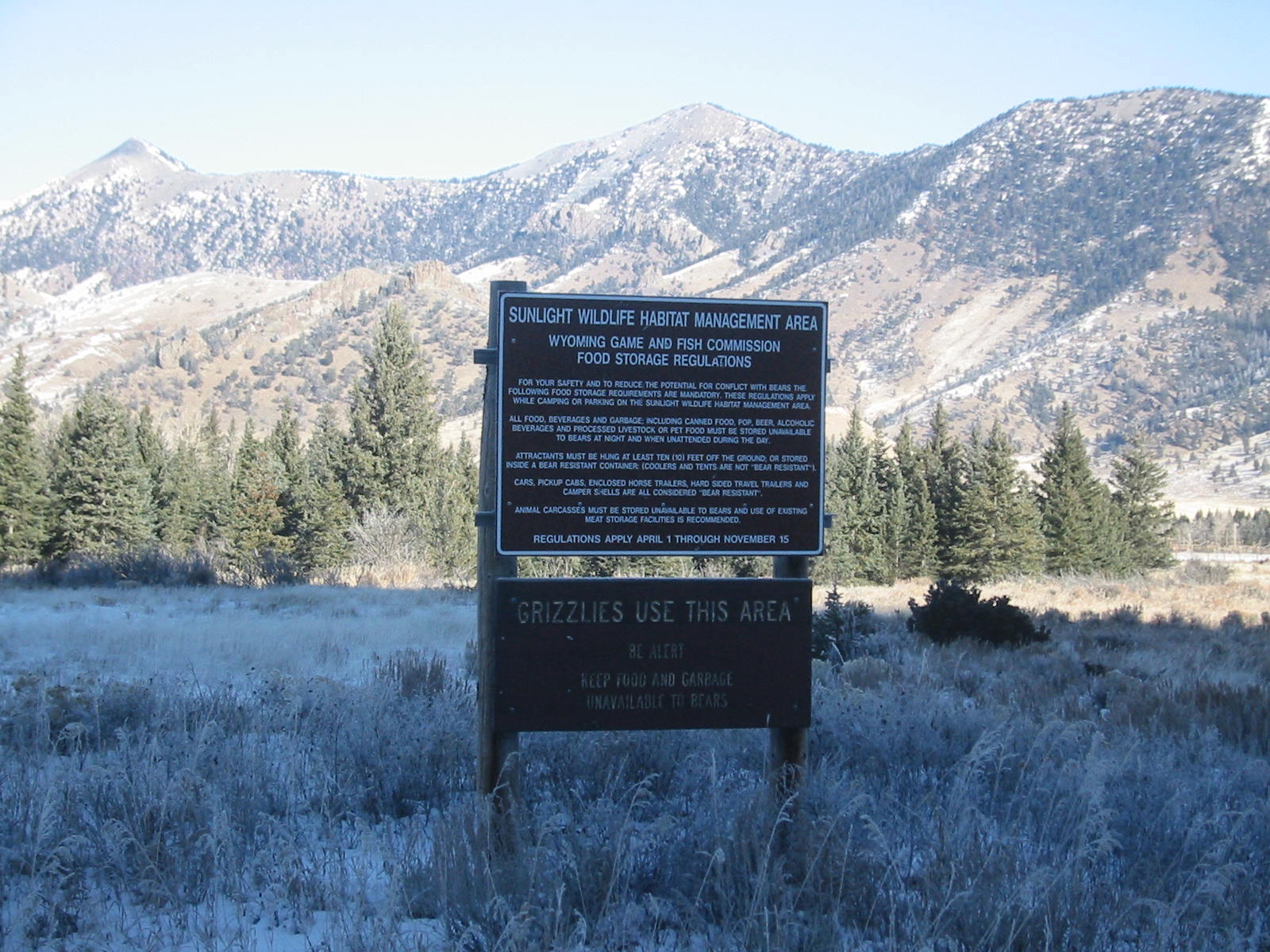
Do we usually think of mountain goats as dangerous animals?  Should we put up signs for these goats like I see here in grizzly country, with warnings for hikers to carry pepper spray even when grizzlies aren’t in the environment?

Do we need signs like these for all wildlife?

Today I was at the museum where I volunteer in their natural history lab.  My boss, the assistant curator said “Rocks would have been a good defense.  He should have thrown some rocks.  I always carry one or two when I hike.”  My boss is a seasoned veteran of wildlife, a lifelong hunter and student of nature.

The truth is there are plenty of wild animals that get aggressive given their mood and circumstance.  I’m more wary of moose than mountain lions, or of bison than bears.  Elk or deer in rut can be mighty crazy and aggressive.  Carrying ‘bear spray’ in general is a good idea.  Some people like to carry a gun when they go out.

We don’t really live with wildlife any more.  They are around, mostly in the shadows around cities and suburbs.   Or, when hikers go out in the national forests and National Parks, most trails are so crowded with people we don’t give large wildlife a second thought.  In general, most of us are more aware and know how to handle ourselves in questionable neighborhoods in cities than in the outdoors.  I certainly have more confidence using an ATM in a bad neighborhood than I do in carrying myself and being alert in nature .  In fact, most of the time when I hike with friends in areas other than grizzly country, we all fall into a chatty and fairly unconscious socializing mood.

Living close to Yellowstone, where no hunting has occurred for over 100+ years, animals large and small are easily visible from the road.  And lots of incidents occur every year.  I don’t think it’s because those people forget these are wild animals, I think it’s because they have no idea what is a right relationship to wildlife.

For instance, one early May in the Lamar, the valley looked like the Serengeti, with lots of predators and prey visible.  I watched a wolf fishing in the Lamar river about 100 feet down a hillside from the road.  There were several people watching from the road while this wolf caught a fish, then carried it over to a sand bar a bit further from the road in order to eat it.  A tourist just had to have a better photo, so he ran down the hillside and attempted to cross the shallow river, scaring the wolf away.  Rules say to stay 100 yards from a wolf.  This man was attempting to get within 25 feet!

In that case the wolf ran away and I thought:  this wolf can’t go have lunch at a fast food restaurant like this tourist can.  That man was interfering with this wolf’s opportunity to eat.

So what is the problem here?  The problem is that wildlife have become so abstracted from our everyday existence that they are an oddity, a rarity, something quite out of the ordinary.  And unless we’re wildlife biologists or have made a career of studying animals like my boss at the Draper, most animals are living creatures that we don’t really understand anymore, can’t read their signs and moods, nor can we read our own instincts of what is dangerous and how to defend ourselves in the natural world.  As a culture, as a people, we are several hundred years out of time.

Mountain Goats of the Clarks Fork

Mountain Goat from jasperjournal.com

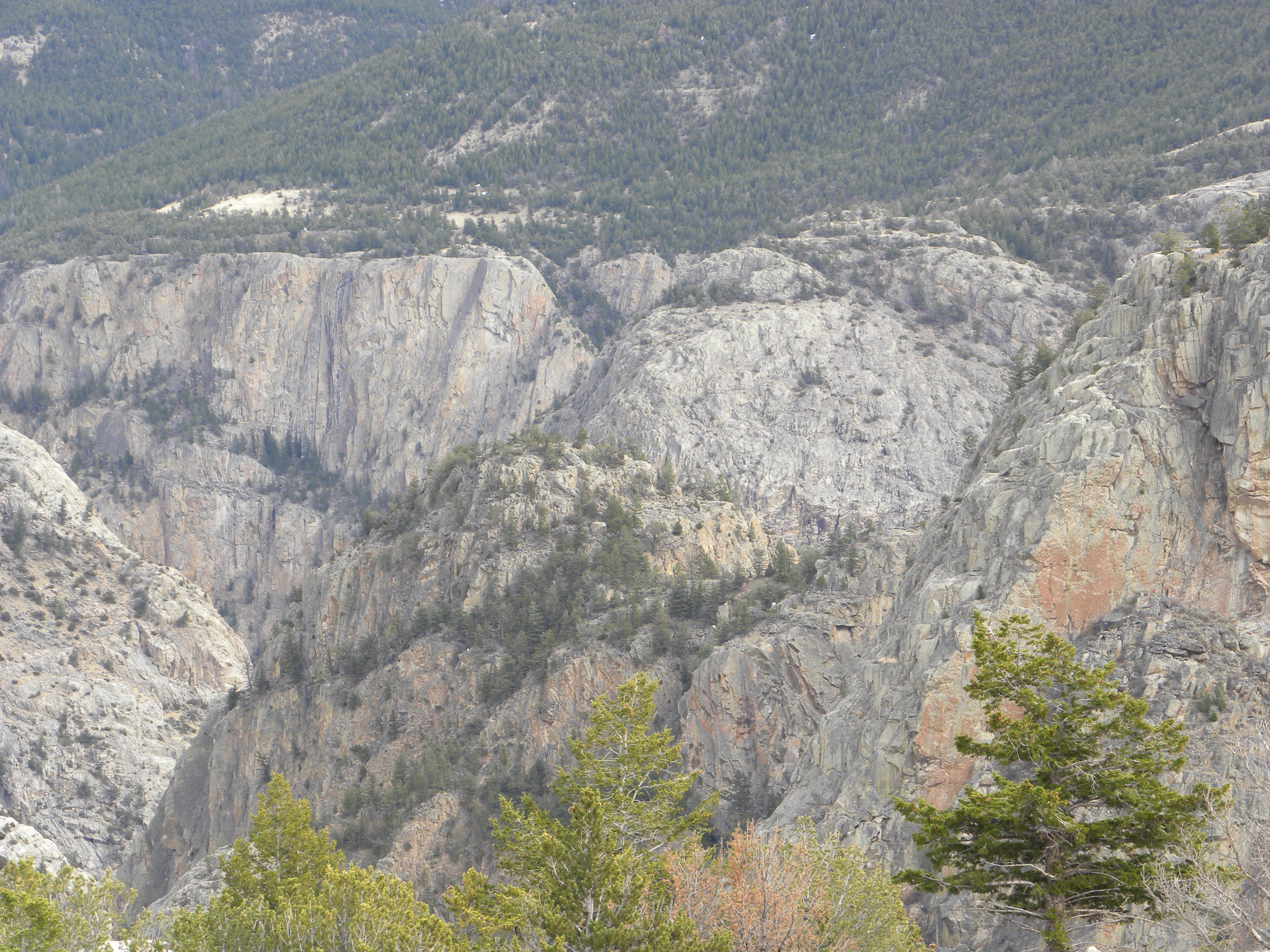
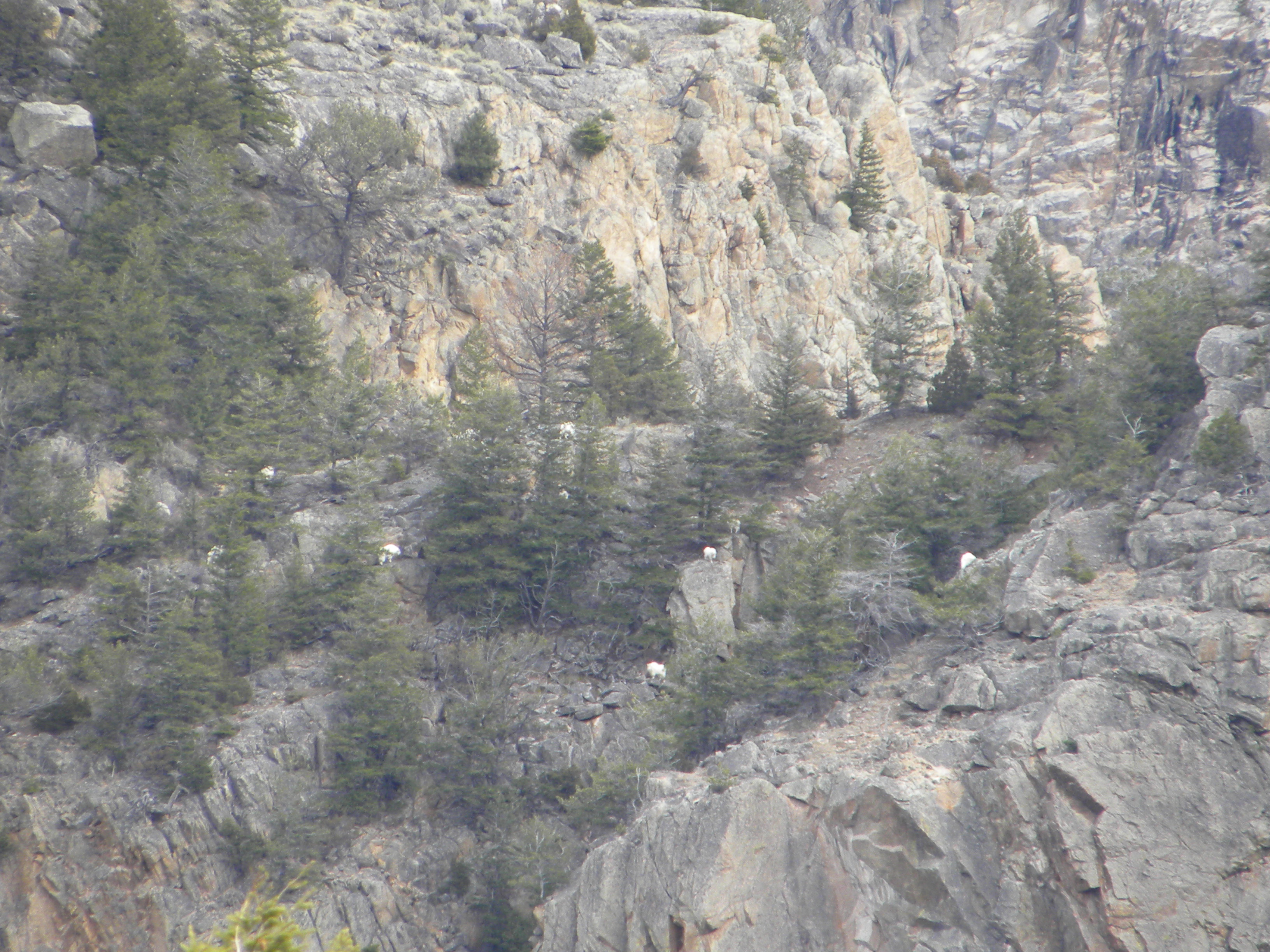
Yesterday I took a walk along the plateau above the Clarks Fork ravine.  The edge is a sheer 1000′ drop tot he river below.  I sat and glassed for the mountain goats that I’d heard ‘hung’ around the cliff edges.  Almost ready to give up, I suddenly saw a small white dot that looked like snow.  I watched it a while and it moved like a white ant.  Pretty soon there were a dozen of these small white dots coming in and out of the trees, hanging on cliff edges that you and I wouldn’t dream of going near.  All I could think of was …”I wanna be a mountain goat!”  Looked like lots of fun, especially to a person like me whose afraid of heights.

The mountain goat controversy remains strong.  Like the fallow and axis deer in Point Reyes that the National Seashore wants to shoot and get rid of, Yellowstone wants to get rid of them.  They are an ‘invasive’ around here, planted by sportsmen for the hunt.  But unlike the Fallow deer which are not from this continent (from India), Rocky Mountain mountain goats do inhabit the high elevations of Montana, Idaho, Colorado, and further north.  Very few prehistoric traces of mountain goats have been seen in these parts, and first hand accounts are few.

Personally, I like them and like seeing them around, especially considering that they are native to areas west of the Park.  It is not inconceivable that they once were around the Absarokas and Beartooths.  That is completely unlike the Fallow deer, which were bought from the San Francisco Zoo in the ’40’s and introduced.  Apparently Rocky Mountain mountain goats were introduced into the Cascades, far out of their native range, with very detrimental effects.

I’m all for eliminating invasive species that ravage the ecosystem and compete with the resources of the natives.  But as long as they are not competing too much with Bighorn forage, I wouldn’t mind keeping them around.  They were a thrill to see.  Gotta figure out a way to get a closer look.

The precipice they are on is in foreground

I counted at least 10 in the area

Look for little white dots!