• MY BOOKS ON WILDLIFE, GARDENING AND MORE

  • Coming Fall 2024. Pre-order and use code 6AF24 for a 40% discount

  • The Wild Excellence

  • Award winning ebook on DG Primer

Grizzly Bears and Delisting

It’s pretty well known that unless you see a grizzly with cubs, its extremely difficult, if impossible, to tell male from female grizzly bears. Recently this was confirmed to me on a trip to Alaska to bear watch. We flew to a small lake contained within the vast wilderness of Lake Clark National Park. The flight took about an hour leaving from Anchorage, landed on the lake, where about fifteen of us boarded pontoons and spent the day circling the lakeshore watching grizzly bears catch salmon.

This image has an empty alt attribute; its file name is img_8817.jpeg
Mom with 2 cubs fishing for salmon

Because these bears are in hyperphagia and also very used to the boat, we could approach quite close, say fifty feet away while the bears fished. Our boat captain was a veteran with thirteen summers under his belt of guiding and watching these bears. He knew the best spots around the lake where the fishing was good for the bears. And he told us something interesting. When we’d see a single bear (versus a mom with cubs), he had no way of knowing if that bear was a male or female. There was no size comparison to use or any other metric, and he’d been watching these bears for over a decade. In all, we saw over thirty bears in one day.

This image has an empty alt attribute; its file name is img_8812.jpeg
Bear catches a salmon
This image has an empty alt attribute; its file name is img_8778.jpeg
Pontoon boats left. This small lake was where we watched grizzly bears fishing all day

That brings me to the status of grizzly bears in the Northern Rockies. The U.S. Fish and Wildlife Agency is setting the stage to delist the Great Bear next year. Wyoming, Montana, and Idaho are actively pushing for a hunt. The local media is telling stories to encourage a hunt. (“While he doesn’t want grizzlies gone, he thinks hunting them would control their numbers and deter them from attacking people and livestock.”)

If delisting didn’t automatically include hunting, I’d be all in. We delisted bald eagles but don’t hunt them. The narrative around “a hunt” is that grizzly bears will “learn” to stay away from humans, or as the quote above, “control their numbers”.

This image has an empty alt attribute; its file name is screenshot-2024-09-27-at-5.37.17e280afpm.png

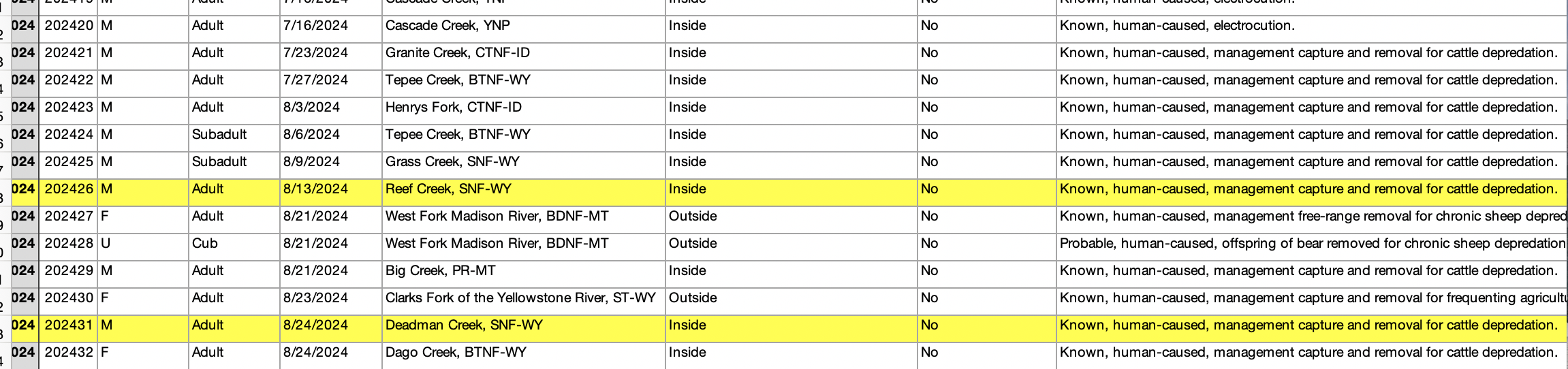
Let’s take the second one first, “control their numbers”. Females don’t begin to have cubs until their 5th or 6th year. Cubs are born in the den the first winter, then stay with mom for 2 more winters. That brings a reproducing female to almost 10 years of age before she can hopefully replicate herself with another female. Grizzlies were the first mammal listed under the ESA in 1975. Fifteen years later, in the mid-80s, most biologists felt they were going to go extinct in the Greater Yellowstone Ecosystem (GYE). It took almost fifty years to go from about 200 grizzlies in the GYE to 1000 bears! Every year about fifty grizzlies are killed for a variety of reasons, mostly human caused (euthanized for livestock depredation, killed by hunters, killed by other bears. 53 so far this year 2024). Add a hunt to that and we can very quickly decimate the population once again.

This image has an empty alt attribute; its file name is img_8808.jpeg

Does killing a solitary animal communicate to other solitary bears to stay away from livestock and human? There’s a sub-adult grizzly that’s been foraging clover this fall in the meadow on the Game Management Area. You can drive your car and watch that bear. If you drive too close, he runs away. But if there’s a hunt, one can legally shoot from a dirt road in Wyoming and he’s certainly close enough, and busy enough foraging, that shooting him would be like shooting fish in a barrel (which is how I see grizzlies in the fall, very absorbed in rooting around because they are in hyperphagia). An easy target for a bear hunter and would killing that sub-adult teach other bears a lesson? Of course not.

Do we need to control grizzly bear numbers? Besides the fact that in the GYE we are already killing over fifty bears a year without a hunt, if GYE grizzlies are to survive long term, they MUST connect naturally with bears in Montana (Northern Rockies). So far they haven’t done this. Wyoming’s plan is to keep killing bears on the edges, the very place where grizzlies must venture in order to connect and foster genetic diversity. Montana’s “plan” is to fly bears into the GYE to maintain genetic diversity, a completely absurd idea!

Anyone who has watched grizzly bears, and any bear biologist will tell you, that these animals are as smart (or smarter) than the Great Apes. They are on par with humans in terms of shear intelligence. Hunting them is simply painful and mean-spirited. Over 100 tribes signed a treaty against a hunt. Grizzly bears are sacred to these tribes. Moving “problem” bears to tribes that want them make more sense. As well as…

  1. Protect your livestock, feed and garbage
  2. Most maulings take place in the fall when hunters are prowling quietly through the woods and bears are getting ready for winter. Carry bear spray and if you are not familiar with hiking/hunting in grizzly country, there are plenty of deer and elk all over this country where there are no grizzly bears. What was shocking to me in this article was that these guys had been charged three times over the last several years. I’ve hiked in grizzly country for twenty years and haven’t had an encounter like they described. I don’t know the details of their situation, but it does make me wonder what they are doing wrong.
  3. I certainly have sympathy for small producers who lose stock to grizzlies on public lands. But public lands are all that our wildlife have and free range cattle should be “at your own risk”, though those risks can be minimized. As noted in my previous post, the ballooning of maximum stock levels on public lands provides a reason for bears to stay low during summer months instead of ranging to higher ground. Are we just feeding these bears with easy prey? There’s been a lot of recent research on non-lethal deterrents. It’s time that the state provides support for that instead of Wildlife Services or direct compensation for losses (grizzly kills in WY are compensated at 3 times the going rate of a cow).
This image has an empty alt attribute; its file name is db231-grizzly-mom-and-cubs.jpg

Public Lands, Grizzly Bears, Cattle

I’ve got a theory. Bear with me as I tell my story.

This last June I was exploring a drainage that burned in the 1988 Yellowstone fires. There’s no trail but I’ve encountered coyotes denning farther up the draw; a place I like to go and investigate. The northeast side of the draw is filling in fast with a thick cover of young lodgepole tree. The ground, however, is a maze of burnt and rotting timber you have to clamber over.

June is when the free-ranging cattle are trucked into the valley. The major livestock producer runs several thousand head of cattle, all yearling males, which he rotates through a range of Forest Service allotments throughout the summer. Mid-June is a time when grizzly bears are foraging at lower elevations. By early July, summer heat and the lure of Army Cutworm moths drives the bears to higher elevations. These young naive yearling cattle roaming freely, especially in heavy timber, are easy Spring prey for hungry grizzlies.

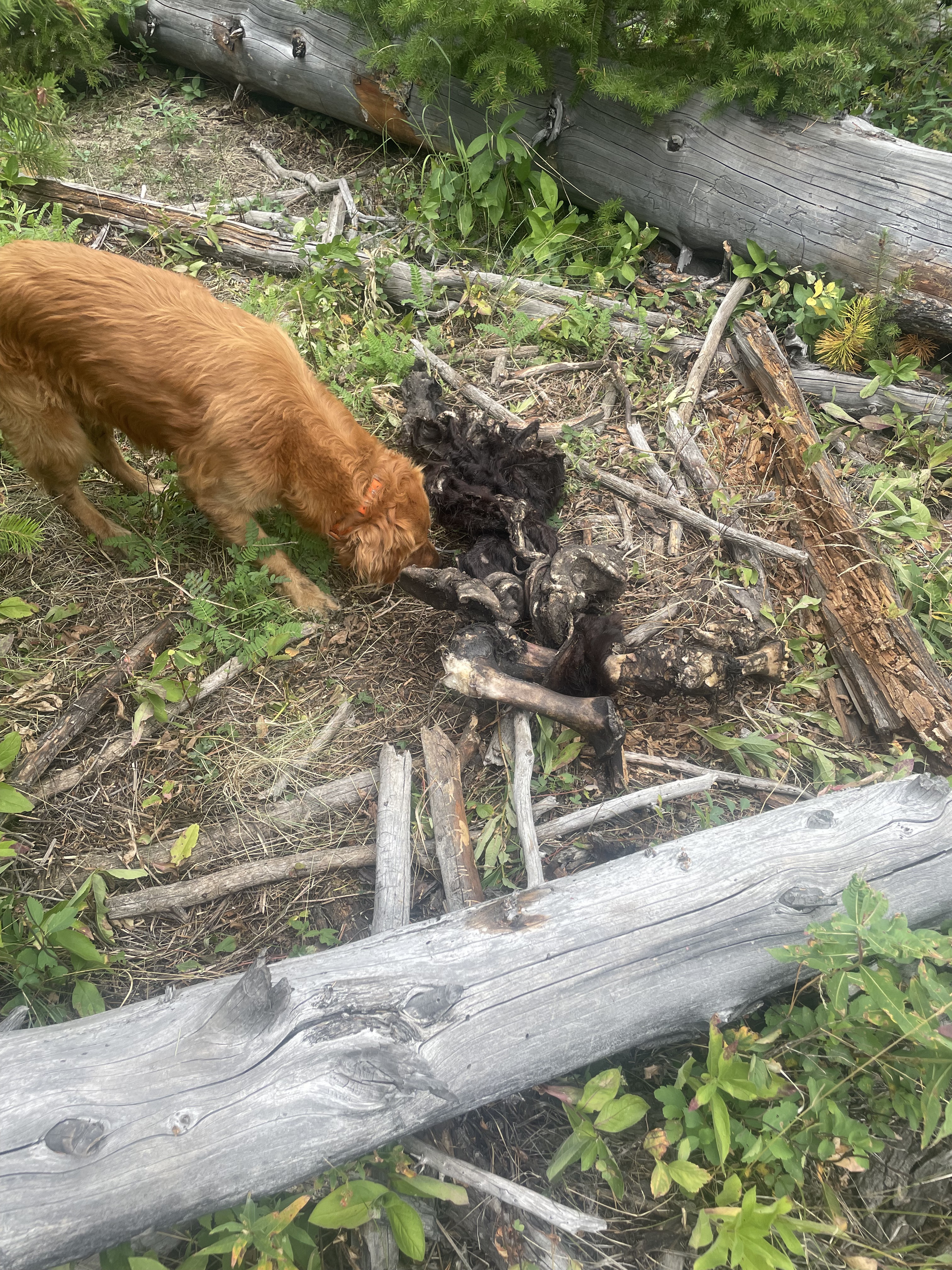
The access to this side draw begins on an open hillside. Right away I notice fresh cow pies indicating that the yearlings have been here recently. As soon as I enter the dense lodgepole pine forest, something didn’t feel right. I pull my bear spray out of its holster, release the safety, and keep my dog at a heel. A large pile of grizzly scat—soupy, wet, and clearly from a meat meal—greets me amidst the tight tree cover. Then a waft of a dead animal fills my nose. The air is still but as the aroma is getting stronger, I can tell it’s coming from somewhere ahead of me. That was my cue to move swiftly to the open meadow on the other side of the creek and high-tail out of there. But I determined to return in a few months to see if what I sensed was correct. Months later in mid-August when I know the bears are up high and the cows are out of that area, I return to see if my instincts were correct. Sure, enough, in short order, after combing the timber, Hintza, my dog, easily locates the dead animal I smelled months ago. Yes, it was a cow. And yes, with all that fresh meaty bear scat, that had been a bear on it.

What was left of the smell from June.

But this wasn’t the first freshly killed cow by a grizzly I’d encountered in the month of June. A few years ago, in an adjacent drainage, I was walking along the gravel road when I saw a strange unnatural hump of dirt and sagebrush. There were drag marks across the road as well. The dirt hump was a covered cow, freshly killed by a bear, one of the most dangerous circumstances you can come across. Bears will defend their kills. The following year and in the same area, the warden rode by on an ATV and warned me I was heading for a dead grizzly-killed cow which he was about to remove. That’s three fresh grizzly kills, a very dangerous situation for a hiker or a horseman. But every summer on hikes I run into dead cattle fully consumed after they’d been predated on—stiff hides with bones scattered.

Those of us who live and recreate in grizzly bear country are instructed to secure our food. I use a bear-proof trash can. Others in the valley keep their garbage locked in their garage. Residents are very conscious of not feeding bears. Yet putting cattle out on public lands in early spring, when grizzlies are hungry and foraging down low, seems akin to putting food out for the bears, especially young naive yearlings. Bears are smart and I’m betting grizzlies here are learning there’s a good source of easy meat. It may even be possible that instead of heading to moth sites and higher elevations, some bears are sticking around throughout the summer. Yearlings who are free-ranging, unfamiliar with the landscape and its risks, are akin to leaving easy food out for bears. That linked article discussing two relocated bears for killing cattle says “bears that are determined to be a threat to public safety are not relocated and might be killed.” But who is creating that risk? If cattle, like our garbage, are not managed correctly, we humans only have ourselves to blame.

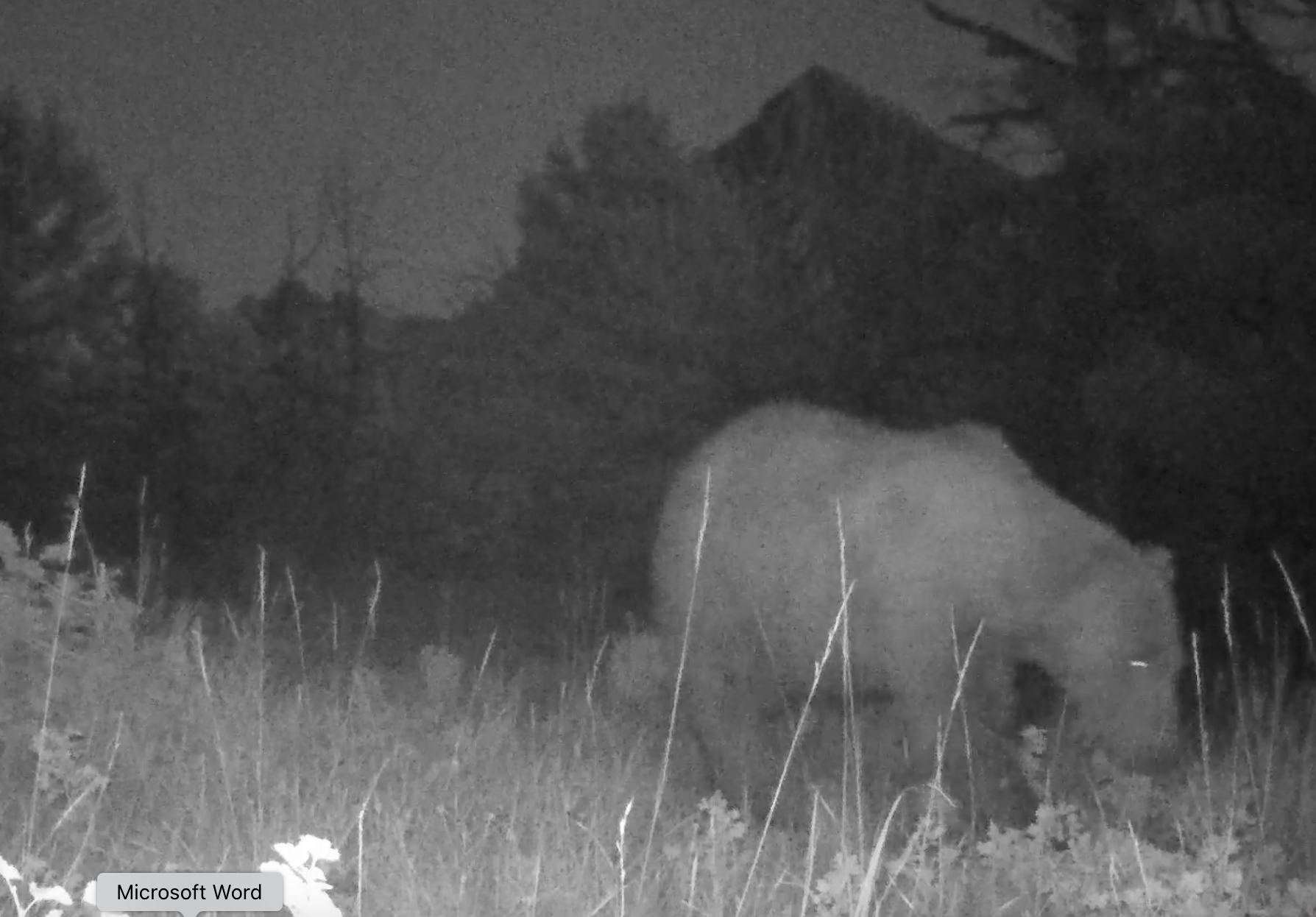
Caught this grizzly on my camera August 2, 2024. I know this bear. He usually comes around in the fall. Here he is below in 2016 early September on ripe chokecherry bushes.

If cows are going to be free-ranging on our forests, (and I feel that livestock on public lands should be “at your own risk” as these are the only lands wildlife have) consideration needs to be given to where and when. Don’t put cattle out in June when grizzlies are down low and hungry. As an alternative, livestock trucked in in June can be placed in areas that are highly visible with a cowboy checking them frequently. Free-ranging cattle in highly populated bear areas are not only endangering the bears (Wyoming has a 3-strikes rule) and livestock, but also hikers, cyclists, horse people and other recreationists.

Two grizzlies killed by USFWS for cattle depredation in my area this summer. We have moth sites and it is unusual for bears to be down so low in August instead of at high elevation moth sites nearby. On one of these August cattle predation sites, there were four grizzlies on the carcass!

So are we training grizzlies to hang around while the pickings are easy, akin to leaving garbage out for them? I think the Forest Service, who manages timing and allotments, can do a much better job for the bears, the cattle and the people. Ironically, jurisdiction is split. The Forest Service does the range management, but it’s the Game and Fish, through state mandates, that pays producers compensation for cattle killed by grizzly bears. But I think it all comes back to the first defense of proper range management to reduce cattle and grizzly deaths. A radical thought would be to have no free-ranging cattle in grizzly country. Why not! But if the status quo must continue, then shift and limit the timing of when and where cattle are located across the forest.

New Release: Ghostwalker: Tracking a Mountain Lion’s Soul – Expanded Edition

I’m very excited to announce the fall release of Ghostwalker: Tracking a Mountain Lion’s Soul through Science and Story published through University of Nebraska Press. This is an expanded edition of the independently published version in 2018. So what’s new?

  1. A new chapter on mountain lions and desert bighorn sheep in the Southwest, a very sticky topic. Bighorn sheep are always teetering into the vulnerable category due to diseases transmitted by domestic sheep that have infected all bighorn herds throughout the Western states. But desert bighorn, who live in isolated sky islands with small herds, are particularly at risk. Predation from mountain lions is targeted as a high risk for desert bighorns. I explore and contrast management attitudes and policies towards mountain lions and bighorns in three states in particular: New Mexico, Arizona, and California. I spent time interviewing and traveling throughout the SW to better understand this gordian knot of a problem.
  2. California! So many new things are happening with mountain lions in California. The California chapter is completely rewritten with a series of new interviews. Biologists Quintons Martins who is doing a study in Sonoma County fills us in on North Coast issues, while Justin Dellinger with CDFW dives deep into isolated populations throughout the state. Kristeen Penrod provides maps of connectors needed throughout Southern California in order to save mountain lions for the future.
  3. What’s happening out there that’s new for mountain lions? We need a new model to replace the North American Model of Wildlife Conservation. I explain what it is and why it needs updating. I speak with Wildlife for All, an organization determined to change the present wildlife management model to be more inclusive. Panthera is studying non-lethal predator protection methods in California that will help ranchers throughout the West. Plus new information on the value of mountain lions for mitigating climate change and as an indicator species.
  4. New stories sprinkled throughout the book along with updated and new information on mountain lion research.
  5. Lastly, almost every photo in the book has been replaced with new ones. Many thanks to several photographers who are doing camera trapping with high-end equipment. Although I have hundreds of photos of mountain lions from over 14 years of using store-bought trail cameras, these images, though great quality for the internet, do not reproduce well in a book. Several professional photographers generously donated some extraordinary photos that will appear in the new edition. Unfortunately the paperback will not be in color.

That’s a summary of what’s new. I’m so pleased to have several new endorsements for this edition.

Author Dan Flores writes:  Leslie Patten has written the most fully-realized mountain lion book I have ever read. Cutting-edge science and interviews are her bedrock, but first Patten is an observer of the lion world as well as a writer whose prose pulls like a river’s current. 

Jim Williams M.S., retired Montana Fish, Wildlife & Parks wildlife biologist and author of Path of the Puma writes: I finished your fantastic book todayYour penchant for unedited and unbridled truth to science is amazing.

Author Ben Goldfarb writes: In Ghostwalker, Leslie Patten braids history, biology, and wildlife management to reveal this elusive cat in all its contradictory glory 

I hope to do some presentations once the book comes out. If you or your organization would like to discuss this, please contact me.

What’s the Story? Cougars, Wolves, Grizzlies

There’s one place in my area where I’ve seen Glacier Lilies, but as soon as the melt starts the access road usually closes due to flooding. Since the weather has been cool, and next week predictions say it will be in the 70s, I decided to check out the spot to see if the lilies are up yet before the road closure. It’s a fairly remote less traveled trail and this time of year grizzlies are down low foraging while wolves are denning. The trail begins at the road’s end with a stream crossing, winds through a burnt valley before turning up a small drainage where the trail heads to a ridgeline pass.

Immediately grizzly tracks began faintly appearing on the dry ground.

When I turned into the forest drainage, the wet ground revealed two grizzly bears. That could only mean a mom and cub. The grizzly cub footprint appeared to be at least a one year old. I became more alert, unlocked my bear spray.

Smaller bear on the left

The area I’d seen the lilies years before was about a mile up the trail near the pass. Bear tracks followed the trail plus revealed a 2 day old scat that said they’d been eating grass mixed with fur.

Closing in on my lily hillside, I found a clear wolf print in the mud. I hadn’t seen wolf tracks earlier on the trail.

wolf track

About 150 yards before the lily area , I came upon what these bears (and wolves) were doing here. An elk kill right by the trail, completely consumed but about a week or less old. Clearly a cougar kill. I searched around the site a bit. No skull, only one leg left plus the spine and pelvis.

What a cougar kill looks like. Rumen pulled out to the left. The fur in a neat circular pattern cut off with the cat’s incisors

What did the tracks and the kill sign say about the story here? Of course, the only thing I can be certain of was this elk was killed by a cougar. But let’s think about what might have happened. Wolves and bears (grizzlies and black) push lions off their kill. With only one leg, and few fresh wolf prints, I imagined the wolves kicked the lion off the kill site, and hauled the other legs off, maybe to their den site over the ridge. The wolves probably consumed most of the elk before the grizzly mom and cub came along (their tracks fairly fresh) to finish off what was left. The fresh wolf track I found was probably a wolf returning to check on any left-overs, and maybe even encountering the grizzlies.

Unfortunately, I didn’t find my Glacier Lilies. Maybe just too early or maybe those bears ate them. But here is some other cool bear sign I found along the trail.

Bears use their claws to strip bark from a tree, then feed on the sapwood by scraping it from the heartwood with their teeth. 

To learn more about mountain lions and their interactions with wolves and bears, read my upcoming book Ghostwalker: Tracking a Mountain Lion’s Soul through Science and Story out this fall University of Nebraska Bison Books. To pre-order a copy and receive a 40% discount, go to this link and use the code 6AF24 

Mountain Lion News

I recently attended a presentation by Wyoming Game and Fish large carnivore biologist Luke Ellsbury on, what else, large carnivores. I was mostly interested to know any results from Justin Clapp’s study on CWD and mountain lions. The field research is done but the analysis hasn’t been published yet. Luke confirmed that mountain lions were definitely targeting CWD deer and elk.

Another study measured the amount of prions in scat from mountain lions intentionally fed CWD infested deer meat. On the first defecation, the meat contained only 3% prions. And no detection on defecations after that. Luke said with these results in hand, the Service is definitely looking at adjusting mountain lion quotas in areas where they want to target reducing CWD in deer and elk. They are also planning on repeating this study with other predators—wolves and bears—and are presently testing CWD meat on bobcats in the field.

The study also corroborated findings from Elbroch’s Jackson study that as lions age they tend to prey switch to elk more heavily. That means if WGF wants to reduce elk CWD through mountain lion predation, reducing hunt quotas will allow more older mountain lions on the landscape. The critical age for prey switching seems to be five years old.

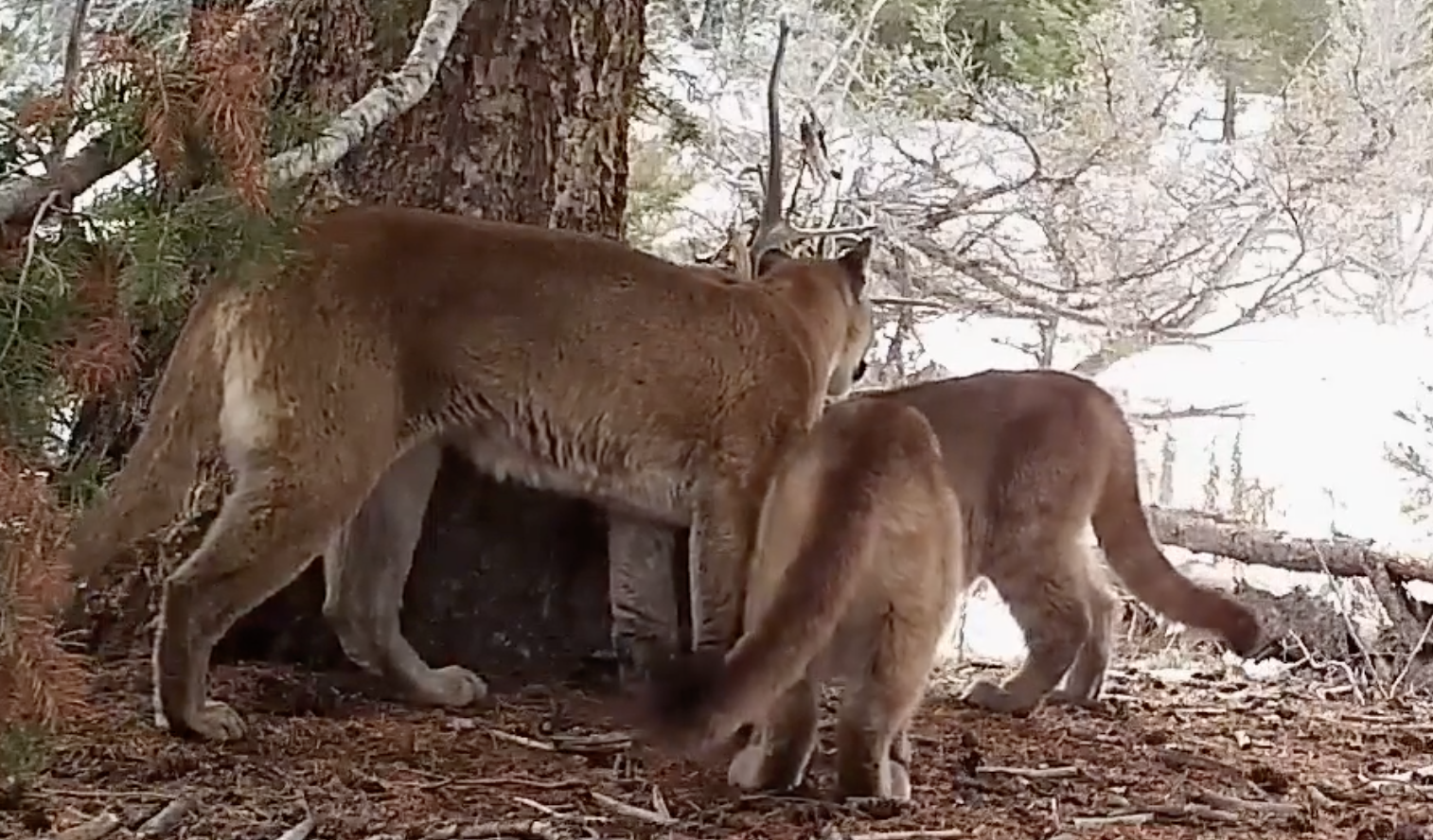
In other more personal mountain lion news, Luke confirmed for me that my one-eyed female lion was not harvested this year. In my area which is the northern end of Hunt Area 19, only one female was harvested this winter. I showed Luke the last video I captured of one of One-Eyed cubs. I thought he looked pretty rough. Luke agreed he didn’t look in good shape, confirming to me that most likely the mother and other cub are dead. And this cub, probably a male because he was always the bigger of the two cubs, isn’t likely to survive either. Cubs under one year old that lose their mother have a very low survival rate as they haven’t developed their hunting skills yet.

Lone Kitten of One-Eye captured early March 2024

Luke told me that this winter one lion was killed by wolves in my area, and that he had a call about another lion recently killed by wolves. Lions in my area aren’t collared, so these would be lions that hunters or hikers encounter and report. We’ve also had one report of a mountain lion dying of bird flu in the North Fork area of Cody.

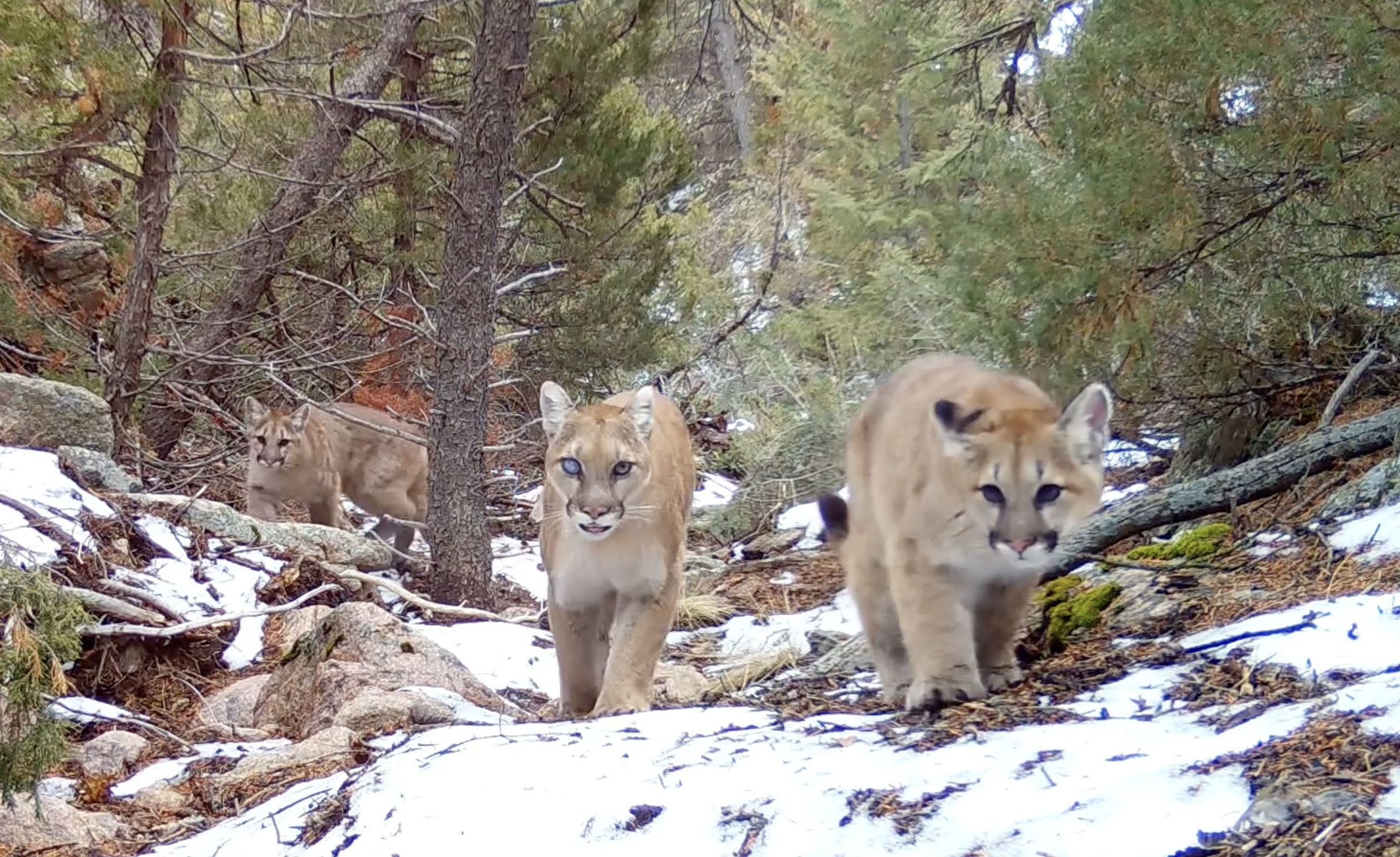
Happier times. One-eye with her family in December 2023

I’ll continue to check cameras and hope to see One-Eye. I’ve followed her since she arrived in my area in 2021 as a young lion. She was probably born with her blindness. This was her second litter and I thought she was going to be really successful. The last time I saw the family together, those cubs looked happy and healthy at probably around seven or eight months old. Life is definitely rough out in the wild.

To pre-order the expanded edition of Ghostwalker out this fall, and to be receive a 40% discount, go to https://www.nebraskapress.unl.edu/bison-books/9781496238474/ and enter code 6AF24

2021 This is One-Eye caterwauling when she first arrived into my valley as a young lion looking for a mate

New Expanded Edition of Ghostwalker

Hi Friends,

I’m very excited that University of Nebraska Bison Books picked up an expanded edition of Ghostwalker to be released Fall 2024. A preview of what’s new:

  • A new chapter exploring mountain lion management for desert bighorn sheep reintroductions in the southwest US. A highly complex and controversial issue, we look at and compare the approach of three states: New Mexico, Arizona, and California. This issue has never been addressed in depth. Mountain lions are dying unnecessarily through egregious state game agency directives.
  • What’s with California these days? The California chapter, completely revised, goes in depth on their problems with genetic bottlenecks in Southern California and coastal areas as far north as Santa Cruz. We’ll explore the findings of the Sonoma County study by Quinton Martins, the recent results of CDFW Justin Dellinger’s analysis, and the enormous task of building corridors and passageways for lions to continue to exist.
  • What’s new in the conservation scene for wildlife? I speak with Kevin Bixby about his new organization Wildlife for All. Panthera’s Veronica Yovovich tells me about their study on non-lethal methods for livestock protections.
  • New stories and updates throughout the book.
  • 23 new interviews with researchers in addition to the 1st edition interviews
  • 22 new photos
To pre-order and receive a 40% discount, use this link and enter code 6AF24

For those of you who haven’t read the first edition, I did several years of research and interviews with prominent biologists working actively with mountain lion research today. The three studies in Yellowstone National Park, a 16 year study in Grand Teton National Park, revealed the secret lives of mountain lions, their interactions with wolves, bears and other wildlife. A full chapter on California, the only state where mountain lions are fully protected from hunting; a look at mountain lions from the angle of trackers; what houndsmen who have worked with biologists have to say; along with how lions care for their young, how they find each other to mate, what a scrape is and more.

I’ll be posting short clips of many of the interviews I did with researchers in the coming months. First interview will be posted here and on YouTube in a few weeks with Sean Murphy, a biologist who worked for New Mexico Game and Fish. He’ll talk about the indiscriminate and ongoing culling of mountain lions by the department in order to transplant desert bighorns.

To pre-order and receive a 40% discount, use this link and enter code 6AF24

California’s North Coast Cul-de-Sac

This is an excerpt from the upcoming expanded edition of Ghostwalker: Tracking a Mountain Lion’s Soul through Science and Story. (University of Nebraska Press, Fall 2024 release)

Just days after my arrival in California, a friend sent me a photo from a door camera of a collared lion in her neighborhood. The lion was standing in a driveway in the early morning hours. Only Dr. Quinton Martins who was running a study north of Marin was collaring cats so this lion had to be one of his. The news media quickly blew up, using the same photo as evidence. Reviewing the GPS data, Dr. Martins told the Press the young male lion known as P36 had crossed busy highway 101 five times. When the cougar encountered the crowded business area of southern Marin, he quickly hightailed it back north.

I met with Martins a few days later, curious what he’d discovered about cougars in Sonoma. Both Sonoma and Marin counties are the end of the road for cougars traveling along the North Coast, but Sonoma County has a larger suitable land base for cougars and more linkages north. Sonoma County is considered an agricultural and farming community, although in the last several decades the area has become more gentrified, with small acreage vineyards that serve as tax write-offs, mega-mansions, and commuters to points south. The semi-rural, mixed habitat region also has a ballooning number of hobby ranchers who own a few small animals like goats and sheep.

Dr. Martins measures a lion's tail
Martins measures a mountain lion’s tail after a capture

From South Africa, Martins was an experienced safari guide with a particular interest in leopards and lions. He became intrigued with the mountain leopards of the Cape in South Africa and began a 10-year research study which contributed to his PhD, learning more about this elusive mountain cat and inventing innovative ways to trap and collar them. In 2016, Martins introduced a mountain lion project to Audubon Canyon Ranch, a local and established San Francisco North Bay environmental non-profit. The proposal was accepted and called Living with Lions Project.

I ask Martins to describe P36’s journey. Martins shows me a map with P36’s GPS pings on them. It looks like a drawing of a billiard game with dots everywhere, some clustered, others far-flung. P36 hadn’t just arrived south into Marin, but previously roamed through three counties looking for a territory to call his own, at one-point landing in a parking lot by the ocean

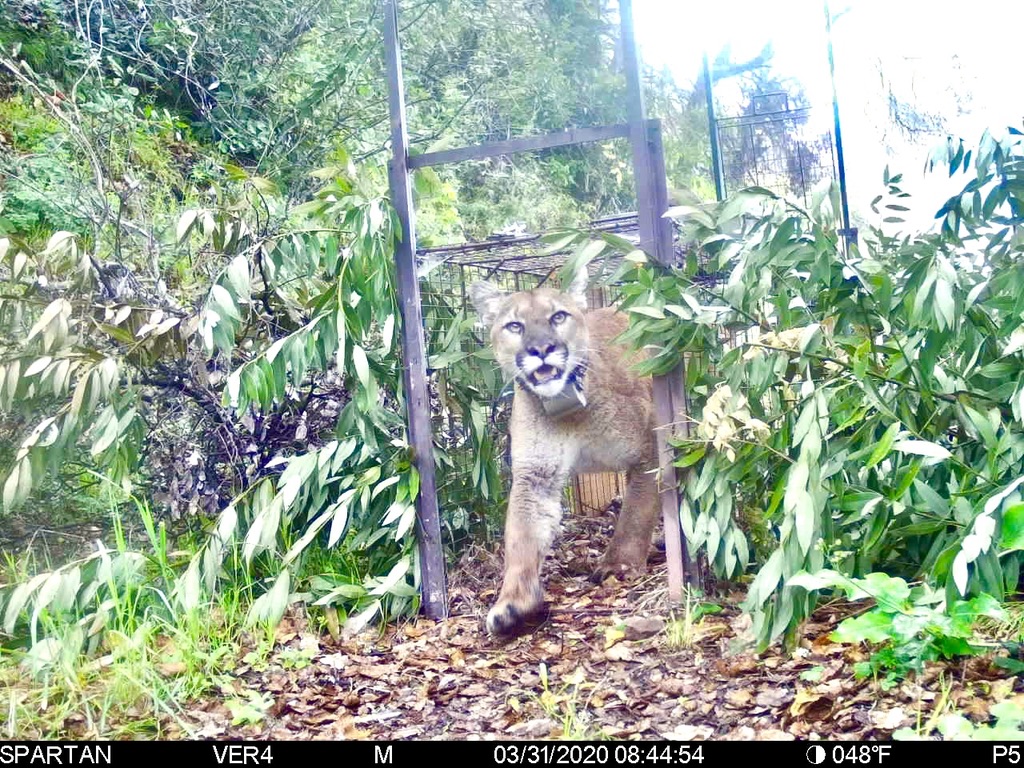
P5. A male in Martins study

“Ah, so that’s the Pacific. Always wanted to see that,” Martins jokes. “Then P36 heads down the coast all the way to Point Reyes, ending up overlooking the Golden Gate bridge. Back tracks and pops over to Tiburon. The last GPS reading indicates he’s hightailed it out of Marin and crossed the Russian River heading back north through Sonoma County.” 

So far P36 has been lucky, crossing busy highway 101 several times without injury. He explored three counties of suitable habitat, all probably occupied by resident males. Like the findings in Santa Cruz, Martins says these young dispersers seem to use sub-optimal fringe habitat while they move about, staying under the radar of any resident males. Dispersers typically use creeks as corridors, killing small prey like raccoons as they navigate to a permanent territory. Habitat near human dominated areas is rich with small prey that cougars can live on.

Releasing a cougar from Martins capture set

“P36, his diet has been amazing,” Martins tells me. “We recorded him since March last year killing 37 deer, 6 wild boar, 2 badgers, an otter and a squirrel. No livestock. And we’ve had him on properties where there is livestock around like calves and he’s made a deer kill right there. You get a day bed reading where he’s walked back through the livestock area, hangs out there, then goes back to feed on the deer he’s killed.”

Given that the North Coast region is still considered an excellent source of genetic diversity, I was curious about the success of Martins’ male dispersers. P36 was doing well, but what about his other cats. Martins shows me a map of his eastern Sonoma study region where two males have successful territories. Considering the majority of suitable habitat in the area is likely already occupied, dispersing males are going to have to head north into Mendocino or beyond.

“There is clearly connectivity in our landscape, which means that any cat can come down here, or get out of here. The key source areas are really important; then ensuring connectivity in the landscape is the next thing. We’ve got all that (in Sonoma County). We’ve got great source populations up north, from Oregon, Mendocino. But cats coming south get to the end of the road in the North Bay area.”

Video of Dr. Quinton Martins talk about his unique system of mountain lion capture will be available in May 2024

The Baseline

In 1996 I was invited to stay overnight at the Nez Perce Patrol cabin in Yellowstone National Park. In the early dawn, I took a walk to the end of the service road. As I peered through the trees, what I saw startled me. In a large clearing was a wolf reintroduction pen. Ten wolves were running around the inside perimeter of the pen. I could hear their heavy breathing. I stood and watched in awe. That intimate moment was my first wolf sighting. Little did I know the magic of that chance encounter would change the trajectory of my life.

Wolf in the Nez Perce pen summer 1996 (NPS photo)

Almost simultaneously, in another part of Yellowstone, several young wolves, pups from the previous year’s reintroduction, were becoming restless. A black female yearling from the newly formed Druid Pack, along with a male from the Rose Creek pack, dispersed to form one of the first packs east of the Park. These wolves may have been following elk that migrate outside the Park in the winter.

Eight years later, I purchased a run-down sixty-year-old log cabin in that same valley where descendants of those young dispersers now lived. That spring was the first extended stay at my new cabin.

Spring weather can be changeable and blustery. Creeks can swell and suddenly the road you traveled on in the morning is impassable upon your return. I decided on a hike up a beautiful drainage surrounded by sandstone cliffs. I didn’t know wolves were denning far up. Alone, I wondered how I’d feel if I encountered a wolf up close. I thought to myself, “I’d be afraid.” On my descent back to the car, a strange hollow sound caught my attention on the adjacent hillside. I found myself within twenty feet of a black wolf. We shared a long moment, then the wolf trotted off. I felt no fear, only an unusual sense of recognition.

We shared a moment

I slowly remodeled my cabin and, in the winter of 2008, I moved full time to my new home. The winter snow revealed the wolves were using dirt roads as an easy corridor. Hearing wolves howl at night was not that uncommon. Encountering wolves on hikes, or watching them feed on kills from the road was a regular occurrence. Golden eagles, ravens, and bald eagles circled and also fed on the carcasses. The valley was alive, not just with wolves, but their presence introduced an electric force that stimulated all the wildlife.

Coyotes taking advantage of a wolf kill in the valley
Bald eagle and ravens wait around a carcass left by wolves in my valley

Then delisting arrived in 2012 with a hunt. It was erratic at first with relisting for several years, then a permanent unchallenged delisting in 2016. Wyoming has decided that my area is good wolf hunting and sets a large quota. Wolves know humans now. They are secretive, travel mostly at night, and are skittish as if they have PTSD. Wolves are adapted to fighting for territory. They lose pack members to other wolves. But humans are an unpredictable agent that unravels packs.

The Lamar pack in my valley after 06 was shot in the first Wyoming hunt in 2012

The valley in winter has become quiet. I no longer hear wolves. I haven’t seen ravens circling or golden eagles feeding on wolf kills for many years. Wolf tracks are now a rarity. My winters are lonelier. The wind howls, but there is a deafening silence without the wolves’ presence. The intensity of the dance of Life they brought passed like a great storm. An untold loss happened with the hunt.

State game agencies look at a hunt as the natural progression to delisting, yet they discount the havoc it brings to wildlife systems. I wouldn’t have seen this directly without living through the policy change. Yes, there are wolves still here, but they are not acting naturally, and their pack families are continuously broken and destroyed year after year.

Wolves travel only at night now, trying to avoid hunters.

A lot of attention is paid to wolves in Yellowstone Park. There was a passionate human howl when hunt quotas were increased along the Park’s northern boundary because it would disrupt Yellowstone packs. I understand that. But studies are needed on the impact of continuous hunting to wolf packs, and what happens to an ecosystem when they are heavily pursued.

Wyoming Game and Fish calls trophy hunting “opportunity.” Because of road access, my hunt zone has better wolf hunting “opportunity.” Yet compared to elk and deer hunters, few people hunt wolves. Those few have stolen my opportunity to see and hear wolves. Places like where I live, with abundant National Forest and Wilderness, do not need wolf hunts.

There is a term in wildlife tracking called baseline. That means an animal is traveling at its natural, most comfortable gait. Weasels lope, bears walk, wolves trot. For me, that is a metaphor of the natural rhythm wolves should be able to live without humans stealing their birthright.

**For details on my experiences in the early days of my valley, before wolf delisting, read my memoir The Wild Excellence, Notes from Untamed America

Two wolves side trot down the road

Wolves and the Landscape of Fear

I recently watched an excellent zoom presentation by Dan MacNulty entitled “New insights into the ecological effects of wolves in Yellowstone National Park.” MacNulty is a professor at Utah State University who has done extensive work in Yellowstone since 1995 on the effect predators have on the ecosystem. MacNulty presented an historical view of wolves and elk in Yellowstone, concentrating particularly on the effect wolves have had on elk and on aspen growth. The two summary take-aways are that:

1.a whole suite of predators (wolves, bears, cougars, and humans) have affected elk in the Northern Range (the study is inside and outside the northern border of the Park as elk migrate  with the seasons), and that

2. wolves really have not had a significant trophic cascade effect on aspen (i.e. elk were pushed by wolves so that they were no longer over-browsing aspen sometimes called the Landscape of Fear) that these previous studies suggested. MacNulty did a long-term extensive study on a variety of aspen plots inside the Park which showed the Landscape of Fear theory did not hold up.

Mature old aspens with young regeneration saplings behind

Much of the zoom presentation material wasn’t new, but several things caught my attention. A chart MacNulty presented showed that wolves take older elk, those aging out of fertility. (Chart screen capture below). He presented another chart showing that hunters tend to take younger aged female elk, the most reproductively fertile in a herd (screen capture not shown). Add that to calf predation which is mostly by black and grizzly bears, followed by wolves, coyotes, and cougars, and you have an all-age class predation by all predators (humans included). One other chart MacNulty showed was that if we eliminated the hunt on cow elk, the Northern Range population would rise to around 11,000-12,000, about double what it is now.

But what interested me was MacNulty’s comments on how elk are not disturbed by wolves unless they are actually hunting. Arthur Middleton’s study on the two Cody herds also showed the same information. Interns spent countless hours observing elk feeding. Middleton’s conclusions were that elk showed no concern for wolves unless they were within about 1/2 mile. Middleton also told me that he spent time observing elk calmly grazing on a hillside in front of an active wolf den.

When the idea of a Landscape of Fear came out several years ago, it never sat right with me. Certainly elk have changed their habits since wolves appeared, their age-old predator. Elk in Colorado for instance, where no wolves exist, will chomp on grass on golf courses, hang around roads, and show no concern. Why should they? They have become like cattle, unhinged from their natural wild instincts. Yet here in the Yellowstone ecosystem, having now adjusted to wolves returning (along with cougars and grizzlies) doesn’t mean elk are now living in a state of fear.

To me, the idea of a Landscape of Fear applies to us humans who rarely enter into an ecosystem where we are not the top predator. We take a walk or hike in grizzly country, thinking all the while there is a bear behind every bush. Or in cougar country where we have a gnawing fear for our lives. We are visitors and have no real knowledge of the habits of what would be our neighbors if we lived in daily contact with them. For wildlife, the natural world IS their home and they know their territories very well. Even migratory herds, like elk and deer, are not only following eons-old routes, but they are faithful to them. They know the habits of their animal neighbors and are well aware of the wildlife that are nearby at any time. Wildlife do not live in constant fear; they live in an Awareness of their surroundings.

Living in fear is not a useful emotion, for humans nor for wildlife. Living with Awareness is. So when MacNulty said their findings did not suggest elk were triggered by wolves (except of course when they are actively hunting them), this made sense. And then it would follow that aspen recruitment isn’t especially affected; that there are many other factors at work relative to aspen regeneration.

One very interesting comment by MacNulty was that was mountain lions, not wolves, changed elk behavior. MacNulty didn’t go into this much further. I certainly would like to hear more about this, but my guess, based on speaking with Dr. Toni Ruth for my book Ghostwalker, is that cougars of course are ambush predators and are quite competent of killing an elk wandering off into the trees. It is more risky and difficult for cougars to take down an elk in the open where elk have the advantage.

I just want to end on another note. The short youtube video called How Wolves Change Rivers went viral many years ago. Although wolves don’t change rivers nor especially help regenerate aspen, I don’t object or fault this story. Humans are storytellers and story driven. False stories like the wolves that were reintroduced are non-native Canadian wolves motivated an entire group of wolf-haters to believe and spread that narrative. On the other hand, wolves changing rivers and enhancing wildlife is a positive story that stirs our appreciation for wolves. Good stories will help foster an appreciation for wolves and other predators.

If you want to listen to a recording of the meeting, it was hosted by Western Wildlife Conservancy and look for the passcode and link

Insentient Landscape

Three Hoodoo wolves. This pack is now gone after last year’s hunt

I was encouraged by The Sierra Club to write an op-ed on the dramatic changes I’ve experienced in my valley since the delisting and hunting of wolves here in Wyoming. With their help, the op-ed came out in The Salt Lake City Tribune.

The original op-ed was a longer more expressive piece which needed to be cut for the Tribune’s size qualification.  I thought I’d print that here.

ONE day in late spring when the light is low and dusk lingers for hours, I headed out for a short hike in a series of craggy volcanic contours of hills and narrow arroyos. Some of these gullies hold snow melt run-off for weeks, attracting bears and cougars. Following a narrow animal trail over slippery scree slopes, I slid into a tight channel with a trickle of water running through it to inspect for tracks. As I headed back up the incline to the makeshift trail, a wolf came trotting by. We saw each other simultaneously, less than ten feet apart. I relished the moment, but she didn’t. Startled, she jolted, eyed me for less than a moment, then darted off. This was two years ago and my last close wolf encounter. Although these close encounters are vivid in my memory, my multi-year observations of the impacts wolves had on my valley is the story I cherish most.

I was lucky. I bought a home in a remote valley next to Yellowstone in 2005, less than nine years after the Yellowstone wolf reintroduction. Wolves had been in the valley for a few years, managed by the U.S. Fish & Wildlife Service and protected from hunting. Elk descend from the high country starting in December, and the wolves follow the elk. My first resolution was to wake up at dawn at least five days a week during January through March and observe elk, with the hopes of also seeing wolves.

Our coyotes were still learning about living with wolves, many times to their demise. With less coyotes, foxes were making a comeback. Locals told me they hadn’t seen foxes in years. I saw them frequently now. By watching winter bird activity like ravens and magpies, I could find kills. Golden eagles were always there, and surprisingly, bald eagles as well, who winter at lower elevations. The winter landscape was alive and tracking became a favorite activity of mine. Several times I tracked mountain lions to a kill site, only to see where wolves had taken over the cat’s kill. And of course, what a thrill to hear a wolf howl. February, the mating month, I heard wolves howling during the day as well as the early mornings. I saw blood trails during their estrus and my dog sometimes found cached meat under the snow.

At one point, after Idaho and Montana began their wolf hunts in 2009, our area had the highest number of wolves in the Northern Range, over 40 in several packs. I watched as these packs vied for territory, keeping their numbers in check to accommodate for territory and prey. I learned then that wolves self-regulate themselves.

During the spring and summer, when wolves left their pups at rendezvous sites, it wasn’t uncommon to encounter a lone wolf on a hike. I had made sure to have my dog well-trained so he never ran after wildlife, especially wolves. Our valley was alive, and slowly our elk herd was learning how to manage with the return of their ancient predator.

In 2012, the Feds delisted wolves in Wyoming, giving the state jurisdiction. First thing Wyoming did was to begin a hunt which lasted only two years until a Federal judge relisted them. But within those two years wolves developed a fearful relationship with humans. Before that time, watching a wolf pack from the dirt road in a vehicle didn’t bother them; encountering one on a hike, they’d observe you then run away. I never felt threatened by wolves. They are curious by nature, and like most animals, don’t want to have much to do with our species. Yet just a year after that first hunt, if they heard a car coming a mile away in the silent depth of a winter morning, they’d disappear.

From 2014 to 2016, wolves in Wyoming were back on the Endangered Species List. It was an odd interval because even though the Feds now had jurisdiction, they had not planned nor allocated extra resources for this turn of events. During the summer I ran into the USFWS biologist monitoring wolves. He asked me to let him know if I saw any wolves, especially pups. Few wolves were collared and no collaring was going on. The wolves had a short reprieve.

Then in 2017 our wolves were delisted again. Wyoming Game & Fish has decided my hunt zone, adjacent to the Park, is easier for wolf hunting opportunity because of backcountry access. That translates into the highest quotas in the Trophy Management Zone. I’ve asked why we have more harvest success here than other zones. I’m told by game managers that wolf hunters are now coming here just to kill wolves; and there are outfitters specializing in providing that killing opportunity.

With five consecutive years of hunting, I no longer see wolves nor hear them. Our winter nights are strangely silent. Sometimes I catch a few on my trail camera near my house. They always travel at night. There’s no need to look for ravens circling or golden eagles in the winter. Although our recent winters have been mild, dispersing our elk, other friends who hike confirm it’s rare to find kill sites anymore.

One of our wolf pack travels back and forth into the Park with the potential to supply fresh genetics. Last year they did not breed nor did our other main pack. Both were reduced, according to the 2020 report by Wyoming Game & Fish, to just three individuals. This year I was told that same pack was all but wiped out, a pack that has been our stronghold since I arrived in 2005.

Wyoming Game & Fish’s idea of managing wolves is hunting opportunity. But what about my opportunity? The opportunity to hear the primal howl of wolves, to observe them, and to witness all the amazing changes—changes that resulted in a landscape teeming with life. Without the natural play of all the varied wildlife, my valley, like so much of the lower 48, is a bereft landscape.

I am lucky. I’ve had so many unique wildlife encounters, memories I’ll cherish forever. I’d like my children and grandchildren to have those same opportunities. But until state wildlife agencies change their orientation, a posture that considers only hunting opportunity, disregarding ecosystem health and wildlife viewing opportunity, things won’t change. I’m using my sorrow and anger to express what we who cherish our wild lands and wildlife must do–speak up and press for change in state wildlife management outside our National Parks. Perhaps that means relisting wolves and revamping the parameters upon which jurisdiction can be given back to the states. If so, then that’s what must happen.

Until then, I’ll remember those rare and powerful moments I was privileged to experience. One evening while returning home at dusk, three wolves ran across the highway in front of my car. Beginning their night’s hunt, I was struck by their excitement, their intensity and force. They seemed the very embodiment of the immense and wondrous power that is the Universe itself.

Life can be suppressed, but it cannot be crushed. Wolves, in their ceaseless energy, their deep intelligence, epitomize the purity and dynamism of Life itself.