


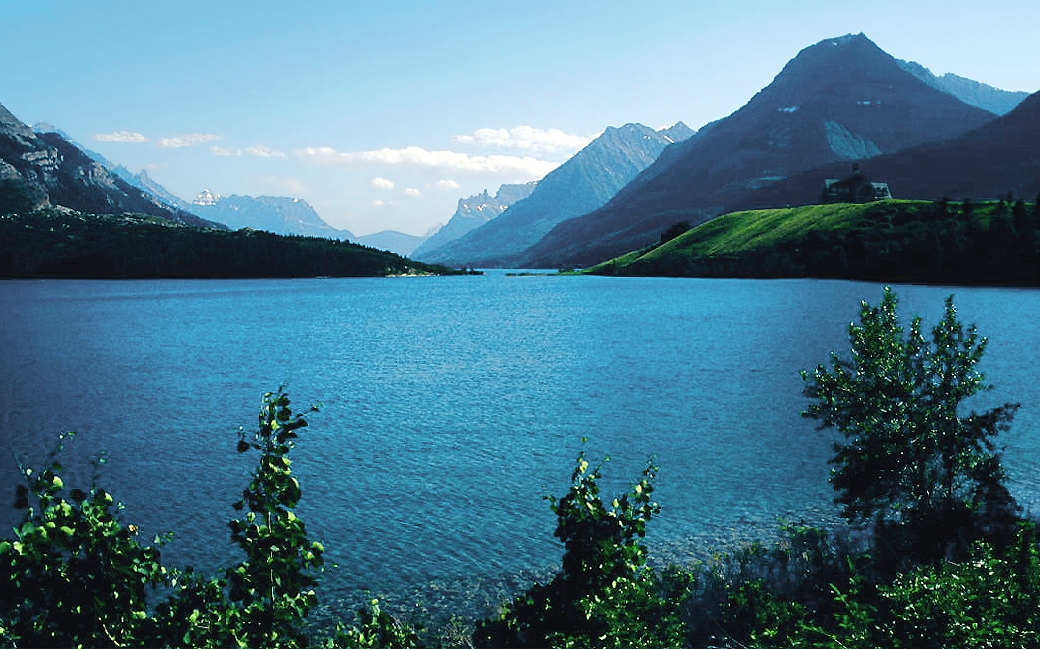
Our ride dropped us off in Waterton Lakes National Park, the real start of our adventure. Standing at the roadside, thumbs out, sometimes holding a sign “you drink, we drive”, had been fun, but the purpose behind our hitchhiking journey from Los Angeles across Canada was to backpack Glacier National Park. We were three girls, a few months shy of eighteen, just graduated high school. It was 1972. Our futures were just beginning, and this would be our last summer together. In a few months we were off to college in different cities.
First stop was the visitor’s center. We needed information on trails and maps. Two Canadian rangers stared at us from behind the counter. When we told them our plans, they both looked genuinely alarmed.
“You three girls are going into the backcountry. Do you know what it’s like in there? Do you have any experience?”
Their worried faces puzzled me. We were highly experienced, at least that’s how I thought of myself. My friends Karen, Sara and I had backpacked the California Sierras and the San Bernadino mountains throughout high school. Just two years before, Karen and I spent a summer at the Banff School of Fine Arts. Every weekend we backpacked different mountain ranges. I remember a soggy few days in the Canadian wilderness when Karen and I challenged each other to light a fire with only one match. Everything was soaked, but we both completed the task. Like most teenagers, we felt invincible and confident, but to our credit we did have the basic skills.
“We want to do a through-hike into Glacier. What route do you recommend?”
“There’s a 10-mile hike that follows a lake. A ranger station is at the lake’s end. From there you can continue on into the United States. You know there are bears out there, grizzlies and black?”
“What about grizzlies,” I asked. We knew what to do about black bears, being an abundant nuisance in the California Sierras.
“You have three choices if you encounter one that charges you. You can climb a tree. Grizzlies can’t climb trees. You can drop to the ground and play dead. Lie on your stomach, put your hands behind your neck.”
“What’s the third option,” Karen asked.
“Play chicken. Stand in place and stare him down. More than likely that bear will run and veer off at the last minute. But not a guarantee.”
I didn’t give his advice much second thought, but playing chicken isn’t in my nature. Climbing a tree sounded doable.
We camped at the visitor center campground that night and set out in the morning. Much of the hike paralleled the lakeshore. The day was overcast, drizzling on and off. By early afternoon we found a suitable campsite by the lake, built a small fire in a clearing adjacent to the lake and began to prepare dinner. In 1972, freeze dried foods didn’t exist. Our packs were full of beans, peas, rice and lentils, all of which required extensive cooking. Our pot, blackened on the bottom from being set over the open flames, wafted aromas throughout the forest. Although the rain abated during our dinner hour, a dark overcast sky signaled a possible storm, so we set up our tents. Gear in the 1970s was heavy and expensive, and as teenagers we had no extra cash for backpacking tents anyways. Instead we’d brought “tube tents”, $2 tubes of orange plastic that hung on a rope between two trees. A clip held the ends loosely together to keep rain out. It was a lousy system. If you really needed it, condensation might be just as bad as the pouring rain outside. But it held in a light rain.
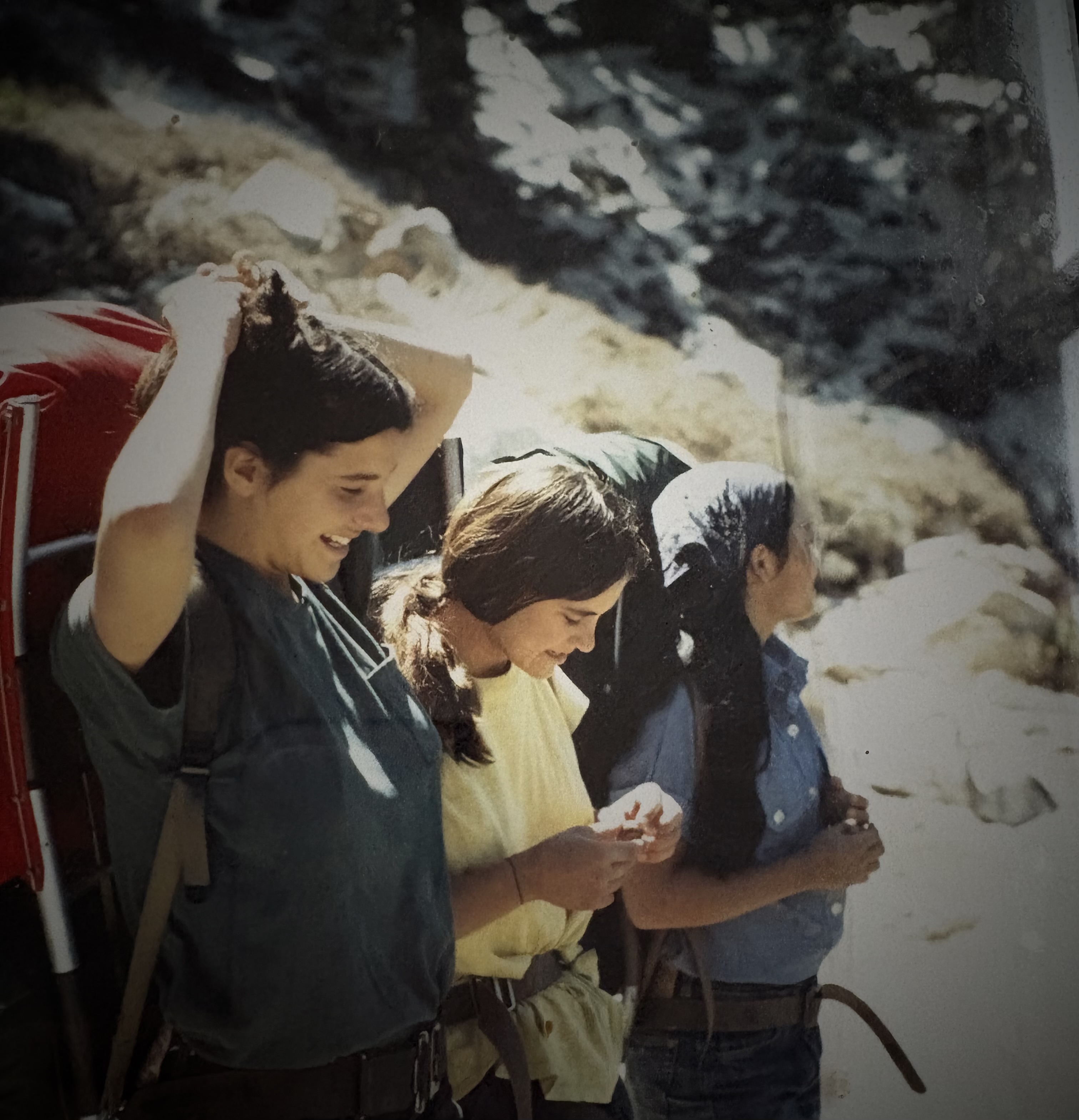
The clouds were closing in as we finished dinner around the fire. We cleaned up and dutifully hung our food high in a tree. Dusk settled and conversation about our trip and the long day began to flow. In the dimming light, Sara spotted something moving in the trees at the clearing’s edge.
“Bear.”
I looked up to see an enormous black bear lumbering towards our hung food. He stopped directly under the food sacks, spent some time pondering them, then obviously decided it wasn’t worth the effort to climb the tree and shimmy the branch. Bears don’t see well, I knew this, but he looked like this wasn’t his first food rodeo as he began beelining towards our fire.
In all my backpacking days up till then, I’d never had a bear encounter, but we instinctively knew what to do next. We yelled and grabbed our pots, banging like our life depended on that noise. It was a tin chorus but the bear wasn’t fazed. The pots were battered but the bear kept coming. Something seemed off with this bruin.
These were our two tried and true methods—hang your food, make a lot of noise—and they were not working. Our packs leaned nearby against a tree. Although there was no food in it, I was sure the packs smelled from our cooking. The bear began rummaging around the packs, sniffing and exploring all the openings. Meanwhile we were building up the fire until it was roaring blaze. I contemplated jumping in the lake. It was close by, and maybe the bear would be discouraged and be gone soon. It didn’t take long to nix that idea—a glacial lake with darkness descending—it was clearly a terrible idea. I glanced around at the trees, remembering what the ranger had told us. Of course, this was a large black bear, not a grizzly. But at that moment it didn’t seem to matter. Yet this forest was not like those in the southern Sierras, full of trees that were stout with lower branches. This Canadian forest had trees that were mere sticks with slender narrow trunks. They required shimming up and I wasn’t sure I could do that. So, I threw more wood on the fire.
Meanwhile, the bear appeared quite comfortable exploring our campsite. He finished with our packs and turned towards us. We sat perfectly still, breathless. I was wedged between Karen and Sara. Keeping one eye on the bear, the other on the fire, we’d run out of ideas what to do next. Banging pots hadn’t worked. A clean camp failed. So, we sat still as statues in front of a blazing hot fire.
The bear first approached Karen. I could feel his hot breath. He paused behind her jacket, sniffing the fabric. The jacket must have absorbed our lentil dinner aromas. He then switched to her pants. He slowly opened his mouth and began placing it around her leg. Before he had a chance to test her leg any further, Karen let out a loud yelp. The bear jumped back.
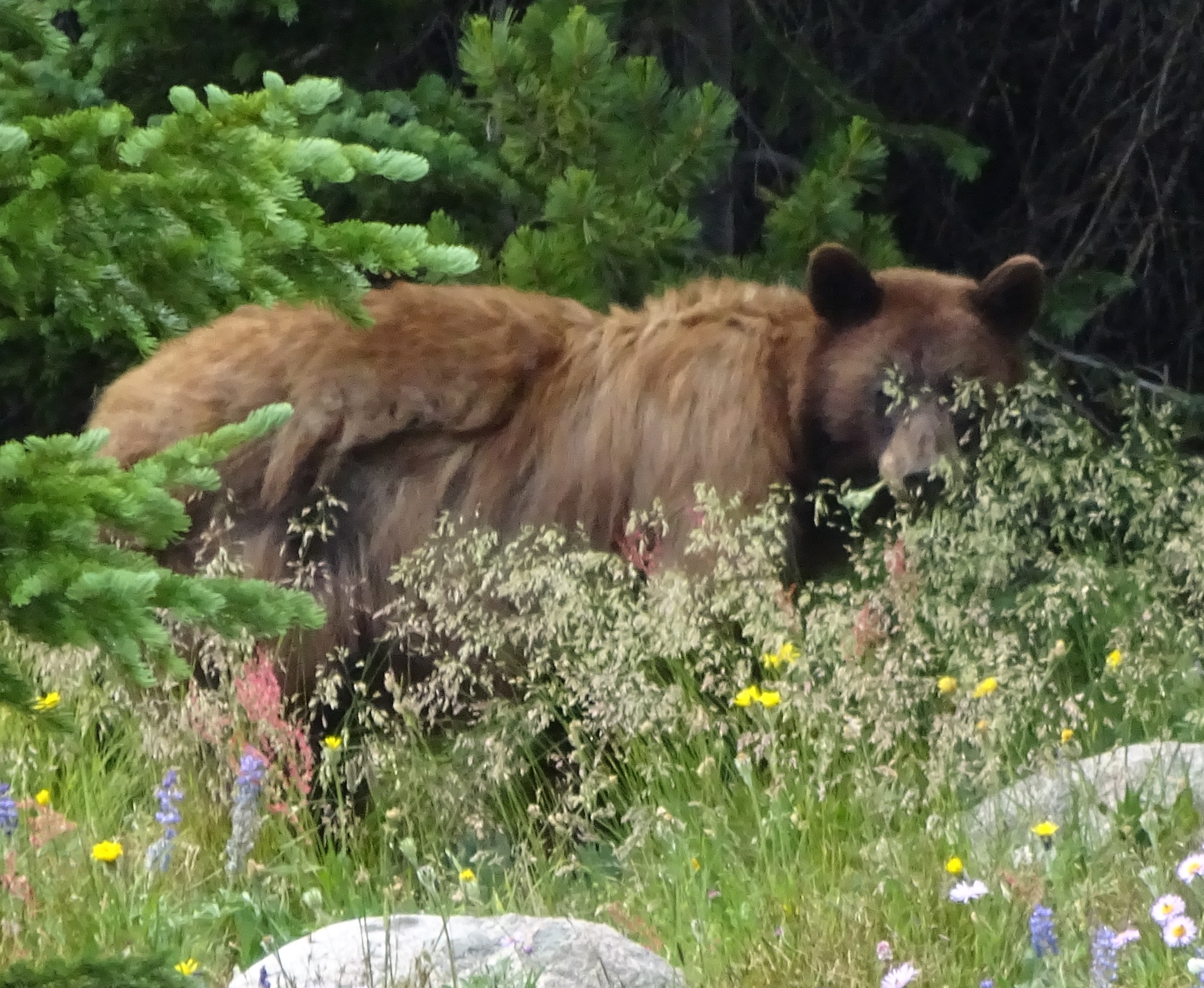
Still not startled enough to retreat by Karen’s reaction, he turned his attention to the fire itself. Lurching his enormous head between me and Karen, he leaned in towards the flames, his muzzle touching my arm. To our amazement, he was fascinated with the fire and wanted to explore it further. His huge face settled next to my shoulder, his eyes fixated on the fire. I stared at him, yet felt no fear. That surprised me. He leaned in towards the flames. As he felt the heat, he quickly pulled his head back beyond my arm, swiping his nose several times with his paw. He almost looked cute.
Having enough of the fire, he moved behind and around me to explore Sara, who was squeezed to my right. Still fascinated with the smell on our down jackets, he started nipping at her jacket’s fabric, but when she pulled away quickly the bear decided we just weren’t that interesting nor edible.
At that point our bear moved to explore the tube tents. With our sleeping bags already laid out inside, he went back and forth, inside and out, while we tried to formulate a plan on how to get rid of this bear. By now it had been over an hour and I’d had enough.
Then an idea came to me. I’d watched too many Sunday morning black and white cowboy movies as a kid, but maybe I’d learned a trick that could be useful now. In those old westerns when the hero wants to sneak past a guard, how did he distract him? It was the same in every movie: he threw a rock into the brush, the guard went to investigate while the hero silently crept into the house. Why not try this, I thought? I picked up some pebbles without moving from my log by the fire, and began throwing them into the woods. To my surprise, the ploy worked. The bear perked up his ears, looked towards the noise, and moseyed off to investigate. That bear was so curious he forgot all about us, continuing his exploration into the forest.
After a restless sleep, the next morning we quickly packed our gear and headed the remaining miles to the lake’s end for the ranger station. Karen said she was sure she saw that bear come around in the morning. Something seemed “off” about this bear. He had no fear of humans. None of the usual techniques worked to deter him.
The ranger station was plush. It had a bathroom with electric lights. We all went to wash up. Karen was complaining of a sore leg. Pulling her pants away exposed a huge black and blue mark in the shape of an upper and a lower jaw. The size of the bruise was shocking, it wrapped her entire thigh like a tattoo. Luckily the skin wasn’t broken. The bear barely clamped down, but that bruise was a mark of how powerful he was.
The ranger met us and we reported what occurred and how we handled it.
“You girls know there were two women killed by grizzles just a few years ago in Glacier. Pretty close to here too.”
What? Why would I know that? I’m seventeen, not from around here, and certainly don’t read the news on bear maulings.
He was descriptive and detailed in his story. ” They were killed on the same night, in different parts of the Park, by two different bears. One mauling was on a mountain, the other by a lake. Pulled them right out of their sleeping bags. The Park Service said both of these women were menstruating at the time. They say the smell of the blood drew the grizzlies in. The bears were thinking another bear was in their territory, so they killed them.”
If we weren’t scared by that black bear, we now were terrified with this new information. Sara just told us her period had started, the very thing that the ranger said drew those grizzlies to attack. Our plans to continue our backpack needed to change. We decided, for now, we needed to spend the next several days camped right next to the ranger station. The ranger said if we took day hikes and made lots of noise while we hiked, we’d probably be fine.
Every day it drizzled a fine mist. The skies were overcast. The enormous mountains surrounding the lake were shrouded in clouds. The dense forest cast off its wetness as we day-hiked to pass the time, yelling as we hiked. It was awful. The whole reason we enjoyed the back country was the solitude, the quiet, the wildlife. Now all we could think about were grizzlies coming for Sara, probably around every corner. After five days, her menstrual cycle over, the three of us hiked the ten miles back to the Waterton Lakes Visitor Center. We surveyed the crowds of eager tourists, felt the pressure of the relentless rain and ominous clouds that enveloped the viewscape, and stuck out our thumbs to head south to Grand Teton National Park, a sunny country far from grizzly bears in 1972.
__________________
1967 was a watershed year for the grizzly. What soon became known as Glacier National Park’s Night of the Grizzlies set off a cascade of far-reaching consequences that almost drove the grizzly bear to extinction in Yellowstone National Park. The connection between these two Parks and their bears, will be described further, but first the relationship between my bear and the 1967 incident.
The fatal maulings in Glacier National Park are well-documented. A book by Jack Olsen accurately details the events surrounding them. I had not yet read the book when I watched a Montana PBS documentary in 2011 about that infamous night. On and off through the years I thought about my bear incident. My two friends and I went our separate ways in life, but on occasion, when we’d get together, the bear always came up. Our summer trip had so many unique, memorable events—a trip to a Hutterite community, a pow-wow in Browning, two weeks in the Teton backcountry, a three day stay at the 40-bed Jackson Hole hospital. But we always circled back to the bear.
The Sierras and their National Parks and National Forests continued over the years to have “problem black bears”, bears who received food rewards and invaded dumpsters and campsites. Around 2004 backcountry campers in Yosemite National Park were required to carry bear canisters, dramatically reducing bear incidents. Once frequently seen on trails and in campsites, black bears are rarely encountered now. Still, I’d never heard of an encounter such as ours with a black bear.
When I moved to my present home next to Yellowstone National Park in 2006, it wasn’t unusual to see grizzlies while hiking. They always ran away. I did know people who’d been bluff charged, and also one friend who’d been mauled, but it was the rare grizzly that mauled and killed. When I viewed the Montana PBS documentary, I began to understand the nature of the bear we encountered in 1972. Here’s a short recap of the fateful night in 1967 in Glacier National Park.
The two fatal incidents occurred on the night of August 12, 1967, two different bears, separated by eight miles and a formidable mountain named Heavens Peak. Since the Park’s creation in 1910 there had not been a single fatal encounter with a grizzly bar. So, these two attacks on the same night raised a lot of controversy. But, once reviewed in depth, the two events coincided with years of food conditioning. Food dumps and trash from the growing number of visitors attracted bears, black and grizzly. Granite Park Chalet, the site of one of the maulings, had been dumping garbage just 200 yards from the building. The year before, the Park Service provided an incinerator, but the sheer volume of visitors created more trash than could be burned nightly. Plus, the nightly arrival of grizzlies was a tourist attraction that was coveted. The dumping continued.
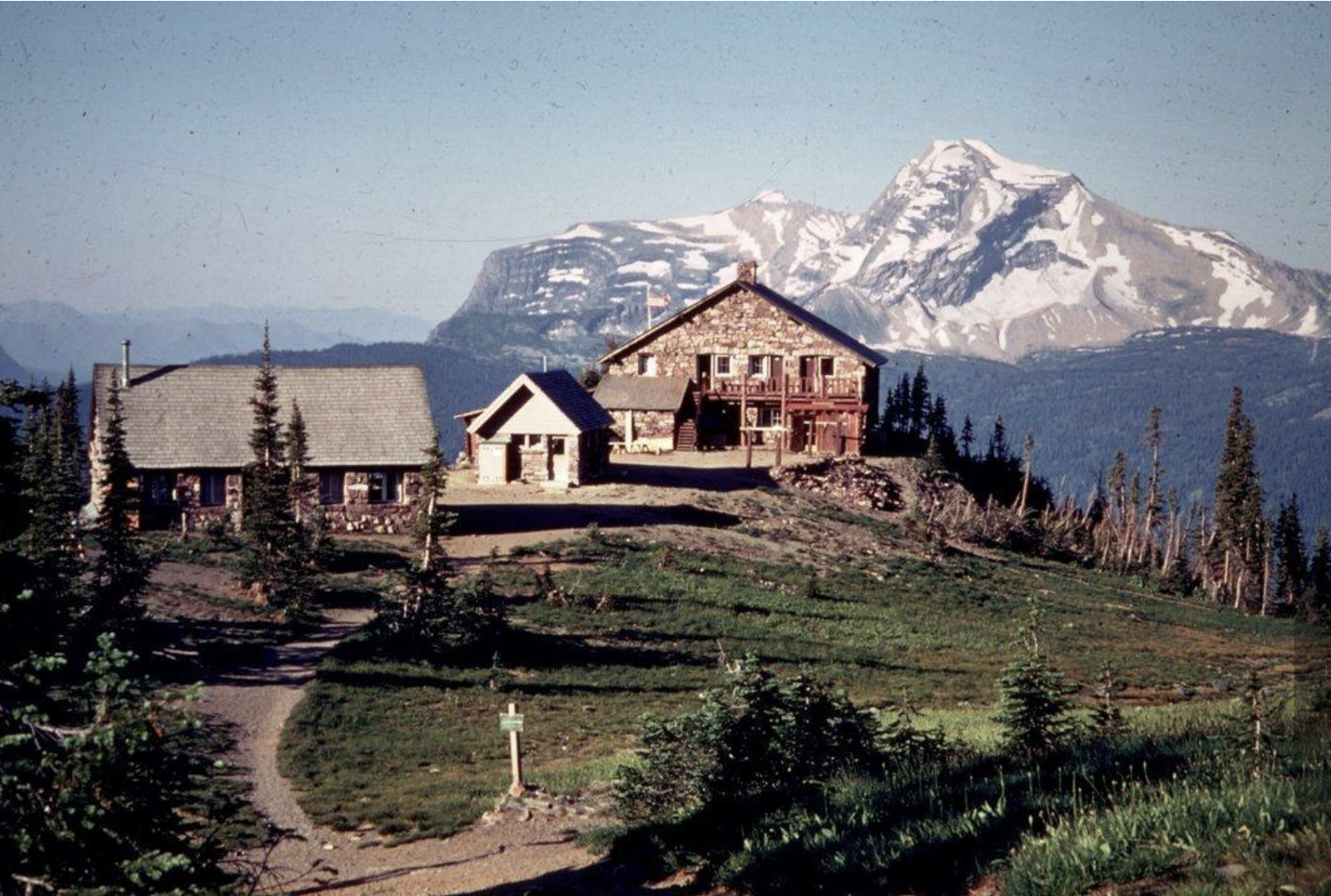
With a long-term drought depressing the berry crop, critical food for grizzlies in the Northern Continental Divide, bears had grown particularly dependent on these dumps. At Trout Lake, on the other side of the Livingston Range, one bear in particular had been trouble throughout the summer. She was old, underweight, and unafraid of humans. That summer there were reports of this old female marauding campers and campsites, even confronting them while on horseback. She had been hanging around a private outfit called Kelly’s Camp at the head of McDonald Lake getting into their garbage. Yet no action was taken by the Park Service. Things were different in those days and with no grizzly bear major incidents since the Park’s opening, policies were lax.
Michele Koons had hiked into Trout Lake during the day with a few friends. A grizzly had come into their campsite earlier and they drove the bear off. The group then moved their site closer to the lake and built a large bonfire. At 4 a.m. the bear returned, sniffing out their sleeping bags. Although her companions escaped up trees, Michele, unable to slip out of her bag, was carried by the bear into the woods. With first light, Koons’ companions hiked out to the McDonald Ranger Station to report the mauling. When the rangers found her body, it was mauled beyond recognition.
“Trout Lake was typical of all the other campgrounds at that time in Glacier National Park,” said Bert Gildart, the ranger who responded to the grizzly attack at Trout Lake in an interview with the Great Falls Tribune in 2017. “I think all the campgrounds in Glacier National Park were a mess. When the chief ranger and I flew back in there a few weeks later, we picked up an immense number, probably 17 burlap sacks we loaded into a Huey helicopter and it was all full of garbage that people had left behind.”
Meanwhile at the Granite Park Chalet, Julie Helgeson and her boyfriend Roy Ducat decided to camp at the campground since the Chalet was over-flowing with visitors. The campground was only 500 yards down the trail. Visitors at the chalet watched the nightly dump feedings then went to bed. But at the campground, a similar scenario as the Trout Lake mauling was playing out. The grizzly first mauled Ducat in his sleeping bag. When he played dead, the bear turned to Helgeson. Ducat climbed out of the bag he was sharing with Julie, and ran for help as the bear dragged Helgeson down the ravine. A search party found her alive, although she died soon thereafter from excessive loss of blood and shock.
Rangers were dispatched to kill the offending bears. Bert Gildart and Leonard Landa shot the old female at Trout Lake. “It was determined on the spot that this bear had glass embedded in its teeth,” Gildart told the Tribune. “So here you had a bear with difficulty chewing and eating in the first place and as well a bear that was horribly emaciated or run down. It couldn’t eat. It weighed slightly over 200 pounds. It wasn’t a big bear at all. It was about 20 years old, an emaciated sow. That’s the reason why it probably fed on the girl.”
Up at Granite Park Chalet, following the mauling, Ranger David Shea was told to kill any bear that came to their dumpsite. The result was three dead bears, including a sow with two cubs. One cub was shot in the jaw by a second ranger, survived the winter, then killed in the spring when he returned to feed on garbage.
From these two incidents, immediate changes in Glacier policies were initiated. “Pack it in, pack it out”, backcountry campgrounds were concentrated, cables for hanging food were set up, education programs began. But of course, all the cleanup of the backcountry along with de-habituating bears took time.
When I finished watching the PBS documentary, I finally understood the strange behavior of my black bear in 1972. It had been five years since the maulings, but was still fresh in the minds of rangers like the one who listened to our story. And the bears we encountered had grown up with garbage and associated humans with it. Lucky for us, our bear was more curious and benign than aggressive.
Theories and tall-tales were abundant as why two girls were killed on the same night. The intense lightning storms and fires were blamed saying they agitated the bears. Others, like our ranger, blamed the women’s menstrual cycle. These tall-tales have all been debunked. It came down to the simple explanation of human food-adapted bears combined with a compressed berry crop due to drought. It was a tragedy long in the making, the fault of humans.
__________________
If there is one book worth reading about the after effects of the Glacier grizzly deaths, it is Engineering Eden by Jordan Fisher Smith. Smith weaves the stories of all the various players that led up to the court hearings of the lawsuit brought by the family of Harry Walker, a young man killed by a grizzly in 1972 in Yellowstone Park. Among those testifying was Starker Leopold, Aldo Leopold’s son, and Frank Craighead. Leopold testified for the government. Craighead testified for the family. It was the Craighead brothers, Frank and John, who conducted the first in-depth study on grizzly bears in Yellowstone National Park. Beginning in June of 1959, the study ran through 1971. The Craighead brothers innovated and designed the first wildlife radio-tracking collar, following distinct bears from spring through denning.

The Glacier maulings had wide repercussions. Though no one had been mauled in Yellowstone, the Craigheads had been calling for years to close the dump. Their advice was to slowly wean the dump-addicted bears off garbage and lure them into the backcountry with helicopter deposited road kill. But the Park’s superintendent, Jack Anderson, along with Yellowstone’s chief biologist Glen Cole ignored their recommendations, thinking bears would immediately return to natural foods. They decided on a cold turkey approach, closing all the dumps at once. The bear problems increased. It was under this atmosphere that Harry Walker was mauled while camping in a non-designated campsite just a short walk from Old Faithful. The Park’s solution to the increased conflict was to shoot problem bears, bears that frequented campsites and former dump sites. Around ninety grizzlies were killed in those first two years. By 1975, when grizzlies bears were the first mammal to be placed under the Endangered Species Act, less than 120 grizzlies were in the entire Yellowstone Ecosystem.
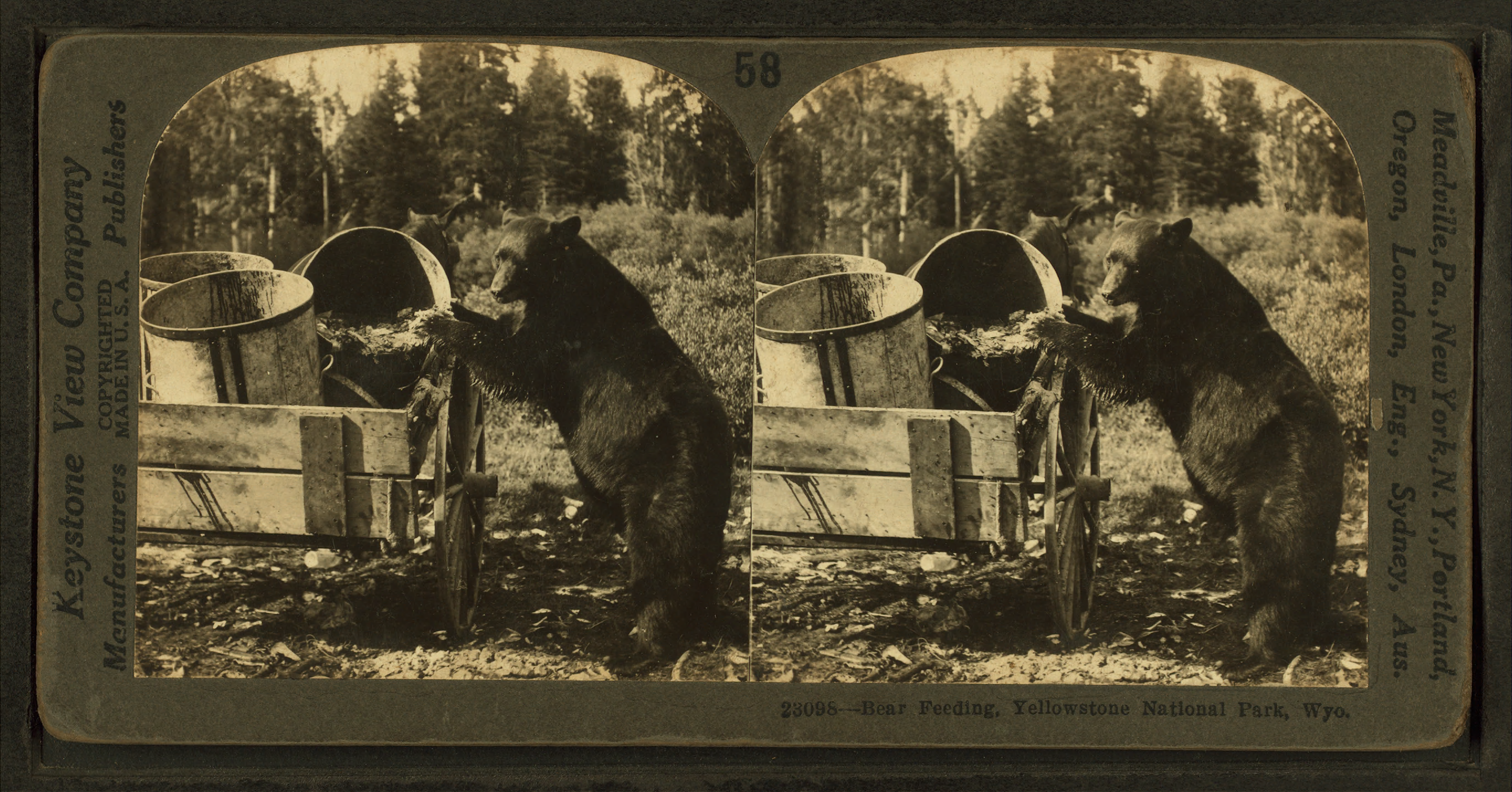
________________________
For many years after that I wondered about my emotional response. Even though that bear had nosed his way, literally, right between me and my friends, I had remained calm and unafraid. I was more curious than afraid. I wondered if my cool response was because I was not adapted to the dangers in that environment. Sure, I thought to myself, if this had been a bad neighborhood in a city, and that bear had been a strange man approaching us, I would have registered fear. So why wasn’t I afraid?
Years later I read a passage from Jungle Lore which explained everything. In this passage, Jim Corbett as a youth was walking down a back road with his dog Magog. Corbett heard voices of men shouting, and then suddenly a leopard ran from the brush and stopped on the road only 10 yards uphill.
“This was the first leopard that Magog (his dog) and I had ever seen, and as the wind was blowing up the hill I believe our reactions to it were much the same —intense excitement, but no feeling of fear. This absence of fear I can now, after a lifetime’s experience, attribute to the fact that the leopard had no evil intentions towards us. Driven off the road by the men, he was quite possibly making for the mass of rocks over which Magog and I had recently come, and on clearing the bushes and finding a boy and a dog directly in his line of retreat he had frozen, to take stock of the situation. A glance at us was sufficient to satisfy him that we had no hostile intensions towards him, for a leopard can size up a situation more quickly than any other animal in our jungles. And now, satisfied from our whole attitude that he had nothing to fear from us, and satisfied also that there were no other human beings in the direction that he wanted to go, he leapt from his crouching position and in a few graceful bounds disappeared into the jungle behind us.”
–Jungle Lore, Jim Corbett
Reading this passage from Corbett, I realized I was very much in-touch. That bear never meant us any harm. In this particular circumstance, fear wasn’t an appropriate emotion. My young bear was looking for a food hand-out, probably something he’d been rewarded with before and for sure something his mother had taught him. With one simple statement, Corbett unveiled I’d experienced an instinctual response, one which we share with all wildlife—a sense of danger or not. It’s the attitude of relaxed awareness, our native gait in the natural world.
_______________________
This story has implications for the plight of the grizzly bear today and our human attitudes towards its future. In 2025, 73 deaths of grizzly bears were recorded in the Greater Yellowstone. Only six of these were attributed to natural causes such as bear on bear. Livestock and unprotected foods accounted for 39. Twelve were caused by humans recreating or hunting. Probably the bulk of these deaths could have been prevented, by either concerted food protections, extra efforts to protect free-ranging livestock, or use of bear spray instead of a gun. There is an attitude in grizzly country that the Greater Yellowstone just has too many bears, and bears are proliferating like crazy; that the GYE is bursting at the seams with bears and a hunt is necessary to control the burgeoning population. But female grizzlies only replace themselves approximately every ten years; a female doesn’t begin to reproduce until the age of 5 or 6 and cubs stay with their mother for 2 ½ years. The longest-lived reproducing female, 399 who lived till 28 years old, had 18 cubs over her lifetime. Only eight reached adulthood and of those only a very few females lived to reproduce.

Looking at the grizzly population another way, these bears were the first mammal listed under the Endangered Species Act in 1975. It has taken fifty years to go from 100 bears to a little over 1000 in the Greater Yellowstone. Grizzly bears are slow reproducers, and with the pressures of humans including new housing in active corridor areas, their population might actually be threatened, particularly if new genetics cannot be infused into the population through connective pathways to grizzlies in the Northern Continental Divide.
I can confess that I was guilty of wanting bears delisted when I first arrived in Wyoming. I too thought a hunt, which was to go into effect in 2008 (but was blocked by the courts) would make bears warier of humans and safer for myself when hiking. But over time living here, carrying bear spray, and on rare occasions encountering grizzlies, my attitude has changed. Certainly, there are plenty of books on grizzly attacks we can read. And plenty of guidance from the Park and Forest Service on hiking in groups of four, making noise, or what do to if a bear approaches. But I felt that information didn’t give me insight into a bear’s mind. I tried to educate myself from watching a few videos as well as some books by people such as William Wright, an old timer who used to hunt bears with a single shot rifle in the early 1900s in Montana until he realized they were going extinct and became a conservationist. I’m not saying grizzlies cannot be dangerous, but I have learned the best posture is a natural awareness of one’s surroundings, which I feel is our innate and instinctual asana in nature.
I no longer support a hunt of any kind on grizzly bears. With such a high rate of yearly deaths of grizzlies mostly due to humans already, a hunt would only add to a potential population decline. The Wyoming Game & FIsh proposed a hunt targeting bears that are at the outskirts or beyond the designated area for grizzlies. But these are the exact bears that might wander farther and provide genetic connectivity for the ecosystem. Killing bears does not make them afraid of humans. Bears are solitary animals and a dead bear communicates nothing to other bears. My personal experience after many years of trail camera work is that bears avoid human habitations and tend to be nocturnal outside the protection of the Park. They are already wary of humans. Additionally, grizzlies are proven to be as smart, maybe smarter, than the Great Apes. Killing an obviously intelligent and sentient being like a grizzly is intolerable.
We can live with grizzlies. They are minders of their own business. They are not out to confront or attack. It’s an extremely rare bear that predates on a human though it has been documented. An encounter with a grizzly most often results in that bear fleeing. Occasionally a bluff charge.
A man I know who grew up in this area, hiked extensively all his life before there was even such a thing as bear spray, once told me his thoughts on bears and bluff charges. He’d been bluff charged many times, by his account around ten times.
“Bears don’t see well. When they get close enough to make out you’re a human, they want nothing to do with you and will peel away.”
I’m not saying that every bluff charge will be a false charge, but I suspect people that carry guns and shoot first possibly shoot before even being charged. There are plenty of incidents over the years where a hunter killed a bear claiming self-defense and the government doesn’t release the full details. Just last year two hunters killed two bears in “self-defense,” a cub and a sow. Did that cub also charge those hunters at the same time as mom?
I’m suggesting an attitude where we humans that live, work and recreate alongside grizzlies do everything we can to coexist. That includes protecting our livestock, our food, carrying bear spray and resorting to it before using a gun in the backcountry. Coexistence means educating ourselves about bears, their needs, their minds as much as possible, rather than resorting to knee-jerk approaches based on uninformed fears. And to take stock in Jim Corbett’s observations on large predators:
“This absence of fear I can now, after a lifetime’s experience, attribute to the fact that the leopard had no evil intentions towards us.”

Filed under: New ideas | Tagged: 1967 grizzly mauling, adventure, Craighead brothers, Glacier National Park, grizzly bear 399, Grizzly bears, hiking, nature, travel, Waterton Lakes National Park, yellowstone, Yellowstone National Park | Leave a comment »
 Leslie Patten Books: Wild Places, Sacred Spaces