• MY BOOKS ON WILDLIFE, GARDENING AND MORE

  • The Wild Excellence

  • True stories of wildlife encounters around the Greater Yellowstone
  • Award winning eBook on Decomposed Granite, tips, how to's, what to watch for
  • Children's book. True stories of a dog and wolves. In a dog's voice
  • Written for dry Mediterranean climates in California, north and south

Fall is a’coming

The Clark’s Nutcrackers are congregating, waiting for the Limber Pine cones to ripen.  You can tell they’ve arrived as they are a noisy bunch.  As Jays, they are super-intelligent birds.  Every year they cache tens of thousands of seeds and are able to memorize the location of their stashes.  Clark Nutcrackers have a distinctive ‘wing-whirl’, which is a loud noise they make when flying.  Although the pine cones aren’t ready yet, they seem anxious, waiting for just the right moment to steal the seeds away from the waiting red squirrels who also cache the cones for winter food.  I’ve been watching the birds  eating insects while they while away their time.

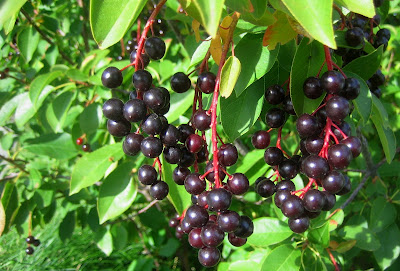
This year is not only a bad cone year for White Bark pines, but the Limber Pine cone production is  down as well.  This bodes poorly for bears.  But the good news is that with all the rain we’ve had, the berry crop is up.  The chokecherry crop is one of the best in years and I’m waiting with my trail cam for some bears to spend time stripping the berries off the branches before the birds get to them.  The bears seem to know the exact time when they’re ripe, and come around for that week only. And with all the beetle kill, the forests are opening up and changing.  I’ve seen new understories packed with chokecherry bushes–all full of cherries.  
Grizzly bears evolved in the plains.  They can’t climb trees like their forest adapted cousins, the black bears, and their massive claws were meant to dig out roots.  Pushed from their native habitat into the mountains, they prefer burn areas and meadows, places that emulate their native past.  Our mountain forests are rapidly changing with all the downed timber, creating good habitat for the Great Bear.
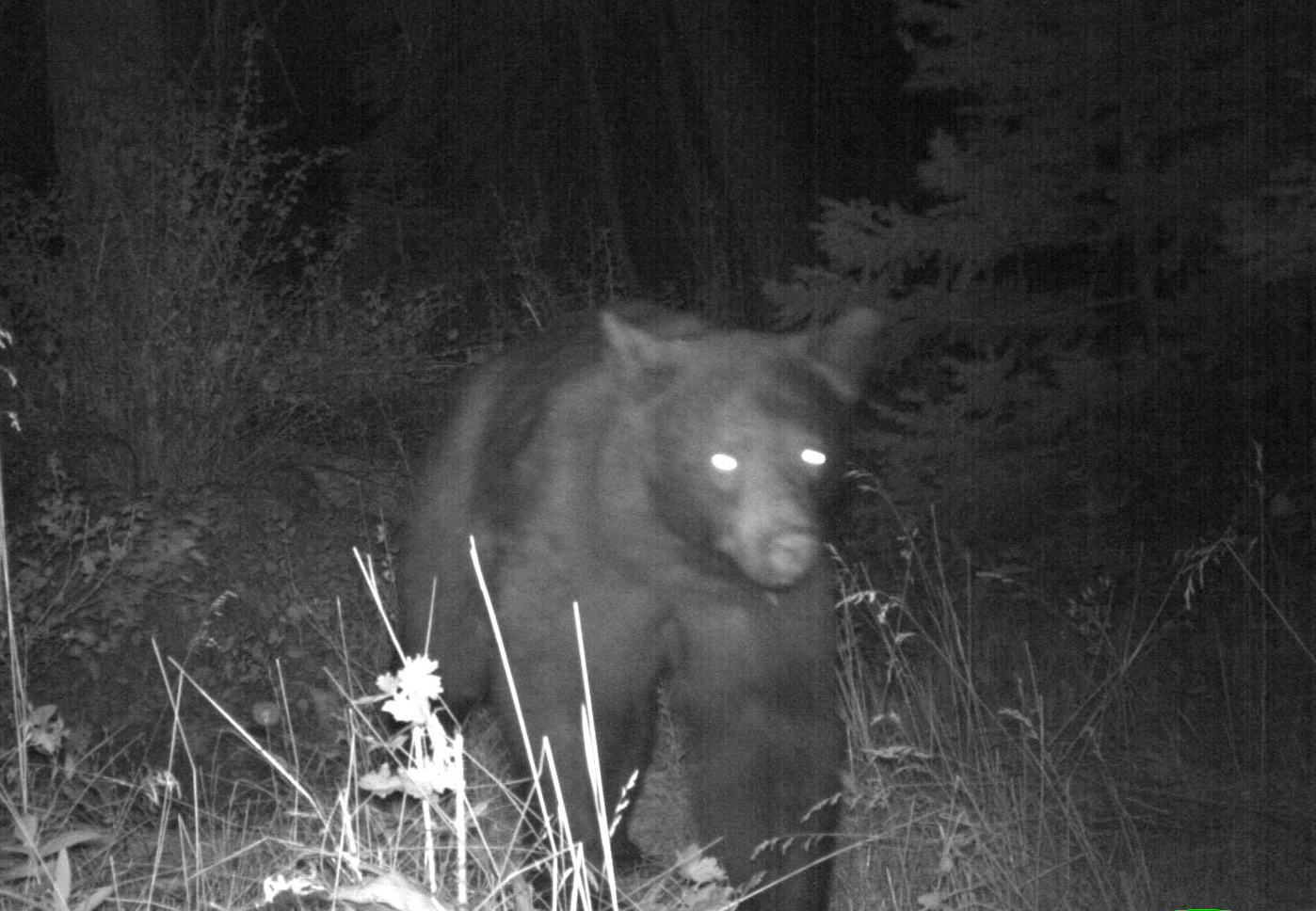
Young bear yesterday coming to look for berries

Young bear yesterday coming to look for berries

The little forest next to my house is a perfect example and a fine study area of a rapidly evolving landscape.  With seven springs emerging from the limestone base, there is sufficient water ground water.  The  old growth Englemann Spruce are dead and dying, falling to the ground and leaving large openings where new chokecherry bushes, dogwoods, raspberries, gooseberries, and aspens are rapidly emerging.  This is an area we specifically asked the Forest Service NOT to put in their logging plans.

In contrast, the lands adjacent to the springs are private and were logged by the homeowners through the State Forestry Office (who were concerned about fire protective barriers) 5 years ago.  Approximately 90% of the trees were cut or were blow downs.  This land too has aspens, gooseberries, and grasses–but much of it has a very high ratio, maybe 10:1, of invasives, particularly Canada Thistle.  The combination of moisture, sun, and rapid disturbance provided a perfect storm for the invasives.  The invasives rob moisture and space for other natives that might get a stronghold.  In the non-logged side, the lesson is clear:   slower is better and the forest can naturally restore itself with little interference by man.


Squirrels, Bears, and birds: What’s the connection?

The Clark’s Nutcrackers have been very busy over the last month.  So have the squirrels.  They’re both competing for the Limber Pine seeds that grow around here.  The birds extract and stash seeds.  The squirrels create middens with stored seeds and cones.  The bears let these animals do their work, then rob the middens.

Clark's Nutcracker

It is really amazing to watch the Nutcrackers.  They are so adept at using their beak to extract the seed.  Limber pine cones are full of sap, really sticky.  I’ve watched a bird work a cone, sometimes to just get sap or a bad seed.  The bird cleans it’s beak quickly and works another seed hole.

Squirrels too can work a cone very quickly and efficiently.  Both squirrels and Nutcrackers seem to know exactly which seed is viable or not.  I’m sure it has something to do with its weight.  Sometimes I find a cone on the ground with a few seeds left in it.  Invariably those seeds are empty, either with worm holes or they just didn’t mature.

Meanwhile, after working hard on caching all these seeds, the bears are coming around robbing all the caches they can find.

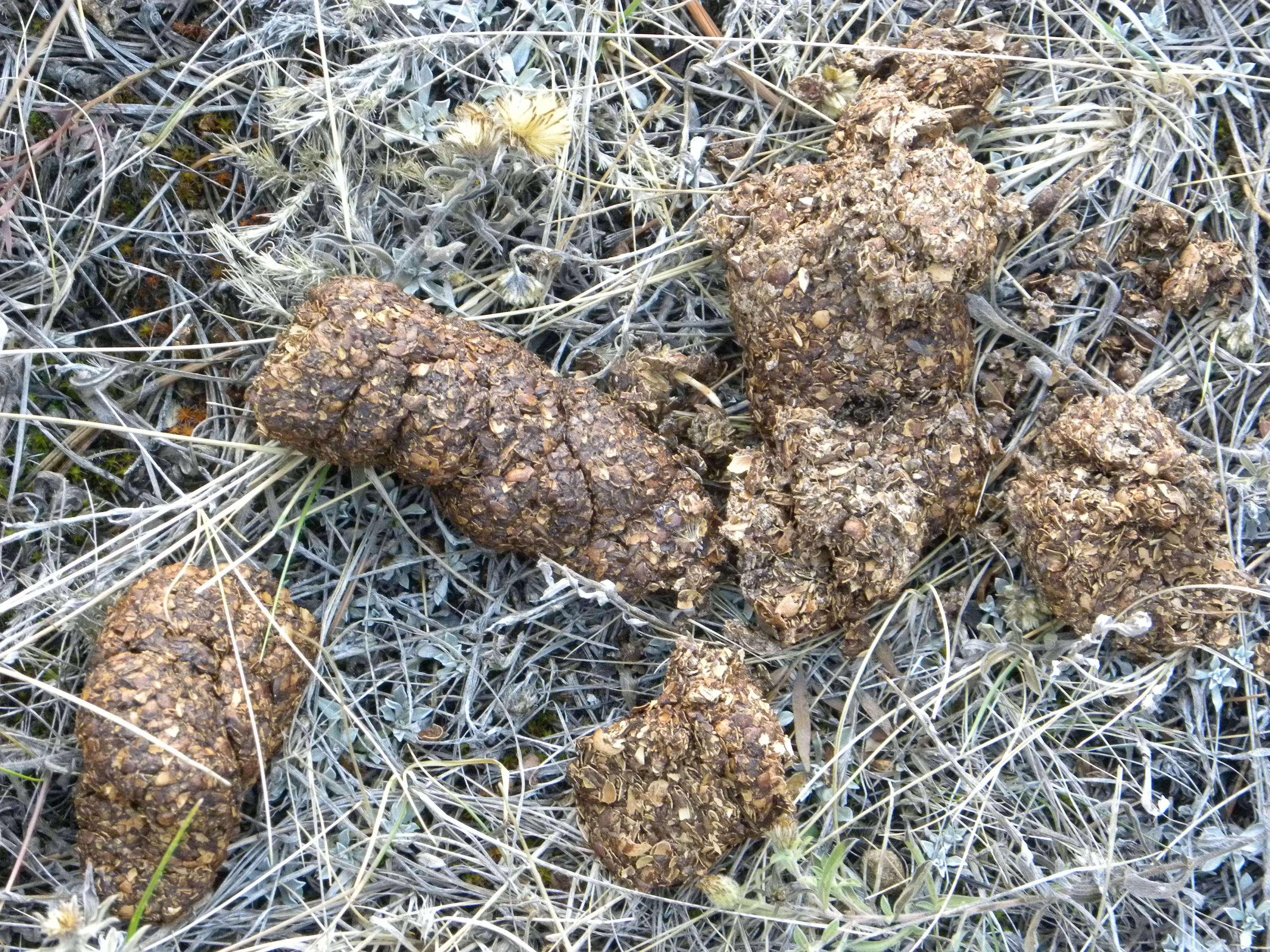
There’s a black bear working my neighborhood intensely, day after day.  His scat is everywhere,  mostly full of pine shells.  The scat even smells like pine nuts…you can smell the rich fatty odors.

Loaded with pine nut debris

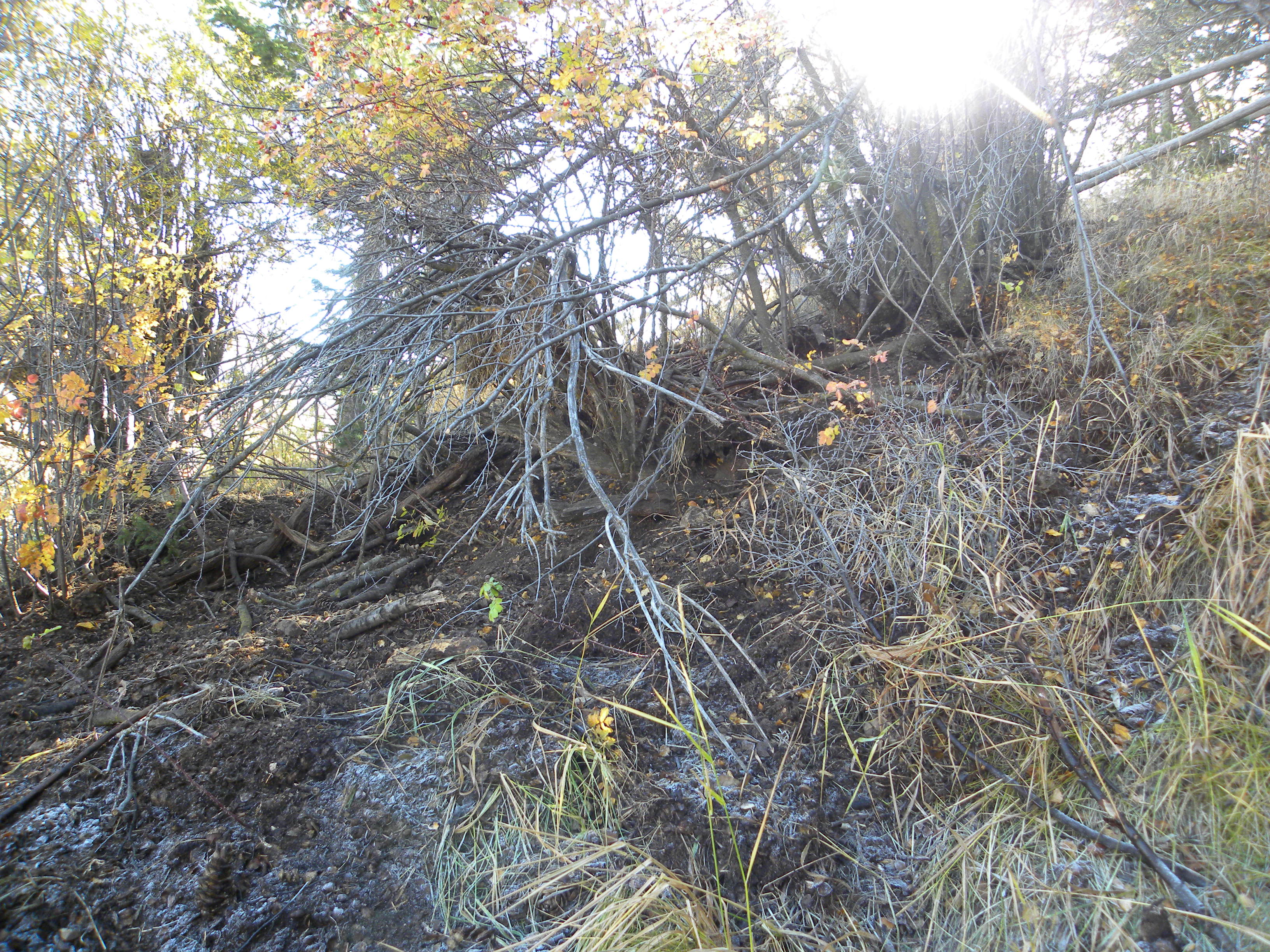
Yesterday I drove down my driveway only to find a huge stump in the middle of the road.  I got out to move it, I looked up the hillside where it had rolled down from, and saw that this bear had completely worked over an old middens.  He’d turned over the soil so much that the chickadees were having a field day.

Dug out middens on my hillside near the house

What a nice circle of feeding and robbing…birds and squirrels feed the bears who feed the birds.

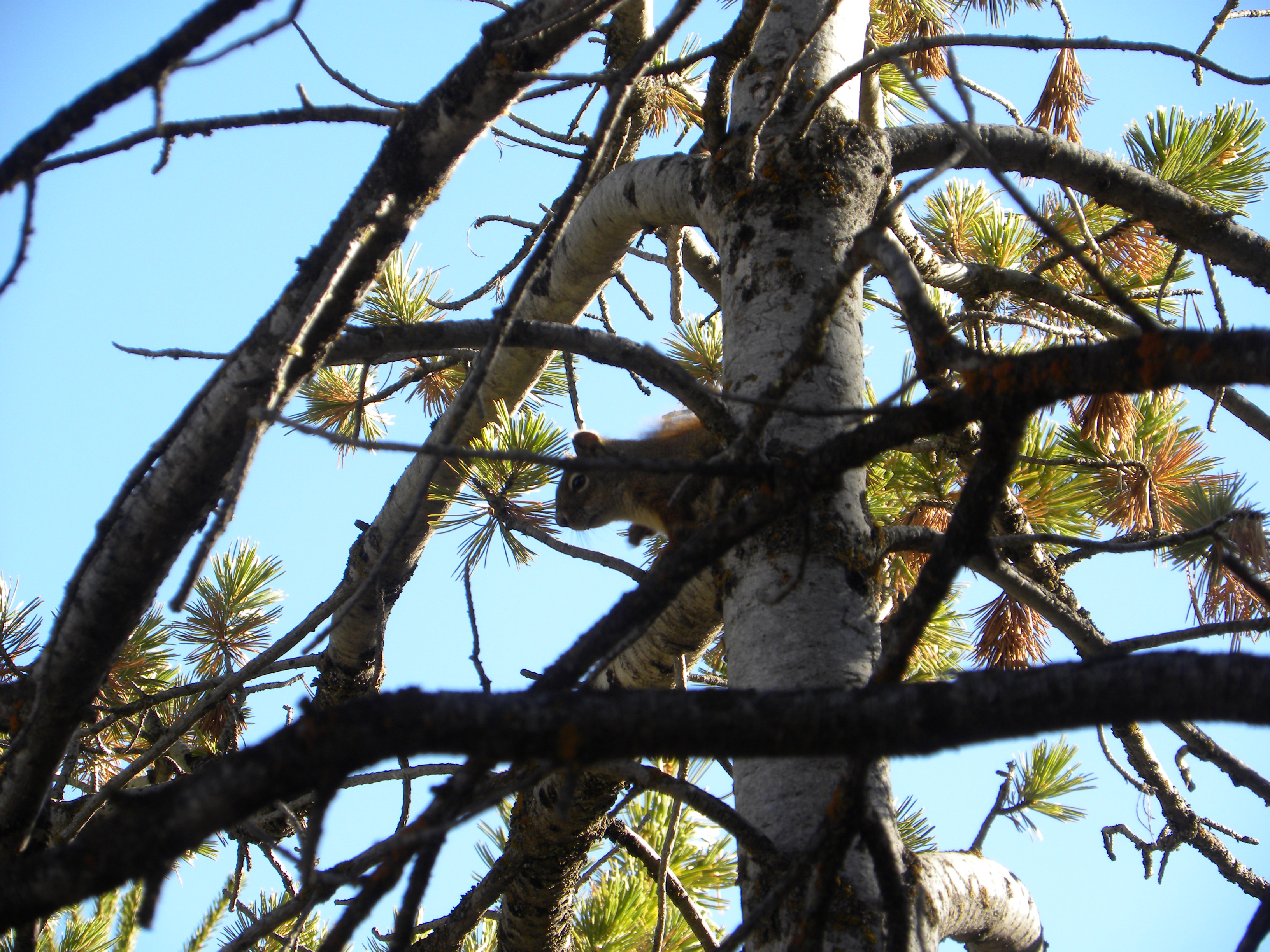
Squirrel above robbed middens angry at me. "I didn't do it" I told him

Clark’s Nutcracker and some five needled pines

Every morning I take a walk on the open meadows above my house dotted with Limber Pines.  Limber pines are technically in the white bark pine ‘family’, which consists of all pines with a cluster of 5 needles.  So when people say ‘That’s not a white bark pine, but a limber pine”, technically they are right and wrong.

Pinus albicaulis is the latin for the White Bark Pine, which is in the white bark pine group because its a 5 needled pine.  The Greater Yellowstone is at the very southern end of Pinus albicaulis territory.  Its a white bark pine that grows at very high altitudes.

I live at around 7,000 feet and, although we have P. albicaulis on our ridgelines, my zone consists of Pinus flexilis, or Limber Pine, another 5 needled pine.  Both produce cones with large, tasty seeds.  And its difficult to tell the two pines apart.  The best way is to look at the cones.  P. albicaulis cones are purple and disintegrate on the tree.  P. flexilis stay intact, are the usual grey/brown, and fall to the ground.

In the mornings on my walk, there’s lots of chatter these days.  The Clark’s Nutcrackers are busy. Clark's Nutcracker Their wings make a whirlwind noise, but their raspy call is distinct.  I watch them take their long beak and skillfully pluck out the large seeds.  They do it upside down or right side up.   Between the busy red squirrels caching all the seeds (they are also amazing to watch as they work the cones like an ear of corn) and the birds, its a wonder there’s any seeds left.  The crop seems to be good this year, as most of the trees have lots of good cones with few worms.  If I watch the squirrels, they know which ones have the worms and which are intact.  But I can always find a few opened cones on the trees, low down that I can reach, that have some missed seeds to eat.  My problem is that the cones are so full of sap, I’m a sticky mess just for a few pine nuts.

The nuts are good.  They taste like pinyon pine nuts (which is a 1 needled pine) and are about as big.  Some of the best and biggest pine nuts I’ve ever tasted are from the Italian Stone pine, Pinus pinea.  Its a beautiful tree and commonly cultivated.  But the Limber Pine nuts are good too, just harder to get out because they are tucked way down inside.

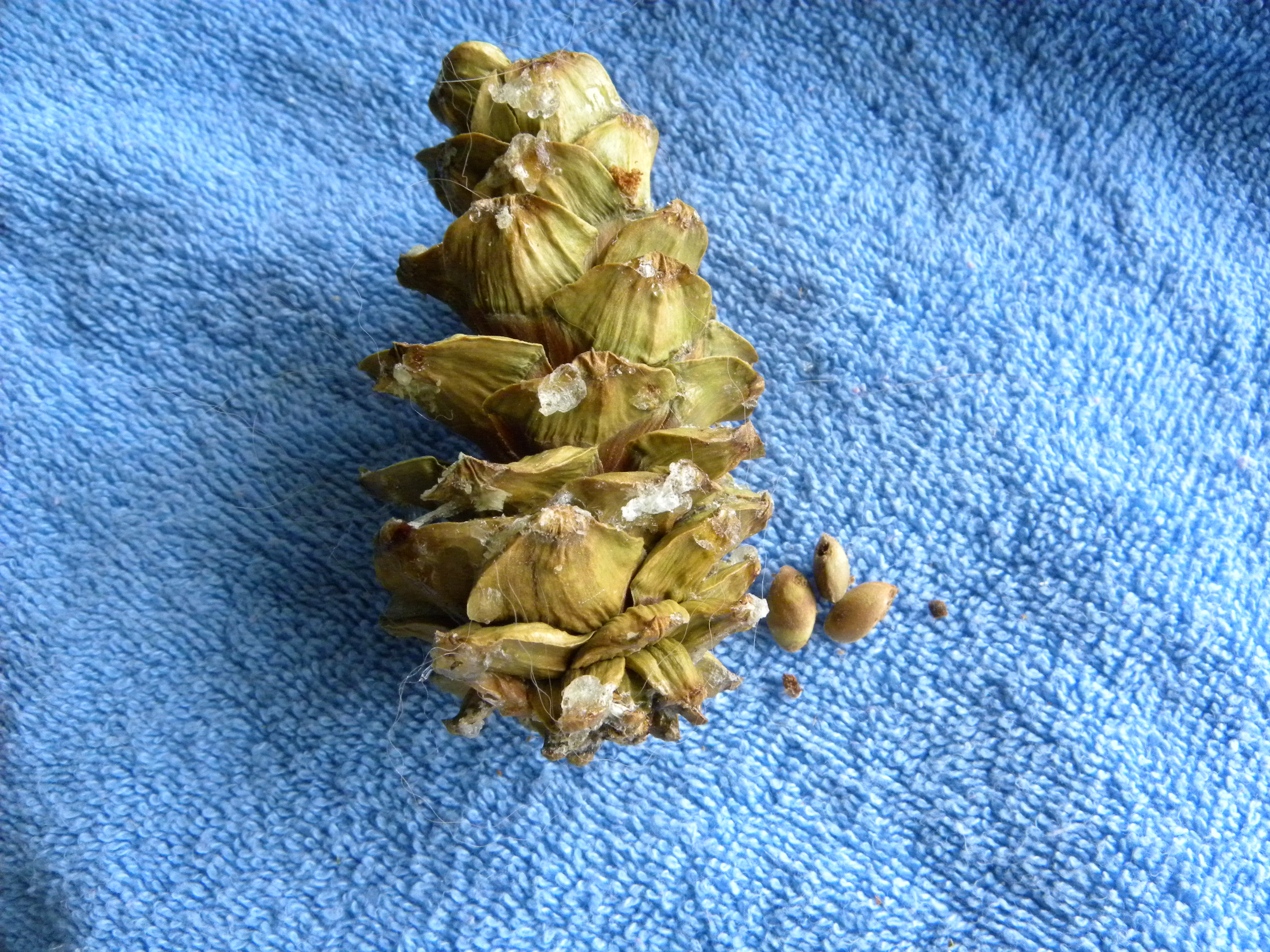
Limber pine cone with seeds

Limber pine cone with seeds and lots of sap

Limber, White Bark, and the Clark’s Nutcracker have evolved a unique marriage.  The two pines are dependent upon the bird for seed dispersal.  Unlike the fire adaptation of Lodgepole pines, whose seed cones open with heat, Limber and White Bark pines disperse their seeds through the bird, and prefer to sprout on the fertile soils after fires.

I asked a grizzly expert at the Shoshone ranger station if grizzlies will sometimes eat the seeds of limber pines.

“Not usually, because they are harder to get out, but they will.”

Grizzlies will reach up for the P. albicaulis seeds; they’ll climb up; and they are smart and look for the stashes of red squirrels and raid them.

By the way, after getting some pine nuts out of the sappy cones, I’m full of sap.  How to get rid of sap on your hands:  take some vegetable oil and rub it around; leave on for a minute; then wash with soap. Voila! Its out.  On your clothes?  Use a little WD40 before you wash.