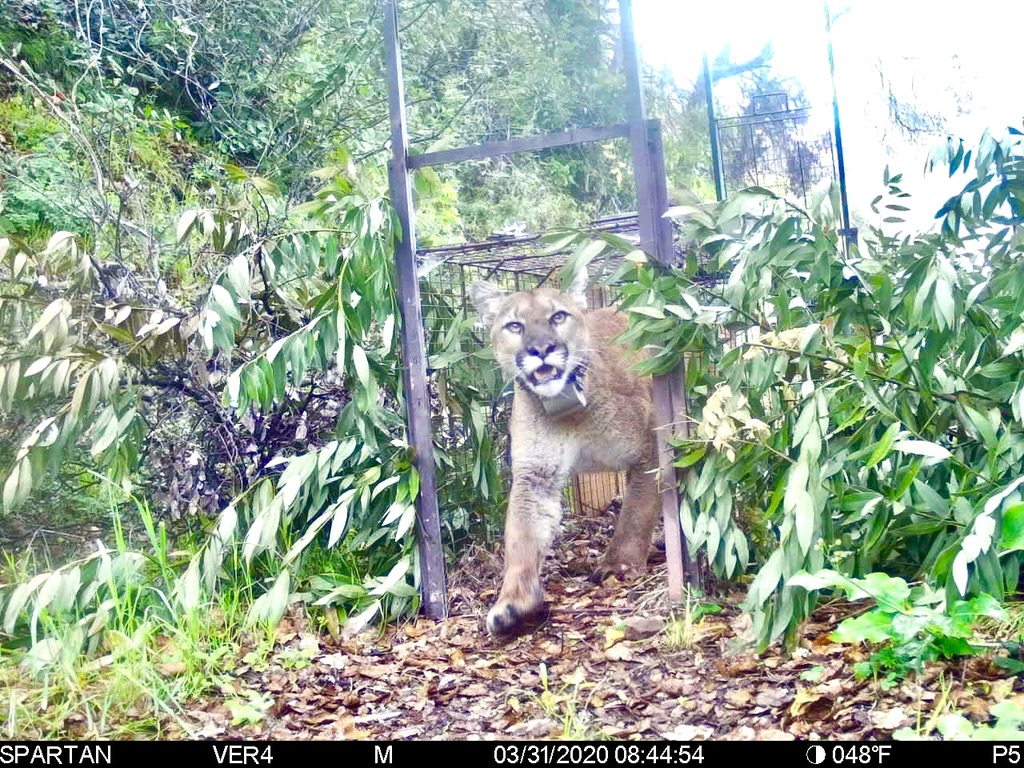
Mountain lion biologist Quinton Martins holds up an antenna while listening to a series of beeps from his hand-held receiver. Martins is searching for a female mountain lion wearing a failing GPS collar that needs replacing. As he leads us across a stream towards the oak and bay hillside, these locator pings indicate she’s alternating between two areas on either side of the creek. Martins thinks she may have a kill, which would be great news. If she does, then he can place a cage trap to recollar her.
Sharon Negri of the Mountain Lion Foundation and I are tagging along, hoping to catch a glimpse of this elusive animal. The hillside is steep with no clear trail as we trudge through tight brush and poison oak, occasionally stopping as Martins rechecks the lion’s location.
“She’s very close. On the other side now, maybe forty meters away in those trees.”
This particular cat, Martins tells us, had at least one kitten who would be eight months old. But the resident male recently died of bacterial bronchial pneumonia linked to Feline Leukemia Virus, opening the territory for a new male. If that’s the case, it could mean this new male might kill the kitten in order to entice the female to breed again.
Martins unique trap system. It triggers by weight avoiding triggering non-target animals
Martins has been running a mountain lion study in partnership with the Audubon Canyon Ranch in Sonoma County since 2016. True Wild, his company with his wife, focuses on coexistence with wildlife and offers customized African safaris as part of their conservation efforts, connecting people to nature in a profound way and working with participants to become more involved in conservation initiatives where possible.
We stop again for another location check. Now Martins’ receiver displays a significantly stronger signal, indicating the cat is on the opposite bank exactly where the second ping showed up on his computer yesterday. Sharon and I carefully navigate the streambed around an enormous jumble of jagged boulders, possibly dumped from soil preparations for the vineyard whose private lands we have permissions to be on. At the ping site there is no indication of a kill while the cat has disappeared through thick bush and over a rise. Knowing this female was so close, yet we never saw her, leaves us frustrated. It is a repeat of a common scenario: cougars watch people yet we humans never see them.
Heading back to the car, Martins points out fresh tracks in the soft dirt. “She’s been here, going back and forth. This cat has been incredibly difficult to find.”
Luckily, Martins has one other lion he wants to sleuth out. P49 has a good working collar that indicates she might have a kill. Martins’ goal with this cat is to find out if she has kittens. As we drive 45 minutes west to the opposite end of Sonoma County, Martins lays out the unique difficulty of doing a wildlife study in a highly populated rural area.
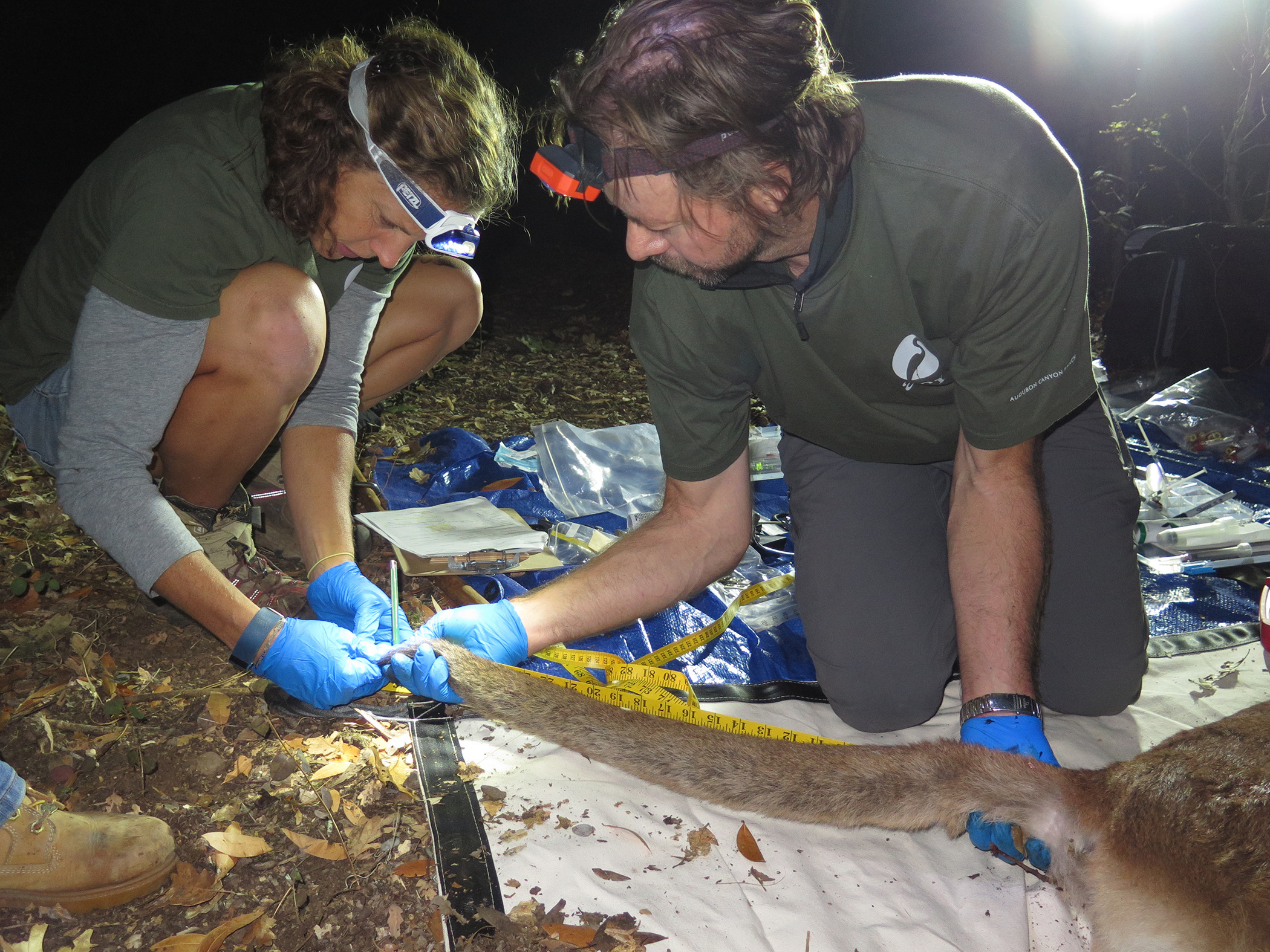
Martins getting data from a sedated lion he is collaring
“The males we have collared—P5 has 17,000 private properties in his territory. P31 has 11,000 private properties. How do you contact that many people and access all those properties to inspect fences or signs of prey? This dilemma is confounded by an increase in weekend private property owners. When you overlap a land parcel map it is as if you are looking at 50,000 or 100,000 mini ecosystems, so you can’t just throw a vegetation layer over it and say ‘OK, this is what the cats are doing.’ As their primary prey is deer, it might look like great deer habitat on a map, but in many cases these properties are fenced to keep deer out. So there might be no deer in areas where you expect deer, but cannot tell because you can’t access the properties very easily. And walking each individual land parcel, one finds different plant and animal resources, a variety of fence types that block or allow animals to move through, and each parcel managed differently to some degree.”
Martins tell us lions are using fences of any type to strategically block or corner and kill deer. In fact, when we approached the previous property, Martins pointed out a cougar-killed deer carcass hanging against the fence that enclosed the vineyard.
Our second property owner is an animal lover excited to discover there’s a lion hanging around his property. He has a large piece of wooded land, over 200 acres, nestled in the hills of Sebastopol. He greets us at his main house and we follow him down the road to where Martins recorded a series of GPS fixes the night before. The dense cluster of pings is a hopeful sign this cat has made a kill and is still hanging around. Cougars can spend up to three days or more consuming an adult deer. They will cover their kill to preserve its freshness as well as deter scavengers while they rest nearby.
The GPS telemetry data indicates the cat traveled along a hillside where an overgrown two-track is still visible. A short hike leads us to her kill—a yearling deer. Cougars kill with a bite to the neck, then consume the internal organs first. Big cats, along with their small domestic cousins, lost the ability somewhere in evolutionary time to convert carotenoids like beta carotene into Vitamin A, so they have to obtain it directly from these nutritious organ meats. That’s exactly what this cat has done. I also see she has begun to pull the fur away with her incisors. Although this is a small deer, Martins thinks there’s enough meat on the carcass that the cat will return, and if she does we’ll find out if she has kittens. The VHF radio signal from her collar indicates she is resting on the opposite hillside only a few hundred yards away.
“She’ll return under cover of night,” Martins tells us as he sets up three trail cameras focused on the carcass.
Even though we never did see a mountain lion, the day was exciting as well as instructive. Conducting a mountain lion study in an urban/rural area has tremendous challenges and complexities that studies in vast wilderness areas like where I live in Wyoming do not. First there is no snow, so finding tracks is as elusive as the animal itself. Second, most mountain lion studies rely on dogs to do the tracking and treeing of the animal. Once treed, biologists can easily dart the lion and lower him to the ground to be collared and released. Obviously dogs can’t be utilized in areas where there are so many people on small private land parcels. In addition, while there are some public lands in Sonoma County—mostly small county parks dotted throughout his study area—Martins’ lions live in territories encompassed by thousands of private properties, meaning he has to obtain permissions from each owner before visiting. Most, but not all owners are happy to help, but even when he has their cooperation, each visit requires one or several phone calls to gain access. It’s a lot of human PR work.
A few days later, Martins relays the good news. P49 has two healthy cubs with her and sends us a photo of the family dining on the carcass. I realize that instead of one lion, there were three nearby, none of whom we saw. But to be fair, mountain lion mothers sometimes stash their kittens while they hunt, then bring them to the kill site afterwards.
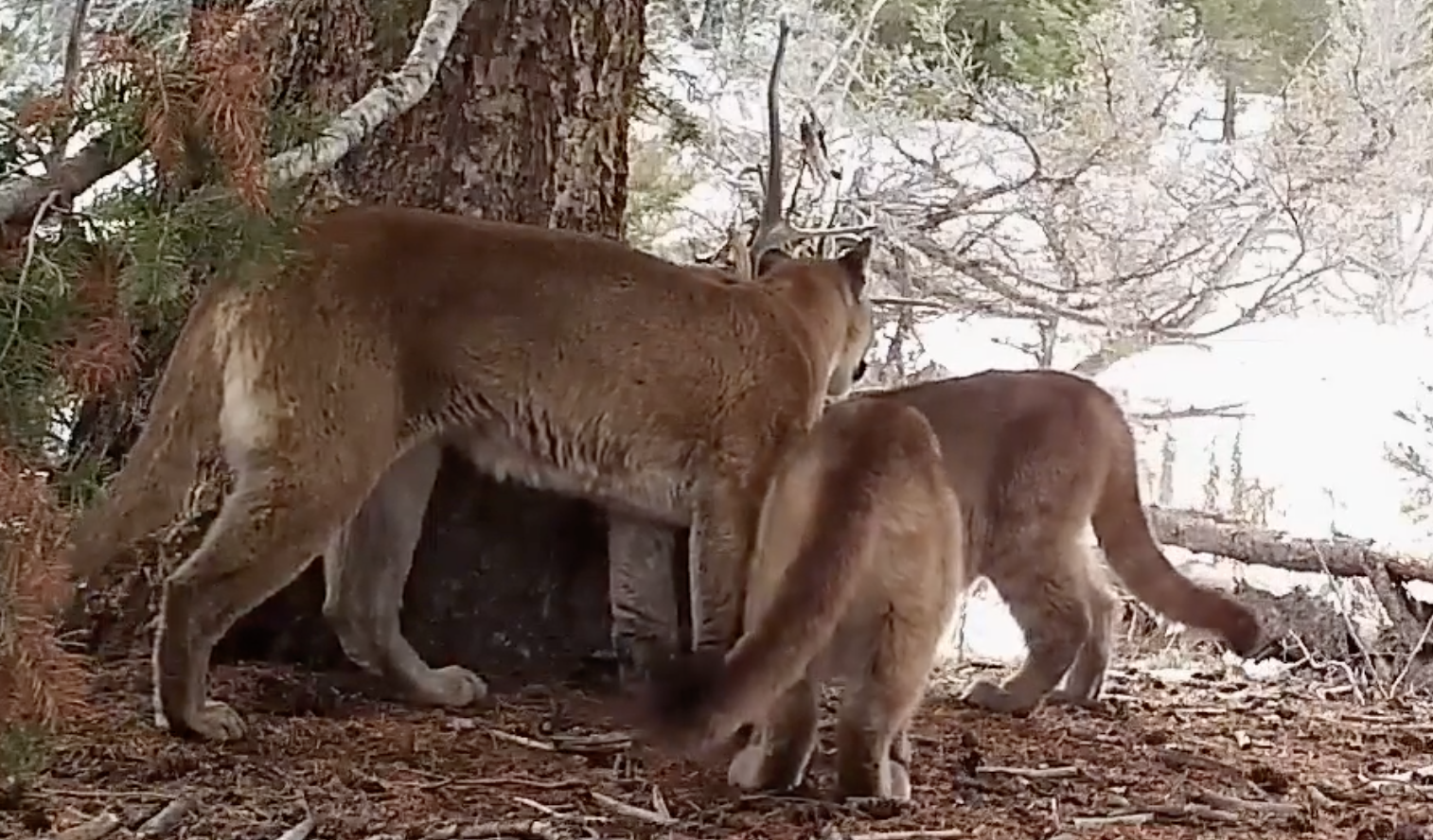
P49 with her two kittens on the kill we found.
These kittens are highly dependent upon their mother’s hunting skills throughout their first year. The span between six and eighteen months is especially important for the cubs because they are learning the art of hunting and killing prey. In addition they are exploring their natal range and learning how to deal with potential enemies. Dispersal occurs usually between 12 and 24 months. Lion dispersal is critically important for genetic diversity, as well as for geographic expansion. Females tend to stay close to their birth mother’s range, while males need to find an empty slot devoid of a dominant male. The odds are tough for dispersing males, who roam much farther than females and have to contend with other territorial males. In an urban/rural landscape, these kittens will need to learn to avoic livestock plus they have a higher chance of contacting diseases from domestic cats like Feline Leukemia Virus and the H5N1 virus, commonly referred to as bird flu which cats have a higher than 70% chance of dying from.
Through Martins work we hope to have a better understanding of mountain lions living in a unique situation sharing their territories with a high density of people in a complex urban/rural landscape. Plus, this coexistence with California’s communities work will hopefully give these iconic cats increased odds of survival, ensuring their vital role in helping ecosystem integrity is maintained.
More info on Martins work and California mountain lions can be found in my book Ghostwalker
If you want to follow updates of Martins’ Sonoma study…
True Wild’s work stems from our love for wild places. We are driven to find ways for people to appreciate and make an effort to protect wild places and the wildlife that shares the world with us. We believe that people can coexist with wildlife through practical and achievable methods and in doing so, serve people, domestic animals, wildlife and the environment we are all living in.
True Wild (www.truewild.org) and Audubon Canyon Ranch in partnership with Sonoma County Wildlife Rescue , are spearheading an essential mountain lion research and education project in California’s San Francisco North Bay Region. We are a key community resource for people to be able to coexist with wildlife, particularly mountain lions. In Africa, we support high impact, coexistence-focused projects that will protect large wild places while benefitting local communities.
We want to maximize impact with minimum overhead, seeking to achieve win-win situations for everyone involved. Donations become investments, involvement leads to tangible returns. We encourage and actively seek both intellectual and financial support to offer solutions to the growing ecological issues our world is facing.
We offer impactful and extraordinary safari opportunities, connecting people to nature in the most profound way in some of the most beautiful places in the world. We view our safaris as a platform for providing a valuable life experience as well as highlighting the significance of wild places that need protection. Each safari is tailor-made to maximize the personal experience.
Last week I attended The Mountain Lion Conference which is held every 3 years. This is the first in-person conference since 2017 because of covid. The Conference agenda is divided between presentations from biologists discussing findings from their recent studies, and state wildlife managers giving a summary of any particular aspect of their management they might choose to present.
Most of the science presented wasn’t new to me. It’s all in my book Ghostwalker: Tracking a Mountain Lion’s Soul through Science and Story. For instance, Kyle Dougherty presented studies done on California connectivity issues, discussing how the Tehachapis are critical for genetic diversity for lions there. I did extensive interviews on connectivity and the challenges in my California chapter. One interesting note was that mountain lions in that critical corridor (where there is no highway crossing yet) spent 19.8 hours on average observing, trying to decide if and where they might cross. None of their collared cats attempted crossing the highway.
Some of the most promising studies are taking place in Texas, the only western state that still lists mountain lions as “predator” status, meaning they have no seasons and no protections. Chloe Nouzille and her crew are studying the impacts of the border wall on mountain lions and other large mammals. So far they’ve found no lions crossing the wall in places where contractors place small pass throughs. These breaks are not placed in known wildlife corridors, but randomly placed about every mile. Not all contractors are doing this. Usually it’s at the request of the landowner. What the team has found is more minimal barriers such as fences were being used by lions, although these fences are too high for deer to jump over. Another Texas study was presented by Lisanne Petracca. Her team is trying to understand the genetics of western Texas lions. Are most of these lions coming from Mexico, New Mexico, or in-breed? There haven’t been studies in Texas since 2008. This renewed attention to mountain lions is very positive and hopefully will push their state legislature to make changes in lion status.
I personally had a few takeaways from Mark Vieira’s presentation on Colorado’s mountain lion female harvest presentation. Colorado doesn’t have limits for females but like most hunting states groups together their quota for both sexes for each zone. Let’s be clear: mountain lion hunting is absolutely a choice and not necessary for lion management. Lion hunting is all about hunting opportunity, not about food. But in all our Western states except California (which outlawed lion hunting through a 1990 ballot initiative. Colorado last year rejected a similar ballot initiative which would have outlawed lion hunting) that’s a fight that is a long time out.
In the meanwhile, I strongly feel good management means a female quota. And if hunting is part of the mix, then ideally the female quota should be 0 or 1 ( where there is boot hunting). Once that limited female quota is met, the zone is shut down to female take. Mountain lions are notoriously impossible to sex unless they are treed. Even then it can be difficult but a person needs to look for a black spot below the anus indicating the lion is a male.
So what has Colorado done since they have no separate quotas? First they have included discussions with houndsmen asking them to voluntarily reduce the female harvest. Second they are now reporting the amount of females taken in live time on their quota page. Third, they require a class to learn how to identify male from a female. (try taking the I.D. exam yourself) Studies have found the difference with an identification class is 10% less killing of females and with these extra minimal efforts, Colorado has reduced their female take another 10% to 39%. Most seasoned houndsmen can distinguish male from female once a cat is treed, along with recognition of track size. States like Wyoming where I live have no required class for new or out-of-state lion hunters, and don’t have a female quota.
One other note on why mountain lion trophy states should have a female quota along with classes on lion biology—mountain lion females are either pregnant, with kittens, or in estrus. If kittens lose their mother before one year old, they almost certainly will not survive. Many states, including Wyoming, do not allow hunters to kill lions traveling with other lions (which most of the time would mean they are kittens even though kittens can be as big or bigger than mom). But females frequently stash their kittens, especially ones under six months old and many times up to one year old when they go hunting.
Trail cameras for wildlife spying have become a popular pastime. Not only has the video and photo quality improved, but the price point for high quality cameras is lower every year. I’ve been using trail cameras since around 2010. I thought it would be interesting to do a short post on my personal evolution of my use and what I’ve discovered.
Professional photographers and folks that are handy with manual camera adjustments have switched from store-bought trail cams to DSLR cameras. Using a DSLR camera trap requires a lot of knowledge of not just wildlife tracking but lighting positioning and camera settings, but the payoff is great. For my expanded Ghostwalker book out this year from University of Nebraska, even though I have thousands of great mountain lion photos and video, I needed to engage these experts for high quality photos that would reproduce in print. I’ve never been great with manual adjustments so point/shoot cameras, like trail cams, are my go-to.
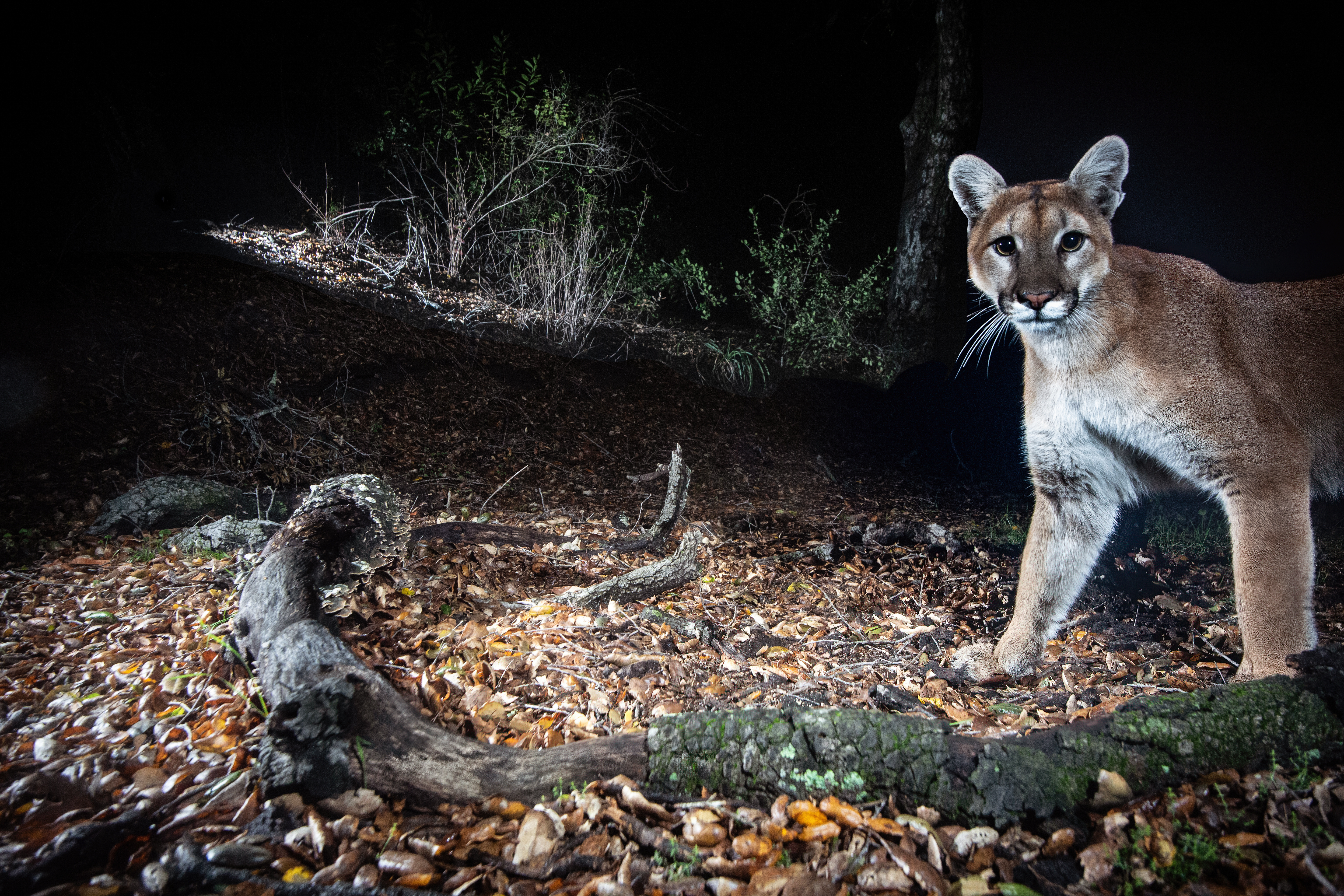
Amazing capture by Jeff Wirth using a DSLR. Wirth graciously consented to let me use some of his photos in Ghostwalker: Tracking a Mountain Lion’s Soul through Science and Story
When I first started using trail cameras their quality was very poor, but I was mainly interested in who was visiting the nearby forest. I caught grizzly and black bears on the animal trails, along with deer, coyotes, and wolves. I was anxious to catch martens who don’t follow trails. To that end I built a box trappers use, baited it, and put a camera on it (of course I didn’t put a trap inside!). Bobcats also don’t follow trails very much and since I do have bobcat trapping in my area in winter, the animals were rare on the landscape. I hung shiny objects to attract the cats with a camera positioned on it. Still, I almost never captured a photo of a bobcat.
After two years of camera trapping, I had several epiphanies that changed the course my experiments. First, after watching trapping in my area, I became aware that my baiting was contributing to these animals becoming less wary of actual kill traps. Therefore I stopped all baiting and scenting. But the biggest revelation was how to reliably capture animals on camera.
Elk on frozen river at a crossing point. I could see the crossing using track I.D.
I had been lucky to capture several mountain lions, and found lion tracks in different areas. That piqued my interest so I attended a class on mountain lions by researcher Toni Ruth in Yellowstone. During that class I watched a video of wildlife on a mountain lion scrape site. I knew about scrapes but had never seen one nor did I know how to find them. A scrape is made by a male lion with his back feet, usually urinated on, to mark territory. Lion scrapes apparently are big attractants for all sorts of wildlife. Once I learned where to find scrapes, I sought these out and placed cameras on them. Scrapes draw almost all the prey and predators in an ecosystem. By continuing to use these same locations for over 15 years, I’ve captured amazing photos, but the real gold here is monitoring sites for so long that you get a read on the ebb and flow of wildlife activity.
(ABOVE VIDEO OF WOLVES HAD CAMERA PLACED ON A TRAIL HEAVY WITH SCRAPE SITES)
A friend who is a feline researcher told me keeping cameras at the same location for many years provides a good indication of the health of the local mountain lion population. Houndsmen and researchers use dogs to find lions, which gives a good clue to the waxing and waning of lions in a designated area. Would monitoring scrape sites alone give me a general idea of lion health?
Lions are impossible to identify. Puma concolor, their latin name, means cat of one color. Unless they have scars such as nicks in an ear, etc. they look alike. And in a hunted area, males usually don’t last long; but another young male will come to fill the void. I did get an indication that I could monitor lions this way a few years ago. In 2015-2016 we had record snows. Our mule deer population crashed. By early spring when the first grass emerged, the landscape was littered with dead deer. Predator populations lag behind prey drop, but it wasn’t long before I noticed I wasn’t catching females with kittens on my camera. Without sufficient prey, females will have smaller litters or none at all. 2017 was the last photo of a mom with young kittens. Although I did catch young dispersers, there seemed to be a dearth of females in my area until 2021. coinciding with a rebound in the mule deer population.
Additionally, the same thing was going on with cottontails and bobcats. Bobcats also visit lion scrape sites, and male bobcats like to scrape over lion scrapes. Rabbits go through seven year cycles and sometime around 2014 I noticed fewer and fewer rabbit tracks in my study area. I also stopped picking up bobcats on my cameras. The rabbit population had crashed and with it bobcat food. Then around 2020 a rabbit took up residence at one of my camera sites. Within a year, more rabbits at other sites, and soon there were rabbits everywhere. The bobcat population rebounded. Now I was catching bobcats with kittens frequently. An indication of how keeping cameras in situ for an extended period can tell the story of the land’s health.
Bobcat visits lion scrape site
In summary, there are many ways to use trail cams. Research, exploration, pleasure. For me it’s become a tool not just to see who is visiting, but to monitor over time the swings of the ecosystem: how weather patterns, food availability, habitat health, and natural cycles affect the wildlife in my study area.
For more videos from my trail camera captures, see my YouTube site
I’m very excited to announce the fall release of Ghostwalker: Tracking a Mountain Lion’s Soul through Science and Story published through University of Nebraska Press. This is an expanded edition of the independently published version in 2018. So what’s new?
A new chapter on mountain lions and desert bighorn sheep in the Southwest, a very sticky topic. Bighorn sheep are always teetering into the vulnerable category due to diseases transmitted by domestic sheep that have infected all bighorn herds throughout the Western states. But desert bighorn, who live in isolated sky islands with small herds, are particularly at risk. Predation from mountain lions is targeted as a high risk for desert bighorns. I explore and contrast management attitudes and policies towards mountain lions and bighorns in three states in particular: New Mexico, Arizona, and California. I spent time interviewing and traveling throughout the SW to better understand this gordian knot of a problem.
California! So many new things are happening with mountain lions in California. The California chapter is completely rewritten with a series of new interviews. Biologists Quintons Martins who is doing a study in Sonoma County fills us in on North Coast issues, while Justin Dellinger with CDFW dives deep into isolated populations throughout the state. Kristeen Penrod provides maps of connectors needed throughout Southern California in order to save mountain lions for the future.
What’s happening out there that’s new for mountain lions? We need a new model to replace the North American Model of Wildlife Conservation. I explain what it is and why it needs updating. I speak with Wildlife for All, an organization determined to change the present wildlife management model to be more inclusive. Panthera is studying non-lethal predator protection methods in California that will help ranchers throughout the West. Plus new information on the value of mountain lions for mitigating climate change and as an indicator species.
New stories sprinkled throughout the book along with updated and new information on mountain lion research.
Lastly, almost every photo in the book has been replaced with new ones. Many thanks to several photographers who are doing camera trapping with high-end equipment. Although I have hundreds of photos of mountain lions from over 14 years of using store-bought trail cameras, these images, though great quality for the internet, do not reproduce well in a book. Several professional photographers generously donated some extraordinary photos that will appear in the new edition. Unfortunately the paperback will not be in color.
That’s a summary of what’s new. I’m so pleased to have several new endorsements for this edition.
Author Dan Flores writes: Leslie Patten has written the most fully-realized mountain lion book I have ever read. Cutting-edge science and interviews are her bedrock, but first Patten is an observer of the lion world as well as a writer whose prose pulls like a river’s current.
Jim Williams M.S., retired Montana Fish, Wildlife & Parks wildlife biologist and author of Path of the Puma writes: I finished your fantastic book today. Yourpenchant for unedited and unbridled truth to science is amazing.
Author Ben Goldfarb writes: In Ghostwalker, Leslie Patten braids history, biology, and wildlife management to reveal this elusive cat in all its contradictory glory
I hope to do some presentations once the book comes out. If you or your organization would like to discuss this, please contact me.
There’s one place in my area where I’ve seen Glacier Lilies, but as soon as the melt starts the access road usually closes due to flooding. Since the weather has been cool, and next week predictions say it will be in the 70s, I decided to check out the spot to see if the lilies are up yet before the road closure. It’s a fairly remote less traveled trail and this time of year grizzlies are down low foraging while wolves are denning. The trail begins at the road’s end with a stream crossing, winds through a burnt valley before turning up a small drainage where the trail heads to a ridgeline pass.
Immediately grizzly tracks began faintly appearing on the dry ground.
When I turned into the forest drainage, the wet ground revealed two grizzly bears. That could only mean a mom and cub. The grizzly cub footprint appeared to be at least a one year old. I became more alert, unlocked my bear spray.
Smaller bear on the left
The area I’d seen the lilies years before was about a mile up the trail near the pass. Bear tracks followed the trail plus revealed a 2 day old scat that said they’d been eating grass mixed with fur.
Closing in on my lily hillside, I found a clear wolf print in the mud. I hadn’t seen wolf tracks earlier on the trail.
wolf track
About 150 yards before the lily area , I came upon what these bears (and wolves) were doing here. An elk kill right by the trail, completely consumed but about a week or less old. Clearly a cougar kill. I searched around the site a bit. No skull, only one leg left plus the spine and pelvis.
What a cougar kill looks like. Rumen pulled out to the left. The fur in a neat circular pattern cut off with the cat’s incisors
What did the tracks and the kill sign say about the story here? Of course, the only thing I can be certain of was this elk was killed by a cougar. But let’s think about what might have happened. Wolves and bears (grizzlies and black) push lions off their kill. With only one leg, and few fresh wolf prints, I imagined the wolves kicked the lion off the kill site, and hauled the other legs off, maybe to their den site over the ridge. The wolves probably consumed most of the elk before the grizzly mom and cub came along (their tracks fairly fresh) to finish off what was left. The fresh wolf track I found was probably a wolf returning to check on any left-overs, and maybe even encountering the grizzlies.
Unfortunately, I didn’t find my Glacier Lilies. Maybe just too early or maybe those bears ate them. But here is some other cool bear sign I found along the trail.
Bears use their claws to strip bark from a tree, then feed on the sapwood by scraping it from the heartwood with their teeth.
To learn more about mountain lions and their interactions with wolves and bears, read my upcoming book Ghostwalker: Tracking a Mountain Lion’s Soul through Science and Story out this fall University of Nebraska Bison Books. To pre-order a copy and receive a 40% discount, go to this link and use the code 6AF24
I recently attended a presentation by Wyoming Game and Fish large carnivore biologist Luke Ellsbury on, what else, large carnivores. I was mostly interested to know any results from Justin Clapp’s study on CWD and mountain lions. The field research is done but the analysis hasn’t been published yet. Luke confirmed that mountain lions were definitely targeting CWD deer and elk.
Another study measured the amount of prions in scat from mountain lions intentionally fed CWD infested deer meat. On the first defecation, the meat contained only 3% prions. And no detection on defecations after that. Luke said with these results in hand, the Service is definitely looking at adjusting mountain lion quotas in areas where they want to target reducing CWD in deer and elk. They are also planning on repeating this study with other predators—wolves and bears—and are presently testing CWD meat on bobcats in the field.
The study also corroborated findings from Elbroch’s Jackson study that as lions age they tend to prey switch to elk more heavily. That means if WGF wants to reduce elk CWD through mountain lion predation, reducing hunt quotas will allow more older mountain lions on the landscape. The critical age for prey switching seems to be five years old.
In other more personal mountain lion news, Luke confirmed for me that my one-eyed female lion was not harvested this year. In my area which is the northern end of Hunt Area 19, only one female was harvested this winter. I showed Luke the last video I captured of one of One-Eyed cubs. I thought he looked pretty rough. Luke agreed he didn’t look in good shape, confirming to me that most likely the mother and other cub are dead. And this cub, probably a male because he was always the bigger of the two cubs, isn’t likely to survive either. Cubs under one year old that lose their mother have a very low survival rate as they haven’t developed their hunting skills yet.
Lone Kitten of One-Eye captured early March 2024
Luke told me that this winter one lion was killed by wolves in my area, and that he had a call about another lion recently killed by wolves. Lions in my area aren’t collared, so these would be lions that hunters or hikers encounter and report. We’ve also had one report of a mountain lion dying of bird flu in the North Fork area of Cody.
Happier times. One-eye with her family in December 2023
I’ll continue to check cameras and hope to see One-Eye. I’ve followed her since she arrived in my area in 2021 as a young lion. She was probably born with her blindness. This was her second litter and I thought she was going to be really successful. The last time I saw the family together, those cubs looked happy and healthy at probably around seven or eight months old. Life is definitely rough out in the wild.
I’m very excited that University of Nebraska Bison Books picked up an expanded edition of Ghostwalker to be released Fall 2024. A preview of what’s new:
A new chapter exploring mountain lion management for desert bighorn sheep reintroductions in the southwest US. A highly complex and controversial issue, we look at and compare the approach of three states: New Mexico, Arizona, and California. This issue has never been addressed in depth. Mountain lions are dying unnecessarily through egregious state game agency directives.
What’s with California these days? The California chapter, completely revised, goes in depth on their problems with genetic bottlenecks in Southern California and coastal areas as far north as Santa Cruz. We’ll explore the findings of the Sonoma County study by Quinton Martins, the recent results of CDFW Justin Dellinger’s analysis, and the enormous task of building corridors and passageways for lions to continue to exist.
What’s new in the conservation scene for wildlife? I speak with Kevin Bixby about his new organization Wildlife for All. Panthera’s Veronica Yovovich tells me about their study on non-lethal methods for livestock protections.
New stories and updates throughout the book.
23 new interviews with researchers in addition to the 1st edition interviews
22 new photos
To pre-order and receive a 40% discount, use this link and enter code 6AF24
For those of you who haven’t read the first edition, I did several years of research and interviews with prominent biologists working actively with mountain lion research today. The three studies in Yellowstone National Park, a 16 year study in Grand Teton National Park, revealed the secret lives of mountain lions, their interactions with wolves, bears and other wildlife. A full chapter on California, the only state where mountain lions are fully protected from hunting; a look at mountain lions from the angle of trackers; what houndsmen who have worked with biologists have to say; along with how lions care for their young, how they find each other to mate, what a scrape is and more.
I’ll be posting short clips of many of the interviews I did with researchers in the coming months. First interview will be posted here and on YouTube in a few weeks with Sean Murphy, a biologist who worked for New Mexico Game and Fish. He’ll talk about the indiscriminate and ongoing culling of mountain lions by the department in order to transplant desert bighorns.
To pre-order and receive a 40% discount, use this link and enter code 6AF24
Yesterday I hiked to one of my trail camera sites planning on retiring the camera for the summer. Because our deer and elk migrate into the high country around Yellowstone starting in May, there is little action with large predators. Grizzly bears start to disappear around early July. On the east side of Yellowstone in the high elevation cirques of the Absarokas, moth sites feed the bears. Cougars are following our deer which make one of the longest migrations in the ecosystem. Wolves probably completed denning and will be taking their pups to rendezvous sites with a babysitter or two, while the other adults forage for food.
Cougar print at 10,000 feet early June in the Beartooths. Lions are following the migrating elk
So you can imagine my surprise when I looked at my camera videos. My newest male cougar is still hanging around, marking his territory with scrapes. He appears to have beat off another large male that has one eye, the other probably lost in a fight. One-eye was last seen at the end of March.
New male in the area. Notice he has eyeshine in both eyes, distinguishing him from One-Eye
Even more exciting, I caught a mating pair of grizzlies. By the time of the year, and the fact that these are two adults, you can be sure this video is a male following a female in estrus.
Large male grizzly. See video link for full story
In summer, when grizzlies disperse for high elevations, the black bears take over. Male black bears will make sure to display who is boss by tree rubbing, destroying cameras, and stomping which also puts down their scent. Interestingly, grizzlies know they are the real top of the food chain and could care less about cameras, although they do rub trees, both males and females. Here is a video of a grizzly female with two cubs spending time tree marking with her cubs following suit.
Mama Grizzly. See video link for story
On a very interesting note, I camera-captured two blonde animals this spring—a fox and a black bear—both fairly rare. To understand this in greater depth, I contacted Jim Halfpenny, well-known mammalogist and tracker. Jim told me he had never seen a fox this blonde, whether at fur sales or in the field. He thought maybe this fox could be a fur farm escapee, but in my inquiries we haven’t had a fox farm in the Big Horn Basin since 1996, plus I live in the high mountains next to Yellowstone so the mystery continues. In addition I’ve never had a fox show up at this location before. This little blonde red fox continued to visit this site over the course of several months, which adds to the mystery.
Blonde phase Red Fox. See the entire video via link above
The blonde phase black bear is also unusual around these parts. Halfpenny told me he had only seen one briefly around the Greater Yellowstone Ecosystem, and never as blonde as this one. Color phases of black bears are not unusual, but the blonde phase is the rarest. Here is a link to an interesting breakdown of color phases of black bears in North America. Although it is presented by a hunter, it is informative. I do NOT support any trophy hunting, but I encourage you to watch this for information. No actual hunting is in the video.
A large carnivore biologist who I showed the videos to had an interesting thought. “Wonder if this is a genetic expression due to the initiation of climate change,” he wrote me. Thinking outside the box leads to interesting possibilities.
Blonde phase Black Bear. See video via link above
Finally, my new book Shadow Landscape is now available on Amazon. These are stories of wildlife encounters I’ve wanted to tell for a long time. I appreciate all my readers and followers. Thanks for your interest in our iconic wildlife.
“Under the aegis of wildlife management, the oxymoron that is now a fact of life for most North American creatures, spins unbounded tinkering, with further tinkering made necessary by past tinkering, effects of causes, effects of causes — a “cascade of consequences” precipitated by human intervention, well intended though it may be.” —Ellen Meloy
San Andres ewe 067 was languishing on a rocky hillside, chewing on tufts of grass when she heard the far-off noise of a chopper. She hated helicopters. She’d already been netted and captured once. That was when she was four years old. The biologists collared, tested and treated her for scabies, a disease that was killing her sheep compadres. During the capture she broke her leg. Although her leg mended, she hadn’t forgotten the noise associated with the trauma. Spotting the helicopter in the distance, she darted uphill into a covey of rocks. The helicopter passed without seeing her.
Desert bighorn ram in Utah
Before the arrival of the market hunters killing sheep to feed railroad workers and miners, before settlers trailed thousands of sheep into Texas and New Mexico, this eighty-five-mile rib of northward trending rock called the San Andres Mountains was prime habitat for desert bighorn sheep. Biologists describe it as a metapopulation: sheep that travel from one range to another, following fluctuations in weather patterns and forage. The home range of ewe 067, probably held the largest population of desert bighorns in the southern Chihuahuan desert of New Mexico. Unhindered by human interference, sheep connected north through the a desert gap into the Oscura Mountains and southward into the Organ Mountains. With the arrival of livestock that brought disease, overgrazing, and unregulated hunting, the sheep died off. By the 1940s only a small remnant bighorn population lived here.
To save the desert bighorns, the San Andres National Wildlife Refuge was created in1941. Only thirty-three sheep remained, mostly in the southern half of the range. White Sands Missile Range was created in 1945, encompassing the Refuge within 3500 square miles. Seven days later, the first atomic bomb exploded on the northern edge of the military testing site. In a fortuitous quirk of isolation, the Refuge was now surrounded by a huge tract of land, with no public visitation or livestock. The bighorns flourished. The military never used the ground, just the air space, and the sheep eventually habituated to the screeching sounds of jets and missile launches.
White Sands Missile Range. The small green outline is the San Andres National Wildlife Refuge
By the mid-1960s the herd grew to over 200 sheep. Yet living on an island has its limitations, even with those high levels of protections from human interference. Island populations are subject to genetic drift, disease outbreaks, forage decline and weather changes. Within the next ten years, by 1979 the herd crashed to around eighty animals and kept declining from there. By the time ewe 067 was born in 1989, only about 35 bighorns comprised her herd. The culprit of the crash was determined to be a scabies-mite infestation, its origin a mystery, but the main suspect of transmission was domestic goats and sheep. Scabies causes incessant itching, hair loss, ear drum damage, loss of hearing and upset equilibrium. The scabies left the sheep vulnerable to contagious ecthyma, a viral disease that causes scabby lesions on the mouth and can lead to blindness, lameness, impaired feeding and starvation. This disease complex, if it didn’t kill a sheep outright, predisposes them to death by other causes such as predation, bacterial infections, falls from precipices.
Now in the winter of 1996, seven year old ewe 067 ran for cover from the helicopter. Meanwhile, two other choppers were also surveying the Refuge. In 15 hours of survey time, not one sheep was observed. The following year the concerted effort was repeated, but this time 067 was on a naked bluff. She was captured, collared and treated for scabies. San Andres ewe 067, the lone remaining native desert bighorn in the Chihuahuan desert, now became known nationwide as “the last ewe.”
067 was born on an isolated protected perch with a wide view. Her mother probably sought out rugged terrain for protection from lions, eagles and coyotes. As the ewe dropped her newborn, an intensive study on mountain lions was taking place within her home range. From 1986 through 1996, Kenneth Logan and Linda Sweanor collared, followed, and documented mountain lions in the Refuge. Bighorn sheep had been listed by the state of New Mexico as endangered in 1980, so although their focus was mountain lions, they agreed to include sheep predation monitoring as well. During the years of the study, the mule deer thrived, so lion kills were mostly opportunistic and compensatory. Of forty-three collared sheep during their ten year tenure, twenty-six died, ten from lion kills. Yet after the study was completed, the mule deer population crashed, and mountain lions were hunting farther and wider for food. With the added predation, along with a small, weakened diseased population, all the sheep disappeared.
All but our last ewe. Ewe 067 watched sheep around her drop, get eaten by lions, or fall off cliffs while she found safe areas to forage. For two years 067 lived alone. For a herd animal, she must have become extra vigilant. Ewes in particular like to live high, combing for good escape habitat, a survival instinct honed to protect their lambs. Sheep have excellent vision. Even at ten years of age, hers must have been highly acute.
Ewe 067 never had much luck with humans. Now easily located with a telemetry collar, during her third capture in 1999 she was placed in a paddock by a guzzler for a week. Bashing her horns against the enclosure, she broke one off.
Possibly 067’s luck with humans was about to change. New Mexico Game and Fish was beginning a new bighorn sheep transplant program. The Refuge with its historical evidence of a large herd of sheep was on its radar to be next. Yet the scabies transmission was scaring them. How was it communicated—did it stay in the soil? Was it through direct contact? A test was devised to see if the Refuge was safe. The NMDGF brought in six “Sentinel” rams in 1999 from Red Rock Wildlife Refuge, a 1,250-acre fenced enclosure in southwest New Mexico where they were raising bighorn sheep for seed stock. The rams were sprinkled on various ranges, used as canary-in-the-coal-mine sheep. They waited two years to see if they died. When all the Sentinels lived, additional transplants were brought in from Red Rock, along with sheep from the Kofa National Wildlife Refuge in Arizona. Between 2001 and 2005, fifty more sheep were brought in from Kofa along with a few more from Red Rock.
The San Andres Mountains as viewed from White Sands National Park
Three years after her capture in the paddock, 067 was spotted with a lamb. One of the Sentinel rams had found her. At thirteen, this feisty survivor had birthed again. She beat scabies, lions, capture, and the terrible fate of aloneness for a herd animal dependent on others.
______________________
“Hintza, come!” I’m keeping my ten-month-old golden retriever close. We’re walking dry washes in the southern New Mexico Chihuahuan desert, looking for mule deer, and I just spotted some javelinas on a nearby scrubby slope. Javelinas don’t like dogs and have been known to kill them. Really, Lindsay Smythe, my hiking partner, is doing most of the work. I’m just tagging along, holding my recorder out, navigating around creosote bushes and rocky terrain trying to keep up and corral the pup. Smythe is the San Andres Wildlife Refuge manager, here helping her friend and fellow lead biologist Ron Thompson on this four-day project. Smythe points out what javelina scat looks like. “Kind of like cattle droppings.” It’s everywhere now that I recognize it. Seeing Hintza, the javelinas deposit some fresh scat to confirm.
I was invited to spend a few days on Ted Turner’s Armendaris Ranch with a small team of biologists as they completed an annual deer survey. The Armendaris, a desert property bordering the Rio Grande by Elephant Butte Reservoir, is over 350 acres of untouched land Turner has reserved for wildlife. It’s impressive and vast private land that stretches across the desert basin east to the San Andres, encompassing the Jornada del Muerto, a name given to the basin by the Spanish for its waterless expanse. The Fra Cristobal mountains hug the reservoir and western edge of the basin. They’re a small range, not terribly high, but their classic crags and high mesas are good sheep habitat, though it’s debatable whether they ever held sheep historically. Looking east, the San Andres appear far in the distance, a long wall of mountains. To the south, much closer, lie the less formidable Caballo mountains, shrouded in clouds suspended above the desert floor.
San Andres mountains far in the distance, looking from the Fra Cristobals
I’m actually here at the invitation of Ron Thompson, big cat biologist. These days Thompson mainly spends his time on jaguars in Mexico as president of the Primero Conservation nonprofit. But he still continues his contract work for the Turner Endangered Species Fund. He helped restore these bighorn sheep and continues research here on adaptive mountain lion management strategies, his most recent being water. It was through his work collaring lions on the Kofa that he met Smythe.
Deer, being the primary lion food, it’s important to keep tabs on how they are doing with an annual study. Deer health bodes well for sheep longevity. The summer of 2020 was especially hard on all wildlife. The monsoons never arrived. Thompson tells me forage on the ranch is in poor shape.
“The habitat is private land and so the ranch manager is responsible for maintaining healthy habitat. It’s not healthy now. We’re in a drought and the main browse component is way overused. I’m telling him your plants are dying. And the deer are declining because of the competition.”
Thompson points me to a nearby hillside where a series of lines demarcate the slope.
“That’s from desert sheep going back and forth. That used to be all grass. It’s been denuded. All been eaten and the sheep aren’t there anymore. Those are the visual impacts I’ve seen in twenty years of being here. But you can’t just come here, look at the mountain, and say, where are the sheep. They’re here and they continue to have an impact.”
Thompson says the deer fawn recruitment is down 10%. That’s why he’s brought this small team to comb, section by section, the Fra Cristobal range. Today, Smythe and I observe one buck, one set of coyote tracks, and several dozen javelina. The sheep are higher up so we don’t expect to see them on this route. Smythe tells me the lower area of the mountain is poor deer country so she’s not surprised at our limited success.
Smythe is the perfect person to discuss sheep and lions with. She’s been the sole biologist and manager of the Refuge for two years. Before that she worked at Kofa National Wildlife Refuge in Arizona, and at the Desert National Wildlife Refuge (DNWR) near Las Vegas, another sheep refuge surrounded by Nellis Airforce base. Kofa is the main supplier of desert bighorn transplants for Arizona with currently over 900 sheep. The DNWR has 900 sheep.
Kofa National Wildlife Refuge (USF&W Photo)
Kofa National Wildlife Refuge had a precipitous drop in their sheep population in the early 2000s, from over 800 animals to 400. This was before any awareness of Mycoplasma ovipneumoniae. Since Kofa was providing the majority of the sheep transplants throughout Arizona, alarm bells went off. Meanwhile, for years Kofa had been developing more and more artificial water sources specifically for sheep. In fact, the increase was phenomenal. Arizona had 750 managed waters in 1997 for wildlife. By 2019, the state was managing over 3,000. It was through trail cameras set at water developments in the Kofa that managers noticed an increase of mountain lions.
“In that portion of the state, southwestern Arizona, it had very low to no mountain lions historically. A mountain lion might come through, be seen, but it wasn’t a regular occurrence.” Amber Munig, big game program management supervisor for Arizona Game and Fish tells me.
“And we had relatively no mountain lion harvests in that portion of the state for decades. We started to see mountain lions in there, and at one point we had over 14 mountain lions within the Kofa complex itself.”
Arizona Game and Fish sprang into action. Sensitive to public opinion, the Agency created a mountain lion predation management plan. They collared sheep and every mountain lion they could snare. The policy said that if a mountain lion killed two sheep within a six-month period, that lion was removed. If it only killed one, it was left alone, or if it was two outside of the six months, then it went free.
“We had this very strict approach for dealing with mountain lions killing bighorn sheep.” Munig says.
Smythe’s employment from 2005 through 2011 at the Kofa coincided with the sheep drop. She helped push for control limits in their management plan. The idea was the plan would target any lions that showed a clear affinity for killing sheep.
“My opinion is that a lot of the declines (at Kofa) attributed to predation—the real root cause was disease. For a long time we weren’t testing for it at all. When I was at Kofa we had six mountain lions collared, and there were definitely some males that killed a lot of sheep. There was one that killed six sheep within the span of a few months. But the problem is every time you had a mountain lion kill sheep, it was killed. No one has ever left mountain lions collared long enough to really understand the interaction very well. Everybody starts panicking, and that’s what happened in our lion study at Kofa.”
Smythe explains that “the intent was to kill offending lions that had really learned how to target bighorn sheep. But it turned out that all the lions met that criteria very quickly and so they ended up killing all of them.” It’s the rare mountain lion that actually shows a clear preference for one prey or another. Usually, it’s an opportunistic kill while hunting for their preferred prey, deer. In Logan and Sweanor’s study only one lion in ten years demonstrated a clear affinity for sheep. He was removed.
Kofa’s predation management plan area was vast. The borders were delineated at highway 35 to the east, i-10 to the north, i-8 as the southern boundary, and west to the California border. The argument was “you can’t just kill lions in the mountain range because lions migrate in from other places.” So dispersers were killed too. Because it takes ten to fifteen years for a herd to rebound from a disease epidemic, it might have eventually cycled out of the infection on its own. It may have happened faster with lion removal, but, as Smythe reiterates, “the problem is they never do research. Everybody starts to panic and the lions always end up losing.”
The Plan did have a shut off valve. When the population reached 800, mountain lion killing would end. In 2019 that target population was reached, with over 900 animals in the Kofa, thus ending lion culling, a good fifteen years since the plan’s inception. The AZGF is still monitoring the collared lions for data purposes, but there is no longer removal of lions.
As we circle around an enormous obstacle of prickly pear cactus, Smythe argues that if every lion is killed in a treatment area, “they have no way of knowing if that’s what caused the rebound or not.”
Smythe reminds me that in 2002, twenty sheep were imported into San Andres from the Kofa herd, and another thirty in 2005.
“We know the Kofa decline was caused by disease because when they transplanted the bighorns from Kofa to San Andres, they all came down with Mycoplasma. When we tested them, we strain-typed it, and it’s the same strain. It is the Kofa strain that killed my sheep. All these declines that we’ve had were more than likely disease. Predation may have compounded that.”
Lions, like wolves, are good at sensing the weak and sick in a herd. Compromised animals are easier prey than healthy. An entire herd of sick animals may be like an open market for a lion.
Smythe feels the models for sheep management may be in the San Andres and Desert National Wildlife Refuge. The DNWR has never had lion management, yet they’ve also had deep disease dips along with rebounds. The San Andres did have a period of state lion controls when the animals were listed as state endangered and reintroduced into the Refuge in the 2000s. An environmental assessment was done and offending lions were to be removed. Over a ten year period around thirty lions were culled. But that plan sunsetted and there hasn’t been any active lion removal since. With the last visual aerial count at 170 animals, the Refuge population is doing fine, probably around carrying capacity.
San Andres sheep population over the course of the Refuge
Smythe’s recount of no testing going on during the Kofa decline is accurate. Arizona came particularly late into the disease monitoring game, probably starting only eight years ago. Yet during the early 2000s this was the situation throughout the West. Sheep biologists had been chasing sheep diseases for decades, but the science wasn’t there yet. Everything was cultured, which is unreliable for identifying and differentiating finicky pathogens.
“We were clueless,” Mike Cox of Nevada Department of Wildlife told me. “We didn’t want to be clueless but we didn’t have the science behind it. We didn’t have any money. Nobody cared. There’re no huge grants working on bighorns. We were blind of what was really causing the issue, just a lot of ideas and theories…It was a big circle-jerk for decades.”
In 2009, more than 2,000 bighorn died throughout the Western states.
“No one understood what was going on. People were thinking it was sunspots,” Cox told me, joking to emphasize how blindsided sheep biologists were.
Finally, a breakthrough occurred in the lab. Thomas Besser, a clinical veterinarian pathologist from Washington State University along with a few others, were able to isolate and identify the ringleader of sheep bacteria, Mycoplasma ovipneumoniae. Although there are several other bacteria living dormant in sheep, with their defense mechanisms intact, they can fight those off. But Mycoplasma destroys those immunities.
All this was happening sight unseen in the Kofa sheep die-off in the early 2000s. Now, in retrospect, game agencies can look back and see the real culprit.
Amber Munig pieced it out for me. “What we believe happened is that we had a disease episode that went through the Kofas which affected lamb recruitment and probably an all age class die-off. At the same time, we were seeing some expansion of mountain lions, some from south and some from east. We don’t know exactly why. Our deer and javelina populations were relatively stable at that time.”
“We had predation increasing, something we hadn’t had in the past for this population, occurring when the population was depressed. With our predation management and time allowing animals to clear any pathogens that were holding on within the population, it allowed for that population to recover. I think it was a combination of time and our very focused effort to not allow predation to keep suppressing that population.”
Yet the question still remains as to why the lion population in the Kofa complex increased from almost zero to fourteen animals. Ron Thompson has thoughts on the answer. Along with several other researchers, Thompson conducted a simple, yet elegant long-term study placing camera traps at water catchments spanning all three southwest deserts—Mohave, Sonoran, and Chihuahuan—including traps in the Kofa. Using data collected over years, the study revealed bighorn sheep using water catchments at limited times of the year, specifically the driest, hottest season. In the Sonoran Desert, where the Kofa traps were located, 85% of all desert bighorn sheep visits occurred during May through August. Bighorns have been evolutionarily adapted to get their water from their food. In the winter, they can kick barrel cacti over and chew the pulp. Predators on the other hand, need year-round water sources. Thompson found “desert bighorn sheep concentrated their visits to water within 4-5 summer months across all 3 deserts. Mountain lions visited water year-round in the Chihuahuan and Mojave deserts, and generally year-round in the Sonoran.”
The research concluded that “managed waters allow populations of desert bighorn sheep to inhabit areas they previously had not. Indeed, this outcome forms justification of managing waters for desert bighorn sheep. It follows that managed waters could enable mountain lions to inhabit locations they previously had not…”
Thompson reminds me to “keep this association in mind”—the increase in the number of photos of lions at water developments in the Kofa. “That,” meaning the lion numbers increase he says, “was suspected as the smoking gun cause for the decline.”
Day two of the mule deer survey I’m out on my own with Hintza. I suppose the researchers feel I’ve gotten the hang of walking and looking for deer. I’m combing a long wide wash that runs through a deep ravine. Two others are hiking the high ridges above. I’m assigned to not only look for deer, but scout for lion tracks. Before I set out, Thompson checked a trail camera located on a water source pinch point here. No lions had come by.
Although it hasn’t rained for weeks, maybe months, a tiny spring emerges through the rough rocks to fill a sandy hole. Hintza gets to quench his thirst. I see javelina tracks everywhere along the sandy bottoms. They resemble small versions of deer tracks set closer together in stride. A few deer tracks but none in the flesh appear. A large lizard suns itself on the hot rocks.
Hintza, my 10 month old pup on the Armendaris
The canyon is stark and beautiful, with gleaming bare stone along the base, sparse desert plants as the hillsides rise steeply above. I’m a plantofile, though unfamiliar with New Mexico, I don’t know many of these plants. I pause to admire a Dasylirion as it is unfurling. Sometimes mistaken for a yucca but they are unrelated. I know it from my days as a landscape designer in Northern California.
At one point I spot Thompson’s son who is assisting with the study. A small speck walking along the high rims, sky lining like a bighorn sheep. The canyon opens and ends at a water development with a rough dirt road leading to it. My assignment is to keep walking up the road and connect to another dirt road where we’ll all meet. As I’ve heard so much about water catchments during my time in the southwest, I spend time studying how this one works.
Unfortunately, for the bighorn, the story does not end with water developments, predator controls, or the recent uncovering of Mycoplasma as their vulnerability to respiratory infection. The beat goes on and we just do not know how to stop it.
Thompson told me over last night’s dinner how he has applied the data from his research. The idea was to allow sheep and deer to drink, but not lions. Sheep and deer have narrow faces, lions have round faces. Those face measurements are known to any researcher. But how long is a lion’s tongue? A key question for a cat that can lap through bars. Since Thompson spends lots of time capturing and collaring lions, it was just one additional measurement. The design he came up with was a trough with pipe laid vertically just wide enough for a lean sheep nose, and water depth just below a lion’s tongue reach. Water for thirsty deer and sheep, yet a deterrent for lions in waterless country. If water isn’t available, lions and other predators will have to search far and wide, leaving the sheep, who are less water-dependent, alone.
Johnson’s ingenious water drinker just for sheep and deer
That predators kill prey is the simplest of biological equivalents, known to any high-schooler. But the intricate dance of nature is a puzzle that humans have difficulty teasing out even absent our interference. Yet nature has been so tinkered with, trampled on, and altered by humans, that when one adds our own unintended consequences to the fluidity of natural factors like climate, habitat, and disease, sorting out cause becomes a veritable soup. To save an animal from extinction, we now find it necessary to trade wildness for rescue interventions.
Bighorn sheep petroglyph on the east side of the Missile Range in the Tularosa Basin
_____________
There’s so much more to this story. Stay tuned for Part III
A few days ago I found a pile of freshly collected dirt and pine needles under a large fir. It had the obvious signs of the only animal around here that covers its scat–felines.
I pushed aside the dirt and found cougar scat, so fresh that it was obvious this cat had just killed and eaten.
Fresh Cougar Scat
In researching my book, Ghostwalker, expert cougar biologist Toni Ruth described to me a typical lion-kill scene—the cougar will drag his kill usually under a tree and cover it. This aides in hiding the smell to keep scavengers away and helps keep it fresh.
A deer can take several days to consume. The cat eats, sleeps and sets up a latrine nearby. Sometimes cougars will just eat the organs and leave. They need the nutritious organs since they lost the ability somewhere in evolutionary time to convert carotenoids like beta carotene into Vitamin A.
Buck in velvet killed by mountain lion. Lion covered the kill after it had entered through the rib cage and eaten the organs
Armed with this knowledge, I began hunting around in an ever-widening circle looking for the kill site. Yet I found nothing. Giving up, I walked into the nearby forest where a light wet snow still covered the ground from the previous evening. There I found the cat’s prints.
I backtracked the cougar, who had crossed through several properties. I found the kill, a young buck, close to a garage whose owners are absentee most all the year.
I could see the cat had entered through the rib cage (typical) and only eaten out the organs so far. I ran home and placed a trail camera at the kill site.
My home is amongst a small cluster of 6-9 acre properties, all bordering National Forest. The valley is a patchwork of a few large ranches interspersed with public lands.
Most everywhere one looks is National Forest. A few miles directly west are the Absaroka mountains, the border of Yellowstone National Park. Deer are getting ready for their annual walk-about, following the green-up to the high country of Yellowstone.
They are a bit late this year as it’s been cold, green-up a bit late, and the snows still deep where they are headed, so bucks and does are still hanging around, many close to homes.
The Basin in early winter from the pass. Public lands in all directions.
Another neighbor who owns a large horse ranch told me they’d spotted a young grizzly scouting their hay fields not far from this cat’s hidden kill.
It got me wondering if the bear would bounce the cougar off his kill. Cougars are subordinate predators, and bears kick them off their kills 50% of the time. A bear can smell a carcass up to 20 miles away. I was betting on the bear.
Young grizzly in the meadows by my house
But I had other questions. First, this cougar seemed to be acting somewhat like cougars that live in urban-wildland settings–its latrine was about 1/4 mile away and not used over and over; it was coming and going to its kill, returning only under cover of darkness.
With most homeowners gone in early spring, I believe this cat would have acted different. But this is Memorial Day weekend, and some of the nearby vacation homes are occupied. Even the usually vacant property where the deer stashed the kill, the owners had come out from the east coast for the weekend. Additionally, noise factor on the dirt road for the holiday weekend was spooking the cat.
So I asked myself “Would this cat return to its kill to finish up or just be satisfied with the organs it already ate?” “Would the grizzly bear overtake it?” I waited a few days and went to retrieve the memory card in the camera.
3:45 a.m. First visitor: A lone coyote stays for about 15 minutes
First visitor to the kill site
4:30 a.m. Cougar shows up. Leaves 40 minutes later
9:28 p.m. Cougar returns. Leaves and comes back at 2:15 a.m. next morning.
Here the cougar is re-burying it’s kill with its back legs.
So after the initial kill and eating the organs, this cougar has returned three times over the course of two nights. The bear apparently has moved on down the valley, more interested in grass and grains than meat. If this was fall, that bear would have definitely been on the carcass during hyperphagia.
Today was warm. This carcass was buried in a wet swampy area amidst trees. The flies were on it, but there is still plenty of meat. So now I wonder if that cougar will return again, even with the flesh beginning to spoil a bit. Or will the bear be back? Coyotes for sure, and maybe some wolves will come by as they are feeding pups now. I added another camera that takes video, so, To be continued…
Reviewing my photos. 3rd day and it is warm (63 degrees). The cougar wasn’t able to cover the carcass very well due to location and there are flies on it, but still plenty of meat.











 Leslie Patten Books: Wild Places, Sacred Spaces