• MY BOOKS ON WILDLIFE, GARDENING AND MORE

  • The Wild Excellence

  • True stories of wildlife encounters around the Greater Yellowstone
  • Award winning eBook on Decomposed Granite, tips, how to's, what to watch for
  • Children's book. True stories of a dog and wolves. In a dog's voice
  • Written for dry Mediterranean climates in California, north and south

Grizzly Bears and Delisting

It’s pretty well known that unless you see a grizzly with cubs, its extremely difficult, if impossible, to tell male from female grizzly bears. Recently this was confirmed to me on a trip to Alaska to bear watch. We flew to a small lake contained within the vast wilderness of Lake Clark National Park. The flight took about an hour leaving from Anchorage, landed on the lake, where about fifteen of us boarded pontoons and spent the day circling the lakeshore watching grizzly bears catch salmon.

This image has an empty alt attribute; its file name is img_8817.jpeg
Mom with 2 cubs fishing for salmon

Because these bears are in hyperphagia and also very used to the boat, we could approach quite close, say fifty feet away while the bears fished. Our boat captain was a veteran with thirteen summers under his belt of guiding and watching these bears. He knew the best spots around the lake where the fishing was good for the bears. And he told us something interesting. When we’d see a single bear (versus a mom with cubs), he had no way of knowing if that bear was a male or female. There was no size comparison to use or any other metric, and he’d been watching these bears for over a decade. In all, we saw over thirty bears in one day.

This image has an empty alt attribute; its file name is img_8812.jpeg
Bear catches a salmon
This image has an empty alt attribute; its file name is img_8778.jpeg
Pontoon boats left. This small lake was where we watched grizzly bears fishing all day

That brings me to the status of grizzly bears in the Northern Rockies. The U.S. Fish and Wildlife Agency is setting the stage to delist the Great Bear next year. Wyoming, Montana, and Idaho are actively pushing for a hunt. The local media is telling stories to encourage a hunt. (“While he doesn’t want grizzlies gone, he thinks hunting them would control their numbers and deter them from attacking people and livestock.”)

If delisting didn’t automatically include hunting, I’d be all in. We delisted bald eagles but don’t hunt them. The narrative around “a hunt” is that grizzly bears will “learn” to stay away from humans, or as the quote above, “control their numbers”.

This image has an empty alt attribute; its file name is screenshot-2024-09-27-at-5.37.17e280afpm.png

Let’s take the second one first, “control their numbers”. Females don’t begin to have cubs until their 5th or 6th year. Cubs are born in the den the first winter, then stay with mom for 2 more winters. That brings a reproducing female to almost 10 years of age before she can hopefully replicate herself with another female. Grizzlies were the first mammal listed under the ESA in 1975. Fifteen years later, in the mid-80s, most biologists felt they were going to go extinct in the Greater Yellowstone Ecosystem (GYE). It took almost fifty years to go from about 200 grizzlies in the GYE to 1000 bears! Every year about fifty grizzlies are killed for a variety of reasons, mostly human caused (euthanized for livestock depredation, killed by hunters, killed by other bears. 53 so far this year 2024). Add a hunt to that and we can very quickly decimate the population once again.

This image has an empty alt attribute; its file name is img_8808.jpeg

Does killing a solitary animal communicate to other solitary bears to stay away from livestock and human? There’s a sub-adult grizzly that’s been foraging clover this fall in the meadow on the Game Management Area. You can drive your car and watch that bear. If you drive too close, he runs away. But if there’s a hunt, one can legally shoot from a dirt road in Wyoming and he’s certainly close enough, and busy enough foraging, that shooting him would be like shooting fish in a barrel (which is how I see grizzlies in the fall, very absorbed in rooting around because they are in hyperphagia). An easy target for a bear hunter and would killing that sub-adult teach other bears a lesson? Of course not.

Do we need to control grizzly bear numbers? Besides the fact that in the GYE we are already killing over fifty bears a year without a hunt, if GYE grizzlies are to survive long term, they MUST connect naturally with bears in Montana (Northern Rockies). So far they haven’t done this. Wyoming’s plan is to keep killing bears on the edges, the very place where grizzlies must venture in order to connect and foster genetic diversity. Montana’s “plan” is to fly bears into the GYE to maintain genetic diversity, a completely absurd idea!

Anyone who has watched grizzly bears, and any bear biologist will tell you, that these animals are as smart (or smarter) than the Great Apes. They are on par with humans in terms of shear intelligence. Hunting them is simply painful and mean-spirited. Over 100 tribes signed a treaty against a hunt. Grizzly bears are sacred to these tribes. Moving “problem” bears to tribes that want them make more sense. As well as…

  1. Protect your livestock, feed and garbage
  2. Most maulings take place in the fall when hunters are prowling quietly through the woods and bears are getting ready for winter. Carry bear spray and if you are not familiar with hiking/hunting in grizzly country, there are plenty of deer and elk all over this country where there are no grizzly bears. What was shocking to me in this article was that these guys had been charged three times over the last several years. I’ve hiked in grizzly country for twenty years and haven’t had an encounter like they described. I don’t know the details of their situation, but it does make me wonder what they are doing wrong.
  3. I certainly have sympathy for small producers who lose stock to grizzlies on public lands. But public lands are all that our wildlife have and free range cattle should be “at your own risk”, though those risks can be minimized. As noted in my previous post, the ballooning of maximum stock levels on public lands provides a reason for bears to stay low during summer months instead of ranging to higher ground. Are we just feeding these bears with easy prey? There’s been a lot of recent research on non-lethal deterrents. It’s time that the state provides support for that instead of Wildlife Services or direct compensation for losses (grizzly kills in WY are compensated at 3 times the going rate of a cow).
This image has an empty alt attribute; its file name is db231-grizzly-mom-and-cubs.jpg

Charlie Russell, the Grizzly Whisperer

I am listening to a wonderful interview podcast, in two parts, of Charlie Russell on the Grizzly Beat, a blog by Louisa Wilcox. If you haven’t heard of Russell, this is your chance. Russell tells stories of raising cubs in Kamchatka Russia along with sitting on a log in a Canadian forest with a well-viewed female grizzly. I learned more about how to behave around bears by watching Russell’s body language than any book.

charlierussell-bear-4

Charlie Russell in Kamchatka

Russell candidly talks about how North American wildlife bear management long ago decided the best way to have bears around was to teach people to be afraid of them, and likewise to instill fear in bears of people. But Russell was interested in what bears were really like, and knowing that bears have personalities, he wanted to understand them. Russell spent ten summers in Kamchatka raising bear cubs and living with over 500 bears in the area. He is the only person to have successfully re-introduced cubs into the wild.

Russell’s story is told on these podcasts as well as his video East of Eden. Bears are highly intelligent. If they are treated peacefully, in general they act peacefully towards humans. They know, Russell says, that humans control the habitat that they need. Living with bears is something people can choose to do. It’s not a bear problem, but a people problem Russell say. If a person decides to live in bear country peacefully, the bears will respond in kind. Given that, Russell advices when hiking in bear country to carry bear spray, especially where bears have been taught to fear people. If and when hunting begins in the Northern Rockies, Russell says, this will only exacerbate bears distrust and dislike of people.

Sleeping grizzly

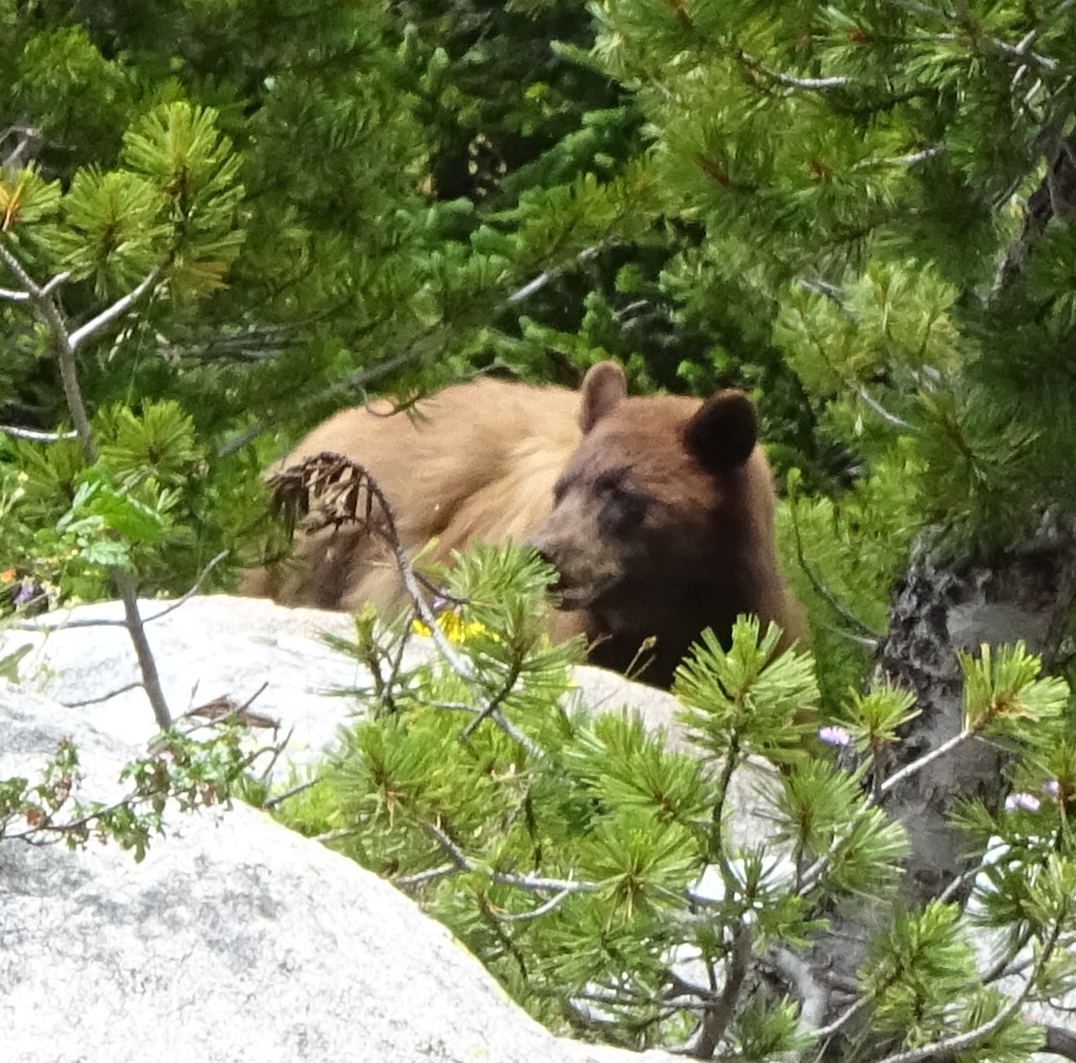
Grizzly minding his own business

Russell’s comment on how bear management today is about fear is something I’ve long thought about. All the available literature on bears, especially grizzly bears, is about bear attacks. The Park requires every backcountry overnight camper to watch a 45 minute video on bears (which is good). The video is all about protecting oneself from bears and what to do in a bear encounter. People management is a good thing (bear spray, food storage, posturing around bears, hiking in groups, making noise, etc), but none of this is about bears, but about fearing bears. We don’t really try to ‘know’ bears. Our present culture is just about separating ourselves from the natural world and fearing bears.

My own closest encounter with a bear took place in 1972. Not a grizzly, but a very large black bear. I was in high school, during summer break, hiking in Waterton-Glacier International Park from the Canadian side. I tell that story here in detail and why I wasn’t afraid. It’s a good lesson in how people and bears can read each other.

Personally, I feel that Russell is one of the few people today that truly understands bears. He is not a scientist, but more of an old fashioned naturalist. Russell owns a ranch next to Waterton Park in Canada that was homesteaded by his grandfather. Long ago he pioneered putting out dead cattle on his side of the Park border in the spring to give hungry bears emerging from dens some much needed protein. Neighboring ranchers feared that the bears would adapt to eating cattle. But instead of this happening, the fed bears moved on and cattle depredation decreased. Soon the wildlife managers were putting road-killed deer and elk carcasses instead.

Please listen to this amazing Bear Whisperer. Enjoy.


Techno danger for Yellowstone Wildlife

I’ve become aware of a new concern for Yellowstone Ecosystem wildlife.  A few weeks ago a friend visited and told me this story.  He’s been coming to YNP for over 40 years and is a responsible person who knows how to handle himself properly around wildlife in the park.

In January we were driving through Lamar Valley when we encountered some bison crossing the road.  We stopped the car and turned off the engine to let them pass.  I usually never film with my phone, but for some reason I began filming these bison.  Suddenly one large male turned on us and attacked the car, causing $2000 worth of damage.  All recorded on my phone.  I sent the movie to some friends, then posted it on Youtube.  Overnight it went viral. A few months later I received a call from a company in England that wanted to buy the video and pay me royalties. Never in my wildest dreams would I have thought this would happen.  Apparently these companies purchase videos and sell them as ‘stock’ clips.

My friend wasn’t looking for fame or money, and his behavior around these bison was completely appropriate.  Yet his story clued me into why we might be seeing so many crazy, careless, and inappropriate behavior around YNP wildlife.

Bison close to car

Take this video of a young grizzly bear ‘attacking’ a car on the Beartooth highway.


It just so happens that I saw this same bear a few weeks ago and wrote about it here.


Young bear

Young bear

This same bear was frequenting the Beartooth Butte campground.  He and his young sister were captured and moved.  The WG&F Bear biologist told me that he’d never seen bear behavior like this before and that obviously these bears had been fed.  Just this week I noticed a note from a Forest Service ranger left on a parked truck at Beartooth Butte trailhead. It said they’d had to confiscate food left in the bed of the truck which might attract bears.

But my point is not that people are feeding bears.  When I saw this video I asked myself  “Why didn’t these people honk their horn, or just drive away?”

My answer came yesterday when I saw a piece of the same video again, but this time on ABC news online.  So did these people keep filming that bear, instead of doing the intelligent thing of honking their horn and scaring it off, just to have a ‘viral‘ video, and maybe make some money selling it?

This year there have been 5 bison attacks on people who came too close.  One women was taking a selfie of herself and her daughter with a bison in the background.  She was mauled by the bison, yet lucky for her not injured badly. Of course, this was simply a stupid act, but several days later I saw her interviewed on ABC.  Did she receive money for this?  From the attached link, you can see her selfie is owned by ABC.  Even if she didn’t receive money and just had her moment of TV fame, doesn’t this media attention only encourage more stupid acts that harm wildlife?

Here’s a story of a man attempting to touch a bison’s nose in Yellowstone Park last week.  

He had someone photograph him doing it.  Will he now sell his photo?

Whether these acts are for money, or just to say “we did it”, they are endangering wildlife.  Feeding bears or encouraging them to keep looking for food inside a car is a death sentence for that bear.  Those people should have used bear spray on that young bear. Then they would have taught that bear a lesson he’ll never forget.

Taking selfies with bison or other stupid acts with bison compromises years of hard work on a new Park bison plan which would allow these animals to migrate outside the Park boundary in winter months.

Our techno media-centric society needs to be educated in how these acts are a great disservice not to the public, but to our wildlife.

Keep our wilderness wild!

Keep our wilderness wild!


More about Bears, Pine Nuts and Delisting

The Clark’s Nutcrackers are starting to hang around, making a ruckus with their characteristic nasal loud call.  They’re waiting for the Limber Pine cones to ripen.  The cones are still green; maybe a few more weeks.  But they’re anxious to begin their ancient fall ritual of collecting and storing seeds–tens of thousands each year–and incredibly they remember these locations.  The seeds that aren’t retrieved might just grow into young pines.

A Forest Service botanist gave me two hints when planting Limber Pine seedlings:

1.  Put two or three seedlings in one hole to imitate how a Nutcracker might have stored those seeds and

2.  Collect some soil from around a mature Limber Pine and place it in the planting hole.  That soil has the correct mycorrhiza (fungi) that is symbiotic with the pines.

I’ve been inspecting the cone production this year and although it seemed better than last year’s very low production, it appears not to be a boon year.  Many trees have no cones.  Others just a few.  I’d judge that around my home the production is going to be medium-low.

I was curious what the Whitebark production is this year.  Sometimes the Limber mirrors the Whitebark, other times it’s a good substitute.  In a hike up Windy Mountain yesterday, our last remaining live stands of Whitebark are up there.  There are lots of dead trees and a few young trees, but there are still some standing mature live trees.Grizzly cub

Whitebarks and Limber Pines cone at the top growth only.  Trees that are in the open will produce more cones.  Windy mountain has a fairly tight forest with upright trees.  Looking at the potential 2014 cone production, I estimated about the same amount as my Limbers. That got me wondering what the official report for 2014 of the Interagency Grizzly Bear Study Team is from the transects they use.

The IGBST is reporting a medium high cone production for 2014.  They define a ‘good’ production of average of 20 cones per tree, vs. 5 cones per tree last year. But here is the catch.  Total mortality on their transects (read ‘dead trees’ from beetles specifically) since 2002 is 75%.    So there are 3/4 less trees from which to obtain food, even if there is good production on those remaining trees.

At least 75% of this Whitebark forest is dead; in other places on Windy it is more like 90%

At least 75% of this Whitebark forest is dead; in other places on Windy it is more like 90%

The IGBST did the Whitebark Pine study required by a judge before delisting.  They concluded that the bears will find other foods in the ecosystem and so can be delisted.  The states are pushing for that delisting status in order to begin a hunt, for which they can charge high dollars for a grizzly bear tag.

Recently I was at a landowners’ meeting where a county commissioner gave a short talk. He mentioned he was on the grizzly bear committee, representing Park County.  This man is no scientist.  He is a politician first and foremost; and he said to this group of landowners that the study ‘proved’ the bear is doing fine without Whitebark pine nuts.  Don’t believe it.  He was simply chanting the line that politicians and state managers have been saying for years in order to delist.griz

I firmly disagree with delisting the Grizzly.  The bear has been dependent on these nuts for making ‘brown fat’ for hibernation.  Without this nut you can be sure to see the Greater Yellowstone Grizzly wandering into the bottomlands where more people live, eating foods like Russian Olive nuts that grow in the drainages, or even livestock.

There are several reasons why I am NOT for delisting the Grizzly:

1.  Grizzly bears are highly intelligent animals, at least as smart as the Great Apes, which puts them on par with humans.

2.  Bears primary food sources–pine nuts and cutthroat trout–are compromised

3.  Climate Change is a big unknown for food for these large carnivores.  Moths that the bears rely on are also a fragile food given pesticides loads in the prairie states.

and one of the most important reasons:

4.  Bears confined to the GYE do not, at this point, have adequate corridors for genetic diversity and may over time die out.   The IGBST delisting plan calls for flying in bears to the ecosystem if and when genetic diversity is compromised.  I’ll say that again  “FLYING IN BEARS”!

To compensate for reduced primary foods, as well as provide a buffer for climate change and provide genetic diversity, bears need to be able to move in and out of the GYE. Yellowstone to Yukon (Y2Y) targets this need.  Presently there are large bear unoccupied areas of this natural corridor; swaths of public and private lands that were formerly bear territory (Central Idaho Complex is an unoccupied example).

It took over 30 years to bring the GYE grizzly numbers up to about 650 bears, from less than 200.  If delisting, and hunting, returns, it won’t be long before those numbers begin to decline again.

Grizzly bears are not just critical to the ecosystem.  They provide something critical to man–the power of the Present moment.  There is nothing more wonderful than that ‘alive’ feeling of walking through woods where grizzly bears at present.  The grizzly bears gift to man is the Power of the Present.  Let us honor that.

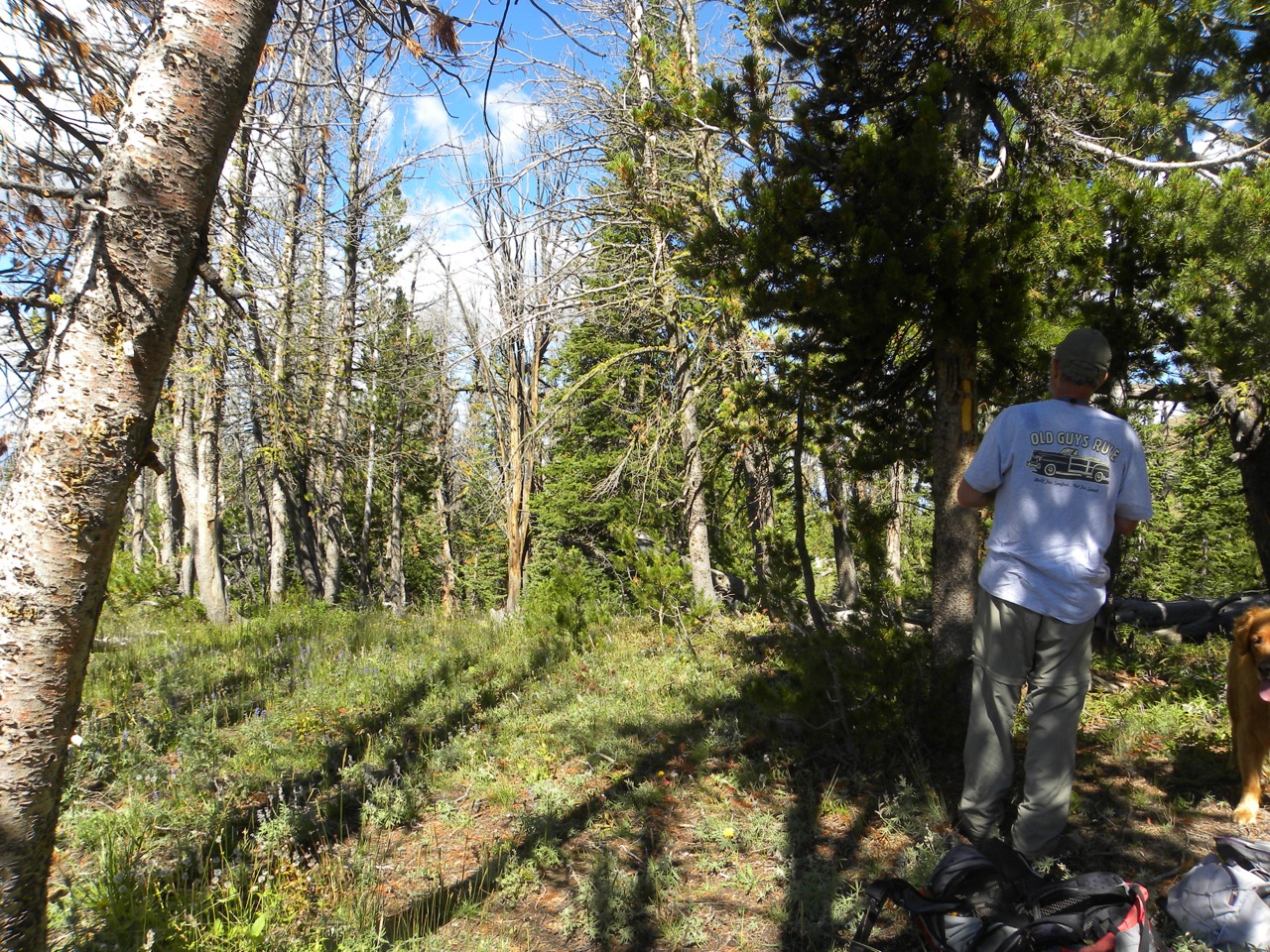
This tree has a blaze and to the left a bear left its own blaze

This tree has a blaze and to the left a bear left its own blaze