


Happy Mother’s day.
Since my son is in New York, I gave myself a present. The last few days have been either too busy or too cold to go into the Park. I heard the road opened earlier than the scheduled date, Friday, the 8th. So on Thursday I headed up towards Cooke City. I never made it because of a snow storm. Not that the snow was so bad, but I figured the animals wouldn’t be out.
This morning I woke up early and was out the door by 7am. I’m only 40 minutes from the Park’s entrance; an hour from the Yellowstone Institute in the Lamar Valley. Because I had the dog, my plan was to visit for 1/2 day, and take a hike outside the Park the other half, with the dog.
In the span of those 3 hours in the Lamar (or on my way there), I saw: (disclaimer…sorry my photos up close are not great. I just have a small digital camera that I use because its lightweight for hiking. Maybe I need to get a better one as well.)
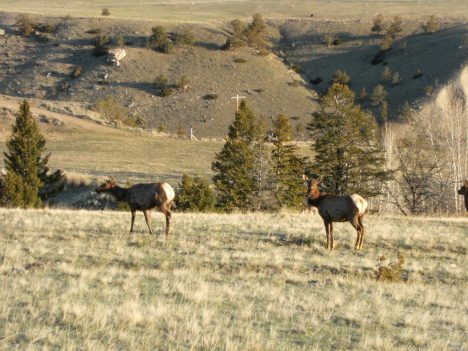
Elk in my Valley. I thought elk on left looked quite pregnant.
First thing on the way to Chief Joseph were some early morning grazing elk. They are getting ready to calf soon. My neighbor, on whose pasture these elk are grazing, called me yesterday to tell me to watch my dog as a wolf walked past her daughter yesterday.
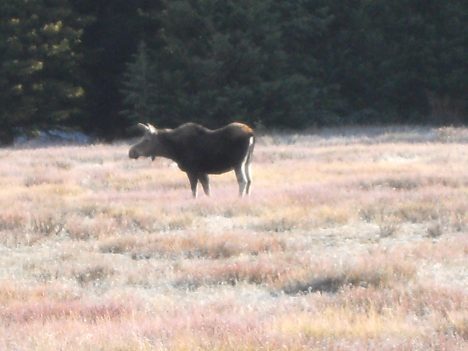
Moose on Chief Joseph Highway
These two moose were up past the 212 turnoff to the Park, right alongside the road. I didn’t see any moose in the Park, although usually some hang out in the river right past the NE entrance.

This one just sat and watched me. She had frost on her fur.
Here’s the approach to the NE entrance. There was no ranger at the gate today, so no entrance fees. Happy Mother’s day.

Not too far into the Lamar Valley, I stopped by a crowd with scopes. I watched 2 wolves for a long time, one a collared gray female and the other a black. They seemed to be trying to figure out how to cross the creek and road to get back to their den on the other side. There was a lot of howling and prowling.
This is through the scope. He was way across the Lamar river.
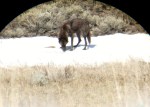
Pronghorn were all over the hillsides. Bighorn sheep were grazing high up. I continued down the road a bit, still wanting to see some Bison babies, when I was distracted by another black wolf of the Druid pack, very close to the road. I stopped and watched with my naked eye. He was walking back and forth along the stream bed. He was so close to the road that I thought he wanted to go to the other side as well. Suddenly, he had something in his mouth. It was a fish! He brought the fish over to a nearby snowbank (all this within 200 feet or so of the road), played with it, rolled on top of it, then devoured it as a magpie watched.

Wolf eating a fish he just caught
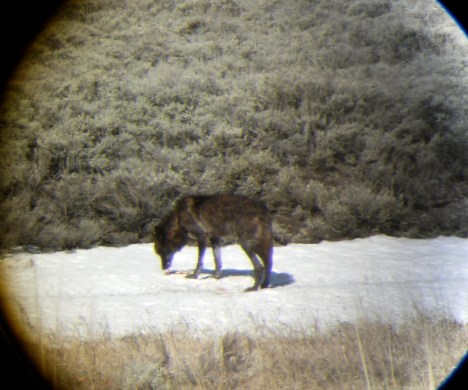
Wolf eating a fish
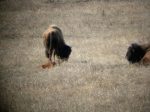
Finally I moved on to see the Bison calves. The one animal we don’t have in our valley next to Yellowstone is Bison. They wouldn’t be allowed to migrate out of the park. Granted, they do shoot a lot of wolves outside the park, but they return and soon reform local packs. In addition, each state is required to have a certain amount of wolves in their delisting program. But Bison no state will tolerate because of the perceived threat of brucellosis to cattle.
Here are the baby pictures:
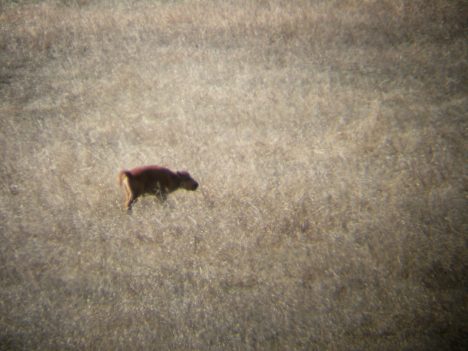
Bison calf

Mom with two calves in the grass nearby
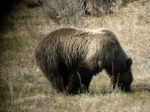
If all this wasn’t enough (I’d barely driven a mile within the Lamar), I went a short distance down the road to view the Grizzly hanging out within 100 feet of the highway. He’d been there all morning. On my way, another black wolf walked through a herd of grizzlies. He was joined by a grey and they both began howling. They were answered by a wolf on the other side of the road, not visible to me, near their den site. A coyote began yipping in tune to the wolves, and then he sauntered across the road. Several Red Tail hawks circled overhead, while Sandhill Cranes walked along the water’s edge.
Here is the bear:

This grizzly spent hours upturning Bison paddies for insects underneath
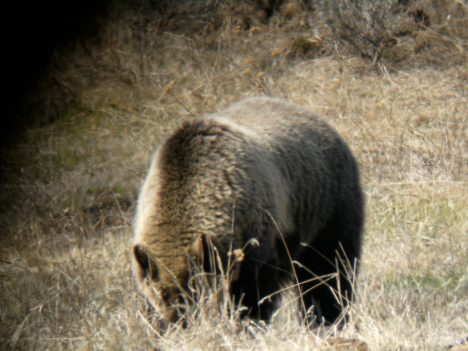
Grizzly rooting around
I’ve oftened pondered what makes for that special nurturing quality of Yellowstone. I left the valley and could feel its warm embrace. There is so much life there. The animals seem at peace, not threatened. They are simply doing what they do, going about their business. There is always a palpable feeling in the air there, like a slice of heaven. Is it the volcano living underneath? All the hot springs? I think its where the natural order of things are in place. In Yellowstone, man is not the top predator. This has been so for generations upon generations of wildlife and they ‘know’ it.
It is time to acknowledge Yellowstone for what it truly is–the serengeti of North America–and treat its surrounding environs as such. Outside of the Park, they are supposedly ‘protected’, but special interests always come first. Buffalo cannot migrate to lower ground in the winter or they are killed; wolves even when they weren’t delisted were killed regularly (they know what the sound of a helicopter means outside of the Park); right now is bear hunting season in my valley.
The income from open grazing or from hunting tags pales in comparison to tourists coming to see our ‘Serengeti of wildlife’. Having the Cattle or Sheep lobbyists win every legislative battle is old school. It is time we see what we have here that is truly of value, and so unique. It is time to preserve this land of the Greater Yellowstone Ecosystem, not just Yellowstone Park, and manage it with wildlife as the number one priority.
There couldn’t have been a better advertisement for Yellowstone as this mornings two hours in the Lamar Valley.
-

- Elk in my Valley. I thought elk on left looked quite pregnant.
-
- Moose on Chief Joseph Highway
-

- This one just sat and watched me. She had frost on her fur.

-
- This is through the scope. He was way across the Lamar river.
-
- Wolf eating a fish he just caught
-

- Wolf eating a fish
-
- Bison calf
-
- Mom with two calves in the grass nearby
-
- This grizzly spent hours upturning Bison paddies for insects underneath
-
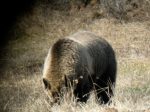
- Grizzly rooting around
Filed under: Yellowstone National Park | Tagged: Bears, Bighorn Sheep, Elk, Grizzly bears, Pronghorn, Wolf, Yellowstone National Park | 2 Comments »
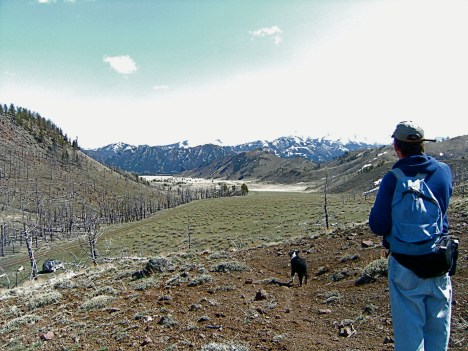 This is an area of excellent forage though, with young sweet grass and sagebrush.
  The snows are just beginning to melt and seasonal streams are running. With a forest of dead timber, standing and downed, the run off will be fast and furious. But its early still and the streams are gentle. A huge log jam up river, crazy every which way, testifies to last years’ fury.

 The trail, not on the map, was a highly used game trail that went up the wide mouth of the drainage. At times the downed trees were so thick the trail disappeared. When the trail faded, we watched where the grizzly had chosen to go, figuring he’d have taken the path of least resistance. It led up the creek bed, the stream disappearing and reappearing in odd places. At one point, we crossed under a large downed tree trunk,. The tracks passed directly underneath so we looked for fur stuck to the nubby remains of the branches. There were a few hairs there. Claw marks on trees noted where a grizzly stopped to mark his territory. They were so high I couldn’t reach them. That’s a big bear.


