• MY BOOKS ON WILDLIFE, GARDENING AND MORE

  • Coming Fall 2024. Pre-order and use code 6AF24 for a 40% discount

  • The Wild Excellence

  • Award winning ebook on DG Primer

Pheromones, Pine Beetles, and more about fires.

I talked with the Wyoming Dept. of Forestry today.  Apparently, the state deals with private landowners, not the forest service.  I’m definitely going to go for ordering pheromones for my trees. Paul in the department told me that, yes!, the grizzlies do use the Limber Pine nuts as well as the Pinus albicaulus.  He also told me that because of lack of fires, the Limber Pines have become an invasive on rangeland.  Of course, I don’t have rangeland.  I butt up to a National forest full of Limber Pines from 7000′ all the way up to 8200′ or more.

He said they’ve been doing a lot of management with the North Fork and South Fork, but up till a few years ago, my area was doing okay enough.  “Not anymore” we both acknowledged.  The south facing slopes across from me are full of beetle kill on the ridge tops.  The end of my valley that butts up against the Park is now about 50-70% dead trees. Compare that to the east entrance to the Park (up the North Fork) which is about 90% dead standing timber.

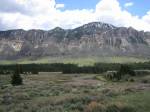
The fires of ’88 came through parts of my valley and through Crandall, which is north of me.  In fact, the tiny town of Crandall was almost entirely engulfed and thanks to a major effort, was saved.  When you drive by Crandall, you can see where the fires came down almost to the town.  Apparently, it was some of the hottest fires.  Now the hillsides are regenerating with Aspens.  Cathedral Cliffs along Chief Joseph Highway

The point is, those fires near me in ’88 helped form a buffer from the pine beetle which spared my area up till now.  But like the economy, those fires of ’88 just ‘kicked the can down the road’, and now my valley’s time is up; due for a big fire.

This winter there’s been logging trucks on my dirt road daily.  The biggest private landowner is logging beetle kill around his property for fire protection.  The Game & Fish clear-cut a big swath of spruce and fir to make way for aspen growth, and the neighbor to my east is cutting and burning beetle kill weekly.  Everyone is aware: its only a matter of time till the fires come this way.

The thing about the blister rust on my trees is that they’ve weakened the pines, along with the many years of drought.  Paul said that usually the rust doesn’t kill the trees, especially in the Rockies due to the dryness.  And I can see that’s true.  These are older pines and surviving despite the brown needles.  But then the pine beetle finishes them off.

This is not a spruce or pine beetle but a wood-eating beetle that eats dead wood. They are scary looking though and BIG!

So I have a choice.  Spray with Sevin or use the Pheromone packets.  The spray lasts for 2 to 3 years.  The Pheromones only one.  But its a no-brainer for me.  I’m just not going to use a non-targeted toxic chemical.  Non-targeted in the sense that it kills beetles, and also other insects that could be beneficial; plus the other types of toxicity.

The pheromones simply are a chemical mimic that tell the beetles “This tree is occupied with beetles already.  Go find another tree.”  If you already have beetles in a tree, neither the chemical nor the pheromones will work.

Paul will come over and look at my property.  Its fairly expensive at $7/packet; but its for a good cause.  What we discussed is instead of just tagging important trees, I’ll do a grid of packets over my 6 acres.  When he comes over, we’ll look at the density and see if I need less than the 30 pkts/acre, which I think I will.  May is the target month to put the packets on the trees.  The beetles fly in July and August.
When a good fire is a bad fire. Grizzlies and pine nuts

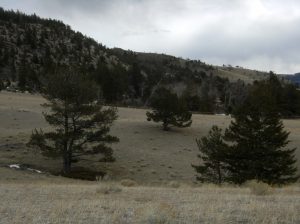
I’ve been working with a small chain saw on the trees around my upper cabin.  Most of my 6 acres is on a plateau above the main cabin.  That arcreage butts up to Shoshone National Forest.  The original owner of my cabin, Doc Firor, deeded that area to Nature Conservancy who gave it to the forest service.  That entire plateau extends for several miles and is prime elk habitat.Riddle Flat from across the river. Prime elk habitat

Almost all of the trees up there are Pinus flexilis or Limber Pine.  Limber Pine is a white bark pine, which basically means it has bunches of 5 needles.  The pine whose common name is Whitebark pine is Pinus albicaulis.  That’s the one that everybody is talking about when they say Grizzlies are dependent on the whitebark pine crop.   But Limber Pine seeds are just as tasty, and squirrels cache them just the same.  Whitebark Limber on left; doug fir on right

Pinus albicaulis and Pinus flexilis are both considered keystone species–that is, without them, an ecosystem can just cascade apart.  And both of them are being infected with an imported fungus that is the cause of white pine blister rust.  This fungus can kill a tree, and its killing massive amounts of Whitebark Pines in the Pacific Northwest.  The Rockies have not been quite as vulnerable because its so much drier here.  But with global warming, and the pine beetles, trees that are weakened by the fungus succumb quickly.My one room upper cabin.  No water. No plumbing.  Yes heat!

I was trying to find out if grizzs will eat Limber Pine nuts as well.  That was important to me, because many of my trees have the rust.  And I’m trying to find out how to identify correctly the rust, as well as how to treat the trees.  Avalanche Peak, Yellowstone.  Dead whitebark pines

I went to the National Forest administrative offices last week in Cody. They are all so helpful and nice there.  One of the supervisors lent me a new phamphlet and told me there’s a pheromone for the beetles, but nothing for the rust.  She said its awfully hard to determine the difference on the tree.

What I really want is a source of blister rust-free seedlings to underplant.  The bad news is that whitebarks take 40-50 years to begin to cone.  But I can wait.  The worse news is that if you can even find a source of seedlings, expect 50% mortality in the first few years.  In fact, the booklet has a really complicated formula to determine how many seedlings you need, based on existing site infections and super-overplanting for death.  The thing I think would be smart would be to do successive planting over a period of 5-7 years.  And since I have a test plot that could be a model for the rest of the nearby forest, I’d love it if the Forest Service used me for testing.  Robin at the Ag department told me they do test plots on private land often.

Meanwhile, I’m going on what’s said on the internet and in this phamphlet.  I’ve been limbing up by hand and by machine up to 6-8′ from the ground all of my trees (this is a several year project!), starting with around my upper cabin.  Since the trees are older, most of the bottom limbs are dead anyways.  But limbing up will provide air circulation and light, both will help the trees health.Before pruning; cabin is in the background

Another interesting thing about blister rust is the Ribes (Gooseberry) connection.  When the rust first came to this continent, in the 1930’s, they found that Ribes was a host.  So the government in their wisdom, decided to eliminate all the Ribes in the West.  But there are so many species of Gooseberry native to the West, over 150 in North America.  And Ribes is an important food for wildlife.  You could never eradicate all the Ribes, and that’s just what they found.

As I was doing all my pruning, sure enough, many many trees have Ribes growing right on top of the trunk.  Besides being a host for a nasty disease, I did have to wonder about other types of symbiotic relations between the two, for example nutrient exchange.  I haven’t learned about that yet.

Whitebark pines, including my Limber Pine, are an amazing tree.  Unlike most pines, they are not wind pollinated, but dependent upon the Clark’s Nutcracker for dispersal.  Squirrels too  cache the seeds but not as far.  They grow on thin soils, at high altitudes, and usually are the first to colonize in disturbed sites, such as fires and landslides.  Grizzlies depend on their nutritious content to fatten them up for winter, or satisfy them in the early spring.  Grizzlies can’t climb the trees to get the seed.  Instead, they are experts at finding squirrel caches and robbing them.  When I asked about my Limber Pines, a forester said that grizzlies eat their seeds, but they are rougher so they aren’t number one on the menu.  Obviously my plot as well as the forest next to me is just as important for the grizzly recovery.

The benefits of fire in this care are so mixed.  Whitebarks are fire-dependent.  Where fires have been suppressed, more shade tolerant conifers replace them and there is little opportunity for regeneration.  So they like that clear open ground.  But their cones don’t open with heat.  The seeds are animal dispersed, so there needs to be stands for their new growth, which means they like low- and moderate-intensity fires.  That’s hard to have in areas with so much beetle kill and fire suppression like my valley.  To add fuel to the fire so to speak, scorch or fire damage on trees that would otherwise live, increases their susceptibility to beetle-kill.After pruning.  Cabin is now visible. Deer will love this!

Regardless, I’m thinning away, hoping for more air circulation, light, and in addition all that thinning imitates a ground fire.  Many of the natives I would plant in California requires a good chopping back to the ground every so often to mimic fire.  That’s what I’m doing for now.