• MY BOOKS ON WILDLIFE, GARDENING AND MORE

  • Coming Fall 2024. Pre-order and use code 6AF24 for a 40% discount

  • The Wild Excellence

  • Award winning ebook on DG Primer

HOW TO TRACK A MOUNTAIN LION

“She’s close.” 

Mountain lion biologist Quinton Martins holds up an antenna while listening to a series of beeps from his hand-held receiver. Martins is searching for a female mountain lion wearing a failing GPS collar that needs replacing. As he leads us across a stream towards the oak and bay hillside, these locator pings indicate she’s alternating between two areas on either side of the creek. Martins thinks she may have a kill, which would be great news. If she does, then he can place a cage trap to recollar her.

Sharon Negri of the Mountain Lion Foundation and I are tagging along, hoping to catch a glimpse of this elusive animal. The hillside is steep with no clear trail as we trudge through tight brush and poison oak, occasionally stopping as Martins rechecks the lion’s location.

“She’s very close. On the other side now, maybe forty meters away in those trees.”

This particular cat, Martins tells us, had at least one kitten who would be eight months old. But the resident male recently died of bacterial bronchial pneumonia linked to Feline Leukemia Virus, opening the territory for a new male. If that’s the case, it could mean this new male might kill the kitten in order to entice the female to breed again.
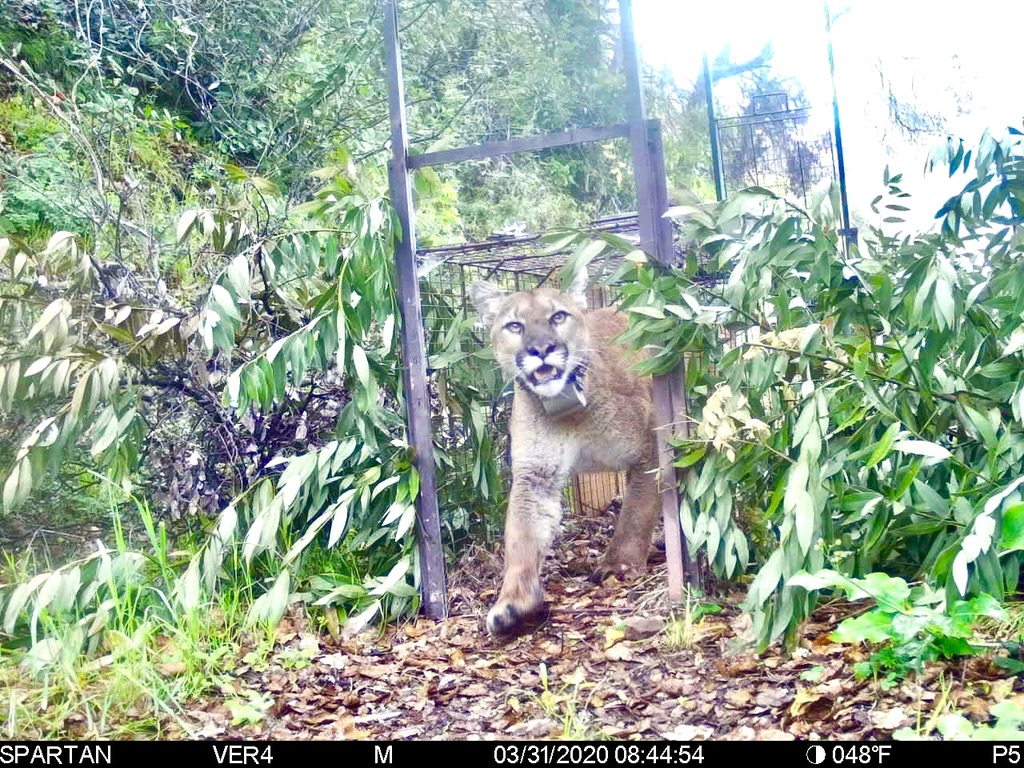
Martins unique trap system. It triggers by weight avoiding triggering non-target animals

Martins has been running a mountain lion study in partnership with the Audubon Canyon Ranch in Sonoma County since 2016. True Wild, his company with his wife, focuses on coexistence with wildlife and offers customized African safaris as part of their conservation efforts, connecting people to nature in a profound way and working with participants to become more involved in conservation initiatives where possible.

We stop again for another location check. Now Martins’ receiver displays a significantly stronger signal, indicating the cat is on the opposite bank exactly where the second ping showed up on his computer yesterday. Sharon and I carefully navigate the streambed around an enormous jumble of jagged boulders, possibly dumped from soil preparations for the vineyard whose private lands we have permissions to be on. At the ping site there is no indication of a kill while the cat has disappeared through thick bush and over a rise. Knowing this female was so close, yet we never saw her, leaves us frustrated. It is a repeat of a common scenario: cougars watch people yet we humans never see them.

Heading back to the car, Martins points out fresh tracks in the soft dirt. “She’s been here, going back and forth. This cat has been incredibly difficult to find.”

Luckily, Martins has one other lion he wants to sleuth out. P49 has a good working collar that indicates she might have a kill. Martins’ goal with this cat is to find out if she has kittens. As we drive 45 minutes west to the opposite end of Sonoma County, Martins lays out the unique difficulty of doing a wildlife study in a highly populated rural area.
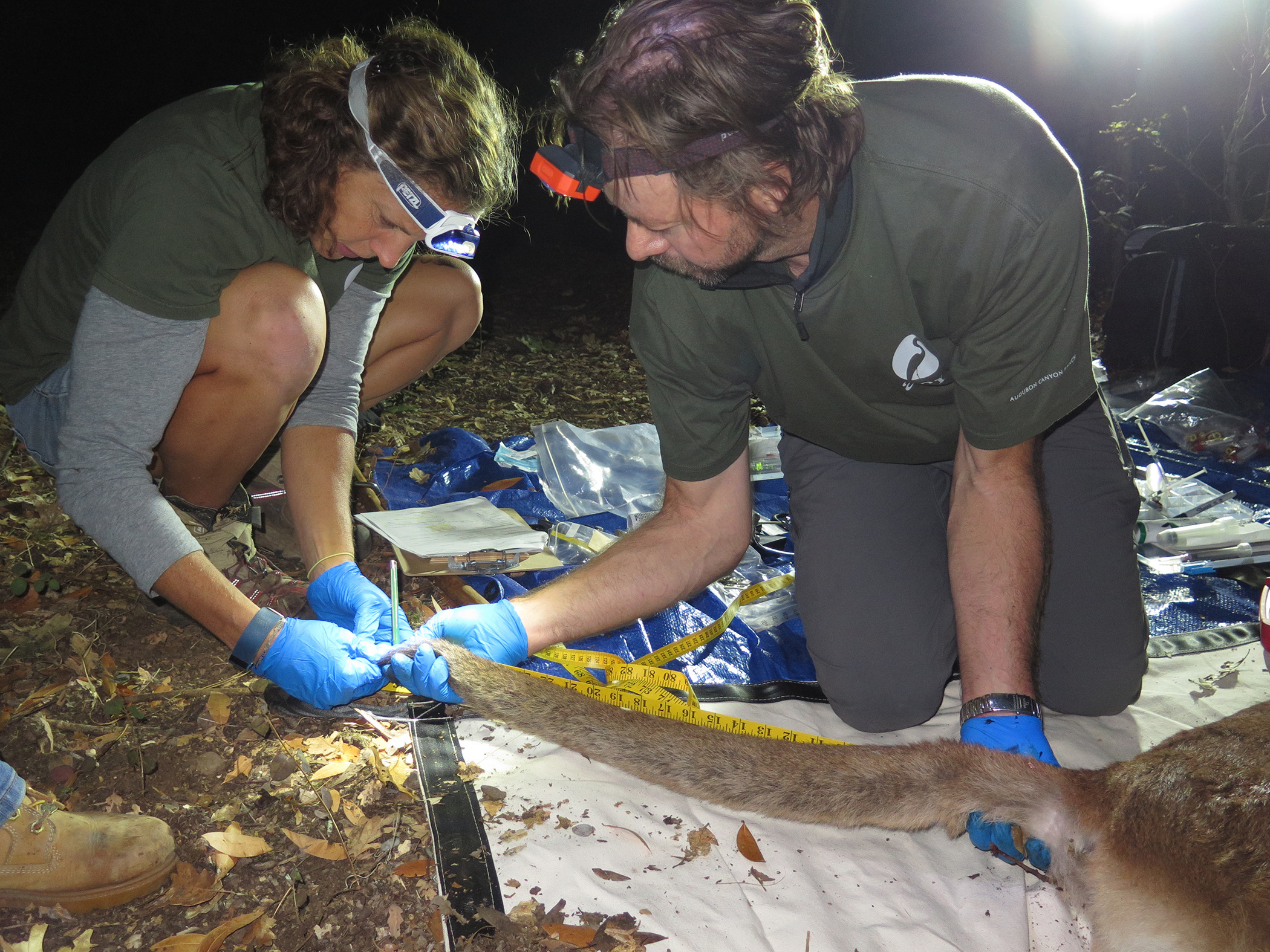
Martins getting data from a sedated lion he is collaring

“The males we have collared—P5 has 17,000 private properties in his territory. P31 has 11,000 private properties. How do you contact that many people and access all those properties to inspect fences or signs of prey? This dilemma is confounded by an increase in weekend private property owners. When you overlap a land parcel map it is as if you are looking at 50,000 or 100,000 mini ecosystems, so you can’t just throw a vegetation layer over it and say ‘OK, this is what the cats are doing.’ As their primary prey is deer, it might look like great deer habitat on a map, but in many cases these properties are fenced to keep deer out. So there might be no deer in areas where you expect deer, but cannot tell because you can’t access the properties very easily. And walking each individual land parcel, one finds different plant and animal resources, a variety of fence types that block or allow animals to move through, and each parcel managed differently to some degree.”

Martins tell us lions are using fences of any type to strategically block or corner and kill deer. In fact, when we approached the previous property, Martins pointed out a cougar-killed deer carcass hanging against the fence that enclosed the vineyard.

Our second property owner is an animal lover excited to discover there’s a lion hanging around his property. He has a large piece of wooded land, over 200 acres, nestled in the hills of Sebastopol. He greets us at his main house and we follow him down the road to where Martins recorded a series of GPS fixes the night before. The dense cluster of pings is a hopeful sign this cat has made a kill and is still hanging around. Cougars can spend up to three days or more consuming an adult deer. They will cover their kill to preserve its freshness as well as deter scavengers while they rest nearby.

The GPS telemetry data indicates the cat traveled along a hillside where an overgrown two-track is still visible. A short hike leads us to her kill—a yearling deer. Cougars kill with a bite to the neck, then consume the internal organs first. Big cats, along with their small domestic cousins, lost the ability somewhere in evolutionary time to convert carotenoids like beta carotene into Vitamin A, so they have to obtain it directly from these nutritious organ meats. That’s exactly what this cat has done. I also see she has begun to pull the fur away with her incisors. Although this is a small deer, Martins thinks there’s enough meat on the carcass that the cat will return, and if she does we’ll find out if she has kittens. The VHF radio signal from her collar indicates she is resting on the opposite hillside only a few hundred yards away.

“She’ll return under cover of night,” Martins tells us as he sets up three trail cameras focused on the carcass.

Even though we never did see a mountain lion, the day was exciting as well as instructive. Conducting a mountain lion study in an urban/rural area has tremendous challenges and complexities that studies in vast wilderness areas like where I live in Wyoming do not. First there is no snow, so finding tracks is as elusive as the animal itself. Second, most mountain lion studies rely on dogs to do the tracking and treeing of the animal. Once treed, biologists can easily dart the lion and lower him to the ground to be collared and released. Obviously dogs can’t be utilized in areas where there are so many people on small private land parcels. In addition, while there are some public lands in Sonoma County—mostly small county parks dotted throughout his study area—Martins’ lions live in territories encompassed by thousands of private properties, meaning he has to obtain permissions from each owner before visiting. Most, but not all owners are happy to help, but even when he has their cooperation, each visit requires one or several phone calls to gain access. It’s a lot of human PR work.

A few days later, Martins relays the good news. P49 has two healthy cubs with her and sends us a photo of the family dining on the carcass. I realize that instead of one lion, there were three nearby, none of whom we saw. But to be fair, mountain lion mothers sometimes stash their kittens while they hunt, then bring them to the kill site afterwards.

P49 with her two kittens on the kill we found.

These kittens are highly dependent upon their mother’s hunting skills throughout their first year. The span between six and eighteen months is especially important for the cubs because they are learning the art of hunting and killing prey. In addition they are exploring their natal range and learning how to deal with potential enemies. Dispersal occurs usually between 12 and 24 months. Lion dispersal is critically important for genetic diversity, as well as for geographic expansion. Females tend to stay close to their birth mother’s range, while males need to find an empty slot devoid of a dominant male. The odds are tough for dispersing males, who roam much farther than females and have to contend with other territorial males. In an urban/rural landscape, these kittens will need to learn to avoic livestock plus they have a higher chance of contacting diseases from domestic cats like Feline Leukemia Virus and the H5N1 virus, commonly referred to as bird flu which cats have a higher than 70% chance of dying from.

Through Martins work we hope to have a better understanding of mountain lions living in a unique situation sharing their territories with a high density of people in a complex urban/rural landscape. Plus, this coexistence with California’s communities work will hopefully give these iconic cats increased odds of survival, ensuring their vital role in helping ecosystem integrity is maintained.

More info on Martins work and California mountain lions can be found in my book Ghostwalker

If you want to follow updates of Martins’ Sonoma study…

True Wild’s work stems from our love for wild places. We are driven to find ways for people to appreciate and make an effort to protect wild places and the wildlife that shares the world with us. We believe that people can coexist with wildlife through practical and achievable methods and in doing so, serve people, domestic animals, wildlife and the environment we are all living in. 

True Wild (www.truewild.org) and Audubon Canyon Ranch in partnership with Sonoma County Wildlife Rescue , are spearheading an essential mountain lion research and education project in California’s San Francisco North Bay Region. We are a key community resource for people to be able to coexist with wildlife, particularly mountain lions. In Africa, we support high impact, coexistence-focused projects that will protect large wild places while benefitting local communities. 

We want to maximize impact with minimum overhead, seeking to achieve win-win situations for everyone involved. Donations become investments, involvement leads to tangible returns. We encourage and actively seek both intellectual and financial support to offer solutions to the growing ecological issues our world is facing. 

We offer impactful and extraordinary safari opportunities, connecting people to nature in the most profound way in some of the most beautiful places in the world. We view our safaris as a platform for providing a valuable life experience as well as highlighting the significance of wild places that need protection. Each safari is tailor-made to maximize the personal experience. 

If you must hunt, how to better manage mountain lion populations

Last week I attended The Mountain Lion Conference which is held every 3 years. This is the first in-person conference since 2017 because of covid. The Conference agenda is divided between presentations from biologists discussing findings from their recent studies, and state wildlife managers giving a summary of any particular aspect of their management they might choose to present.

Most of the science presented wasn’t new to me. It’s all in my book Ghostwalker: Tracking a Mountain Lion’s Soul through Science and Story. For instance, Kyle Dougherty presented studies done on California connectivity issues, discussing how the Tehachapis are critical for genetic diversity for lions there. I did extensive interviews on connectivity and the challenges in my California chapter. One interesting note was that mountain lions in that critical corridor (where there is no highway crossing yet) spent 19.8 hours on average observing, trying to decide if and where they might cross. None of their collared cats attempted crossing the highway.

Some of the most promising studies are taking place in Texas, the only western state that still lists mountain lions as “predator” status, meaning they have no seasons and no protections. Chloe Nouzille and her crew are studying the impacts of the border wall on mountain lions and other large mammals. So far they’ve found no lions crossing the wall in places where contractors place small pass throughs. These breaks are not placed in known wildlife corridors, but randomly placed about every mile. Not all contractors are doing this. Usually it’s at the request of the landowner. What the team has found is more minimal barriers such as fences were being used by lions, although these fences are too high for deer to jump over. Another Texas study was presented by Lisanne Petracca. Her team is trying to understand the genetics of western Texas lions. Are most of these lions coming from Mexico, New Mexico, or in-breed? There haven’t been studies in Texas since 2008. This renewed attention to mountain lions is very positive and hopefully will push their state legislature to make changes in lion status.

I personally had a few takeaways from Mark Vieira’s presentation on Colorado’s mountain lion female harvest presentation. Colorado doesn’t have limits for females but like most hunting states groups together their quota for both sexes for each zone. Let’s be clear: mountain lion hunting is absolutely a choice and not necessary for lion management. Lion hunting is all about hunting opportunity, not about food. But in all our Western states except California (which outlawed lion hunting through a 1990 ballot initiative. Colorado last year rejected a similar ballot initiative which would have outlawed lion hunting) that’s a fight that is a long time out.

In the meanwhile, I strongly feel good management means a female quota. And if hunting is part of the mix, then ideally the female quota should be 0 or 1 ( where there is boot hunting). Once that limited female quota is met, the zone is shut down to female take. Mountain lions are notoriously impossible to sex unless they are treed. Even then it can be difficult but a person needs to look for a black spot below the anus indicating the lion is a male.

So what has Colorado done since they have no separate quotas? First they have included discussions with houndsmen asking them to voluntarily reduce the female harvest. Second they are now reporting the amount of females taken in live time on their quota page. Third, they require a class to learn how to identify male from a female. (try taking the I.D. exam yourself) Studies have found the difference with an identification class is 10% less killing of females and with these extra minimal efforts, Colorado has reduced their female take another 10% to 39%. Most seasoned houndsmen can distinguish male from female once a cat is treed, along with recognition of track size. States like Wyoming where I live have no required class for new or out-of-state lion hunters, and don’t have a female quota.

One other note on why mountain lion trophy states should have a female quota along with classes on lion biology—mountain lion females are either pregnant, with kittens, or in estrus. If kittens lose their mother before one year old, they almost certainly will not survive. Many states, including Wyoming, do not allow hunters to kill lions traveling with other lions (which most of the time would mean they are kittens even though kittens can be as big or bigger than mom). But females frequently stash their kittens, especially ones under six months old and many times up to one year old when they go hunting.

Trail Cameras

Trail cameras for wildlife spying have become a popular pastime. Not only has the video and photo quality improved, but the price point for high quality cameras is lower every year. I’ve been using trail cameras since around 2010. I thought it would be interesting to do a short post on my personal evolution of my use and what I’ve discovered.

Professional photographers and folks that are handy with manual camera adjustments have switched from store-bought trail cams to DSLR cameras. Using a DSLR camera trap requires a lot of knowledge of not just wildlife tracking but lighting positioning and camera settings, but the payoff is great. For my expanded Ghostwalker book out this year from University of Nebraska, even though I have thousands of great mountain lion photos and video, I needed to engage these experts for high quality photos that would reproduce in print. I’ve never been great with manual adjustments so point/shoot cameras, like trail cams, are my go-to.

Amazing capture by Jeff Wirth using a DSLR. Wirth graciously consented to let me use some of his photos in Ghostwalker: Tracking a Mountain Lion’s Soul through Science and Story

When I first started using trail cameras their quality was very poor, but I was mainly interested in who was visiting the nearby forest. I caught grizzly and black bears on the animal trails, along with deer, coyotes, and wolves. I was anxious to catch martens who don’t follow trails. To that end I built a box trappers use, baited it, and put a camera on it (of course I didn’t put a trap inside!). Bobcats also don’t follow trails very much and since I do have bobcat trapping in my area in winter, the animals were rare on the landscape. I hung shiny objects to attract the cats with a camera positioned on it. Still, I almost never captured a photo of a bobcat.

After two years of camera trapping, I had several epiphanies that changed the course my experiments. First, after watching trapping in my area, I became aware that my baiting was contributing to these animals becoming less wary of actual kill traps. Therefore I stopped all baiting and scenting. But the biggest revelation was how to reliably capture animals on camera.

Elk on frozen river at a crossing point. I could see the crossing using track I.D.

I had been lucky to capture several mountain lions, and found lion tracks in different areas. That piqued my interest so I attended a class on mountain lions by researcher Toni Ruth in Yellowstone. During that class I watched a video of wildlife on a mountain lion scrape site. I knew about scrapes but had never seen one nor did I know how to find them. A scrape is made by a male lion with his back feet, usually urinated on, to mark territory. Lion scrapes apparently are big attractants for all sorts of wildlife. Once I learned where to find scrapes, I sought these out and placed cameras on them. Scrapes draw almost all the prey and predators in an ecosystem. By continuing to use these same locations for over 15 years, I’ve captured amazing photos, but the real gold here is monitoring sites for so long that you get a read on the ebb and flow of wildlife activity.

(ABOVE VIDEO OF WOLVES HAD CAMERA PLACED ON A TRAIL HEAVY WITH SCRAPE SITES)

A friend who is a feline researcher told me keeping cameras at the same location for many years provides a good indication of the health of the local mountain lion population. Houndsmen and researchers use dogs to find lions, which gives a good clue to the waxing and waning of lions in a designated area. Would monitoring scrape sites alone give me a general idea of lion health?

Lions are impossible to identify. Puma concolor, their latin name, means cat of one color. Unless they have scars such as nicks in an ear, etc. they look alike. And in a hunted area, males usually don’t last long; but another young male will come to fill the void. I did get an indication that I could monitor lions this way a few years ago. In 2015-2016 we had record snows. Our mule deer population crashed. By early spring when the first grass emerged, the landscape was littered with dead deer. Predator populations lag behind prey drop, but it wasn’t long before I noticed I wasn’t catching females with kittens on my camera. Without sufficient prey, females will have smaller litters or none at all. 2017 was the last photo of a mom with young kittens. Although I did catch young dispersers, there seemed to be a dearth of females in my area until 2021. coinciding with a rebound in the mule deer population.

Additionally, the same thing was going on with cottontails and bobcats. Bobcats also visit lion scrape sites, and male bobcats like to scrape over lion scrapes. Rabbits go through seven year cycles and sometime around 2014 I noticed fewer and fewer rabbit tracks in my study area. I also stopped picking up bobcats on my cameras. The rabbit population had crashed and with it bobcat food. Then around 2020 a rabbit took up residence at one of my camera sites. Within a year, more rabbits at other sites, and soon there were rabbits everywhere. The bobcat population rebounded. Now I was catching bobcats with kittens frequently. An indication of how keeping cameras in situ for an extended period can tell the story of the land’s health.

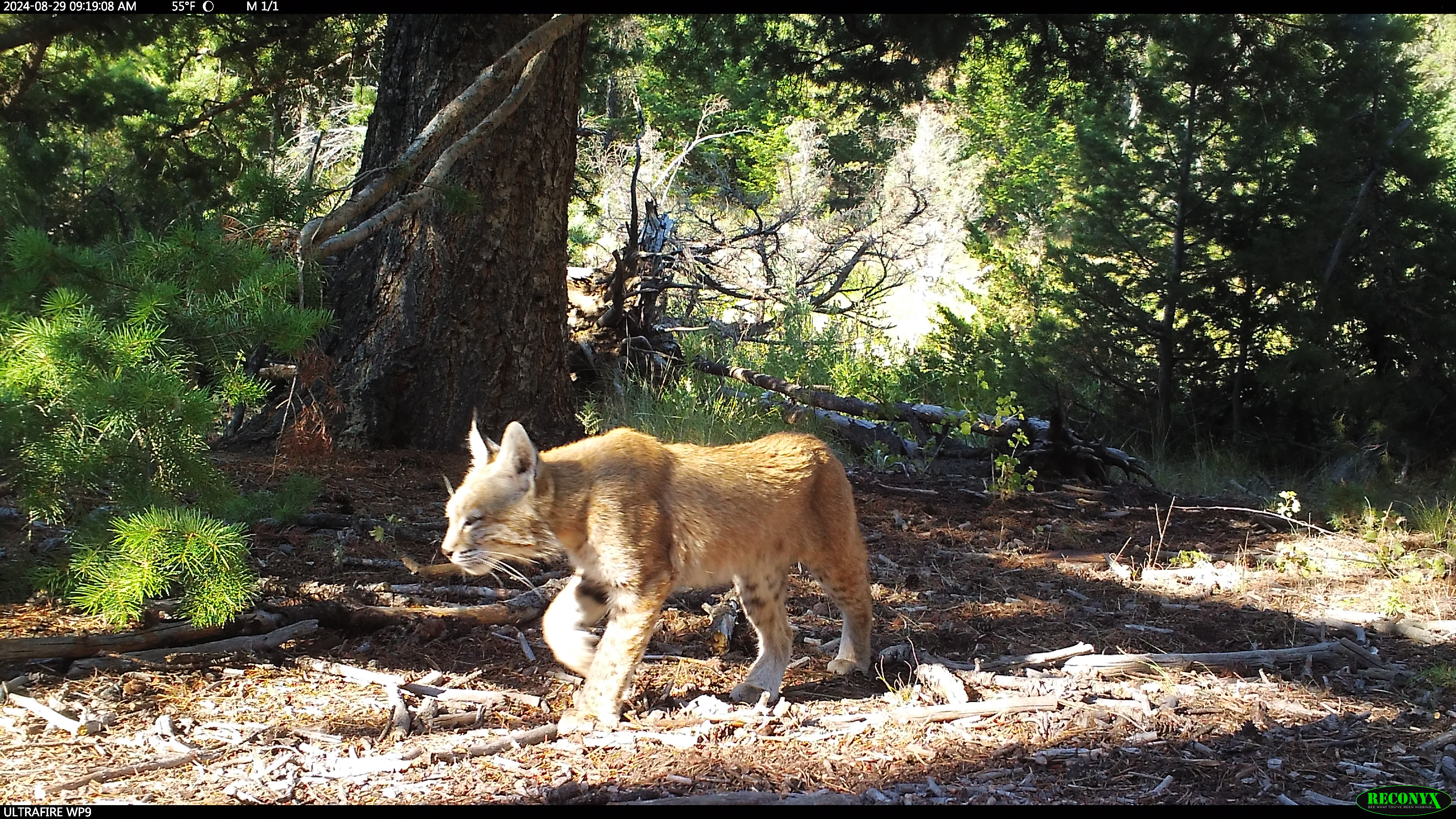
Bobcat visits lion scrape site

In summary, there are many ways to use trail cams. Research, exploration, pleasure. For me it’s become a tool not just to see who is visiting, but to monitor over time the swings of the ecosystem: how weather patterns, food availability, habitat health, and natural cycles affect the wildlife in my study area.

For more videos from my trail camera captures, see my YouTube site

New Release: Ghostwalker: Tracking a Mountain Lion’s Soul – Expanded Edition

I’m very excited to announce the fall release of Ghostwalker: Tracking a Mountain Lion’s Soul through Science and Story published through University of Nebraska Press. This is an expanded edition of the independently published version in 2018. So what’s new?

  1. A new chapter on mountain lions and desert bighorn sheep in the Southwest, a very sticky topic. Bighorn sheep are always teetering into the vulnerable category due to diseases transmitted by domestic sheep that have infected all bighorn herds throughout the Western states. But desert bighorn, who live in isolated sky islands with small herds, are particularly at risk. Predation from mountain lions is targeted as a high risk for desert bighorns. I explore and contrast management attitudes and policies towards mountain lions and bighorns in three states in particular: New Mexico, Arizona, and California. I spent time interviewing and traveling throughout the SW to better understand this gordian knot of a problem.
  2. California! So many new things are happening with mountain lions in California. The California chapter is completely rewritten with a series of new interviews. Biologists Quintons Martins who is doing a study in Sonoma County fills us in on North Coast issues, while Justin Dellinger with CDFW dives deep into isolated populations throughout the state. Kristeen Penrod provides maps of connectors needed throughout Southern California in order to save mountain lions for the future.
  3. What’s happening out there that’s new for mountain lions? We need a new model to replace the North American Model of Wildlife Conservation. I explain what it is and why it needs updating. I speak with Wildlife for All, an organization determined to change the present wildlife management model to be more inclusive. Panthera is studying non-lethal predator protection methods in California that will help ranchers throughout the West. Plus new information on the value of mountain lions for mitigating climate change and as an indicator species.
  4. New stories sprinkled throughout the book along with updated and new information on mountain lion research.
  5. Lastly, almost every photo in the book has been replaced with new ones. Many thanks to several photographers who are doing camera trapping with high-end equipment. Although I have hundreds of photos of mountain lions from over 14 years of using store-bought trail cameras, these images, though great quality for the internet, do not reproduce well in a book. Several professional photographers generously donated some extraordinary photos that will appear in the new edition. Unfortunately the paperback will not be in color.

That’s a summary of what’s new. I’m so pleased to have several new endorsements for this edition.

Author Dan Flores writes:  Leslie Patten has written the most fully-realized mountain lion book I have ever read. Cutting-edge science and interviews are her bedrock, but first Patten is an observer of the lion world as well as a writer whose prose pulls like a river’s current. 

Jim Williams M.S., retired Montana Fish, Wildlife & Parks wildlife biologist and author of Path of the Puma writes: I finished your fantastic book todayYour penchant for unedited and unbridled truth to science is amazing.

Author Ben Goldfarb writes: In Ghostwalker, Leslie Patten braids history, biology, and wildlife management to reveal this elusive cat in all its contradictory glory 

I hope to do some presentations once the book comes out. If you or your organization would like to discuss this, please contact me.

What’s the Story? Cougars, Wolves, Grizzlies

There’s one place in my area where I’ve seen Glacier Lilies, but as soon as the melt starts the access road usually closes due to flooding. Since the weather has been cool, and next week predictions say it will be in the 70s, I decided to check out the spot to see if the lilies are up yet before the road closure. It’s a fairly remote less traveled trail and this time of year grizzlies are down low foraging while wolves are denning. The trail begins at the road’s end with a stream crossing, winds through a burnt valley before turning up a small drainage where the trail heads to a ridgeline pass.

Immediately grizzly tracks began faintly appearing on the dry ground.

When I turned into the forest drainage, the wet ground revealed two grizzly bears. That could only mean a mom and cub. The grizzly cub footprint appeared to be at least a one year old. I became more alert, unlocked my bear spray.

Smaller bear on the left

The area I’d seen the lilies years before was about a mile up the trail near the pass. Bear tracks followed the trail plus revealed a 2 day old scat that said they’d been eating grass mixed with fur.

Closing in on my lily hillside, I found a clear wolf print in the mud. I hadn’t seen wolf tracks earlier on the trail.

wolf track

About 150 yards before the lily area , I came upon what these bears (and wolves) were doing here. An elk kill right by the trail, completely consumed but about a week or less old. Clearly a cougar kill. I searched around the site a bit. No skull, only one leg left plus the spine and pelvis.

What a cougar kill looks like. Rumen pulled out to the left. The fur in a neat circular pattern cut off with the cat’s incisors

What did the tracks and the kill sign say about the story here? Of course, the only thing I can be certain of was this elk was killed by a cougar. But let’s think about what might have happened. Wolves and bears (grizzlies and black) push lions off their kill. With only one leg, and few fresh wolf prints, I imagined the wolves kicked the lion off the kill site, and hauled the other legs off, maybe to their den site over the ridge. The wolves probably consumed most of the elk before the grizzly mom and cub came along (their tracks fairly fresh) to finish off what was left. The fresh wolf track I found was probably a wolf returning to check on any left-overs, and maybe even encountering the grizzlies.

Unfortunately, I didn’t find my Glacier Lilies. Maybe just too early or maybe those bears ate them. But here is some other cool bear sign I found along the trail.

Bears use their claws to strip bark from a tree, then feed on the sapwood by scraping it from the heartwood with their teeth. 

To learn more about mountain lions and their interactions with wolves and bears, read my upcoming book Ghostwalker: Tracking a Mountain Lion’s Soul through Science and Story out this fall University of Nebraska Bison Books. To pre-order a copy and receive a 40% discount, go to this link and use the code 6AF24 

Mountain Lion News

I recently attended a presentation by Wyoming Game and Fish large carnivore biologist Luke Ellsbury on, what else, large carnivores. I was mostly interested to know any results from Justin Clapp’s study on CWD and mountain lions. The field research is done but the analysis hasn’t been published yet. Luke confirmed that mountain lions were definitely targeting CWD deer and elk.

Another study measured the amount of prions in scat from mountain lions intentionally fed CWD infested deer meat. On the first defecation, the meat contained only 3% prions. And no detection on defecations after that. Luke said with these results in hand, the Service is definitely looking at adjusting mountain lion quotas in areas where they want to target reducing CWD in deer and elk. They are also planning on repeating this study with other predators—wolves and bears—and are presently testing CWD meat on bobcats in the field.

The study also corroborated findings from Elbroch’s Jackson study that as lions age they tend to prey switch to elk more heavily. That means if WGF wants to reduce elk CWD through mountain lion predation, reducing hunt quotas will allow more older mountain lions on the landscape. The critical age for prey switching seems to be five years old.

In other more personal mountain lion news, Luke confirmed for me that my one-eyed female lion was not harvested this year. In my area which is the northern end of Hunt Area 19, only one female was harvested this winter. I showed Luke the last video I captured of one of One-Eyed cubs. I thought he looked pretty rough. Luke agreed he didn’t look in good shape, confirming to me that most likely the mother and other cub are dead. And this cub, probably a male because he was always the bigger of the two cubs, isn’t likely to survive either. Cubs under one year old that lose their mother have a very low survival rate as they haven’t developed their hunting skills yet.

Lone Kitten of One-Eye captured early March 2024

Luke told me that this winter one lion was killed by wolves in my area, and that he had a call about another lion recently killed by wolves. Lions in my area aren’t collared, so these would be lions that hunters or hikers encounter and report. We’ve also had one report of a mountain lion dying of bird flu in the North Fork area of Cody.

Happier times. One-eye with her family in December 2023

I’ll continue to check cameras and hope to see One-Eye. I’ve followed her since she arrived in my area in 2021 as a young lion. She was probably born with her blindness. This was her second litter and I thought she was going to be really successful. The last time I saw the family together, those cubs looked happy and healthy at probably around seven or eight months old. Life is definitely rough out in the wild.

To pre-order the expanded edition of Ghostwalker out this fall, and to be receive a 40% discount, go to https://www.nebraskapress.unl.edu/bison-books/9781496238474/ and enter code 6AF24

2021 This is One-Eye caterwauling when she first arrived into my valley as a young lion looking for a mate

New Expanded Edition of Ghostwalker

Hi Friends,

I’m very excited that University of Nebraska Bison Books picked up an expanded edition of Ghostwalker to be released Fall 2024. A preview of what’s new:

  • A new chapter exploring mountain lion management for desert bighorn sheep reintroductions in the southwest US. A highly complex and controversial issue, we look at and compare the approach of three states: New Mexico, Arizona, and California. This issue has never been addressed in depth. Mountain lions are dying unnecessarily through egregious state game agency directives.
  • What’s with California these days? The California chapter, completely revised, goes in depth on their problems with genetic bottlenecks in Southern California and coastal areas as far north as Santa Cruz. We’ll explore the findings of the Sonoma County study by Quinton Martins, the recent results of CDFW Justin Dellinger’s analysis, and the enormous task of building corridors and passageways for lions to continue to exist.
  • What’s new in the conservation scene for wildlife? I speak with Kevin Bixby about his new organization Wildlife for All. Panthera’s Veronica Yovovich tells me about their study on non-lethal methods for livestock protections.
  • New stories and updates throughout the book.
  • 23 new interviews with researchers in addition to the 1st edition interviews
  • 22 new photos
To pre-order and receive a 40% discount, use this link and enter code 6AF24

For those of you who haven’t read the first edition, I did several years of research and interviews with prominent biologists working actively with mountain lion research today. The three studies in Yellowstone National Park, a 16 year study in Grand Teton National Park, revealed the secret lives of mountain lions, their interactions with wolves, bears and other wildlife. A full chapter on California, the only state where mountain lions are fully protected from hunting; a look at mountain lions from the angle of trackers; what houndsmen who have worked with biologists have to say; along with how lions care for their young, how they find each other to mate, what a scrape is and more.

I’ll be posting short clips of many of the interviews I did with researchers in the coming months. First interview will be posted here and on YouTube in a few weeks with Sean Murphy, a biologist who worked for New Mexico Game and Fish. He’ll talk about the indiscriminate and ongoing culling of mountain lions by the department in order to transplant desert bighorns.

To pre-order and receive a 40% discount, use this link and enter code 6AF24

Unusual Wildlife Captures this spring

Yesterday I hiked to one of my trail camera sites planning on retiring the camera for the summer. Because our deer and elk migrate into the high country around Yellowstone starting in May, there is little action with large predators. Grizzly bears start to disappear around early July. On the east side of Yellowstone in the high elevation cirques of the Absarokas, moth sites feed the bears. Cougars are following our deer which make one of the longest migrations in the ecosystem. Wolves probably completed denning and will be taking their pups to rendezvous sites with a babysitter or two, while the other adults forage for food.

Cougar print
Cougar print at 10,000 feet early June in the Beartooths. Lions are following the migrating elk

So you can imagine my surprise when I looked at my camera videos. My newest male cougar is still hanging around, marking his territory with scrapes. He appears to have beat off another large male that has one eye, the other probably lost in a fight. One-eye was last seen at the end of March.

New male in the area. Notice he has eyeshine in both eyes, distinguishing him from One-Eye

Even more exciting, I caught a mating pair of grizzlies. By the time of the year, and the fact that these are two adults, you can be sure this video is a male following a female in estrus.

Large male grizzly. See video link for full story

In summer, when grizzlies disperse for high elevations, the black bears take over. Male black bears will make sure to display who is boss by tree rubbing, destroying cameras, and stomping which also puts down their scent. Interestingly, grizzlies know they are the real top of the food chain and could care less about cameras, although they do rub trees, both males and females. Here is a video of a grizzly female with two cubs spending time tree marking with her cubs following suit.

Mama Grizzly. See video link for story

On a very interesting note, I camera-captured two blonde animals this spring—a fox and a black bear—both fairly rare. To understand this in greater depth, I contacted Jim Halfpenny, well-known mammalogist and tracker. Jim told me he had never seen a fox this blonde, whether at fur sales or in the field. He thought maybe this fox could be a fur farm escapee, but in my inquiries we haven’t had a fox farm in the Big Horn Basin since 1996, plus I live in the high mountains next to Yellowstone so the mystery continues. In addition I’ve never had a fox show up at this location before. This little blonde red fox continued to visit this site over the course of several months, which adds to the mystery.

Blonde phase Red Fox. See the entire video via link above

The blonde phase black bear is also unusual around these parts. Halfpenny told me he had only seen one briefly around the Greater Yellowstone Ecosystem, and never as blonde as this one. Color phases of black bears are not unusual, but the blonde phase is the rarest. Here is a link to an interesting breakdown of color phases of black bears in North America. Although it is presented by a hunter, it is informative. I do NOT support any trophy hunting, but I encourage you to watch this for information. No actual hunting is in the video.

A large carnivore biologist who I showed the videos to had an interesting thought. “Wonder if this is a genetic expression due to the initiation of climate change,” he wrote me. Thinking outside the box leads to interesting possibilities.

Blonde phase Black Bear. See video via link above

Finally, my new book Shadow Landscape is now available on Amazon. These are stories of wildlife encounters I’ve wanted to tell for a long time. I appreciate all my readers and followers. Thanks for your interest in our iconic wildlife.

Mountain Lions: Masters of Invisibility

I gave a presentation at the Buffalo Bill Center of the West in Cody, WY. With excellent quality equipment, the museum video taped the presentation. About 45 minutes if you want to watch it: https://youtu.be/l2TMldiC4-w

Cougar Kitten 1:2016

Cougar Kitten 6 months old

Fishers, Neo-Cortex, The Killer Claw. What wasn’t in Ghostwalker.

What didn’t get into my new book Ghostwalker: Tracking a Mountain Lion’s Soul through Science and Story? A lot of fascinating information trackers, researchers, and others told me just couldn’t squeeze into the narrative. Here are some excerpts from interviews with trackers and a researcher I interviewed.

From Jim Sullivan, Sonoma County Tracker:

badger tracks dune slack

Our language causes us to think that when you say something you really ‘have’ it. It’s always in flux. I’ve studied lots of science, and one thing that’s really important to understand is that things don’t follow laws. Laws are like a grid we put on it in order to understand what’s happening. Not necessarily the way it is, it’s how it moves.

I’ll tell you a little about my teaching in my class. I teach a traditional native  style tracking. The native trackers tracked in sacred time and I started asking myself what that meant and what their spiritual life was like. What I understand about it is to make it into a spiritual practice and a meaningful part of your life, you got to look at tracking as a metaphor. So all the different things you do in tracking actually took place at a time when our neo-cortex was forming 2 million years ago. Our brain is designed to work that way because it came into being in order to solve tracking problems. You know how in tracking you have the four views? You have the eagle’s view, then you have the standing view, the kneeling view, and you are also instructed to go around the object so you can see it from different lights. That’s a metaphor to learning anything. A way of expressing it is that you have to look at everything from all the different sides. Most people tend to have kind of a laser focus. They know one version of it real well and then they speak with authority about it. But you’re not really an authority until you know all the main opinions. So that’s how I look at tracking. Even applying that to mountain lions. Things change depending upon your point of view, and also your presence and also other presences. When you make statements about wolves are a certain way, bobcats are a certain way, you have to do that, but it’s just a grid you’re putting on what the animals are actually doing. Takes the edge off it.

Matt Nelson told me how they set traps and tracked on Mark Elbroch’s Colorado study:

3TrishCarney_PUC_092817_G7A5514-2sm

It was pretty neat. We would set these traps where the cat had to set its foot exactly where you wanted it. It would jerk a little cable snare tight around its wrist and the cat was stuck there. One of the neat things about these methods nowadays is they have transmitters on them, both cage traps and snares. So as soon as that animal was captured, we’d get a signal on our radio and we would hustle in there and minimize the time that animal was trapped. Those were the three methods: Hounds, cage traps and snares.

The sooner we could get cameras into a kill, the more information we could get. We’d try and recognize the GPS data. We got pretty good; we knew the cat was on a kill the very next morning. We’d hike in there real quick. Typically you never saw the cat. But what we started doing was we started sneaking in. Real quietly and just trying to see them. And sure enough, we started seeing them. We’d watch a mama creep out with kittens and sneak away from us. Then we’d go back to the GPS data, and you’d see she had walked out a little ways, wait for us to leave, then walk right back down to their kill, the next hour. GPS collars are very accurate within a meter, but hand-held ones are not that good. Every time we walked into a kill was a tracking adventure. We’d find where the animal came in, and try to read the story of the kill as best we could depending upon what kind of sign there was. Then we’d piece it all together amongst ourselves. It was a lot of fun. I learned a lot in those months. Science is invasive. Darting an animal and collaring it is extremely invasive. Mark’s idea was if we’re going to be invading an animal’s life this much, let’s get all we can. Let’s make it pay as best we can to honor the cat.

I worked one winter and part of one summer. Obviously the snow holds tracks, but sometimes we were in waist deep snow and its not easy. In the summertime, if the substrate was good, we’d go out, take numerous GPS points from where the cat had been the previous day. We’d start at one point and trail the animal, and if we ever lost it we’d know know where to pick it up at the next GPS point. Sometimes you could follow an animal a great distance if the substrate was good and the conditions right. GPS was back up in case we lost the trail.

Jim Halfpenny, mammalogist and tracker from Gardiner Montana told me lots of great tracking stories:

My real interest in cougars started in 1982; I got called into Nederland, CO. A bear had mauled a horse inside the town of Nederland. Forest Service called me and I went in and looked at it. I looked around a little bit and I said This is not a bear that mauled a horse. It’s a cougar. Which really shocked people; a cougar in the middle of town. On the edge of the horse there were five claw marks, and Forest Service said it has to be a bear it has five claws. On a cougar, the dew claw doesn’t show on a print and it’s not bone attached, it’s tendon attached. It’s called the killer claw because it will wrap around something. If you ever have a house cat wrap around, you’ll get five marks. And the claw marks were thin not fat. Hey guys, I’m sorry. Cats leave five claw marks, you don’t realize this. I went home that night and started thinking about it. What is a cougar doing in a town? That’s what started a project.

Research ecologist Peter Stine based out of Northern California worked with Carl Koford who did some of the original estimates on mountain lion populations in the 1980s using track lines. Koford drove hundreds and hundreds of miles of dirt roads around the state to determine tracks per linear mile. Here Peter talks with me about fisher populations in the Southern Sierras and mountain lions:

DSCN1846

We started the study because the fisher is a forest carnivore, and the assumption is that fisher population are affected by forest management. We wanted to better understand how many fisher are there and how they are relating to their habitat. There’s a detailed study that was started just south of Yosemite. To cut to the chase, turns out the number one cause of mortality is predation and mostly mountain lions. Typically it appears they’re killing them but not eating them. Why and what’s the impact of predation on the fisher population? Fishers in the southern Sierra are very rare. They were petitioned for listing as an endangered species but that petition was ultimately denied. But the point is they’re rare and apparently declining, and predation by mountain lions appears to be a pretty significant factor. This prompted some more detailed work that’s going on right now in the Sierras to look at the whole predator complex in the Sierra Nevada and predator relationship to one another. Mountain lions much prefer deer over other prey species. The big question is: Is there enough deer in the Sierras for lions or are deer populations declining or at a low level because of forest management and densification of forests.? Does that have an influence on mountain lions and their behavior towards other predators?These are all questions that are important for us to understand, especially if we are going to address fisher population in its apparent imperiled status. Data we have on fisher is that they like closed forest, they like multi-layered canopy, they need den sites and rest sites distributed across their home range which is quite large. We don’t still understand what a healthy viable landscape should look like when you consider both fisher habitat requirements and other species like spotted owls, how that juxtaposes with resilient forests that have experienced frequent fire and that you’d normally consider to be a heterogeneous landscape that has dense forest and patches of opening which presumably based on everything we know was what forests looked like prior to heavy influence from European people.

There’s so much more great info I can share in future posts from interviews for Ghostwalker that I could not include in the book. Stay tuned.

cougar