• MY BOOKS ON WILDLIFE, GARDENING AND MORE

  • The Wild Excellence

  • True stories of wildlife encounters around the Greater Yellowstone
  • Award winning eBook on Decomposed Granite, tips, how to's, what to watch for
  • Children's book. True stories of a dog and wolves. In a dog's voice
  • Written for dry Mediterranean climates in California, north and south

Elk–the poster child for an elegant chaos

Yesterday down by the river Koda found a large cow elk carcass.  I usually follow the dog when he’s intent on something as he invariably leads me to interesting stuff.  And he kept his promise, for this was no ordinary carcass. This elk had a collar, a VHF tracking collar.  I assumed, rightly so, that this was a collar left over from Arthur Middleton’s 3 year elk field study in my valley.  Just last month I caught an elk on my trail camera by my house wearing a collar.  I contacted Arthur because I was surprised there were still some elk with them.  Apparently some of the collars employed for the study were designed to fall off; but others were going to stay with the elk for life.

I decided the best thing was not to touch the collar, but to contact the game warden.  I knew they’d want the collar back, even if it no longer carried data or was active.  The collars can be refurbished and save the WG&F around $600. But I wasn’t sure if they wanted to check the elk’s health out, with the collar on, before I removed it for them.  Since the carcass was in a fairly easy access location, I did worry that someone would come bye and snatch the collar for themselves as a souvenir.  When I spoke with the warden, he requested that I go back, obtain the collar, and save it for him.

Predated elk with collar.  How the elk died, we don't know.  But she provided a good meal for a lot of predators.

Predated elk with collar. How the elk died, we don’t know. But she provided a good meal for a lot of predators.

I noticed that she only had one ivory.  When she was collared back in around 2008, they took one of her ivories (her eye tooth) to determine her age.  Judging by her teeth, she was an older cow, but once the warden retrieves the collar, they can match it up and determine her exact age at death.  At long last, she’ll get that collar off.  I did feel badly that she had to move around with that collar around her neck all these years.

Arthur Middleton’s study in my valley was commissioned to find out why this migratory elk herd has such a low cow/calf ratio.  He spent three years of fieldwork, and several more writing his thesis.  Since that time, Arthur was awarded a prize/grant to study the other 5 migratory elk herds in the Greater Yellowstone Ecosystem.  You can read the controversial results of that study here on my blog, and here on the web.

One of the many interesting findings was the rate of vigilance displayed by elk relative to wolves.  Before the study, everyone was postulating that wolves were responsible for the low calf ratios.  The theory out there was that wolves were pushing the elk hard and therefore stressing them out.  This additional stress led to less foraging, more vigilance, and just less calving success.

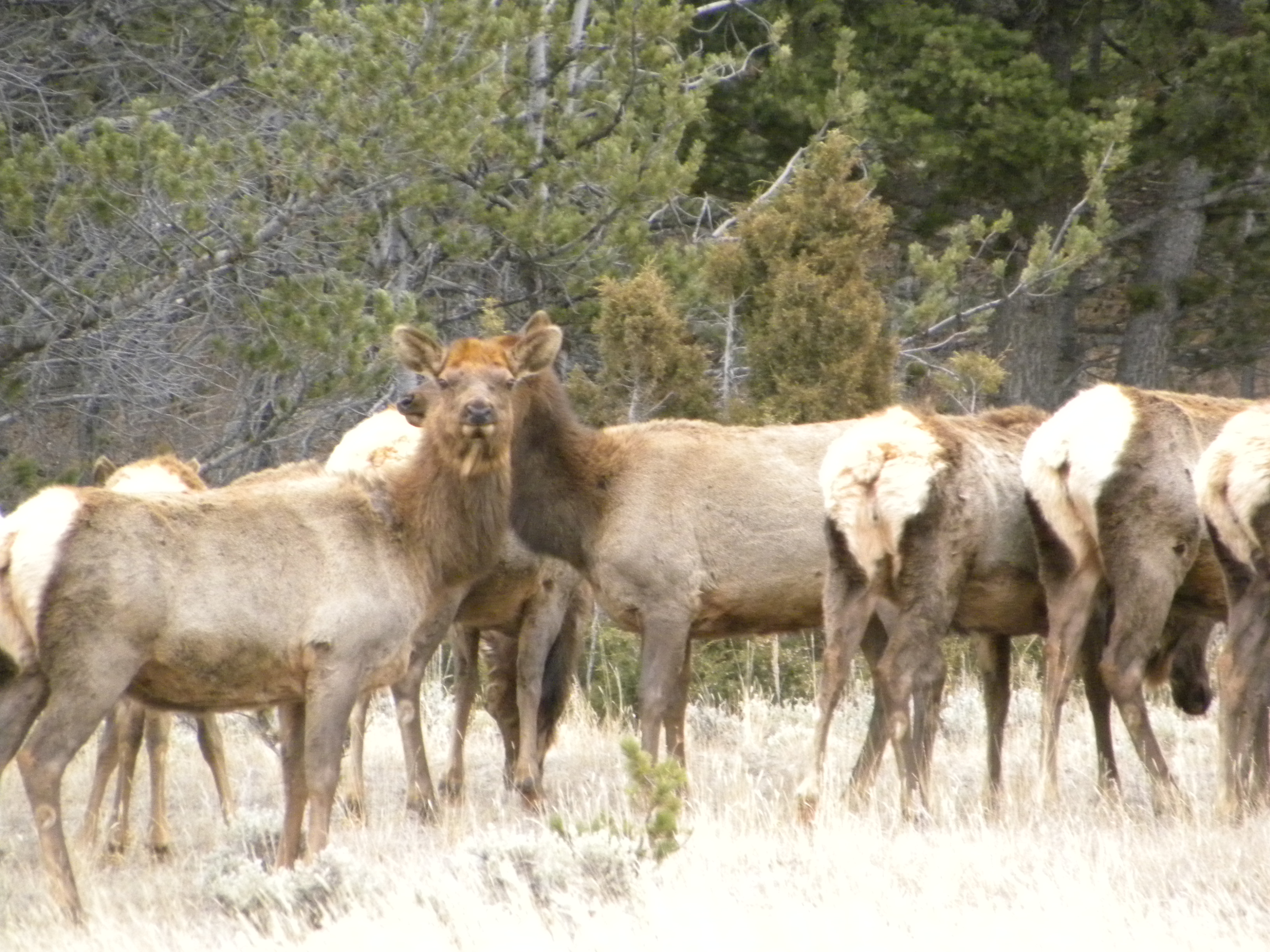
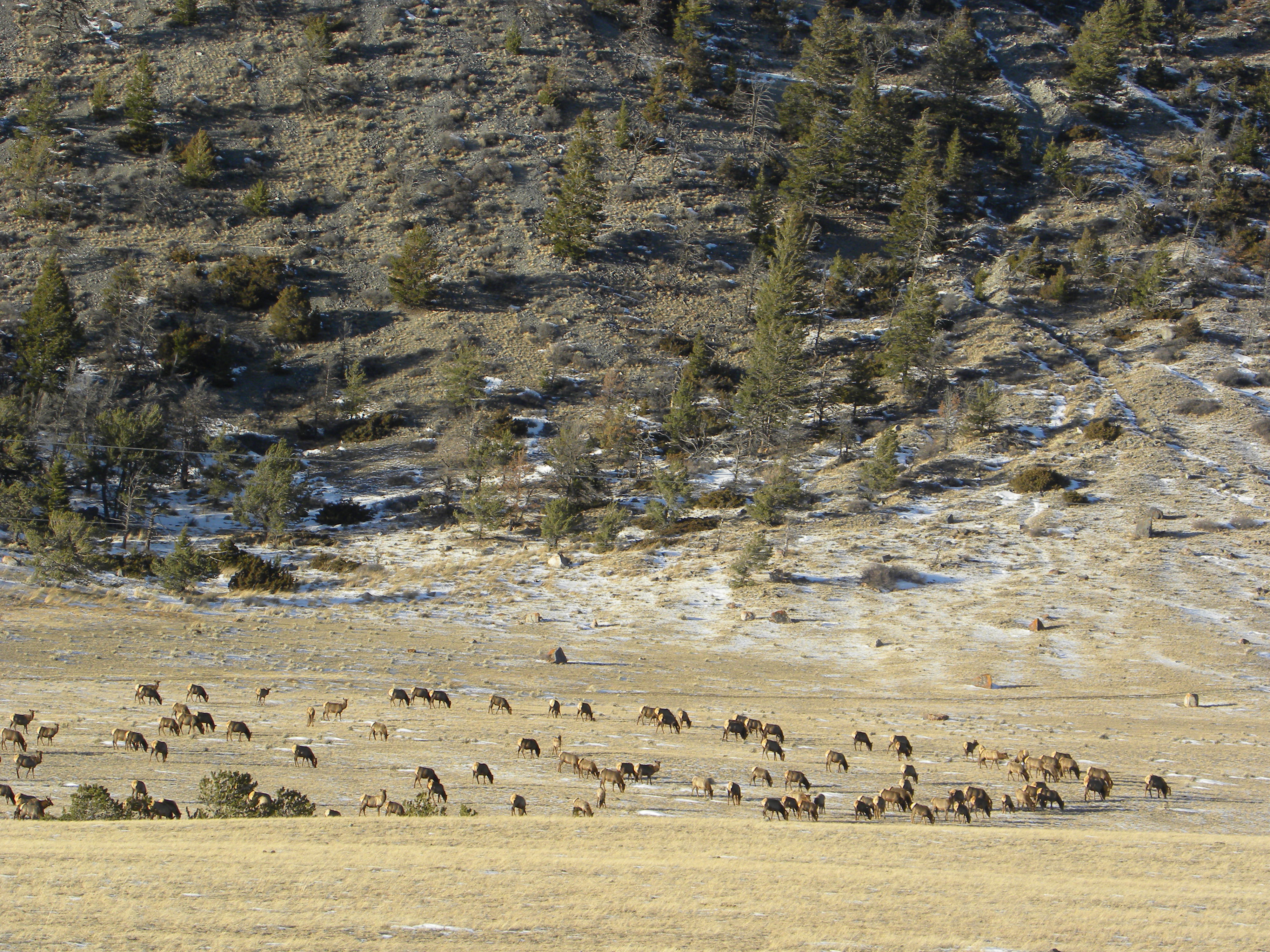
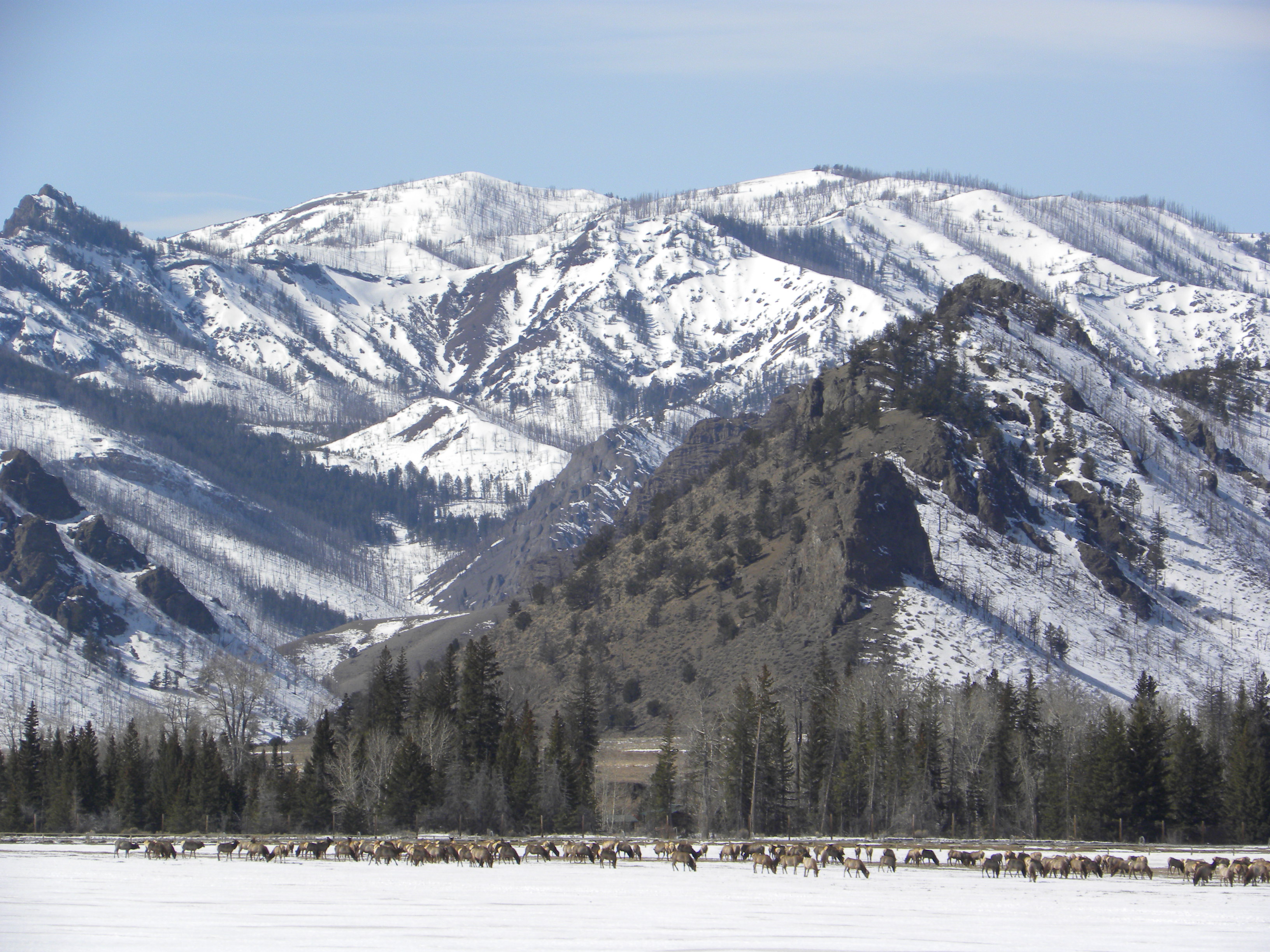
About 2000 elk are in the valley in winter.

About 2000 elk are in the valley in winter.  These are the YNP Lamar elk herd.

The results debunked this theory.  First off, there was no more vigilance with the migratory herd than the non-migratory herd that was used for comparison in the study(where wolves are present although not as many; and they had normal cow/calf ratios).  But more interesting was that elk did not show any signs of stress or movement until wolves were within 1 km, and these wolf/elk encounters occurred, on average, once every 9 days.  These factors are important to what Arthur is now stirring up a storm of controversy with.

The Rocky Mountain Elk Foundation helped fund Middleton’s study. But they seem to ignore the results of the study and still blame wolves for all the decline.  Included in the above 80% is the overpopulation of elk on the Northern range present before wolves.  YNP was killing elk for years to help reduce the herd.  One reason why wolves were introduced in 1996.

Just recently, Middleton had an op-ed in the New York Times.  In it, he contends that his results, as well as other studies, challenge the straight forward idea of wolves and trophic cascades.  In other words, that wolves herd the elk sufficiently to allow less browsing on aspens and willows, allowing them to regenerate.  The idea of trophic cascades is no doubt true (apex predators affect whole ecosystems), but Arthur is saying ecosystems have a lot more complexity to them then the simple fix of restoring top predators.

One of the ideas rattling around these days in biology is the Landscape of Fear.  I’m not a biologist, but the whole notion never sat right with me.  Simply put, the theory maintains predators will change the behavior of their prey, through fear, in ways that affects the their movement throughout the landscape, changing their feeding patterns and thus the plant material.  True, but maybe not the whole of it I think.  Ecosystems are varied and complex.  Arthur posted a photo of a wolf den with a herd of elk grazing nearby.  We humans have certain notions of fear-consciousness, yet this might not at all be what’s driving all the movements of wildlife.  As I said in that previous post, I still think nature has more to do with adaptation and awareness, than with so-called ‘fear’.

Recently I took a class with James Halfpenny in the Park.  He was asked about the wolf-coyote relationship.  It has been documented that wolves killed about 50% with the wolf reintroduction, but now their population seems to have recovered.  Coyotes are using the ‘inbetweens’ of the wolf territories to move around.  It didn’t take them long to work out, and remember instinctively, their age-old relationship with their big brothers and how to live with them (and take advantage of their kills).

And if wolves are herding elk from intensive aspen/willow foraging, I have to ask why the pack of six wolves in my valley was slacking on the job.  When the snows got really deep, the elk settled in my front yard and forest, topping every single aspen and willow they could reach.

Wolf wary of infared light

Wolf wary of infared light


Ode to a Wyoming Spring

Yesterday I took a short hike on the Clark’s Fork plateau.  And I was again reminded that there is nowhere like the Greater Yellowstone Ecosystem and the Northern Spine of the Rockies where one can experience what I did in just a few hours in the lower U.S.  Frankly, it was a magical excursion.

I began my hike on a well-known trail that falls just 45′ down to the vast plateau above the rocky cliffs of the Clark’s Fork.  Within moments I came across cougar tracks in the melting snowfield.  After a following the tracks a few steps, the elusive cougar  disappeared.

Left Hind cougar

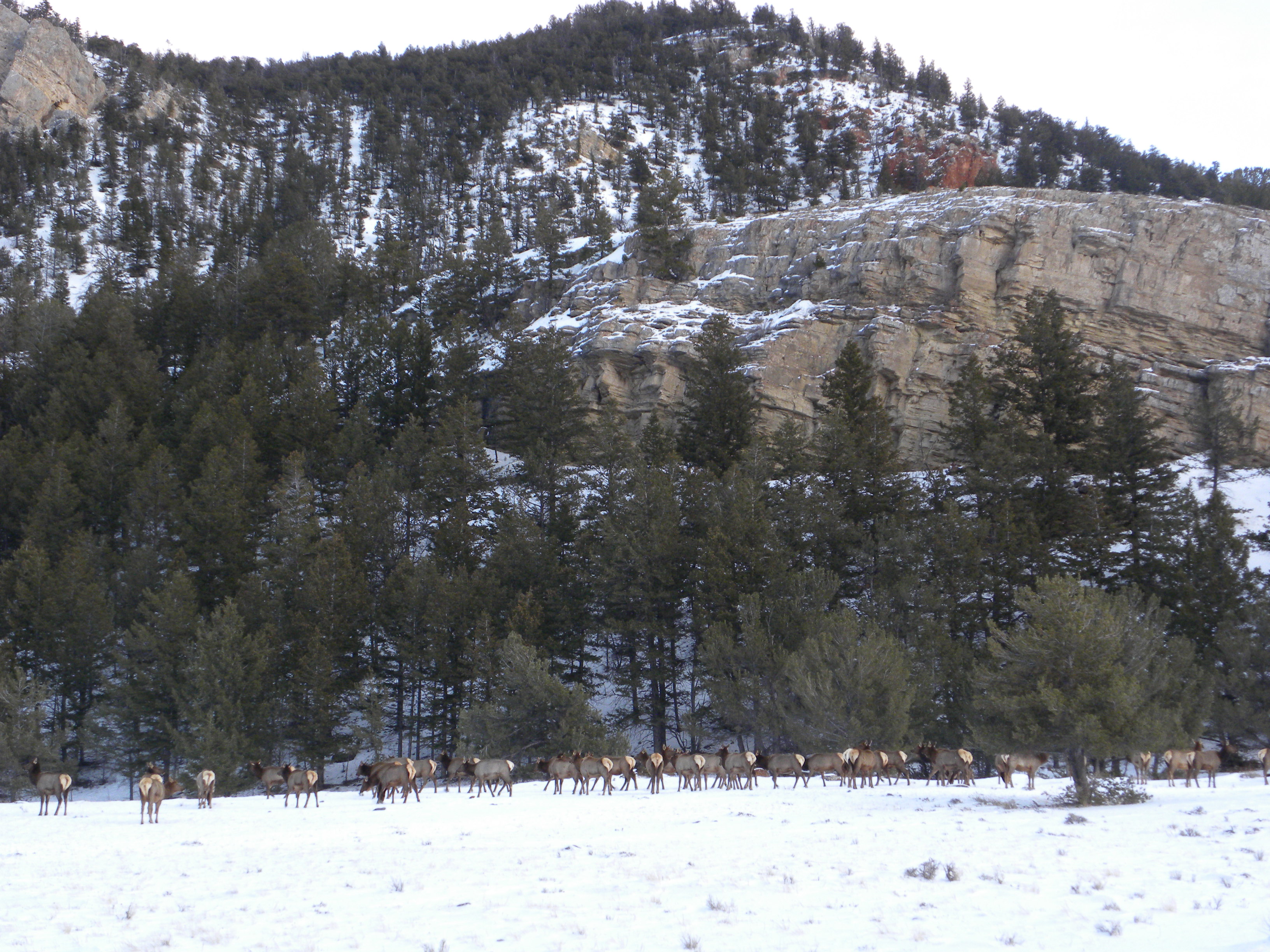
From the parking area above I’d spied a few elk, so I knew some were around.  But as I rounded a bend in the treeline, there was a small herd of about 75 elk in the meadows near the cliff edges.  Elk disband into smaller and smaller herd sizes as spring nears, until soon they disappear to calve and head into the high country.  The elk spied me and Koda, and were a bit skittish but quite curious.  As they ran one direction, then another to follow our movements (I was headed away from them and already at quite a distance), their hooves pounded on the frozen earth an ancient, but familiar hollow sound.

elk

I watched the elk briefly as they watched me, but I was headed for the river.  Within moments I spied fresh wolf tracks, 2 sets, as well as a lone coyote, on a sprint down to the river too.  I began following them as they lead me down the narrow gully that meets the river’s edge.

Two wolves side trot down the road

Two wolves side trotting towards the river

The wolves sidetracked up to a small meadow for a view and I did too.  From there, I glassed around, probably doing what the wolves did with their own eyes and good sense of smell.  Just a ravine away, there was a large gathering of birds on a melting ice field.  I detoured that way and watched them for a while.  Thousands of birds were gathering in trees, taking time for a drink.  Their chirping sounded like crickets, which I knew weren’t out yet because it was about 37 degrees.

After following the canine tracks down to the river, and seeing they’d crossed over, I made my way slowly to the cliff edge.  I wanted to spy for mountain goats that frequent the Clark’s Fork cliffs in the winter.  There is a special look-out area, where the meadows give way to trees, that soon fall precipitously over the 1000′ edge.  As I neared the trees and cliffs, I heard that strange ‘cricket’ sound again.  The flock had flown here and they were flying everywhere, from tree to tree, around the cliffs, thousands of birds.  These were Bohemian Waxwings and maybe there were beginning their migration north.  Beautiful birds, a bit smaller than robins, they caught my eye and senses.

Bohemian Waxwing

Whatever they were up to, the sheer force of their presence and numbers was magical.  The sun beat down through the trees.  I stood and allowed the new spring sun to warm my body, closed my eyes, and listened to them.  As I became quiet, they grew less concerned about my presence and became more active, flying all around me.  I felt like I was receiving a tiny bit of what America might have looked like hundreds of years ago–when wildlife was so abundant that this ‘small’ flock of a thousand birds or so was common.

What a wonderful two hour hike.  Only in a place like the Greater Yellowstone.  I was reminded of how precious, fragile, and necessary this place is.

Some winter musings

So far this winter has been a roller coaster of temperatures.  December brought weeks of sub- zero temps, while almost every day in January was in the high 30’s and 40’s.  All our snow in the valley melted and the ground was bare.  Then one day two feet of snow fell, and didn’t stop. One constant has been wind–a lot of it and up to 50 mph.

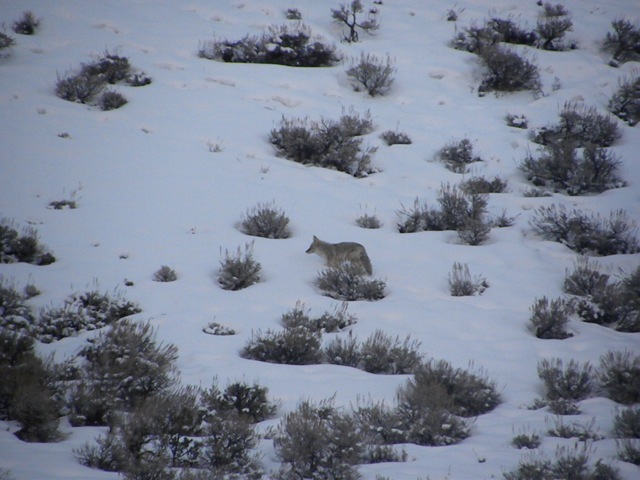
Before all the deep snows came, I spent a lot of time watching for wildlife and sometimes seeing them.  I had several glimpses of a lame coyote, with a hurt or broken back left leg.  One day I saw him scurry across a wide field.  I wondered if he’d make it through the winter, with his lameness as well as wolves to watch out for.  Then a few weeks later I saw him stealing a large bone from a recent deer kill.  It was early morning when I noticed the coyote.  He saw my car and started running for cover.  It was then I saw it was my limpy friend.  I took a few photos and was on my way.

Here's the fellow.  Who knows what happened to his leg.

Here’s the fellow. Who knows what happened to his leg.  In his attempt to flee, he dropped his prize bone.  That’s when I left, allowing him to return to it.

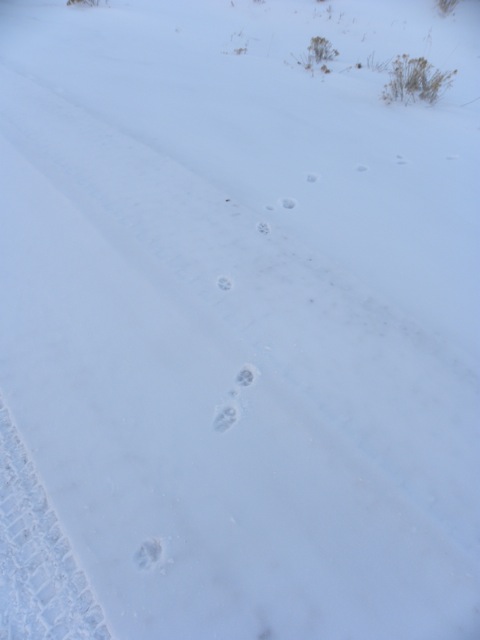
Poor guy had it tough enough without me making it harder.  But on the way home I checked for his tracks.  I was curious what a useless left back leg would look like in the tracks.

The arrow points the direction he was headed

The arrow points the direction he was headed

coyote limp

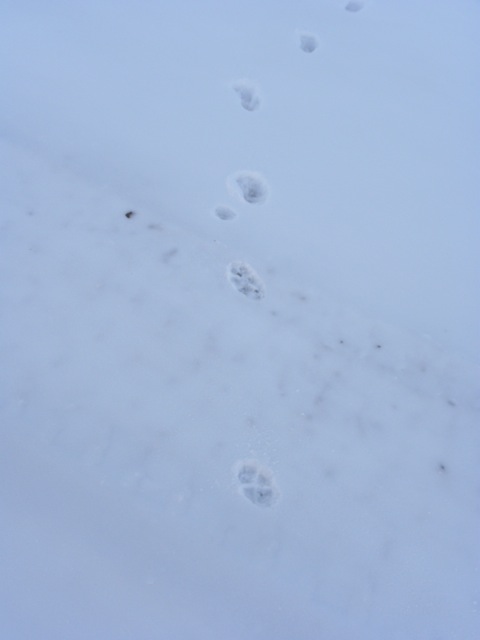
You can tell what a difficult time he is having because his gait is so uneven.  Look for that tiny imprint of his lame foot.

You can see the small imprint of his left hind leg.  The back legs are in front because he is running

You can see the small imprint of his left hind leg. The back legs are in front because he is running

One ski tour I took a few more photos of tracks.  This time a Snowshoe Hare and a Marten track

Distinct weasel-type prints 2x2

Distinct weasel-type prints 2×2

Front feet are in the rear and the back feet on top.  Look how big and wide the back feet are, like a snowshoe.  Hence, the name

Front feet are in the rear and the back feet on top. Look how big and wide the back feet are, like a snowshoe. Hence, the name

Here’s a photo from January on the flats behind my house.  Where’s all the snow?

This is a large herd of about 350 elk.  No snow in January

This is a large herd of about 350 elk. No snow in January

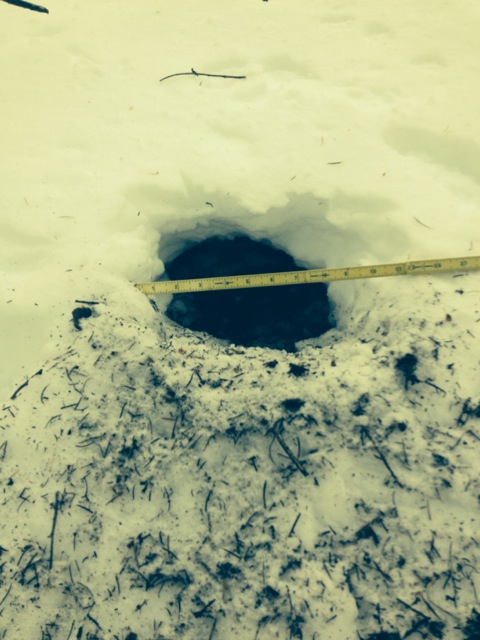
Here’s a puzzle.  We had a few days of intense snow without a let-up.  During a short let-up of the storm, I took a walk around our woods and discovered this interesting ‘hole’.  It doesn’t go anywhere, but was obviously a temporary snow shelter dug out during the storm just above the base of a tree on a hillside.  The hole measured about 6 or 7 inches across, big enough for a fox or a skunk.  I have seen skunks once here, but they are rare.  So are raccoons at this altitude.  I wondered what could have done this.  All tracks were obliterated by the recent snows.

Hole that doesn't go anywhere dug out for a temporary shelter.

Hole that doesn’t go anywhere dug out for a temporary shelter.

I found bobcat tracks around my house.  Bobcats have become quite rare around here because of intense trapping.  Bobcat pelts can go for up to $1000! and so a lot of newbies want to cash in.  Wyoming has no limit on how many bobcats a person can trap and the season is long, pretty much all winter.  So I set up a camera trap to get some photos.  I’ve never been successful catching photos of bobcats, except the few times I’ve seen them myself.  But instead of catching a bobcat, I caught a shot of this fox.Fox

I understand from some old timers around here that foxes used to be quite rare.  Canines are territorial and will kill other canines in their area.  Wolves kill coyotes, coyotes kill foxes.  I’ve seen foxes quite a lot since I’ve lived here and I think the wolves are keeping the coyotes either ‘in check’ or enough on their toes so that there is room for foxes again.

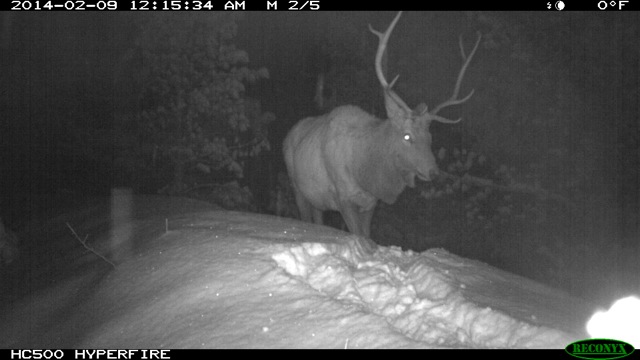
I discovered a secret game trail that is quite a hike from my house.  An old water diversion ditch, it appeared the wildlife were using it frequently.  I also found a deer kill nearby.  To confirm my suspicions, I set my trail camera up and left it there for 6 weeks.  I got a lot of photos of rabbits, deer, elk, coyotes, and wolves.  Here are a few.  Look at the temperature on the two nighttime wolf photos.  Its -33 degrees!

Wolf

Wolf stares into camera

Wolf

Bull elk

Nice Bull Elk

Wolf

see the second set of eyes in the background

I really do live in a special place, right next to Yellowstone National Park!

How to collar a wolf

The spotter plane has been flying very occasionally because either its too windy or snowing. When the spotter flies in January, its because the Wyoming Game and Fish are looking to find wolves.  They need to complete their annual count and do collaring.

Here's how its done although this pix is of cargo.  The wolf would be wrapped in a net.

Here’s how its done although this pix is of cargo. The wolf would be wrapped in a net.

This morning was beautiful.  Four inches of new snow and no wind–perfect conditions to fly and look for wolves against the snow.  I saw the helicopter head up a neighboring drainage and knew they’d found wolves there.  It just so happened that I was on my way to meet a friend in Cody when I saw the copter returning to a trailhead pullout with a sling hanging from it.  The copter hovered while a cadre of Game and Fish employees guided the net to the ground, then carried the cargo to a lowered tailgate of a truck.  I knew what was happening so I turned my vehicle up the dirt road to get a closer look.

Lying on the tailgate was a small sedated wolf.  A female, she was this year’s pup and only about 70 pounds.  Her teeth told the tale as they were white and perfect, but her paws said she’d be growing bigger by the spring.  Usually I keep my camera in the truck, but this morning the elk were in my front yard and I was taking their pictures.

About 2000 elk are in the valley in winter.

About 2000 elk are in the valley in winter. 

So no photos folks, you’ll just have to believe me when I say I touched her fur, and held her foot.  And the truth is I didn’t feel badly about no photos.  Photographing a sedated wolf felt like I would be violating her dignity.

I asked one of the fellows how long before she awoke. “About 1/2 hour till the drug wears off.”  He told me.  “It’s the same drug the vet uses to sedate your dog.”

One person will stay with her till she wakes, then she’ll just have to find her way back to her pack by herself from the parking area–although far in human walking terms, probably no great feat for a wolf, who can travel up to 30 miles in a night.  She can surely scent her way, or howl her way, back to her family.

Not today's wolf but here is an example of collaring.

Not today’s wolf but here is an example of collaring.

I’ve been volunteering for many years now in the Draper lab at the Buffalo Bill Museum of the West.  About six months ago the lab acquired over 100 frozen wolf heads from the U.S. Fish and Wildlife.  USF&W managed wolves when they were still listed. They shot wolves for livestock control.  These wolf heads, and some carcasses, were saved for DNA and other scientific purposes.  The lab also is receiving wolves from Yellowstone National Park that died from various causes, usually wolves that killed other wolves.  With this repository of skulls from all over the GYE, the museum will be in a unique position of holding essential DNA information which could help ensure the Greater Yellowstone wolf population has sufficient genetic diversity so as not to go extinct again.

Draper lab Buffalo Bill Museum of the West

Working at the lab, I’ve held and worked on many wolf skulls, but of course all dead wolves. Seeing a living wolf so close up is definitely a thrill.  But I have mixed feelings about collaring and so much interference.  Wolf collaring outside the Park is essential for only two reasons: first to count the population and track them, ensuring that the numbers of wolves do not fall below the critical 100 wolves and 10 breeding pairs; and second they take blood in order to make sure enough genetic mixing is taking place, again part of the delisting mandate.  Other than that, these wolves have been studied for over 15 years and now that hunting is taking place outside the Park, the study inside the Park has, I feel, been compromised with too many unnatural variables.

So, my reservations?  The amount of disturbance that wildlife in general is subjected to is constant.  There is general hunting season on ungulates from around September through December.  Collaring of wolves.  Fly over counts of sheep and elk.  Cougar hunting is seven months from September through March. Regulated trapping seasons on fur bearers such as martens, bobcats, and beavers.  Year round trapping on wolves in part of the state, coyotes, raccoons, badgers, rabbits.  Then there’s snowmobile activity in winter and ATV activity in summer.  The human pressures on wildlife never stops, in addition to their predation pressure and food needs.  And this is just around my area.  Many states have year round hunting and trapping regs depending upon the animal.

Putting all my concerns aside, it certainly was a magnificent day–awakening to hundreds of elk in my front yard and getting a close-up look and feel of their predator, the wolf.

Four wolves far away

Four wolves far away


The Ecology of Awareness vs. the Landscape of Fear

The Greater Yellowstone Ecosystem is a great laboratory that houses all the fauna and flora that make up a complete ecosystem. Granted, humans have greatly altered that system, with invasive species of animals and plants, farms and ranchettes, housing developments, dams and canals; but still pristine and natural wildlife interactions can be observed in the vast  lands  surrounding the Park.

Coyote searching sagebrush for prey

Coyote searching sagebrush for prey

Since wolves were introduced, a lot of the systems have changed, and not only have the wolves been studied, but their effect on elk, coyotes, aspens, watercourses, beavers, grizzlies and more.  Wolves are an apex predator, in other words, at the top of the food chain.  They are the key lynchpin effecting entire landscapes, the beginning of a domino effect, which creates a ripple of change far and wide.  This is referred to as a ‘trophic cascade‘.

'06 swims the Lamar river, emerges onto the road right in front of tourists.

World Famous ’06 shot by hunters in 2012

One of these studied effects is the resurgence of willow and aspens streamside in the Park.  Before wolves were re-introduced (wolves were extirpated from the Park by the early 1930’s), there was not an aspen younger than 80 years old to be found.  Aspen only live about 100 years.  This dearth of young trees was because elk, free of predation, were browsing like cattle, feeding  unfettered in stream bottoms on young shoots.  But once the wolves arrived, everything changed.  An elk in a river bottom is more vulnerable–less escape avenues, harder terrain to navigate quickly.  Over time, elk learned river courses were not where they wanted to linger so the aspens and willows rejuvenated.   With young trees returning, the beavers had food and materials for their dams.  With the beavers returning, slower stream habitat was created for fish and insects, and the fish had shade and cover.  So you get the concept of trophic cascades.

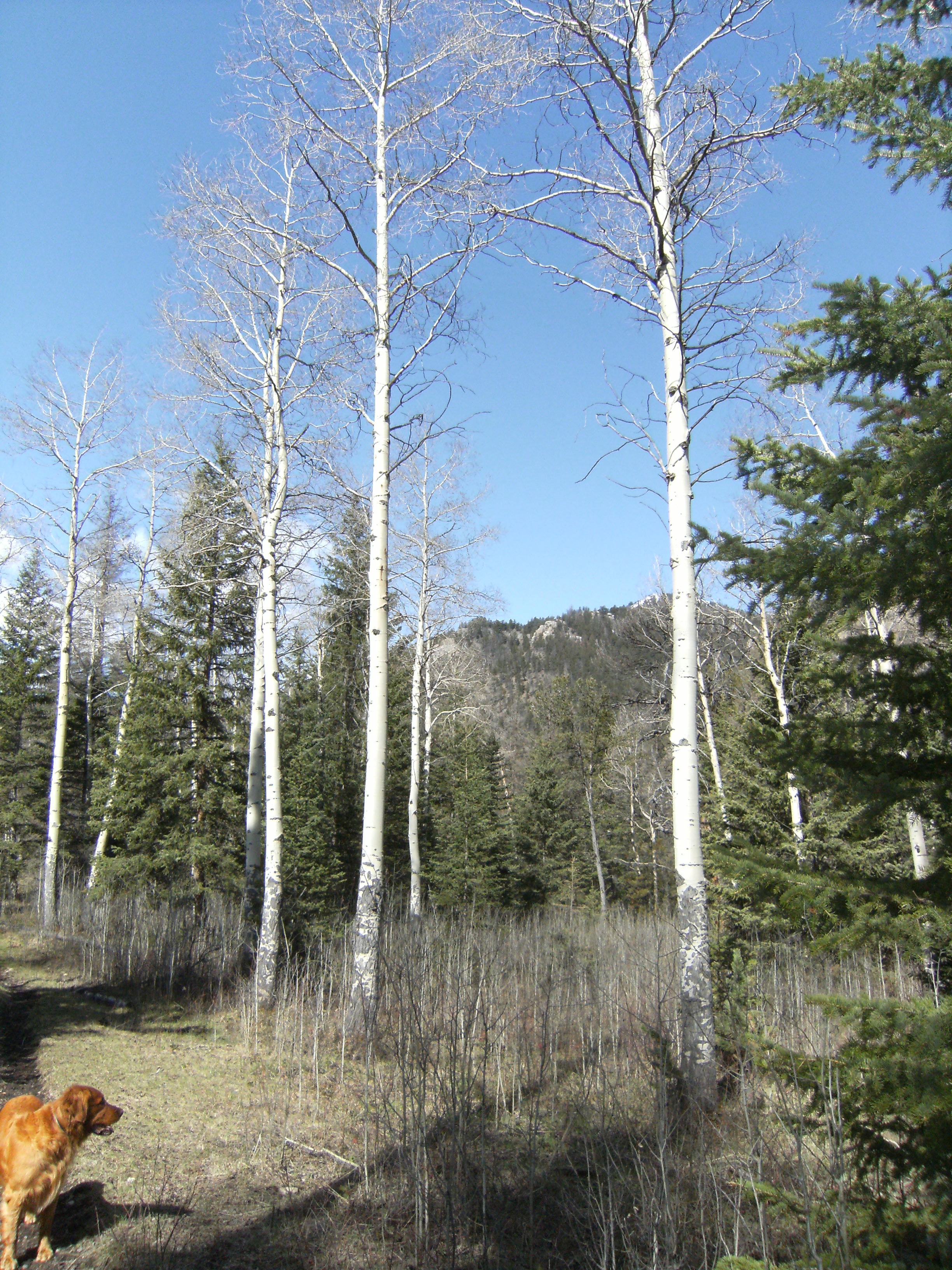
Mature old aspens and gazillions of young aspen clones

Mature old aspens and new young aspen clones with the reintroduction of wolves

One of the ideas that came out of all these new studies was a scientific catch phrase: ‘The Ecology of Fear” or sometimes called “The Landscape of Fear“.  This of course, relates to the idea explained above–that wolves,and all predators, effect prey movement through fear of being killed, and thus mold the landscape.  And this is a true observation, even with humans.  Fear has us humans avoiding certain neighborhoods at night, or packing a gun, or just being more vigilant when hiking around grizzlies.

Grizzly bear

Grizzly bear on a well used forest service road.  Gun or bear spray?  What do you carry?

The world of nature and its observations, scientific or not, can be compared to a room full of individuals.  Each person describes the experience through their own lens; in a sense it is like a vast hall of mirrors playing tricks on the observer.  The Landscape of Fear is only one way to describe the play of nature, and I feel we do a great disservice to tag Life through this lens.  We demean non-humans, reducing animals to little more than reactive and fearful creatures.  Fear is a useful emotion. Without it survival would not be possible. But fear does not describe the whole and the complexity.  I prefer to think of it as the Landscape of Intelligence and Adaptation.

Elk herd in valley on a warm day

Elk herd grazing in winter

For instance, with their native predator back, the elk relearned their landscape, reconnected with their instincts, re-quickened their alertness and intelligence–much like a person who walks in grizzly bear country as opposed to walking a trail on the California coast.  This kind of alertness, although born out of our universal need to survive, is an act in Consciousness.  Elk, nor any other animal, are not walking around fearful all the time.  They are aware, alert, ready to adapt to new circumstances. They feed in the open where they can run, they distrust and don’t like fences that hinder their freedom to escape, and they stay close to forest cover where its harder for wolves to out maneuver them.  But they also are frisky, feed early before storms, move continuously for better forage, adapt their location for wind and weather protection, and are forever curious.  They are intelligent.

elk and snow

We have all seen people who are frozen with fear, or their outlook on life is clouded by paranoia.  They are not healthy mentally, nor happy. And their personal Landscape of Fear becomes one of obsession with protection as their world becomes narrower.  Clearly then, this is not the natural state.

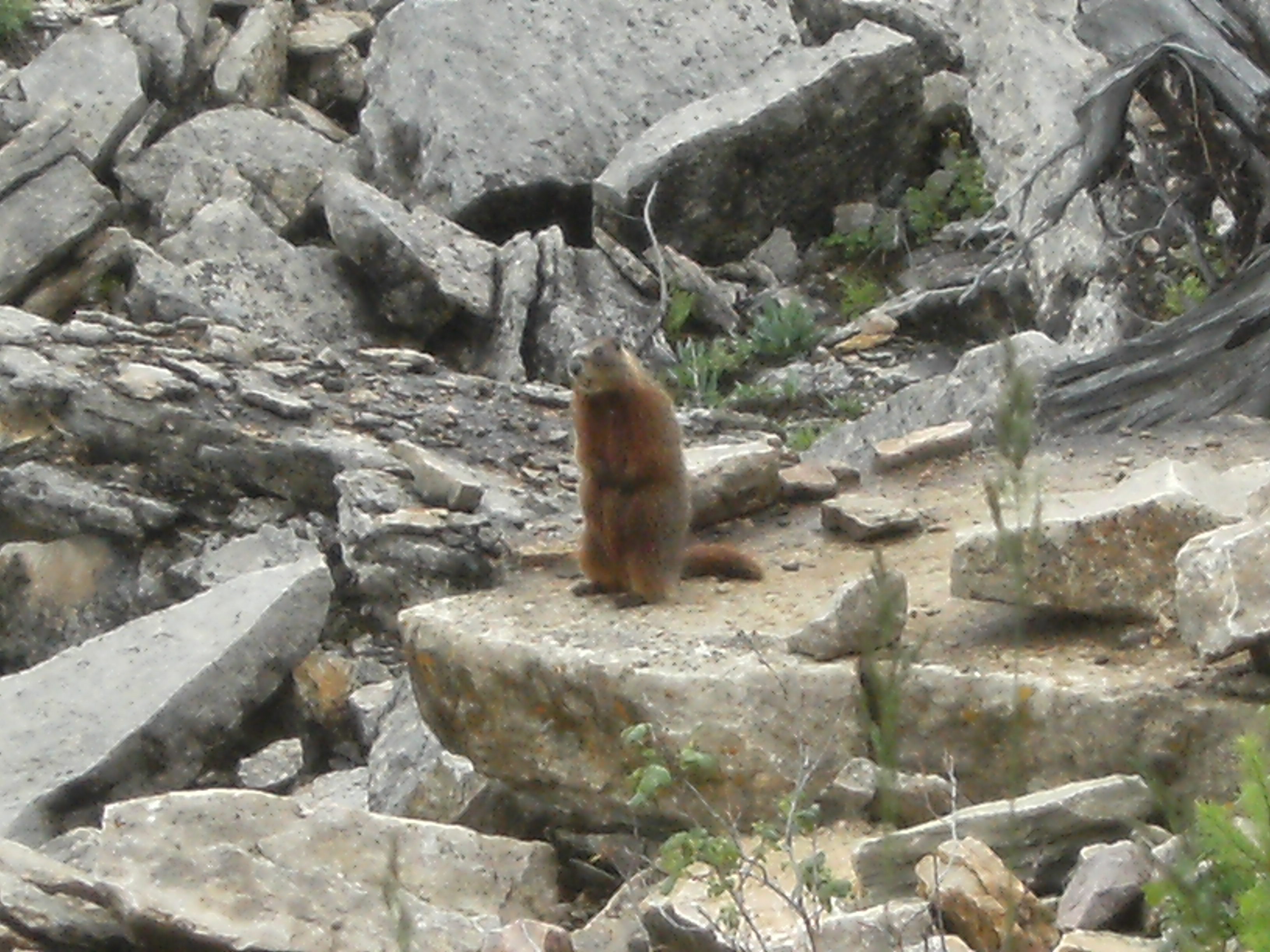
Fat Marmot

Alert Marmot

The natural state is one of relaxed awareness, able to draw on whatever appropriate response is necessary at any moment. It is a flexible state of consciousness, with the ability to learn and grow, move and adapt.  This is the lens through which I view the natural world. This is the mirror I feel dignifies wildlife and all of Life.

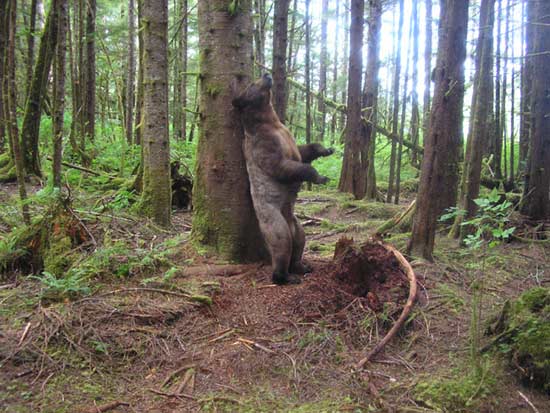
Bear scent trees and leave their hairs

Happy bear makes a tree rub

Wyoming’s wolf hunt hits hard

I’ve been checking the kill data sheets on the Wyoming Game and Fish predator site every day.  The data is divided into zones, with a quota in each except for the ‘predator zone’.  In the Predator area, which constitutes over 85% of Wyoming, a wolf can be killed, by any means, any time of the year.  In the Trophy Area, its October through December.

My zone is zone 2.  We’ve had early snows, which drives the game further down from the high meadows.  It also makes tracking easier.  Wolves follow elk and so do hunters.  The quota in my zone has been 4 wolves total.wolf

With the large quota of 8 wolves last year that dispersed and mostly destroyed the existing pack, there have been few wolves here.  Park wolves moved in this winter, although their pack was hit hard when several of the members moved outside the Park boundary and were killed, among them the Alpha female. Come spring the Lamar pack dispersed, a few had small litters, and although I’d watched a few lone wolves here and there, the wolf watching here, as well as Lamar valley in the Park, was poor.  Summer in general is a time when wolves are tending their pups and not running in packs.  Fall and winter they ‘pack up’.

This wolf, from my valley, was by the road two years ago.  With the hunts you will no longer see wolves so easily

This morning I looked at the Wyoming Game and Fish ‘harvest’ data (I hate that euphemism.  I ‘harvest’ vegetables and fruits; I ‘kill’ animals), and it appears that over the weekend five (5) wolves were killed in my zone–one over the quota even.  I don’t yet know the details, but I might assume they were running together, adults and pups, and all ‘harvested’ by elk hunters working high up with wolf tags in their pockets.

I find the whole wolf hunt, and how its being handled in Wyoming (as well as Montana and Idaho) a sad state of affairs.  The Wyoming Game and Fish wolf site is extremely lean on data and statistics which makes me distrust what their final count for 2013 will be.  They say they will have, at the end of this hunt, a total of 160 wolves.  Yet with 50 wolves killed this year already in the predator zone and as control, these additional 26 wolves for the hunt amounts to approximately 75 wolves harvested. Wyoming’s final data report for 2012 estimated 186 wolves as of December 2012.  Even with new pups, a kill rate of over 75 wolves will be cutting it close to the agreement with USF&W below:

Under the terms of the delisting agreement between Wyoming and USFWS, the state of Wyoming is required to maintain wolves at or above the minimum delisting criteria of ≥100 wolves and ≥10 breeding pairs in WYO, with YNP and WRR (Wind River Reservation) providing the additional buffer of ≥50 wolves and ≥5 breeding pairs necessary to meet the ≥150 wolf and ≥15 breeding pair requirement for the state.

My valley which is directly adjacent to the Lamar Valley, is a rich corridor that allows for genetic exchange.  The Lamar elk herd migrates here in the winter, returning to the Park in the spring.  The herd has been studied for its low cow-calf ratio, but the results of this study are not being used to make management decisions.  The study shows the biggest impact to this herd has been compressed ‘green-up’ reducing feed quality (think climate change and drought), and to a lesser extent, grizzly take on young as the bears food (specifically cutthroat trout) has been reduced.  With zone 2 as one of the largest quotas in the state for wolves, WG&F is trying to eliminate wolves in this area in order to build up the elk herd population–even though their own studies indicate wolves are not the herd’s main problem.

What must be said, that isn’t being said enough, is what is a landscape devoid of its full suite, bereft of predators, lacking that intricate network of fundamental relationships? Wolves operate as a family unit; they have emotions like ours.  There is something magnificent and whole about having an abundance of wildlife, all of the members of one’s ecosystem, present.  The Land itself becomes alive.  That is why I love living here, and not in a ‘wilderness’ of only pretty views.wolf

I end this post with a quote from Joe Hutto.  He spent a year raising a brood of wild turkeys.  Here he reflects upon his youth when he hunted turkeys for food.  I would like to believe that this is what motivates hunters to kill for trophy or sport, killing an animal that you don’t even eat.  I like to think these wolf hunters are attempting, unknowingly, to touch something magnificent, more alive, and more fully conscious.  And possibly one day they might wake up and instead of killers of wolves, they will be advocates.

“I try to recall whether in my young mind, at that moment, I could have imagined, anticipated, or even longed for the irony of the present moment and this strange continuity.  Like an arrow shot high and blind, it seems as though I have traveled very far although my path was peregrine.  It appears, in retrospect, that my trajectory could only have brought me eventually to this singular experience.  I realize now that as a young hunter, my intent was not merely to kill for food this elusive bird, but was rather my clumsy way of reaching toward something that enchanted and mystified me.”

Wolf Watching

Now that wolf hunting is a reality in Wyoming, I’m always loathe to write a post about wolves.  Frankly, I don’t want to give out any information that will help hunters during the fall hunt season.  Last year, the first wolf hunt season, the Wyoming Game and Fish had a quota of eight wolves in my hunt area.  Eight!  There barely were eight wolves here.  The Hoodoo pack had, the year before, driven off most of the other competing packs and were dominating the valley.  So what happened on that hunt last October-December?  Eight wolves were taken, yes, but three of them were from the Lamar Pack in the Park, including the Alpha female of that pack.  During the winter, the entire Lamar Pack, disrupted after loosing their strongest hunter, spent most of their time here, mostly consuming deer, an easy prey. But come spring and mating season, the Pack fragmented, with only three, sometimes four, returning to the Park full time.

A disrupted Lamar Canyon pack in the valley this winter

A disrupted Lamar Canyon pack in the valley this winter

What used to be the best most reliable wolf watching area in the country, the Lamar Valley of Yellowstone National Park, is now quite lean. Its a rare day in the Lamar when tourists can view wolves there.  Only three, sometimes, four, adult wolves are left in the valley, although they’ve produced a small litter of pups.  The remainder of the pack has dispersed.

Here in the valley, some of those Lamar wolves remain this summer, and a few have pups in various locations.  Its unclear at this point how many are here, and what will happen to them in terms of new pack formations, nor how many of these wolves will venture back into the Park come September.

Wyoming Game and Fish has a much lower quota this year and that’s because they are getting dangerously close to their relisting number of 100 wolves outside the park, and 50 wolves inside.  As of this writing 23 wolves have been killed in the predator zone alone.   Taken together with the 67 wolves killed last fall, that’s almost 100 wolves out of about 212 before the hunt outside the Park.  Between wolves that are killed naturally, and wolves that are killed by WG&F as predator control, even with new pup counts the line is getting thin.

wolf

This years’ quota is set for four wolves in my area.  So far, I’ve seen several lone wolves and a few reports of a wolf with a pup.  Once again, this fall could easily decimate and disrupt the wolf population here.

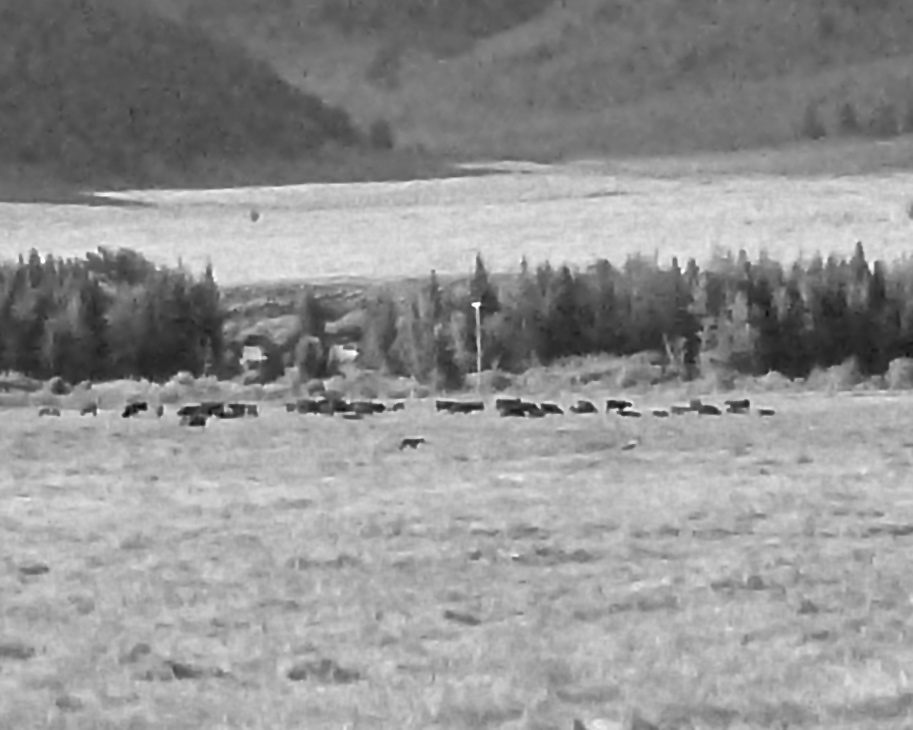
Last week I had a wonderful thrill.  Upon returning from a creek expedition I spied a lone wolf mousing in a field next to over 75 cows with calves.  I watched her for over an hour, deftly reducing the ground squirrel population.  She was incredibly focused on her task and I suspect she would be returning to feed some hungry pups with this small meal.  When she got too close in her endeavor to the cows, a large mama would come over and push her further away.  Otherwise, the cows paid her no mind and went about their business grazing undisturbed.  The good news is that these cows are removed to lower pastures come October when wolves tend to hunt in packs and could easily take down a cow.

Hard to see, but the small dot in the foreground is the wolf mousing amongst the cattle

Hard to see, but the small figure in the foreground is the wolf mousing amongst the cattle

I like wolves; and I like seeing them in the landscape.  They are finally re-inhabiting their old nation where they once roamed freely.  Where there are few problems and livestock conflicts, where the habitat is good, where there is room for genetic exchange, it makes little sense to even hunt wolves in these areas.  The wolves here have self-regulated for a long time.  It’s a tough and short life being a wolf.  They fight and kill for territory, and their territory is defined by how many wolves can actually be sustained.  They also work as a family with a close-knit social order.  Disrupting that order continuously exacerbates problems with livestock.   Given the human social and political climate, I don’t see much change for wolves in the immediate future.

Co-existing with Predators

In helping homeowners over the years deal in natural ways with small critters like moles and gophers, as well as larger animals like deer, I found that there is one necessary ingredient–the homeowner has to want to co-exist rather than resort  to lethal controls.

That same principle applies to larger predators in the landscape such as cougars, wolves, bears, or coyotes.  The wolf reintroduction has generated a lot of fear.  But if we want wolves to remain in the landscape, then ranchers will need to learn new methods.  I have always advocated that, just like the homeowners I helped and educated, ranchers need and deserve a helping hand.  This should include public and private monies for education and training.  Instead of ranchers just given a ‘kill tag’ or being reimbursed ad infinitum for predations, they need to be aided in new protection methods with the goal of incorporating those techniques into their regular routine.

There are several private organizations doing just that:  working with ranchers to discover ways to protect their herds and flocks.  Below is a fantastic informative video I hope you’ll watch.  Well produced with the added benefit of wonderful scenery and wildlife footage, ‘A Season of Predators’ gives you a vision of where we must be headed if we are to have bears and wolves remain in the landscape.

One additional note I’d make:  Although this video concentrates on wolf management, we, the public, are spending millions of dollars a year funding government killing of predators and ‘nuisance’ animals.  This arm of the USF&W is called Wildlife Services and its main job, unlike its title, is killing predators.  One local man who works for WS told me that he trapped and killed 400 raccoons last year for one farmer.  He also had to kill dozens of feral cats as part of his job.  Ironically, he was also killing the local coyotes that would have kept the raccoon and feral cat population in check.  This is the kind of government subsidization that is ‘old school’.  Instead of simply killing wildlife as well as throwing away all that money that not only doesn’t teach the farmer any practices, but doesn’t teach the local wildlife anything, Wildlife Services could have used those dollars exploring new methods and instructing this farmer in sustainable practices in co-existence.

Having worked with over-populations of deer in suburban areas, I know that deer damage can be controlled.  For instance, deer actually are trainable.  Does teach their fawns what to eat.  Deer can be browsing on one type of flower in the landscape, but miles away won’t touch that plant but prefer another.  Through a variety of means that don’t even include fencing, deer can be ‘taught’ not to eat a particular plant.  As you’ll see in this video, wolves can be taught too, but it takes a bit more work than simply a trap, a gun, or a poison.  This is the kind of ‘work’ where your psyche and body meld into the land.  You’ll have some loss, but the goal is to minimize.  You are working with the wild, not against it, and in doing so there is great pleasure and satisfaction, with the rewards being a feeling of oneness with the Land.


Another view

Here’s another video of that wolf. Be patient till about 20 seconds when he comes and checks out the camera for a real close up.

Wolf investigates

I had my trail camera focused on a road killed jackrabbit. A marten spent two days trying to get it down. Then a coyote came bye, the marten scrambled up a tree, and the coyote pulled it from where it hung and devoured it.

Four days later, this wolf came along to investigate the scene of the crime.