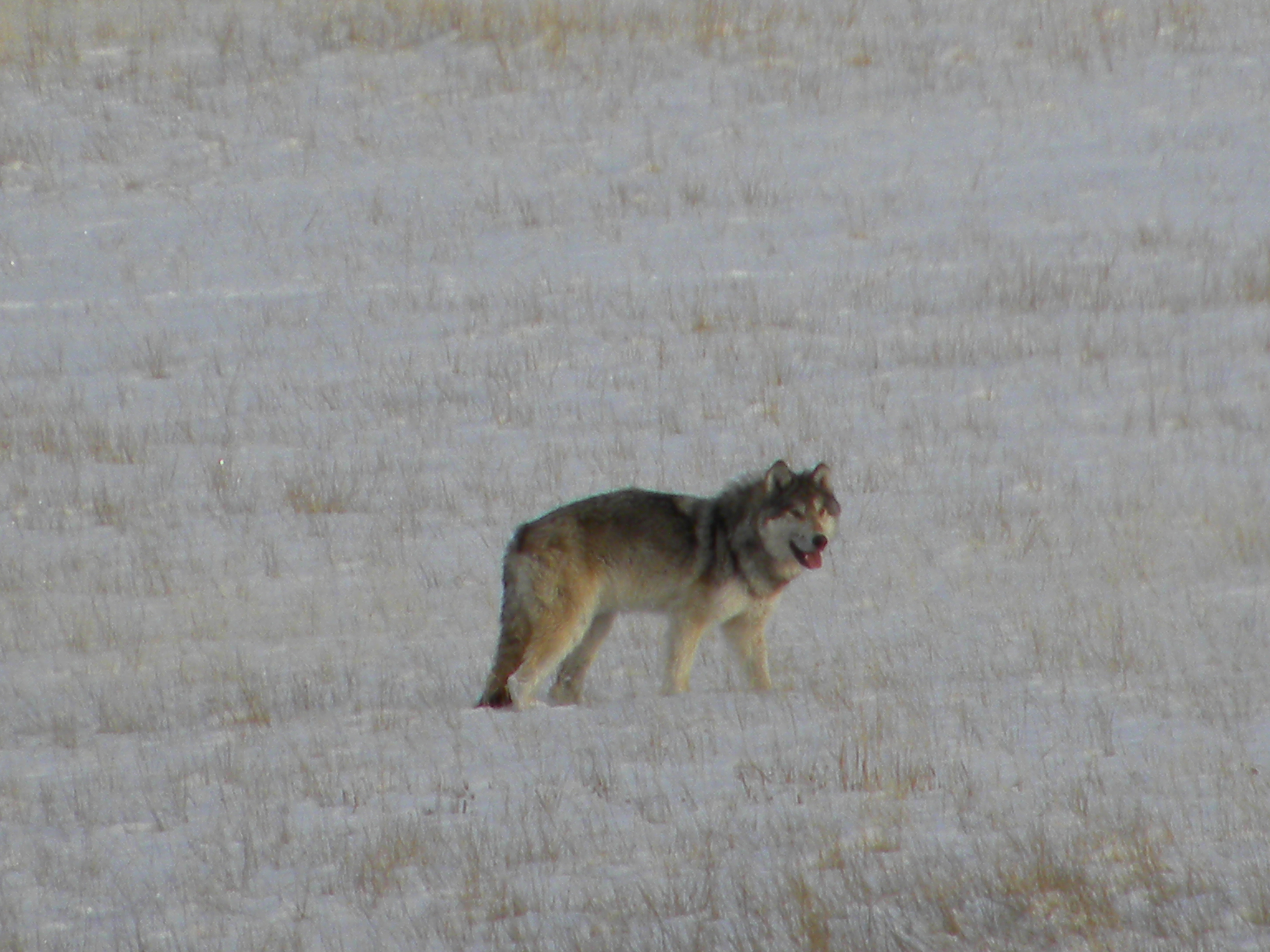
This is a great documentary, free online, by Canadian Geographic on coyotes. Humans have been trying to eradicate coyotes for years, unsuccessfully. In fact, whereas coyotes were confined to a small area of the West a hundred years ago, now they are ubiquitous, all over North America, from cities to suburbs, on islands and the countryside. Why, no matter how much humans have trapped, shot,and poisoned coyotes, do they come back in greater numbers than before?

Coyote hunting ground squirrels
Here in the GYE, wolves were eradicated by the 1930’s. Since then, coyotes have been the bane of the sheep, cattle, chicken, and any other type of rancher. Coyotes are considered ‘varmits’ and can be shot on sight in Wyoming. Coyotes used to be blamed for all the troubles. With the reintroduction of wolves, now wolves are blamed. But if you want to keep coyotes under control, then you need to have wolves around.
According to YNP biologist Bob Crabtree who has been studying coyotes since before wolf reintroduction, since wolves came on the scene in Yellowstone, there has been an 80% reduction in the coyote population. Coyotes are the oldest indigenous species in North America, some 3 million years old. Their arch enemy is the Wolf. Over the thousands of years of dealing with wolves, coyotes have become cunning and adaptable under that stress. They have developed highly sophisticated strategies of dealing with high mortality rates. For one, they breed rapidly when under attack and produce more litters. For another, they can feed up and down the food chain.

Coyote pup
Each year in Yellowstone 1/3 of the coyotes are killed. This makes the survivors much smarter: Super Coyotes. And although wolves are their nemesis, they also provide a smorgasbord of food. Coyotes in Yellowstone mostly eat ground squirrels. It takes a few to make a good meal. But when wolves kill large prey, the wolf pack will eat their fill and leave the rest. Coyotes can take advantage of their leftovers, which is like eating 100 ground squirrels.

Coyotes taking advantage of a wolf kill

So it pays to stick around the wolves, but not too close. This stress has produced powerful survival skills. It seems coyotes evolved to do better in a state of flux.
Humans created conditions for coyotes that have allowed them to populate all of North America. They’ve killed off their primary enemy, the wolf. They’ve cultivated fields and created open spaces. They’ve filled those open spaces with nice plump meat to raise pups with. And by putting stress on coyotes through trapping and killing, humans are acting like wolves, making the coyotes breed more rapidly.
Everyone I know has a story about coyotes in the city and suburbs, close and strange encounters, bold coyotes. I’ve watched coyotes kill a deer right next to a house. I’ve seen them lounging mid-day on the grass in a cemetery. I know a friend whose daughter was walking her dog in the open space of Marin County who became surrounded by coyotes. She started singing and they left.

Urban coyote rests mid-day in local cemetery
Singing brings up a good point. Biologists who are studying coyotes in urban areas say, since we can’t eradicate them, we will need to learn to live with them. One biologist says “They are teaching us things maybe we don’t want to learn yet.” As top predators in an urban environment, there is a ‘nervous harmony’ that can be adapted to. Humans need to learn to just scare coyotes away–use a hose, shout, sing, water pistols–make those coyotes think “These humans are so unpredictable”.
The documentary had some interesting things to say about the eastern coyote. It seems they are growing bigger. DNA studies reveals the eastern coyote is mating with the smaller Eastern (as compared with the larger grey wolf of the west) Wolf to create a super top predator–smarter, wilier, more adaptable. It seems ancient Native Americans understood Coyote much better than us modern humans when they described him as ‘the trickster’, the ‘shapeshifter’.
I applaud Coyote. Humans have taken over every inch of North America, as well as the entire world. Rats, cockroaches, and a few other smaller species thrive around humans. But Coyote is the only large predator that has adapted and fully populated all of our environments. He truly is more cunning than us!

Coyote hunting voles
Filed under: Coyotes, Yellowstone National Park | Tagged: Coyotes, Shapeshifter, yellowstone, Yellowstone National Park | 6 Comments »