• MY BOOKS ON WILDLIFE, GARDENING AND MORE

  • The Wild Excellence

  • True stories of wildlife encounters around the Greater Yellowstone
  • Award winning eBook on Decomposed Granite, tips, how to's, what to watch for
  • Children's book. True stories of a dog and wolves. In a dog's voice
  • Written for dry Mediterranean climates in California, north and south

A Grizzly story

Elk from the trail camera

I set up my trail camera for the last two weeks, hoping to catch some bears or wolves.  Mostly I got a lot of elk.  But I did capture 3 bighorn rams and a coyote.

The crazy part is that on the way up there I was following a grizzly’s perfect tracks in the snow.  The tracks were actually solid ice and super clear.  I was trying to figure out how they turned to ice.  I thought “Maybe he went up in the early morning or evening over thin snow that melted under his heat and then iced over.”  The ranch hand neighbor thought he just melted actual ice with his heat.  But everywhere around the tracks was snow, except for his tracks.  Any enlightening thoughts would be gladly accepted folks.

I chatted with J___ at the nearby ranch on my return.  He told me that that same grizz had walked right through the cows, looking for their mineral lick that they used to keep every year.  Its gone this year but probably its the same grizzly.

Then he told me a great grizzly story:

“You remember last year they were trapping and collaring.  They caught 3 grizzlies on our property all in one morning.  The traps are just 55 gallon barrels.  The bear goes in for the meat and the door closes behind him.  The doors on both ends are just metal grates.”

“Well Mark Bruscino was there (note: he’s the G&F Bear specialist in Wyoming) and asked if I wanted to come see as this was unusual.  They’d never trapped 3 bears all at once and it was 2 sows and one cub, so it was going to be interesting which bear belonged to the cub.  They trap the bears, then dart them with a light sedative.  Mark said ‘look inside that barrel at that grizzly’, so I looked.  And the bear, instead of looking out the grate, was looking sideways at the wall of the can.  I looked from one end, then I looked from the other end.  But each time I looked, the bear looked away, as if shy or something.

” ‘What’s going on?’ ” I asked Mark.

” ‘That bear is embarrassed.  She’s been caught before and she’s embarrassed that she got caught again.’ ”

“Well Mark sedated her and looked at her ear tag.  That bear, Mark said, was the first bear he’d ever caught and collared, 11 years back. She was 3 years old then.”

” ‘That bear has only been handled by people twice, both of them me.  She remembers me.  Bears are smart.  Most people would be shocked to learn how smart bears are,’  Mark said”

“You know the bear can hear you when they’re sedated.  And Mark was talking to that bear saying things like “Hi, you remember me.”  She’d be sure to remember something like being caught in a trap.

“Mark said that that bear had been in Dubois, caught and transferred for cattle killing.  She was put here and didn’t get into any trouble for all those years, until last year when she killed our pigs.  A year later she was tracked, by her collar, down in Dubois, but since then the collar’s fallen off.  When you think about it, how does a bear know, after being trapped in Dubois, then flown here by helicopter, not even driven here, but flown…how can they know how to get back to Dubois.  They don’t go the same route, she had to cross 3 highways, and its really rugged country between here and there.”

“Mark said we had about 1/2 hour before those bears woke up.  I helped them pull them out of the cans.  I was trying to be really gentle so as not to twist her paw or whatever.  Mark said there’s no handles on the bears, you just pull on their fur. ‘Don’t worry about hurting them.  These are massive creatures.  They’ve been over rock cliffs and in all kinds of situations.’

I told J___ that was a great story. Next time they’re trapping I hope to get a photo or maybe even ‘pet’ a sleeping bear.  J___ got too and so did all their dudes that day.

The Golden Bear of California

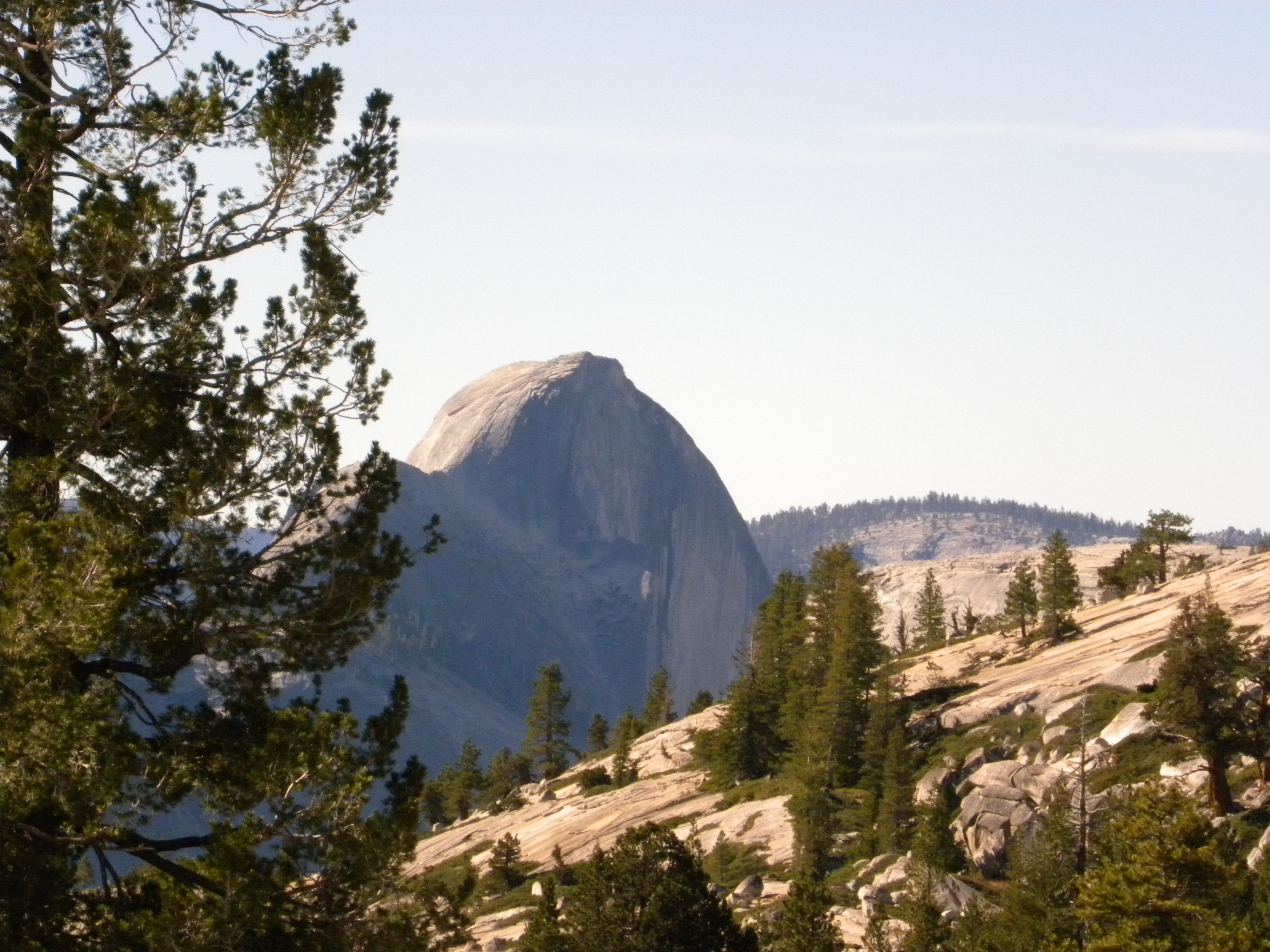
View from the pass of Half Dome

View from the pass of Half Dome

Driving through Tioga Pass, I couldn’t help but think of California’s state flag…the great Golden  Bear, a sub-species of our Grizzly, now extinct.

Black bears are ubiquitous in the Sierras.  I’ve heard from friends that back country hikers are now required to carry their food in bear containers when backpacking, adding lots of extra weight to their packs.  Last time I camped in Yosemite Valley, bears walked continually through our campground which was shared with dozens of other campsites.

So my question is…Why not introduce the great Grizzly back to California?  Hey, people are getting used to living with black bears.  It’s just a little jump from the Black to the Grizzly.  Besides, there won’t be so many black bears with a few grizzlies around as they don’t share territory easily.  A little bit of googling and it seems others are asking the same question.  Not many others though, but a few.

As opposed to the Greater Yellowstone Ecosystem which is higher, colder, and food scarcer, California is warm with abundant food.  Apparently, a hundred and fifty years ago, grizzlies were everywhere, gathering even in ‘herds’, unusual for the usually solitary beast.  Salmon, acorns, abundant wildlife, washed up whales…food was easy.  Seems like California harbored 20 percent of the 50,000 grizzlies that roamed the continent long ago.  Its a shame to waste all the protected spaces of Californias’ Federal and State Parks and Forests.

In addition, it might give pause to the growing population of California.  When I was growing up here, California had an already bulging population of about 12 million.  Now its pushing 37 million, too many people for the space.  Many of these newcomers are easterners and mid-westerners, looking for climate change, in denial of the natural dryness of the west.  I watched California grow in the 80’s and 90’s, developers building out-of-place Cape Cod style McMansions, tearing down ancient oaks to put in home vineyards with private labels for Christmas gifts, lawns and golf courses erected where there should be Manzanitas.  I suggest the only thing that might put a stop to all this madness is the great, top of the food chain predator–the California Golden Bear.

Now, in all seriousness, Californians have the room for a few bears.  Biologist Carlos Carroll maintains that the Siskiyou Mountains could maintain around 300 Grizzlies.  I’ve been to these remote mountains on the Oregon Border.  They would make nice habitat.  I’m thinking so would Yosemite, and Tahoe for that matter.  Wolves in California might be just too big a jump, but Grizzlies are actually easier to live with, tend to be solitary, populate slowly and are omnivorous.

I like having Grizzlies in my valley in Wyoming.  They make me aware.  They make me remember that life is wild and that I too am a child of the wild.  We humans tend to eliminate everything that threatens us.  But really, we can never fully eliminate all threats.  In trying to cheat death, we only cheat ourselves of our natural woolly wildness and loose touch with an important part of our soul.

A surprise walk

Its starting to feel like the Canadian Rockies here, raining every day, even if just a little bit.  Last fall I had driven up an old fire road that’s usually closed.  I wasn’t sure if they only opened it in the fall for hunters, so I took a drive over there, and sure enough, the road was closed and the gate locked.  I parked and walked up the dirt fire road that leads to high meadows.  This area was home to the ’88 fires and the lush undergrowth shows it.

There’s been so much rain that the forest is lush.Lush forest

More and new wildflowers appear every day.Paintbrushes

Calypso bulbosa - Fairy Slipper Orchid-endangered

Saxifraga odontoloma

A loud almost bell-like sound announced the presence of a marmot hanging in the rock pile below us.  Koda went crazy.  He knew he couldn’t get to the marmot, and that fat marmot just kept teasing him.Fat Marmot

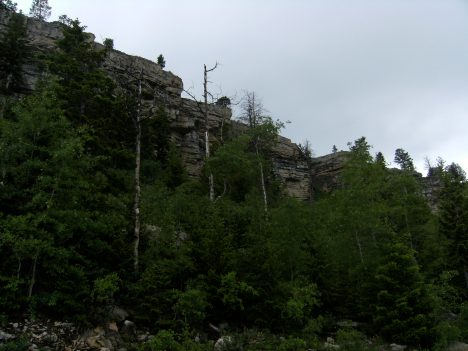
As we ascended higher, the reef cliffs came into view.  A Golden Eagle sat in a tree near the old road cut.  Our presence caused him to take to flight.Looking up at the limestone reef

There was a lot of fairly fresh grizzly scat along the road, but the only recent prints were elk.  Occasionally there were faint bear tracks, and it seemed like there might be two bears, indicating a sow and cub.

Pretty fresh bear scat.  Can you see the penny at the right for size?

Pretty fresh bear scat. Can you see the penny at the right for size?

Along the road, there were lots of berry bushes–thimbleberries and raspberries.  A perfect place for bears in the fall as well.

Thimbleberry

Thimbleberry

Way up near the top of the ridge, I suddenly heard a loud high-pitched consistent chirp or call.  I thought it was coming from a large bird and looked towards where I heard the sound, down the hillside.  Meanwhile, the smart animal with me, Koda, was looking up the hillside into the wooded bank.  I turned around and there was an elk in the timber.  Confused about the sound, it seemed to have been coming from the elk, although not at all like the bugling I’ve heard in the fall.   It was a contact call I found out later, between that elk and her calf.

As we headed towards the top of the ridge, an old fire cut from the ’88 fires, now overgrown, was covered with Geraniums.  Apparently these plants like disturbed areas.

Geraniums in disturbed area-old road cut

Geraniums in disturbed area-old road cut

The ridgeline meadows were magnificent.  Plenty of water and waterfalls along the way.  So much water so high up.  The old fires had provided great forage areas.High meadow and old burn

Koda catches a whiff

Koda smells out the grizzlies

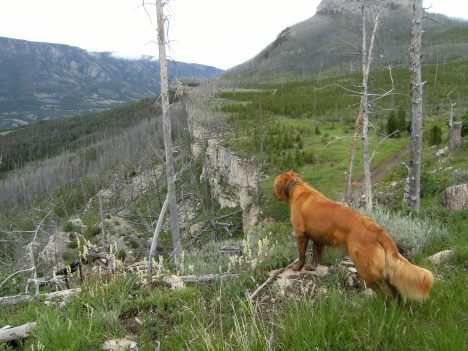
On the way down, Koda stopped at the cliff edge.  I thought he was looking at the view.  My old dog used to relish the views from high ridges.  But Koda is different.  He’s still young and not prone to being pensive nor reflective yet.

I stepped to the edge and noticed two grizzlies below in the tarns.  I don’t know if Koda saw them, but he certainly smelled them.  I bet they smelled us too.  At first I just saw a smallish black bear, and, from afar, tried to make out whether he was a grizzly or not.  It was hard to see the hump or his face clearly enough.  But then, following about 20′ behind, I saw a large brown grizzly.  I assumed the black bear was her two year old cub.  Unfortunately, I didn’t have my new camera with me so the shot is far away.  But, that’s about the distance I like to see bears from.

Look close there's the grizzly

Look close there's the mama grizzly. Black cub is in the upper left corner.

I glassed the bears for as long as the mosquitos would let me.  They moved down the mountain, through the scree and downed timber, foraging as they went.  What a privilege to see these magnificent animals.  As always, I carry bear spray, but what I use the most is my mosquito spray!

Grizzlies and the Edge of Eden

The last two days I hiked into several drainages where the hottest spots of the Yellowstone 1988 fires burned.  After 20 years those soils are still so sterile that no new trees are growing.  Hottest area of the '88 fires.  Sterile ground, good forageThis is an area of excellent forage though, with young sweet grass and sagebrush.   Pulsatilla flowers just emerging nowThe snows are just beginning to melt and seasonal streams are running.  With a forest of dead timber, standing and downed, the run off will be fast and furious.  But its early still and the streams are gentle.  A huge log jam up river, crazy every which way, testifies to last years’ fury.

In summer, without the advantage of shade,  this place is too hot to hike in.  In the fall, it is full of hunters hoping to kill bull elk migrating from the Park. There is a strangeness here, the dead trees stand as sentinels against the hoodoo-like rock carvings from ancient lava flows.Dead trees and lava hoo doos

This is grizzly country.  They inhabit these draws, drainages that rise abruptly into high meadows; forests thick with Lodgepoles and Limber  Pines.  Spring is the best season here.  The dead timber provides homes for insects that attract an abundance of birds.  A woodpecker fights a flicker for territory, running him around and up a dead tree.  Finally the flicker retreats.  I find it curious this jockeying for dominance in an area of abundant food.There is a strangeness here

We saw grizzly tracks both days.  On the second day we followed a grizzly trail, although we were backtracking him. Grizzly track The trail, not on the map, was a highly used game trail that went up the wide mouth of the drainage. At times the downed trees were so thick the trail disappeared.  When the trail faded, we watched where the grizzly had chosen to go, figuring he’d have taken the path of least resistance.  It led up the creek bed, the stream disappearing and reappearing in odd places.   At one point, we crossed under a large downed tree trunk,.  The tracks passed directly underneath so we looked for fur stuck to the nubby remains of the branches.   There were a few hairs there.  Claw marks on trees noted where a grizzly stopped to mark his territory.  They were so high I couldn’t reach them.  That’s a big bear.Grizzly scratches on pine tree
Another tree with grizzly marks
A coyote,  running in our direction on the far side of the draw, suddenly smelled or heard us, and decided to turn back.   A bloody leg dangled from his mouth.  Koda noted the spot near the trail where the kill might be, but I called him back, fearing we’d find that grizzly there.  On the way back down, we walked over to the site Koda found.  A kill a few days old, the only remains was a small rib cage of a young elk or deer.

Its grizzly time right now.  They won’t be going high to find their moth sites until sometime in July.  Tonight  I watched a powerful video about  Charlie Russell called The Edge of Eden: Living with Grizzlies.   Charlie grew up in Canada  on an outfitter’s ranch.  He was a cattle rancher for years and had to deal with grizzlies.  He found that if he left out some winter kill cattle for the hungry grizzlies in the spring, they’d leave his cattle alone the rest of the year.  He wanted to understand grizzlies better and went to Kamchatka, Russia where the local zoos kill orphan cubs.  He began bringing these cubs back to the wilds, acting as their mother and protecting them for a year, sometimes two, then allowing them to roam free.  It’s a marvelous video  (that won several  film festivals) and story about a man trying to help restore respect for the grizzly as well as pioneer new strategies for those living in grizzly country.  To order the video, contact skyfilms@xplornet.com.

When a good fire is a bad fire. Grizzlies and pine nuts

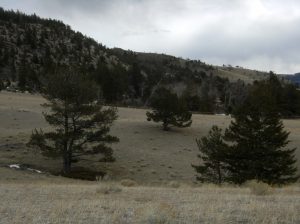
I’ve been working with a small chain saw on the trees around my upper cabin.  Most of my 6 acres is on a plateau above the main cabin.  That arcreage butts up to Shoshone National Forest.  The original owner of my cabin, Doc Firor, deeded that area to Nature Conservancy who gave it to the forest service.  That entire plateau extends for several miles and is prime elk habitat.Riddle Flat from across the river. Prime elk habitat

Almost all of the trees up there are Pinus flexilis or Limber Pine.  Limber Pine is a white bark pine, which basically means it has bunches of 5 needles.  The pine whose common name is Whitebark pine is Pinus albicaulis.  That’s the one that everybody is talking about when they say Grizzlies are dependent on the whitebark pine crop.   But Limber Pine seeds are just as tasty, and squirrels cache them just the same.  Whitebark Limber on left; doug fir on right
Pinus albicaulis and Pinus flexilis are both considered keystone species–that is, without them, an ecosystem can just cascade apart.  And both of them are being infected with an imported fungus that is the cause of white pine blister rust.  This fungus can kill a tree, and its killing massive amounts of Whitebark Pines in the Pacific Northwest.  The Rockies have not been quite as vulnerable because its so much drier here.  But with global warming, and the pine beetles, trees that are weakened by the fungus succumb quickly.My one room upper cabin.  No water. No plumbing.  Yes heat!

I was trying to find out if grizzs will eat Limber Pine nuts as well.  That was important to me, because many of my trees have the rust.  And I’m trying to find out how to identify correctly the rust, as well as how to treat the trees.  Avalanche Peak, Yellowstone.  Dead whitebark pines

I went to the National Forest administrative offices last week in Cody. They are all so helpful and nice there.  One of the supervisors lent me a new phamphlet and told me there’s a pheromone for the beetles, but nothing for the rust.  She said its awfully hard to determine the difference on the tree.

What I really want is a source of blister rust-free seedlings to underplant.  The bad news is that whitebarks take 40-50 years to begin to cone.  But I can wait.  The worse news is that if you can even find a source of seedlings, expect 50% mortality in the first few years.  In fact, the booklet has a really complicated formula to determine how many seedlings you need, based on existing site infections and super-overplanting for death.  The thing I think would be smart would be to do successive planting over a period of 5-7 years.  And since I have a test plot that could be a model for the rest of the nearby forest, I’d love it if the Forest Service used me for testing.  Robin at the Ag department told me they do test plots on private land often.

Meanwhile, I’m going on what’s said on the internet and in this phamphlet.  I’ve been limbing up by hand and by machine up to 6-8′ from the ground all of my trees (this is a several year project!), starting with around my upper cabin.  Since the trees are older, most of the bottom limbs are dead anyways.  But limbing up will provide air circulation and light, both will help the trees health.Before pruning; cabin is in the background

Another interesting thing about blister rust is the Ribes (Gooseberry) connection.  When the rust first came to this continent, in the 1930’s, they found that Ribes was a host.  So the government in their wisdom, decided to eliminate all the Ribes in the West.  But there are so many species of Gooseberry native to the West, over 150 in North America.  And Ribes is an important food for wildlife.  You could never eradicate all the Ribes, and that’s just what they found.

As I was doing all my pruning, sure enough, many many trees have Ribes growing right on top of the trunk.  Besides being a host for a nasty disease, I did have to wonder about other types of symbiotic relations between the two, for example nutrient exchange.  I haven’t learned about that yet.

Whitebark pines, including my Limber Pine, are an amazing tree.  Unlike most pines, they are not wind pollinated, but dependent upon the Clark’s Nutcracker for dispersal.  Squirrels too  cache the seeds but not as far.  They grow on thin soils, at high altitudes, and usually are the first to colonize in disturbed sites, such as fires and landslides.  Grizzlies depend on their nutritious content to fatten them up for winter, or satisfy them in the early spring.  Grizzlies can’t climb the trees to get the seed.  Instead, they are experts at finding squirrel caches and robbing them.  When I asked about my Limber Pines, a forester said that grizzlies eat their seeds, but they are rougher so they aren’t number one on the menu.  Obviously my plot as well as the forest next to me is just as important for the grizzly recovery.

The benefits of fire in this care are so mixed.  Whitebarks are fire-dependent.  Where fires have been suppressed, more shade tolerant conifers replace them and there is little opportunity for regeneration.  So they like that clear open ground.  But their cones don’t open with heat.  The seeds are animal dispersed, so there needs to be stands for their new growth, which means they like low- and moderate-intensity fires.  That’s hard to have in areas with so much beetle kill and fire suppression like my valley.  To add fuel to the fire so to speak, scorch or fire damage on trees that would otherwise live, increases their susceptibility to beetle-kill.After pruning.  Cabin is now visible. Deer will love this!

Regardless, I’m thinning away, hoping for more air circulation, light, and in addition all that thinning imitates a ground fire.  Many of the natives I would plant in California requires a good chopping back to the ground every so often to mimic fire.  That’s what I’m doing for now.