• MY BOOKS ON WILDLIFE, GARDENING AND MORE

  • The Wild Excellence

  • True stories of wildlife encounters around the Greater Yellowstone
  • Award winning eBook on Decomposed Granite, tips, how to's, what to watch for
  • Children's book. True stories of a dog and wolves. In a dog's voice
  • Written for dry Mediterranean climates in California, north and south

What is the wolf experience?

Wolf hunts are going on right now.  I recently read that in Montana you can shoot a wolf, tag it, and walk away, leaving the carcass to rot on the ground.  In Idaho, the wolf hunt is practically year round with no legal limits.  Idaho’s first legal wolf trapping season is about to begin.  They want to reduce their population from about 1000 wolves down to 150. Wolf haters always like to talk about dogs being prey for wolves.  The amount of dogs killed by wolves is miniscule–mostly sheep dogs watching their flock in open country. Traps for wolves, on the other hand, will certainly kill or maim a lot of dogs.

Last winter my dog almost got caught in a leg trap intended for a bobcat.  Luckily, I say almost.  The trap was set close to a large tourist pull-out that houses one of the only toilets along a major road.  Although not illegal, I considered the trappers’ choice of placement highly unethical, and frankly lazy.  People stop there for a rest and let their dogs out for a break.  

When I was a kid growing up, my parents impressed upon me the two taboo subjects you should never talk about in a social setting–religion and politics. These were surely the firecrackers that would ignite a fight when you just wanted peace and a good time.  Why? Because religion and politics are the stuff of emotion, not logic.  Today, living in the West, I add one more subject to that list–wolves.

I’ve pondered why wolves are on this list.  Really, they are just an animal doing what they were born to do. There are lots of other predators that we don’t place in the same category.  Eagles, weasels, mountain lions to name a few.  Only wolves have that magnetic polarizing effect.

Why?  I’m going to venture a wild hypothesis:

On a warm June night, I’m returning from a meeting in Cody.  It’s dusk and I’m beginning my drive home.  The massive up-tilt of red rock, called the Chugwater Formation, forms the cornerstone of the grassy large ranch that sits at the base of the mountain road.

Chugwater sandstone

The land slopes gradually upward, then with increasing steepness the views widen of this deep impressive drainage.  I’ve always loved this part of the ascent.  I can sense the specialness of this place, where once buffalo grazed.   Indians used this area as a drive, the ancient cairns stand as sentinels where they hid as the bison rushed through.

As I climb up the road, the view of the valley is most exquisite.   A cattle guard on the highway marks the boundary between the private lands below and the Shoshone National Forest above.  As my car crosses the grate, like a shot, three wolves run like hell across the road.  I press hard on the brakes to let them pass,  Full of life and energy, in my imagination, I see their excitement as the anticipation of their upcoming evening hunt.

The vision of those wolves will stick in my mind forever.   It was as if the Force of Life itself flew past me in a vision.

A wonderful chapter in Henry Beston’s The Outermost House describes a trip he made by boat to a rock full of birds.

The tiny island was so crowded that chicks were falling over the cliffs, eggs were being stepped on by birds and breaking, the energy of Life, and Death, one entire cycle, overwhelmed him to a point where he was almost sickened.  Raw creation.

I read that book as a teenager.   In it I understood that Life itself, that teeming, raw, primal energy of our Existence, permeates everything.  In fact, that energy of Life is so powerful that even death can not nullify it.

“There has been endless time of numberless deaths, but neither consciousness nor life has ceased to arise. The felt quantity and cycle to death has not modified the fragility of flowers, even the flowers within our human body.” **

And in a flash I understood what I, and all those who are traveling with me in this modern world, are afraid of.  We are afraid of life, which is a strange thing to say considering how hard we try and hang on to it.  But really, we are constantly suppressing it, attempting to harness and control it, create little niches where we feel safe and comfortable.  That is why it is easier for us to destroy, tear things apart, sullen our environment, attempt to control the forces of nature, and create the illusion of predictability, than to embrace Life.   To be in life implies being overwhelmed, swept away, carried like a raft in a great ocean, humbled, acknowledging our smallness and our connectedness.

I once made a trip to the Charlotte Islands, a land that even Canadians call “what Canada used to look like”.

A maze of small inlets and calm channels, the cold waters are so clear you can see over 50′ down riding in your kayak.  You are tide pooling without waiting for the lowest tides.  The waters were alive with life in a way I had never seen tide-pooling in Northern California.  Instead of dozens of sea stars, you saw hundreds on a rock. Masses of jellyfish small and large swam by you.  Everything I saw in the Northern California shores were multiplied one hundred-fold here.  These were the remnants of waters we still hadn’t polluted, a glimpse into the original primordial oceans that birthed us.  Life at this level looms on a mind-boggling yet fearsome scale.  Somewhere in us we say that this amount of energy must be controlled.

And that is where I come back to these wolves.  The vision of my wolves, running ecstatically across the road, in total abandon to their Existence, is an affirmation of that immense, wondrous, yet terrifying Power that is the Universe itself.  Wolves, in their ceaseless energy, their joie de vivre, their deep intelligence, embody the purity of   Life.

Maybe that is why humans have spent so much time and effort trying to control, even eliminate them. They are the emblem of true, unabashed, Freedom.

**Da Free John


Kye Oh Tay

The notion of the trickster and the culture hero, together, is fascinating to me.   Around the West, coyote was the hero of these tales.  In the Northeast it was Raven, and in the South and Eastern United States it was hare and rabbit.

But what is a trickster?  And what is a culture hero?  In reading about ‘culture hero’ definitions, it is a mythical animal or creature that brings important things into this world, such as the animals, or humans, or gives fire to humans and teaches them how to grow or find food.  Coyote fills this bill in many stories.

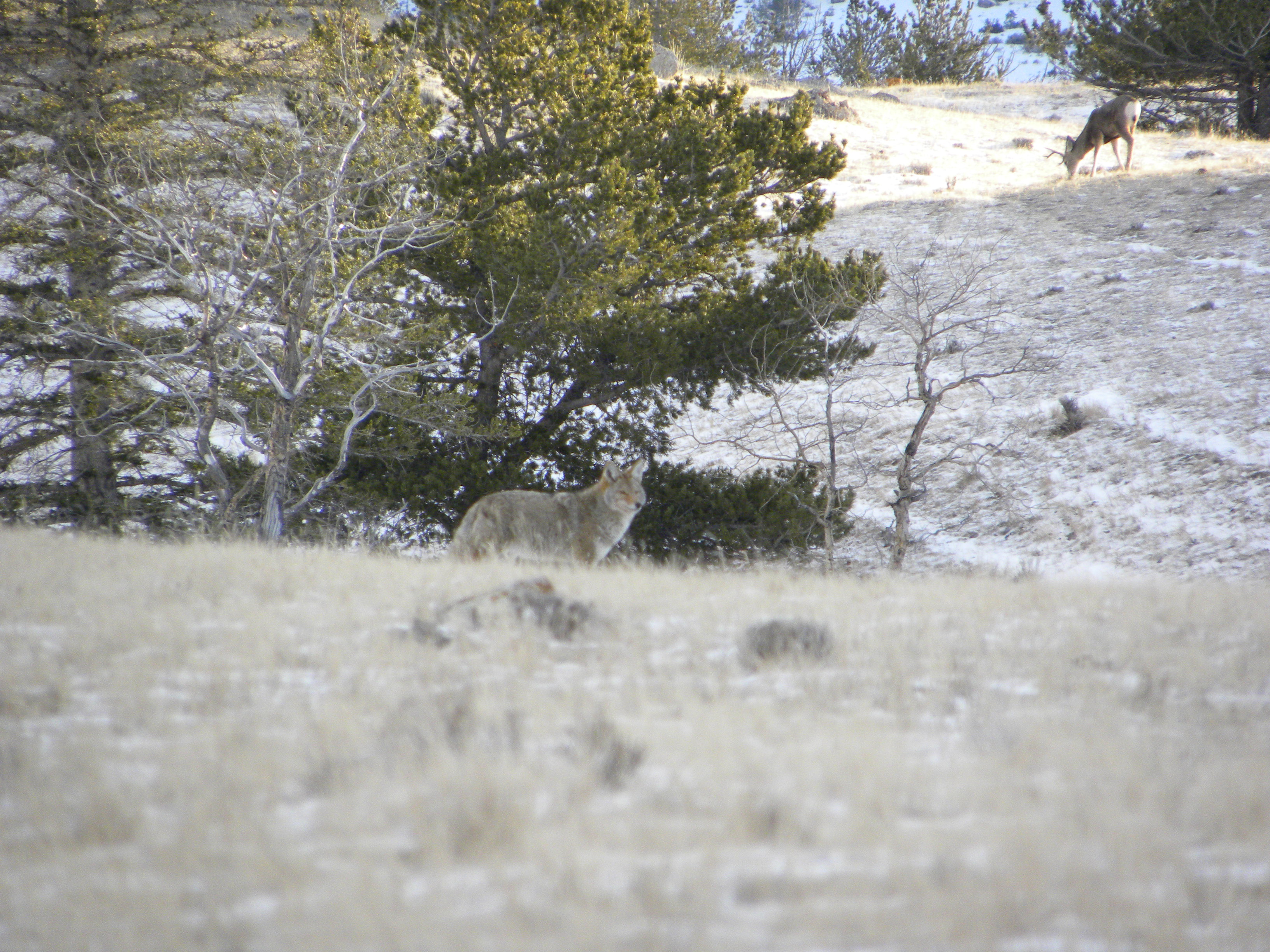
Coyote blends into the landscape with deer in background

And the trickster?  That is harder to define.  A trickster is the embodiment of opposites, of extremes.  He makes you laugh at the absurd, or at his foibles.  Jung described the trickster as the ‘shadow side of a culture’, all the things that you can’t admit to or hide now out in the open and that energy is expressed and released through story.

I am intrigued by the trickster, because no matter how much you read about it, the trickster is enigmatic and can’t be grasped.  Coyote stories remind me of a tradition I studied for some time–Tibetan Crazy Wisdom. These Enlightened Adepts taught through living paradox; their life and teachings (if they had a teaching at all) were expressions of their unconditional freedom.  They lived lives outside the conventional agreements of morality, religion and social contracts.  Their very existence in Time and Space exploded and confounded our idea of living as limited mortal beings.

Coyote, as creator and destroyer, rogue, knave, fool, giver of fire to humans but also of birth and death is the Crazy Adept of many American Indian cultures.

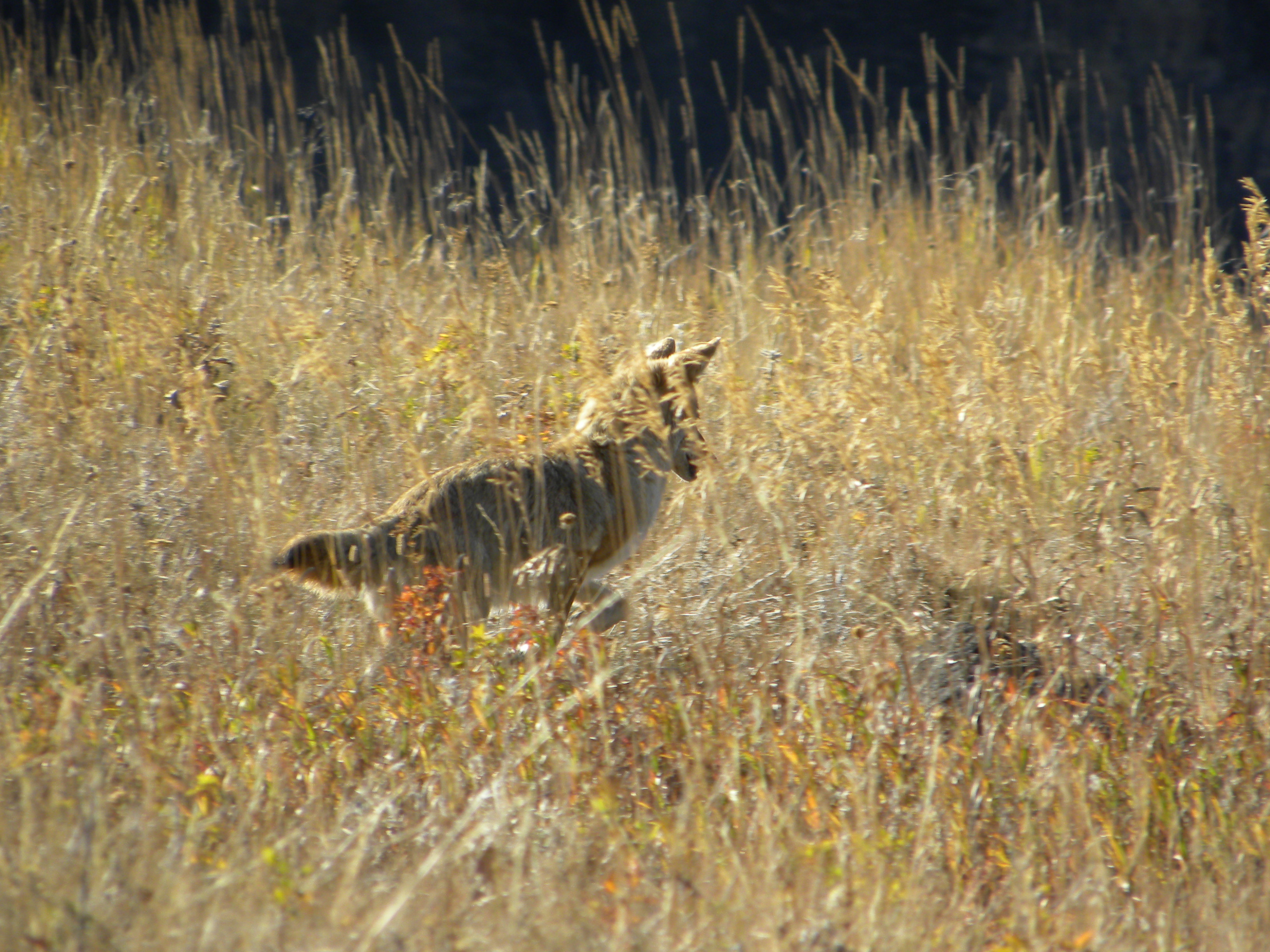
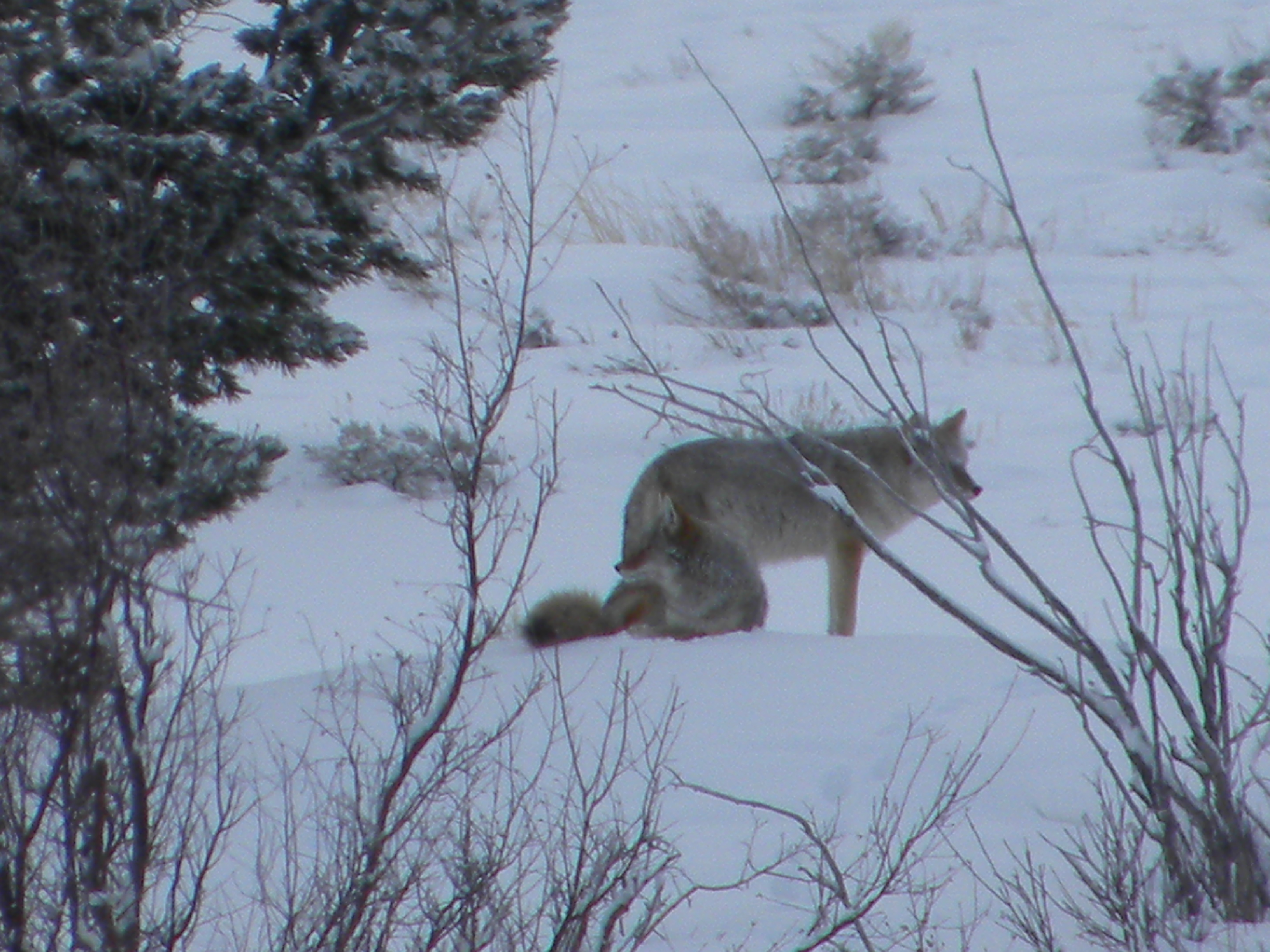
Coyote hunting ground squirrels

But what is interesting to me is simply how confounded I am when I read Coyote stories.  I think “I don’t get it” and that is exactly it.  It is funny and silly yet profound and sacred at the same time.  There is a depth that is untouchable and indescribable.  And still my question remains “why Coyote?”   We can tell the story about how coyote has defied extermination by the White Man, and lived to spread ten-fold instead.  Or how he might follow a trapper, dig up his traps, urinate them and run off to the hills.  Surely these tell of Coyote’s cunning.  But I suspect the native peoples understood many more attributes of coyotes that white men overlook because our culture has seen them only as pests and predators to be extirpated.

Coyote catching grasshoppers

In choosing Coyote as their culture hero and trickster, native peoples have bestowed a great honor as well as power to this creature.  Coyote is given the power to stop the mind just as the Zen Masters’ stick might give the blow of Enlightenment to his student.  Coyote frees us from stodgy mind, creating an opening for creativity, inspiration, and True Religion.  Coyote embodies our dualistic nature, Yin and Yang, Good and Evil, Form and Formless.  In the embrace of Paradox, we are Free.  Coyote is here to guide us through his Crazy Wisdom, his Tricksterness, beyond Time and Space.

That is a great power.  And so I am still puzzled, speechless, and confounded by The Trickster–and that is as it should be, I suppose.  I feel that I need to observe and understand coyote more deeply so that his hidden blessing will be revealed.

It was a cold night. Winter was beginning to set in.  My window was slightly cracked and, at 2am, I awakened to the songs of a ‘Medicine Dog’–a lone coyote howling just outside near the front lawn. Since Koda has lived here, the coyotes take a different route home at night, so this was a rare visitation.  In my sleepiness, it seemed like the right thing to howl back.  After some responsive singing between us, it became clear that this was a pup of the year, calling for his pack and I was only confusing him, so I stopped singing his songs back to him.  And sure enough there soon came faint replies far up the mountain from where the coyotes den in the spring. The teenager took off to meet his brothers and I fell soundly and happily back asleep.

Wolves, Scouts and a new beginning–The Wyoming Wolf Management Plan

I’ve been filling my ears with Jon Young’s ‘Advanced Bird Language’ CD’s.  If you don’t know Jon Young, he’s an expert tracker and naturalist.   On tape 7, something caught my attention that’s so pertinent to what’s about to occur in Wyoming.

Native Americans considered wolves their brothers.  Many tribes called their scouts ‘wolves’.  The wolf was the premier hunter and the Indians learned from them.  On this tape, Young goes into some specifics about wolves as the ultimate teachers and models for their scouts.  Indian scouts were special members of the tribe that fanned far out into the landscape to warn the tribe of dangers, or tell them of food sources or new areas to occupy.  Scouts were the most highly trained in the art of ‘invisibility’, moving unseen through the landscape.  They needed to be able to cover great distances in a short amount of time, be fully aware of their surroundings, and bring back the needed information as well as do all this traveling very lightly.

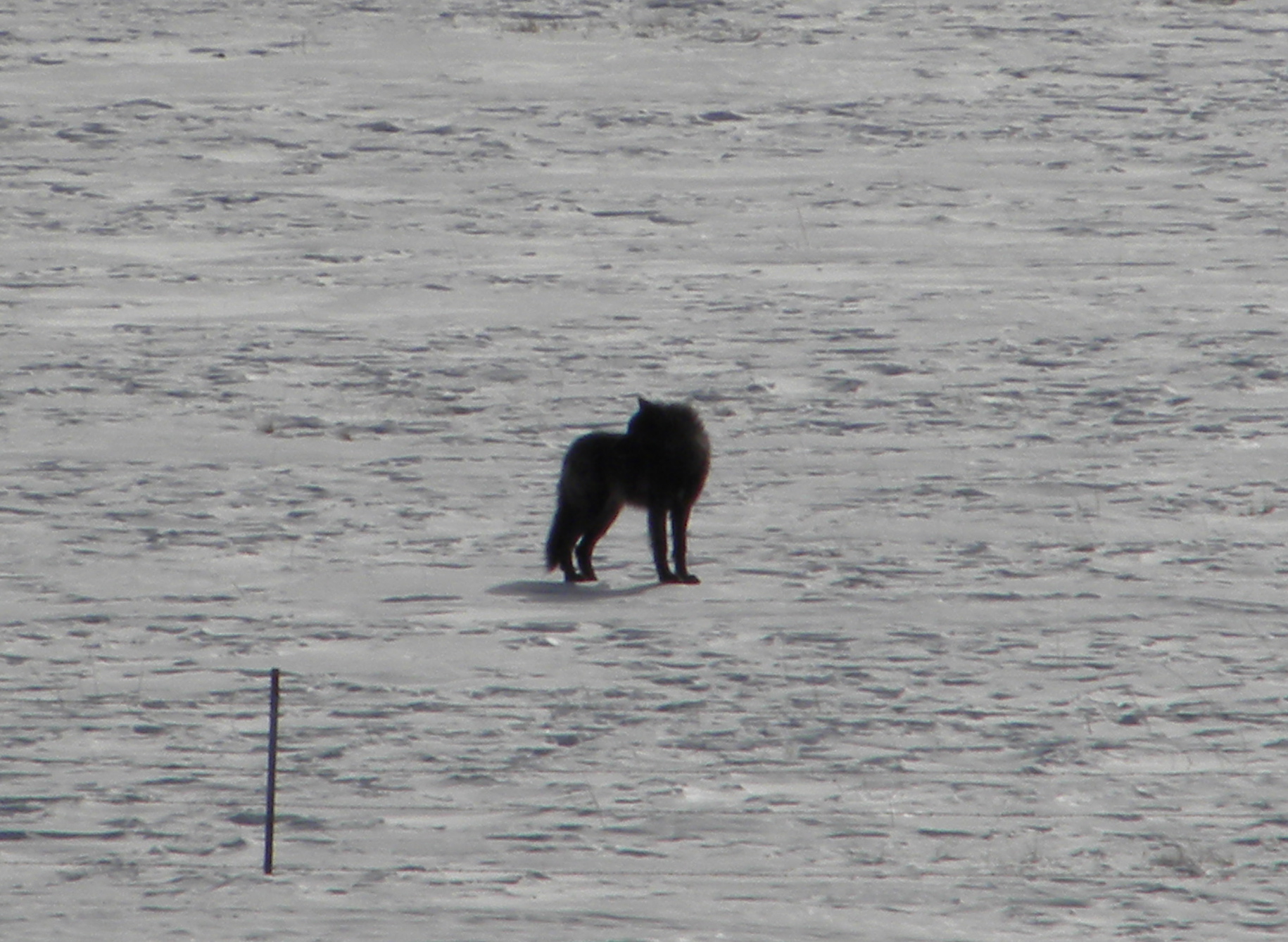
Sunlight Pack black wolf

Here, paraphrasing Jon Young’s words, is his explanation for why wolves were the ultimate teachers for these individuals:

“Wolves move in a highly efficient manner.  They move with such stealth and perfection that their tracks are like poetry of perfection.  They place their feet in such a proper manner, even at high speeds.  They are masters of energy conservation even while moving.”

Two wolves side trot down the road

“Wolves are highly intelligence.  They can watch someone perform a task, like undo a latch, just once, and unlike a dog that must be trained, they can go over and undo that latch with their nose.  To observe, to see the pattern, to recognize it, and then to do it themselves–that’s intelligence.”

“Cougars and Bears master invisibility by moving very slow, by traveling in dark and shadowy places, but wolves don’t have that luxury.  Wolves might cover 25 miles in one night so they are practicing invisibility while also covering huge distances.  This is something that scouts really looked to as a role model.  So the scout had to be like the wolf also.  They had to run long distances in silence,  pull the information and bring it back.”

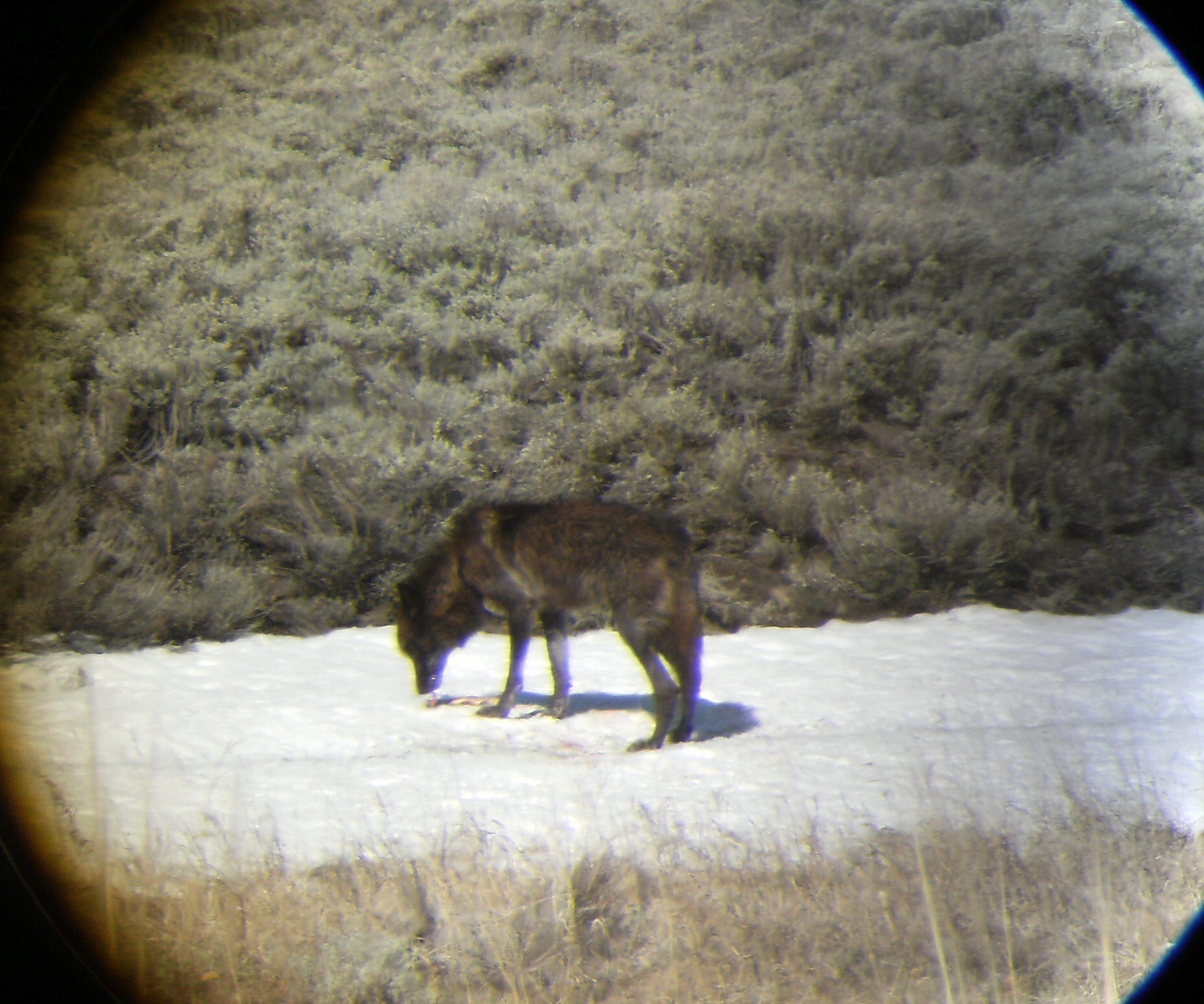
Wolf eating fish it caught in the Lamar

“Scouts, like wolves, needed to recognize things not just with tunnel vision but out of the corner of their eye, with their peripheral vision and be able to instantly respond.”

“Wolves are crepuscular, which means they travel at the edge of night–at dusk and at dawn.  Wolves are the masters of illusion and can stay just on the edges; so the scout modeled that ability to stay on the edge of sight.”

“Wolves have incredible hearing.  They are following sound even in their sleep. Wolves are the ultimate power in Awareness.  Their eyesight, their hearing, their sense of smell, all their senses combine to create enormous instinctive ability.”

I have known that Indian scouts were called ‘wolves’, but this is the best point-by-point explanation of ‘why’ that I’ve ever encountered.

Why is this so pertinent this week?  Because this Friday, Sept. 9 at 5 pm, all comments will be due, in writing only, on the Proposed Wolf Management Plan in Wyoming, in other words, the plan that will determine the future fate of wolves in this state regarding hunting, quotas, designated status (Predator and/or Trophy Game), etc.

Whether you are for or against hunting wolves, whether you live in Wyoming (Idaho, or Montana where the hunts are already taking place) or in a big city, consider these traditional notions and views I have laid out above about wolves.

Sunlight wolf

Once, in this great Country of ours, wolves were our teachers, friends, with attributes to aspire to.  This is Our Story, the story that goes with Our Ancestral Lands of North America. The stories from the Old World that we were told in our youths, ‘Little Red Riding Hood’ stories, the stories that created and fed on our present day fears, these were only partial tales, partial teaching stories. These were the stories told to young children so they wouldn’t venture into the woods alone.  All cultures had those stories.  But in every culture as the children grew to adolescence, they were told different stories, richer, fuller stories with more complexities for their more complex growing brains.  These were the stories that called young people to embrace role models.  The bear that was once scary for the young child, is now a great hunter.  And the wolf that might devour you, the little kid, walking in the forest (not having listened to your parents) is now a story told with more nuance, more richness, so you will aspire to model that wolf and become a great scout.

In this important moment, when wolves will finally be fully delisted in Wyoming, as well as Idaho and Montana, we need the full story, the story that enriches and dignifies this majestic predator that has always belonged back in our landscape.

Coyote as Creator

Several weeks ago, while botanizing, I noticed a dead-end steep drainage with a series of picturesque hoodoos.  It drew me and I decided to hike up and explore.  The drainage was thin and narrow with steep sides, so I was following up the bottom.  Although the nearby creek was full of run-off, this little tributary was dry yet there was vegetation as well as a series of downed dead trees.

As I rounded a curve, about six small balls of furry things ran quickly across the drainage for cover.  What were they?  Too big for marmots or squirrels and the wrong color, not moving like rabbits, it took me a moment to wipe my eyes and decide what I was seeing.  Pups!  Yes.  And they were just the cutest things you’ve ever seen, scurrying back to their den for cover.  One little guy got caught up in some dead branches and was trying hard to get over them.

Area around den. A perfect spot

I paused for a moment when they had disappeared, thankful their parents were nowhere in sight because I had the dog with me.  Koda was a good boy.  He saw their fluffy things and, in his curiosity, wanted to investigate but he obeyed and kept close by me.  I retreated from the area right away, worried about their parents returning, the dog and my smell causing their parents to move to another den site.

These pups, from a URL, are about the same size as what I saw

O.K., I said to myself, were they wolf pups or coyote pups?  It all happened so fast, but as I thought it through I realized they were all the same tawny brown color, a definite sign they were coyotes, and I guessed they were about 5 or 6 weeks old, just by having been around dog puppies enough to discern their bodies and skill set.

Interesting, with the late spring and all the snow this winter, everything is late.  Two years ago on Mother’s Day, early May, I saw some coyote pups that looked about 12 weeks old.  And here it was late June, and these little guys were only 6 weeks old.

Coyote pup mother's day 2009

A few days ago I ventured back.  Coyotes leave their den when their pups are around 8 weeks old and I figured they’d be gone.  Just to make sure, I negotiated a route from the back way.  Instead of up the drainage, I came from high up on the top of the hillside where I could look at the site from above.  I sat for quite a while and glassed the den area.  When I was fairly sure there was no activity, I went and explored.

The den

The area right in front of the den, as pictured above, was clean as a whistle.  I used my watch and shown some light inside the den.  It too was immaculate–no bones or feces.  There was another smaller opening nearby, and I understand that coyotes usually have a second entrance. The front entrance was about 12″x 14″.  In the drainage directly below, under the debris of downed trees, scads of old bones and feathers lay around, and piles of scat.  There were at least 3 deer skulls, but they were so old that I figured this den had been used quite a few times before.

Den in size relation to Koda. He would never be able to enter

I picked through some of the feathers.  Songbirds, flickers, an owl and even a red-tail hawk. These parents were good hunters.

As I went on my way to continue searching for plants, I remembered something.  Last year I took an early spring hike up this valley with a friend.  The main valley goes far and narrows into dense forest with a year-round stream running through it.  On our way up, we spied a coyote carrying a deer leg in the direction of this den.  Could it have been one of the same parents?  It was the right time of year.  Maybe I caught a glimpse of the mom or dad.

Phacelia

Moose, wolves, and a false spring

Yesterday was another glorious early spring day.  Some friends came up and we took a drive north towards Crandall and beyond, as far as the road is plowed.  The lonely 11 or so miles between Pilot Creek, a parking pull-out for snowmobilers, and the NE entrance to the Park won’t be open for another 5 weeks yet, but they’ll have a lot of plowing to do.  There is still an incredible amount of snow everywhere.  It will be a while before you can hike the backcountry.

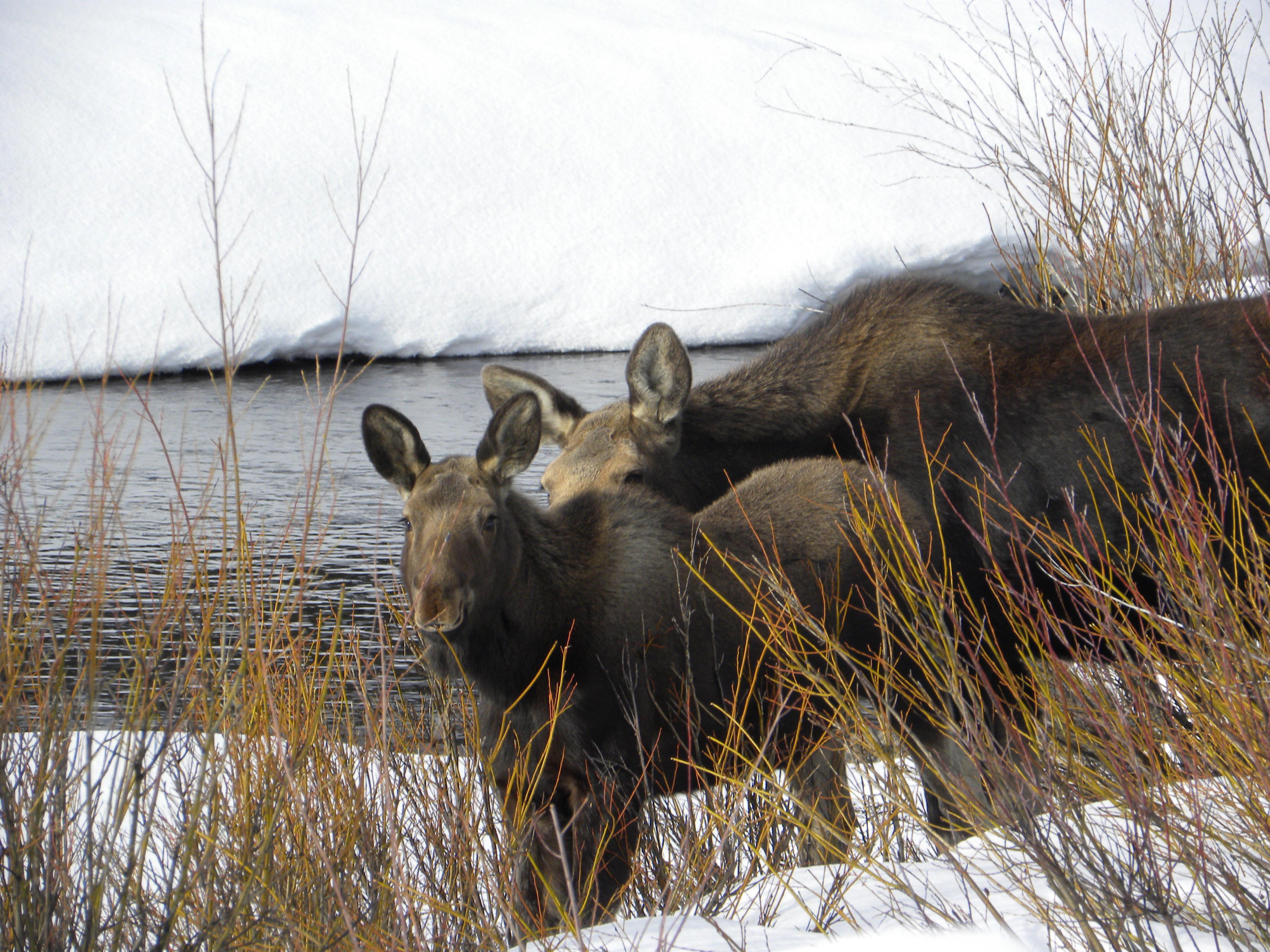
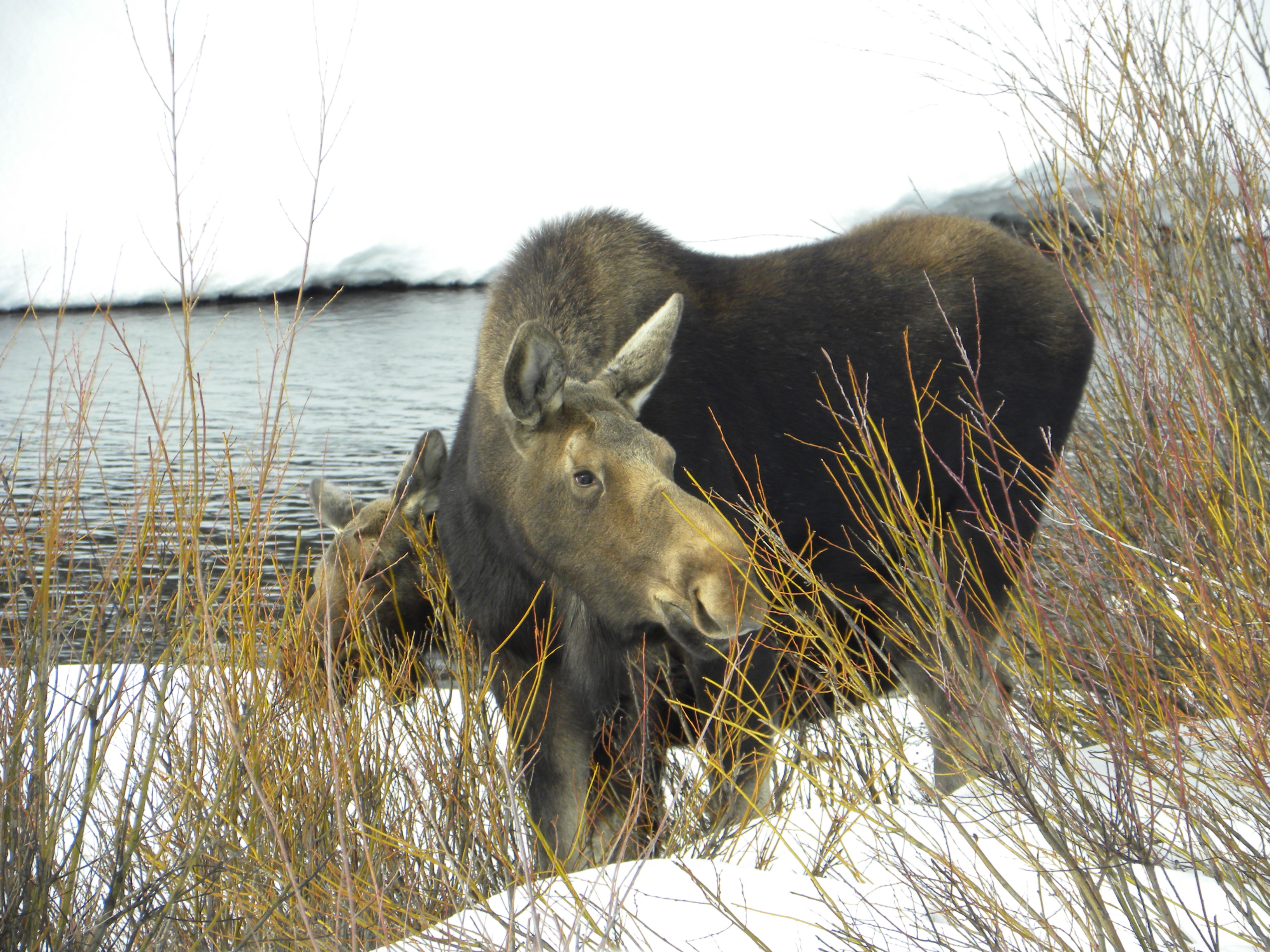
As the snowmobilers raced past us to begin their expensive thrills, we idled along looking for wildlife.  The banks by the side of the road have melted but still an easy 4′ high.  This gave good cover for a moose and her calf just on the other side of the highway along the Clark’s Fork River.

Mama with yearling


Because we could barely see over the snow bank, we quietly got out of the car to take photos.   Mama and baby kept browsing but mama moved between us and her calf.  What a good mother.

Mama Moose moves between us and her calf

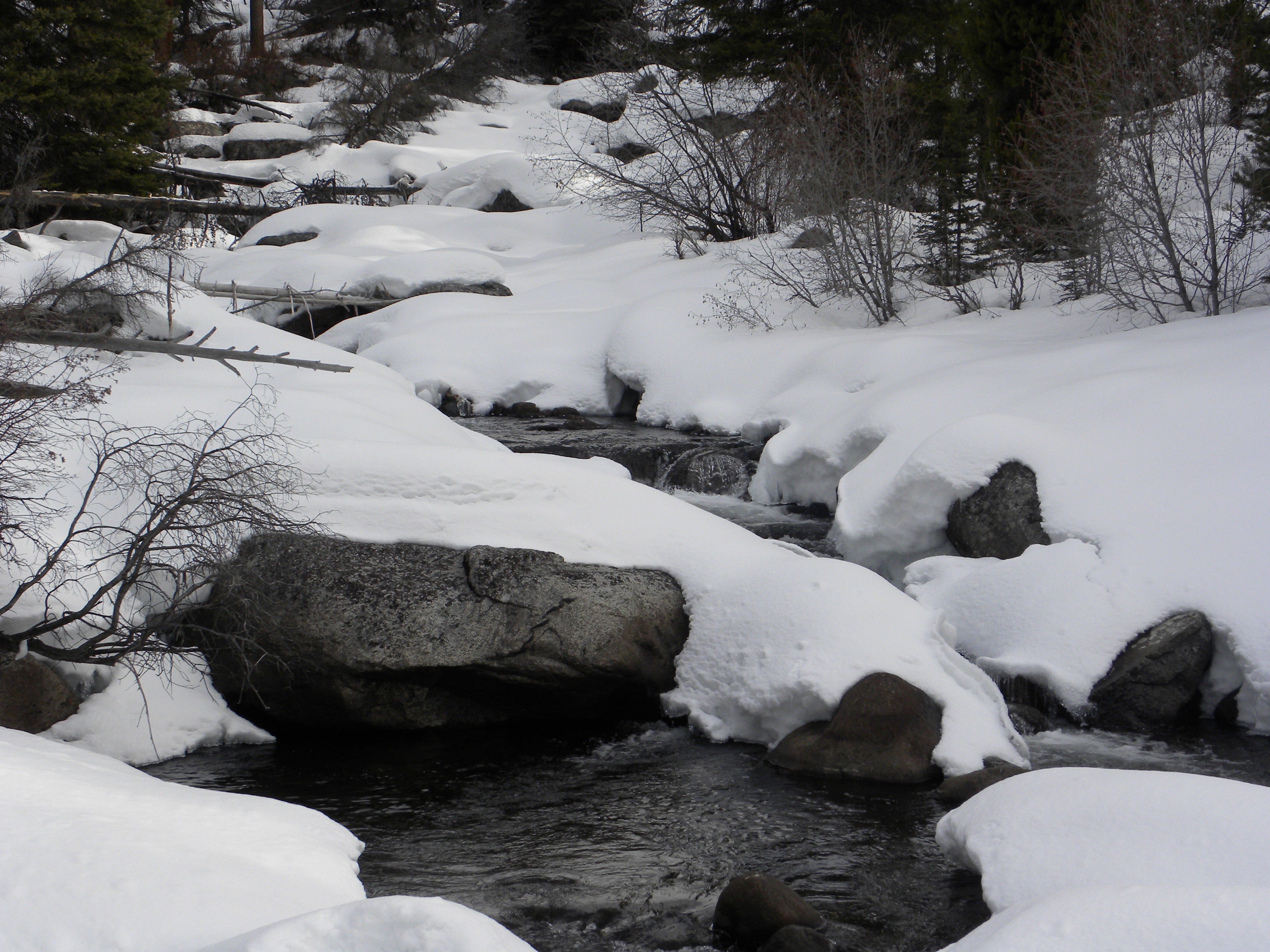
On the way back I shot a photo of Crazy Creek, still solidly covered with snow and ice.  This creek, in a few months, will be an awesome volume of water.

Crazy Creek March 2011

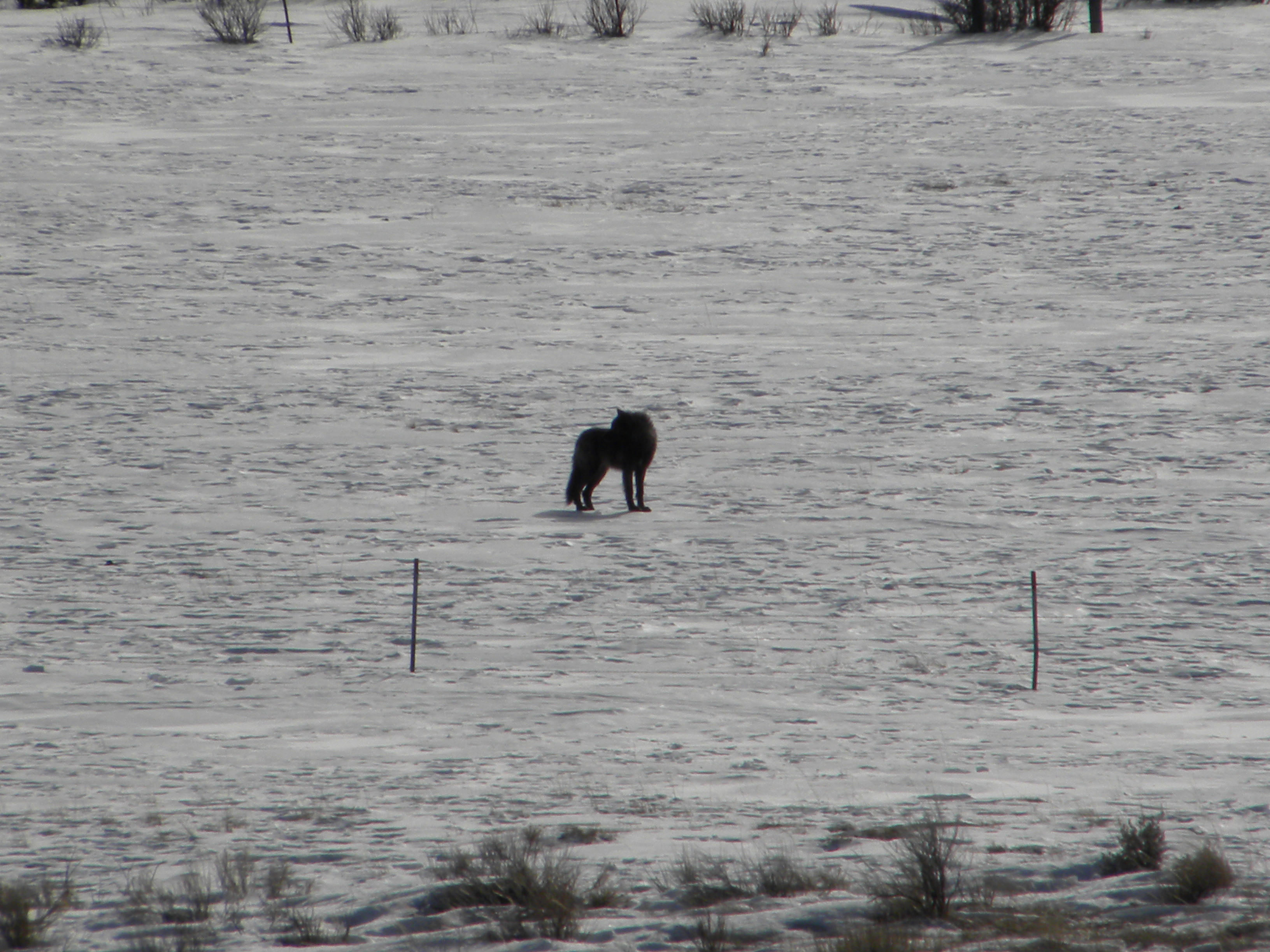
Almost back to Sunlight, I asked my friends, who come up regularly on weekends, if they’d seen any wolves this winter.  They are avid photographers and would like a good shot.  They told me they hadn’t.  Not more than two minutes passed when we spotted 2 wolves by the side of the highway.  This was a most unusual sighting.  Almost 11:00, I’ve almost never seen wolves hanging so near the main road.  There were elk up on the hillside, along with deer, not too far away who didn’t seem too perturbed.  Two wolves would be hard-pressed to bring down an elk, so I suspected there was a kill higher up on the hillside, or possibly down below where they were wanting to cross to.  A big grey sauntered quickly up the hill and out of sight.  But a beautiful black loitered long enough to take some good photos.  Wolves I’ve met always seem intelligently curious.  This one certainly was.

After I came home and my friends were gone, I noticed a yearling moose walking back and forth along the fenceline across the road where the horses are.  The fence has a wooden top post and is very wildlife friendly, but this yearling wasn’t that tall and was very uncertain as to whether she could make the jump.  She moved back and forth for over 15 minutes, trying to find a spot she felt comfortable to cross.  Finally, a car drove up the road, spooked her, and forced her into making the leap.  She did clear, but not without her back leg stuck for a moment.  She ran up my driveway, because its the open line in the fence and stood in front of the house for a while, seemingly perplexed.  Where was her mom, I wondered.

Yearling moose will get kicked out before the mother gives birth again, but it did seem a little soon, but what do I know.  I thought maybe she was already on her own.  She made her way through the front meadow, where I’ve taken down some posts for a winter opening in a buck and rail fence of my neighbors.  It was then I saw her mom, who’d been watching the whole thing patiently.  She was standing in the tree line.  Soon mama and baby were united again.  I had to wonder if mother was, as I would be, gnawing worriedly and wondering if her baby could make the jump successfully, or if mom was treating her offspring to just another new lesson preparing her daughter for the big wide world.

Koda bored because he couldn't get out and play with the wolves!

“Wolfer”

I’ve just finished a great read.  Carter Niemeyer’s new memoir Wolfer.  I’d say its a must for anyone living in the West, or anyone interested in the conflicts around wolves.

Niemeyer tells his story of growing up in Iowa, learning how to trap.  He trapped for a living, got his masters in biology, then took a job in Montana where he spent the rest of his life.  He worked for over 25 years with Animal Damage Control  (that changed its name once wolves were on the scene to the more innocuous ‘Wildlife Services’), then was chosen to be a key player in the wolf re-introduction in the mid-90’s.  He’s an engaging and honest writer, weaving his personal story from a ‘killer’ of animals to a staunch and courageous supporter of wolves in the lower 48.

One of the things I love about the book is his descriptions of going out to investigate livestock damage.  Several years before re-introduction in 1995, wolves were beginning to come into the U.S. by the Montana-Canadian border.  Talk of the re-introduction stirred the rumor pot as well.  Carter was the most experienced trapper for Animal Control, and at that time he was a supervisor. So he was the one sent out on almost all of these calls.  Neimeyer describes how time after time after time, the rancher swore his cow, or sheep, or horse, or goat, was killed by wolves.  Neimeyer skinned every dead carcass to determine what killed it.  It was a rare case when wolves actually brought the animal down, although wolves might have been around feasting on the dead animal.  Many ranchers were incensed at Carter, calling him a ‘wolf lover’, because without his signature they weren’t reimbursed the $7000 from Defenders of Wildlife.  Neimeyer tells stories about how Animal Damage Control investigators, sent out to determine cause of death, just kicked the carcass and said ‘Wolf’, or even worse, identified coyote tracks as wolf tracks.  Most of the animals investigated died by disease, dehydration, neglect–yet all these deaths were blamed on wolves.

If you want to get a feeling for where your tax dollars go in support of what Wildlife Services does, listen to this statistic from the 1980’s from Neimeyer’s book:

Animal Damage Control had been putting out more than 2,000 1080 bait stations in Montana every fall, winter, and spring to kill coyotes.  Throughout the state, about 100,000 pounds of horsemeat was injected with 1080 every year and placed at these stations, resulting in 18,000 to 20,000 dead coyotes annually….Then there was strychnine.  Trappers in Montana put out 50,000 to 60,000 tablets yearly to kill coyotes.”

When helicopter killing became the norm in the late 80’s, trappers were killing around 100 coyotes a day aerially.  When wolves came along on the ESL, poison bait stations became an issue and ADC, feeling that its mission would be thwarted, was staunchly anti-wolf.

Carter was officially hired by U.S. Fish and Wildlife to work on the wolf program.  His stories of finding, darting, literally wrestling with wolves are fascinating and informative.  After working so closely with wolves for so long, he has these things to say in his book about them:

“In my simple mind, wolves weren’t anything but another majestic predator to behold and I believed they belonged back with us.”

“The problem, ultimately, is not with wolves, but with those who believe that the only good wolf is a dead one.  Inept government investigations and outright lies about the nature of these animals result in bogus statistics and ultimately, more dead wolves.  After all the time I’ve spent dealing with them in my career, I’ve come to the same kind of thinking that Betty Baker expressed:  Why did we bring wolves back if all we’re going to do is kill them?”

“Wolves, for whatever great strides they’ve made in the modern mind as well as the modern West, continue to be persecuted, and there’s truly no basis for it.”

This is an important book, written by a man who knows wolves intimately and has integrity and the courage to speak the truth.


Shapeshifter

This is a great documentary, free online, by Canadian Geographic on coyotes.  Humans have been trying to eradicate coyotes for years, unsuccessfully.  In fact, whereas coyotes were confined to a small area of the West a hundred years ago, now they are ubiquitous, all over North America, from cities to suburbs, on islands and the countryside.  Why, no matter how much humans have trapped, shot,and  poisoned coyotes, do they come back in greater numbers than before?

Coyote hunting ground squirrels

Here in the GYE, wolves were eradicated by the 1930’s.  Since then, coyotes have been the bane of the sheep, cattle, chicken, and any other type of rancher.  Coyotes are considered ‘varmits’ and can be shot on sight in Wyoming.  Coyotes used to be blamed for all the troubles.  With the reintroduction of wolves, now wolves are blamed.  But if you want to keep coyotes under control, then you need to have wolves around.

According to YNP biologist Bob Crabtree who has been studying coyotes since before wolf reintroduction, since wolves came on the scene in Yellowstone, there has been an 80% reduction in the coyote population.  Coyotes are the oldest indigenous species in North America, some 3 million years old.  Their arch enemy is the Wolf.  Over the thousands of years of dealing with wolves, coyotes have become cunning and adaptable under that stress.  They have developed highly sophisticated strategies of dealing with high mortality rates.  For one, they breed rapidly when under attack and produce more litters.  For another, they can feed up and down the food chain.

Coyote pup

Each year in Yellowstone 1/3 of the coyotes are killed.  This makes the survivors much smarter:  Super Coyotes.  And although wolves are their nemesis, they also provide a smorgasbord of food.  Coyotes in Yellowstone mostly eat ground squirrels.  It takes a few to make a good meal.  But when wolves kill large prey, the wolf pack will eat their fill and leave the rest.  Coyotes can take advantage of their leftovers, which is like eating 100 ground squirrels.

Coyotes taking advantage of a wolf kill

So it pays to stick around the wolves, but not too close.  This stress has produced powerful survival skills. It seems coyotes evolved to do better in a state of flux.

Humans created conditions for coyotes that have allowed them to populate all of North America.  They’ve killed off their primary enemy, the wolf.  They’ve cultivated fields and created open spaces.  They’ve filled those open spaces with nice plump meat to raise pups with.  And by putting stress on coyotes through trapping and killing, humans are acting like wolves, making the coyotes breed more rapidly.

Everyone I know has a story about coyotes in the city and suburbs, close and strange encounters, bold coyotes.  I’ve watched coyotes kill a deer right next to a house.  I’ve  seen them lounging mid-day on the grass in a cemetery.  I know a friend whose daughter was walking her dog in the open space of Marin County who became surrounded by coyotes.  She started singing and they left.

Urban coyote rests mid-day in local cemetery


Singing brings up a good point.  Biologists who are studying coyotes in urban areas say, since we can’t eradicate them, we will need to learn to live with them.  One biologist says “They are teaching us things maybe we don’t want to learn yet.”  As top predators in an urban environment, there is a ‘nervous harmony’ that can be adapted to.  Humans need to learn to just scare coyotes away–use a hose, shout, sing, water pistols–make those coyotes think “These humans are so unpredictable”.

The documentary had some interesting things to say about the eastern coyote.  It seems they are growing bigger.  DNA studies reveals the eastern coyote is mating with the smaller Eastern (as compared with the larger grey wolf of the west) Wolf to create a super top predator–smarter, wilier, more adaptable.  It seems ancient Native Americans understood Coyote much better than us modern humans when they described him as ‘the trickster’, the ‘shapeshifter’.

I applaud Coyote.  Humans have taken over every inch of North America, as well as the entire world.  Rats, cockroaches, and a few other smaller species thrive around humans.  But Coyote is the only large predator that has adapted and fully populated all of our environments.  He truly is more cunning than us!

Coyote hunting voles

A brilliant and frigid day

Its -14 degrees tonight at only 7 pm.  Today it was a clear beautiful day and the mercury never got above -1 degrees F.  I got bundled up and went out for a ski, but my new skis have a big problem with their bindings.  I tried for 20 minutes and never got my shoes to hook in, but I got pretty cold in the process.  So I abandoned that idea, threw on my snow shoes, and headed out on the trail by the creek.

An enormous sun-dog, or halo, circled the sun.  The sky was clear blue and the air was so cold you could literally see ice crystals flying by.

Over the bridge there were some old coyote tracks.  This coyote was using a rotary lope.  He switches from one side to the next as you can see from the photo.  Maybe he picks up the pace over the bridge because he’s so exposed with out cover on either side.  I’m working hard on studying gait so I was thrilled to see and recognize this one.

Coyote lopes across the bridge. Notice change from one side to the next

Usually this walk has lots of wolf tracks but none today.  A moose has been walking around the willows

Moose droppings and tracks

.  I find an area near tree cover where several moose lay down.  At first I thought these might be a group of elk, but only moose scat was around and the bed measured 60″–too big for an elk.  Laying in that deep snow, a moose or an elk creates a deep depression with their weight and body heat.  The lay becomes a natural snow cave, insulating them and keeping them warm.

I watched a dipper feeding and bathing.  Wow they are stout little things.  It was so cold my hat was icing up and this bird was hanging in the stream.  Ice flowed by him.

Dipper

On the way out, the elk were spending their resting time mid-day in the upper meadows.  They were there yesterday too when it was just as cold but cloudy.  Usually they hide mid-day in the trees.  I wondered why they were hanging on the hillsides, exposed, during these bitter cold days.  On the way home, around 3:00, they were already out and grazing. Usually when the deer and elk feed early, that’s a sign of a storm coming.  Maybe they know something I don’t.

Why are the elk resting in the meadow mid-day?

On the way up to my cabin, I see a young cow moose running bye.  I suppose its a very cold and moosey day.

Moose by my house

Bald eagles, coyotes and a kill

An old cow elk broke her leg trying to get over the fence when a car drove bye.  Didn’t take long for the predators to bring her down.  Yesterday early morning I drove up the road and found 5 coyotes on a kill.  Usually coyotes can’t bring a large elk down, but they might have in this case.  She was an easy kill.  Since I didn’t see any wolves around and the carcass was less than half eaten and still warm, not frozen, I assumed they were the culprits.  I watched them for over a good hour. One dominant coyote was chowing down.  Another bold coyote kept slinking around, trying to get in a few bites, but the big male wouldn’t have it.

Error
This video doesn’t exist

Once the male got his fill, he’d go off somewhere, leaving the carcass for the secondary prowler.  She or he started tugging and pulling off the meat.  She got in about five or ten minutes before Mr. Big Man came back who then, with some posturing and fighting, threw her off.  Three other coyotes, not so bold, hung out in the trees.

Coyotes waiting their turn

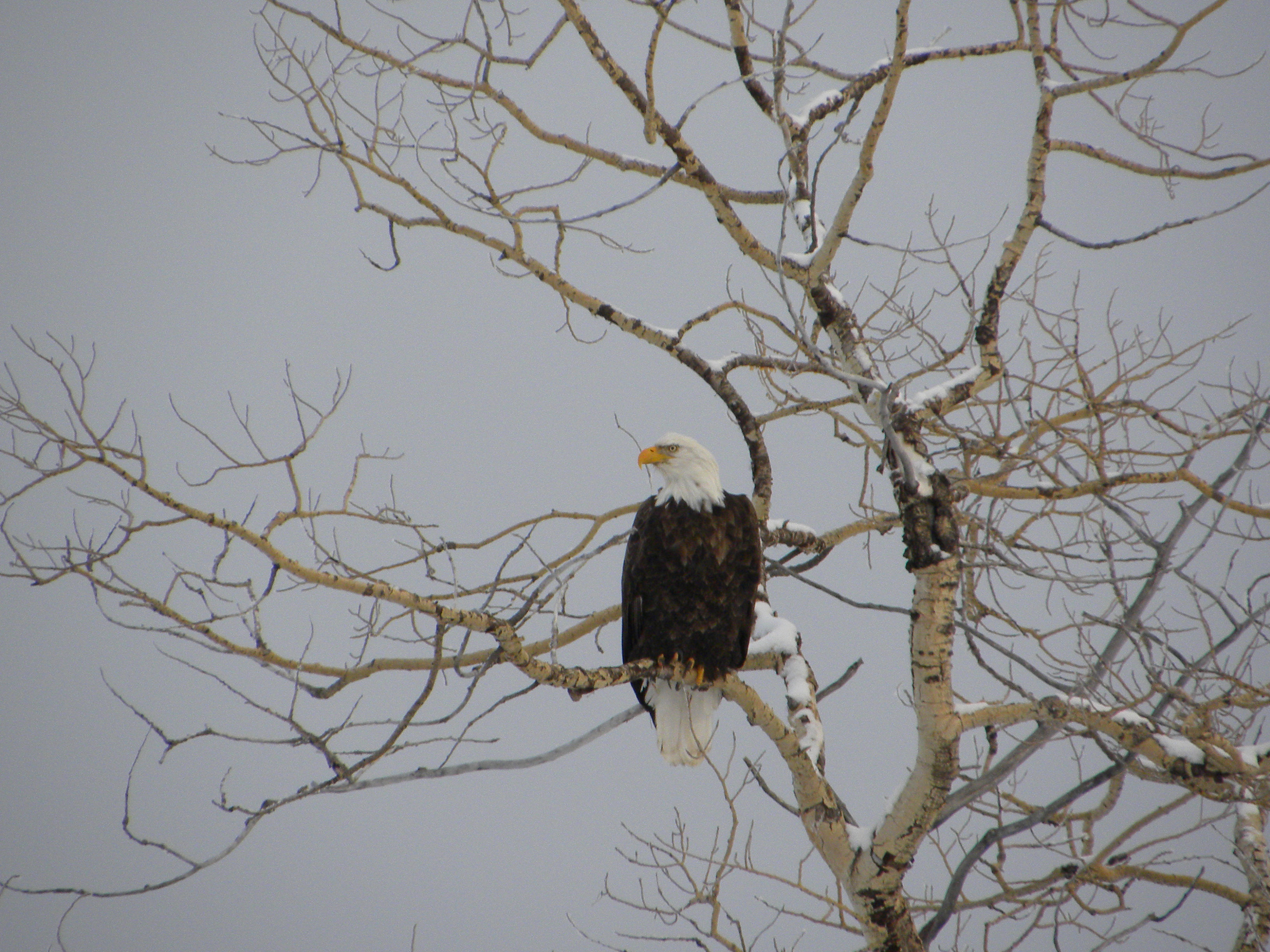
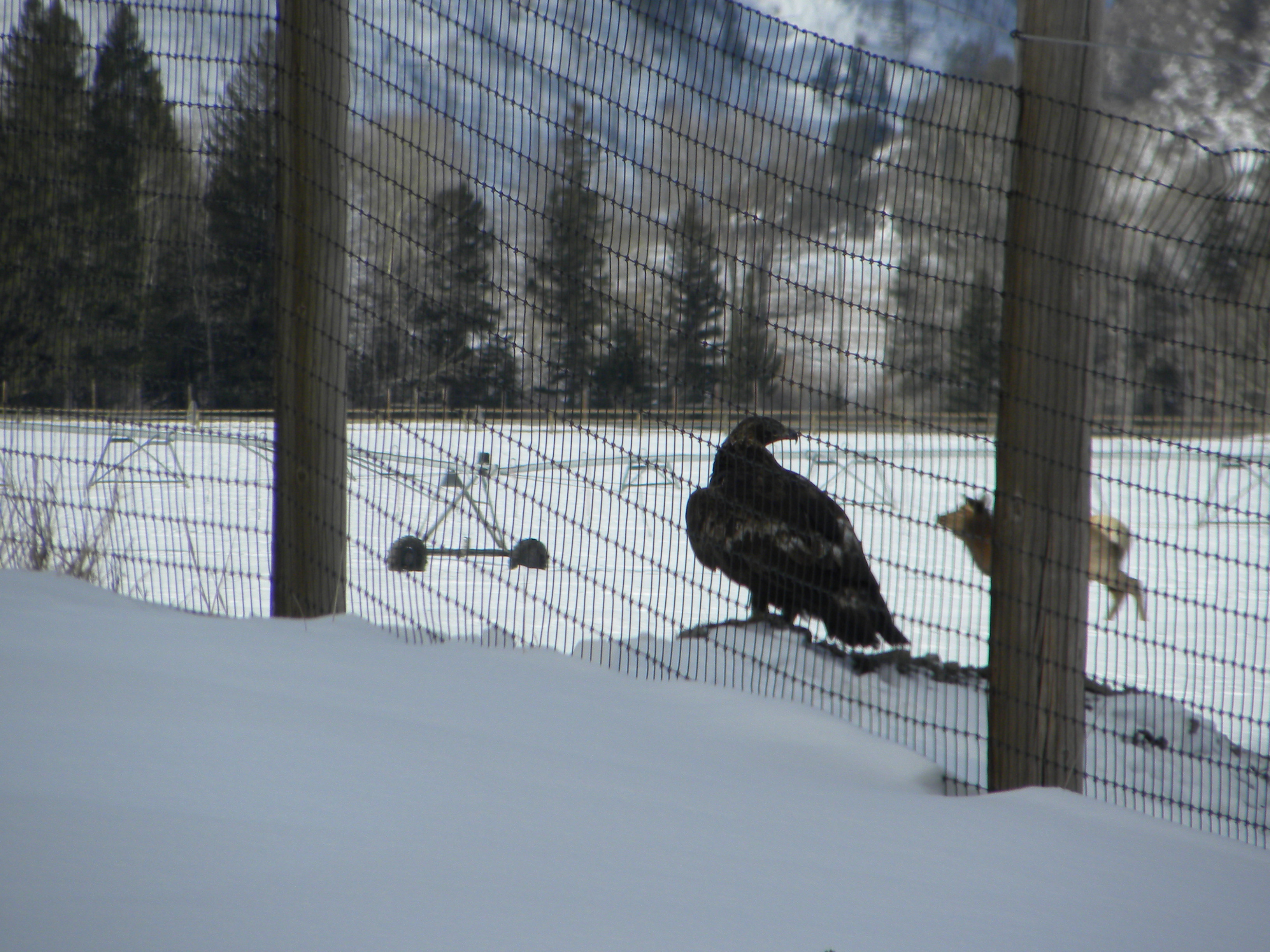
Two beautiful Bald eagles waited in the trees, along with several Golden Eagles.  I watched a Golden and a Bald tug at each other in mid-air before going to their respective perches.  Of course, tons of magpies and crows waited.

It was cold outside, about 5 degrees.  I came back in the late afternoon, hoping to get some closer photos of the Bald eagles.  By now it was hovering near 0 degrees.  A beautiful Bald Eagle sat in a leafless aspen along with a Golden and some crows.  I zigzagged closer and closer.  I kept shooting and wondered how close I could get before she took flight.  I’ve actually seen this pair of Balds hanging around the valley a few weeks ago.  I knew the dog could get real close without disturbing her.  After all, the dog is essentially like the wolves or coyotes that she tolerates around kills.  In fact, I’ve watched coyotes eating a carcass with the crows around, or even a Bald eagle chasing a coyote off a kill.

Just when I saw her get a little ruffled and ready to fly, I backed away.  My hand on the camera was freezing!  Numb.

I drove up the road, watched the elk for a time in the beauty of the chilled sunset, then drove back home.  It was getting dim.  The birds, all of them, were gone.  The kill still there.  I wondered–where did those eagles go at night.  They’d been sitting out there all day, in fact I’d watched them for over an hour without them moving.  The cold didn’t bother them.  But they’d gone somewhere to bed down.  Where does a bird that big go to rest for the evening?

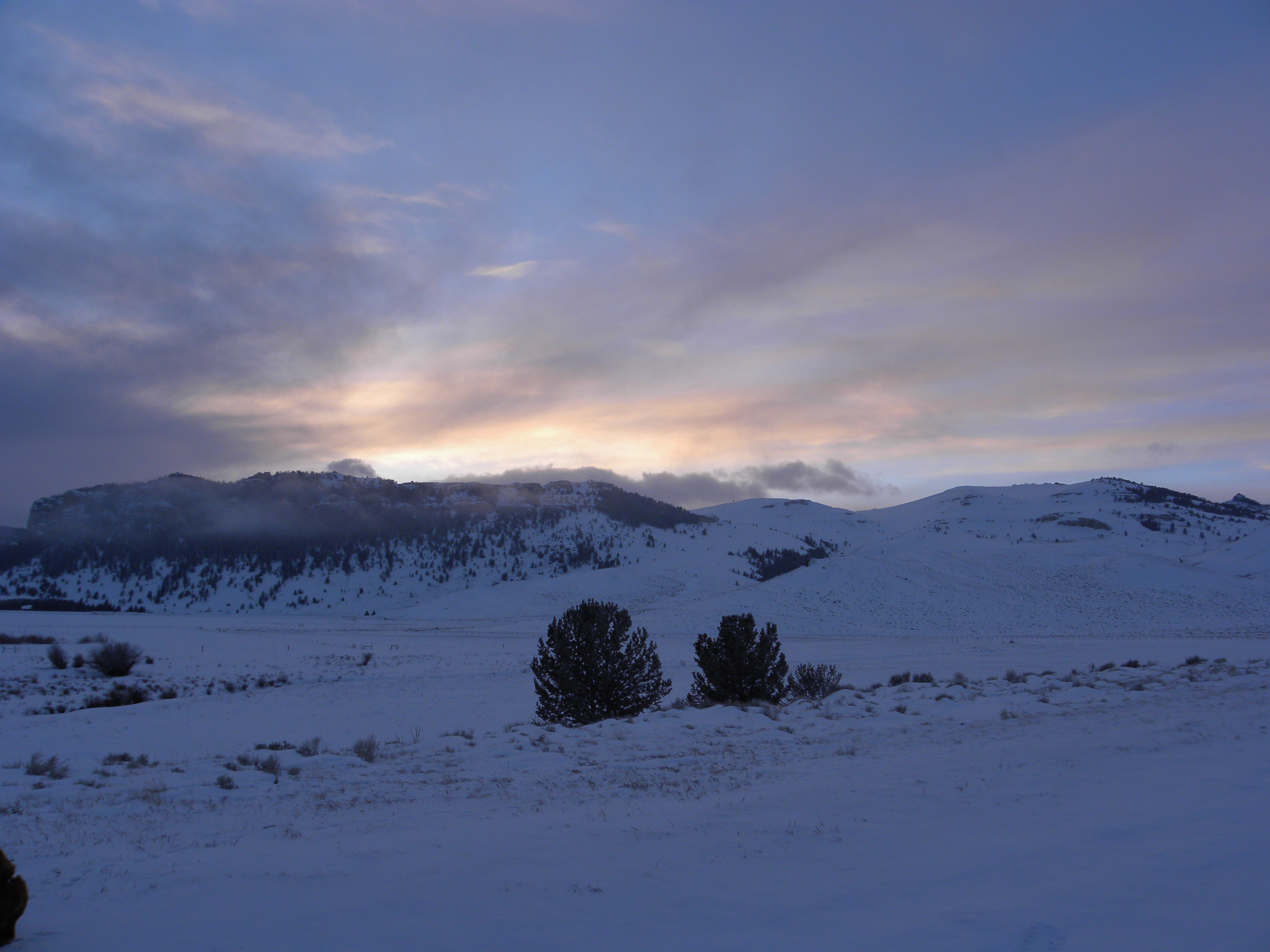
0 degrees sunset

High drama

Nature is full of drama, usually of the life and death kind.

On a rare warm, windless, beautiful day, I loaded up with the dog and headed for a hike down the unplowed part of the main road.   Just over the crest of the flats, I saw about 600 elk corralled within the ‘elk fence’, nervous and jittery.  It was almost 11:00 and these elk should have been resting in the trees.  Besides, you never see elk inside this fence.

Elk stuck inside fence and can't get to safety

I’ve heard two stories about this fences’ beginnings from two different neighbors.  When this ranch was owned by a wealthy man named Bugas in the 70’s, so the first story goes, the county conservation services re-graded and drained the field so he could put his cattle here, or at least more cattle.  Then to keep the elk out of the grazing pasture, the county paid for the fence.  Your tax dollars at work!

The second story isn’t too different from the first but with some variation, yet still with cattle in mind.  In the hard winter of ’77-’78, when the snows were so deep you couldn’t see the tops of the fence posts, Bugas’ cattle were struggling and starving.  The elk were eating the feed that was set out for them.  So a temporary fence was erected for that winter only.

Since that time the property was sold to Earl Holdings, one of the wealthiest men in the world, the fence remains, and the elk can’t move through or over.  So to see the elk inside was very unusual and probably spelled trouble.  The fence borders the creek.  On the other side of the creek is the game preserve where the elk have been gathering every evening and morning to eat.  One gate to the ranch property is open from the creek side, which is how these elk got in.   And that is how they would need to get out of this very large enclosed pasture.

But why they were there was solved when I saw some birds circling in their winter pasture across the creek.  There was a kill over there. These elk were trying to get across the private pasture and into the forest beyond but were being prevented by the fence.  Now they were sitting ducks for the wolves.  The road is between the fence and the forest where they wanted to head but were prevented.  They were hanging around the fence line by the road and every time a car went bye, they stressed, running this way and that, confused, not conserving their energy, unable to head in any safe direction.


Golden eagle resting after feeding on carcass

Needless to say, I’ve hated this fence ever since I’ve been here, and here was more proof why it should go.  When I saw the kill I went back to get my scope,  On the return I ran into Ron.  He’s a citizen ‘Wolfman Jack’.  He does a great service by being totally obsessed with wolves and following them.  He knows more what’s happening with the packs around here than anyone, including the Wildlife Services folks.  He relayed the drama that had unfolded this morning.

The Sunlight Pack made a kill.  The Sunlight pack is about 10 strong , almost all young wolves.  While they were on the kill, Ron heard some barking.  At first he thought it was the ranch dogs nearby, but then here come the Absaroka Pack, mature wolves 7 strong. They pushed the Sunlight pack off the kill.  While we were talking a black wolf from the Absaroka pack came checking things out.

Ron told me that between the Sunlight Pack, the Absaroka Pack which seems to come around here as well, and the Hoodoo pack of 10 wolves up around Crandall (but they frequent the valley here as well), AND the Beartooth pack of now 10, there is more going on in this area than the whole of the Northern Range.  We’ve got a lot of wolves running around this valley.

Wolves are such social animals and their interactions and orders are constantly changing.  The U.S. Fish and Wildlife biologist, Scott Becker, told me that they have few collared wolves at this point.  The dynamics are constantly changing and hard to keep track of.

When Abby was doing her wolf study here several years ago, there were only 2 or 3 wolves in the so-called Beartooth pack.  That pack is located across the Clark’s Fork of the Yellowstone, where there are very few elk.  It didn’t seem like a very hospitable place, especially in winter.  Scott told me they must eat a lot of deer up there.

I continued on down the road and began my hike.  Resting in the pasture, I saw 3 wolves–2 blacks and a grey.  When they saw me, the grey hightailed it out of there, but I was able to get some good video of these blacks.

Error
This video doesn’t exist