• MY BOOKS ON WILDLIFE, GARDENING AND MORE

  • The Wild Excellence

  • True stories of wildlife encounters around the Greater Yellowstone
  • Award winning eBook on Decomposed Granite, tips, how to's, what to watch for
  • Children's book. True stories of a dog and wolves. In a dog's voice
  • Written for dry Mediterranean climates in California, north and south

My Kind of Wyoming

There is a rawness here.  A kind of un-forgetting.  Where forgetting can mean the difference between life and death.  A brilliant clear day of 60 degrees can suddenly turn into a snowstorm at 20 below.   The crackling of dry leaves can mean a grizzly and her cubs around the corner.   Your car breaks down on a lonely dirt road where no one travels for days at a time.

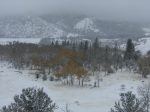
Vulnerability is the tenure of existence.  No amount of pretense or camouflage can make up for the visibility of that fundamental truth.  The sharp edge of living with that awareness draws the psyche into deeper places.  There is no hiding from the existential quandary of our aloneness.Changing Aspens after a October snowstorm

Elk in Geyser Basin, Yellowstone

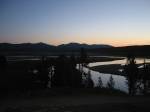
Dawn in Yellowstone

In a state as large as 97,000 sq. miles in area but with only a little over  600,000 people, this is the unspoken understanding people live with day by day.  You try and be prepared, but the truth is we are all dependent .  Rugged independence may be what is imagined by those passing through, fueled by the cowboy Hollywood image; one has to live here to know the extent of actual interdependence.

You may not care for your neighbors’ politics or drinking problem, but he’ll sure as hell be there for you when you’re broke down on the road or lost in a snowstorm.  A whole town will pitch in with a raffle or a fundraiser if you need medical care you can’t afford.  Total strangers do the unheard-of to help one another.  A young man from back east was lost in our area while hiking the cliffs.  One of my neighbors looked for him for over two years until he finally gave up.   A friend of mine risked his life to save a drowning stranger trapped on a frozen river, in an upturned truck, that he encountered while driving along a lonesome highway.Red River Canyon, Lander

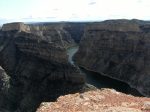
The intense quiet and overwhelming geography make long gaps in a conversation comfortable, even necessary.   It is as if the Human is subsumed by the largeness of the landscape.   I stop to say hello to a neighbor.  Standing in the dirt driveway by the fenced meadow, large cumulus clouds pass over.   The sky turns brilliant colors as the day comes to a close.  We pause to watch .  There is a rightness to it, as if in church—here, we are in church.  It is the Land.Big Horn Canyon
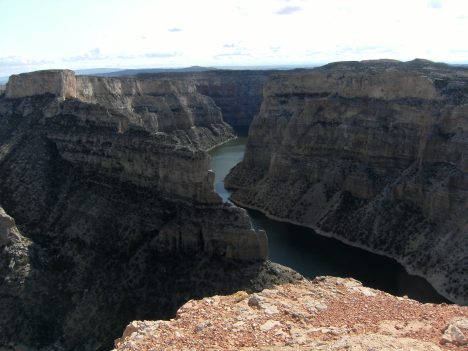
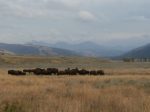
Thoughts are telegraphed rather than spoken.   The land itself starts to breath you, in and out.  The only forgetting is what comes with leaving behind the busyness, the necessities of ‘thinking to know’ and ‘needing to know’.  The rhythm of the natural world is meditation,  awareness,  alertness.  That seems to be the nature of consciousness for it is the key to survival.Buffalo in Lamar Valley
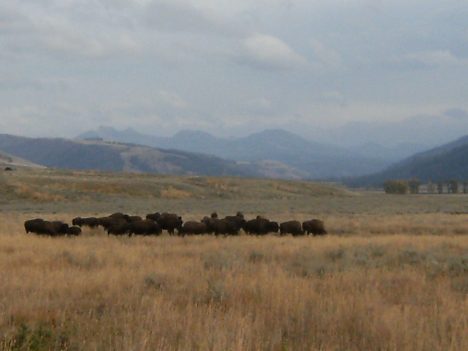
People here watch game.  They read the weather by the movement of the deer or the seasonal shifts of the birds.  They remember a year by the large population of Unita Ground Squirrels or the overwhelming plague of grasshoppers.  Time is punctuated by rare sightings–of a wolf making a kill, a mountain lion stalking a deer, the buffalo skull found by the river.Wild Horse in Big Horns

The art of storytelling is alive, well, and resuscitated.  There are stories of breaking horses, of rodeo riding, of guiding and ranching.  The time the tourist at Yellowstone was trying to push a Grizzly into the back of his station wagon to ‘bring him home’.  The 47″ trout caught ice fishing in ’62 down at New Fork Lakes.   The 9 cords of wood “I tried to sell ’em cheap” with the house, but that fellow said “I’m putting in electric heat”, and then it got 30 below in Pinedale, the electricity went off, and he had to haul his whole family to a motel in town.  Those are the abbreviated versions.  The embellished keep you captive.

Gretel Ehrlich, in beautiful prose that reflects her love affair with Wyoming, eloquently expresses it:

“…there is true vulnerability in evidence here.  Because these men work with animals, not machines or numbers, because they live outside in landscapes of torrential beauty, because they are confined to a place and a routine embellished with awesome variables, because calves die in the arms that pulled others into life, because they go to the mountains as if on a pilgrimage to find out what makes a herd of elk tick, their strength is also a softness, their toughness, a rare delicacy.” (The Solace of Open Spaces)

This is my kind of place.  This is Wyoming.Backpacking in the Beartooths

The Hermitage

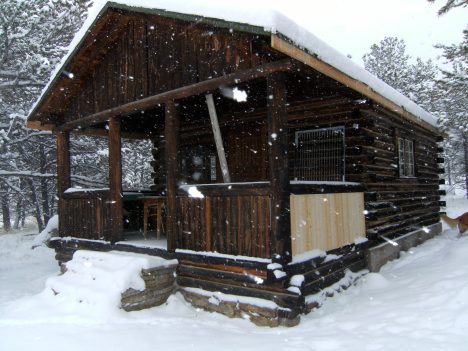
More fixing on my upper cabin, and with that comes hanging its name on a sign. I love that upper cabin. It has no water, no outhouse, and as of now, no heat. I love this little cabin! It has a dangerous oil barrel for a stove sitting directly on the wood floor with single-wall stove piping.Original wood stove and grimmy floor I’m about to change that part. I bought a used tiny Jotul and the seller threw in a whole bunch of double and triple wall pipe. Problem now is that the steep rough dirt road to the cabin is full of snow. So I’ll be waiting a few more weeks to get it up there.

The great thing about that cabin is how secluded it is; how primitive it is. Its where the forest sings its most intimate songs because nobody’s around to hear them.View from side. The forest sings.

When I first looked at this property, for all of 1/2 hour, the realtor showed me the upper cabin and told me it was built originally as a hunting cabin because the elk passed through there. Its true the elk are up there in the winter. But it wasn’t true that it was built for hunting. The previous owners simply used it to store junk. It wasn’t until 2 summers ago that I found out its true origin.

The original owner of my cabin, Doc Firor, began coming up here as a ‘dude’ to the ranch across the street. In fact, many of the long time residents started coming here to Ali Ritterbrown’s dude ranch. That was in the 30’s, when the main road was dirt.

Doc Firor was the head surgeon at Johns Hopkins in Maryland. After coming to the dude ranch a few times and falling in love with the mountains, he bought this property, which at that time was several hundred acres. There were no buildings on the property yet, and although he’d stay at the ranch when he came out, he wanted a retreat getaway. So he built the one room cabin in 1957, several years before he built the larger cabin, and he’d retreat there in the afternoons, away from the dudes.

When I finally closed escrow on my property it was December. I stayed in the main house a few nights. It was the first time I’d been here for more than an hour. I had planned to stay a week, but that was cut short to 2 days because of a family emergency. Lucky for me too, because I didn’t realize how un-winterized the place was. The water pump didn’t work so I had no hot water, and barely any cold. All the windows were single-paned and leaky. The propane heater didn’t work and the house never got above 50 degrees even with the wood stove. It was –10 degrees outside. I slept on a mousey couch by the fireplace.

The previous owners who’d lived here since the 80’s had left all their stuff—part of the deal when you buy a cabin in the sticks. You could feel they’d had wonderful, memorable times here, full of family and friends on summer vacations. In going through what was left, I found photos, stories, board games, an ice cream maker, an inflatable raft, fishing gear, books on mule care, an outdoor BBQ, and a fire pit under the stars.  All expressions of good times and warmth.

But the original owners’, the Firor’s, I knew nothing about. That first night on the creaky couch I had a powerful dream with religious symbols of the Pope and a grizzled graying man praying fervently. I awoke a bit perplexed. I am not religious and the dream, although powerful, had little meaning to me.   But it soon became quite clear when that afternoon my neighbors invited me over and told me about their friend, Doc Firor, and what a religious man he had been. He spent a lot of time in the upper cabin, studying the Bible, my neighbors said. At times he even gave the sermon at the Sunday church gatherings. The first night at my new cabin was a kind of ‘visitation’ from the ethereal leftovers of Doc Firor’s presence.'Doc' & Mrs.

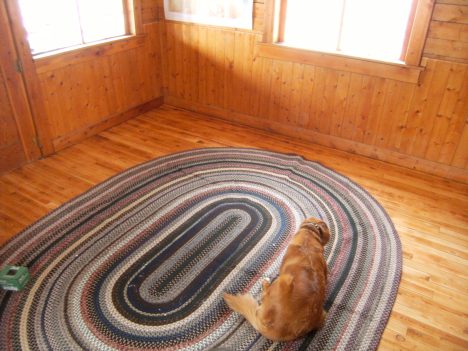
When I came back in the spring of that year, I found myself spending many afternoons at the upper cabin, taking my computer up there and writing. I had to agree with ‘ole Doc—-it’s a special spot. I decided to restore its’ spirit and began by cleaning out the junk left by the previous owners. I filled several pick-up loads with old siding, pipe, junky furniture, you name it. I rented a sander and a generator and restored the wood floor, which was full of sticky residues. I found a forest service bunk bed for guests to sleep in. Now I’m looking for book cases,  and soon I’ll replace the stove and install a proper fireproof floorboard under it. But I still didn’t know Doc Firor’s complete story until his son, Tom, now in his 70’s, paid me an unexpected visit from his Vermont home two summers ago.My refinished floors and new rug

I am not religious nor raised Christian. But I do have a background and interest in spirituality and am well-read in most religious traditions. Many years ago I had a special interest in a very famous and well-known Indian spiritual teacher named Ramana Maharshi. He lived in South India during the first half of the 20th century. I particularly remember being very influenced by a book of reminiscences written by Arthur Osborne. He related his impressions of Ramana and the life at the Ashram when he was there in the 1930’s. Anyone traveling to South India in the 1930’s would surely have heard of the great teacher, Ramana Maharshi, as he was well-known and quite revered.Classic photo of the great sage, Ramana Maharshi

Tom told me his father and mother walked every day to the upper cabin. His dad called it his ‘ashram’. I asked Tom where his father heard that Indian term. After all, Firor was a devout Christian, not a Hindu. Tom told me his father was a missionary doctor for a year in South India in 1936. That his time there was very important to him and shaped him a lot. He took from it the word ‘ashram’, which means a place of spiritual retreat, a hermitage traditionally in the forest.

I couldn’t imagine Doc Firor living in South India in 1936, a relatively sparsely populated region of India, and not going to Tiruvannamalai to see the great Master. By 1936 the world was beginning to hear about Ramana. Already by then some very famous people had come to see him.   It was a strange and unexpected connection that I had with this particular property and its history.

A little side piece to this is that one day the neighbors who bought the Ritterbrowns Dude Ranch came over.  They asked me about my upper cabin and how it was doing.  They already knew the story.  “We have our own Ashram, you know”, they told me.  “It’s a little cabin up in the back of our property with a library.”  Apparently, the Doc had popularized the Hindu word around here.

This winter I found a nice piece of wood from the forest and began burning a sign. Its simple, but a way to honor Doc Warfield Firor’s relationship with this place, as well as my own.  I’ll be hanging it at the door of the small cabin as soon as the snows melt a bit.  New sign

Wolves, turkeys and free attention

A cacophony of sounds coincided this evening in one unexplainable happening.

I was outside at dusk when the turkeys in the forest started making a huge ruckus.  The last time such a noise came from them, a large hawk flew out of the forest.  But tonight was crazier.  Not only were the turkeys in a frenzy, clucking and screeching, but one of them was screaming uncontrollably.  In my imagination, a turkey was being murdered while the other turkeys scolded the perpetrator.Wild turkeys, not native

In fact, I did once witness this same phenomenon with some small birds.  I walked outside to find a cat that had a wren in its mouth, while dozens of other wrens screamed from the nearby rooftop.

While the turkeys were going wild, Koda, who’d been listening to the birds, began staring westward towards Herman Mountain.  He had picked up the faint sounds of a howling wolf .  As I strained to hear the wolf, several other wolves across the valley began to answer.  The wolves began howling back and forth to each other.  This lasted several minutes–the wolves howling,  the turkeys complaining.  As the turkeys began to settle, the wolves called for a bit longer–then all was still.

Its a mystery to me if there is any connection between these two auditory events.  Its around turkey mating season, so maybe that’s what all the fuss was about.

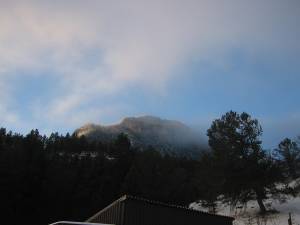
Yesterday I took a short jaunt around Herman Mountain.  Mt. Herman from my cabinThat mountain is actually named after the man who built my cabin in the 50’s.   Herman Elsbury owned a sawmill near here.  All the logs from my two cabins were from the valley, which he milled.

It took some exploring to discover the high trail a few years ago.  I had used all the deer trails, which climbed from one steep forested area to another with several plateaud meadows between.  The high trail is reached from the backside which is gradual and climbs to the highest plateau.  Its a beautiful hike, and last summer JB showed me how to access the peak.Mt. HermanI haven’t been carrying bear spray yet, although there has been sightings in the Park and on the lower Clarks Fork.  I haven’t seen any tracks around here.  Hiking in the GYE is unlike anywhere else in the U.S.  Its not a jaunt in the woods.  Its a primeval experience.  You have to have all your senses in gear, alert, open, present.  It is a wonderous experience that takes you back to your native, most basic existence.
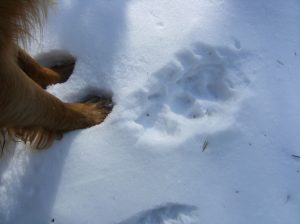
And since I wasn’t thinking about bears, well, I really wasn’t present.  I was on a little mental holiday.  Until I was jolted out of my reverie.  In the deep snow, about a mile up, suddenly huge tracks appeared.  Not of a bear, but of two, maybe three, massive wolves.  They had run easily up the steep side, my side of the mountain, and were heading I assumed towards the meadow where I’d seen 150 head of elk the other day.

I’m not worried about wolves for myself.  They’d be afraid of me.  But I need to be vigilant when I hike for my dog.  Although I’ve heard that if your dog stays close its unlikely anything will happen.  I’ve also heard otherwise.  And by the size of those tracks, those wolves were a lot bigger than Koda.  Wolf tracks with Koda

The wolf howling nearby tonight may have been the same wolves I saw tracks of yesterday on Mt. Herman.  There are supposedly five in the valley; one has a limp.  My friend saw four of them, all black, crossing the road the other evening.  They seemed to have regrouped since last summer, when the pack was mostly killed off for predation, leaving a mother and her yearling pup.

My walk, and this evening of turkeys, was just another reminder:  this place is a wild place; and it is always, in every moment, deserving of my free and total attention.

This is love

“Little things that will change you forever, may appear from way out of the blue, making fools of everybody who don’t understand.”  __George Harrison

When I decided to purchase my cabin, I’d only been on the property for one hour.  It was 3pm and I was about to return to California on a 5pm flight.  The realtor had nothing to show me but one homestead up the South Fork which seemed, in his mind, to fit what I wanted.  But when I saw it, that Land just didn’t speak to me.  It was the only property I’d seen so far.

“Is there anything else?”  I asked him.

“There’s this one place, about 45 minutes north of Cody.  But they’ve been debating for a year whether to sell it or not.”

I hesitated because I wanted to live near town.   “Show it to me.” I said.  ” I’m here and if they market it, then at least I’ve seen it.”

It was love at first sight.  I went back on the plane to San Francisco, made them an offer they accepted, and began the escrow process.  “As is.  Everything comes with it except the mounts,”  I was told."As is.  Everything comes with it."

My water comes from a spring on Forest Service land and the owner told me it was running 12-15 gpm.  Since I closed escrow in December, it was hard to check his accuracy.  All I knew was the cistern was full and water came out of the pipes."My water comes from a spring in the nearby forest."

But come spring, when the snow was melting, I had a carpenter at the cabin doing some work for me.  I was still in San Francisco when he called to tell me the bad news.  “The cistern’s about empty.  Seems like you’re running only 1/2 gpm.”

Since I share that spring with 3 other homes, that was terrible news.  If you don’t have water in the West, you have nothing.  As the saying here goes ‘Whiskey’s for drinking, but water’s for fighting over.”  And historically in Wyoming, people have been shot dead over water wars.I'm the first of 7 springs

That first May I went to Wyoming to meet my neighbor who shares the spring.   He lives in Powell, an hour away, most of the time.  He and his brother, who is a geologist, had put the system in with their father about 20 years ago.  It was a quick education for me as I have only lived on city water all my life.

H__, the geologist, explained that our side of the valley is limestone base.  All those layers allow for nice underground snow melt runoff .  Seven springs come directly out of the limestone layers in the forest next to me.  In Wyoming, in order to use a spring that’s not directly on your property, you have to file a claim.  If you don’t develop the spring in something like 5 years, you lose your rights.  There are first rights, second rights, even third rights on springs.  My neighbor and I have first rights on this spring.  My other neighbor has second rights; which basically means that if there isn’t enough water (defined in specific gpm’s), I can shut him off.

Across the river on the other side of my valley, the south facing side, that land is mostly granite based and the homes over there either have wells or no water.  A very lucky few have springs.  My side is the desirable side.Across the river its all granite base

My spring box, which in my case is a cistern, takes the water directly from below ground before it spills out of the limestone above ground.  It does this with the equivalent of a drainage system–wrapped perforated pipes laid in a gravel base, that feed into the cistern.  That water then flows into our three properties through 6′ deep pipes.

When one member of my California crew whose from Guatemala, came to help me with some carpentry up here last year, he really wanted to see my spring.  He told me that in Guatemala, in the mountains, whole towns are fed from springs using these kinds of catchment systems.

My underground cistern

As the three of us looked over the spring that was hardly running, and walked up to the other springs that seemed to be flowing faster, H__ offered that given the 7 year drought, and possibly some shifting of the limestone, maybe a few minor quakes here and there, our spring might be running dry.  I choked.  My neighbors have rights to another spring they can use.  I didn’t.  No water and my new venture was worthless.

My options were to haul water in (there are some people on the granite side that do that!), or try and dig a well which is an expensive venture out here.  Both an overwhelming thought. But my first option was to explore this problem much further.Another style.  A spring houseInside the spring house

My neighbors went back to Powell, and my immediate agreed-upon job was to go to the cistern every morning and take measurements.  That way we’d get a good idea of actual flow.

That night I had a powerful and unexpected dream.

In my dream there were no people.  Not even a story.  The dream was just water.  Lots and lots of it. And a voice was saying “Copius amounts of water”.  The word ‘copius’ just rang and rang.  When I awoke, I knew it to be true and decided the spring was not dry, just either clogged or diverted.

That was May.  I went back to California and worried about it a lot.

In July I came back to Wyoming for a few weeks.  That first afternoon I was back, I took a drive down the road.  A badger poked his head out from his hole and walked alongside the road with the car.  I took it as a sign that digging was the right approach to the spring.

My neighbor and I began hand digging alongside the PVC pipe that went into the hillside, trying to expose the drainage catchment system a bit.  We got to the first 45 ell and still there was little water.  The going was hard as the limestone layers were thick.  When they originally dug the system and put down the pipe and gravel, they laid all the limestone back over the top and then covered it with soil.  Apparently, the difference between a regular french drain and a spring system, is that you want to be very careful how you dig.  The layers are sensitive and too much disturbance can cause the spring to divert or clog.

So all that limestone was on top of the pipes, and to get down to the pipes to see if water was running or not, required lifting and heaving these large boulders.  I promised R__ that I’d dig till the next 90 ell over the coming week.

That week another badger appeared in my life and took up residence in the hillside next to my home.  I spent a few hours digging.  I was certain, according to my dream and according to these badgers, that water was there.  When I hit the 90, I dug a bit further and water started spewing out. Sure enough, there was plenty of water; just a clogged system that needed replacing.

I like to think of my valley as my magic.  I like to think that when you follow a scent that draws you as a bliss, when you stand at your center, helping hands appear.

I came here on a songline, a bit of music in the wind that drew me.  I left behind a life because I fell in love–in this case not with a man, but with a mountain.  Magic happens here. Healing happens here.

“Little things that will change you forever may appear way out of the blue, making fools of everybody who don’t understand.   This is love.  This is love.”  George Harrison

Welcome to Wyoming

I really like this quote from Finis Mitchell, a man who grew up since 1906 in the Wind Rivers, and was a fishing outfitter all his life.  Finis  stocked most of the lakes there, carrying them in by horseback.

Throughout this century I’ve roamed this wilderness, communing with nature, observing other creatures along with myself, merely desiring to live and let live.  Because of this aloneness, I’ve learned to love, not only those of my own kind, but all life within a wilderness; the birds, the beasts, the trees, the flowers, and the grasses of the land.  Only in wilderness, it seems, is man’s love so thoroughly and completely returned, so unselfishly shared.

I arrived here on Saturday, after driving out from the Bay Area.  I’m a real whimp when it comes to snowy roads and since Cody had a minor snowstorm on Friday, I waited till Saturday to go over the 8000 ft. pass to my cabin, choosing instead to stay in a warm house with a Cody friend.

The students who are studying elk and wolves in my valley had been staying in the cabin.  They cleaned it up real nice before I arrived and B___ will be staying here with me.  She’s temporarily hired on to follow ‘Spud’, the nickname the guys gave the Idaho wolf who’s traveled  all the way across Yellowstone to end up in my area.  He’s radio collared and she’s acting as his GPS, tracking him every 4 hours.  Apparently he’s been hanging with a female.  Maybe they’re going to mate. Continue reading