• MY BOOKS ON WILDLIFE, GARDENING AND MORE

  • The Wild Excellence

  • True stories of wildlife encounters around the Greater Yellowstone
  • Award winning eBook on Decomposed Granite, tips, how to's, what to watch for
  • Children's book. True stories of a dog and wolves. In a dog's voice
  • Written for dry Mediterranean climates in California, north and south

Elk–the poster child for an elegant chaos

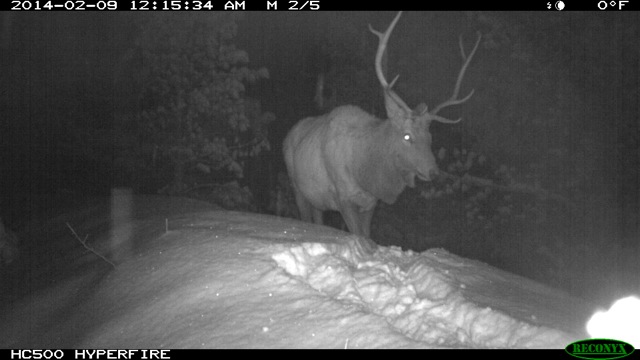
Yesterday down by the river Koda found a large cow elk carcass.  I usually follow the dog when he’s intent on something as he invariably leads me to interesting stuff.  And he kept his promise, for this was no ordinary carcass. This elk had a collar, a VHF tracking collar.  I assumed, rightly so, that this was a collar left over from Arthur Middleton’s 3 year elk field study in my valley.  Just last month I caught an elk on my trail camera by my house wearing a collar.  I contacted Arthur because I was surprised there were still some elk with them.  Apparently some of the collars employed for the study were designed to fall off; but others were going to stay with the elk for life.

I decided the best thing was not to touch the collar, but to contact the game warden.  I knew they’d want the collar back, even if it no longer carried data or was active.  The collars can be refurbished and save the WG&F around $600. But I wasn’t sure if they wanted to check the elk’s health out, with the collar on, before I removed it for them.  Since the carcass was in a fairly easy access location, I did worry that someone would come bye and snatch the collar for themselves as a souvenir.  When I spoke with the warden, he requested that I go back, obtain the collar, and save it for him.

Predated elk with collar.  How the elk died, we don't know.  But she provided a good meal for a lot of predators.

Predated elk with collar. How the elk died, we don’t know. But she provided a good meal for a lot of predators.

I noticed that she only had one ivory.  When she was collared back in around 2008, they took one of her ivories (her eye tooth) to determine her age.  Judging by her teeth, she was an older cow, but once the warden retrieves the collar, they can match it up and determine her exact age at death.  At long last, she’ll get that collar off.  I did feel badly that she had to move around with that collar around her neck all these years.

Arthur Middleton’s study in my valley was commissioned to find out why this migratory elk herd has such a low cow/calf ratio.  He spent three years of fieldwork, and several more writing his thesis.  Since that time, Arthur was awarded a prize/grant to study the other 5 migratory elk herds in the Greater Yellowstone Ecosystem.  You can read the controversial results of that study here on my blog, and here on the web.

One of the many interesting findings was the rate of vigilance displayed by elk relative to wolves.  Before the study, everyone was postulating that wolves were responsible for the low calf ratios.  The theory out there was that wolves were pushing the elk hard and therefore stressing them out.  This additional stress led to less foraging, more vigilance, and just less calving success.

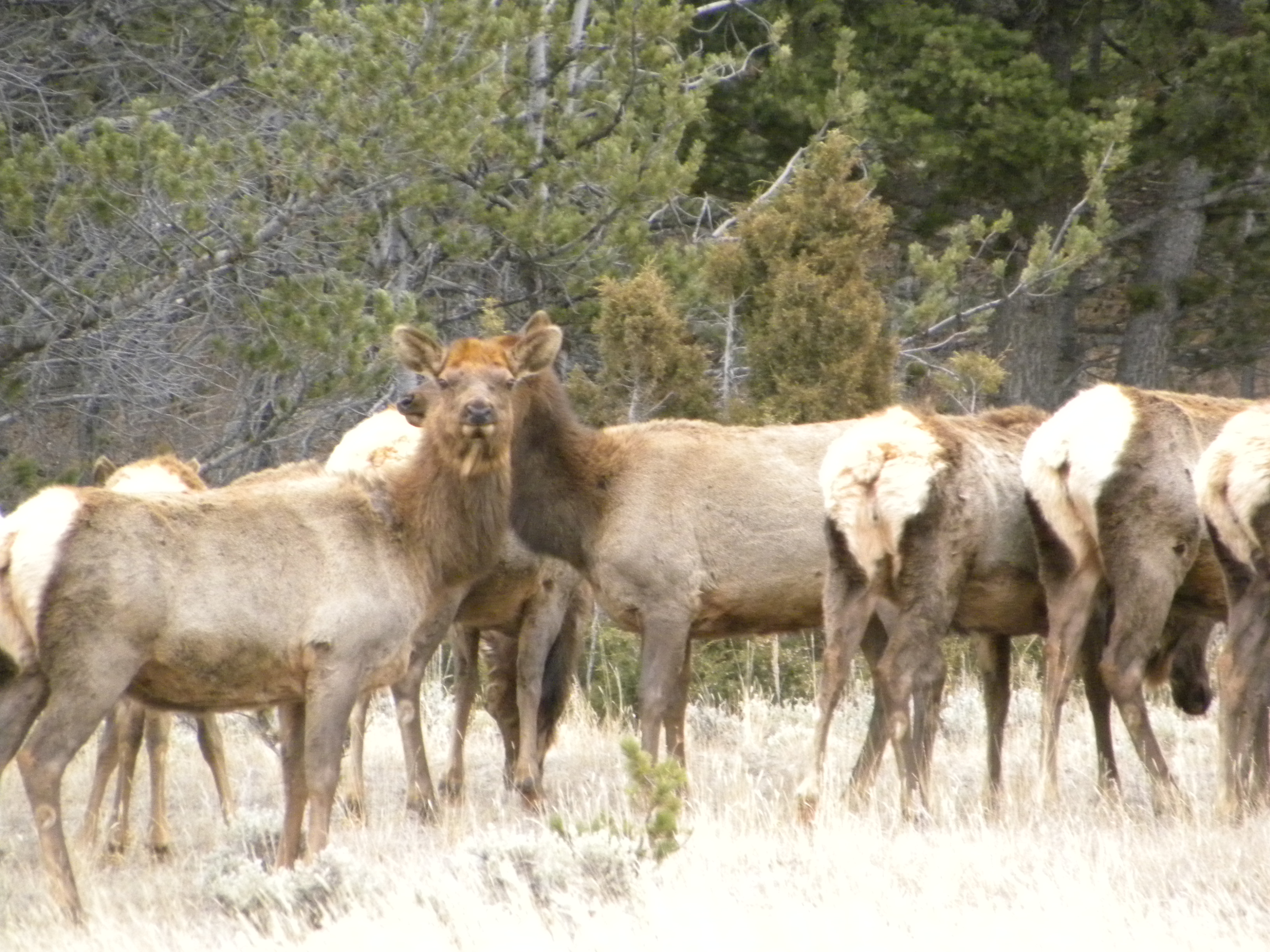
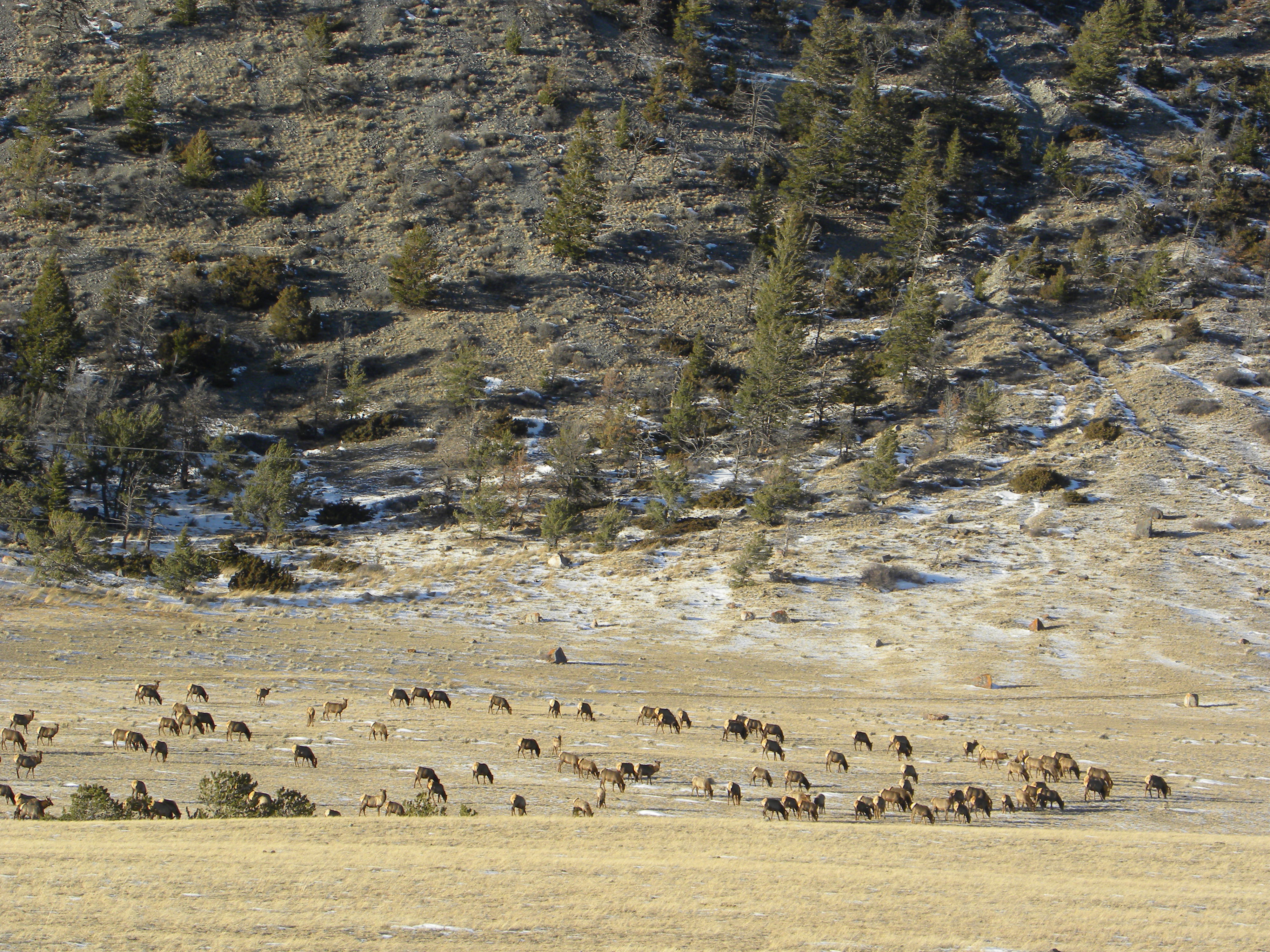
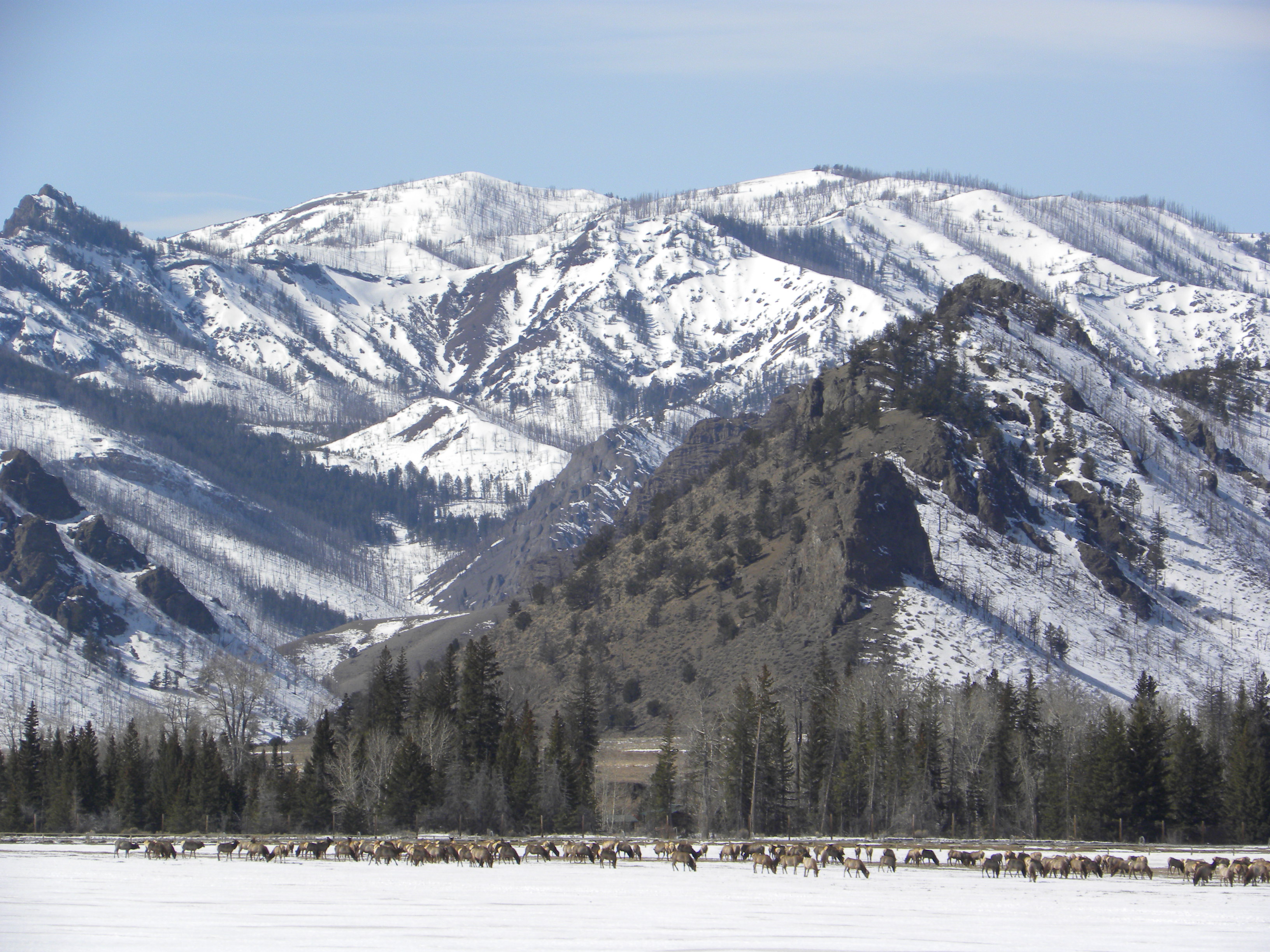
About 2000 elk are in the valley in winter.

About 2000 elk are in the valley in winter.  These are the YNP Lamar elk herd.

The results debunked this theory.  First off, there was no more vigilance with the migratory herd than the non-migratory herd that was used for comparison in the study(where wolves are present although not as many; and they had normal cow/calf ratios).  But more interesting was that elk did not show any signs of stress or movement until wolves were within 1 km, and these wolf/elk encounters occurred, on average, once every 9 days.  These factors are important to what Arthur is now stirring up a storm of controversy with.

The Rocky Mountain Elk Foundation helped fund Middleton’s study. But they seem to ignore the results of the study and still blame wolves for all the decline.  Included in the above 80% is the overpopulation of elk on the Northern range present before wolves.  YNP was killing elk for years to help reduce the herd.  One reason why wolves were introduced in 1996.

Just recently, Middleton had an op-ed in the New York Times.  In it, he contends that his results, as well as other studies, challenge the straight forward idea of wolves and trophic cascades.  In other words, that wolves herd the elk sufficiently to allow less browsing on aspens and willows, allowing them to regenerate.  The idea of trophic cascades is no doubt true (apex predators affect whole ecosystems), but Arthur is saying ecosystems have a lot more complexity to them then the simple fix of restoring top predators.

One of the ideas rattling around these days in biology is the Landscape of Fear.  I’m not a biologist, but the whole notion never sat right with me.  Simply put, the theory maintains predators will change the behavior of their prey, through fear, in ways that affects the their movement throughout the landscape, changing their feeding patterns and thus the plant material.  True, but maybe not the whole of it I think.  Ecosystems are varied and complex.  Arthur posted a photo of a wolf den with a herd of elk grazing nearby.  We humans have certain notions of fear-consciousness, yet this might not at all be what’s driving all the movements of wildlife.  As I said in that previous post, I still think nature has more to do with adaptation and awareness, than with so-called ‘fear’.

Recently I took a class with James Halfpenny in the Park.  He was asked about the wolf-coyote relationship.  It has been documented that wolves killed about 50% with the wolf reintroduction, but now their population seems to have recovered.  Coyotes are using the ‘inbetweens’ of the wolf territories to move around.  It didn’t take them long to work out, and remember instinctively, their age-old relationship with their big brothers and how to live with them (and take advantage of their kills).

And if wolves are herding elk from intensive aspen/willow foraging, I have to ask why the pack of six wolves in my valley was slacking on the job.  When the snows got really deep, the elk settled in my front yard and forest, topping every single aspen and willow they could reach.

Wolf wary of infared light

Wolf wary of infared light


Ode to a Wyoming Spring

Yesterday I took a short hike on the Clark’s Fork plateau.  And I was again reminded that there is nowhere like the Greater Yellowstone Ecosystem and the Northern Spine of the Rockies where one can experience what I did in just a few hours in the lower U.S.  Frankly, it was a magical excursion.

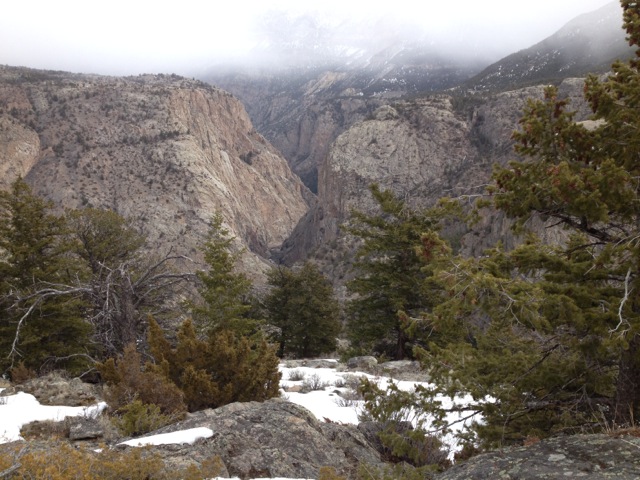
I began my hike on a well-known trail that falls just 45′ down to the vast plateau above the rocky cliffs of the Clark’s Fork.  Within moments I came across cougar tracks in the melting snowfield.  After a following the tracks a few steps, the elusive cougar  disappeared.

Left Hind cougar

From the parking area above I’d spied a few elk, so I knew some were around.  But as I rounded a bend in the treeline, there was a small herd of about 75 elk in the meadows near the cliff edges.  Elk disband into smaller and smaller herd sizes as spring nears, until soon they disappear to calve and head into the high country.  The elk spied me and Koda, and were a bit skittish but quite curious.  As they ran one direction, then another to follow our movements (I was headed away from them and already at quite a distance), their hooves pounded on the frozen earth an ancient, but familiar hollow sound.

elk

I watched the elk briefly as they watched me, but I was headed for the river.  Within moments I spied fresh wolf tracks, 2 sets, as well as a lone coyote, on a sprint down to the river too.  I began following them as they lead me down the narrow gully that meets the river’s edge.

Two wolves side trot down the road

Two wolves side trotting towards the river

The wolves sidetracked up to a small meadow for a view and I did too.  From there, I glassed around, probably doing what the wolves did with their own eyes and good sense of smell.  Just a ravine away, there was a large gathering of birds on a melting ice field.  I detoured that way and watched them for a while.  Thousands of birds were gathering in trees, taking time for a drink.  Their chirping sounded like crickets, which I knew weren’t out yet because it was about 37 degrees.

After following the canine tracks down to the river, and seeing they’d crossed over, I made my way slowly to the cliff edge.  I wanted to spy for mountain goats that frequent the Clark’s Fork cliffs in the winter.  There is a special look-out area, where the meadows give way to trees, that soon fall precipitously over the 1000′ edge.  As I neared the trees and cliffs, I heard that strange ‘cricket’ sound again.  The flock had flown here and they were flying everywhere, from tree to tree, around the cliffs, thousands of birds.  These were Bohemian Waxwings and maybe there were beginning their migration north.  Beautiful birds, a bit smaller than robins, they caught my eye and senses.

Bohemian Waxwing

Whatever they were up to, the sheer force of their presence and numbers was magical.  The sun beat down through the trees.  I stood and allowed the new spring sun to warm my body, closed my eyes, and listened to them.  As I became quiet, they grew less concerned about my presence and became more active, flying all around me.  I felt like I was receiving a tiny bit of what America might have looked like hundreds of years ago–when wildlife was so abundant that this ‘small’ flock of a thousand birds or so was common.

What a wonderful two hour hike.  Only in a place like the Greater Yellowstone.  I was reminded of how precious, fragile, and necessary this place is.

The Fox and the Hound

O.K.  I exaggerate.  The hound would be Koda who found the carcasses but he never saw the fox, nor was he interested in a hunt.

Several days ago Koda found a dead yearling deer partially snowed over under a dead tree root.  I recognized the yearling as one of the babies that had been frequenting my yard this winter with his sister and mother. How he died I wasn’t sure.  His ribs exposed and his rumen still inside but all the organs eaten out, and the head missing.  He could have just died from the harsh winter, or possibly a cougar kill that had been buried in the snow, and exposed when the snow melted.

Cougars will frequently just eat just the internal organs as they lack the ability to manufacture Vitamin A.  It had snowed the evening before and there were no cougar tracks to be found, just a lot of canine tracks.  I’m not very familiar with fox tracks vs. coyote tracks, so I just wasn’t sure which one it was.  I put my trail camera on movie, and left it there for two days.  I wanted to make sure I didn’t run into any bears.  I heard they are starting to emerge, and they’d be looking for winter kills.  The boar grizzlies emerge first.  In the 6 winters I’ve been here, my limited experience is that while Yellowstone and the North Fork report bears in early March a lot of times, our area is slightly later by about a month.  We may just have more forest without homes, while the North Fork is a narrow corridor with a lot of cabins.

I returned in two days to find this video on my camera.

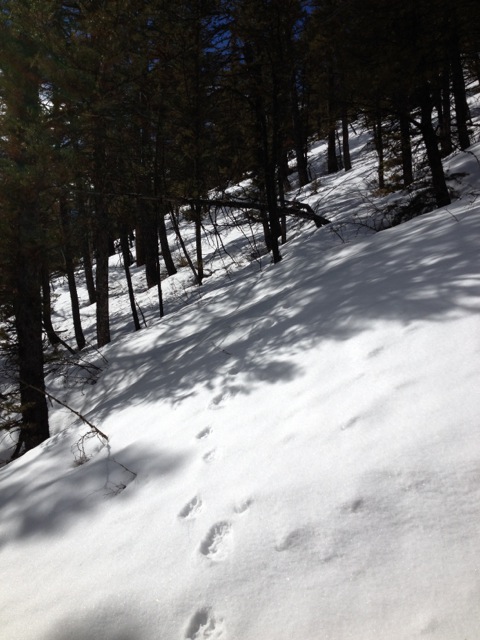
Now armed with the knowledge that these tracks clearly belonged to a fox, I checked all around and noticed a distinct path the fox had followed to, and from, the carcass up the hill.  This fox had followed his own trail to the carcass then back to his den or lay.  Clearly the trail was deliberate, not like a wandering excursion.  So I got my GPS out and followed his trail.

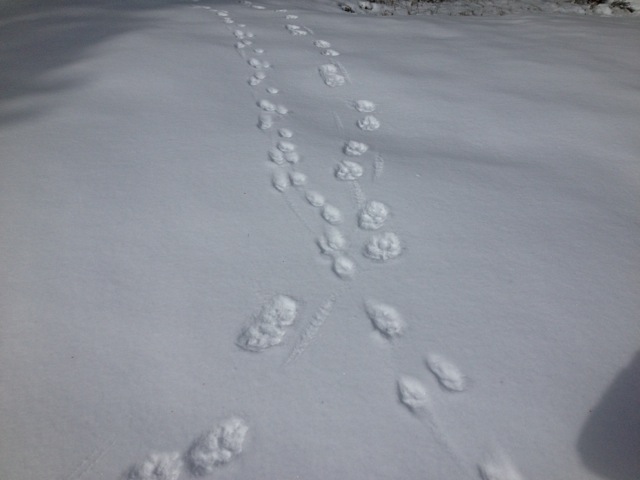
Wolf track lower left; fox track lower right.  Then they cross.

Wolf track lower left; fox track lower right. Then they cross.

Fox track and ruler

Fox track and ruler; foxes have lots of fur on their feet which makes for indistinct tracks

Following the fox’s track reminded me of when I followed a bobcat track up this same mountain last year.  Up and up he went.  Unlike coyotes or wolves who like to follow path (like deer paths), or course across a hill or mountain, this guy was going straight up and ignoring worn paths.

Fox track close-up

Fox track close-up

As I got higher, the snow softened and I kept ‘post-holing’; each footstep was sinking deep into the drifts and I had a hard time climbing.  The fox on the other hand was gliding across the snow.  Koda was sinking too.  Of course, Koda weighs 90 pounds and that fox might weigh 20 pounds.

Fox continues but I don't

Fox continues but I don’t

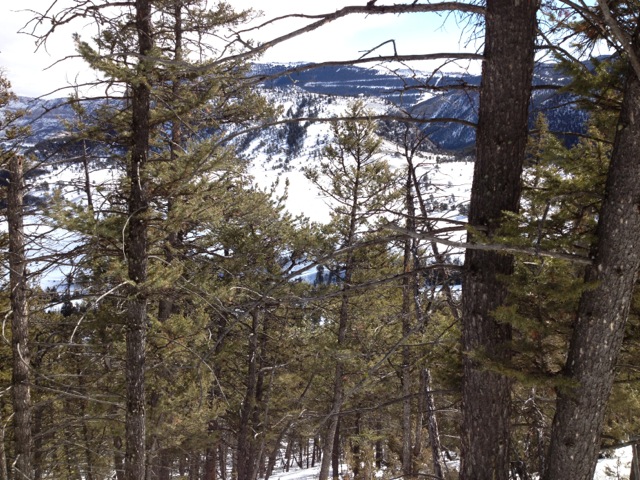
Finally, I could just go no more.  I was high up the mountain, on steep sides with deep snow.  I took a GPS reading, hung a bit of shiny stuff on a limb, and decided to return when the snows melted some and explore.

Where I had to stop because of deep snow

Where I had to stop because of deep snow

This is exactly what happened when I followed a bobcat last year.  I lost his tracks when the mountain turned into a jumble of boulders high up near its summit. Probably he had his den there as bobcats like rock shelters.

Foxes according to Rezendes, might be a link between canines and felines. He writes:

In fack, there was originally some dispute as to whether foxes should be classed taxonomically as dogs or cats.  Cats are direct-registering animals, and foxes are direct-registering animals.  Foxes have eyes similar to those of cats; their pupils dilate elliptically, up and down, rather than in a round fashion, as dogs’ eyes do.

And gray foxes can climb trees, the only canine that can do so.  Plus they have semi-retractable claws.  A lot of times their claws do not show in tracks.

Red fox pelts come in the full variety of colors, from red to black, grey to white. But always they have the white tip.  Red foxes are native to North America.

Just a few of the possible fox coat colors

Just a few of the possible fox coat colors

 It is believed they crossed into North America sometime during the last ice age about 35,000 to 11,500 years ago.  Foxes of this wave are closely related to the European, and Canadian red fox. But in the Beartooth mountains by my home, there is another red fox that is being studied.  These foxes are believed to have arrived during the Illinoian glacier period, 310,000 to 128,000 years ago, and could be the ancestors to a genetically isolated populations of red fox living in the Western U.S.  They live high up (7000-10,000 ft.).   I suppose since I’m at 6800′ I could be seeing some very ancient ancestral foxes.

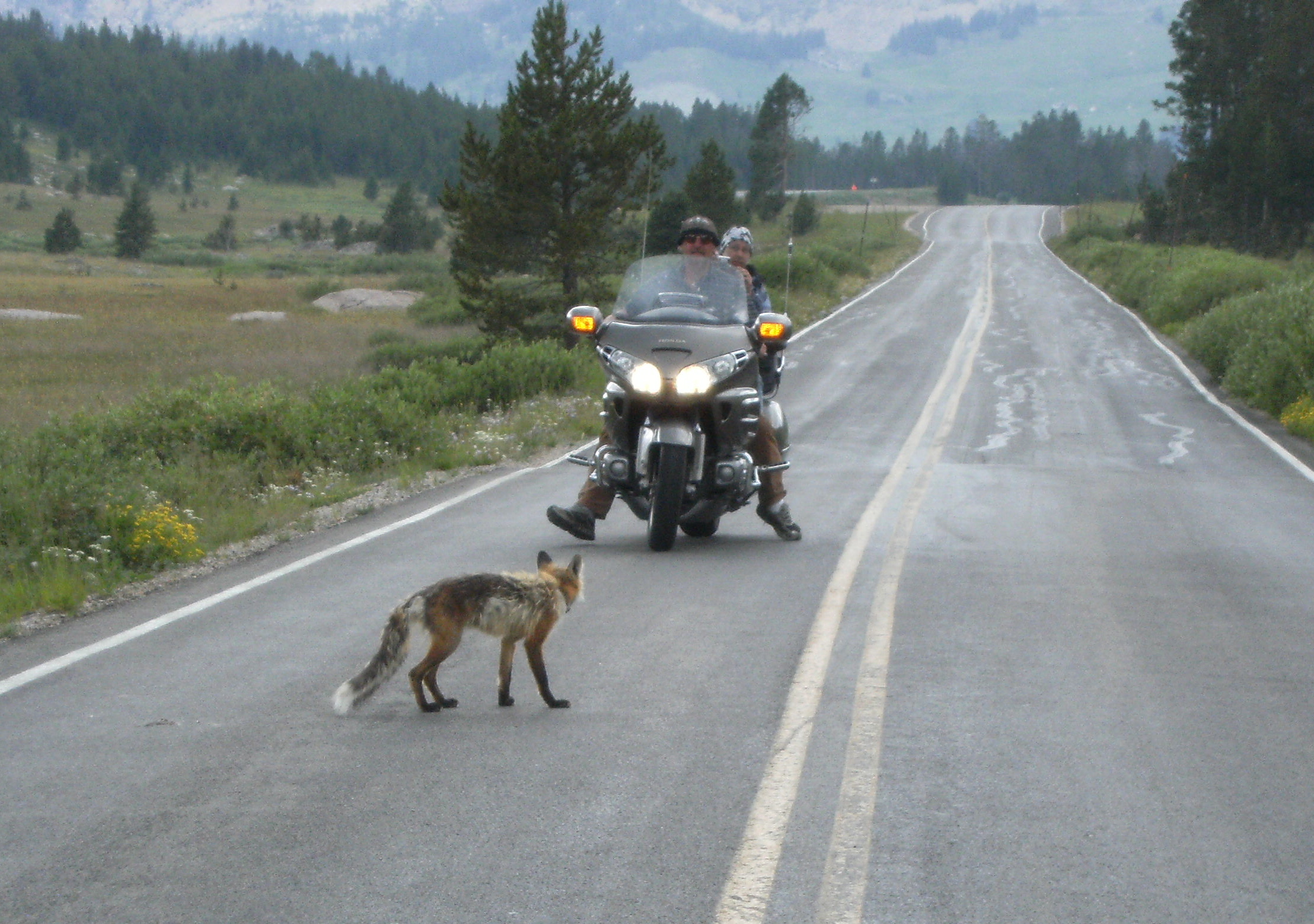
Fox on Beartooth Highway

A Beartooth fox at 10,000 feet

Some winter musings

So far this winter has been a roller coaster of temperatures.  December brought weeks of sub- zero temps, while almost every day in January was in the high 30’s and 40’s.  All our snow in the valley melted and the ground was bare.  Then one day two feet of snow fell, and didn’t stop. One constant has been wind–a lot of it and up to 50 mph.

Before all the deep snows came, I spent a lot of time watching for wildlife and sometimes seeing them.  I had several glimpses of a lame coyote, with a hurt or broken back left leg.  One day I saw him scurry across a wide field.  I wondered if he’d make it through the winter, with his lameness as well as wolves to watch out for.  Then a few weeks later I saw him stealing a large bone from a recent deer kill.  It was early morning when I noticed the coyote.  He saw my car and started running for cover.  It was then I saw it was my limpy friend.  I took a few photos and was on my way.

Here's the fellow.  Who knows what happened to his leg.

Here’s the fellow. Who knows what happened to his leg.  In his attempt to flee, he dropped his prize bone.  That’s when I left, allowing him to return to it.

Poor guy had it tough enough without me making it harder.  But on the way home I checked for his tracks.  I was curious what a useless left back leg would look like in the tracks.

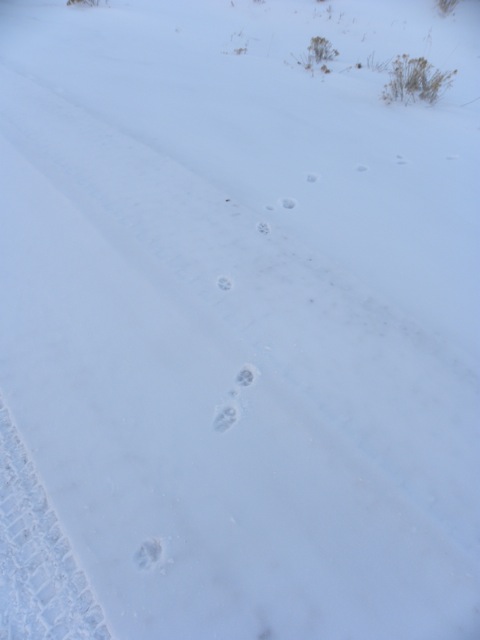
The arrow points the direction he was headed

The arrow points the direction he was headed

coyote limp

You can tell what a difficult time he is having because his gait is so uneven.  Look for that tiny imprint of his lame foot.

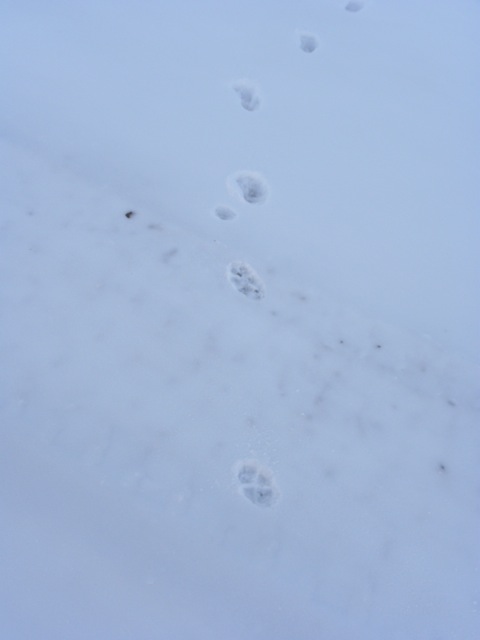
You can see the small imprint of his left hind leg.  The back legs are in front because he is running

You can see the small imprint of his left hind leg. The back legs are in front because he is running

One ski tour I took a few more photos of tracks.  This time a Snowshoe Hare and a Marten track

Distinct weasel-type prints 2x2

Distinct weasel-type prints 2×2

Front feet are in the rear and the back feet on top.  Look how big and wide the back feet are, like a snowshoe.  Hence, the name

Front feet are in the rear and the back feet on top. Look how big and wide the back feet are, like a snowshoe. Hence, the name

Here’s a photo from January on the flats behind my house.  Where’s all the snow?

This is a large herd of about 350 elk.  No snow in January

This is a large herd of about 350 elk. No snow in January

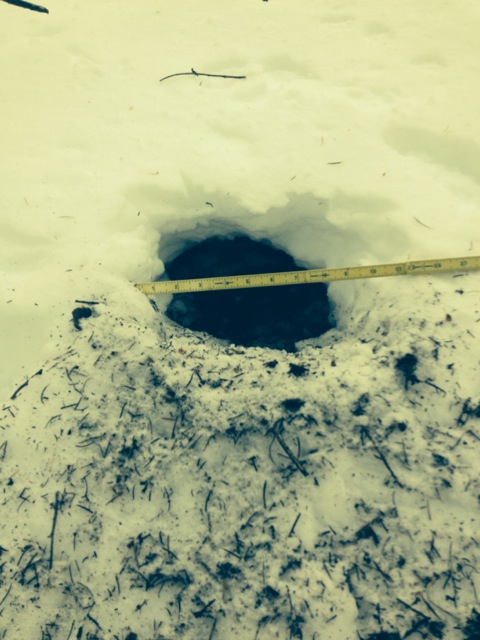
Here’s a puzzle.  We had a few days of intense snow without a let-up.  During a short let-up of the storm, I took a walk around our woods and discovered this interesting ‘hole’.  It doesn’t go anywhere, but was obviously a temporary snow shelter dug out during the storm just above the base of a tree on a hillside.  The hole measured about 6 or 7 inches across, big enough for a fox or a skunk.  I have seen skunks once here, but they are rare.  So are raccoons at this altitude.  I wondered what could have done this.  All tracks were obliterated by the recent snows.

Hole that doesn't go anywhere dug out for a temporary shelter.

Hole that doesn’t go anywhere dug out for a temporary shelter.

I found bobcat tracks around my house.  Bobcats have become quite rare around here because of intense trapping.  Bobcat pelts can go for up to $1000! and so a lot of newbies want to cash in.  Wyoming has no limit on how many bobcats a person can trap and the season is long, pretty much all winter.  So I set up a camera trap to get some photos.  I’ve never been successful catching photos of bobcats, except the few times I’ve seen them myself.  But instead of catching a bobcat, I caught a shot of this fox.Fox

I understand from some old timers around here that foxes used to be quite rare.  Canines are territorial and will kill other canines in their area.  Wolves kill coyotes, coyotes kill foxes.  I’ve seen foxes quite a lot since I’ve lived here and I think the wolves are keeping the coyotes either ‘in check’ or enough on their toes so that there is room for foxes again.

I discovered a secret game trail that is quite a hike from my house.  An old water diversion ditch, it appeared the wildlife were using it frequently.  I also found a deer kill nearby.  To confirm my suspicions, I set my trail camera up and left it there for 6 weeks.  I got a lot of photos of rabbits, deer, elk, coyotes, and wolves.  Here are a few.  Look at the temperature on the two nighttime wolf photos.  Its -33 degrees!

Wolf

Wolf stares into camera

Wolf

Bull elk

Nice Bull Elk

Wolf

see the second set of eyes in the background

I really do live in a special place, right next to Yellowstone National Park!

Noisy and curious elk check out a photo-trap for a bobcat

Elk are smart and elk are curious. Lots of elk passed by this bobcat photo-trap (intended to camera catch a bobcat, not kill one! I used shiny objects and a road-killed bunny), and all of them were very curious. Most really liked that shiny DVD I hung up. Listen to the calls that are on the entire clip. This is mostly what one would call ‘cow talk’.  Elk are all real communicative, and ‘talking’ is just way they do it.  Rubbing noses, following their lead cow’s cues, and watching how others are responding to potential danger are some others. This all takes place on my property at around 7am. You can see elk in the beginning of the clip in the upper left feeding in my front meadow.

How to collar a wolf

The spotter plane has been flying very occasionally because either its too windy or snowing. When the spotter flies in January, its because the Wyoming Game and Fish are looking to find wolves.  They need to complete their annual count and do collaring.

Here's how its done although this pix is of cargo.  The wolf would be wrapped in a net.

Here’s how its done although this pix is of cargo. The wolf would be wrapped in a net.

This morning was beautiful.  Four inches of new snow and no wind–perfect conditions to fly and look for wolves against the snow.  I saw the helicopter head up a neighboring drainage and knew they’d found wolves there.  It just so happened that I was on my way to meet a friend in Cody when I saw the copter returning to a trailhead pullout with a sling hanging from it.  The copter hovered while a cadre of Game and Fish employees guided the net to the ground, then carried the cargo to a lowered tailgate of a truck.  I knew what was happening so I turned my vehicle up the dirt road to get a closer look.

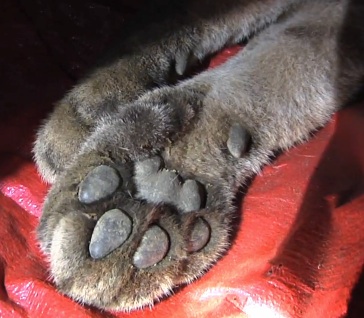
Lying on the tailgate was a small sedated wolf.  A female, she was this year’s pup and only about 70 pounds.  Her teeth told the tale as they were white and perfect, but her paws said she’d be growing bigger by the spring.  Usually I keep my camera in the truck, but this morning the elk were in my front yard and I was taking their pictures.

About 2000 elk are in the valley in winter.

About 2000 elk are in the valley in winter. 

So no photos folks, you’ll just have to believe me when I say I touched her fur, and held her foot.  And the truth is I didn’t feel badly about no photos.  Photographing a sedated wolf felt like I would be violating her dignity.

I asked one of the fellows how long before she awoke. “About 1/2 hour till the drug wears off.”  He told me.  “It’s the same drug the vet uses to sedate your dog.”

One person will stay with her till she wakes, then she’ll just have to find her way back to her pack by herself from the parking area–although far in human walking terms, probably no great feat for a wolf, who can travel up to 30 miles in a night.  She can surely scent her way, or howl her way, back to her family.

Not today's wolf but here is an example of collaring.

Not today’s wolf but here is an example of collaring.

I’ve been volunteering for many years now in the Draper lab at the Buffalo Bill Museum of the West.  About six months ago the lab acquired over 100 frozen wolf heads from the U.S. Fish and Wildlife.  USF&W managed wolves when they were still listed. They shot wolves for livestock control.  These wolf heads, and some carcasses, were saved for DNA and other scientific purposes.  The lab also is receiving wolves from Yellowstone National Park that died from various causes, usually wolves that killed other wolves.  With this repository of skulls from all over the GYE, the museum will be in a unique position of holding essential DNA information which could help ensure the Greater Yellowstone wolf population has sufficient genetic diversity so as not to go extinct again.

Draper lab Buffalo Bill Museum of the West

Working at the lab, I’ve held and worked on many wolf skulls, but of course all dead wolves. Seeing a living wolf so close up is definitely a thrill.  But I have mixed feelings about collaring and so much interference.  Wolf collaring outside the Park is essential for only two reasons: first to count the population and track them, ensuring that the numbers of wolves do not fall below the critical 100 wolves and 10 breeding pairs; and second they take blood in order to make sure enough genetic mixing is taking place, again part of the delisting mandate.  Other than that, these wolves have been studied for over 15 years and now that hunting is taking place outside the Park, the study inside the Park has, I feel, been compromised with too many unnatural variables.

So, my reservations?  The amount of disturbance that wildlife in general is subjected to is constant.  There is general hunting season on ungulates from around September through December.  Collaring of wolves.  Fly over counts of sheep and elk.  Cougar hunting is seven months from September through March. Regulated trapping seasons on fur bearers such as martens, bobcats, and beavers.  Year round trapping on wolves in part of the state, coyotes, raccoons, badgers, rabbits.  Then there’s snowmobile activity in winter and ATV activity in summer.  The human pressures on wildlife never stops, in addition to their predation pressure and food needs.  And this is just around my area.  Many states have year round hunting and trapping regs depending upon the animal.

Putting all my concerns aside, it certainly was a magnificent day–awakening to hundreds of elk in my front yard and getting a close-up look and feel of their predator, the wolf.

Four wolves far away

Four wolves far away


The Ecology of Awareness vs. the Landscape of Fear

The Greater Yellowstone Ecosystem is a great laboratory that houses all the fauna and flora that make up a complete ecosystem. Granted, humans have greatly altered that system, with invasive species of animals and plants, farms and ranchettes, housing developments, dams and canals; but still pristine and natural wildlife interactions can be observed in the vast  lands  surrounding the Park.

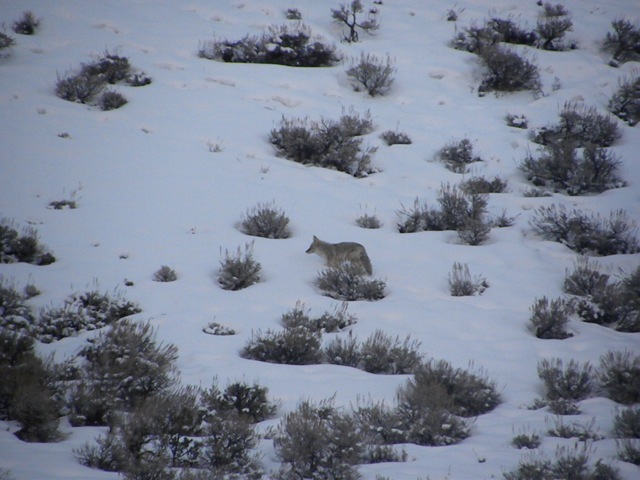
Coyote searching sagebrush for prey

Coyote searching sagebrush for prey

Since wolves were introduced, a lot of the systems have changed, and not only have the wolves been studied, but their effect on elk, coyotes, aspens, watercourses, beavers, grizzlies and more.  Wolves are an apex predator, in other words, at the top of the food chain.  They are the key lynchpin effecting entire landscapes, the beginning of a domino effect, which creates a ripple of change far and wide.  This is referred to as a ‘trophic cascade‘.

'06 swims the Lamar river, emerges onto the road right in front of tourists.

World Famous ’06 shot by hunters in 2012

One of these studied effects is the resurgence of willow and aspens streamside in the Park.  Before wolves were re-introduced (wolves were extirpated from the Park by the early 1930’s), there was not an aspen younger than 80 years old to be found.  Aspen only live about 100 years.  This dearth of young trees was because elk, free of predation, were browsing like cattle, feeding  unfettered in stream bottoms on young shoots.  But once the wolves arrived, everything changed.  An elk in a river bottom is more vulnerable–less escape avenues, harder terrain to navigate quickly.  Over time, elk learned river courses were not where they wanted to linger so the aspens and willows rejuvenated.   With young trees returning, the beavers had food and materials for their dams.  With the beavers returning, slower stream habitat was created for fish and insects, and the fish had shade and cover.  So you get the concept of trophic cascades.

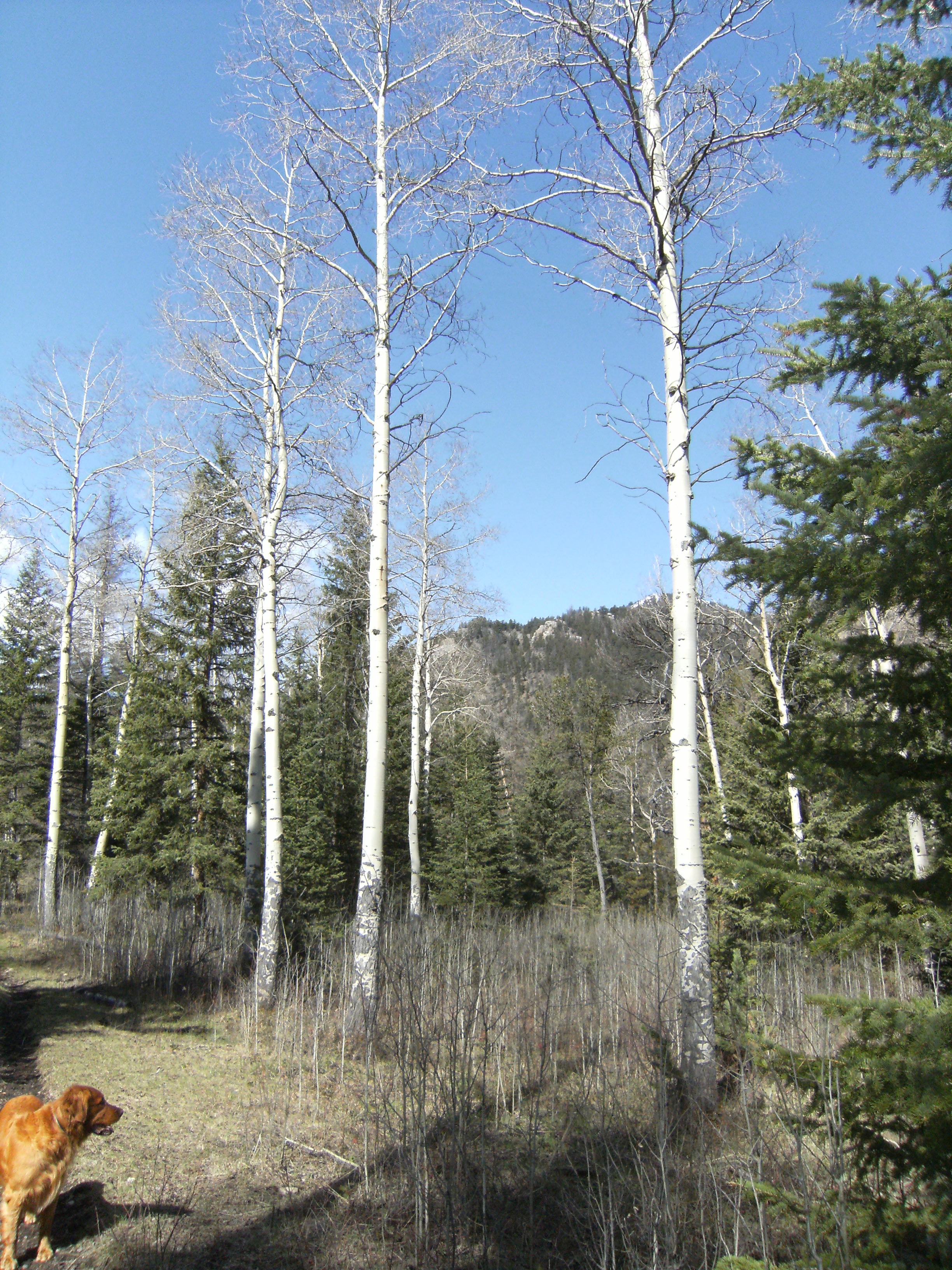
Mature old aspens and gazillions of young aspen clones

Mature old aspens and new young aspen clones with the reintroduction of wolves

One of the ideas that came out of all these new studies was a scientific catch phrase: ‘The Ecology of Fear” or sometimes called “The Landscape of Fear“.  This of course, relates to the idea explained above–that wolves,and all predators, effect prey movement through fear of being killed, and thus mold the landscape.  And this is a true observation, even with humans.  Fear has us humans avoiding certain neighborhoods at night, or packing a gun, or just being more vigilant when hiking around grizzlies.

Grizzly bear

Grizzly bear on a well used forest service road.  Gun or bear spray?  What do you carry?

The world of nature and its observations, scientific or not, can be compared to a room full of individuals.  Each person describes the experience through their own lens; in a sense it is like a vast hall of mirrors playing tricks on the observer.  The Landscape of Fear is only one way to describe the play of nature, and I feel we do a great disservice to tag Life through this lens.  We demean non-humans, reducing animals to little more than reactive and fearful creatures.  Fear is a useful emotion. Without it survival would not be possible. But fear does not describe the whole and the complexity.  I prefer to think of it as the Landscape of Intelligence and Adaptation.

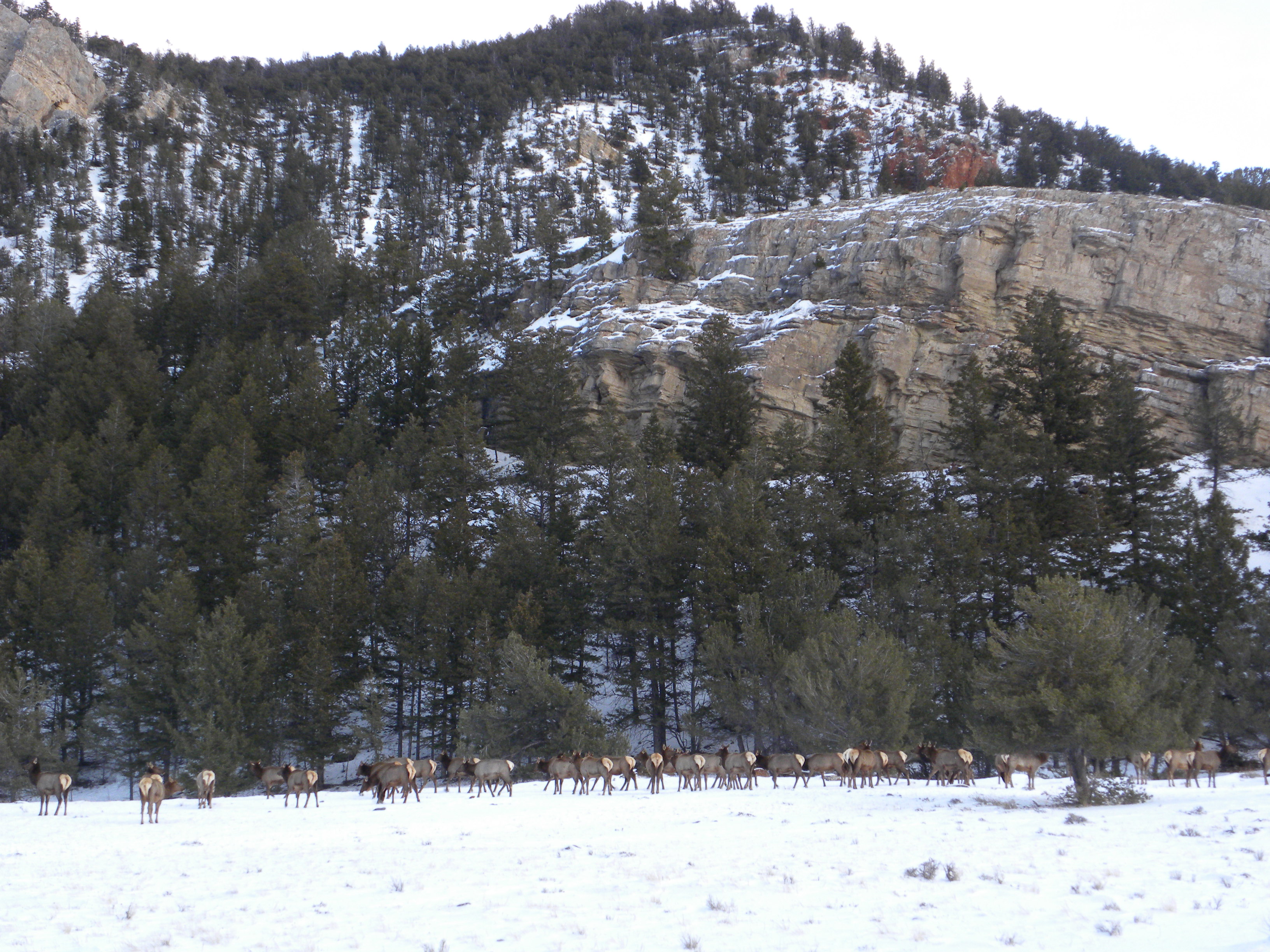
Elk herd in valley on a warm day

Elk herd grazing in winter

For instance, with their native predator back, the elk relearned their landscape, reconnected with their instincts, re-quickened their alertness and intelligence–much like a person who walks in grizzly bear country as opposed to walking a trail on the California coast.  This kind of alertness, although born out of our universal need to survive, is an act in Consciousness.  Elk, nor any other animal, are not walking around fearful all the time.  They are aware, alert, ready to adapt to new circumstances. They feed in the open where they can run, they distrust and don’t like fences that hinder their freedom to escape, and they stay close to forest cover where its harder for wolves to out maneuver them.  But they also are frisky, feed early before storms, move continuously for better forage, adapt their location for wind and weather protection, and are forever curious.  They are intelligent.

elk and snow

We have all seen people who are frozen with fear, or their outlook on life is clouded by paranoia.  They are not healthy mentally, nor happy. And their personal Landscape of Fear becomes one of obsession with protection as their world becomes narrower.  Clearly then, this is not the natural state.

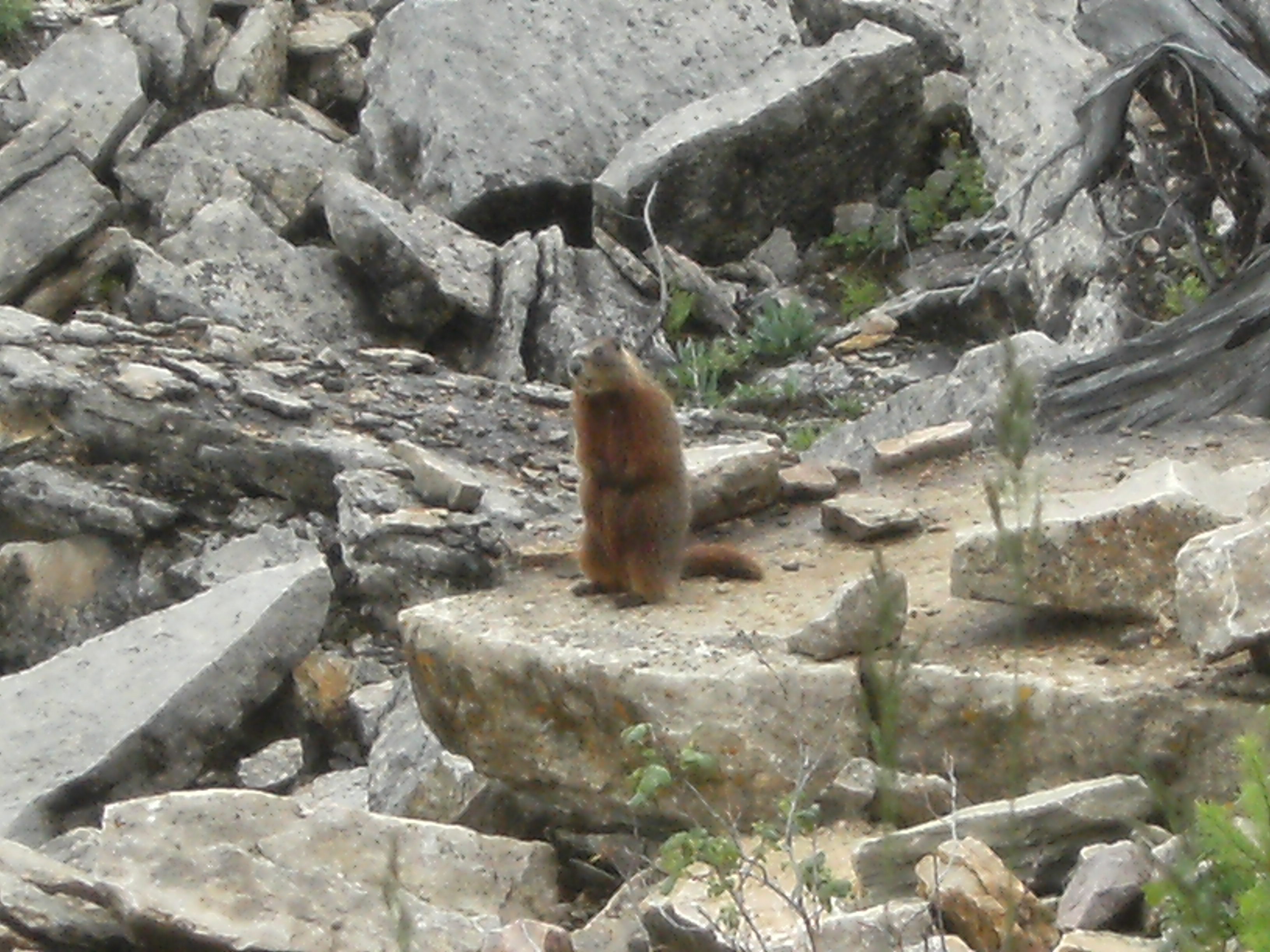
Fat Marmot

Alert Marmot

The natural state is one of relaxed awareness, able to draw on whatever appropriate response is necessary at any moment. It is a flexible state of consciousness, with the ability to learn and grow, move and adapt.  This is the lens through which I view the natural world. This is the mirror I feel dignifies wildlife and all of Life.

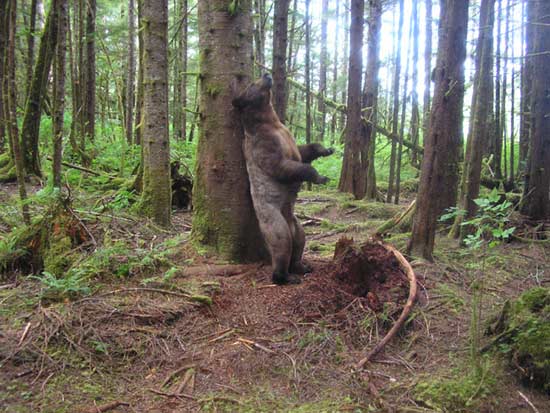
Bear scent trees and leave their hairs

Happy bear makes a tree rub

Our American History

I spent the last month wandering through Southwest Anazasi ruins, specifically around Bluff/Blanding in the Cedar Mesa area.  With the help of a guide book, and the local who owned the motel I was staying at, I explored as many petroglyph and ruin sites as I could, given that the mesa had quite a bit of snow and many roads were impassable clay.

This guy never got out in the sticky red clay, even with all our help

This guy never got out in the sticky red clay, even with all our help

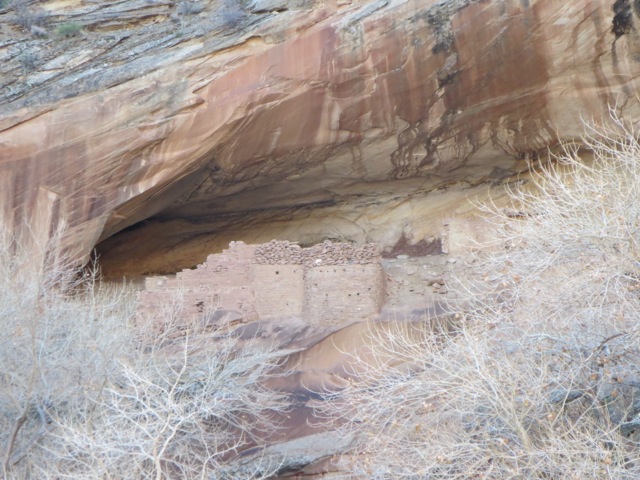
Cedar Mesa area is unique amidst cultural Anazasi sites.  Its a BLM study area that probably had a population 2-3 times that of today; that would be easily 10,000 people living there. And it shows.  Hike down any canyon and you will absolutely see granaries, old stonework and dwellings, kivas.  In short order, anyone will be able to judge what topographic features would attract an Anazasi dwelling:  south facing cliffs,  high alcoves, inaccessible nooks with some access to water.  Some of the ruins obviously housed many families, while others were small and may have held only a few.  Invariably though, they’d be a kiva always there, sometimes several.  These were community meeting rooms and the general size of the mesa kiva seemed like it could house no more than ten comfortably.
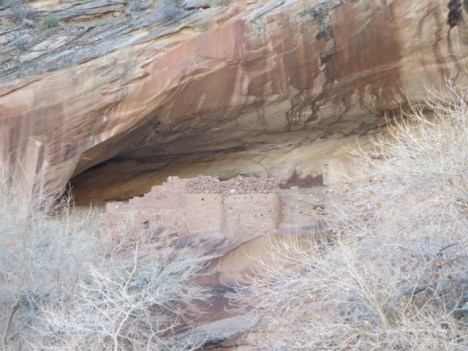
Large extensive alcove run
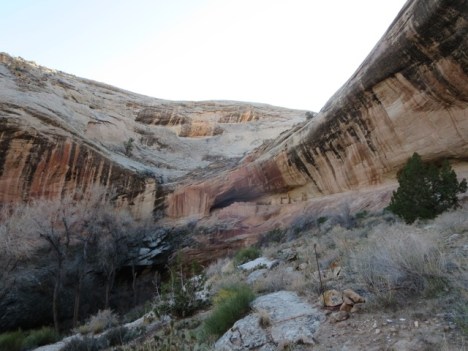
Large extensive alcove run

View of ruin approach.  The ruin is right at this large pour off, difficult to access purposely for defensive purposes

View of ruin approach. The ruin is right at this large pour off, difficult to access purposely for defensive purposes.  You can see the ruin on the right side.  The left side of the pour off has a small alcove with handprints and grinding stones, below.

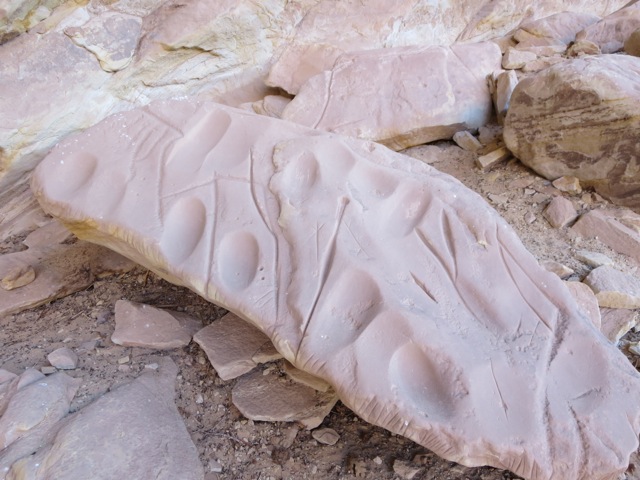
Corn grinding stone.  A common site within dwelling areas.

Corn grinding stone. A common site within dwelling areas. Also cuts where axes were sharpened
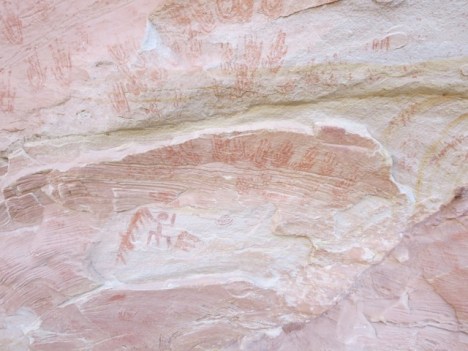
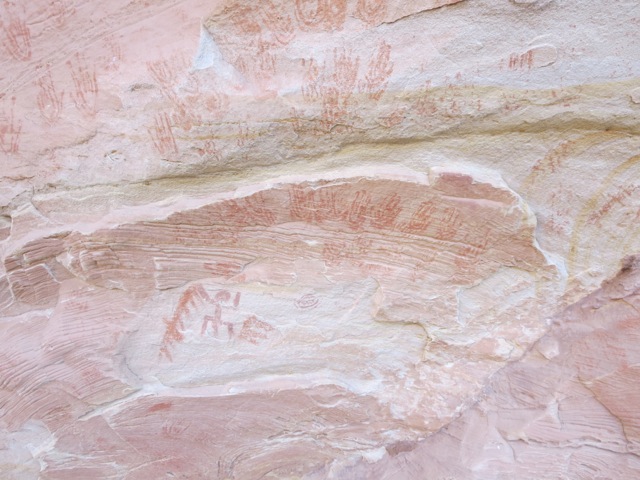
I fantasized that women were grinding the corn, and when their hands got too muddy with red clay, here they went to clean them off.  Many handprints also had the familiar spiral inside

I fantasized that women were grinding the corn, and when their hands got too muddy with red clay, here they went to clean them off. Many handprints also had the familiar spiral inside

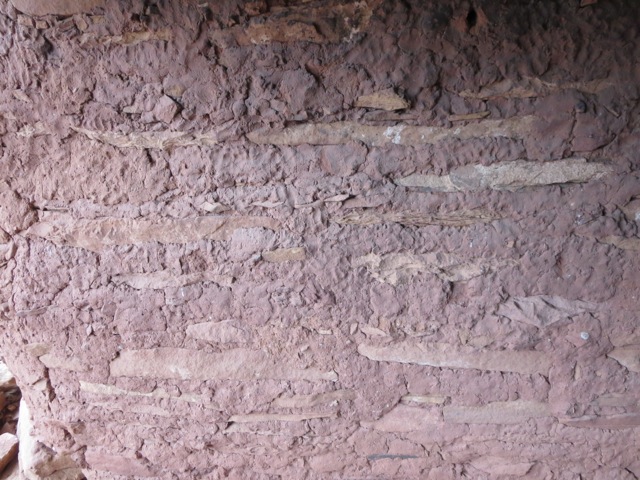
I took a lot of photos of walls.  I know something about building stone walls, having designed many and used many masons in my work.  These walls were very well-constructed.  Of course!  They’ve lasted over a thousand years.  Some built more meticulous than others.  Granaries could be quickly constructed, while housing was finer work.  Stones were honed for corners.  Although most of the finish has worn off, one can still see in places where plaster was applied so that the end product hid the stone work.

This interesting structure was obviously a kiln
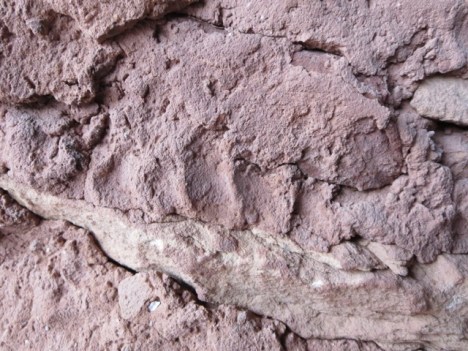
This interesting structure was obviously a kiln

Fingerprints are common to be seen on the plaster and mortar work.  If this doesn't connect you with the people who did this work, nothing will.

Fingerprints are common to be seen on the plaster and mortar work. If this doesn’t connect you with the people who did this work, nothing will.

Here the plaster is still visible

Here the plaster is still visible

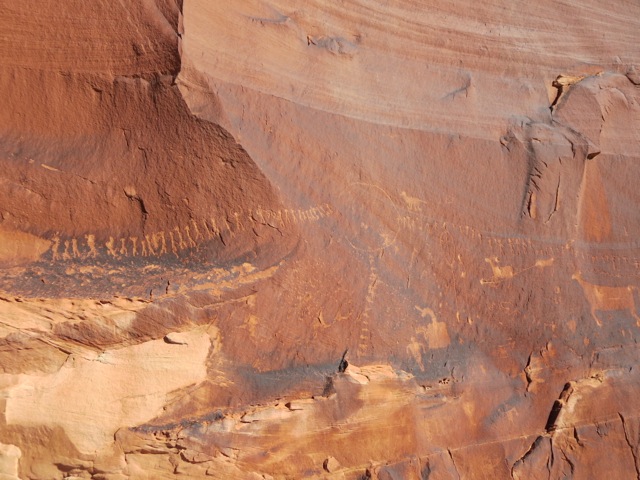
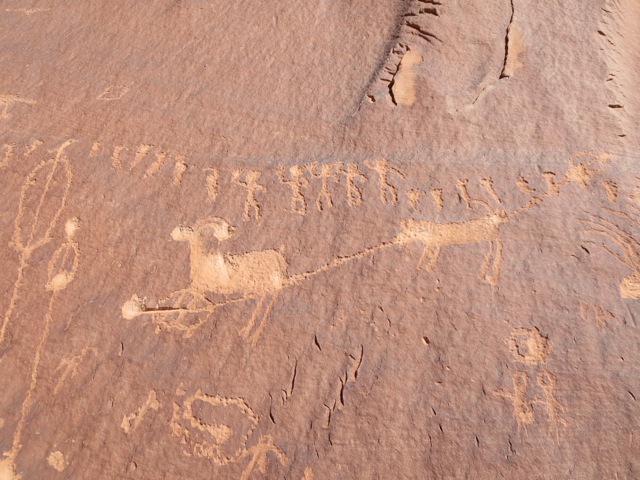
And there’s so much more to Cedar Mesa area–the petroglyphs and pictographs.  I took hundreds of photos of writings at many different sites.  Seeing so many, I still could not come up with why some sites were picked for writings and others not.  There are plenty of perfect patinas for drawings that are empty.  Petroglyphs of course were not done in just one period, but a site may contain pictures that span hundreds of years.  I found drawings in home dwellings, and more elaborate ones at the very top of a ridge line (on Comb Ridge i.e. the Processional).
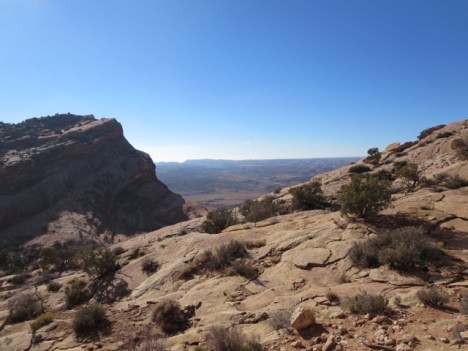
The location of this artwork.  This is at the very top of Comb Ridge with a view to the San Juan River miles below

The location of this artwork. This is at the very top of Comb Ridge with a view to the San Juan River miles below

A more macro view of the story

A more macro view of the story

This is a small piece of a very large story called The Processional

This is a small piece of a very large story called The Processional 

Petroglyphs seemed to be at prominent places, like when we hiked down to the San Juan River to a wall with thousands of glyphs.  Perhaps this was a crossing place, a signpost for travelers telling them about the game or where to go; maybe it was a vision quest site; or a rock that marked territory. Some of the sites are astronomical indicators and these have been documented.    I suspect that glyphs contained all these elements depending upon the site.  One thing that becomes obvious quickly:  white people write their names and dates; native peoples were telling stories about the land, the landscape and the animals.  “As if the Land owned us”  says a Ute Indian.

This was my third year of exploration in the Southwest.  I highly recommend reading House of Rain by Craig Childs if you are going.  It helps to put this great history into perspective.  But it wasn’t until I went to Chaco Canyon that the Four Corner Regions all knitted together into an amazing historical tapestry.

Chaco is our greatest preserved heritage in the United States and so few people have visited it let alone know about it.  Frankly, I didn’t either.  But once I saw it, I understood so much more about the multi-cultural groups bundled together as the Anazasi than ever before.  Chaco was at its height around the 10th-11th century.  A massive undertaking of architecture in the middle of the desert, the Chachoans built huge kivas and ‘pueblos’.  Pueblo Bonito alone has only had 3 acres excavated and they suspect there are over 6 acres.  And there are many many more structures here, all aligned astronomically, all built by the finest builders of the land.  Chaco is a ritual landscape, a landscape of spirit lines, where geography and the spirit world combine through astonomy.

Yet so few people actually lived here, less than 6,000 at most.  Bins of turquoise, corn from 100’s of different regions, feathers of exotic parrots from the tropics, were found.  This was a place of opulence where probably a few priests and caretakers lived.  Goods came in, but not out.  People today have no words nor concepts for that.

The buildings were not built all at once, but over hundreds of years and changed over time.  Great roads over thirty feet wide and so perfectly straight they could have been engineered today fanned out across the landscape.  If the road came to a cliff wall, they didn’t go around but build steps straight up to the top.  These wide roads, sometimes lined with crushed potsherds, connected to Great Kivas hundreds of miles away.  They recently found one from Chaco to Bluff.

Although they don’t know what Chaco really was, if you go there when its quiet, like I did, you can feel a lot.  Chaco was a great spiritual center; it was the Heart of the Anazasi, where pilgrimages were made, maybe annually or bi-annually.  Maybe just once in a lifetime.  And when you went, you brought your gifts of corn.  Maybe you stayed a bit, especially if you had spiritual prominence in your smaller community, or did a spirit quest.  One can imagine great celebrations and games taking place.

Unique corner window where the light shines through perfectly on the winter solstice

Unique corner window where the light shines through perfectly on the winter solstice

Exquisite walls by master builders at Chaco could be over 4 stories high
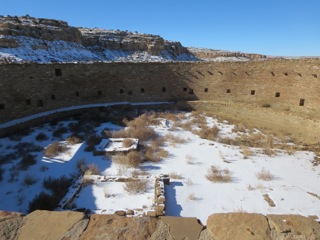
Exquisite walls by master builders at Chaco could be over 4 stories high

IMG_0299

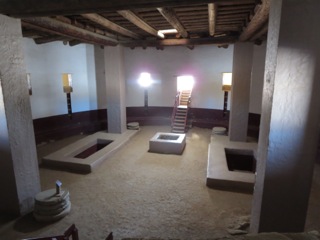
This is a kiva at Aztec Ruins that was reconstructed.

This is a kiva at Aztec Ruins that was reconstructed.

The largest Kiva at Chaco could house hundreds if not a thousand people

The largest Kiva at Chaco could house hundreds if not a thousand people

Yet Chaco began to decline, and was no longer the center of trade, commerce, and spirituality somewhere around the early 1100’s and the center moved north towards Aztec.  And although drought gripped the region in the late 1200’s, that no longer is the sole reason archaeologists suspect for the regions abandonment.  To wander around Cedar Mesa, Mesa Verde, or Hovenweep, it becomes obvious these were a frightened people–building in the most defensible and inaccessible places.  Hovenweep with its unique towers is the epitome.  The towers are placed at the heads of drainages, protecting their precious water.  Cannibalism, decapitations, and other extreme violence is evident in these late periods.  Cedar Mesa may have held some of the last hold-outs.  Why this happened and what was happening, we’ll never know.  But more than drought was going on as this was a land of droughts and people had been living here for thousands of years.

Apart from the specifics of its history, my question when I finally visited Chaco was why are we not teaching this in our American History books to our school children?  Why does our history, still, after all these years of increased social awareness, begin with Columbus and. at the most, only a nod to native peoples who were here before Europeans?  Is it because we are committed to the United States being only an idea:  the idea of freedom and democracy? Is that what we have decided binds us, and so that is what we’ve decided we’ll teach?

America is not a concept.  It is the Land and the landscape as well, and if we are to be a people connected to Place, then we must learn about Place and how ‘the land owns us’.  And although the Anazasi migrated south, and are today’s Hopi, Zuni, and Puebloans by culture and blood, they are still part of the heritage of our America, our Place. And a Great One; one that we can learn from.   By excising this history from our studies, we divorce ourselves off from the long history of our Land and its peoples here.   I feel that if our youth integrated these ancient histories as their own, we would all come to cherish not only the ruins that remain, but the Land itself and our connection to its preservation.
Cave

Muskrats

I spend a day a week working at the Cody Museum of the West in their lab preparing specimens.  We don’t kill any animals for specimens.  They are brought to us having died in various circumstances.  Some hit by cars; others maybe hung up in fences; in a few circumstances they were caught in traps intended for other animals.   Several years ago I was given a muskrat to prepare.  Apparently this poor muskrat was the victim of a man who didn’t know much about wildlife. The muskrat had gotten into his irrigation ditch; the owner saw the muskrat and killed him, thinking he was a dangerous animal.  You might call this ‘the killing reflex’ that some people have towards the unknown.

Muskrat or musquash

Anyways, I was able to handle this interesting animal that we rarely see.  And what stands out is that half their body length is their scaly tail, which is slightly flattened vertically.   Muskrats are not rats at all, but they are in the rodent family.   The ‘musk’ part of their name is appropriate though because they do have a scent gland which they use to mark their territory.   Beavers are our largest rodents, and muskrats would run second.  ‘Musquash’, (or moskwas) a Native American term for muskrats, might be a more appropriate name.  Muskrats play prominent in Indian legends, including many tribes creation myths.  In some tribes, muskrats taught the people how to build lodges and were clan animals; in others they are considered lucky and bestow wealth and hunting success on humans who treat them well.  Muskrats were thought to tell when winter was coming by observing when they built their houses.

Muskrats are aquatic animals, but unlike beavers who spend time on the land cutting trees, muskrats spend all their time in the water, or in burrows they make right at the water’s edge. They are important wetland animals as they eat vegetation, thus keeping the wetlands open and providing suitable habitat for birds.  They also are an important prey species for fox, coyotes, mink, eagles and hawks.  

I decided I wanted to get to know these critters a bit.  Up the road about 15 minutes there’s an area of 700 acres of wetland with a 10 acre swamp.

Over 700 acres of wetland lies beneath these cliffs

Over 700 acres of wetland lies beneath these cliffs

I headed there and explored some shallow ponds of the north side first.  When I didn’t see any muskrat evidence, I began exploring the large and extensive swamp on the south side of the road.  Right away I discovered 4 or 5 ‘homes’ close together, sometimes called ‘push-ups’.

Close up of a constructed house.  These don't last more than a season usually

Close up of a constructed house. These don’t last more than a season usually

Muskrats are not quite the builders like beavers but they can make houses of reeds and grasses which they use in winter.  These houses were in a smaller pond, near the shore which was beginning to freeze up.  In the large and extensive swamp nearby I could only locate 2 or 3 houses and this was perplexing, given how much acreage there was and I’d read how territorial muskrats are.  For some insight I began communicating with Bob Arnebeck, a naturalist back east who has extensively studied his local muskrat and beaver population.  I wondered if, because the large Swamp still had open water, the musquashs had no need to build homes.

Muskrat house near shoreline.  Note frozen water

Muskrat house near shoreline. Note frozen water

Bob thought this might be the case and that Swamp Lake could be too deep for push-ups (at least for now since its not frozen), that muskrats build in shallows and try to get it done before the freeze-up, and that open water in winter would be a great time to actually see the animals. He also thought that muskrats might not be quite as territorial in winter, which would explain why I saw these houses so close to each other.  Bob speculated that the muskrats might even use the numerous push-ups as a kind of ‘shell game’ for predators that explore them in the winter.   In frozen ponds, the animals are rarely seen except for their frozen bubbles under the ice, or where a mink or fox has gone out to explore their homes.

This winter, when it finally really comes, I plan to spend time out in the swamp area and see the stories the tracks in the snow can tell.  I’ll be reporting back, hopefully learning a lot more about these elusive creatures.

Fox

Here’s the fox video for those who couldn’t see it through facebook