• MY BOOKS ON WILDLIFE, GARDENING AND MORE

  • The Wild Excellence

  • True stories of wildlife encounters around the Greater Yellowstone
  • Award winning eBook on Decomposed Granite, tips, how to's, what to watch for
  • Children's book. True stories of a dog and wolves. In a dog's voice
  • Written for dry Mediterranean climates in California, north and south

The Red Desert and Healing Herbs

Last year in June I went on a field trip with John Mionczynski to the Red Desert. John is a well-known biologist and expert botanist on medicinal plants. He probably knows the Red Desert better than anyone, having lived nearby for most of his life and explored it deeply. I’d been previously to the Red Desert for a one day exploration. The Red Desert is the most isolated and remote desert in North America. It’s home to wintering elk and pronghorn, petroglyphs, Oregon Trail wagon ruts, vast pristine sand dunes and unique badlands made of petrified turtle shells and petrified wood. There’s no cell coverage, no electric or phone lines, with a pristine quiet that takes you back in time with a glimpse of what life was like in pre-settler days.

The badlands of the Red Desert
John explains petroglyphs in the Red Desert
Some of the varied topography of the Red Desert

But that’s not what this post is about. The trip was organized by Benjamin Clark, owner of American Wilderness Botanicals out of Lander, Wyoming. During the weekend trip I had a chance to talk with John about what plant medicine might be useful for me since I had breast cancer a few years back. After going through chemo etc. I had decided not to take the drugs that suppress one’s estrogen production, drugs that have a lot of side effects and are recommended for up to 10 years after treatment. Instead I was consulting with a naturopathic doctor who gave me quercetin supplements. John recommended I harvest and dry fireweed, taking it as a daily tea. Fireweed it turns out is not only high in quercetin but also in oenothein B. John told me that elders in native local cultures used fireweed tea as a daily general tonic.

Fireweed in bloom. Best to harvest when in bloom. Discard stems after drying

Since the ’88 fires came down into our area, we have an abundance of fireweed. I spoke with Benjamin who was looking for a supply for his essential oil production and we made a date for him to come up for a harvest. In addition to fireweed, Ben was able to procure Artemisia frigida, Fringed Sage. I harvested about 6 large bundles, hung them to dry, then took the leaves off and discarded the stems. The tea is very pleasant. Six bundles have lasted me a year, until my next harvest this summer.

Ben told me how he distills the fireweed:

“I loaded the still this morning and am soaking the fireweed in cold water today.I’ll be distilling the fireweed either tonight or tomorrow morning. I steam disinfected the still prior to loading the fireweed”

Steam disinfecting the distiller
Finished product processing

“This Fireweed is so good and the aroma is so sweet with a lot of depth.”

In the fall I drove to Lander to visit Benjamins distillation set up in person and help him harvest osha root. We went up Towgotee pass and harvested Lodgepole Pine boughs for a hydrosol along with the osha root.

I knew that at one point John had cured himself of Lyme disease using herbs. Somehow his successful treatment was shared on the internet and now Ben is shipping herbs and the lyme treatment protocol throughout the United States. This includes Osha and Fringed Sage taken in a specific order.

I’m looking forward to gathering and drying fireweed this summer for another year of tea and health.

Sign in the Red Desert

What do Americans find Sacred? Bighorn Sheep, the Winds and Selenium

The Light in High Places. Wow, this is a great book by Joe Hutto.  I love the Wind River Mountains so I took this book from the library with that in mind.  But I was surprised how beautiful and poetic Huttos’ prose is.  Although a trained biologist, Hutto is a fantastic writer who expresses his feelings in a rhythm that is natural to Wyoming and close to the pace of the high country of the Winds.

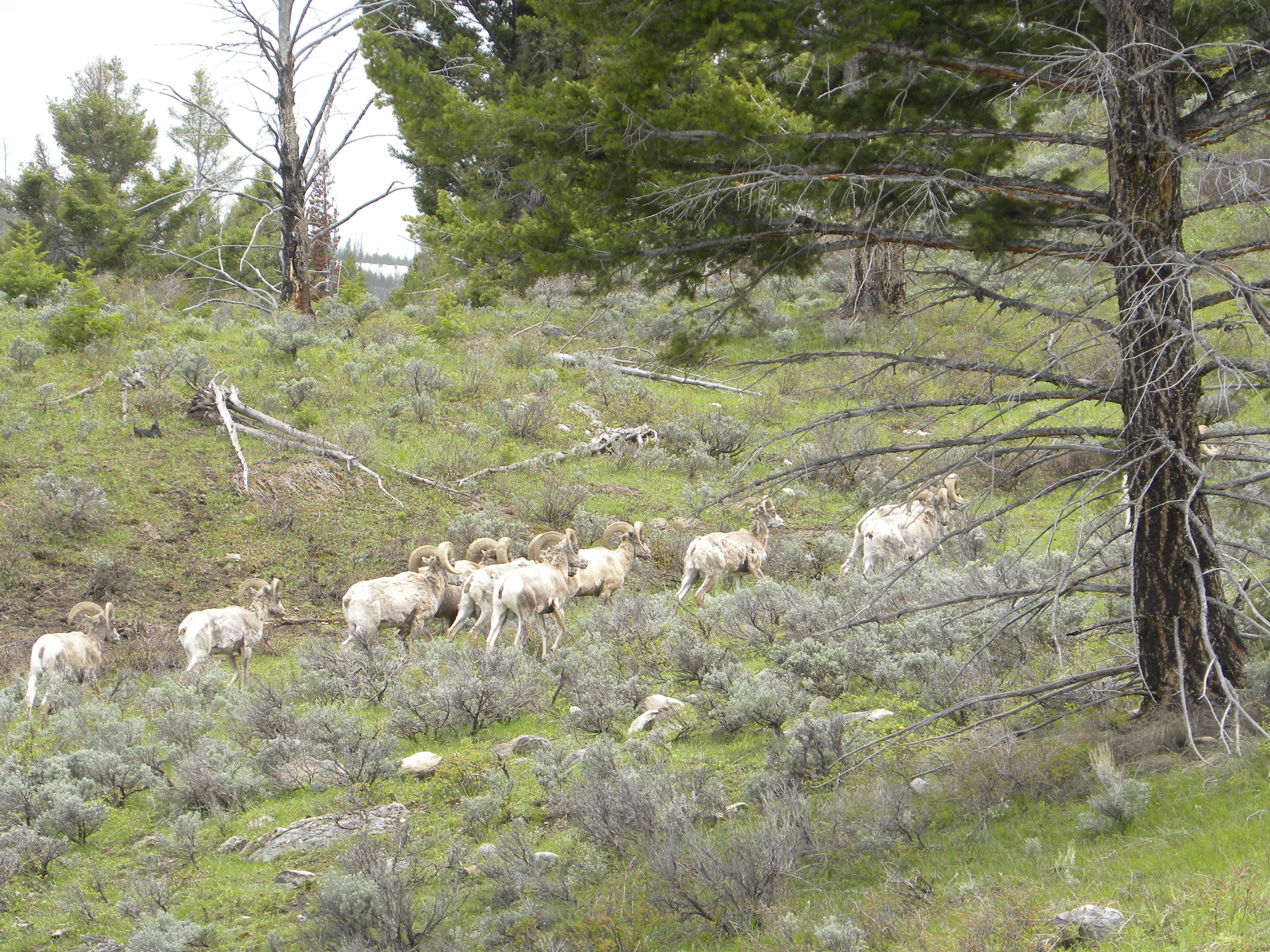
Hutto teams up with John Mionczynski (who has been studying the Bighorn Sheep of Whiskey Mountain since the 70’s) to understand more fully why our native Sheep are in so much trouble.  Starting sometime in and around 2001, he spends his summers living high up on Middle Mountain, in a tent, above timberline at 12,000′, alone.  He sets up rainfall catches, watches ewes, lambs and rams all day, encounters bears, wolverines and a lone black wolf.  He comes to know, summer by summer, each sheep by sight, is accepted by them as almost another herbivore who can mingle among them, and fully describes what its like to live in this rarified environment day by day.

The middle of the book digresses and describes Hutto coming to Wyoming in the 70’s.  He lived on Red Canyon Ranch and worked cattle before the Nature Conservancy bought it; rode and hiked all over the area around Lander and the southern Winds; and tells some wonderful tales of iconic cowboys he knew.

Strangely enough, Hutto and Mionczynski’s findings about Bighorn Sheep were not what I supposed. Although the sheep are vulnerable to domestic sheep diseases, the difficult and puzzling downhill plight of the bighorn sheep is not so simple as exposure to domestics.  The Whiskey Mountain sheep herd do not come in contact with domestic sheep yet their numbers are shakey.  Why?  Many ungulates need Selenium to stay healthy.  Ewes that have experienced selenium deficiencies as lambs will tend toward early mortality, contributing fewer lambs to the herd.  Young lambs require relatively high doses of Se to avoid a form of nutritional muscular dystrophy.  The lamb’s body mines the bones in search of Se when there are deficiencies, causing the lamb to become weak, crippled, have a weakened immune system, and predisposing it to pneumonia and other diseases, as well as predators.

So, what is suddenly causing this lack of Se in these high pristine environments?  Hutto’s answer, from their research, is acid rain.  The rainfall is so acid all summer long, between 3.8 to 4.2 (normal should be on the side of slightly acidic side of neutral which is 7.0), that this in turn changes the soil chemistry which changes the uptake in minerals and nutrients in the surrounding vegetation.  In Hutto’s words:

“The term acid rain is a simplistic epithet that in reality involves not merely a good dosing of nitric or sulfuric acid, but also a veritable witch’s brew of accompanying chemistry including the entire spectrum of heavy metals resulting from fossil fuel and other industrial emissions.  Each time a drop of water falls, these mountains are being doused with a chemistry that includes not only acid in the form of nitrate and sulfur compounds, but could include mercury and other toxic elements that can continue migrating up the food chain.  It is the snow, rain, and glacial meltwater from these mountains that feed the Wind River in its entirety, and the Wind River in turn fills the Boysen Reservoir…”

Are they the 'canaries in the coal mine'?

Supporting their theory was the fact that when a long term drought came to the Winds in the mid-2000’s, the herd became healthier and produced more healthy lambs.  Less acid rainwater, more normal levels of selenium in the surrounding vegetation.  Yet drought also produces less available water in these high places.  A vicious cycle.

This book is science and beautiful prose, but mostly it’s Hutto’s expression of his love for Wyoming, its wildness, and the sheep.  You will not be overwhelmed by facts and figures, but his easy personal style will draw you in.

“Because of the oil and gas boom, formerly protected areas are being opened to new roads and drilling.  Most disturbing perhaps in our immediate vicinity is the opening of formerly inaccessible areas of the Red Desert by the Bureau of Land Management to new drilling operations in spite of the objections and desperate cries of the concerned residents of Wyoming.  The Red Desert is not only the highest desert in North America but a great fragile expanse characterized by a multitude of unique geological, ecological, paleontological, historical, and prehistorical features.  The greater Yellowstone ecosystem, the Wind River Mountains, and the Red Desert are the richest and most environmentally diverse expanse of wilderness left in the lower forty-eight states–the jewel in the crown of American environmental conservation.  Any large-scale industrial development in this remaining wonder of the natural world that contains meager petroleum reserves can only beg the question, What in fact do Americans find sacred.”

Hutto and Mionczynski’s preliminary findings are a warning to all Americans and especially to those of us who live, play and work here.  We live here because of this incredible Land that we love and its wildlife.  Just in my area, politicians are pushing the BLM to open the entire Big Horn Basin to oil and gas drilling.  Right now, we have a healthy Sheep herd in the Absaroka-Beartooth Front. Here’s another reason to rethink this kind of avaricious planning.