

Here’s another video of that wolf. Be patient till about 20 seconds when he comes and checks out the camera for a real close up.
Filed under: New ideas | Tagged: Wolf, Wolves | Leave a comment »


Here’s another video of that wolf. Be patient till about 20 seconds when he comes and checks out the camera for a real close up.
Filed under: New ideas | Tagged: Wolf, Wolves | Leave a comment »
I had my trail camera focused on a road killed jackrabbit. A marten spent two days trying to get it down. Then a coyote came bye, the marten scrambled up a tree, and the coyote pulled it from where it hung and devoured it.
Four days later, this wolf came along to investigate the scene of the crime.
Filed under: New ideas | Tagged: Wolf, Wolves | Leave a comment »
With wolf hunts now taking place in all three states around Yellowstone, new issues are coming up. Although Montana and Idaho had a hunt last year, this fall is Wyoming’s first wolf hunt.
At least 10 collared Yellowstone Park and Grand Teton wolves have been killed in this years’ hunt, and more than half of them occurred in Wyoming. The last collared wolf killed was taken in my area, hunt area 2, and she was the eighth wolf and so closed the zone. And this wolf, wolf 832F (F for female), dubbed ‘o6 by Park wolf watchers, was perhaps the most famous wolf in the world, and most loved. She’d been highly visible in the Lamar Valley since she was born in 2006, and was the alpha female of her pack.

’06 this summer hightails it away from Molly Pack
Last spring on a May morning I went to the Lamar and watched her with her son try and scare a grizzly off a dead bison. On the other side of the grizzly were two wolves of Molly’s Pack, a formidable pack in the Park that had been threatening to kill 06’s pups. Another wolf from the Lamar Pack, 754, was shot in my hunt zone in November. At least 2 collared wolves from Grand Teton have been shot, and there’s speculation that as many as 13 uncollared from GT have been taken in the hunt.
’06’s death has been highly publicized all around the world, from PRI to European newspapers. People from all over the world watched and knew ’06. In response to public opinion, Montana, who is about to begin their first wolf trapping season, has created a buffer zone around the Park’s northern border. Just for this hunt/trap season only. Next year is a different story perhaps. Although Idaho’s wolf hunting and trapping season is almost endless, the expansive Madison Valley sits in the way of many wolves migrating from the Park in that direction.

’06 swims the Lamar river, emerges onto the road right in front of tourists.
Wyoming is another story. Most of the Park is in WY, as is all of Grand Teton. 85% of the state has been approved by the Obama administration as a predator zone which means shoot on sight (or trap, or bait, or whatever) anytime, anywhere. So the managed hunt zone, called the Trophy Zone, is essentially the ‘buffer’ zone around the Park. With the loss of so many study wolves, is the era of Park research over? And with the hoards of wolf watchers habituating these wolves to a benign human presence, is the era of wolf watching in the Park about to change? Will it be harder to see wolves in the Park? And will that bring in less visitors? And should Wyoming manage their ‘buffer zone’ around the Park with Park research in mind?
I can say that my zone, hunt zone 2, had the highest quota of all the zones. If you take zone 2 and 3 together, they make up the entire Absaroka eastern side of YNP, with a quota of 16 out of 52 wolves. This is a rich area for genetic exchange, mostly Shoshone designated wilderness area, and wolves travel frequently in and out of the Park in this area following their prime food, elk. Those two areas alone, which are a prime buffer zone, make up 1/3 of the state’s quota for 2012!
Hopefully ’06’s death will bring some good and highlight what is wrong with the hunts the way they are managed now.
First, the quotas of 100 wolves and 10 breeding pairs per state was set a long time ago when no one knew how wolves would adapt to the Rocky Mountains. Although Montana is setting their own quota at 400, Idaho which has prime territory and over 70% federal lands, is in a frenzy to eliminate wolves, hunting and trapping 10 months of the year with no quotas. Wyoming, which has few wolves outside the Park, before the hunt it was around 230, is not only mostly predator status, but is also eyeing that 100 mark as their quota. These quotas are simply ridiculously low for the amount of good habitat and prey. Wyoming in many areas is trying to reduce their elk counts by giving hunters numerous tags, but at the same time reducing the predator that could do that job in a better, more effective and selective manner.
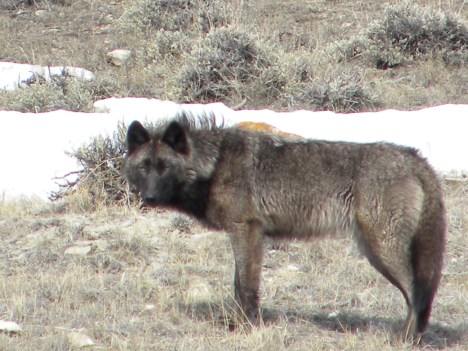
This wolf, from my valley, was by the road two years ago. With the hunts you will no longer see wolves so easily
Second, trapping is simply anathema to the 21st century. It is cruel and poses dangers to not only other wildlife, but to pets. Pelts are sold mostly to the Chinese market, which enrages me more. This is what happened with our beaver and bison in the 19th century, when European demand had hunters and trappers eradicating our wildlife for hats and coats. Wildlife as a commodity is simply wrong, just as human trafficking is.
Third, until the predator status is changed so that all of Wyoming is designated trophy status, the Trophy zone around the Park needs to be changed. Quotas in sensitive areas right around the Park need to be decreased, hunt zones readjusted, and hunt times changed for each area. Instead of hunting the entire trophy zone Sept or October through December, zones near the Park need to close earlier as the elk begin to come down from the high country and the Park wolves follow. Once Wyoming predator status is eliminated, wolf hunts should take place only in areas where there are conflicts with ranchers, not in areas with no conflict and lots of wilderness.
Finally, personally I disagree with hunting predators–wolves, coyotes, foxes, cougars, bears, martens, you name it. Being able to shoot a predator that is eating your sheep or cattle is one thing, hunting them for sport is another. On the other hand, just seeing a wolf or coyote passing your property doesn’t mean they’re going to cause trouble; and ranchers who are far-sighted and conscious are trying new methods for protecting their flocks and herds. Yet that being said, for now the delisting not only calls for a hunt, but in the short run of the next ten years, it may be the only way to quiet the loud and contentious opposition to wolves. Let’s just not undo all the good hard work that brought them here over these last 15 years.
If you want to comment and have your voice heard on the wolf situation in Wyoming, here is a link. Wyoming wolf hunt

Two wolves side trot down the road
Filed under: Wolf | Tagged: Grand Teton National Park, Lamar wolf pack, montana wolf hunt, nature, Wolf, Wolf '06, Wolf 832F, Wolves, Wyoming wolf hunt, Yellowstone National Park | 3 Comments »
I have been randomly calling the Wyoming Mortality Hot Line or going to the online link to find out how many wolves have been killed (let’s not call it by the euphemism ‘harvested’). I am especially interested in my Area (area 1). As of today, 3 of the quota of 8 have been taken.
Today, I just found out that one of those wolves was the yearling pup I’ve seen many times over the last year.

Yearling pup this spring
He was born a year ago spring. I first saw him with his mom last fall. She is a black alpha female (not sure if she’s still around) and she was harassing a cow as her pup tried to help. The cow didn’t run, but just kept turning around and chasing her down. Finally she gave up. If prey don’t give chase, wolves usually get confused. They can too easily get kicked and hurt by confronting large prey from in front.
The pair seemed inseparable and the next time I saw the pup was around January. He was with his mom loping up a nearby ridgeline. Mom turned, looked, and sprinted off. But the yearling was curious and watched me for awhile. We shared a moment from afar on that cold winter early morning.
The last time I saw him was this spring. I was hiking down a draw, following a cougar track. Koda lagged behind. I was above a creek on a thin deer trail when I spied something odd behind a tree about 20′ ahead. I stopped and his grey head peeked out. He’d been curious, watching Koda and I. When he saw that I noticed him, he ran off to join his mom in the meadow a few hundred yards away. I sprinted up beyond the trees to catch a glimpse again of the Alpha female. (I was able to snap the photo below of her). She eyed me warily for a bit then took off with her pup.

Alpha female; mom of yearling pup killed this week
Last spring I went to a WY G&F information meeting about the hunt. It was clear that it would go through, starting this October 1. The quotas were already set, with my area having the largest. Immediately I knew that this curious youngster would be amongst the first to die. Wolves have been hunted by helicopters around here for years, but not by hunters on foot. Although these wolves were wary, they were not yet scared of humans. The opportunity I’ve had over these last seven years to see wolves over and over again fairly close (I’ve had at least three occasions where I’ve seen wolves 25′ away, eye to eye, both of us curious about one another), has come to a close. It will be better that way for the wolves. Within a year or two of these hunts, wolves will not be seen casually in these parts.
Predators by nature and design must be smart. They need to think and strategize. Wolves cooperate when they hunt and that takes smarts. Prey are given the gift of speed. They look, listen and run. But predators must be more cunning than that.
If you share a moment with one of these magnificent creatures, you realize how intelligent, how full of Life they are. They embody everything that is wild and free. When they look you in the eye, they see right through you, much deeper than you see into them. In the end, though I am saddened by the loss of these wolves in Sunlight, the hot button issues surrounding wolves is not really about wolves at all.
I am reading ‘Shadow Mountain’ by Renee Askins, one of the spearheaders of bringing wolves back to Yellowstone National Park. I highly recommend this engaging, personal and well-written book. I end this entry with a quote from Askins book and a fond farewell to that magnificent and curious pup who shared with me not only his inquisitive nature, but his wild and free spirit.
“It soon became clear that in most discussions wolves merely provided a pretext to talk about much deeper and more personal political views, invariably those having to do with control–control of land and control of animals. Who controlled the “rights” to the animals, who could kill the elk that the wolves would prey upon, who could kill the wolves that killed “too many” elk, who could control which prey species and which predators and where and when and how. In truth, all of it was a discussion about killing and control veiled in the professional shibboleth of “wildlife management.” Wildlife management is, of course, an oxymoron. Animals that are truly “wild” are, by definition, not managed. Yet I would discover…over the next several years a troubling trend toward complete control or manipulation of many “wildlife” populations even within national parks.

Alpha male of the Hoodoo pack
Filed under: Wolf | Tagged: Renee Askins, Shadow Mountain, Wolf, Wolves, wyoming wolf delisting plan, Wyoming wolf hunt | 3 Comments »
A friend of mine stumbled upon a wolf den with pups while shed hunting a month ago. The pups were about four weeks old, he said. Apparently, his inadvertent presence caused the wolves to move their pups to another location, for although I put my trail camera on the den site.
I never saw any activity and only got this one photo of a male wolf returning to the area to investigate.
I waited a month to be sure that the pups were old enough to have left and inspected the site. What a feat of engineering. The den was on a hillside in a small drainage.
The den was essentially a tunnel with an entrance above and below. My dog is 90 pounds and he was big enough to crawl inside the tunnel entrances, but too big to enter the tunnel connector. Here he is for size at the lower entrance.

Koda for size
Although this site had been abandoned for several weeks with overgrown vegetation, it was perfectly clean inside and out. I looked around for bones. There were some deer bones but quite a ways down hill from the den site.

Upper entrance demonstrates cleanliness
I tried to shine a light as far down as I could, but the den tunnel made a right turn downhill and exited at this bottom hole.
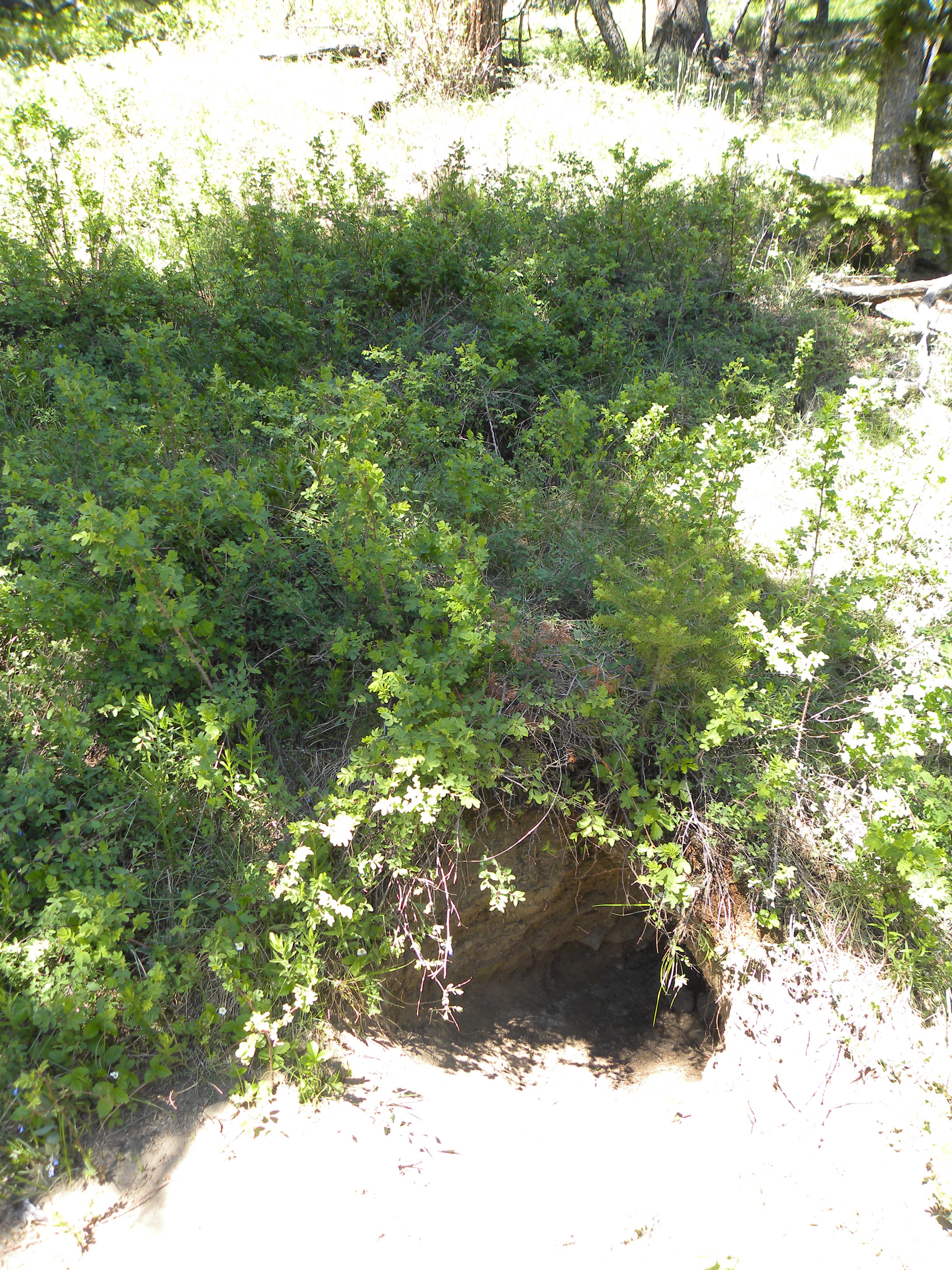
View of lower entrance. Upper entrance is visible directly above
The chosen site was not near an animal trail. In fact, the trail made by the wolves going back and forth to the den was now overgrown. Yet I caught a wide variety of animals on my camera.
Of course, the supercilious coyote appeared several times, even spending a long time peeing nearby on a log. A young black bear ambled bye.
A blue grouse with chicks appeared;
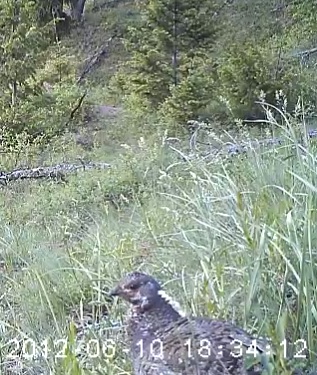
Find her chick!
a cow elk explored the site; and a yet to be identified weasel-like animal that looks suspiciously like a wolverine–all these animals in just a few weeks visited this den site area.
How lucky we are to have such a wealth of animal life in this special place we call the Greater Yellowstone Ecosystem.
Also Read:- Sacred Sites and Mountain Lions
Filed under: Wolf | Tagged: Greater yellowstone ecosystem, Wolf, wolf den, Wolves | 2 Comments »
There is so much wildlife activity in the little piece of woods and meadows next to my home that I don’t need to venture much farther than ‘around the block’. Sometimes just sitting on my front patio is enough.
Besides the nesting bluebirds and house wrens, the red-tailed hawk making its’ rounds, and the pair of Golden Eagles soaring above, there are morning and evening visits from does and bucks in velvet, and an occasional turkey.
But the unseen action is taking place when I’m sleeping. Now I’ve caught two different wolves on my trail camera set up in the woods. On the 2nd of May I clocked this black female passing south early morning.

Solitary female probably from the old Sunlight Pack that was killed off last year by another pack
And now on the 12th I caught another wolf, unknown, heading north almost at the same time in the morning.

first shot from trail camera

Yearling pup from the pack presently occupying the valley
Of course, coyote is always running through the woods so trail photos of him abound.

Coyote. Easy to tell wolf and coyote apart
Usually when I retrieve my trail camera I’m expecting to see dozens of only deer photos so I have been pleasantly surprised. Here’s a nice buck photo.
Lastly though, here’s the most unexpected. Last week Koda dragged me over to some strong smelling scat. It was a large pile on top of an older pile, definitely cat, and I mean big cat. The deer are still low and some must be having their fawns. Of course, this winter I spent tracking a cougar and understanding in greater depth their sign. Yet I was surprised to see that a cougar was this low and so close to the houses. Granted, the summer residents aren’t here yet, but there is the occasional activity still. I made a mental note of where the scat was–on the far side of the woods–but saw nothing else.
Then today while returning the chip to the trail camera, Koda got a sudden urge. I’ve learned to trust his instincts and smeller so I followed him. And not more than 50 feet off trail from my camera was a cat kill. The deer had already been consumed with just its legs left, but there was the tell-tale mound of the formerly covered carcass, the plucked fur, and another smelly scat on top of it all.

Cougars pluck their carcasses. Bears pull the skin back.
I found a jaw of a young deer, although the legs were too big to be a fawn, so maybe this deer had been a yearling. This is the first time I’ve seen cougar sign in the woods or a cougar kill so low. The crazy thing is those cougars are so stealthy that there were no tracks, and besides, my trail camera was almost right there and I didn’t get any photos. The cat, you see, didn’t use the game trail like the Canids and Ungulates do.

Telltale sign of where a cougar covered its’ kill. Plucked fur abounds.
Filed under: Cougars, Wolf | Tagged: Cougars, Wolf, Wolf pictures, Wolves | 1 Comment »
It seems that nature study comes to a person in batches. In other words, what you think you want to study might not be what presents itself.
Last week on my way to town there was a road kill Great Horned Owl. He seemed in good shape so I called the museum where I volunteer preparing specimens and asked if they wanted it. Since they already have plenty of Great Horneds, they passed, but this owl was a sign of what was to be a week full of owls.
The next morning, at 6am, I heard a strange owl call from the nearby forest. I thought it might be a Great Gray, and sure enough, when I listened to its call, it was. He was passing through on his way to a location north of here–maybe Reef creek or even Yellowstone.
The following week at the museum I was given a Long-eared Owl to prepare. The tag said it was found in my area in Sunlight. Her wing was broken and she’d died in rehab. I suspected it had been struck by a car. But when I saw the Game Warden the following day he told me he’d found a Long-eared Owl on the road before the area was opened to the public May 1st.
“That’s the owl I just prepared. Unfortunately, it died in rehab.” I told him. Who knows how it broke its’ wing.

Long eared owl
With all this owl activity, I decided to walk through my nearby woods with the intent of finding a roost. A pair of Great Horneds live there. Last year I watched one being mobbed by a Cooper’s Hawk. Great Horneds are considered the ‘Lions of the Forest’. They eat a lot of different foods, large and small. When I was helping with a Spotted Owl study in California, we learned that Great Horneds kill Spotted Owls. Watching that Coopers Hawk continuously swoop and peck at the Great Horned sitting on a dead fallen log confirmed how tough these owls are. That Great Horned was unperturbed; in fact, he acted like the Coopers was an inconvenient fly.

Great Horned Owl
It didn’t take long before I found a large cache of pellets beneath a dead spruce. The tree even had some owl feathers hanging from a high branch. I threw them all into a bag and brought them home for inspection.

My stash of pellets
Just the week before my boss at the museum, Curator Chuck Preston, put a vole skull under a microscope to demonstrate how to determine its’ species. The secret is to count the middle set of upper molars. One species has four closed triangles while the other species in our area has three.
I dissected all the pellets and found that this owl was feasting on voles. Dozens of voles and just voles were in these pellets. Using a hand lens to see the molars, I determined these were all Montane voles (Microtus montanus).

Montane vole
With over 30 Montane voles in these pellets, there were two other distinct skulls, much larger, and from a different species of vole. This was the Water vole (Microtus richardsonii).
Yesterday on a hike up Tipi Gulch, I came across another Great Horned Owl roost with some recent (seemed like that mornings) pellets. Inside were several Montane voles and one Water vole. Voles must be on the upswing and doing fine here this year. Voles also don’t hibernate and are active at night. Rabbits on the other hand have been scarce.
It was fun, and interesting, to check out what these owls are eating. So much activity in such a tiny forest nearby. Yesterday I retrieved my trail camera that was set up by my spring where I get my water. Look what else is traveling through these woods. As Thoreau says, you can spend a lifetime exploring a twenty mile radius.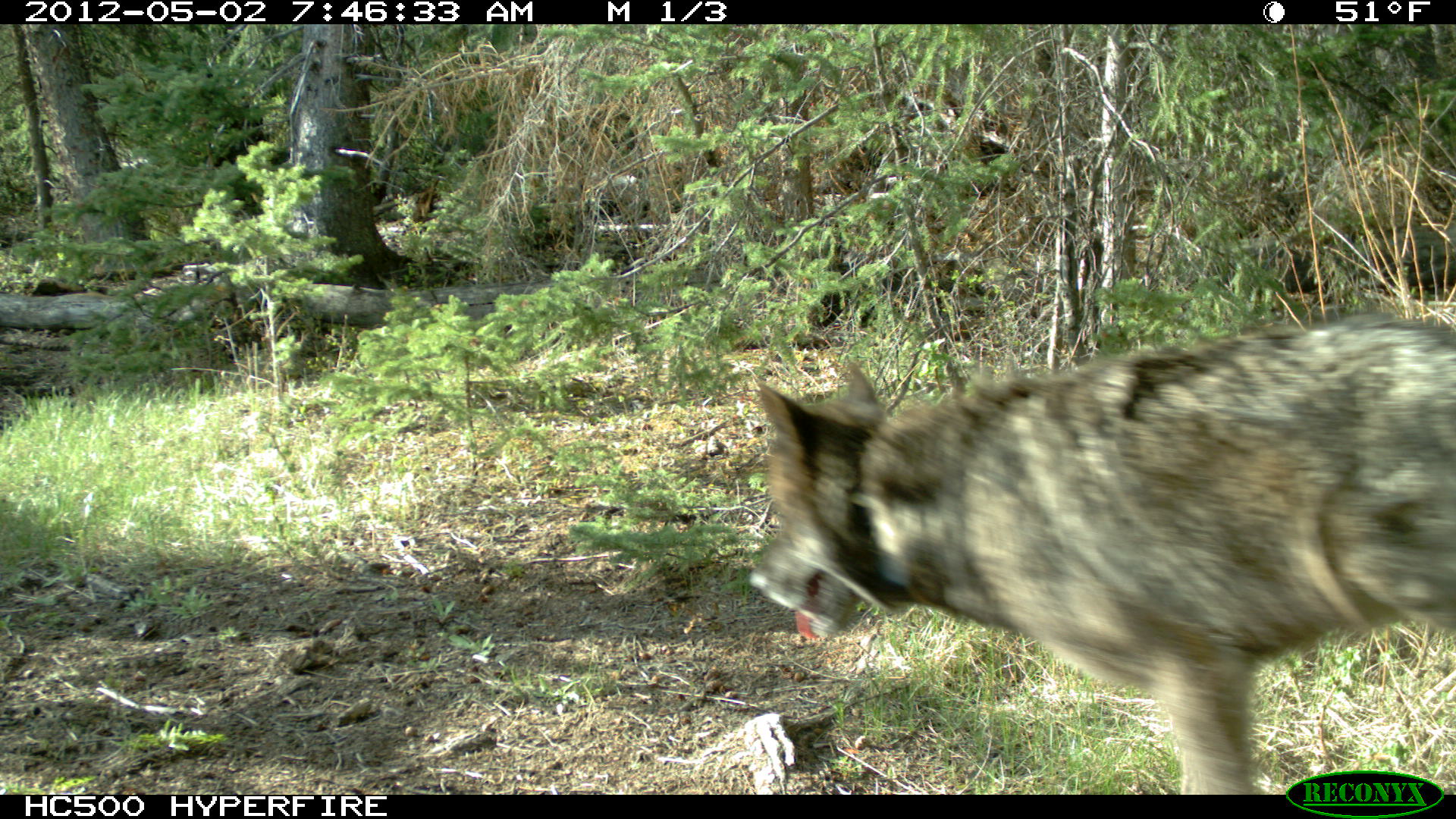
Wolf with bad left hind leg
Filed under: Owls | Tagged: Great Horned Owl, Long eared owl, Montane vole, Owl pellets, Water vole, Wolf, Wolf pictures, Wolves | 1 Comment »

The Plateau
I’ve been hiking the plateau for several days now and, wow, what a lot of wildlife activity is going on there. A few days ago on my first jaunt I ran into a fairly fresh elk carcass. She was a very large and old elk. I’d been seeing lots of wolf tracks on the plateau and of course there were fresh tracks leading to the carcass
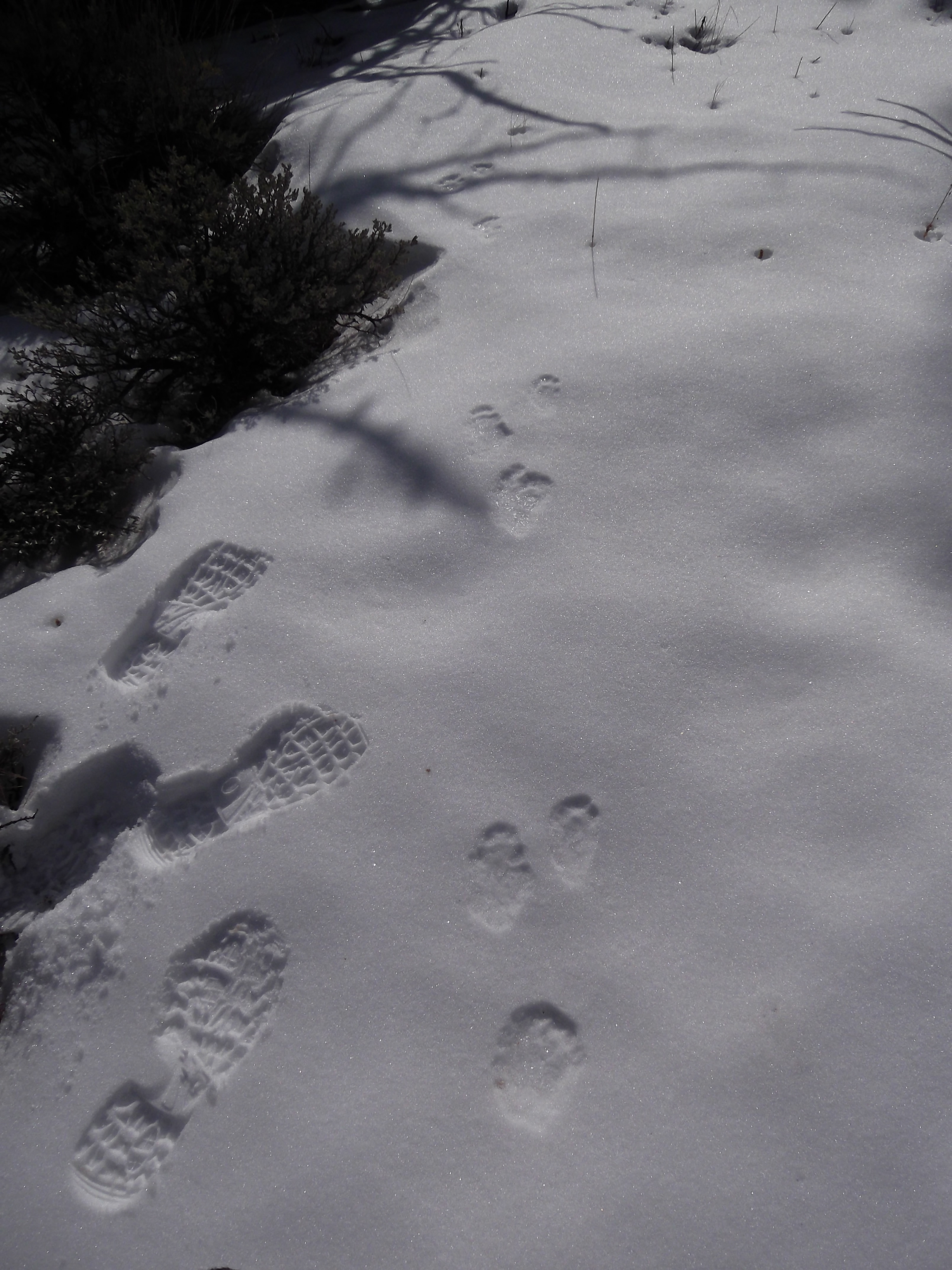
Rabbit prints with my own footprints too
That same day I realized where all the cottontails are–on Dead Indian plateau! The cottontails here seemed active and numerous and here I found and tracked a bobcat hunting them.
Several days later I explored a cliff edge on the plateau that looks out over Sunlight creek gorge. There, on a prominence, were over a dozen Mountain Goats, safely grazing on the edges where no sane predator including humans would go.

But today was a bonanza. There are plenty of deer on the plateau, and although there are elk tracks and other evidence of elk, I haven’t seen any with my own eyes. But I do run into deer occasionally. And with all the granite cliffs and rocks, that makes for perfect cat country. After scrambling up a huge granite boulder, I saw from afar some interesting large tracks that at first glance could be mistaken for wolf. But as soon as I got close enough to make them out, there was no question what they were–cougar tracks. I followed them for a while into a heavy deer area when they disappeared under the blown snow from yesterday. Some of the tracks were perfect ice. Seeing those tracks takes one’s breath away.
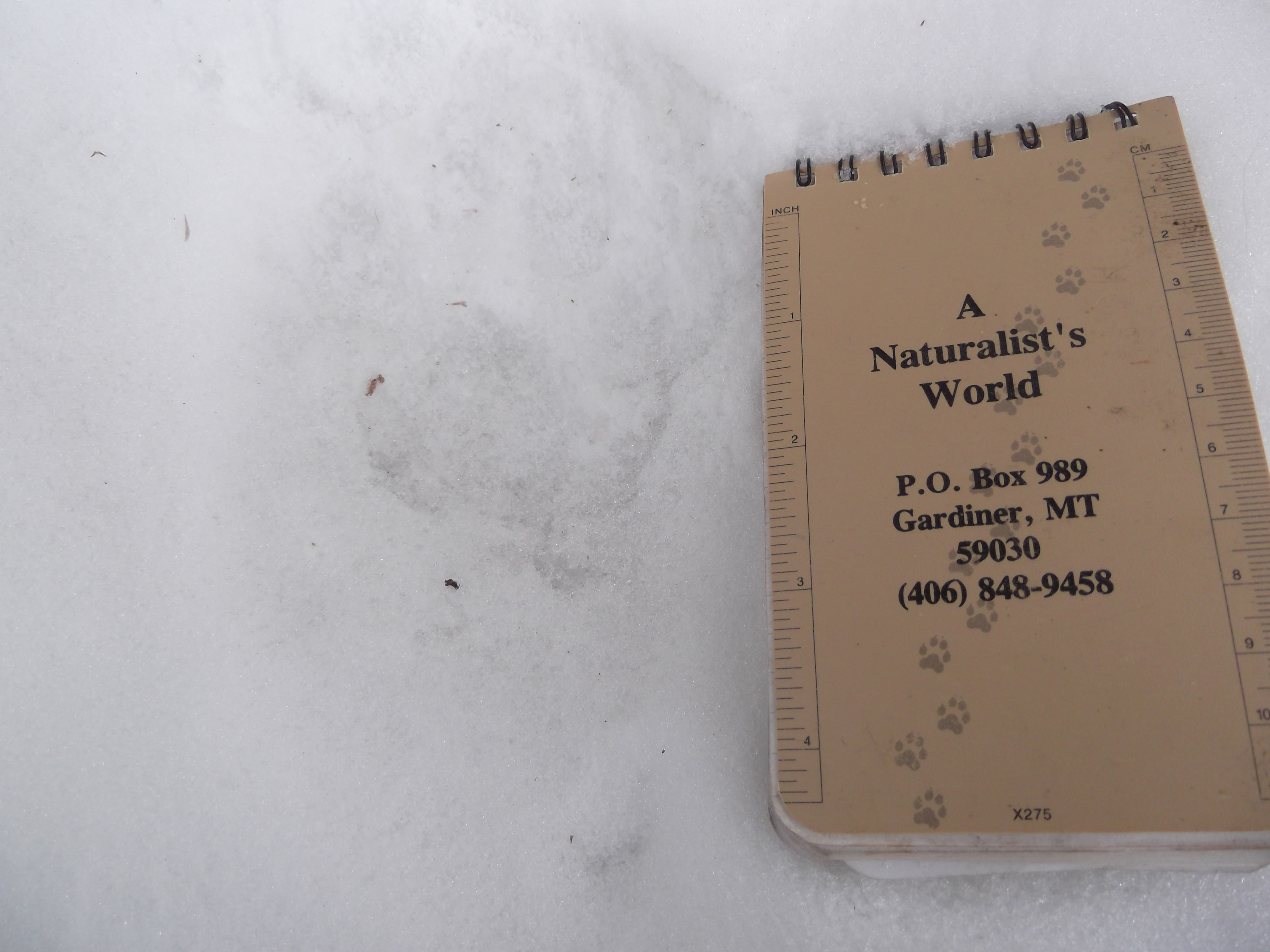
This track measures 3"x3" approx.
It seemed like this cougar was following me, figuratively not literally. As I lost the cougar farther back, I began concentrating on my bobcat that I found in virtually the same location as the other day. He or she was weaving around, obviously hunting again. Here is a photo of where the cat stopped to scratch in the snow. 
Here is a photo of the bobcat in a sit-down in front of a large sage brush. Obviously something caught his attention there.
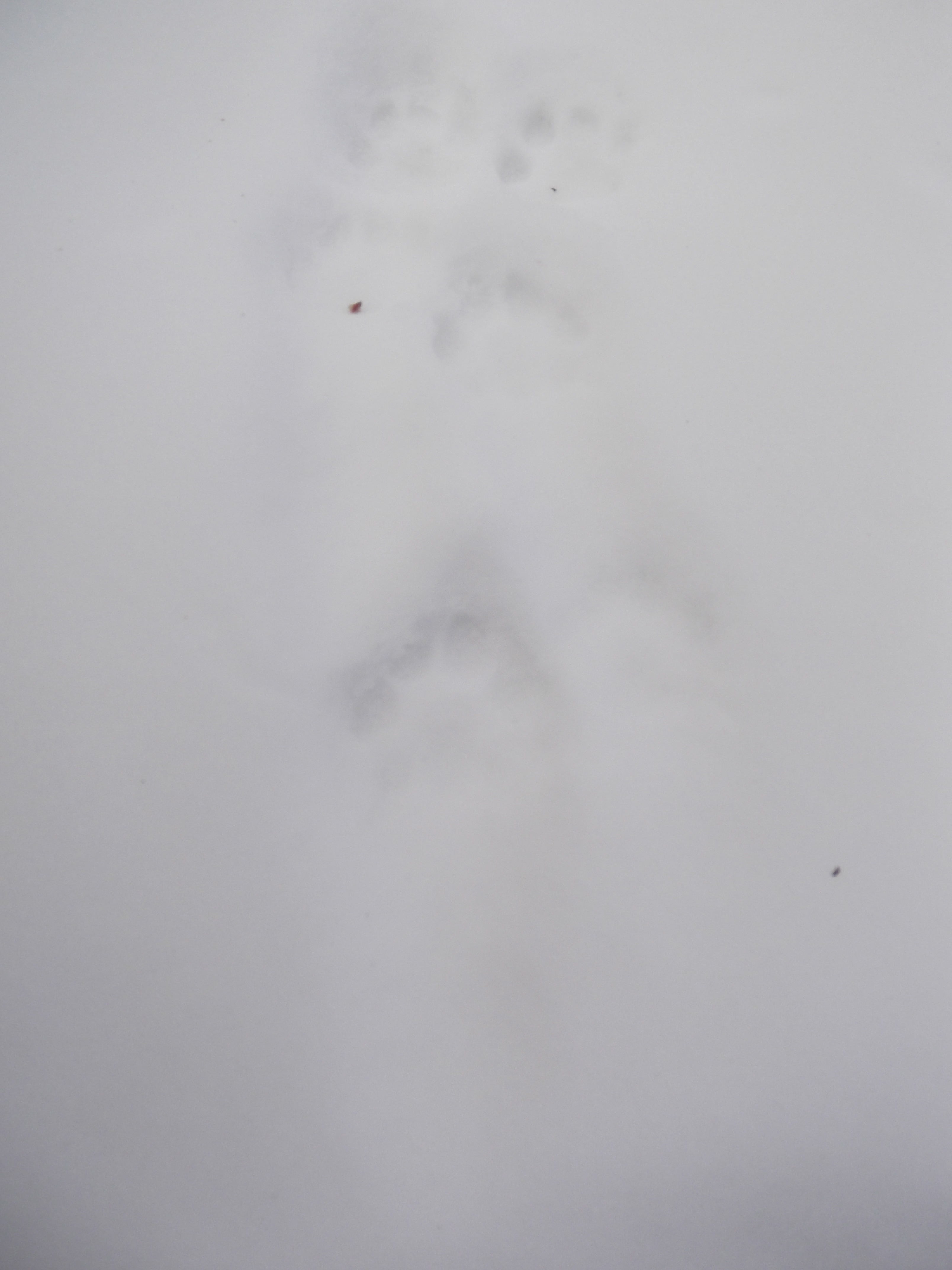
Bobcat sitdown
And there again was my cougar, making the rounds in this area too. Here are two prints comparing a cougar print with a bobcat, for size.

Cougar hind track measuring 2.75 x 3.25
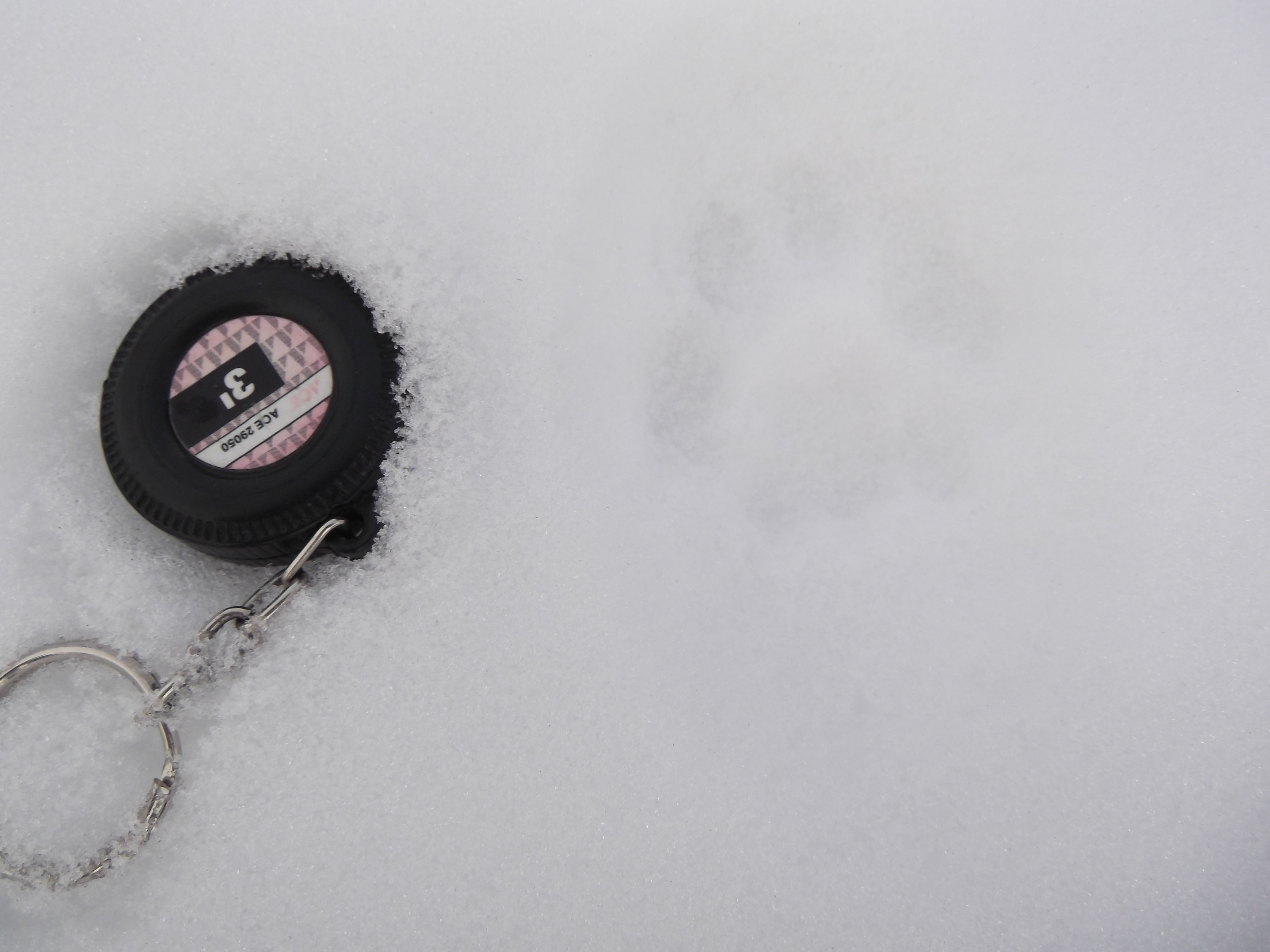
bobcat track measuring 1.75 x 2"
This rocky area is incredibly active–so much going on. Partly because it is usually always windswept of snow, it is good ungulate habitat in the winter, which means food for predators. In the fall bears frequent the area to look for limber pine middens.
It was great fun tracking big and small cats today; and knowing that you’re in the presence of a cougar your heart skips a beat. Luckily, I have my personal wolf to protect me.

My great protector concentrating on his ball while a buck glides in the background
Filed under: Tracking | Tagged: Bobcats, Elk, mountain goats, Tracking, Wolf, Wolves | Leave a comment »
The snows are melting and although Sunlight creek is still not in the spring run-off phase, you can feel the weather breaking.
Last night it snowed lightly, but today its raining. It’s a slow warm-up, but it’s coming. My old neighbor who grew up in this valley tells me this was a normal winter in terms of snowfall, but I suspect its still not as cold as when he was growing up. His wife says that -25 degrees was regular then. Not now.
Several years ago I helped an elderly woman stage her landscape in order to sell her home. Her husband had been a great friend of mine and fellow beekeeper. Once he died Dorothy packed up the family home and moved to Idaho where her kids were. That was the year I bought my cabin in Wyoming and along with so many other strange coincidences, it turned out her father had been the Chief Engineer in Yellowstone from the spring of 1925 through the spring of 1930. The last two years he was the Assistant Superintendent at Mammoth under Horace Albright His name was Merrill Daum and the family had interviewed him and transcribed his memoirs. Dorothy graciously gave me a copy of the section from his time in the Park. Here are a few of his stories of snow in those days:
There were no concessionaires living in the park in the wintertime. They closed up everything. We had to go down to Gardiner and Livingston to do our shopping. We had cars and oh yes, the road was open. We only had light snow in that country. We could keep the road from the park open up to Mammoth with our own equipment, but from there on it was generally open. They had a train running in there every so often, so many days a week, so we had train service at Gardiner. So much of that country was rough and hot that the snow was not very thick on it.
I don’t know much about Middle Geyser basin. It wasn’t a good place to stop and just put a road through to yell at Old Faithful. That’s where we turned off from and went cross country to the Lake and Canyon or kept on going out to West Yellowstone or to Old Faithful. We had ten cabins about every ten miles on the ranger patrol station because they would patrol all along that area, especially the southern part of the Park because there might be poachers come in to kill the game. They’d go around in the winter time on skis. That’s a long trip around that part. Down towards the southern entrance there might be ten, twelve feet of snow. I’ll never forget looking at one of the bridges; there was a stream going under and all that snow on top of the bridge. One winter the bridge just broke.
The wintertime was mainly spent getting ready for the next year. Then we had to get ready to remove the snow in the spring. We started at Cody,Wyoming at the entrance. About thirty miles from Cody up to the entrance. We got as far as the Park with snow 12 to 15 to 20 feet deep. We’d blast it out with TNT which Uncle Sam gave us. That would start it thawing and then we’d take a big power shovel and shovel the stuff so we had a two-way highway through there to the east entrance of the park. From there on we’d use our own equipment. The deep snow was right there at the entrance. That was the high point. We’d generally try to get the Park open by the 1st of June. By the 6th of June we were officially open, I believe. But you couldn’t make some of the interior trips that early. It would be long in July before you could get away from the snow.
Here is a photo tribute to my 2010-2011 winter in Wyoming. After this long and snowy winter, I think I am officially a Wyomingite!

The Basin in early winter from Dead Indian

This is a wolf howl machine, an experimental device to see if wolves are in the area

Two wolves side trot down the road

Coyotes on an elk kill
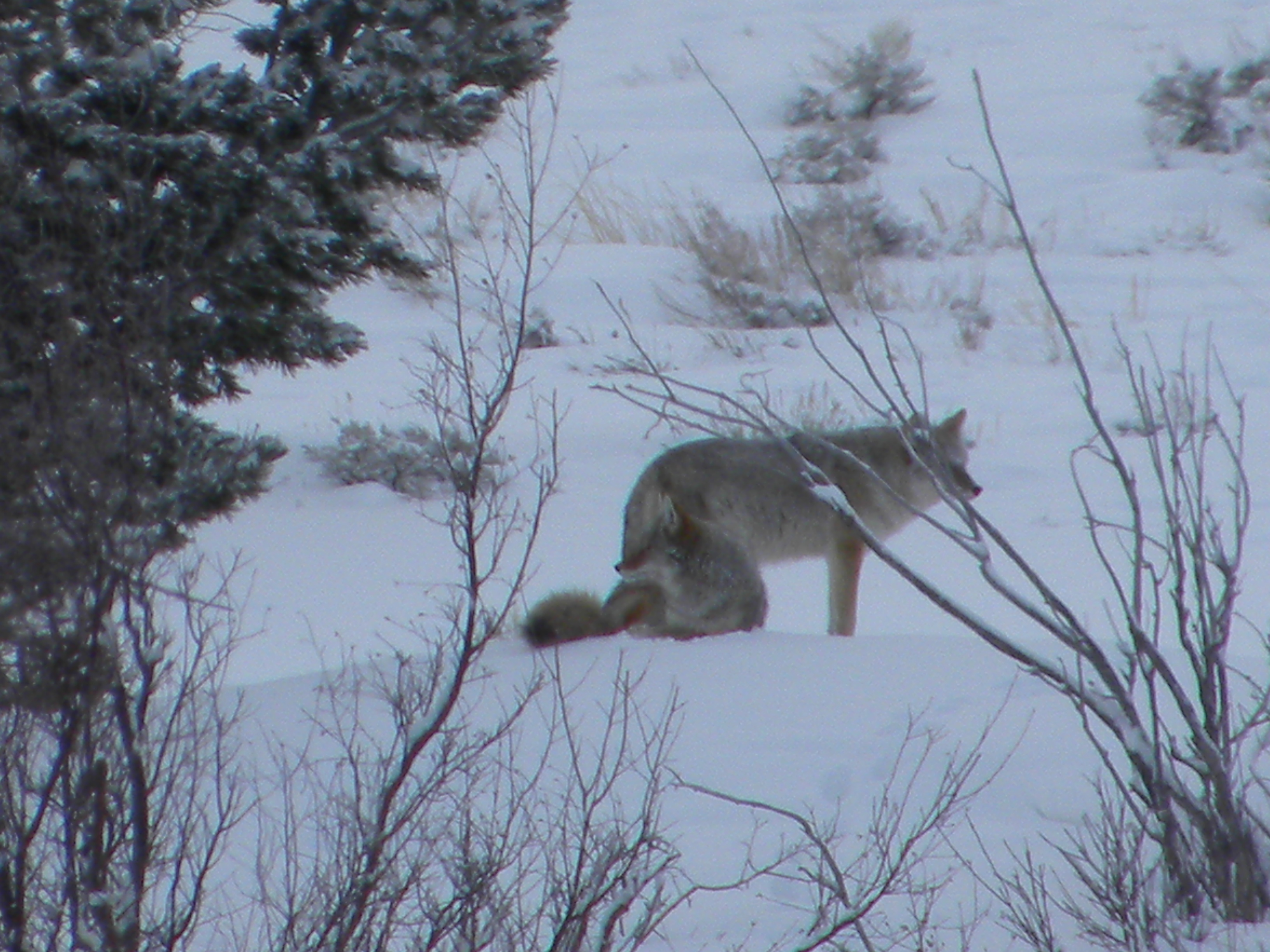
A coyote pair waits their turn on a nearby kill

The Yellowstone migratory herd resides in the valley in winter

Black wolf resting mid-day in the sun after a morning elk meal

Moose stands in deep snow
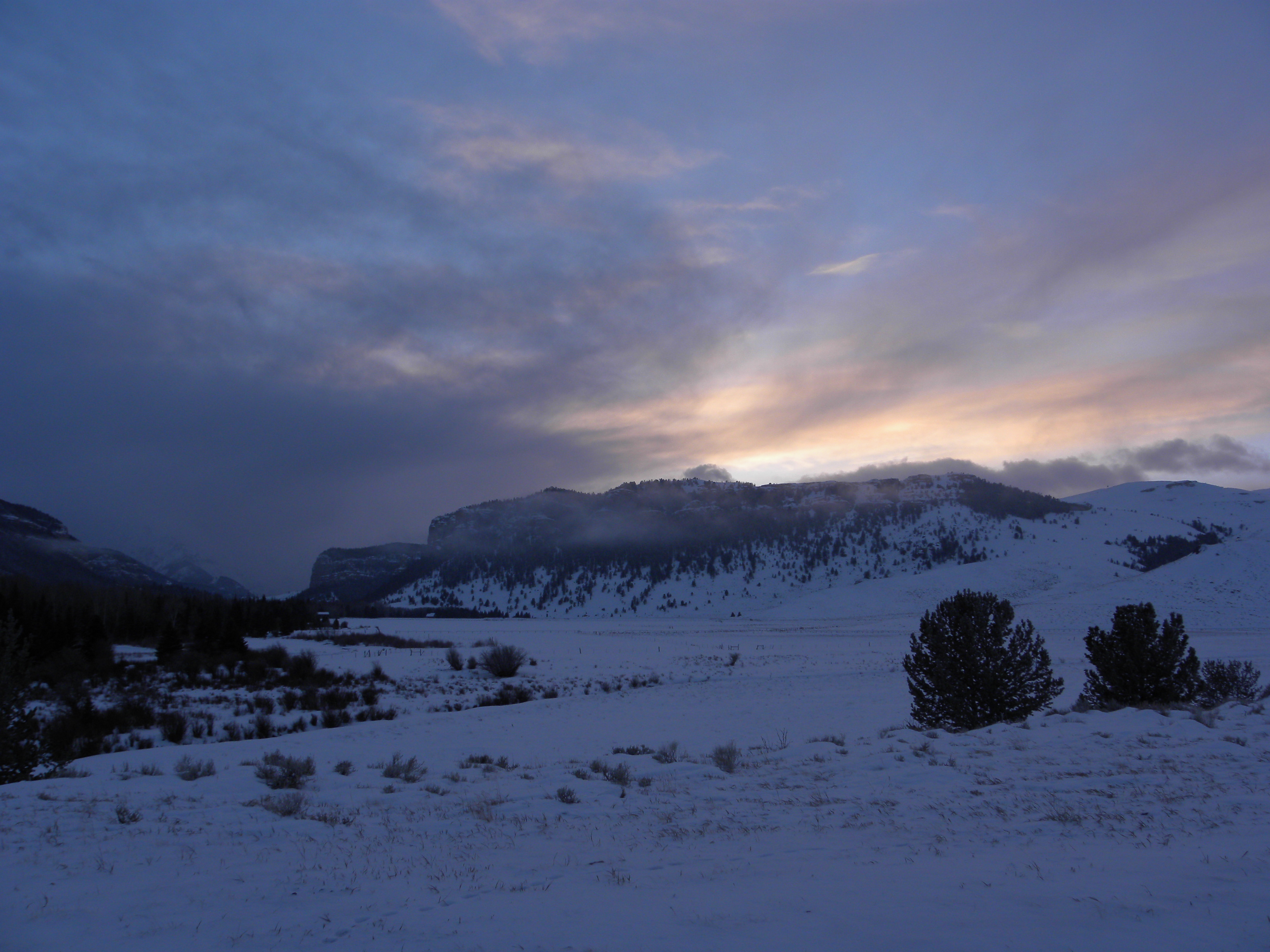
Sunset in a 2011 winter

After a day of skiing, dog tired
Filed under: Cody Environs | Tagged: Coyotes, Elk, Wolf, Wolf pictures, Yellowstone National Park | 1 Comment »
Yesterday was another glorious early spring day. Some friends came up and we took a drive north towards Crandall and beyond, as far as the road is plowed. The lonely 11 or so miles between Pilot Creek, a parking pull-out for snowmobilers, and the NE entrance to the Park won’t be open for another 5 weeks yet, but they’ll have a lot of plowing to do. There is still an incredible amount of snow everywhere. It will be a while before you can hike the backcountry.
As the snowmobilers raced past us to begin their expensive thrills, we idled along looking for wildlife. The banks by the side of the road have melted but still an easy 4′ high. This gave good cover for a moose and her calf just on the other side of the highway along the Clark’s Fork River.
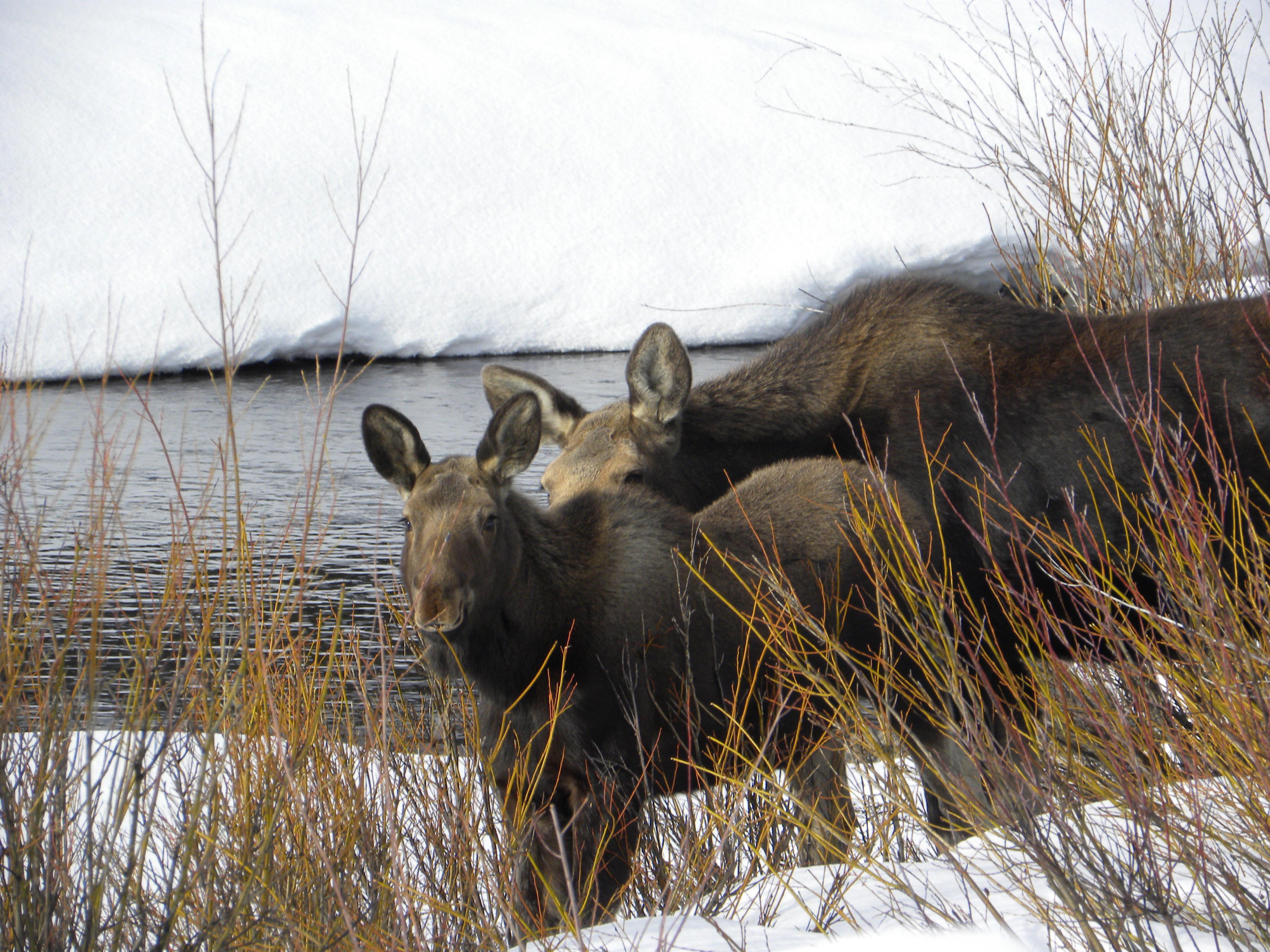
Mama with yearling
Because we could barely see over the snow bank, we quietly got out of the car to take photos. Mama and baby kept browsing but mama moved between us and her calf. What a good mother.
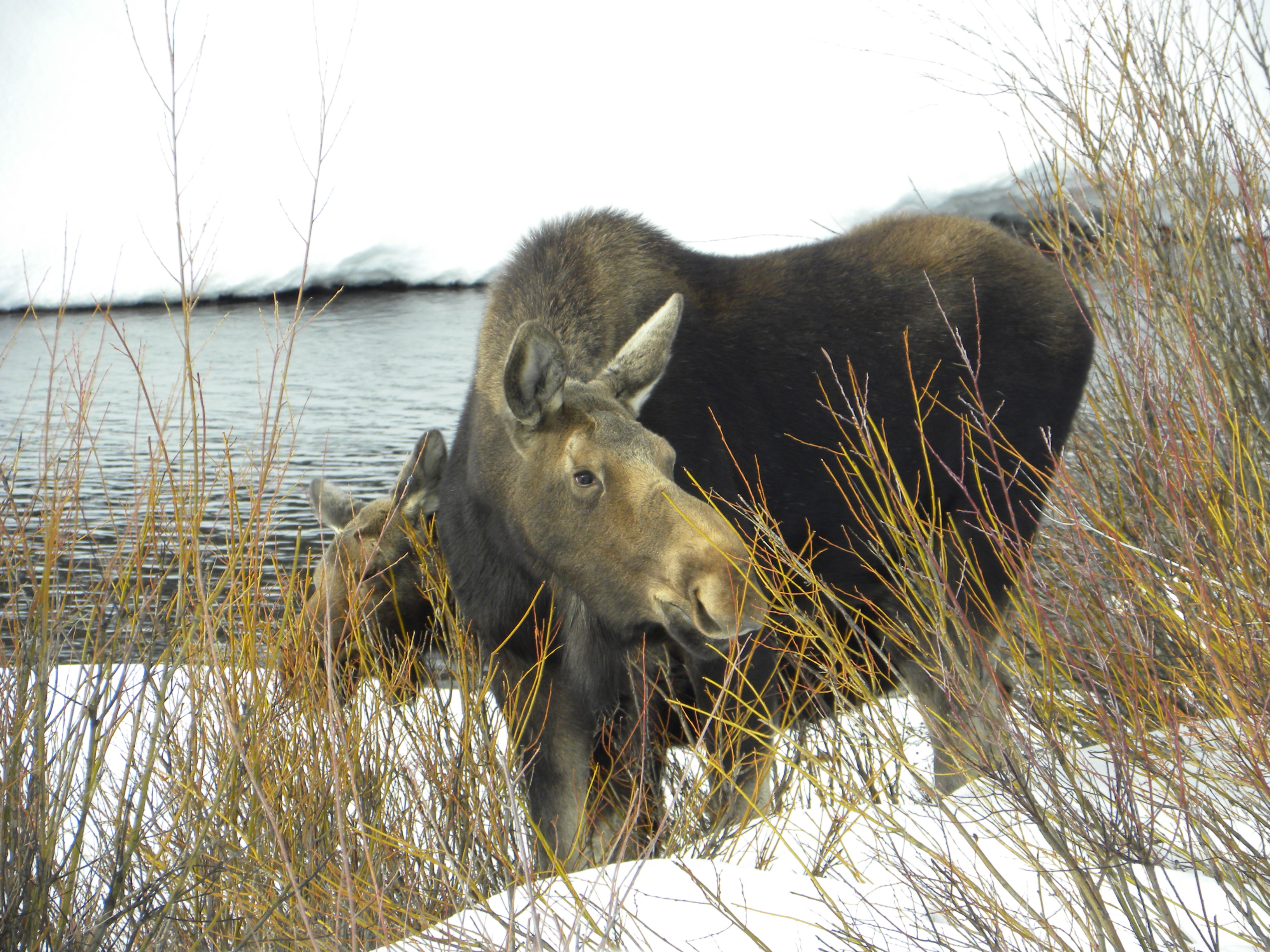
Mama Moose moves between us and her calf
On the way back I shot a photo of Crazy Creek, still solidly covered with snow and ice. This creek, in a few months, will be an awesome volume of water.
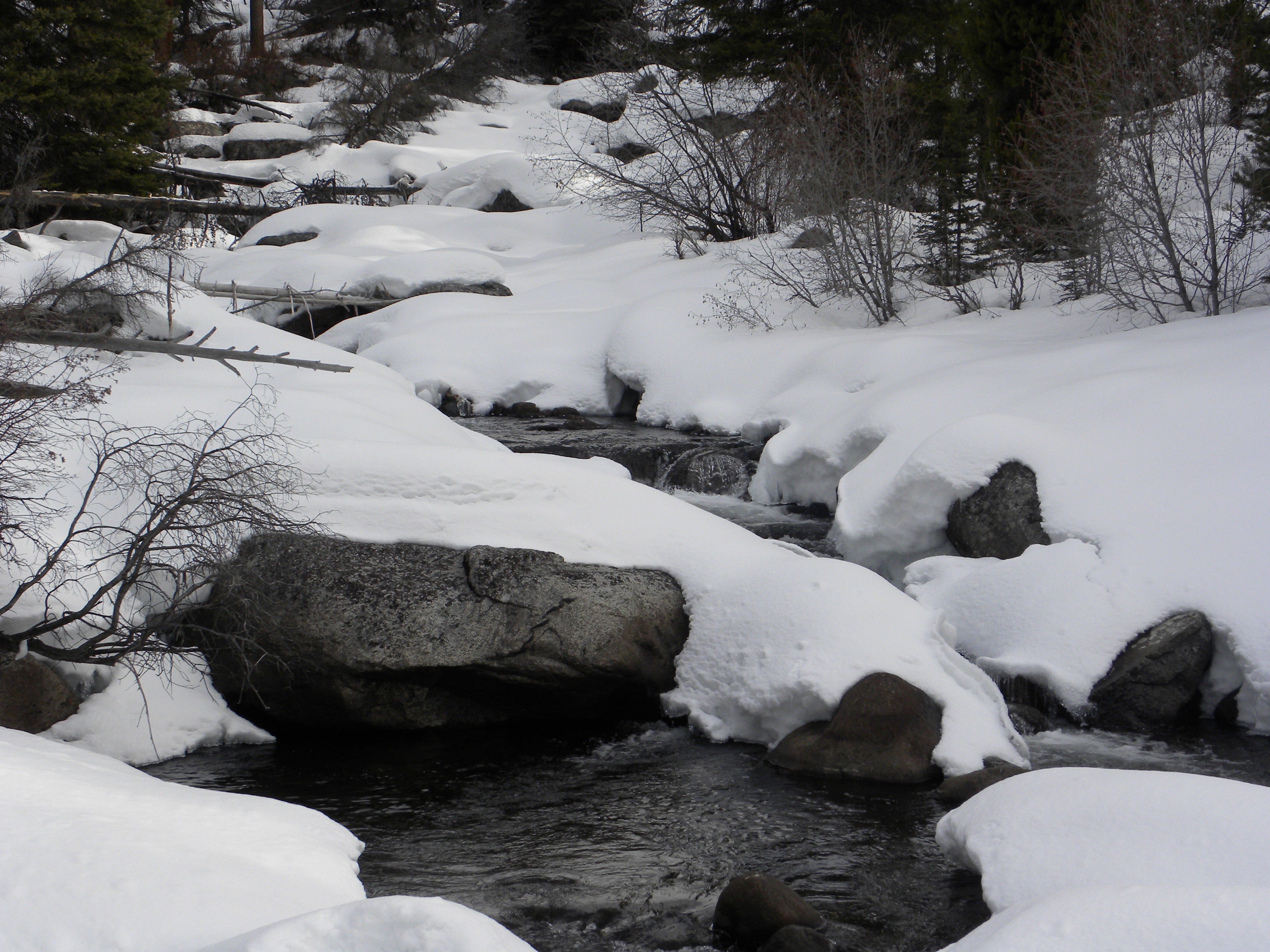
Crazy Creek March 2011
Almost back to Sunlight, I asked my friends, who come up regularly on weekends, if they’d seen any wolves this winter. They are avid photographers and would like a good shot. They told me they hadn’t. Not more than two minutes passed when we spotted 2 wolves by the side of the highway. This was a most unusual sighting. Almost 11:00, I’ve almost never seen wolves hanging so near the main road. There were elk up on the hillside, along with deer, not too far away who didn’t seem too perturbed. Two wolves would be hard-pressed to bring down an elk, so I suspected there was a kill higher up on the hillside, or possibly down below where they were wanting to cross to. A big grey sauntered quickly up the hill and out of sight. But a beautiful black loitered long enough to take some good photos. Wolves I’ve met always seem intelligently curious. This one certainly was.


After I came home and my friends were gone, I noticed a yearling moose walking back and forth along the fenceline across the road where the horses are. The fence has a wooden top post and is very wildlife friendly, but this yearling wasn’t that tall and was very uncertain as to whether she could make the jump. She moved back and forth for over 15 minutes, trying to find a spot she felt comfortable to cross. Finally, a car drove up the road, spooked her, and forced her into making the leap. She did clear, but not without her back leg stuck for a moment. She ran up my driveway, because its the open line in the fence and stood in front of the house for a while, seemingly perplexed. Where was her mom, I wondered.
Yearling moose will get kicked out before the mother gives birth again, but it did seem a little soon, but what do I know. I thought maybe she was already on her own. She made her way through the front meadow, where I’ve taken down some posts for a winter opening in a buck and rail fence of my neighbors. It was then I saw her mom, who’d been watching the whole thing patiently. She was standing in the tree line. Soon mama and baby were united again. I had to wonder if mother was, as I would be, gnawing worriedly and wondering if her baby could make the jump successfully, or if mom was treating her offspring to just another new lesson preparing her daughter for the big wide world.
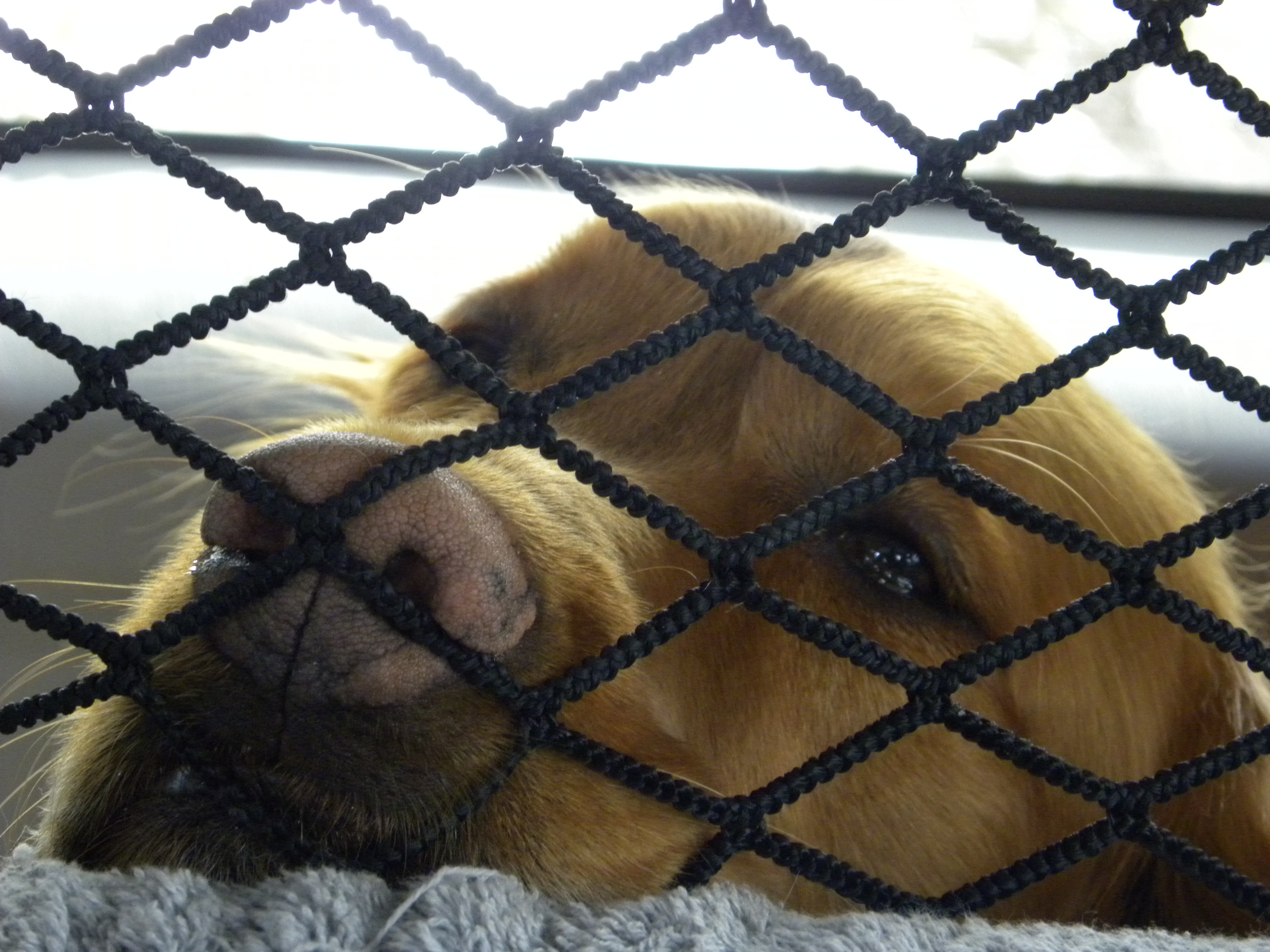
Koda bored because he couldn't get out and play with the wolves!
Filed under: Cody Environs, Moose, Wolf | Tagged: Clarks Fork, Moose, Wolf, Wolf pictures, Wolves | 2 Comments »
 Leslie Patten Books: Wild Places, Sacred Spaces