


Its hard not to go ‘political’ when I heard about Salazar’s decision to delist wolves in Idaho and Montana (not yet Wyoming). I just need to take a moment to reflect. Forgive me for putting on hold the post I wanted to write today, which was about the obsidian flintknapping site I found yesterday.
Obama’s penchant for compromise just seems to be getting him in trouble with both sides and no one’s happy. In this case, compromise isn’t the basis for decision. And compromise is really just politics.
What wildlife needs here is science melded with stewardship. To be a steward, you have to be a lover. As has been said before, ‘you only protect what you love’. One of the wildlife students made an interesting observation. “I’m afraid it will take the wolf being hunted for it to be truly protected. Hunters go to great lengths to protect what they hunt to ensure the health of its population.” Certainly true with elk around here.
In the last few years that I’ve been looking at this issue, it seems to me there are so many areas to be addressed in a ‘delisting’ plan. Simply putting the wolf on the hunted list with target numbers attached is a copout.
Wolves have a highly organized social system. Packs in my area are constantly being reduced to numbers that are not viable. When that happens, without the instruction of the Alpha, inexperienced and outnumbered wolves will go for the easiest prey–calves–in order to eat. Taking down a larger animal like an elk requires pack coordination and is risky. Just see my post on the coyote with hubris that was kicked and killed by an elk. That’s just one factor.
Yesterday I found out a bit more about the calf predation that took place on the ranch down the road last spring. Apparently, the grazing allotment rotation had been changed by the Forest Service in order to combine two ranches at once. It was pup season, and the Forest Service told the ranchers to graze in the draw just over the hill from the den. With the late winter the elk were still around in early May, yet farther down the valley from the den site. That made it much easier for the wolves to go over the hill and get calves for their pups. That predation was the forest service’s fault, not the ranchers or the wolves. But because the forest service wasn’t thinking about the whole picture, 3 wolves were shot, one of them was from the initial introduction to Yellowstone 10 years ago!
A very large ranch over the hill has resident elk on it. In the summer, the elk graze the interface between the forest and the open meadows. The wolves follow the elk along that ecotone. All summer long the cattle grazed lower in their valley, while the wolves ate elk. Then, at the end of the summer the cattle were moved near the interface, and within days some calves were killed. Next of course came the wiping out of the entire pack by Wildlife Services. With some responsibility on the part of this rancher, this incident would not have happened.
Delisting should require stewardship of all involved parties. By simply compensating ranchers with money and killing wolves, there is no incentive to protect their flock, especially since so many of the ranchers in my area are the extreme wealthy looking for a tax write off, or ranching because it sounds neat (there are many ranches here owned by wealthy foreigners).
I don’t profess to understand all the problems or solutions, but I can see a few things:
1. Requirements for ranchers in wolf areas i.e. shepherding. I have heard about some ranches experimenting with Shepherding Programs (tourists pay to come out and Shepherd, like going to a Dude Ranch). That’s a win-win situation. There are many other methods being experimented with as well.
2. Open Grazing policies need to be re-looked at. First of all, they are too cheap. Last I heard it was $1.95/month for a Cow/Calf pair! Wow, that 1898 prices. You can’t have your cake and eat it too. Open Grazing, you’re on your own with the wolves and wolves are protected. That’s that!
3. I would like to see some tribal involvement in these issues as well. I’m not sure what that would look like, but I feel they’ve been stewards here for many thousands of years and the perspective they can provide is unique and in many instances is not obtainable through conventional survey techniques. One native american said to me a lovely thing “The wolves are herding the elk” and that’s a true observation. As a plant person, I can see that the effect the wolves have had on the aspen/willow population is only positive.
Wolves are magnificent animals. I’ve seen them here several times in my valley while hiking around. They are important in our ecosystem in so many ways, and deserve better. Since I’ve been here, there is just too much killing going on in my area of our three packs. Summer comes, packs are wiped out and reduced, other wolves move in, packs reorganize again and shift around. Just ‘delisting’ is not a solution.
Filed under: Wolf | Tagged: Native American Culture, Wolf | Leave a comment »
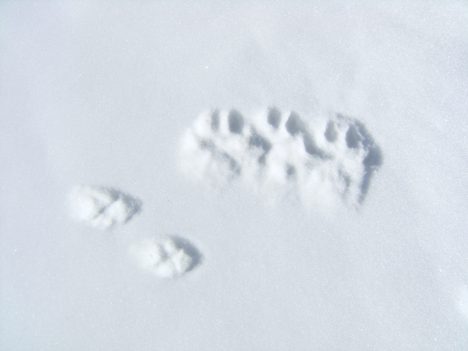 I followed them for a while until they went down a steep wooded slope. But later picked them up and, along with coyote tracks, they were headed straight for the dead horse. Seemed like they weren’t too interested in much of the horse though, as just its organs were gone and the rest of the carcass remained intact. Even the birds weren’t on it.
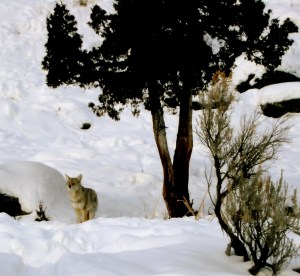 “They say you can’t raise a coyote, but I did” he told me. “The coyote used to disappear for days or a week at a time. Sometimes other coyotes would come around and howl, trying to entice the baby out to join them, and sometimes she would. But she’d always come back. It was four years before I could pet her. She’d sleep against my leg, but wouldn’t let me touch her. Finally, after four years, she’d let me love her. Smarter than any dog I ever had.”


 Leslie Patten Books: Wild Places, Sacred Spaces