• MY BOOKS ON WILDLIFE, GARDENING AND MORE

  • The Wild Excellence

  • True stories of wildlife encounters around the Greater Yellowstone
  • Award winning eBook on Decomposed Granite, tips, how to's, what to watch for
  • Children's book. True stories of a dog and wolves. In a dog's voice
  • Written for dry Mediterranean climates in California, north and south

The magnificent and endangered grizzly

There’s been plenty of hubbub regarding bears this summer in the Greater Yellowstone Ecosystem, mainly grizzlies.  If you haven’t followed it, we had two deaths just on the eastern side of the Absarokas from grizzlies this summer, one of them occurred just up the road from where I live.  In addition, there’s been 38 grizzly deaths just this year, 31 on those caused by humans.  And many of the bears causing trouble have been found to be underweight, or their cubs were malnourished.  Grizzlies were put back on the Endangered Species list just this summer because one of their main food sources, White Bark pine nuts, is also in trouble and in major decline.

Grizzlies have been coming down into hay fields, down into the flats where there are towns and farms.  Why? Because they need more habitat, they need food.  Let’s not forget that grizzlies were actually plains animals, following the Bison and ‘Buffalo Wolves’ on the prairie.  Grizzlies can’t climb trees and their enormous claws are adapted for digging.


Grizzly rooting around


On the other hand, the smaller Black Bear is a forest bear.  It can climb trees.

It’s not just that ‘we have too many bears’.  Its that we’ve decided Grizzlies can only be in places where people don’t want to live year round–the high mountains–or where we’ve protected the land, such as Yellowstone Park.  And even in those places we barely tolerant them, calling on the feds to move or kill a bear (Grizzlies get three strikes before they’re out, dead out that is) that interferes with our ‘rights’.  In an area north of Gardiner, a sow with her two underweight cubs were moved for raiding a chicken coup.  Chickens are bear bait, and having one just north of the north entrance to the Park makes your chickens a restaurant for a bear.  I don’t understand why we have to waste good tax dollars and federal employees’ time on moving bears for stupid people.

My valley happens to be one of the places the U.S. Fish and Wildlife Service moves bad bears, with the hopes they’ll go into Yellowstone.  My valley has good access into the Park, but most of these bears just quickly ‘home’ or return to their territory.  This I’ve been told by one of the bear coordinators. (“You don’t have to worry about the relocated bears.  They leave fairly quickly.”)

So why relocate?  These dedicated federal employees seem to spend a lot of their summer moving ‘bad’ bears here and there–from Jackson to the East Entrance, from Dubois to Cooke City, from Cody area back to Jackson–or they have the dirty and terrible job of euthanizing ‘problem’ bears.  Problem hardly ever means human/bear conflicts, but mostly cattle/sheep/horse/chicken conflicts or just too-darn-close-for-comfort conflicts.
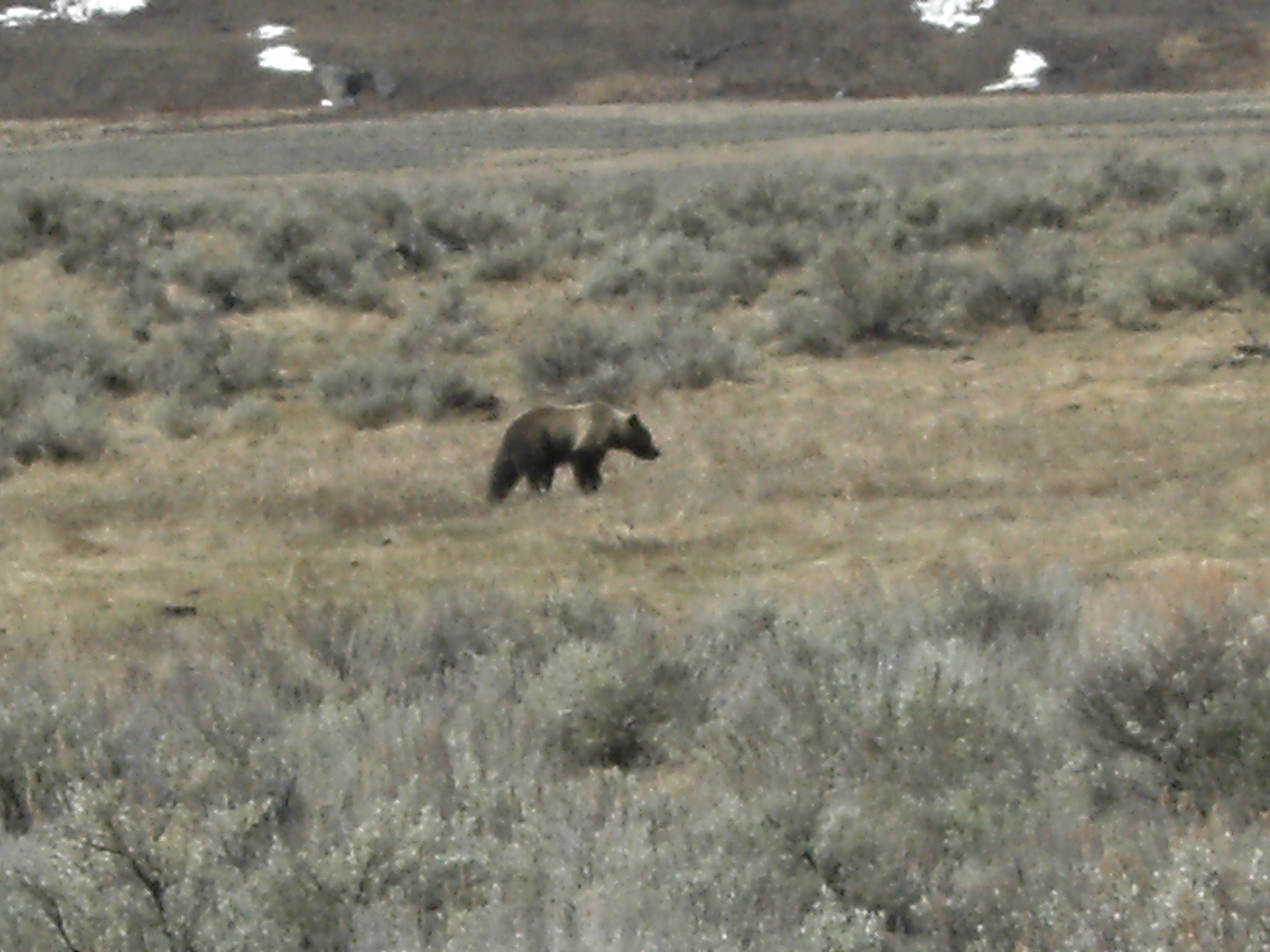
We just have to begin to make a concerted effort to live with bears and give them more habitat.  A few things I can suggest (and there are many more that could be added to the list by people ‘in the know’):

1.  Use bear-proof garbage cans and food containers.  Several bears were euthanized in 2010 because of ‘food rewards’.  The article above said that after euthanizing a bear roaming around West Yellowstone, the feds discovered lots of unsecured food containers.  That’s just a crime!  West Yellowstone is exactly adjacent to the Park.  If you want to live there, secure your food or pay the consequences.  Should the bears pay the consequences for stupid people?

2.  We need contiguous wildlife corridors from here to the Canadian Border, with planned wildlife crossings over highways.  This is very important.  These bears and other wildlife need to be able to migrate out into other food sources when their own territories get too cramped.  And for God’s sake, at least slow down in Yellowstone.  This summer alone there were several bears killed by cars in the Park.

California is now putting the grizzly bear on all CDL.  If you hold your license up to the light, there’s a bear there; the same bear that’s on their flag and the exact same one that was shot to extinction in the early 1900’s.  If you’re going to tout it, then bring it back.  California has good habitat for grizzlies.  Let’s move some there.

3.  We need prairie where Grizzlies and Bison and wolves can roam again.  Grizzlies are already moving into eastern Montana.  Support the American Prairie Foundation and tell them to not just bring Bison back (already beginning to happen there) but wolves and grizzlies as well.  With the extinction of the White Bark Pine by the end of this next decade, bears will need a different food source.  We need to be thinking about recreating some of the kinds of habitat they lived in when Lewis & Clark were here.  L&C didn’t find game in the mountains; the game was abundant in the prairies.  Restoring bison to the prairies along with wolves makes for more game for grizzlies, along with all the small mammals and roots they like to dig for.

This summer I was fortunate enough to see three grizzlies–2 in the Park and the other one we slowed down while the bear crossed the road near here.  What a beautiful magnificent animal.  There is nothing like hiking in grizzly county, knowing that you are not at the top of the food chain.  It makes you alert, alive and aware.  Let’s preserve that.  It keeps our human ‘hubris’ in check.


Grizzly track with penny for sizing


Yellowstone spring

I’m doing some work here, adding a utility room.  With all the noise and construction, it was a great opportunity to escape to the park and let the workers watch the dog.

Since it only takes me 40 minutes to the NE entrance, I escaped around eleven and was back by 5.  The day was overcast and on the cold side.  I’d planned to do a day hike, but chucked the idea with a cold wind blowing through the Lamar.  There was enough activity to view right from the road.

I’ts early June, the kids are still in school, and usually May and June the Park is still quiet during the week.  Yet last summer was the busiest the Park has ever seen and its predicted to be the same again this year.  The Lamar Valley had plenty of people today, but they all seemed serious wildlife watchers and so the atmosphere was calm and peaceful.

I do have to say, with all the hubbub around the ecosystem about wolves–rallies in Jackson and Cody recently, sponsored by outfitters and the Elk Foundation, complaining about wolves taking their business away [i.e. “biggest slaughter since the bison” meaning the wolves are eating all the elk, like when we killed all the bison] and wanting Wyoming wolves hunted as predators–it seems to be completely forgotten that wolves have created an incredible tourist attraction that benefits Wyoming.  I only talked with a few tourists in the valley, but they were all looking for wolves.  I ran into a carload of tourists from Oklahoma who had gotten out of their car to use the restroom when they heard a wolf howl.  They walked out to an overlook of the Lamar river and saw a black wolf–a thrilling experience for them.

Another man stopped and asked what I was looking at through my scope.  When I told him ‘a black bear’, he said “We already saw that.  We’re looking for wolves.”

It seems to be one of the main draws to the Park these days.  Wolves have fueled the attendance to record numbers!

With the Druid Pack all but gone, I didn’t expect to hear or see wolves in the Lamar, but there was a black wolf running around there, plus a tourist told me she’d seen one on a kill earlier.

Mostly though, since I see wolves in my own valley, I love to see the Bison and especially their babies at this time of year.  They are the only wildlife that cannot leave the Park so I have none in my valley.

Error
This video doesn’t exist

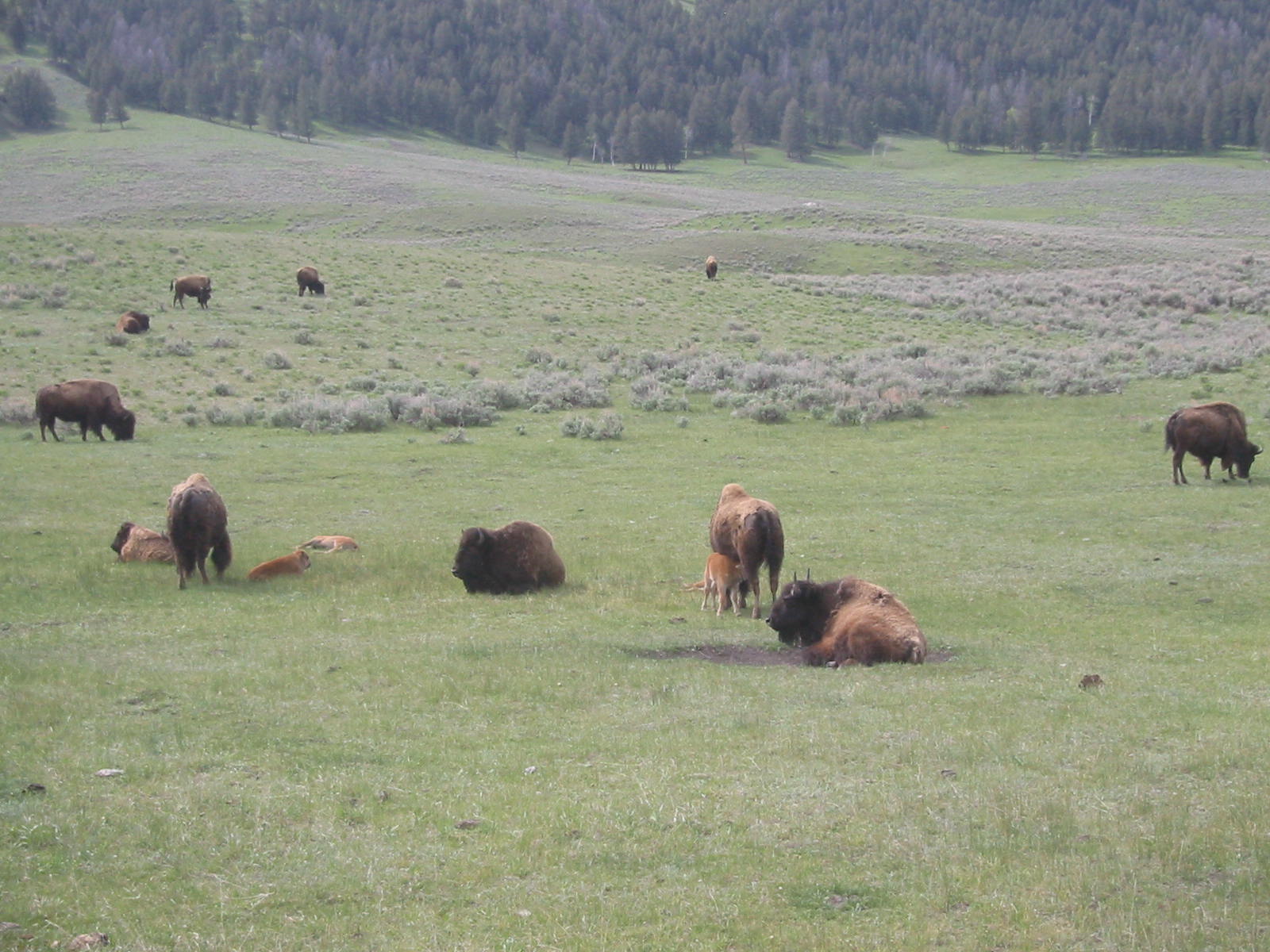
There were a lot of Bison in the Lamar this day.  I always try and imagine the great herds that once roamed everywhere just a few hundred years ago.

Loads of Bison

Besides Bison, wolves, and black bears, on the way out I saw 2 beautiful old bull moose hanging by the side of the road (until a crazy tourist tried to get a close up picture.  Fortunately for the tourist, the Bulls decided to head up the hillside instead of into the tourist).

Yellowstone for mine eyes only

A friend came up late morning to help me plant more trees.  A squall came in and with it a fierce cold wind.  After several minutes the weather settled down, the sun shone through brilliant cumulus clouds but it was still hovering above freezing.  This continued several times all morning until I’d had enough.  Hungry and cold I suggested we quit for the day and head to the house for lunch.

Since I’m needing some poles to repair a gate, we decided to see if we could make it up to Beartooth Lake to cut some lodgepole poles.  The road was clear and this typical May weather had brought new snow into the mountains.  Pilot and Index Peaks were covered white in snow, the deep of the blue sky setting them off.

We got a little past the maintenance yard and then got stuck in the snow.  I let the dogs out while my friend shoveled and I pushed the truck.  The dogs, like 2 kids, went wildly romping around the deep snow pack.

That adventure foiled, my friend suggested we see how far we could get towards Cooke City.  About 5 miles from Cooke, the road was full of snow, although a plow had gone over it.  The sign said ‘Road Closed’ but we kept on.  My friend said they run a plow now so that the heat of the sun will melt the rest off.  That way there’ll be less work to do come May 7th when the NE entrance officially opens.

Once into Cooke, the road was clear and dry and we decided to head for the Lamar.  By now it was about 6:30 pm and a perfect time to catch some wildlife watching.  But as we drove into the park, a deep fog appeared and it started to snow…sleet really.  My friend commented that he’d been coming here for 50 years and during that entire time the willows had never been able to grow.

“You’d have to have come here for that long to see the difference.  The willows are growing now.  They’ve never been this big.  The elk used to use the Lamar like cattle.  They’d be down in the river bottoms.  Now the wolves keep them on the move and the brush is coming back.”

As we continued towards the Buffalo Ranch, the sky cleared.  We kept commenting that we wished we’d brought our cameras.  I thought about it as I walked out the door, but figured I was just going to cut poles.  Instead, the air, the sky, the mountains, the weather was magnificent…a special day, a special light.

We watched a grizzly for a while nosing around for food.  Three sand hill cranes hunted nearby.  Elk grazed easily in the valley, while a Bison, beginning to shed, rubbed his back on a rock.  No one was in the valley.  It was left to the wildlife.

Coming a little north of Crandall on the way home, a grizzly bounded across the road in front of us.  It was about 7:30 and I suppose he was headed out for his evening rounds.  We stopped and watched him climb up the rocky cliffs on the other side of the highway, so close to the homes around there.

A spontaneous surprise, the day was full of typical May weather, my favorite time of the year.  Snow, sleet, sun….dry, wet, foggy, brilliant need-your-sunglasses light.  And lots of wildlife. Although we kept commenting how, of course, where’s your camera when you need it, I reminded my friend “This was a day just for our eyes only.”

Our keystone species: Bison and their restoration

I’m reading a book that, for the first time for me, pops to life what it meant that there were 60 million Bison here before the white man arrived.

Bison bison, the survivor amongst many large mammals that became extinct in North America, were tough and well suited for this continent.  Surviving -50 degree winters, summer droughts and waterless days where he could drink prickly pear juice if needed.  They lived long and remained fertile into old age, were sure-footed and could swim if needed.  They lived at sea level, on the high plains, and in the high mountains.   A keystone species, their roaming and fertilizing of the soil conditioned it for native grasses as well as provided food for the bears and wolves that freely lived amongst them.

When the Spanish arrived, they found Buffalo north of the Rio Grande and inward into Florida.  Bison covered the continent from Canada to Mexico north.  Bison were in Georgia, along the Mississippi, in Pennsylvania and along the Niagara.

When spring ice floes began, Bison that had fallen through the cracks while crossing the river drowned and were carried downstream.  Thousands of carcasses floated down western rivers.  One trapper counted over 730 until he got tired and stopped counting. Rivers were a continuous brown flow and these carcasses formed complete dams.  Bodies of Bison flowed day and night in the spring.  Grizzlies waited for these spring ‘run-offs’.

Calf loss of Bison was set around 50%.  With 15 million new calves born each year, that meant 7 1/2 million calf carcasses strewn across the country.  Audubon’s party camped on a low island on the Missouri covered with dead Bison calves.

The Bison were so thick that people didn’t count them by individuals.  Instead they counted them by how many days it took to pass one point.  One trapper counted 5 days before the herd passed a point completely.  One man wrote that while traveling up the Arkansas 15 miles a day and able to see for 15 miles on each side of the trail, in 3 days he’d seen about 1350 square miles of land entirely covered with Buffalo.  The herds were “in such immense numbers as to defy computation.”

"Thick as gnats" was one expression used. Native Americans called the country "one robe".

When the buffalo were reduced to only bones covering the plains, people were making money collecting and selling them for fertilizer or glue or for sugar factories.  Railroad cars filled to the brim operated day and night hauling bones.

A few Bison escaped the slaughter by holing up in Yellowstone National Park.  In the early days of the Park, even these few animals were being poached.  By 1902, only 25 or 30 Bison remained in the herd.  An intensive protective breeding program brought these last genetically wild Bison back from the brink.

Controversy remains today.  Bison leaving the Park are subject to slaughter over brucellosis.  Only 3000  of the once 60 million of the wild herd remains, confined within Park boundaries.  If this isn’t a definition of an American tragedy…

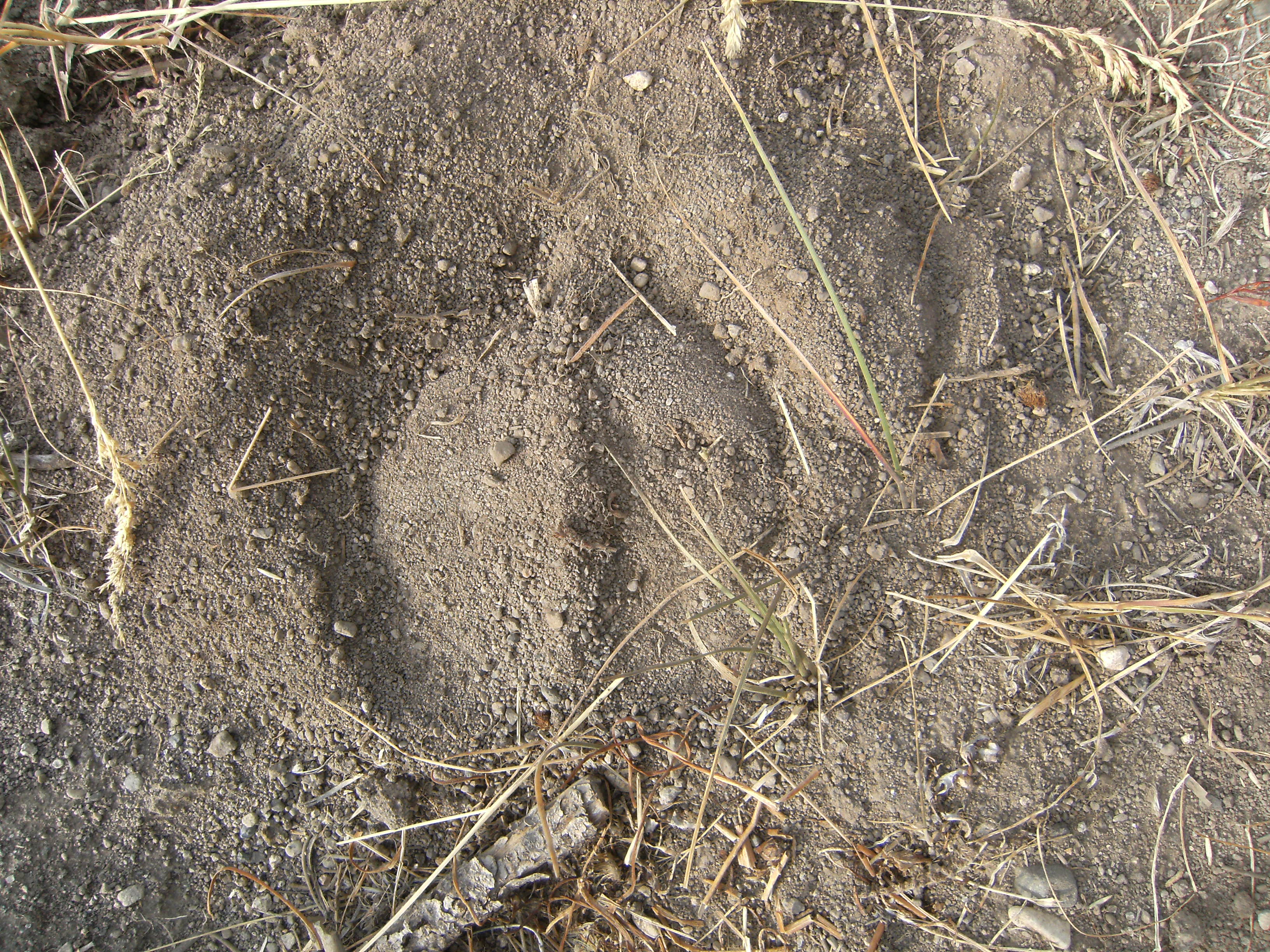
Bison footprint

Memory is short.  I suppose it could be touted as a conservation success story, saving the Bison from extinction, running them through a very narrow genetic bottleneck to pop out with 3000 in the Park in 2010.  But what of the other many millions?

An apology from the government is long overdue to the Bison.  A presidential pardon.   And then a place, a very large place in the mid-west they can call their home, should be granted to them, to let them live again and build their numbers as they please.  This idea isn’t new.  Its’ been floating around since the late 1980’s when Drs. Frank and Deborah Popper proposed The Buffalo Common, an area set aside where dying farming communities are.  The Poppers were given a lot of grief over their ideas, but it seems that, with the shrinking of family farms and many towns in the Mid-West folding up, this idea is now being considered as not only realistic, but money making (the key to everything capitalistic!).

There is not one national park in the mid-west.  Imagine herds of thousands of Bison roaming their old habitat.  The short and tall grass prairies would be restored, the soil would sing again, and tourists would come from all over the world to see these magnificent animals, found no where else on earth,  just as they now come to Yellowstone. 

Mountain Goats of the Clarks Fork

Mountain Goat from jasperjournal.com

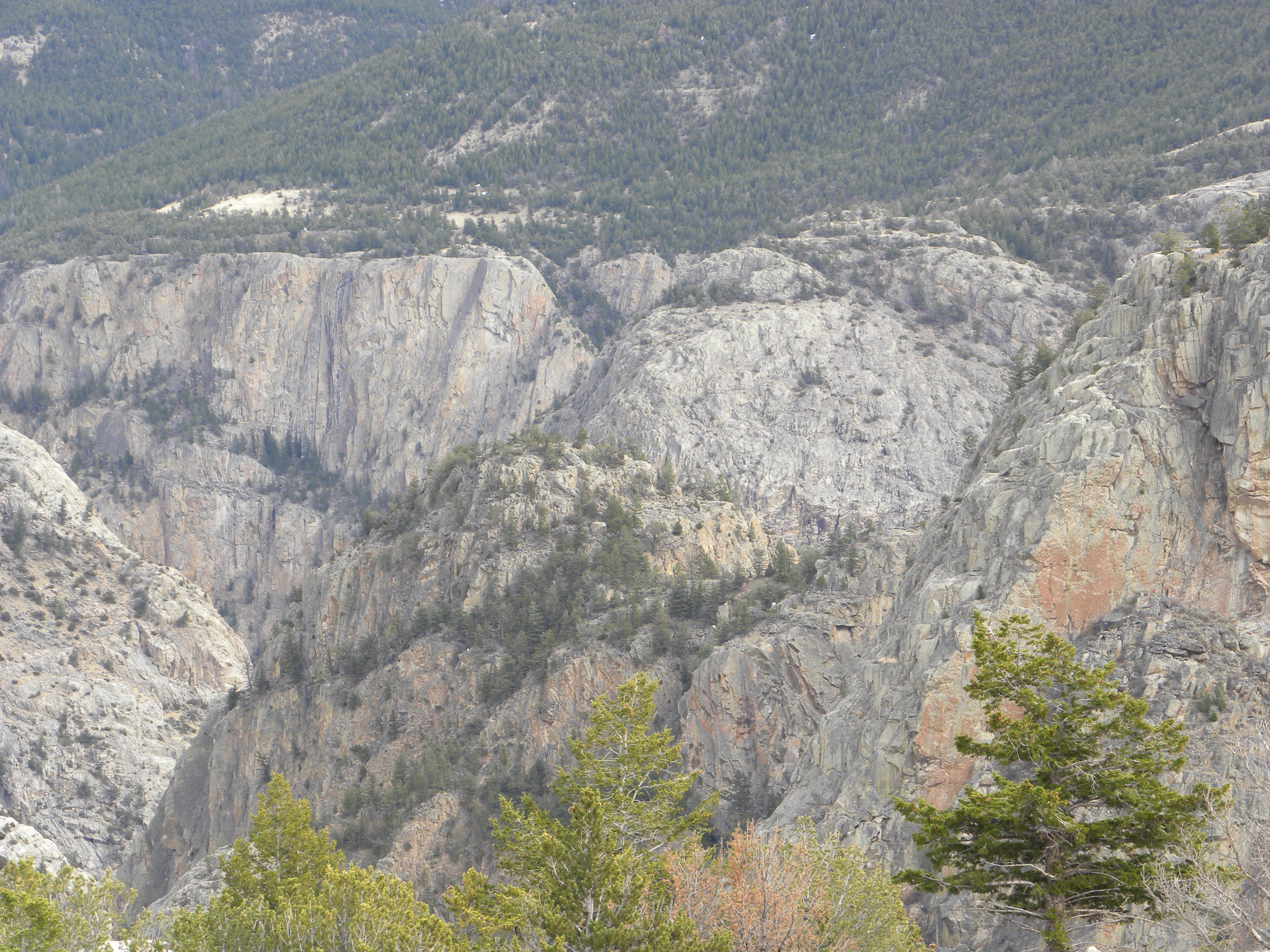
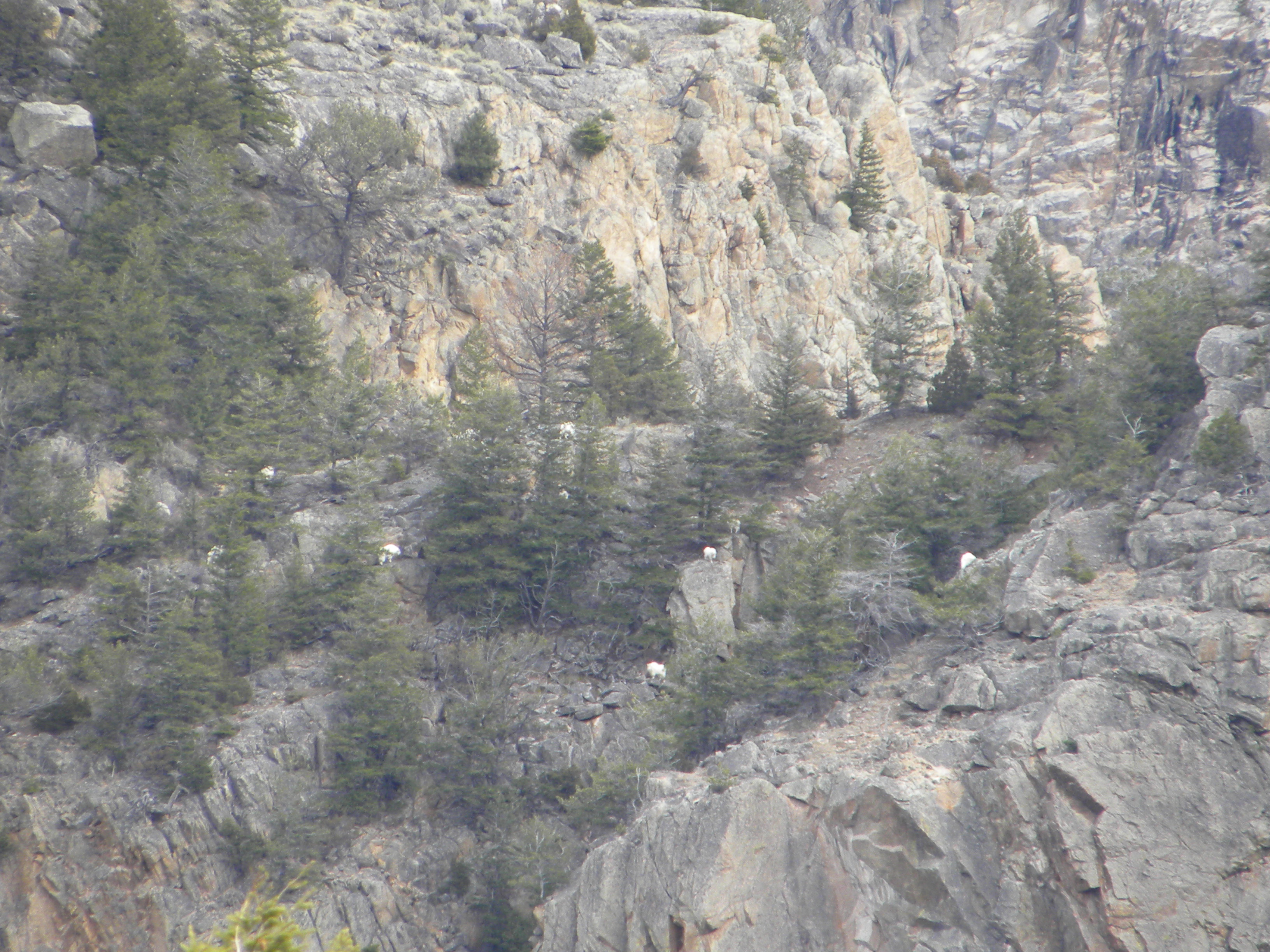
Yesterday I took a walk along the plateau above the Clarks Fork ravine.  The edge is a sheer 1000′ drop tot he river below.  I sat and glassed for the mountain goats that I’d heard ‘hung’ around the cliff edges.  Almost ready to give up, I suddenly saw a small white dot that looked like snow.  I watched it a while and it moved like a white ant.  Pretty soon there were a dozen of these small white dots coming in and out of the trees, hanging on cliff edges that you and I wouldn’t dream of going near.  All I could think of was …”I wanna be a mountain goat!”  Looked like lots of fun, especially to a person like me whose afraid of heights.

The mountain goat controversy remains strong.  Like the fallow and axis deer in Point Reyes that the National Seashore wants to shoot and get rid of, Yellowstone wants to get rid of them.  They are an ‘invasive’ around here, planted by sportsmen for the hunt.  But unlike the Fallow deer which are not from this continent (from India), Rocky Mountain mountain goats do inhabit the high elevations of Montana, Idaho, Colorado, and further north.  Very few prehistoric traces of mountain goats have been seen in these parts, and first hand accounts are few.

Personally, I like them and like seeing them around, especially considering that they are native to areas west of the Park.  It is not inconceivable that they once were around the Absarokas and Beartooths.  That is completely unlike the Fallow deer, which were bought from the San Francisco Zoo in the ’40’s and introduced.  Apparently Rocky Mountain mountain goats were introduced into the Cascades, far out of their native range, with very detrimental effects.

I’m all for eliminating invasive species that ravage the ecosystem and compete with the resources of the natives.  But as long as they are not competing too much with Bighorn forage, I wouldn’t mind keeping them around.  They were a thrill to see.  Gotta figure out a way to get a closer look.

The precipice they are on is in foreground

I counted at least 10 in the area

Look for little white dots!

Old first hand Stories of Yellowstone

My old neighbor JB told me this story today.   Its impossible to place it in time.  In JB’s mind it was like yesterday, but probably in reality sometime in the late ’50’s or early 60’s.

“My job was to plow the road from Mammoth to Cooke City.  There were two plows going and it was Christmas day.  It was 60 below zero, really really cold.  Those plows aren’t heated, you know.  You’ve gotta keep the window cracked too, otherwise the windshield freezes up with ice and you can’t see.  So it’s 60 below outside, no heat, and the window’s cracked.”

I asked him how he stayed warm.

“You just put on more clothes!  The snow was 4 or 5 feet deep and I got a call on the radio from the couple staying at the Buffalo Ranch.  His wife was going into labor and they were stuck.   I was going around a curve on my way to Tower, as fast as I could which wasn’t too fast in a plow, when I saw a patch of clear road ahead.  I knew that meant trouble.  The other plow was a few minutes ahead and a clear patch meant he’d gone off the road.  When I got there the plow was completely off the road, tipped over, and the driver was buried under the snow.  At 60 below he didn’t have much time and it was good I was just behind him.”

“I started digging him out and when I got to him he said ‘Lunch box’.  He kept repeating that.  I didn’t know he had a heart condition and his medication was in his lunchbox.  I never found that lunchbox.  They got him over to Billings.  He was pretty mangled up and didn’t work for over 2 years.”

“Then I started plowing my way to the Buffalo Ranch.  I finally got that couple unstuck.  She never got further than Mammoth where she had her baby.  That was Christmas Day.  I didn’t get home till 3 am.”

I had a client whose father, Merrill Daum, worked in Yellowstone from 1925 to 1930, first as the Chief Engineer then eventually as Assistant Superintendent to Horace Albright.  Daum spent the first several years working on oiling the roads.  Here are a few story excerpts from a memoir my client gave me.

We had an epidemic there one year.  They had quite a few cases of the tourists coming down sick after they’d been there at Old Faithful Inn during the afternoon and evening.  They came down with vomiting.  They really were sick.  It broke out at the Lake.  Then to Canyon.  The Lake was where they really had the epidemic.  One hundred or so sick people there.  We had to go around shooting them all with a needle.  I don’t know what we injected them with.  To relax them so they wouldn’t vomit themselves to death.  They put four of us at the table morning, noon, and night at the Lake Hotel and we were each to eat different things, not the same thing to see what food was causing our troubles.  None of us got sick.  THey just threw up on the floors, every place they got caught.

Bears came on our porch on that duplex we lived in at Mammoth.  I finally got tired of bears once and I took an apple, filled it with red pepper, pinned it together and put it on the porch.  That bear came up and swallowed that and all of a sudden he was blowing and wiping his nose in the snow, trying to get cool.  He really was hot.  He never bothered us again.

At Yellowstone we were building a highway out near Canyon and Lake areas and our construction crew was in tents.  The bears would keep coming in and get the food out of the kitchen.  I was there once in the daytime and here was a Grizzly.  They’re beautiful animals.  The sun would glisten on the beautiful points on their fur.  This darn grizzly was walking home with a sack of oats.  Just walking right off with it.  A sack of oats about 75 pounds.  Nothing we could do about it.  They did take a lot that first year.  You weren’t allowed to kill them.  You could sit right there next to the garbage and they wouldn’t bother you.  All they wanted was to dig in the garbage.  The worst place where I chased one bear was at West Thumb.  The bear came in there that fall, before the snows.  I happened to go around the store which had candies and things like that and the shopkeeper had the windows all closed.  The place was broken into and there was the bear inside, just gorging himself on candy.  I’ll never forget how surprised that bear was for somebody to come in and find him.

We had to get ready to remove the snow in the spring. We started at Cody, about 30 miles from Cody up to the entrance.  We got as far as the Park with snow 12-20 feet deep.  We’d blast it out with TNT which Uncle Sam gave us.  That would start it thawing and then we’d take a big power shovel and shovel the stuff so we had a two-way highway through there to the east entrance of the Park.  From there on in we’d use our own equipment.  The deep snow was right there at the entrance.  That was the high point.  We’d generally try to get open by June 1st.  By June 6th we were officially open, I believe.  But you couldn’t make some of the interior trips that early.  It would be long in July before you could get away from the snow.

Elk in the Valley

This is the week the collared elk get their ‘check-ups’–sonogram, blood, and other indicators.  In order to do that, these elk need to be located and darted from a helicopter.  Then the biologists are lowered down, do their thing within just a few minutes, and are whisked away again to their next elk, while the elk is waking up.  This is the last year of a five year study to find out why the elks’ pregnancy rates are so low in my valley.

Helicopter getting ready

I’ve been watching them on and off as they work the valley.  The copter pilots are amazing.  They’re Kiwis, the best mountain copter pilots around.  With no doors, they dress in super warm suits, land in odd and uneven terrain, and maneuver quite close to trees, cliffs and mountain tops.

Watching them work, I couldn’t help but remember when I went river rafting on the South Island of New Zealand.  The rafting adventure began at the head of a glacier and in order to get there we needed to ferry all our equipment, including ourselves, by helicopter up the canyon.  I boarded the copter, fully expecting to fly above the canyon and set down on the glacier.  But instead, the pilot took off inside the narrow canyon, running those curves like a race car with the raft waving around tied below us.  The copter seemed to swing freely side to side, hanging by the propeller above.  It was so scary that I decided to just accept whatever might come and enjoy the fantastic ride.

Copter in my valley

One of the students explained that the biologists on board are from Oregon and pioneered these elk allocation studies.  Most of these elk are not residents.  In other words, they don’t live here year round.  Instead, they come in around January from the Park, snow pushing them towards warmer terrain.  Sometime around late April or May, they begin to make their way back into Yellowstone to have their calves.  From what the student heading the study tells me, 6 out of every 10 calves succumb to predators, mostly grizzlies coming out of hibernation with an appetite and the calves are easy prey in their first 10 days. 

Error
This video doesn’t exist

But this study is looking at low pregnancy rates amongst this group.

I spent some time talking with one of the Game & Fish biologists about what’s being called sudden Aspen death in Colorado.  Reminds me of Sudden Oak Death (SOD) in California which I’ve spent quite a bit of time thinking about.   My own theory with SOD has to do with lack of fires.  Fires have been cleansing the soils in California (and the West) for thousands of years, clearing out fungus as well as competing undergrowth.

This biologist had worked in south WY and felt that the Aspens, bereft of fires, are in the process of a natural rejuvenative cycle so young clones can arise.  He told me a story about early settlers being angry at Native Americans in the Sierra Madres for setting fire to aged forests.  Those Indians gardened the landscape with fire as their tool, aiding the regenerative process in Aspens.  With a fire suppression policy blanketing the West for over 100 years, forest health has declined as well as quality of feed for our native ungulates.

Yellowstone in winter

Planning a trip to Yellowstone?  I recommend the winter!

There are so many reasons to choose winter over summer, but I’ll just give you a few.

First, the lack of crowds.  Yellowstone might get 100,000 visitors a week in the summer, whereas they get that total for the whole winter.

Next, the wildlife.  The wolves are roaming and highly visible in winter.  In the summer they’re attending to their young and following elk to higher grounds.  If you go in February, the wolves are in heat and you might catch courting and mating behavior.  Even better, spring for the cash to stay at the Yellowstone Institute at the Buffalo Ranch in the Lamar Valley and take a wolf class.  You’ll get educated and see wolves.

Elk, Bison, Bald Eagles, Coyotes, Foxes…so much wildlife and it’s mighty quiet with just one road open for cars (the North Road).  All the other roads are groomed for cross-country skiing or snowshoeing, and there are snow coaches to take you to groomed trails.  Although you can travel by snowmobile with a guide, I don’t really recommend it.  It might be fun, but you can do that outside the Park.  Snowmobiling is about tunnel vision, noise and speed–all things that don’t go along with wildlife watching; all things that Yellowstone has to offer.

Thermal features in the winter are amazing.  The deep greens or turquoises shimmer against the whiteness of the snow.  Bison like to hang around the warm grounds.

Several years ago I took a GYC wolf watching tour at the Buffalo Ranch.  We’d get up around 7am every morning, step outside our cabins, set up scopes and watch the Druid Pack of 17 wolves while we sipped our morning coffee.  In the afternoons we hiked or skied.  I stayed a few extra days to ski other parts of the park.  It was some of the best money I ever spent.

Yellowstone in the winter is one of the best kept secrets.

Yellowstone Autumn

I decided to spend a few days in Yellowstone.  I like to bask in Boiling River but I especially wanted to hear the elk bugling.  The bulls are in rut and if you’ve never heard an elk bugle, you’re missing out.  Its the eeriest sound, the most beautiful sound, a sound that seems other worldly.

The Park, usually nice and quiet this time of year with all the crowds gone, was jammed pack. They’re having the busiest fall in 10 years.   I couldn’t get a campground anywhere, so I had to drive outside of Mammoth 20 miles down the road to a National Forest campground.  That was a real surprise.  And even that campground was just about full.  I think I found the very last site!

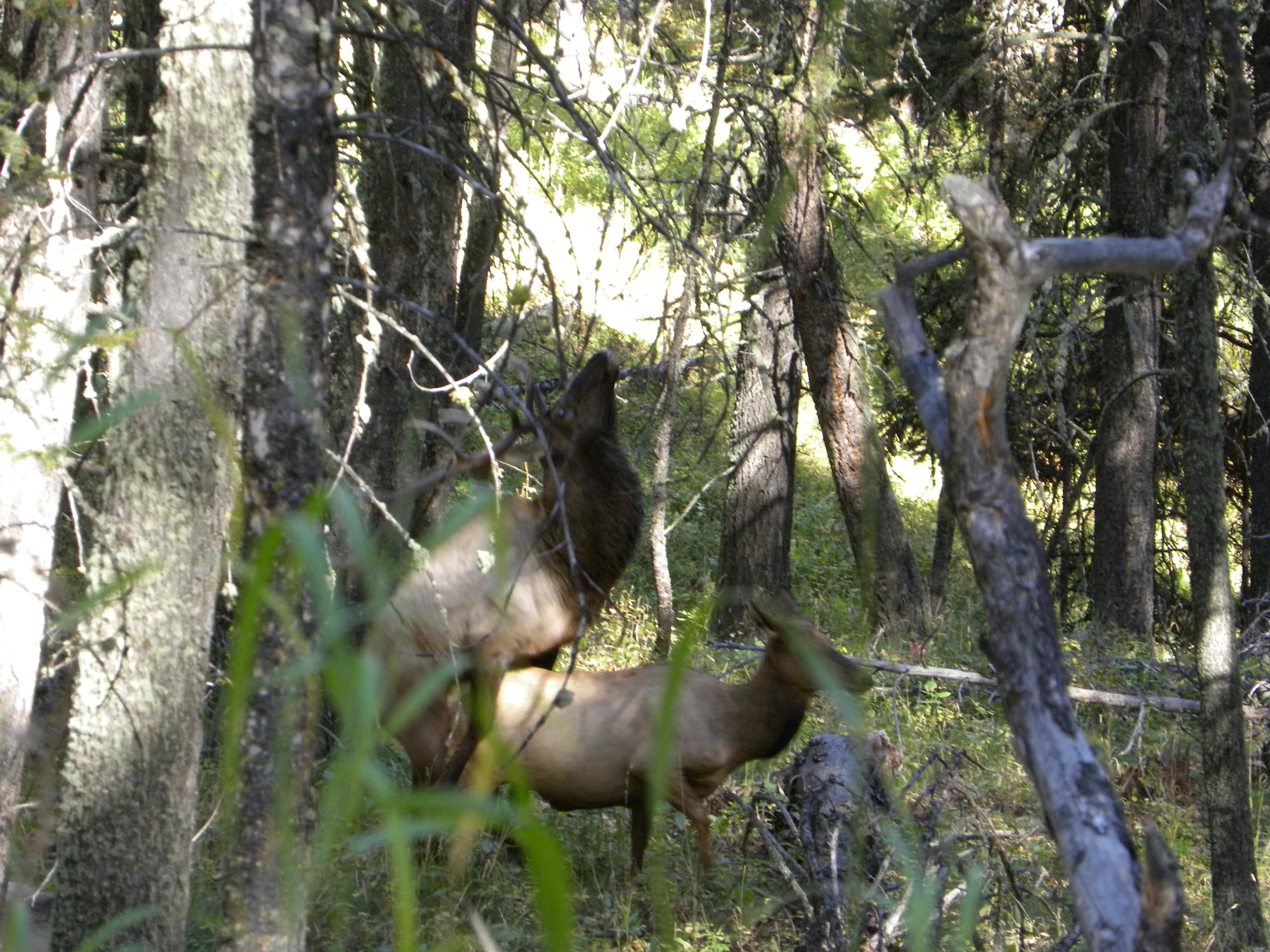
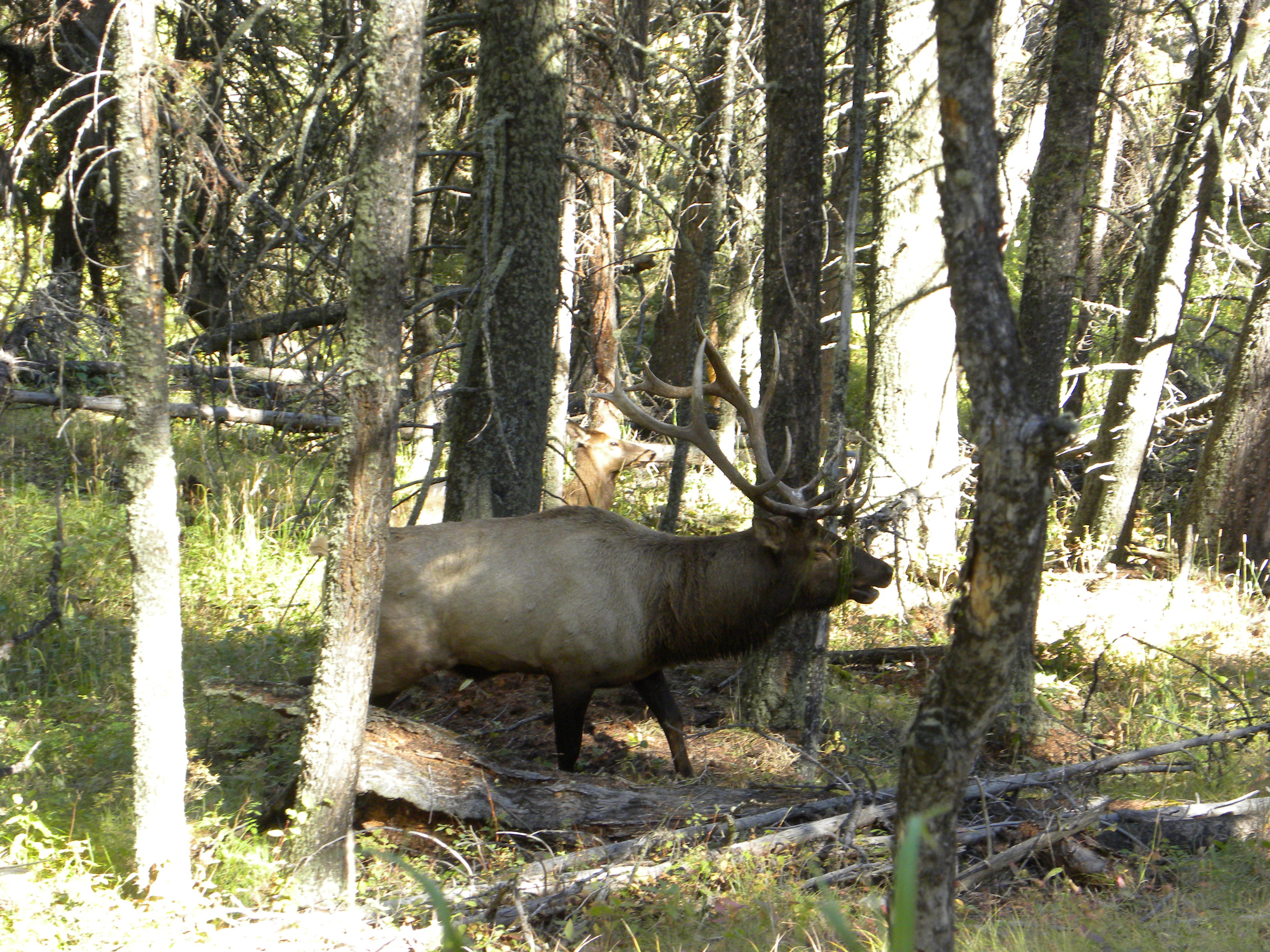
Waking up early, I soaked in the river, then headed up the trail to the Beaver ponds.  Its a fairly short loop of 5 miles.  Since I was early on the trail, I didn’t see anyone for the first hour.  The trail winds along the open hillside overlooking Gardiner, but soon dips into a conifer glade with seeps.  The day was already hot (as we’re having our summer now in fall), and as I moved into the cool shade I noticed about 20 elk, mostly cows and calves, lying around.  One bull was there.  This was his harem.  The cows were relaxed.  The calves were curious.  And the bull was keyed up.Elk mating

I lay down on the trail and watched for ten minutes.  As I continued on, I later heard that some hikers had come around the corner and gotten chased a bit by that bull.Bull Elk

Although there were no beavers to be seen when I arrived at the ponds, their evidence was.Beaver evidence

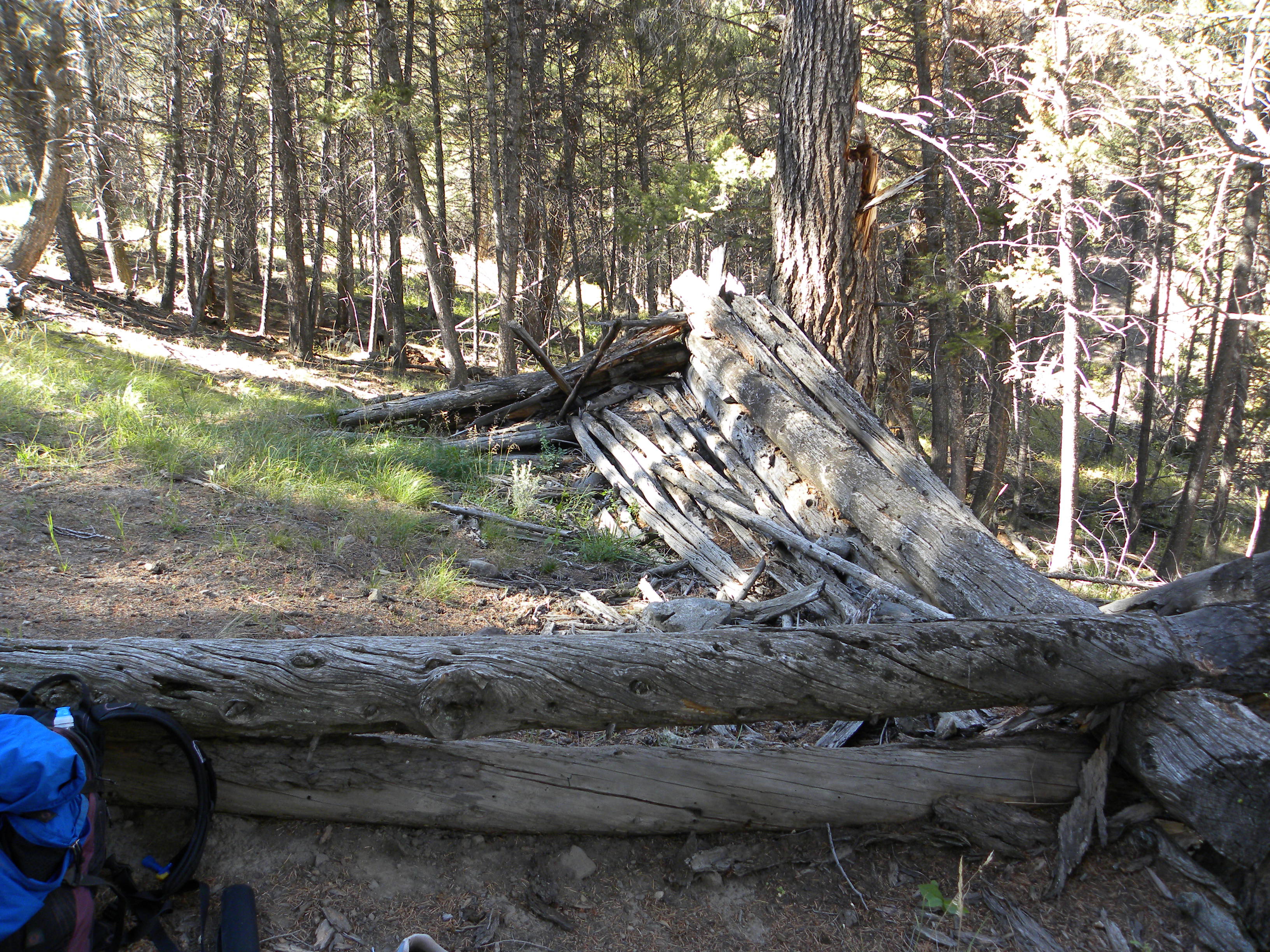
On the last leg of the trail, I noticed an old structure that looked like it had been a cabin.  I couldn’t find references to it in the guidebooks.  Wondering if anyone knows what it used to be?

Old Structure along Beaver Pond trail

Old Structure along Beaver Pond trail

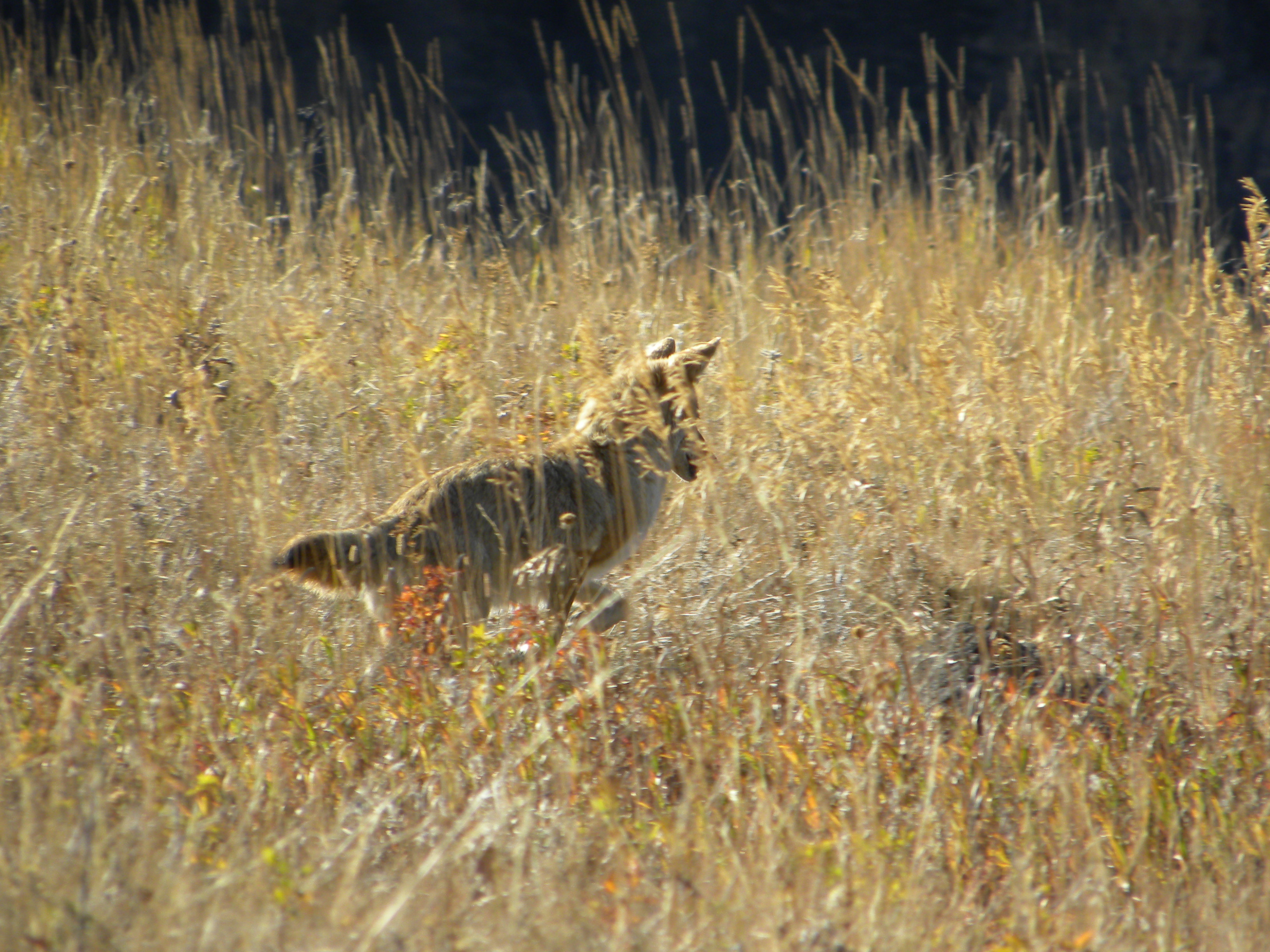
After a late lunch, I headed back towards the Lamar.  A coyote was catching grasshoppers.  He was terribly cute pouncing around.

Coyote catching grasshoppers

Coyote catching grasshoppers

And the light was perfect for this herd of Bison.

The light was perfect

The light was perfect

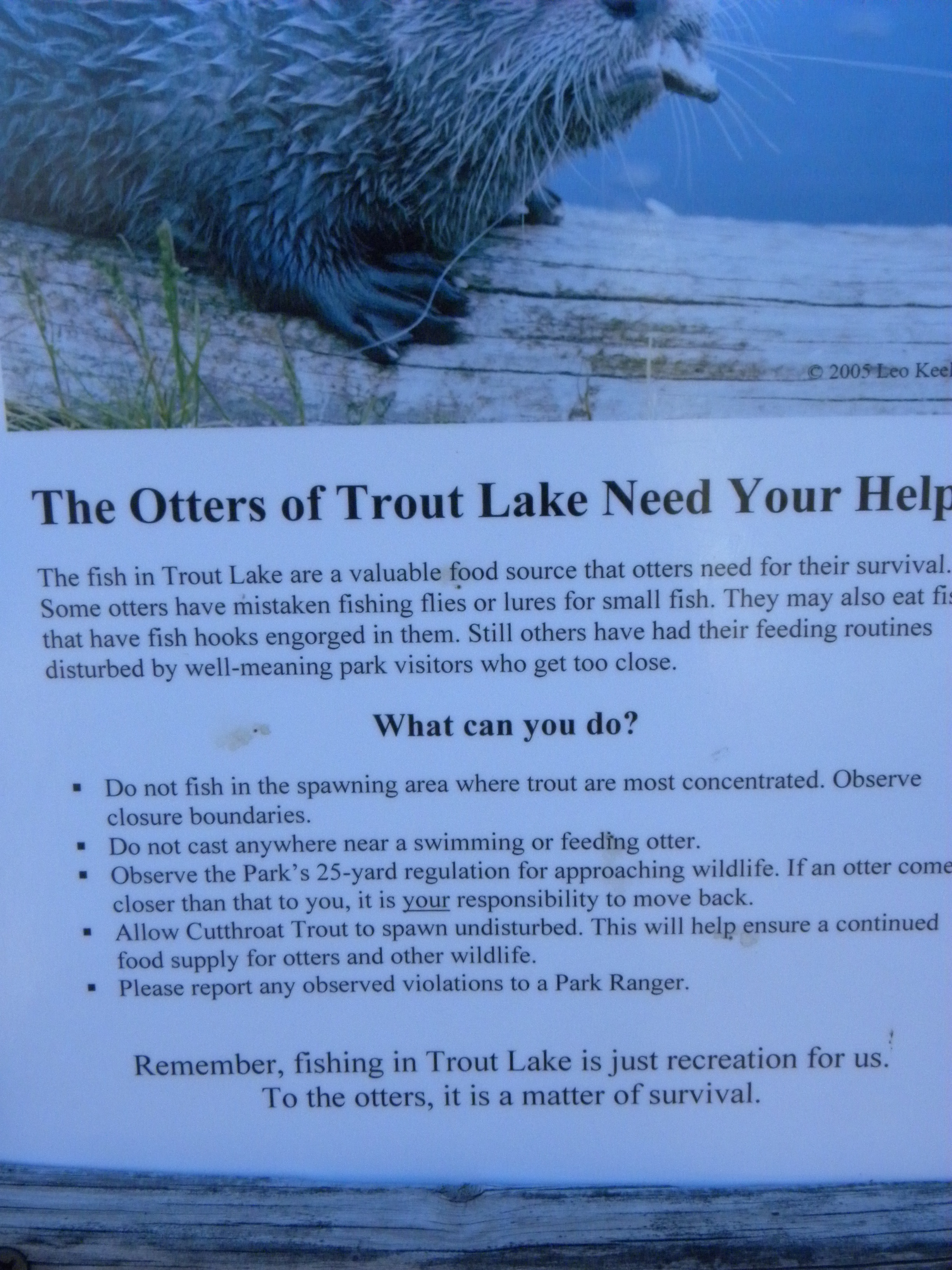
I stopped for a while and watched a second coyote, before heading up to Trout Lake.  I wondered if the otters were active.  Trout Lake is a very short hike/walk.  Otters are often seen playing there.  I didn’t see any otters today, but the lake was beautiful.  I spent time snapping some photos of the Lake, of a gigantic ladybug, and a dragonfly.

Trout Lake

Trout Lake

Ladybug

Dragonfly

Trout Lake signage

In order to get into the Park, you must rise in elevation.  That’s because of the bulge from the hot spot that Yellowstone sits upon.  I used to wonder why that special feeling seemed to almost begin and end at those entrances and exits, until it was explained to me.

I met a woman from California on the trail.  She comes to Yellowstone every fall for 3 weeks.  At the campground I met some people from Seattle who come every year at this time.  I met a man several years ago who comes every spring from Iowa.  Yellowstone is just like that.  It is a very powerful place.  A healing place.  Once it gets under your skin, you can’t help but dream the dream of returning again and again.

The woman who married a bear teaches me about pine nuts

After we visited the bear cave in Yellowstone, Jim Halfpenny sat us down on a nearby log and told a story.

“When we first migrated north from Africa, ancient peoples had no idea how to live with cold, what foods to eat, how to make shelters.  The Bear was their teacher.  Native Americans had several layers in one story.  The first and simplest they might tell to the children so they would stay close and be afraid of bears.  As the child grew older, the same story would be told in greater depth revealing more teaching and wisdom.”

“This story of the woman who married a bear was told in some form all over the world where there are bears.”

Jim went on to tell this ancient story in great detail about a Chief’s daughter who married a bear, lived with the bear clan, bore him two sons and then went back to her people.  When she returned with her sons, half-bear half-human, she was now a changed woman–a wise woman with much to teach her people.

This is the story of why humans throughout time have respected and honored bears, and how it was Bear who taught Humans how to live.

I was wandering in the upper meadows this morning, watching the Clark’s nutcrackers poke their beaks in the pine cones and extract the seeds, stashing them in the pouch in their throats.  Sometimes they’d try and clean the sap off by rubbing their long beaks against the bark. Since all the cones were way high,  I looked for dropped pine nuts on the ground, possibly ones the squirrels and birds had missed.  There were lots.  But every one I opened was no good, the nut had never matured.  I tried tree after tree with the same result and I marveled at how the animals knew to let these bad ones go.  I figured that if my life depended on these seeds, I’d definitely go hungry.

When I had a big garden, I used to fight the birds for the cherries on my tree.  I tried netting, decoys, shiny objects.  But crows and jays are smart and they’d wait till the cherries were just perfectly ripe, then beat me out there.  I’d have only the leftovers.  Pine nuts seemed the same.   I began to think about the Native Americans in the Basin & Range and California traveling far and wide for the Pinyon Pine nut.  Or the Native Californians and their acorn harvests.  There were ancient tricks to this that alluded me.

I knew that when I lived in California, I used to collect Redwood cones unopened, then let them ripen by a window and all the 100’s of tiny seeds would fall out.  Perhaps…

I wandered a bit farther up the denser parts of the hillside and noticed an old middens I was familiar with.  In one of the cavities beneath the trees there was stashed 3 douglas fir pine cones, fresh this year.  And that gave me an idea.  I went back and started hunting for a middens of Limber Pine cones.  Sure enough, I found a really large one with tons and tons of fresh cones, unopened and untouched.

Limber pine middens.  There's lots more than shown and much is buried

Limber pine middens. There's lots more than shown and much is buried

Some even had the pitch gone.  There were cones on top and cones underneath.  I tried a few nuts.  These were the good ones!  These were the ones for squirrel for the long winter ahead.

The cone collector's home

The cone collector's home looking down on us raiding his middens

Then I remembered the bear story.  Bears are smart.  They do sometimes climb the trees for their beloved nuts.  But its a whole lot easier to let squirrel do the work and just raid his larder, and that’s what they do.  Bear must have taught that to the People.  That was my lesson for today.

Look close, I took this bear scat apart & there's pine nut shells

Look close, I took this bear scat apart & there's pine nut shells inside