

Here’s another video of that wolf. Be patient till about 20 seconds when he comes and checks out the camera for a real close up.
Filed under: New ideas | Tagged: Wolf, Wolves | Leave a comment »


Here’s another video of that wolf. Be patient till about 20 seconds when he comes and checks out the camera for a real close up.
Filed under: New ideas | Tagged: Wolf, Wolves | Leave a comment »
I had my trail camera focused on a road killed jackrabbit. A marten spent two days trying to get it down. Then a coyote came bye, the marten scrambled up a tree, and the coyote pulled it from where it hung and devoured it.
Four days later, this wolf came along to investigate the scene of the crime.
Filed under: New ideas | Tagged: Wolf, Wolves | Leave a comment »
Everyone who is interested in nature needs a study area. Jon Young recommends a ‘secret spot’ that you go to everyday and sit for 45 minutes to an hour. While you sit you listen, possibly take notes, then journal upon your return. You will get to know one area intimately–the birds and their alarms, the movements of wildlife through the area, the seasonal changes.
This winter I was with a friend who is an excellent tracker; so much so that he has started doing tracking studies for a living. A property owner might be curious who is visiting his land. Richard goes to the site several times over the course of a month or more and studies the sign left by the wildlife. He showed me a map of one site he’d done. That excited me and I thought I could do that in my little woods during the winter months. Then I realized that I’d been doing something like that, informally, all along. Every time I walked through the woods, I mentally noted who’d been visiting, either through tracks, other sign, or even my trail camera. So I decided that I’d do a more concentrated and documented study.
In some of my past entries this winter, I’ve noted what I found: lots of martens and weasels, cougar sign, meagre rabbit sign, wolves, coyotes, etc. I tried putting some of this into a map. I thought maybe if I could map it, then I might be able to determine how many martens inhabit my study area or how many weasels. By knowing where I saw the sign, then I could use others science on the approximate square area a weasel occupies.

This is my hand drawn map of my study area. Different colors relate to different animal tracks. Dashed lines are trails Hatched lines are fences.
My study area covers approximately two square miles, some meadow with sparse limber pines, lots of hillside with mostly douglas fir, and wetlands that have logged spruce. The mountain I traipsed through regularly is structured like a wedding cake, tilting and falling over on its side. Layer upon layer rises up as a series of platforms, reaching into a scree area. The top layers are decorated with large boulders. The icing is snow that leaves a record of all the guests.
What did I learn? Plenty! By walking regularly through a defined area, I feel I came close to entering the secret world of animals. I became privy to their goings on–where the bobcat hunts and where he rests; the high energy rhythms of the weasel moving from tree to tree, hole to hole, looking for voles; the mysterious interactions of cougars and wolves; and the exuberance of resident coyotes who’ve been hiding and silent when the wolves were here, but when the pack returned to the park, they began their singing once more.

The YNP wolves visited Sunlight this winter for a few months.
There is an entire world, separate from the narcissistic preoccupations of human society, occurring simultaneously. It has its own language. The animals understand that language, yet I have to relearn it. I found that it wasn’t about watching one animal alone, but the relationship between all the wildlife that was fascinating. Wildlife are well aware of each other. Only us modern humans are deaf to this living web. By combining oneself with the ‘natural’ world, possibly a door might unlock to another way of seeing the world and its Mysteries altogether.

Mysteries of the Universe captured in sound
Filed under: Tracking | Tagged: Tracking | 3 Comments »
Here’s another type of weasel. I’m pretty sure this one is a long-tailed weasel because it’s tracks were about the right size. It’s hard to tell an ermine from a long-tail from the video. The quality was compromised because of the snow.I tried to enhance it a bit.
I was trying to catch a mink. I baited with sardines and fish and set the box on an ice bar right along the river. But instead I caught this guy. Notice the white fur with the black tip. Both ermines and long tail weasels change their coat color to white in winter. Watch the other video and you will see that Martens keep their coat color. This box is about similar size to the Marten box because minks are about Marten size. That will give you a size difference.
I’ll keep trying for that Mink!
Filed under: Mustelids | Tagged: long tail weasel, Weasel | 1 Comment »
Trapping season for bobcats and martens is over! Living here, it seems wildlife never get a break. Between hunting, collaring, trapping, logging, snowmobiling, ATV’s, there’s always some disturbance, sometimes quite major like hunting, that is going on. Cougar hunting is still on till the end of this month, although we have almost no snow and black bear spring hunt season begins soon.
Regardless, I have been worried that I haven’t seen any bobcat prints in the usual spots all winter. Bobcat trapping is becoming of major concern because pelts are fetching up to $1000. The Chinese and Russian market in particular are driving the prices, and every Tom, Dick and Harry is trapping the cats. A big story out in the California desert is trappers who are scanning the internet for bobcat pictures unsuspecting amateur photographers post, then placing traps right outside these people’s backyards. Other trappers are putting tons of leg hold traps on the border of Joshua Tree National Monument.
Although the rabbit populations are down in the desert, they are not doing so bad up here. The cottontails are beginning to rebound, and the snowshoe hare population seems to be doing just fine. But where are the bobcats?
So I was happy when right after a fresh snow the other day I came across this bobcat trail.

21″ stride direct register made me think he was trotting or just a big bobcat walking
I tracked the fellow for over two hours and let me tell you it was strenuous. He seemed to be on a mission, heading directly, and mostly at a trot, up the steep slopes until finally, once high up, he stopped to stand on a boulder and look down over the valley.
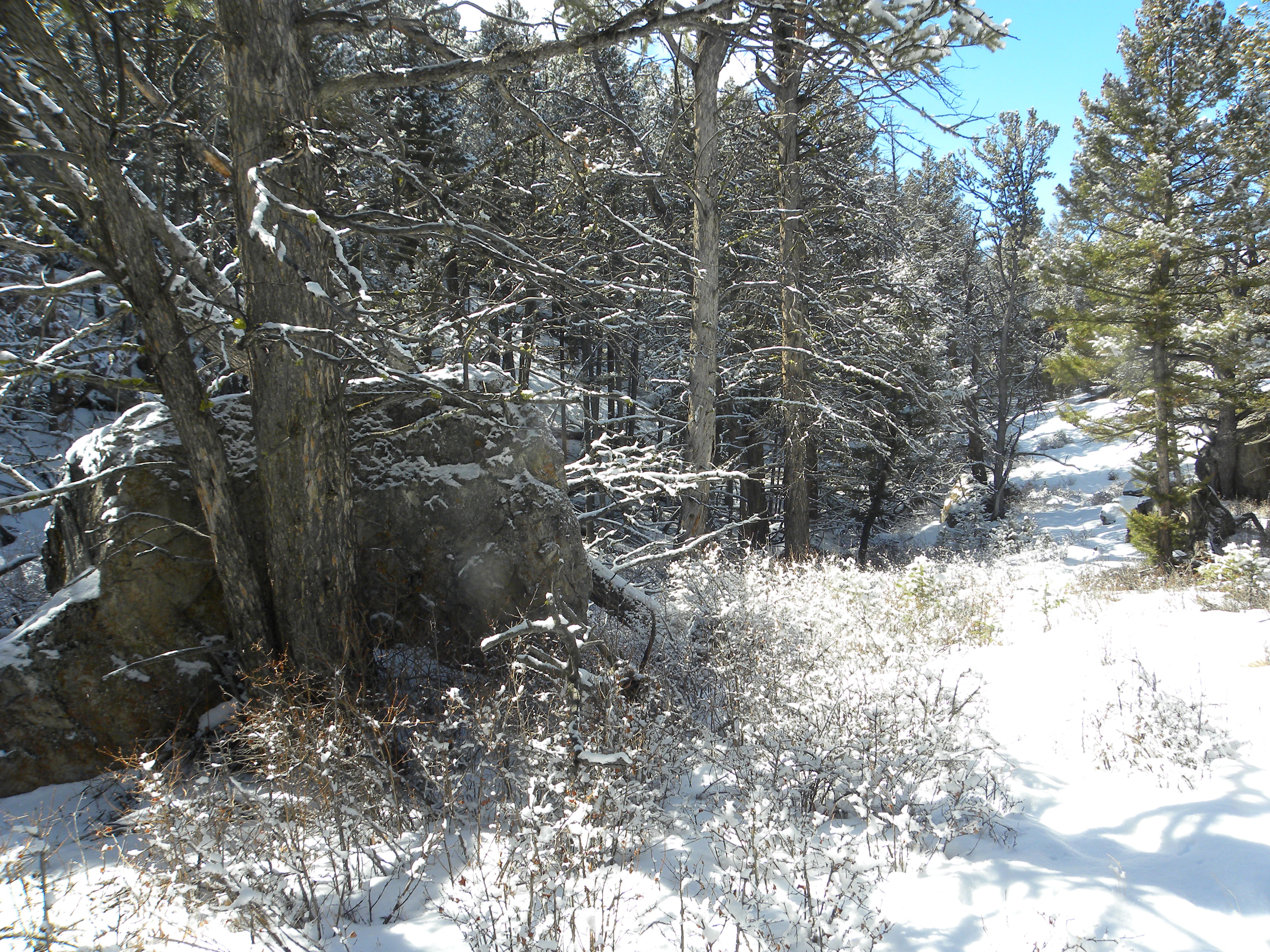
Bobcat takes me up high
Then he made a sharp left and zigged and zagged even higher up. As the snow got patchier with the daytime temperatures warming, I was having a harder time finding his tracks. Finally, he led me way high, into the snow-covered scree base of the mountain. I figured he was going back to his daytime den, as the tracks were made early morning. Everything in me wanted to follow him, but the difficult terrain and my own exhaustion said ‘Another Day’.
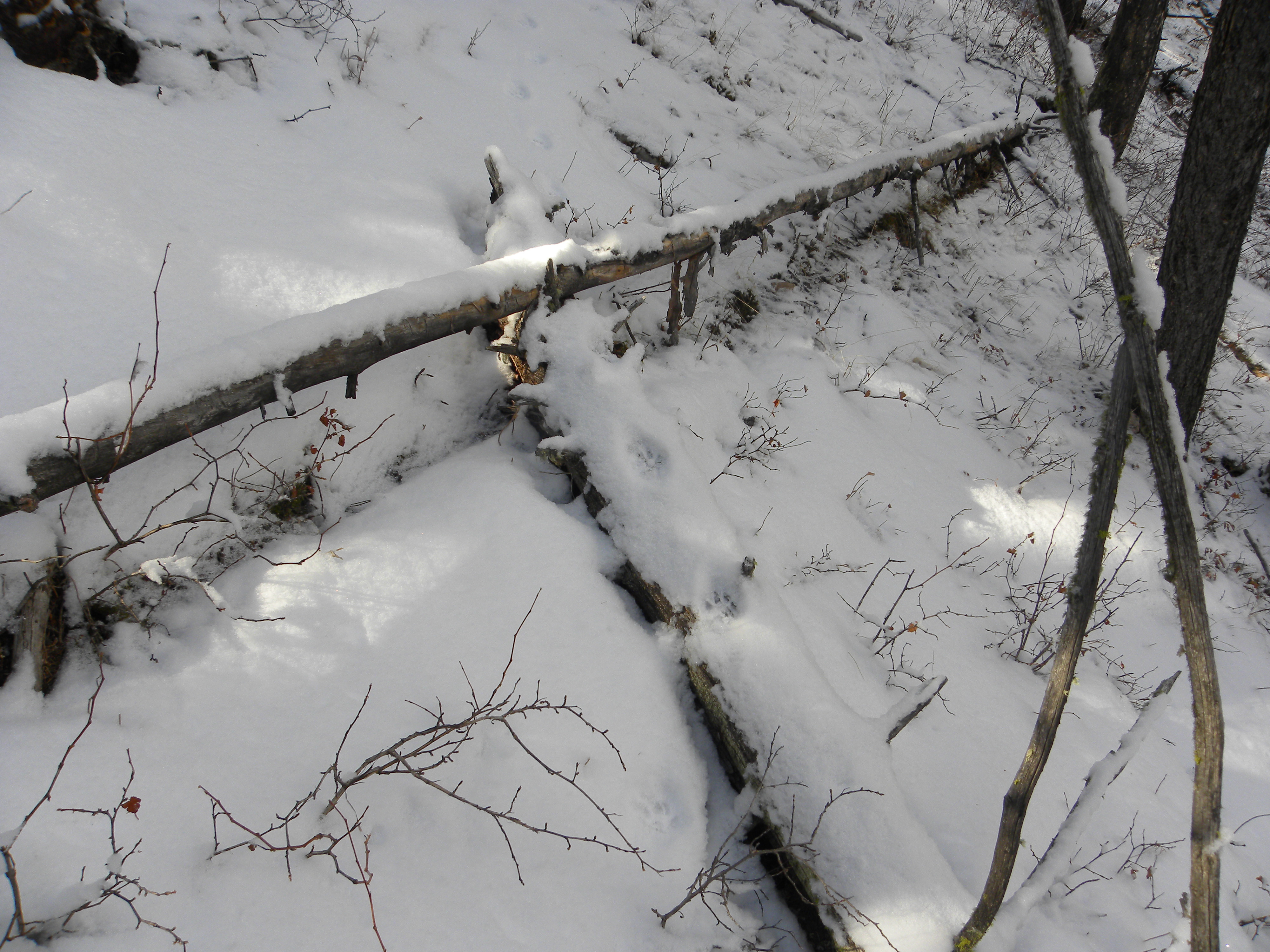
Cats like to walk on downed logs to help hide their scent

Nice direct register print with my 3′ tape measure for size
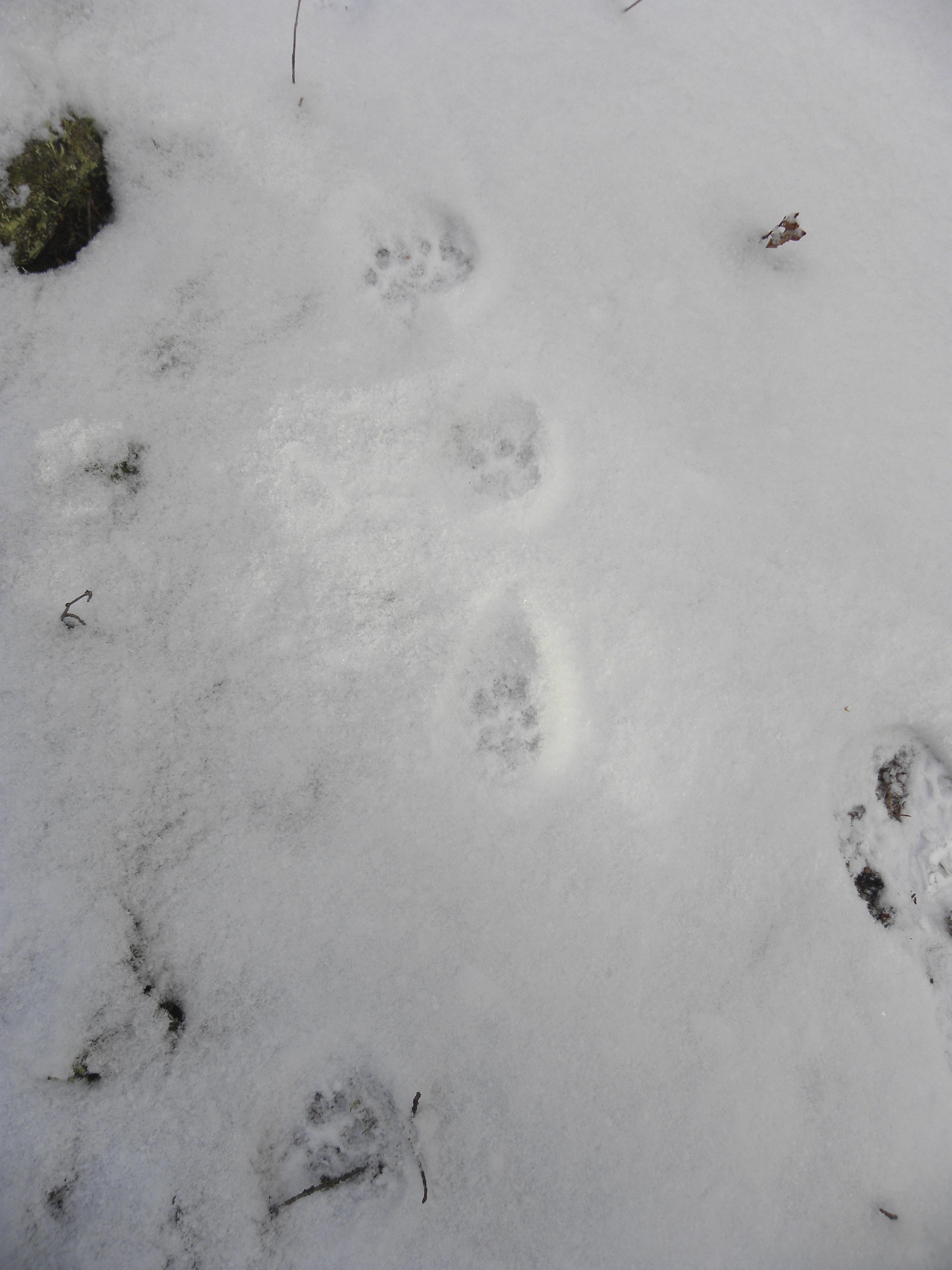
This cat was almost completely direct registering but here he did a curious thing. Not sure of what happened with his gait here. Any ideas?
Here’s another question to answer: Bobcats are very habitual animals, using the same territory over and over again. This bobcat was occupying cougar territory. He was denning and hunting in an area where I’ve seen cougar sign over and over again. I understand cougars sometimes kill bobcats. Last year I found bobcat and cougar tracks together in another area with almost the same freshness. I wonder about this tenuous relationship, and how these bobcats are avoiding cougars.

Photo I took of a bobcat in Palm Springs wildlife zoo. He looks like he wants to get out there.
Filed under: Bobcats | Tagged: Bobcats | 1 Comment »
There are plenty of weasels this year after a plentiful squirrel population. Here is a marten exploring a box with fat I made for him.
Filed under: Mustelids | Tagged: Martens | Leave a comment »
Finally time to post a cougar entry. Days have been warm, so when we’ve had snow, it melts off quickly. But I’ve had two interesting cougar tracking experiences.
Several days after a very nice snow I ventured out to an area where I’ve seen cat tracks many times. Its a landscape full of boulders with low cliffs easily passable for humans–perfect cougar tracking. I headed straight for some high cliffs where I found cougar tracks last year, and lo and behold, there were fresh puma tracks. Because the terrain is fairly easy, I was able to follow these tracks for over an hour, mostly up, down and over boulders. A coyote occasionally mirrored this cougars’ trail.

Left Hind
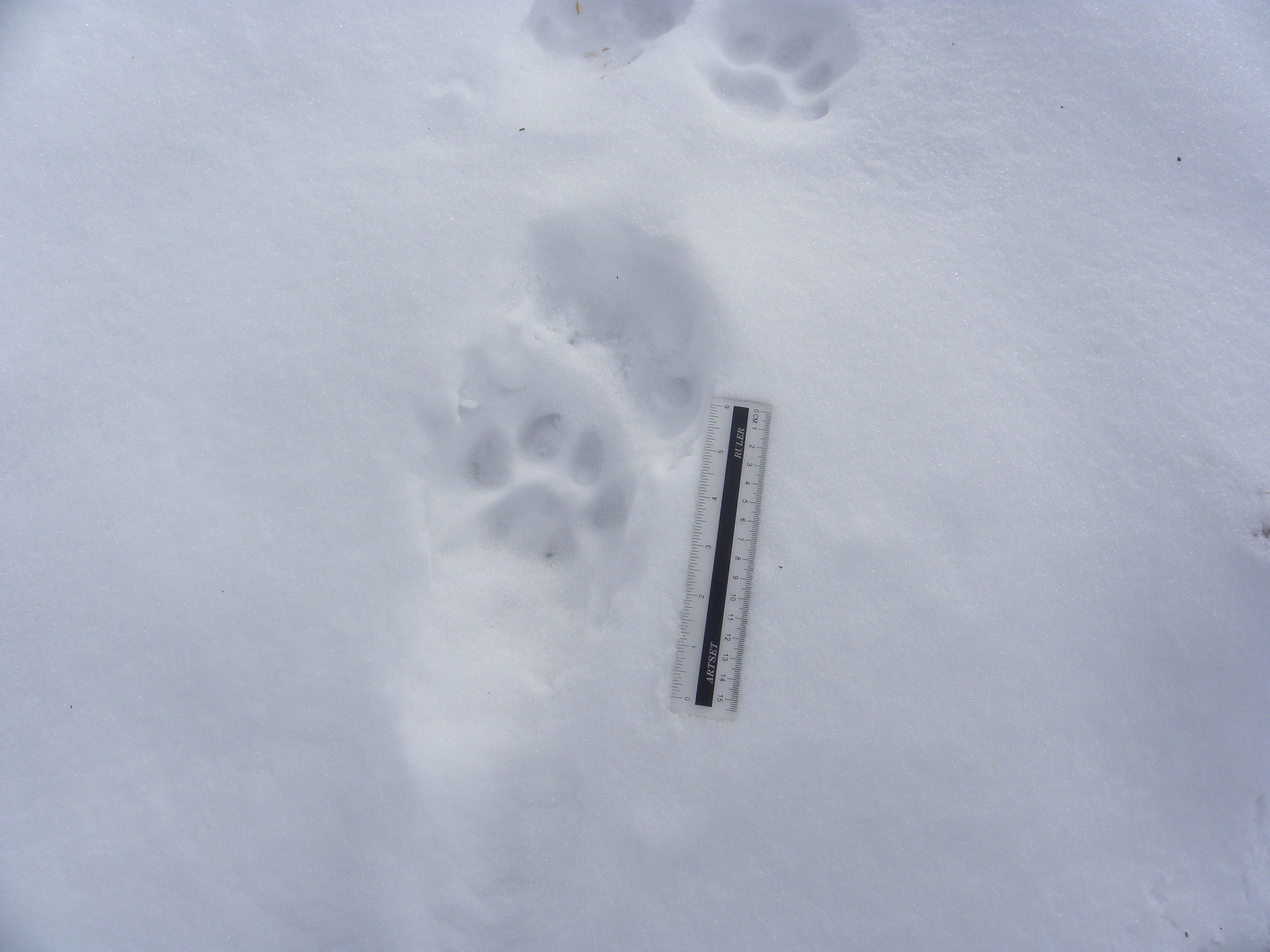
Nice front print

Right front (Rt.) Left hind over front foot (lt) cougar
Moving with an easy gait, occasionally jumping high up on a boulder or down into a gully (where I had to go around. Following a cougar isn’t easy), the cougar stopped on a rock at an overlook to size up the terrain. All this indicated that this cougar was relaxed.
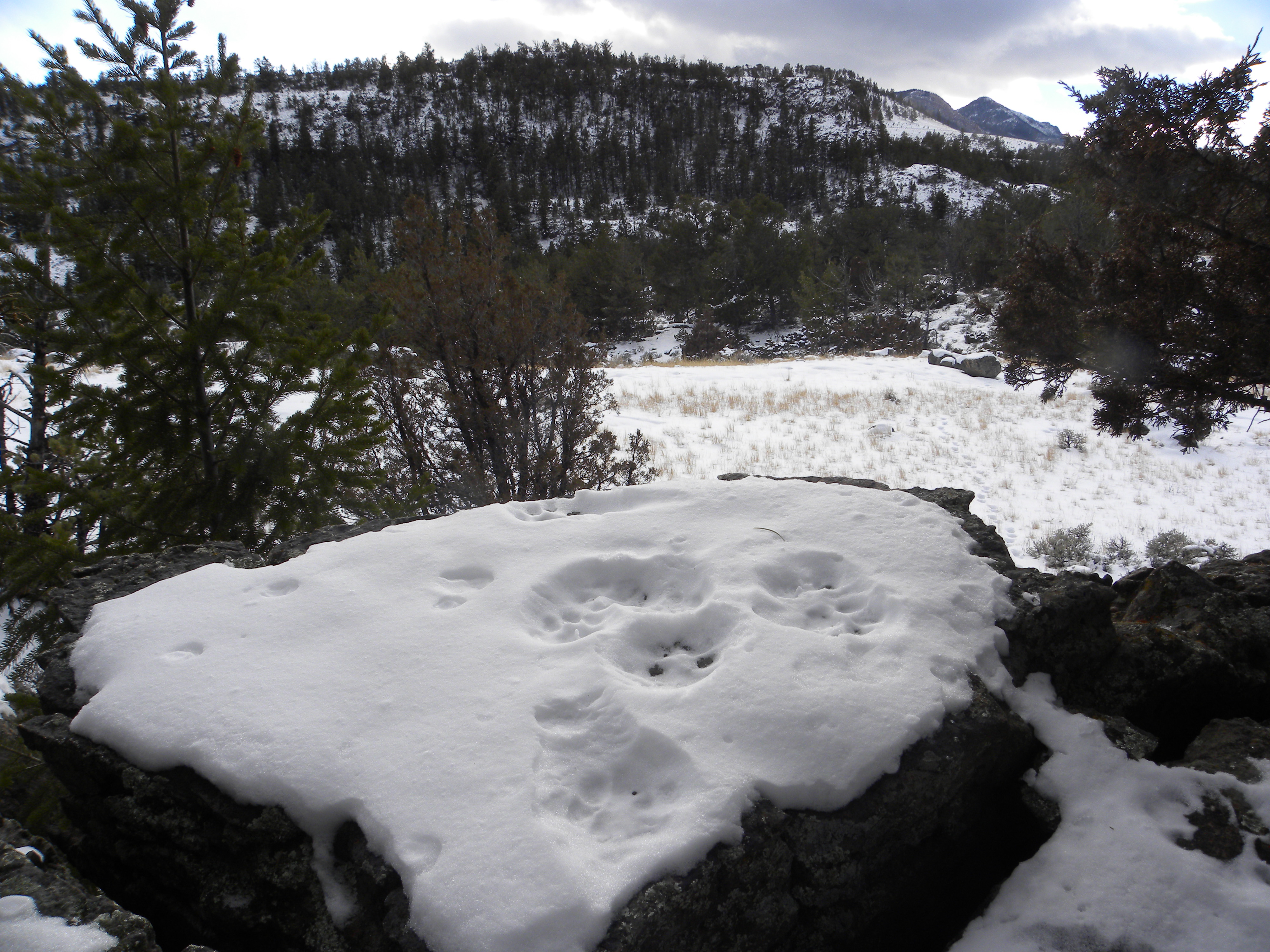
I’d seen wolf tracks when I began early on, but not coinciding with my cougars tracks. Yet suddenly the wolf pack’s tracks appeared atop a ridge, fresh as the cougars’. The wolves and the cougar headed down a narrow path to a ravine below, where I lost the cougar tracks in an array of wolf tracks. I searched everywhere but the plethora of canine tracks obscured all other sign. What were those wolves doing? There was no sign of a kill in the area. Usually Koda is pretty good at finding carcasses when I can’t. I even went back on another day, combing the area for a kill, but nothing.
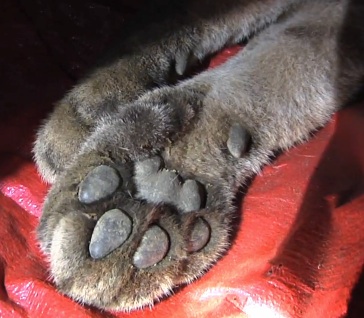
Cougar paw

Anesthesized cougar teeth
A few days ago I hiked up the mountain behind my home. A series of terraces stair steps up the mountain side. It’s a north facing wooded area and some of the shelfs are quite steep. I climbed fairly high when I came across a fresh cougar track. The cat scrambled to the next level, the final mesa before the mountainside turns to scree. It’s an area full of large boulders. The cougar easily and deftly walked up the slope toward a giant granite boulder which she jumped on top of. Yet what caught my attention were the wolf tracks that ran right in front of the boulder and over the cougar tracks–same freshness. Here again were cat and canine tracks together.
Again losing the cat tracks, I followed the wolf tracks back to the woods by my house. There I found not only cougar and wolf tracks, but a deer kill already picked over by birds, probably from the night before. Did the cougar kill the deer, only to be driven off by the wolves?
So, this leaves me with more questions than answers. Do wolves keep a pretty good bead on cougars? Cougar kills are easy food for other predators and that’s why they take time to cover their kills. But what were those wolves doing around that cougar on my first tracking excursion? What kind of competition are those wolves presenting to that cougar? And it also lead me to think about people who hunt cougars with dogs. Eight dogs have been killed by wolves in Montana this year while hunting cougars. Are those dogs more susceptible to being caught and killed by wolves because they are following cougars? There have been a series of dogs lost in Sunlight over the years, some for a few weeks, yet all the lost dogs have turned up, not killed by wolves. Yet a few years ago a hound hunting cougars was killed by the wolf pack.
I am curious about the relationship between cougars and wolves, two top predators competing for similar prey.
Filed under: Cougars | Tagged: Cougars, Wolves | 3 Comments »
With warm temperatures and little snow in my mountain lion tracking areas, I’ve turned to tracking small mammals above my house. I’m not sure if I am just becoming aware of what these tracks look like, or if I am actually noticing an explosion of long-tailed weasels this year.
During last summer, we had a lot of reports in the neighborhood of weasels. One neighbor told me her indoor cat killed a baby weasel and left it in the living room. Obviously, some weasel had gotten into her house and had a litter. Because weasels kill a tremendous amount of mice, she wasn’t too happy with her cat. I personally watched a weasel take three baby bluebirds from their nest that were about to fledge. I attribute all these sighting to an explosion of Unita ground squirrels this summer.
The weasel family has a distinct gait, especially in snow, called a 2×2.

you can see the 2×2 gait where the back feet land in the front feet tracks.

These are really clear weasel tracks on the porch. My shoe for size.
The only way I could figure out what kind of weasel I was seeing was to take measurements of the track width. After taking lots of measurements, I found I’m seeing long-tailed weasels, not ermines. From my observations, it appears that weasels hardly ever backtrack, unlike squirrels who make a deep trails back and forth between their caches and trees. They wander from one rock or juniper to the next looking for mice and voles. The reason you rarely see backtracking is because, unlike squirrels, they don’t have permanent dens. Instead they go out looking for prey, make a kill, then take over their prey’s nests. They might use these nests for a few days only.

Vole tracks on snow close up

Vole bound. You can see it’s tail drag. My shoe is for size.
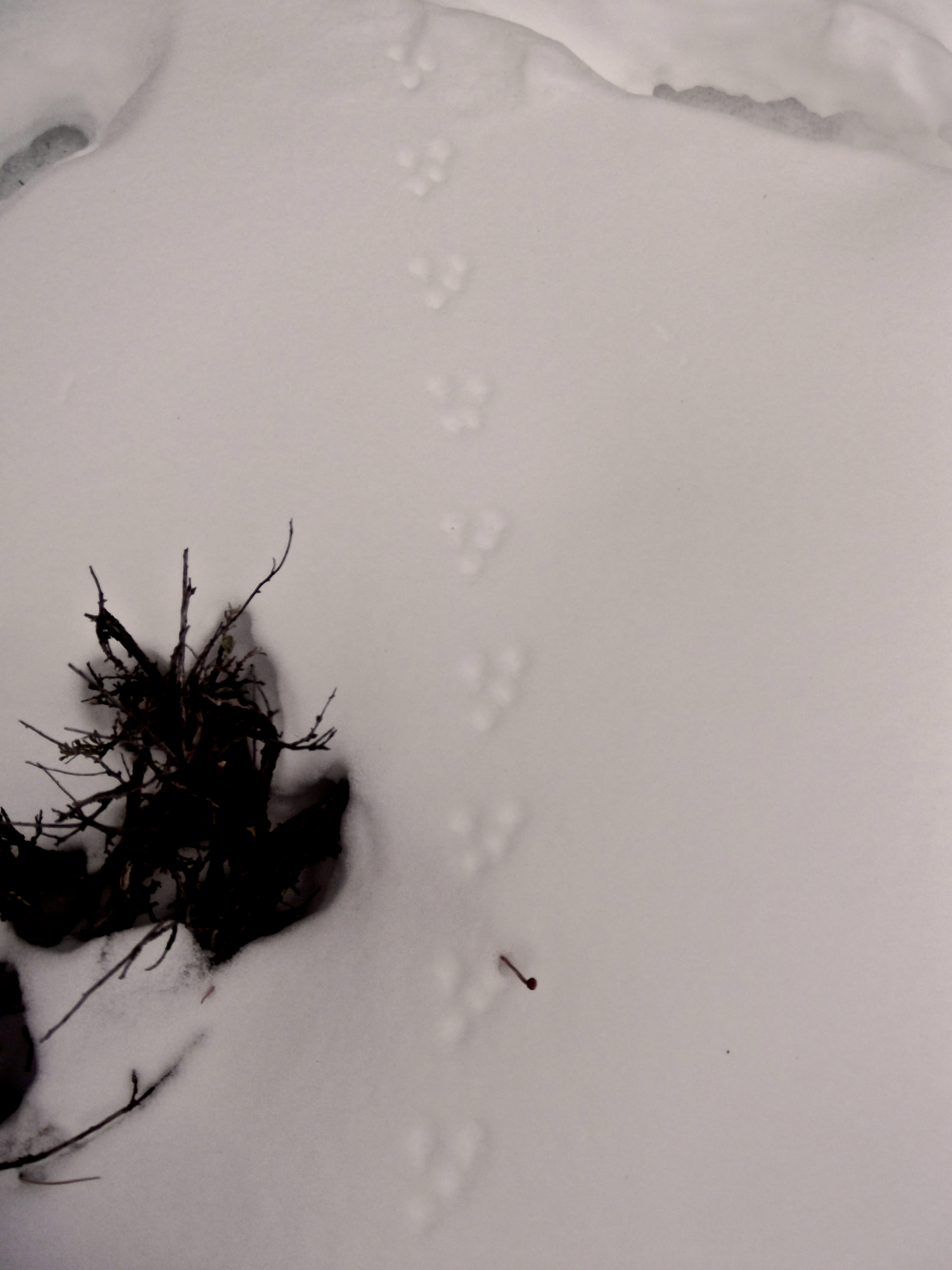
Mouse tracks in snow
I’ve found these weasel tracks in fairly predictable areas–forested areas encircling small to medium sized meadows. This would make sense considering their prey consists mainly of voles and mice.
I followed a weasel track into the trees and came across Marten tracks. Martens, like weasels, are mustelids and have that characteristic 2×2 in snow except much bigger. Where weasels have a trail width of 1″-3″ depending upon which weasel, martens have a trail width of 2 3/4″ to 4 1/2″ and a much bigger foot. Once you start to recognize these tracks, they will be easy to distinguish from rodents and from each other.

Scale shows width of track

Ruler shows trail width
The Martens, unlike the weasels, like to travel in heavy timber for protection. They also eat voles, but take squirrels, carrion, berries,fruit, chipmunks and birds. Martens climb trees whereas weasels rarely do. They prefer old growth forests. James Lowery says that ‘logging that removes old growth trees and forest management practices that result in islands of forest separated by open space do not provide good habitat for marten and, some would say, destroy the health of the forest as well.” Lowery’s comments makes me wonder about the logging that is going on this winter in the Sunlight area.
I walked up Little Sunlight Campground the other day which has been extensively logged. Loggers have created huge slash piles. They took all the largest trees and left islands of narrow girthed conifers in groups with large meadows in between. When I walked the logging road, I saw almost no tracks except deer and a few elk, but no squirrels or smaller critters. Are these the best forest practices in a wild place like the GYE? Many people I talk to say we need this for fire protection, or we need the lumber. But control burns are better for the habitat as they suppress invasives that come up after logging, and encourage fire adapted plant materials that fix nitrogen to sprout. This kind of logging will be good for large browsers, but not for martens and other animals that depend on old growth forests and dense cover.

You can see the slash pile beyond Koda. This was a heavily forested area before logging
Filed under: Mustelids | Tagged: Logging, Long-tailed weasel, Martens | 2 Comments »
“The Grizzly Bear, by William H. Wright, first published in 1909, is one of the best all around books ever written on the subject. His books shows a hunter becoming a naturalist: Wright first studied the grizzly in order to hunt him, then he came to hunt him in order to study him.” Frank C. Craighead, Jr.
That’s quite a recommendation from Frank Craighead, one of the most well known grizzly bear experts. Craighead was instrumental in having this out of print book republished. Not only is this a highly readable book, but fascinating if you can get over all the grizzly bear hunts and killing he describes in the first half. But Wright was a product of his time. No hunting quotas, tags or seasons.
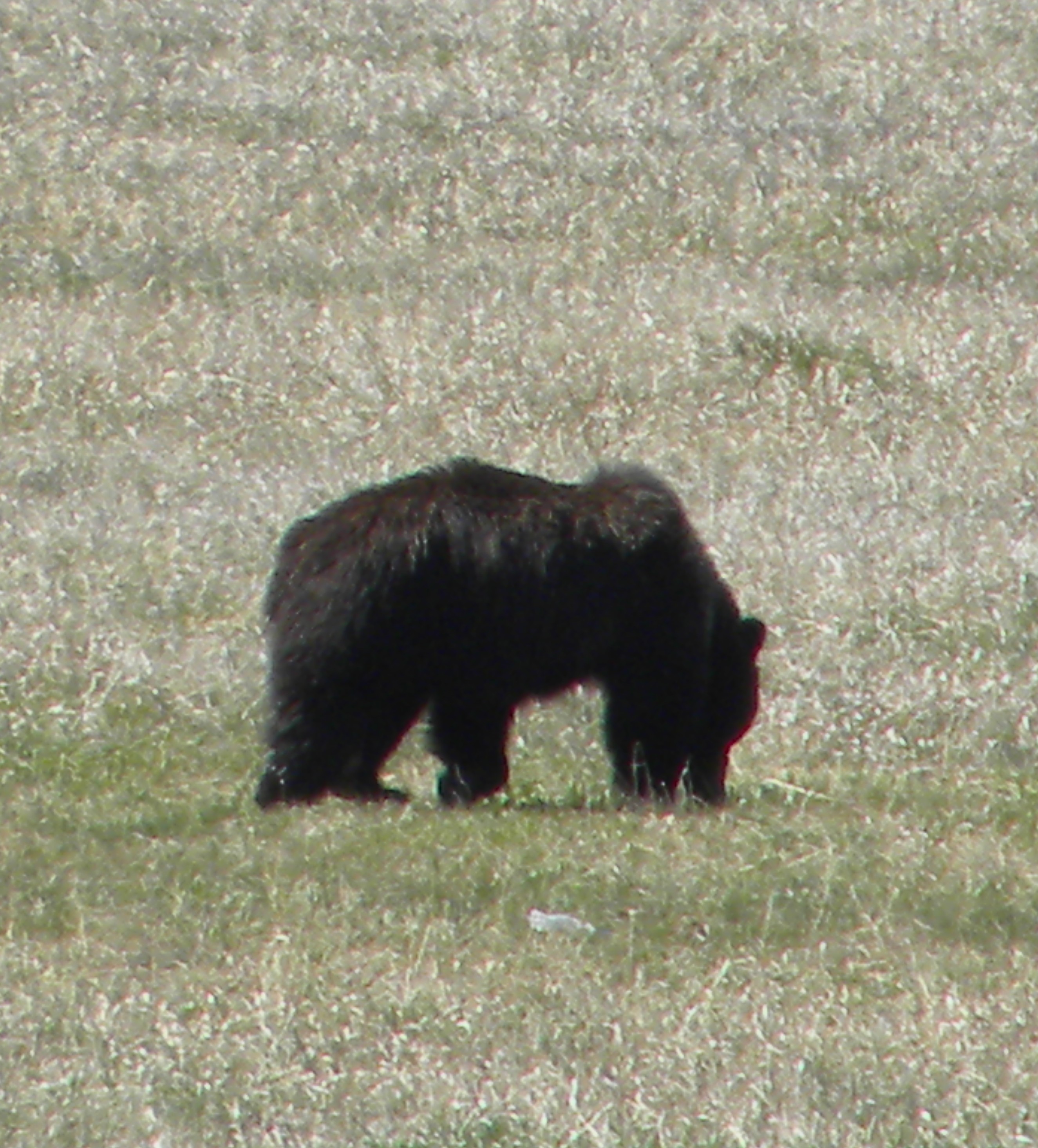
Grizzly in Lamar
But Wright is not just a bear hunter; he’s a fascinating character. He knows grizzlies inside and out. He sees a track and, even if he is not hunting bears, he gets in the mood to follow the griz for two days. He’s eight hours behind him, but because he understands grizzly habits, he figures he’ll eventually catch up. He describes where and when the bear was digging, if the bear was successful at catching his marmot or ground squirrel (and how many), when the bear took a nap, how it paused to sniff for danger…all in the tracks. Then when night comes and he still hasn’t caught up with the bear, Wright finds a large rock, builds a lean-too and a fire and beds down. Then he starts out again the next morning, all in unfamiliar territory. At last he finds the bear in dense shrubbery and kills it. Wright never baits bears as he considers it not fair chase. He only uses his own cunning pitted against the bear, whom he considers the smartest animal there is.
In one narrative, Wright is guiding two fellows on a bear hunt in the Bitterroots. The men are back at camp while Wright is fishing with the dogs. Wright and the dogs spot a grizzly. The dogs run after the bear and corral him in a hole. As the bear swats at the dogs, Wright, who left his gun back at camp and in his attempt to save the dogs, takes out his pocket knife and starts swinging at the bear. Long story short, Wright kills the bear with his pocket knife.

Grizzly minding his own business
Wright realized that grizzlies were endangered and becoming extinct. He loved these bears and admired their intelligence and had already begun photographing them in the wild in the attempt to save them. In 1906 he went to Yellowstone National Park to use some new photography methods. His was essentially the first ‘trail camera’. He used a sewing thread as a trip wire. One end he attached to an electric switch which exploded a flash and sprung the shutter of his camera. The other end of the trip wire was tied to a small stake driven into the ground beyond the trail. He located a heavily used bear trail, set up the apparatus, then hid in the bushes to watch, mostly at dusk and into the night.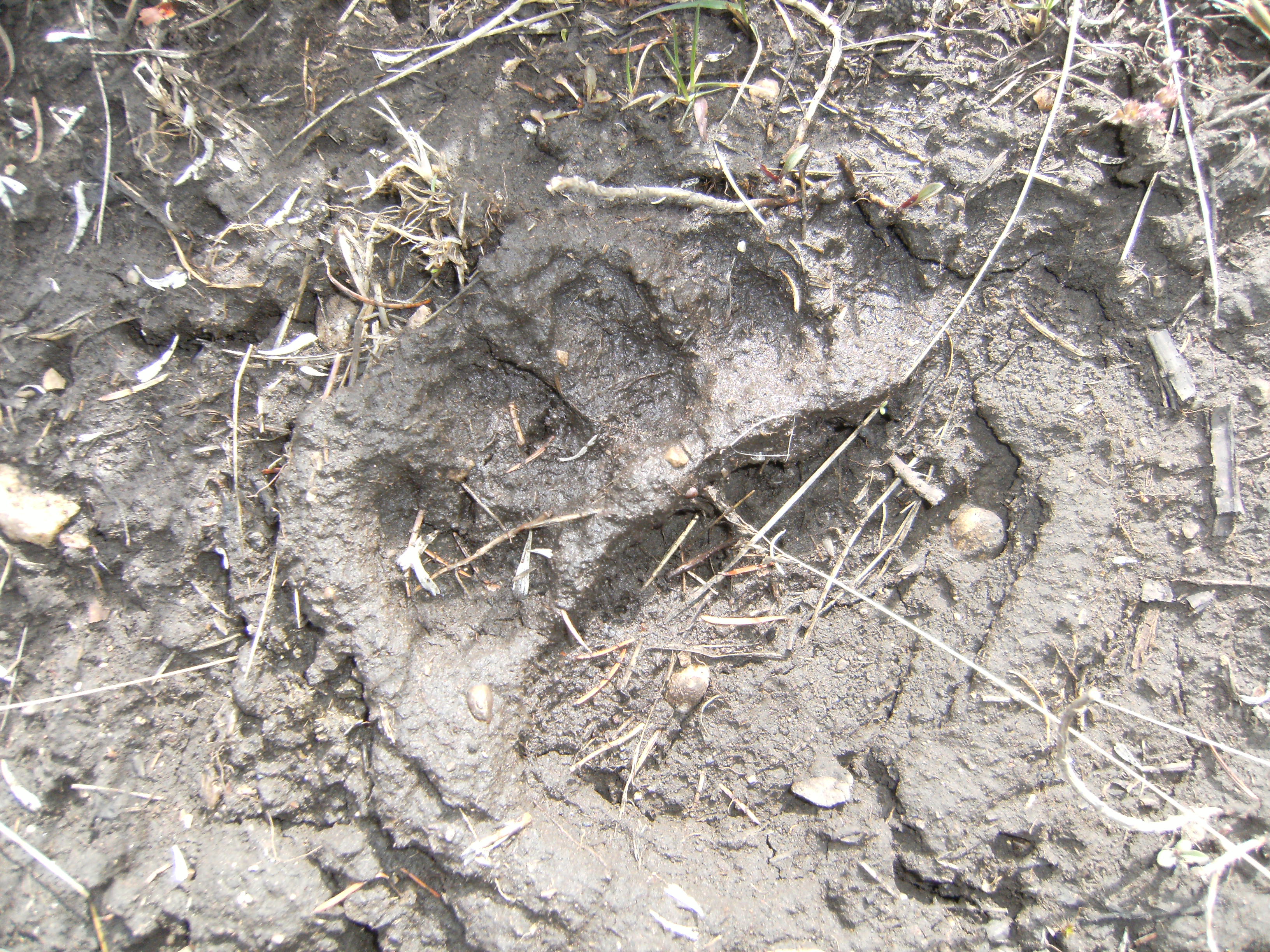
From there he reports on the various bears that came bye. In every instance, whether mom with cubs, or three year olds, or old boars, the bears all stopped short of the thread, sniffed the thread, sometimes bolted, sometimes explored the thread up to the stake and down to the switch. Most all of them refused to go beyond the thread.
So Wright left the Mt. Washburn area and headed toward Lake. He set up the apparatus, but this time he found the thinnest wire he could, so thin that he himself couldn’t see it from ten feet away. He then chose a trail that was covered with grass in order to conceal the wire. Then he waited some two hundred yards up the trail and watched. Again, all the bears detected the wire, nosing along it inquisitively. Wright even recognized a few of the bears from the Washburn area on this trail. 
Thinking that maybe these Yellowstone bears were quite adapted to people, Wright tried walking up and down the trail first to human scent it, then hiding behind the tree. But this only made the bears more inquisitive, some of whom came, under cover of darkness, within ten feet of him. Wright remained still in order not to frighten them. When they got close enough to figure out he wasn’t a stump, they all ran off.
Wright describes the grizzly temperament as very wary of danger. He says they are habitually cautious and alert, and the veru least scent or sound or sight sends them into the farthest hills. 
Reading Wright has made me think again about grizzlies. My usual take on grizzlies is that they have not a care in the world as they are top predators. I think of them as swaggering through the woods, meandering from food source to food source. Yet Wright describes them completely differently, and says he found the protected Yellowstone bears no different than any other wild bears he had encountered in the Selkirks or the Bitterroots. Reading his tracking narratives, it appears these grizzlies are peaceable animals, not only wary of dangers, but mostly interested in sleeping and digging for foods. Without having such direct and repeated experiences with grizzlies, it’s impossible for a person to know their nature like Wright does. So instead, tales get told and assumptions are made, and all we can go on is what we’re told to do in case we actually run into a bear while hiking or camping, and usually this involves a gun or bear spray. With more bears inhabiting our region, it’s good to read all we can. I highly recommend Wright’s book.
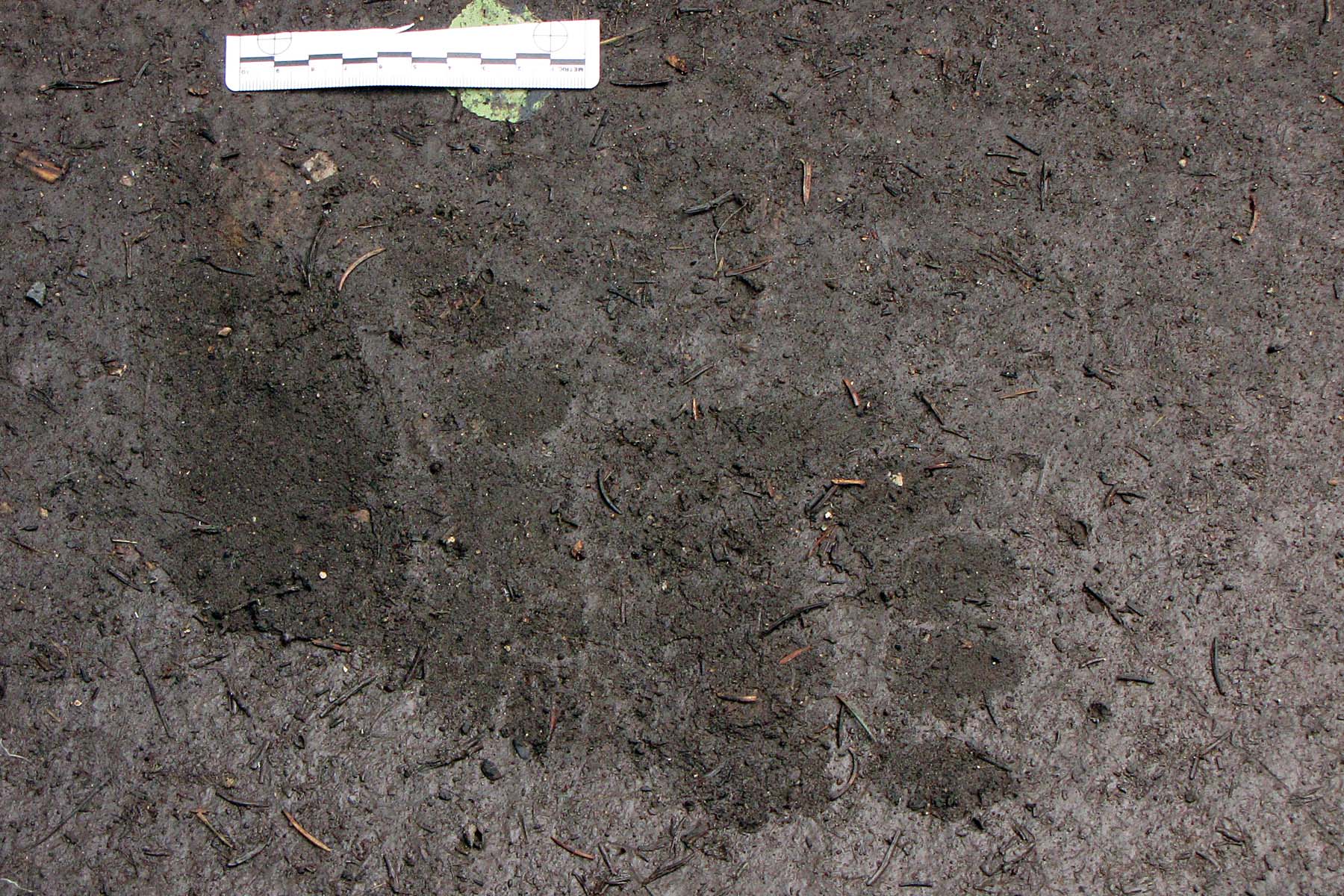
A Grizzly track found by the river
Filed under: Grizzlies | Tagged: Bears, grizzlies | 3 Comments »
With wolf hunts now taking place in all three states around Yellowstone, new issues are coming up. Although Montana and Idaho had a hunt last year, this fall is Wyoming’s first wolf hunt.
At least 10 collared Yellowstone Park and Grand Teton wolves have been killed in this years’ hunt, and more than half of them occurred in Wyoming. The last collared wolf killed was taken in my area, hunt area 2, and she was the eighth wolf and so closed the zone. And this wolf, wolf 832F (F for female), dubbed ‘o6 by Park wolf watchers, was perhaps the most famous wolf in the world, and most loved. She’d been highly visible in the Lamar Valley since she was born in 2006, and was the alpha female of her pack.

’06 this summer hightails it away from Molly Pack
Last spring on a May morning I went to the Lamar and watched her with her son try and scare a grizzly off a dead bison. On the other side of the grizzly were two wolves of Molly’s Pack, a formidable pack in the Park that had been threatening to kill 06’s pups. Another wolf from the Lamar Pack, 754, was shot in my hunt zone in November. At least 2 collared wolves from Grand Teton have been shot, and there’s speculation that as many as 13 uncollared from GT have been taken in the hunt.
’06’s death has been highly publicized all around the world, from PRI to European newspapers. People from all over the world watched and knew ’06. In response to public opinion, Montana, who is about to begin their first wolf trapping season, has created a buffer zone around the Park’s northern border. Just for this hunt/trap season only. Next year is a different story perhaps. Although Idaho’s wolf hunting and trapping season is almost endless, the expansive Madison Valley sits in the way of many wolves migrating from the Park in that direction.

’06 swims the Lamar river, emerges onto the road right in front of tourists.
Wyoming is another story. Most of the Park is in WY, as is all of Grand Teton. 85% of the state has been approved by the Obama administration as a predator zone which means shoot on sight (or trap, or bait, or whatever) anytime, anywhere. So the managed hunt zone, called the Trophy Zone, is essentially the ‘buffer’ zone around the Park. With the loss of so many study wolves, is the era of Park research over? And with the hoards of wolf watchers habituating these wolves to a benign human presence, is the era of wolf watching in the Park about to change? Will it be harder to see wolves in the Park? And will that bring in less visitors? And should Wyoming manage their ‘buffer zone’ around the Park with Park research in mind?
I can say that my zone, hunt zone 2, had the highest quota of all the zones. If you take zone 2 and 3 together, they make up the entire Absaroka eastern side of YNP, with a quota of 16 out of 52 wolves. This is a rich area for genetic exchange, mostly Shoshone designated wilderness area, and wolves travel frequently in and out of the Park in this area following their prime food, elk. Those two areas alone, which are a prime buffer zone, make up 1/3 of the state’s quota for 2012!
Hopefully ’06’s death will bring some good and highlight what is wrong with the hunts the way they are managed now.
First, the quotas of 100 wolves and 10 breeding pairs per state was set a long time ago when no one knew how wolves would adapt to the Rocky Mountains. Although Montana is setting their own quota at 400, Idaho which has prime territory and over 70% federal lands, is in a frenzy to eliminate wolves, hunting and trapping 10 months of the year with no quotas. Wyoming, which has few wolves outside the Park, before the hunt it was around 230, is not only mostly predator status, but is also eyeing that 100 mark as their quota. These quotas are simply ridiculously low for the amount of good habitat and prey. Wyoming in many areas is trying to reduce their elk counts by giving hunters numerous tags, but at the same time reducing the predator that could do that job in a better, more effective and selective manner.
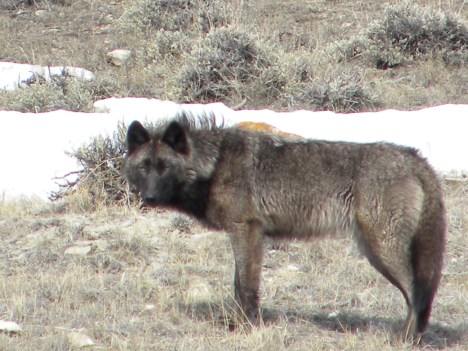
This wolf, from my valley, was by the road two years ago. With the hunts you will no longer see wolves so easily
Second, trapping is simply anathema to the 21st century. It is cruel and poses dangers to not only other wildlife, but to pets. Pelts are sold mostly to the Chinese market, which enrages me more. This is what happened with our beaver and bison in the 19th century, when European demand had hunters and trappers eradicating our wildlife for hats and coats. Wildlife as a commodity is simply wrong, just as human trafficking is.
Third, until the predator status is changed so that all of Wyoming is designated trophy status, the Trophy zone around the Park needs to be changed. Quotas in sensitive areas right around the Park need to be decreased, hunt zones readjusted, and hunt times changed for each area. Instead of hunting the entire trophy zone Sept or October through December, zones near the Park need to close earlier as the elk begin to come down from the high country and the Park wolves follow. Once Wyoming predator status is eliminated, wolf hunts should take place only in areas where there are conflicts with ranchers, not in areas with no conflict and lots of wilderness.
Finally, personally I disagree with hunting predators–wolves, coyotes, foxes, cougars, bears, martens, you name it. Being able to shoot a predator that is eating your sheep or cattle is one thing, hunting them for sport is another. On the other hand, just seeing a wolf or coyote passing your property doesn’t mean they’re going to cause trouble; and ranchers who are far-sighted and conscious are trying new methods for protecting their flocks and herds. Yet that being said, for now the delisting not only calls for a hunt, but in the short run of the next ten years, it may be the only way to quiet the loud and contentious opposition to wolves. Let’s just not undo all the good hard work that brought them here over these last 15 years.
If you want to comment and have your voice heard on the wolf situation in Wyoming, here is a link. Wyoming wolf hunt

Two wolves side trot down the road
Filed under: Wolf | Tagged: Grand Teton National Park, Lamar wolf pack, montana wolf hunt, nature, Wolf, Wolf '06, Wolf 832F, Wolves, Wyoming wolf hunt, Yellowstone National Park | 3 Comments »
 Leslie Patten Books: Wild Places, Sacred Spaces