• MY BOOKS ON WILDLIFE, GARDENING AND MORE

  • The Wild Excellence

  • True stories of wildlife encounters around the Greater Yellowstone
  • Award winning eBook on Decomposed Granite, tips, how to's, what to watch for
  • Children's book. True stories of a dog and wolves. In a dog's voice
  • Written for dry Mediterranean climates in California, north and south

Cougar photos

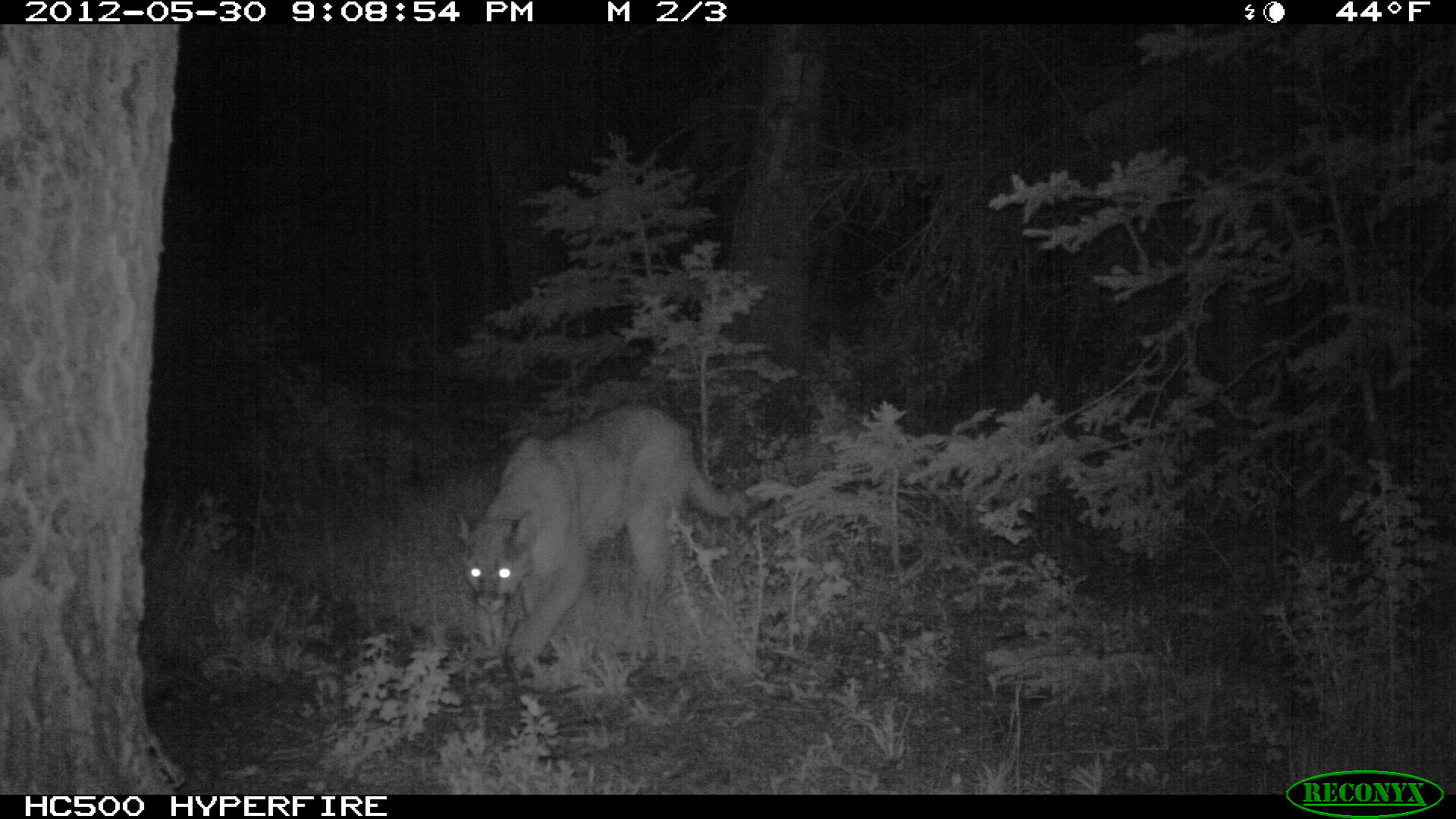
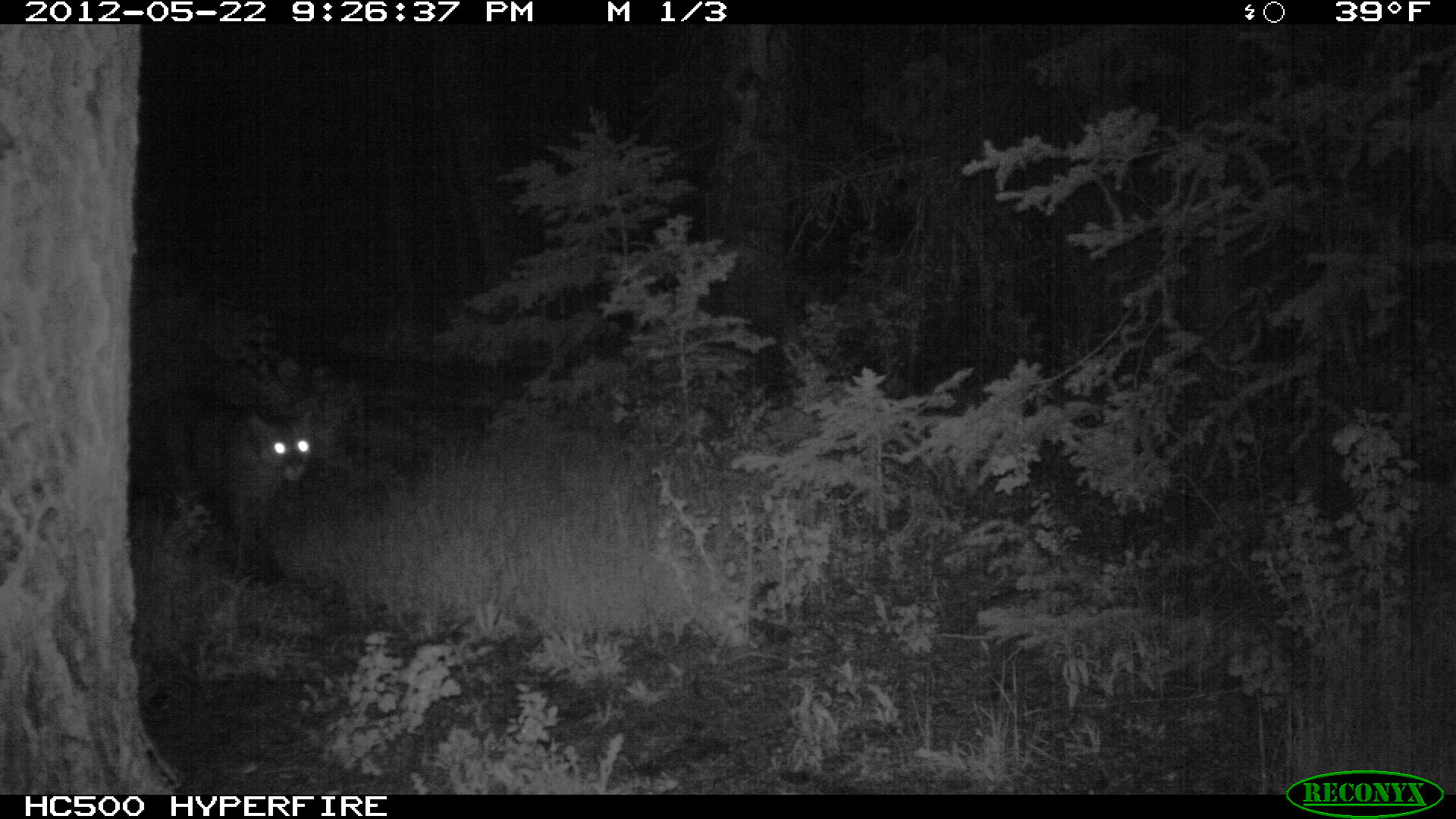
OK, I’m wrong. Cougar do sometimes use human trails.  And here’s the proof. Caught on my trail camera…

A cautious cougar

Cougar coming through

More Cougars with some Wolves thrown in

I’ve said it before and I’ll write it again:  animals present themselves to you, not the other way around.  And for the last six months, cougars are what have been presenting themselves to me to learn about.

If you’ve been reading my blog, you’ve seen that cougars have been constantly coming into my awareness now since the winter.  Last winter I tracked a cougar in the snows and found over 5 of her kill sites.  Then the last several weeks I found some cougar scat on the edge of the little forest by me.  A week later I found a fairly fresh kill site, just 25 feet from my trail camera.  Too bad cougars don’t use trails.  The kill site was just off-camera by a little bit.

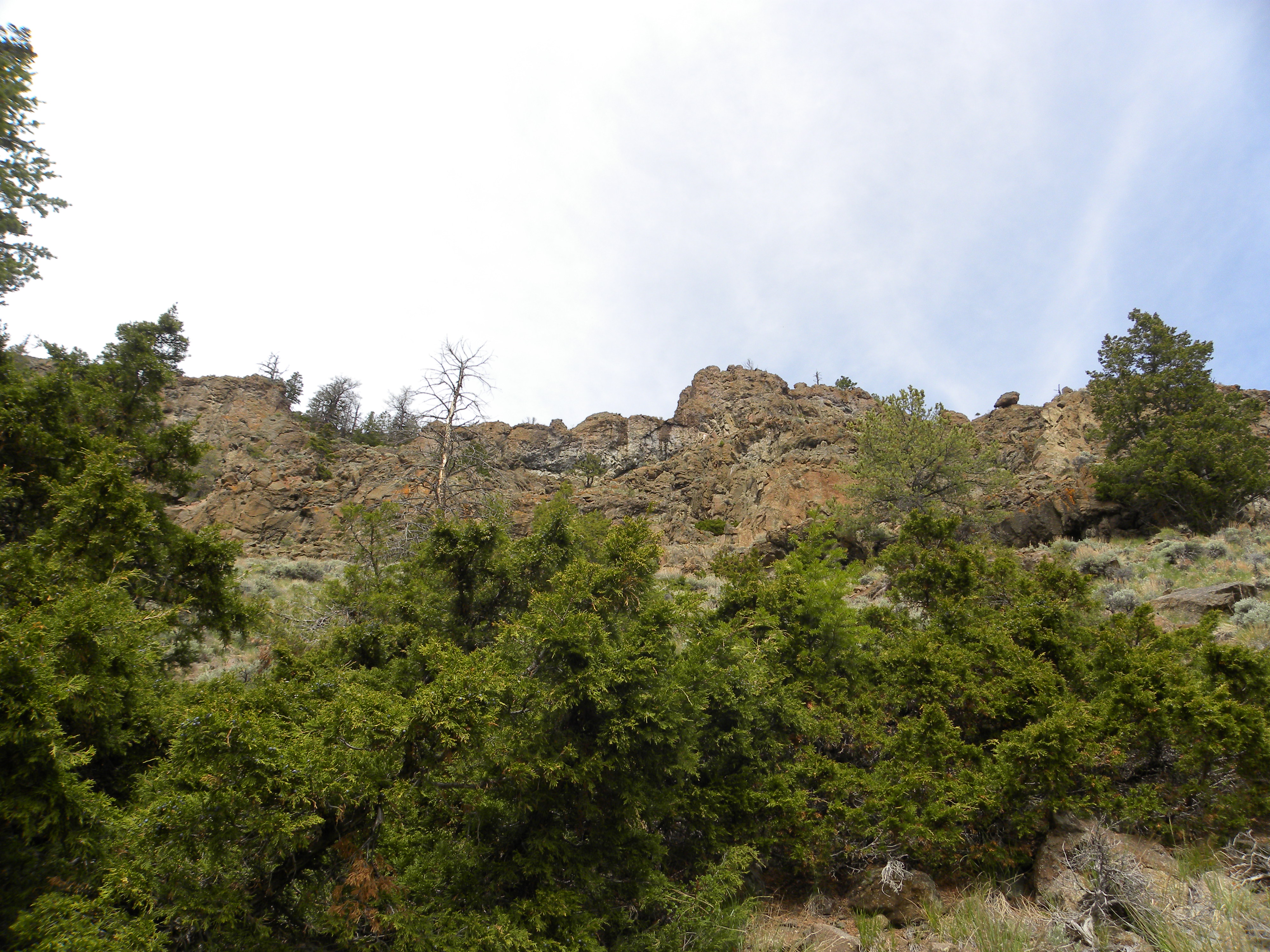
Last week I hiked up a drainage located  within a smallish draw.  I climbed high, then worked my way horizontally around the draw, finally descending via a creek with snow-melt in it.  As I was climbing to the ridgeline that was a rocky crescent, I pushed aside some brush and saw a large cave rock shelter.

Koda guards a cougar densite

Koda was ever anxious to run right in and stick his nose inside.  I called him off.  There might be something dangerous inside.

After determining all was quiet, I went to investigate.  This had been a cougar den, and one used this year.  I could tell from the smelly scat at the entrance.  The sticks and duff had all been pushed consciously to the front, and at the farthest rear of the cave was a neat round bed.  This was really exciting.

Den site of a cougar. Duff in front.  Bed at back end (where it’s dark in photo)

I began pushing farther uphill towards the rocks, looking out for sign of kills along the way.  Sure enough, there was a lot of evidence of deer predation here.

Rocky ridge I hiked to.

One thing I pondered was the lack of water.  A small creek was running several drainages over with snowmelt, but all the other drainages were bone-dry.  The canid dens I’ve seen are all close to a water source.  I thought about cougars in the Southwest, a super-dry area, and wondered about their use of water, especially with kittens.

Eventually I worked my way over to the drainage with water.

Drainage with some water I followed and found lion tracks

Coming round a curve, I found a large cougar print in the mud.  I understand that instead of following trails, like bears or wolves, cougars like to follow drainages.  I wished I could have taken a cast of that.

I followed the drainage down until I came to a downed large tree .  I went one way and Koda went around the tree on the opposite side. Above the creek,  I was following a deer trail now and called the dog back to me.  As he came across the creek, I noticed something move behind a tree about 25 feet ahead on the trail.  It was grey.  I peered to get a better look and there was the  yearling wolf I’d caught on the trail camera just days before.

This curious yearling wolf was watching me from behind a tree.  

She’d been curious, watching me.  When she noticed I’d seen her, she bolted.  I called the dog, who luckily was behind me, to a ‘heel’ and we moved ahead until we had a view of the hillside meadows.  There was her collared mom.  I kept the dog beside me, tried to take some photos while I walked out of the area, all the while we kept our eyes on each other.  She’d move a bit away, then stop and eye me.

Female collared wolf.  She’d move uphill, then stop to see where I was

I thought about how curious wolves are, and how these wolves, though cautious, are fairly used to people.  Most of the time I see wolves around here, they prance ahead, then stop to watch; easy targets once hunting season on wolves will begin next fall.  I fear these two wolves won’t live to see another spring.

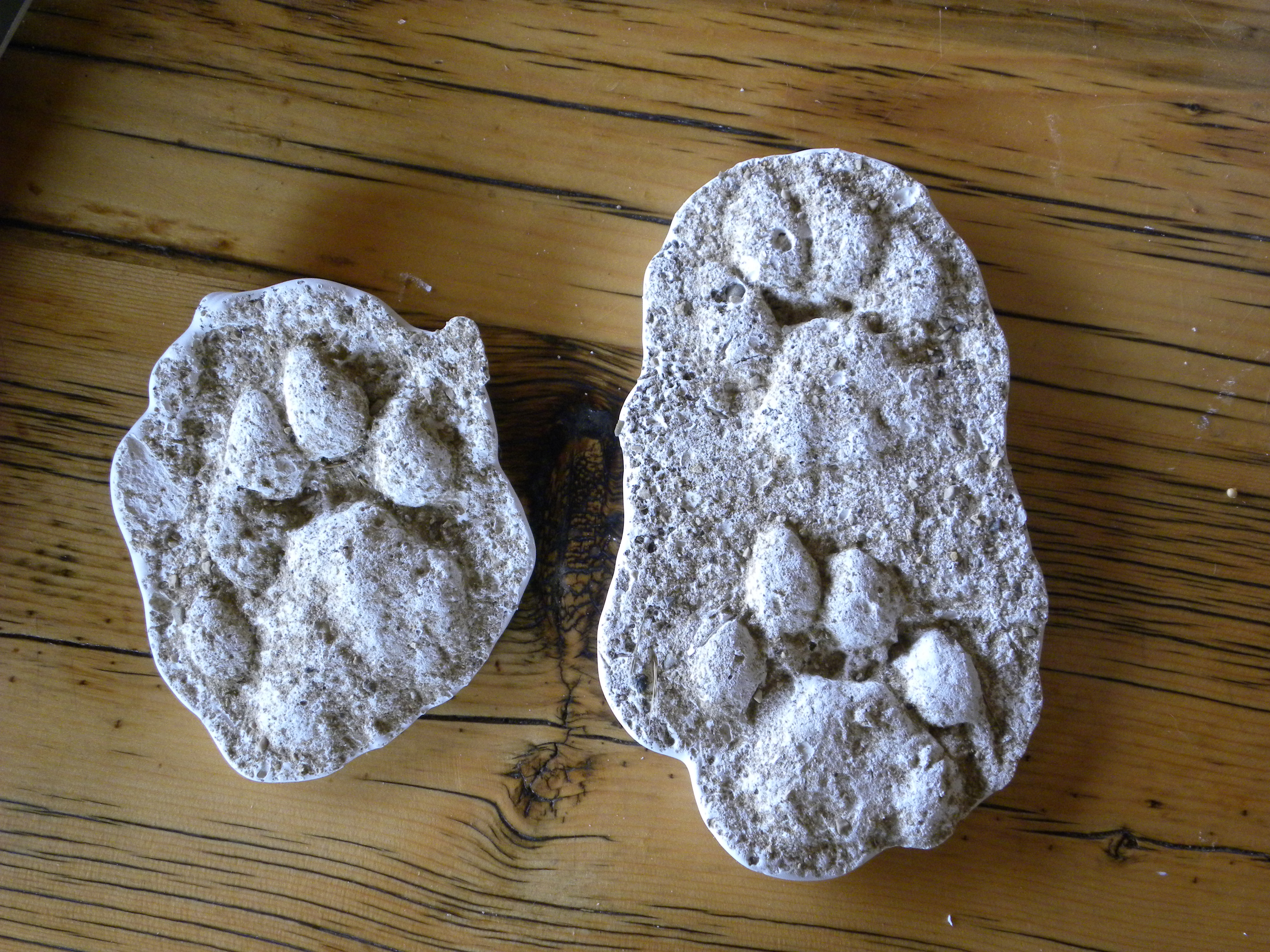
I was still stoked from that morning for several days.  What a lot of wonderful wildlife adventures.  Then just a few days later, I walked at dusk to the mailbox.  Cougar prints crossed the driveway, still damp from recent rains.  Now I had my casts!  A perfect week and a lot of cougar lessons besides.

Cast of cougar prints–right side is rear on top, front on bottom. Cougar was going at a fast trot. Left print is a direct register


Wolves, cougars, and the little woods

There is so much wildlife activity in the little piece of woods and meadows next to my home that I don’t need to venture much farther than ‘around the block’.  Sometimes just sitting on my front patio is enough.

Besides the nesting bluebirds and house wrens, the red-tailed hawk making its’ rounds, and the pair of Golden Eagles soaring above, there are morning and evening visits from does and bucks in velvet, and an occasional turkey.

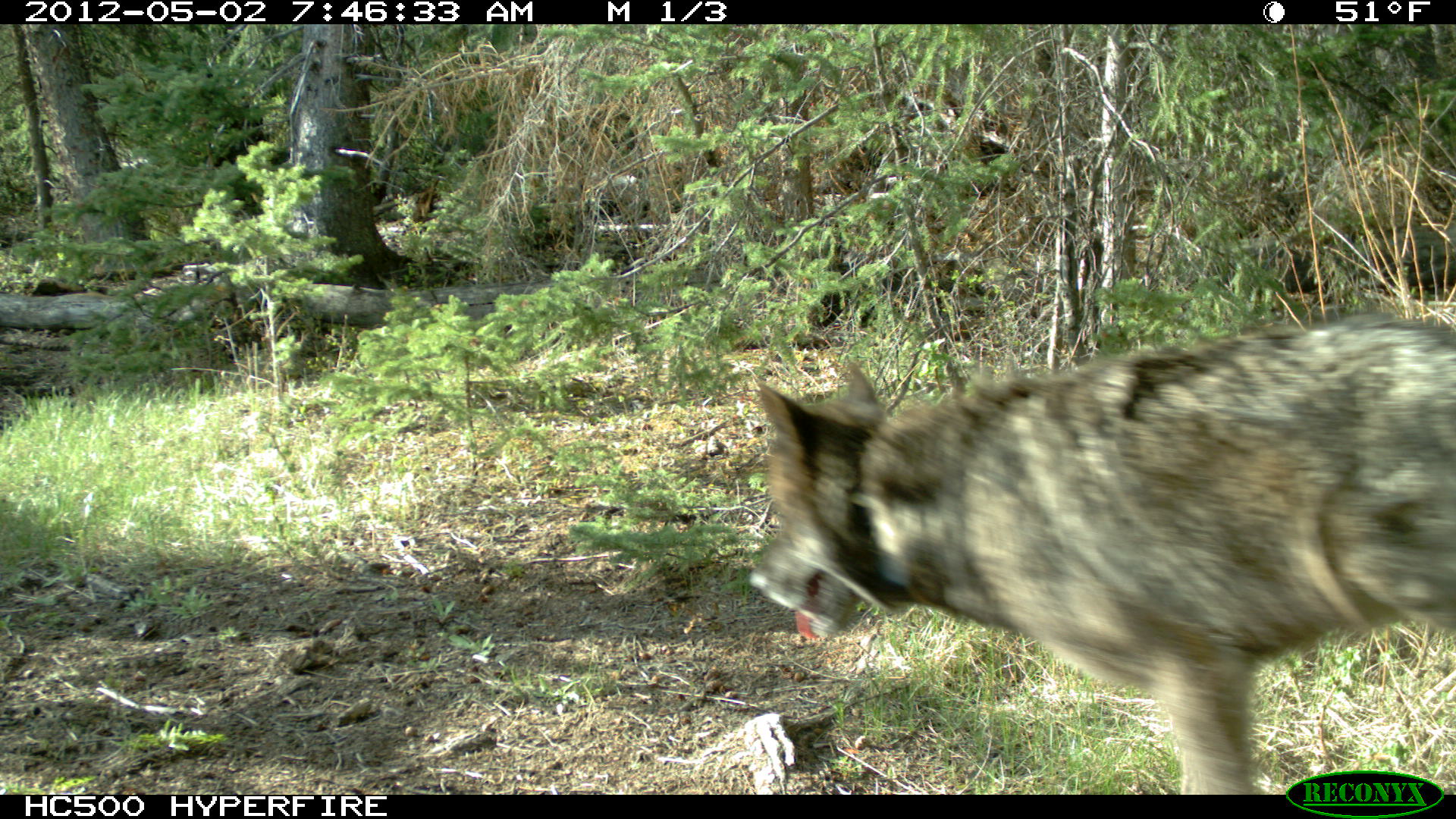
But the unseen action is taking place when I’m sleeping.  Now I’ve caught two different wolves on my trail camera set up in the woods.  On the 2nd of May I clocked this black female passing south early morning.

Solitary female probably from the old Sunlight Pack that was killed off last year by another pack

And now on the 12th I caught another wolf, unknown, heading north almost at the same time in the morning.

first shot from trail camera

Yearling pup from the pack presently occupying the valley

Of course, coyote is always running through the woods so trail photos of him abound.

Coyote. Easy to tell wolf and coyote apart

Usually when I retrieve my trail camera I’m expecting to see dozens of only deer photos so I have been pleasantly surprised.  Here’s a nice buck photo.

Lastly though, here’s the most unexpected.  Last week Koda dragged me over to some strong smelling scat.  It was a large pile on top of an older pile, definitely cat, and I mean big cat.  The deer are still low and some must be having their fawns.  Of course, this winter I spent tracking a cougar and understanding in greater depth their sign.  Yet I was surprised to see that a cougar was this low and so close to the houses.  Granted, the summer residents aren’t here yet, but there is the occasional activity still.  I made a mental note of where the scat was–on the far side of the woods–but saw nothing else.

Then today while returning the chip to the trail camera, Koda got a sudden urge.  I’ve learned to trust his instincts and smeller so I followed him.  And not more than 50 feet off trail from my camera was a cat kill.  The deer had already been consumed with just its legs left, but there was the tell-tale mound of the formerly covered carcass, the plucked fur, and another smelly scat on top of it all.

Cougars pluck their carcasses. Bears pull the skin back.

I found a jaw of a young deer, although the legs were too big to be a fawn, so maybe this deer had been a yearling.  This is the first time I’ve seen cougar sign in the woods or a cougar kill so low.  The crazy thing is those cougars are so stealthy that there were no tracks, and besides, my trail camera was almost right there and I didn’t get any photos.  The cat, you see, didn’t use the game trail like the Canids and Ungulates do.

Telltale sign of where a cougar covered its’ kill. Plucked fur abounds.

Hike up Cottonwood Canyon at the base of the Bighorns

What a lovely hike that I highly recommend.  Cottonwood Creek is one of several canyons on the western side of the Bighorns.  The turnoff is just past the bridge over the reservoir on U.S. Highway 14 Alt.  This is the Little Mountain Travel Management area on BLM lands.  A newish looking campground, equipped with nice outhouses and even a pergola dedicated to Senator Craig Thomas  (no water though) makes an overnight stay inviting so you can explore all the other back roads and canyons.

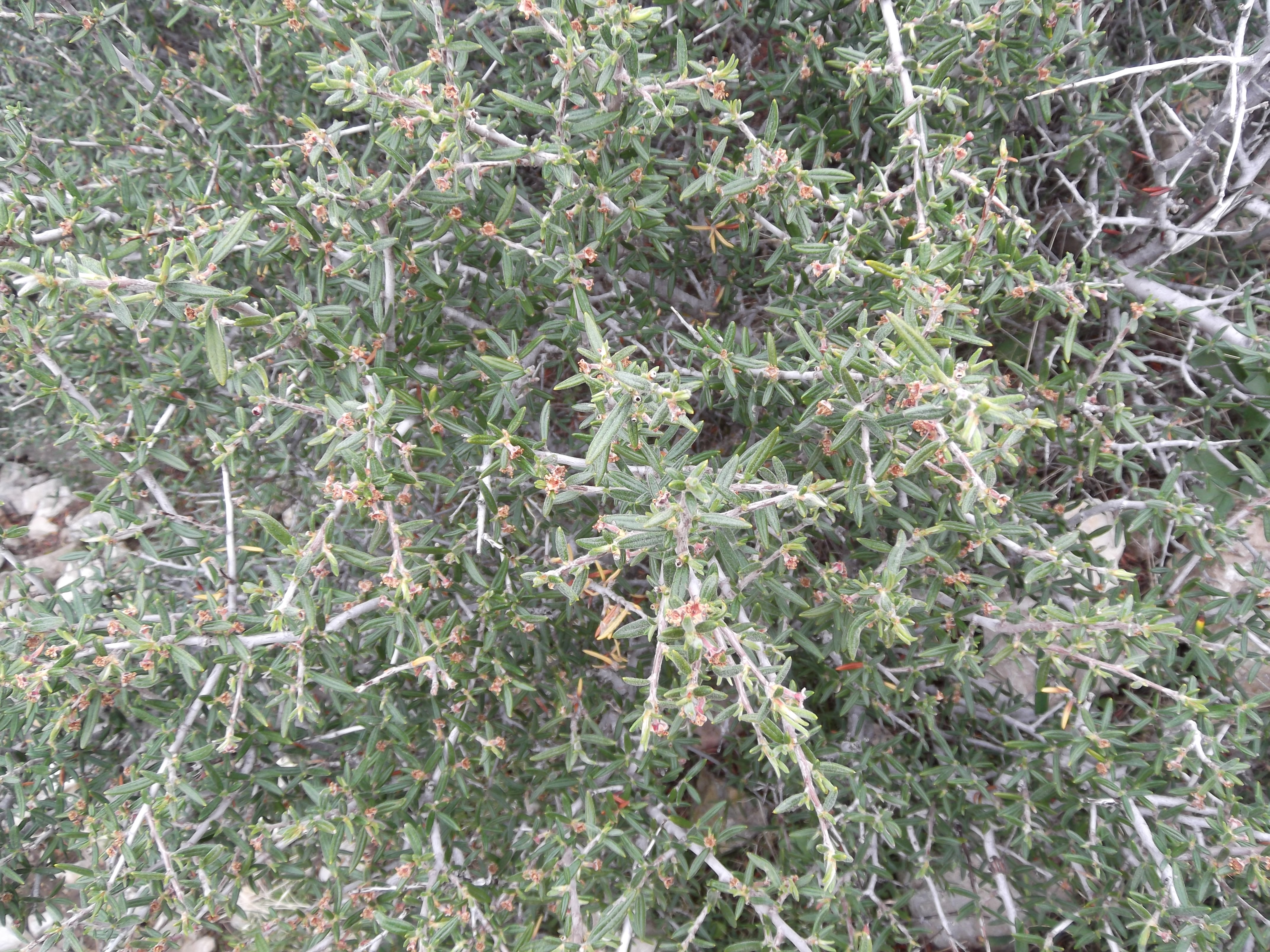
I did this as a day hike.  The trail runs parallel to the creek, where of course Cottonwoods grow, as well as Willows, Serviceberries, Chokecherries, Big Sage, Mountain Maples, and a shrub I couldn’t identify.

Unidentified plant. Suggestions?

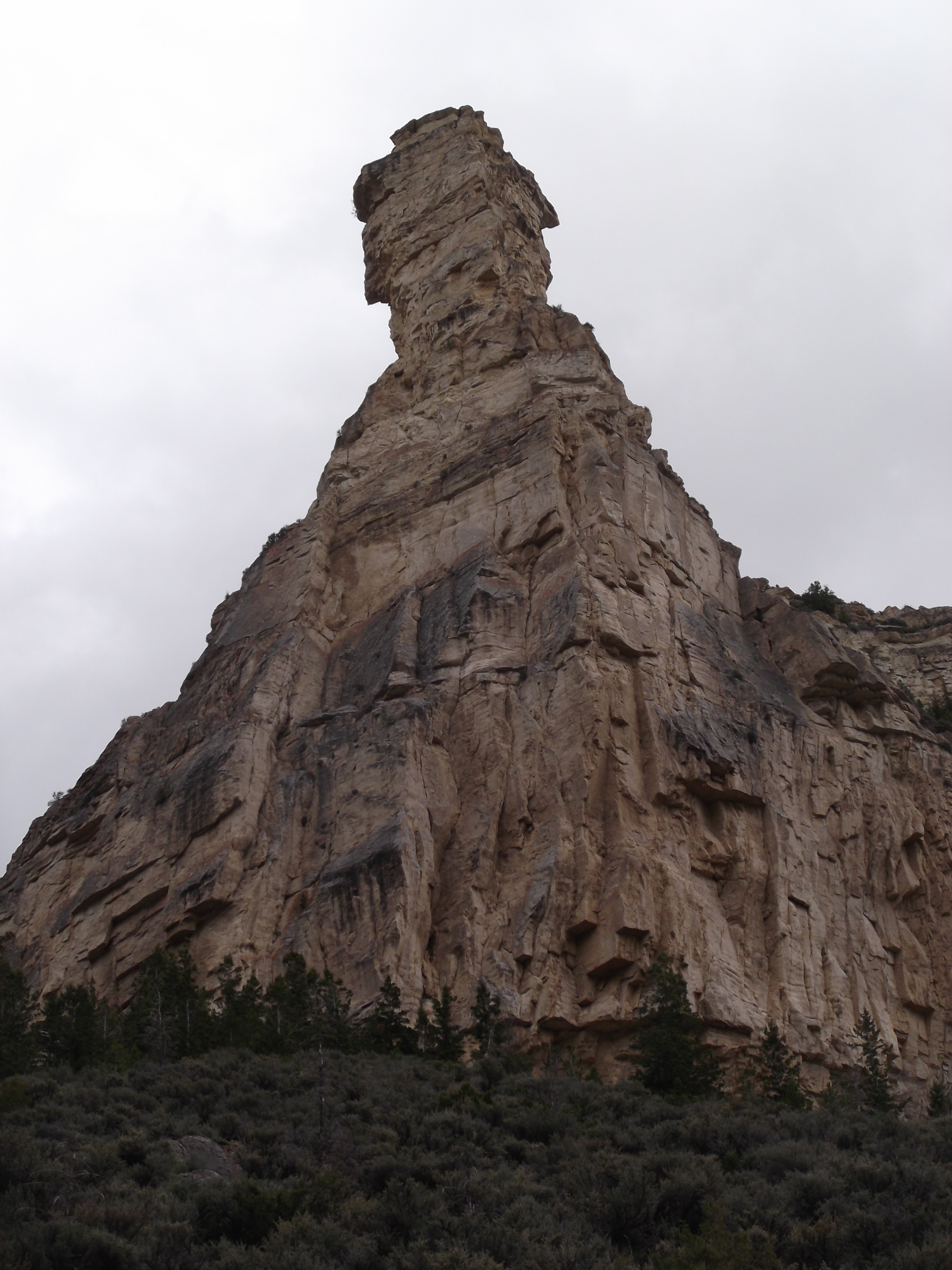
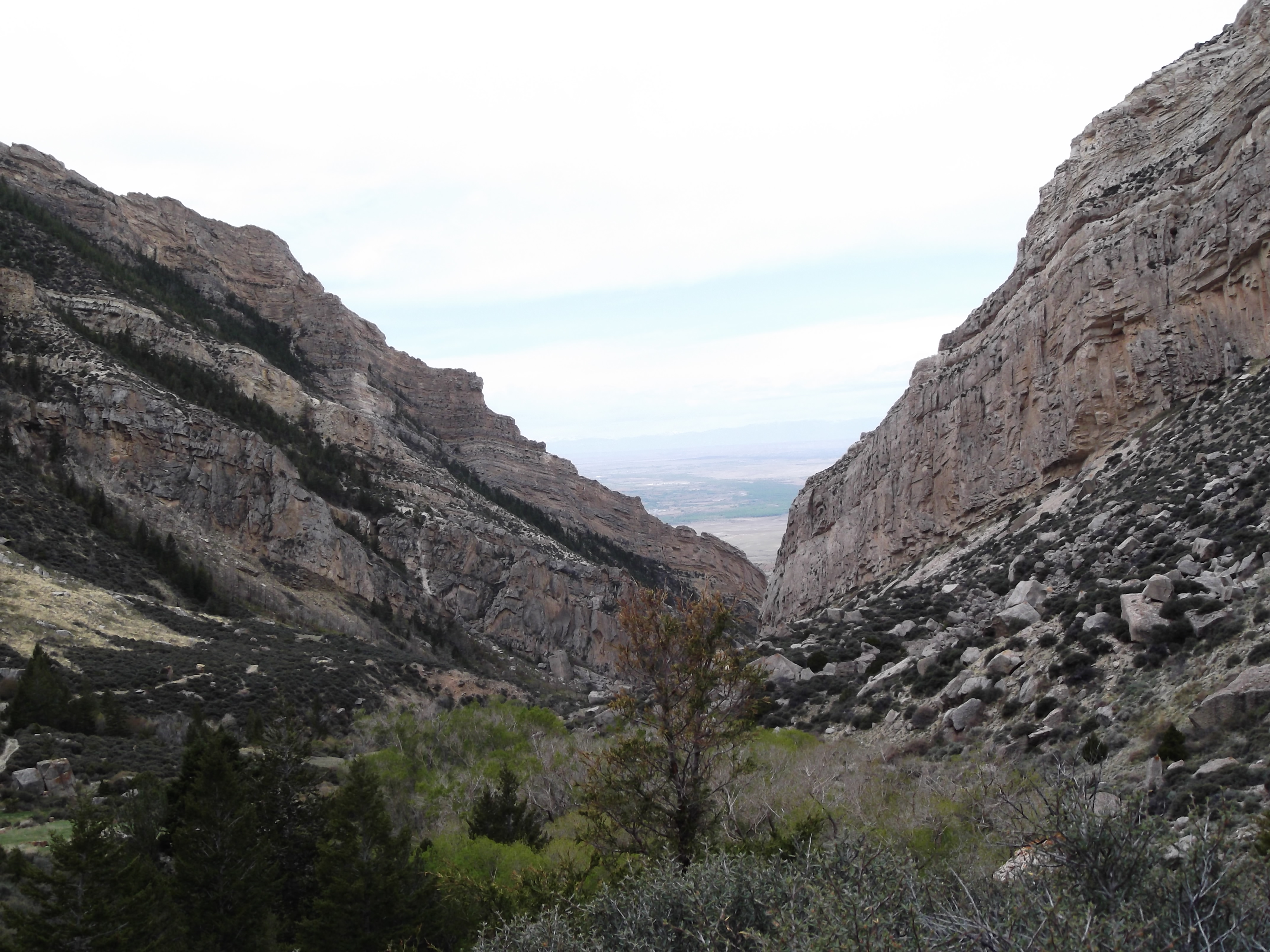
These photos don’t do the Canyon justice.  It is striking, overwhelming in its’ beauty, with massive, impressive cliffs and waterfalls surrounding your climb higher and deeper into the canyon.  The trail eventually reaches the Forest Service boundary.

Start of the hike


Near the hike’s beginning


A few miles up and a lunch stop


Unusual cliff formation


Looking back toward the Bighorn Basin from up the Canyon


I am so lucky to live in such a diverse area, with the playground of the high desert of the Bighorn Basin, Yellowstone and the Absarokas to the West, the Beartooths to the North, and the lovely Bighorns and sacred Pryor Mountains to the East.

Yellowstone and the Lamar at its finest–wolves, bears, and high drama

Yellowstone is at it’s finest in May, especially in the Lamar Valley.  Just less than an hour away from my home, I’ve been three times this week.  May is my favorite month.  First off, because I’m south of the NE entrance, the road into the Park is not plowed on the Montana side during the winter, making travel to the Park in the winter extremely difficult.  Once the Beartooth Highway is plowed (Memorial Day), traffic into the NE entrance is heavy.  But in May, the roads are almost completely free of cars.

But more importantly, its the time of the year for calving.  Bison, elk and pronghorn are all calving during this month and predator interactions abound.  Bears, wolves and coyotes move into the Lamar looking for young and afterbirth.  Plus you’re likely to see boars looking for sow bears to mate with.

Newborn with mom
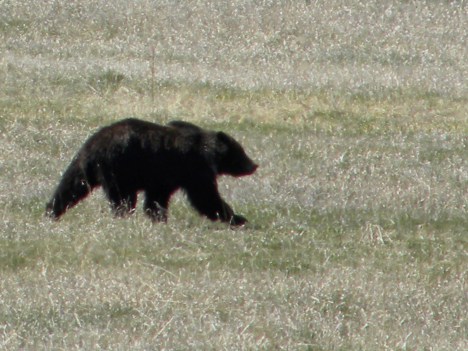
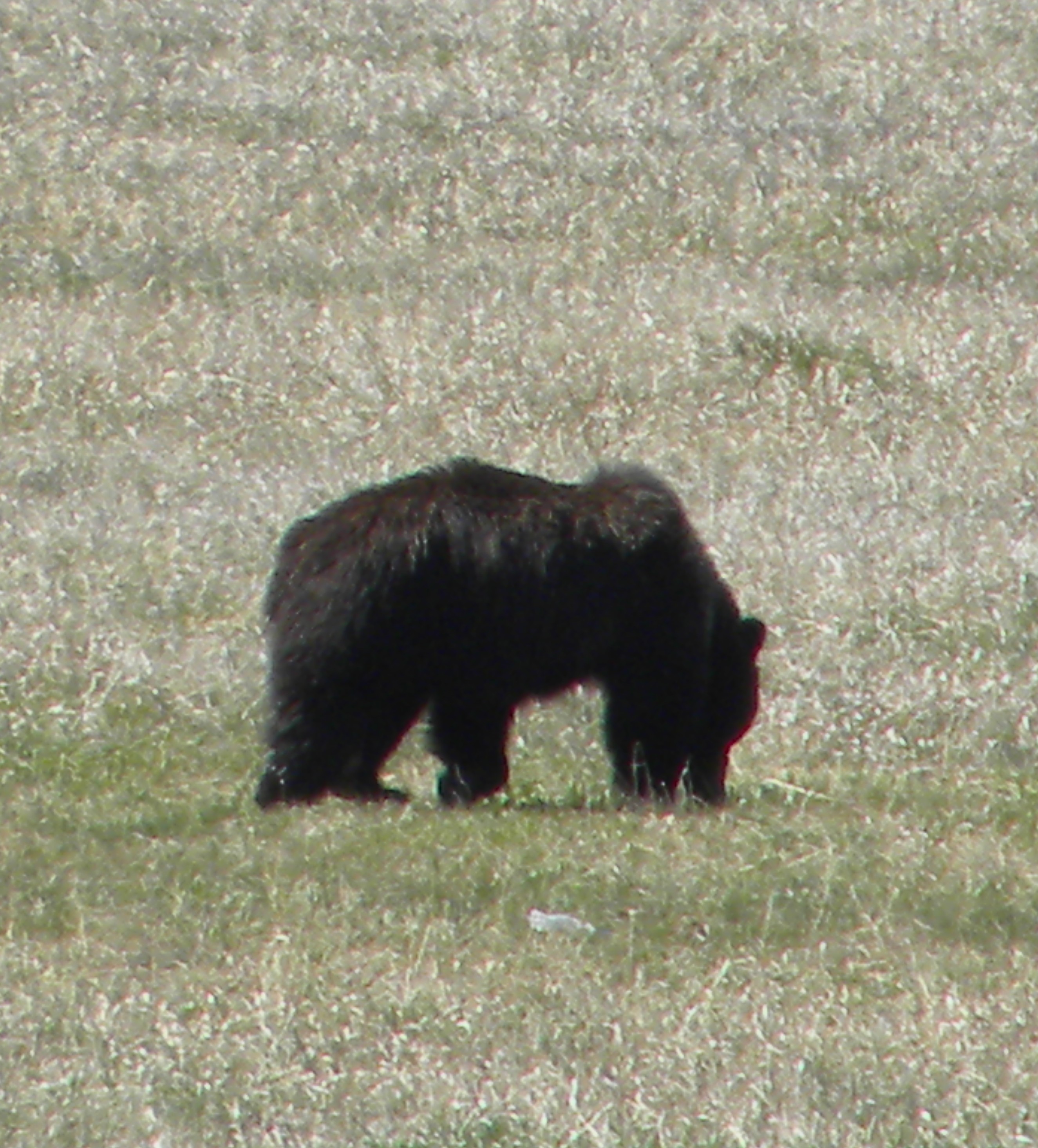
Black grizzly
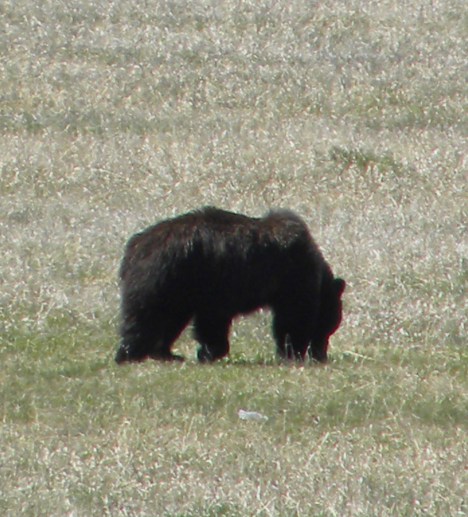
Grizzly in Lamar

Any day in Yellowstone is a great day but today hit the jackpot.  As soon as I arrived, I spotted two wolves on a rise.  A group of veteran wolf watchers had set up on what I used to know as Hill 44, but now they tell me its called Geriatric Hill!

This wasn’t just any old two wolves, but the Alpha female and her yearling of what is now called The Lamar Pack.

Lamar pack alpha female collared

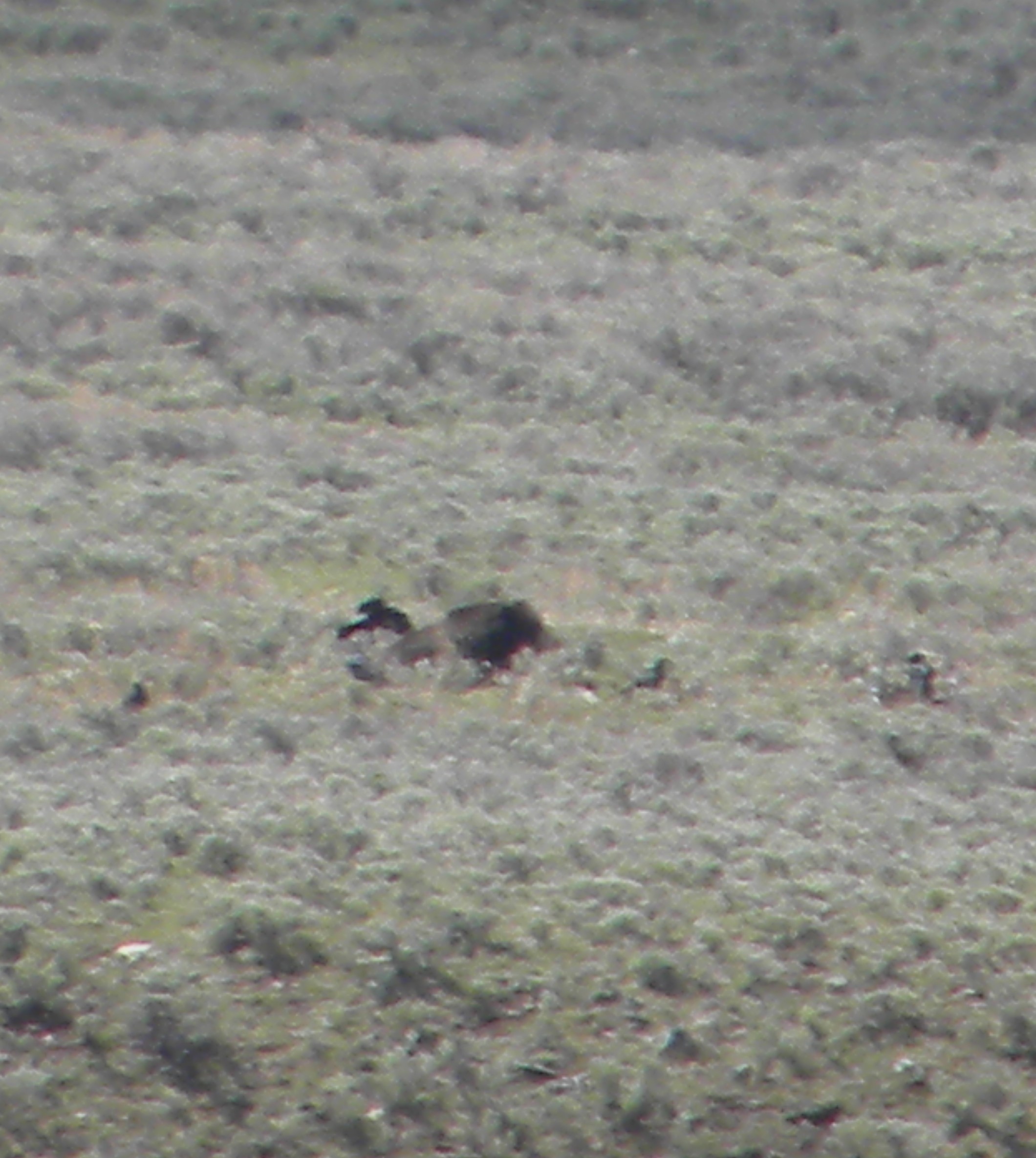
A large grizzly lay on top of a bison that had died giving birth, its calf already consumed. Two wolves from Mollie’s Pack were also hanging around the bear.

Grizzly sits on carcass guarding it

What’s wonderful about these avid wolf watchers is that they know all the latest and past gossip about the Park packs.  Literally its gossip because wolves are extremely social animals, and very territorial.  These wolfers can recognize each wolf by sight, know their assigned numbers, as well as the history of each wolf and each pack.  Hanging around with them, I asked questions and picked up the back story.

Mollie’s Pack has been around a long time in the interior of the Park.  They’re well known because they were the only pack regularly preying on bison, which is quite a feat.  Now, 17 strong, they have returned to the Northern Range and, without any pups to take care of and keep them near a den, they are roaming and killing off other wolves.  I asked one of the wolfers why they aren’t denning.

“Their Alpha female disappeared.  No one knows what happened to her.  She was old though.  The Mollie’s paid a visit to the Lamar Pack’s den the other night.  Things seem to be okay as of now, but see those two Mollie’s are moving in on these Lamar wolves.”

The two Lamar’s were grey and smaller.  They sat on a rise with their eyes glued to the two larger black Mollie’s on the south side of the sagebrush plateau.  Between them the grizzly laid happily on the carcass.  For over an hour I watched the Lamar wolves glued to one area, while the Mollies moved closer then farther from the bear. The Mollies seemed restless.  One of them kept howling for reinforcements, which never came.  Obviously, their agenda was two-fold:  move the bear off the carcass and get rid of those Lamar wolves.

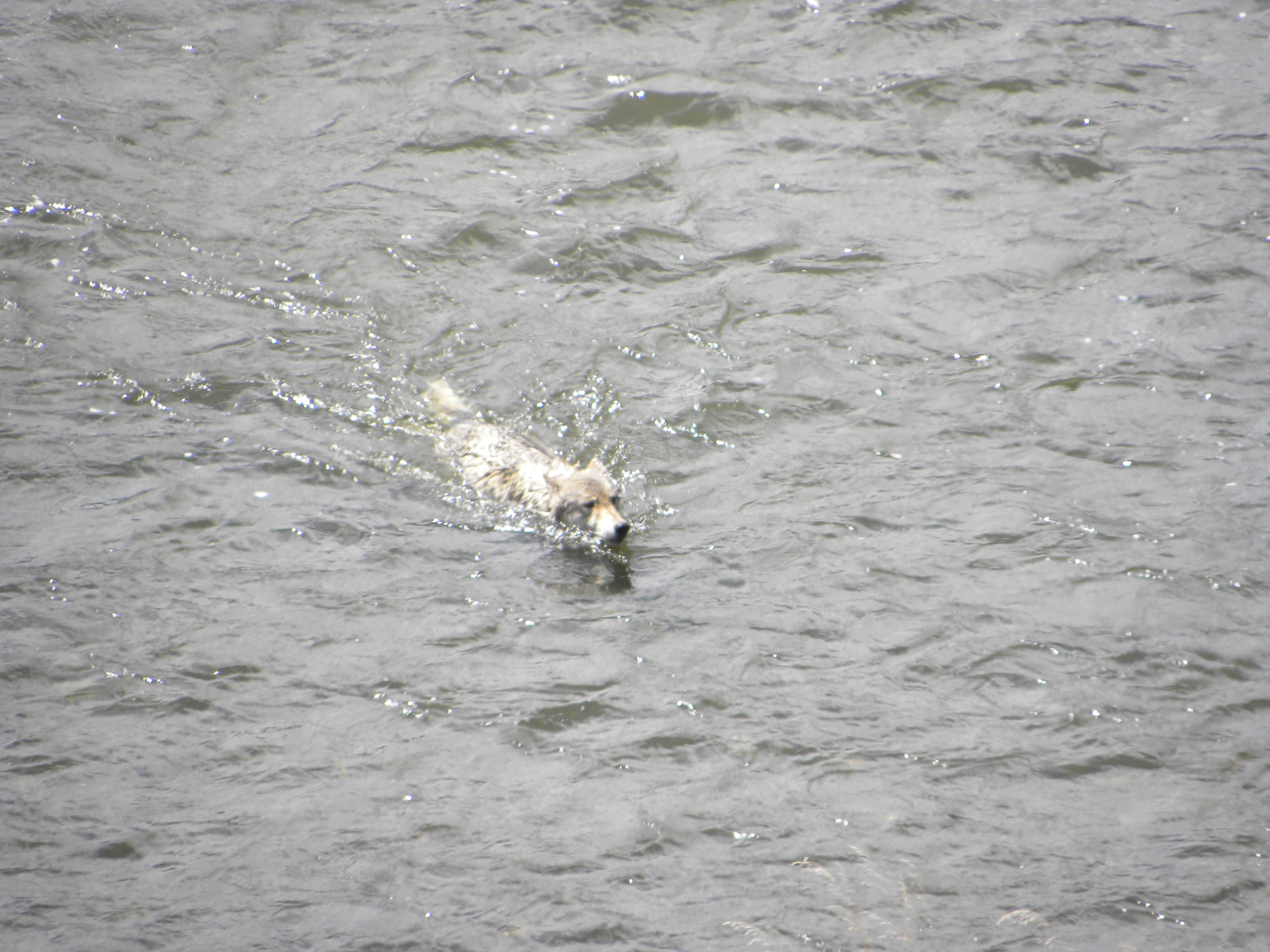
Then something dramatic happened:  all of a sudden the Lamar Alpha female started running towards her den.  Through the sagebrush, she was coming directly towards us. With the wolfer crowd cheering her on (“run girl, run…”) she swam the river and ran across the road, presumably back to her den.  With some hesitation, her yearling pup followed, swimming the river for safety from the Mollie’s.

Alpha female hightails it away from Molly Pack

Lamar alpha swims river back to den

She emerges right below us by the road

“We might have to just cut off those Mollie’s if they try to follow.  It’s not kosher, but those Mollie’s have already decimated several of the packs here and we don’t want them killing off these Lamar wolves”, my new wolfer friends from Kansas told me.  “We come here four times a year–spring, fall, winter.  We’re going home next week.”

She got out her walkie-talkie.  “The pup’s coming across the river.  Stay in your places.  Don’t move.”  I asked who she was talking to.  “Anyone with a radio.  I’m just telling them not to crowd the pup or get in her way while she’s running back to the den.”

Lamar wolf pup swims away from Molly’s Pack

With the resident wolves gone, the Mollie’s began moving closer to the grizzly.  A feeling deep, beyond words, overcame me.  I was witnessing a drama so ancient that the genetic blueprints are hidden in the dusts of bear/wolf evolutionary history.   The Mollie’s harassed the grizzly for a time while the bear growled and swatted and the wolves growled back, then laid down nearby in the grass to wait their turn.  I had the feeling wolves have mastered the art of being patient for their chance at a meal from a bear.

With the high drama passed for the moment, I made my way down the valley to see what else was happening. Just as I was thinking that I probably wouldn’t see any coyotes with all the wolf activity going on, a coyote came trotting up the roadside.  I pulled over and watched.

Coyote searching sagebrush for prey

The other day I’d seen a coyote sneak up to a small herd of bison with calves.  The bison made a surround around their calves, and when the coyote got within 10 feet, the two bison moms put their calves inbetween them and made a tight fence with their bodies.  I thought this coyote might be up to something.  He was definitely hunting.

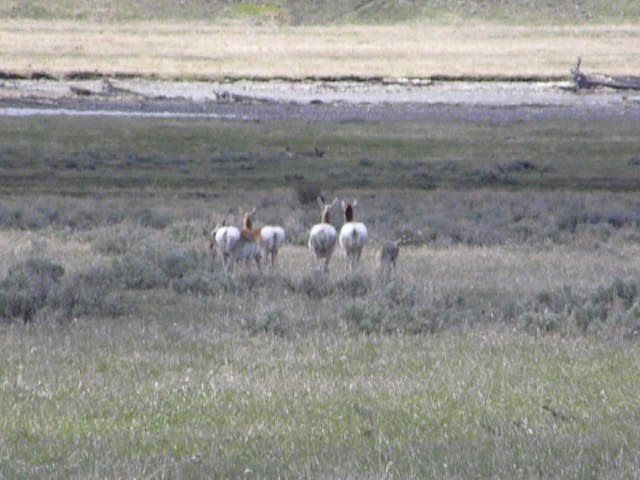
Coyote made a laser for a group of Pronghorn. I’d read that coyotes are the main predator of antelope calves.  It seemed to me there have been more Pronghorn this year than I’d ever seen in the Lamar.  With the introduction of wolves and the subsequent reduction of coyotes, I’d heard that the pronghorn were rebounding.

Coyote was definitely hunting for pronghorn babies.  The group of pronghorn got skittish and started following the coyote, trying on the one hand to keep their distance and on the other to push him away.

Coyote searches sagebrush for pronghorn calves with pronghorns on his heels

It was an interesting dance.  A lone male antelope oddly enough kept his distance, while the females were grouped around the coyote.  Coyote was unperturbed by all the pronghorn attention.  This time, it seemed, the coyote left without his meal.

Meanwhile, up the valley, a large herd of bison lazed with their newborn calves.  I stopped for a while to observe and heard a lone wolf howling over and over from the west side of the Lamar.

Sitting here listening to wolf howls from male of the extinct Agate pack

I turned around and drove back to the east end.  The wolfer crowd had moved west to observe the two Mollie’s, who had just run off an elk.  I got out and spoke with a wolfer from England.

“We’re from the U.K. but we come here all the time.  Last year we bought a place in Paradise Valley.  That wolf you heard over there wasn’t from the Mollie Pack, but the male from the old Agate.  He came through the secret passageway. (Note:  I have no idea where that is but it sounded interesting) The Mollie Pack killed all the Agate females and since the bloodline goes with the females, the Agates are now gone.  He’s been coming back and forth with a Mollie female.”

One can’t ask for a better day in the Park.  On my way home, I just couldn’t help but think about the intensity and fascination people have with wolves, and how many people now come to Yellowstone Park just to watch wolves.  Those people from Kansas would never have come four times a year every year before wolves were here.  And why would people fly all the way from England many times a year, and even buy a house here, if wolves weren’t visible in the Park.

Besides the obvious ecological benefits wolves provide (think Trophic Cascade), there are new human economic benefits.  I just can’t understand why the East side of the Park can’t get with the 21st century on this.    Instead of plowing the 9 miles to the Park in the winter which would bring in throngs of wolf watchers (think Kansas people and U.K. people), the snowmobile lobby keeps it closed.  Instead of advertising wolf watching, the wolf hating crowd is playing a wolf hating movie in Cody during tourist season.  And soon there will be a hunting season here and my valley, which has premiere wolf watching in the winter, is slated for one of the highest quotas on wolves, more than there even are presently in the existing pack.

“The last wolf in England was killed in 1756”, the U.K. woman told me. “The reason some people hate wolves goes back to the Europeans who came here”, she said. “You know the ‘Little Red Riding Hood’  story?  Europeans told that to their children so they wouldn’t go off with strange men.  That’s not a story about wolves, but a story to scare little children into not trusting male strangers.”

Just a final note:  I arrived in the Park a little after 11 am.  I spent the morning watering my newly planted Limber Pines, then left after 10 am for a leisurely visit.  All this excitement in the Lamar occurred in just 3 hours.  I left the Park at 2pm and got home after 3.  Wow, what a treasure our National Park is!

Bison with newborn calves

Owls and more Owls

It seems that nature study comes to a person in batches.  In other words, what you think you want to study might not be what presents itself.

Last week on my way to town there was a road kill Great Horned Owl.  He seemed in good shape so I called the museum where I volunteer preparing specimens and asked if they wanted it.  Since they already have plenty of Great Horneds, they passed, but  this owl was a sign of what was to be a week full of owls.

The next morning, at 6am, I heard a strange owl call from the nearby forest.  I thought it might be a Great Gray, and sure enough, when I listened to its call, it was.   He was passing through on his way to a location north of here–maybe Reef creek or even Yellowstone.

The following week at the museum I was given a Long-eared Owl to prepare.  The tag said it was found in my area in Sunlight.  Her wing was broken and she’d died in rehab.  I suspected it had been struck by a car.  But when I saw the Game Warden the following day he told me he’d found a Long-eared Owl on the road before the area was opened to the public May 1st.

“That’s the owl I just prepared.  Unfortunately, it died in rehab.” I told him.  Who knows how it broke its’ wing.

Long eared owl

With all this owl activity, I decided to walk through my nearby woods with the intent of finding a roost.  A pair of Great Horneds live there.  Last year I watched one being mobbed by a Cooper’s Hawk.  Great Horneds are considered the ‘Lions of the Forest’.  They eat a lot of different foods, large and small.  When I was helping with a Spotted Owl study in California, we learned that Great Horneds kill Spotted Owls.  Watching that Coopers Hawk continuously swoop and peck at the Great Horned sitting on a dead fallen log confirmed how tough these owls are.  That Great Horned was unperturbed; in fact, he acted like the Coopers was an inconvenient fly.

Great Horned Owl

It didn’t take long before I found a large cache of pellets beneath a dead spruce.  The tree even had some owl feathers hanging from a high branch.  I threw them all into a bag and brought them home for inspection.

My stash of pellets

Just the week before my boss at the museum, Curator Chuck Preston, put a vole skull under a microscope to demonstrate how to determine its’ species.   The secret is to count the middle set of upper molars.  One species has four closed triangles while the other species in our area has three.

I dissected all the pellets and found that this owl was feasting on voles.  Dozens of voles and just voles were in these pellets.  Using a hand lens to see the molars, I determined these were all Montane voles (Microtus montanus).

Montane vole

With over 30 Montane voles in these pellets, there were two other distinct skulls, much larger, and from a different species of vole.  This was the Water vole (Microtus richardsonii).

Yesterday on a hike up Tipi Gulch, I came across another Great Horned Owl roost with some recent (seemed like that mornings) pellets.  Inside were several Montane voles and one Water vole.  Voles must be on the upswing and doing fine here this year.  Voles also don’t hibernate and are active at night.  Rabbits on the other hand have been scarce.

It was fun, and interesting, to check out what these owls are eating.  So much activity in such a tiny forest nearby.  Yesterday I retrieved my trail camera that was set up by my spring where I get my water.  Look what else is traveling through these woods.  As Thoreau says, you can spend a lifetime exploring a twenty mile radius.

Wolf with bad left hind leg

Close to Open–Yellowstone Park

The NE entrance will be open on May 11th, they say.  We’re always the last for the Park to plow and I’m not sure why.  Its only a nine mile stretch and a heck of a lot easier to plow than the east entrance over Sylvan Pass.  Must be politics and economics driving the decisions. I had to see for myself today the snow pack left.  Besides, I was hoping to purchase a fishing license at the Crandall store.  So a friend and I took a ride.

Before we got too far, the Switchback Ranch on the other side of the Clark’s Fork was flying all their summer supplies over.  Unbelievably, there really is no access to this ranch from Clark, which is on that side of the canyon.  If you drive to the desert and up to the mouth of the Clark’s Fork Canyon, there’s a primitive (and I mean PRIMITIVE) jeep road that goes along the river’s edge.  At the 4 mile mark, the road climbs the side of the canyon in switchbacks–thus the name of the ranch.  I’ve been at the base of the climb, but not up it.  I understand that even in an ATV you do 3-point turns at every corner, and its’ a hairy scary ride.  The road itself along the river is more like driving in a dry riverbed, rough for even an ATV.

Look at the green area. That's the ranch across the canyon

The previous owner was connected with Ford Motor Co., a man named Bugas.  Bugas owned a lot of property in my basin as well.  The current owner is David Leuschen, a Wall Street Mogul.  Oddly enough when I first purchased my property I had a client in California whose husband is a trader.  While I was designing and installing their garden, he was over here on a retreat at the Switchback.

Because of the treacherous and arduous and impossible access to the Ranch, all the major supplies are flown over.  Their base is a forest service knoll by the highway, directly across from the Ranch.  The supplies are attached to a helicopter and flown over the Clark’s Fork Canyon, a thousand feet below.

Returning for a new load

All the gas and diesel fuel for the year are carried over in several passes

Catching the free line and ready to attach. A flatbed worth of seed

1500 pounds of seed in that sack.

Off it goes to the Ranch. The whole process there and back just takes about five minutes.

It’s a beautiful place but no matter how much money I had, I wouldn’t want my supplies and friends flown in.  The old Wright ranch on the Bench used to have a zip line across the creek and that was how you’d get over there.  Now there’s a bridge, but that’s up the road near Crandall.

For all of you thinking of trying to get into the Park early, I’d say not this week.  We got pretty far, but the snow was still over the road at around Lolo Pass.  Up on the Beartooth, you can drive quite a ways, but not as far as the lake yet.  The run-off though is beginning.  This is Beartooth creek taken from the road.

Spring runoff in the Beartooth is beginning

And a moose grazing happily undisturbed

Beartooth Cow Moose amidst last years logged area in Aspens

And home in my front yard

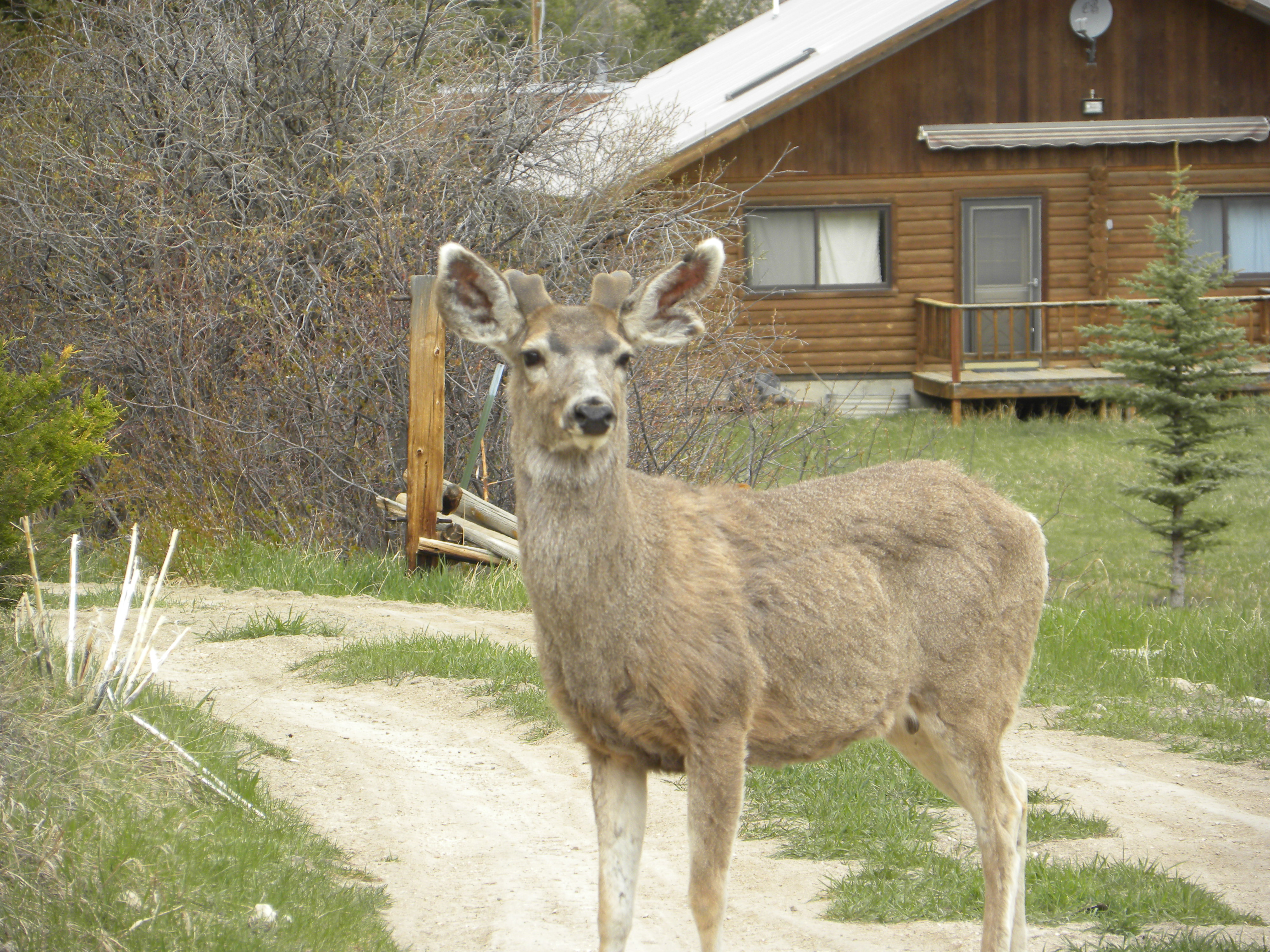
Buck with nubby antlers in front yard

Unfortunately, the Crandall store didn’t have their fishing licenses in yet.  Guess I’ll just have to go for another ride next week.

An afternoon hike in April

The snows are melting, early, and we don’t seem to be getting our usual spring wet dump of moisture.  These spring snows are what the eastern side of the Absarokas depend upon for their real moisture.  The winter snows are dry, while these spring snows put a lot of moisture into the ground.  But the high country still has snow and the rivers aren’t running much yet, so that means the elk are still hanging around.

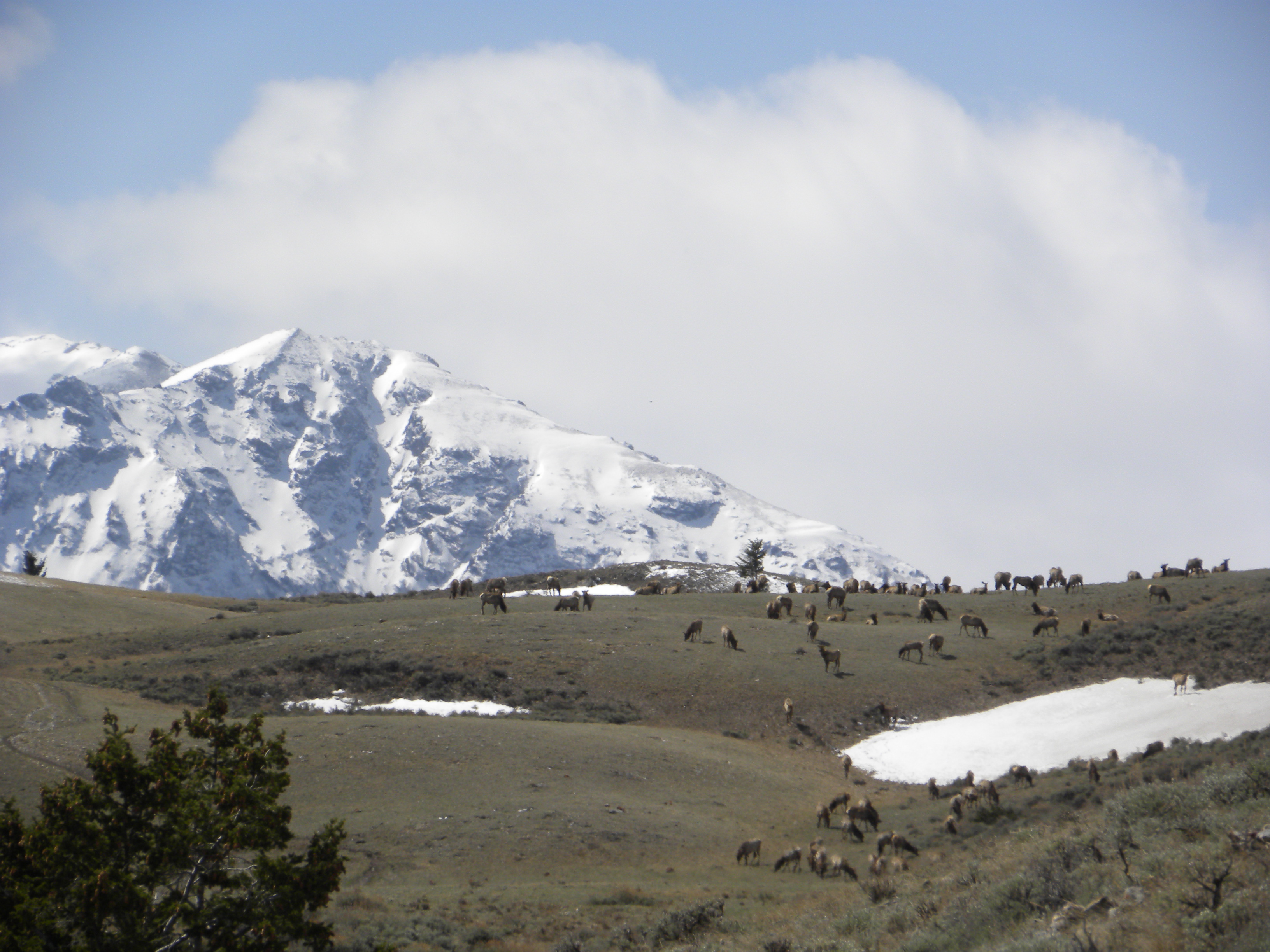
The other day I took an easy hike up beyond a ridge.  On the way I spied a herd of over 500 elk, fattening up on new grass getting ready to drop their babies in the next few weeks.

Down below a moose and her yearling passed by.

This pond usually has Sandhill Cranes but not today.  I’ve heard them a few times and seen them flying.  Today only Mallards were enjoying the reflection of the snowy peaks.

One of the most interesting features in my valley is old volcanic sulphur deposits.  From my limited understanding of geology, the Absarokas were formed by active volcanism from 53 to 38 million years ago.  The Absaroka volcanics are more than a mile thick, and this volcanic activity is not related to the Yellowstone hot spot which is much more recent.  (Yellowstone’s first eruption occurred only 2 million years ago.)

There are several interesting sulphur deposits, but my favorite has a little creek associated with it.  During the spring, the creek crosses the road, the water turning a cerulean blue.  As you climb towards the area with the deposits, the creek turns milky white and smells distinctly sulphurish.  Unfortunately, the water is as cold as the snow melt that supplies the creek.

Sulphur deposits. Nothing growing

At the deposit area, there’s no greenery on the hillside, and the few hearty trees growing there are stunted.  The hillside also shows evidence of a massive slide in the past.

On this hike I spied something I’d never seen before. Not that they weren’t maybe there before, but there were these unusual ‘lumps’ of raised sulphur (I have no idea what the technical term is).  When the snow recedes some, I’ll climb the hill and inspect them better.  Could they be evidence of something active happening underneath?  I keep hoping for a warm creek to swim in.

Volcanic mounds. Are these evidence of new activity?

Ways Not to Treat Our Lands

Living next to our first National Forest, one can’t help feel like a caretaker.  So when I see abuses, I  shake my head and wonder “who would do this?”  “How can they come out here to enjoy this vast awesome wilderness and throw their beer cans as they walk around?”  It makes no sense to me.

Hunters left this trashy campsite which I found today. Along with their empty shells there were plastic water bottles all around the site. I packed it out for them.

People use our public lands everyday.  They enjoy the great outdoors in a myriad of ways, from hunting and fishing to just lazing around in the camper next to an open fire.

There’s a movement in Congress that all of us–the public who cherish the outdoors–need to be aware of.  Many politicians are actively trying to privatize these lands.  What does that mean?  It means that there would be a wholesale sell-off of lands that belong to all of us.  And who could afford these lands?  Only the very wealthy.  Once those lands are private, they are gone forever.  No longer will we be able to hike, hunt, fish, bike, or walk over them.

Public lands are accessible to people of all income and walks of life.  Even now, in the great state of Wyoming where I live, things have changed over the last 20 years.  Where it was understood people could cross private lands to fish, and large ranches were owned by your local neighbors, now the only people who can afford these large tracts of land are the extreme wealthy.  They are the Bill Gates, the hedge fund owners, the Texas oil men.  My neighbor who owns all the bottom lands here doesn’t live here (I’ve never met them), rarely visits, runs cattle for a tax write off, and is among the 50th wealthiest individuals in the world.  If the Ryan budget has its way, much of the lands that are now open will be closed to everyone but the wealthy and their friends.

And that brings me back to what we all cherish.  These public lands are our generation’s bank account for our children.  We are only its’ stewards.   When people leave trash around, or tear up areas with ATV’s, or poach wildlife, or a myriad of other abuses, they are forgetting that these lands belong to you, me and everybody, and future generations.

Five ATVer's tore up this meadow on National Forest lands in Idaho

So, thanks for being a great steward. Enjoy OUR lands.


Cougar Town

Somehow it just works this way.  I dream up an animal I want to study and know more about, then decide to try and track it.  But it just doesn’t work as I plan.  This winter it was martens, yet I didn’t see one track.  But instead of the animal I had in mind, another one presents itself.  This time its cats, and not just little cats, but cougars.

Remember I saw that mountain lion track, tried to follow it, but lost it pretty quickly.

cougar track with my measuring tape

Yesterday I went back to the area and ran into two older cougar deer kills.  Today I went with my camera to record them and inspect them better.  First I headed to a small rock ledge where the cougar obviously dragged his kill.

Cougar dragged kill to this site

What was left was a lot of fur and the rumen, still perfectly intact.  What I discovered is that cougars open the carcass and remove the rumen like a surgeon.  When you find a canine kill site, the rumen remains are scattered and opened up.  Canines tear their prey apart messily.  Cats are very methodical.  Cats are unable to synthesize vitamin A, so they must get it from the internal organs of their prey, what they gorge on first usually.

Kill site where cougar surgically removed rumen before eating

This site had absolutely no bones, only tons of plucked hair, the rumen, and a large pile of scat.  There was a cache mound but only hair underneath.

Cougars use their lower incisors to shear fur from skin

Cougar scat at a kill site, very meaty smelling

I headed for another site I’d seen yesterday where a male fawn was killed.  It’s near a meadow, so I assumed the fawn was killed in the meadow and dragged to this secluded spot in the trees.  Again the rumen and testicles this time, still intact from over the winter, the fur plucked and a very few bones–mostly the skull which was split in two.

Deer paunch surgically removed

Now after I left this spot I’d found yesterday, I ran into three more old stashed kills in the same general area.  Wow, cougars are an efficient killing machine.  All these other sites were old and had one thing in common that was interesting:  all the sites had a lot of plucked hair and had covered mounds.  Underneath all these covered mounds was only hair, no bones or carcass.  I assumed that this was where the carcass was first dragged to, then plucked.  The carcass was moved after that for a second feeding, but only after the original area was covered.  I am perplexed why the site with no carcass remains anymore still needed to be covered.  If the carcass with covered, then re-visited and consumed, it would seem unnecessary to then re-cover it.  Under all these mounds, only fur.  A mystery yet for me to solve.

One site had scratch marks on the ground (you can see the mound and in front of it the area is clean where the cat scratched with its back legs.  There were scratch marks in the dirt that are visible too).  I understand that mostly it’s males that scratch like this.

Cougar kill that was dragged under this tree and then covered


In middle of photo are cougar scratches. mound behind full of hair

A tree in this cache circle had these marks on it that were old–are these cougar scratches?

Was this a cougar scratch that was next to a stashed kill?

Not too far away Koda found a leg here or there.  I found the hide scattered as well.  This was an older kill, not this winter, so scavengers probably already got to it long ago.

I found several other sites like this, all in a fairly small radius–all around a rocky rise.  How exciting this was to explore this cougar(s) territory and see his tracks.  I learned a lot just reading, exploring, observing, tracking.  I went home with the desire to find a good cougar video, but just couldn’t find any; then by serendipity, I turned on the Monday night National Geographic Channel featuring Wild America with an hour feature on cougar tracking!  What a great cougar day.  Now I hope to see one of these beautiful elusive  animals some day.