• MY BOOKS ON WILDLIFE, GARDENING AND MORE

  • The Wild Excellence

  • True stories of wildlife encounters around the Greater Yellowstone
  • Award winning eBook on Decomposed Granite, tips, how to's, what to watch for
  • Children's book. True stories of a dog and wolves. In a dog's voice
  • Written for dry Mediterranean climates in California, north and south

Shapeshifter

This is a great documentary, free online, by Canadian Geographic on coyotes.  Humans have been trying to eradicate coyotes for years, unsuccessfully.  In fact, whereas coyotes were confined to a small area of the West a hundred years ago, now they are ubiquitous, all over North America, from cities to suburbs, on islands and the countryside.  Why, no matter how much humans have trapped, shot,and  poisoned coyotes, do they come back in greater numbers than before?

Coyote hunting ground squirrels

Here in the GYE, wolves were eradicated by the 1930’s.  Since then, coyotes have been the bane of the sheep, cattle, chicken, and any other type of rancher.  Coyotes are considered ‘varmits’ and can be shot on sight in Wyoming.  Coyotes used to be blamed for all the troubles.  With the reintroduction of wolves, now wolves are blamed.  But if you want to keep coyotes under control, then you need to have wolves around.

According to YNP biologist Bob Crabtree who has been studying coyotes since before wolf reintroduction, since wolves came on the scene in Yellowstone, there has been an 80% reduction in the coyote population.  Coyotes are the oldest indigenous species in North America, some 3 million years old.  Their arch enemy is the Wolf.  Over the thousands of years of dealing with wolves, coyotes have become cunning and adaptable under that stress.  They have developed highly sophisticated strategies of dealing with high mortality rates.  For one, they breed rapidly when under attack and produce more litters.  For another, they can feed up and down the food chain.

Coyote pup

Each year in Yellowstone 1/3 of the coyotes are killed.  This makes the survivors much smarter:  Super Coyotes.  And although wolves are their nemesis, they also provide a smorgasbord of food.  Coyotes in Yellowstone mostly eat ground squirrels.  It takes a few to make a good meal.  But when wolves kill large prey, the wolf pack will eat their fill and leave the rest.  Coyotes can take advantage of their leftovers, which is like eating 100 ground squirrels.

Coyotes taking advantage of a wolf kill

So it pays to stick around the wolves, but not too close.  This stress has produced powerful survival skills. It seems coyotes evolved to do better in a state of flux.

Humans created conditions for coyotes that have allowed them to populate all of North America.  They’ve killed off their primary enemy, the wolf.  They’ve cultivated fields and created open spaces.  They’ve filled those open spaces with nice plump meat to raise pups with.  And by putting stress on coyotes through trapping and killing, humans are acting like wolves, making the coyotes breed more rapidly.

Everyone I know has a story about coyotes in the city and suburbs, close and strange encounters, bold coyotes.  I’ve watched coyotes kill a deer right next to a house.  I’ve  seen them lounging mid-day on the grass in a cemetery.  I know a friend whose daughter was walking her dog in the open space of Marin County who became surrounded by coyotes.  She started singing and they left.

Urban coyote rests mid-day in local cemetery


Singing brings up a good point.  Biologists who are studying coyotes in urban areas say, since we can’t eradicate them, we will need to learn to live with them.  One biologist says “They are teaching us things maybe we don’t want to learn yet.”  As top predators in an urban environment, there is a ‘nervous harmony’ that can be adapted to.  Humans need to learn to just scare coyotes away–use a hose, shout, sing, water pistols–make those coyotes think “These humans are so unpredictable”.

The documentary had some interesting things to say about the eastern coyote.  It seems they are growing bigger.  DNA studies reveals the eastern coyote is mating with the smaller Eastern (as compared with the larger grey wolf of the west) Wolf to create a super top predator–smarter, wilier, more adaptable.  It seems ancient Native Americans understood Coyote much better than us modern humans when they described him as ‘the trickster’, the ‘shapeshifter’.

I applaud Coyote.  Humans have taken over every inch of North America, as well as the entire world.  Rats, cockroaches, and a few other smaller species thrive around humans.  But Coyote is the only large predator that has adapted and fully populated all of our environments.  He truly is more cunning than us!

Coyote hunting voles

Wikiups, cattle and a few hundred years

This is not going to look like much, but there’s a story here.

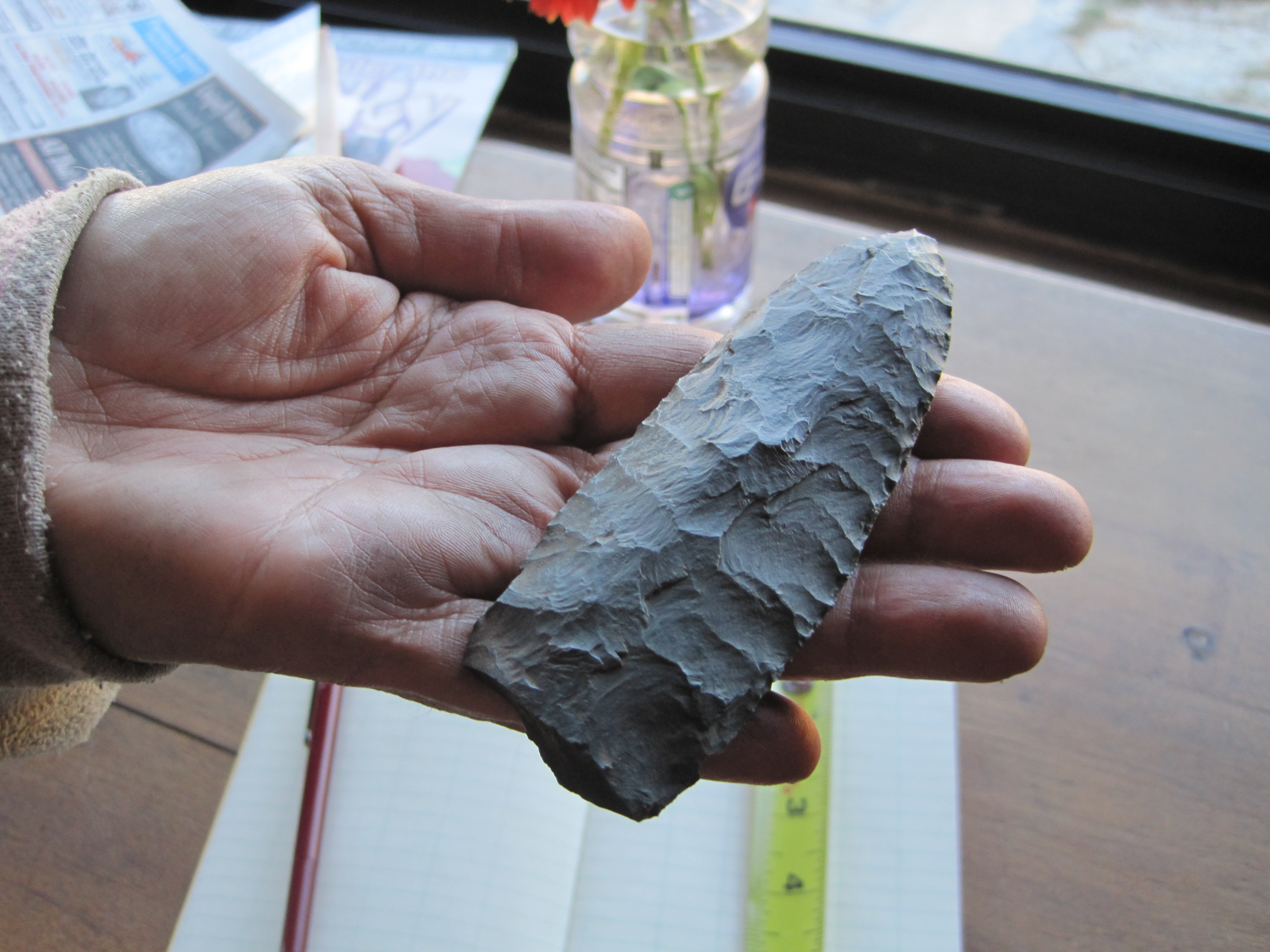
This summer I contacted the Forest Service archaeologist.  The forest service is planning on doing logging and burning in the valley for beetle damage.  Since our stream is on forest service land, and is a sensitive area, I didn’t want logging done there.  The hydrologist, the archaeologist and the permit supervisor came out and did a walk through.  Afterwards, I took the archaeologist aside and showed her some arrowheads and a large spear I’d found on my property.

2500-3000 year old spear head found on property

The archaeologist was amazed at the find and told me she wanted to come back with Larry Todd, a premier archaeologist in the state, and make some molds of the spear from clay.

In the fall, Larry and Molly came up to my house and made an identical mold of the spear.  Larry put the age, although it was very hard to age it, at around 2500 years old.  I showed him a small obsidian arrowhead that I had found, oddly enough, on the same day, behind my house.  He aged that at around 4000 years old.

Molly and Larry were on their way up the valley to find, document, measure, and photograph some wikiups.  They invited me to come along.  They had a rough photograph taken in the seventies of the five wikiups which were still standing at the time.  A former forest service archaeologist had measured and documented them.

I knew the small drainage.  I’d hiked it several times.  It was an off shoot that had only a well-used animal trail heading up it.  The trail led to a small flat clearing which then separates into two very narrow draws, both of which get steep and dead end quickly.  I’d never seen any wikiups there.

We hiked up the draw and arrived at the clearing.  Molly had shown me the photo from the 1970’s.  The wikiups were upright and intact.  But now she pointed them out, a pile of sticks.  Once I knew what I was looking at, it was easy to find the five piles of sticks–old sticks, but still now just sticks.

The two archaeologists spent an hour collecting data.  Larry said these wikiups were probably over 300 years old.  The poles, unrecognizable to me even though I’m quite familiar with trees, were made of aspen.  Looking around, there were only one or two aspen in the area.  Obviously the landscape had been different then, changed mostly by frequent fire.

A long time resident had told Molly that he used to picnic here with his parents as a child.  The wikiups were still standing then.  But the cattle that are allowed to run free-range in the valley also liked to lay here and rub themselves against the standing wikiup poles.  Eventually the cattle knocked all of them over.

Wow!  After 300 years intact, these special artifacts were destroyed in just the last 25 years–by cattle.

300 year old wikiup standing till 25 years ago when destroyed by cattle

Would we let cattle  hang around the Liberty Bell, defecating and knocking the bell over?  I was saddened and appalled at the unconscious policies that allowed these cattle to run rampant over native sacred heritage sites.   These cattle, owned by a super wealthy ranch, provide only a nice tax break for the ranch owner.

Have we lost our perspective?  We must make an effort to preserve these delicate sites.  Soon fires will come and destroy them; that is for sure.  But our stance should be to protect these sites, as long as we can, for future generations, and, if for no other reason, out of respect to the peoples who came before and their present day ancestors.

A brilliant and frigid day

Its -14 degrees tonight at only 7 pm.  Today it was a clear beautiful day and the mercury never got above -1 degrees F.  I got bundled up and went out for a ski, but my new skis have a big problem with their bindings.  I tried for 20 minutes and never got my shoes to hook in, but I got pretty cold in the process.  So I abandoned that idea, threw on my snow shoes, and headed out on the trail by the creek.

An enormous sun-dog, or halo, circled the sun.  The sky was clear blue and the air was so cold you could literally see ice crystals flying by.

Over the bridge there were some old coyote tracks.  This coyote was using a rotary lope.  He switches from one side to the next as you can see from the photo.  Maybe he picks up the pace over the bridge because he’s so exposed with out cover on either side.  I’m working hard on studying gait so I was thrilled to see and recognize this one.

Coyote lopes across the bridge. Notice change from one side to the next

Usually this walk has lots of wolf tracks but none today.  A moose has been walking around the willows

Moose droppings and tracks

.  I find an area near tree cover where several moose lay down.  At first I thought these might be a group of elk, but only moose scat was around and the bed measured 60″–too big for an elk.  Laying in that deep snow, a moose or an elk creates a deep depression with their weight and body heat.  The lay becomes a natural snow cave, insulating them and keeping them warm.

I watched a dipper feeding and bathing.  Wow they are stout little things.  It was so cold my hat was icing up and this bird was hanging in the stream.  Ice flowed by him.

Dipper

On the way out, the elk were spending their resting time mid-day in the upper meadows.  They were there yesterday too when it was just as cold but cloudy.  Usually they hide mid-day in the trees.  I wondered why they were hanging on the hillsides, exposed, during these bitter cold days.  On the way home, around 3:00, they were already out and grazing. Usually when the deer and elk feed early, that’s a sign of a storm coming.  Maybe they know something I don’t.

Why are the elk resting in the meadow mid-day?

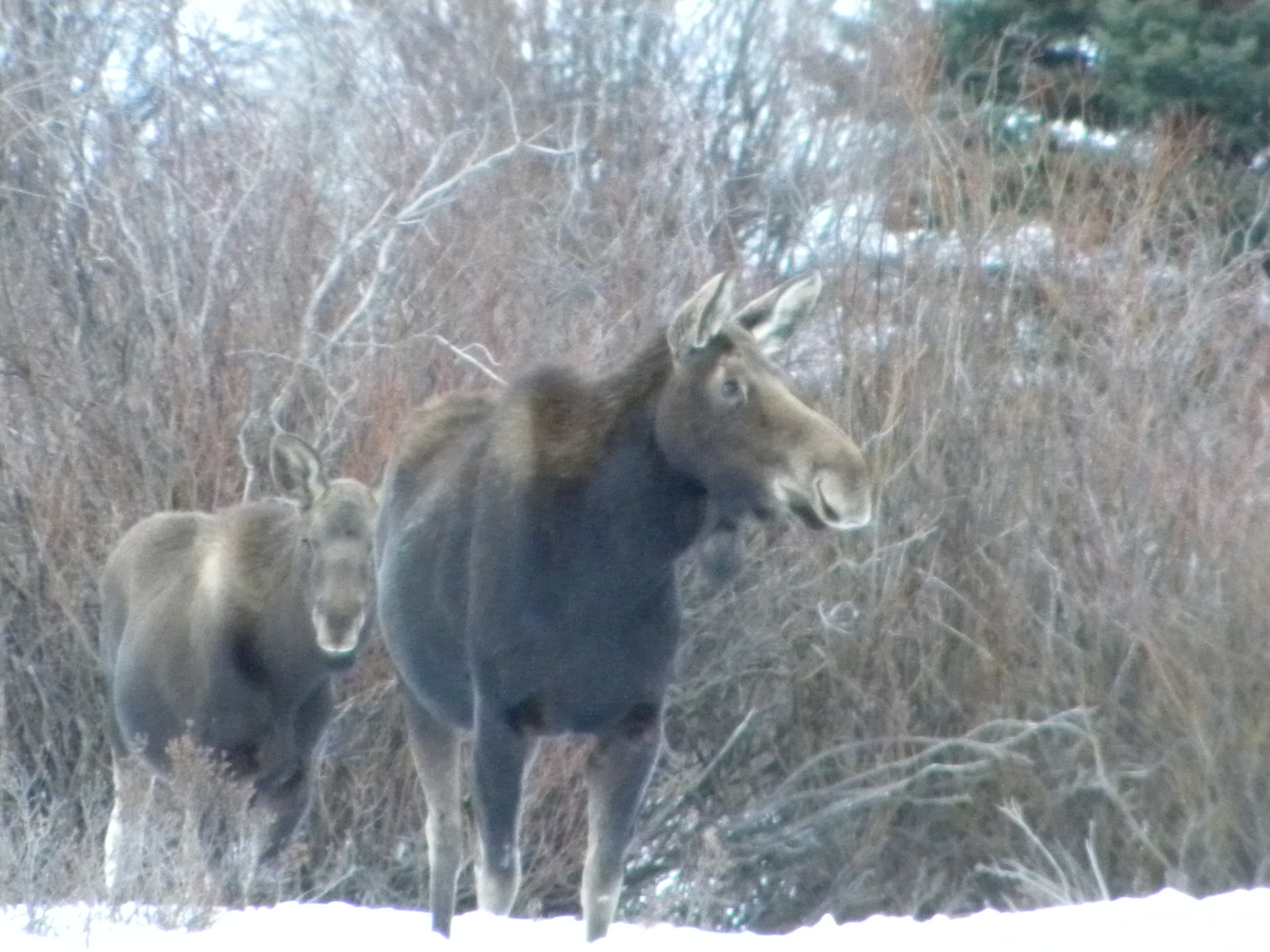
On the way up to my cabin, I see a young cow moose running bye.  I suppose its a very cold and moosey day.

Moose by my house

Hunter gatherers and the Internet

A friend sent me an interesting link the other day.  Nicolas Carr, technology writer, discusses how our brains have changed over the centuries, beginning with the first maps all the way to the internet.  Maps, he argues, may have been the birth of abstract thinking.  Instead of using visual, verbal, or auditory clues to find one’s way around, we suddenly were using an abstract picture of where we were in space.

1890 map of the Tuscarora Indian Reservation

The written word, over the centuries, changed us from a brain of sensory perceptions to one dependent upon abstract thinking.   The written word required the brain to focus attention without distraction. This nurtured a propensity for deep contemplation, considered a great virtue in the Western world. The internet, on the other hand, requires multi-tasking skills. Rodin, Carr says, created the sculpture ‘The Thinker’ as the epitome of cultured man. Could you image if his work had been ‘The Multi-tasker’.

A man I know in California asked me, over the phone, ‘What do you do out there anyways?  I mean, like, how many emails do you get a day?’  The value or worth of one’s life seems to have been stripped down to this:  the amount of blips of conversation vis-a-vis tweets, texts, and emails you get on a daily or hourly basis!

This all got me thinking during a recent hike:  the skills I mentally use, the synapses that need connecting, are quite different than what society has adapted me to throughout my lifetime. And how different is my brain from the hunter-gathers here just a few hundred years ago?

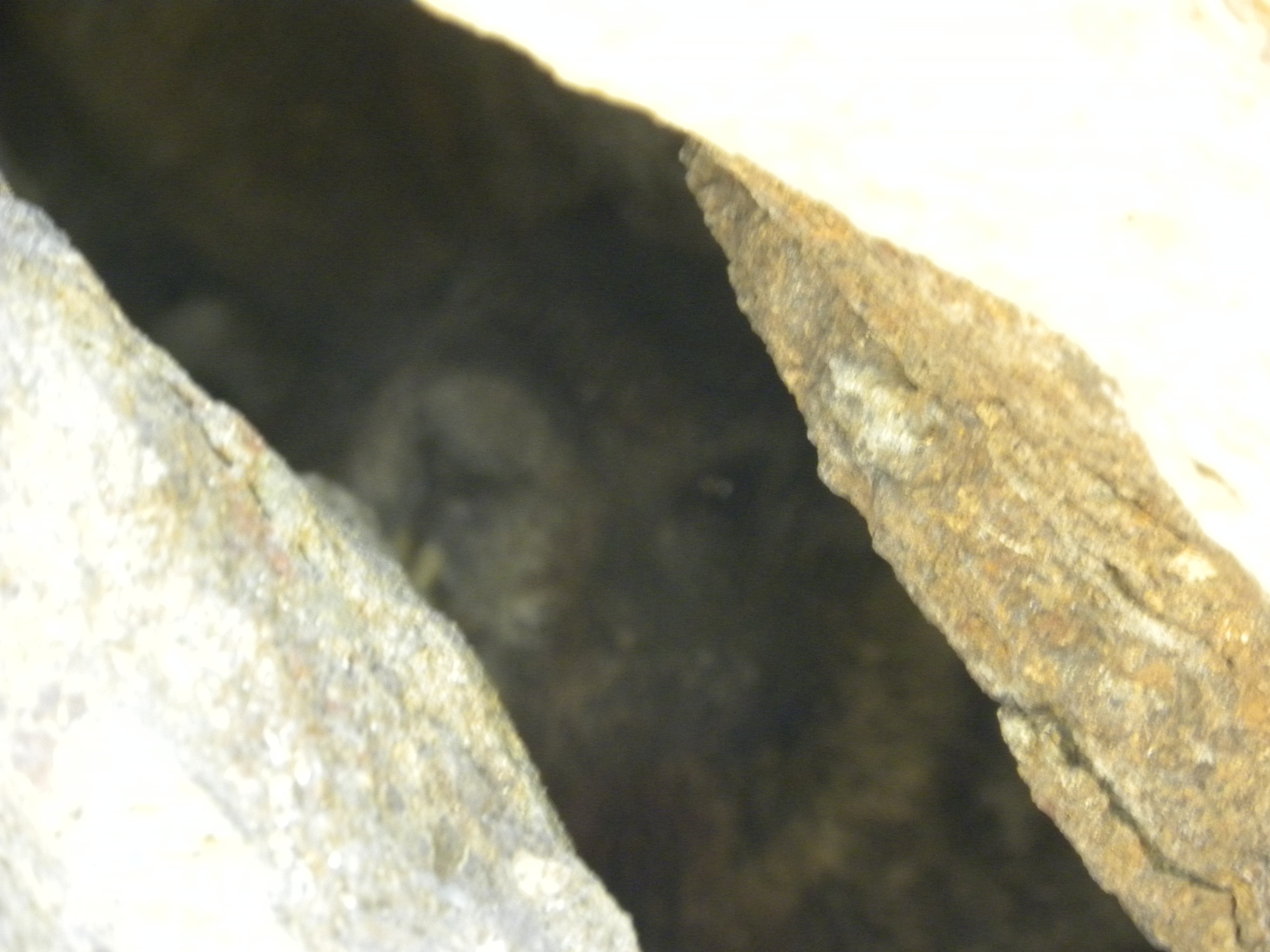
Can you see the marmot in the hole?

I’ve definitely noticed a change in my attention skills since I’ve lived here full time over the last several years.  I was thrilled last October when a grizzly about 200 yards away in the trees caught my peripheral attention.  She wasn’t moving, just foraging, and looked like many of the logs in the forest, but something told me to stop and look.

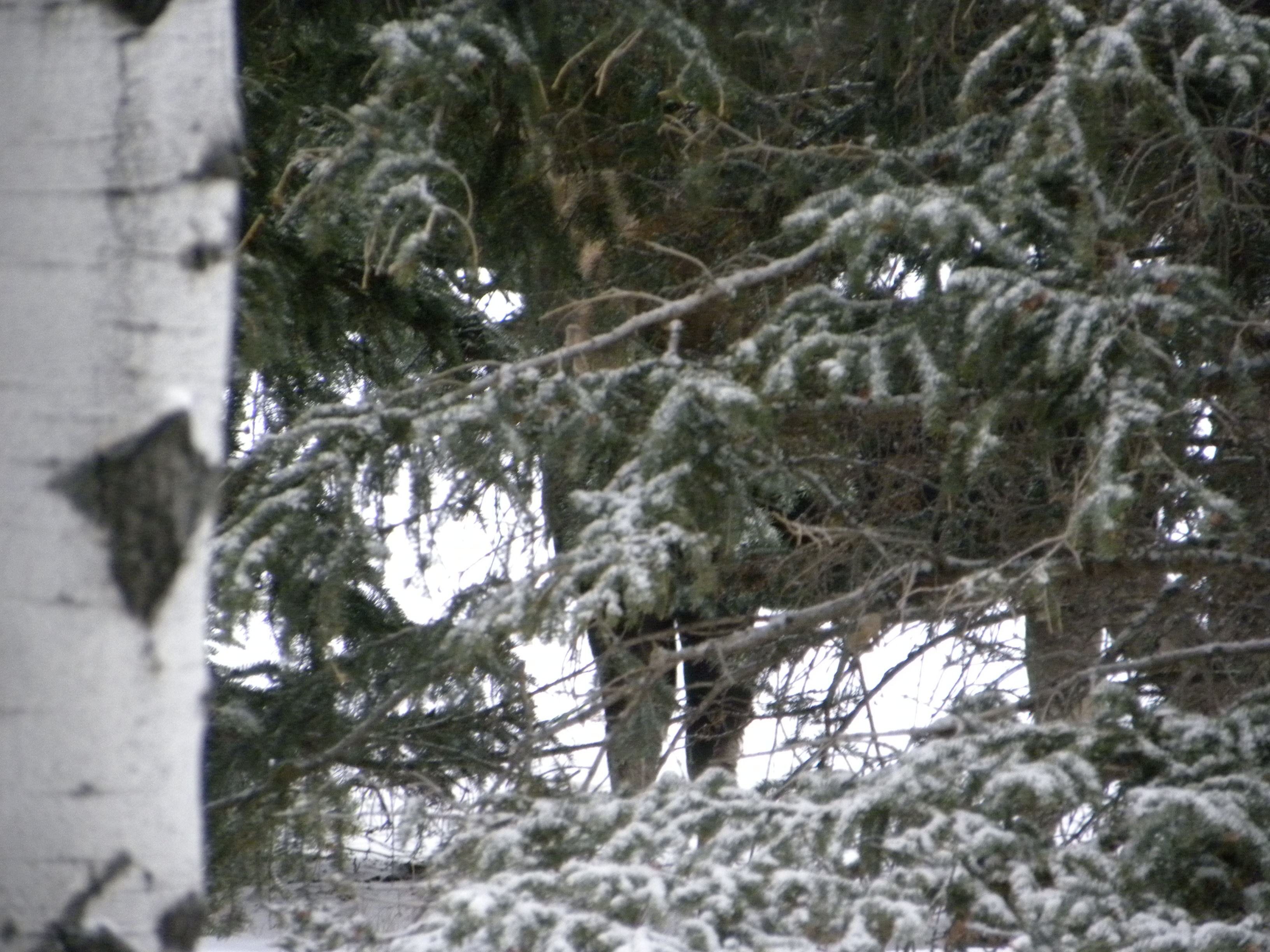
Can you see the moose in the trees?

Just a few weeks ago, walking to my mailbox at dusk, I spontaneously (or so it seemed) looked to my left at a tree branch about 100 feet away.  The light was fading and I could barely make out an outline of a bobcat watching me from a low limb.  I regularly catch movements in the landscape.  I detect moose hiding in the willows or deer escaping through the brush.  One friend who visited me this summer from California commented that I see a lot of animals that she never noticed.  It wasn’t always this way.

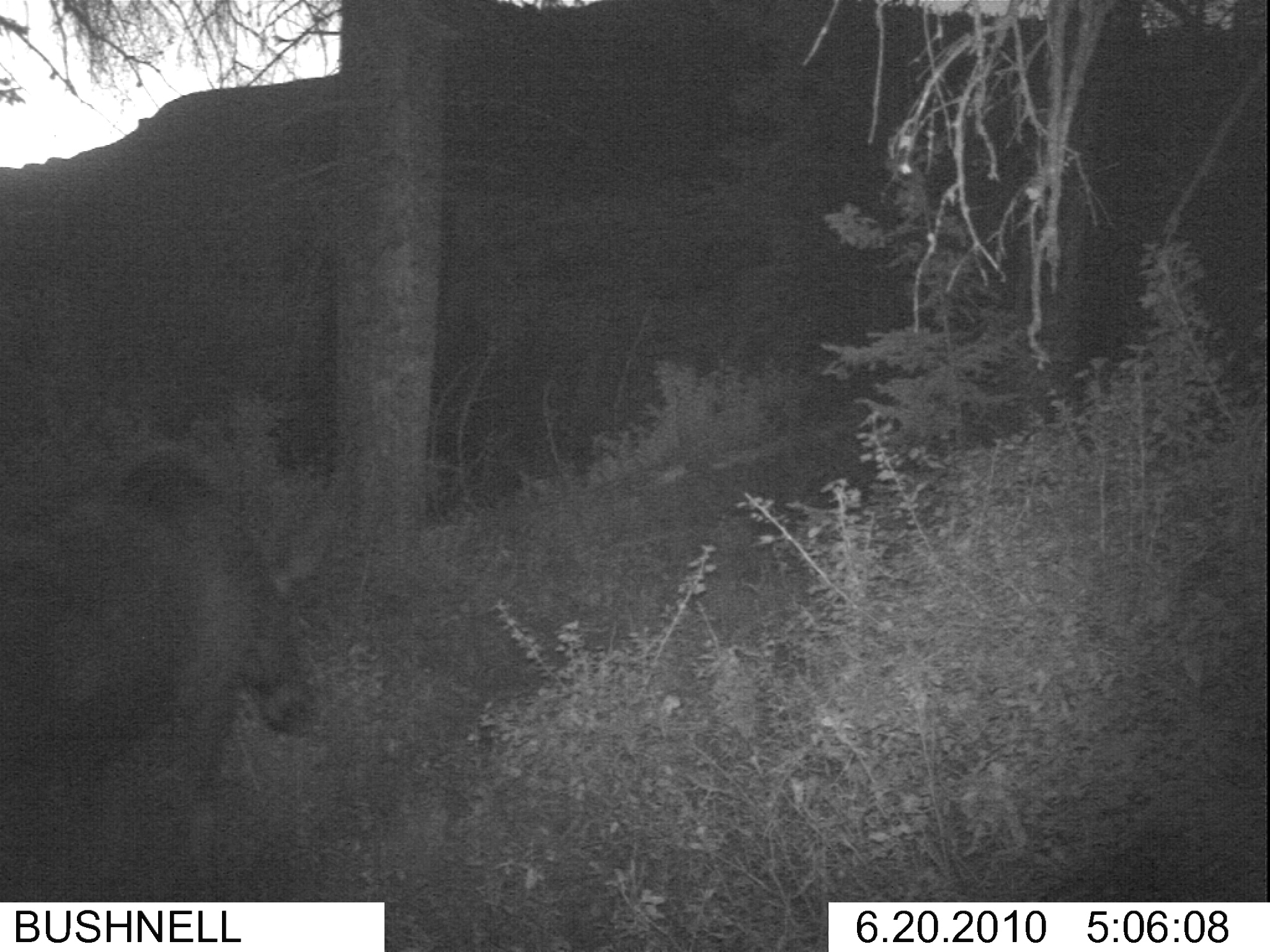
Can you see a moose, at night?

This new-found skill is simply the resurgence of ancient ways of seeing.  How many more skills are lying dormant?  The old adage What is not used becomes obsolete–are there ways of seeing, of smelling, sensory skills that have fallen away over hundreds of years that no longer have the synaptic connections?

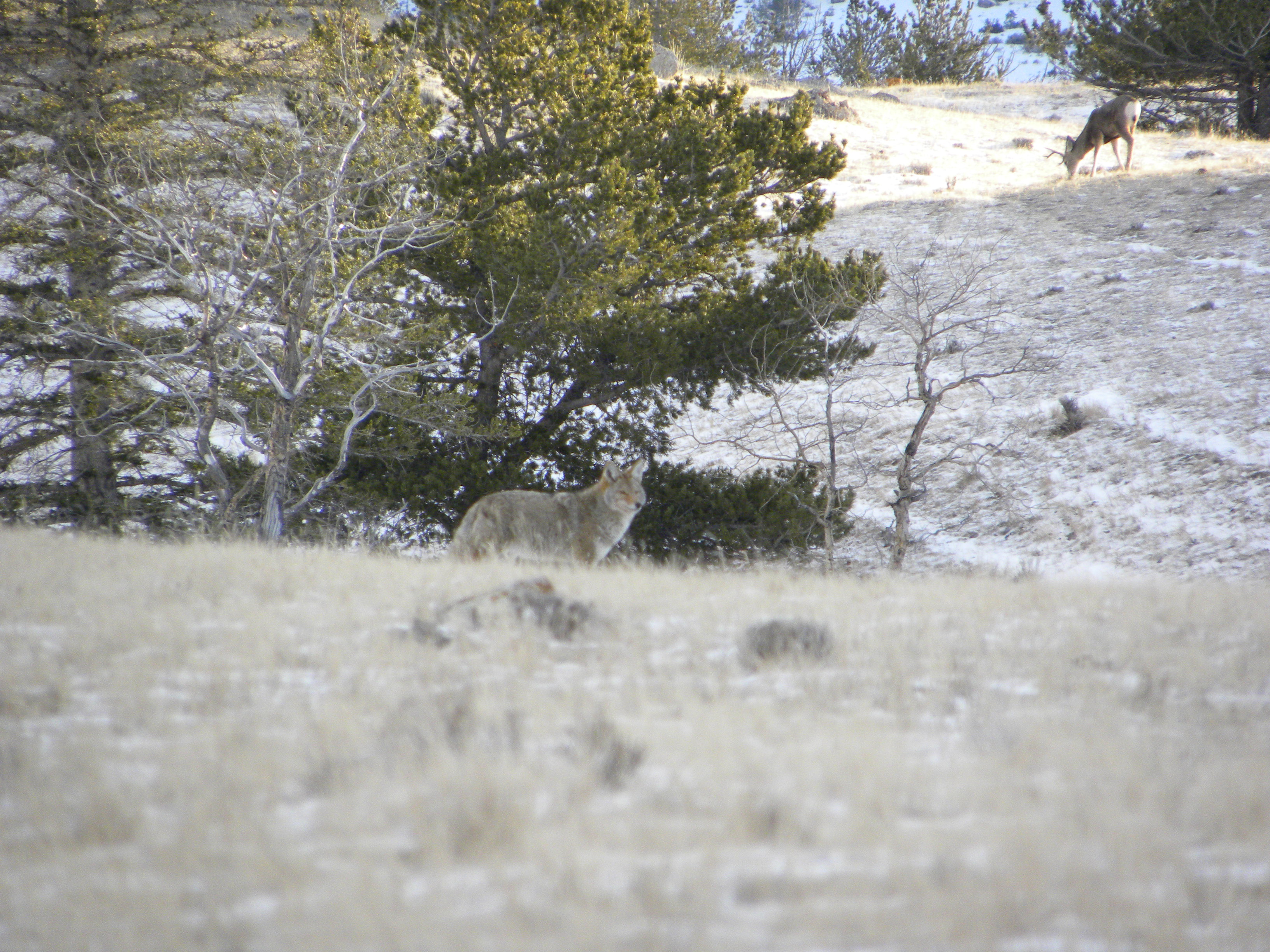
Coyote blends into the landscape

When I hike around these woods, I have to use a completely different set of skills than I might on the internet, or in a city.  Recently I was in New York City.  The amount of bombardment of information was overwhelming.  It was as if grizzlies were coming at me from all different directions.  But walking in the quiet woods, smells, movement, bird sign (i.e. gathering of crows and ravens could mean a nearby kill; small ground birds calling frantically might mean a hawk above)–all subtle information that could save your life, or give you the thrill of seeing wildlife, or, for a hunter-gatherer hundreds of years ago, could mean the next meal.

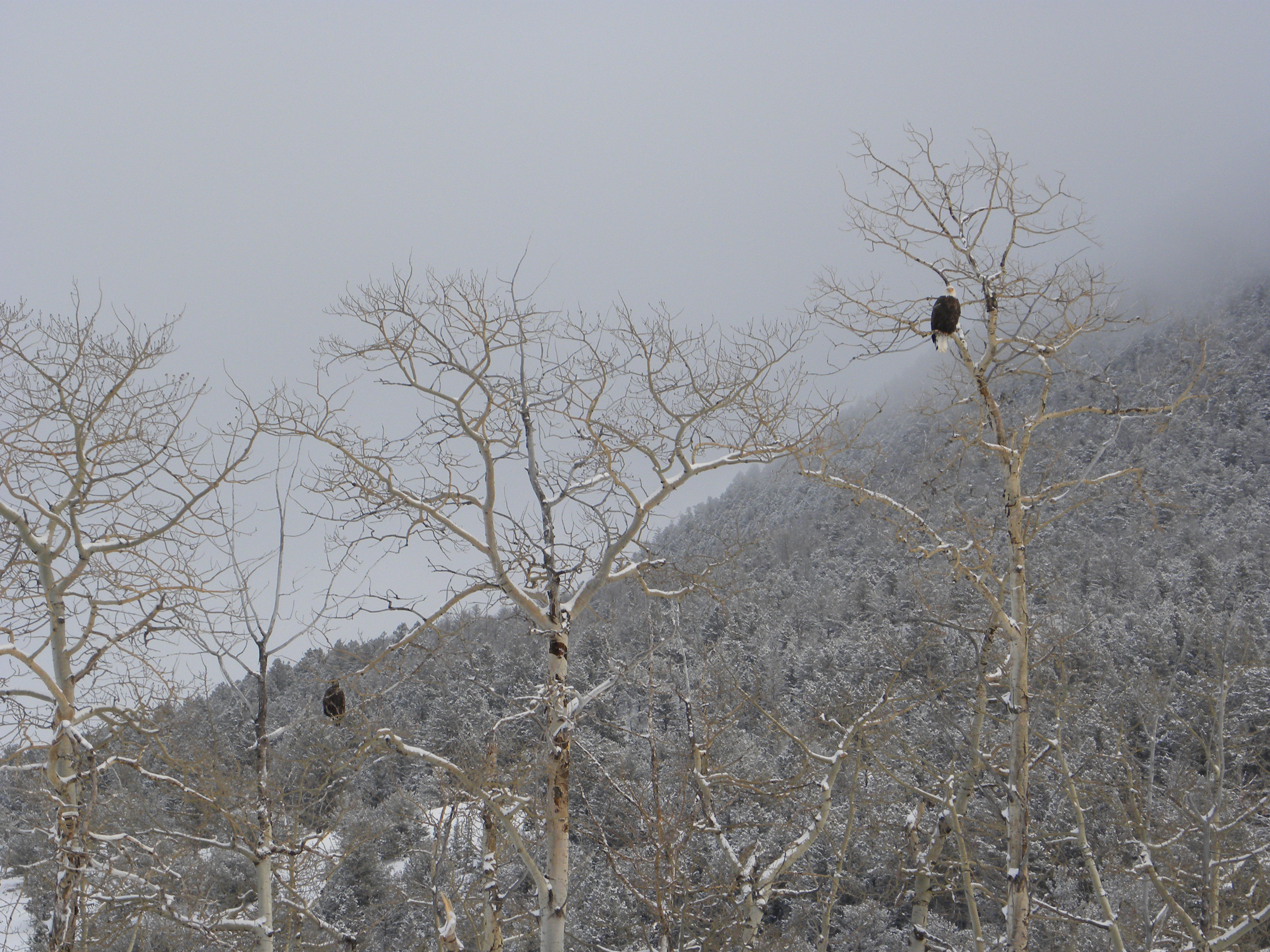
Can you see the Golden eagle as well as the Bald?

How about the skills of location?  Aborigines sang songs, called songlines, that were used as their maps in a featureless world.  Just the skill of orienting oneself without a compass, map, or road signs and finding your way around must be stored in a different part of the brain–not something we usually need to use today.

I once heard a scientist discuss orientation, and that if children are allowed to ‘wander’ freely, that they will have better orienting skills as adults.  Who trusts their children these days to wander freely around cities and suburbs?

A friend told me a woman showed up on his doorstep one afternoon.  She’d parked her car in the desert and taken her dog for a walk.  But she was so disoriented that she couldn’t find her car.  My friend, who knows the Oregon Basin well, easily found her car from the few visual clues she gave him.

Sense of time, sense of self, sense of community, sense of one’s surroundings and all its visual clues–I wonder how different my brain is from my fellow travelers who once roamed these mountains?


The right thing to do…Niagara falls and Yellowstone

I just returned from helping my son with location scouting at Niagara falls.  Its strikingly beautiful, especially in the winter.  The crowds are gone and its bitter cold, but there are ice floes in the river and parts of the falls are frozen.  The Canadian side still lights up the falls at night and the sheer power and magnitude of so much water flowing (in fact only 50% is allowed to release as the other 50% is used for power) overwhelms and puts us humans in our proper perspective relative to the awesome power of nature.

Falls at night

Power of the falls

But along with my visit to Sedona, Arizona last year, (which also is a natural wonder but not a National Park) what really stood out was its contrast to where I live now, the Greater Yellowstone Ecosystem.

Although I live next door to a National Park, I don’t of course live within the Park, but within what was designated a few decades ago as its larger ecosystem.  This is an actual mapped area, you could call it a ‘buffer zone’ where its recognized these large megafauna need room to roam to survive.

And, true to its name, I regularly see all the large and small animals that make up this complete ecosystem in the lower 48, which includes wolves, grizzlies, elk, and the occasional bison that is allowed to leave the Park.

So what’s so great about this area  you might say, as opposed to Niagara or Sedona?  Both have the power to overwhelm through their sheer beauty and immense landscape.  The difference are the animals.  Even the Sierras, as incredible a jewel as they are, are NOT a complete ecosystem.  Many animals that were there just 150 years ago are gone forever.

What Lewis and Clark encountered 200 years ago on their journey West is no longer, but a sliver of it can be glimpsed here in the Yellowstone Ecosystem.  Just a sliver, but that sliver is our history, our heritage.  No one would think of selling Monticello to create senior housing or a Walmart!  Why should we not value our original landscapes and the animals that were here before us in the same way?

Everywhere in the United States, with the exception of Alaska, animals have been pushed out to accommodate the biggest and toughest animal–humans.  And that is no exception in the Yellowstone ecosystem.  The controversy rages here too as to who should have primary use of the lands–hunters, atvs, developers, ranchers, oil and gas?.  Wolves are villified for killing elk that hunters could have taken.  Grizzlies are constantly moved around when they get into lands too close to homes or into unprotected garbage.  Bison are not allowed to leave the Park boundary.  Ranches are sold to developers who parcel up the land into lots, crowding out habitat for large animals.  Snowmobilers feel they should have the right to go wherever they choose, including the Park even when the science says differently.  The animals are last on the list.  And when that is how the priorities are set, what becomes of the land is Niagara Falls, Sedona, or at best a ‘safe’ wilderness like the Sierras; at worst we become like Europe, where their natural history is in the so-distant-past that its entirely unreachable in present-time.

Yellowstone and its ecosystem, unlike Alaska, is easily accessible by car to people from all walks of life, rich or poor.  It is an opportunity to view in the flesh our rich natural past.  Any person can do that from the safety of their car, and watch wolves or bears in the Lamar Valley.  Or one can take more risks and venture into the back country.  Even today, with this area protected and the reintroduction of the wolves, thereby completing the ecosystem fauna, the landscape doesn’t hold a candle to the enormous amounts of wildlife that was once beheld by the mountain men in the 1830’s.  Yet, they are all still here, thanks to the enormous efforts of many men and women conservationists through the century.

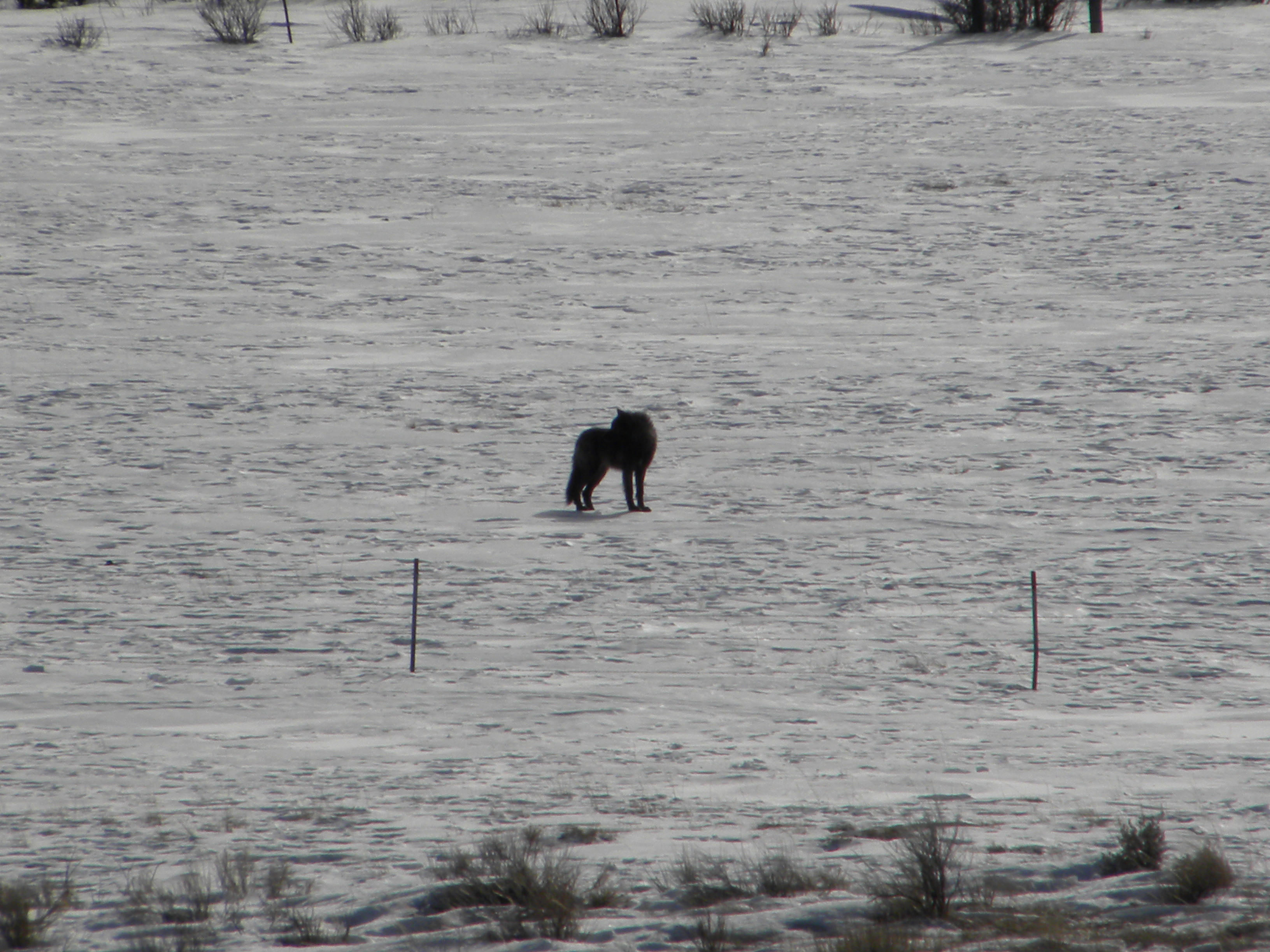
Black wolf

In the U.S., there are many unique and beautiful areas, but there is no where like this area.  Here we have the Serengeti of North America.  And in my mind, we are not valuing nor protecting it enough, nor are we holding it in the proper perspective.

Our Serengeti

The proper perspective:  This area, as well as more large tracts of contiguous land (Yellowstone to Yukon idea) is a wildlife first policy.  This is our gift to our children and the future.  This is our gift to the wildlife here.

Once we all realize what we have here, a jewel that is found no where else in the U.S. (Do we really want the last place where wild animals roam to be in Alaska, out of the reach of most ordinary folks?), we will change our approach and our views on a daily basis.  No longer will we have on the Wyoming books archaic 1890 laws that allow trapping, an indiscriminate way to kill wildlife.  No longer will we confine bison to the tiny Island of the Park because the cattle industry fears losing their brucellosis stamp.  Nor will people call for the extermination of the wolves because they are having a harder time hunting in the spots they are used to.

We will make new laws to help support the wildlife in any way we can and preserve this area; not for ourselves or for any use we desire today, but because we recognize its’ specialness, and because, frankly, its the right thing to do.

There was a time, not long ago, when out of 60 million Bison that once roamed the entire United States, only 100 survived.  In fact, it was thought that all bison were extinct, and that was what we, as a country, as a government, was trying to achieve.  But in the early 20th century, around 100 Bison were found living in Yellowstone.  An immense effort was made to bring at least some bison back and the bison that you see today living in Yellowstone are the result of that effort–the last pure genetic stand of bison living today.

When you go to Yellowstone, there is a power, a respect, a wordless reverence that wells up in your being just seeing these animals.  Something deep and ancient reverberates in their presence.  Imagine if those bison hadn’t been preserved?  Those conservationists who helped preserve the bison of Yellowstone did an incredible service to future generations.  We, living today, are the beneficiaries of their efforts.

We must make those same efforts today for generations that will be living 100 years from now, just as they did for us 100 years ago.  That is how we should be looking at the Greater Yellowstone Ecosystem.  That is how we should be making our laws, our plans, our actions.

“You may say I’m a dreamer, but I’m not the only one…”

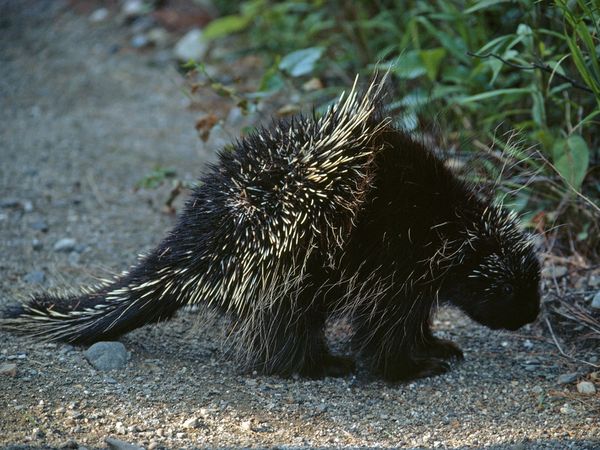
I Miss the Porcupines

Where are all the porcupines?

Last summer I asked several of my neighbors if they’d ever seen a porcupine up here.  I live in a forested area (mostly douglas firs, lodgepoles, limber pines and spruce), plenty of water, around 7,000 ft.  In all my hiking and tooling around, I’ve never seen any porcupine sign. According to Mark Elbroch Mammal Tracks and Sign

Porcupine scat can be found wherever there are porcupines, accumulating anywhere they feed or walk; it may be especially thick in crevices and hollows or even basements, where they rest.  In fact, scat accumulations may be so high at resting places that porcupines have to burrow through their own excrement to exit and enter.  Look for rivers of scat flowing from rock ledges where they hole up in the winter.  Some researchers suggest that this behavior may aid in providing shelters with insulations; winter scat is composed completely of tiny wood chips.

Scats are small, irregular tubes and pellets with rounded or pointy ends. Most scats curve over their length–this asymmetry helps differentiate them from deer scats.  Scats may also be linked and form chains.

Porcupine tracks are also very distinct:

While on a two week back pack trip in the Tetons, I was sleeping outside without a tent, my boots seated by my head.  In the middle of the night, I awoke to a strange sound, a munching sound.  It was pitch dark, no moon.  I looked around and saw nothing but a rock near my head.  I lay my head back down and the munching sound commenced again.  Then it hit me “That rock wasn’t there when I went to sleep.”  I sat up with a start and the ‘rock’ moved away into the darkness.  When I awoke in the morning,  the entire top part of my boot was eaten away.

Porcupines are notorious for chewing outhouse seats, leather, boots, etc.  They are looking for the salt.

When I began asking neighbors last summer about porcupines, I couldn’t find one that had seen any.  But the other day I did find one.  The winter ranch hand across the road has lived around here all of his 60 plus years.  He told me that in the 1950’s there were plenty of porcupines, so many that the Forest Service was asking people to shoot them.

“They didn’t like what they were doing to the trees.  We shouldn’t have shot them.  They weren’t doing nothin’ compared to these beetles.”

He said he hadn’t seen a porcupine for a long time.

Where have all the porcupines gone?  Its an unsolved mystery and no one has given me any answers.

Bald eagles, coyotes and a kill

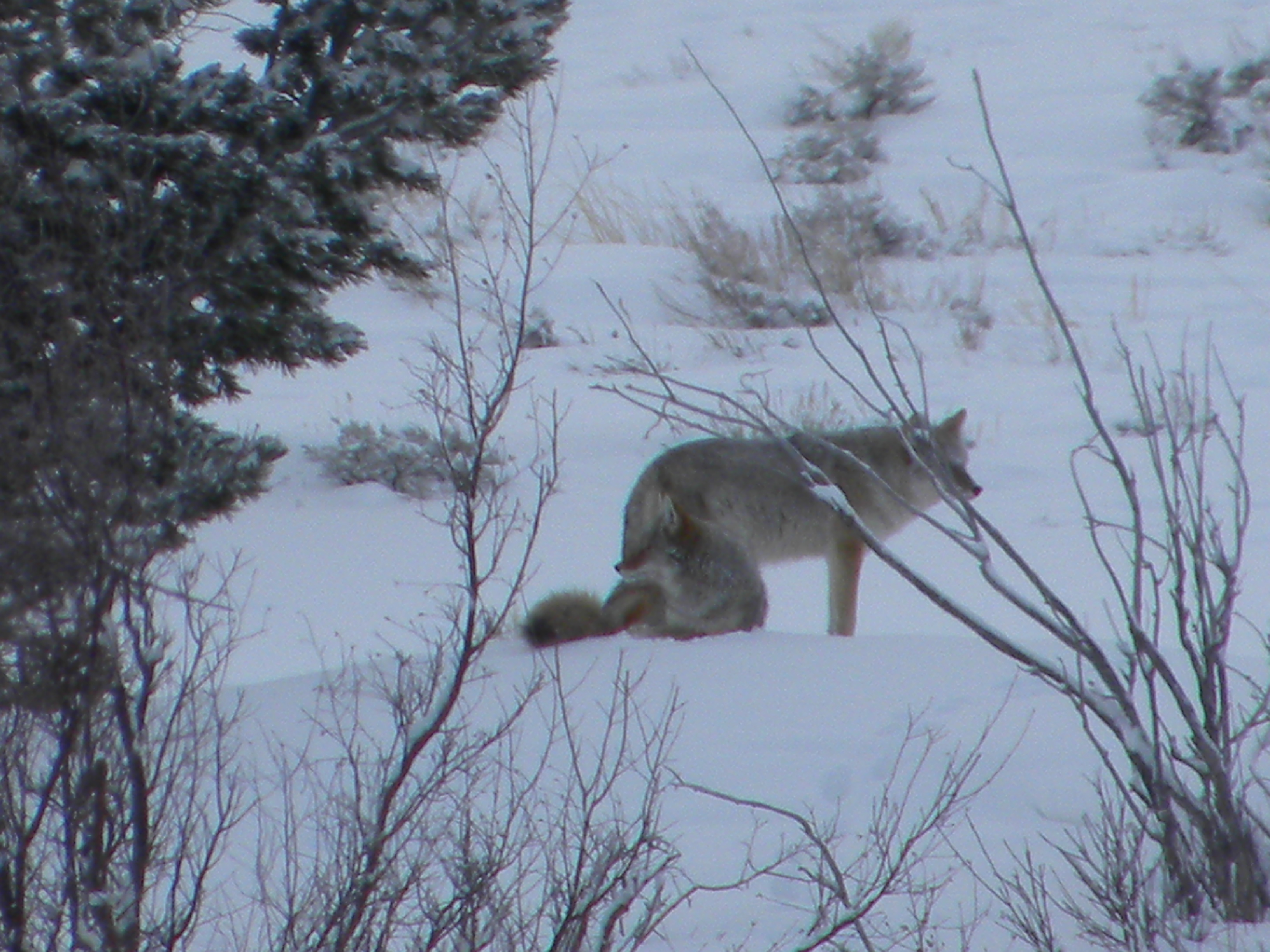
An old cow elk broke her leg trying to get over the fence when a car drove bye.  Didn’t take long for the predators to bring her down.  Yesterday early morning I drove up the road and found 5 coyotes on a kill.  Usually coyotes can’t bring a large elk down, but they might have in this case.  She was an easy kill.  Since I didn’t see any wolves around and the carcass was less than half eaten and still warm, not frozen, I assumed they were the culprits.  I watched them for over a good hour. One dominant coyote was chowing down.  Another bold coyote kept slinking around, trying to get in a few bites, but the big male wouldn’t have it.

Error
This video doesn’t exist

Once the male got his fill, he’d go off somewhere, leaving the carcass for the secondary prowler.  She or he started tugging and pulling off the meat.  She got in about five or ten minutes before Mr. Big Man came back who then, with some posturing and fighting, threw her off.  Three other coyotes, not so bold, hung out in the trees.

Coyotes waiting their turn

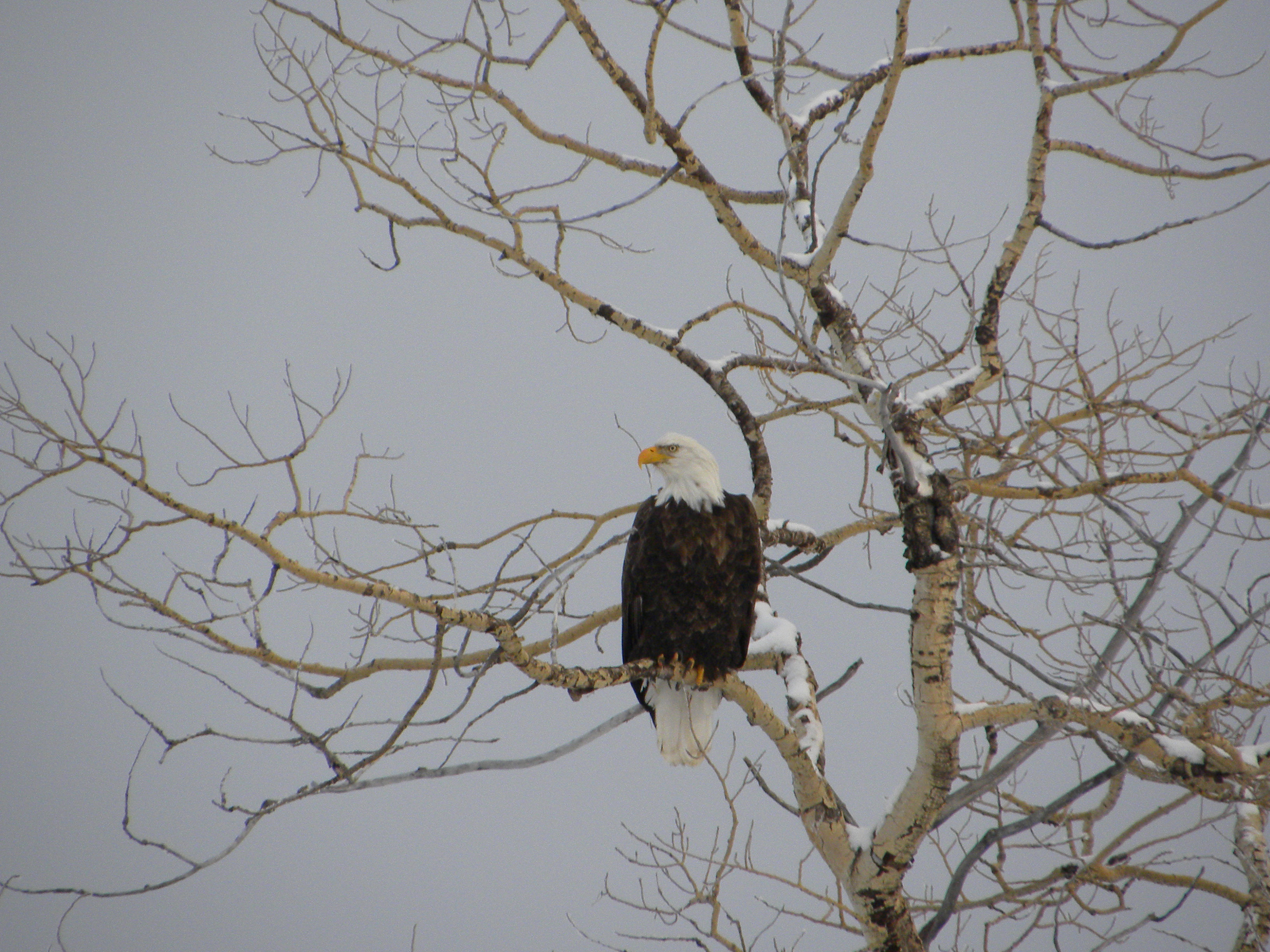
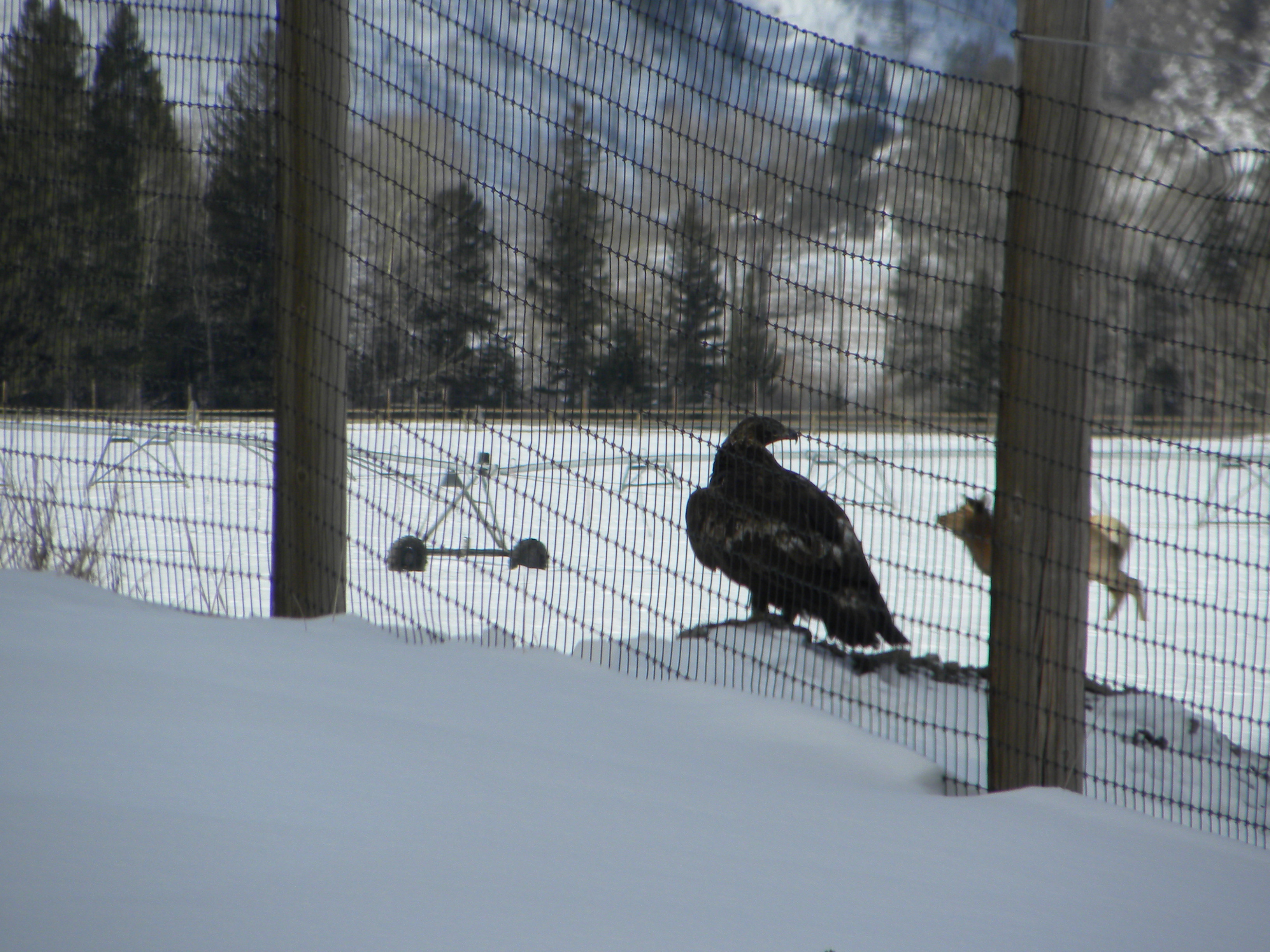
Two beautiful Bald eagles waited in the trees, along with several Golden Eagles.  I watched a Golden and a Bald tug at each other in mid-air before going to their respective perches.  Of course, tons of magpies and crows waited.

It was cold outside, about 5 degrees.  I came back in the late afternoon, hoping to get some closer photos of the Bald eagles.  By now it was hovering near 0 degrees.  A beautiful Bald Eagle sat in a leafless aspen along with a Golden and some crows.  I zigzagged closer and closer.  I kept shooting and wondered how close I could get before she took flight.  I’ve actually seen this pair of Balds hanging around the valley a few weeks ago.  I knew the dog could get real close without disturbing her.  After all, the dog is essentially like the wolves or coyotes that she tolerates around kills.  In fact, I’ve watched coyotes eating a carcass with the crows around, or even a Bald eagle chasing a coyote off a kill.

Just when I saw her get a little ruffled and ready to fly, I backed away.  My hand on the camera was freezing!  Numb.

I drove up the road, watched the elk for a time in the beauty of the chilled sunset, then drove back home.  It was getting dim.  The birds, all of them, were gone.  The kill still there.  I wondered–where did those eagles go at night.  They’d been sitting out there all day, in fact I’d watched them for over an hour without them moving.  The cold didn’t bother them.  But they’d gone somewhere to bed down.  Where does a bird that big go to rest for the evening?

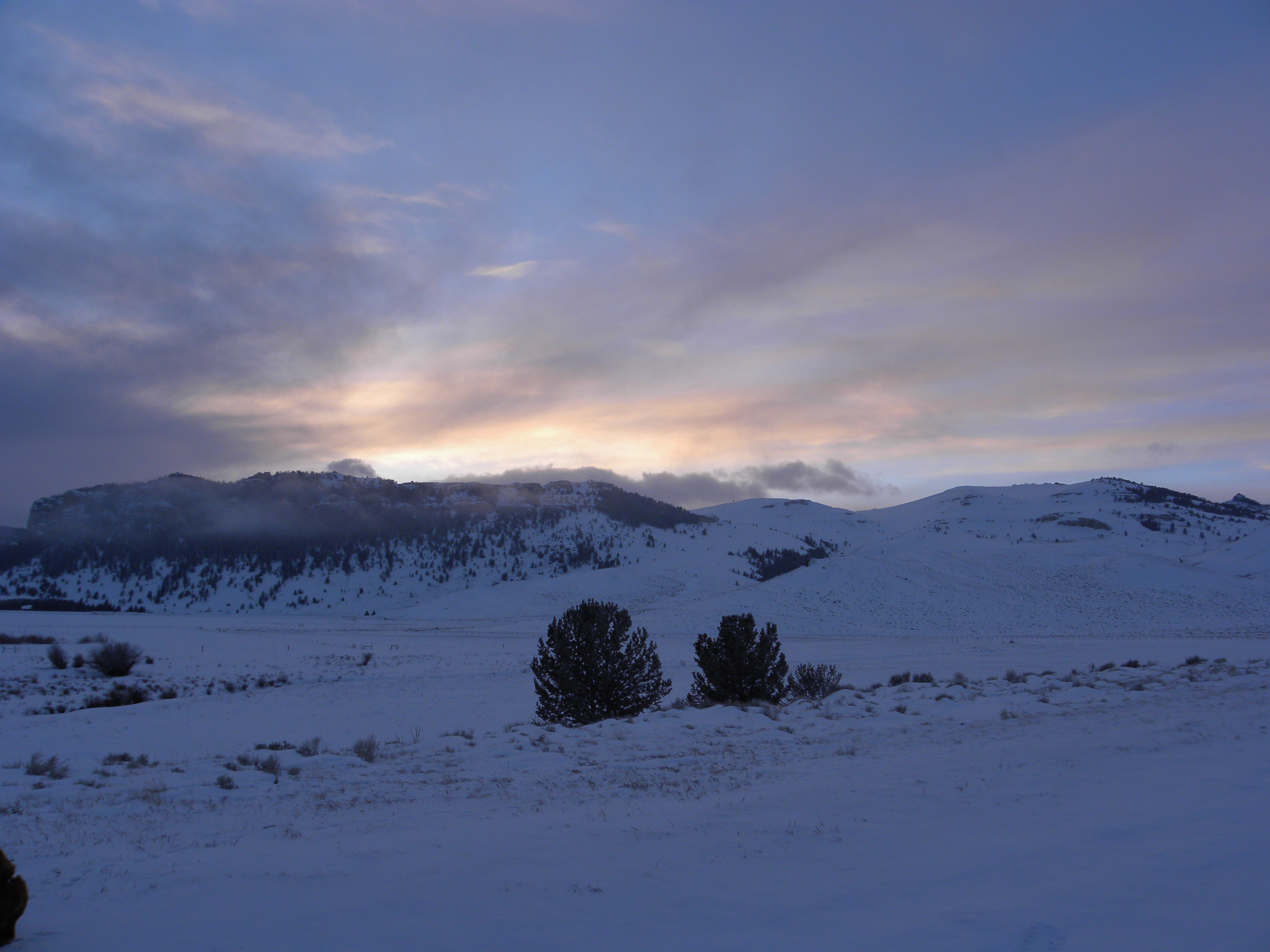
0 degrees sunset

High drama

Nature is full of drama, usually of the life and death kind.

On a rare warm, windless, beautiful day, I loaded up with the dog and headed for a hike down the unplowed part of the main road.   Just over the crest of the flats, I saw about 600 elk corralled within the ‘elk fence’, nervous and jittery.  It was almost 11:00 and these elk should have been resting in the trees.  Besides, you never see elk inside this fence.

Elk stuck inside fence and can't get to safety

I’ve heard two stories about this fences’ beginnings from two different neighbors.  When this ranch was owned by a wealthy man named Bugas in the 70’s, so the first story goes, the county conservation services re-graded and drained the field so he could put his cattle here, or at least more cattle.  Then to keep the elk out of the grazing pasture, the county paid for the fence.  Your tax dollars at work!

The second story isn’t too different from the first but with some variation, yet still with cattle in mind.  In the hard winter of ’77-’78, when the snows were so deep you couldn’t see the tops of the fence posts, Bugas’ cattle were struggling and starving.  The elk were eating the feed that was set out for them.  So a temporary fence was erected for that winter only.

Since that time the property was sold to Earl Holdings, one of the wealthiest men in the world, the fence remains, and the elk can’t move through or over.  So to see the elk inside was very unusual and probably spelled trouble.  The fence borders the creek.  On the other side of the creek is the game preserve where the elk have been gathering every evening and morning to eat.  One gate to the ranch property is open from the creek side, which is how these elk got in.   And that is how they would need to get out of this very large enclosed pasture.

But why they were there was solved when I saw some birds circling in their winter pasture across the creek.  There was a kill over there. These elk were trying to get across the private pasture and into the forest beyond but were being prevented by the fence.  Now they were sitting ducks for the wolves.  The road is between the fence and the forest where they wanted to head but were prevented.  They were hanging around the fence line by the road and every time a car went bye, they stressed, running this way and that, confused, not conserving their energy, unable to head in any safe direction.


Golden eagle resting after feeding on carcass

Needless to say, I’ve hated this fence ever since I’ve been here, and here was more proof why it should go.  When I saw the kill I went back to get my scope,  On the return I ran into Ron.  He’s a citizen ‘Wolfman Jack’.  He does a great service by being totally obsessed with wolves and following them.  He knows more what’s happening with the packs around here than anyone, including the Wildlife Services folks.  He relayed the drama that had unfolded this morning.

The Sunlight Pack made a kill.  The Sunlight pack is about 10 strong , almost all young wolves.  While they were on the kill, Ron heard some barking.  At first he thought it was the ranch dogs nearby, but then here come the Absaroka Pack, mature wolves 7 strong. They pushed the Sunlight pack off the kill.  While we were talking a black wolf from the Absaroka pack came checking things out.

Ron told me that between the Sunlight Pack, the Absaroka Pack which seems to come around here as well, and the Hoodoo pack of 10 wolves up around Crandall (but they frequent the valley here as well), AND the Beartooth pack of now 10, there is more going on in this area than the whole of the Northern Range.  We’ve got a lot of wolves running around this valley.

Wolves are such social animals and their interactions and orders are constantly changing.  The U.S. Fish and Wildlife biologist, Scott Becker, told me that they have few collared wolves at this point.  The dynamics are constantly changing and hard to keep track of.

When Abby was doing her wolf study here several years ago, there were only 2 or 3 wolves in the so-called Beartooth pack.  That pack is located across the Clark’s Fork of the Yellowstone, where there are very few elk.  It didn’t seem like a very hospitable place, especially in winter.  Scott told me they must eat a lot of deer up there.

I continued on down the road and began my hike.  Resting in the pasture, I saw 3 wolves–2 blacks and a grey.  When they saw me, the grey hightailed it out of there, but I was able to get some good video of these blacks.

Error
This video doesn’t exist

Learning gaits

I’ve been working hard to learn animal gaits.  What, you may ask, is that?  Its the pattern you’re going to see on the ground when an animal is moving, either walking, running, loping, trotting, hopping…you get the idea.

I’d been studying track identification for a number of years.  When I was in California last month I went to my old tracking club that meets once a month at Abbot’s Lagoon in Point Reyes.  We walk about a mile to reach a sand dune spit which is always full of life–bobcats, deer, coyotes, raccoons, otters, skunks and more.  This particular morning was a coyote and a bobcat station.  Both stations were about gait analysis.  The coyote switched from a trot, the natural rhythm for a coyote, to a side trot, then looked to the side, then stopped and started walking.  I really was confronted with my limited knowledge of gaits.

Gaits overwhelm me.  I have gait dyslexia it seems.  So what I did was use stiff cardboard and cut out footprints–F for front and R for rear.  Then I’ve been arranging them, using Mark Elbroch book ‘Mammal Tracks and Sign‘ as a guide, in different typical patterns.  Once arranged, I use all fours and mimic the gait.  I think its the only way to get this into my brain, as a kinesthetic exercise.  I once heard that you have to see an advertisement 300 times before its in the brain.  Probably I’ll have to do each gait 300 times before it begins to connect.

Straddle trot turning into a Side Trot (canines)


Transverse Lope

And of course, then you’ve got to go to the field.  Today I went out to a well-traveled back road that’s closed in the winter.  Well-traveled that is, by bunnies, coyotes, and especially the local wolf pack.  Last week the snow was very deep, but today it was hard packed with mostly wolf prints running back and forth.  I still am not very good at figuring out how many wolves were running down the trail, especially since there were tons of prints in both directions.  But at least 4 or 5 wolves.  I could see where they’d made a kill on the other side of the creek, but only a few parts were visible through my binoculars.

As I traveled further up the trail, one wolf was occasionally dripping blood.  I thought it might be too early for her to be in estrus.  The wound though wasn’t coming from the foot.  At one point the wolf shook and there were drips of blood in either direction of her trail.

I followed one wolf track that went off to the side of the trail.  The track stopped at a wide swath of compacted snow, like a lay.  But it didn’t seem that it was a wolf lay.  For one thing there were ungulate hairs in the depression.  Also the wolf’s tracks were fairly unbroken.  Koda was very interested, digging and sniffing the outline.

The bigger track is the front foot

We trekked a bit further to another spot where the wolf went off to the side again, with another depression.  Koda began digging furiously, and came up with a fresh deer skull!  That wolf had stashed the skull there.  Probably the other spot was a possible stash area, but then he changed his mind and stashed it further up.  That was fun and revealing for me because I had wondered if maybe that wolf had laid down.  But it didn’t add up with the ungulate hairs and no deer tracks leading to or from it.  Tracking is kind of like solving a mystery.

Koda, upon finding that wolf’s ‘stash’, took that deer skull and stashed it somewhere else.  I told him that that wolf would be mad with him for messing with his ‘stash’!

The wolves veered off the old road, under a fence line and into the woods.  I followed them out to where they crossed an iced over portion of the river.  They were just making their rounds and I was getting an idea of their route.  Interestingly enough, I saw some old bear tracks.  They were very degraded but were certainly bear.  Yet they weren’t that old because they were in the snow.  Although the winds have been blowing for days, this was a protected area under cover.  But our last snowfall was about a week ago.  These tracks were fairly fresh.  The fact that some bears are out still gave me pause.

So far in the last week, I’ve noticed a few things relative to the wolf pack here.  They use the easy routes to patrol the area.  They like to go up and down the main dirt road, then cut across the meadow through the willows to cross the river.  They circuit around from the closed road on the north side of the creek back to the main road.  When I walked the closed road all the way to the Game and Fish (which is closed during the winter for wildlife habitat), I’d thought the wolves would have continued on their trek through the boundary line.  Elk are in the meadows up there, but the snow is deep, so they use the easier routes for now.  Last year for certain they were coming and going through the habitat boundary, but last year held much less snow.

Also, last year the kills I saw were mainly elk.  So far this year, in just the two weeks that I’ve been watching along the road, they’ve killed not only elk (I saw one elk kill) but a yearling moose and now this deer.

Abbie Nelson out of University of Wyoming, worked up here for 2 summers and fall doing a wolf study.  She told me deer were the preferred food in summer when the elk are gone.  With thousands of elk now in the valley, all along the meadows beside the roads, I was surprised to see this deer kill in the creek bottom.

Tracking animals always gets me into their mindset.  And if I can begin to learn gaits, then I might be able to get in to their heads even more.  You can see which way an animal was looking, if they paused or speed up, and  then you ask yourself ‘Why?’.  It is a real study for sure.  I’m working on it.

Synchronicity: Coming to Wyoming, the final piece

Synchronicity is the experience of two or more events that are apparently causally unrelated occurring together in a meaningful manner. To count as synchronicity, the events should be unlikely to occur together by chance. The concept of synchronicity was first described by Swiss psychologist Carl Gustav Jung in the 1920s. (Wikipedia)

“When coincidences pile up in this way, one cannot help being impressed by them—for the greater the number of terms in such a series, or the more unusual its character, the more improbable it becomes.” C.G. Jung

“I know I’m supposed to be here, just give me some time to figure out why.” The Secret Life of Bees

_______________________________

I continued my life working in California, putting the finishing touches on raising my teenage son.  I was used to this life, my friends, my home, my neighborhood.  I’d grown up and lived my entire life in California, and loved all of its varied environments, from the deserts of Southern California, to the Sierras, the coastal redwoods, the wild surf of the Northern California coast.  I’d grown up surfing and swimming in Southern California, and spent my entire adult life in parts of Northern California.

How I love the ocean that I grew up with

I’d planted thousands of trees and shrubs, grown many summers worth of vegetables, picked fruit, studied oaks, madrones and manzanitas, watched baby salamanders clamber out of quiet pools, rare Coho salmon fight their way up Redwood creek, guided school children through Muir woods and Muir beach, and helped with Spotted Owl studies.  All my life-long friends were in California.  I loved my family, my friends, and most of all I loved the land.

My garden in California. I love the land there

Yet strange coincidences started reaching out and tugging me more and more in the direction of Wyoming.

For instance, soon after the purchase, I had a job in California with a wife who was a doctor and the husband a geologist.  In this case I mostly dealt with the wife relative to the design elements.  One day husband Bill and I were talking about my cabin near Yellowstone.  I was telling him about how incredible the geological features were.

“Wait, I have something I want to give you.  Janet can’t stand that I collect these.  They clutter up the house, are big.  I have no where to keep them.”

He came back with a 24×36 bound book of geological maps.  The date was 1898, so this was an original series of maps put out by the U.S. Geological Survey.

“These are original maps of the Yellowstone area.  You’ll use them more than I will.”

Later, upon inspection, I saw that the quadrant of maps he had given me wasn’t Yellowstone at all, but Sunlight Basin and the Absarokas bordering Yellowstone and my valley.  Since my neighbor in Wyoming is the Park Geologist, I gave these prints to him.

Another client gave me a section of her father’s memoirs.  He was the chief engineer in Yellowstone in ’29-‘31.

My son was looking at colleges.  He applied to Pasadena art college, a small school in Southern California.  These small schools usually have an evening get-together for questions and PR.  This was done one evening at a alumni’s office in Oakland, an architect.  After listening to the presentation I was walking around for the coffee and dessert part, when my eye caught a scale model of a museum he designed.

“That looks like the Buffalo Bill museum in Cody”, I asked.  “The Plains Indian wing.”

“It is.  I designed it five years ago.”

One afternoon I was looking at possible storage units in Northern California where I still lived.  When I came out of the 2nd floor onto the balcony, I saw a Hertz moving van in the parking lot blocking my view.  The advertisement on the side said “Visit the Buffalo Bill Museum in Cody”.  I have never seen one of these advertisements on a moving van since.

Then there were the persistent dreams.  In the winter in California, I’d have dreams of wolves and elk in the snow in Sunlight.  I dreamt quite accurately about the original owner whom I had known nothing about.  Dreams of native Americans, of new beginnings, of going to live in Wyoming; persistent, insistent dreams.

And then there were the healing forces.  After a series of deaths in my family and close friends over the course of two years, new sorrows seemed to echo old wounds.  I was spent, exhausted, and in pain emotionally.  I had been squeezing in two weeks here and there during the spring and summer, driving the 20 hours back and forth from California.  I decided to take some time off and spend September and most of October here.

Deep present loss can easily echo past losses.  I felt like I had a deep gash in my heart that had been there for a long time, even longer than these family deaths.  I came here and just ‘let the mountain work on me’.  I couldn’t do much but surrender to the Place.  Sometime in October, I had an amazing day.  I took a chair up to a high point on my property, a place with a view to the east of the entire Clark’s Fork plateau.  I sat.  After several hours, a new feeling arose, one that was recognizable yet unfamiliar at the same time.  I felt centered.  I felt my own center.  This Place itself was my center.  How could it be, but it was true, that I’d never felt this before?    I went back to California a different person.  I literally felt like someone had done heart surgery, sewing up a very old wound, healing a condition of sorrow and grief.  I was happy again.

Dawn in Yellowstone. A new day

There is something about Place, and I believe especially about the Greater Yellowstone Ecosystem, a very special Place on this Earth.  Maybe its that giant hotspot underneath us; maybe its because its one of the last places in our contiguous United States where wild is still wild, where large predators still rule the landscape and things are right; maybe its because it was the last and final stand of Native Americans and you can feel the pulse of their history as you walk around.  Whatever it is, its palpable.  The healing power of Yellowstone and my little valley is the Center of the Universe.