• MY BOOKS ON WILDLIFE, GARDENING AND MORE

  • The Wild Excellence

  • True stories of wildlife encounters around the Greater Yellowstone
  • Award winning eBook on Decomposed Granite, tips, how to's, what to watch for
  • Children's book. True stories of a dog and wolves. In a dog's voice
  • Written for dry Mediterranean climates in California, north and south

Squirrels, Bears, and birds: What’s the connection?

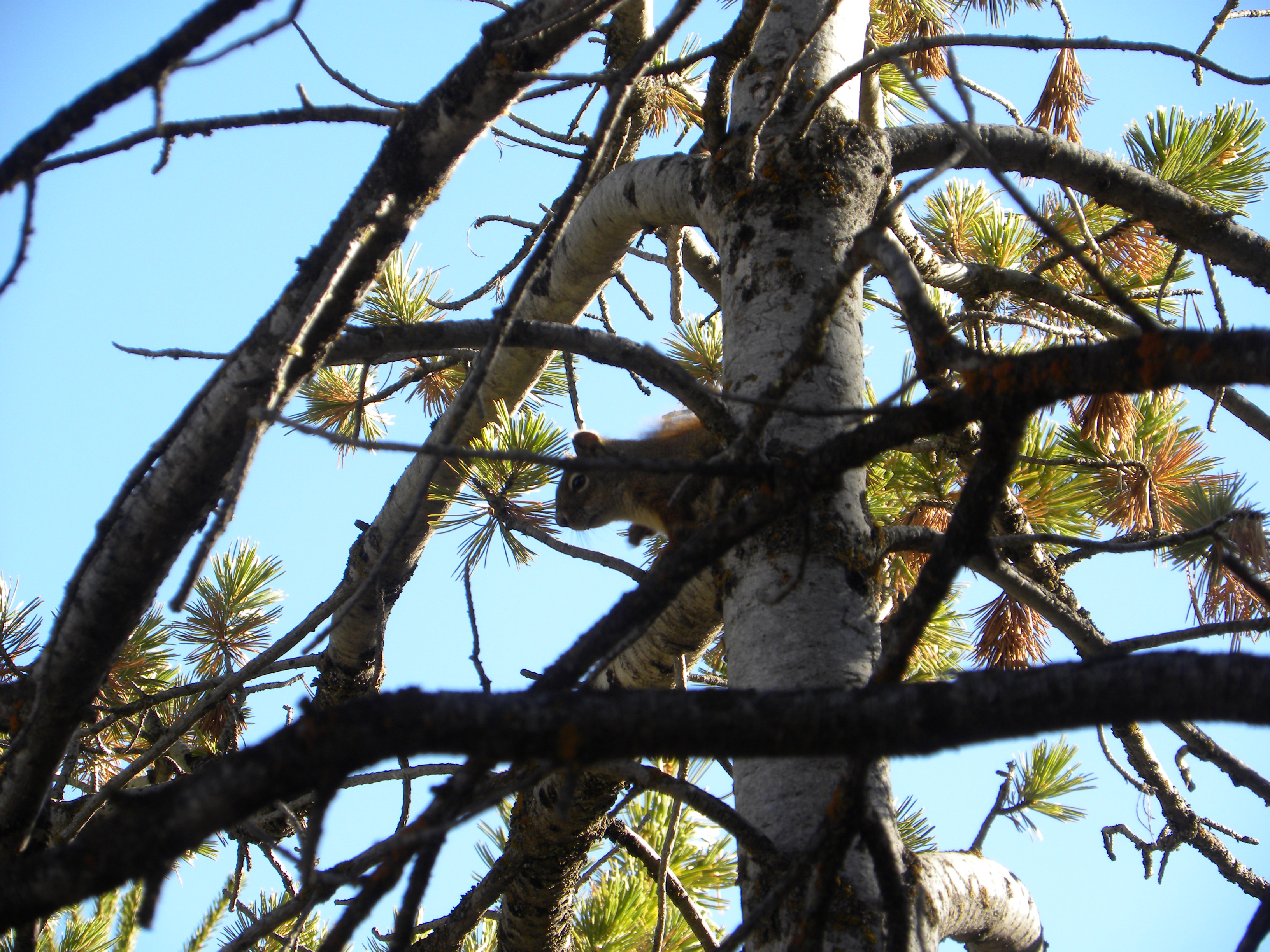
The Clark’s Nutcrackers have been very busy over the last month.  So have the squirrels.  They’re both competing for the Limber Pine seeds that grow around here.  The birds extract and stash seeds.  The squirrels create middens with stored seeds and cones.  The bears let these animals do their work, then rob the middens.

Clark's Nutcracker

It is really amazing to watch the Nutcrackers.  They are so adept at using their beak to extract the seed.  Limber pine cones are full of sap, really sticky.  I’ve watched a bird work a cone, sometimes to just get sap or a bad seed.  The bird cleans it’s beak quickly and works another seed hole.

Squirrels too can work a cone very quickly and efficiently.  Both squirrels and Nutcrackers seem to know exactly which seed is viable or not.  I’m sure it has something to do with its weight.  Sometimes I find a cone on the ground with a few seeds left in it.  Invariably those seeds are empty, either with worm holes or they just didn’t mature.

Meanwhile, after working hard on caching all these seeds, the bears are coming around robbing all the caches they can find.

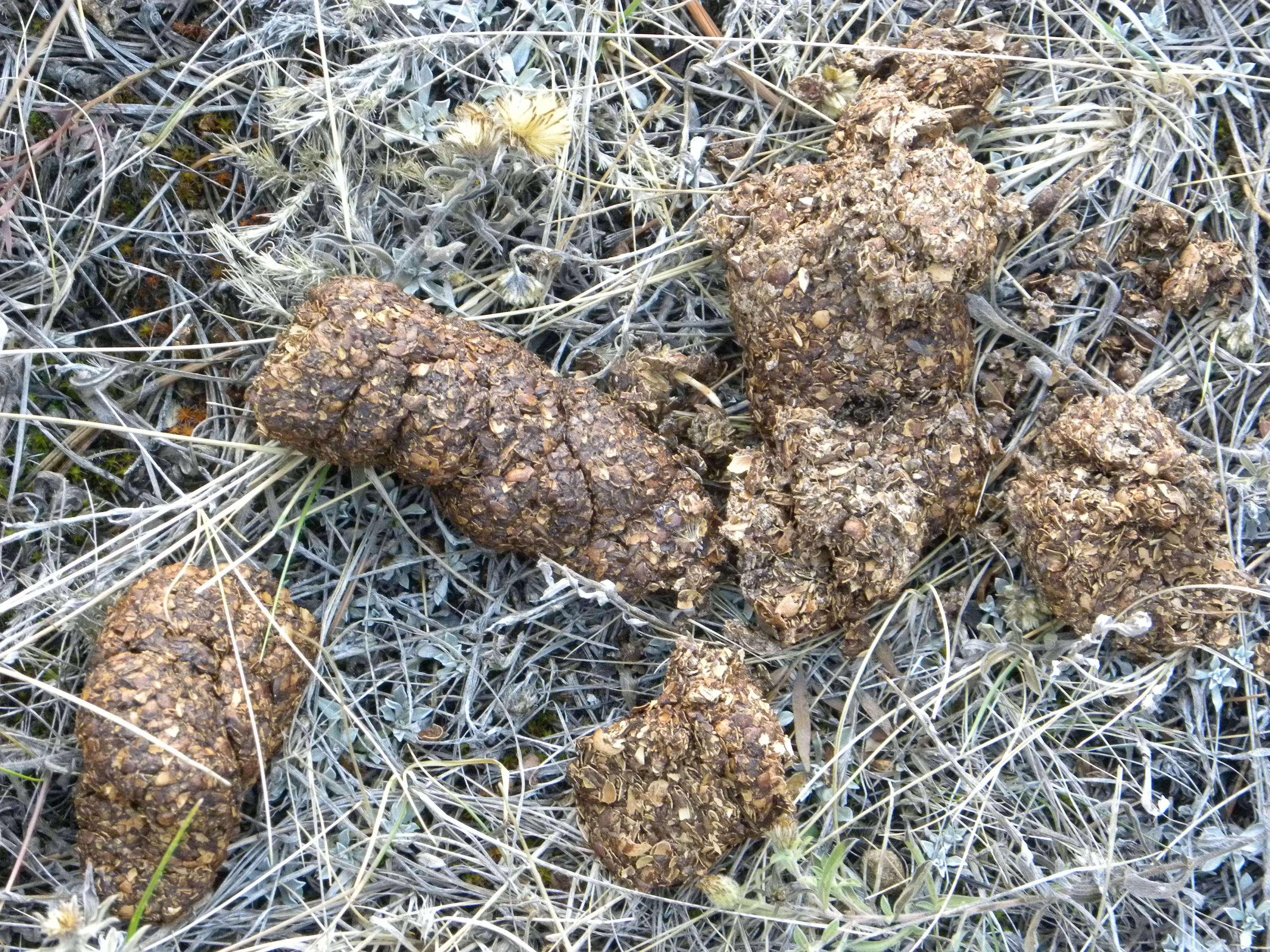
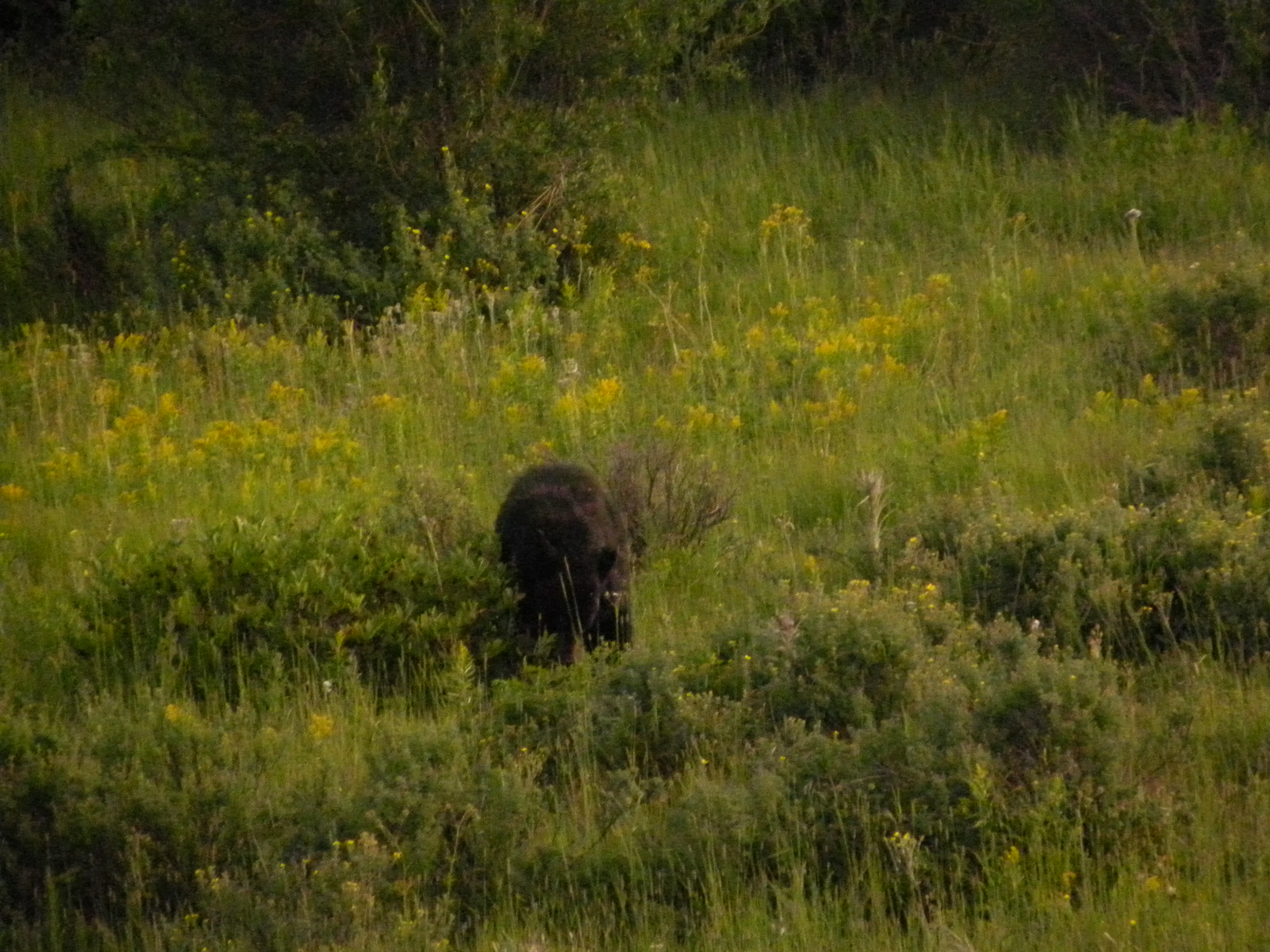
There’s a black bear working my neighborhood intensely, day after day.  His scat is everywhere,  mostly full of pine shells.  The scat even smells like pine nuts…you can smell the rich fatty odors.

Loaded with pine nut debris

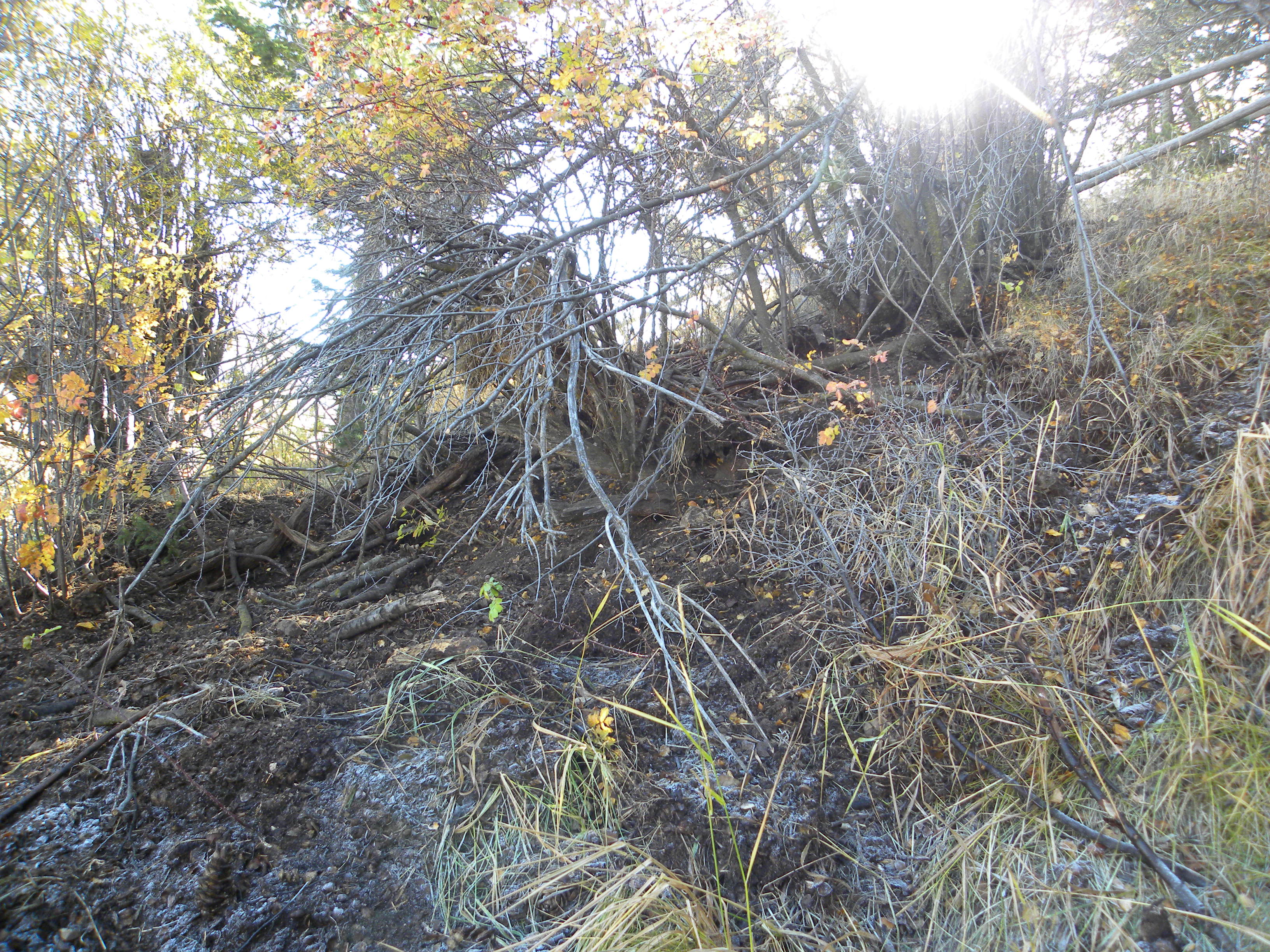
Yesterday I drove down my driveway only to find a huge stump in the middle of the road.  I got out to move it, I looked up the hillside where it had rolled down from, and saw that this bear had completely worked over an old middens.  He’d turned over the soil so much that the chickadees were having a field day.

Dug out middens on my hillside near the house

What a nice circle of feeding and robbing…birds and squirrels feed the bears who feed the birds.

Squirrel above robbed middens angry at me. "I didn't do it" I told him

The Bear Facts

When I took Jim Halfpenny’s tracking class last year, he gave me a small pamphlet entitled  Bear Ecology.  Yellowstone Ecosystem. The pamphlet consists of lots of charts, so I’ll try and digest a few for you, literally.

Since I’ve been watching bear evidence and their scats a lot lately, here are a few facts:  About 80% of the nutritive value of Grizzly bear food comes from herbs. From this they get mostly protein.  Less than 20& comes from animals, where they get fat and protein.  The rest comes from shrubs and pine nuts.

Of the plants that Grizzlies in Yellowstone National Park consume:  78% or more of their plant diet comes from Sedges and grasses.  A whopping 6% comes from Claytonia lanceolata or Spring Beauties.  Further down in value importance are Cirsium (thistle), Clovers, Yampa, Biscuit root, onion grass, horsetail, and whitebark pine.  But if you look at the nutritive values of food, the only two that provide fat as well as protein are animal and pine nuts.  Therefore, they need these to increase their brown fat for winter hibernation.

On this chart, as far as animal foods, cutthroat trout are at the top of importance.  After that comes gopher, voles and marmots, elk, deer, and bison.  Below that are ants.

Another interesting chart is about the differences between Black Bear and Grizzly Bear den types.

Black Bears evenly split their types of dens between boulders, crevices, and outcrops.  They only dig 13% of their dens.

black bear digging for ?

Grizzlies, on the other hand, dig 86% of their dens and rarely use caves.  Which might explain why in these charts, which are not that up to date, Black bears were denning almost a month earlier than Grizzlies.  Grizzlies need to wait for more snow cover.

I’ve been intrigued with bear diet this year especially since I know that the White Bark Pine Crop is poor.  I keep wondering how these bears, that are so huge and strong, survive on mostly vegetarian diets.  These breakdowns help explain some of how they are able to use plants and convert them into useable proteins.  

So far, living at 7000′, we’ve had no snow yet on the eastern side of the Absarokas.  Today it rained some, October 17th.  I wonder how global warming will affect the denning times of black and grizzlies.  I wonder what plants they will find when its not cold enough to den but not warm enough, nor the days long enough, for good plant growth.

Mark Bruscino was on Wyoming PBS friday night.  He said an interesting thing.  He said that Grizzly bears are as intelligent as the Great Apes, making them the most intelligent wild animal in North America.  Surely they are an animal worth protecting, and giving more room to move into habitat that supports their needs as we, and the bears, face new challenges ahead.

Pika news

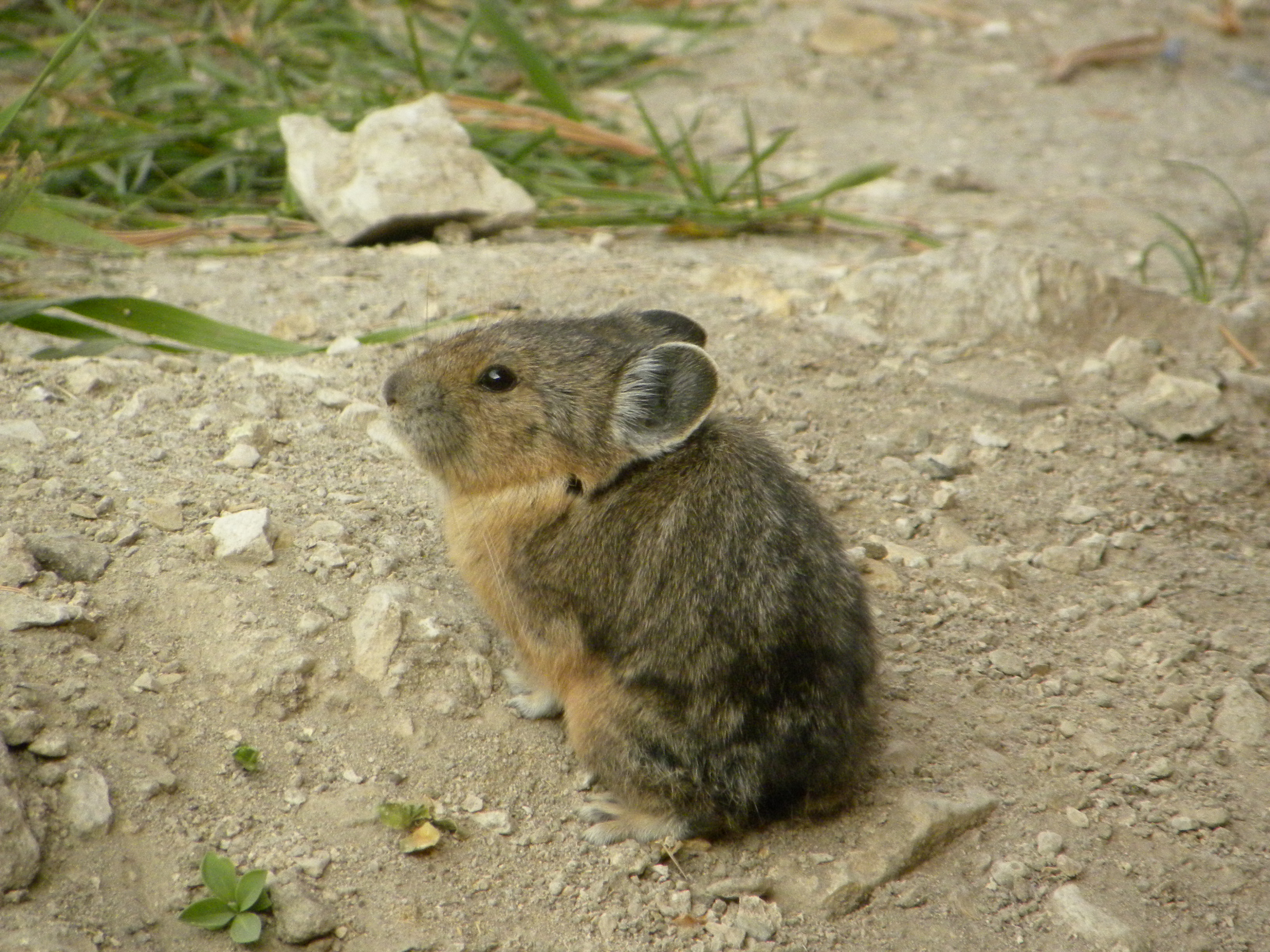
So my cute little friend has continued to hang around.  He/she has eaten most of the wild tomato plants around and seems to be gathering grass seed heads.  I’ve been testing him on a few foods.  So far he likes lettuce, a lot; carrot greens, why of course, he’s a lagomorph; and kale; but he doesn’t care for arugula!

Pika in my front yard at 6800'

I’m betting he’ll like sprouts, but not sure about bean sprouts or, considering he shunned my arugula, radish sprouts. He’s getting ready for winter.  Most mornings I see him meditating on a little rock by my back corner.  If he hears me snooping on him, he’s off.  But his evidence is everywhere and I have to wonder if he wonders where all this extra unharvested food is coming from.

Pikas are sooo cute


Pika at my door


Well folks, truthfully I’ve only seen Pikas in talus at about 10,000 feet, scampering about, making their characteristic whistle-calls.  So when I saw this little lagomorph at my new back door the other day, I was confused and thought it was some tiny bunny or something.  Some bunny species I wasn’t familiar with.  I ran and got my camera.


So incredibly cute!!!


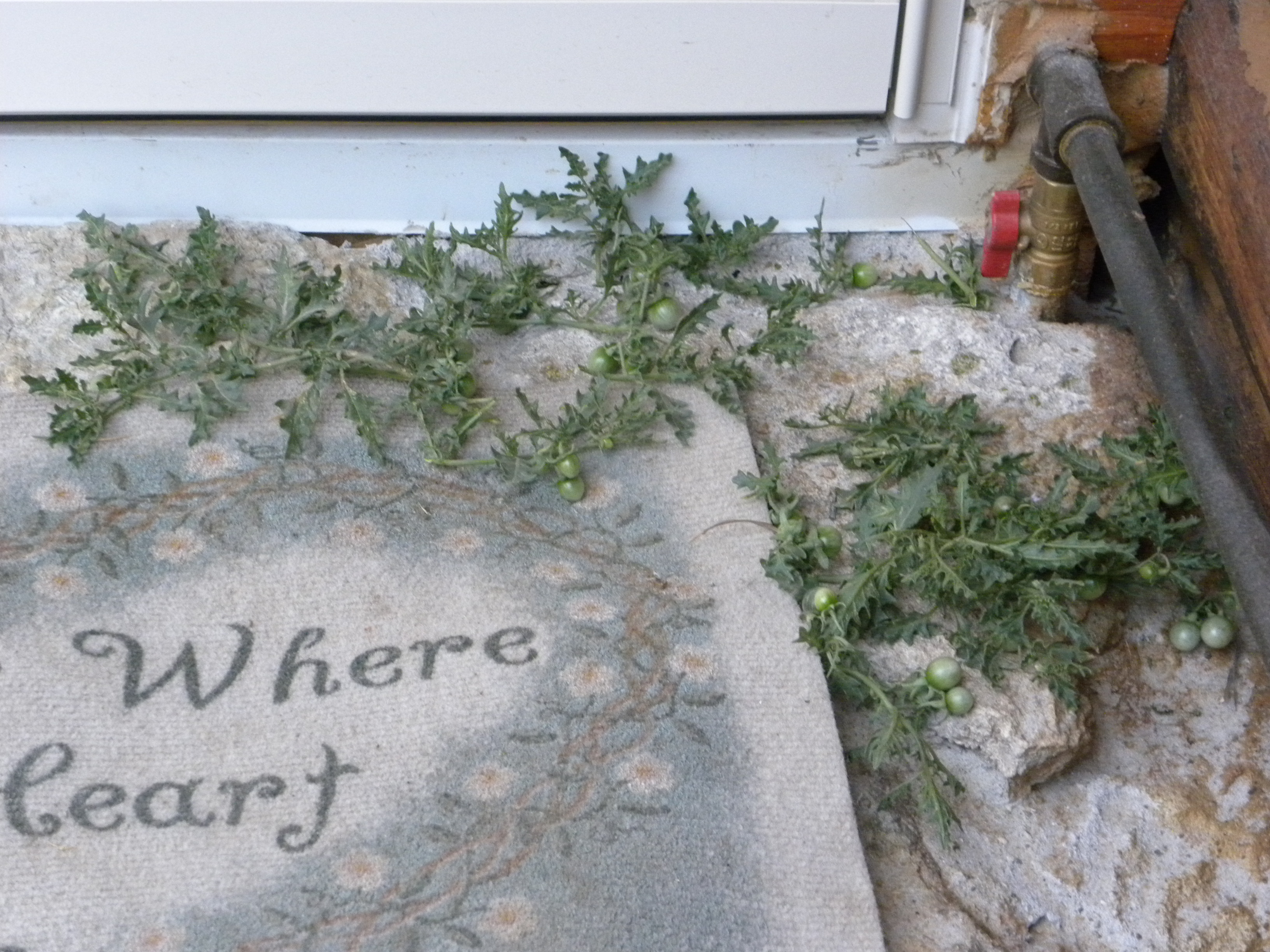
The first mystery came when I found loads of wild tomato cuttings at my new back door step.  I didn’t know what this plant was at first.  It looked like a green cherry tomato and the leaves had that typical Solanum family look.  But I don’t grow tomatoes up here, nor had I eaten any.  Besides, I don’t compost (because of bears) and all my trash is in bear-proof bins.  Where had these plants come from.  I hunted around and sure enough, in the disturbed area behind my new addition was a weedy plant with these little ‘tomatoes’ on it. (a little research and found they are Solanum triflorum. Wild Tomato).  The Pika is cutting them up and leaving them on my rock doorstep to dry for the winter.


Dehydrating food for winter

This little guy is just the cutest.  I check sometimes several times a day what’s happening with the dehydrating area–my back step!  Lots of days I’ll put out lettuce.  He’ll move things around, or take some of them to his cavern below in the rock.  Other times new pieces of vegetation will appear–sometimes grass seed heads.  But mostly he’s working on the tomato.

Pikas are not yet on the endangered species list, but they are certainly endangered.  Climate change is going to wreck havoc with their niches.  I hope this little guy sticks around all winter and makes it through the winter.  Maybe even finds another pika in the spring and have lots of pikas around.  I’m happy to have a chance to share my home with a species that might not be around that much longer.


The Year of the Poor Pine Harvest

Well, what a drag.  After a week of frustration with my Bushnell Trophy Cam, I finally diagnosed that the camera is broken.  And the reason it’s a drag is because yesterday someone left a gut pile at the bottom of my driveway.  Here’s the story:

Early yesterday morning some deer came out to graze in the private pasture across the road.  It’s deer hunting season and I noticed a nice 3 point buck hanging with the does.   Around 1 pm I heard 2 shots coming from behind my property.  At sunset, Koda and I took a walk beyond my back acreage and returned via the main dirt road.  It was almost dark when we crossed over the cattle guard marking the forest service boundary line.  I petted the horses on one side of the road while Koda was busy in the ditch on the other side.  I went to investigate and in the dark I could see the gut pile left from the buck, lying by the roadside.  With my camera not working, all I could do was check the area in the morning, knowing that probably a grizzly would be bye during the night.  With the pile so close to the house, I made sure Koda and I stayed inside that night.

In the morning, after walking around the area, from the blood evidence, this hunter illegally shot from the road.  He waited till the deer wasn’t on private property, then shot him.  But the easy access was through private property, so he dragged the deer under the boundary fence and through my neighbors’ property to the nearby road just about 25 feet away.  I can’t say I hate hunters because I know quite a few.  Many are ethical and kill for the meat.  I myself like elk and deer meat.  But I do despise the ones that break the law, or are too lazy to walk or ride in, or hunt just for trophy, or complain incessantly about wolves making it harder for them to find elk.

What giveth, taketh away, and then giveth again.  My little buck friend saw its last day and had its last meal this morning.  But grizzlies are hungry this year.  It is the Year of the Poor Pine Nut Crop, and that is what fattens grizzlies up for their long winter sleep.  This grizzly gorged himself on the gut pile, then left a scat of his last meal or meals, which clearly consisted of rose hips.  His scat was full of rose leaves and fruit, and although rose hips don’t taste too bad, especially after a frost or two, they’re not gonna put much weight on the bear.


Bear scat consisting of lots of wild rose and hips


I felt sad for the buck, but it was a nice stroke of luck for this grizzly and I was glad for him.

After checking the area, I went for a hike down a spectacular secret slot canyon.  Its secret because most of the year there’s a stream running through it.  In summer the brush is so thick you can’t paw your way through.  But in the late fall, the leaves of the Cornus (Dogwood) shrubs are gone and the stream has dried up.  Its only about 50 yards through the 5′ wide canyon to the main creek.  The creek, surrounded by high canyon walls, is inaccessible except for this narrow slot canyon.  But the game know the way and there were grizzly tracks down through the muddy canyon floor.  I crossed the creek and came into a wide wooded valley surrounded by high granite walls.  Large Junipers, Douglas Firs and a few Pines populated the area.  Exploring the canyon, it was obvious a grizzly had been hanging around here for quite some time.  He too was eating rose hips, but he had been spending a lot of time invading middens for pine nuts.  These aren’t from Pinus albicaulis, the White Bark Pine, but Pinus flexilis which is also in the white bark family.  The grizzlies seem to have been eating quite a lot of these this year.  Even the grizzly who ate the gut pile had old scat nearby with Limber Pine shells in it.   Although Limber Pine has been hit heavily by blister rust and beetles, we still have large stands around here and apparently the grizzlies are taking advantage of them in a bad White Bark year.  They certainly are not as big and fat as White Bark, but they’ll do in a bad year.

I’ve been thinking a lot about the bears, how resourceful they must be, how they’re mostly herbivores, how they have to spend so much of their energy foraging for food with so little calories.  I’ve been thinking about those reports I’ve read this summer about undernourished bears.  I am amazed how they are able to make a living out there.  What a wondrous animal.

The magnificent and endangered grizzly

There’s been plenty of hubbub regarding bears this summer in the Greater Yellowstone Ecosystem, mainly grizzlies.  If you haven’t followed it, we had two deaths just on the eastern side of the Absarokas from grizzlies this summer, one of them occurred just up the road from where I live.  In addition, there’s been 38 grizzly deaths just this year, 31 on those caused by humans.  And many of the bears causing trouble have been found to be underweight, or their cubs were malnourished.  Grizzlies were put back on the Endangered Species list just this summer because one of their main food sources, White Bark pine nuts, is also in trouble and in major decline.

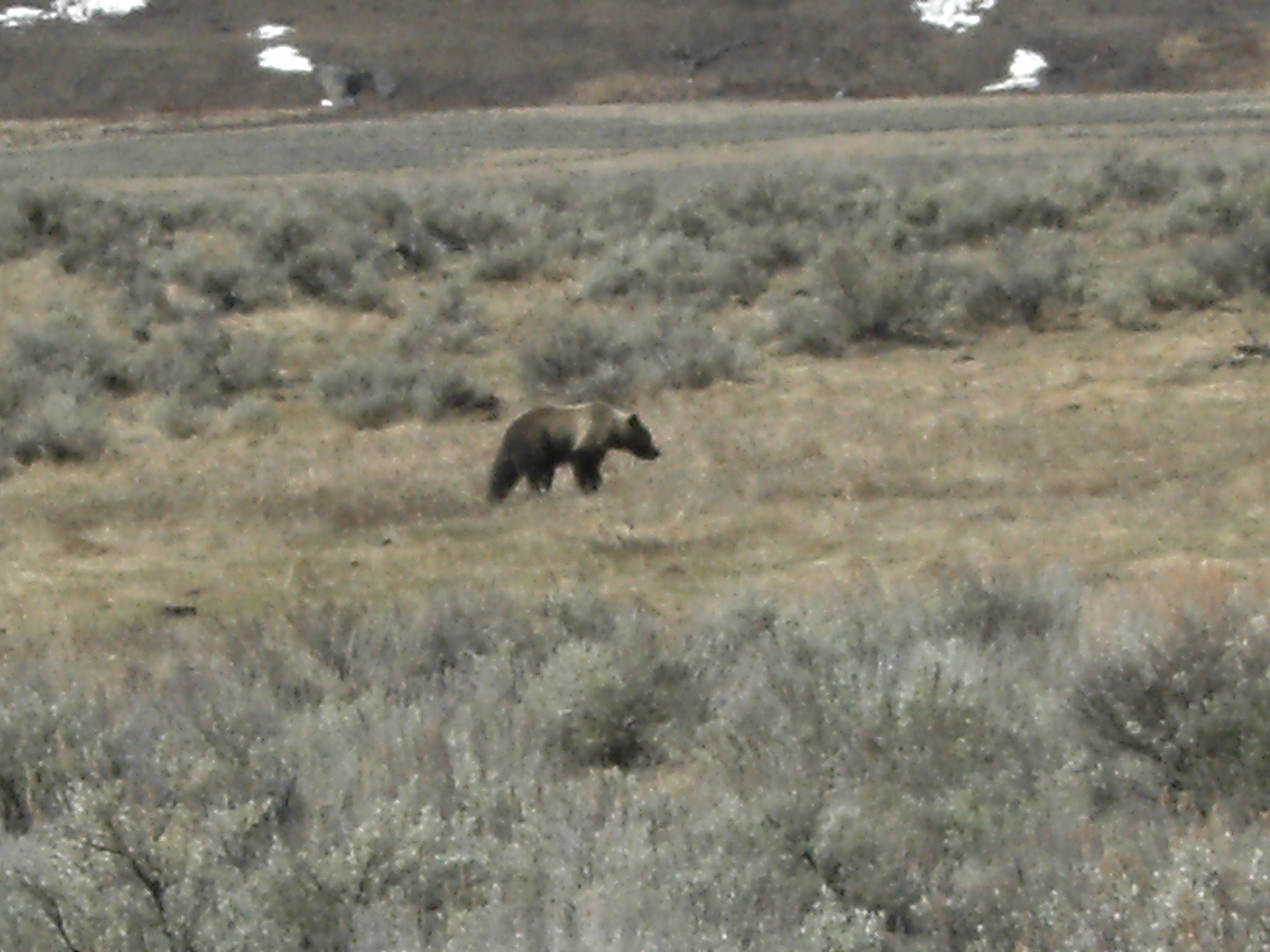
Grizzlies have been coming down into hay fields, down into the flats where there are towns and farms.  Why? Because they need more habitat, they need food.  Let’s not forget that grizzlies were actually plains animals, following the Bison and ‘Buffalo Wolves’ on the prairie.  Grizzlies can’t climb trees and their enormous claws are adapted for digging.


Grizzly rooting around


On the other hand, the smaller Black Bear is a forest bear.  It can climb trees.

It’s not just that ‘we have too many bears’.  Its that we’ve decided Grizzlies can only be in places where people don’t want to live year round–the high mountains–or where we’ve protected the land, such as Yellowstone Park.  And even in those places we barely tolerant them, calling on the feds to move or kill a bear (Grizzlies get three strikes before they’re out, dead out that is) that interferes with our ‘rights’.  In an area north of Gardiner, a sow with her two underweight cubs were moved for raiding a chicken coup.  Chickens are bear bait, and having one just north of the north entrance to the Park makes your chickens a restaurant for a bear.  I don’t understand why we have to waste good tax dollars and federal employees’ time on moving bears for stupid people.

My valley happens to be one of the places the U.S. Fish and Wildlife Service moves bad bears, with the hopes they’ll go into Yellowstone.  My valley has good access into the Park, but most of these bears just quickly ‘home’ or return to their territory.  This I’ve been told by one of the bear coordinators. (“You don’t have to worry about the relocated bears.  They leave fairly quickly.”)

So why relocate?  These dedicated federal employees seem to spend a lot of their summer moving ‘bad’ bears here and there–from Jackson to the East Entrance, from Dubois to Cooke City, from Cody area back to Jackson–or they have the dirty and terrible job of euthanizing ‘problem’ bears.  Problem hardly ever means human/bear conflicts, but mostly cattle/sheep/horse/chicken conflicts or just too-darn-close-for-comfort conflicts.

We just have to begin to make a concerted effort to live with bears and give them more habitat.  A few things I can suggest (and there are many more that could be added to the list by people ‘in the know’):

1.  Use bear-proof garbage cans and food containers.  Several bears were euthanized in 2010 because of ‘food rewards’.  The article above said that after euthanizing a bear roaming around West Yellowstone, the feds discovered lots of unsecured food containers.  That’s just a crime!  West Yellowstone is exactly adjacent to the Park.  If you want to live there, secure your food or pay the consequences.  Should the bears pay the consequences for stupid people?

2.  We need contiguous wildlife corridors from here to the Canadian Border, with planned wildlife crossings over highways.  This is very important.  These bears and other wildlife need to be able to migrate out into other food sources when their own territories get too cramped.  And for God’s sake, at least slow down in Yellowstone.  This summer alone there were several bears killed by cars in the Park.

California is now putting the grizzly bear on all CDL.  If you hold your license up to the light, there’s a bear there; the same bear that’s on their flag and the exact same one that was shot to extinction in the early 1900’s.  If you’re going to tout it, then bring it back.  California has good habitat for grizzlies.  Let’s move some there.

3.  We need prairie where Grizzlies and Bison and wolves can roam again.  Grizzlies are already moving into eastern Montana.  Support the American Prairie Foundation and tell them to not just bring Bison back (already beginning to happen there) but wolves and grizzlies as well.  With the extinction of the White Bark Pine by the end of this next decade, bears will need a different food source.  We need to be thinking about recreating some of the kinds of habitat they lived in when Lewis & Clark were here.  L&C didn’t find game in the mountains; the game was abundant in the prairies.  Restoring bison to the prairies along with wolves makes for more game for grizzlies, along with all the small mammals and roots they like to dig for.

This summer I was fortunate enough to see three grizzlies–2 in the Park and the other one we slowed down while the bear crossed the road near here.  What a beautiful magnificent animal.  There is nothing like hiking in grizzly county, knowing that you are not at the top of the food chain.  It makes you alert, alive and aware.  Let’s preserve that.  It keeps our human ‘hubris’ in check.


Grizzly track with penny for sizing


Recycling in Cody, WY

It took me a while to figure out where I could recycle in Cody.  First I was told “go to Wal-Mart, they have a drop off in the parking lot.”  But when I went I saw they only recycle plastic bags.  Finally I found the actual recycling center, a steel warehouse structure in back of the Senior Center near the main drag.

I suppose I was spoiled coming from California where I had curbside pick-up.  In Marin, we recycled plastics #1 & #2, plus all paper, cardboard, aluminum and glass.  If we got it wrong, it was sorted by people at the recycling center.  The local garbage company did the pick-up every week and they were making good money at it.  So good, that after a while, instead of the public putting out 5 gallon buckets every week with the recyclables, they gave us a nice special garbage can, one side for glass and the other side for everything else.

But I was grateful to at least find a recycling center in Cody.  I began taking my recyclables there weekly and sorting them myself, like you’re supposed to.  The first week the man who worked there came up and told me “We don’t take that kind of plastic.”

“But it’s number 1”  I insisted.

“Doesn’t matter.”

The next week he caught me again, this time with cereal boxes I’d crushed and put in the paper area.

“We don’t take that kind of paper.  That’s pressboard, not cardboard.”  He was training me.

The following week I threw some bean cans in the metal bin.  “No, no.”  he ran over.  “That’s tin, we don’t take that.”

This went on, every week, for months.  I just couldn’t figure out what they recycled and what they didn’t.  A few months later I read in the local paper that the recycling center would now be taking all plastics–1 through 7.  Even though that made no sense to me as far as what’s recyclable and what’s not, I secretly relished it.  Now, finally, I wouldn’t get into trouble, at least over the plastics.  I took my load, mostly #1’s, and started pumping them into the large bins.

“Wait, wait wait.  Not so fast.”  Here came my nemesis. Uh oh, I’m about to be reprimanded again, I thought.  “No plastic bags.”

“But Walmart takes plastic bags,” I protested.

“We don’t.”

One day I brought in batteries that I’d been saving up for a year.  Of course, batteries have lots of toxins in them, lead being one of them.  I was told no one takes those in Cody and I should just throw them in the trash.

Truthfully, this was getting pretty humorous.  The capstone of all scoldings came this summer.  I finally cleaned out my California storage unit and shipped the rest of my belongings here.  The packing company had used those awful plastic peanuts to protect many of my valuables.  I carefully put them all into garbage bags, about 10 bags worth, and took them optimistically down to the recycling center.

“Do you take these?” The familiar ‘lion at the gate’ was busy, so I asked a nice woman who works there.

“Yes, just put them in the back.  There is a man who comes and picks them up and sells them.  You too can sell them at UPS.”

Well I didn’t want to bother, and didn’t need the change, so I began unloading them and putting them in a corner of the warehouse, when along came the Bearer of Bad Recycling News.

“We don’t take that.”  he told me.  I told him the lady said he did.

“Well, we don’t, but a man does come weekly who takes them.  But he’s retiring soon.”

I asked when he was going to retire, hoping it wasn’t this week.

“He’ll probably retire when I do.”  I couldn’t resist so I asked “When’s that?”

“I don’t know.  Maybe in a few years.”

This summer a friend from California came and accompanied me to town.  “Have to stop at the recycling center.” I told her.

“I’ll help you sort” she said.  I felt amused.  So she started with the plastics.  “uh oh, no lids and no plastic bags.”  She moved on to the cans.  “Nope, those are tin, not aluminum.  Can’t recycle.”

“What!” My friend was confused.  Finally she was unloading the paper.  “Hold on, that’s pressboard.  They don’t take those.”

“But that’s paper.  They’re boxes. You’re just wrong there.”

“Let’s ask the lady and I’ll show you I’m right.”  Was I gloating?

A few months ago, the Cody Enterprise carried an editorial by a local woman encouraging Cody residents to recycle more, do their part.  Well, those people better be dedicated and persistent, I thought.  I’m pretty dogged about recycling, but most people aren’t.  If it ain’t easy, they’ll be quitting after one or two times.  The land fill, on the other hand, is easy and usually free.


The Totem

I know or have heard of many people declaring that their totem animal is one of the strong, impressive mammals–the wolf, the bear, the cougar, the lynx.  Why are so many of the small animals ignored as a totem?  For instance, Plenty Coups, the last chief of the Crow Indians, had a vision in which his totem animal was revealed to him.  This small little bird was his guiding inspiration, the totem whose wisdom saved his people and won them a reservation on their native lands.

The Lynx

“Listen, Plenty-Coups” said a voice.  “in that tree is the lodge of the Chickadee.  He is the least in strength but strongest of mind among his kind.  He is willing to work for wisdom.  The Chickadee-person is a good listener.  Nothing escapes his ears, which he has sharpened by constant use.  Whenever others are talking together of their successes or failures, there you will find the Chickadee-person listening to their words.  But in all his listening he tends to his own business.  He never intrudes, never speaks in strange company, and yet never misses a chance to learn from others.  He gains success and avoids failure by learning how others succeeded or failed, and without great trouble to himself.  There is scarely a lodge he does not visit, hardly a Person he does not know, and yet everybody likes him, because he minds his own business, or pretends to.

“The lodges of countless Bird-people were in that forest when the Four Winds charged it.  Only one is left unharmed, the lodge of the Chickadee-person.  Develop your body, but do not neglect your mind, Plenty-Coups.  It is the mind that leads a man to power, not strength of body.”

chickadee

We think only of these large mammals as totems because, I propose, we no longer fully ‘know’ animals anymore.  Who amongst us could understand the ‘Chickadee-person’ like Indians that lived with all the animals, large and small, observing them in detail day in and day out?  Each animal has a special quality, a unique force that can connect a person to that higher need in themselves.

I also wonder if there are dual totems; totems in tandem that make up the whole, rather than just a partial piece.  For instance, when I was told that Soona had bone cancer, I knew her slow death would be excruciating, as well as debilitating.  Not a life for a dog.  I got some good advice: take off work for a week and do all the things with her that she loves, then put her down.

I took off work, but was agonizing over the decision, even though I knew it was best for her.  During that week that stretched into two, I was given a series of dreams.   All my dreams had wolves in them–courage, strength, canine. Yes.  But they also contained an important critical ‘other’ totem–elk.  In each dream, over and over, I watched wolves take down and kill elk.  It was the full circle of life.   In every dream, my focus wasn’t on the wolves, but on the dying elk.  I would look deeply into the eyes of the elk as she lay dying and saw there was only a quality of complete surrender.   She knew this was her ‘dharma’ or lot in life.  No remorse, no fear.   I realized it was Soona’s time to go, like these elk, and she was surrendered to it.  It was only me that wasn’t.

So the totem wasn’t just the wolf, but the wolf and the elk.  They are one and there can’t be one without the other.  Their lives and deaths are intertwined.  They are one totem, coins representing both sides. The Yin and the Yang.

Does that mean my friend who changed his name to Wolf, should be Wolf-Elk?  Or the one now known as Bear be Bear-roots?  Lynx-Hare?  Cougar-Deer?


I came to do a thing for a dog

Walking the Winds.  It’s what I dream of constantly.  It’s what brought me to Wyoming in the first place.

I’ve walked the Winds over 8 times and never can get enough.  In the last five years I haven’t been able to get there for one reason or another–health, foot problems, moving, work.  Last time I was there it poured every day for a week.

When my old dog died, I swore I’d take her ashes up to the Wind Rivers. She’d been my constant hiking companion there.  I’ve held onto them for the last two years, lamenting that I might not be able to fulfill that promise to her, dreaming of the day I’d go back.

This year I tested myself first in the Beartooths on a four day backpack.  The old injury in my foot seemed to have healed enough to brave the trek to the Winds.

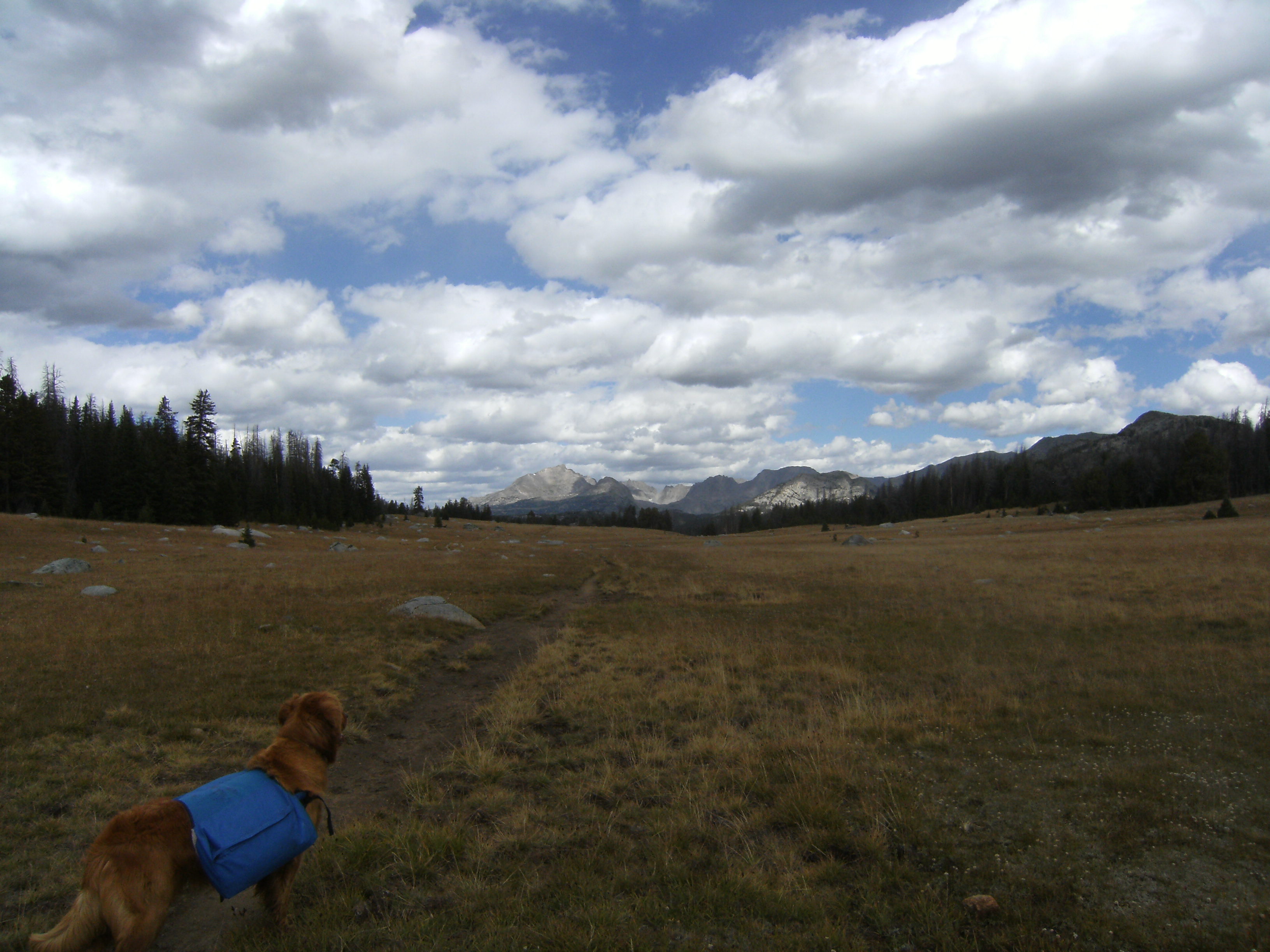
So last week I packed up and chose a route I’d done partway before, up the Fremont trail from the Big Sandy entrance.  I’d planned to do a 7 day over to Dream Lake with Koda.  The weather looked incremental and unstable on Monday, but after that the report said ‘Sunny’.  I hiked to Dad’s lake, five miles in, on Sunday and made camp.


The hike into Dad's from the Fremont trail


The first mishap occurred that night.  My newest Thermarest, the latest greatest lightest model, had a pin hole in it.  The mattress was dead the next morning, essentially laying me bare on the cold ground.  The temperatures were hovering around freezing or less at night so this wasn’t good.  Since I’d only used the mattress 2 times before, I hadn’t brought a proper patch kit.  I tried duct tape, lots of other tapes, to no avail.  OK, I can live with sleeping direct on the ground.  I’d done it before.

By Monday the weather was certainly very unsettled, so I decided to stay at Dad’s Lake and day hike to Shadow Lake with Soona’s ashes.  The 10 mile round trip into a glacial valley was phenomenal.  Shadow Lake sits on the back side of the Cirque of the Towers, the primo climbing grounds for world class climbers.  The front side is crowded with hikers and climbers, but the back side is not.  I had the whole valley to myself.

The trail winds up to the Continental Divide, a cluster of above timber line granite peaks, then cuts off into a wide sub-alpine valley for 2 miles that dead ends below the Cirque.  Three lakes sit at its base.  As I walked up the valley, it became only more and more stunning.  A wide river flows easily through its floor.  Glacial carved towering mountains surround you on both sides.  The view from Shadow lake of the Cirque is phenomenal.

As I turned up the side trail to the valley, the threatening weather turned intense.  It started to snow, hard.  But the valley kept egging me on and I knew this was the perfect place for Soona.  Finally, the lake appeared through the trees.  The cloud cover was heavy but the snow had stopped for now.  I had a quick lunch, knowing that I better return to camp soon; scattered the dog’s ashes, and sat down for some prayers and chants.  Suddenly the sun appeared through a small parting of the clouds.  The entire sky was black except for right above me where the heat of the sun changed the mood.  It was a brief 10 minutes of sun, as if the heavens had opened to receive my prayers and Soona had acknowledged her final resting place as ‘Good’.  When I started back to camp, the clouds covered the sky again and snow came down.  It snowed the whole 5 miles back to camp.

At Dad’s lake, the weather seemed to turn, the sun came out, broken clouds scattered the sky, a beautiful sunset was beginning.  Koda jumped in the lake and then it began snowing again.  Despite toweling him off (with my backpacking towel!) and a good fire, he went to bed shivering.  That night was the first time I ever opened up an emergency blanket and used it–on a dog!


Dad's Lake. The Continental Divide looms in the background


That evening was going to be very cold.  I knew it.  It’d been snowing all day and clearing some in the evening.  Surely it would be around 20 degrees tonight.  I wanted a good fire.  The only dry wood was what I could find still hanging on the trees.  I picked around for dead branches and carried a load back to my camp.  As I sorted through the dry branches I found a giant, and I mean giant, dragonfly, the biggest I’d ever seen, clinging to one.  He had gotten cold and was still.  I moved the dragonfly to a nearby tree, pondering it for a time.  The mystery of his’ life strategy stuck me…how he survived by becoming still and asleep.   When it was cold, boom, he was in another state, helpless, at the mercy of his unique physiology.

By the next day, when the weather was supposed to clear, a cold north wind had come blazing in.  I hiked up to Washakie creek, but was loathe to do the 3 miles of a 10,500 foot pass to Dream Lake in the threatening weather and strong winds.  Washakie creek combines side by side with East Fork River in a wide and beautiful sub-alpine valley, a place where most of August would be uncampable due to mosquitos.  But the cold had killed off all the bugs and it was an incredible camping spot.  Tons of wood and good fishing.  Although my fishing pole had broken in half the day before, it still worked just fine.  I caught 3 fish in the span of 15 minutes, nice big brookies.

By the next morning, instead of the weather improving as predicted (I swear that being a weatherman is the only job where you can be wrong half the time and STILL keep your job), it was overcast and threatening to snow, with daytime temperatures hovering in the high 30’s.  Besides the bad weather, my Steripen water purifier (also fairly new) broke.  No clean water (except if I boiled it) was a real set-back.  So along with my sleeping pad, broken fishing pole, and bad weather, I decided this trip was just for Soona.  I made the hike out that day, getting nice and dehydrated without any water to drink.

The good news is that the foot I’d been nursing for a year survived nicely, and I met some incredible, inspirational people.  A couple who was celebrating the woman’s 60th birthday by doing the entire Highline trail (over 100 miles) in 14 days.  Another couple in their early seventies who’d been backpacking in the Winds for over 25 years.  And I camped next to a 60 year old man who, because his doctor had told him not to backpack alone any more, was making a last memorable trip to the Winds by staying there for a month.  He was taking pictures and keeping a good journal, “for my grandchildren”.   He had dehydrated his own food, would come in from one trailhead for a 10 day stretch, then hike out to replenish and come in from another trailhead.

“I’ve watched the mountains all August, go from wildflowers to fall snows.”  I bow down to all these inspirational souls who keep backpacking way into their later years.  Next year I’m going for 3 weeks, and do it like the Texan rancher.  But this year I’d come to do a thing for a dog.

last backpack in the Beartooths at 10

Heaven in Canada

Happy even in old age

The babies and Medicine Lodge Park

Birds several days ago

Here are the baby bluebirds several days ago.  Now here they are today.  Boy do they grow fast.

Bluebirds today

Last week I took a trip to Medicine Lodge State park near Hyattville.  A well-tended State Park, the spot is an oasis in the Big Horn Basin.  This site was excavated in the 70’s by George Frison.  Its a continuous occupation site of over 11,000 years!  Here are a few photos.

The stone wall palette

Fat marmot