• MY BOOKS ON WILDLIFE, GARDENING AND MORE

  • The Wild Excellence

  • True stories of wildlife encounters around the Greater Yellowstone
  • Award winning eBook on Decomposed Granite, tips, how to's, what to watch for
  • Children's book. True stories of a dog and wolves. In a dog's voice
  • Written for dry Mediterranean climates in California, north and south

Cat Tracking and a wildlife bonanza

The Plateau

I’ve been hiking the plateau for several days now and, wow, what a lot of wildlife activity is going on there.  A few days ago on my first jaunt I ran into a fairly fresh elk carcass.  She was a very large and old elk.  I’d been seeing lots of wolf tracks on the plateau and of course there were fresh tracks leading to the carcass

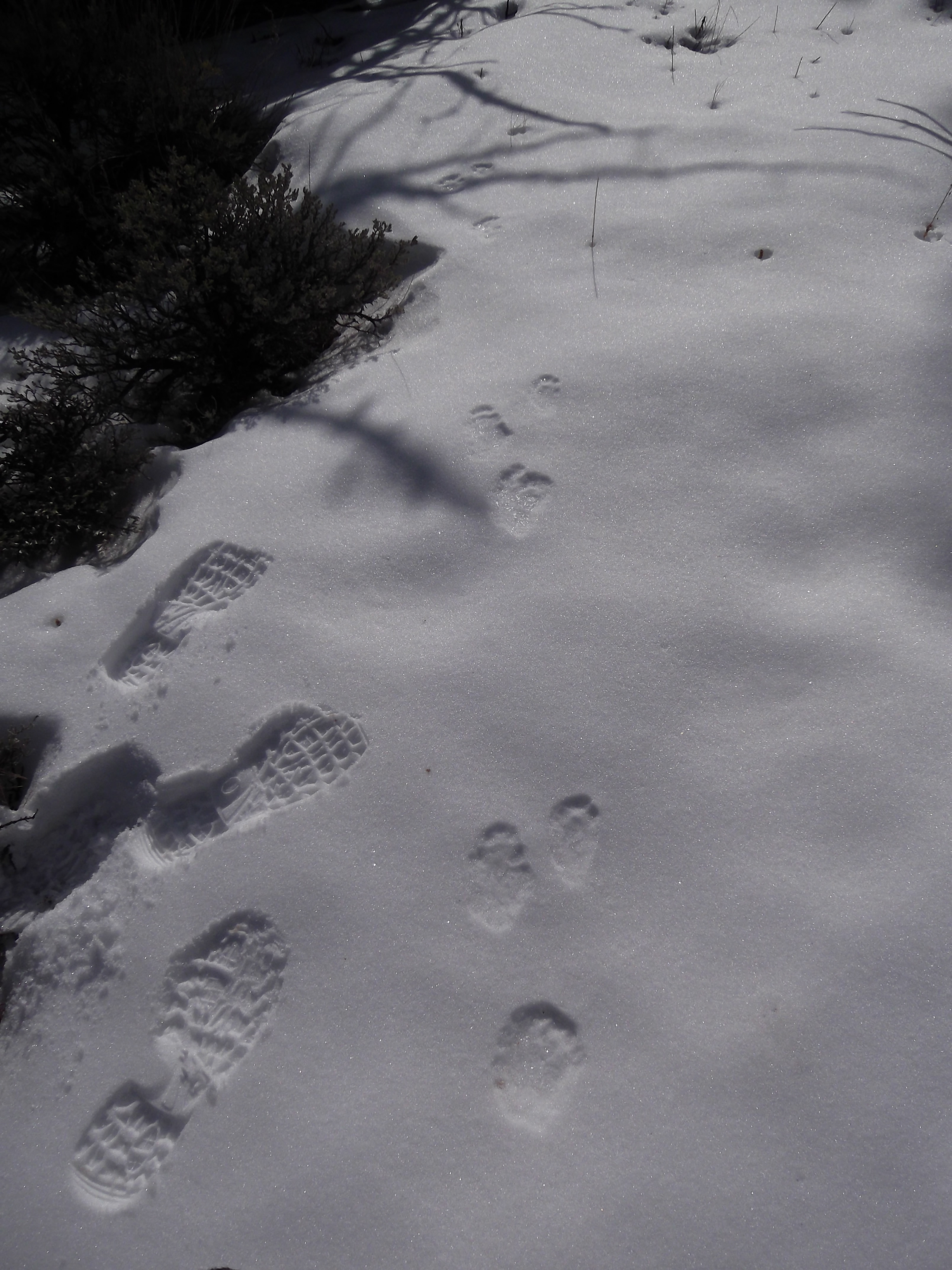
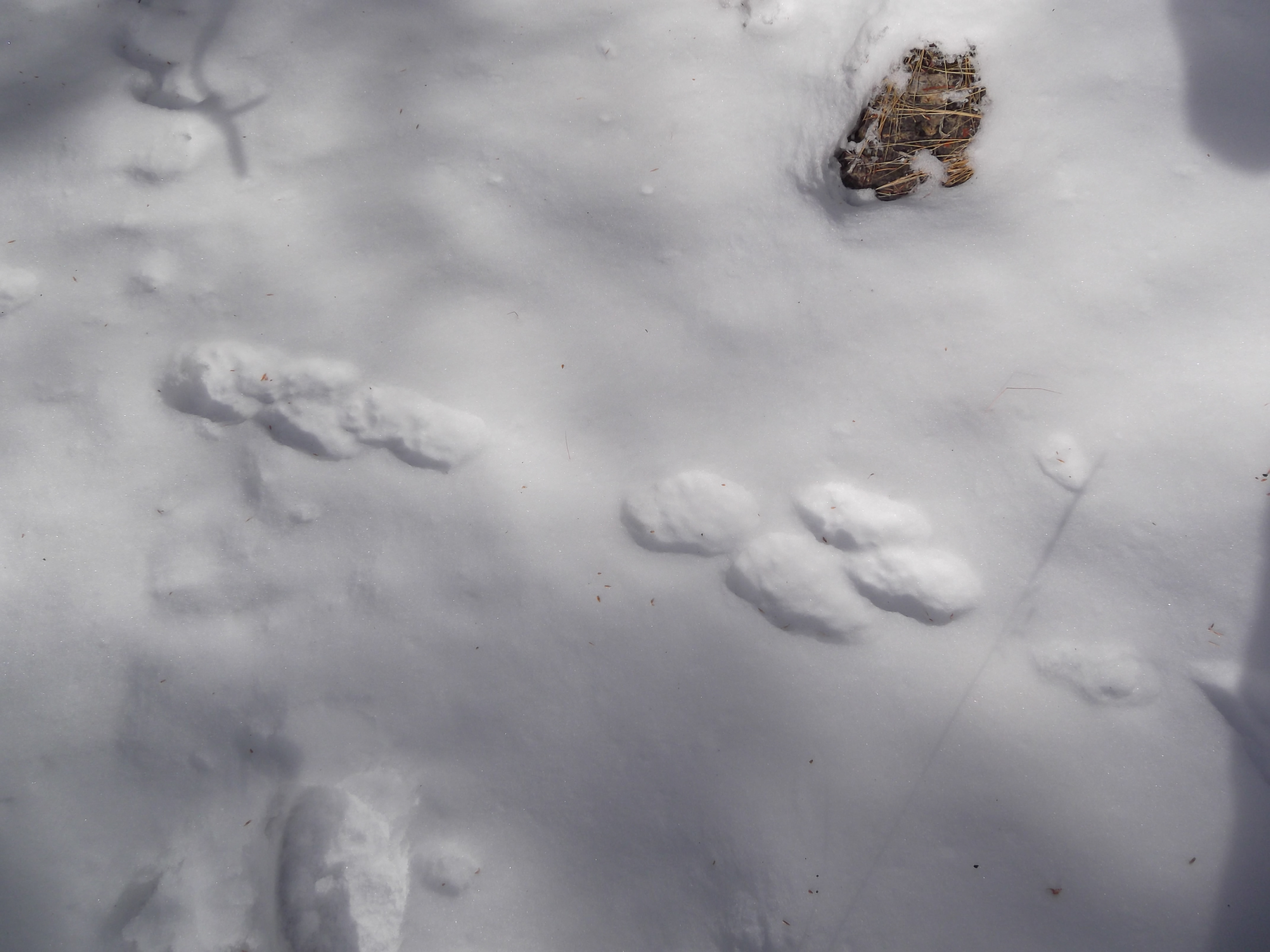
Rabbit prints with my own footprints too

That same day I realized where all the cottontails are–on Dead Indian plateau!  The cottontails here seemed active and numerous and here I found and tracked a bobcat hunting them.

Several days later I explored a cliff edge on the plateau that looks out over Sunlight creek gorge.  There, on a prominence, were over a dozen Mountain Goats, safely grazing on the edges where no sane predator including humans would go.

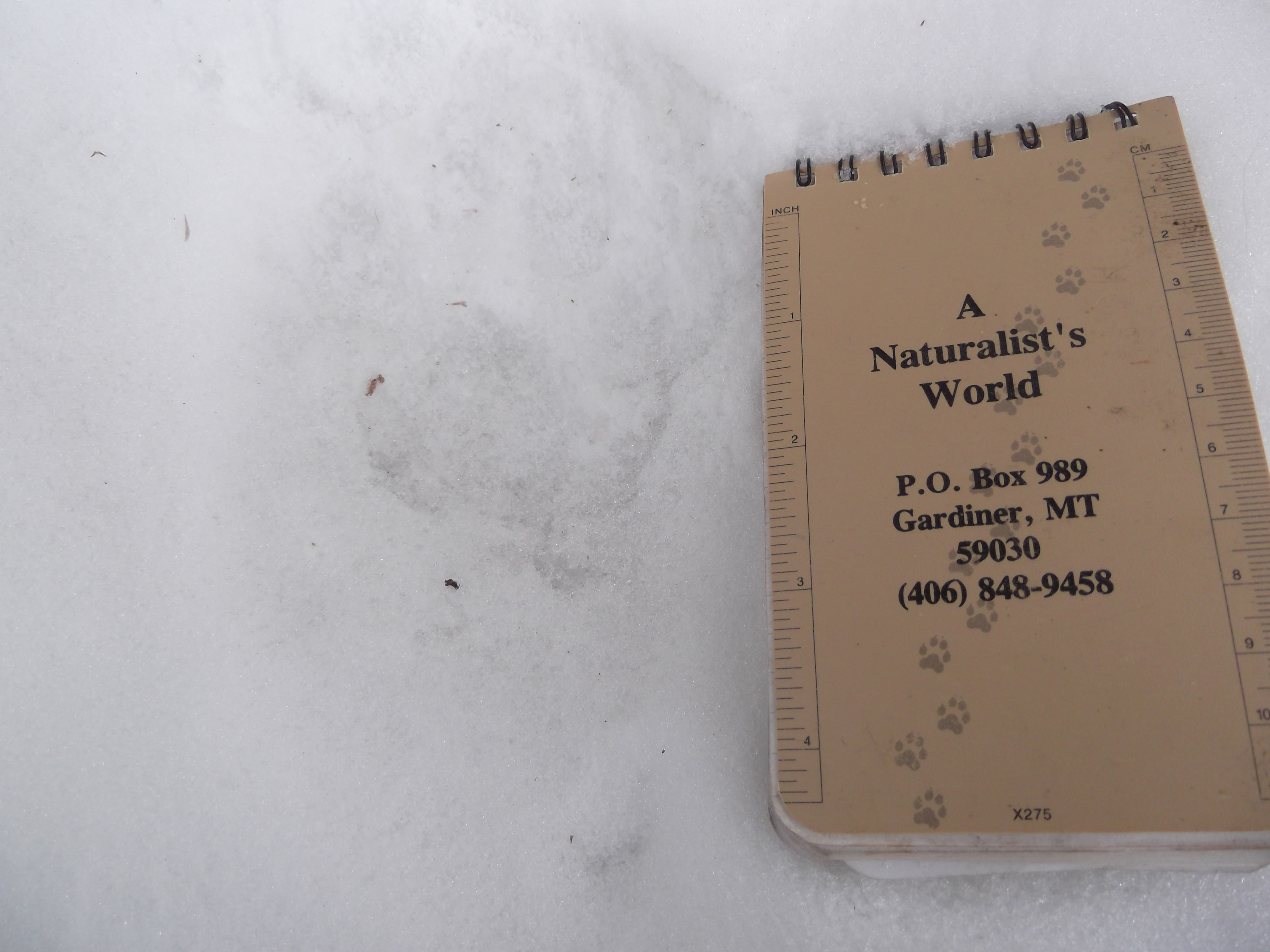
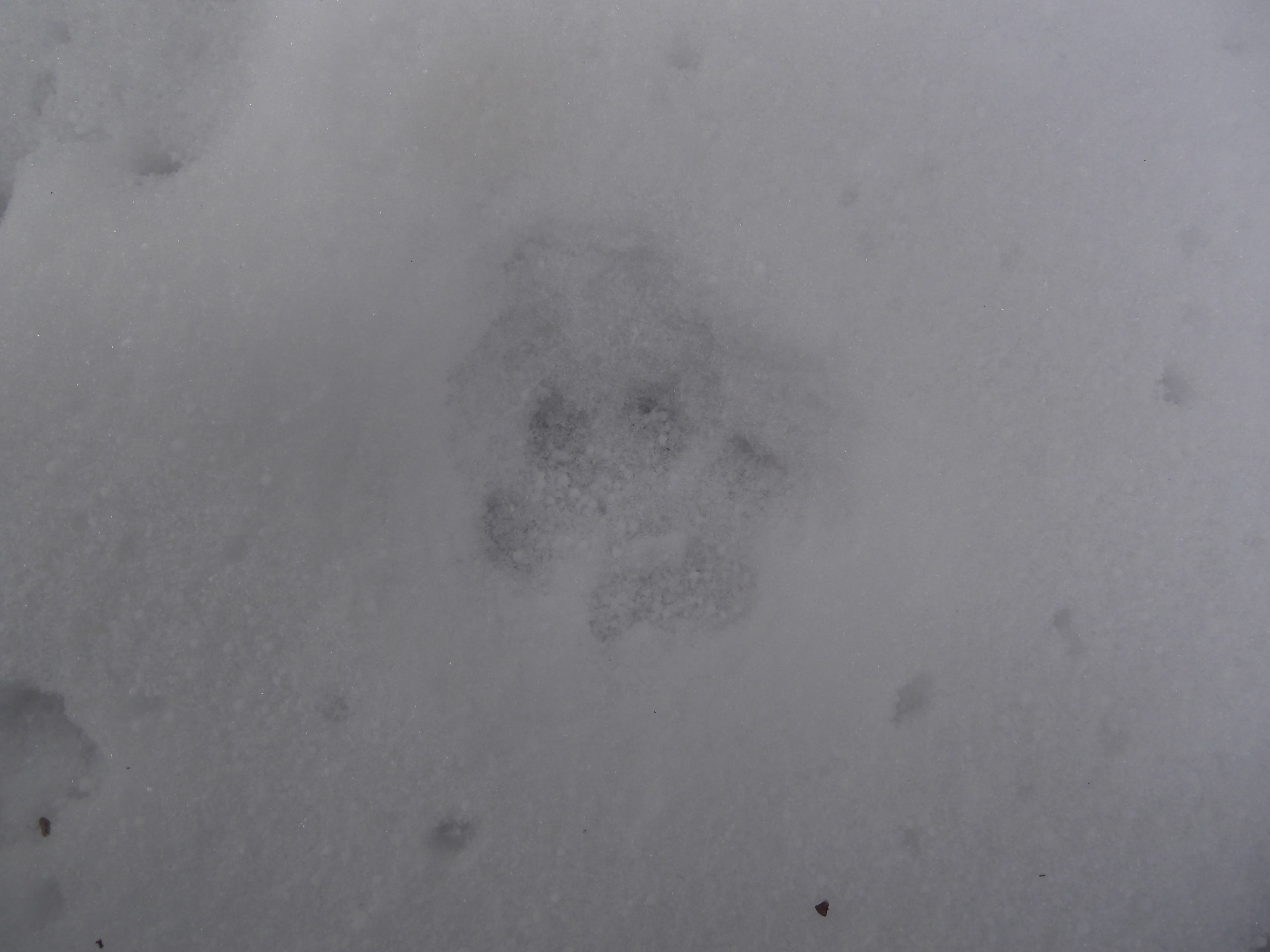
But today was a bonanza.  There are plenty of deer on the plateau, and although there are elk tracks and other evidence of elk, I haven’t seen any with my own eyes.  But I do run into deer occasionally.  And with all the granite cliffs and rocks, that makes for perfect cat country.  After scrambling up a huge granite boulder, I saw from afar some interesting large tracks that at first glance could be mistaken for wolf.  But as soon as I got close enough to make them out, there was no question what they were–cougar tracks.  I followed them for a while into a heavy deer area when they disappeared under the blown snow from yesterday.  Some of the tracks were perfect ice.  Seeing those tracks takes one’s breath away.

This track measures 3"x3" approx.

It seemed like this cougar was following me, figuratively not literally.  As I lost the cougar farther back, I began concentrating on my bobcat that I found in virtually the same location as the other day.  He or she was weaving around, obviously hunting again.  Here is a photo of where the cat stopped to scratch in the snow.  

Here is a photo of the bobcat in a sit-down in front of a large sage brush.  Obviously something caught his attention there.

Bobcat sitdown

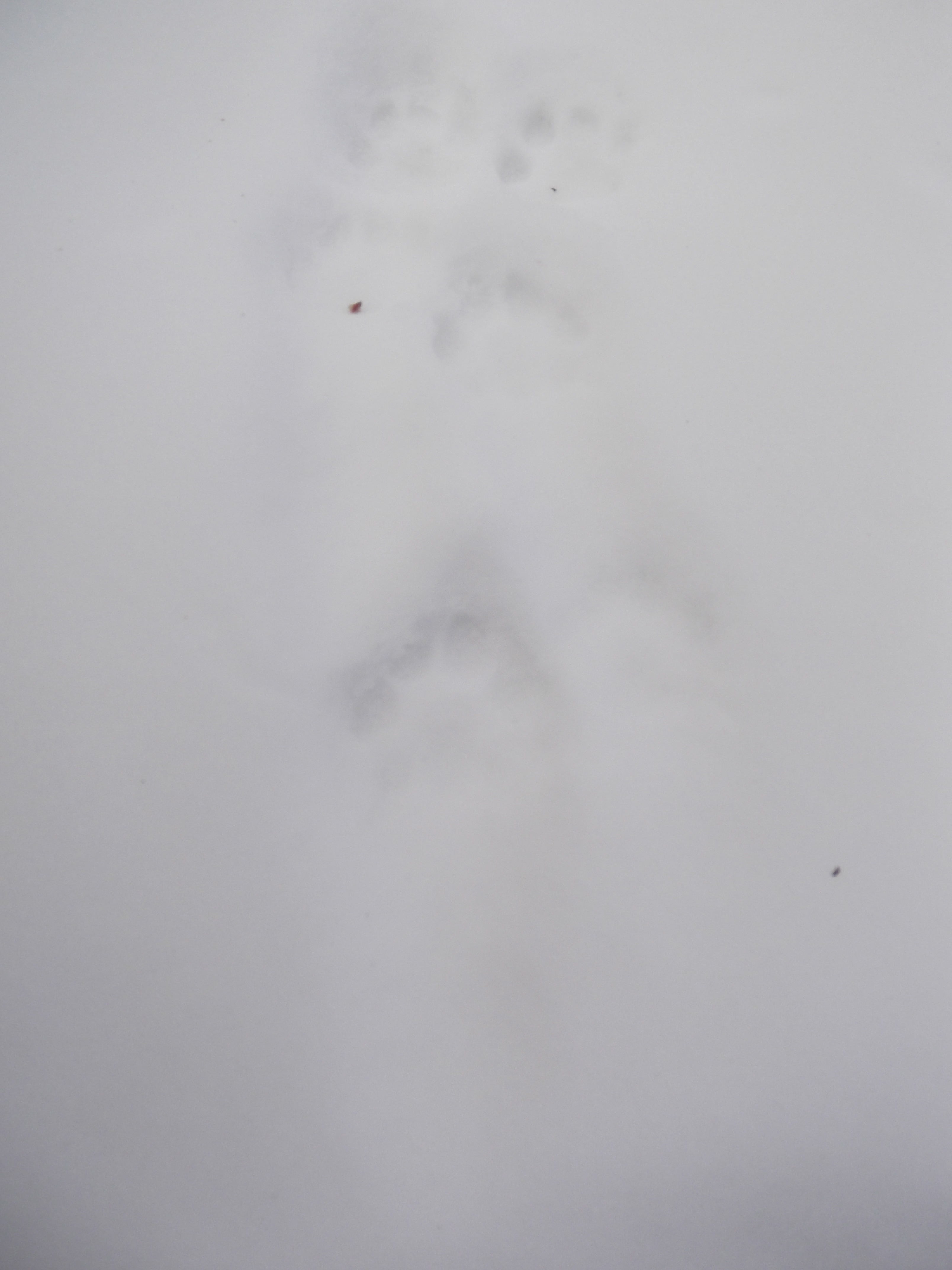
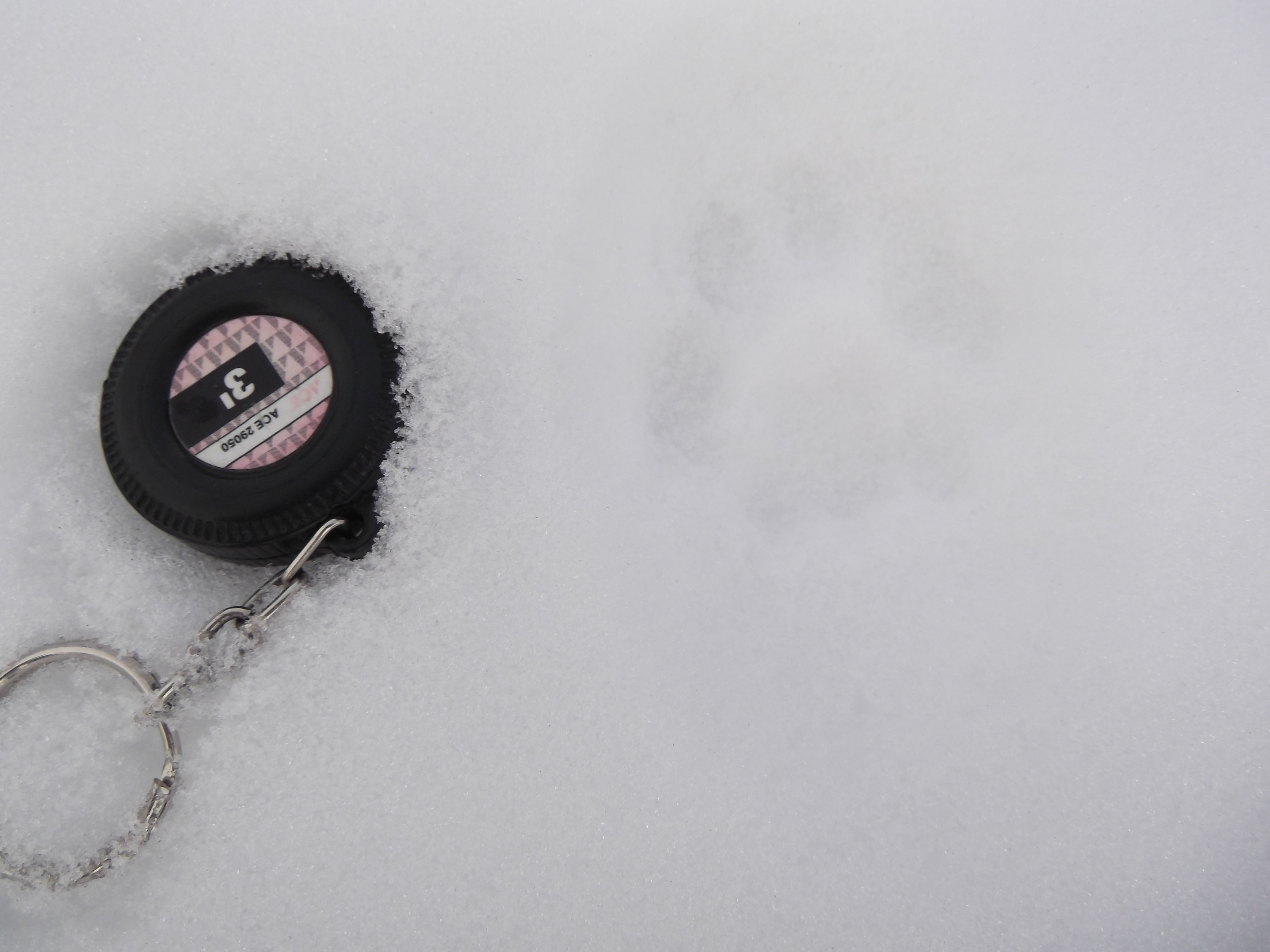
And there again was my cougar, making the rounds in this area too.  Here are two prints comparing a cougar print with a bobcat, for size.

Cougar hind track measuring 2.75 x 3.25

bobcat track measuring 1.75 x 2"

This rocky area is incredibly active–so much going on.  Partly because it is usually always windswept of snow, it is good ungulate habitat in the winter, which means food for predators.  In the fall bears frequent the area to look for limber pine middens.

It was great fun tracking big and small cats today; and knowing that you’re in the presence of a cougar your heart skips a beat.  Luckily, I have my personal wolf to protect me.

My great protector concentrating on his ball while a buck glides in the background

Wildlife update

Of course this wildlife update could never be completely accurate; its just my own observations and the result of a few conversations.

As I noted in an earlier post, up around Camp Creek where there is a nice mosaic of young and old spruce/doug fir forest plus open meadows, I saw sign of an abundance of Snowshoe hares with a coyote or two hunting them.  But down here in the valley, cottontails are rarely to be found.  Today I saw my first sign of a cottontail in the willows by my house.  But on a walk near the upper bridge where I usually see a lot of sign, there were no bunnies to be seen.  The same is true with the Jackrabbit population in the valley.  Rabbits are subject to boom and bust cycles.  I had thought it had a lot to do with the predator/prey cycle, but my boss at the museum told me its more complicated than that.  In fact, so complicated that scientists don’t really know the cause.  But, one prominent theory is that it actually has to do with plants.  The theory goes that the plants the rabbits eat begin to build up toxins as a defense to over-consumption.  The toxins get so high they eventually cause the massive mortality in the rabbits.  The rabbits that remain of course, are the survivors and have the tolerance they pass on to their little bunnies.  Eventually, the population builds up again.

With the lack of bunnies, you’d think the bobcat population might be down, but there’s been the usual one hunting in my neck of the woods.

Bobcat track

I’ve seen sign of him tracking turkeys.  The turkey population on the other hand, seems to be holding its own.  Regularly there are 10-15 wandering threw the woods, making a nice racket.

Turkey in snow

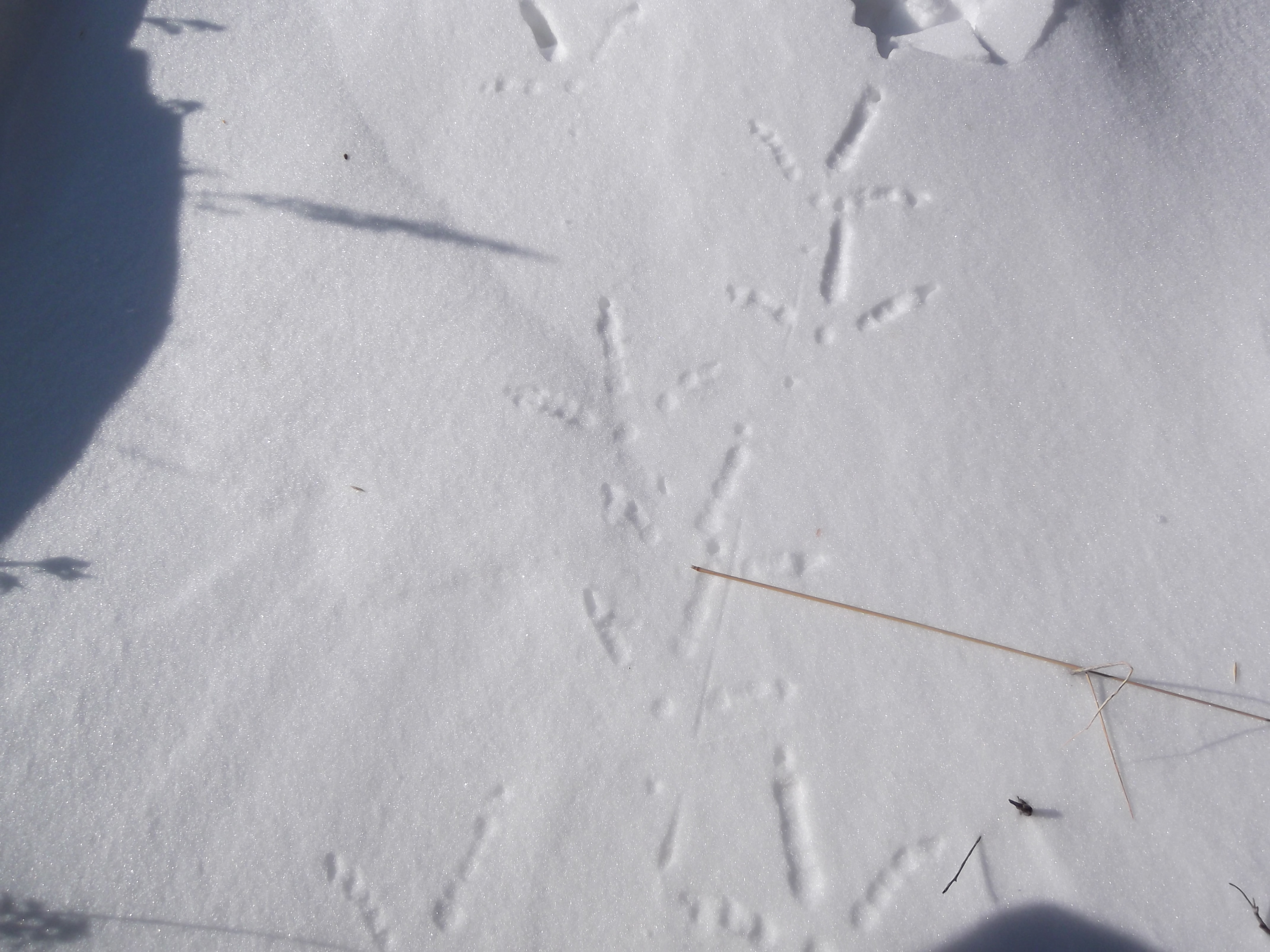
turkey tracks

Wolves this year are down in the valley.  From 4 packs in the range last year, down to just two struggling packs of about 4 wolves each.  The Sunlight pack has just disappeared, and the once ten strong Hoodoo pack that roamed from the northeast Park boundary of the Absarokas into Sunlight was reduced this summer by at least half due to cattle predation.  What’s left of that Hoodoo pack has been the main wolf pack in the valley and apparently are not great hunters, as they have been struggling to kill the wise cow elks and are mostly predating on deer.

A wolf lopes through the snow away from a kill site

That being said, coyotes seem to be on the rise and in control of the valley.  Their tracks are everywhere and their calls are heard nightly.  When I arrived back here in January, I found an adult elk that they had killed.  Today I found a dead pup, death unknown.  But where I usually had seen wolf tracks regularly, for instance running down the roads, now I am seeing mostly coyote tracks.

Coyote caught on trail camera

I found a dead fox, dead from an injury to its leg.  Its leg was mangled, maybe due to a trap or a fight with a coyote.  The fox population seems to be getting healthier here, probably because of several years of wolves keeping coyotes in check.

A fearful fox lopes in snow before dying

Fox caught on trail camera

I would assume that the deer and elk are having a better year than last as there is much less snow with higher temperatures.  There’s been fewer times when I’ve seen large herds of elk on Riddle Flats, maybe because there is plenty of clear ground in many places in the valley.

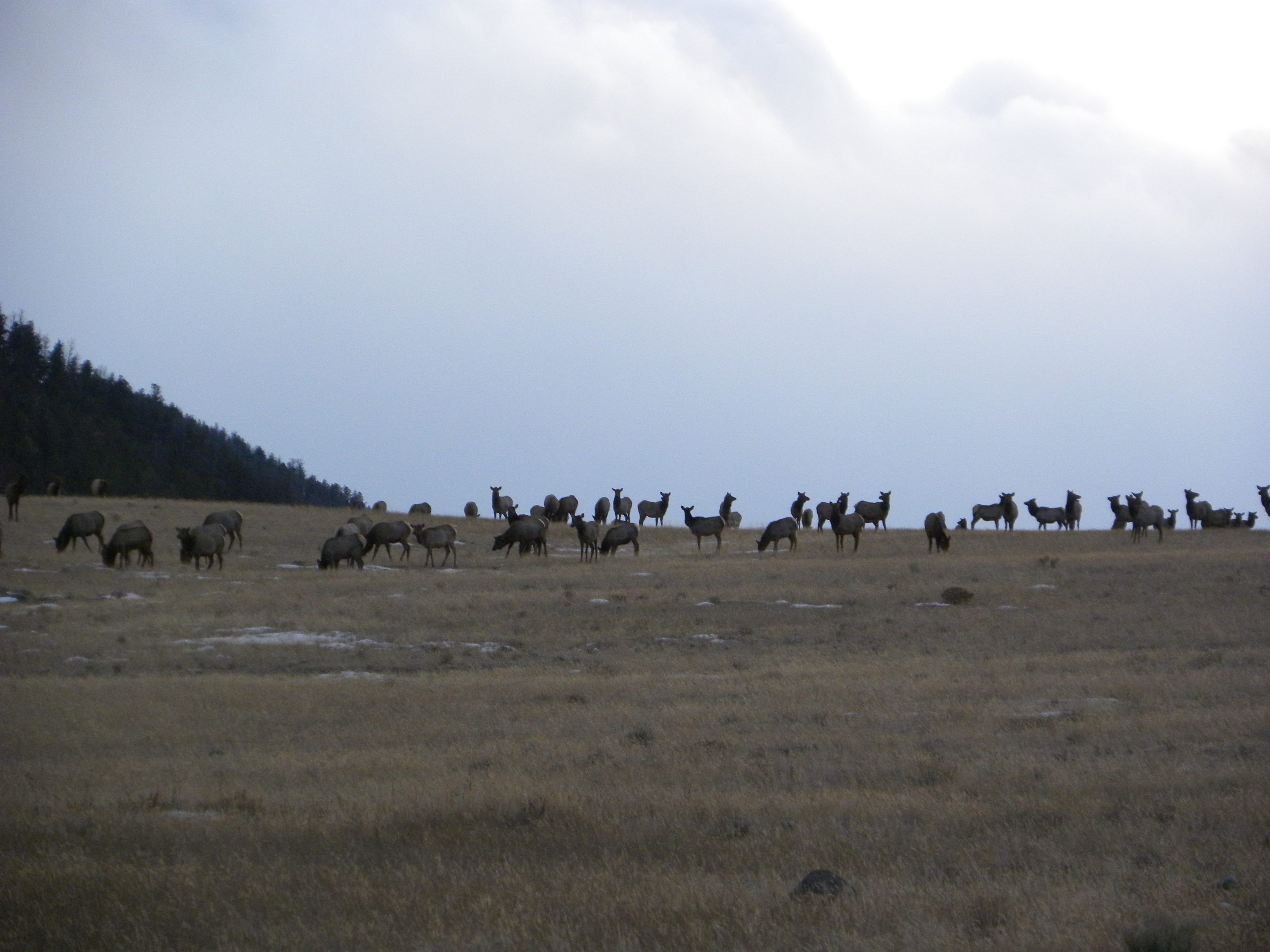
500 head of elk on Riddle Flat

I’ve seen a few Golden Eagles, but no Bald Eagles this winter.  I saw some grouse today by the river happily foraging.  And despite the fact that a completely insane hunter poached a cow moose and her baby this fall in the valley, the moose seem to be doing o.k.  One resident told me she saw two bull moose and there are a few cow/calves hanging around. I have one cow and her calf by me.  Moose normally have twins, but I’ve noticed the cow that hangs around my area hasn’t had twins for several years now.

I haven’t heard of any sightings of bear tracks, which surprises me because we’ve had such warm weather.  I am still waiting to catch some marten tracks or an actual marten on my camera.  I recently bought a new stealth camera, a Reconex which is made in the USA and is the top rated trail camera on the market.  I need to get a sim card and batteries for it, then I’ll be setting it up first with the intention of catching that bobcat.

Yellowstone in June

A blustery, unpredictable June brought with it fantastic wildlife watching in my three days in the Park.  I spent two nights in Mammoth and did several hikes.  On one, we ran into that herd of Rams you see.  150 years of no hunting leaves the wildlife very relaxed around people.  The rams hardly noticed us, moving slowly across the trail and up the hillside about 20 feet away.

From what I heard today, so far not too many cubs of the year (COY) have been spotted.  But I was a lucky one to get to watch a mom and 2 cubs for about fifteen minutes before they disappeared into the trees.  The cubs spent the entire time playing, rolling around, and then catching up with mom…..soooo cute!  One the way home I watched a courting pair of grizzlies.  The female was collared.  They rested together for quite some time under a tree while dozens of people watched about 100 yards away.

Yellowstone in May/June is the best time of the year.  One woman told me she spotted 71 bears last year in two weeks.  In early July grizzly bears move up into the high country to hunt for moths.  The elk follow the grasses higher up as well.  Wolves tend to follow the elk.  So although you may see these animals in summer, the sightings will be fewer and more difficult to find.

The wildlife, the thermal activity, the incredible setting–that is the magic of Yellowstone and spring is the best time of year to come.

Grizzlies and elk calves

Its unusual to see  the Cody backcountry herd grazing every morning and night this time of year.  Usually, by now, they’re headed over the passes to calve in the Lamar. But the snows in the high country are still too deep and the melt hasn’t even begun.

I’ve been watching this small herd from my window.  They come early morning and evening.

Elk May 20, 2011 still in Sunlight

The other morning I spied a lone elk.  I watched her for a few days going back and forth between the herd in the pasture and a patch of willows in the nearby forest.  She’d disappear into the willows and the forest by the road and seemed concerned.  I had a feeling she had a calf hidden in the brush there.

The lone cow with deer

But last night something strange happened which made me wonder if I was correct.  Instead of just this lone cow wandering over to this marshy area, a cadre of about 7 elk wandered over there with her and disappeared into the forest.

So this afternoon I took my bear spray and cautiously investigated while the elk were grazing.  In a muddy area of the creek, now widened by slash and blow downs from the logging last year, I spied a grizzly track moving in the direction of a small clearing.  A few yards up from the track, there was the calf, completely consumed.  Only the skin and legs remained.   It had been predated right where it had lain, for it was in a heap in the grass by a freshly fallen spruce bough.  I inspected the little legs and skin.  The small thing was deftly and perfectly skinned.  Certainly a bear, and my guess is it was that grizzly who made the track just a few feet away.

Grizzly in the Lamar feeding amongst the willows

I had hoped to spy a living calf, so I had a sicken and sad feeling.

Six out of 10 elk calves are predated within their first 10 days.  They are fairly helpless for those first two weeks.  Many people say the calves don’t have a scent, but I would disagree. I haven’t seen tracks in those marshy areas and this griz went directly to that calf.  The calf was not too far from the road, but at the edge of a wide swath of logged forest that includes a lot of swampy areas.  That bear did not wander about through the open woods looking for an elk, but clearly walked from the nearby meadow into the woods right to the calf.  Handling the calf’s skin, I could smell it on my hands.  It doesn’t have a strong smell, and staying on the ground low keeps it’s smell down.  But it does have a smell and to a grizzly, I’m sure its pretty strong.

I was in the Lamar Valley a few days ago and within an hour saw three grizzly boars in the valley. A friend told me in 2 days she saw 20 bears just in Lamar Valley.  The Lamar is becoming a favorite of the grizzlies.  I have wondered if these migratory elk, who usually calve in the Lamar, might have better success here.  Certainly there are bears here, but not as many as in the Lamar.  That’s a question I can’t answer.  Unfortunately for this little elk, it wasn’t the case.

And one more question I had:  Why, last night, did I see 7 or 8 elk accompany mama elk into the willows, not a route the elk ever take around here?  Was that a show of sympathy and support?  After that, the lone elk has not been alone anymore, and I haven’t seen her nor any of the others wander into the willows.

My heart felt saddened for that little calf and her mother.  But I can’t blame the grizzly.  How could I…I went home and enjoyed a BBQ’d bison steak myself.

Sleeping grizzly.

Goodbye to a long Winter

The snows are melting and although Sunlight creek is still not in the spring run-off phase, you can feel the weather breaking.

Last night it snowed lightly, but today its raining.  It’s a slow warm-up, but it’s coming.  My old neighbor who grew up in this valley tells me this was a normal winter in terms of snowfall, but I suspect its still not as cold as when he was growing up.  His wife says that -25 degrees was regular then.  Not now.

Several years ago I helped an elderly woman stage her landscape in order to sell her home.  Her husband had been a great friend of mine and fellow beekeeper.  Once he died Dorothy packed up the family home and moved to Idaho where her kids were. That was the year I bought my cabin in Wyoming and along with so many other strange coincidences, it turned out her father had been the Chief Engineer in Yellowstone from the spring of 1925 through the spring of 1930.  The last two years he was the Assistant Superintendent at Mammoth under Horace Albright  His name was Merrill Daum and the family had interviewed him and transcribed his memoirs. Dorothy graciously gave me a copy of the section from his time in the Park.  Here are a few of his stories of snow in those days:

There were no concessionaires living in the park in the wintertime.  They closed up everything.  We had to go down to Gardiner and Livingston to do our shopping.  We had cars and oh yes, the road was open.  We only had light snow in that country.  We could keep the road from the park open up to Mammoth with our own equipment, but from there on it was generally open.  They had a train running in there every so often, so many days a week, so we had train service at Gardiner.  So much of that country was rough and hot that the snow was not very thick on it.

I don’t know much about Middle Geyser basin.  It wasn’t a good place to stop and just put a road through to yell at Old Faithful.  That’s where we turned off from and went cross country to the Lake and Canyon or kept on going out to West Yellowstone or to Old Faithful.  We had ten cabins about every ten miles on the ranger patrol station because they would patrol all along that area, especially the southern part of the Park because there might be poachers come in to kill the game.  They’d go around in the winter time on skis.  That’s a long trip around that part.  Down towards the southern entrance there might be ten, twelve feet of snow.  I’ll never forget looking at one of the bridges; there was a stream going under and all that snow on top of the bridge.  One winter the bridge just broke.

The wintertime was mainly spent getting ready for the next year.  Then we had to get ready to remove the snow in the spring.  We started at Cody,Wyoming at the entrance.  About thirty miles from Cody up to the entrance.  We got as far as the Park with snow 12 to 15 to 20 feet deep.  We’d blast it out with TNT which Uncle Sam gave us.  That would start it thawing and then we’d take a big power shovel and shovel the stuff so we had a two-way highway through there to the east entrance of the park.  From there on we’d use our own equipment.  The deep snow was right there at the entrance.  That was the high point.  We’d generally try to get the Park open by the 1st of June.  By the 6th of June we were officially open, I believe. But you couldn’t make some of the interior trips that early.  It would be long in July before you could get away from the snow.

Here is a photo tribute to my 2010-2011 winter in Wyoming.  After this long and snowy winter, I think I am officially a Wyomingite!

The Basin in early winter from Dead Indian

This is a wolf howl machine, an experimental device to see if wolves are in the area

Two wolves side trot down the road

Coyotes on an elk kill

A coyote pair waits their turn on a nearby kill

The Yellowstone migratory herd resides in the valley in winter

Black wolf resting mid-day in the sun after a morning elk meal

Moose stands in deep snow

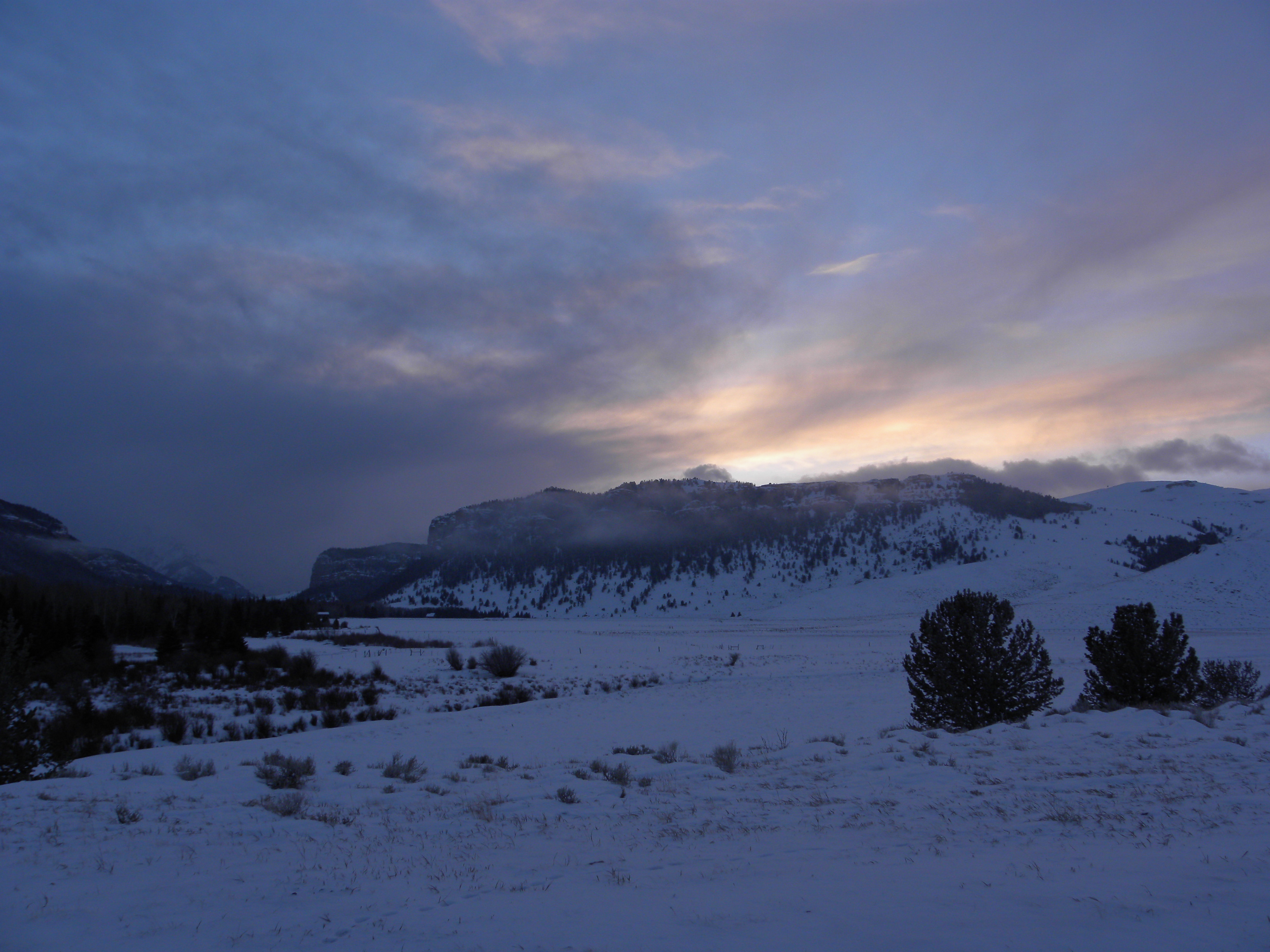
Sunset in a 2011 winter

After a day of skiing, dog tired


A brilliant and frigid day

Its -14 degrees tonight at only 7 pm.  Today it was a clear beautiful day and the mercury never got above -1 degrees F.  I got bundled up and went out for a ski, but my new skis have a big problem with their bindings.  I tried for 20 minutes and never got my shoes to hook in, but I got pretty cold in the process.  So I abandoned that idea, threw on my snow shoes, and headed out on the trail by the creek.

An enormous sun-dog, or halo, circled the sun.  The sky was clear blue and the air was so cold you could literally see ice crystals flying by.

Over the bridge there were some old coyote tracks.  This coyote was using a rotary lope.  He switches from one side to the next as you can see from the photo.  Maybe he picks up the pace over the bridge because he’s so exposed with out cover on either side.  I’m working hard on studying gait so I was thrilled to see and recognize this one.

Coyote lopes across the bridge. Notice change from one side to the next

Usually this walk has lots of wolf tracks but none today.  A moose has been walking around the willows

Moose droppings and tracks

.  I find an area near tree cover where several moose lay down.  At first I thought these might be a group of elk, but only moose scat was around and the bed measured 60″–too big for an elk.  Laying in that deep snow, a moose or an elk creates a deep depression with their weight and body heat.  The lay becomes a natural snow cave, insulating them and keeping them warm.

I watched a dipper feeding and bathing.  Wow they are stout little things.  It was so cold my hat was icing up and this bird was hanging in the stream.  Ice flowed by him.

Dipper

On the way out, the elk were spending their resting time mid-day in the upper meadows.  They were there yesterday too when it was just as cold but cloudy.  Usually they hide mid-day in the trees.  I wondered why they were hanging on the hillsides, exposed, during these bitter cold days.  On the way home, around 3:00, they were already out and grazing. Usually when the deer and elk feed early, that’s a sign of a storm coming.  Maybe they know something I don’t.

Why are the elk resting in the meadow mid-day?

On the way up to my cabin, I see a young cow moose running bye.  I suppose its a very cold and moosey day.

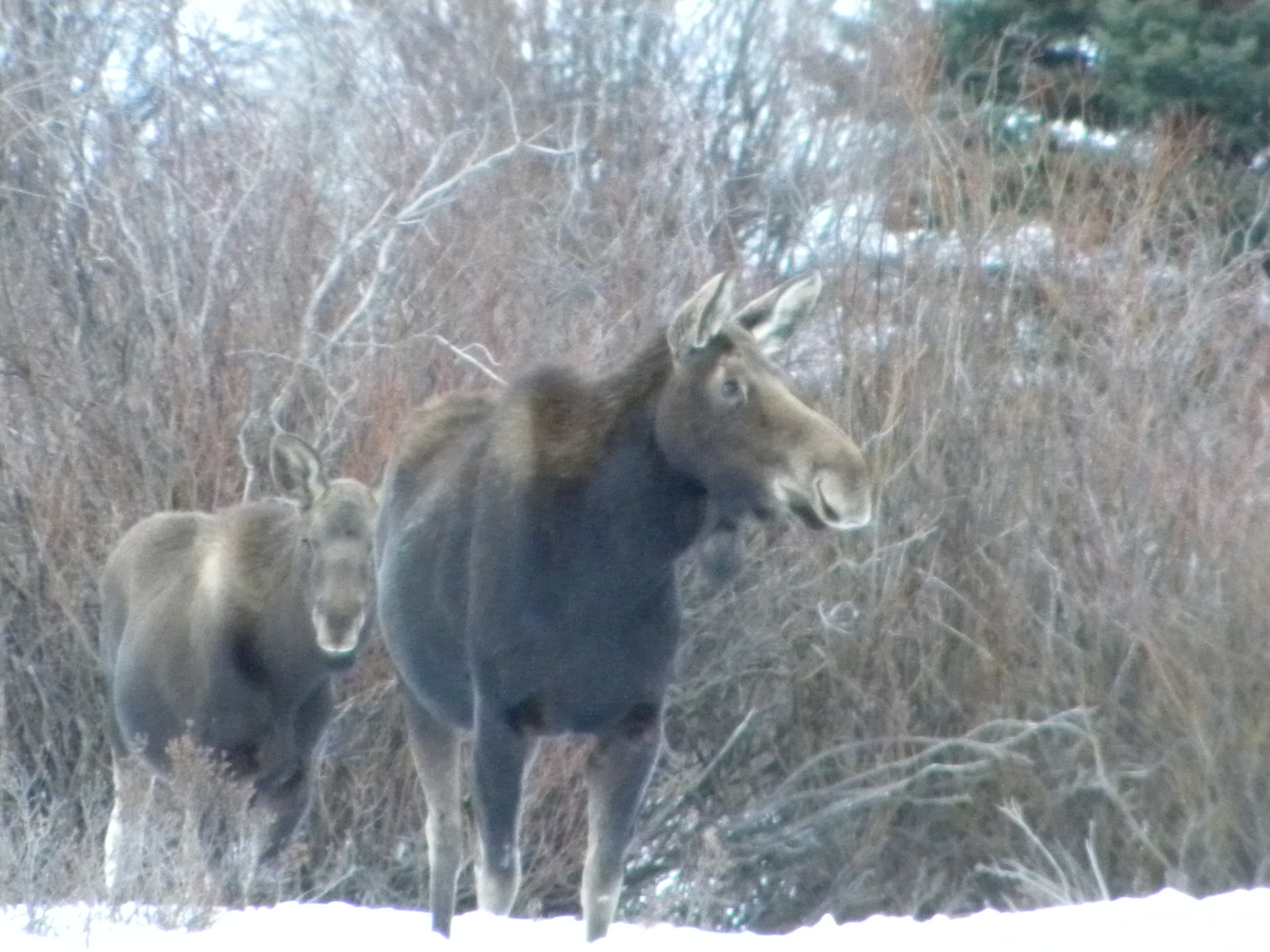
Moose by my house

The right thing to do…Niagara falls and Yellowstone

I just returned from helping my son with location scouting at Niagara falls.  Its strikingly beautiful, especially in the winter.  The crowds are gone and its bitter cold, but there are ice floes in the river and parts of the falls are frozen.  The Canadian side still lights up the falls at night and the sheer power and magnitude of so much water flowing (in fact only 50% is allowed to release as the other 50% is used for power) overwhelms and puts us humans in our proper perspective relative to the awesome power of nature.

Falls at night

Power of the falls

But along with my visit to Sedona, Arizona last year, (which also is a natural wonder but not a National Park) what really stood out was its contrast to where I live now, the Greater Yellowstone Ecosystem.

Although I live next door to a National Park, I don’t of course live within the Park, but within what was designated a few decades ago as its larger ecosystem.  This is an actual mapped area, you could call it a ‘buffer zone’ where its recognized these large megafauna need room to roam to survive.

And, true to its name, I regularly see all the large and small animals that make up this complete ecosystem in the lower 48, which includes wolves, grizzlies, elk, and the occasional bison that is allowed to leave the Park.

So what’s so great about this area  you might say, as opposed to Niagara or Sedona?  Both have the power to overwhelm through their sheer beauty and immense landscape.  The difference are the animals.  Even the Sierras, as incredible a jewel as they are, are NOT a complete ecosystem.  Many animals that were there just 150 years ago are gone forever.

What Lewis and Clark encountered 200 years ago on their journey West is no longer, but a sliver of it can be glimpsed here in the Yellowstone Ecosystem.  Just a sliver, but that sliver is our history, our heritage.  No one would think of selling Monticello to create senior housing or a Walmart!  Why should we not value our original landscapes and the animals that were here before us in the same way?
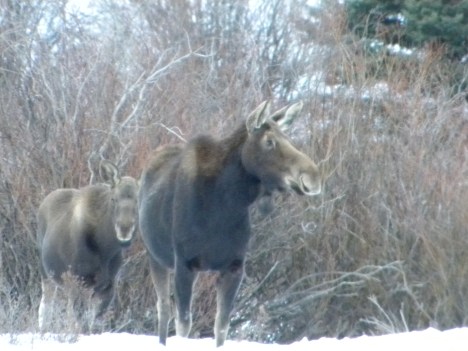
Everywhere in the United States, with the exception of Alaska, animals have been pushed out to accommodate the biggest and toughest animal–humans.  And that is no exception in the Yellowstone ecosystem.  The controversy rages here too as to who should have primary use of the lands–hunters, atvs, developers, ranchers, oil and gas?.  Wolves are villified for killing elk that hunters could have taken.  Grizzlies are constantly moved around when they get into lands too close to homes or into unprotected garbage.  Bison are not allowed to leave the Park boundary.  Ranches are sold to developers who parcel up the land into lots, crowding out habitat for large animals.  Snowmobilers feel they should have the right to go wherever they choose, including the Park even when the science says differently.  The animals are last on the list.  And when that is how the priorities are set, what becomes of the land is Niagara Falls, Sedona, or at best a ‘safe’ wilderness like the Sierras; at worst we become like Europe, where their natural history is in the so-distant-past that its entirely unreachable in present-time.

Yellowstone and its ecosystem, unlike Alaska, is easily accessible by car to people from all walks of life, rich or poor.  It is an opportunity to view in the flesh our rich natural past.  Any person can do that from the safety of their car, and watch wolves or bears in the Lamar Valley.  Or one can take more risks and venture into the back country.  Even today, with this area protected and the reintroduction of the wolves, thereby completing the ecosystem fauna, the landscape doesn’t hold a candle to the enormous amounts of wildlife that was once beheld by the mountain men in the 1830’s.  Yet, they are all still here, thanks to the enormous efforts of many men and women conservationists through the century.
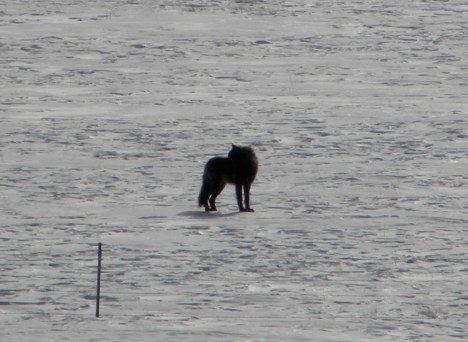
Black wolf

In the U.S., there are many unique and beautiful areas, but there is no where like this area.  Here we have the Serengeti of North America.  And in my mind, we are not valuing nor protecting it enough, nor are we holding it in the proper perspective.
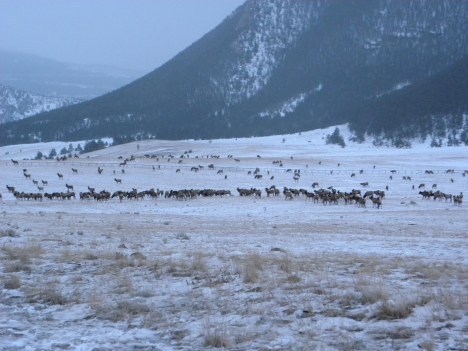
Our Serengeti

The proper perspective:  This area, as well as more large tracts of contiguous land (Yellowstone to Yukon idea) is a wildlife first policy.  This is our gift to our children and the future.  This is our gift to the wildlife here.

Once we all realize what we have here, a jewel that is found no where else in the U.S. (Do we really want the last place where wild animals roam to be in Alaska, out of the reach of most ordinary folks?), we will change our approach and our views on a daily basis.  No longer will we have on the Wyoming books archaic 1890 laws that allow trapping, an indiscriminate way to kill wildlife.  No longer will we confine bison to the tiny Island of the Park because the cattle industry fears losing their brucellosis stamp.  Nor will people call for the extermination of the wolves because they are having a harder time hunting in the spots they are used to.

We will make new laws to help support the wildlife in any way we can and preserve this area; not for ourselves or for any use we desire today, but because we recognize its’ specialness, and because, frankly, its the right thing to do.

There was a time, not long ago, when out of 60 million Bison that once roamed the entire United States, only 100 survived.  In fact, it was thought that all bison were extinct, and that was what we, as a country, as a government, was trying to achieve.  But in the early 20th century, around 100 Bison were found living in Yellowstone.  An immense effort was made to bring at least some bison back and the bison that you see today living in Yellowstone are the result of that effort–the last pure genetic stand of bison living today.

When you go to Yellowstone, there is a power, a respect, a wordless reverence that wells up in your being just seeing these animals.  Something deep and ancient reverberates in their presence.  Imagine if those bison hadn’t been preserved?  Those conservationists who helped preserve the bison of Yellowstone did an incredible service to future generations.  We, living today, are the beneficiaries of their efforts.

We must make those same efforts today for generations that will be living 100 years from now, just as they did for us 100 years ago.  That is how we should be looking at the Greater Yellowstone Ecosystem.  That is how we should be making our laws, our plans, our actions.

“You may say I’m a dreamer, but I’m not the only one…”

The Totem

I know or have heard of many people declaring that their totem animal is one of the strong, impressive mammals–the wolf, the bear, the cougar, the lynx.  Why are so many of the small animals ignored as a totem?  For instance, Plenty Coups, the last chief of the Crow Indians, had a vision in which his totem animal was revealed to him.  This small little bird was his guiding inspiration, the totem whose wisdom saved his people and won them a reservation on their native lands.

The Lynx

“Listen, Plenty-Coups” said a voice.  “in that tree is the lodge of the Chickadee.  He is the least in strength but strongest of mind among his kind.  He is willing to work for wisdom.  The Chickadee-person is a good listener.  Nothing escapes his ears, which he has sharpened by constant use.  Whenever others are talking together of their successes or failures, there you will find the Chickadee-person listening to their words.  But in all his listening he tends to his own business.  He never intrudes, never speaks in strange company, and yet never misses a chance to learn from others.  He gains success and avoids failure by learning how others succeeded or failed, and without great trouble to himself.  There is scarely a lodge he does not visit, hardly a Person he does not know, and yet everybody likes him, because he minds his own business, or pretends to.

“The lodges of countless Bird-people were in that forest when the Four Winds charged it.  Only one is left unharmed, the lodge of the Chickadee-person.  Develop your body, but do not neglect your mind, Plenty-Coups.  It is the mind that leads a man to power, not strength of body.”

chickadee

We think only of these large mammals as totems because, I propose, we no longer fully ‘know’ animals anymore.  Who amongst us could understand the ‘Chickadee-person’ like Indians that lived with all the animals, large and small, observing them in detail day in and day out?  Each animal has a special quality, a unique force that can connect a person to that higher need in themselves.

I also wonder if there are dual totems; totems in tandem that make up the whole, rather than just a partial piece.  For instance, when I was told that Soona had bone cancer, I knew her slow death would be excruciating, as well as debilitating.  Not a life for a dog.  I got some good advice: take off work for a week and do all the things with her that she loves, then put her down.

I took off work, but was agonizing over the decision, even though I knew it was best for her.  During that week that stretched into two, I was given a series of dreams.   All my dreams had wolves in them–courage, strength, canine. Yes.  But they also contained an important critical ‘other’ totem–elk.  In each dream, over and over, I watched wolves take down and kill elk.  It was the full circle of life.   In every dream, my focus wasn’t on the wolves, but on the dying elk.  I would look deeply into the eyes of the elk as she lay dying and saw there was only a quality of complete surrender.   She knew this was her ‘dharma’ or lot in life.  No remorse, no fear.   I realized it was Soona’s time to go, like these elk, and she was surrendered to it.  It was only me that wasn’t.

So the totem wasn’t just the wolf, but the wolf and the elk.  They are one and there can’t be one without the other.  Their lives and deaths are intertwined.  They are one totem, coins representing both sides. The Yin and the Yang.

Does that mean my friend who changed his name to Wolf, should be Wolf-Elk?  Or the one now known as Bear be Bear-roots?  Lynx-Hare?  Cougar-Deer?


Mothers: Bears and Elk

Last week an elk calf was killed right in the little meadow by my house.  Koda discovered the leg, lying in the disturbed grass near a solitary aspen.  The mother elk had been hanging around all morning, calling and calling for her baby.

Now, almost a week later, I heard her early this morning, still calling.

Cow elk sniffs where calf was killed

It breaks my heart to hear her.  I saw her last week quite a lot, coming closer and closer into the meadow, unperturbed by my presence or the dog, obviously confused as to where her baby might be.

Koda and I walked the trail through the little adjacent forest.  Fresh black bear tracks, a mother and her cubs, had wandered amongst the springs.  I set up my trail camera and found another leg from the calf.

The little elk had disappeared almost without a trace.  I’ve walked and walked around the area looking for more evidence.  One leg in the meadow; one in the woods; where’s the rest of her remains?  She barely lived, barely had a chance.

Yet, maybe these two little bear cubs will now have a chance.

Black Bear cubs

Its bear hunting season and although you can’t shoot a mother or her cubs, the young male whose been hanging around, digging for roots and insects, is fair game so to speak.

Its sad, but yet true.  One life feeds another.  I sing for the bear mother.  I cry for the elk mother.  One does not negate the other nor hold more value than the other.  Its’ the old and ancient dance.  Don’t be fooled.  Despite all the latest new fangled technologies, extended life, genetic transformations, new pills, greed on Wall Street, fat cat politicians and the usual rhetoric, we too are dancing.

Report on the Clark’s Fork elk herd

It snowed about 4″ here last night but I braved the drive into town early in order to hear Arthur Middleton’s talk at the Buffalo Bill Museum.  Arthur is the PhD student that’s in charge of the study on why the Sunlight elk herd has such low calf/cow ratios.  He’s been working up here in the field for 3 years, and now he expects to crunch all the data for another 3.  But his preliminary findings were what he wanted to report today to the public.

First off, I’ve seen his interns up here for the past two years and gotten to know them and Arthur.  I can’t say enough about how focused, diligent and hardworking these students are.  Up at dawn in the dead of winter to observe elk in the freezing cold.  As Arthur put it today, they had 4 behaviors that were noted:  feeding, bedding, vigilant, and running.  That’s about all the elk did, day after day.

Arthur did a great job of presenting all this info to the public in lay person’s terms.  He used slides and began step by step explaining some of the biology necessary to understand the complexity.  Simply put, there are many factors to consider, and I do remember at last years’ good-bye party for the interns listening to Arthur thinking all the factors through.  Here’s my summary of Arthurs’ points and I hope I’m doing justice to it all.

1.  First there are two herds that he studied, one migratory (Sunlight herd migrates here in winter and to the Park in the spring/summer/fall); and one non-migratory which is down north of Cody.  By looking at data from a lot of years ago, the elk have changed their patterns.  There used to be no non-migratory herds around here.  Migration, as Arthur pointed out, is a fairly fixed behavior taught by cow to calf, so it takes many years to make a change.  Arthur explained the advantages of migration, mainly better food quality as the elk follow the new grasses up as the snow melts.  There might be some predation advantages too as the predators den in the spring and stay put for a while as the elk move higher up.

Elk from the trail camera

2. Arthur explained how lactation takes a lot of energy from the mother (as all of us mothers know!).  Basically, non-lactating elk have 50 pounds more fat on them than those that lactate.  While the normal pregnancy rates for elk is 90% (and the NON-migrating herd is at that bar), the Sunlight (migrating) herd is at only about 60%.  The premier finding of this study was that the Sunlight herd cows are only getting pregnant every other year.  By doing that, they save energy vis a vis body fat that helps them through the winter.

3.   Displaying a slide of the rainfall patterns over the last hundred years, and comparing that with satellite data that looks at greening rates (especially in the months of June/July during lactation), we could see that this area has been in a severe drought, as well as compressed warming trends (i.e. shorter winters).  A photo of the high mountain pass between Sunlight and Yellowstone in June showed not as much green as should be expected.

4.  Another interesting find was behavior, what the interns were watching during those months they were here.  The vigilant behavior time was the same for the non-migratory and the migratory.  But where they differed was that the non-migratory herd spent more time bedding while the migratory herd spent more time feeding.  The nutritional quality of the migrators just wasn’t as good.  Factors governing the non-migratory herds were irrigated pastures and intentional low grade fires set to improve grazing in areas where cattle are.  The migratory Sunlight herd goes up through wild and high country where natural fires and rainfall determine feed quality.

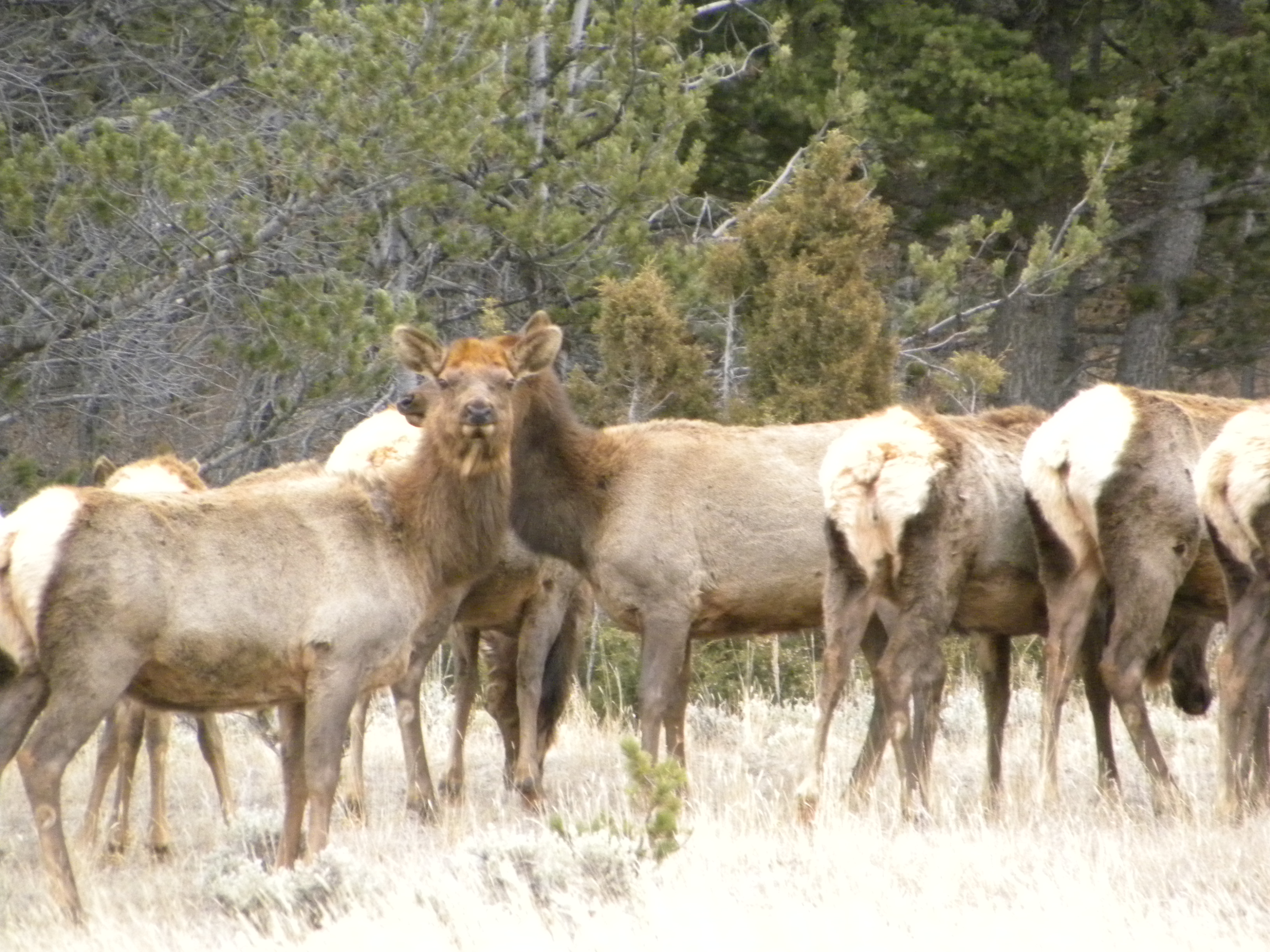
More elk

5.  Lastly, looking at predation, Arthur showed a chart from research in Yellowstone pre -wolves on calf predation.  Predation was looked at by bears (main predator of calves), coyotes, cougars, natural causes, and survival rate.    He compared that to a more recent chart that included wolves.  Interestingly enough, wolves were almost about the same as the coyotes in the first slide but the bear predation had increased 3 fold. Lots more bears are in the Park since the 80’s.

This grizzly spent hours upturning Bison paddies for insects underneath

Although Arthur has more data to analyze, it seems obvious that the main factor that is affecting this herds’ decrease in cow/calf ratio is quality of feed.  These elk, smartly enough, are compensating for the nutritional loss by having calves every other year, instead of every year.  Add to that the increased predation on calves by bears in the park, with the new factor of wolves predating at the same rate as coyotes approximately, and you pretty much get your 30% drop.

Bull and cow mating in Yellowstone

One other comment Arthur made was that most of the migratory herds are doing well in Wyoming.  Sunlight as well as one other herd stood out as extremely low on a comparison chart and that was why this study was conducted.  Why this herd suffers more from drought than other herds–you’d have to look at each herd individually.

After the talk I went to the local hairdresser to make an appointment for next week.  As I was waiting at the counter, I noticed a large poster ready to put up, advertising the ‘Wolf Rally’ in Cody on May 22 by hunters, like the one in Jackson several weeks ago.  These guys are blaming wolves for all their woes and want the Wyoming delisting plan enacted which would give the wolf  predator status all over the state (meaning you can shoot on sight).  On the tag line of the poster there was an invitation to ‘Come and learn the science of what’s happening with the wolves and elk’.  Somehow I don’t think so.

Nature is a beautiful complexity that takes much time and pondering to put some of the pieces together that Man can understand.  What I learned from so many of my biology classes is that things are just not as simple as you think.  I watched Arthur over these last several years thinking through so many pieces of this puzzle in a questioning way, trying to piece parts together.   Its much easier to have an emotional opinion, play the game of scapegoat, and rally around a cause.