• MY BOOKS ON WILDLIFE, GARDENING AND MORE

  • The Wild Excellence

  • True stories of wildlife encounters around the Greater Yellowstone
  • Award winning eBook on Decomposed Granite, tips, how to's, what to watch for
  • Children's book. True stories of a dog and wolves. In a dog's voice
  • Written for dry Mediterranean climates in California, north and south

A Grizzly story

Elk from the trail camera

I set up my trail camera for the last two weeks, hoping to catch some bears or wolves.  Mostly I got a lot of elk.  But I did capture 3 bighorn rams and a coyote.

The crazy part is that on the way up there I was following a grizzly’s perfect tracks in the snow.  The tracks were actually solid ice and super clear.  I was trying to figure out how they turned to ice.  I thought “Maybe he went up in the early morning or evening over thin snow that melted under his heat and then iced over.”  The ranch hand neighbor thought he just melted actual ice with his heat.  But everywhere around the tracks was snow, except for his tracks.  Any enlightening thoughts would be gladly accepted folks.

I chatted with J___ at the nearby ranch on my return.  He told me that that same grizz had walked right through the cows, looking for their mineral lick that they used to keep every year.  Its gone this year but probably its the same grizzly.

Then he told me a great grizzly story:

“You remember last year they were trapping and collaring.  They caught 3 grizzlies on our property all in one morning.  The traps are just 55 gallon barrels.  The bear goes in for the meat and the door closes behind him.  The doors on both ends are just metal grates.”

“Well Mark Bruscino was there (note: he’s the G&F Bear specialist in Wyoming) and asked if I wanted to come see as this was unusual.  They’d never trapped 3 bears all at once and it was 2 sows and one cub, so it was going to be interesting which bear belonged to the cub.  They trap the bears, then dart them with a light sedative.  Mark said ‘look inside that barrel at that grizzly’, so I looked.  And the bear, instead of looking out the grate, was looking sideways at the wall of the can.  I looked from one end, then I looked from the other end.  But each time I looked, the bear looked away, as if shy or something.

” ‘What’s going on?’ ” I asked Mark.

” ‘That bear is embarrassed.  She’s been caught before and she’s embarrassed that she got caught again.’ ”

“Well Mark sedated her and looked at her ear tag.  That bear, Mark said, was the first bear he’d ever caught and collared, 11 years back. She was 3 years old then.”

” ‘That bear has only been handled by people twice, both of them me.  She remembers me.  Bears are smart.  Most people would be shocked to learn how smart bears are,’  Mark said”

“You know the bear can hear you when they’re sedated.  And Mark was talking to that bear saying things like “Hi, you remember me.”  She’d be sure to remember something like being caught in a trap.

“Mark said that that bear had been in Dubois, caught and transferred for cattle killing.  She was put here and didn’t get into any trouble for all those years, until last year when she killed our pigs.  A year later she was tracked, by her collar, down in Dubois, but since then the collar’s fallen off.  When you think about it, how does a bear know, after being trapped in Dubois, then flown here by helicopter, not even driven here, but flown…how can they know how to get back to Dubois.  They don’t go the same route, she had to cross 3 highways, and its really rugged country between here and there.”

“Mark said we had about 1/2 hour before those bears woke up.  I helped them pull them out of the cans.  I was trying to be really gentle so as not to twist her paw or whatever.  Mark said there’s no handles on the bears, you just pull on their fur. ‘Don’t worry about hurting them.  These are massive creatures.  They’ve been over rock cliffs and in all kinds of situations.’

I told J___ that was a great story. Next time they’re trapping I hope to get a photo or maybe even ‘pet’ a sleeping bear.  J___ got too and so did all their dudes that day.

The Golden Bear of California

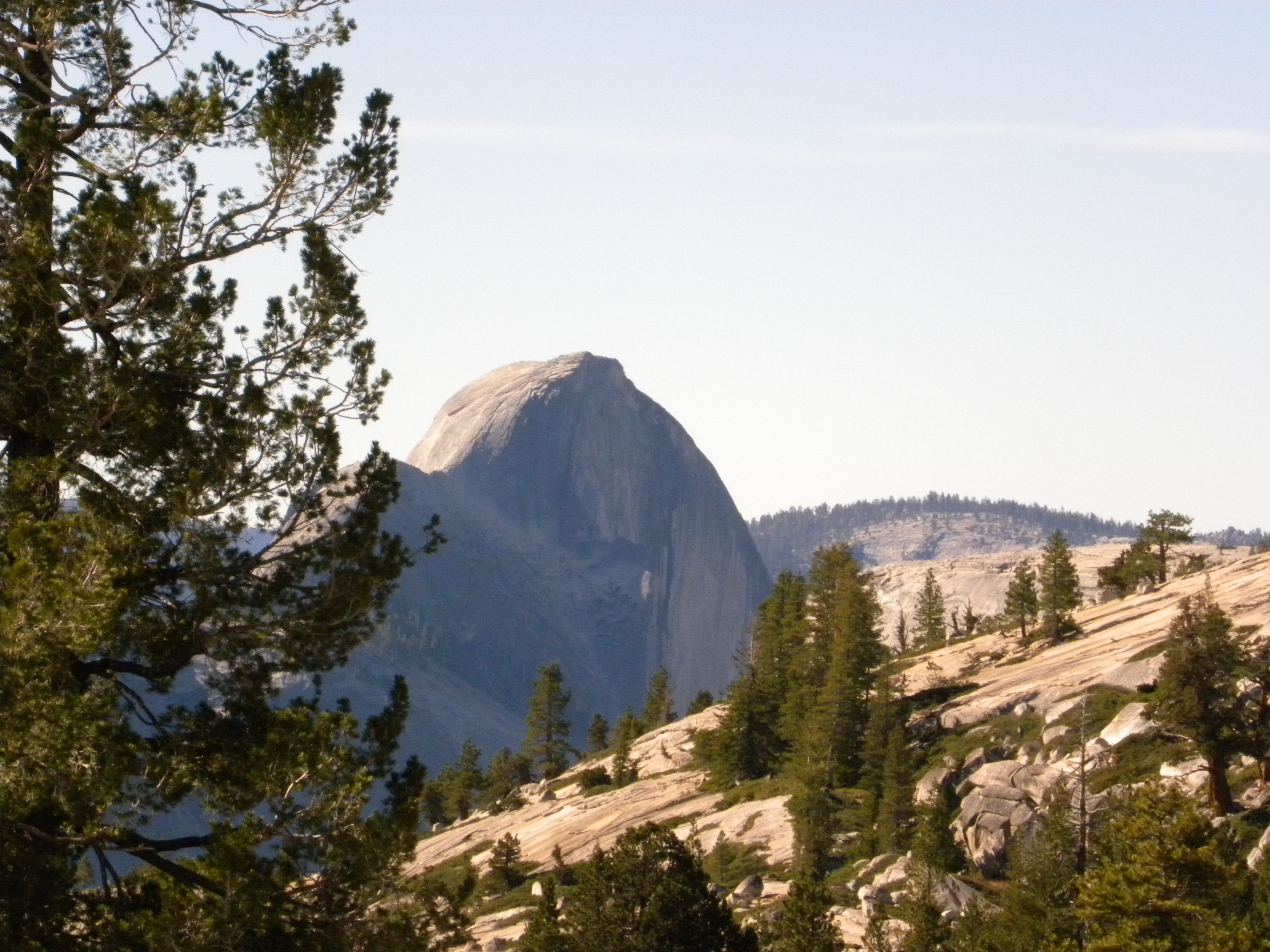
View from the pass of Half Dome

View from the pass of Half Dome

Driving through Tioga Pass, I couldn’t help but think of California’s state flag…the great Golden  Bear, a sub-species of our Grizzly, now extinct.

Black bears are ubiquitous in the Sierras.  I’ve heard from friends that back country hikers are now required to carry their food in bear containers when backpacking, adding lots of extra weight to their packs.  Last time I camped in Yosemite Valley, bears walked continually through our campground which was shared with dozens of other campsites.

So my question is…Why not introduce the great Grizzly back to California?  Hey, people are getting used to living with black bears.  It’s just a little jump from the Black to the Grizzly.  Besides, there won’t be so many black bears with a few grizzlies around as they don’t share territory easily.  A little bit of googling and it seems others are asking the same question.  Not many others though, but a few.

As opposed to the Greater Yellowstone Ecosystem which is higher, colder, and food scarcer, California is warm with abundant food.  Apparently, a hundred and fifty years ago, grizzlies were everywhere, gathering even in ‘herds’, unusual for the usually solitary beast.  Salmon, acorns, abundant wildlife, washed up whales…food was easy.  Seems like California harbored 20 percent of the 50,000 grizzlies that roamed the continent long ago.  Its a shame to waste all the protected spaces of Californias’ Federal and State Parks and Forests.

In addition, it might give pause to the growing population of California.  When I was growing up here, California had an already bulging population of about 12 million.  Now its pushing 37 million, too many people for the space.  Many of these newcomers are easterners and mid-westerners, looking for climate change, in denial of the natural dryness of the west.  I watched California grow in the 80’s and 90’s, developers building out-of-place Cape Cod style McMansions, tearing down ancient oaks to put in home vineyards with private labels for Christmas gifts, lawns and golf courses erected where there should be Manzanitas.  I suggest the only thing that might put a stop to all this madness is the great, top of the food chain predator–the California Golden Bear.

Now, in all seriousness, Californians have the room for a few bears.  Biologist Carlos Carroll maintains that the Siskiyou Mountains could maintain around 300 Grizzlies.  I’ve been to these remote mountains on the Oregon Border.  They would make nice habitat.  I’m thinking so would Yosemite, and Tahoe for that matter.  Wolves in California might be just too big a jump, but Grizzlies are actually easier to live with, tend to be solitary, populate slowly and are omnivorous.

I like having Grizzlies in my valley in Wyoming.  They make me aware.  They make me remember that life is wild and that I too am a child of the wild.  We humans tend to eliminate everything that threatens us.  But really, we can never fully eliminate all threats.  In trying to cheat death, we only cheat ourselves of our natural woolly wildness and loose touch with an important part of our soul.

Tracking class

I just finished the most awesome week in a tracking class with world renown tracking expert, Jim Halfpenny.   Lucky for me the class took place at a dude ranch 5 minutes down the road and although many of the ranch’s clients participated, the final day, Friday, on gaits. was attended by only myself.  So, I had a private lesson.  And as it turns out, gaits have always been difficult for me to understand.  I’m that person when you say “Raise your left hand”, you have to tell me “No, the other left!”.  And that’s why four-legged animals, with double the rights and lefts, confuse me no end.  Jim is a fantastic teacher and was able to simplify the whole gait thing for me.

Monday was a general introduction day.  Tuesday we all headed for the Park, leaving here at 5:00 am sharp.  We spent about 3 hours in the Lamar looking for wolves.  We did finally find one lazing around in the grass.  While everyone was waiting for that wolf to wake up, I spent some time checking the ridgelines and found 30 Bighorn sheep.  Then it was off to Canyon for a look at their new visitors’ center which opened this year.  I hadn’t seen it and I must say it was very impressive.  The displays were all centered around the volcanic activity in the Park.

After watching some coyotes catch grasshoppers and a lunch byt the river, Jim took us to a bear cave.  We hiked in about 1/2 mile.  This cave has been used on and off by bears for many years.  It looked tiny from the opening, but once you crawled inside, all 14 of us fit quite easily and we could even stand up.  It wasn’t smelly at all.  Quite comfortable I must say.

In the bear cave.  We all fit.

In the bear cave. We all fit.

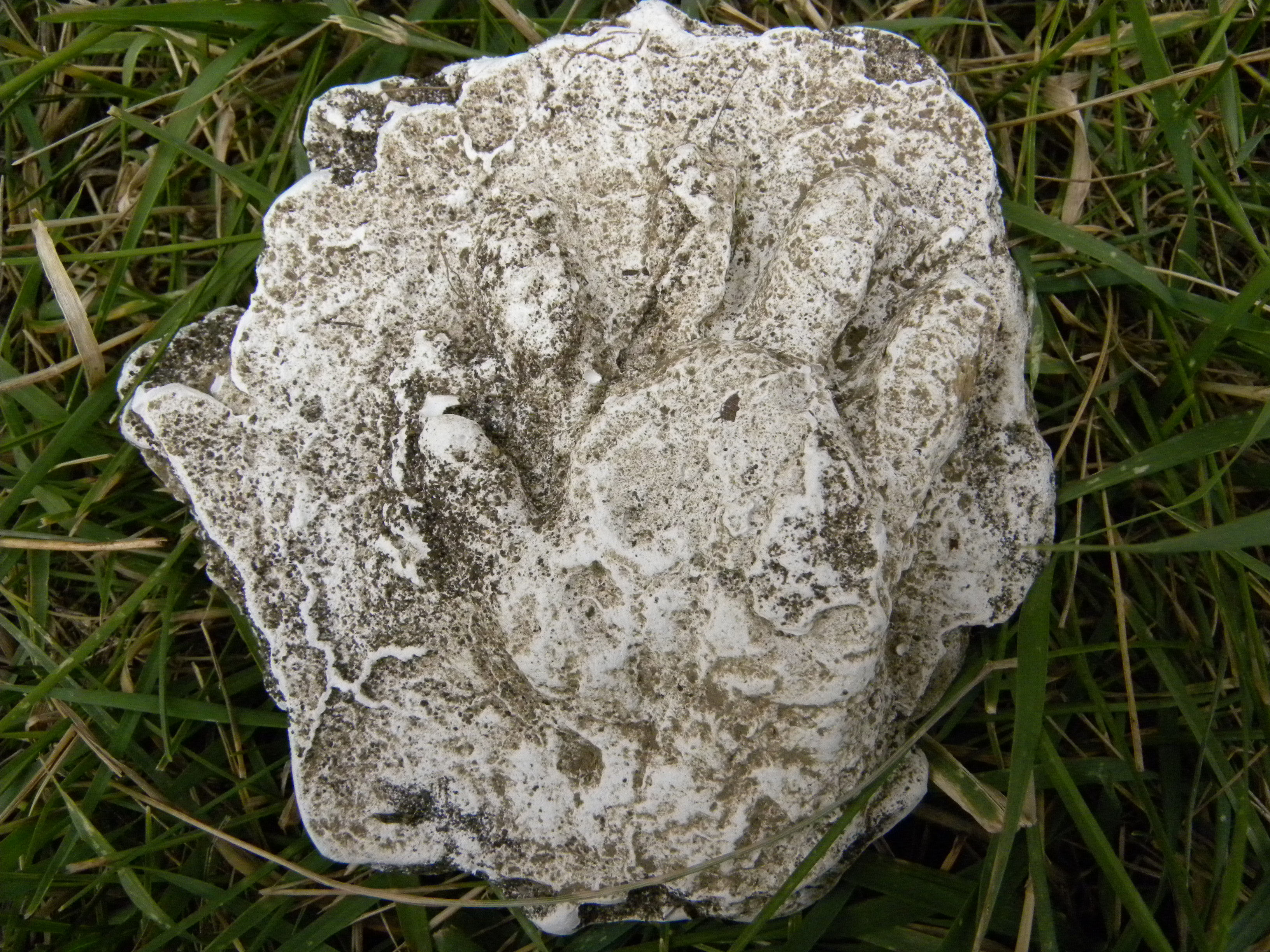
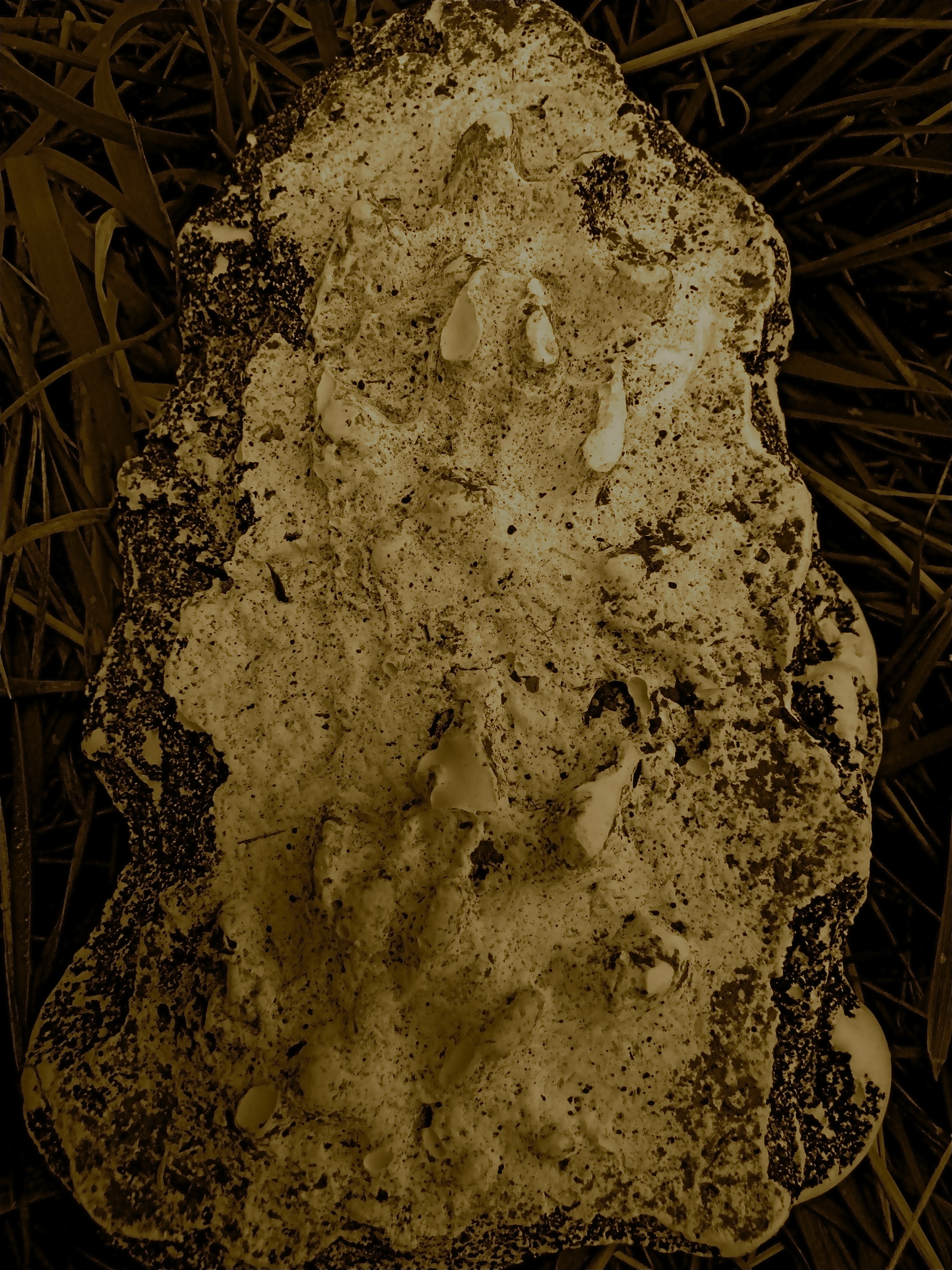
Thursday was devoted to time in the field finding tracks and casting them.  I was so excited because I’ve been wanting to learn to cast but wasn’t sure about proper technique.  We casted several different Grizzlies tracks, as well as raccoon, mink, and wolf.

Raccoon

Raccoon

Raccoon

Raccoon

Hard to see but these are mink prints!

Hard to see but these are mink prints!

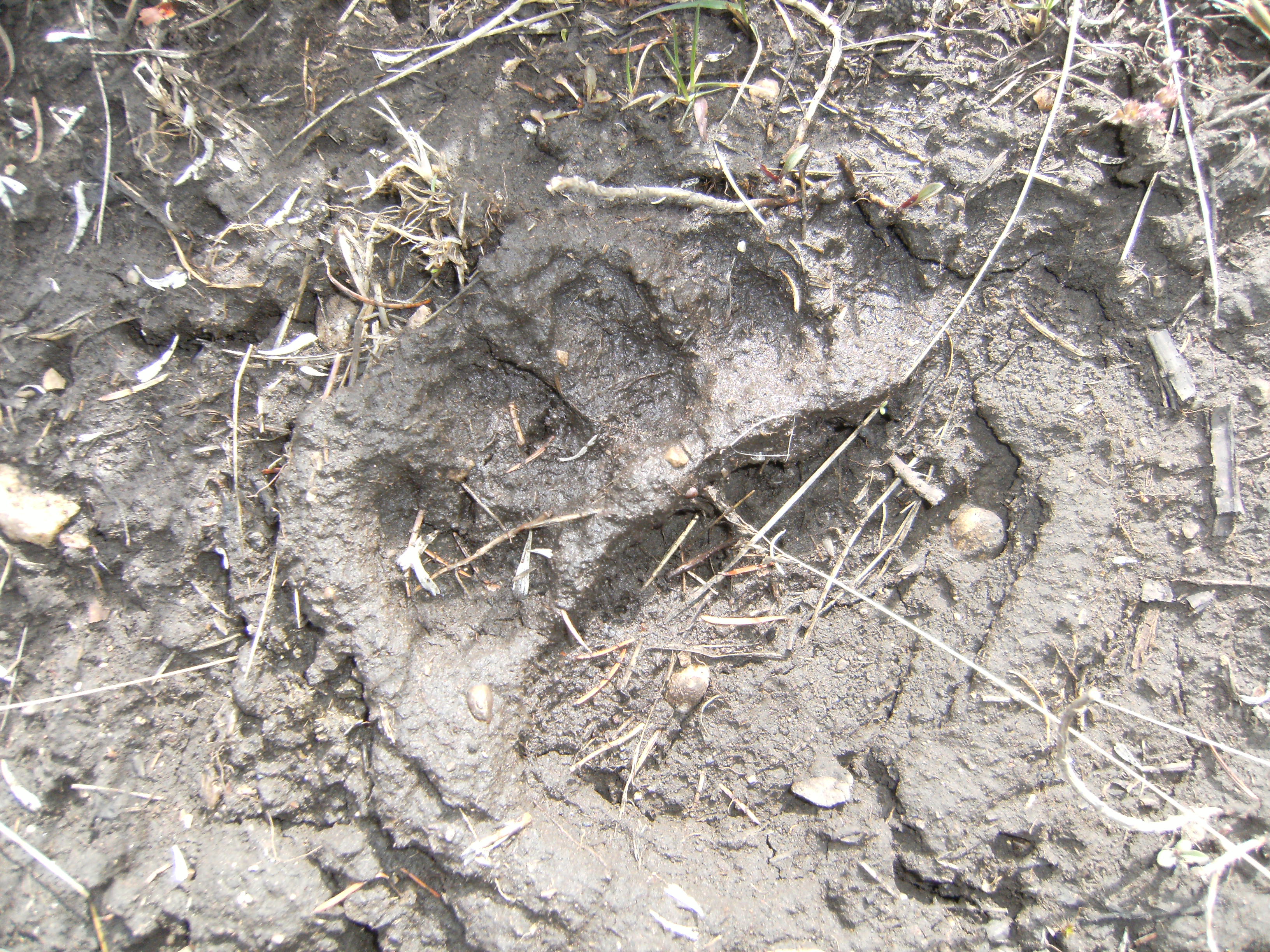
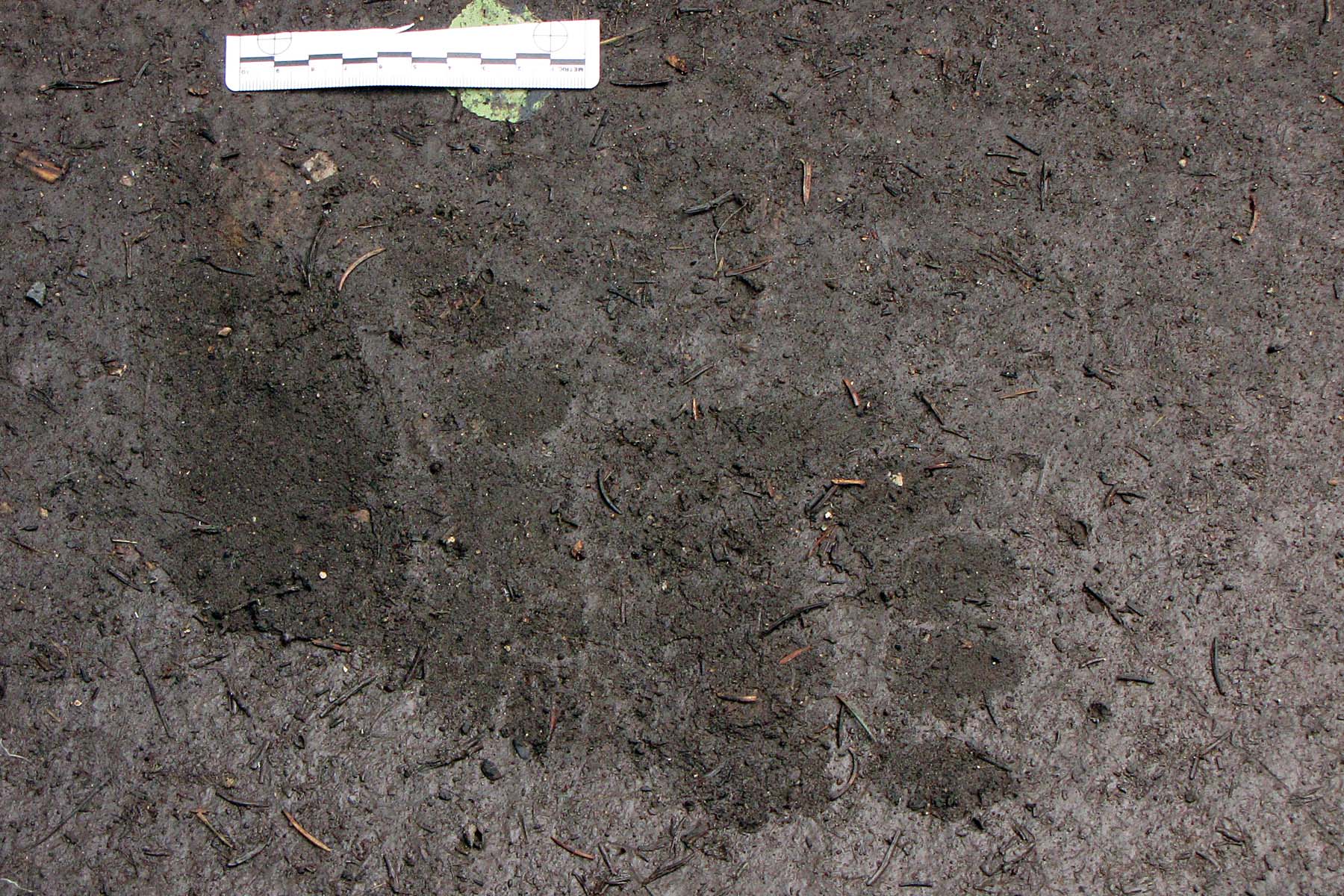
A Grizzly track found by the river

A Grizzly track found by the river

Here I am on Friday with my ‘graduation’ exercise.

I'm happy because I passed my final test and the hardest for me: gait I.D.

I'm happy because I passed my final test and the hardest for me: gait I.D.

Jim found a series of large dog tracks and I had to interpret what the dog was doing as well as  each foot.  I PASSED!   We also found more grizzly, moose, tons of deer, horse, and cattle (ugh!).  Now all I have to do is practice, practice, practice.

Clark’s Nutcracker and some five needled pines

Every morning I take a walk on the open meadows above my house dotted with Limber Pines.  Limber pines are technically in the white bark pine ‘family’, which consists of all pines with a cluster of 5 needles.  So when people say ‘That’s not a white bark pine, but a limber pine”, technically they are right and wrong.

Pinus albicaulis is the latin for the White Bark Pine, which is in the white bark pine group because its a 5 needled pine.  The Greater Yellowstone is at the very southern end of Pinus albicaulis territory.  Its a white bark pine that grows at very high altitudes.

I live at around 7,000 feet and, although we have P. albicaulis on our ridgelines, my zone consists of Pinus flexilis, or Limber Pine, another 5 needled pine.  Both produce cones with large, tasty seeds.  And its difficult to tell the two pines apart.  The best way is to look at the cones.  P. albicaulis cones are purple and disintegrate on the tree.  P. flexilis stay intact, are the usual grey/brown, and fall to the ground.

In the mornings on my walk, there’s lots of chatter these days.  The Clark’s Nutcrackers are busy. Clark's Nutcracker Their wings make a whirlwind noise, but their raspy call is distinct.  I watch them take their long beak and skillfully pluck out the large seeds.  They do it upside down or right side up.   Between the busy red squirrels caching all the seeds (they are also amazing to watch as they work the cones like an ear of corn) and the birds, its a wonder there’s any seeds left.  The crop seems to be good this year, as most of the trees have lots of good cones with few worms.  If I watch the squirrels, they know which ones have the worms and which are intact.  But I can always find a few opened cones on the trees, low down that I can reach, that have some missed seeds to eat.  My problem is that the cones are so full of sap, I’m a sticky mess just for a few pine nuts.

The nuts are good.  They taste like pinyon pine nuts (which is a 1 needled pine) and are about as big.  Some of the best and biggest pine nuts I’ve ever tasted are from the Italian Stone pine, Pinus pinea.  Its a beautiful tree and commonly cultivated.  But the Limber Pine nuts are good too, just harder to get out because they are tucked way down inside.

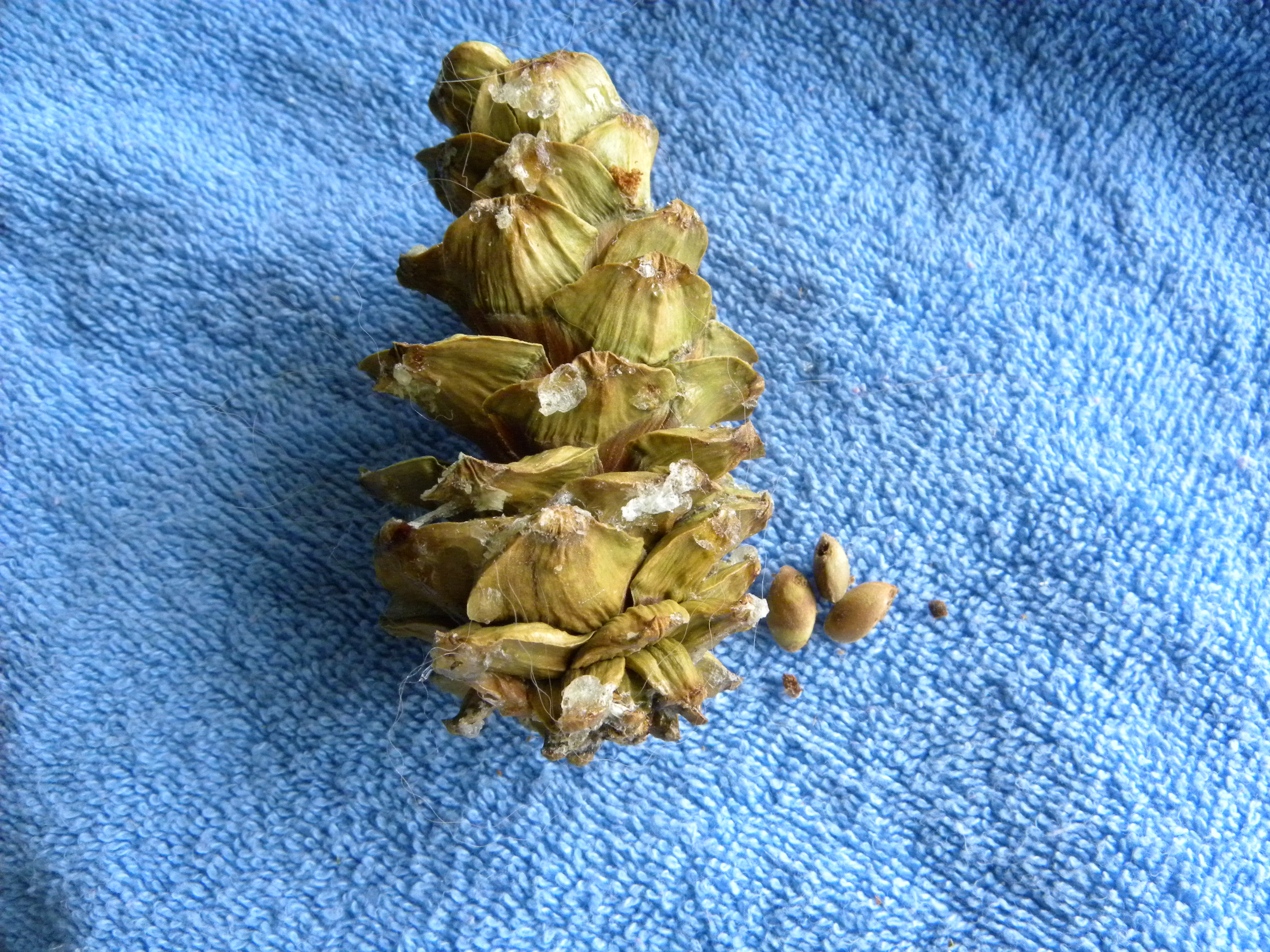
Limber pine cone with seeds

Limber pine cone with seeds and lots of sap

Limber, White Bark, and the Clark’s Nutcracker have evolved a unique marriage.  The two pines are dependent upon the bird for seed dispersal.  Unlike the fire adaptation of Lodgepole pines, whose seed cones open with heat, Limber and White Bark pines disperse their seeds through the bird, and prefer to sprout on the fertile soils after fires.

I asked a grizzly expert at the Shoshone ranger station if grizzlies will sometimes eat the seeds of limber pines.

“Not usually, because they are harder to get out, but they will.”

Grizzlies will reach up for the P. albicaulis seeds; they’ll climb up; and they are smart and look for the stashes of red squirrels and raid them.

By the way, after getting some pine nuts out of the sappy cones, I’m full of sap.  How to get rid of sap on your hands:  take some vegetable oil and rub it around; leave on for a minute; then wash with soap. Voila! Its out.  On your clothes?  Use a little WD40 before you wash.

Pine Beetles, Spruce Beetles, and what to do?

The County Fire Warden and the State Forester paid a visit to my neighbors last week.  There’s some money in the till to help homeowners clear dead and dying trees from their properties.  Since my area is full of beetle kill, and getting worse exponentially every year, we’re sitting ducks for a big forest fire.  The fires are going to happen, and need to happen for a variety of reasons, and the number one issue of fire fighters is saving structures (and lives of course).  If we can help out beforehand, all the better.

My neighbors and I have been talking about the little forest that surrounds us for several years.  Its mainly Spruce (Picea engelmannii)–old Spruce–and they are being hit hard by the beetles.   In fact, one of my friends counted the rings on a downed large tree–185!  That’s almost 200 years old, the average life span of a Spruce.

The Douglas Firs (Pseudotsuga menziesii) interspersed amongst them seem to be healthy for now, and all around the outskirts where there is light, as well as the areas where the spruce have fallen, Aspens are coming up.  The small forest is half private lands and half National Forest.  Its sits below a shelf of limestone where the springs run–our drinking water.  So the area is wet, and sometimes swampy.  The Spruce like this.  Upslope above the springs, it’s mainly Douglas firs.  Higher than that, there is less ground water and the forest turns into a mix of Limber Pine (Pinus flexilis) and Doug Fir.

I don’t own land in the Spruce forest so I was not a part of the walk-through, but I was told that the way the money from the State will flow is more reimbursement for the first acre around structures, and then the reimbursement percentage diminishes the further out you go from buildings.  The recommendation was to have one logging company do the whole job.  It wouldn’t be clear-cut.  They’d be taking out dead standing trees as well as clearing (probably burning) ground fuels.  The spruce are in such bad shape that there’s no money in it for useable timber.  Its good for firewood and/or log cabins.

My friend who was a forester for over 30 years cleared up some misnomers for me.  I asked him if it was true that standing dead trees were no more a fire hazard than standing live trees.

“True”, he said, “but trees with dead needles are like a torch.  Dead needleless trees are equally a fire hazard as live green ones.  What’s the real hazard is all the ground fuel.  Crown fires can’t usually continue very far unless they have fuel below to ladder them up.”

I made a point to mention to the State Forester that our small forest is home to moose, three species of owls, deer, turkeys, bears, and various obvious small birds and mammals.  Sensitive logging is imperative.

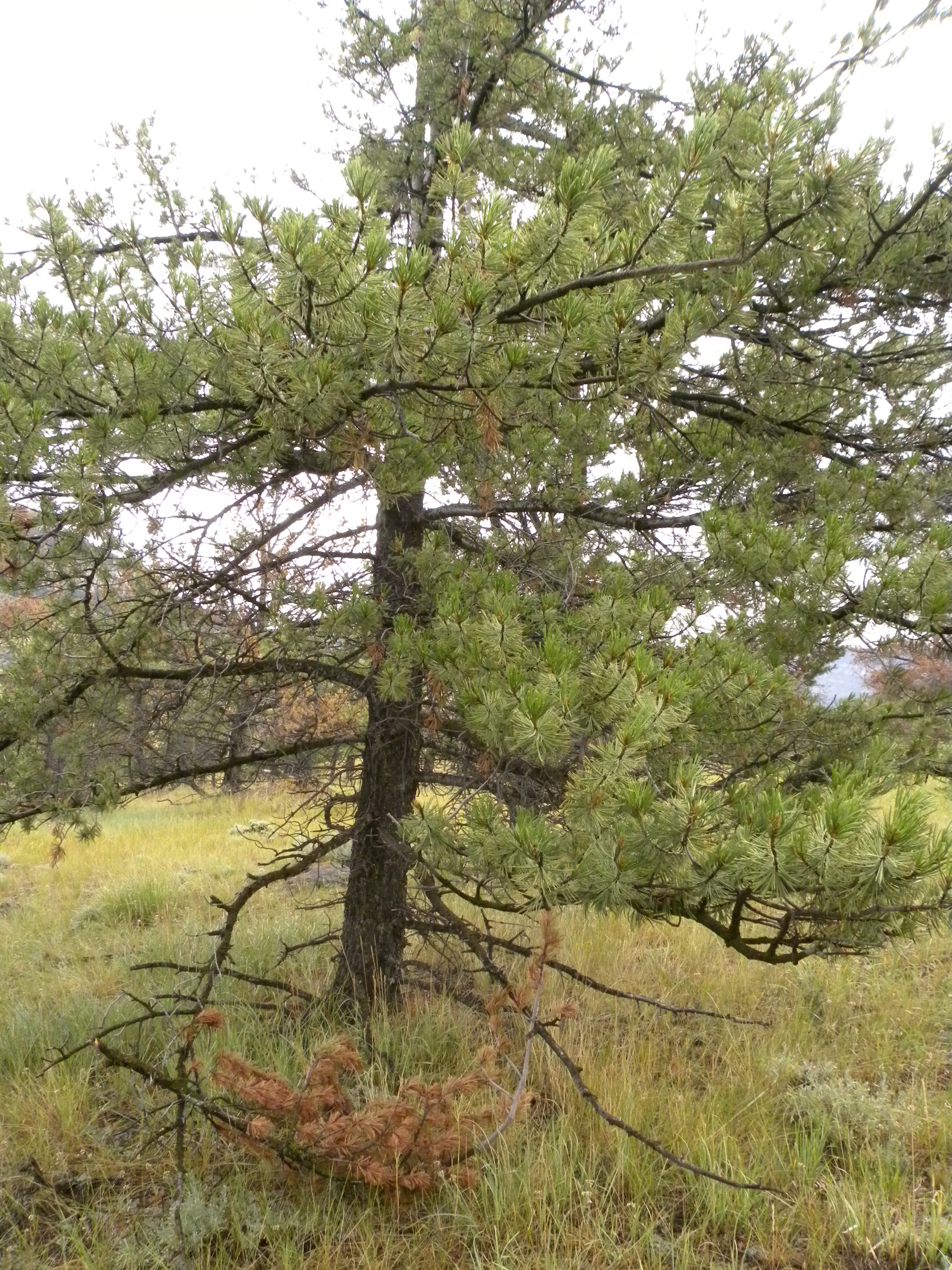
When they had finished with the Spruce forest, they showed up on my property and we walked to my upper area which is Limber Pine exclusively.  When I first got the property several years ago, there were no dead trees.  Last year I noticed I had blister rust, which I’m sure they’ve had for years.  But this winter I had several trees suddenly die on me from pine beetle.  I was anxious for the State Forester to see my trees, their health, and show me how to identify beetles and explain in detail their life cycle.

Apparently, the pine beetle has a one year life cycle as opposed to the spruce beetle which has a two year cycle.  The beetles fly sometime in the late spring, find a tree or trees (they look for larger ones), lay their eggs, and the larvae overwinter and feed on the tree.  The beetles make tunnels, called galleries, laying their eggs as they go along (and eating the tree as well).  The Forester found a cluster of infested trees on my property in one area.

Last years kill

Last years kill

He took an axe and cut into the bark, exposing the tissue of the tree beneath and showed us the galleries along with a beetle (quite small).
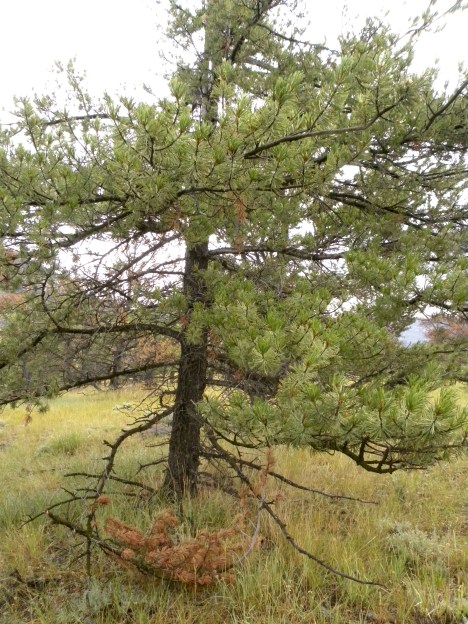
This tree is a goner

This tree is a goner

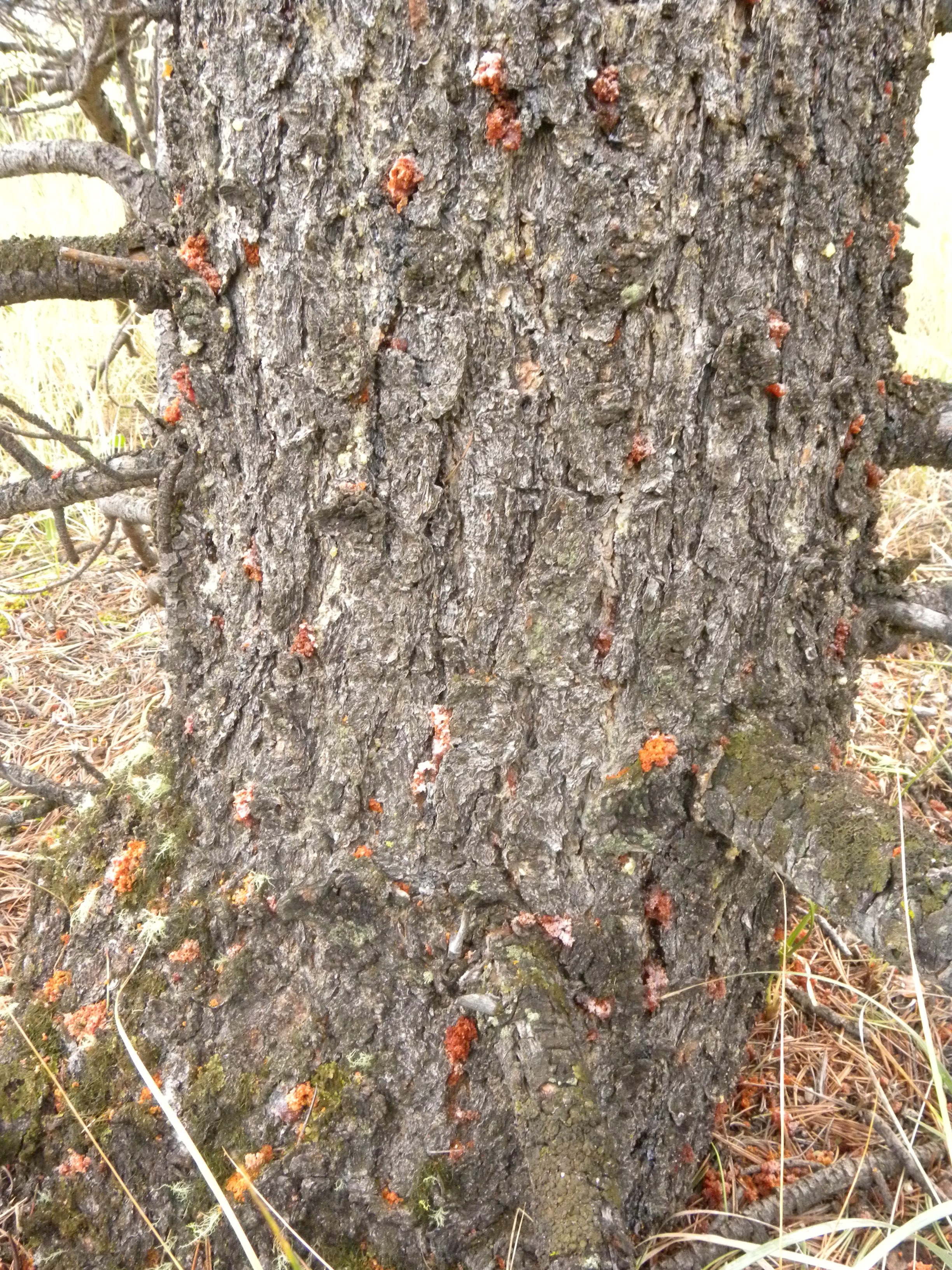
The identifying feature on my Pine trees is the frass(tissue or wood of the tree) at the base of the tree as well as the holes with pitch and frass where the beetles have bored and the tree is trying to ‘pitch’ them out.

Frass at base of tree

Frass at base of tree

If the infestation isn’t too bad, if the tree isn’t stressed by other factors such as drought or disease, then a tree can usually fend off the beetles by producing a lot of sap or pitch in the wound, just like your body might get rid of a splinter.  But between the extended drought years and the blister rust, many of my trees are succumbing.

Tree trying to pitch out beetle

Tree trying to pitch out beetle

What can I do?  Not much.  The pines that are dead no longer have beetles in them.  I can use them for firewood or leave them standing dead (better to take most of them down to reduce the fire hazard, although Limber Pines usually don’t present much of a fire hazard as they burn out).  The ones that have infestations this year I should cut down this winter and burn them onsite.  Burning will kill the larvae, insuring those beetles won’t fly next spring.  And the old specimen trees I want to save I could put pheromones on (He says that’s iffy at best) or spray with Sevin (toxic chemical) which works well.

In addition, I’ve noticed that there are very few young trees on my property, or on the Forest Service property next to mine.  This is probably due to a combination of drought, poor seed production, and blister rust, which has hit the young trees hard.  I suggested, and they agreed, that I begin a planting project of seedlings.  There’s no money for replanting in Wyoming.  Montana or Idaho might give homeowners money for that, but Wyoming doesn’t (not a heavily forested state).  I’d be planting for the future.  Pinus flexilis takes about 40 or 50 years before it begins to cone and produce.

One thing I can do is pray for 2 weeks of cold weather.  20 degrees below zero for two consecutive weeks kills the larvae.  We haven’t had that for years, and with global warming (or climate change, whatever you want to call it), that kind of cold is getting harder and harder to come by.

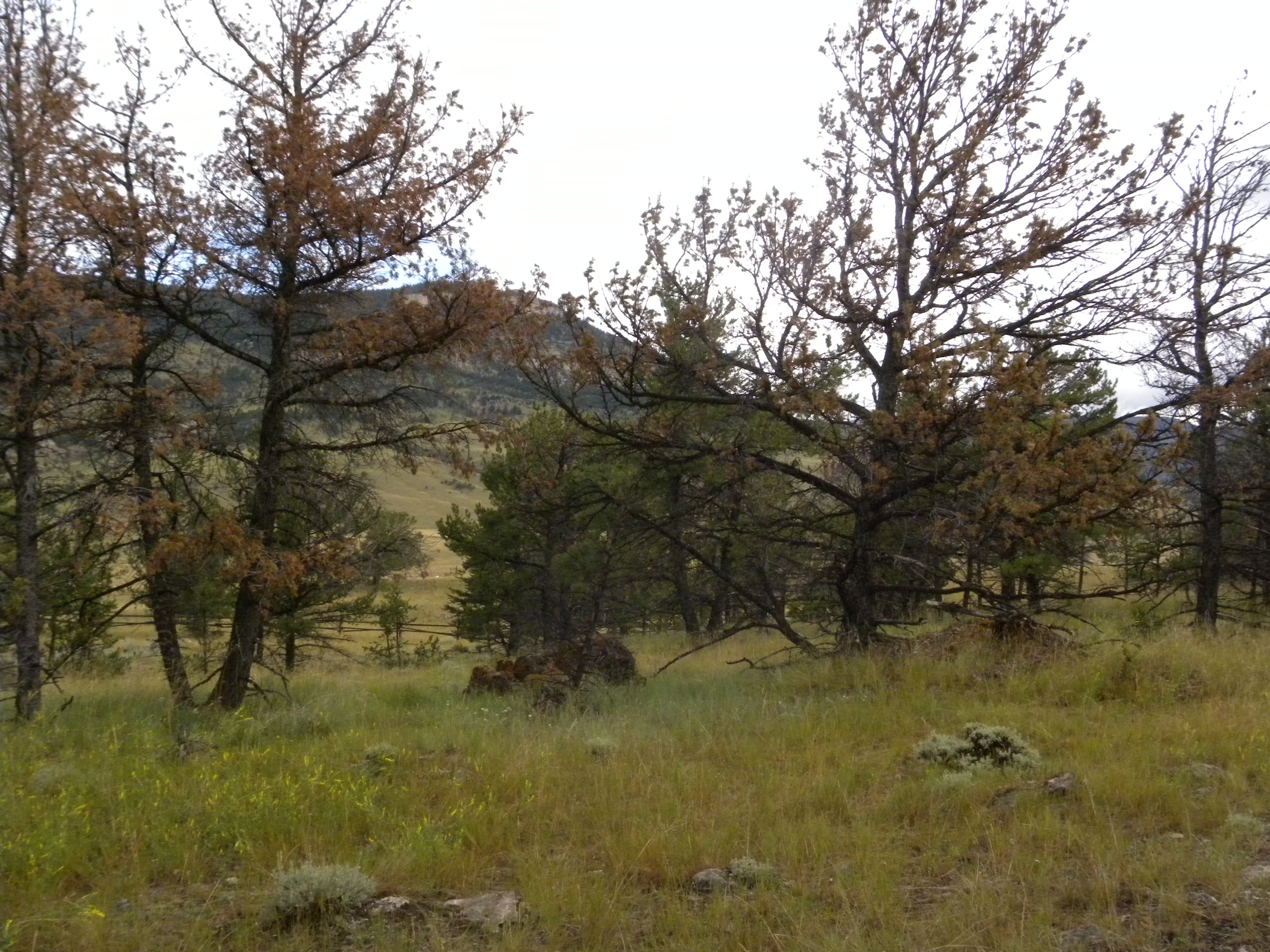
For now, it looks like the trees have ‘the plague’.

This tree looks like it has smallpox!

This tree looks like it has smallpox!

Of course, these cycles are natural in nature.  The Spruce will disappear and be replaced by Aspen, as well as young spruce and doug fir.  The Limber and White Bark are more problematic–between non-native Blister rust and native pine beetles killing whole forests, these pines contain nuts that are the fall food for Grizzlies.  They need the fat for their winter hibernation.  Pine nuts are to the Grizzlies of the Rockies as Salmon is for Grizzlies of Alaska; and as the trees disappear, another food source will be needed.  With warmer winters come shorter hibernation periods.  I suspect that will mean more Grizzly/human interactions and that, of course, means bad news for the bears.  Bears never are the winners in conflicts with humans, at least in the long run.

Last summer I spotted a government vehicle next to a nearby Aspen grove.  I stopped and chatted with the plant pathologist working on a 5 year Federally funded Aspen study in the Western U.S.

“The Aspens in Colorado are dying, by the droves, and no one knows why,”  he told me.

I asked about our trees.

“They’re just dying of the usual pests and diseases.”

Things are changing all over the West, in so many unpredictable, unusual, and new ways.  Dogwoods, Magnolias, and Redwoods once grew in Yellowstone, millions of years ago.  Twenty two different species of Redwoods were native to the United States.  Now only two species grow in just a tiny portion of California.  We’re in for some big changes.

A surprise walk

Its starting to feel like the Canadian Rockies here, raining every day, even if just a little bit.  Last fall I had driven up an old fire road that’s usually closed.  I wasn’t sure if they only opened it in the fall for hunters, so I took a drive over there, and sure enough, the road was closed and the gate locked.  I parked and walked up the dirt fire road that leads to high meadows.  This area was home to the ’88 fires and the lush undergrowth shows it.

There’s been so much rain that the forest is lush.Lush forest

More and new wildflowers appear every day.Paintbrushes

Calypso bulbosa - Fairy Slipper Orchid-endangered

Saxifraga odontoloma

A loud almost bell-like sound announced the presence of a marmot hanging in the rock pile below us.  Koda went crazy.  He knew he couldn’t get to the marmot, and that fat marmot just kept teasing him.Fat Marmot

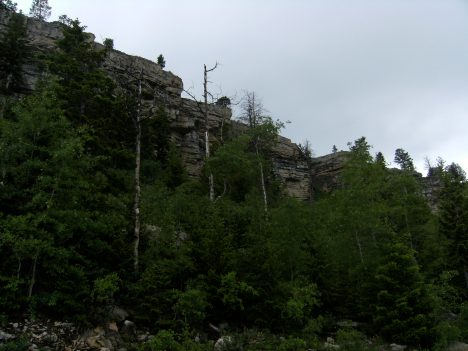
As we ascended higher, the reef cliffs came into view.  A Golden Eagle sat in a tree near the old road cut.  Our presence caused him to take to flight.Looking up at the limestone reef

There was a lot of fairly fresh grizzly scat along the road, but the only recent prints were elk.  Occasionally there were faint bear tracks, and it seemed like there might be two bears, indicating a sow and cub.

Pretty fresh bear scat.  Can you see the penny at the right for size?

Pretty fresh bear scat. Can you see the penny at the right for size?

Along the road, there were lots of berry bushes–thimbleberries and raspberries.  A perfect place for bears in the fall as well.

Thimbleberry

Thimbleberry

Way up near the top of the ridge, I suddenly heard a loud high-pitched consistent chirp or call.  I thought it was coming from a large bird and looked towards where I heard the sound, down the hillside.  Meanwhile, the smart animal with me, Koda, was looking up the hillside into the wooded bank.  I turned around and there was an elk in the timber.  Confused about the sound, it seemed to have been coming from the elk, although not at all like the bugling I’ve heard in the fall.   It was a contact call I found out later, between that elk and her calf.

As we headed towards the top of the ridge, an old fire cut from the ’88 fires, now overgrown, was covered with Geraniums.  Apparently these plants like disturbed areas.

Geraniums in disturbed area-old road cut

Geraniums in disturbed area-old road cut

The ridgeline meadows were magnificent.  Plenty of water and waterfalls along the way.  So much water so high up.  The old fires had provided great forage areas.High meadow and old burn

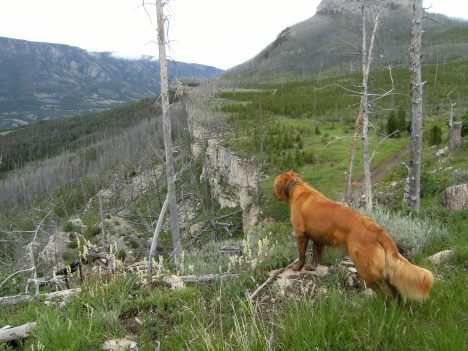
Koda catches a whiff

Koda smells out the grizzlies

On the way down, Koda stopped at the cliff edge.  I thought he was looking at the view.  My old dog used to relish the views from high ridges.  But Koda is different.  He’s still young and not prone to being pensive nor reflective yet.

I stepped to the edge and noticed two grizzlies below in the tarns.  I don’t know if Koda saw them, but he certainly smelled them.  I bet they smelled us too.  At first I just saw a smallish black bear, and, from afar, tried to make out whether he was a grizzly or not.  It was hard to see the hump or his face clearly enough.  But then, following about 20′ behind, I saw a large brown grizzly.  I assumed the black bear was her two year old cub.  Unfortunately, I didn’t have my new camera with me so the shot is far away.  But, that’s about the distance I like to see bears from.

Look close there's the grizzly

Look close there's the mama grizzly. Black cub is in the upper left corner.

I glassed the bears for as long as the mosquitos would let me.  They moved down the mountain, through the scree and downed timber, foraging as they went.  What a privilege to see these magnificent animals.  As always, I carry bear spray, but what I use the most is my mosquito spray!

More Grizzly news around town

The Wyoming Game and Fish is finally starting their bear trapping and collaring in my valley.  They were supposed to start weeks ago, but the weather was too incremental, with several wet snowstorms, making it impossible to get far enough in to place the traps.  I know this only because one of the students who worked on the elk project this winter was supposed to help with the trapping.  Instead, because the work was delayed, he’s already off to Canada to work with bears there.

Our main dirt road travels directly west, ending about 7 miles from the Yellowstone boundary.  But those seven miles are straight up, through the shale and scree of the Absaroka Mountains.  If you can make it over the pass, you’ll end up in the Hoodoos, one of the most remote areas of Yellowstone.

Past the bear gate, the Absarokas are the eastern border of Yellowstone's wilds

Past the bear gate, the Absarokas are the eastern border of Yellowstone's wilds

The dirt road is maintained for about 25 miles from the Chief Joseph Highway.  After that its strictly four-wheel condition, and mostly only ATV’s can cross some of the creeks at the upper ends.

Past the bear gate its rugged and wild country.

Past the bear gate its rugged and wild country.

About 20 miles from the main highway, the road is closed till July 15.  That’s the ‘Bear Gate’.  People ask “Is that so the bears don’t get into the populated part of the valley?”  But the gate is so cars don’t go up there and disturb the bears.  The idea is that the Grizzlies can have their own space, undisturbed by cars, atv’s, people, when they emerge from their dens.  Its a great idea, but of course the grizzlies do what they want and roam free, which means they are up the valley this direction if they please.  But it does help to discourage weekenders and reduce human-bear conflicts.

Where do they go after July 15th?

Just 10 or 15 years ago, no one knew where Grizzlies went when they suddenly disappeared from the Park in early July.  One day a private plane was flying over the Absarokas and saw bears, lots of them, congregating on slopes of scree above timberline.  They were turning over rocks and boulders.  Usually solitary, this was a strange site to see groups of bears together.  It turned out they were looking for cut-worm moths and eating them at the rate of up to 40,000 a day.  I once saw these moths in the Wind River Mountains.  Thousands of them hanging under a rock crevice.  It was a sight I won’t forget.

The moths provide the bears with much needed fat for the winter.  At the end of my valley there is a glacier.  Its not uncommon to find the bears in the talus slopes in August.

Moths at high altitudes attract bears in my valley in late summer

Moths at high altitudes attract bears in my valley in late summer

Today I drove up the valley for a short hike across the river to a Sulphur Lakebed.

Sulphur deposits around the lake.  Lots of grizzly sign here

Sulphur deposits around the lake. Lots of grizzly sign here

On the way, I stopped and chatted with some new young forest rangers.  I asked about the collaring and if it had begun.

“They’re trapping at the bear gate.  Just a bit beyond it.” They informed me.

I said I wished they’d let us residents know so we don’t hike there.  They put carcasses out as bait and I don’t want to be nearby. “I wish they’d tell us”, the young rangers replied.

I suppose its good science to have them counted and collared.  But I can’t help but feel “let the bears be bears.”

My hike today on the south side of the creek, quite a ways down from the bear gate, was full of fresh bear tracks and scat.

Front and back grizzly tracks.

Front and back grizzly tracks. Notice the penny for size. See the straight line of the grass under the toes

On the way back home, I met a neighbor who told me there were fresh tracks behind his ranch and he’d led the G&F fellows up to where they could place their traps.  There was a huge pile of scat on the road as well. Last week I ran into fresh tracks in two drainages on the north side of the road.

Bear scat with trash collected on my hike today.

Bear scat with trash collected on my hike today.

My valley is where ‘problem bears’ are dropped off.  They take them to the bear gate, or beyond, and let them go, with the hopes they’ll go into Yellowstone.  A problem bear was dropped off just last week.  I think we average about 4 or 5 problem bears a summer.

Several years ago, I had the privilege of riding around with Mark Bruscino for an afternoon of bear education up the North Fork.  We didn’t see any bears, but I learned a lot talking with Mark.  Mark is the bear specialist for Wyoming Game and Fish.  He’s been working to restore the Grizzly population for over fifteen years.  I asked about the problem bears.

“Tell people that the bears they really don’t have to worry about are the problem ones we drop off.  Within days they ‘home’ back to where they came from.”

I think the relocation is an exercise in public relations, with a hope and a prayer that the bear learns something once he gets ‘home’.

The cool thing about hiking in grizzly country is the need to stay alert and aware.  In California, I could hike, think, talk, and space out all at the same time.  But hiking here, in the Greater Yellowstone area, I have to stay aware of my environment all the time.  I listen, I slow down, I look around; and so I notice so much more.  That doesn’t mean being tense. It means being conscious.  I think that’s how we’re all meant to be living all the time.  Taking the predators away, well, we’ve just forgotten.

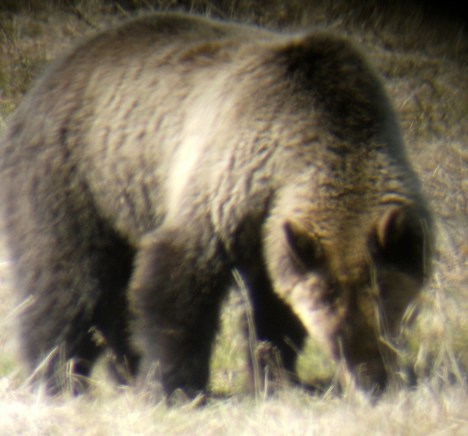
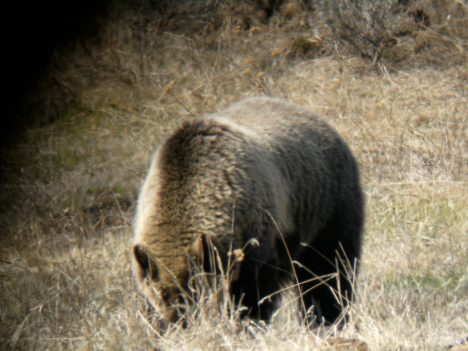
Grizzly photo taken in Lamar Valley last sunday, mother's day

Grizzly photo taken in Lamar Valley last sunday, mother's day

An Advertisement for Yellowstone!

Happy Mother’s day.

Since my son is in New York, I gave myself a present.  The last few days have been either too busy or too cold to go into the Park.  I heard the road opened earlier than the scheduled date, Friday, the 8th.   So on Thursday I headed up towards Cooke City.  I never made it because of a snow storm.  Not that the snow was so bad, but I figured the animals wouldn’t be out.

This morning I woke up early and was out the door by 7am.  I’m only 40 minutes from the Park’s entrance; an hour from the Yellowstone Institute in the Lamar Valley.  Because I had the dog, my plan was to visit for 1/2 day, and take a hike outside the Park the other half, with the dog.

In the span of those 3 hours in the Lamar (or on my way there), I saw: (disclaimer…sorry my photos up close are not great.  I just have a small digital camera that I use because its lightweight for hiking.  Maybe I need to get a better one as well.)

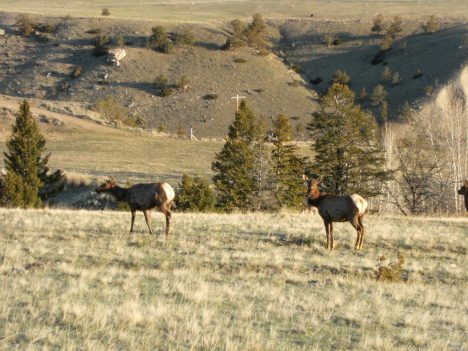
Elk in my Valley.  I thought elk on left looked quite pregnant.

Elk in my Valley. I thought elk on left looked quite pregnant.

First thing on the way to Chief Joseph were some early morning grazing elk.  They are getting ready to calf soon.  My neighbor, on whose pasture these elk are grazing, called me yesterday to tell me to watch my dog as a wolf walked past her daughter yesterday.

Moose on Chief Joseph Highway

Moose on Chief Joseph Highway

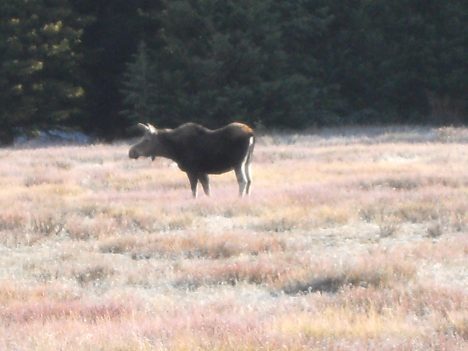
These two moose were up past the 212 turnoff to the Park, right alongside the road.  I didn’t see any moose in the Park, although usually some hang out in the river right past the NE entrance.

This one just sat and watched me.  She had frost on her fur.

This one just sat and watched me. She had frost on her fur.

Here’s the approach to the NE entrance.  There was no ranger at the gate today, so no entrance fees.  Happy Mother’s day.

Entrance to Park

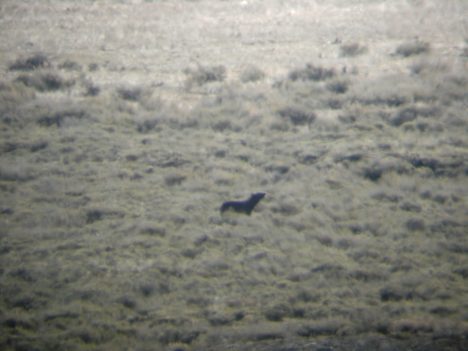
Not too far into the Lamar Valley, I stopped by a crowd with scopes.  I watched 2 wolves for a long time, one a collared gray female and the other a black.  They seemed to be trying to figure out how to cross the creek and road to get back to their den on the other side.  There was a lot of howling and prowling.

This is through the scope.  He was way across the Lamar river.

This is through the scope. He was way across the Lamar river.

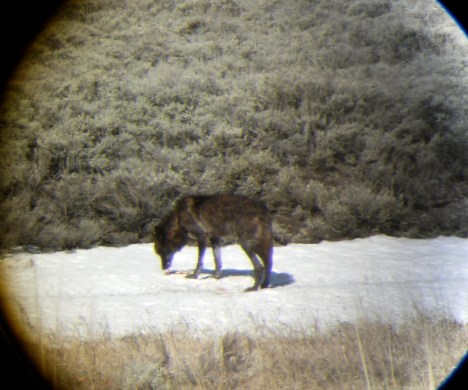
Pronghorn were all over the hillsides.  Bighorn sheep were grazing high up.  I continued down the road a bit, still wanting to see some Bison babies, when I was distracted by another black wolf of the Druid pack, very close to the road.  I stopped and watched with my naked eye.  He was walking back and forth along the stream bed.  He was so close to the road that I thought he wanted to go to the other side as well.   Suddenly, he had something in his mouth.  It was a fish!  He brought the fish over to a nearby snowbank (all this within 200 feet or so of the road), played with it,  rolled on top of it, then devoured it as a magpie watched.

Wolf eating a fish he just caught

Wolf eating a fish he just caught

Wolf eating a fish

Wolf eating a fish

Finally I moved on to see the Bison calves.  The one animal we don’t have in our valley next to Yellowstone is Bison.  They wouldn’t be allowed to migrate out of the park.  Granted, they do shoot a lot of wolves outside the park, but they return and soon reform local packs.  In addition, each state is required to have a certain amount of wolves in their delisting program.  But Bison no state will tolerate because of the perceived threat of brucellosis to cattle.

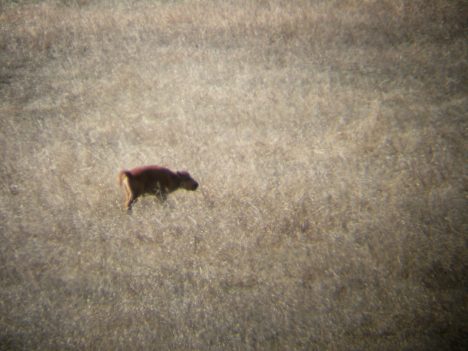
Here are the baby pictures:

Bison calf

Bison calf

Mom with two calves in the grass nearby

Mom with two calves in the grass nearby

If all this wasn’t enough (I’d barely driven a mile within the Lamar), I went a short distance down the road to view the Grizzly hanging out within 100 feet of the highway.  He’d been there all morning.  On my way, another black wolf walked through a herd of grizzlies.  He was joined by a grey and they both began howling.  They were answered by a wolf on the other side of the road, not visible to me, near their den site.  A coyote began yipping in tune to the wolves, and then he sauntered across the road.  Several Red Tail hawks circled overhead, while Sandhill Cranes walked along the water’s edge.

Here is the bear:

This grizzly spent hours upturning Bison paddies for insects underneath

This grizzly spent hours upturning Bison paddies for insects underneath

Grizzly rooting around

Grizzly rooting around

I’ve oftened pondered what makes for that special nurturing quality of Yellowstone.  I left the valley and could feel its warm embrace.  There is so much life there.  The animals seem at peace, not threatened.   They are simply doing what they do, going about their business.  There is always a palpable feeling in the air there, like a slice of heaven.  Is it the volcano living underneath?  All the hot springs?  I think its where the natural order of things are in place.  In Yellowstone, man is not the top predator.  This has been so for generations upon generations of wildlife and they ‘know’ it.

It is time to acknowledge Yellowstone for what it truly is–the serengeti of North America–and treat its surrounding environs as such.  Outside of the Park, they are supposedly ‘protected’, but special interests always come first.  Buffalo cannot migrate to lower ground in the winter or they are killed; wolves even when they weren’t delisted were killed regularly (they know what the sound of a helicopter means outside of the Park); right now is bear hunting season in my valley.

The income from open grazing or from hunting tags pales in comparison to tourists coming to see our ‘Serengeti of wildlife’.  Having the Cattle or Sheep lobbyists win every legislative battle is old school.  It is time we see what we have here that is truly of value, and so unique.  It is time to preserve this land of the Greater Yellowstone Ecosystem, not just Yellowstone Park, and manage it with wildlife as the number one priority.

There couldn’t have been a better advertisement for Yellowstone as this mornings two hours in the Lamar Valley.

Grizzlies and the Edge of Eden

The last two days I hiked into several drainages where the hottest spots of the Yellowstone 1988 fires burned.  After 20 years those soils are still so sterile that no new trees are growing.  Hottest area of the '88 fires.  Sterile ground, good forageThis is an area of excellent forage though, with young sweet grass and sagebrush.   Pulsatilla flowers just emerging nowThe snows are just beginning to melt and seasonal streams are running.  With a forest of dead timber, standing and downed, the run off will be fast and furious.  But its early still and the streams are gentle.  A huge log jam up river, crazy every which way, testifies to last years’ fury.

In summer, without the advantage of shade,  this place is too hot to hike in.  In the fall, it is full of hunters hoping to kill bull elk migrating from the Park. There is a strangeness here, the dead trees stand as sentinels against the hoodoo-like rock carvings from ancient lava flows.Dead trees and lava hoo doos

This is grizzly country.  They inhabit these draws, drainages that rise abruptly into high meadows; forests thick with Lodgepoles and Limber  Pines.  Spring is the best season here.  The dead timber provides homes for insects that attract an abundance of birds.  A woodpecker fights a flicker for territory, running him around and up a dead tree.  Finally the flicker retreats.  I find it curious this jockeying for dominance in an area of abundant food.There is a strangeness here

We saw grizzly tracks both days.  On the second day we followed a grizzly trail, although we were backtracking him. Grizzly track The trail, not on the map, was a highly used game trail that went up the wide mouth of the drainage. At times the downed trees were so thick the trail disappeared.  When the trail faded, we watched where the grizzly had chosen to go, figuring he’d have taken the path of least resistance.  It led up the creek bed, the stream disappearing and reappearing in odd places.   At one point, we crossed under a large downed tree trunk,.  The tracks passed directly underneath so we looked for fur stuck to the nubby remains of the branches.   There were a few hairs there.  Claw marks on trees noted where a grizzly stopped to mark his territory.  They were so high I couldn’t reach them.  That’s a big bear.Grizzly scratches on pine tree
Another tree with grizzly marks
A coyote,  running in our direction on the far side of the draw, suddenly smelled or heard us, and decided to turn back.   A bloody leg dangled from his mouth.  Koda noted the spot near the trail where the kill might be, but I called him back, fearing we’d find that grizzly there.  On the way back down, we walked over to the site Koda found.  A kill a few days old, the only remains was a small rib cage of a young elk or deer.

Its grizzly time right now.  They won’t be going high to find their moth sites until sometime in July.  Tonight  I watched a powerful video about  Charlie Russell called The Edge of Eden: Living with Grizzlies.   Charlie grew up in Canada  on an outfitter’s ranch.  He was a cattle rancher for years and had to deal with grizzlies.  He found that if he left out some winter kill cattle for the hungry grizzlies in the spring, they’d leave his cattle alone the rest of the year.  He wanted to understand grizzlies better and went to Kamchatka, Russia where the local zoos kill orphan cubs.  He began bringing these cubs back to the wilds, acting as their mother and protecting them for a year, sometimes two, then allowing them to roam free.  It’s a marvelous video  (that won several  film festivals) and story about a man trying to help restore respect for the grizzly as well as pioneer new strategies for those living in grizzly country.  To order the video, contact skyfilms@xplornet.com.