• MY BOOKS ON WILDLIFE, GARDENING AND MORE

  • The Wild Excellence

  • True stories of wildlife encounters around the Greater Yellowstone
  • Award winning eBook on Decomposed Granite, tips, how to's, what to watch for
  • Children's book. True stories of a dog and wolves. In a dog's voice
  • Written for dry Mediterranean climates in California, north and south

“Wolfer”

I’ve just finished a great read.  Carter Niemeyer’s new memoir Wolfer.  I’d say its a must for anyone living in the West, or anyone interested in the conflicts around wolves.

Niemeyer tells his story of growing up in Iowa, learning how to trap.  He trapped for a living, got his masters in biology, then took a job in Montana where he spent the rest of his life.  He worked for over 25 years with Animal Damage Control  (that changed its name once wolves were on the scene to the more innocuous ‘Wildlife Services’), then was chosen to be a key player in the wolf re-introduction in the mid-90’s.  He’s an engaging and honest writer, weaving his personal story from a ‘killer’ of animals to a staunch and courageous supporter of wolves in the lower 48.

One of the things I love about the book is his descriptions of going out to investigate livestock damage.  Several years before re-introduction in 1995, wolves were beginning to come into the U.S. by the Montana-Canadian border.  Talk of the re-introduction stirred the rumor pot as well.  Carter was the most experienced trapper for Animal Control, and at that time he was a supervisor. So he was the one sent out on almost all of these calls.  Neimeyer describes how time after time after time, the rancher swore his cow, or sheep, or horse, or goat, was killed by wolves.  Neimeyer skinned every dead carcass to determine what killed it.  It was a rare case when wolves actually brought the animal down, although wolves might have been around feasting on the dead animal.  Many ranchers were incensed at Carter, calling him a ‘wolf lover’, because without his signature they weren’t reimbursed the $7000 from Defenders of Wildlife.  Neimeyer tells stories about how Animal Damage Control investigators, sent out to determine cause of death, just kicked the carcass and said ‘Wolf’, or even worse, identified coyote tracks as wolf tracks.  Most of the animals investigated died by disease, dehydration, neglect–yet all these deaths were blamed on wolves.

If you want to get a feeling for where your tax dollars go in support of what Wildlife Services does, listen to this statistic from the 1980’s from Neimeyer’s book:

Animal Damage Control had been putting out more than 2,000 1080 bait stations in Montana every fall, winter, and spring to kill coyotes.  Throughout the state, about 100,000 pounds of horsemeat was injected with 1080 every year and placed at these stations, resulting in 18,000 to 20,000 dead coyotes annually….Then there was strychnine.  Trappers in Montana put out 50,000 to 60,000 tablets yearly to kill coyotes.”

When helicopter killing became the norm in the late 80’s, trappers were killing around 100 coyotes a day aerially.  When wolves came along on the ESL, poison bait stations became an issue and ADC, feeling that its mission would be thwarted, was staunchly anti-wolf.

Carter was officially hired by U.S. Fish and Wildlife to work on the wolf program.  His stories of finding, darting, literally wrestling with wolves are fascinating and informative.  After working so closely with wolves for so long, he has these things to say in his book about them:

“In my simple mind, wolves weren’t anything but another majestic predator to behold and I believed they belonged back with us.”

“The problem, ultimately, is not with wolves, but with those who believe that the only good wolf is a dead one.  Inept government investigations and outright lies about the nature of these animals result in bogus statistics and ultimately, more dead wolves.  After all the time I’ve spent dealing with them in my career, I’ve come to the same kind of thinking that Betty Baker expressed:  Why did we bring wolves back if all we’re going to do is kill them?”

“Wolves, for whatever great strides they’ve made in the modern mind as well as the modern West, continue to be persecuted, and there’s truly no basis for it.”

This is an important book, written by a man who knows wolves intimately and has integrity and the courage to speak the truth.


The right thing to do…Niagara falls and Yellowstone

I just returned from helping my son with location scouting at Niagara falls.  Its strikingly beautiful, especially in the winter.  The crowds are gone and its bitter cold, but there are ice floes in the river and parts of the falls are frozen.  The Canadian side still lights up the falls at night and the sheer power and magnitude of so much water flowing (in fact only 50% is allowed to release as the other 50% is used for power) overwhelms and puts us humans in our proper perspective relative to the awesome power of nature.

Falls at night

Power of the falls

But along with my visit to Sedona, Arizona last year, (which also is a natural wonder but not a National Park) what really stood out was its contrast to where I live now, the Greater Yellowstone Ecosystem.

Although I live next door to a National Park, I don’t of course live within the Park, but within what was designated a few decades ago as its larger ecosystem.  This is an actual mapped area, you could call it a ‘buffer zone’ where its recognized these large megafauna need room to roam to survive.

And, true to its name, I regularly see all the large and small animals that make up this complete ecosystem in the lower 48, which includes wolves, grizzlies, elk, and the occasional bison that is allowed to leave the Park.

So what’s so great about this area  you might say, as opposed to Niagara or Sedona?  Both have the power to overwhelm through their sheer beauty and immense landscape.  The difference are the animals.  Even the Sierras, as incredible a jewel as they are, are NOT a complete ecosystem.  Many animals that were there just 150 years ago are gone forever.

What Lewis and Clark encountered 200 years ago on their journey West is no longer, but a sliver of it can be glimpsed here in the Yellowstone Ecosystem.  Just a sliver, but that sliver is our history, our heritage.  No one would think of selling Monticello to create senior housing or a Walmart!  Why should we not value our original landscapes and the animals that were here before us in the same way?

Everywhere in the United States, with the exception of Alaska, animals have been pushed out to accommodate the biggest and toughest animal–humans.  And that is no exception in the Yellowstone ecosystem.  The controversy rages here too as to who should have primary use of the lands–hunters, atvs, developers, ranchers, oil and gas?.  Wolves are villified for killing elk that hunters could have taken.  Grizzlies are constantly moved around when they get into lands too close to homes or into unprotected garbage.  Bison are not allowed to leave the Park boundary.  Ranches are sold to developers who parcel up the land into lots, crowding out habitat for large animals.  Snowmobilers feel they should have the right to go wherever they choose, including the Park even when the science says differently.  The animals are last on the list.  And when that is how the priorities are set, what becomes of the land is Niagara Falls, Sedona, or at best a ‘safe’ wilderness like the Sierras; at worst we become like Europe, where their natural history is in the so-distant-past that its entirely unreachable in present-time.

Yellowstone and its ecosystem, unlike Alaska, is easily accessible by car to people from all walks of life, rich or poor.  It is an opportunity to view in the flesh our rich natural past.  Any person can do that from the safety of their car, and watch wolves or bears in the Lamar Valley.  Or one can take more risks and venture into the back country.  Even today, with this area protected and the reintroduction of the wolves, thereby completing the ecosystem fauna, the landscape doesn’t hold a candle to the enormous amounts of wildlife that was once beheld by the mountain men in the 1830’s.  Yet, they are all still here, thanks to the enormous efforts of many men and women conservationists through the century.

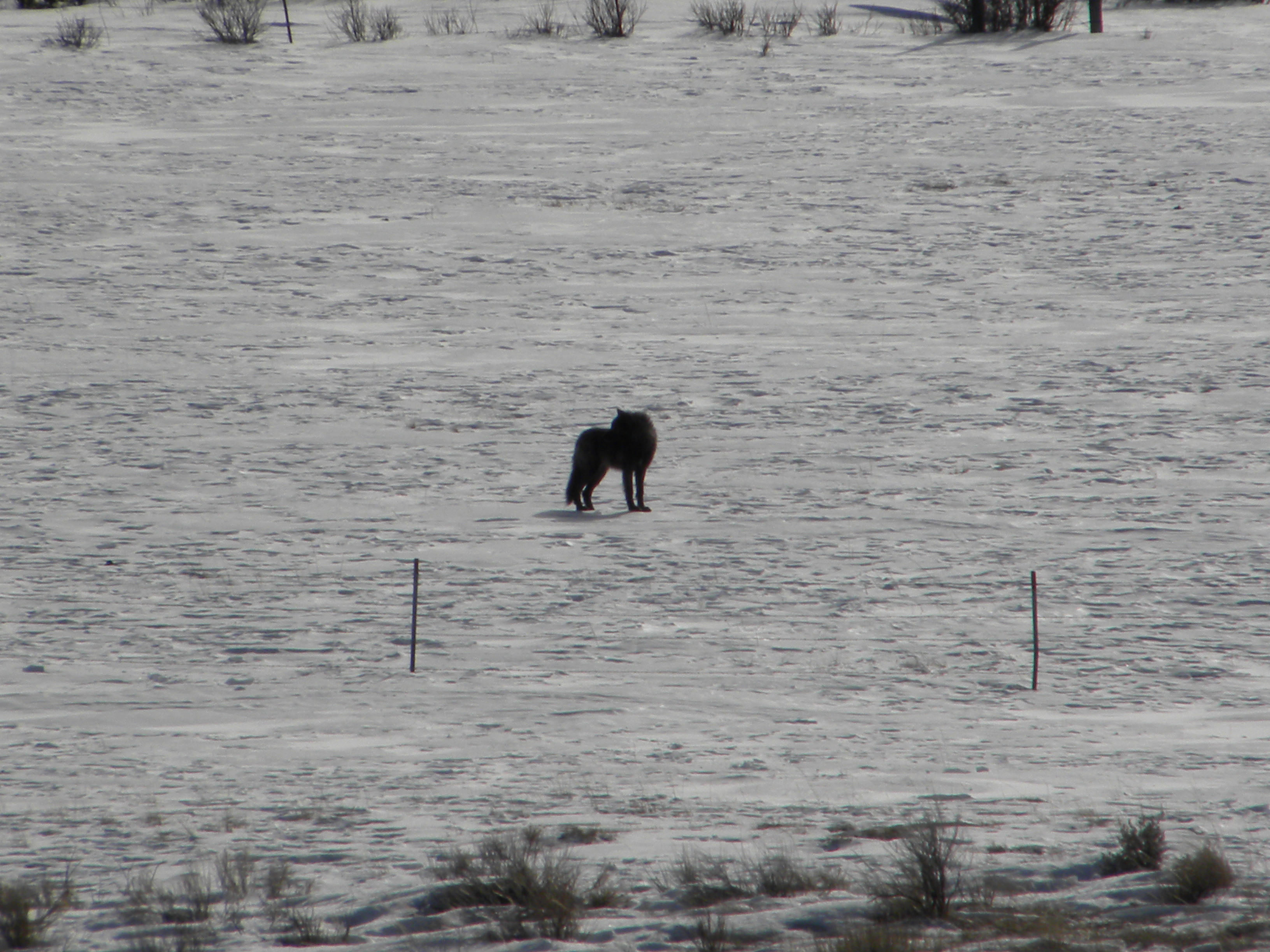
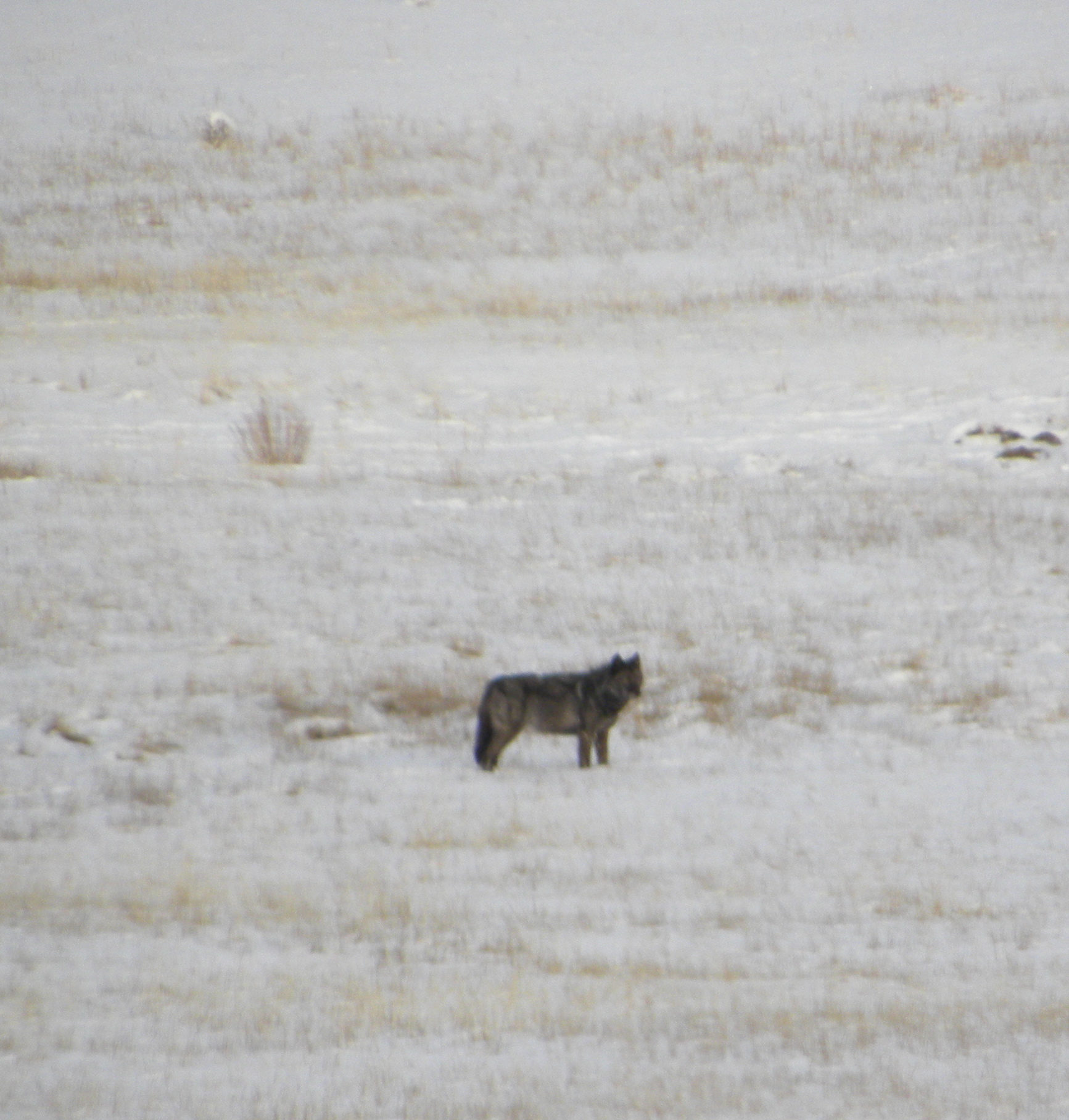
Black wolf

In the U.S., there are many unique and beautiful areas, but there is no where like this area.  Here we have the Serengeti of North America.  And in my mind, we are not valuing nor protecting it enough, nor are we holding it in the proper perspective.

Our Serengeti

The proper perspective:  This area, as well as more large tracts of contiguous land (Yellowstone to Yukon idea) is a wildlife first policy.  This is our gift to our children and the future.  This is our gift to the wildlife here.

Once we all realize what we have here, a jewel that is found no where else in the U.S. (Do we really want the last place where wild animals roam to be in Alaska, out of the reach of most ordinary folks?), we will change our approach and our views on a daily basis.  No longer will we have on the Wyoming books archaic 1890 laws that allow trapping, an indiscriminate way to kill wildlife.  No longer will we confine bison to the tiny Island of the Park because the cattle industry fears losing their brucellosis stamp.  Nor will people call for the extermination of the wolves because they are having a harder time hunting in the spots they are used to.

We will make new laws to help support the wildlife in any way we can and preserve this area; not for ourselves or for any use we desire today, but because we recognize its’ specialness, and because, frankly, its the right thing to do.

There was a time, not long ago, when out of 60 million Bison that once roamed the entire United States, only 100 survived.  In fact, it was thought that all bison were extinct, and that was what we, as a country, as a government, was trying to achieve.  But in the early 20th century, around 100 Bison were found living in Yellowstone.  An immense effort was made to bring at least some bison back and the bison that you see today living in Yellowstone are the result of that effort–the last pure genetic stand of bison living today.

When you go to Yellowstone, there is a power, a respect, a wordless reverence that wells up in your being just seeing these animals.  Something deep and ancient reverberates in their presence.  Imagine if those bison hadn’t been preserved?  Those conservationists who helped preserve the bison of Yellowstone did an incredible service to future generations.  We, living today, are the beneficiaries of their efforts.

We must make those same efforts today for generations that will be living 100 years from now, just as they did for us 100 years ago.  That is how we should be looking at the Greater Yellowstone Ecosystem.  That is how we should be making our laws, our plans, our actions.

“You may say I’m a dreamer, but I’m not the only one…”

High drama

Nature is full of drama, usually of the life and death kind.

On a rare warm, windless, beautiful day, I loaded up with the dog and headed for a hike down the unplowed part of the main road.   Just over the crest of the flats, I saw about 600 elk corralled within the ‘elk fence’, nervous and jittery.  It was almost 11:00 and these elk should have been resting in the trees.  Besides, you never see elk inside this fence.

Elk stuck inside fence and can't get to safety

I’ve heard two stories about this fences’ beginnings from two different neighbors.  When this ranch was owned by a wealthy man named Bugas in the 70’s, so the first story goes, the county conservation services re-graded and drained the field so he could put his cattle here, or at least more cattle.  Then to keep the elk out of the grazing pasture, the county paid for the fence.  Your tax dollars at work!

The second story isn’t too different from the first but with some variation, yet still with cattle in mind.  In the hard winter of ’77-’78, when the snows were so deep you couldn’t see the tops of the fence posts, Bugas’ cattle were struggling and starving.  The elk were eating the feed that was set out for them.  So a temporary fence was erected for that winter only.

Since that time the property was sold to Earl Holdings, one of the wealthiest men in the world, the fence remains, and the elk can’t move through or over.  So to see the elk inside was very unusual and probably spelled trouble.  The fence borders the creek.  On the other side of the creek is the game preserve where the elk have been gathering every evening and morning to eat.  One gate to the ranch property is open from the creek side, which is how these elk got in.   And that is how they would need to get out of this very large enclosed pasture.

But why they were there was solved when I saw some birds circling in their winter pasture across the creek.  There was a kill over there. These elk were trying to get across the private pasture and into the forest beyond but were being prevented by the fence.  Now they were sitting ducks for the wolves.  The road is between the fence and the forest where they wanted to head but were prevented.  They were hanging around the fence line by the road and every time a car went bye, they stressed, running this way and that, confused, not conserving their energy, unable to head in any safe direction.


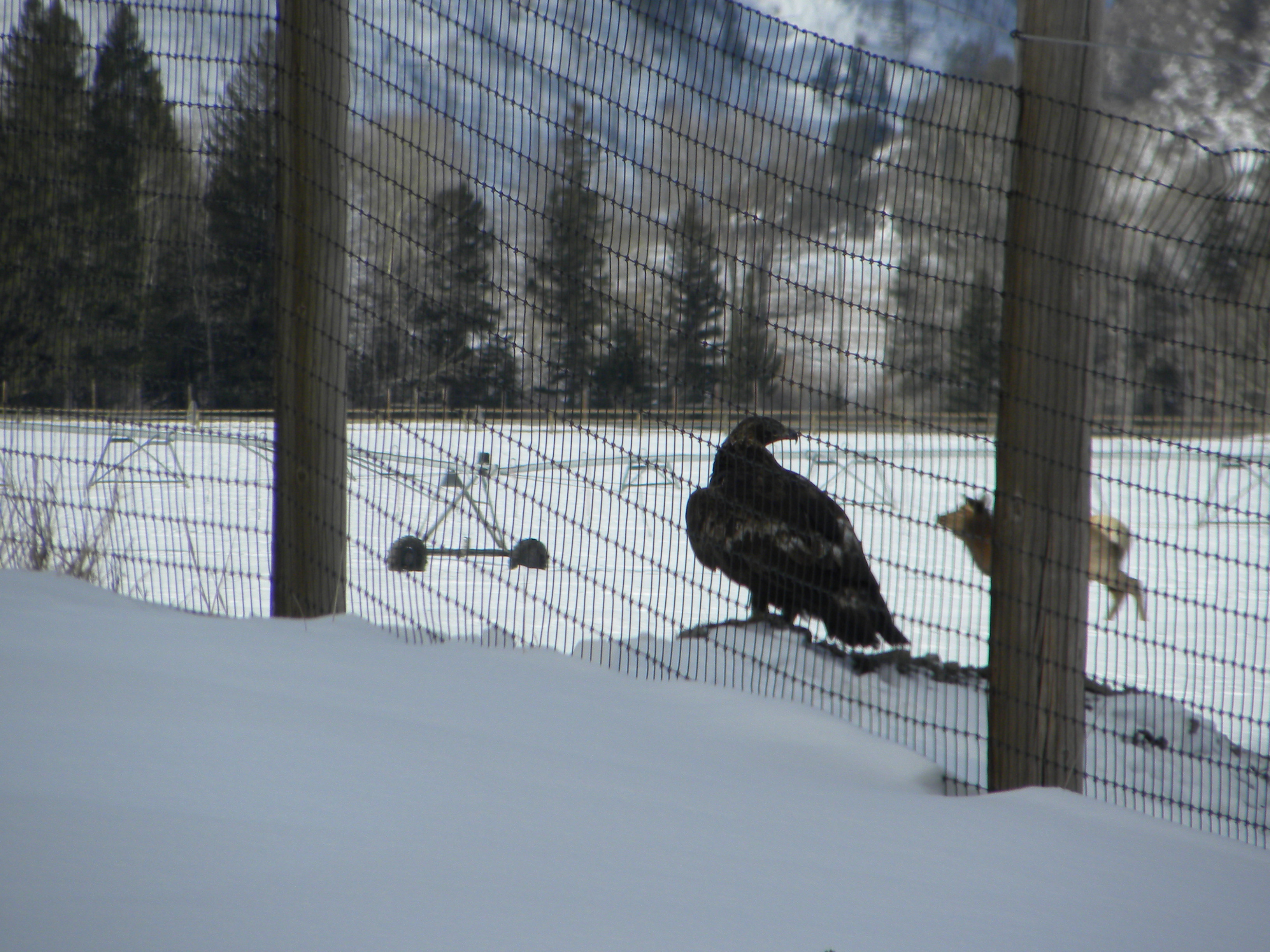
Golden eagle resting after feeding on carcass

Needless to say, I’ve hated this fence ever since I’ve been here, and here was more proof why it should go.  When I saw the kill I went back to get my scope,  On the return I ran into Ron.  He’s a citizen ‘Wolfman Jack’.  He does a great service by being totally obsessed with wolves and following them.  He knows more what’s happening with the packs around here than anyone, including the Wildlife Services folks.  He relayed the drama that had unfolded this morning.

The Sunlight Pack made a kill.  The Sunlight pack is about 10 strong , almost all young wolves.  While they were on the kill, Ron heard some barking.  At first he thought it was the ranch dogs nearby, but then here come the Absaroka Pack, mature wolves 7 strong. They pushed the Sunlight pack off the kill.  While we were talking a black wolf from the Absaroka pack came checking things out.

Ron told me that between the Sunlight Pack, the Absaroka Pack which seems to come around here as well, and the Hoodoo pack of 10 wolves up around Crandall (but they frequent the valley here as well), AND the Beartooth pack of now 10, there is more going on in this area than the whole of the Northern Range.  We’ve got a lot of wolves running around this valley.

Wolves are such social animals and their interactions and orders are constantly changing.  The U.S. Fish and Wildlife biologist, Scott Becker, told me that they have few collared wolves at this point.  The dynamics are constantly changing and hard to keep track of.

When Abby was doing her wolf study here several years ago, there were only 2 or 3 wolves in the so-called Beartooth pack.  That pack is located across the Clark’s Fork of the Yellowstone, where there are very few elk.  It didn’t seem like a very hospitable place, especially in winter.  Scott told me they must eat a lot of deer up there.

I continued on down the road and began my hike.  Resting in the pasture, I saw 3 wolves–2 blacks and a grey.  When they saw me, the grey hightailed it out of there, but I was able to get some good video of these blacks.

Error
This video doesn’t exist

Learning gaits

I’ve been working hard to learn animal gaits.  What, you may ask, is that?  Its the pattern you’re going to see on the ground when an animal is moving, either walking, running, loping, trotting, hopping…you get the idea.

I’d been studying track identification for a number of years.  When I was in California last month I went to my old tracking club that meets once a month at Abbot’s Lagoon in Point Reyes.  We walk about a mile to reach a sand dune spit which is always full of life–bobcats, deer, coyotes, raccoons, otters, skunks and more.  This particular morning was a coyote and a bobcat station.  Both stations were about gait analysis.  The coyote switched from a trot, the natural rhythm for a coyote, to a side trot, then looked to the side, then stopped and started walking.  I really was confronted with my limited knowledge of gaits.

Gaits overwhelm me.  I have gait dyslexia it seems.  So what I did was use stiff cardboard and cut out footprints–F for front and R for rear.  Then I’ve been arranging them, using Mark Elbroch book ‘Mammal Tracks and Sign‘ as a guide, in different typical patterns.  Once arranged, I use all fours and mimic the gait.  I think its the only way to get this into my brain, as a kinesthetic exercise.  I once heard that you have to see an advertisement 300 times before its in the brain.  Probably I’ll have to do each gait 300 times before it begins to connect.

Straddle trot turning into a Side Trot (canines)


Transverse Lope

And of course, then you’ve got to go to the field.  Today I went out to a well-traveled back road that’s closed in the winter.  Well-traveled that is, by bunnies, coyotes, and especially the local wolf pack.  Last week the snow was very deep, but today it was hard packed with mostly wolf prints running back and forth.  I still am not very good at figuring out how many wolves were running down the trail, especially since there were tons of prints in both directions.  But at least 4 or 5 wolves.  I could see where they’d made a kill on the other side of the creek, but only a few parts were visible through my binoculars.

As I traveled further up the trail, one wolf was occasionally dripping blood.  I thought it might be too early for her to be in estrus.  The wound though wasn’t coming from the foot.  At one point the wolf shook and there were drips of blood in either direction of her trail.

I followed one wolf track that went off to the side of the trail.  The track stopped at a wide swath of compacted snow, like a lay.  But it didn’t seem that it was a wolf lay.  For one thing there were ungulate hairs in the depression.  Also the wolf’s tracks were fairly unbroken.  Koda was very interested, digging and sniffing the outline.

The bigger track is the front foot

We trekked a bit further to another spot where the wolf went off to the side again, with another depression.  Koda began digging furiously, and came up with a fresh deer skull!  That wolf had stashed the skull there.  Probably the other spot was a possible stash area, but then he changed his mind and stashed it further up.  That was fun and revealing for me because I had wondered if maybe that wolf had laid down.  But it didn’t add up with the ungulate hairs and no deer tracks leading to or from it.  Tracking is kind of like solving a mystery.

Koda, upon finding that wolf’s ‘stash’, took that deer skull and stashed it somewhere else.  I told him that that wolf would be mad with him for messing with his ‘stash’!

The wolves veered off the old road, under a fence line and into the woods.  I followed them out to where they crossed an iced over portion of the river.  They were just making their rounds and I was getting an idea of their route.  Interestingly enough, I saw some old bear tracks.  They were very degraded but were certainly bear.  Yet they weren’t that old because they were in the snow.  Although the winds have been blowing for days, this was a protected area under cover.  But our last snowfall was about a week ago.  These tracks were fairly fresh.  The fact that some bears are out still gave me pause.

So far in the last week, I’ve noticed a few things relative to the wolf pack here.  They use the easy routes to patrol the area.  They like to go up and down the main dirt road, then cut across the meadow through the willows to cross the river.  They circuit around from the closed road on the north side of the creek back to the main road.  When I walked the closed road all the way to the Game and Fish (which is closed during the winter for wildlife habitat), I’d thought the wolves would have continued on their trek through the boundary line.  Elk are in the meadows up there, but the snow is deep, so they use the easier routes for now.  Last year for certain they were coming and going through the habitat boundary, but last year held much less snow.

Also, last year the kills I saw were mainly elk.  So far this year, in just the two weeks that I’ve been watching along the road, they’ve killed not only elk (I saw one elk kill) but a yearling moose and now this deer.

Abbie Nelson out of University of Wyoming, worked up here for 2 summers and fall doing a wolf study.  She told me deer were the preferred food in summer when the elk are gone.  With thousands of elk now in the valley, all along the meadows beside the roads, I was surprised to see this deer kill in the creek bottom.

Tracking animals always gets me into their mindset.  And if I can begin to learn gaits, then I might be able to get in to their heads even more.  You can see which way an animal was looking, if they paused or speed up, and  then you ask yourself ‘Why?’.  It is a real study for sure.  I’m working on it.

Yellowstone spring

I’m doing some work here, adding a utility room.  With all the noise and construction, it was a great opportunity to escape to the park and let the workers watch the dog.

Since it only takes me 40 minutes to the NE entrance, I escaped around eleven and was back by 5.  The day was overcast and on the cold side.  I’d planned to do a day hike, but chucked the idea with a cold wind blowing through the Lamar.  There was enough activity to view right from the road.

I’ts early June, the kids are still in school, and usually May and June the Park is still quiet during the week.  Yet last summer was the busiest the Park has ever seen and its predicted to be the same again this year.  The Lamar Valley had plenty of people today, but they all seemed serious wildlife watchers and so the atmosphere was calm and peaceful.

I do have to say, with all the hubbub around the ecosystem about wolves–rallies in Jackson and Cody recently, sponsored by outfitters and the Elk Foundation, complaining about wolves taking their business away [i.e. “biggest slaughter since the bison” meaning the wolves are eating all the elk, like when we killed all the bison] and wanting Wyoming wolves hunted as predators–it seems to be completely forgotten that wolves have created an incredible tourist attraction that benefits Wyoming.  I only talked with a few tourists in the valley, but they were all looking for wolves.  I ran into a carload of tourists from Oklahoma who had gotten out of their car to use the restroom when they heard a wolf howl.  They walked out to an overlook of the Lamar river and saw a black wolf–a thrilling experience for them.

Another man stopped and asked what I was looking at through my scope.  When I told him ‘a black bear’, he said “We already saw that.  We’re looking for wolves.”

It seems to be one of the main draws to the Park these days.  Wolves have fueled the attendance to record numbers!

With the Druid Pack all but gone, I didn’t expect to hear or see wolves in the Lamar, but there was a black wolf running around there, plus a tourist told me she’d seen one on a kill earlier.

Mostly though, since I see wolves in my own valley, I love to see the Bison and especially their babies at this time of year.  They are the only wildlife that cannot leave the Park so I have none in my valley.

Error
This video doesn’t exist

There were a lot of Bison in the Lamar this day.  I always try and imagine the great herds that once roamed everywhere just a few hundred years ago.

Loads of Bison

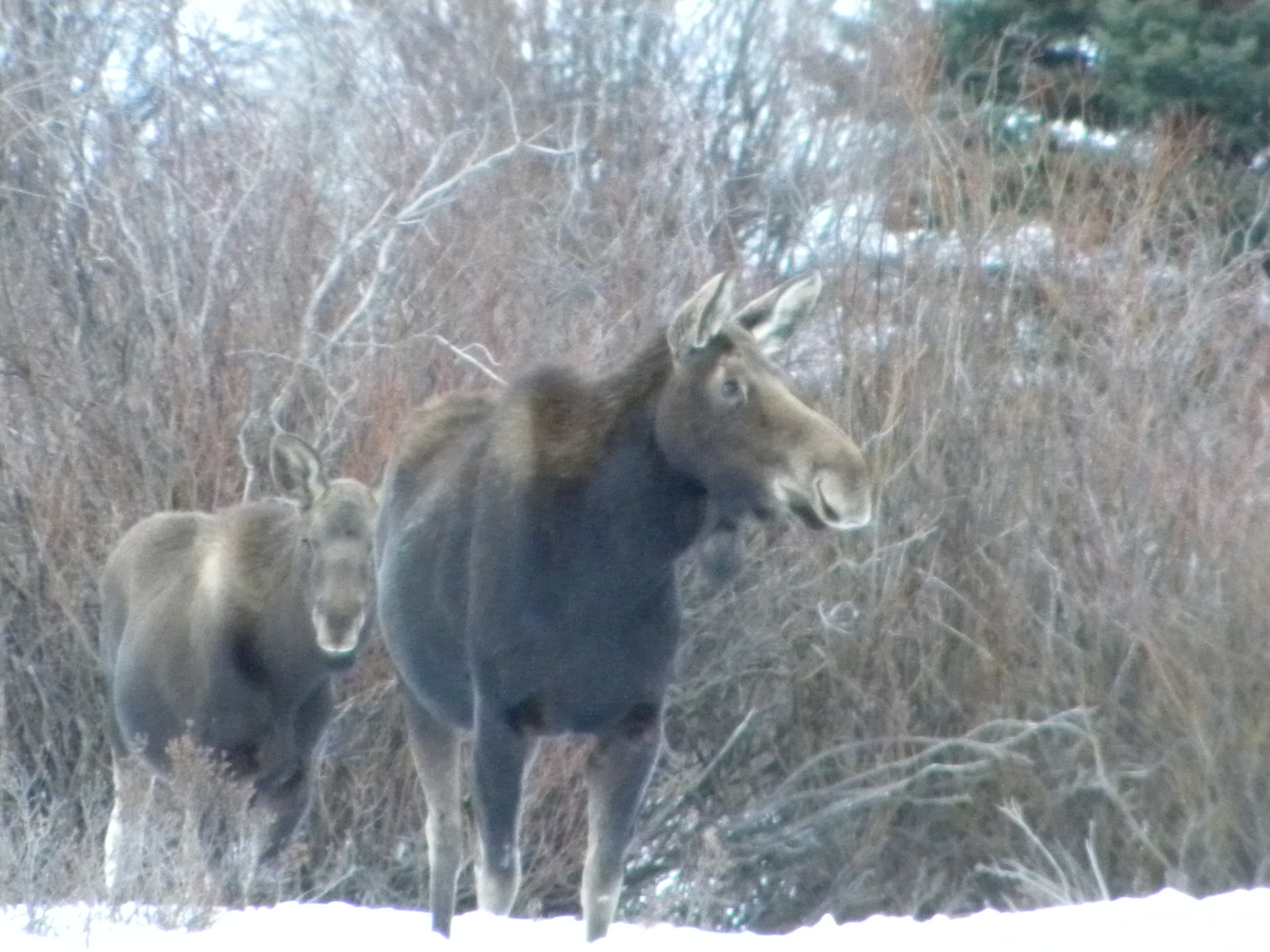
Besides Bison, wolves, and black bears, on the way out I saw 2 beautiful old bull moose hanging by the side of the road (until a crazy tourist tried to get a close up picture.  Fortunately for the tourist, the Bulls decided to head up the hillside instead of into the tourist).

Report on the Clark’s Fork elk herd

It snowed about 4″ here last night but I braved the drive into town early in order to hear Arthur Middleton’s talk at the Buffalo Bill Museum.  Arthur is the PhD student that’s in charge of the study on why the Sunlight elk herd has such low calf/cow ratios.  He’s been working up here in the field for 3 years, and now he expects to crunch all the data for another 3.  But his preliminary findings were what he wanted to report today to the public.

First off, I’ve seen his interns up here for the past two years and gotten to know them and Arthur.  I can’t say enough about how focused, diligent and hardworking these students are.  Up at dawn in the dead of winter to observe elk in the freezing cold.  As Arthur put it today, they had 4 behaviors that were noted:  feeding, bedding, vigilant, and running.  That’s about all the elk did, day after day.

Arthur did a great job of presenting all this info to the public in lay person’s terms.  He used slides and began step by step explaining some of the biology necessary to understand the complexity.  Simply put, there are many factors to consider, and I do remember at last years’ good-bye party for the interns listening to Arthur thinking all the factors through.  Here’s my summary of Arthurs’ points and I hope I’m doing justice to it all.

1.  First there are two herds that he studied, one migratory (Sunlight herd migrates here in winter and to the Park in the spring/summer/fall); and one non-migratory which is down north of Cody.  By looking at data from a lot of years ago, the elk have changed their patterns.  There used to be no non-migratory herds around here.  Migration, as Arthur pointed out, is a fairly fixed behavior taught by cow to calf, so it takes many years to make a change.  Arthur explained the advantages of migration, mainly better food quality as the elk follow the new grasses up as the snow melts.  There might be some predation advantages too as the predators den in the spring and stay put for a while as the elk move higher up.

Elk from the trail camera

2. Arthur explained how lactation takes a lot of energy from the mother (as all of us mothers know!).  Basically, non-lactating elk have 50 pounds more fat on them than those that lactate.  While the normal pregnancy rates for elk is 90% (and the NON-migrating herd is at that bar), the Sunlight (migrating) herd is at only about 60%.  The premier finding of this study was that the Sunlight herd cows are only getting pregnant every other year.  By doing that, they save energy vis a vis body fat that helps them through the winter.

3.   Displaying a slide of the rainfall patterns over the last hundred years, and comparing that with satellite data that looks at greening rates (especially in the months of June/July during lactation), we could see that this area has been in a severe drought, as well as compressed warming trends (i.e. shorter winters).  A photo of the high mountain pass between Sunlight and Yellowstone in June showed not as much green as should be expected.

4.  Another interesting find was behavior, what the interns were watching during those months they were here.  The vigilant behavior time was the same for the non-migratory and the migratory.  But where they differed was that the non-migratory herd spent more time bedding while the migratory herd spent more time feeding.  The nutritional quality of the migrators just wasn’t as good.  Factors governing the non-migratory herds were irrigated pastures and intentional low grade fires set to improve grazing in areas where cattle are.  The migratory Sunlight herd goes up through wild and high country where natural fires and rainfall determine feed quality.

More elk

5.  Lastly, looking at predation, Arthur showed a chart from research in Yellowstone pre -wolves on calf predation.  Predation was looked at by bears (main predator of calves), coyotes, cougars, natural causes, and survival rate.    He compared that to a more recent chart that included wolves.  Interestingly enough, wolves were almost about the same as the coyotes in the first slide but the bear predation had increased 3 fold. Lots more bears are in the Park since the 80’s.

This grizzly spent hours upturning Bison paddies for insects underneath

Although Arthur has more data to analyze, it seems obvious that the main factor that is affecting this herds’ decrease in cow/calf ratio is quality of feed.  These elk, smartly enough, are compensating for the nutritional loss by having calves every other year, instead of every year.  Add to that the increased predation on calves by bears in the park, with the new factor of wolves predating at the same rate as coyotes approximately, and you pretty much get your 30% drop.

Bull and cow mating in Yellowstone

One other comment Arthur made was that most of the migratory herds are doing well in Wyoming.  Sunlight as well as one other herd stood out as extremely low on a comparison chart and that was why this study was conducted.  Why this herd suffers more from drought than other herds–you’d have to look at each herd individually.

After the talk I went to the local hairdresser to make an appointment for next week.  As I was waiting at the counter, I noticed a large poster ready to put up, advertising the ‘Wolf Rally’ in Cody on May 22 by hunters, like the one in Jackson several weeks ago.  These guys are blaming wolves for all their woes and want the Wyoming delisting plan enacted which would give the wolf  predator status all over the state (meaning you can shoot on sight).  On the tag line of the poster there was an invitation to ‘Come and learn the science of what’s happening with the wolves and elk’.  Somehow I don’t think so.

Nature is a beautiful complexity that takes much time and pondering to put some of the pieces together that Man can understand.  What I learned from so many of my biology classes is that things are just not as simple as you think.  I watched Arthur over these last several years thinking through so many pieces of this puzzle in a questioning way, trying to piece parts together.   Its much easier to have an emotional opinion, play the game of scapegoat, and rally around a cause.

Wolf etiquette in the backcountry

The local wolf pack has been starting to get into bits of trouble.  I saw the ranch hand from the dude ranch down the way.  His cows have been calving.  They only keep about 30 cows around in the winter, but this morning, early, one of them calved and they got to it just about 10 seconds before two wolves did.  They fired a shot and scared them away. 

Error
This video doesn’t exist

Just a few days ago, the wolves killed an elk right at the pasture line where the cows hang.  And the students told me they saw the small black female hanging near the cow pasture on the bridge yesterday.

Where all good dogs come from. Black female wolf

The Sunlight Pack has gotten into trouble almost every summer.  In a few weeks, the rancher that owns most of the valley floor will be bringing his cattle up here, maybe over 500 head or more.  They overwinter down near Powell and calf down there.  Last year it was almost all yearlings up here.  Yearlings aren’t too seasoned and are too curious.  Not a good combo for wolf country.

I’m worried for the pack.  This is good wolf country and cattle really shouldn’t be up here anymore.  The open range leases should be retired; ranches for tax write off purposes should be retired as well.  My eternal fantasy is to win the lottery and buy the big ranch.  Then put Bison back on it and don’t worry if the wolves and bears get a few.   Bison belong here.  They used to be here.

Eventually, you can count on the wolves picking off a few cattle.  Wildlife Services, Dept. of Agriculture, can decimate the ‘bad’  packs each year, trying to get them not to have a taste for cows.  But its not that they love cows.  Its sometimes they are handy or easy.  Really, the wolves prefer elk.   You can’t really blame those wolves for hanging around when the cows are calving.  Calves are helpless when they’re first born, and an easy meal.  It’s really a smart strategy.  Just as smart as the little chipmunk who ate a hole in my bucket full of grain for the turkeys.  Easy meal; low expenditure of energy; biology 101 really.

The Valley that Sits in the Middle of the Land

The ranch hand told me his friend went ‘horn hunting’ by horseback last weekend near the ranch in the back country with his two dogs.  The dogs ran off and haven’t been seen since. I showed him the electronic collar I keep Koda on.

“They’re bird dogs, not people dogs like yours.”  We’re both thinking the wolves probably already got them.

Last spring a young experienced hiker and his dog went backpacking up the North Fork near the Park entrance.  There’s a wolf pack up there, and although he kept his dog close, when he went to set up camp in a meadow in the rain, his dog was sniffing around and got attacked a few hundred yards away in the trees by 8 wolves.  There had been a recent human encampment there, probably with some leftovers.  The hiker ran to his dog, the wolves ran off, but the poor dog died.

That hiker didn’t really do anything wrong.  He kept his dog close at least most of the time.  When I told this to a local who hikes with her dog, her reply was telling:  “That’s a risk you take hiking around here.”

I keep Koda close.  I watch him at all times and keep him on a shock collar I got through Cabelas.  He’s a dog’s dog, not really a people dog.  He has come to like people, and he’s loyal to me especially.  When he sees a dog, I can easily control his desire to run up and play.  But his response to a coyote or a wolf is different.  Some ancient wildness overtakes him.  He recognizes the dog part, but he senses the freedom part too.  In a moment he’s off and that could be the difference between life and death for him.  That’s when the shock collar comes in super handy.  But its no guarantee.

Koda with his toy.

Yet I do have to say, those fellows who took their 2 dogs out here, in wolf country, and didn’t watch them, let them run around where ever their noses took them–that is just irresponsible with your dog and certainly you can’t blame the wolves.

However you cut it, with the wolves and grizzlies here, I still prefer that wildness.  One of the students and I were talking about New Zealand.  He did an internship last fall in Antarctica and spent time on the south Island of New Zealand for vacation.

“Compared to Antarctica, it was great to be in a place with plants and trees, lush and fertile, where we could hike.  But to tell you the truth, as a biologist, it lacked.  They have no native animals there, except for a few birds.  The scenery was beautiful, but I missed the wildlife, especially the big animals, those ones that make you aware when you’re hiking around.”

Even if Chief Seattle didn’t really say it, its worth quoting:  “What is man without the beasts?  If all the beasts were gone, men would die from a great loneliness of spirit.”

Amen to that.

We love our dogs. Let's keep them safe.

The wolves have a good day

What a day!  Let’s begin with 4″ of fresh snow.  Then add 5 wolves running past my property, 4 greys and 1 black.    Throw in back tracking and tracking the wolves to explore what route they are using to come down into the valley.  And for the day’s finale, watching the wolves on two kills they’d made by the road this morning.

Lots of elk tracks too on this beautiful day

Around 1 pm, we heard the dogs barking and looked out the front window to see 4 beautiful wolves running along the nearby pastures through a herd of horses.  Those horses are used to dogs so they didn’t seem perturbed one bit.  And those wolves were ‘booking’.  They had someplace to go or a meeting to attend.  Within just a few minutes they were up on the opposite hillside and over the divide, a hike that takes me at least 45 minutes!  Then along came a limpy grey following way behind.  They all looked amazingly healthy, no mange.

Limpy wolf but seems to be doing fine

These are the new Sunlight Pack, pushed slightly south into Elk Creek because of a much larger pack of 10 wolves occupying their northern range.  Last winter I didn’t get a chance to see the Sunlight Pack as they were hanging deeper west in the valley, moving with ease back and forth (north and south) across the valley floor.  This has been their home range for several years.

There’s an elk study going on, in its fifth season, in the valley and they’ve been able to do some good collaring this year of wolves.  And so they’ve learned that the Sunlight Pack has been bullied a bit by this larger pack to the north.  In fact, all that howling I heard on Valentines’ day was the Hoodoo Pack making a kill on the northern side of the river, a side that used to belong to the Sunlight pack.

Tracks of four wolves 'booking it'

At around dusk I went up the road to get a closer look at the kills and see if there were any wolves still  on them.  The UofW crew said they processed the kills and they were two older cow elks, about 10 and 12 years old.  “How old is old for an elk?”  I asked.  “About 15.  Some can live till 20, but that’s really old. These were in pretty good shape,” they informed me.  

Error
This video doesn’t exist

With some quick and dirty math, I figure that’s about 50 or 60 years in human terms.

Right as Rain

Its Valentines’ Day and I’m finally home.

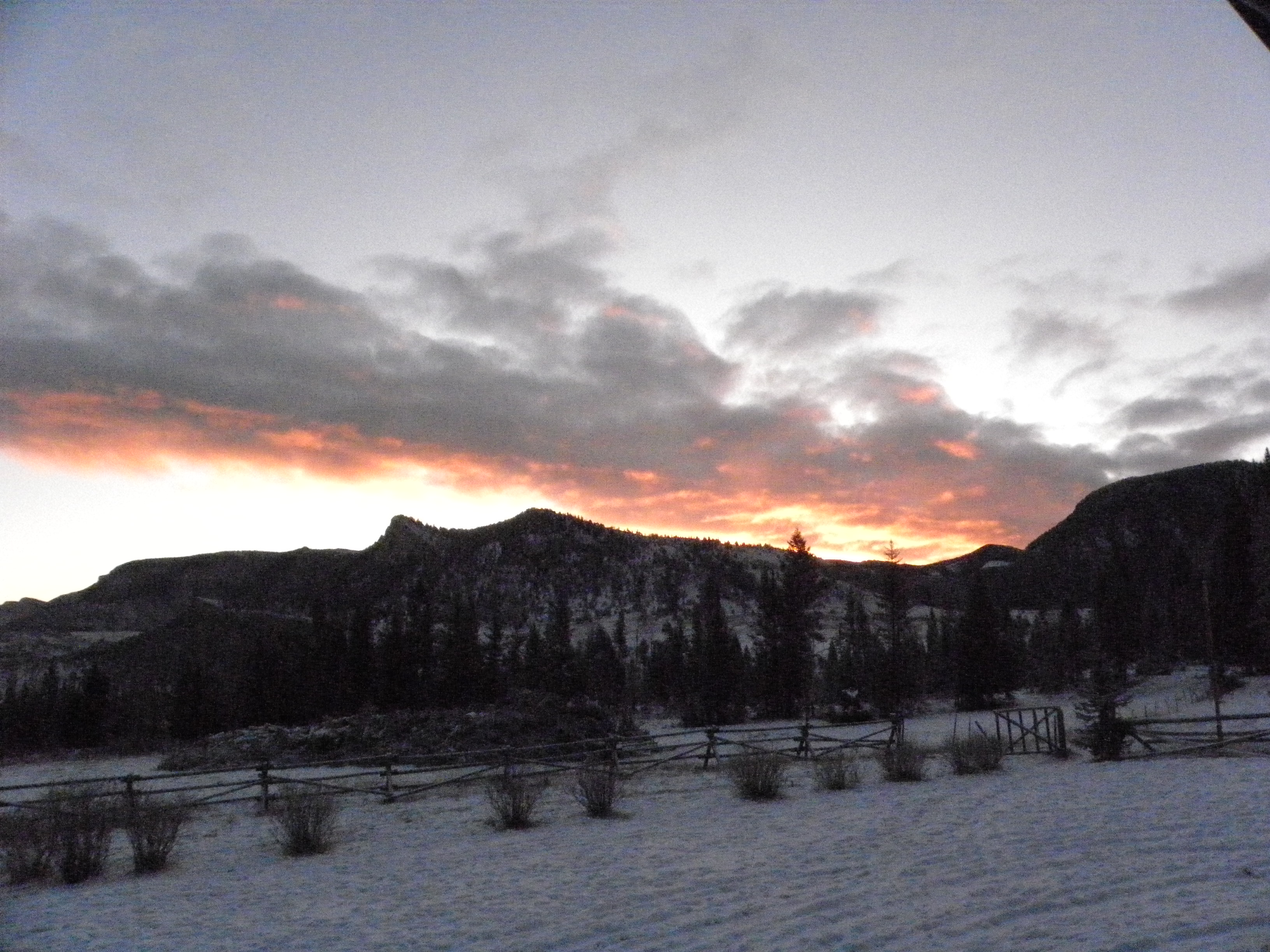
The day was clear and beautiful.  I awoke to a small bit of fresh snow and a beautiful fiery sunrise.

Sunrise over Dead Indian

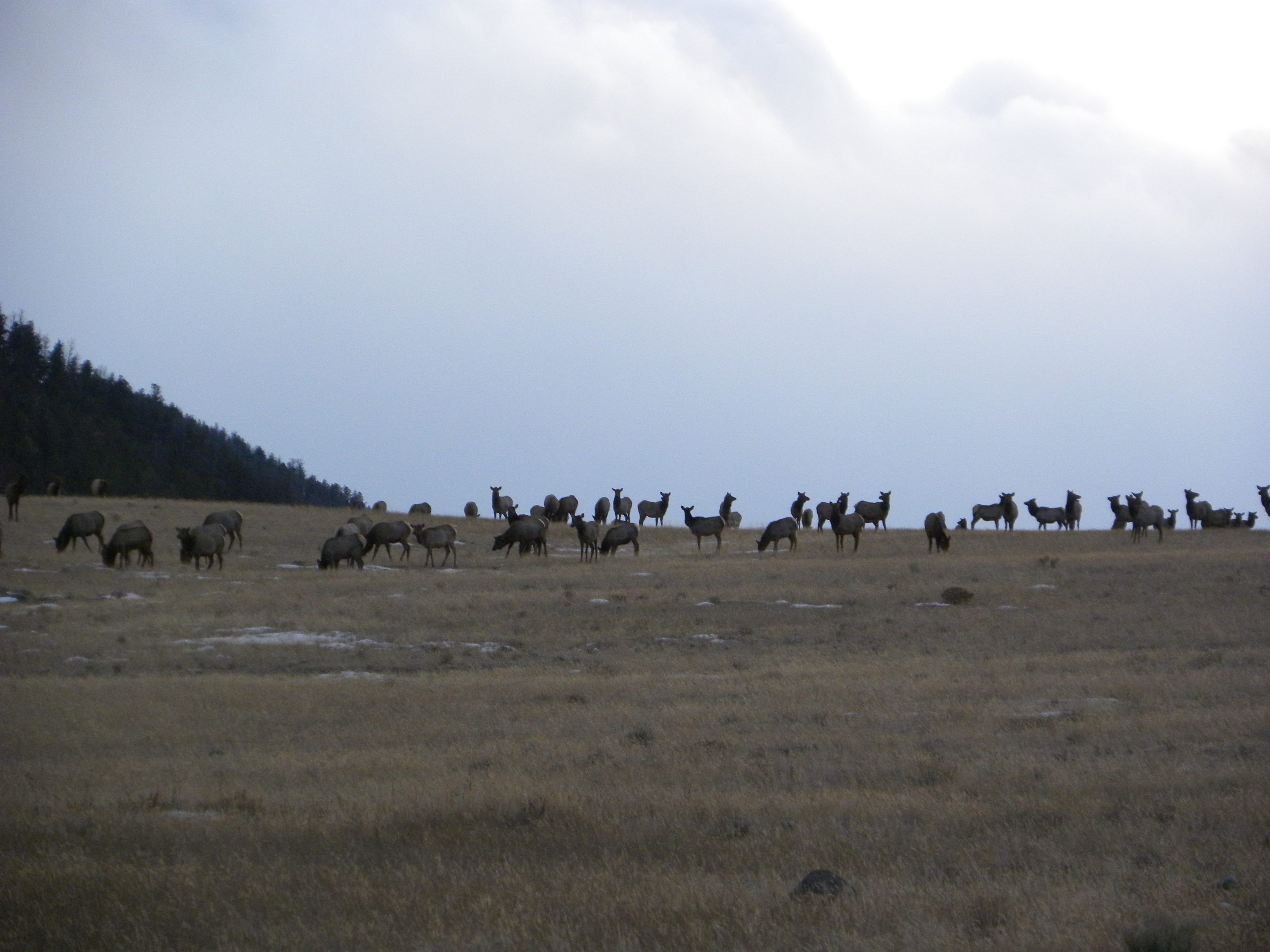
Last night I watched the elk that overwinter in my valley.  I heard the recent G&F count was 1460.  They come down from the Park when the weather pushes them out.  This year, as last year, they were a bit on the ‘late’ side.  At dusk and dawn they come out of the tree cover to feed.  Here’s a herd of about 700.

Just a small part of the large elk herd behind my house
More elk
Beautiful elk in their winter clothing

The herd is almost exclusively cows and their calves with a few young males, called ‘spikes’ because their antlers are barely branched, if at all.

The whole day the wolves were howling in the valley.  Its mating season and I suppose its also Valentines Day for them too.

We felled some beetle infested trees on my property and did a burn that lasted till after dusk.  The wolves  howled.  The air was still and clear.  The ash fell like snowflakes.  Elk grazed on the flats up above and a lone Great Horned Owl called in the low light of the sky.  I’m back and everything is right as rain.

Brush fire

Yellowstone in winter

Planning a trip to Yellowstone?  I recommend the winter!

There are so many reasons to choose winter over summer, but I’ll just give you a few.

First, the lack of crowds.  Yellowstone might get 100,000 visitors a week in the summer, whereas they get that total for the whole winter.

Next, the wildlife.  The wolves are roaming and highly visible in winter.  In the summer they’re attending to their young and following elk to higher grounds.  If you go in February, the wolves are in heat and you might catch courting and mating behavior.  Even better, spring for the cash to stay at the Yellowstone Institute at the Buffalo Ranch in the Lamar Valley and take a wolf class.  You’ll get educated and see wolves.

Elk, Bison, Bald Eagles, Coyotes, Foxes…so much wildlife and it’s mighty quiet with just one road open for cars (the North Road).  All the other roads are groomed for cross-country skiing or snowshoeing, and there are snow coaches to take you to groomed trails.  Although you can travel by snowmobile with a guide, I don’t really recommend it.  It might be fun, but you can do that outside the Park.  Snowmobiling is about tunnel vision, noise and speed–all things that don’t go along with wildlife watching; all things that Yellowstone has to offer.

Thermal features in the winter are amazing.  The deep greens or turquoises shimmer against the whiteness of the snow.  Bison like to hang around the warm grounds.

Several years ago I took a GYC wolf watching tour at the Buffalo Ranch.  We’d get up around 7am every morning, step outside our cabins, set up scopes and watch the Druid Pack of 17 wolves while we sipped our morning coffee.  In the afternoons we hiked or skied.  I stayed a few extra days to ski other parts of the park.  It was some of the best money I ever spent.

Yellowstone in the winter is one of the best kept secrets.