• MY BOOKS ON WILDLIFE, GARDENING AND MORE

  • The Wild Excellence

  • True stories of wildlife encounters around the Greater Yellowstone
  • Award winning eBook on Decomposed Granite, tips, how to's, what to watch for
  • Children's book. True stories of a dog and wolves. In a dog's voice
  • Written for dry Mediterranean climates in California, north and south

Last chance to have your voice heard on Wyomings’ wolf delisting plan

Comments to the U.S. Fish and Wildlife Service regarding Wyoming’s wolf delisting plan MUST be received within a 100 days on or before January 13, 2012.  This is our last chance to be heard regarding this plan.  I sent a letter to Wyoming Game and Fish before the comment closing date which was on a Thursday.  The following tuesday they announced their acceptance of the plan.  Had they read my comments?  I doubt they were reading over the weekend.

But these are the Feds and the ones who have initiated the deal and done the science.  The more comments, maybe we can actually hold them to the science instead of the back door political deal Secretary of the Interior Ken Salazar maneuvered with Wyoming Governor Matt Mead.

Folks,  wolves do not belong to Wyoming and Wyoming politics.  Wolf recovery and management shouldn’t be based on the demands of the Elk Foundation, the NRA, or the Safari Club International.

In the USF&W website maze, I found it hard to locate the information as to where to send comments so I will print it here.  I am also copying an attachment from a letter from the Sierra Club Resilient Habitat department regarding talking points you might include in your letter.  Please take a moment and have your voices heard.  Thank you.

A majestic predator that deserves to take its place in the ecosystem

Tell the U.S. Fish and Wildlife Service (USFWS) that its draft rule to delist wolves in Wyoming is flawed and should be withdrawn. Submit your comment today!


Written comments can be submitted by one of the following methods:

1) Federal eRulemaking Portal: http://www.regulations.gov. Enter “FWS-R6-ES-2011-0039” in the “Keyword” box and check “Proposed Rule” in the “Document Type” box.

2) U.S. mail or hand-delivery: Public Comments Processing, Attn: Docket No. [FWS–R6–ES–2011–0039]; Division of Policy and Directives Management; U.S. Fish and Wildlife Service; 4401 N. Fairfax Drive, MS 2042-PDM; Arlington, VA 22203.


Consider making the following points in your comments:

  • This plan is virtually identical to multiple plans that have been rejected previously by both USFWS and federal courts because of their unacceptable impacts to wolves and the lack of regulatory mechanisms to conserve wolves as required by the Endangered Species Act.
  • Wolves should be managed by the Wyoming Game and Fish Department across the entire state, not as “predator” in 88% of the state (where they can be killed by any means by anyone, without a license) and “trophy game” in an arbitrary zone around the national parks. No unregulated killing of wolves should be allowed.
  • The proposed “flex-zone” area south of Grand Teton National Park is not grounded in sound science. The USFWS has arbitrarily drawn this line where wolves will receive limited protection as ‘trophy game” for only 4 months of the year. The USFWS admits that this will only likely protect half of the seasonal dispersal of wolves and that only 35% of dispersing wolves will probably reproduce. This proposed zone will almost certainly not protect effective dispersal because wolves will be hunted during the period of protection and very likely be eradicated (through unlicensed killing) from the area for the remaining 8 months of the year.
  • The USFWS will allow Wyoming to define “unacceptable impacts” of wolves on elk and other ungulates (which will almost certainly result in wolves being killed), yet Wyoming’s plan has not defined any criteria for determining “unacceptable impacts” by wolves. Currently, all of Wyoming’s 35 elk management units are at or above the Wyoming Game and Fish Department’s numeric objectives for those herds.
  • The USFWS disingenuously concludes that the Wyoming dual classification (trophy game/predator) plan is biologically sound because the remainder of the state is unsuitable wolf habitat. However, the proposed predator zone has contributed 3 breeding pairs, and 6 of the state’s 30 packs have entire or partial territories within this zone.
  • Relying on the indiscriminate shooting of wolves as the primary management tool to reduce wolf conflicts is not a strategy for success. Wyoming should work with stakeholders to promote tolerance and prevent conflict by implementing nonlethal, proactive wolf deterrents and livestock husbandry practices. There are active and successful programs working with ranchers and wolf managers in other states and this could be expanded to Wyoming if state and federal agencies are willing to work collaboratively and support these management tools.
  • Wolves play a key role in maintaining a healthy ecosystem. Since wolves were reintroduced to Yellowstone, beavers, songbirds and many other species are making a comeback. These benefits must be recognized in any management plan.
  • Millions of people come to Wyoming every year for the chance to see a wolf in the wild. Wolves in Yellowstone alone generate an estimated $70 million annually in cumulative impacts from wildlife viewing.


What is the wolf experience?

Wolf hunts are going on right now.  I recently read that in Montana you can shoot a wolf, tag it, and walk away, leaving the carcass to rot on the ground.  In Idaho, the wolf hunt is practically year round with no legal limits.  Idaho’s first legal wolf trapping season is about to begin.  They want to reduce their population from about 1000 wolves down to 150. Wolf haters always like to talk about dogs being prey for wolves.  The amount of dogs killed by wolves is miniscule–mostly sheep dogs watching their flock in open country. Traps for wolves, on the other hand, will certainly kill or maim a lot of dogs.

Last winter my dog almost got caught in a leg trap intended for a bobcat.  Luckily, I say almost.  The trap was set close to a large tourist pull-out that houses one of the only toilets along a major road.  Although not illegal, I considered the trappers’ choice of placement highly unethical, and frankly lazy.  People stop there for a rest and let their dogs out for a break.  

When I was a kid growing up, my parents impressed upon me the two taboo subjects you should never talk about in a social setting–religion and politics. These were surely the firecrackers that would ignite a fight when you just wanted peace and a good time.  Why? Because religion and politics are the stuff of emotion, not logic.  Today, living in the West, I add one more subject to that list–wolves.

I’ve pondered why wolves are on this list.  Really, they are just an animal doing what they were born to do. There are lots of other predators that we don’t place in the same category.  Eagles, weasels, mountain lions to name a few.  Only wolves have that magnetic polarizing effect.

Why?  I’m going to venture a wild hypothesis:

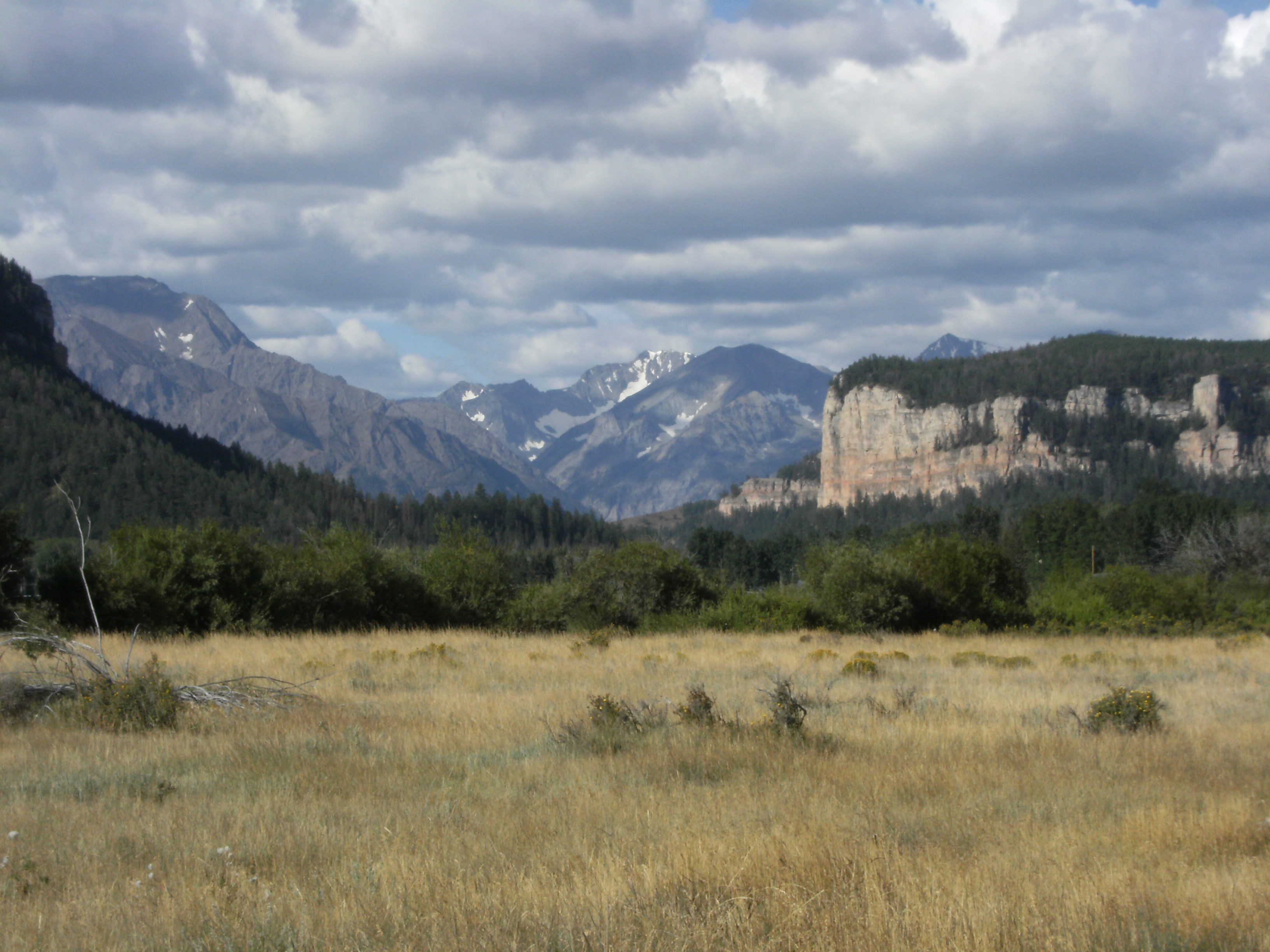
On a warm June night, I’m returning from a meeting in Cody.  It’s dusk and I’m beginning my drive home.  The massive up-tilt of red rock, called the Chugwater Formation, forms the cornerstone of the grassy large ranch that sits at the base of the mountain road.

Chugwater sandstone

The land slopes gradually upward, then with increasing steepness the views widen of this deep impressive drainage.  I’ve always loved this part of the ascent.  I can sense the specialness of this place, where once buffalo grazed.   Indians used this area as a drive, the ancient cairns stand as sentinels where they hid as the bison rushed through.

As I climb up the road, the view of the valley is most exquisite.   A cattle guard on the highway marks the boundary between the private lands below and the Shoshone National Forest above.  As my car crosses the grate, like a shot, three wolves run like hell across the road.  I press hard on the brakes to let them pass,  Full of life and energy, in my imagination, I see their excitement as the anticipation of their upcoming evening hunt.

The vision of those wolves will stick in my mind forever.   It was as if the Force of Life itself flew past me in a vision.

A wonderful chapter in Henry Beston’s The Outermost House describes a trip he made by boat to a rock full of birds.

The tiny island was so crowded that chicks were falling over the cliffs, eggs were being stepped on by birds and breaking, the energy of Life, and Death, one entire cycle, overwhelmed him to a point where he was almost sickened.  Raw creation.

I read that book as a teenager.   In it I understood that Life itself, that teeming, raw, primal energy of our Existence, permeates everything.  In fact, that energy of Life is so powerful that even death can not nullify it.

“There has been endless time of numberless deaths, but neither consciousness nor life has ceased to arise. The felt quantity and cycle to death has not modified the fragility of flowers, even the flowers within our human body.” **

And in a flash I understood what I, and all those who are traveling with me in this modern world, are afraid of.  We are afraid of life, which is a strange thing to say considering how hard we try and hang on to it.  But really, we are constantly suppressing it, attempting to harness and control it, create little niches where we feel safe and comfortable.  That is why it is easier for us to destroy, tear things apart, sullen our environment, attempt to control the forces of nature, and create the illusion of predictability, than to embrace Life.   To be in life implies being overwhelmed, swept away, carried like a raft in a great ocean, humbled, acknowledging our smallness and our connectedness.

I once made a trip to the Charlotte Islands, a land that even Canadians call “what Canada used to look like”.

A maze of small inlets and calm channels, the cold waters are so clear you can see over 50′ down riding in your kayak.  You are tide pooling without waiting for the lowest tides.  The waters were alive with life in a way I had never seen tide-pooling in Northern California.  Instead of dozens of sea stars, you saw hundreds on a rock. Masses of jellyfish small and large swam by you.  Everything I saw in the Northern California shores were multiplied one hundred-fold here.  These were the remnants of waters we still hadn’t polluted, a glimpse into the original primordial oceans that birthed us.  Life at this level looms on a mind-boggling yet fearsome scale.  Somewhere in us we say that this amount of energy must be controlled.

And that is where I come back to these wolves.  The vision of my wolves, running ecstatically across the road, in total abandon to their Existence, is an affirmation of that immense, wondrous, yet terrifying Power that is the Universe itself.  Wolves, in their ceaseless energy, their joie de vivre, their deep intelligence, embody the purity of   Life.

Maybe that is why humans have spent so much time and effort trying to control, even eliminate them. They are the emblem of true, unabashed, Freedom.

**Da Free John


Can we really Re-Wild?

I just came back from New York where I picked up a few interesting books.   Two of them present similar science on our vanishing wildlife but different approaches.  End of the Wild by the late Stephen M. Meyer  who was a professor of Political Science at MIT, says it is just too late to save the biodiversity on this planet.  It is known that in the next 100 years, more than half the planet’s species will disappear.  Meyer’s says that there will still be plants and animals, but they will be the weedy species that survive more easily around humans–from dandelions to coyotes, mosquitos to corn–species that survive in human disturbed eco-systems.  His is a pessimistic view.

The other book I’m reading, Rewilding the World by Caroline Fraser is a fascinating read, presenting a more hopeful view that will take work, though.  Scientists concur that ecosystems, to remain intact, need three things–Cores, Corridors, and Canines (or translate top predators).  For instance, a Core would be Yellowstone Park; a Corridor would be the Yellowstone to Yukon project; and the Canine would be the wolf in this case.

Y2Y map

One of the most fascinating bits of research Fraser quotes that began this kind of thinking amongst scientists was a study done in 1990 by John Terborgh, a biologist who studied a stranded hilltop ‘island’ created by a new hydroelectric dam in Venezuela that flooded a valley.  As the new lake filled, the predators fled, leaving only smaller creatures behind on the islands.  I quote the book below:

After a team studied the islands, the data painted a horrific picture.  Safe from predators, howler monkeys proliferated on some islands, but they were not enjoying their freedom from fear.  Normally social animals, they were living alone, attacking one another, and killing their own infants.  By denuding trees, they caused surviving plants to protect themselves with toxins, so meals provoked vomiting.  Many plants are capable of deploying extraordinary chemical defenses against herbivory by inducing a rapid rise in levels of toxins that can repel or kill those feeding on them.  On islands with howler monkeys, the instability caused by the absence of predators and superabundance of herbivores set off a vicious chain reaction.  

On other islands, predators of left-cutter ants were absent (armadillos and army ants) and the ants ran amok, carrying everything green off to their underground nests, leaving a…thicket of impenetrable throny vines, destroying all remaining life, plant and animal.  Terborgh and colleagues reported that after a few years almost 75 percent of vertebrate species had been lost from the smaller islands without jaguars or pumas.”

Fraser’s book examines corridor projects around the world, successes and failures.  She looks at central and south America, and large projects in Africa.  Many of the African projects are of interest, not only because of the great diversity of megafauna (particularly elephants which reck havoc amongst farmlands and villages and need very large corridors) but because they are multi-national endeavors–huge corridors that cross nation boundaries. Like the Greater Yellowstone, these Peace Parks (a concept first begun with Waterton-Glacier Park) include protected cores, as well as corridors where people live.

I can’t begin to describe all the different approaches here, but certainly the corridor projects that have been the most successful involve the local communities and take into account their needs.  One of the most botched plans was Paseo Pantera in central America, where good intentions became convoluted by developers getting involved and local peoples weren’t taken into account from the start.  The project degraded into an “integrated conservation and development project”

Large animals need large corridors.

Large Corridor areas for large animals

 And there is also the ‘problem with predators’, a human problem that has been obvious in the GYE since the wolf was eliminated in the 30’s in Yellowstone, and millions of coyotes, bobcats and other predators have been routinely destroyed with tax dollars for decades due to cattle predation.

Yellowstone to Yukon is a corridor concept that has been around since 1997. Its a conservation vision to preserve our North American great animals for future generations and for the earth.  Some work is being done already, like over- and underpasses for wildlife; wildlife friendly fencing, and species reintroduction.  But to be successful, it will take people living within this corridor to be involved and share the same vision, to do their small part whether it be active shepherding their livestock or replacing their fences for pronghorn passage, or saying ‘no’ to intensive housing developments in corridor areas, or as small as bear-proof garbage cans.  People need to realize when they live or move to these areas that they are becoming involved in wildlife corridors, which have special requirements, different than city or suburb living.  And help and education needs to be given to those people, such as ranchers, affected by corridors. Solutions must be community based but with the greater vision in mind.

Fraser states ” ‘Carnivorous animals are important.  We have to stop thinking of them as passengers on this earth and start thinking of them as drivers.’ Inevitably, an ecosystem robbed of its top predators begins a remorseless process of impoverishment.”  If we are truly interested in saving the great animals of North America, from wolves to bison, elk and pronghorn to grizzly bears, we who live here must all become involved in the Vision of Y2Y, stop our regional bickering and look towards the wholistic future.

Fraser’s book presents a glimmer of hope for Rewilding.  We, as a world culture, are fighting a strong current of species loss.  It is a great fight not just for these species, but for ourselves and the future of mankind on this planet.  Meyer’s vision of a world of limited weedy human-adapted species may sound livable, but boring, and missing the richness of magnificent mammals such as tigers, elephants, and crocodiles.  But Fraser’s admonition of the howler monkey hell, a potential future with the absence of diversity and predators, is a world not worth living in.

Moose, wolves, and a false spring

Yesterday was another glorious early spring day.  Some friends came up and we took a drive north towards Crandall and beyond, as far as the road is plowed.  The lonely 11 or so miles between Pilot Creek, a parking pull-out for snowmobilers, and the NE entrance to the Park won’t be open for another 5 weeks yet, but they’ll have a lot of plowing to do.  There is still an incredible amount of snow everywhere.  It will be a while before you can hike the backcountry.

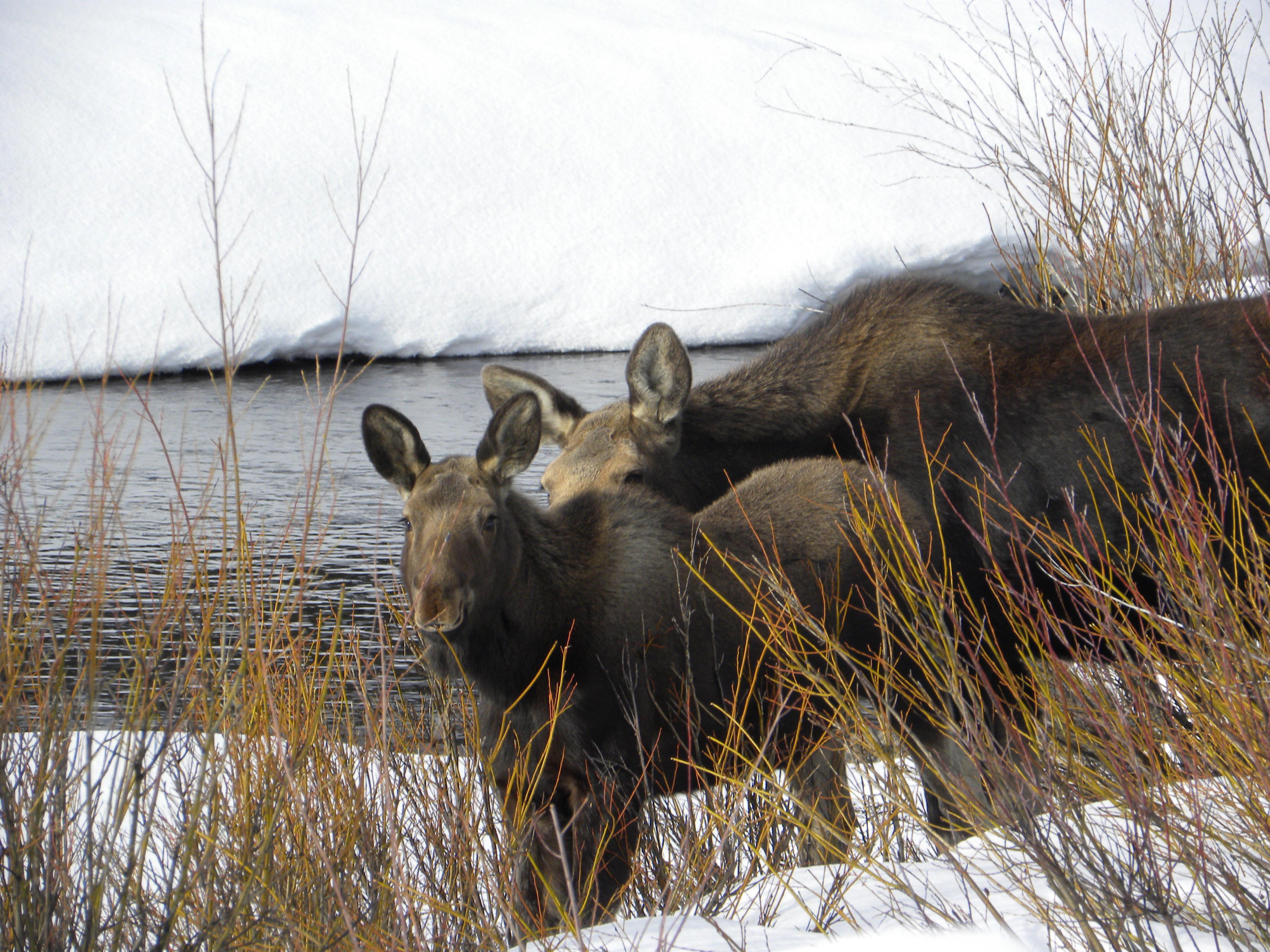
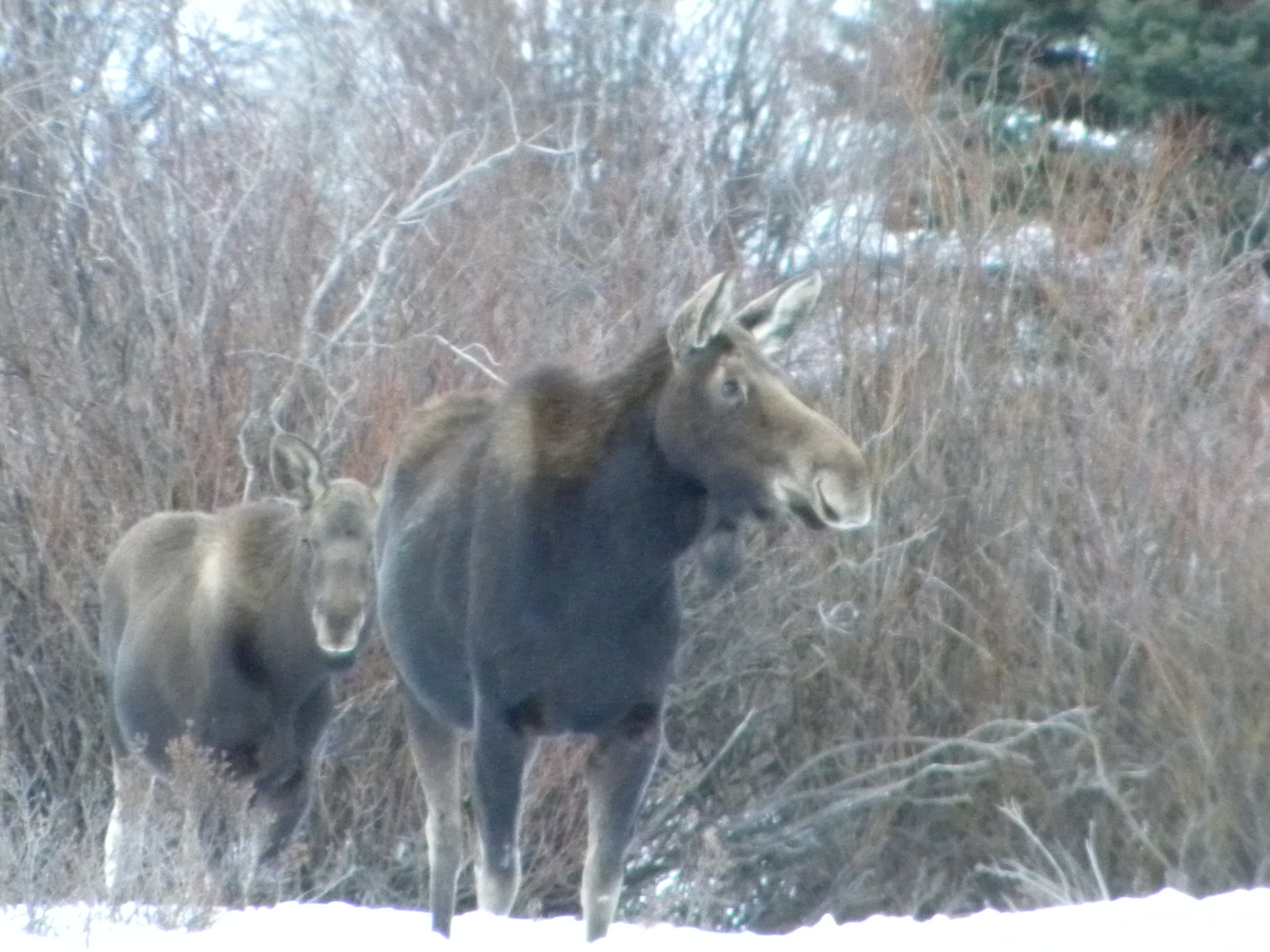
As the snowmobilers raced past us to begin their expensive thrills, we idled along looking for wildlife.  The banks by the side of the road have melted but still an easy 4′ high.  This gave good cover for a moose and her calf just on the other side of the highway along the Clark’s Fork River.

Mama with yearling


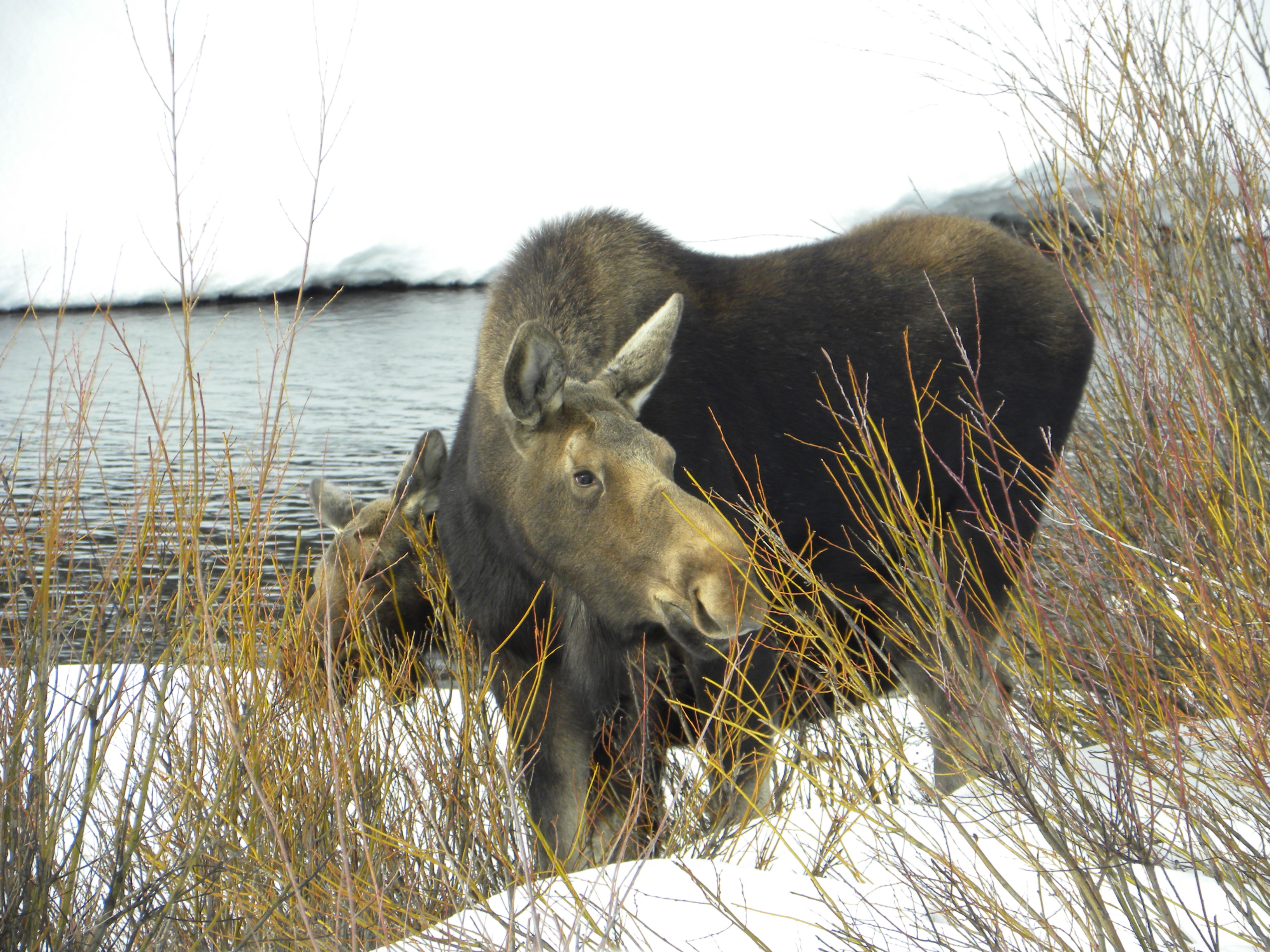
Because we could barely see over the snow bank, we quietly got out of the car to take photos.   Mama and baby kept browsing but mama moved between us and her calf.  What a good mother.

Mama Moose moves between us and her calf

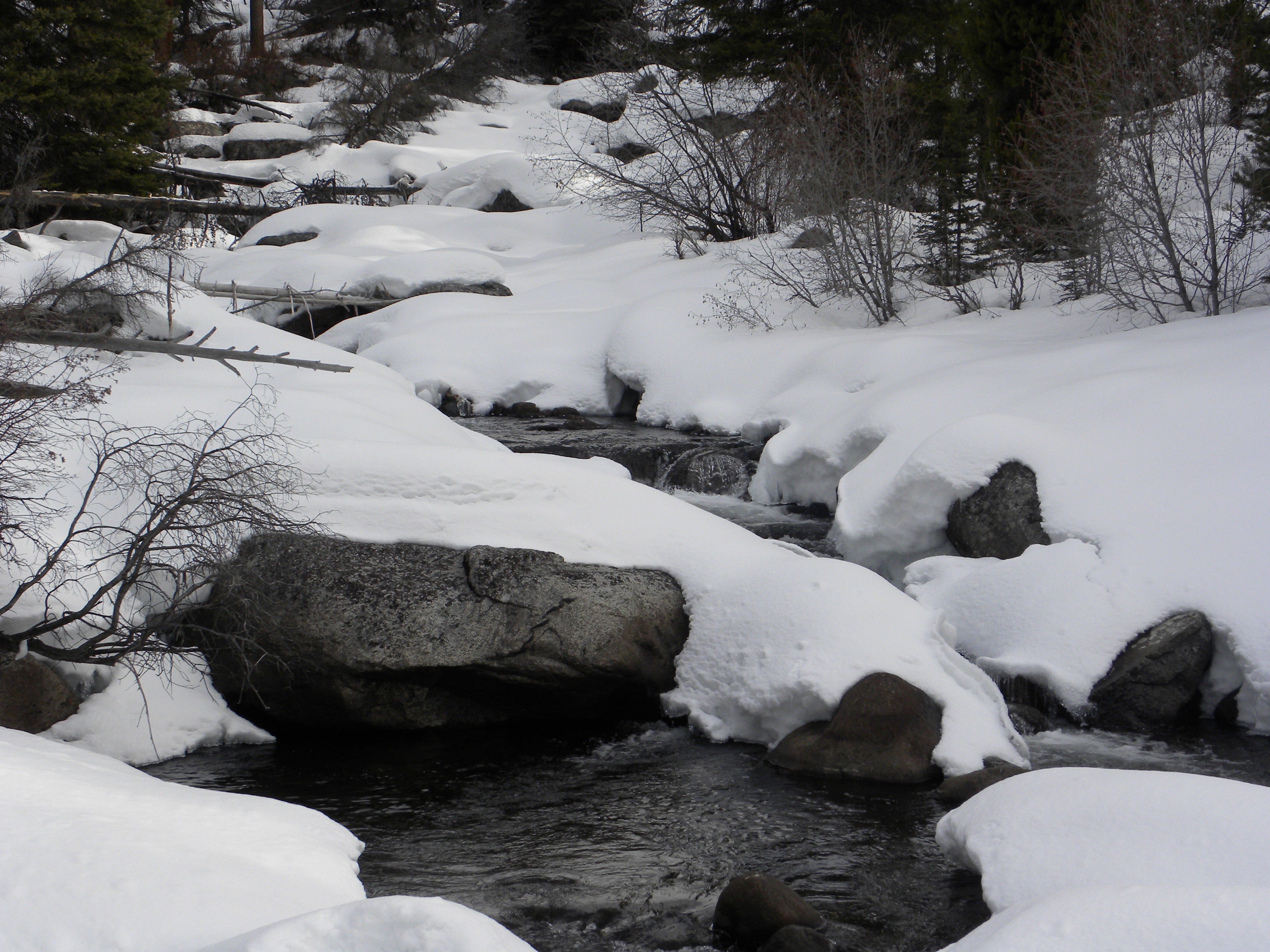
On the way back I shot a photo of Crazy Creek, still solidly covered with snow and ice.  This creek, in a few months, will be an awesome volume of water.

Crazy Creek March 2011

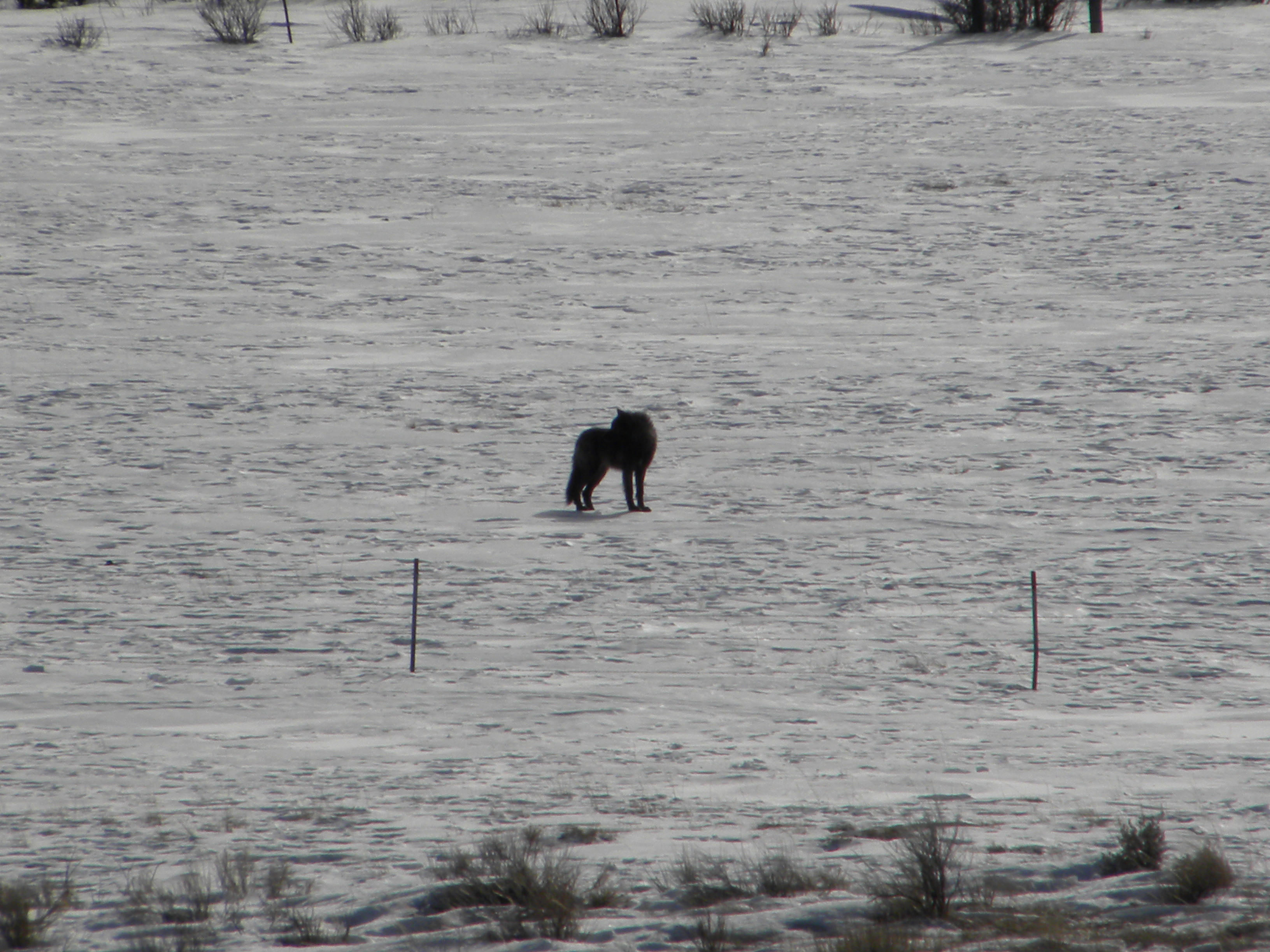
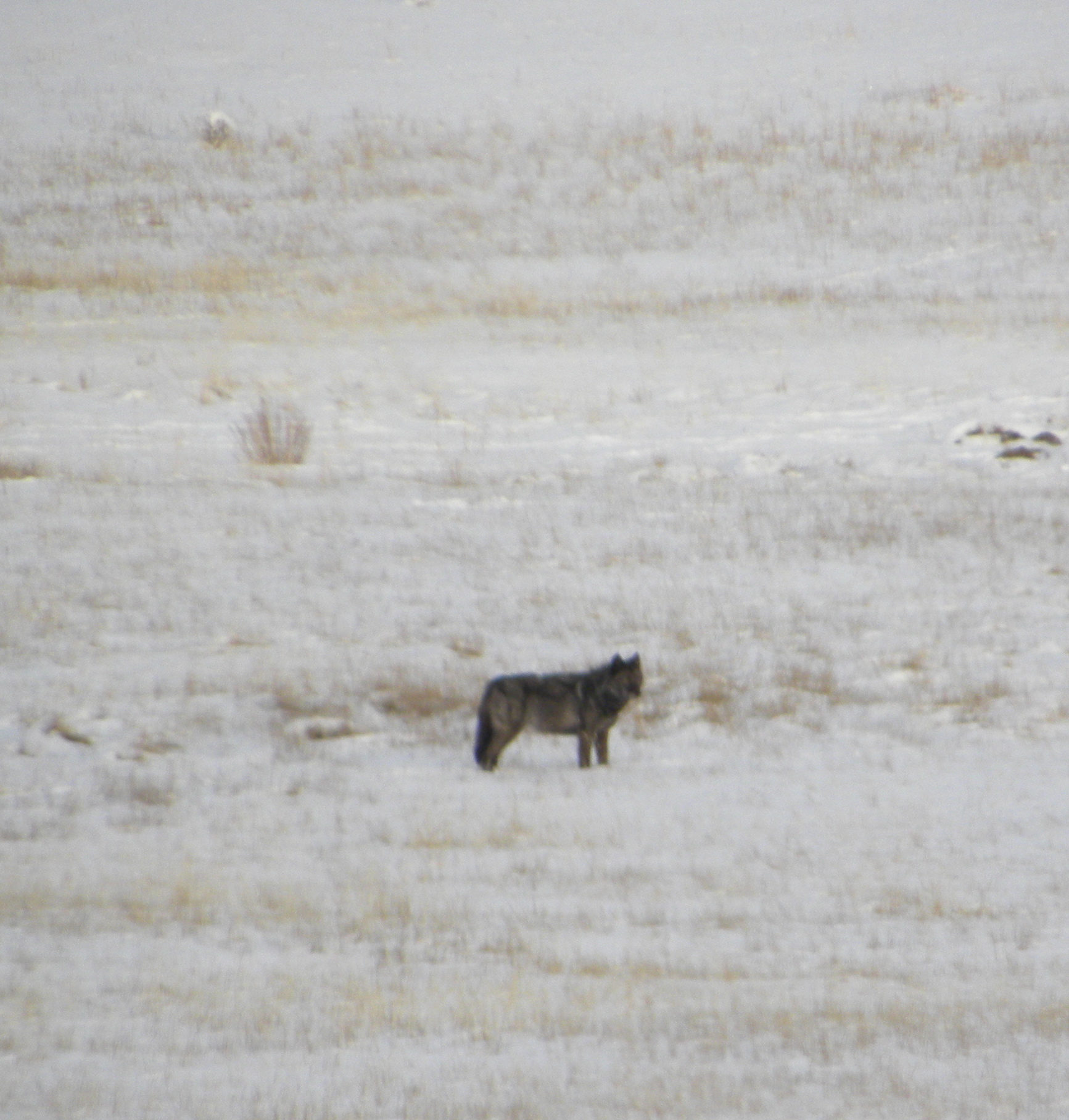
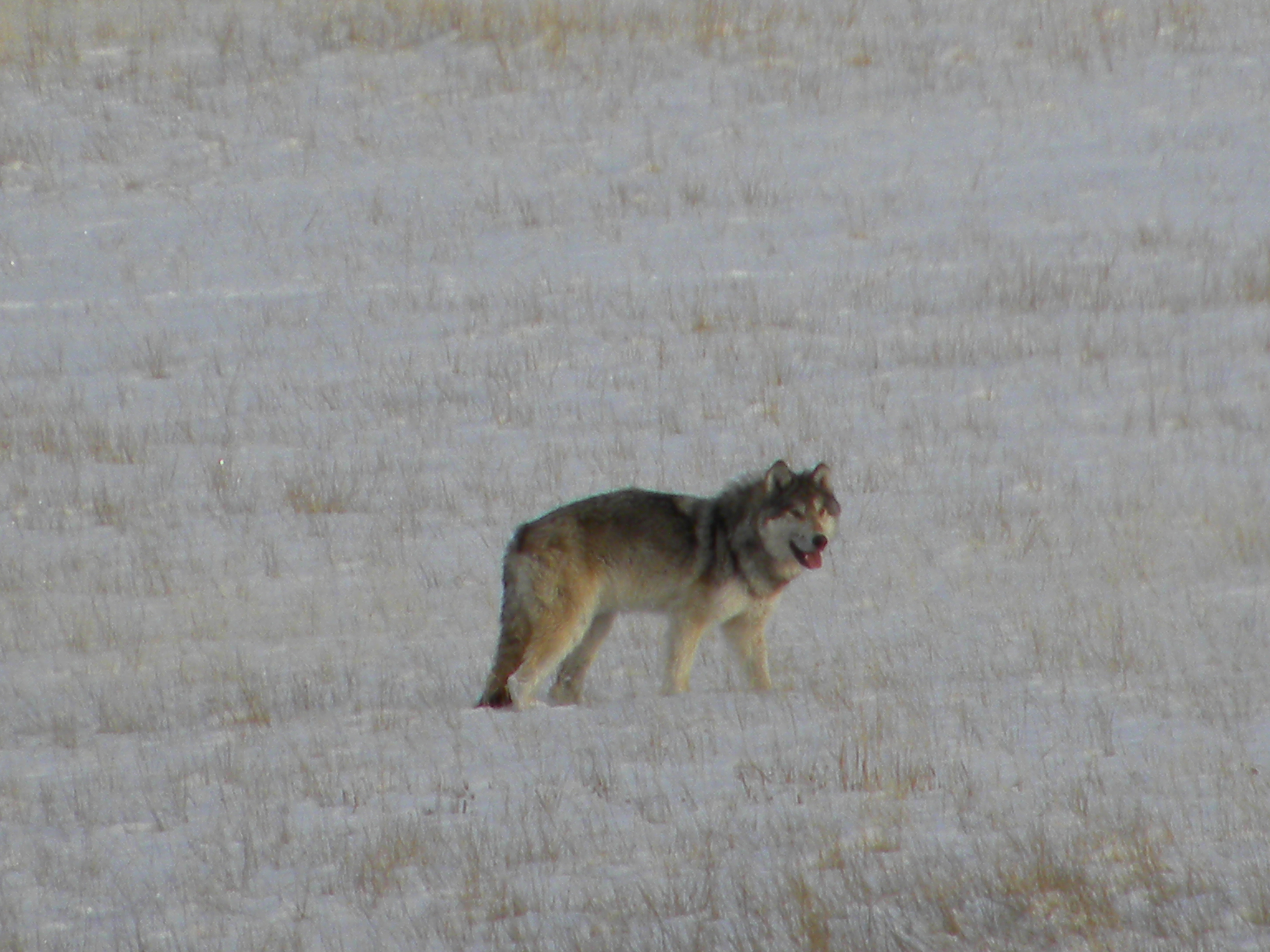
Almost back to Sunlight, I asked my friends, who come up regularly on weekends, if they’d seen any wolves this winter.  They are avid photographers and would like a good shot.  They told me they hadn’t.  Not more than two minutes passed when we spotted 2 wolves by the side of the highway.  This was a most unusual sighting.  Almost 11:00, I’ve almost never seen wolves hanging so near the main road.  There were elk up on the hillside, along with deer, not too far away who didn’t seem too perturbed.  Two wolves would be hard-pressed to bring down an elk, so I suspected there was a kill higher up on the hillside, or possibly down below where they were wanting to cross to.  A big grey sauntered quickly up the hill and out of sight.  But a beautiful black loitered long enough to take some good photos.  Wolves I’ve met always seem intelligently curious.  This one certainly was.

After I came home and my friends were gone, I noticed a yearling moose walking back and forth along the fenceline across the road where the horses are.  The fence has a wooden top post and is very wildlife friendly, but this yearling wasn’t that tall and was very uncertain as to whether she could make the jump.  She moved back and forth for over 15 minutes, trying to find a spot she felt comfortable to cross.  Finally, a car drove up the road, spooked her, and forced her into making the leap.  She did clear, but not without her back leg stuck for a moment.  She ran up my driveway, because its the open line in the fence and stood in front of the house for a while, seemingly perplexed.  Where was her mom, I wondered.

Yearling moose will get kicked out before the mother gives birth again, but it did seem a little soon, but what do I know.  I thought maybe she was already on her own.  She made her way through the front meadow, where I’ve taken down some posts for a winter opening in a buck and rail fence of my neighbors.  It was then I saw her mom, who’d been watching the whole thing patiently.  She was standing in the tree line.  Soon mama and baby were united again.  I had to wonder if mother was, as I would be, gnawing worriedly and wondering if her baby could make the jump successfully, or if mom was treating her offspring to just another new lesson preparing her daughter for the big wide world.

Koda bored because he couldn't get out and play with the wolves!

“Wolfer”

I’ve just finished a great read.  Carter Niemeyer’s new memoir Wolfer.  I’d say its a must for anyone living in the West, or anyone interested in the conflicts around wolves.

Niemeyer tells his story of growing up in Iowa, learning how to trap.  He trapped for a living, got his masters in biology, then took a job in Montana where he spent the rest of his life.  He worked for over 25 years with Animal Damage Control  (that changed its name once wolves were on the scene to the more innocuous ‘Wildlife Services’), then was chosen to be a key player in the wolf re-introduction in the mid-90’s.  He’s an engaging and honest writer, weaving his personal story from a ‘killer’ of animals to a staunch and courageous supporter of wolves in the lower 48.

One of the things I love about the book is his descriptions of going out to investigate livestock damage.  Several years before re-introduction in 1995, wolves were beginning to come into the U.S. by the Montana-Canadian border.  Talk of the re-introduction stirred the rumor pot as well.  Carter was the most experienced trapper for Animal Control, and at that time he was a supervisor. So he was the one sent out on almost all of these calls.  Neimeyer describes how time after time after time, the rancher swore his cow, or sheep, or horse, or goat, was killed by wolves.  Neimeyer skinned every dead carcass to determine what killed it.  It was a rare case when wolves actually brought the animal down, although wolves might have been around feasting on the dead animal.  Many ranchers were incensed at Carter, calling him a ‘wolf lover’, because without his signature they weren’t reimbursed the $7000 from Defenders of Wildlife.  Neimeyer tells stories about how Animal Damage Control investigators, sent out to determine cause of death, just kicked the carcass and said ‘Wolf’, or even worse, identified coyote tracks as wolf tracks.  Most of the animals investigated died by disease, dehydration, neglect–yet all these deaths were blamed on wolves.

If you want to get a feeling for where your tax dollars go in support of what Wildlife Services does, listen to this statistic from the 1980’s from Neimeyer’s book:

Animal Damage Control had been putting out more than 2,000 1080 bait stations in Montana every fall, winter, and spring to kill coyotes.  Throughout the state, about 100,000 pounds of horsemeat was injected with 1080 every year and placed at these stations, resulting in 18,000 to 20,000 dead coyotes annually….Then there was strychnine.  Trappers in Montana put out 50,000 to 60,000 tablets yearly to kill coyotes.”

When helicopter killing became the norm in the late 80’s, trappers were killing around 100 coyotes a day aerially.  When wolves came along on the ESL, poison bait stations became an issue and ADC, feeling that its mission would be thwarted, was staunchly anti-wolf.

Carter was officially hired by U.S. Fish and Wildlife to work on the wolf program.  His stories of finding, darting, literally wrestling with wolves are fascinating and informative.  After working so closely with wolves for so long, he has these things to say in his book about them:

“In my simple mind, wolves weren’t anything but another majestic predator to behold and I believed they belonged back with us.”

“The problem, ultimately, is not with wolves, but with those who believe that the only good wolf is a dead one.  Inept government investigations and outright lies about the nature of these animals result in bogus statistics and ultimately, more dead wolves.  After all the time I’ve spent dealing with them in my career, I’ve come to the same kind of thinking that Betty Baker expressed:  Why did we bring wolves back if all we’re going to do is kill them?”

“Wolves, for whatever great strides they’ve made in the modern mind as well as the modern West, continue to be persecuted, and there’s truly no basis for it.”

This is an important book, written by a man who knows wolves intimately and has integrity and the courage to speak the truth.


The right thing to do…Niagara falls and Yellowstone

I just returned from helping my son with location scouting at Niagara falls.  Its strikingly beautiful, especially in the winter.  The crowds are gone and its bitter cold, but there are ice floes in the river and parts of the falls are frozen.  The Canadian side still lights up the falls at night and the sheer power and magnitude of so much water flowing (in fact only 50% is allowed to release as the other 50% is used for power) overwhelms and puts us humans in our proper perspective relative to the awesome power of nature.

Falls at night

Power of the falls

But along with my visit to Sedona, Arizona last year, (which also is a natural wonder but not a National Park) what really stood out was its contrast to where I live now, the Greater Yellowstone Ecosystem.

Although I live next door to a National Park, I don’t of course live within the Park, but within what was designated a few decades ago as its larger ecosystem.  This is an actual mapped area, you could call it a ‘buffer zone’ where its recognized these large megafauna need room to roam to survive.

And, true to its name, I regularly see all the large and small animals that make up this complete ecosystem in the lower 48, which includes wolves, grizzlies, elk, and the occasional bison that is allowed to leave the Park.

So what’s so great about this area  you might say, as opposed to Niagara or Sedona?  Both have the power to overwhelm through their sheer beauty and immense landscape.  The difference are the animals.  Even the Sierras, as incredible a jewel as they are, are NOT a complete ecosystem.  Many animals that were there just 150 years ago are gone forever.

What Lewis and Clark encountered 200 years ago on their journey West is no longer, but a sliver of it can be glimpsed here in the Yellowstone Ecosystem.  Just a sliver, but that sliver is our history, our heritage.  No one would think of selling Monticello to create senior housing or a Walmart!  Why should we not value our original landscapes and the animals that were here before us in the same way?

Everywhere in the United States, with the exception of Alaska, animals have been pushed out to accommodate the biggest and toughest animal–humans.  And that is no exception in the Yellowstone ecosystem.  The controversy rages here too as to who should have primary use of the lands–hunters, atvs, developers, ranchers, oil and gas?.  Wolves are villified for killing elk that hunters could have taken.  Grizzlies are constantly moved around when they get into lands too close to homes or into unprotected garbage.  Bison are not allowed to leave the Park boundary.  Ranches are sold to developers who parcel up the land into lots, crowding out habitat for large animals.  Snowmobilers feel they should have the right to go wherever they choose, including the Park even when the science says differently.  The animals are last on the list.  And when that is how the priorities are set, what becomes of the land is Niagara Falls, Sedona, or at best a ‘safe’ wilderness like the Sierras; at worst we become like Europe, where their natural history is in the so-distant-past that its entirely unreachable in present-time.

Yellowstone and its ecosystem, unlike Alaska, is easily accessible by car to people from all walks of life, rich or poor.  It is an opportunity to view in the flesh our rich natural past.  Any person can do that from the safety of their car, and watch wolves or bears in the Lamar Valley.  Or one can take more risks and venture into the back country.  Even today, with this area protected and the reintroduction of the wolves, thereby completing the ecosystem fauna, the landscape doesn’t hold a candle to the enormous amounts of wildlife that was once beheld by the mountain men in the 1830’s.  Yet, they are all still here, thanks to the enormous efforts of many men and women conservationists through the century.

Black wolf

In the U.S., there are many unique and beautiful areas, but there is no where like this area.  Here we have the Serengeti of North America.  And in my mind, we are not valuing nor protecting it enough, nor are we holding it in the proper perspective.

Our Serengeti

The proper perspective:  This area, as well as more large tracts of contiguous land (Yellowstone to Yukon idea) is a wildlife first policy.  This is our gift to our children and the future.  This is our gift to the wildlife here.

Once we all realize what we have here, a jewel that is found no where else in the U.S. (Do we really want the last place where wild animals roam to be in Alaska, out of the reach of most ordinary folks?), we will change our approach and our views on a daily basis.  No longer will we have on the Wyoming books archaic 1890 laws that allow trapping, an indiscriminate way to kill wildlife.  No longer will we confine bison to the tiny Island of the Park because the cattle industry fears losing their brucellosis stamp.  Nor will people call for the extermination of the wolves because they are having a harder time hunting in the spots they are used to.

We will make new laws to help support the wildlife in any way we can and preserve this area; not for ourselves or for any use we desire today, but because we recognize its’ specialness, and because, frankly, its the right thing to do.

There was a time, not long ago, when out of 60 million Bison that once roamed the entire United States, only 100 survived.  In fact, it was thought that all bison were extinct, and that was what we, as a country, as a government, was trying to achieve.  But in the early 20th century, around 100 Bison were found living in Yellowstone.  An immense effort was made to bring at least some bison back and the bison that you see today living in Yellowstone are the result of that effort–the last pure genetic stand of bison living today.

When you go to Yellowstone, there is a power, a respect, a wordless reverence that wells up in your being just seeing these animals.  Something deep and ancient reverberates in their presence.  Imagine if those bison hadn’t been preserved?  Those conservationists who helped preserve the bison of Yellowstone did an incredible service to future generations.  We, living today, are the beneficiaries of their efforts.

We must make those same efforts today for generations that will be living 100 years from now, just as they did for us 100 years ago.  That is how we should be looking at the Greater Yellowstone Ecosystem.  That is how we should be making our laws, our plans, our actions.

“You may say I’m a dreamer, but I’m not the only one…”

High drama

Nature is full of drama, usually of the life and death kind.

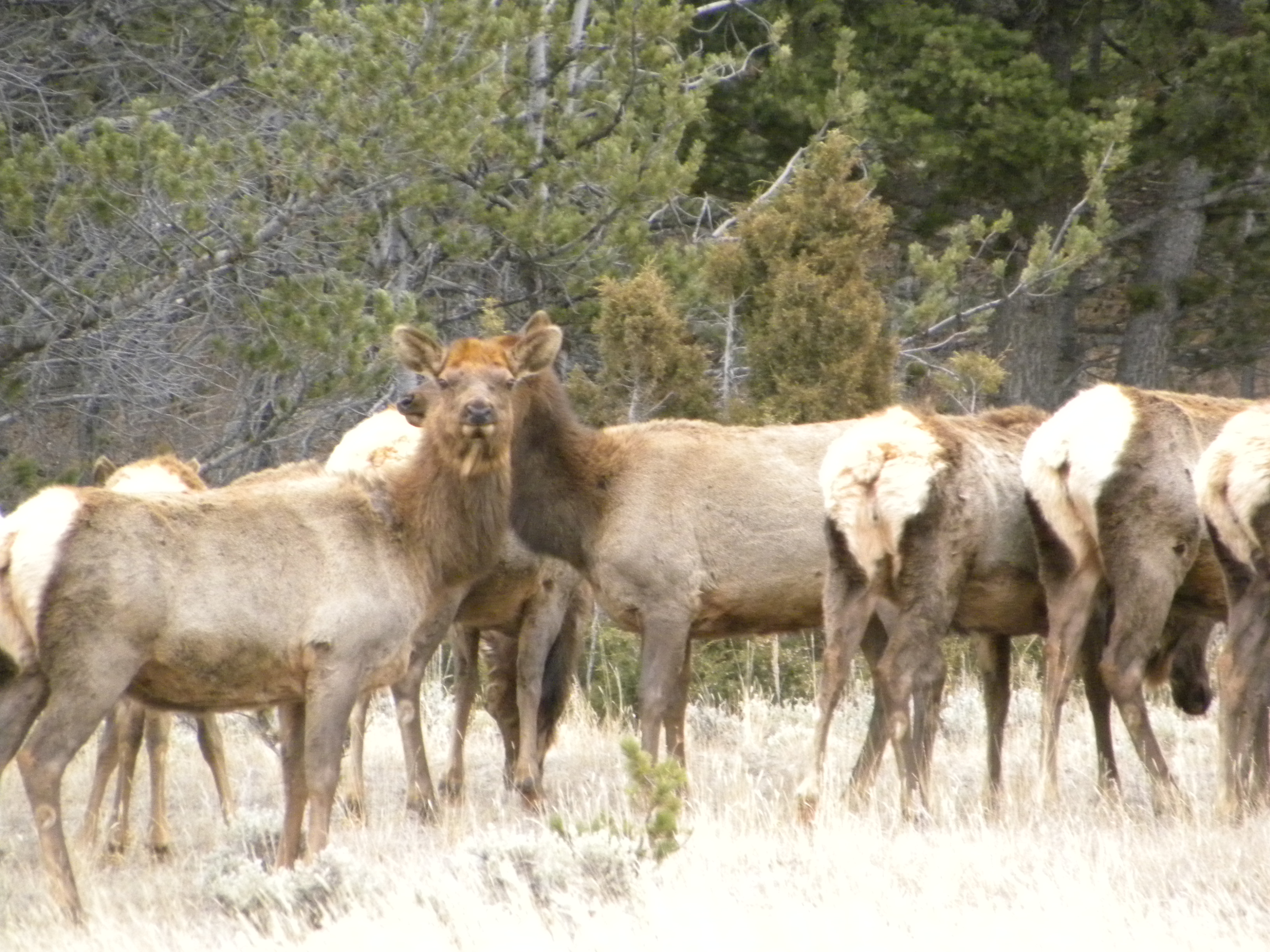
On a rare warm, windless, beautiful day, I loaded up with the dog and headed for a hike down the unplowed part of the main road.   Just over the crest of the flats, I saw about 600 elk corralled within the ‘elk fence’, nervous and jittery.  It was almost 11:00 and these elk should have been resting in the trees.  Besides, you never see elk inside this fence.

Elk stuck inside fence and can't get to safety

I’ve heard two stories about this fences’ beginnings from two different neighbors.  When this ranch was owned by a wealthy man named Bugas in the 70’s, so the first story goes, the county conservation services re-graded and drained the field so he could put his cattle here, or at least more cattle.  Then to keep the elk out of the grazing pasture, the county paid for the fence.  Your tax dollars at work!

The second story isn’t too different from the first but with some variation, yet still with cattle in mind.  In the hard winter of ’77-’78, when the snows were so deep you couldn’t see the tops of the fence posts, Bugas’ cattle were struggling and starving.  The elk were eating the feed that was set out for them.  So a temporary fence was erected for that winter only.

Since that time the property was sold to Earl Holdings, one of the wealthiest men in the world, the fence remains, and the elk can’t move through or over.  So to see the elk inside was very unusual and probably spelled trouble.  The fence borders the creek.  On the other side of the creek is the game preserve where the elk have been gathering every evening and morning to eat.  One gate to the ranch property is open from the creek side, which is how these elk got in.   And that is how they would need to get out of this very large enclosed pasture.

But why they were there was solved when I saw some birds circling in their winter pasture across the creek.  There was a kill over there. These elk were trying to get across the private pasture and into the forest beyond but were being prevented by the fence.  Now they were sitting ducks for the wolves.  The road is between the fence and the forest where they wanted to head but were prevented.  They were hanging around the fence line by the road and every time a car went bye, they stressed, running this way and that, confused, not conserving their energy, unable to head in any safe direction.


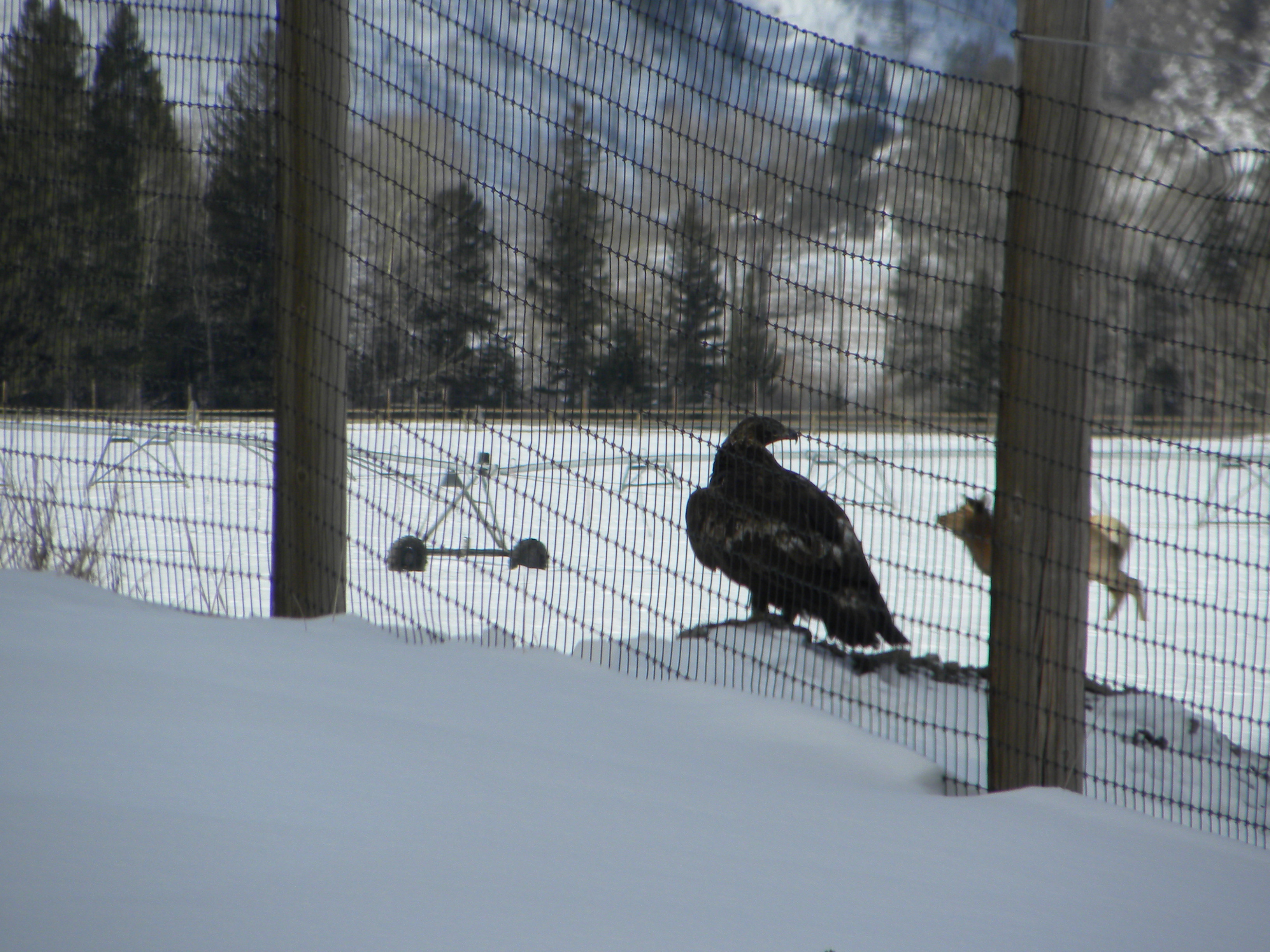
Golden eagle resting after feeding on carcass

Needless to say, I’ve hated this fence ever since I’ve been here, and here was more proof why it should go.  When I saw the kill I went back to get my scope,  On the return I ran into Ron.  He’s a citizen ‘Wolfman Jack’.  He does a great service by being totally obsessed with wolves and following them.  He knows more what’s happening with the packs around here than anyone, including the Wildlife Services folks.  He relayed the drama that had unfolded this morning.

The Sunlight Pack made a kill.  The Sunlight pack is about 10 strong , almost all young wolves.  While they were on the kill, Ron heard some barking.  At first he thought it was the ranch dogs nearby, but then here come the Absaroka Pack, mature wolves 7 strong. They pushed the Sunlight pack off the kill.  While we were talking a black wolf from the Absaroka pack came checking things out.

Ron told me that between the Sunlight Pack, the Absaroka Pack which seems to come around here as well, and the Hoodoo pack of 10 wolves up around Crandall (but they frequent the valley here as well), AND the Beartooth pack of now 10, there is more going on in this area than the whole of the Northern Range.  We’ve got a lot of wolves running around this valley.

Wolves are such social animals and their interactions and orders are constantly changing.  The U.S. Fish and Wildlife biologist, Scott Becker, told me that they have few collared wolves at this point.  The dynamics are constantly changing and hard to keep track of.

When Abby was doing her wolf study here several years ago, there were only 2 or 3 wolves in the so-called Beartooth pack.  That pack is located across the Clark’s Fork of the Yellowstone, where there are very few elk.  It didn’t seem like a very hospitable place, especially in winter.  Scott told me they must eat a lot of deer up there.

I continued on down the road and began my hike.  Resting in the pasture, I saw 3 wolves–2 blacks and a grey.  When they saw me, the grey hightailed it out of there, but I was able to get some good video of these blacks.

Error
This video doesn’t exist

The Totem

I know or have heard of many people declaring that their totem animal is one of the strong, impressive mammals–the wolf, the bear, the cougar, the lynx.  Why are so many of the small animals ignored as a totem?  For instance, Plenty Coups, the last chief of the Crow Indians, had a vision in which his totem animal was revealed to him.  This small little bird was his guiding inspiration, the totem whose wisdom saved his people and won them a reservation on their native lands.

The Lynx

“Listen, Plenty-Coups” said a voice.  “in that tree is the lodge of the Chickadee.  He is the least in strength but strongest of mind among his kind.  He is willing to work for wisdom.  The Chickadee-person is a good listener.  Nothing escapes his ears, which he has sharpened by constant use.  Whenever others are talking together of their successes or failures, there you will find the Chickadee-person listening to their words.  But in all his listening he tends to his own business.  He never intrudes, never speaks in strange company, and yet never misses a chance to learn from others.  He gains success and avoids failure by learning how others succeeded or failed, and without great trouble to himself.  There is scarely a lodge he does not visit, hardly a Person he does not know, and yet everybody likes him, because he minds his own business, or pretends to.

“The lodges of countless Bird-people were in that forest when the Four Winds charged it.  Only one is left unharmed, the lodge of the Chickadee-person.  Develop your body, but do not neglect your mind, Plenty-Coups.  It is the mind that leads a man to power, not strength of body.”

chickadee

We think only of these large mammals as totems because, I propose, we no longer fully ‘know’ animals anymore.  Who amongst us could understand the ‘Chickadee-person’ like Indians that lived with all the animals, large and small, observing them in detail day in and day out?  Each animal has a special quality, a unique force that can connect a person to that higher need in themselves.

I also wonder if there are dual totems; totems in tandem that make up the whole, rather than just a partial piece.  For instance, when I was told that Soona had bone cancer, I knew her slow death would be excruciating, as well as debilitating.  Not a life for a dog.  I got some good advice: take off work for a week and do all the things with her that she loves, then put her down.

I took off work, but was agonizing over the decision, even though I knew it was best for her.  During that week that stretched into two, I was given a series of dreams.   All my dreams had wolves in them–courage, strength, canine. Yes.  But they also contained an important critical ‘other’ totem–elk.  In each dream, over and over, I watched wolves take down and kill elk.  It was the full circle of life.   In every dream, my focus wasn’t on the wolves, but on the dying elk.  I would look deeply into the eyes of the elk as she lay dying and saw there was only a quality of complete surrender.   She knew this was her ‘dharma’ or lot in life.  No remorse, no fear.   I realized it was Soona’s time to go, like these elk, and she was surrendered to it.  It was only me that wasn’t.

So the totem wasn’t just the wolf, but the wolf and the elk.  They are one and there can’t be one without the other.  Their lives and deaths are intertwined.  They are one totem, coins representing both sides. The Yin and the Yang.

Does that mean my friend who changed his name to Wolf, should be Wolf-Elk?  Or the one now known as Bear be Bear-roots?  Lynx-Hare?  Cougar-Deer?


Wolf etiquette in the backcountry

The local wolf pack has been starting to get into bits of trouble.  I saw the ranch hand from the dude ranch down the way.  His cows have been calving.  They only keep about 30 cows around in the winter, but this morning, early, one of them calved and they got to it just about 10 seconds before two wolves did.  They fired a shot and scared them away. 

Error
This video doesn’t exist

Just a few days ago, the wolves killed an elk right at the pasture line where the cows hang.  And the students told me they saw the small black female hanging near the cow pasture on the bridge yesterday.

Where all good dogs come from. Black female wolf

The Sunlight Pack has gotten into trouble almost every summer.  In a few weeks, the rancher that owns most of the valley floor will be bringing his cattle up here, maybe over 500 head or more.  They overwinter down near Powell and calf down there.  Last year it was almost all yearlings up here.  Yearlings aren’t too seasoned and are too curious.  Not a good combo for wolf country.

I’m worried for the pack.  This is good wolf country and cattle really shouldn’t be up here anymore.  The open range leases should be retired; ranches for tax write off purposes should be retired as well.  My eternal fantasy is to win the lottery and buy the big ranch.  Then put Bison back on it and don’t worry if the wolves and bears get a few.   Bison belong here.  They used to be here.

Eventually, you can count on the wolves picking off a few cattle.  Wildlife Services, Dept. of Agriculture, can decimate the ‘bad’  packs each year, trying to get them not to have a taste for cows.  But its not that they love cows.  Its sometimes they are handy or easy.  Really, the wolves prefer elk.   You can’t really blame those wolves for hanging around when the cows are calving.  Calves are helpless when they’re first born, and an easy meal.  It’s really a smart strategy.  Just as smart as the little chipmunk who ate a hole in my bucket full of grain for the turkeys.  Easy meal; low expenditure of energy; biology 101 really.

The Valley that Sits in the Middle of the Land

The ranch hand told me his friend went ‘horn hunting’ by horseback last weekend near the ranch in the back country with his two dogs.  The dogs ran off and haven’t been seen since. I showed him the electronic collar I keep Koda on.

“They’re bird dogs, not people dogs like yours.”  We’re both thinking the wolves probably already got them.

Last spring a young experienced hiker and his dog went backpacking up the North Fork near the Park entrance.  There’s a wolf pack up there, and although he kept his dog close, when he went to set up camp in a meadow in the rain, his dog was sniffing around and got attacked a few hundred yards away in the trees by 8 wolves.  There had been a recent human encampment there, probably with some leftovers.  The hiker ran to his dog, the wolves ran off, but the poor dog died.

That hiker didn’t really do anything wrong.  He kept his dog close at least most of the time.  When I told this to a local who hikes with her dog, her reply was telling:  “That’s a risk you take hiking around here.”

I keep Koda close.  I watch him at all times and keep him on a shock collar I got through Cabelas.  He’s a dog’s dog, not really a people dog.  He has come to like people, and he’s loyal to me especially.  When he sees a dog, I can easily control his desire to run up and play.  But his response to a coyote or a wolf is different.  Some ancient wildness overtakes him.  He recognizes the dog part, but he senses the freedom part too.  In a moment he’s off and that could be the difference between life and death for him.  That’s when the shock collar comes in super handy.  But its no guarantee.

Koda with his toy.

Yet I do have to say, those fellows who took their 2 dogs out here, in wolf country, and didn’t watch them, let them run around where ever their noses took them–that is just irresponsible with your dog and certainly you can’t blame the wolves.

However you cut it, with the wolves and grizzlies here, I still prefer that wildness.  One of the students and I were talking about New Zealand.  He did an internship last fall in Antarctica and spent time on the south Island of New Zealand for vacation.

“Compared to Antarctica, it was great to be in a place with plants and trees, lush and fertile, where we could hike.  But to tell you the truth, as a biologist, it lacked.  They have no native animals there, except for a few birds.  The scenery was beautiful, but I missed the wildlife, especially the big animals, those ones that make you aware when you’re hiking around.”

Even if Chief Seattle didn’t really say it, its worth quoting:  “What is man without the beasts?  If all the beasts were gone, men would die from a great loneliness of spirit.”

Amen to that.

We love our dogs. Let's keep them safe.

The wolves have a good day

What a day!  Let’s begin with 4″ of fresh snow.  Then add 5 wolves running past my property, 4 greys and 1 black.    Throw in back tracking and tracking the wolves to explore what route they are using to come down into the valley.  And for the day’s finale, watching the wolves on two kills they’d made by the road this morning.

Lots of elk tracks too on this beautiful day

Around 1 pm, we heard the dogs barking and looked out the front window to see 4 beautiful wolves running along the nearby pastures through a herd of horses.  Those horses are used to dogs so they didn’t seem perturbed one bit.  And those wolves were ‘booking’.  They had someplace to go or a meeting to attend.  Within just a few minutes they were up on the opposite hillside and over the divide, a hike that takes me at least 45 minutes!  Then along came a limpy grey following way behind.  They all looked amazingly healthy, no mange.

Limpy wolf but seems to be doing fine

These are the new Sunlight Pack, pushed slightly south into Elk Creek because of a much larger pack of 10 wolves occupying their northern range.  Last winter I didn’t get a chance to see the Sunlight Pack as they were hanging deeper west in the valley, moving with ease back and forth (north and south) across the valley floor.  This has been their home range for several years.

There’s an elk study going on, in its fifth season, in the valley and they’ve been able to do some good collaring this year of wolves.  And so they’ve learned that the Sunlight Pack has been bullied a bit by this larger pack to the north.  In fact, all that howling I heard on Valentines’ day was the Hoodoo Pack making a kill on the northern side of the river, a side that used to belong to the Sunlight pack.

Tracks of four wolves 'booking it'

At around dusk I went up the road to get a closer look at the kills and see if there were any wolves still  on them.  The UofW crew said they processed the kills and they were two older cow elks, about 10 and 12 years old.  “How old is old for an elk?”  I asked.  “About 15.  Some can live till 20, but that’s really old. These were in pretty good shape,” they informed me.  

Error
This video doesn’t exist

With some quick and dirty math, I figure that’s about 50 or 60 years in human terms.