This is a post about something I regularly and randomly think about: What is the impact on grizzly bears when they are captured and moved? Or even captured and taggedfor research?
Obviously a capture is a very close encounter with humans. Some captures are used solely for research where the grizzly is ear tagged, collared, or tattooed or both. Then there are captures that move problem bears (grizzlies in the Greater Yellowstone area are moved usually for killing livestock) to more remote areas of the GYE that the bear isn’t familiar with. How does that affect a bears’ perception of humans? I also wonder how moving a grizzly in the fall affects their ability to find food sources in an unknown territory.
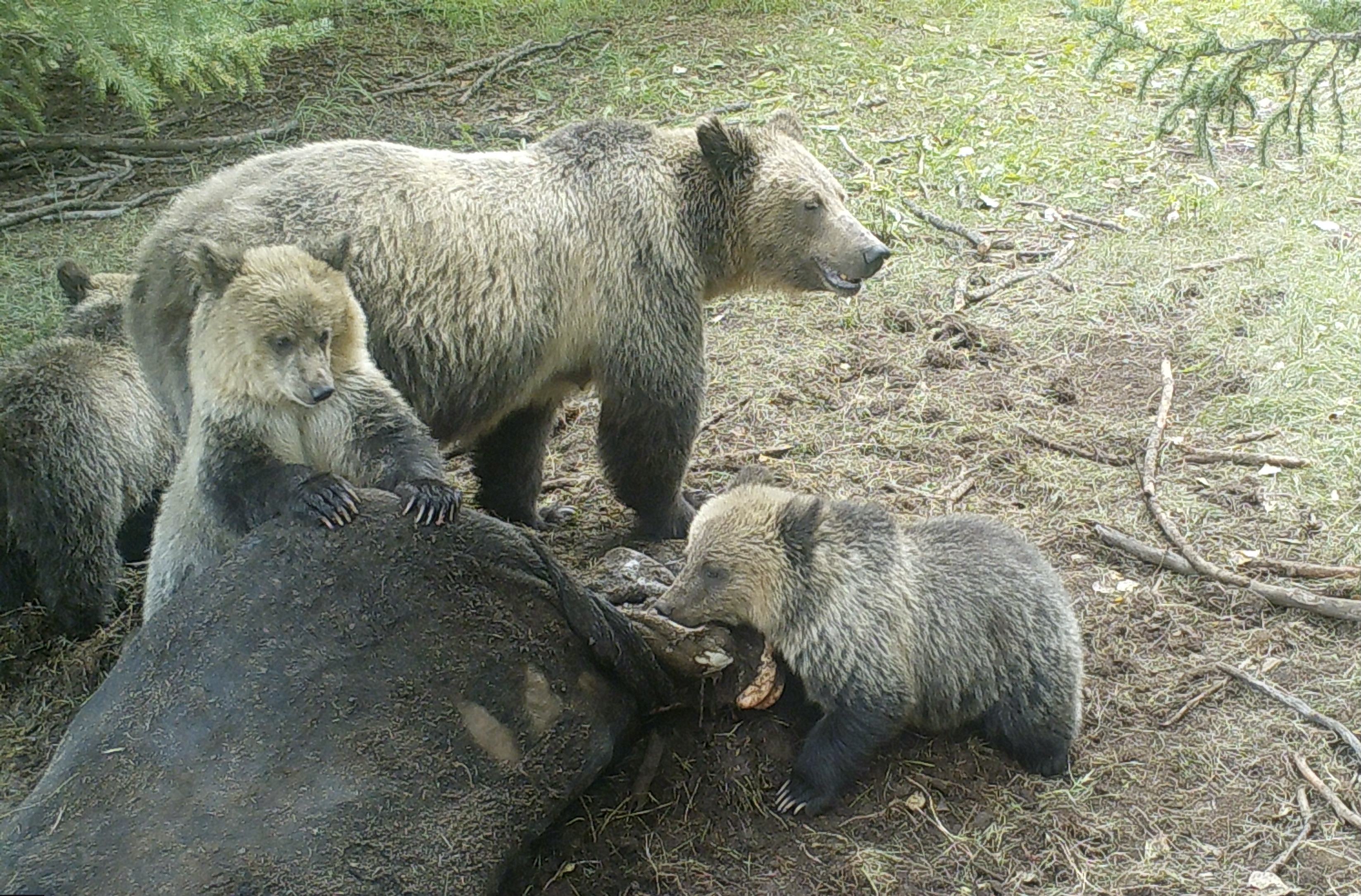
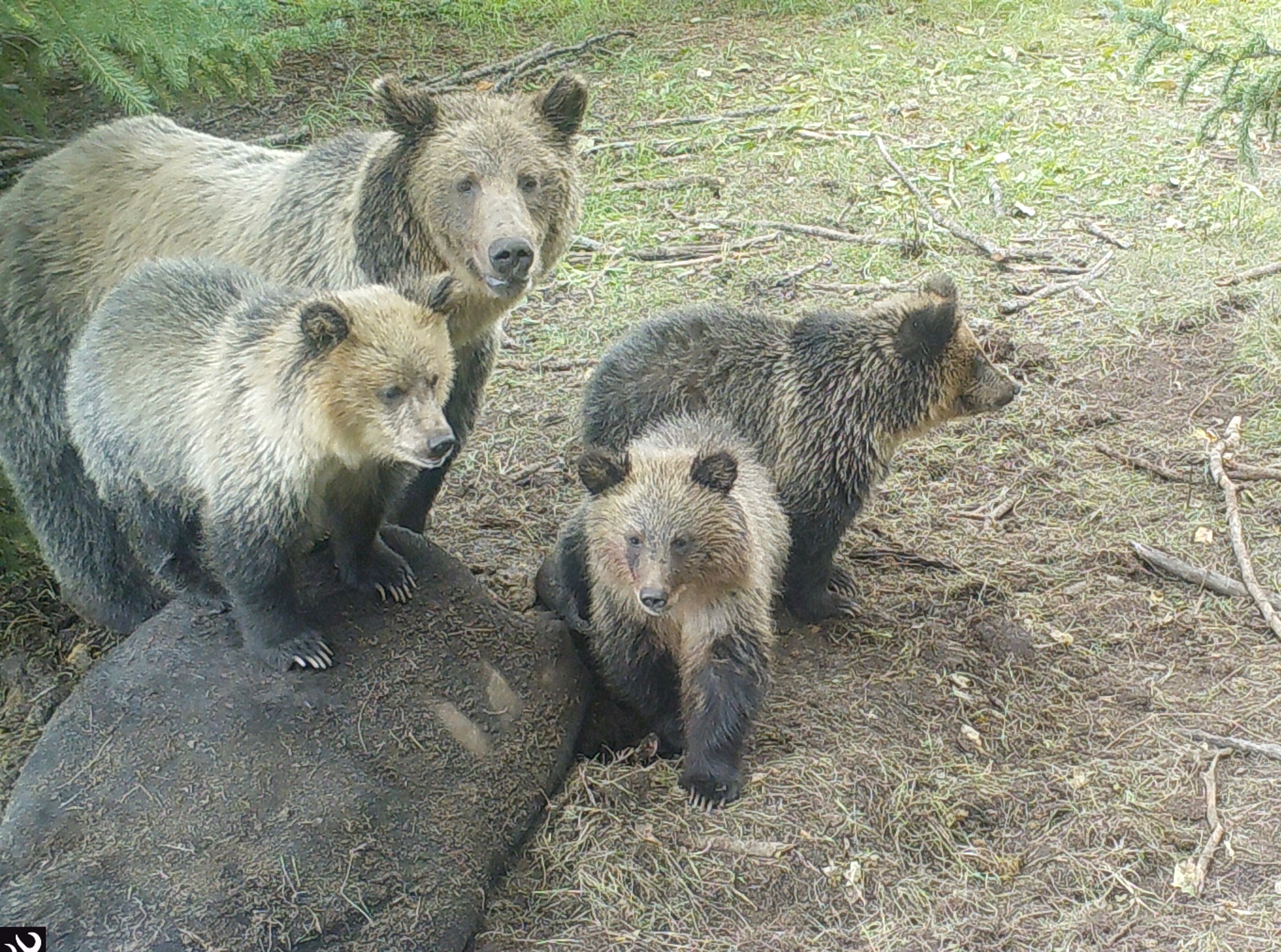
Grizzly family on a cow that was sick and put down by rancher
When I first moved to Wyoming, our local landowners association’s yearly meeting had a speaker from the Wyoming Game & Fish Department who specialized in bear management. I live in an area where problem bears are dropped off. The hope is that they’ll roam into Yellowstone or adjacent wilderness areas. This bear biologist told the crowd “You don’t have to worry about the bears that are dropped off here. They’ll just ‘home back’ to where they came from.”
Craighead brothers in Yellowstone Park with a captured bear. The first study using radio collared bears
One story sticks in my mind that illustrates all my questions. In the fall of 2017 our local game warden Chris Queen, was off-duty and hunting elk up a remote drainage. It was dusk and he was walking out, back to his truck, without any success. On the way he encountered a female grizzly with three cubs. Queen later told me that he knew this bear. She was aggressive and hornery. The wind wasn’t with him, she charged, and he shot her to protect himself.
“I didn’t want my kids to be fatherless,” he told me. I knew Chris had used bear spray previously in a grizzly encounter. And when we discussed the incident he was on his way to help with some spring bear captures. I didn’t blame Chris. You never know what you’ll do in an encounter and he had a lot of experience with bears and using bear spray. The incident was thoroughly investigated by the Department and Chris was cleared. The three cubs were 2 year olds and the WGFD felt they had a good chance of making it on their own so they didn’t try and capture them. Winter was near and the cubs would be denning.
What stuck with me was the story of grizzly bear No. 423, the bear Queen killed. She was known to WGFD because she had a tattoo on her inner lip. 423 was born in Sunlight basin around 1996. When she was 5 or 6 she broke into an unsecured building, probably in one of the ranches in the valley, and received a grain reward. She was captured and moved to the East Fork of the Wind River. From there she ‘homed’ back to Sunlight, a distance of about 80 miles as the crow flies over rugged terrain and scoured treeless peaks. In 2011 at fifteen years old, 423 was trapped again in Sunlight Basin after she was found eating a cow calf. Although it wasn’t clear if she had actually killed the calf (cattle die from many things), she was moved again, this time to the Idaho/Wyoming border near Jackson. Again 423 homed back to Sunlight, this time venturing over 100 miles through several mountain ranges. (WGFD documented her in 2013 in Sunlight up Trail Creek drainage). When Chris encountered 423 six years later, 423 had three cubs, making her more dangerous as grizzly sows will protect their cubs if they feel threatened.
Besides the obvious question of how these bears are able to find their way back to their natal range, I have to wonder the impact these long distance moves had on 423’s temperament. Now she was an much older bear, 21 years old, with three cubs and a series of unpleasant experiences with humans. Was she thinking “No way you’re gonna move me again, and separate me from my cubs.”
Two female grizzlies attack a trail cam. The first has a blue ear tag. I’ve seen her with cubs many times. The second has one cub and she is wearing a collar.
I’ve been using trail cameras for over fifteen years. I regularly get captures of grizzly bears. My personal experience is that grizzly bears rarely mess with my cameras. Sometimes cubs will explore them but adult males or females hardly ever do. On the other hand, male black bears (and sometimes female black bears) regularly disturb my cameras. I think of grizzlies as the top of the food chain. They have nothing to prove. Black bears though, as subordinate predators in an environment where an encounter with a grizzly can mean death, have to act tough. They stomp around the area, leaving their scent, and bite the cameras to prove their dominance. Yet I have had a few incidents where grizzlies pawed my camera. One was set up on a freshly dead deer. The grizzly bit the camera up, then dragged the deer far up the hillside. That’s typical protective behavior on a large meal. But the other grizzlies that chewed the cameras all had been ear tagged or collared. Two were females with cubs.
I’d love to see a study on the effect of handling and/or moving grizzlies. I’d like to know if grizzlies that are moved in the fall have time to home back, or how they find enough food in an unknown area to make it through the winter.
Bears are smart and they also have individual personalities. I once read a book by a retired Montana warden who helped out on captures. He commented that some bears repeatedly went into cage traps for the free meal (usually road-killed deer are the bait in the trap). Grizzlies are one of the most studied mammals. But I’ve yet to see a study answering these questions.
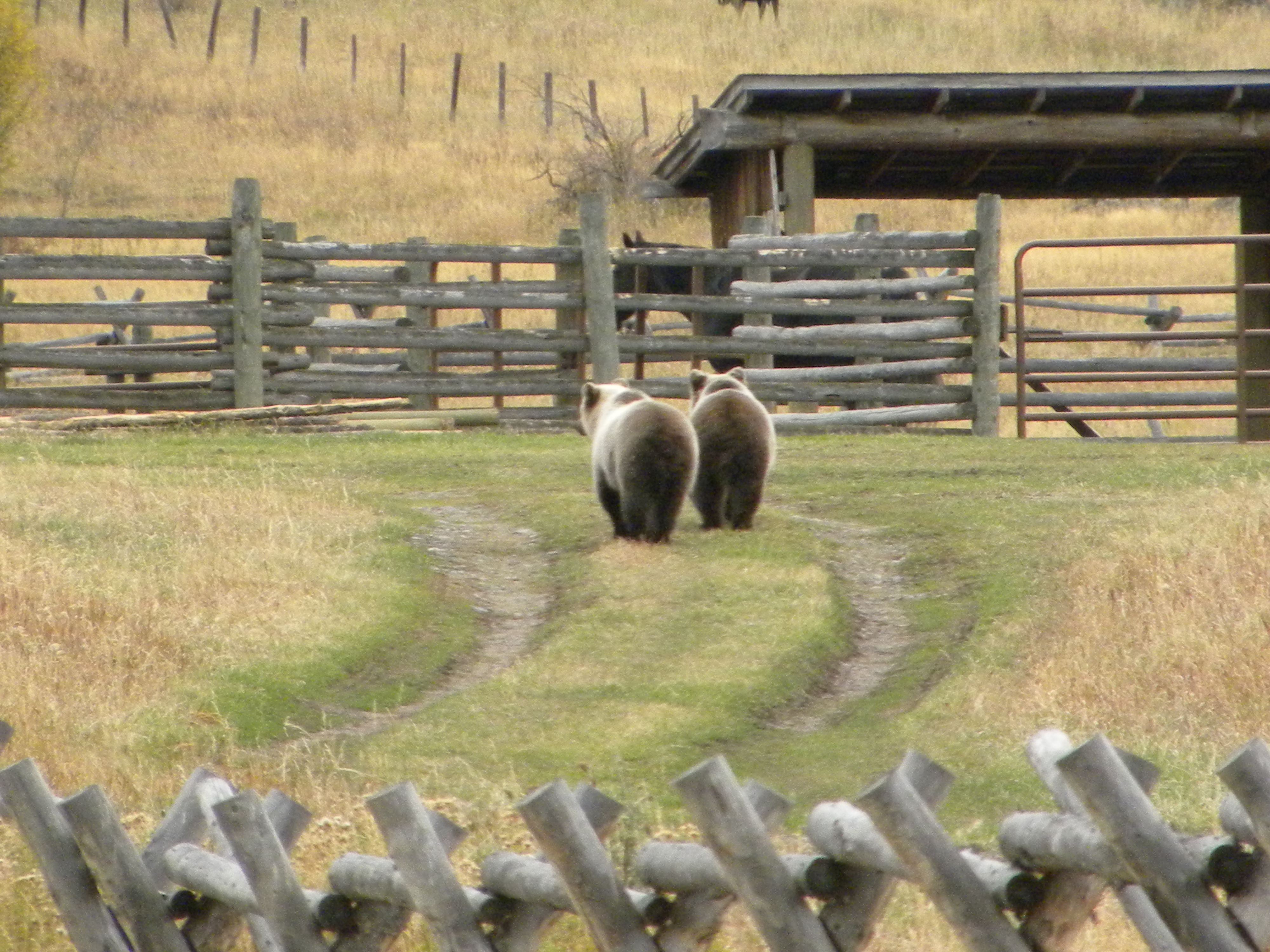
Two young grizzlies travel together in early spring
Today, December 11, there is no snow on the ground at 6500 feet, a warm wind blows hard in 50 degree temperatures. I’m wondering what the future might hold for our grizzly bears as climate change marches forward. No one really knows. The sensible prescription is to make sure we provide corridors for passage to alternative foods as ecosystems change. That’s the best planning we can do.
Grizzly family foraging a cow carcass that died of Larkspur poisoning
But I thought I’d indulge in visualizing what it could be like for bears, and especially for grizzlies since so few of them remain in the lower 48–only around 2000 in the Yellowstone ecosystem and the Northern Continental Divide, just a fraction of their historic range.
Probably the best place to look to is California where grizzlies once roamed but were extirpated by the early 1900s. Tracy Storer was a zoologist at University of California Davis. He spent years collecting every historical scrap on California grizzlies ever put on paper—in magazines, books, journals, newspaper clippings, Spanish logs, or Mission records. In 1955 he published California Grizzly. We now have better grizzly biology than what’s noted in his book, but the book records the fascinating story of grizzly habits along with Spanish and white men encounters. No one knows how many grizzlies California had. Joseph Grinnell, using suitable habitat and assuming one bear every 20 square miles (at one point the Interagency Grizzly Bear Team was using females with cubs every 19 square miles for population estimates) he estimated 2595 pre-1830.
Other sources estimate 10,000 bears because people met “herds” of bears, or bears in groups. Seeing 16 bears in “one drove…and that grizzly bears were almost an hourly sight, in the vicinity of the streams, and it was not uncommon to see thirty or forty a day.”(1841 Sacramento Valley). Although sightings of grizzlies in groups were common, that’s probably not that different from today where dozens of bears can be seen on moth sights or Alaska bears at salmon runs. Where food is plentiful, bears are tolerant of each other. California acorn season in the fall drew lots of grizzlies, beached whale carcasses, or large fields of clover.
Grizzly rooting around for tubers
Although there were probably a few grizzlies that denned in the Sierras, those environs were left to black bears, while most of the grizzlies were resident in the lower elevations and along the coast. Storer writes: “We think that, of the grizzlies living at lower elevations, the females with their young cubs were sequestered for a time, but the others were active through much or all the year…”
As our climate warms and conifer forests succumb to beetles and other pests, shrubs and grasses will dominate the landscape. Our National Forests will turn into National Shrublands. This favors grizzlies who are usually 80% meatless in their diet. Grizzlies are opportunists. They’ll find new foods. A warden who spent a lot of time helping biologists tag bears once told me grizzlies were following streams out of the mountains into the lower elevations in fall, feasting on Russian Olive fruits, an invasive species planted here several decades ago which has taken over native cottonwood habitat.
Lack of food is the main driver of bears denning. With warming weather, there might be many types of food year round. Insects will be out year round, rodents that usually hibernate won’t, shrubs will keep their foliage longer, grasses will grow year round.
Grizzlies might do alright, but don’t expect them to hibernate, except for females who need to give birth to their helpless young in the den. Of course, I am being optimistic here. No one knows what the future brings as our climate seems to be warming at a rapid rate. Ensuring protected habitat through partnership with private lands and our federal and state lands, is the best we can do at this point.
I’ve got a theory. Bear with me as I tell my story.
This last June I was exploring a drainage that burned in the 1988 Yellowstone fires. There’s no trail but I’ve encountered coyotes denning farther up the draw; a place I like to go and investigate. The northeast side of the draw is filling in fast with a thick cover of young lodgepole tree. The ground, however, is a maze of burnt and rotting timber you have to clamber over.
June is when the free-ranging cattle are trucked into the valley. The major livestock producer runs several thousand head of cattle, all yearling males, which he rotates through a range of Forest Service allotments throughout the summer. Mid-June is a time when grizzly bears are foraging at lower elevations. By early July, summer heat and the lure of Army Cutworm moths drives the bears to higher elevations. These young naive yearling cattle roaming freely, especially in heavy timber, are easy Spring prey for hungry grizzlies.
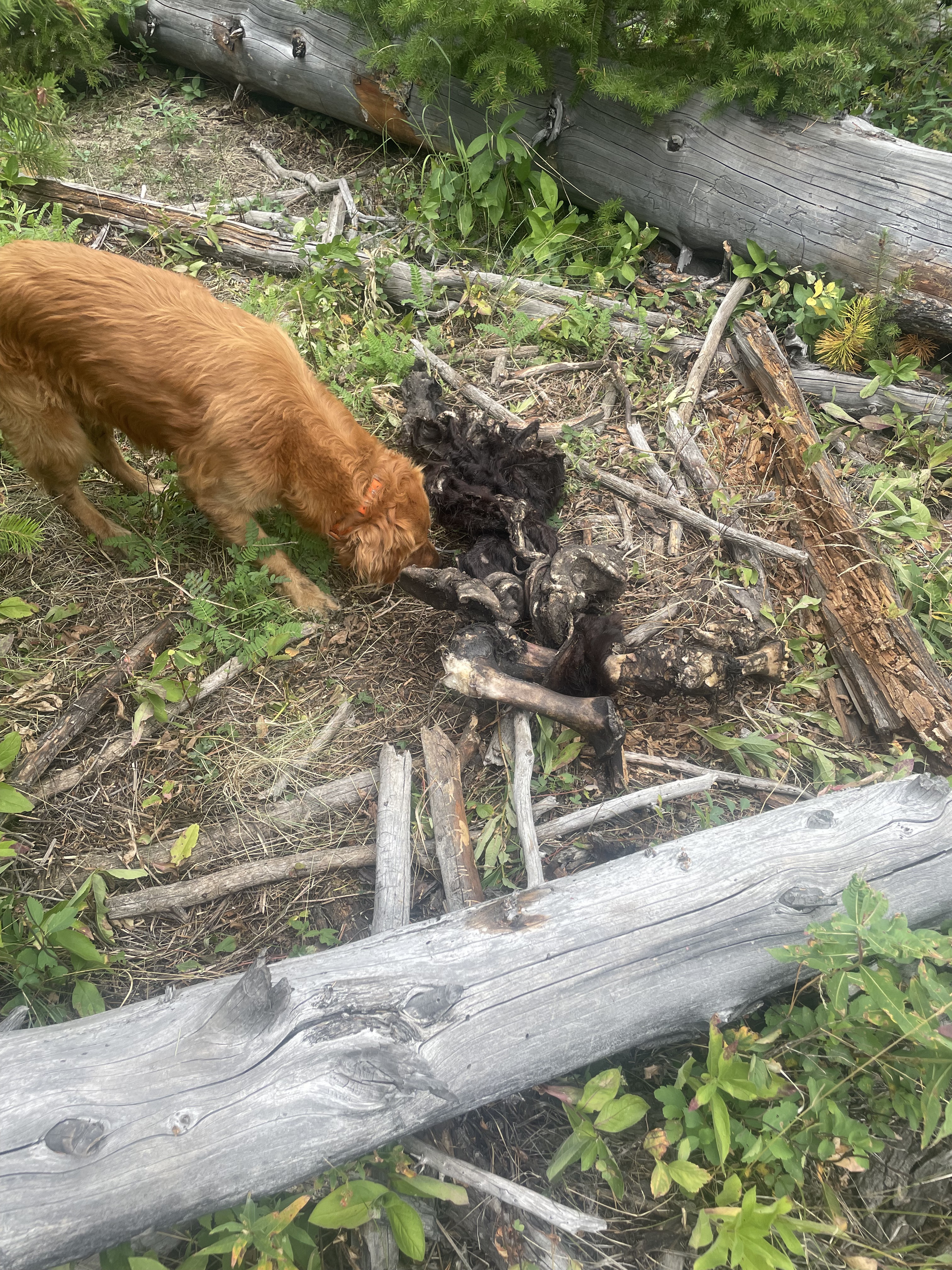
The access to this side draw begins on an open hillside. Right away I notice fresh cow pies indicating that the yearlings have been here recently. As soon as I enter the dense lodgepole pine forest, something didn’t feel right. I pull my bear spray out of its holster, release the safety, and keep my dog at a heel. A large pile of grizzly scat—soupy, wet, and clearly from a meat meal—greets me amidst the tight tree cover. Then a waft of a dead animal fills my nose. The air is still but as the aroma is getting stronger, I can tell it’s coming from somewhere ahead of me. That was my cue to move swiftly to the open meadow on the other side of the creek and high-tail out of there. But I determined to return in a few months to see if what I sensed was correct. Months later in mid-August when I know the bears are up high and the cows are out of that area, I return to see if my instincts were correct. Sure, enough, in short order, after combing the timber, Hintza, my dog, easily locates the dead animal I smelled months ago. Yes, it was a cow. And yes, with all that fresh meaty bear scat, that had been a bear on it.
What was left of the smell from June.
But this wasn’t the first freshly killed cow by a grizzly I’d encountered in the month of June. A few years ago, in an adjacent drainage, I was walking along the gravel road when I saw a strange unnatural hump of dirt and sagebrush. There were drag marks across the road as well. The dirt hump was a covered cow, freshly killed by a bear, one of the most dangerous circumstances you can come across. Bears will defend their kills. The following year and in the same area, the warden rode by on an ATV and warned me I was heading for a dead grizzly-killed cow which he was about to remove. That’s three fresh grizzly kills, a very dangerous situation for a hiker or a horseman. But every summer on hikes I run into dead cattle fully consumed after they’d been predated on—stiff hides with bones scattered.
Those of us who live and recreate in grizzly bear country are instructed to secure our food. I use a bear-proof trash can. Others in the valley keep their garbage locked in their garage. Residents are very conscious of not feeding bears. Yet putting cattle out on public lands in early spring, when grizzlies are hungry and foraging down low, seems akin to putting food out for the bears, especially young naive yearlings. Bears are smart and I’m betting grizzlies here are learning there’s a good source of easy meat. It may even be possible that instead of heading to moth sites and higher elevations, some bears are sticking around throughout the summer. Yearlings who are free-ranging, unfamiliar with the landscape and its risks, are akin to leaving easy food out for bears. That linked article discussing two relocated bears for killing cattle says “bears that are determined to be a threat to public safety are not relocated and might be killed.” But who is creating that risk? If cattle, like our garbage, are not managed correctly, we humans only have ourselves to blame.
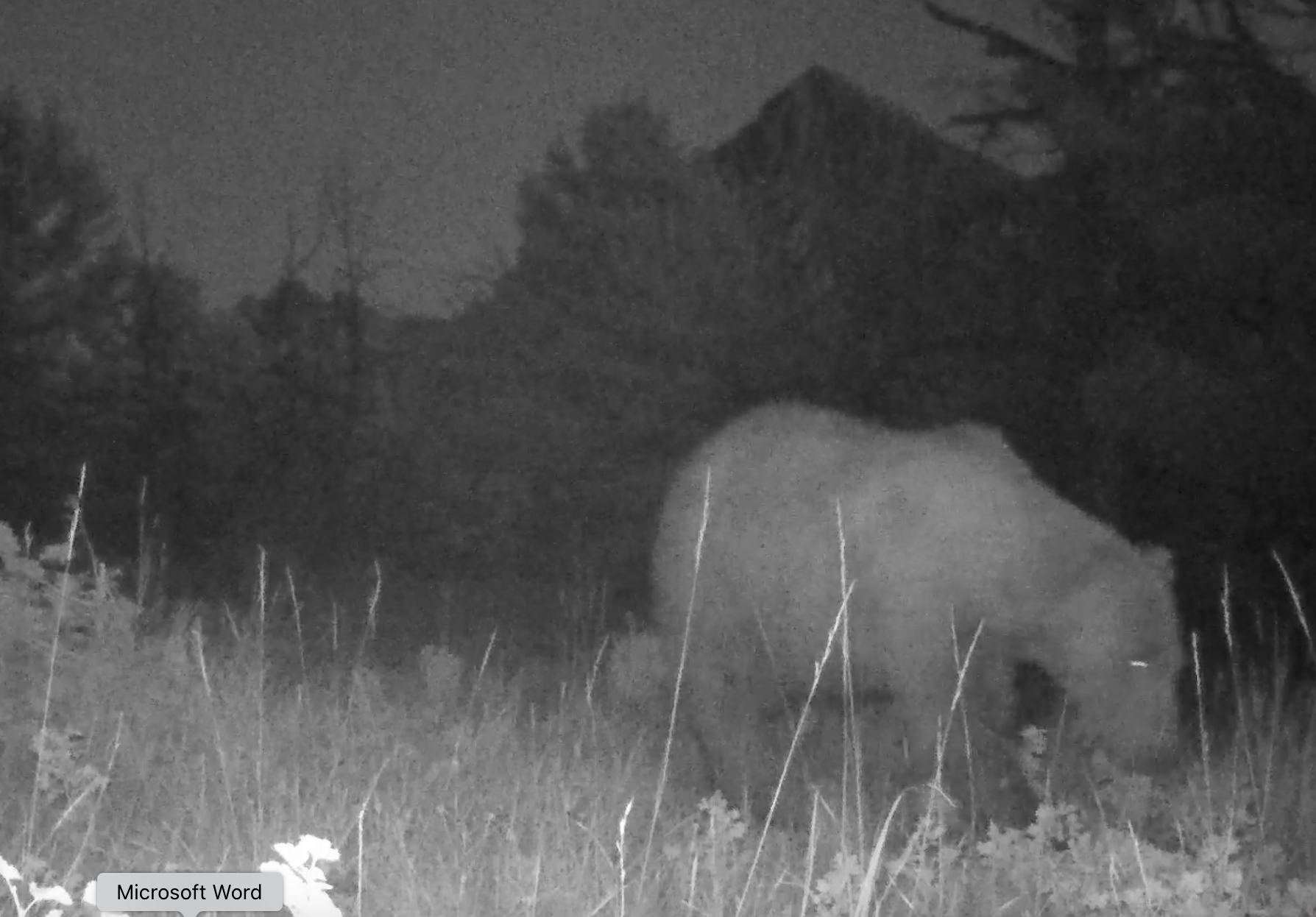
Caught this grizzly on my camera August 2, 2024. I know this bear. He usually comes around in the fall. Here he is below in 2016 early September on ripe chokecherry bushes.
If cows are going to be free-ranging on our forests, (and I feel that livestock on public lands should be “at your own risk” as these are the only lands wildlife have) consideration needs to be given to where and when. Don’t put cattle out in June when grizzlies are down low and hungry. As an alternative, livestock trucked in in June can be placed in areas that are highly visible with a cowboy checking them frequently. Free-ranging cattle in highly populated bear areas are not only endangering the bears (Wyoming has a 3-strikes rule) and livestock, but also hikers, cyclists, horse people and other recreationists.
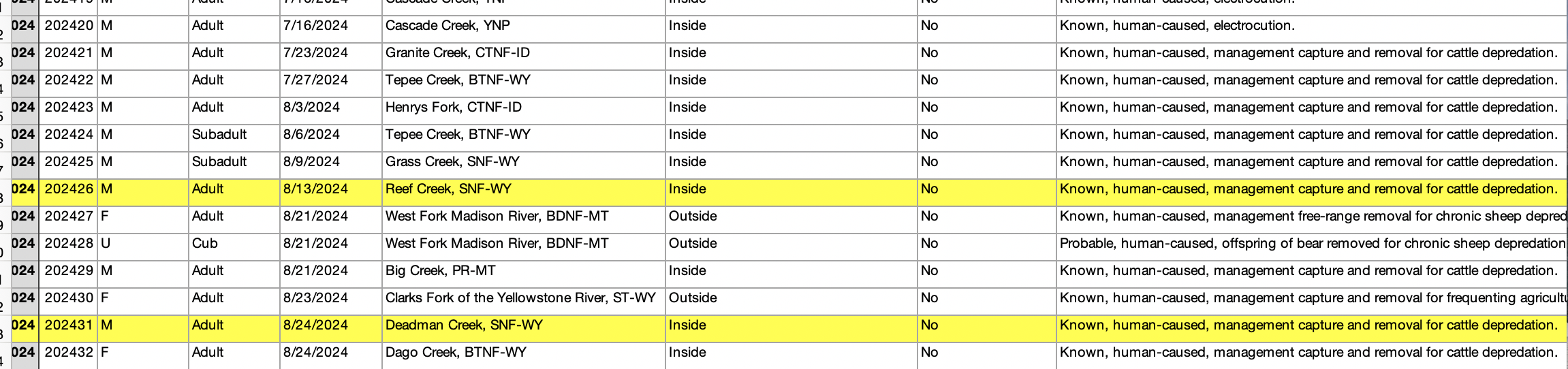
Two grizzlies killed by USFWS for cattle depredation in my area this summer. We have moth sites and it is unusual for bears to be down so low in August instead of at high elevation moth sites nearby. On one of these August cattle predation sites, there were four grizzlies on the carcass!
So are we training grizzlies to hang around while the pickings are easy, akin to leaving garbage out for them? I think the Forest Service, who manages timing and allotments, can do a much better job for the bears, the cattle and the people. Ironically, jurisdiction is split. The Forest Service does the range management, but it’s the Game and Fish, through state mandates, that pays producers compensation for cattle killed by grizzly bears. But I think it all comes back to the first defense of proper range management to reduce cattle and grizzly deaths. A radical thought would be to have no free-ranging cattle in grizzly country. Why not! But if the status quo must continue, then shift and limit the timing of when and where cattle are located across the forest.
There’s one place in my area where I’ve seen Glacier Lilies, but as soon as the melt starts the access road usually closes due to flooding. Since the weather has been cool, and next week predictions say it will be in the 70s, I decided to check out the spot to see if the lilies are up yet before the road closure. It’s a fairly remote less traveled trail and this time of year grizzlies are down low foraging while wolves are denning. The trail begins at the road’s end with a stream crossing, winds through a burnt valley before turning up a small drainage where the trail heads to a ridgeline pass.
Immediately grizzly tracks began faintly appearing on the dry ground.
When I turned into the forest drainage, the wet ground revealed two grizzly bears. That could only mean a mom and cub. The grizzly cub footprint appeared to be at least a one year old. I became more alert, unlocked my bear spray.
Smaller bear on the left
The area I’d seen the lilies years before was about a mile up the trail near the pass. Bear tracks followed the trail plus revealed a 2 day old scat that said they’d been eating grass mixed with fur.
Closing in on my lily hillside, I found a clear wolf print in the mud. I hadn’t seen wolf tracks earlier on the trail.
wolf track
About 150 yards before the lily area , I came upon what these bears (and wolves) were doing here. An elk kill right by the trail, completely consumed but about a week or less old. Clearly a cougar kill. I searched around the site a bit. No skull, only one leg left plus the spine and pelvis.
What a cougar kill looks like. Rumen pulled out to the left. The fur in a neat circular pattern cut off with the cat’s incisors
What did the tracks and the kill sign say about the story here? Of course, the only thing I can be certain of was this elk was killed by a cougar. But let’s think about what might have happened. Wolves and bears (grizzlies and black) push lions off their kill. With only one leg, and few fresh wolf prints, I imagined the wolves kicked the lion off the kill site, and hauled the other legs off, maybe to their den site over the ridge. The wolves probably consumed most of the elk before the grizzly mom and cub came along (their tracks fairly fresh) to finish off what was left. The fresh wolf track I found was probably a wolf returning to check on any left-overs, and maybe even encountering the grizzlies.
Unfortunately, I didn’t find my Glacier Lilies. Maybe just too early or maybe those bears ate them. But here is some other cool bear sign I found along the trail.
Bears use their claws to strip bark from a tree, then feed on the sapwood by scraping it from the heartwood with their teeth.
To learn more about mountain lions and their interactions with wolves and bears, read my upcoming book Ghostwalker: Tracking a Mountain Lion’s Soul through Science and Story out this fall University of Nebraska Bison Books. To pre-order a copy and receive a 40% discount, go to this link and use the code 6AF24
For those of us who care about the fate of the grizzly bear, for those who love to see grizzlies in Yellowstone National Park and its outer ecosystem, Engineering Eden by Jordan Fisher Smith is an important chronicle of the bear’s recent history and how we almost lost him.
Many do not know that it was Yellowstone Park Superintendent Jack Anderson and Yellowstone’s chief biologist Glen Cole who almost brought Yellowstone grizzlies to extinction following the 1967 maulings in Glacier National Park known as The Night of the Grizzlies. The reaction to the night of August 13th, when two women were mauled to death in two separate incidents by grizzly bears, led to the quick closing of Yellowstone dump sites. The closings were over the objections of Frank and John Craighead.
The Craighead brothers had been conducting the first in-depth grizzly study in the Park. In an 11 year continuous study beginning in 1959, the brothers invented the first radio collars, collaring and ear-tagging 256 bears in the Park during that time. Their study shed light on where grizzlies denned, the size of their home ranges, and how bears homed back to where they were captured. From the results of their research, the Craigheads proposed the Greater Yellowstone Ecosystem—linking Yellowstone, Grand Teton, five national forests, and two national wildlife refuges into a single landscape. It was apparent to them that the boundaries of the Park itself were not sufficient to protect nor contain the food sources and wanderings of grizzlies.
Craighead Brothers move a grizzly (NPS photo)
While Anderson and Cole wanted to immediately close all the Yellowstone dumps, the Craigheads, knowing these bears had grown up adapted to receiving food rewards and understanding the bears better than anyone, advocated for a slow change-over, dropping road killed carcasses at the Trout Creek dump site. In other words, a slow wean rather than cold turkey. In the end, the Craigheads were right. Without the additional food sources of the dumps, the bears began heading into campgrounds, rummaging for food. At that time campers were not protecting their food, nor were there bear-proof cans provided. Everything happened too fast. Rangers were employed to kill problem bears and the bear population crashed to below 150 bears. Since bear reproduction is extremely slow, even after the bears had been on the Endangered Species list for ten years in the mid-1980s, most scientists thought the Yellowstone grizzly would soon be extinct. By 1990, the Greater Yellowstone grizzly population had dipped to 99 bears. Slowly, it began to creep back up to present day estimates of about 750 bears.
Engineering Eden uses as its focal a lawsuit trial centered around the death of a young man named Harry Walker. Walker was passing through Yellowstone in 1972 with a friend. They camped about a mile outside the designated campgrounds in Old Faithful, left their food out, set up a tent, then went back to the lodge for the evenings entertainment. Trying to find their way back to camp after midnight on a moonless night, Walker was mauled and killed by a grizzly who’d found their food. The family sued the United States government, and in a high profile case, Starker Leopold, son of Aldo Leopold, testified as an expert witness for the government while Frank Craighead testified for the family. Smith uses the trial, going forward and backward in time, to bring to light all the events surrounding the case, even discussing black bears in Yosemite that were also garbage bears.
If you don’t know about The Night of the Grizzlies, there’s a Montana PBS special worth watching, or a short but excellent book by Jack Olsen. Yet it is worth recapping that night since this was the spark that ignited what followed in Yellowstone.
The two fatal incidents occurred on the night of August 12, 1967, two different bears, separated by eight miles and a formidable mountain named Heavens Peak. Since the Park’s creation in 1910 there had not been a single fatal encounter with a grizzly bar. So these two attacks on the same night raised a lot of controversy. But they were actually a long time in the making which included other non-fatal maulings that had occurred in Glacier. Food dumps and trash from the growing number of visitors attracted bears, black and grizzly, for years. Granite Park Chalet, the site of one of the maulings, had been dumping garbage just 200 yards from the building. The year before, the Park Service provided an incinerator, but the sheer volume of visitors created more trash than could be burned nightly. Plus, the nightly arrival of grizzlies was a tourist attraction that was coveted. The dumping continued.
With a long term drought depressing the berry crop, critical food for grizzlies in the Northern Continental Divide, bears had grown particularly dependent on these dumps. At Trout Lake, on the other side of the Livingston Range, one bear in particular had been trouble throughout the summer. She was old, underweight, and unafraid of humans. That summer there were reports of this old female marauding campers and campsites, even confronting them while on horseback. She had been hanging around a private outfit called Kelly’s Camp at the head of McDonald Lake getting into their garbage. Yet no action was taken by the Park Service. Things were different in those days and with no grizzly bear major incidents since the Park’s opening, policies were lax.
Michele Koons had hiked into Trout Lake earlier in the day with a few friends. This bear had come into their campsite earlier and they drove her off. The group then moved their site closer to the lake and built a large bonfire. At 4 a.m. the bear returned, sniffing out their sleeping bags. Although her companions escaped up trees, Michele, unable to slip out of her bag, was carried into the woods. With first light, Koons’ companions hiked out to the McDonald Ranger Station to report the mauling. When the rangers found her body, it was mauled beyond recognition.
“Trout Lake was typical of all the other campgrounds at that time in Glacier National Park,” said Bert Gildart, the ranger who responded to the grizzly attack at Trout Lake in an interview with the Great Falls Tribune in 2017. “I think all the campgrounds in Glacier National Park were a mess. When the chief ranger and I flew back in there a few weeks later, we picked up an immense number, probably 17 burlap sacks we loaded into a Huey helicopter and it was all full of garbage that people had left behind.”
Meanwhile, since the Granite Park Chalet was over-flowing with visitors the evening of August 11, Julie Helgeson and her boyfriend Roy Ducat decided to camp at the campground 500 yards down the trail. A similar scenario played out, with the grizzly first mauling Ducat in his sleeping bag. When he played dead, the bear turned to Helgeson. Ducat climbed out of the bag he was sharing with Julie, and ran for help as the bear dragged Helgeson down the ravine. A search party found her alive, although she died soon thereafter from excessive loss of blood and shock.
Rangers were dispatched to kill the offending bears. Bert Gildart and Leonard Landa shot the old female at Trout Lake. “It was determined on the spot that this bear had glass embedded in its teeth,” Gildart told the Tribune. “So here you had a bear with difficulty chewing and eating in the first place and as well a bear that was horribly emaciated or run down. It couldn’t eat. It weighed slightly over 200 pounds. It wasn’t a big bear at all. It was about 20 years old, an emaciated sow. That’s the reason why it probably fed on the girl.”
Up at Granite Park Chalet, following the mauling, Ranger David Shea was told to kill any bear that came to their dumpsite. The result was three dead bears, including a sow with two cubs. One cub was shot in the jaw by a second ranger, survived the winter, then killed in the spring when he returned to feed on garbage.
From these two incidents, immediate changes in Glacier policies were initiated. “Pack it in, Pack it out”, backcountry campgrounds were concentrated, cables for hanging food were set up, education programs began. But of course all the cleanup of the backcountry along with de-habituating bears took time.
For years I could not make sense of what happened to my friends and I in Glacier National Park in the summer of 1972. My friends Karen and Sarajo and I had spent our high school free time backpacking with other teenagers and a parent chaperone in the Sierras and high mountains of the San Bernadino forest. We thought of ourselves as pretty experienced. We understood cleaning up our cooking site and hanging our food high in trees. In those days, there wasn’t any freeze-dried backpacking food sold. We brought rice, lentils, and other grains that needed cooking for an hour. Smells wafted through the air. But still, a clean camp could be kept.
That summer my friends and I were on a journey typical of teenagers who had just graduated high school. It was the beginning of the rest of our lives and we were excited. We’d hitchhiked to Waterton Lakes National Park with the intention of a through-hike. We stopped at the visitor center for maps and information. Two Canadian rangers stared at us from behind the counter. When we told them our plans, they both looked genuinely alarmed.
“There’s a 10 mile hike that follows a lake. A ranger station is at the lake’s end. From there you can continue on into the United States. You know there are bears out there, grizzlies and black?”
“What about grizzlies,” I asked. We knew what to do about black bears, being an abundant nuisance in the California Sierras.
“You have three choices if you encounter one that charges you. You can climb a tree. Grizzlies can’t climb trees. You can drop to the ground and play dead. Lie on your stomach, put your hands behind your neck.”
“What’s the third option,” Karen asked.
“Play chicken. Stand in place and stare him down. More than likely that bear will run and veer off at the last minute. But not a guarantee.”
I didn’t give his advice much second thought, but playing chicken isn’t in my nature. Climbing a tree sounded doable.
We camped at the visitor center campground that night and set out in the morning. Much of the hike paralleled the lakeshore. The day was overcast, drizzling on and off. By early afternoon we found a suitable campsite by the lake, built a small fire in a clearing adjacent to the lake and began to prepare dinner.
Our pot, blackened on the bottom from being set over the open flames, wafted aromas throughout the forest. Although the rain abated during our dinner hour, a dark overcast sky signaled a possible storm, so we set up our tents. Gear in the 1970s was heavy and expensive, and as teenagers we had no extra cash for backpacking tents anyways. Instead we’d brought “tube tents”, $2 tubes of orange plastic that hung on a rope between two trees. A clip held the ends loosely together to keep rain out. It was a lousy system. If you really needed it, condensation might be just as bad as the pouring rain outside. But it held in a light rain.
The clouds were closing in as we finished dinner around the fire. We cleaned up and dutifully hung our food high in a tree. Dusk settled and conversation about our trip and the long day began to flow. In the dimming light, Sarajo spotted something moving in the trees at the clearing’s edge.
“Bear.”
I looked up to see an enormous black bear lumbering towards our hung food. He stopped directly under the food sacks, spent some time pondering them, then obviously decided it wasn’t worth the effort to climb the tree and shimmy the branch. Bears don’t see well, I knew this, but he looked like this wasn’t his first food rodeo as he began beelining towards our fire.
In all my backpacking days up till then, I’d never had a bear encounter, but we instinctively knew what to do next. We yelled and grabbed our pots, banging like our life depended on that noise. It was a tin chorus but the bear wasn’t fazed. The pots were battered but the bear kept coming. Something seemed off with this bruin.
These were our two tried and true methods—hang your food, make a lot of noise—and they were not working. Our packs leaned nearby against a tree. Although there was no food in it, I was sure the packs smelled from our dinner’s cooking. The bear began rummaging around the packs, sniffing and exploring all the openings. Meanwhile we were building up the fire until it was a roaring blaze. I contemplated jumping in the lake. It was close by, and maybe the bear would be discouraged and gone soon. It didn’t take me long to nix that idea—a glacial lake with darkness descending—it was clearly a terrible idea. I glanced around at the trees, remembering what the ranger had told us. Of course, this was a large black bear, not a grizzly. But at that moment it didn’t seem to matter. Yet this forest was not like those in the southern Sierras, full of trees that were stout with lower branches. This Canadian forest had trees that were mere sticks with slender narrow trunks. They required shimming up and I wasn’t sure I could do that. So I threw more wood on the fire.
Meanwhile, the bear now seemed quite comfortable exploring our campsite. He finished with our packs and turned towards us. We sat perfectly still, breathless. I was wedged between Karen and Sarajo. Keeping one eye on the bear, the other on the fire, we’d all run out of ideas what to do next. Banging pots hadn’t worked. A clean camp failed. So we sat still as statues in front of a blazing hot fire.
The bear first approached Karen. I could feel his hot breath. He paused behind her jacket, sniffing the fabric. The jacket must have absorbed our lentil dinner aromas. He then switched to her pants. He slowly opened his mouth and began placing it around her leg. Before he had a chance to test her leg any further, Karen let out a loud yelp. The bear jumped back.
Still not startled enough to retreat by Karen’s reaction, he turned his attention to the fire itself. Lurching his entire head between me and Karen, he leaned in towards the flames, his muzzle touching my arm. To our amazement, he was fascinated with the fire and wanted to explore it further. His huge face settled next to my shoulder, his eyes fixated on the fire. I stared at him, yet felt no fear. That surprised me. He leaned in towards the flames. As he felt the heat, he quickly pulled his head back beyond my arm, swiping his nose several times with his paw. He almost looked cute.
Having enough of the fire, he moved behind and around me to explore Sarajo, who was squeezed to my right. Still fascinated with the smell on our down jackets, he started nipping at her jacket’s fabric, but when she pulled quickly away, the bear decided we just weren’t that interesting nor edible.
At that point our bear moved to explore the tube tents. With our sleeping bags already laid out inside, he went back and forth, inside and out, while we tried to formulate a plan on how to get rid of this bear. By now it had been over an hour and I’d had enough.
I picked up some pebbles without moving from my log by the fire, and began throwing them into the woods. To my surprise, the ploy worked. The bear perked up his ears, looked towards the noise, and moseyed off to investigate. That bear got so curious he forgot all about us, continuing his exploration into the forest.
After a restless sleep, the next morning we quickly packed our gear and headed the remaining miles to the lake’s end for the ranger station. Karen said she was sure she saw that bear come around in the morning. Something seemed “off” about this bear. He had no fear of humans. None of the usual techniques worked to deter him.
The ranger station was plush. It had a bathroom with electric lights. We all went to wash up. Sarajo told us she started her period. Karen was complaining about a sore leg. Pulling her pants away exposed a huge black and blue mark in the shape of an upper and a lower jaw. The size of the bruise was shocking, it wrapped her entire thigh like a tattoo. Luckily the skin wasn’t broken. The bear barely clamped down, but that bruise was a mark of how powerful he was.
The ranger met us and we reported what occurred and how we handled it.
“You girls know there were two women killed by grizzles just a few years ago in Glacier. Pretty close to here too.”
What? Why would I know that? I’m seventeen, not from around here, and certainly don’t read the news on bear maulings.
He was descriptive and detailed in his story. ”They were killed on the same night, in different parts of the Park, by two different bears. One mauling was on a mountain, the other by a lake. Pulled them right out of their sleeping bags. The Park Service said both of these women were menstruating at the time. They say the smell of the blood drew the grizzlies in. The bears were thinking another bear was in their territory, so they killed them.”
If we weren’t scared by that black bear, we now were terrified with this new information. And Sarajo had just told us her menstrual cycle had started. Our plans to continue our backpack needed to change. We decided, for now, we needed to spend the next several days camped right next to the ranger station. The ranger said if we took day hikes and made lots of noise while we hiked, we’d probably be fine.
Every day it drizzled a fine mist. The skies were overcast. The enormous mountains surrounding the lake were shrouded in clouds. The dense forest cast off its wetness as we day hiked to pass the time, yelling as we hiked. It was awful. The whole reason we enjoyed the back country was the solitude, the quiet, the wildlife. Now all we could think about were grizzlies coming for Sarajo, probably around every corner. After five days, her menstrual cycle over, the three of us hiked the ten miles back to the Waterton Lakes Visitor Center. We surveyed the crowds of eager tourists, felt the pressure of the relentless rain and ominous clouds that enveloped the viewscape, and stuck out our thumbs to head south to Grand Teton National Park, a sunny country far from grizzly bears in 1972.
Only years later did I watch the Montana PBS special and realize we were dealing with a highly conditioned bear. We were just lucky that he wasn’t aggressive. During the feeding of black bears in Yosemite, there were many cases of injuries from frustrated bears.
As far as the myth of menstruation motivating the Glacier bear attacks, Smith writes this about it:
The August 1968 report concluded that, indeed, Michele Koons had been menstruating. Menstrual pads had been found in her personal effects. And it stated that Julie Helgeson, whose pack contained menstrual supplies, might also have been expecting the onset of menstruation. The document postulated that menstrual odor…may have attracted the bears that killed them.* [*It is worth mentioning that the Park Service’s report on the grizzly attacks of August 13, 1967, was written by men, who may not have known that many women have menstrual supplies in their personal effects whether they are menstruating or not.]
Following the Glacier report’s release the menstruation story took on a life of its own, as it was recited by rangers throughout the national parks. In some cases female Park Service employees were forbidden to work in areas where they might encounter bears during that time of the month. Later, an exhaustive study of bear attacks by Stephen Herrero…failed to find any correlation between menstruation and bear incidents.
Why is it worth reading and revisiting the details of this? Haven’t we learned the lessons of food storage? Although there are still plenty of incidents with grizzlies outside the National Parks getting into chicken coops, grain bins, or just unprotected trash, in general the Park Service, surrounding National Forests and Game Agencies have done a good job getting the information out and providing proper storage cans to protect food. Yosemite, that once had hundreds of bear incidents in the 1970s, (i.e. 979 in 1975 alone) now has less than 40 a year.
Besides the historical value of how we almost lost Yellowstone grizzlies due to mismanagement and political pressures, I think we are again at a crucial moment. Yellowstone grizzlies are back on the endangered species list, along with Montana’s bears, but that will not be for long. Montana is right now having discussions about delisting protocols. The lawsuit that put the bear back on the ESA will be challenged and eventually the bear will be off again, for better or worse. Acknowledging that we’ve succeeded in saving the bear from extinction in Yellowstone and the lower 48 is cause for celebration. But how we move forward is the question of the moment.
Bears need movement, corridors for genetic meet and greet. They need habitat preserved. And we need to do all we can, more than we even have, to protect them into the future. Montana growth bulges, how will we respect and give space to grizzlies?
I think one of the things this history shows us is how fragile grizzlies actually are. In my mind, our task now is to continue not to hunt grizzlies once they are delisted, to protect and acquire corridors which includes conservation easements on private lands, to educate newcomers and old timers alike in food protections (including livestock small and large), to appropriate funds and education for ranchers for non-lethal methods of livestock protections, and to support these efforts through general funds for game agencies so as not to rely on hunting licenses. Many groups have been working on all these points. Gaining public support and dollars, especially once the bear is delisted, is probably key.
Climate change along with population growth are growing new threats to the bear. We have seen in the past how quickly we almost lost him. It is possible to happen again.
The second edition of The Wild Excellenceis out. With ten new photos and updated information on grizzly bears, I’ve included below a piece from the new preface. Order direct from Amazon and tell your local bookstore to please order from their distributor for in-stock local availability.
In October 2018, my new book on mountain lions, Ghostwalker, will be available. Ghostwalker: Tracking a mountain lion’s soul through science and story is an account of my personal journey to understand as much as possible about this elusive, secretive animal. To that end, I conducted dozens of interviews–with cougar researchers, conservation organizations, wildlife managers, houndsmen and trackers. You’ll find the latest, cutting-edge research explored in the book. More info to come later.
“His cowboy boots are probably still sitting there.”
Jim was relating the story of J. K. Rollinson, the first Forest Service Ranger in the valley where I live. Rollison helped build a government cabin in the Beartooth Mountains in 1908. My new friend Jim, a slight man in his mid-80s yet still in excellent shape, had guided me the week before to another historic Beartooth site—a crumbling stockade from the 1860s hidden within a copse of spruce. Jim grew up in the Big Horn basin where he worked in an array of outdoor jobs throughout his life, including with the Forest Service. The cabin, he said, if it’s still there, was at Sparhawk Lake.
I knew the Beartooth Range pretty well, but hadn’t heard of Sparhawk. Jim said the lake was named after Ranger Frank Sparhawk. Sparhawk, along with Rollinson, used the cabin as a summer refuge while overseeing livestock operations in this high alpine environment. The small cabin saved the rangers a ten-mile rugged horseback trip from the Crandall Ranger Station. I was curious if any remnants were left. Pouring over a map, I found the tarn not far from Sawtooth Lake, a large body of water wrapped at the base of a mountain bearing the same name. A rough dirt road off the main highway leads to Sawtooth’s lakefront. The road is in good shape for the first mile and a half, then turns into a rocky, rutted mess. I pulled off where the road loses its shape and walked the final two and a half miles to the lake.
Spruce and whitebark pine forest, interspersed with verdant meadows of high alpine wildflowers, make this scenic dirt access road a popular weekend ride for off-road vehicles. The course is along a ridgeline overlooking a U-shaped wetland of marsh and lakes. The adjacent eastern ridgeline, visible at times from the Sawtooth road, is also a popular route. Called the Morrison Jeep Road, it’s an historic trail used as a connector route from the 10,000 foot Beartooth Plateau down to the desert mouth of the Clark’s Fork Canyon. The local ATV club was anxious for a loop trail joining Sawtooth Lake with the jeep trail. To accomplish that, the Forest Service would have to build a new road into and through the marsh up to the opposite ridgeline. That was another reason I wanted to walk this road. I had to see what kind of habitat damage that would create.
A few hundred yards before the final approach to Sawtooth Lake, I encountered a parked Toyota 4-Runner with Montana plates. That last stretch is too rough and eroded for even the toughest vehicle. I also heard gunshots. It was early September, not yet hunting season, but these fellows were using trees for target practice on the far side of the lake. I couldn’t see them, but sure could hear their antics. No one else was around, and thankfully the route to Sparhawk was in the opposite direction.
A small jewel hidden within dense tree cover, I found the remains of Sparhawk’s cabin by the side of the lake, along with a Forest Service plaque commemorating his service. Only the log outline of a tiny cabin, but no cowboy boots, remained. I ate lunch, then returned the route I came. Walking the road back up the steep hill, I found the 4-Runner still parked on the small knoll. From this point, the road opens into a meadow edged with dense tree cover on its far side. Breaking the forest’s silence, a deep sonorous barking suddenly roared through the trees. I stopped and listened. The mysterious low-pitched “honk” came again, then again. I looked across the meadow just in time to see a large grizzly bear running through the woods, followed by a tiny cub. The barking continued and another cub ran to catch up with her bear mother. These little cubs, born last winter, referred to as cubs of the year or COY for short, were incredibly cute. All this raucous was far enough away, with me downwind, that I wasn’t afraid. Mom was headed for the lake at a quick clip. The barking continued, like an old man with a wheezy cough and a megaphone, and after a few minutes a third cub appeared.
Mesmerized by this scene, I momentarily forgot about the men still down by the lake who were probably fishing by now. Instead I reflected on the increasing use by grizzlies of this alpine area. The Beartooths are good habitat with intact whitebark pines—now a rarity in the rest of the ecosystem due to widespread beetle kill. Females who eat whitebark pine nuts are known to have larger litters. Here was a successful grizzly mother utilizing these resources.
When the bears were out of sight, I remembered the men. No chance for me to let them know those bears were on their way towards them. The quartet of bears would be at lakeside before I could even turn around. Hopefully the men would not run into them, or at the very least keep their cool….
Last October our game warden was hunting in my valley when he was bluff charged by a sow grizzly bear. This bear had three cubs of the year (COY) by her side. She first gave a bluff charge, but then turned around, huffed, and came at the warden again. It was then that Chris Queen discharged his hunting rifle and killed her. After some deliberation about what to do with her young, small cubs, the Wyoming Game and Fish decided to let nature take its course, giving them a slim chance to make a den and survive the winter.
Grizzly cubs stay with their mother for about 2 1/2 years. Born blind and helpless in the winter den, cubs need to learn everything about bear survival from their mother. What foods to eat and where to find them. One fall I was in Tom Miner Basin. A pair of two year old grizzlies were roaming together. I was told they’d lost their mother the previous fall, but somehow managed to survive the winter and thrive through the summer. COY surviving without their mother is a rare event.
Tom Miner basin. Two cubs that survived when their mother was killed the previous year
When I heard about the sow’s death, my heart ached. I knew that bear. In fact, I’d just observed her and the cubs the week before. She was ambling across a pasture while the cubs pranced and played behind her. A few years ago, I watched her with two two-year-old cubs cross a meadow on the opposite side of the road. Every spring I would drive up the nearby drainage across from these meadows and find her tracks with cubs in tow. Little Sunlight, where the warden killed her, was not far from the area I’d observed the family. These were her haunts.
Mama grizzly with her three COY in September shortly before she was killed
I wondered if those cubs survived. The Game & Fish said they counted them in their tally as dead bears. How many bears died in a previous year would determine how many could be hunted in the following. I’m sure they ear-tagged them though. My plan was to drive up their mother’s favorite drainage and see if I could either spot the cubs, or at best, locate their tracks. Mom always walked down the dirt road, then veered off into the meadows at a predictable place. Since I saw her there (either by sight or by sign) early spring and late fall, I thought maybe she tended to den in that area so the cubs might too. At the very least, I felt this was an area the cubs knew. To my disappointment, after an extensive search, the only tracks I could see were the faint sign of an adult male. That doesn’t mean the cubs didn’t survive, but the odds are low.
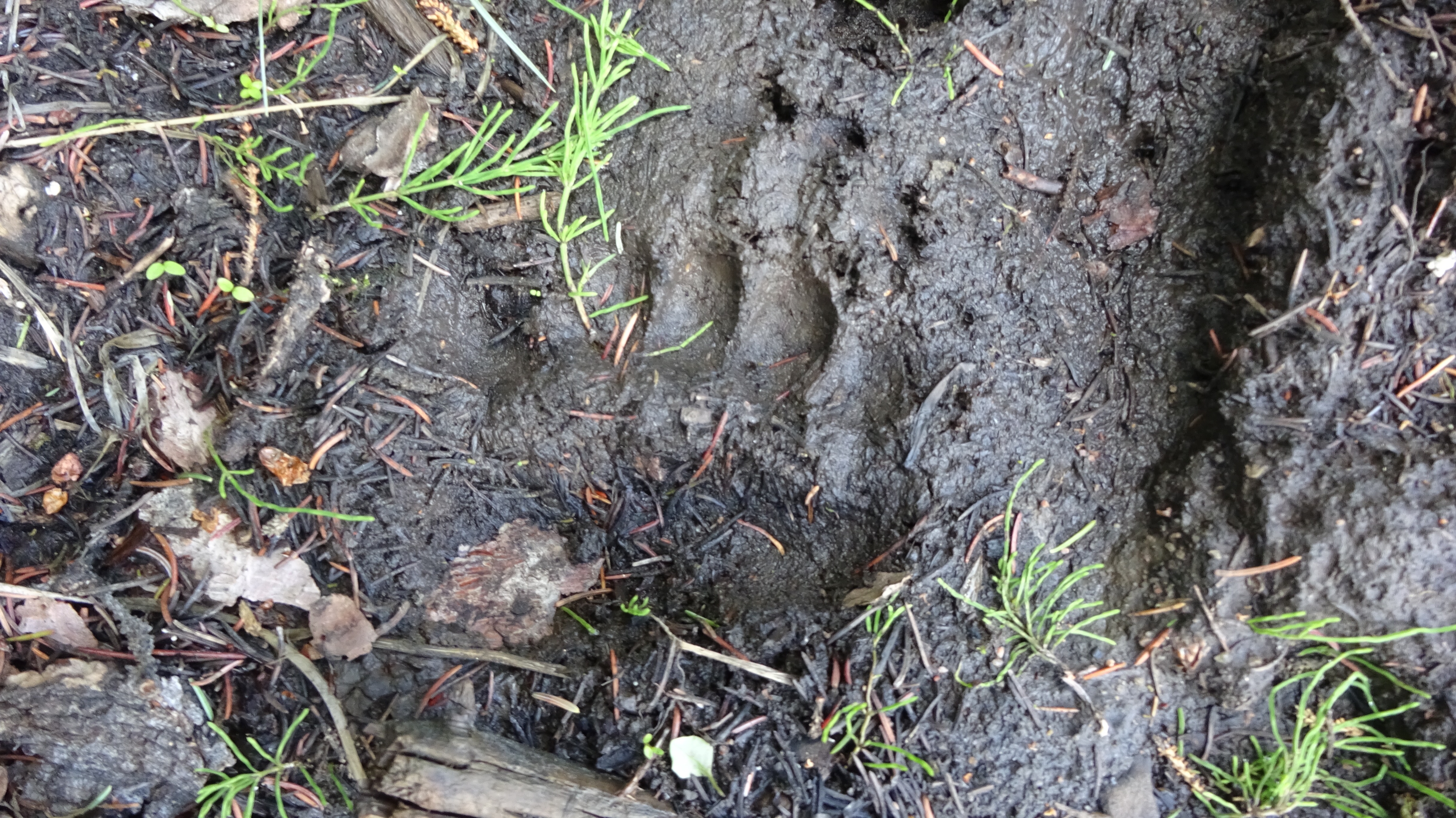
Male griz about 12″ long and 5″ wide. He’s traveling towards the left of the print.
Just last week a person shot and killed a female sow in what they said was self-defense. She had several cubs with her. There was no mention in the article of the hiker carrying bear spray. It also appeared he was hiking alone, so his story can never be verified.
Last week I attended the very important Wyoming Game and Fish commission meeting. After hours of public comment, running 5:1 against a hunt, the commissioners voted unanimously within a few minutes to let the first grizzly hunt in the lower 48 in over 40 years proceed. We all knew the outcome of that vote before we even attended. Regardless, it was important we be heard. A spokesman for the tribes read a comment. The tribes requested that instead of a hunt, those bears be transferred to various tribal lands. If the Wyoming Game & Fish along with residents who say “have a hunt to reduce bear numbers” really believe that meme, then why not transfer bears to other areas where they once lived instead of killing them for trophy.
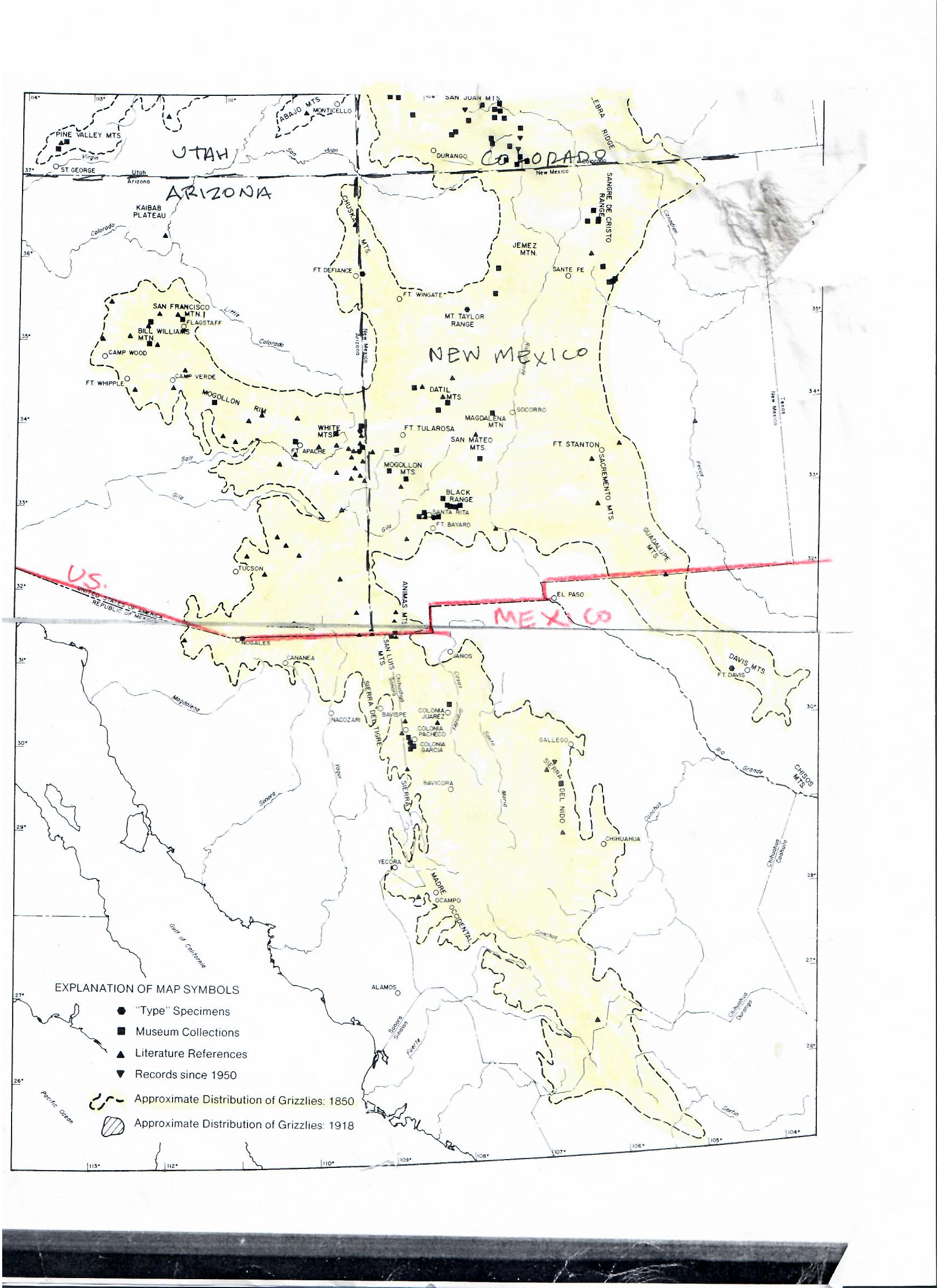
I was in Silver City, New Mexico last month. One of the last grizzly bears was killed in that area in the 1930s. An extensive study was done in the 1970s to see if the Gila National Forest would still support a small population of grizzlies. The study concluded that although there had been fire suppression which hindered some of their food sources, grizzlies could survive there. Since that time fires have come to the Gila and opened up the habitat. With livestock protections, grizzlies could once again roam the Gila National Forest and surrounding areas. The tribes could be the catalyst who help expand grizzlies into areas where they once lived where habitat is still suitable.
Yellow indicates grizzly range in 1860 in northern Mexico and SW USA
Wyoming has it backwards. The state feels it has to hunt the bear to reduce conflicts and bear population. Instead, they should be ramping up their efforts to teach people how to live around grizzly country, like carrying bear spray and protecting food sources. Plus they should cooperate with the tribes, transferring the 2018 hunt quota of 23 bears to tribal lands.
As William Wright so succinctly put it over a hundred years ago: “grizzly bears are minders of their own business.” We can honor that bear temperament by leaving them be.
Tired COY leans on Mama. I still haven’t seen any signs of the COY this spring
One of the special privileges of living in the Greater Yellowstone Region is seeing grizzly bears. In the fall, they are hungry preparing for hibernation. Rosehips, chokecherries and limber pine nuts lure them nearer to our homes, where they forage mainly at night to avoid people. In the early spring, when they emerge from their dens, young sprouts in the local pasture is roughage for their systems.
The presence of grizzlies makes a difference when I am hiking. I see their large tracks or fresh scat and remember to stay alert, awake, and aware. I carry my bear spray ‘weapon’, which I’ve never used on a bear, but have used on a bison, and it saved my life.
Print looks even larger because its in mud, but you can see his claws
Yet this rarity of wildness in our modern world carries with it great responsibility. If I want to live, work, and enjoy this last remaining wild place in our country (and also one of the last intact temperate ecosystems in the entire world), then I, like my cousin the grizzly, must make sacrifices and accommodations–small yet important and life saving for the bear. Special garbage cans; no bird feeders; Bar-B-Qing precautions; and most importantly, a tolerance for wildness. The Great Bear himself has been accommodating us humans for centuries, and mostly paying for it with his life.
Probably our best lesson in grizzly history comes from California, where the bear adorns their state flag. And the very best historical account of the Great State’s grizzlies is California Grizzly by Tracy Storer and Lloyd Tevis Jr. Storer painstakingly poured through every historical documented account of grizzly bears back to the Spanish Missions. He collects them together into an easily readable book first published in the 1950s. My paperback edition has a wonderful foreword by Rick Bass. I would say the only section not fully accurate is ‘Habits of California Grizzlies’, which includes erroneous data such as grizzlies being able to give birth at two or three years of age. Bringing grizzlies back from the brink here in Yellowstone has yielded much new data.
It’s unknown how many grizzlies were in California before the Spanish arrived and brought their cattle in the early 1700s. But Storer estimates California may have had as many as 10,000 bears in the early to mid-1800’s. California during Spanish rule was a different place than when American settlers came out during the gold rush.
During the Spanish period, not more than thirty such [land] grants were made; but after Mexico threw off her allegiance to the crown, the lavish generosity of the new provincial government brought some eight million acres into the possession of about eight hundred grantees. Each rancho, an empire unto itself, grazed thousands of cattle, sheep, and horses; supported hundreds of Indian servants, and was an economically independent, self-sustaining community.
In addition to cattle, wild horses brought in by the Spanish were so numerous that there were recorded herds twenty miles long. This overpopulation of horses depleted the range for livestock so thousands were killed, sometimes driven over cliffs or lanced by vaqueros. There were frequent slaughters of livestock during severe droughts, as well as natural deaths in these enormous herds. Missions and ranches had private butchering grounds, where only the choice meats were taken and the rest thrown in large piles. Grizzlies came at night to the ravines near the slaughter-corrals. Storer reports that in 1834 the missionaries, who anticipated secularization, disposed of 100,000 cattle just for their tallow and hides, leaving the rest for wild animals.
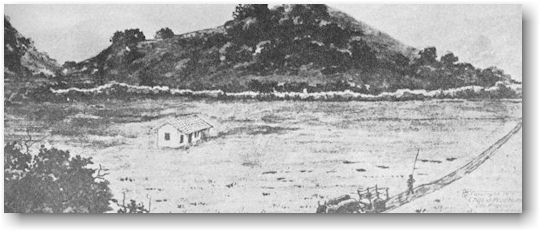
Rancho Cahuenga, near the location of the present Hollywood Bowl, as it appeared in January, 1847, at the signing of the Treaty of Cahuenga.
This abundant new and easy source of protein is what fueled an accelerated bear population growth, so by the time early Americans began arriving, grizzly bears were commonly seen in large numbers foraging together.
In January, 1827, Duhaut-Cilly wrote that ‘bears are very common in the environs; and without going farther than five or six leagues [a league is about 3.5 miles] from San Francisco, they are often seen in herds”
George C. Yount, among the first American pioneers in California, arriving in February 1831 [of Yountville fame in Northern California] …said “they are every where–upon the plains, in the valleys, and on the mountains…so that I have often killed as many as five or six in one day, and it was not unusual to see fifty or sixty within the twenty-four hours.”
John Bidwell, in the Sacramento Valley in 1841, saw sixteen in one drove and said that “grizzly bear were almost an hourly sight, in the vicinity of the streams, and it was not uncommon to see thirty to forty a day”
While bears were a problem for the Spanish in the 1700s when trying to grow their herds, by the early 1800s cattle, sheep and horses were sculpturing every hill in the coastal region. The Spanish now viewed these lands as a playground, and grizzlies as part of a new sport.They roped grizzlies for bear-bull fights (another chapter in the book which is fascinating yet hard to read). These animal fights were even commonly conducted right after church in stoutly built arenas. But although the Spanish engaged in this cruel entertainment, California was underpopulated and grizzlies benefited from the increased food supply. When gold was discovered in 1849, a spectacular invasion of Americans came, and grizzlies were now doomed. In the span of just 25 years after California became a state in 1850, most all the grizzlies were gone. A few stragglers remained until early 1900s.
Storer includes so many fascinating facts about the bear in California. One would suspect that grizzlies rarely hibernated in that warm climate. Although no one was keeping scientific records, grizzlies were seen year-round except in the high Sierras, as evidenced from that above quote in January by Duhaut-Cilly. Probably females denned for part of the winter in order to give birth to their helpless newborns. Before white men cleared the land, grizzlies inhabited dense growths of trees, vines, and cattails that bordered lowland rivers and creeks. They pastured in tall grasses and clovers in the spring and ate acorns in the fall. Along the entire coast, grizzlies foraged on the continuous supply of marine animals that washed ashore, supplementing with berries from manzanita bushes that grew nearby. Tall manzanita thickets were common places for grizzlies to shelter, while place names remain as ghostly evidence such as Bear Valley, Big Bear, or Oso Rio.
What is to be learned from California–a land so rich and blessed with near perfect climate, where once grizzlies freely roamed? It demonstrates how quickly a large population of top predators can be extirpated; or how a dense, rapid growth in human population spells demise for the great bear; how abundant human food waste leads to habituated bears. And reading through the entire account in this book reminds me that Europeans have a very dark history when it comes to wildlife. The wanton slaughter and intolerance for grizzlies is still evident today when we see signs such as this one which seem to have one purpose in mind, without any appreciation nor feeling for the animal itself:
With a bit of mindfulness, we can enter fully into a new legacy, one that values wildness and wilderness, preserves vast lands for top predators like the Great Bear, sees the worth of connectivity between public and private lands, and makes good choices as to how we live with grizzlies in our midst. This is the future I envision for our country and it’s wonderful heritage of wildlife.
Muddy Creek is an access trail to Granite Lake in the Beartooth Mountains on the Wyoming side. Although I have done a lot of hiking and backpacking in the Beartooths, I have to admit I haven’t been to Granite Lake, a 228-acre subalpine lake, among the largest in the Absaroka-Beartooth Wilderness. Most people approach the lake through Clay Butte, which is also a trail into Martin Lake Basin and the Beartooth backcountry. Yet since I heard that Granite Lake is a popular horse, fishing, and camping area, I’ve avoided it. Maybe this summer I’ll do the 9 mile roundtrip hike there.
Muddy Creek is one means of entry, and mostly because of its apt name, I haven’t been on that trail either. This being a drier year, I thought I’d try it for a day hike. This is not a trail description entry, but some observations along the stretch I did. But for those interested, the trail is flat, skirting an extensive meadow, until it reaches the mouth of the canyon to Granite Lake. At that point it begins to gently climb into the narrow drainage. I turned around at the incline point and end of the meadows.
This is a beautiful hike that enters the wilderness boundary in about .08 miles from the trailhead and stays in the trees and shade.
Wilderness boundary. Muddy Creek
Muddy Creek used to be a popular trail in the day. You can see old logging cuts throughout, before the area became Wilderness. I’ve read old records where some old-timers considered Ghost Creek (just south of the highway) and east Muddy Creek (north of the highway where the trail is), their private hunting grounds. In fact, I was going around some downed timber when I discovered, about 2 miles up and on the trail, an old trapping snare.
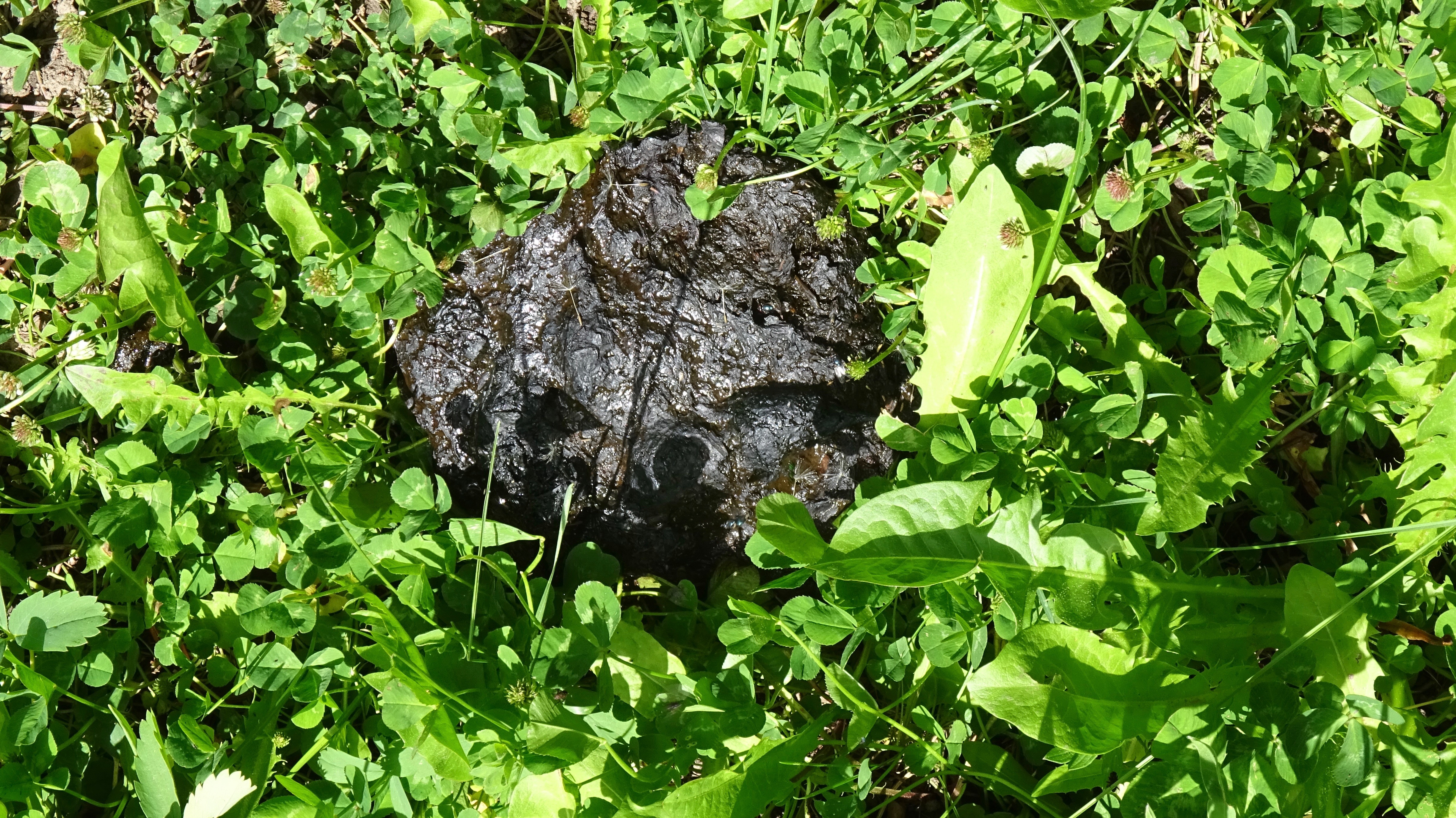
The meadows, in reality, are a wetland full of willows. Fresh moose tracks are everywhere–prime summer habitat for them. But the real surprise is the amount of grizzly bear scat. I’m used to hiking in bear country, but I’ve never seen so much bear evidence as there is on this trail. In the first mile through forest, I’d safely guess that there was a large pile of bear scat every 20 feet and most of it fairly fresh. In fact I saw the freshest pile I’ve ever seen on a hike, one that was still wet and steaming.
Front foot with claw marks
Bear scat still wet and steaming
I started looking for bear rubs along the trail and found many. Called rub trees, it’s unclear why they use them. Probably as a way of scenting and getting a good back scratch at the same time. Once you’ve seen a rub tree, you’ll know how to look for them. Most I’ve found are on or near human trails. Bears use human trails too. I’ve found several where a trail blaze is in the tree and a bear scratches or rubs that tree. You know who is The Boss then.
Rub trees will have a smooth side to them and will not have lichen there. Look from the side and you will see the bear’s fur. Cattle especially also rub trees so learn to distinguish the fur. Ungulates, especially elk, will sometimes rub and horses as well. But once you’ve seen bear fur, you’ll know it.
Rub Tree viewed from afar. You can see it has a smooth appearance on one side.
Same rub tree viewed up close so you can see bear fur on it
Ungulates have hollow hairs. When bent they are stiff and form a sharp bend. Bear’s have finer fur. Try to distinguish which side of a hair is the root. Then look at the opposite end. Most grizzly hairs will have a light tip to them–thus the ‘grizzled’ look. Here is a good photo from USF&W.
It’s more likely that your rub tree fur will look like this:
Some of the fur I pulled off the tree
View from about halfway up the vast meadows
A few blooming flowers:
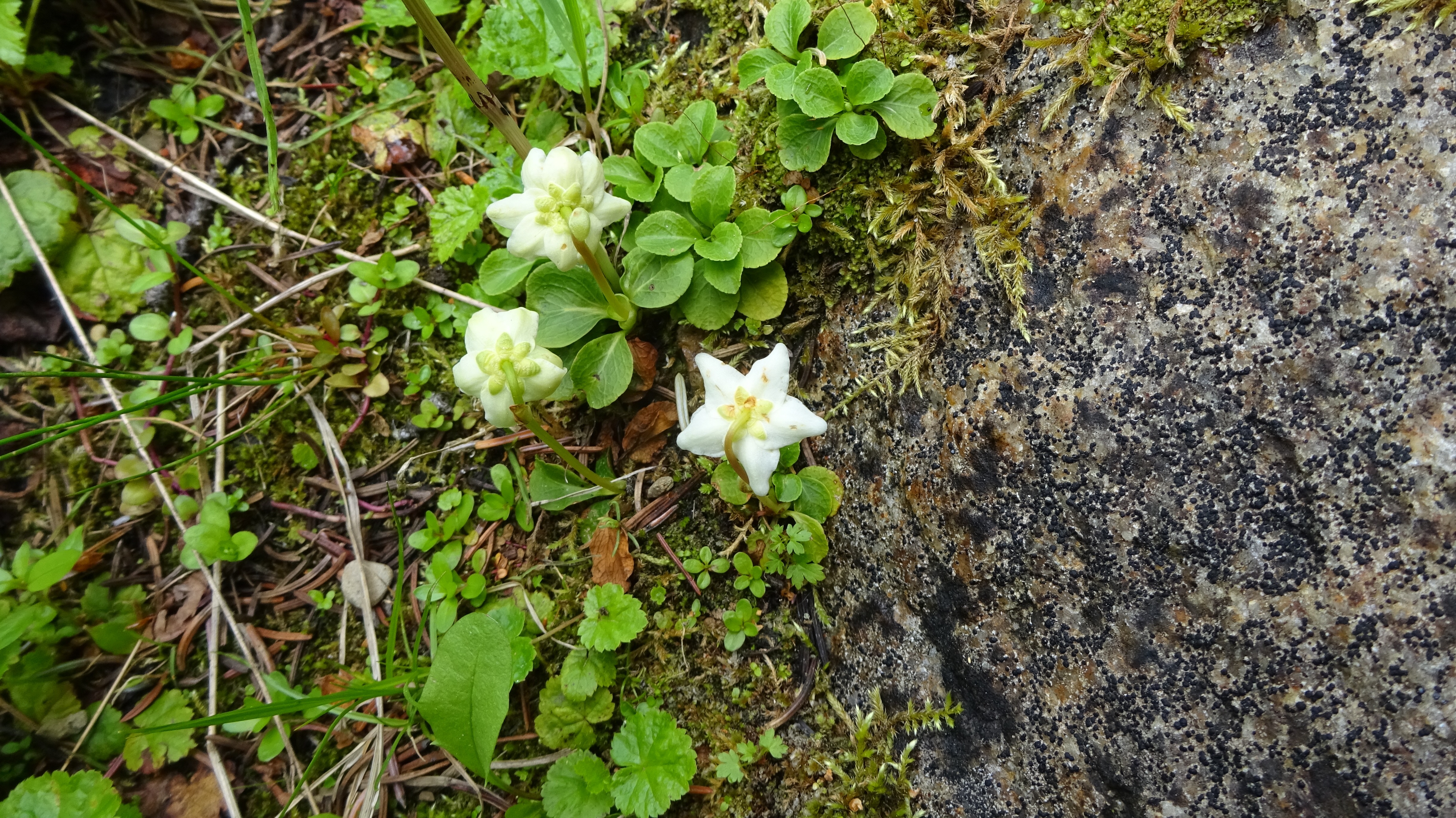
New flower for me. Wood Nymph Moneses uniflora
One of my favorites. Thalictrum occidentalis. There are many beautiful Thalictrums in the landscape market.
A real plus for the bears is that I can see this will be a super berry year. Last year all their fall foods were lean and so people were seeing more bears on the edges of the ecosystem. This year my Chokecherries will have a bounty year, and all the flower evidence for Raspberries and Strawberries indicates a boom cycle. In addition, I have not seen any Buffalo berries on plants for many years. But this year the beginning of the fruit is evident.
Shepherdia canadensis. The berries are tiny green now. Red in the fall and I like the taste
And finally, my plea once again for the Great Bear. We are in the midst of a USF&W delisting process for Grizzly Bears which means the states will be managing and hunting them. Walking on the Muddy Creek trail, seeing so much bear sign, is not an indication, as some people have expressed, to be scared and hunt bears so they will avoid people.
Instead, the Great Bear is a mnemonic, a reminder to stay alert and awake. His presence signals I need to hike as a ‘walking meditation’, being fully Present in the moment. Thus, the grizzly is a Spiritual Bear. Let us all honor the Grizzly bear in that manner.
Grizzly Bears are sacred to the tribes. We need to all think about them in this manner.
I am listening to a wonderful interview podcast, in two parts, of Charlie Russell on the Grizzly Beat, a blog by Louisa Wilcox. If you haven’t heard of Russell, this is your chance. Russell tells stories of raising cubs in Kamchatka Russia along with sitting on a log in a Canadian forest with a well-viewed female grizzly. I learned more about how to behave around bears by watching Russell’s body language than any book.
Charlie Russell in Kamchatka
Russell candidly talks about how North American wildlife bear management long ago decided the best way to have bears around was to teach people to be afraid of them, and likewise to instill fear in bears of people. But Russell was interested in what bears were really like, and knowing that bears have personalities, he wanted to understand them. Russell spent ten summers in Kamchatka raising bear cubs and living with over 500 bears in the area. He is the only person to have successfully re-introduced cubs into the wild.
Russell’s story is told on these podcasts as well as his video East of Eden. Bears are highly intelligent. If they are treated peacefully, in general they act peacefully towards humans. They know, Russell says, that humans control the habitat that they need. Living with bears is something people can choose to do. It’s not a bear problem, but a people problem Russell say. If a person decides to live in bear country peacefully, the bears will respond in kind. Given that, Russell advices when hiking in bear country to carry bear spray, especially where bears have been taught to fear people. If and when hunting begins in the Northern Rockies, Russell says, this will only exacerbate bears distrust and dislike of people.
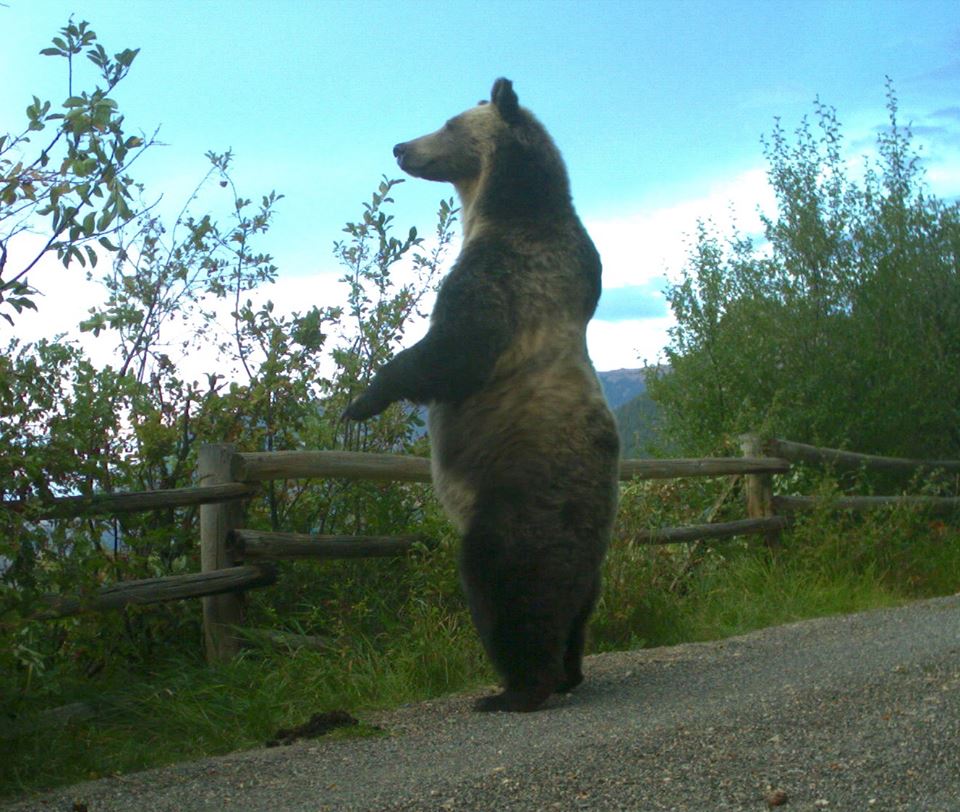
Grizzly minding his own business
Russell’s comment on how bear management today is about fear is something I’ve long thought about. All the available literature on bears, especially grizzly bears, is about bear attacks. The Park requires every backcountry overnight camper to watch a 45 minute video on bears (which is good). The video is all about protecting oneself from bears and what to do in a bear encounter. People management is a good thing (bear spray, food storage, posturing around bears, hiking in groups, making noise, etc), but none of this is about bears, but about fearing bears. We don’t really try to ‘know’ bears. Our present culture is just about separating ourselves from the natural world and fearing bears.
My own closest encounter with a bear took place in 1972. Not a grizzly, but a very large black bear. I was in high school, during summer break, hiking in Waterton-Glacier International Park from the Canadian side. I tell that story here in detail and why I wasn’t afraid. It’s a good lesson in how people and bears can read each other.
Personally, I feel that Russell is one of the few people today that truly understands bears. He is not a scientist, but more of an old fashioned naturalist. Russell owns a ranch next to Waterton Park in Canada that was homesteaded by his grandfather. Long ago he pioneered putting out dead cattle on his side of the Park border in the spring to give hungry bears emerging from dens some much needed protein. Neighboring ranchers feared that the bears would adapt to eating cattle. But instead of this happening, the fed bears moved on and cattle depredation decreased. Soon the wildlife managers were putting road-killed deer and elk carcasses instead.
Please listen to this amazing Bear Whisperer. Enjoy.











 But although the Spanish engaged in this cruel entertainment, California was underpopulated and grizzlies benefited from the increased food supply. When gold was discovered in 1849, a spectacular invasion of Americans came, and grizzlies were now doomed. In the span of just 25 years after California became a state in 1850, most all the grizzlies were gone. A few stragglers remained until early 1900s.







 Leslie Patten Books: Wild Places, Sacred Spaces