• MY BOOKS ON WILDLIFE, GARDENING AND MORE

  • The Wild Excellence

  • True stories of wildlife encounters around the Greater Yellowstone
  • Award winning eBook on Decomposed Granite, tips, how to's, what to watch for
  • Children's book. True stories of a dog and wolves. In a dog's voice
  • Written for dry Mediterranean climates in California, north and south

A Mountain Speaks. The Sacredness of Naming

This is the first part of a longer essay that I thought I’d share. This essay embodies my ‘beef’ with many European place names for North American landscape features.

A Mountain Speaks

October 2013

I’m musing again over the name for the impressive mountain that looms above my cabin. “It has no formal name, but we all call it Mt. Herman,” a neighbor told me when I moved here. ‘Mt. Herman’ is a placeholder only, a bookmark in contemporary time, a way to name a mountain in conversation. From old records about this valley, Herman Ellsbury was the first white baby born here. He also happened to be the original homesteader of this property and the man who was commissioned to build the cabin I now live in.

Although I feel Mt. Herman deserves a moniker that acknowledges its dominance and, in my opinion, spiritual significance in this landscape, others take the more traditional route. One of my neighbors, native Wyomingite, Park employee, and scientist, feels history is imbued in the name, a visible fossil of the past and it’s deeds. Yellowstone Park history is communicated in the names of mountains and rivers—Norris, Lewis, Washburn, Haynes, Lamar. Names must be consistent, he tells me, so that they can be found on maps and agreed upon by the general public, or even First Responders. Of course, now we have GPS for communicating an actual location he reminds me.

Another neighbor tells me, in jest, that she is renaming Mt. Herman after her deceased husband. I imagine petroglyph graffiti by white people who scrawl their initials with a date next to ancient images of sacred animals. And if she were serious, she could name officially any unnamed mountain, gap, or other feature formally through a legal procedure that goes into the public record and soon onto maps.

The ritual of naming requires more than a nod to someone we loved or considered influential. Places themselves have power and in a name that power is concentrated and expressed.

“A place must be properly named”, says Laurens van der Post in his novel A Story Like the Wind. In van der Post’s book, all the different tribes in an area in the African bush agree: in order to be protected “against all the negative aspects of the forces of magic” in the surrounding landscape, a place name is necessary.

Samyama is a term described in Patanjali’s Yoga Sutras. It was an expression used extensively by my former teacher. Samyama involves active listening, studying, contemplation, and intuitive awareness. My teacher also referred to this process as a ‘consideration’. I understood it to mean deep, open awareness, contemplation of an issue or a thing or a person or anything, until you beheld its essence. In other words, you’ve ‘considered’ the object of your attention from every possible angle and have now come to understand it through direct knowledge. Robert Heinlein, in his book Stranger in a Strange Land used the word ‘grok’ –an expression of understanding a thing completely through intuition and empathy. Samyama or consideration is the means by which you come to grok something.


Today’s forces of magic in my little valley might be described as many human disturbances encroaching upon the landscape. With the coming of a finished paved road over the mountain in 1992, traffic has increased. And with the increased traffic have come more powerful machinery such as off-road vehicles in the summer demanding more access through new roads deeper into the mountain terrain; hunting no longer done much on horseback, but on ATV’s that drive up and down the dirt roads; trapping all winter long for pelts sold overseas to Russian and Chinese buyers; incessant noise from snowmobiles using the paved road to head into the Beartooth mountains; January helicopter darting of wolves for collaring and counting; fly-over elk counts in winter; logging trucks followed by individuals who buy the slash-piles for firewood sale; summer cattle trucked up to graze on surrounding forest lands. A year round onslaught of noise and landscape disturbance that, taken together, describes a whole host of negative forces that wildlife must contend with year-round. So maybe the real and true name of this stalwart mountain that guards my valley entrance is necessary to discover.

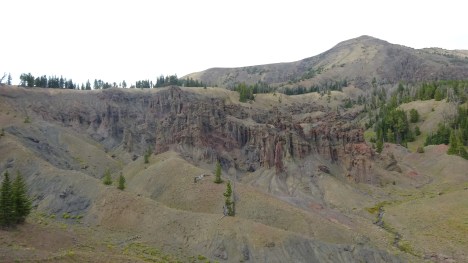
Shaped like a wedding cake melting off to one side, the mountain rises up in deeply wooded layers. As the soil gives way to pure scree, massive boulders scatter the division between tree and rock high above. The mountain’s uplift is so steep no life can take hold. There, a multi-colored prominence, like the hull of a great ship, leans eastward, framing the rising moon. Colored layers of biscuit, cream, deep reds and grays adorn the treeless buttresses of rock one thousand feet above.

A mountain made of limestone allows water to carve fissures and crevices. Snowmelt seeps into the mountain’s soil. I’ve dug by hand into this earth. Making even a small hole unearths dozens of limestone rock. This is not a mountain made of earth, but of stones. Millions of tonnage of rock creates passageways and dark tunnels where water flows change, move, travel. Near the mountain’s base is where all this water emerges, and not coincidentally, is where wildlife moves through. “From the rock, the mountain weeps” my neighbor tells me. So true.

In that way I began my consideration of my mountain’s name. I’ve admired this mountain for over eight years, but this is the first time I asked it to reveal its true name to me.

Today I remembered a phrase from Aldo Leopold –‘Thinking like a Mountain”. Leopold coined the phrase to mean the interconnectedness of all things. When no wolves live on the mountain, the deer overgraze and overrun it, eventually starving them to death.

How do you ‘think like a mountain’? I pondered this yet I am not sure of the answer. My mountain, like the mountain Leopold might have been referring to, is home to almost all the wildlife in these parts, with the possible exception of mink (who live in the river below that this mountain streams feed), the eradicated beaver, lynx (although they’ve occasionally been spotted here) and fisher. There are badgers in the sagebrush at its feet, and red squirrels, chipmunks, voles and mice in the spruce-fir forests. Long-tailed weasels hunt the meadow/forest edges, while martens prefer to mingle amongst the thick terraced slopes. Bobcats watch for snowshoe hares, cottontails, and jackrabbits. Mountain lions stalk the numerous deer. Grizzly come and go spring through fall, digging for roots, eating berries and rose hips, tearing apart rotten logs for grubs. Moose browse the willows and dogwood where riparian areas hold the mountain’s run-off, and wolves travel through, making the resident coyotes nervous and watchful. I have yet to see a lynx but the snowshoe hares are plentiful enough to feed them, and I’ve caught on camera a wolverine once. Great Horned, Boreal and Great Gray owls are my neighbors, along with Bald and Golden eagles. Chickadees and nuthatches are among the few small birds that brave the winter cold. Many other hawks, warblers, and small birds spend their spring and summer in the shadow of my mountain.

This mountain is a cradle of Life containing all the necessary pieces to make the whole, a complex and complete recipe to feed all the parts. Thinking like a mountain, like this mountain, must have that as a main component—holistic thinking. And yet, a mountain, by its sheer immobility, its impressive features and toughness, implies no thought, only the present moment.   It will take an open, clear-eyed, receptive, intuitive approach—a reverent approach—to receive my mountain’s name. This is not just a mountain, but also a life support system.

_________


Herman Ellsbury built my cabin for Doc Firor. Ellsbury owned a sawmill farther up the Clark’s Fork Canyon. In 1957 Firor, the new owner of the property wanted a summer home. Ellsbury, whose father originally homesteaded this parcel, which was much larger at the time, knew the area well. He knew where the winds blew from and when. He’d studied the arc of the sun during all the seasons. He could map out the path of the game, where the snows drifted into impenetrable mounds, or follow with a pointed finger where shadows would cast during the winter solstice. These secrets of the Land, and many more, were as comfortable for him as a favorite coat might be for a city dweller. Many people come to my property and comment, “Why don’t you build on the ridge above? That’s the best view.” But Ellsbury had the natural smarts that I always advocate to my clients when I tell them “Live in your house for a few years before you create a garden”. He had that wisdom which comes with living close to the land, observing nature’s rhythms year after year. So he built Doc Firor’s log cabin at the base of a bank, not on the ridge above. He faced it east, what people today might call perfect Feng Shui though this idea probably came from ancient tipi rings in the area, whose doorways always faced the rising sun. By this perfect placement, the cabin avoids our fifty-mile per hour winds that blow frequently in winter. The wooded hillside behind provides just the perfect buffer since the trees create a natural snow fence, and an old irrigation ditch testifies to how he used my creek to gravity-feed the cabin. Because Herman Ellsbury was the first white child born here, the locals saw fit to give this mountain his name as a way of honoring their own settlement, the habitation of what they saw as empty country.

Of course these lands were only empty because the native peoples had been driven out before the homesteaders arrived in the early 1900s. The Crows, who once claimed this area as part of their territory, are now living on a reservation northeast of here; and although in the late 1800s it was part of their reservation, the discovery of gold, the creation of Yellowstone Park and the influx of new settlers shrunk the reservation drastically. Sheep Eater Shoshone Indians, who also called these mountains home for thousands of years, lived a nomadic life, traveling between the Absaroka Mountains and today’s Yellowstone Park. The Park removed them, their way of life shattered by the hoards of miners who diminished their food sources and gave them diseases, the few who remained were moved to the Shoshone and Bannock reservations south and west of here.

Clearly, my valley was inhabited for over 10,000 years. Evidence still surfaces, from native dwellings to the occasional arrowhead. The entire spring outflow, and the swamp created by its emerging waters, was a favorite bison wallow as well as a butchering site for native peoples. In my mind, an injustice was being done with place names that told only a white man’s story, barely a hundred years old.

There is a lesson in the Badger-Two Medicine roadless area that sits between Glacier National Park, the Great Bear and Bob Marshall Wilderness Areas, and the high plains of the Blackfeet Nation in northwest Montana. This wild area is sacred to the Blackfeet, and unlike the rest of the Bob Marshall country, the Badger retains its traditional Indian place names. Why? All the country surrounding the Badger has white man contemporary names, but the Blackfeet fought this tradition and, in 1915, sent a group of Blackfeet chiefs to Washington D.C. asking to retain their spiritual names. The names retain the magic of the area, and it’s long history.

There is one other element to naming that might be peculiar to me. As long as I can remember, I’d had trouble recalling the names of people that I do not know intimately or personally. So, for instance, when I try to remember a valley next to mine named Russell (obviously named after Osborne Russell, one of the few trappers who could write, kept a diary, and trapped the Yellowstone in the 1830s), my mind needs to search for a while. The name Russell does not describe landscape features, but sits like a dangling participle, a reference to nothing that is being observed, nor remembered, as the features of the place. Naming a creek or a mountain after a person signifies a complete disconnect from the Earth and its features.

Between this land’s rich human history, and the nourishment my mountain provided for the abundant wildlife, I was certain my mountain had a name of its own. But what was it?

Charlie Russell, the Grizzly Whisperer

I am listening to a wonderful interview podcast, in two parts, of Charlie Russell on the Grizzly Beat, a blog by Louisa Wilcox. If you haven’t heard of Russell, this is your chance. Russell tells stories of raising cubs in Kamchatka Russia along with sitting on a log in a Canadian forest with a well-viewed female grizzly. I learned more about how to behave around bears by watching Russell’s body language than any book.

charlierussell-bear-4

Charlie Russell in Kamchatka

Russell candidly talks about how North American wildlife bear management long ago decided the best way to have bears around was to teach people to be afraid of them, and likewise to instill fear in bears of people. But Russell was interested in what bears were really like, and knowing that bears have personalities, he wanted to understand them. Russell spent ten summers in Kamchatka raising bear cubs and living with over 500 bears in the area. He is the only person to have successfully re-introduced cubs into the wild.

Russell’s story is told on these podcasts as well as his video East of Eden. Bears are highly intelligent. If they are treated peacefully, in general they act peacefully towards humans. They know, Russell says, that humans control the habitat that they need. Living with bears is something people can choose to do. It’s not a bear problem, but a people problem Russell say. If a person decides to live in bear country peacefully, the bears will respond in kind. Given that, Russell advices when hiking in bear country to carry bear spray, especially where bears have been taught to fear people. If and when hunting begins in the Northern Rockies, Russell says, this will only exacerbate bears distrust and dislike of people.

Sleeping grizzly

Grizzly minding his own business

Russell’s comment on how bear management today is about fear is something I’ve long thought about. All the available literature on bears, especially grizzly bears, is about bear attacks. The Park requires every backcountry overnight camper to watch a 45 minute video on bears (which is good). The video is all about protecting oneself from bears and what to do in a bear encounter. People management is a good thing (bear spray, food storage, posturing around bears, hiking in groups, making noise, etc), but none of this is about bears, but about fearing bears. We don’t really try to ‘know’ bears. Our present culture is just about separating ourselves from the natural world and fearing bears.

My own closest encounter with a bear took place in 1972. Not a grizzly, but a very large black bear. I was in high school, during summer break, hiking in Waterton-Glacier International Park from the Canadian side. I tell that story here in detail and why I wasn’t afraid. It’s a good lesson in how people and bears can read each other.

Personally, I feel that Russell is one of the few people today that truly understands bears. He is not a scientist, but more of an old fashioned naturalist. Russell owns a ranch next to Waterton Park in Canada that was homesteaded by his grandfather. Long ago he pioneered putting out dead cattle on his side of the Park border in the spring to give hungry bears emerging from dens some much needed protein. Neighboring ranchers feared that the bears would adapt to eating cattle. But instead of this happening, the fed bears moved on and cattle depredation decreased. Soon the wildlife managers were putting road-killed deer and elk carcasses instead.

Please listen to this amazing Bear Whisperer. Enjoy.


New Product to Protect DG

I received an email recently from Tony Damico with Wheeler Zamaroni about a new product to use with Decomposed Granite paths and patios. This is a sealer from TerraKoat International that has been extensively tested by WZ for efficacy for over a year.  I have not personally used it but want to pass along this information to my readers. Here is a quote from Damico:

I wanted to let you know what WZ’s take was on the product. Because Wheeler Zamaroni is a landscape supply company we sell a lot of Decomposed Granite, Decomposed Granite with dry stabilizer and Decomposed Granite with liquid stabilizer. (the liquid stabilizer TerraKoat EX is leaps and bounds better than the dry stabilizer) It is the customers that decide to use the dry stabilizer or no stabilizer at all that benefit most from this product.

As you can see from Tony’s quote above, if you used a dry stabilizer or no stabilizer during your installation, you should consider using RainKoat for winter preservation.

Here are the simple instructions:

  1. Remove any loose debris from the DG surface
  2. Using a pump type garden sprayer apply DG RainKoat at the rate of 100 sq. feet per gallon
  3. For high traffic areas or additional protection a second coat can be applied.

For more information call Wheeler Zamaroni 650-271-2099

Or see this website of http://www.terrakoat.com/terrakoatex.html

Upcoming Talks in the Greater Yellowstone Region

I have a few upcoming talks in the Greater Yellowstone Area this spring.

Spring into Yellowstone is an annual event in the Cody Area. This year it takes place May 11-May 15. Events include a variety of wildlife and geology tours and hikes. I’ll be speaking on Sunday, May 15 with a new video presentation of cougars, grizzlies, and wolves that I’ve taken in the valley where I live next to Yellowstone Park. Below is a screen shot description of this talk.

stories copy

I also will be speaking in Billings, Mt. at Barjon’s Books. This will be in conjunction with several Montana conservation groups. The date for this presentation is yet to be determined.

If you would enjoy a video/slide presentation to a private or public organization around the Greater Yellowstone Ecosystem, please email the author at ecoscapes@wildblue.net or contact my publisher, Wordsworth Publishing.

Press Release Bookstores

The Wild Excellence book and video presentaion

A Heartfelt Response to Grizzly Delisting

This past Monday night I attended a Wyoming Game and Fish (WG&F) informational meeting on my state’s proposed management plan once grizzly bears are delisted from the Endangered Species Act. I’ve also read a few of the comments on the USF&W site (you can comment here on the Feds proposed rule).

Although hunting was not discussed by the WG&F (that’s for the Wyoming Game Commission to decide), hunting will definitely be allowed once bears are delisted and, according to the Feds rule, over 100 bears can be killed right away! Some of the comments in favor of delisting at the meeting went like this:

  1. Hunt them so they will become afraid of people. I’m afraid to walk in the woods now.
  2. Hunt them so we can have a trophy hunt. These funds from hunting tags ($600 instate; $6000 out of state) support wildlife.
  3. Bears have become a nuisance on my ranch. There are too many bears.
2011_bervik_brown_bear20on20ground

The Proposed Rule would allow a hunt on Greater Yellowstone Grizzly Bears

The meeting was presented as a science-based plan. The comments were based on emotion. What was missing was the Spirit of the Bear, the living sentient being.

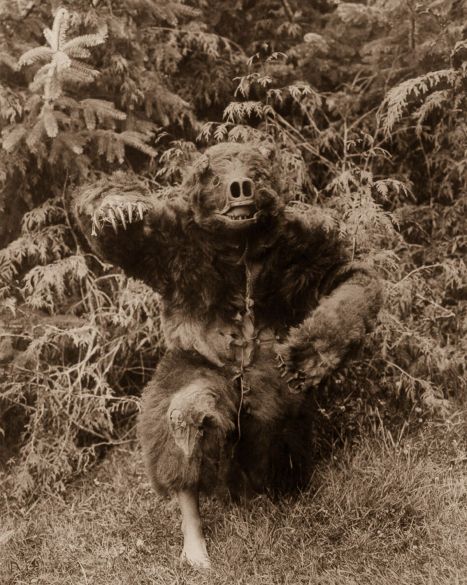
Grizzly Bears were once revered by the tribes. Some tribes hunted them, others never did. But they all respected the bear, told stories about them, dressed up like bears, and even had secret bear societies. To dream about bears was sacred and special. Bears represented renewal, death and rebirth and transformation. Bears were numinous beings, powerful, respected, honored, imitated. This is what I did not hear in the meeting. I heard fear, and I heard annoyance, but our modern-day stories have no room for the sacredness of these animals.

Grizzly Bear

In the lower forty-eight, 99% of the U.S. has no grizzly bears. If you like to recreate without ‘fear’, there are plenty of beautiful places to do so. Yet here in the Greater Yellowstone, one has an opportunity to experience the pressures a top predator calls you to: ‘Be awake’, ‘use all your senses’. Hiking and recreating in Grizzly Bear country is a privilege, even a type of spiritual retreat. All your senses are heightened–not in fear– but awake and conscious. As I’ve said in my book The Wild Excellence:

To walk with the Great Bear one must be alert, fully awake and aware. With the Great Bear around, you cannot walk lost in thought, or conversation. You must be Present. This alone is a gift that only another top predator can bring to man. The grizzly bear’s gift to man is the Power of the Present Moment. The Present is his present to us. He presses it upon us by circumstance. Men do not give themselves that gift by choice. That is the gift of the grizzly.

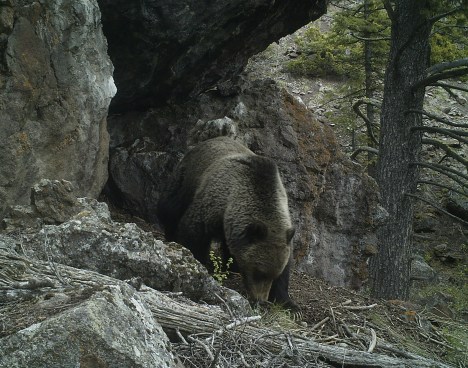
One thing I’ve learned about bears hiking in these mountains, and living with bears, is that Grizzlies are minders of their own business. In general they are solitary animals (except for moms and cubs. That is why a dead bear will not teach other bears to fear people), mostly vegetarian, and want nothing to do with humans. They are highly intelligent and never forget.

Slide1

Grizzlies will not be tolerated outside the DMA (the dark black line)

One fall I came upon an illegal outfitter’s hunting camp. The camp had a lot of burnt food trash in the fire pit. I cleaned it all up and packed it out. The next fall I hiked there again. I wanted to see if they had re-set up their camp. Although the camp was clean and no one had used it since I’d been there, I found piles of steaming fresh grizzly scat. The bears had found it the year before too and never forgot.

trashed campsite

Trashy fire pit

I moved to my cabin, smack in the middle of grizzly country, where problem bears were relocated to, ten years ago. At that time I knew nothing about grizzlies. I too thought a hunt season (bears were delisted for a short time in 2007) would make the forest safer for myself. But I’ve changed my mind after living around bears. These are magnificent animals. So intelligent that a hunt on them would be like killing my brother. I honor and respect the Bear and although delisting may be warranted at this time, hunting should never be allowed.

We need new stories about Grizzlies, stories that tell of their intelligence, magnificence, and personality. Maybe instead of a PowerPoint show, the WG&F biologists should have dressed up like the Bear, did some dancing, and shared food. I think we all might have learned a lot more about bears.

grizzly in east painter

Grizzly Bear minding his own business

Cougar ah-ha moment

An ah-ha moment. I might have read about it, studied it, even thought I totally digested the information. But then, out of the blue, everything comes together and sinks in bodily. I ‘grok’ it, or understand something so thoroughly that the I become a part of the observed.

And this is exactly what occurred last week while hunting around for new lion scrapes.

DSC00405

Cougar scrape. The depression was made with the cougar’s back legs pushing back

I wandered into a small meadow above Dead Indian canyon, the river 200 feet below. This field narrowed into a jumble of massive boulders that funneled to a cliff overhang. Noticing an animal route that looked easy, I descended a rib of rocks into a small U-shaped gulch near the river. I know this canyon. It’s a wonderful hidden gully that the river carved out ages ago, but is now overgrown with Limber Pines and Douglas firs. Bears use this corridor, as do cougars. There’s an old Indian lean-to and a trapper’s whiskey-still was once hidden here.

DSCF1085.JPG

Ancient native lean to by river

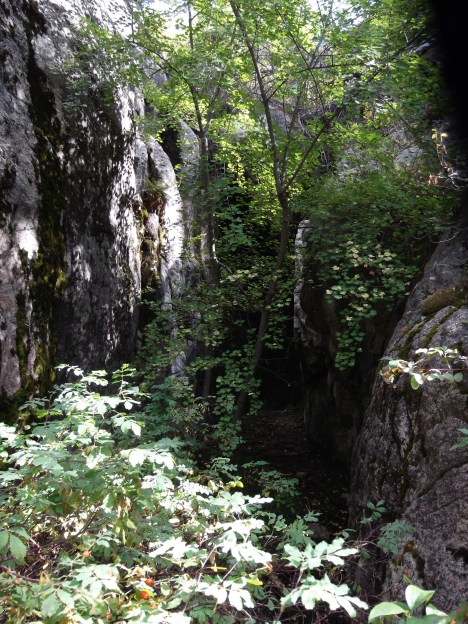
Today I had approached from the north side of the river, yet the approach to this canyon from the south is extraordinary. Two massive shelves of rock form a tunnel less than six feet wide. Water collects in this tight space, and the passage is overgrown with dogwoods and rose bushes.

DSCF1074.JPG

Entrance to the hidden passage

It’s too wet to enter except in the fall. I noticed this anomaly and decided to explore it several years ago in late September. At the entrance, a muddy print of a grizzly greeted me. Obviously, this hidden tunnel was known to the wildlife. I pushed through brush for about fifty feet, the fissure of rock opening just a few feet above an unusually easy crossing of Dead Indian creek.  That’s where I saw the Crow shelter. I crossed the creek, and it was then I discovered the U-shaped gorge.

DSCF1076.JPG

Dead Indian creek at the crossing

Today I was looking for other animal routes, specifically where cougars might pass from low to high above. Walking along the cliff escarpment I noticed an opening that might be easy to navigate. I followed the narrow passage uphill and 3/4 of the way up, under a large tree, was an old puma scat and scrape. Once at the cliff edge, back into the light, I noticed another scrape. This was obviously a cougar common route.

DSCF1098.JPG

Route from below to above for animals

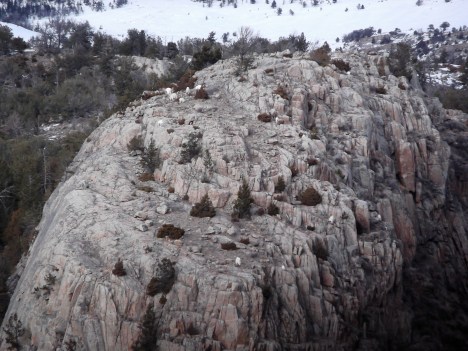
So, what about that ah-ha moment? I traversed back to the large fields leading to the car, then decided to take a last side trip to look for mountain goats. They winter in these canyons and I usually spot them clinging to narrow shelfs and rock ledges.

Mountain goats

Mountain Goats on the cliff face

Walking the cliff edges, I came to a steep gully that dropped 1000′ down to Sunlight Creek. It would not be a trip I’d want to take, but animals could do it. And there, at the opening to the narrow defile, under a large Douglas Fir, was a scrape. And then it hit me. Scrapes are placed at corridor routes!

Of course, I’d read this. In Cougar Ecology & Conservation Kenneth Logan and Linda Sweanor write:

Male cougars seem to scrape throughout their territories. The scrapes are usually located along cougar travel routes, such as ridgelines, canyon rims, drainage bottoms, under large trees and ledges, and at kill caches.

And my notes from Toni Ruth’s cougar class in Yellowstone last year noted the same. But now I had the information viscerally, and will never forget it.

Female cougar

Female cougar checks out a scrape


Delisting just around the Corner

I’ve been writing a lot of blog posts on grizzly bears for a good reason–to raise awareness that these magnificent animals are headed for delisting, and hunting, in the Greater Yellowstone Ecosystem. Grizzlies in the Northern Continental Divide will be next on the chopping block, but that’s for another round with the U.S. Fish and Wildlife.Grizzly Bear

Despite pleas from environmentalists and Native American Tribes across the West, who maintain the Great Bear is sacred in their histories, the Feds are moving forward fast at the behest of the state politicians.

Arguments on the delisting side say bears are at full capacity in the ecosystem and that is why you see them more frequently in areas near human populations. But according to David Mattson, a leading authority on bear food sources, our bears are just responding to diminishing food sources and moving out beyond the PCA boundaries.

Avalanche Peak, Yellowstone.  Dead whitebark pines

Avalanche Peak, Yellowstone. Dead whitebark pines

Feds are putting a relisting trigger at 600 or less bears. Their goal is to maintain around 674 bears. At the Spring Interagency Grizzly Bear Management Team, the report was 757 for 2014 as bears are counted when they emerge from their dens. Recently, the official count for 2015 was 714 bears, down 6% from last year. Yet so far in 2015, 59 bears have been killed by mostly human-caused mortalities–either directly or indirectly where the management team has euthanized a bear for food rewards. You can see each bear mortality here and the reasons.  That would bring our 2015 count down to 655 for 2015, already below their goal.

One might say rightly that this 2015 spring count minus this year’s mortalities does not account for new births. Yet grizzlies are notoriously slow to expand their population, as I’ve stated in other posts. Since we are most interested in females in the population, grizzlies are not ready to conceive until at least 5 years of age. Their young stay with them for 2.5 years, with a typical litter of 2-3 cubs. And with the high cub mortality, a female grizzly will, at best, only replace herself in 10 years. Grizzly front foot

If one does the math, it’s easy to see that between hunting (which will be legal but is not now; yet even now with hunter mistakes, several grizzlies are killed every year) and bears killed due to food rewards (either livestock or garbage), it will be very difficult to maintain the Feds goals that would include an official hunt.

In addition, add to this math the food pressures facing grizzlies–loss of Whitebark pines, cutthroat trout, poor berry years–plus the unknowns of climate change and one has a disaster in the making for the Great Bear.

What irks me the most is this statement:

Bears living outside the 19,300-square-mile Yellowstone “monitoring area” would not be counted toward the population goal. Similarly, bears killed outside the monitoring area would not count toward annual bear mortality caps.

This statement delivers the certainty of death for any genetic diversity in the GYE–signaling a slow decline over decades of the bears that are isolated in this ecosystem.

I’ve been interested in what happened to the California Grizzly Bear that made them go extinct so quickly. Interestingly enough, when the Spaniards arrived, they brought their cattle with them. Slowly these herds expanded into the thousands. Because the human population in California was low, few of these cows were used for meat. Mostly they were killed for their hides for leather goods. Monthly, or even weekly, they herded the cattle into killing yards, where they slaughtered and skinned them, leaving the meat to rot. Grizzlies soon learned of these cattle heaps and flocked to them. Grizzly numbers soared during the time when the Spaniards owned California because of easy increased food for bears. But of course the Spaniards had their own forms of cruelty. They roped bears for sport, pitting them against bulls after starving them for days while chained up.Grizzly mom and cubs

When the United States won the Mexican American war and gold was discovered in California, miners rushed by the thousands into the state. These men were ruthless. They killed anything that got in their way, which included Indians and Grizzlies. Within a short time, twenty years, both of these native populations had almost disappeared completely. Grizzlies became hard to find, until the last lone bear was killed in Southern California in 1908, lured into a beehive trap. It’s a terribly sad story, yet shows how fast this population can decline, from probably over 100,000 bears to almost 0 in twenty to thirty years.

Grizzly bear population in the GYE before delisting had declined to around 125 bears. After over forty years, millions of dollars, herculean efforts by many wildlife biologists and agencies, there are a little over 650-715 bears. Why is the USF&W bowing to political pressures from conservative states and rushing towards a hunt?

white bark pine bear conflicts chart

Correlation between bear/livestock conflicts and Whitebark Pine loss in the ecosystem

Koda’s Blog

This is to let you know that Koda will now be posting to his own blog site.  I’ve encouraged him to post his stories, which have been so popular on my own site.  He says he will, but first he just had to advertise the book he is writing for other dogs.  So his first post is just that–a preview of his book by a dog for dogs. Here is the link to Koda’s blog.

Koda

Techno danger for Yellowstone Wildlife

I’ve become aware of a new concern for Yellowstone Ecosystem wildlife.  A few weeks ago a friend visited and told me this story.  He’s been coming to YNP for over 40 years and is a responsible person who knows how to handle himself properly around wildlife in the park.

In January we were driving through Lamar Valley when we encountered some bison crossing the road.  We stopped the car and turned off the engine to let them pass.  I usually never film with my phone, but for some reason I began filming these bison.  Suddenly one large male turned on us and attacked the car, causing $2000 worth of damage.  All recorded on my phone.  I sent the movie to some friends, then posted it on Youtube.  Overnight it went viral. A few months later I received a call from a company in England that wanted to buy the video and pay me royalties. Never in my wildest dreams would I have thought this would happen.  Apparently these companies purchase videos and sell them as ‘stock’ clips.

My friend wasn’t looking for fame or money, and his behavior around these bison was completely appropriate.  Yet his story clued me into why we might be seeing so many crazy, careless, and inappropriate behavior around YNP wildlife.

Bison close to car

Take this video of a young grizzly bear ‘attacking’ a car on the Beartooth highway.


It just so happens that I saw this same bear a few weeks ago and wrote about it here.


Young bear

Young bear

This same bear was frequenting the Beartooth Butte campground.  He and his young sister were captured and moved.  The WG&F Bear biologist told me that he’d never seen bear behavior like this before and that obviously these bears had been fed.  Just this week I noticed a note from a Forest Service ranger left on a parked truck at Beartooth Butte trailhead. It said they’d had to confiscate food left in the bed of the truck which might attract bears.

But my point is not that people are feeding bears.  When I saw this video I asked myself  “Why didn’t these people honk their horn, or just drive away?”

My answer came yesterday when I saw a piece of the same video again, but this time on ABC news online.  So did these people keep filming that bear, instead of doing the intelligent thing of honking their horn and scaring it off, just to have a ‘viral‘ video, and maybe make some money selling it?

This year there have been 5 bison attacks on people who came too close.  One women was taking a selfie of herself and her daughter with a bison in the background.  She was mauled by the bison, yet lucky for her not injured badly. Of course, this was simply a stupid act, but several days later I saw her interviewed on ABC.  Did she receive money for this?  From the attached link, you can see her selfie is owned by ABC.  Even if she didn’t receive money and just had her moment of TV fame, doesn’t this media attention only encourage more stupid acts that harm wildlife?

Here’s a story of a man attempting to touch a bison’s nose in Yellowstone Park last week.  

He had someone photograph him doing it.  Will he now sell his photo?

Whether these acts are for money, or just to say “we did it”, they are endangering wildlife.  Feeding bears or encouraging them to keep looking for food inside a car is a death sentence for that bear.  Those people should have used bear spray on that young bear. Then they would have taught that bear a lesson he’ll never forget.

Taking selfies with bison or other stupid acts with bison compromises years of hard work on a new Park bison plan which would allow these animals to migrate outside the Park boundary in winter months.

Our techno media-centric society needs to be educated in how these acts are a great disservice not to the public, but to our wildlife.

Keep our wilderness wild!

Keep our wilderness wild!


Decomposed Granite Paths and Patios

With summer here, lots of do-it-yourselfers will be hunting for info on Decomposed Granite.  I have many posts on ‘how-to’ and ‘how-not-to’, including my eBooklets with complete installation information.

I’ve found a few more photos from previous installations of mine in addition to those already on my website.

First some Decomposed Granite paths

A Decomposed Granite path in a shady location.  Notice the concrete transition just at the outside door so DG is not tracked into house

A Decomposed Granite path in a shady location. Notice the concrete transition just at the outside door so DG is not tracked into house

Decomposed Granite path

Decomposed Granite path.  Notice the edging here

Decomposed granite flagstone patio

Decomposed granite flagstone patio with DG in between stones. Pathway is all Decomposed Granite.

Decomposed Granite path no hardener

How to Install a Decomposed Granite Pathway. No hardener was used in this job

Stone and DG

Decomposed Granite path with stone blocks inserted

Decomposed granite path

Lovely Decomposed Granite path under arbor.  This path was done with a TerraPave seal

Decomposed granite pathway

Another arbor

Wood and DG steps

Pressure treated wood contains these Decomposed Granite stairs

I would be amiss if I did not show a photo of how you can mix different fines to achieve different Decomposed Granite colors. Areas of the country have different standard decomposed granite colors.

Here in the San Francisco area, most DG is gold fines, and occasionally like some of the photos above you can find grey.  In the photo below we mixed in some black fines to obtain a darker color.

Elsewhere on my website, I have photos of a rock I used that was more pink.  Rock can be used but it must have fines in it.

Now for some patios using decomposed granite:

Decomposed Granite pathway

Decomposed Granite walk and patio

Decomposed granite shade

Another view of the Decomposed granite patio next to a shade bed

Decomposed Granite leads to a deck

Decomposed Granite leads to a deck

Decomposed Granite with a small flagstone shower

Decomposed Granite with a small flagstone shower

Decomposed Granite inbetween properly placed flagstones by pool

Decomposed Granite in between properly placed flagstones by pool

Decomposed Granite path at the Getty Museum L.A.

Decomposed Granite patio at the Getty Museum L.A.

The bench sits on a decomposed granite patio which transitioned from the concrete patio in front

The bench sits on a decomposed granite patio which transitioned from the concrete patio in front

For a complete guide to Decomposed Granite paths, pathways, and using other materials such as pavers and concrete, please see my eBook.