• MY BOOKS ON WILDLIFE, GARDENING AND MORE

  • The Wild Excellence

  • True stories of wildlife encounters around the Greater Yellowstone
  • Award winning eBook on Decomposed Granite, tips, how to's, what to watch for
  • Children's book. True stories of a dog and wolves. In a dog's voice
  • Written for dry Mediterranean climates in California, north and south

15 Mile Basin and the BLM Plan

There is a struggle going on over our federal lands in the Bighorn Basin.  The Bureau of Land Management is taking public comments on their new draft-plan.  This plan will set the guidelines for the next 20 years of land use.  And the struggle, as I see it, is between immediate short-term gratification and greed, and open pristine lands for our wildlife and recreational and contemplative uses for human beings.

The politicians and the oil and gas companies would like the entire Bighorn Basin open to development for the next twenty years.  And as we all have seen, once that open space is gone, its marred forever.  An alternative plan of the BLM’s is for a compromise that protects and makes more pristine areas off-limits, but allows exploration in other areas.

One of these fantastic areas is called 15 mile basin, an area that right now is the largest contiguous space in the basin with no oil/gas leases.  I’d never been there and the Wyoming Outdoor Council and the GYC were sponsoring an overnight with a walk the next day with Rick Dunne, a native seed farmer.

Our leader Rick Dunne

Besides a lot of fun and meeting new people, the area was quite incredible.  Rick mostly explained the geology of the region and the Bighorn Basin in general.  First we spent some time in  Gooseberry Badlands Scenic walk-through.  I’d been there once before, but today the river was running, making this a truly magical area.

Gooseberry creek

Then Rick took us on a 14 mile drive on a 2 track near Squaw Teats, with a quarter mile hike to an overlook.  From there the basin stretched in all its colors and buttes as far as the eye could see without any roads, oil fields, or human structures.  Rick told us that this area was probably rarely seen nor accessible because of the hiking and lack of water.  It was strikingly beautiful.

The Basin--millions of years old

Many people don’t even know about BLM lands.  In the early 1900’s, when the National Parks and National Forests were being created, the Bureau of Land Management was sort of everything left over.  In those early years timber was what was of most interest to a growing country and so the National Forests were created to save our timberlands.  BLM lands usually have high and low desert communities.  These lands have their own beauty and solitude, with delicate ecosystems and unique wildlife.  These lands belong to all of us, just like our Parks and National Forests.  They are not the property of a few commissioners nor of the oil and gas industries.

Because you as an American citizen own these lands, even if you don’t live in the area, you certainly can comment on the proposed draft.  In fact, those comments from the public are really what shapes the plan.  I came to live in Wyoming because I spent every summer hiking in the Wind River Mountains outside of Pinedale.  I wanted to move to that area, until the Jonas Field, a massive oil/gas field.  Now the Pinedale area has more ozone level alerts than Los Angeles (where I grew up.  Pinedale, Wy has more smog than L.A.!!??).

Here is a link

15 Mile Basin overlook

to help you see the BLM plan and comment.  We have till July 20 to have our voices heard.

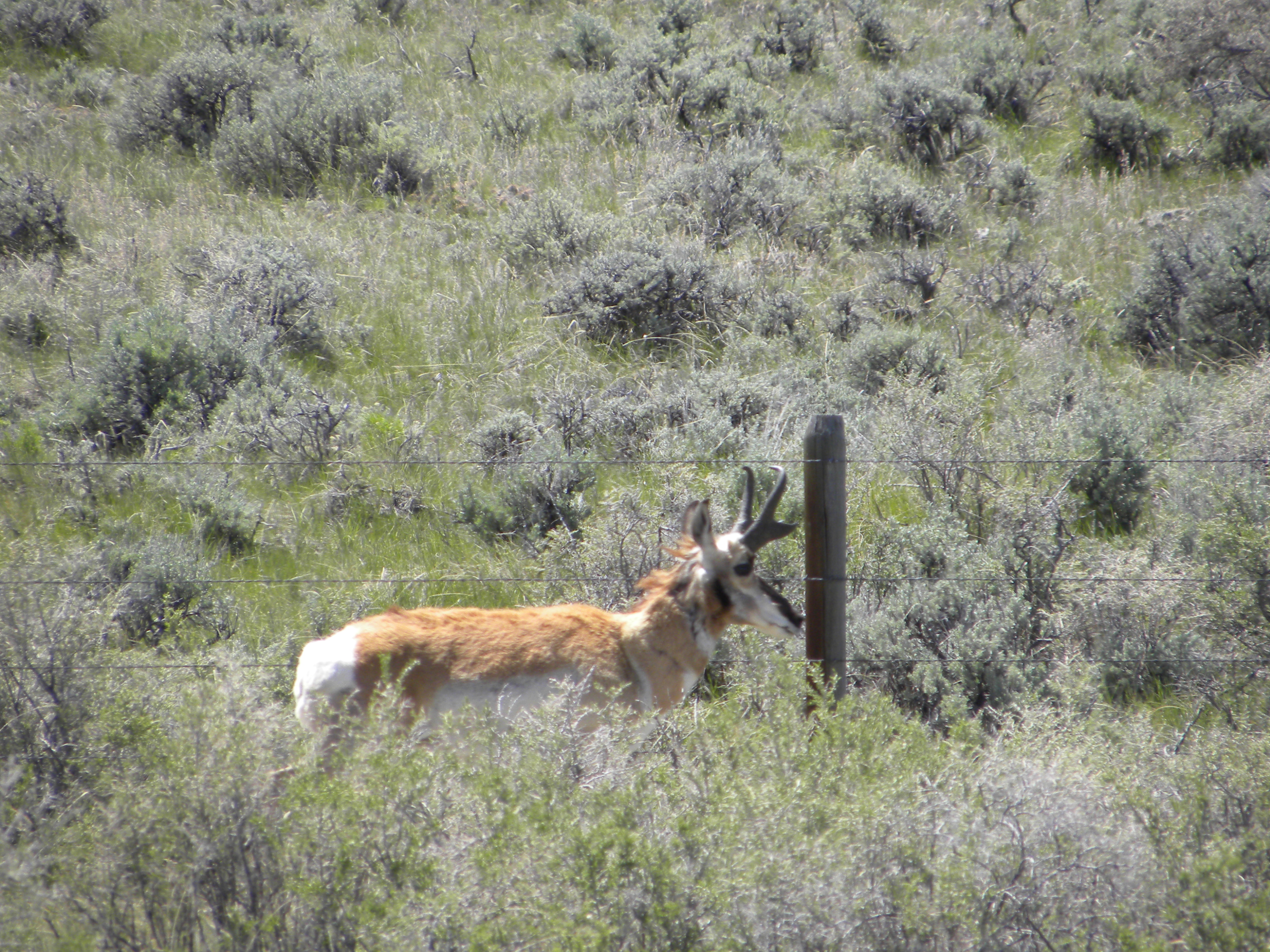
A Pronghorn struggles to find a place to go under a fence that is not wildlife friendly on BLM lands. He will be greatly impacted by oil/gas fields, new roads and fencing for development.

Grizzlies and elk calves

Its unusual to see  the Cody backcountry herd grazing every morning and night this time of year.  Usually, by now, they’re headed over the passes to calve in the Lamar. But the snows in the high country are still too deep and the melt hasn’t even begun.

I’ve been watching this small herd from my window.  They come early morning and evening.

Elk May 20, 2011 still in Sunlight

The other morning I spied a lone elk.  I watched her for a few days going back and forth between the herd in the pasture and a patch of willows in the nearby forest.  She’d disappear into the willows and the forest by the road and seemed concerned.  I had a feeling she had a calf hidden in the brush there.

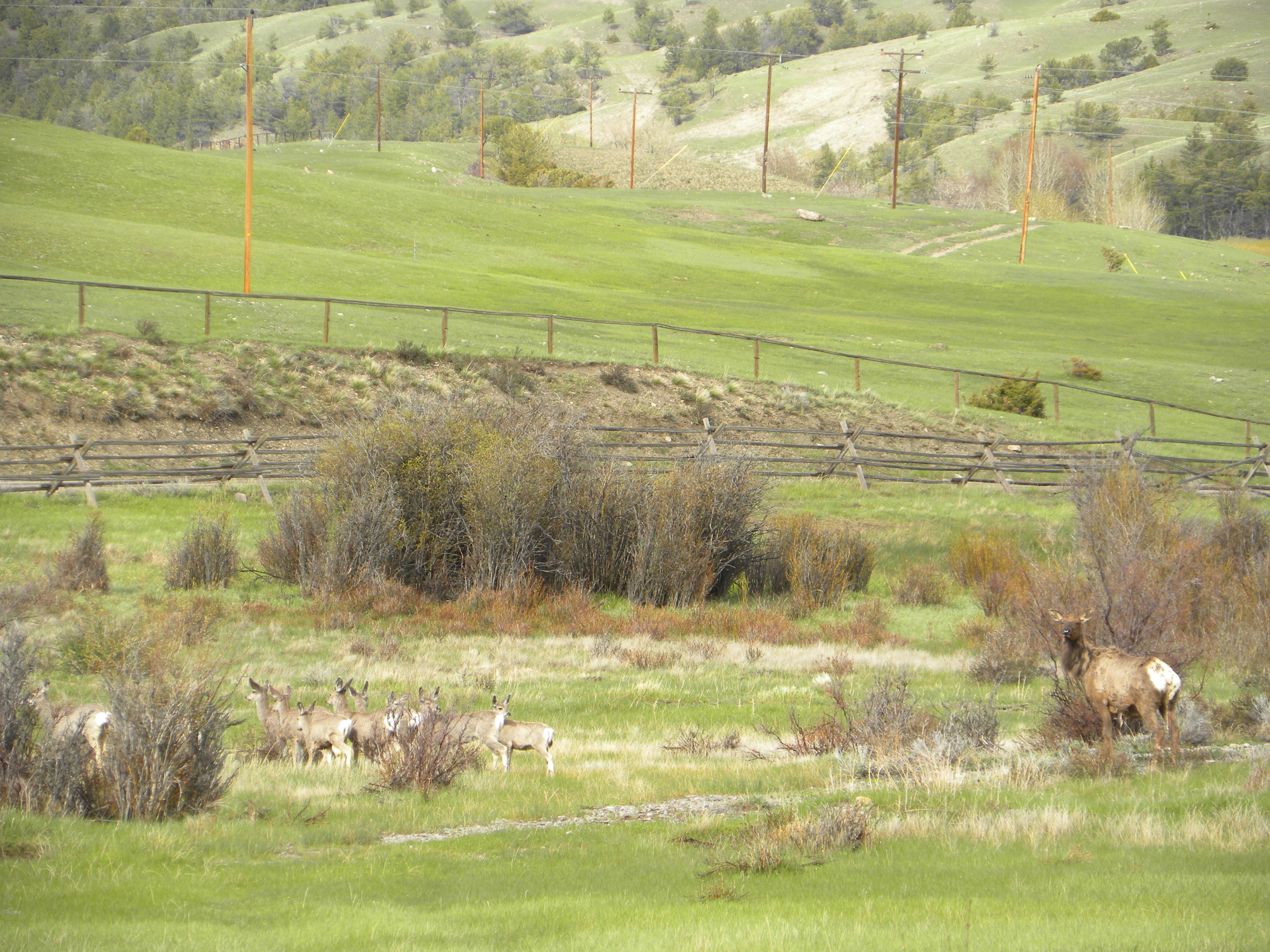
The lone cow with deer

But last night something strange happened which made me wonder if I was correct.  Instead of just this lone cow wandering over to this marshy area, a cadre of about 7 elk wandered over there with her and disappeared into the forest.

So this afternoon I took my bear spray and cautiously investigated while the elk were grazing.  In a muddy area of the creek, now widened by slash and blow downs from the logging last year, I spied a grizzly track moving in the direction of a small clearing.  A few yards up from the track, there was the calf, completely consumed.  Only the skin and legs remained.   It had been predated right where it had lain, for it was in a heap in the grass by a freshly fallen spruce bough.  I inspected the little legs and skin.  The small thing was deftly and perfectly skinned.  Certainly a bear, and my guess is it was that grizzly who made the track just a few feet away.

Grizzly in the Lamar feeding amongst the willows

I had hoped to spy a living calf, so I had a sicken and sad feeling.

Six out of 10 elk calves are predated within their first 10 days.  They are fairly helpless for those first two weeks.  Many people say the calves don’t have a scent, but I would disagree. I haven’t seen tracks in those marshy areas and this griz went directly to that calf.  The calf was not too far from the road, but at the edge of a wide swath of logged forest that includes a lot of swampy areas.  That bear did not wander about through the open woods looking for an elk, but clearly walked from the nearby meadow into the woods right to the calf.  Handling the calf’s skin, I could smell it on my hands.  It doesn’t have a strong smell, and staying on the ground low keeps it’s smell down.  But it does have a smell and to a grizzly, I’m sure its pretty strong.

I was in the Lamar Valley a few days ago and within an hour saw three grizzly boars in the valley. A friend told me in 2 days she saw 20 bears just in Lamar Valley.  The Lamar is becoming a favorite of the grizzlies.  I have wondered if these migratory elk, who usually calve in the Lamar, might have better success here.  Certainly there are bears here, but not as many as in the Lamar.  That’s a question I can’t answer.  Unfortunately for this little elk, it wasn’t the case.

And one more question I had:  Why, last night, did I see 7 or 8 elk accompany mama elk into the willows, not a route the elk ever take around here?  Was that a show of sympathy and support?  After that, the lone elk has not been alone anymore, and I haven’t seen her nor any of the others wander into the willows.

My heart felt saddened for that little calf and her mother.  But I can’t blame the grizzly.  How could I…I went home and enjoyed a BBQ’d bison steak myself.

Sleeping grizzly.

Goodbye to a long Winter

The snows are melting and although Sunlight creek is still not in the spring run-off phase, you can feel the weather breaking.

Last night it snowed lightly, but today its raining.  It’s a slow warm-up, but it’s coming.  My old neighbor who grew up in this valley tells me this was a normal winter in terms of snowfall, but I suspect its still not as cold as when he was growing up.  His wife says that -25 degrees was regular then.  Not now.

Several years ago I helped an elderly woman stage her landscape in order to sell her home.  Her husband had been a great friend of mine and fellow beekeeper.  Once he died Dorothy packed up the family home and moved to Idaho where her kids were. That was the year I bought my cabin in Wyoming and along with so many other strange coincidences, it turned out her father had been the Chief Engineer in Yellowstone from the spring of 1925 through the spring of 1930.  The last two years he was the Assistant Superintendent at Mammoth under Horace Albright  His name was Merrill Daum and the family had interviewed him and transcribed his memoirs. Dorothy graciously gave me a copy of the section from his time in the Park.  Here are a few of his stories of snow in those days:

There were no concessionaires living in the park in the wintertime.  They closed up everything.  We had to go down to Gardiner and Livingston to do our shopping.  We had cars and oh yes, the road was open.  We only had light snow in that country.  We could keep the road from the park open up to Mammoth with our own equipment, but from there on it was generally open.  They had a train running in there every so often, so many days a week, so we had train service at Gardiner.  So much of that country was rough and hot that the snow was not very thick on it.

I don’t know much about Middle Geyser basin.  It wasn’t a good place to stop and just put a road through to yell at Old Faithful.  That’s where we turned off from and went cross country to the Lake and Canyon or kept on going out to West Yellowstone or to Old Faithful.  We had ten cabins about every ten miles on the ranger patrol station because they would patrol all along that area, especially the southern part of the Park because there might be poachers come in to kill the game.  They’d go around in the winter time on skis.  That’s a long trip around that part.  Down towards the southern entrance there might be ten, twelve feet of snow.  I’ll never forget looking at one of the bridges; there was a stream going under and all that snow on top of the bridge.  One winter the bridge just broke.

The wintertime was mainly spent getting ready for the next year.  Then we had to get ready to remove the snow in the spring.  We started at Cody,Wyoming at the entrance.  About thirty miles from Cody up to the entrance.  We got as far as the Park with snow 12 to 15 to 20 feet deep.  We’d blast it out with TNT which Uncle Sam gave us.  That would start it thawing and then we’d take a big power shovel and shovel the stuff so we had a two-way highway through there to the east entrance of the park.  From there on we’d use our own equipment.  The deep snow was right there at the entrance.  That was the high point.  We’d generally try to get the Park open by the 1st of June.  By the 6th of June we were officially open, I believe. But you couldn’t make some of the interior trips that early.  It would be long in July before you could get away from the snow.

Here is a photo tribute to my 2010-2011 winter in Wyoming.  After this long and snowy winter, I think I am officially a Wyomingite!

The Basin in early winter from Dead Indian

This is a wolf howl machine, an experimental device to see if wolves are in the area

Two wolves side trot down the road

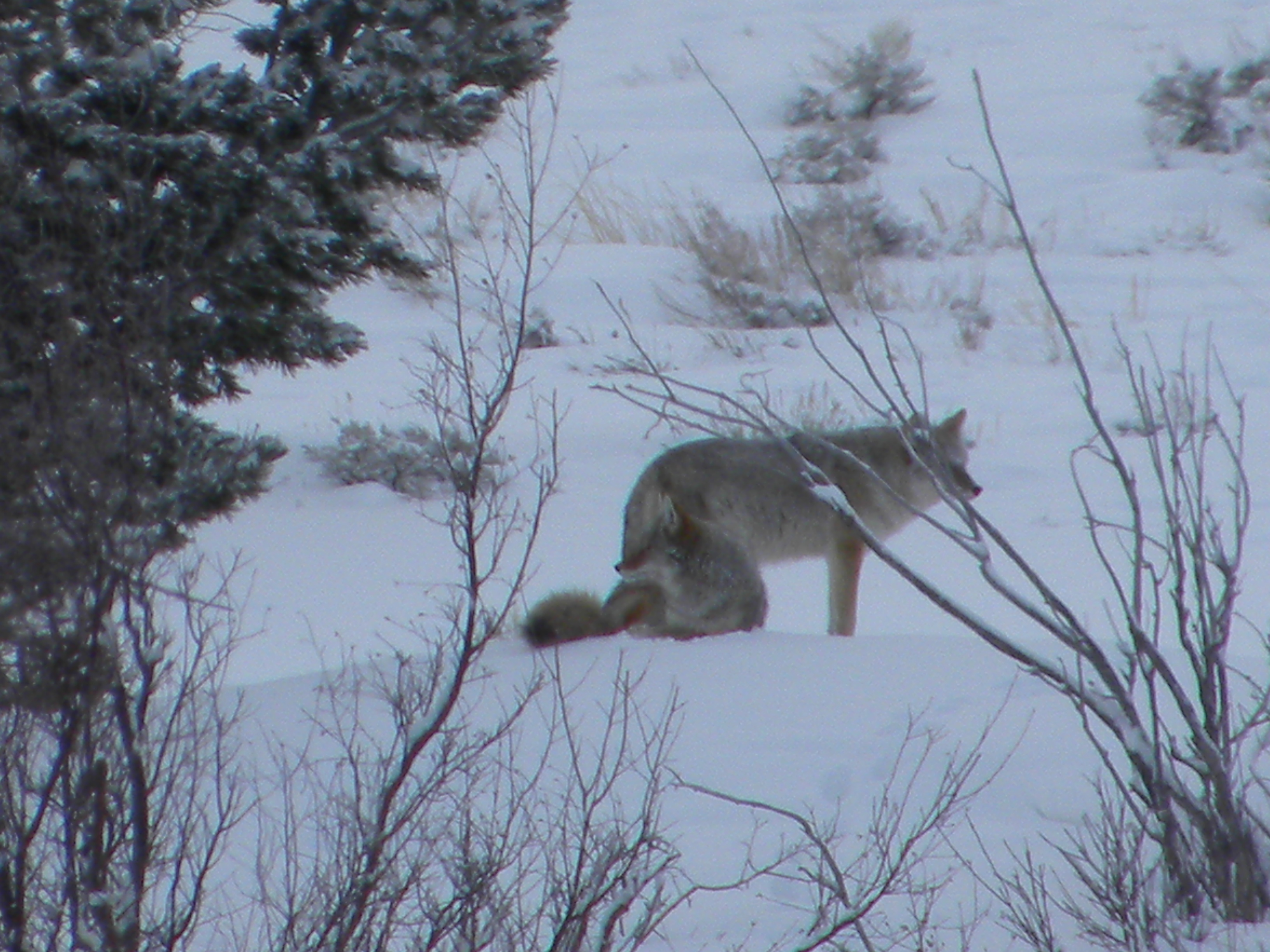
Coyotes on an elk kill

A coyote pair waits their turn on a nearby kill

The Yellowstone migratory herd resides in the valley in winter

Black wolf resting mid-day in the sun after a morning elk meal

Moose stands in deep snow

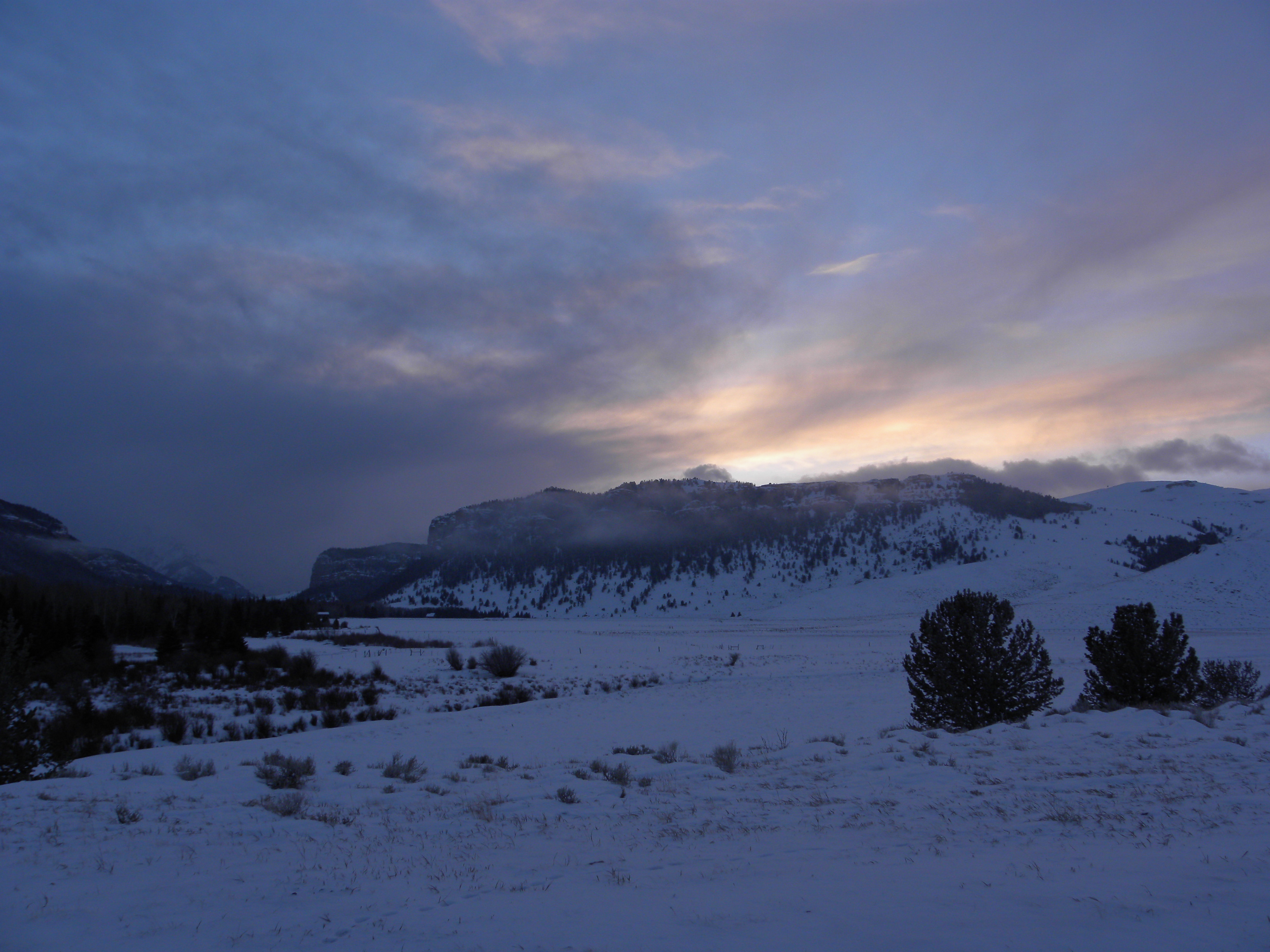
Sunset in a 2011 winter

After a day of skiing, dog tired


The Old Old Road

I’d heard about the route the early homesteaders and miners took into my valley.  Dead Indian Hill, the only way to get to Sunlight from the plains below, is an 8800’ pass.  It took a good two days to negotiate the trail, essentially an old Indian and game route.

The drainage beginning at lower right of photo and moving up to upper left marks the Old Old road.

The pass at Dead Indian forms a huge windswept meadow.  During the winter, up until quite recently, this area was impassible.  I just recently read a book about a forest service ranger in 1956 living in the valley year round with his family.  On valentine’s day they decided to brave the drive over Dead Indian pass for a get-together dance with other forest service employees.  It took them over 12 hours to get to Cody.   At the pass, they repeatedly had to hook up their come-along to wooden fence posts that weren’t covered by snow, and pull their car out of a drift.

At the top of the pass looking down into the valley, its’ a 2000’ drop, pretty much straight down.  The homesteaders would fell a tree at the top as heavy as their horses could drag, with all its limbs and branches, and chain it to the wagon axle before starting the descent.  This kept the wagon from running away.  I heard you could still see the old logs piled at the bottom of the hill.   Indian hunting parties also used this trail.  In those days thousands of pony tracks and travois marks were still visible.

The timeline was still sketchy for me as to all the road improvements, but I understood that around 1905 some of the residents living north of Dead Indian asked the county to help with improvements on the road.  The spring muds made for a treacherous ride.  The money was approved and a passable upgrade, an actual dirt road instead of a trail, was built, mostly by the residents in the valley.  Painter Ranch pitched in with a four-horse team, a breaking plow, and one man, and Al Beam did the same.  Miners who had claims in the Valley helped blast rocks.  By 1909 the new grade was completed, with a series of switchbacks especially on the lower end of Dead Indian.  This dirt road (with improvements added in the 1930’s) was used for the next 80 years until the early 1990’s when a paved road was constructed.

View of improved 1909 old road

I wanted to walk the old old road.  (I began calling the original game trail ‘the old old road’, while the 1909 road was the ‘old road’) The old 1909 road is easy to find.  It’s still in fair condition.  But the trail is a lot more difficult.  Its been over 100 years since it was used.  A good game trail still runs through the creek drainage and you can see the old old road follows it.  But then the game trail turns southwest up into another drainage.  At that point I couldn’t see where or even how a team of horses could go up the steep hillside.  I decided to head up to the old road.   I had to marvel at all the work.  It really was a pretty good road that required cutting into the hillside some, and all by hand and horsepower.

The old road is now what the game use.  The ‘ponies’ of today was the evidence of hundreds of elk and deer tracks.  I rounded a corner and found an old cow elk winter kill.

I hiked up to a large meadow where the road petered out.  This probably was the end of the 1909 improvements.  From here the old road may have hugged close to the paved road of today.  I headed back down, keeping an eye out for where a wagon might have veered off.  Pretty soon, I came to a gently sloping meadow and followed it, leaving the old road.

The meadow ended by a fairly steep slope, but I could see a series of young trees marking the width of a wagon.  Old ruts were even somewhat visible at times.  This was ‘the beaver slide’, where it got so steep they had to use the logs.

Notice the young trees. This is the view looking up of the beaver slide. Imagine a wagon pulled by a horse team, fully loaded, coming down this steep grade, especially in mud!

I hiked down, following a trail of young trees hugged on either side by mature trees.  Wow, I could barely imagine going down this grade with a team of horses.  At the bottom of the slide, a small meadow opened up above a fork in a dry stream.  This was the fork I missed before, where the drainage splits.  I had read descriptions of taking a drink from a crystal clear stream after the beaver slide, where the logs were unloaded.  This must have been that stream, now gone and dried up.  Lots of old dead trees were scattered around the open area.  I wouldn’t say they were piled, but upon closer inspection you could see they’d been chopped with an ax.  Here it was, the logs that had been cut by those old timers to prevent run-away wagons.

Logs cut with an ax to keep wagons from sliding down hillside

I was surprised how much of an impression this hike made upon me.  I felt the history of the place enacted before me…the cut logs holding back the wagons from tumbling down the hillside; the herculean efforts of these men to build a better and safer road with only man and horse power; the old trail used for thousands of years by Indians on foot and later with their ponies.  Though I was the only one walking these trails today, the stories and ghosts of the past walked beside me.

Fixing fence and wildlife

Its been snowing wet spring snows every day.  But this morning there was a nice break and blue sky interspersed with strange light and dark clouds over an immensely beautiful white landscape.

Gorgeous till it started snowing again around 2pm

I’ve been learning a lot about what it is to go ‘ster crazy’, ‘cabin fever’.  Its been a new experience for me being a native Californian.  So I took this opportunity to get outside, and not wanting to try my hand anymore this winter at hiking in the snow, especially wet snow, I decided to fix my fence instead.

I need a fence because I border National Forest where permittees seasonally run cattle.  In Wyoming, the law requires you to fence out.  In fact, you have to have a fence built to Wyoming state specs if you are to have any rights or say about cattle being in your yard.  If a cow is hurt while on your property, if it wasn’t fenced correctly, then you, the homeowner, are liable for that cow.

My fence in 2005. I have a smooth bottom wire now but the top 2 strands are even funkier

Frankly, I hate barbed wire.  We all know that it was the invention of barbed wire that was the final death knell of the West; what partitioned off the free range.  Besides, it tears up my pants and my hands.

Last year I removed the lowest string of wire and replaced it with a smooth wire.  Its easier on the wildlife, although the deer and elk prefer to jump the fence anyways.  I don’t have pronghorn where I live.  Pronghorn never jump fences but prefer to go under and so often die not knowing where or how to get under a tight fence.

But I have seen elk get caught up jumping a fence.  When they can’t see the top wire and they’re stressed, they might not make the leap.  This winter I watched an older elk, frightened by a car, run back and forth trying to decide where to jump a fenceline, then judge it incorrectly and break her leg.  A few days later she was a meal for the coyotes.  Last year an elk died with its leg in the top wire of a fence line.

My own fence I inherited.  The previous owners sometimes brought their mules, but they didn’t maintain the fence.  Although I’ve replaced the bottom with a smooth wire, to keep cattle out and stay legal, I need to have the middle and top wire be barbed (ugh!).  But my top wire was saggy and I’ve been wanting to stretch.  Probably one of the most dangerous things for wildlife are saggy wires.  They are easy to get caught in.  My ultimate desire would be for a post and rail fence, but, sorry, I just can’t afford that.

The super wildlife friendly fence. Costly though and I have such rocky ground

Montana Fish, Wildlife and Parks publishes on their webpage a great booklet entitled How to Build Fence with Wildlife in Mind. Its got tons of handy tips and describes lots of different styles and types of fences.  In there, for a 3 strand fence for Low or Seasonal Livestock Use, they recommend posts placed at 16.5′ apart, Top wire 40″ preferred (42″ maximum), mid wire 28-30″ from the ground, and the bottom wire at 18″.

Instructions for a 3 strand smooth wire in light stock areas

But I’m substituting from the above barbed top and middle to be Wyoming compliant, but here is one that has a smooth wire on the bottom for wildlife, but is legal and good for heavy stock use.

For heavy stock use and wildlife friendly

I’m finally starting to get pretty good at fence work.  Its taken me several years and lots of mistakes since I’ve had no fence guru to instruct me.  I unleashed the top wire for about 1/3 of the fence line and began, in shorter sections, using a stretcher.  After about 2 hours, I’d re-stretched about 1/2 the fence line to the south.  I regrouped at the cabin for lunch and supplies, then headed back to start the next section.  The weather was beginning to shift, getting cloudier and colder.

I began undoing the top wire, moving along the fence westward.  All morning I’d noticed crows cawing around the mountains.  When I returned from lunch, a golden eagle soared above.  I wondered about something dead higher up.  But the surprise was on me.  There, on the inside of my fence, right next to the fence in fact, was a fresh dead deer.   Had it misjudged or not seen the fence?  Its eyes were already poked out, eaten by the crows.

This is the second dead deer in two weeks I’ve run into.  The last one I showed a photo on my post.  This one rigor mortis hadn’t even set in.  It had been eaten on just a little from its back hind quarters.  Either it just died there and had been scavenged or possibly a coyote might have brought it down.  I was certain that bear would be back soon for another meal.

It is the toughest time of year right now for deer and elk.  They’ve had a long winter, are bony and weak.  The new grass is showing its greenery, but not much yet and certainly not much higher than a 1/2″ tall. These deer hang around here all winter long.  I’m sure I’ve seen this one many times in my yard.

I suppose I won’t be finishing fixing fence for a week or so.

Moose, wolves, and a false spring

Yesterday was another glorious early spring day.  Some friends came up and we took a drive north towards Crandall and beyond, as far as the road is plowed.  The lonely 11 or so miles between Pilot Creek, a parking pull-out for snowmobilers, and the NE entrance to the Park won’t be open for another 5 weeks yet, but they’ll have a lot of plowing to do.  There is still an incredible amount of snow everywhere.  It will be a while before you can hike the backcountry.

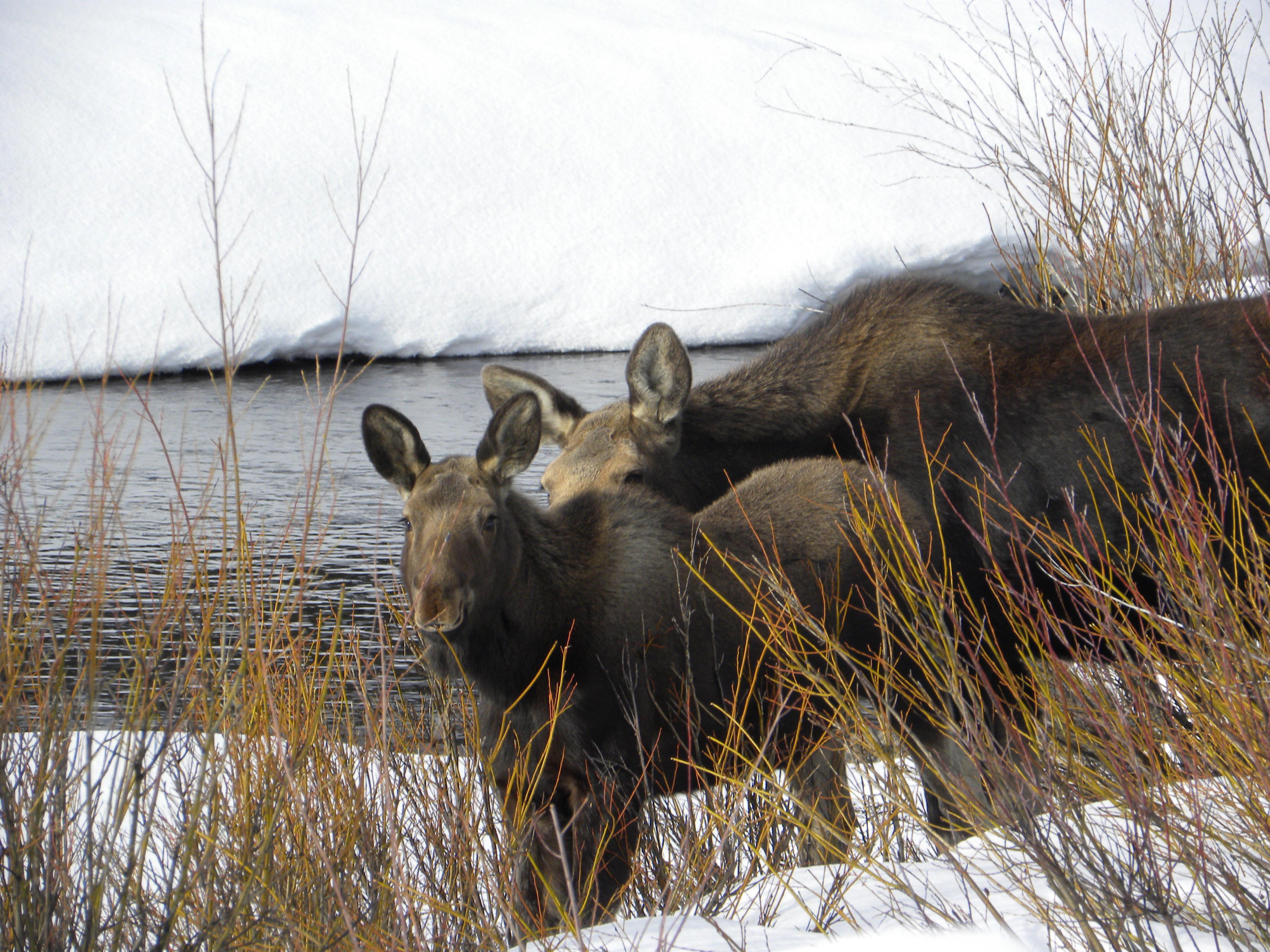
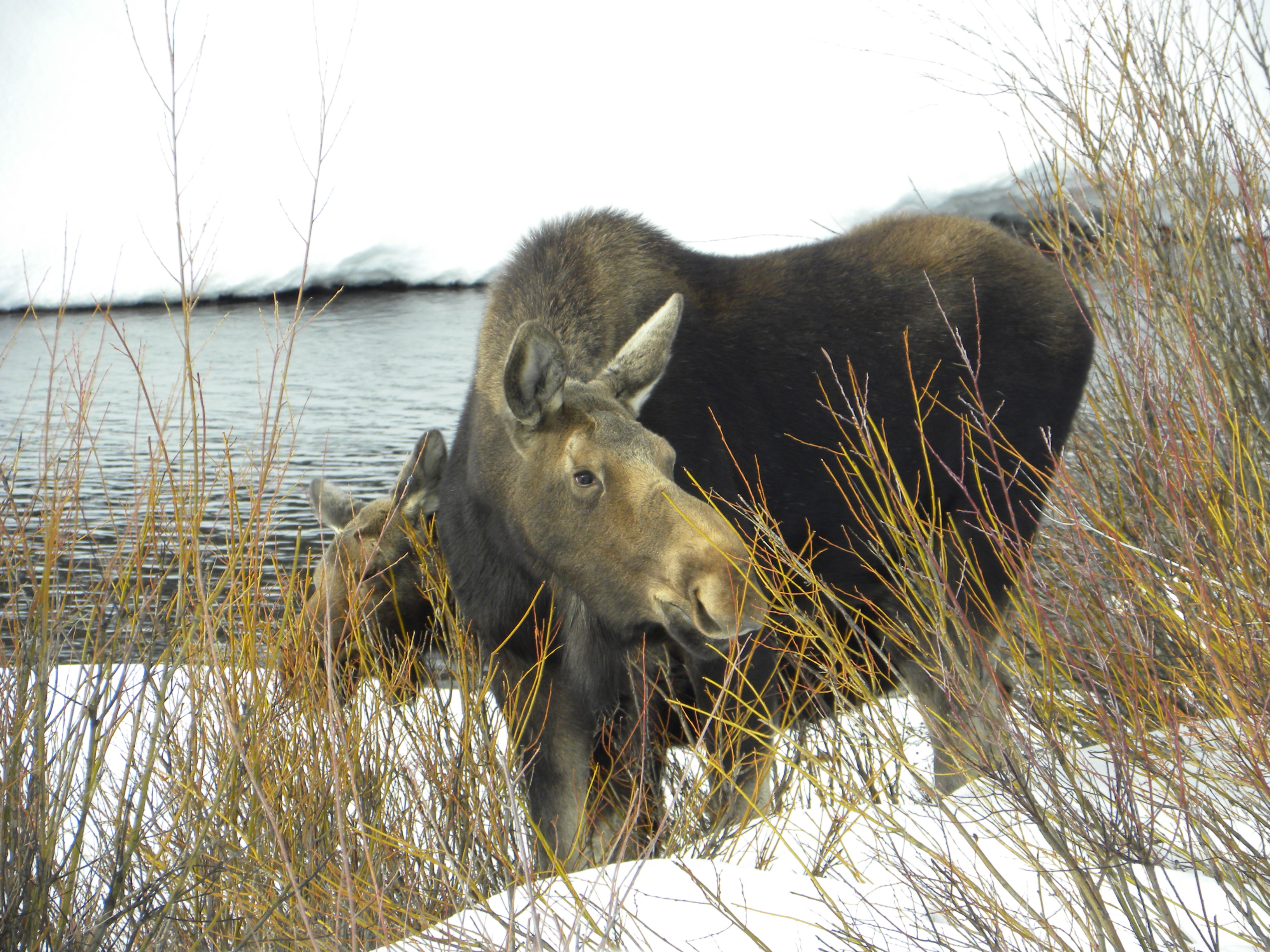
As the snowmobilers raced past us to begin their expensive thrills, we idled along looking for wildlife.  The banks by the side of the road have melted but still an easy 4′ high.  This gave good cover for a moose and her calf just on the other side of the highway along the Clark’s Fork River.

Mama with yearling


Because we could barely see over the snow bank, we quietly got out of the car to take photos.   Mama and baby kept browsing but mama moved between us and her calf.  What a good mother.

Mama Moose moves between us and her calf

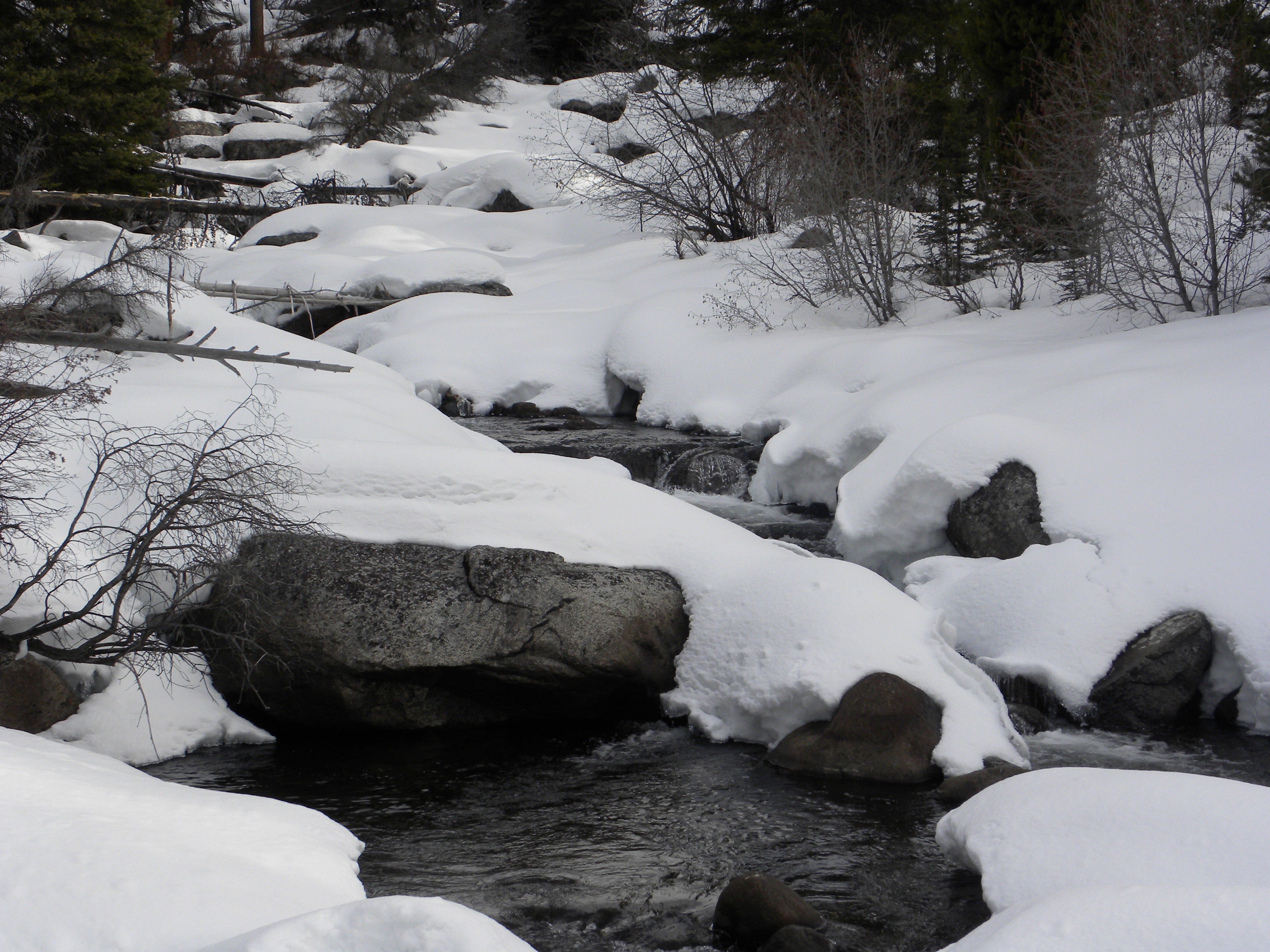
On the way back I shot a photo of Crazy Creek, still solidly covered with snow and ice.  This creek, in a few months, will be an awesome volume of water.

Crazy Creek March 2011

Almost back to Sunlight, I asked my friends, who come up regularly on weekends, if they’d seen any wolves this winter.  They are avid photographers and would like a good shot.  They told me they hadn’t.  Not more than two minutes passed when we spotted 2 wolves by the side of the highway.  This was a most unusual sighting.  Almost 11:00, I’ve almost never seen wolves hanging so near the main road.  There were elk up on the hillside, along with deer, not too far away who didn’t seem too perturbed.  Two wolves would be hard-pressed to bring down an elk, so I suspected there was a kill higher up on the hillside, or possibly down below where they were wanting to cross to.  A big grey sauntered quickly up the hill and out of sight.  But a beautiful black loitered long enough to take some good photos.  Wolves I’ve met always seem intelligently curious.  This one certainly was.

After I came home and my friends were gone, I noticed a yearling moose walking back and forth along the fenceline across the road where the horses are.  The fence has a wooden top post and is very wildlife friendly, but this yearling wasn’t that tall and was very uncertain as to whether she could make the jump.  She moved back and forth for over 15 minutes, trying to find a spot she felt comfortable to cross.  Finally, a car drove up the road, spooked her, and forced her into making the leap.  She did clear, but not without her back leg stuck for a moment.  She ran up my driveway, because its the open line in the fence and stood in front of the house for a while, seemingly perplexed.  Where was her mom, I wondered.

Yearling moose will get kicked out before the mother gives birth again, but it did seem a little soon, but what do I know.  I thought maybe she was already on her own.  She made her way through the front meadow, where I’ve taken down some posts for a winter opening in a buck and rail fence of my neighbors.  It was then I saw her mom, who’d been watching the whole thing patiently.  She was standing in the tree line.  Soon mama and baby were united again.  I had to wonder if mother was, as I would be, gnawing worriedly and wondering if her baby could make the jump successfully, or if mom was treating her offspring to just another new lesson preparing her daughter for the big wide world.

Koda bored because he couldn't get out and play with the wolves!

Shapeshifter

This is a great documentary, free online, by Canadian Geographic on coyotes.  Humans have been trying to eradicate coyotes for years, unsuccessfully.  In fact, whereas coyotes were confined to a small area of the West a hundred years ago, now they are ubiquitous, all over North America, from cities to suburbs, on islands and the countryside.  Why, no matter how much humans have trapped, shot,and  poisoned coyotes, do they come back in greater numbers than before?

Coyote hunting ground squirrels

Here in the GYE, wolves were eradicated by the 1930’s.  Since then, coyotes have been the bane of the sheep, cattle, chicken, and any other type of rancher.  Coyotes are considered ‘varmits’ and can be shot on sight in Wyoming.  Coyotes used to be blamed for all the troubles.  With the reintroduction of wolves, now wolves are blamed.  But if you want to keep coyotes under control, then you need to have wolves around.

According to YNP biologist Bob Crabtree who has been studying coyotes since before wolf reintroduction, since wolves came on the scene in Yellowstone, there has been an 80% reduction in the coyote population.  Coyotes are the oldest indigenous species in North America, some 3 million years old.  Their arch enemy is the Wolf.  Over the thousands of years of dealing with wolves, coyotes have become cunning and adaptable under that stress.  They have developed highly sophisticated strategies of dealing with high mortality rates.  For one, they breed rapidly when under attack and produce more litters.  For another, they can feed up and down the food chain.

Coyote pup

Each year in Yellowstone 1/3 of the coyotes are killed.  This makes the survivors much smarter:  Super Coyotes.  And although wolves are their nemesis, they also provide a smorgasbord of food.  Coyotes in Yellowstone mostly eat ground squirrels.  It takes a few to make a good meal.  But when wolves kill large prey, the wolf pack will eat their fill and leave the rest.  Coyotes can take advantage of their leftovers, which is like eating 100 ground squirrels.

Coyotes taking advantage of a wolf kill

So it pays to stick around the wolves, but not too close.  This stress has produced powerful survival skills. It seems coyotes evolved to do better in a state of flux.

Humans created conditions for coyotes that have allowed them to populate all of North America.  They’ve killed off their primary enemy, the wolf.  They’ve cultivated fields and created open spaces.  They’ve filled those open spaces with nice plump meat to raise pups with.  And by putting stress on coyotes through trapping and killing, humans are acting like wolves, making the coyotes breed more rapidly.

Everyone I know has a story about coyotes in the city and suburbs, close and strange encounters, bold coyotes.  I’ve watched coyotes kill a deer right next to a house.  I’ve  seen them lounging mid-day on the grass in a cemetery.  I know a friend whose daughter was walking her dog in the open space of Marin County who became surrounded by coyotes.  She started singing and they left.

Urban coyote rests mid-day in local cemetery


Singing brings up a good point.  Biologists who are studying coyotes in urban areas say, since we can’t eradicate them, we will need to learn to live with them.  One biologist says “They are teaching us things maybe we don’t want to learn yet.”  As top predators in an urban environment, there is a ‘nervous harmony’ that can be adapted to.  Humans need to learn to just scare coyotes away–use a hose, shout, sing, water pistols–make those coyotes think “These humans are so unpredictable”.

The documentary had some interesting things to say about the eastern coyote.  It seems they are growing bigger.  DNA studies reveals the eastern coyote is mating with the smaller Eastern (as compared with the larger grey wolf of the west) Wolf to create a super top predator–smarter, wilier, more adaptable.  It seems ancient Native Americans understood Coyote much better than us modern humans when they described him as ‘the trickster’, the ‘shapeshifter’.

I applaud Coyote.  Humans have taken over every inch of North America, as well as the entire world.  Rats, cockroaches, and a few other smaller species thrive around humans.  But Coyote is the only large predator that has adapted and fully populated all of our environments.  He truly is more cunning than us!

Coyote hunting voles

Synchronicity: Coming to Wyoming, the final piece

Synchronicity is the experience of two or more events that are apparently causally unrelated occurring together in a meaningful manner. To count as synchronicity, the events should be unlikely to occur together by chance. The concept of synchronicity was first described by Swiss psychologist Carl Gustav Jung in the 1920s. (Wikipedia)

“When coincidences pile up in this way, one cannot help being impressed by them—for the greater the number of terms in such a series, or the more unusual its character, the more improbable it becomes.” C.G. Jung

“I know I’m supposed to be here, just give me some time to figure out why.” The Secret Life of Bees

_______________________________

I continued my life working in California, putting the finishing touches on raising my teenage son.  I was used to this life, my friends, my home, my neighborhood.  I’d grown up and lived my entire life in California, and loved all of its varied environments, from the deserts of Southern California, to the Sierras, the coastal redwoods, the wild surf of the Northern California coast.  I’d grown up surfing and swimming in Southern California, and spent my entire adult life in parts of Northern California.

How I love the ocean that I grew up with

I’d planted thousands of trees and shrubs, grown many summers worth of vegetables, picked fruit, studied oaks, madrones and manzanitas, watched baby salamanders clamber out of quiet pools, rare Coho salmon fight their way up Redwood creek, guided school children through Muir woods and Muir beach, and helped with Spotted Owl studies.  All my life-long friends were in California.  I loved my family, my friends, and most of all I loved the land.

My garden in California. I love the land there

Yet strange coincidences started reaching out and tugging me more and more in the direction of Wyoming.

For instance, soon after the purchase, I had a job in California with a wife who was a doctor and the husband a geologist.  In this case I mostly dealt with the wife relative to the design elements.  One day husband Bill and I were talking about my cabin near Yellowstone.  I was telling him about how incredible the geological features were.

“Wait, I have something I want to give you.  Janet can’t stand that I collect these.  They clutter up the house, are big.  I have no where to keep them.”

He came back with a 24×36 bound book of geological maps.  The date was 1898, so this was an original series of maps put out by the U.S. Geological Survey.

“These are original maps of the Yellowstone area.  You’ll use them more than I will.”

Later, upon inspection, I saw that the quadrant of maps he had given me wasn’t Yellowstone at all, but Sunlight Basin and the Absarokas bordering Yellowstone and my valley.  Since my neighbor in Wyoming is the Park Geologist, I gave these prints to him.

Another client gave me a section of her father’s memoirs.  He was the chief engineer in Yellowstone in ’29-‘31.

My son was looking at colleges.  He applied to Pasadena art college, a small school in Southern California.  These small schools usually have an evening get-together for questions and PR.  This was done one evening at a alumni’s office in Oakland, an architect.  After listening to the presentation I was walking around for the coffee and dessert part, when my eye caught a scale model of a museum he designed.

“That looks like the Buffalo Bill museum in Cody”, I asked.  “The Plains Indian wing.”

“It is.  I designed it five years ago.”

One afternoon I was looking at possible storage units in Northern California where I still lived.  When I came out of the 2nd floor onto the balcony, I saw a Hertz moving van in the parking lot blocking my view.  The advertisement on the side said “Visit the Buffalo Bill Museum in Cody”.  I have never seen one of these advertisements on a moving van since.

Then there were the persistent dreams.  In the winter in California, I’d have dreams of wolves and elk in the snow in Sunlight.  I dreamt quite accurately about the original owner whom I had known nothing about.  Dreams of native Americans, of new beginnings, of going to live in Wyoming; persistent, insistent dreams.

And then there were the healing forces.  After a series of deaths in my family and close friends over the course of two years, new sorrows seemed to echo old wounds.  I was spent, exhausted, and in pain emotionally.  I had been squeezing in two weeks here and there during the spring and summer, driving the 20 hours back and forth from California.  I decided to take some time off and spend September and most of October here.

Deep present loss can easily echo past losses.  I felt like I had a deep gash in my heart that had been there for a long time, even longer than these family deaths.  I came here and just ‘let the mountain work on me’.  I couldn’t do much but surrender to the Place.  Sometime in October, I had an amazing day.  I took a chair up to a high point on my property, a place with a view to the east of the entire Clark’s Fork plateau.  I sat.  After several hours, a new feeling arose, one that was recognizable yet unfamiliar at the same time.  I felt centered.  I felt my own center.  This Place itself was my center.  How could it be, but it was true, that I’d never felt this before?    I went back to California a different person.  I literally felt like someone had done heart surgery, sewing up a very old wound, healing a condition of sorrow and grief.  I was happy again.

Dawn in Yellowstone. A new day

There is something about Place, and I believe especially about the Greater Yellowstone Ecosystem, a very special Place on this Earth.  Maybe its that giant hotspot underneath us; maybe its because its one of the last places in our contiguous United States where wild is still wild, where large predators still rule the landscape and things are right; maybe its because it was the last and final stand of Native Americans and you can feel the pulse of their history as you walk around.  Whatever it is, its palpable.  The healing power of Yellowstone and my little valley is the Center of the Universe.

Coming to Wyoming part 1

How did you get to Wyoming?

Of course, I am asked that question regularly.  And, there is the short answer and the long answer, but both replies are more full of questions than answers.

Long ago, a few lifetimes in my personal history, I spent several weeks backpacking through the Tetons with two girlfriends.  We were hitchhiking through the West in a summer between high school and college.  After a fine time, with many adventures, we were ready to put out our thumbs and head back to California, when a driver who picked us up asked “Have you girls been to the Wind Rivers?”

“No, where’s that?”

“Just an hour east of here.  You must go.  I’ll drop you off and you can backpack there.”

The Winds, as aficionados and lovers like to fondly call them, have several put-ins on their western front, all at least 10 to 15 miles from the hiker’s main destination—the rugged base of the Continental Divide.  But after several days of being eaten by mosquitoes, (with thousands of lakes the Winds are notorious for their bugs) and never quite making it to the divide, we called it quits.  But you could see those tantalizing mountains in the background and I swore to myself that I’d come back someday.

Flash forward 27 years.  I’m a single mom newly divorced with a nine-year old.  Close friends are going to visit their son in Yellowstone who is a seasonal worker.  They have a nine-year old too and invite us along.  We fly into Salt Lake and drive the rest of the way.  After a week in the Park, I see my opportunity and jump on it.  They drive home with my son and I arrange to fly out of Jackson, rent a car, and put in at Big Sandy for a modest 5-day hike.

In those 27 years inbetween, I’d had some serious back injuries and was not even sure if I can backpack anymore, but this is my first time in years so I pick a fairly easy route.  The hike is about 5 miles to Big Sandy Lake, the shortest distance to the Winds from any trailhead.  It’s a well-traveled route, because its also the quickest way to the Cirque of the Towers, a massive granite glacial cirque treasured by climbers from all over the world.

Mission accomplished, I was able to complete the trip, and so began coming back every summer for a seven day backpack over the course of more than eight years.  During that time I usually hiked about 40-50 miles and eventually completed most of the Highline Trail, a glorious trail that traverses a north/south axis through the Bridger-Teton wilderness.

When my son was about 15, and I’d finished another solo trip to the Wind Rivers, I started to wonder why I was coming home so soon.  Couldn’t I find a summer rental in Pinedale or Lander?  I tried but it wasn’t so easy.  Wyoming isn’t Tahoe and summer rentals are not the norm in these small towns.  Jackson would be out of the question over-my-head expensive.  Rental hunting led to the idea of just buying a small 2nd home or piece of land.

One time while hiking in Wyoming, a fellow hiker asked if I’d been to the Beartooths.

“Where is that?”

“Charles Kuralt called the Beartooth Highway the most beautiful highway in America.  You’ve got to drive home that way.”

But it wasn’t on my way home, and I was always in a time constraint.  So the following summer I decided to hike, with a few friends, into the Beartooth Range instead of the Winds.

It was a rainy experience and crowded, although spectacular.  But I missed my Winds.  So I decided to take a short trek to the Winds from the Eastern side, the reservation side.  This required me to head home via Cody.  I’d been thinking about towns to live in.  Pinedale had been tops on my list.  Little did I know that Pinedale can be the coldest town in America at times.  I’m really not a great researcher of these things.  I was just going on my gut and on my love affair with the Wind Rivers.

But when I drove into Cody, I immediately knew this was a town I could live in.  I was attracted to it.  It felt like a real town.

In the winter of 2005 I contacted a realtor via the internet in the Cody area.  Since I really had only been to Cody one night, I arranged to fly into town in the February break, with my son, and have him show me areas around the town.  Then my son and I would snowmobile into Yellowstone for a vacation.

I had a vision in the back of my head of what I wanted.  Either a place to fix up, or land to build.  It needed to have trees but not be ‘in the trees’;  there must be a creek on or near the property; somewhat isolated but not too isolated.  I was figuring I’d live around town on the outskirts.

My realtor Al showed me the North Fork area, which is the North Fork of the Shoshone, the road that leads into the East entrance of Yellowstone.  Expensive lots and homes abound in this breathtakingly beautiful valley.  He showed me the South Fork of the Shoshone, a massive wide valley that dead ends into trails to the Thorofare of Yellowstone.  These areas all had lots and cabins, but what I didn’t account for was that way back when, when the government was giving out homesteads and people were settling here, the government took the timbered areas while the homesteaders built and farmed in the low, open, praire parts of the valley.  All these homes, excepting the giant ranches, were subdivided 20 and 40 acre lots of bare ground usually with a well.  A housing boom of retired Floridians and Californians who’d made money selling their own homes had changed the valley as well.  The houses were in general exposed to each other, sometimes even with little subdivisions of lesser acreage.  For a million dollars plus I might find something special, but I didn’t have that kind of money.  The image in my mind of what I wanted was just not available here.

“What you want comes up every ten years or so,” Al said.

Al took me to Clark, an unincorporated town on the far outskirts, situated at the base of the Clarks’ Fork canyon, the town was smack in a wind tunnel.  It had a strange displaced aura about it, a town without a town, with stories of transients, drug runners and government haters.

He drove us to the nearby town of Powell, a farming village that felt quite settled and sensible.  Powell was a nice town but not what I had in mind.  I left feeling quite discouraged.

That summer I took my son for the first time with me to the Winds.  The whole experience had changed from one summer to the next.  Cheney had pushed through drilling on public lands without the need for the same limits and waiting periods as previously.  Wyoming was a boom state.  There was not a hotel, motel nor campground space between Salt Lake and the Pinedale turnoff at Green River.  My son and I slept on the side of the road south of Big Piney after driving for 25 hours.  The Persius meteor shower was a brilliant consolation in the clear open desert sky.

Pinedale had transformed itself as well, with large hotels.  The Jonas field was fueling the economy.  Ticky-tacky houses were springing up everywhere.  “Thank God I didn’t buy here” I told myself.

We had a rainy but beautiful adventure in the Winds, and I was reminded how much I love Wyoming, and that I hadn’t heard a peep from Al.  He had never shown me even one house, just neighborhoods.  I called him when I returned.

“Everything that was in the book last February has sold” he said.  “Like I said, what you want comes up every ten years.”

That was August.  In September I got a call from Al.  “I have a house that fell through.  It will be re-listed in a few days and its’ gonna go quick.  I think it’s what your looking for.  There’s 40 acres, a creek, cottonwoods, and an old homestead on it, a new well and electricity.  You better come right away if you’re interested in seeing it.”

I booked a flight to Cody.  Being in a busy work season, I made arrangements to come into town on the 5pm Wednesday flight, and leave the next evening back to San Francisco.

What a disappointment the property was.  Yes, it had all the elements I asked for, but the ‘feeling’ just wasn’t right.  The land was broken, neglected, desolate and tired.

The house on the neglected land
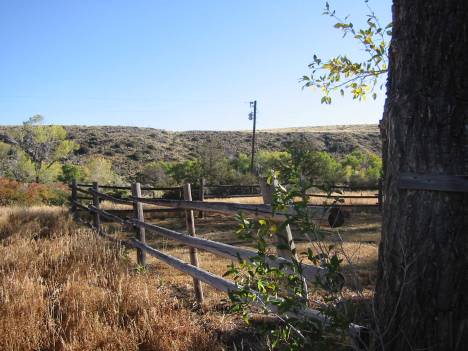
The country around the other house

“Well, I’m here and got a few more hours till my flight.  Is there anything else you want to show me while I’m here.”

“There is one place, up in Sunlight Basin, but its not on the market.  The parents died and the kids now own it.  They’ve been squabbling for over a year as to whether they want to sell or not.  But I’ll be their listing agent if they do.”

“Show it to me in case they ever do.  Where is Sunlight?”

I’d been wanting to be within 20 minutes of town.  Sunlight was an hour northwest, over an 8500 ft. pass.  I was skeptical, but I was here so why not.

As soon as we turned off 120 highway onto Chief Joseph Scenic road, I was mesmerized, hooked.  From Dead Indian pass, you could see the entire country for millions of miles.  West to Yellowstone, northeast to Beartooth Plateau, below to the stunning Clark’s fork canyon 900’ deep, and across into the wide glacier valley of Sunlight.  I’d never seen a landscape more varied geologically, nor more breathtaking that this view.

We got to the cabin—a run-down summer cabin built in 1959.  Cluttered with too many old couches and chairs, a tacked down orange shag carpet brought out from Washington state by the owners when it no longer was in style in their main home, animal heads on the wall, 50’s linoleum that was coming apart, original windows that questionably opened, and the entire back area of the house was unfinished with open joists and studs.

First glance at what would become my cabin...too much furniture

Unfinished ceiling. Warped cheap paneling

the bulging paneling alongside the shower

I stood on the porch and looked east at a massive ridge jutting into the horizon.

“I could die here.” I said aloud.

“I’d buy it if I could,” said Al.

I asked Al what the comps were, and told him to offer just a bit more, and that was my final price.  I was nervous, I was firm, I’d never put myself out on a financial limb like this before, was I making a mistake….mostly I was just going by my heart.  I’d put it out there and see what they said.  The reality was…this house wasn’t on the market and the three children hadn’t decided if they were selling.  The reality was…I’d seen only two homes around Cody, both today.  The reality was…I hadn’t even done any homework about this place, its weather, anything. But I was already in love, and when you’re in love you usually act before you think.

Living and working in California, I slowly fixed my little cabin up to be livable anytime of the year.  I dreamed of coming here in the summer, watching the weather, and when it was good, going hiking in the Winds.  I thought about spending Christmases here in the snow with family.  Oh, but I’d have to winterize it as well as lots of other things.  That meant lots of work and all that cost money, money that I had only bit by bit, little by little.   So that’s how I fixed it up, little by little, over several years.

New T&G bluestain pine with my California crew

Never did I think about moving here permanently.  But once this place was mine, strange coincidences conspired, over and over, to point the way here.  For some reason, this place in Sunlight was calling me, suggesting it was the center of my universe, the place of peace for me.  Over time it became an irresistible urge.  My journey was just beginning.

The Road

After a brief hiatus working in CA, I got back to Sunlight in time for the arrival of the elk from the Lamar in Yellowstone. In the early mornings I drive up the dirt road hoping to catch whatever might be out there.

Most days I’ve seen 2 moose calves eating amongst the willows up near the ranger station.

Young moose

In the evenings several hundred elk come to graze in the open.

Elk feeding at dusk

Bunnies run to the brush. Two bald eagles play overhead. The Sunlight wolves patrol the road, side trotting up and down.

Running down the road 2 blacks and a grey

Today I took a hike along a closed winter road by the river. Tons of wolf, moose, coyote, elk, deer, rabbit and mouse tracks. I could hear a few howls across the valley, and then a pack of coyotes yelping. I stopped, listened hard, and found their direction. Somewhere by the ranger station across the river the coyotes were singing, along with the crows. I suspected there was a kill there.

Driving back, I looked for the kill. I found it about 50 yards off the road, mostly picked over, probably from a few days ago. I climbed down the steep incline and over to investigate. Was it one of those young moose?

Although pretty badly chewed, the skull definitely looked like a moose, not an elk. There aren’t too many moose around here, between the long drought and the ’88 fires. Besides, moose aren’t native to these parts of WY. But I do mourn any moose that’s gone as there are so few.

Living in a complete ecosystem, with top predators, you see the full cycle of life every day, especially in the winter when the landscape is so clear and visible and the wildlife are not interfered with by atvs, hunters, cattle, campers, and all the others amusements we humans conjure up. I’m constantly confronted by my modern, linear, goal oriented thinking, as if nature were a line from beginning to end.

What is Real?

Nature is a circle of Life, of endless feeding and being fed, unedited beauty, a starkness stripped to naked Reality, though elusive and hidden at the same time.  Multi-dimensional, dispassionate,  full of the passion and energy of Life.  All Paradox and no conclusions.