• MY BOOKS ON WILDLIFE, GARDENING AND MORE

  • The Wild Excellence

  • True stories of wildlife encounters around the Greater Yellowstone
  • Award winning eBook on Decomposed Granite, tips, how to's, what to watch for
  • Children's book. True stories of a dog and wolves. In a dog's voice
  • Written for dry Mediterranean climates in California, north and south

What is an elephant?

The Buddha tells a parable that is a classic:  The King has six blind men brought to the Palace and asked to describe an elephant.  “When the blind men had each felt a part of the elephant, the king went to each of them and said to each: ‘Well, blind man, have you seen the elephant? Tell me, what sort of thing is an elephant?”  Each blind man describes the elephant differently.  The one who touched his ear said he was like a fan.  The one who touched his leg said he was like a tree trunk.  The man who felt his tusk said he was like a spear.  Touching the elephant’s body, one exclaimed he was like a wall.  One man touched his trunk and said he was like a rope.

How can anyone describe the Whole until he has learned about all the parts.  Relative to Nature, we are all like the blind man for we cannot see the whole and all the parts are too many, too intricate, and some parts even invisible which we will never see.

I was speaking with someone today about Grizzly bears and the need for connective corridors and Yellowstone to Yukon to become a reality; how if grizzlies are delisted in 2014, then hunted to control their numbers, they will just be in a virtual zoo in the GYE, and how studies have shown that without connectivity, over time the bear will go extinct in the Greater Yellowstone Ecosystem. Strangely enough, I was told that the plan was that if genetic diversity were compromised, then bears from other areas could just be flown in!  I think that’s the idea with wolves as well.

Trying to manipulate all the parts to make a whole becomes a juggling act that is doomed to failure.  Over time, we’ll never be able to control wolves for livestock on public lands or figure out how many we should kill to maintain elk and deer at levels we want; Or how to control the diseases in the ungulates we desire to hunt when we have killed the wolves that control those diseases; or manage cattle on public lands and still maintain healthy ecosystems for elk and deer; or control brucellosis, that originated with cattle, from transferring back to cattle from elk and bison; or keep enough control over Park bison and still have enough genetic diversity; or shoot enough coyotes to keep them from killing sheep or chickens; or kill enough raccoons to protect our cornfields.  We are like the boy with his fingers in the dyke.

In the end, we always seem to learn that all the parts need to be there to make up the Whole; and the Whole can self-manage and heal itself quite well, without our interference.  This has even been proven in places where humans are no longer allowed, like Chernobyl, now a healthy ecosystem as far as wildlife is concerned.

The question is not how do WE manage and juggle everything.  The question is how can we live lightly?    When all is said and done, it will not be the Endangered Species Act, nor some Act of Congress that makes the final difference, but an act in Consciousness that each and every one of us must make.  And that Conscious Act will translate into our Approach to all of Life itself.


A farewell to a wonderfully curious wolf pup of the Hoodoo Pack

I have been randomly calling the Wyoming Mortality Hot Line or going to the online link to find out how many wolves have been killed (let’s not call it by the euphemism ‘harvested’).  I am especially interested in my Area (area 1).  As of today, 3 of the quota of 8 have been taken.

Today, I just found out that one of those wolves was the yearling pup I’ve seen many times over the last year.

Yearling pup this spring

He was born a year ago spring.  I first saw him with his mom last fall.  She is a black alpha female (not sure if she’s still around) and she was harassing a cow as her pup tried to help.  The cow didn’t run, but just kept turning around and chasing her down.  Finally she gave up.  If prey don’t give chase, wolves usually get confused.  They can too easily get kicked and hurt by confronting large prey from in front.

The pair seemed inseparable and the next time I saw the pup was around January.  He was with his mom loping up a nearby ridgeline.  Mom turned, looked, and sprinted off.  But the yearling was curious and watched me for awhile.  We shared a moment from afar on that cold winter early morning.

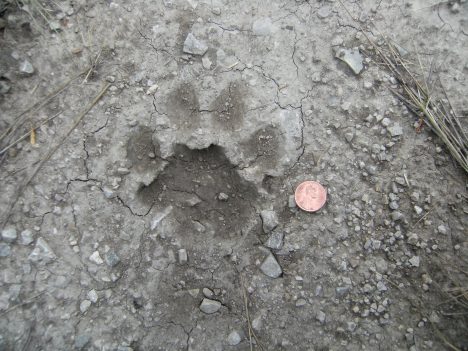
The last time I saw him was this spring.  I was hiking down a draw, following a cougar track.  Koda lagged behind.  I was above a creek on a thin deer trail when I spied something odd behind a tree about 20′ ahead.  I stopped and his grey head peeked out.  He’d been curious, watching Koda and I.  When he saw that I noticed him, he ran off to join his mom in the meadow a few hundred yards away.   I sprinted up beyond the trees to catch a glimpse again of the Alpha female. (I was able to snap the photo below of her).  She eyed me warily for a bit then took off with her pup.

Alpha female; mom of yearling pup killed this week

Last spring I went to a WY G&F information meeting about the hunt.  It was clear that it would go through, starting this October 1.  The quotas were already set, with my area having the largest.  Immediately I knew that this curious youngster would be amongst the first to die.  Wolves have been hunted by helicopters around here for years, but not by hunters on foot.  Although these wolves were wary, they were not yet scared of humans.  The opportunity I’ve had over these last seven years to see wolves over and over again fairly close (I’ve had at least three occasions where I’ve seen wolves 25′ away, eye to eye, both of us curious about one another), has come to a close.  It will be better that way for the wolves.  Within a year or two of these hunts, wolves will not be seen casually in these parts.

Predators by nature and design must be smart.  They need to think and strategize. Wolves cooperate when they hunt and that takes smarts.  Prey are given the gift of speed.  They look, listen and run.  But predators must be more cunning than that.

If you share a moment with one of these magnificent creatures, you realize how intelligent, how full of Life they are.  They embody everything that is wild and free. When they look you in the eye, they see right through you, much deeper than you see into them.   In the end, though I am saddened by the loss of these wolves in Sunlight,  the hot button issues surrounding wolves is not really about wolves at all.

I am reading ‘Shadow Mountain’ by Renee Askins, one of the spearheaders of bringing wolves back to Yellowstone National Park.  I highly recommend this engaging, personal and well-written book.  I end this entry with a quote from Askins book and a fond farewell to that magnificent and curious pup who shared with me not only his inquisitive nature, but his wild and free spirit.

“It soon became clear that in most discussions wolves merely provided a pretext to talk about much deeper and more personal political views, invariably those having to do with control–control of land and control of animals.  Who controlled the “rights” to the animals, who could kill the elk that the wolves would prey upon, who could kill the wolves that killed “too many” elk, who could control which prey species and which predators and where and when and how.  In truth, all of it was a discussion about killing and control veiled in the professional shibboleth of “wildlife management.” Wildlife management is, of course, an oxymoron.  Animals that are truly “wild” are, by definition, not managed.  Yet I would discover…over the next several years a troubling trend toward complete control or manipulation of many “wildlife” populations even within national parks.

Alpha male of the Hoodoo pack

Ernest Hemingway, Bears, and Sunlight

My neighbor who was born in the valley in 1924 told me the other day that September 16 was his cut-off day.  “Usually snows on that day, or anytime soon afterwards”, he said.  Well, things are definitely a’changin because it rained, hard, on Sept. 16.

Besides the climate, Sunlight has changed a lot since my neighbor homesteaded here.  In 1929, when he was just 5 years old, Ernest Hemingway came to the Basin and stayed at a ranch called the L-T, owned by the Copelands.  Hemingway, with his wife Pauline and their young son, came to write, rest and hunt in these mountains intermittently over the next 10 years. Apparently, he wrote “The Green Hills of Africa”“Death in the Afternoon” and “To Have and Have Not”  here in a small cabin.

But these facts are findable online.  What interested me was a wild story I heard from a reliable local; a story that apparently is famous around Cody.  Here’s the tale I was told:

Hemingway made a bet with some friends that a grizzly bear could take on an African lion.  In order to prove it, he concocted up a scheme.  He hired one of the Crandall locals to catch him a live grizzly.  Being that this was in the 1930’s, there were of course no tranquilizer guns nor other easy methods to catch a live bear.  So the hired fellows dug a very large and deep pit; threw in some attractive bait, then covered up the pit and waited.  Soon enough a griz appeared and fell into the pit.  The question now was how to haul the bear up, and keep him alive.  One of these locals was an excellent roper.  He roped the bear’s front and back legs, and after a lot of pulling, they got the bear out of the pit.  They tied a rope around the bears neck, and apparently easily led the bear to a waiting cage.  This poor unsuspecting grizzly was then transported to Las Vegas, where an African lion awaited him.  The griz was led into the ring with the lion, and within seconds killed that lion. So Hemingway won his bet.

What happened to that grizzly after the match?  That part of the story was omitted, but I suspect he was made into a rug which lies somewhere now.

This is such a wild story that I’d love to hear from any locals that can add tidbits or fill in with details.

Grizzly minding his own business

And it is the season to tell bear stories as the bears come low down, in hyperphagia and getting ready for winter.  Here’s a cute grizzly cub I caught on my trail camera the other day–way too small to take on a lion.

Summer backpack in the Winds

If things work out, I always try and spend some time backpacking in my favorite granitic peaks at the Continental Divide–The Wind Rivers or Bridger/Teton National Forest.  This year I wanted to fill in an area that I’d never been to:  the middle Winds through a trailhead called Scab Creek.

First off, if you’ve never been to these mountains, it turns out this is not the first trailhead you should seek out.  There are other access trails that head more quickly and directly into the alpine reaches of the Divide.  From the Scab creek trailhead, it’s approximately 18 miles to the alpine tundra.  Also, the Divide in this area is accessed through a series of wide drainages that had no easy connecting routes.

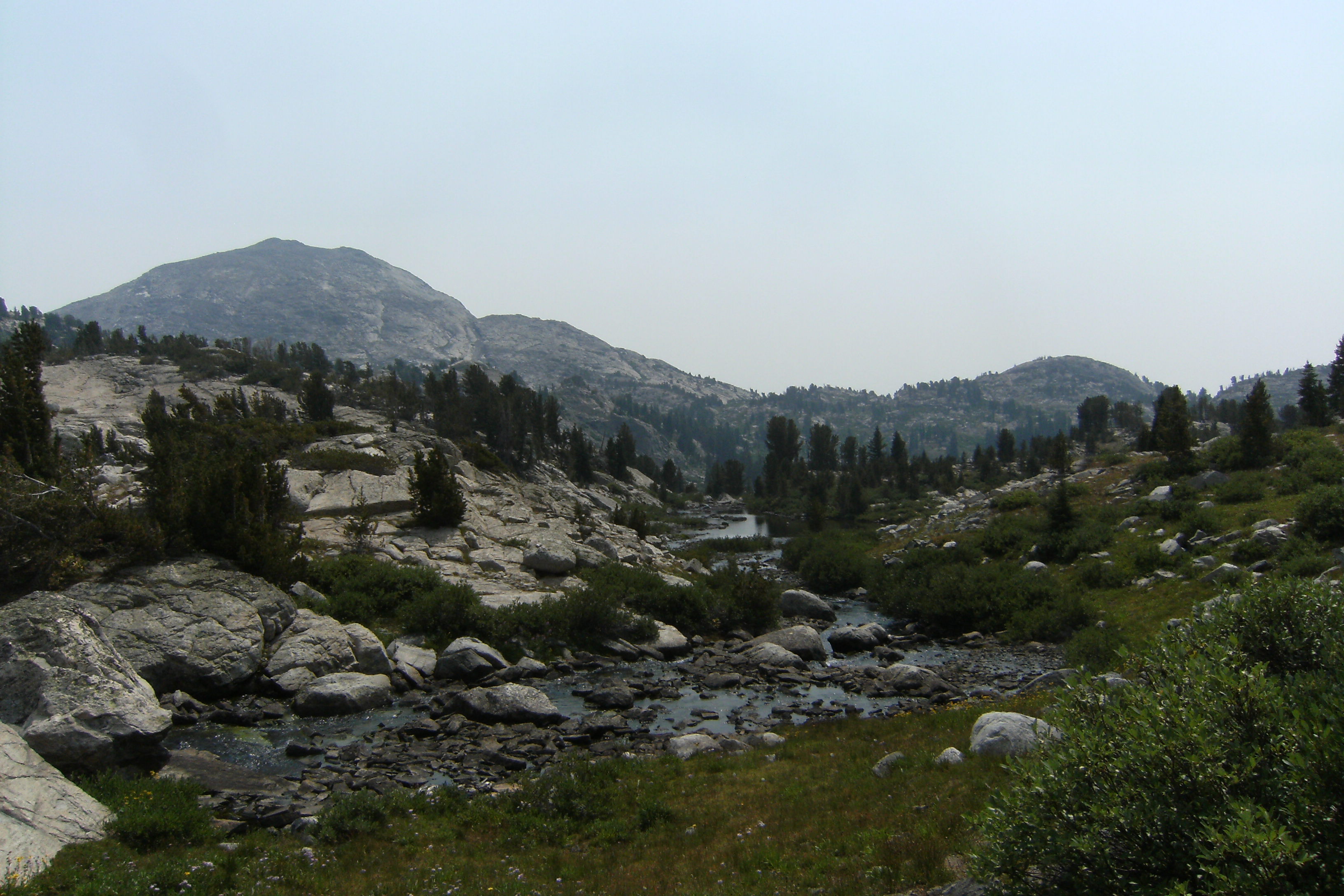
Middle Fork Lake…the Divide

Although both trailheads offer fairly direct entrance into the Middle Winds, I chose Scab Creek over Boulder Creek because I understood that Boulder Creek trail ran through a large burn area.  The summer has seen above average temperatures every day.  Scab creek would be more pleasant.

Scab creek is a dry trail for over 5 miles.  It’s also quit an uphill slough.  The first lake, Little Divide, is about 6 miles in.  I recommend that you stop there for the night, because after that you’ll be going another 5 miles to the next set of lakes.  Little Divide is a pleasant, though usually crowded lake with a few groups as it’s a stopover lake, not a destination. 

Firehole Lake

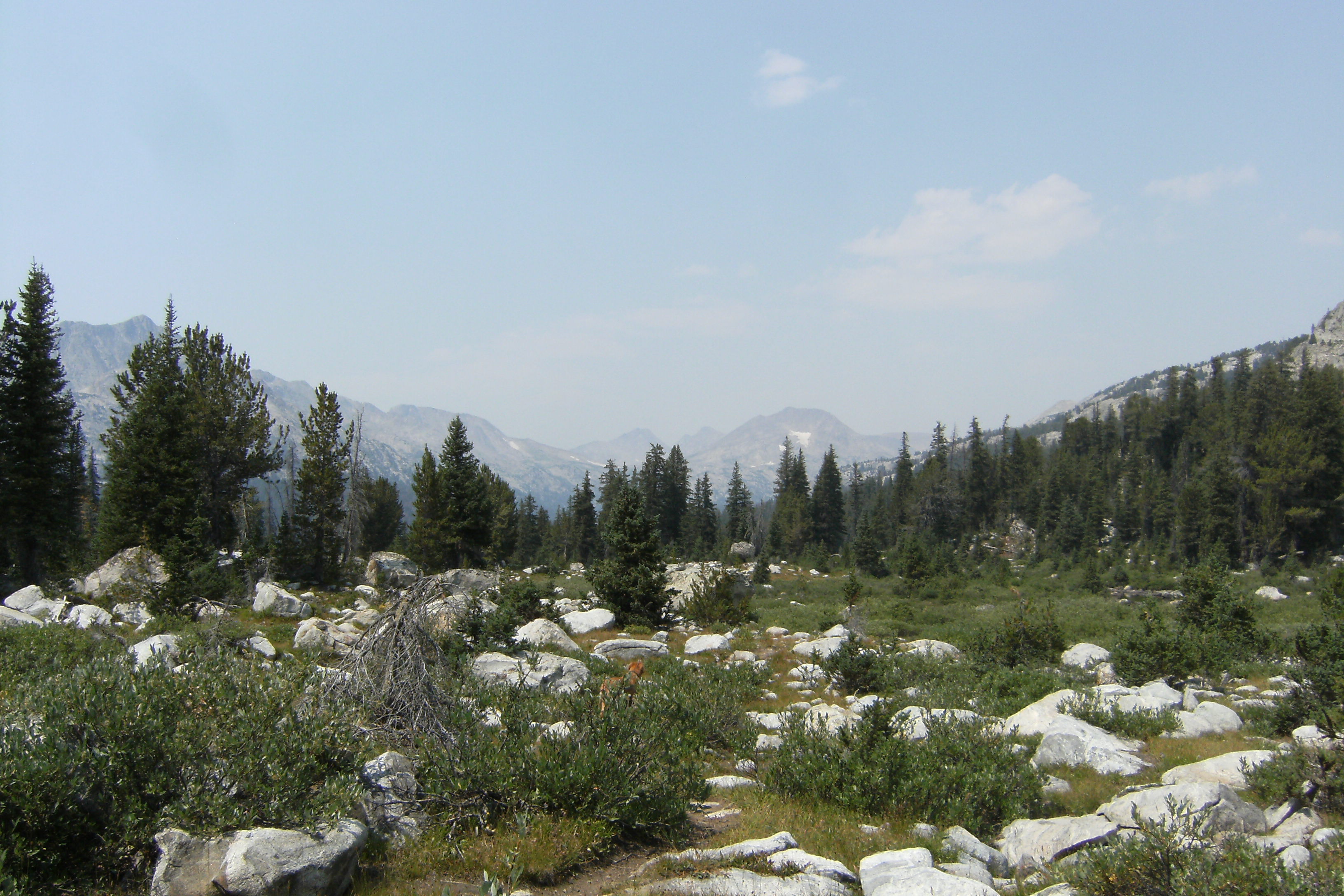
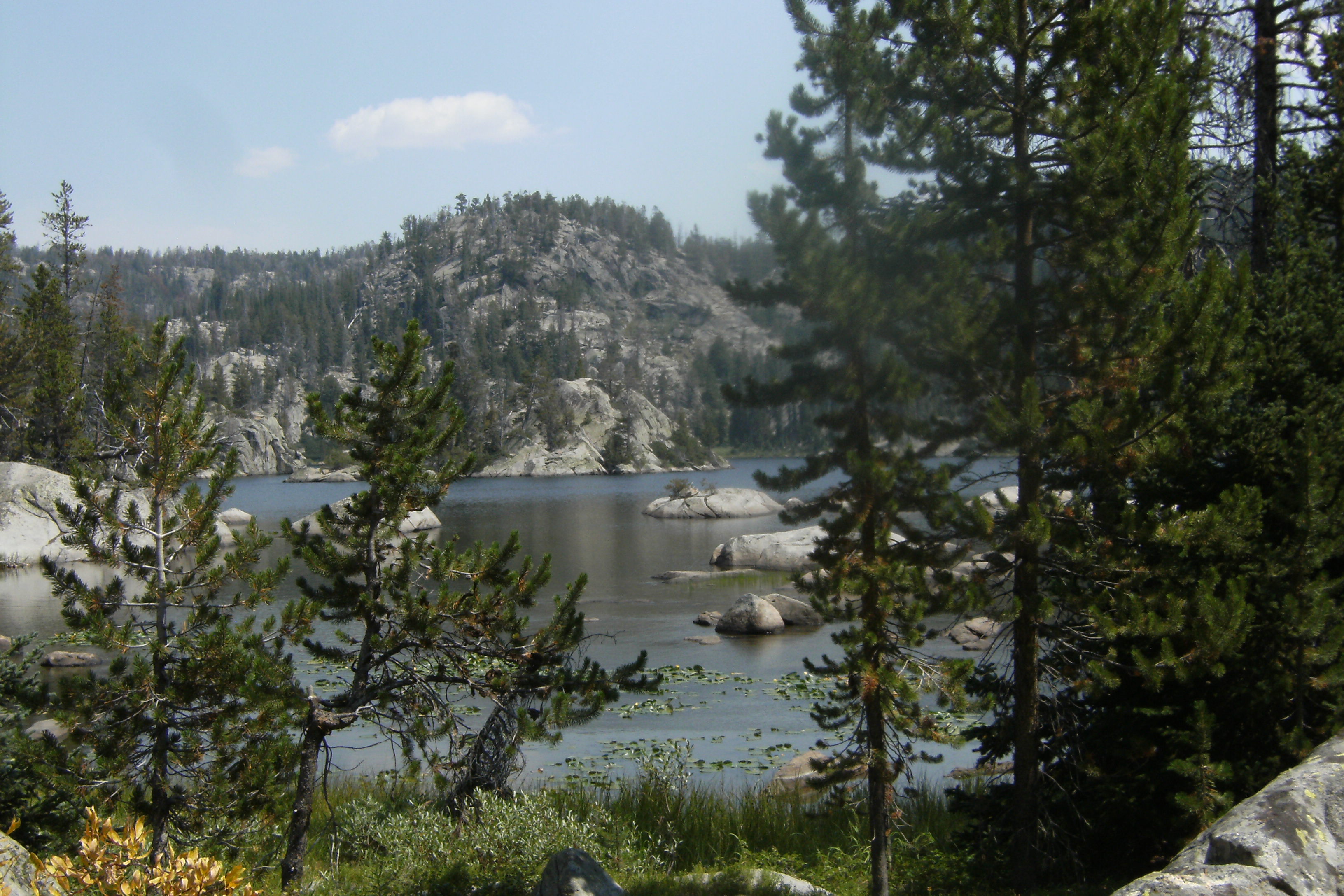
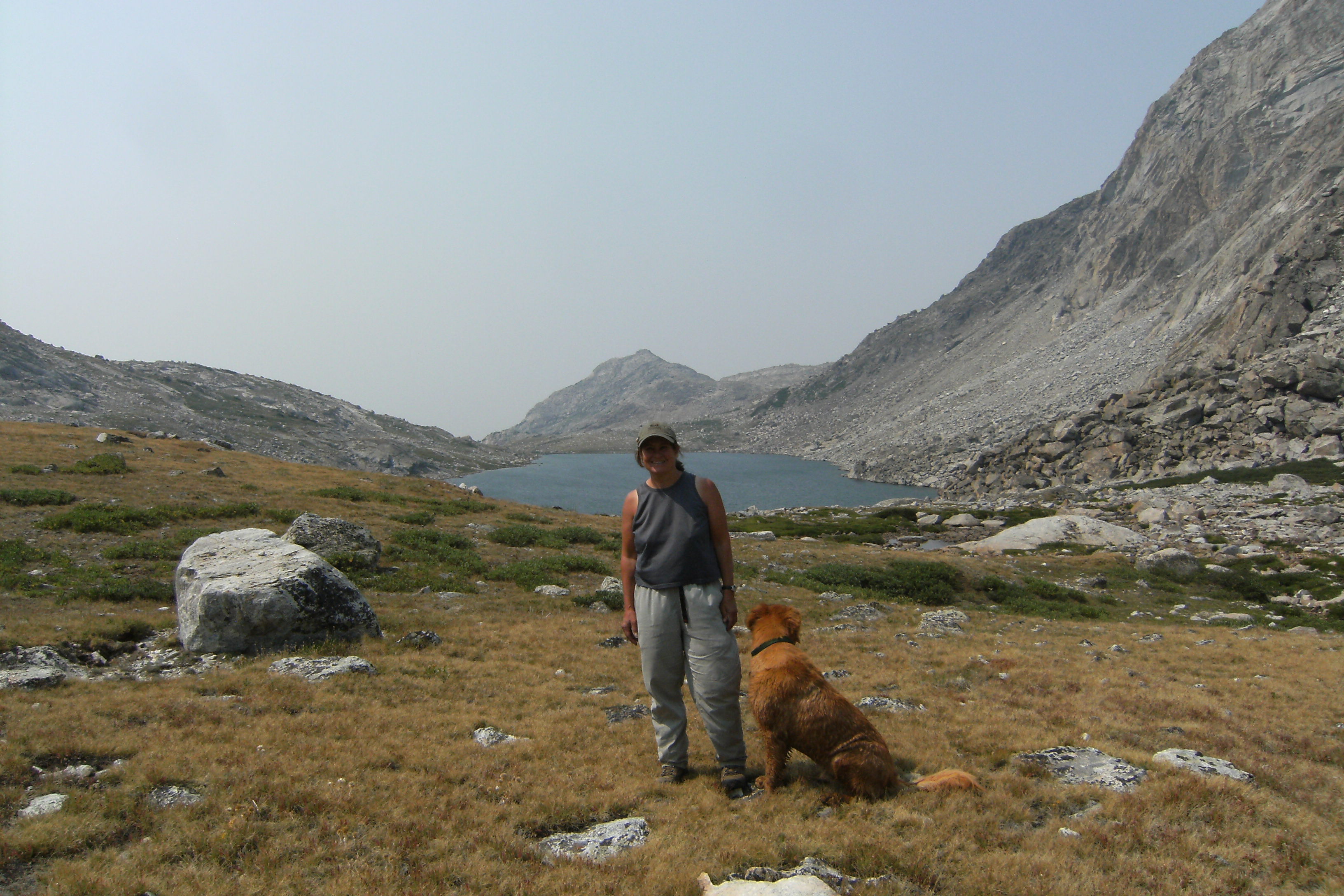
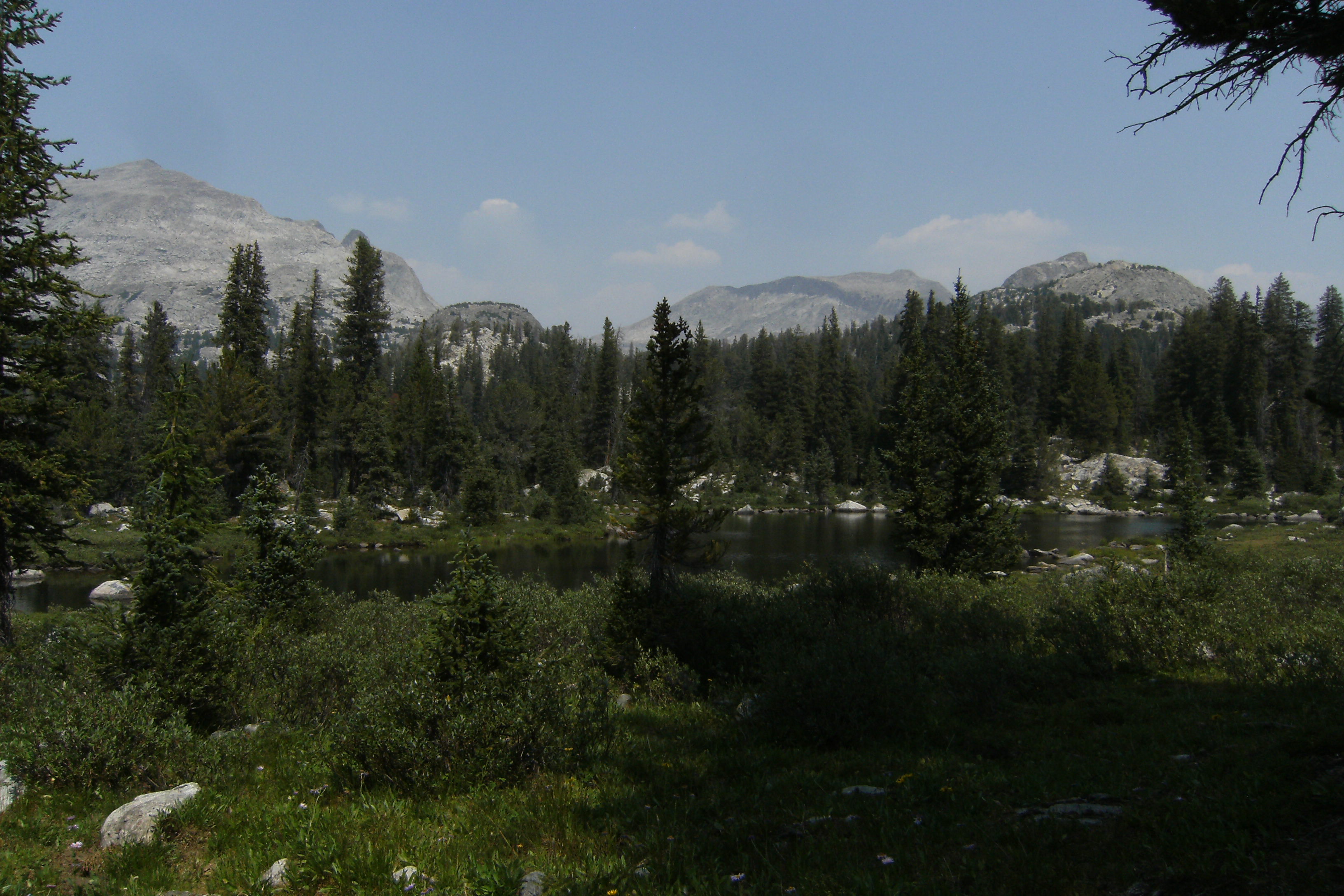
Dream Lake would seem to be the logical next lake on your second day, but I found it to be not a pleasing place to camp at all, so I hiked the extra 1.5 miles to Sandpoint Lake, a wonderful gem surrounded by conifers with several large beaches of sand.    From there I took a day hike to Middle Fork Lake, an east-west drainage with access to the Divide passes.  Because I was anxious to camp in alpine country, and I wanted to see North Fork and Europe Canyons, I packed over to Prue Lake, a beautiful alpine lake.

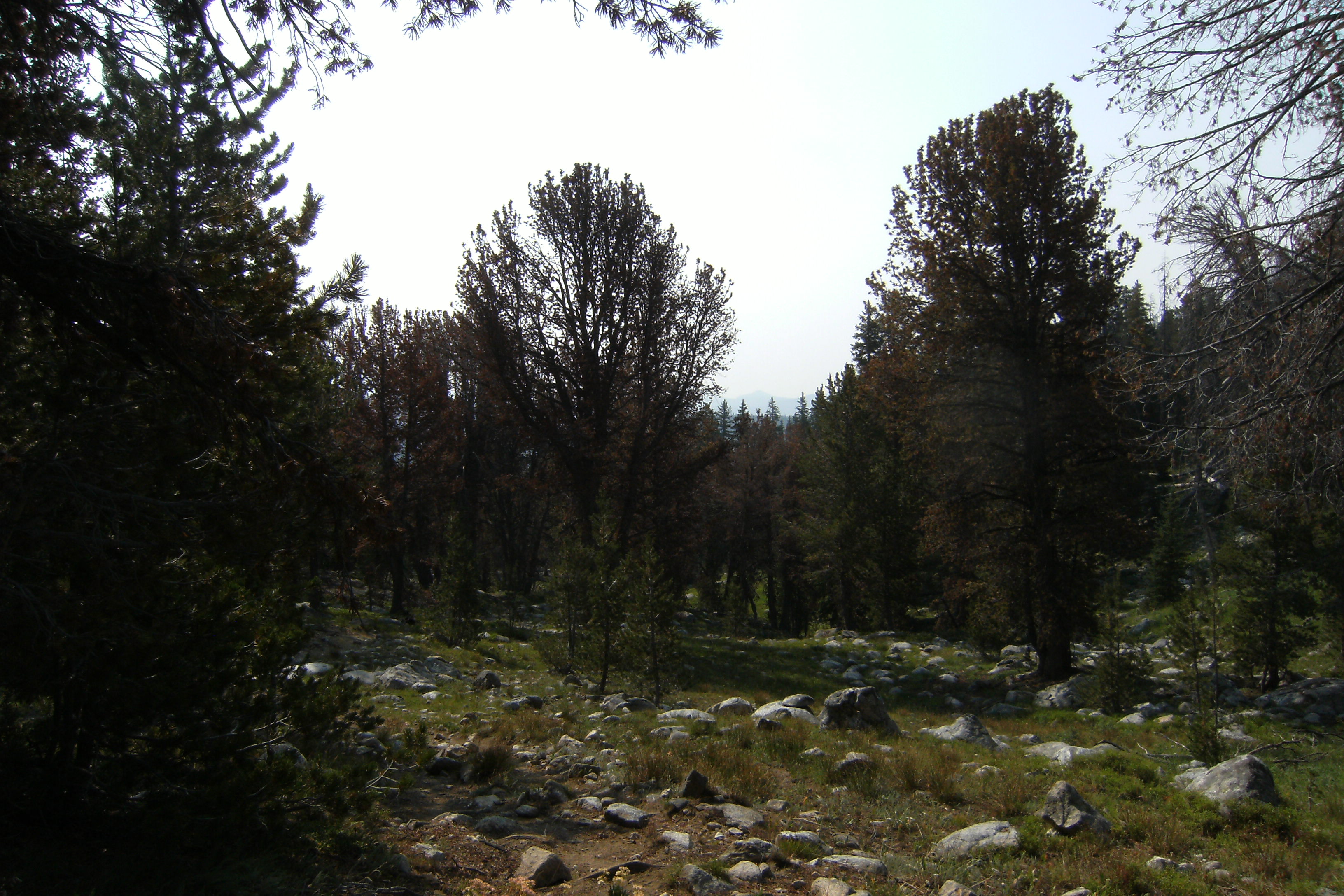
My entire 8 days in the Winds was marked by smoke from fires.  In fact, there was a fire just on the other side of the Divide on the reservation.  The basin around Pinedale was completely obscured by smoke.  One depressing note was the noted increase of dead Whitebark Pines since even two years ago.  I would approximate that 40-50% of all the ancient Whitebarks were dead or dying.

Dead ancient whitebark pines

There still are few grizzlies in the Wind Rivers.  I heard of a sighting over at Pole Creek this year, and last year there was reported a sow and cubs hanging around New Forks all summer.  Grizzlies mostly head over to the Green River area north, where they get into trouble with sheep and then are relocated.  The Wind Rivers, Bridger-Teton Wilderness is NOT in the Grizzly Bear Recovery zone.  I am not sure what the forest’s policy is, but it seems they look the other way as long as the bear is not making trouble.

Europe Canyon was the high point of my trip.

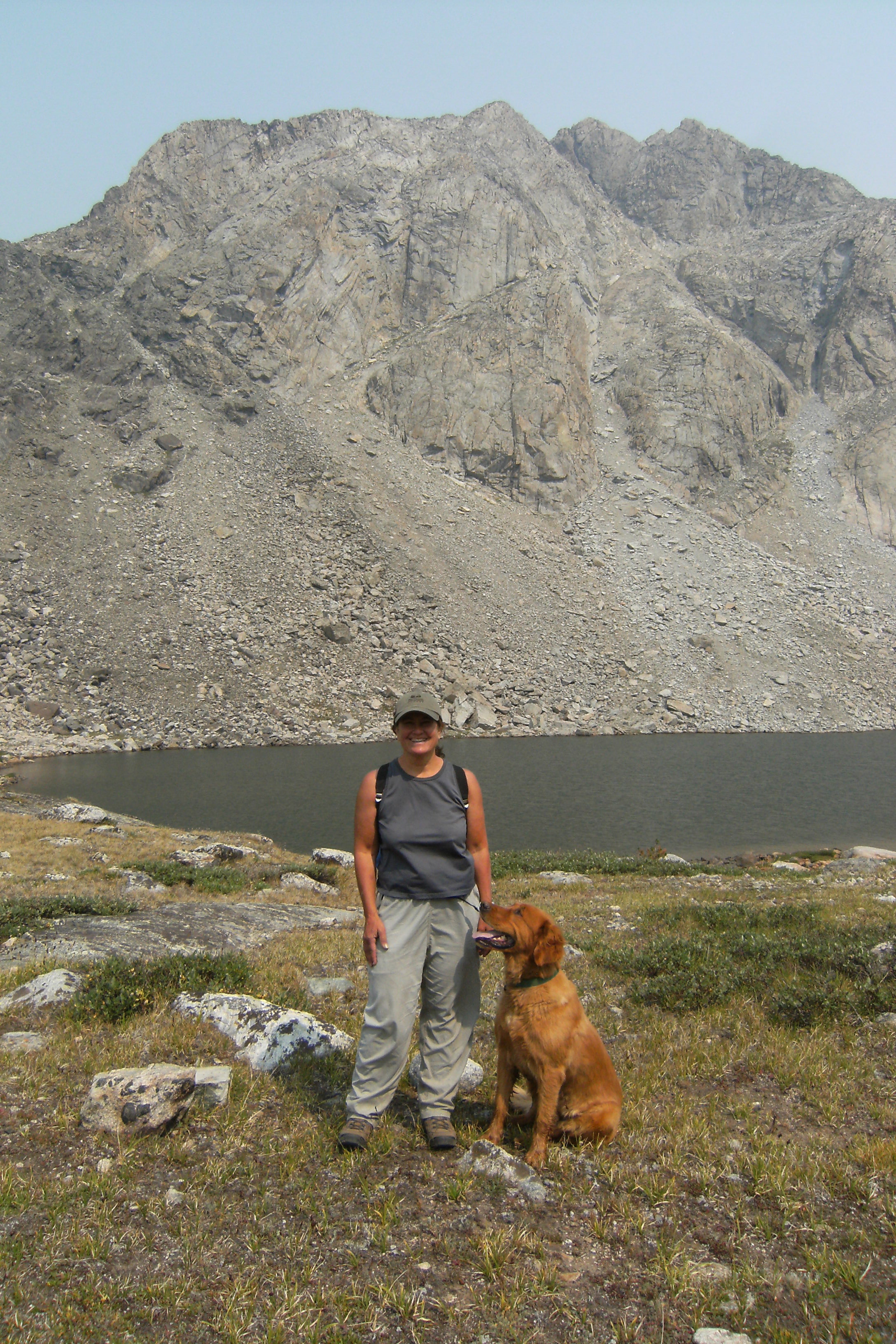
At Europe Canyon

An incredibly beautiful, yet remote high drainage with several lakes, I met some new friends from England and hiked with them all day.

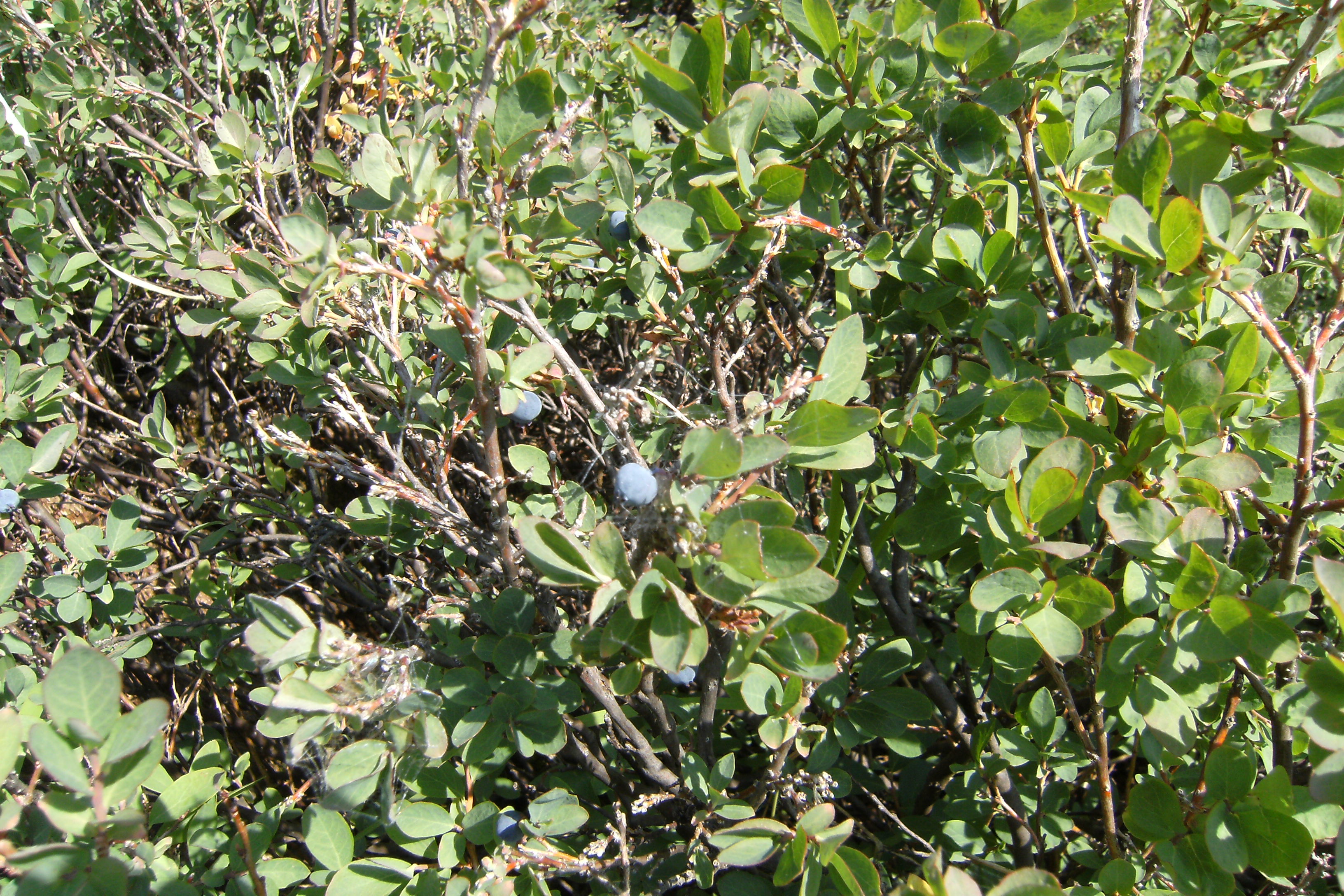
Took a break for some blueberries

Eight days in the Scab creek entrance is barely enough to get you to the Divide and back.   I met a few groups that were doing shuttle hikes out of Elkhart Park through Pole Creek and out Scab.  If you do the middle winds and can swing two cars, I’d recommend that as your itinerary.  Otherwise, choose a route on the north or south end to enjoy more time in the high alpine country.  The best thing about the Middle Winds is the lack of people.  There were days when I saw no one.  A fellow camping at Europe Canyon told us we were the first people he’d seen in 7 days.  Although Little Divide can be crowded, there is plenty of solitude up the canyons in the high country, and for experienced backpackers, a lot of cross-country opportunities.


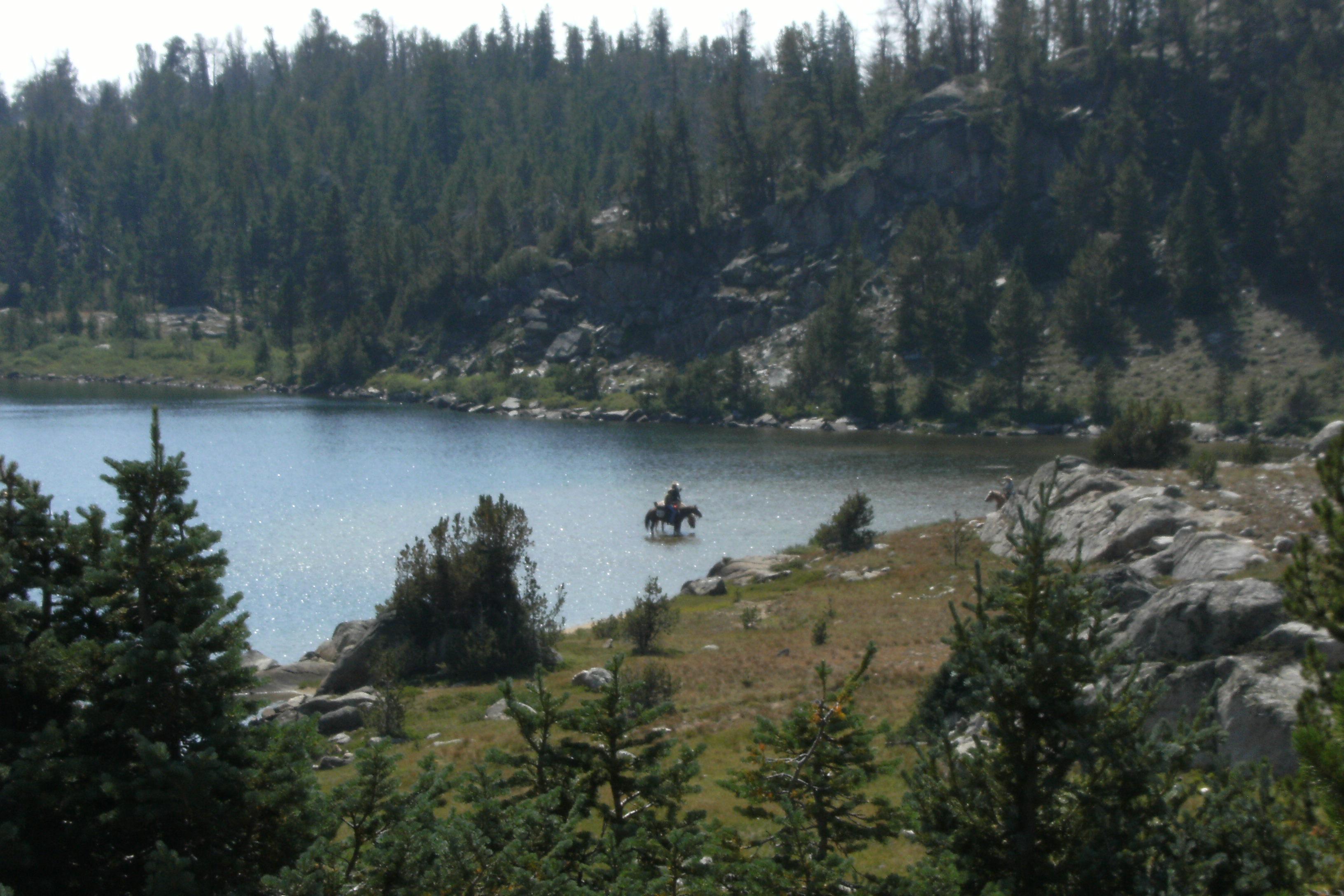
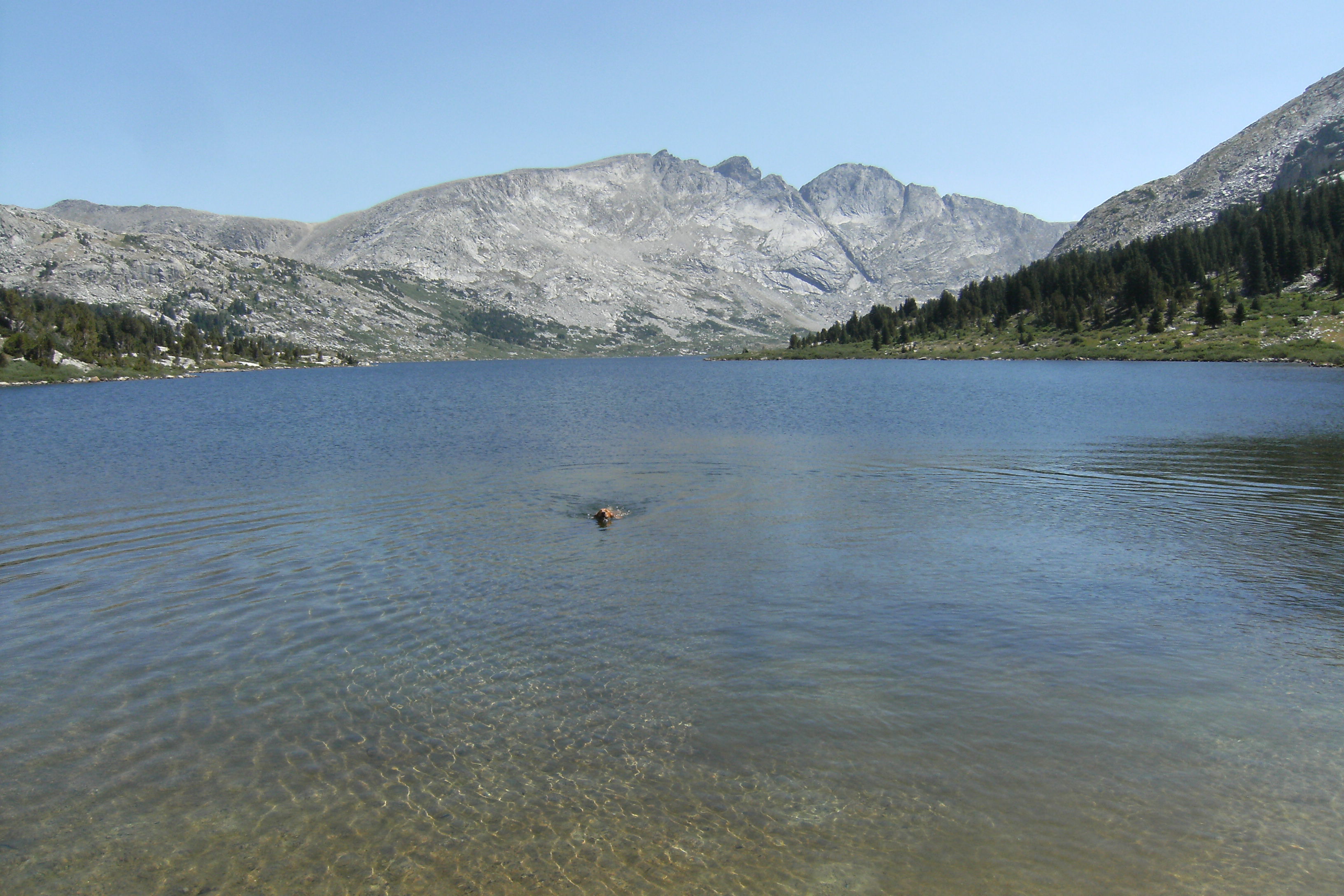
Koda takes a dip in glacial fed Middle Fork Lake


The GLORIA project in the Beartooth Mountains

I was in the Pryor Mountains last month on a BioBlitz.  What’s a Bioblitz you might ask?  It’s an appropriate name, because in the span of about 24 hours people group up and find as many species as they can.  I of course signed up for the botany group, but other areas included bats, invertebrates, birds, or mammals. There was even a ‘spider’ category.  In that 24 hours, we hiked and drove from desert to alpine environment, documenting every plant we could find.  Those we were unable to identify in the field, we brought back to camp to identify where a nice shade tent with tables, microscopes, and plant books was provided.  It was a lot of work and a lot of fun.

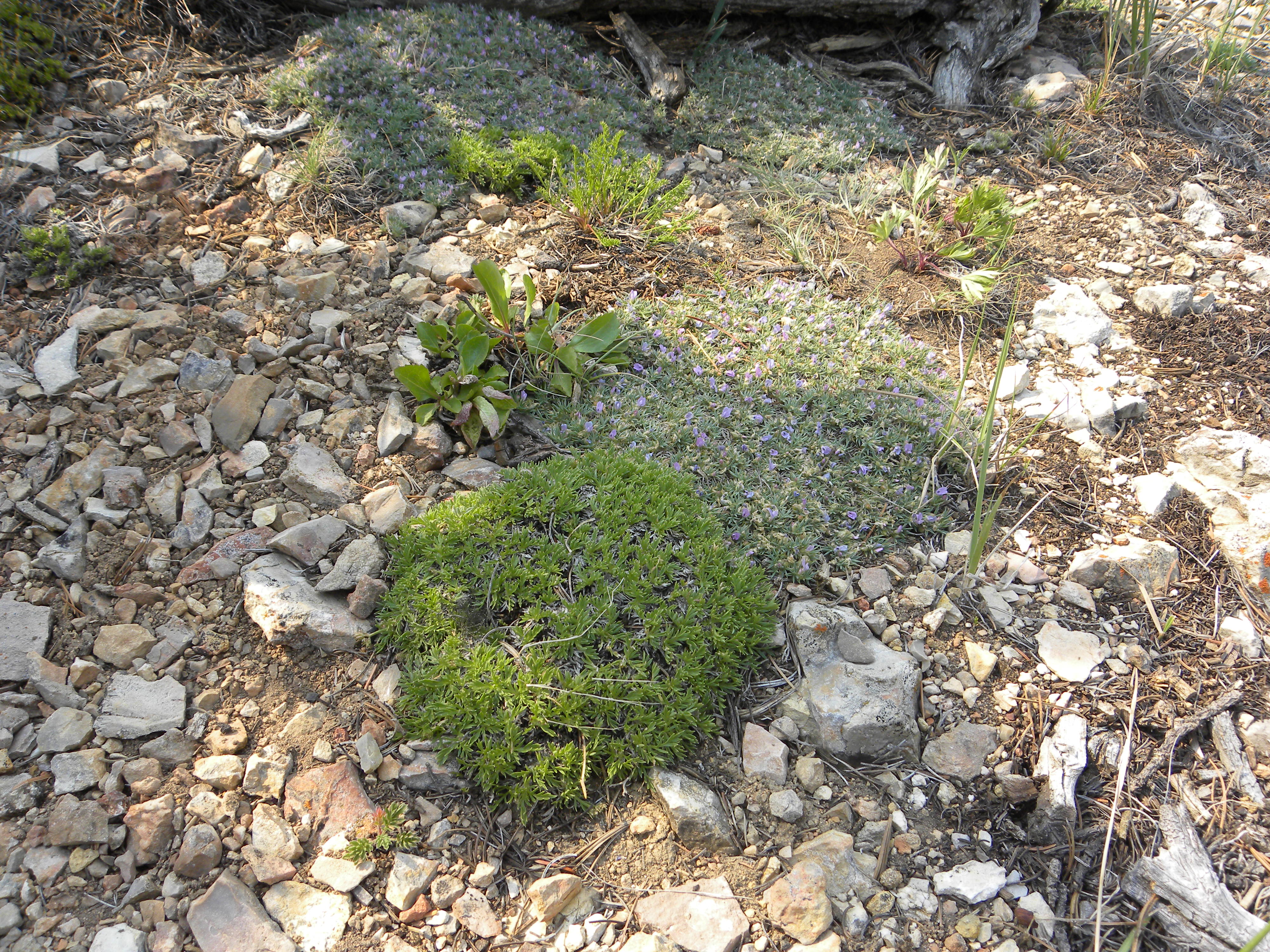
At the BioBlitz I met Professor Lyman who is the botany teacher at Rocky Mountain College in Billings. She had other projects going which were near the Sunlight area that I offered to help on.  First we met up on Bald Ridge where she had a camera on Shoshonea pulvinata, a rare plant that appears on only a very few sites around the Cody area.  She wanted to discover what the pollinators were for this plant.  I offered to check the camera, but the plant had already finished blooming.  We hiked the ridge and discovered several pockets of this plant, mostly on cliff edges where the scree is thick and the drainage is perfect.

Rare plant at Bald ridge

Shoshonea pulvinata green plant not blooming

Where Shoshonea grows on Bald Ridge

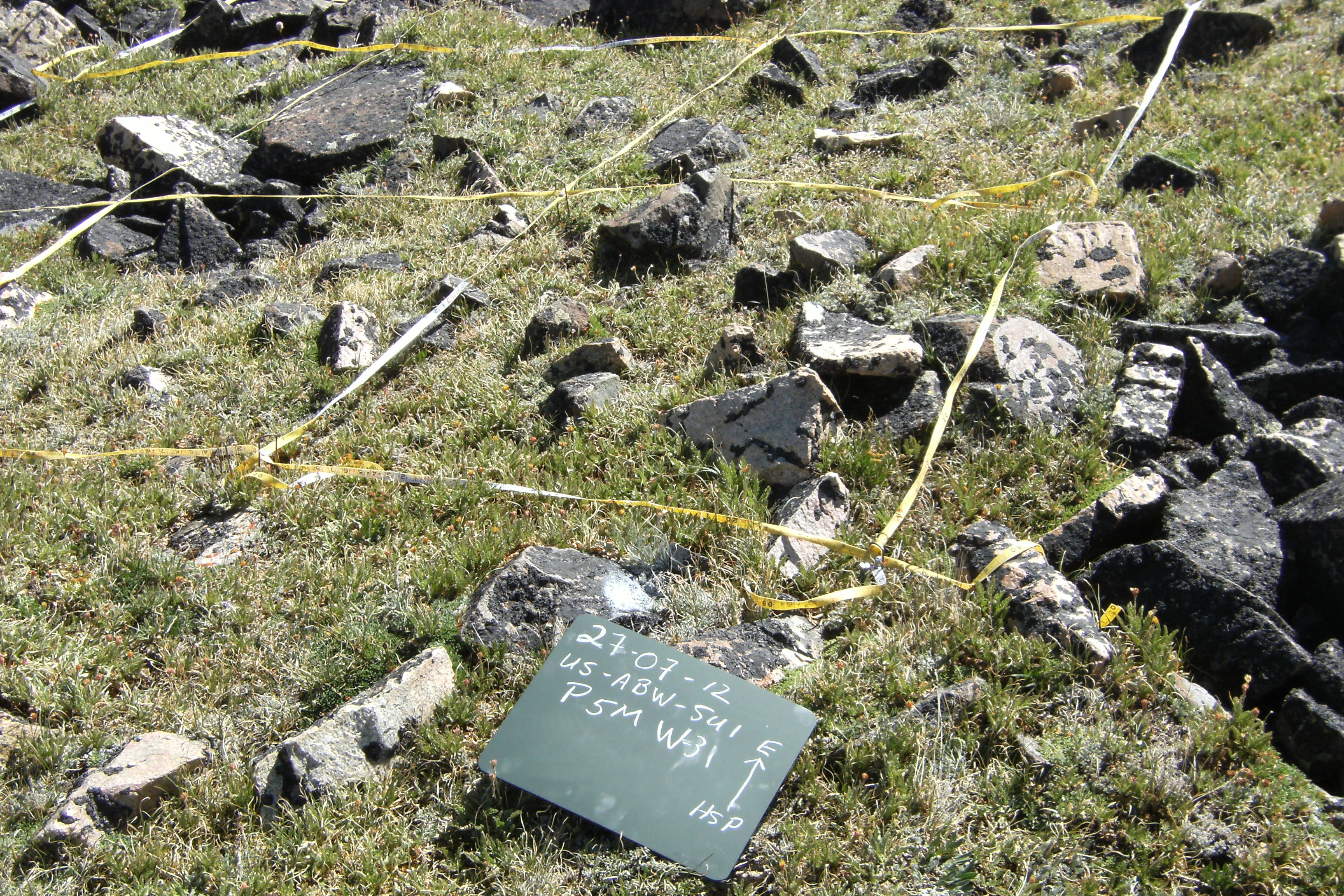
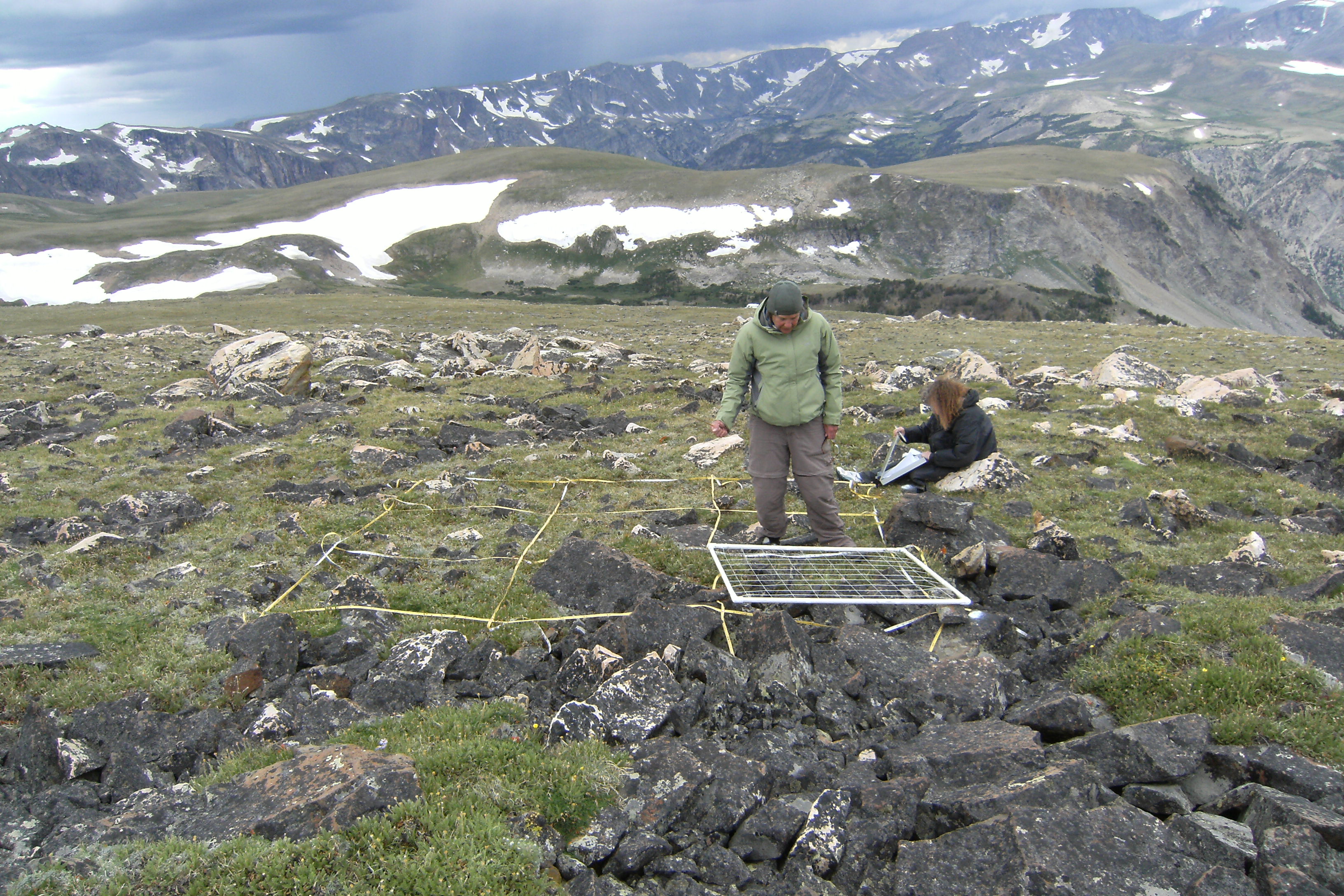
Her next project began last week.  The GLORIA project was to be set up on four high peaks in the Beartooth Mountains.  This is a worldwide project that’s been going on for about 10 years and started over in Europe.  The idea is to monitor climate change by detecting changes in the plant life at these mountain summits.  The set-up is very detailed, pain-staking, and specific.  The peaks must be 50 meters minimum distance from each other and at least 50 meters elevational change from each other.  A formula is used to measure off distance down the slope at 5 and 10 meters North, South, East, and West; then a grid is installed at each bearing.  At the grid-mark, plants are counted and identified.  A heat sensor is installed which will record temperature changes.  Every five years the same exact area is recounted as to the plant material and the percentages of species change.

View from one of the GLORIA summits

The project set-up was a lot of work but very interesting.  One day I helped carry supplies in to the summit and measure off the  grid.

Marking the grid for photographs

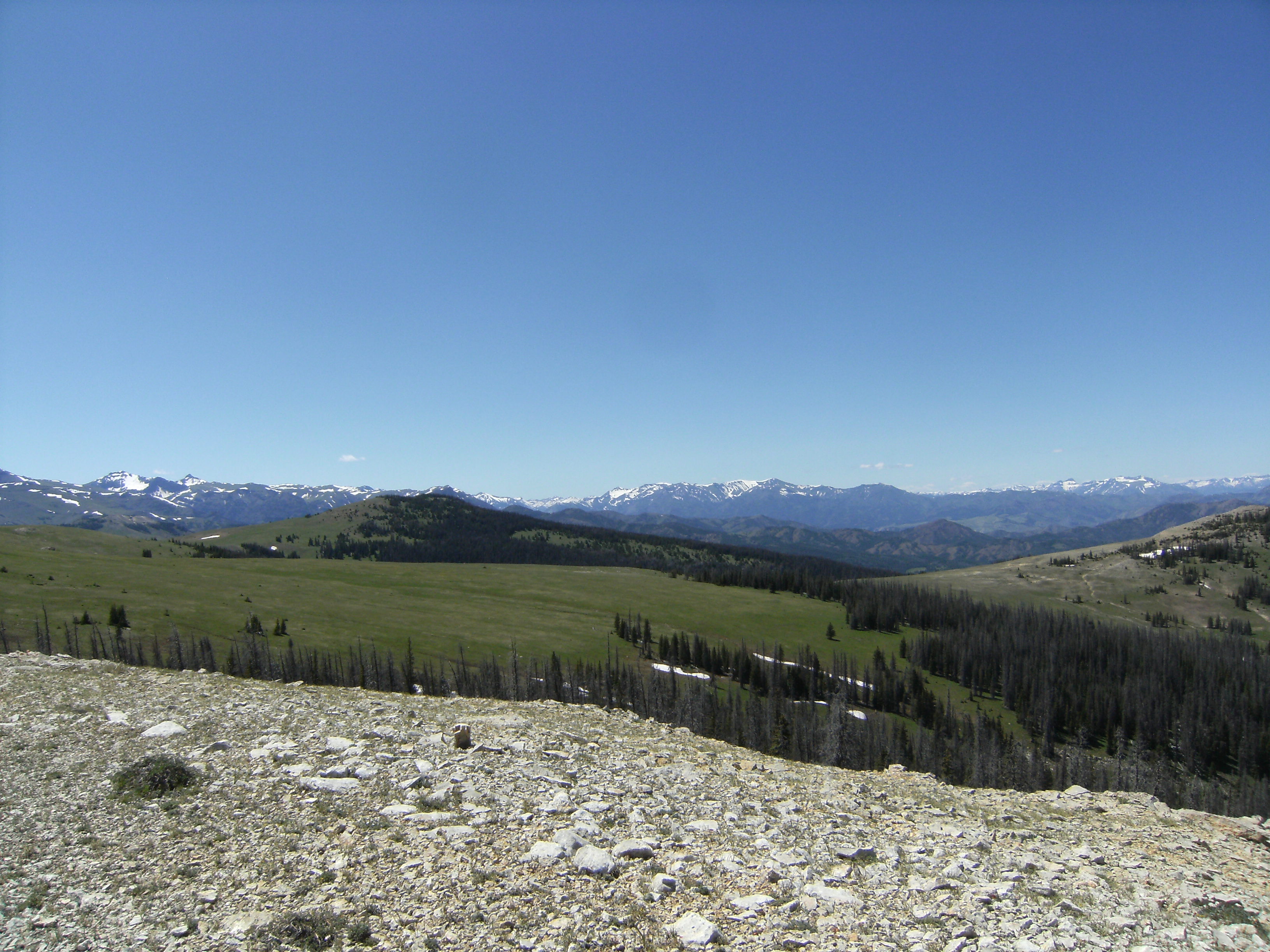
Another day after completing a second grid area, we hiked the afternoon looking for another appropriate summit.  The top of the Beartooths is a beautiful location to spend the day, especially with the heat down lower.  One afternoon we got run off the mountain by fast moving thunderstorms.  The highest bare summit is no place to be in a lightening storm.

Counting plant material within the grid

One day in surveying the summit, which is treeless and fairly shrubless, we actually found a bird’s nest with chicks in it.  I would guess there are few predators up there.

Bird nest on summit with chicks

A possible summit

The Beartooths contain some of the oldest rock in the world.  Professor Lyman’s husband is a geologist and he pointed out some pure quartz veins to me.  Here’s a giant that I wished I could haul home (the rock not the dog!).

Quartz on the summit

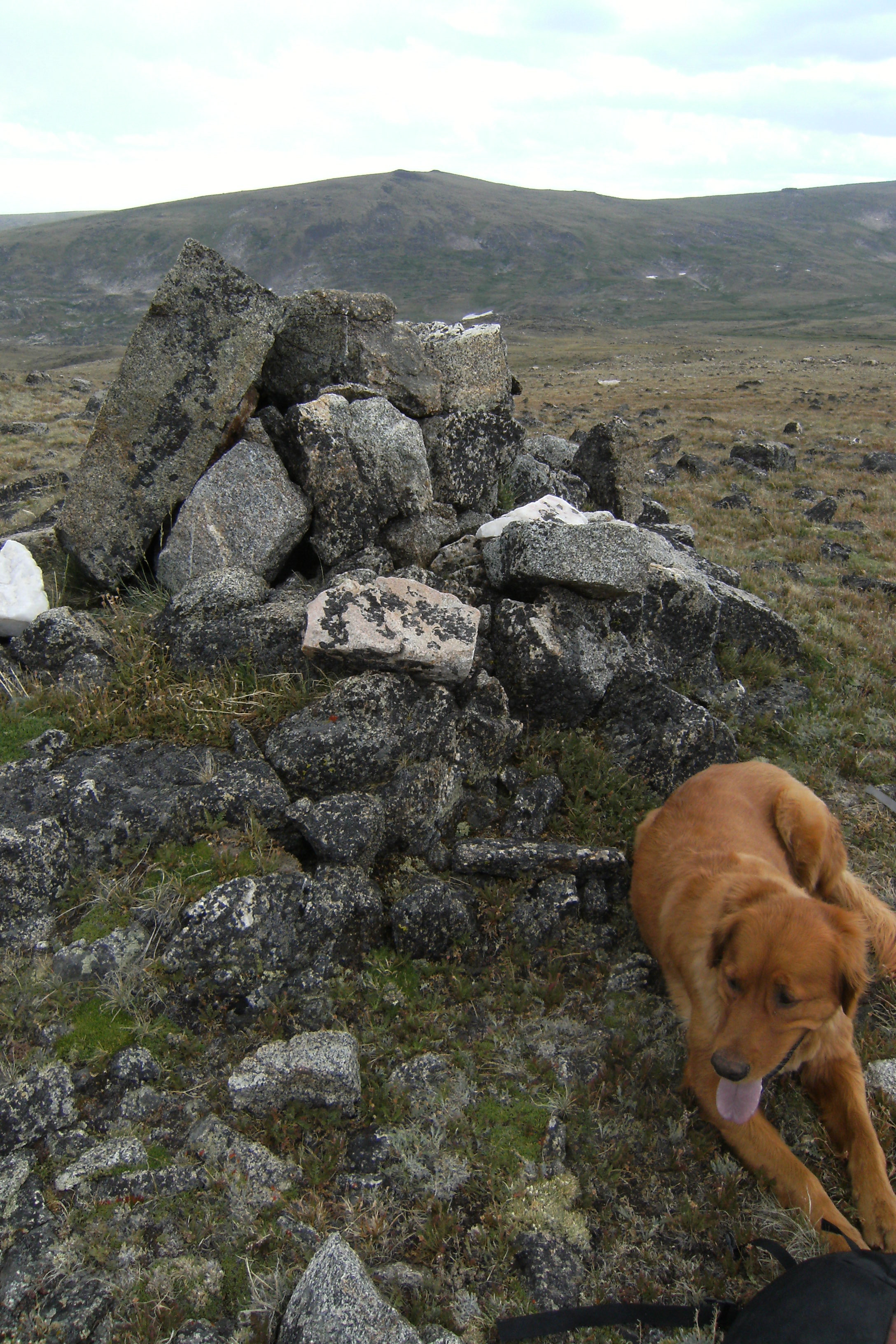
Domestic sheep were run on these mountains until the early 2000’s.  Domestic sheep, when they intermingle with Big Horn Sheep, cause our natives to develop diseases like pneumonia  to which the native sheep have no resistance.  These old sheep allotments have been retired–a good thing.  But I suspect these summit cairns are left-overs from sheep herders.

Sheep herder cairn on a summit with quartz

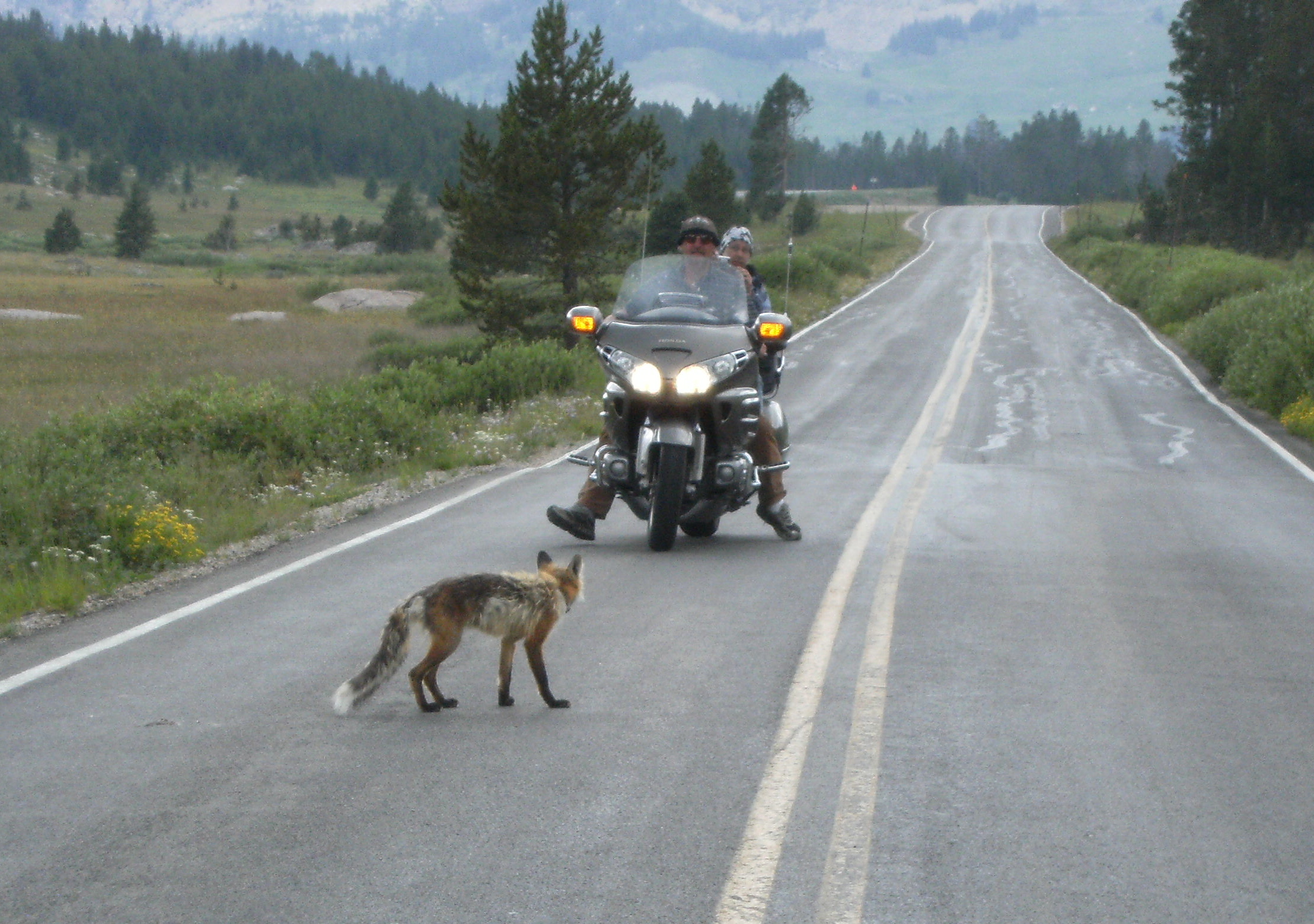
On the way home one evening, right near the Top of the World store, a fox was in the road chowing down on a road-killed ground squirrel.  Oddly, he didn’t move for the traffic and I got some good photos.  Even when this motorcyclist was right bye him, he continued to eat for a long time.  Fox are considered predators in Wyoming and can be shot on sight at any time of the year.  Good thing none of these motorists were on that kind of a mission, just a sightseeing mission.

The Tipping Point

Everything is up for grabs now relative to climate.   Climatic tipping point talk is abuzz about the scientific community.  All our efforts to save species have a large ‘unknown’ given rapid ecosystem changes due to climate instability.  The tipping point, researchers say, may be within just the next 10 years.

For the last several years, I’ve taken to setting up my trail camera all summer in the little forest by my house.  The forest is home to 7 springs that emerge from the limestone underground rivulets hidden deep within the abutting mountain.  These springs flow into private lands, much of which is soggy and marshy.  The forest also is a lively travel corridor.

Spring area, one spring

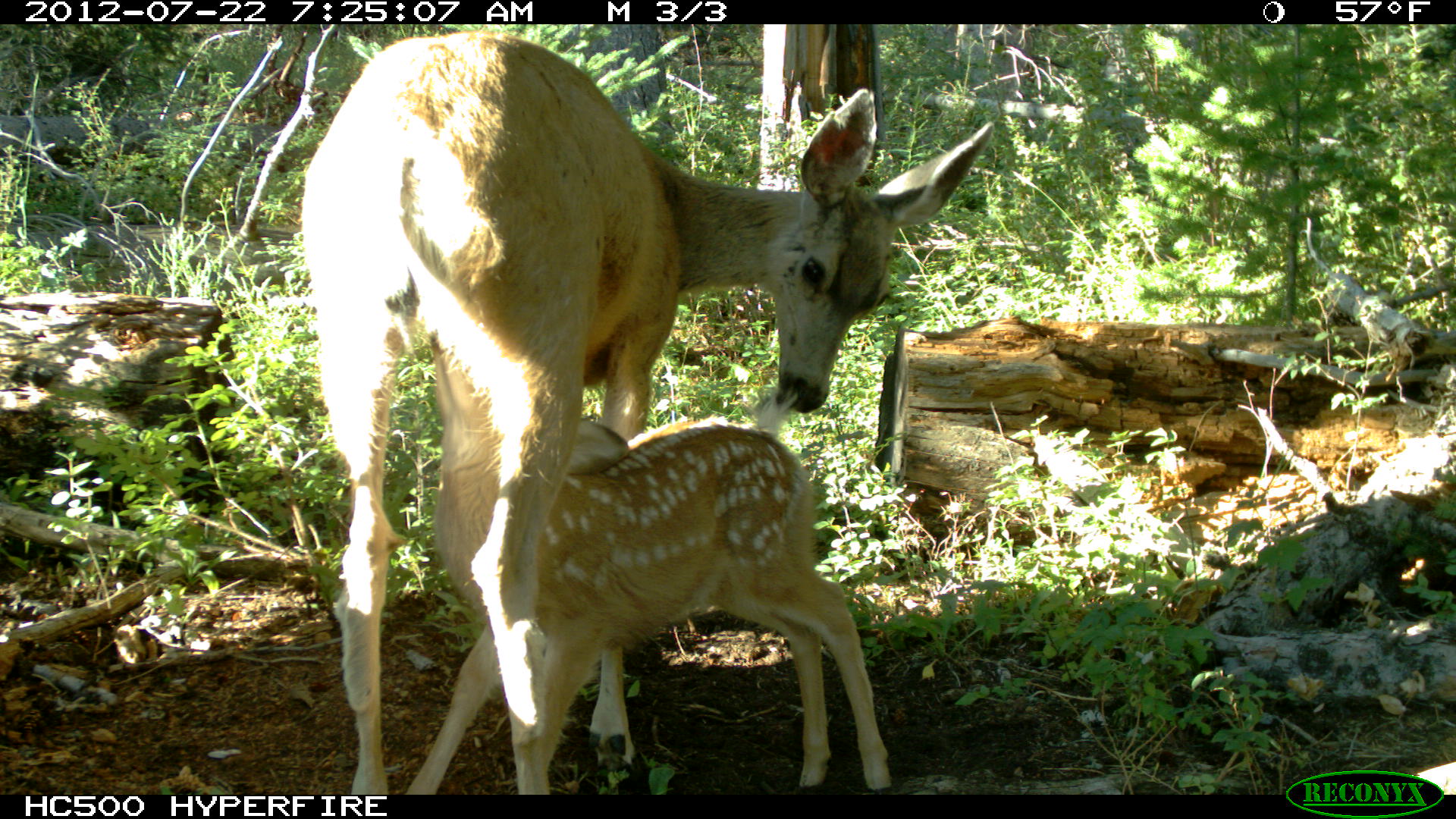
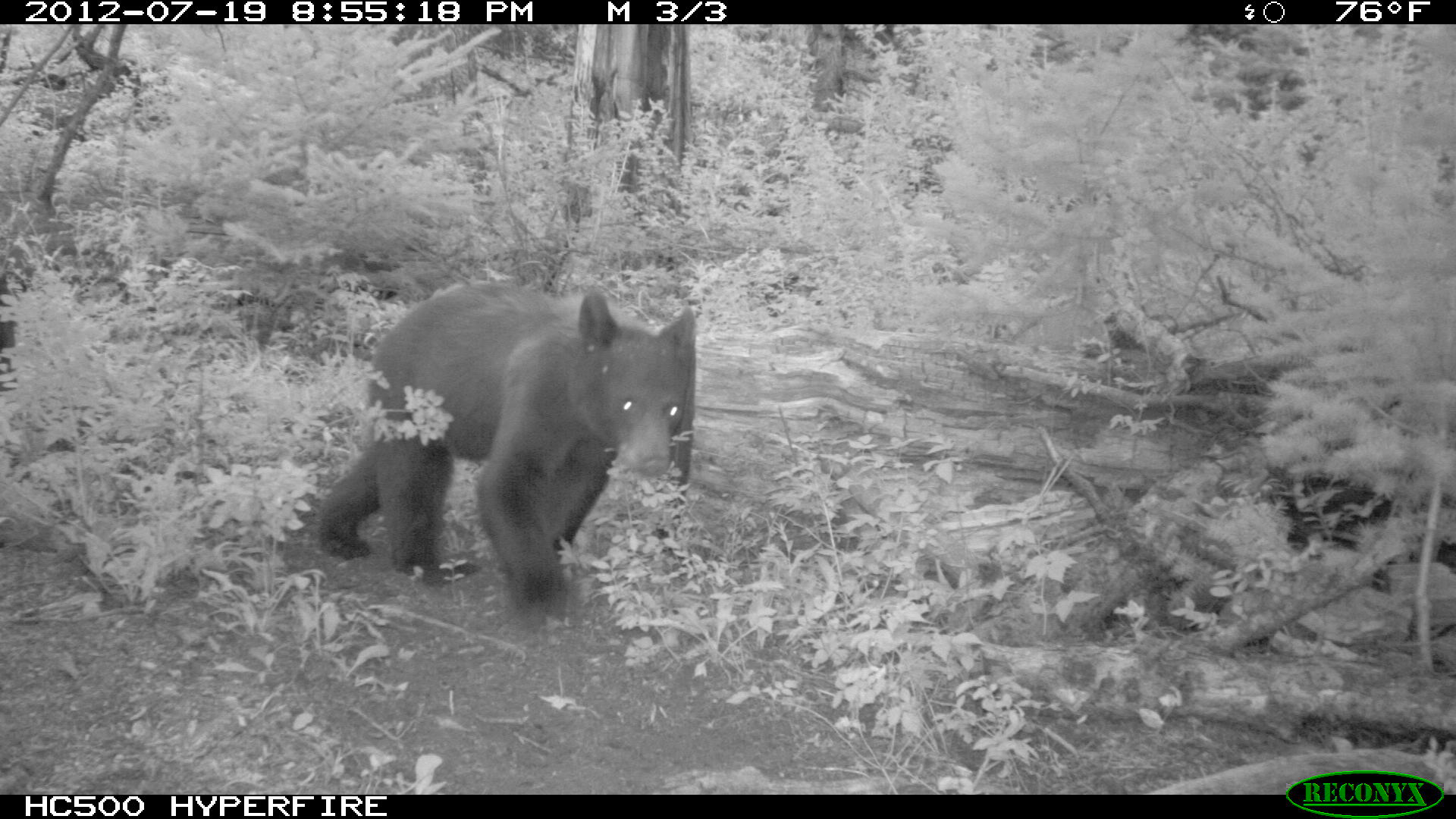
In previous summers I’d pick up my trail camera chip every few weeks.  Mostly I’d see deer, a few coyotes, and an occasional black bear.  By fall, the grizzly activity increased.  But this summer–the hottest on record and with an even hotter heat index making almost every day unbearable–activity has increased dramatically, and of course, always at night.  I’ve had scores of black bears, cougar, a boar grizzly, and even a moose a few weeks ago.  Given that moose go into heat stress at temperatures above 57 degrees, and anything above 80 degrees is unsuitable for them without refugia, I wondered how this poor moose was coping. (notice the temp and time!)

These animals would normally be higher up this time of year.  But my theory is that the constant heat and drought has forced them lower.  Of course, this is not the case across the board or we’d be seeing a lot of wildlife in the irrigated areas.  But I take this as a sign of the future–as we use diminishing precious water to irrigate pasture or grow crops, we’ll see more wildlife seeking refuge closer to us.  As prey move in, so do predators.  As forests die and meadows dry, animals will seek food and water wherever they can find it.

Couple that with the sad state of food for grizzly bears.  Today I took a long hike up the back side of Windy Mountain, once a stronghold for Whitebark pine nut food.  The trail begins around 8,400′ and heads up to 9400′.  I can say with confidence that 99% of all the mature Whitebark Pines are dead throughout that ecosystem.

Dead Whitebark Pine forest

The only good news is that there are young seedlings in many areas, especially on the north-west slope in a large burn area.  But these trees won’t bear for at least another 30 years–if they survive the dramatic shifts in climate.

A friend told me not long ago that all the still affordable lands are high up in mountainous territory.  These are the areas, he said, no one wants to live in because the climate is too harsh.  Real estate in places like Oregon, Washington, the Southwest, and California is beyond pocketbook reach anymore.  But evidence points to humans heading into the mountains in the Altithermal, a period of drought and dryness after the glaciers melted.  Animals, as well as people, may be heading higher up sooner than later.


Weasels and birds

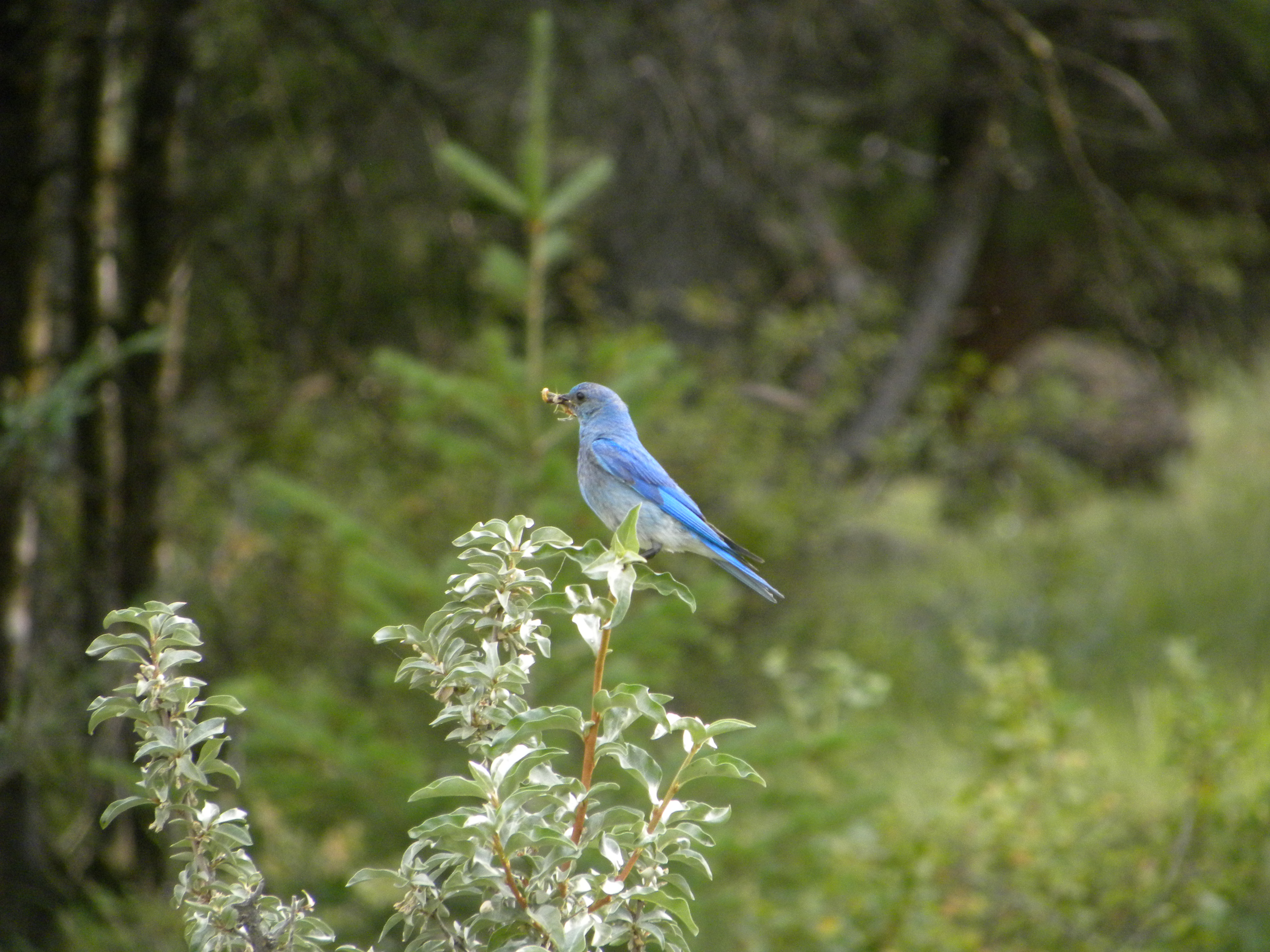
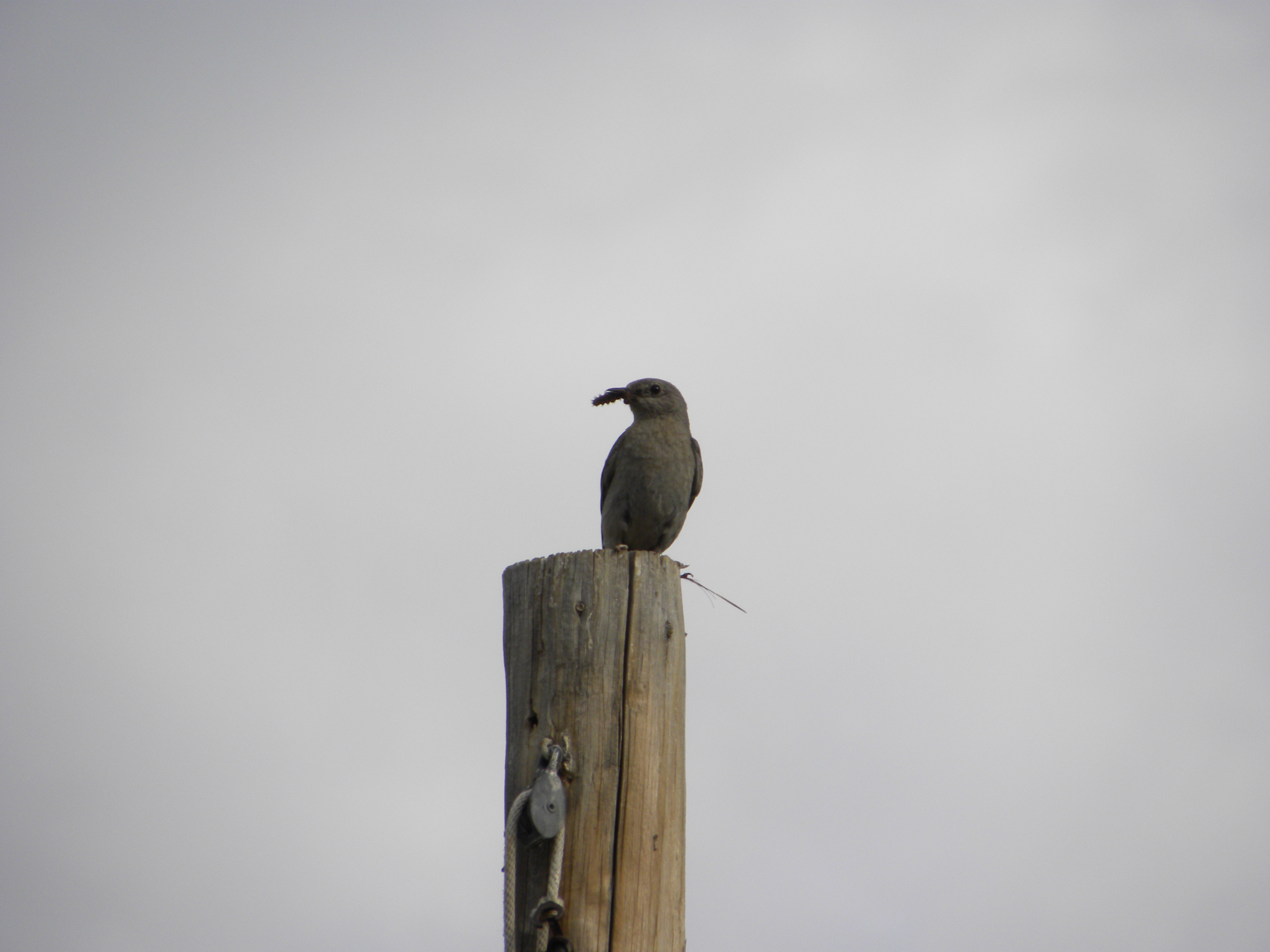
A pair of bluebirds has been nesting here for over a month.  They laid a clutch around May 25 which didn’t hatch until several weeks ago (unless perhaps, when I go to inspect the box, they built a nest on top of the old unhatched eggs).  From what I’ve seen and read, bluebird eggs should hatch within about two weeks so this was very unusual.  I had been checking the 5 eggs every few days, till finally, on June 25, they hatched.

The father is an especially watchful and concerned dad.  He is always checking on the hatchlings, and he was always checking on the eggs too.  Three eggs hatched and lately, as they’ve been growing, the parents have been busy feeding those hungry youngsters.

Concerned dad

Long-Tailed weasel

I just returned from a Bioblitz over the weekend in the Pryors.  I headed out to check my trail camera in the woods and upon my return the bluebirds were really upset, making a big racket right outside their box.  I stood watching fairly close, wondering what the fuss was about.  Then I saw.  A head popped out of their house, and suddenly a long-tailed weasel emerged.  He ran off into a ground squirrel hole quick as a flash. Then I went to check on the babies.  One had fledged and was alive in the grass, but the other two were dead in the box.  If only I’d been a bit quicker I might have scared that weasel off.

I watched the birds for the next several hours.  The weasel returned for his prizes and carried them back into the hole, while the fledgling made his way through the grass uphill into deeper cover.  While the upset parents kept an eye out for the weasel, they also fed and protected their only baby that was left.

fledging hiding in bushes, making it’s way farther from the nest box

Meanwhile a menagerie of other bird species were coming around, interested.  Juncos, a female bluebird, and especially a pair of chipping sparrows wondered what the fuss was about, sometimes helping to scare off the intruder.  One of the most fascinating things was to watch the response of all the neighboring birds over the course of the several hours the bluebirds were upset.

That weasel, or its offspring, may have been the one that ate my pika two years back.  Oddly, he seemed to know exactly when to make his move for the birds–when they were just about to fledge, still helpless yet nice and plump.

mom still feeding the one chick left in the bushes

I rarely see weasels although I know they are around.  But being opportunistic carnivores, they have impeccable hunting skills.  Since I’ve watched this pair of bluebirds year after year, I feel a kinship with them and wanted to drive off that weasel.  I even tried to get my dog to flush him out.  Maybe the fact that the dog and I were gone for 3 days gave this weasel his bold chance.   Yet nature has it’s own ways and my human interference, well-intentioned though it may be, is probably more of the problem than a solution.

What is wild?

What counts as wildness and wilderness is determined not by the absence of people, but by the relationship between people and place.  A place is wild when its order is created according to its own principles of organization—when it is self-willed land.  Native peoples usually…”fit” that order, influencing it but nor controlling it…  Jack Turner

I’ve been re-reading ‘The Abstract Wild’ .  Jack Turner is so eloquent and makes such an impassioned plea for wildness.  Neither does he mince words nor ideas.

I find it interesting to consider once again What is Wild?  Turner argues that it isn’t just about the preservation of ecosystems per se, but what wilderness and wildness does for the soul of people.  People need wildness.  We need it to know who we are.  “Something vast and old is vanishing”

Black grizzly

I live in a beautiful and some say remote, isolated place, right on the border of our largest Park.  Yellowstone National Park, and its surrounding region,  is the only intact ecosystem in the temperate world.   I live bordering the Shoshone National Forest, a National Forest with the most designated wilderness area in the U.S.  Many people would say that apart from Alaska, these are truly the last wild areas left.  To me it has a certain wildness; but truly it is not.

Wolves are captured, collared and sometimes killed under a ’10J’ rule; elk, deer, and sheep are carefully counted to keep track of their numbers, then hunts, seasons and quotas are established; grizzlies are either dropped off here or, if they are ‘getting into trouble’, they are captured and moved; studies are conducted constantly on habitat health for different forms of plants and wildlife; commercial logging goes on.

Elk study expedition

There are the public interests as well.  All Terrain Vehicle owners want more roads and access; ranchers move their cattle onto the public lands, want protection and reimbursement for losses, want fences built and water sources maintained; back country horsemen clear trails; hunters blaze new trails; snowmobilers need their winter access; trappers work their traplines; and in every season people shoot coyotes, ground squirrels,  badgers and other ‘varmints’.

In our National Park next door, there is no hunting, trapping, or ATV’s, but there certainly are snowmobiles and biology studies that include collaring animals.  Trails are ‘managed’ for bears to have their privacy in the spring, and for humans to be safe from bears. Aspen or White Bark Pine studies are conducted.  Fish are monitored. Even frogs are monitored.  Backpackers are assigned to specific campsites on specific days, and reservations can be made in advance. And cell towers must go up to appease tourists who complain about poor coverage.

As remote as my cabin may seem to most of my friends and visitors, it is not wild and this place is barely a direct experience of wilderness.  What makes it different is the presence of top predators, especially the Great Bear.  If it were not for the presence of grizzly bears, there would be many more people hiking these mountains, making it even less wild.  The nearby Wind River Mountains or The Big Horns are a perfect example of beautiful mountains without grizzlies that are full of people.  The Winds are considered a Wilderness area, yet sheep graze there in the summer. And although grizzlies make their way down there as it is good habitat, they are endlessly moved because it’s not part of their sanctioned ‘reintroduction area’.  The Big Horns are full of cattle and ATV’s.

Wildness is determined by the relationship between people and place…where people influence but not control it.  Here is the fine line between ‘influence’ and ‘control’.  In order to understand that difference, one must identify with one’s Place.  That takes living there, watching its order, its seasons, its needs, what a Place wants.  An attitude of service to a Place is necessary rather than exploitation for fun or profit.  If one works the land for a living, then a sensitivity must occur where the entire biotic community is taken into account along with ones’ needs.  That is not an easy task when it comes to growing food–no spraying, no rodenticides, protection from deer and bears, rabbits, and frosts.

And if all this is done properly, I still am not sure that Turner’s definition is complete for wildness.  Wildness as a relationship requires an intimacy that we no longer will know ever again.  There may be a handful, if that many, of tribes in the entire world who still know that kind of intimacy.

Intimacy with elk.  The wild herd of Yellowstone in Sunlight in Winter

Turner pleads for a new tradition of wildness. To create a wilder self, the self must live the life of the wild, mold a particular form of human character, a form of life.  Relics will not do, tourism will not do, books will not do.  He does not look to the past– Native American traditions or African bushmen or Australian aborigine knowledge.  The landscape of the past is gone.  Turner says we must consider what our new intelligence of the wild will be today, in this modern age; and then expound it through art and literature.  Although this ‘rant’ of a book might be considered pessimistic by some, it truly isn’t. Turner has hope that as the emergence of new ‘wild’ spokespeople is taking place, others will seek that wild direct experience too; and they will demand it of our culture.  Turner’s is not a lament, but a plea.  In this complex World where economics is the glue that binds all of us, it is difficult to see where wildness will win out in the end.  Even with the ‘good fight’ that takes place day to day,there is a slow (or maybe fast) erosion of places where direct contact with the wild can even occur.  I, unlike Turner, am not so optimistic.

Cub carves out his space in the forest nearby

What does a wolf den look like?

A friend of mine stumbled upon a wolf den with pups while shed hunting a month ago. The pups were about four weeks old, he said.  Apparently, his inadvertent presence caused the wolves to move their pups to another location, for although I put my trail camera on the den site.

I never saw any activity and only got this one photo of a male wolf returning to the area to investigate.

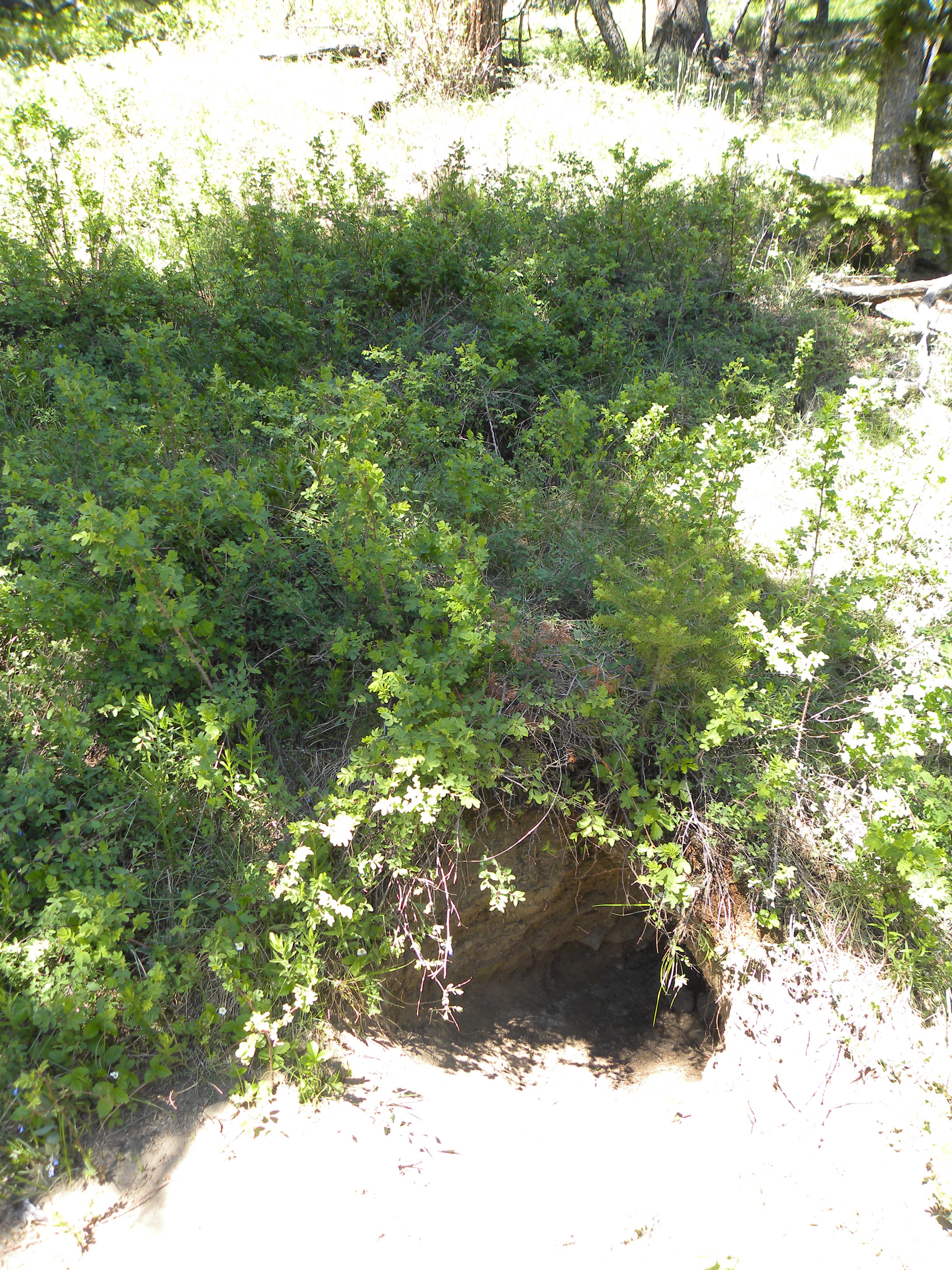
I waited a month to be sure that the pups were old enough to have left and inspected the site.  What a feat of engineering.  The den was on a hillside in a small drainage.

The den was essentially a tunnel with an entrance above and below.  My dog is 90 pounds and he was big enough to crawl inside the tunnel entrances, but too big to enter the tunnel connector.  Here he is for size at the lower entrance.

Koda for size

Although this site had been abandoned for several weeks with overgrown vegetation, it was perfectly clean inside and out.  I looked around for bones. There were some deer bones but quite a ways down hill from the den site.

Upper entrance demonstrates cleanliness

I tried to shine a light as far down as I could, but the den tunnel made a right turn downhill and exited at this bottom hole.

View of lower entrance. Upper entrance is visible directly above

The chosen site was not near an animal trail.  In fact, the trail made by the wolves going back and forth to the den was now overgrown.  Yet I caught a wide variety of animals on my camera.

Of course, the supercilious coyote appeared several times, even spending a long time peeing nearby on a log.  A young black bear ambled bye.

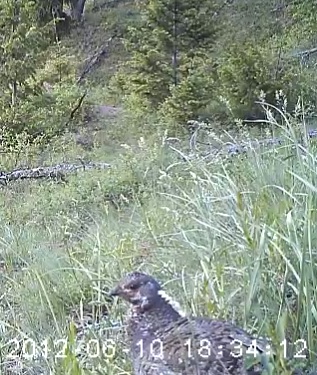
A blue grouse with chicks appeared;

Find her chick!

a cow elk explored the site; and a yet to be identified weasel-like animal that looks suspiciously like a wolverine–all these animals in just a few weeks visited this den site area.

How lucky we are to have such a wealth of animal life in this special place we call the Greater Yellowstone Ecosystem.

Also Read:- Sacred Sites and Mountain Lions

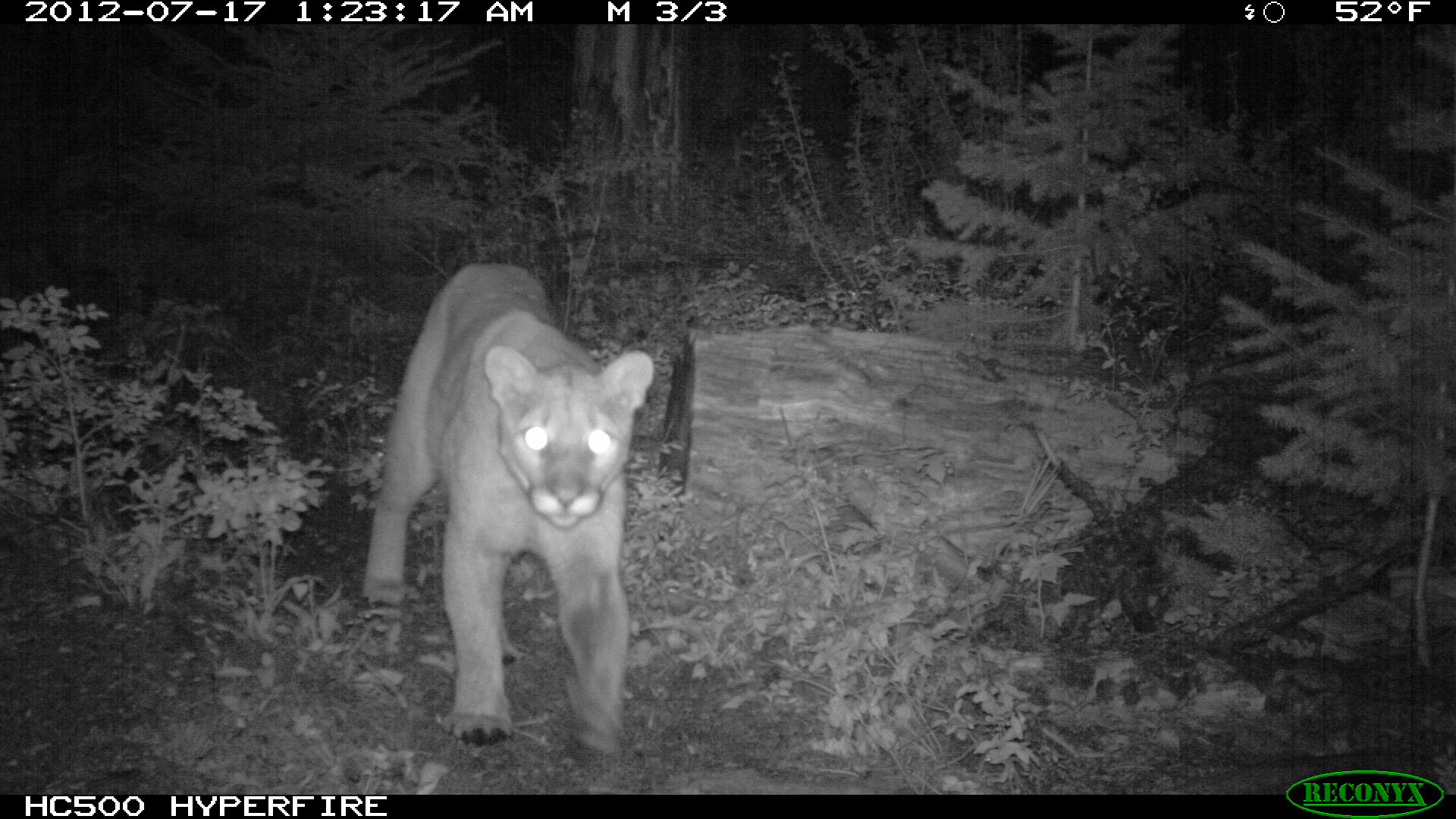
More cougar photos

This cougar is still hanging around.  This series shows her coming directly to the trail cam and marking right in front of it.  I suspect it’s the red infared light she’s reacting to.