• MY BOOKS ON WILDLIFE, GARDENING AND MORE

  • The Wild Excellence

  • True stories of wildlife encounters around the Greater Yellowstone
  • Award winning eBook on Decomposed Granite, tips, how to's, what to watch for
  • Children's book. True stories of a dog and wolves. In a dog's voice
  • Written for dry Mediterranean climates in California, north and south

Coyote as Creator

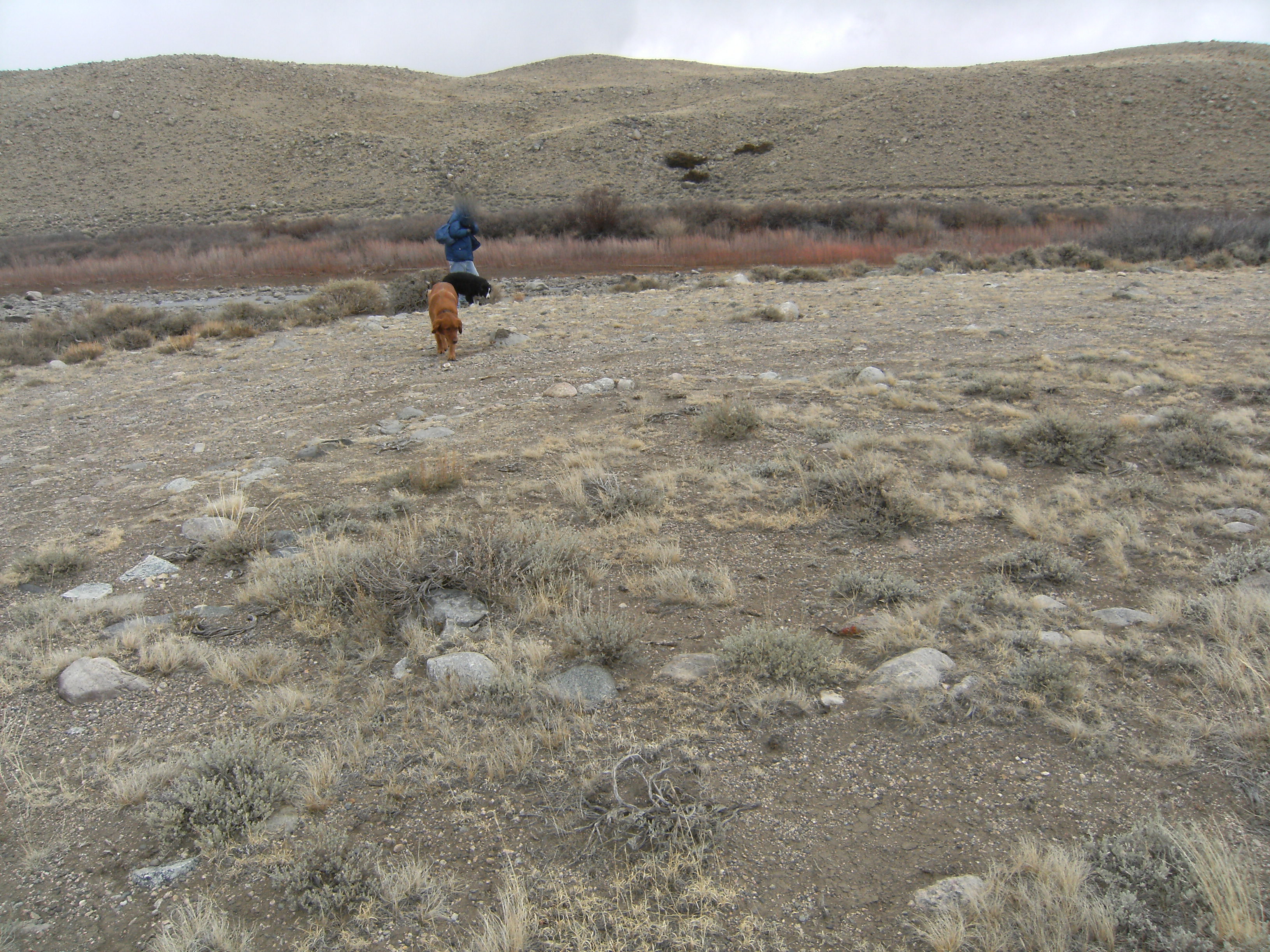
Several weeks ago, while botanizing, I noticed a dead-end steep drainage with a series of picturesque hoodoos.  It drew me and I decided to hike up and explore.  The drainage was thin and narrow with steep sides, so I was following up the bottom.  Although the nearby creek was full of run-off, this little tributary was dry yet there was vegetation as well as a series of downed dead trees.

As I rounded a curve, about six small balls of furry things ran quickly across the drainage for cover.  What were they?  Too big for marmots or squirrels and the wrong color, not moving like rabbits, it took me a moment to wipe my eyes and decide what I was seeing.  Pups!  Yes.  And they were just the cutest things you’ve ever seen, scurrying back to their den for cover.  One little guy got caught up in some dead branches and was trying hard to get over them.

Area around den. A perfect spot

I paused for a moment when they had disappeared, thankful their parents were nowhere in sight because I had the dog with me.  Koda was a good boy.  He saw their fluffy things and, in his curiosity, wanted to investigate but he obeyed and kept close by me.  I retreated from the area right away, worried about their parents returning, the dog and my smell causing their parents to move to another den site.

These pups, from a URL, are about the same size as what I saw

O.K., I said to myself, were they wolf pups or coyote pups?  It all happened so fast, but as I thought it through I realized they were all the same tawny brown color, a definite sign they were coyotes, and I guessed they were about 5 or 6 weeks old, just by having been around dog puppies enough to discern their bodies and skill set.

Interesting, with the late spring and all the snow this winter, everything is late.  Two years ago on Mother’s Day, early May, I saw some coyote pups that looked about 12 weeks old.  And here it was late June, and these little guys were only 6 weeks old.

Coyote pup mother's day 2009

A few days ago I ventured back.  Coyotes leave their den when their pups are around 8 weeks old and I figured they’d be gone.  Just to make sure, I negotiated a route from the back way.  Instead of up the drainage, I came from high up on the top of the hillside where I could look at the site from above.  I sat for quite a while and glassed the den area.  When I was fairly sure there was no activity, I went and explored.

The den

The area right in front of the den, as pictured above, was clean as a whistle.  I used my watch and shown some light inside the den.  It too was immaculate–no bones or feces.  There was another smaller opening nearby, and I understand that coyotes usually have a second entrance. The front entrance was about 12″x 14″.  In the drainage directly below, under the debris of downed trees, scads of old bones and feathers lay around, and piles of scat.  There were at least 3 deer skulls, but they were so old that I figured this den had been used quite a few times before.

Den in size relation to Koda. He would never be able to enter

I picked through some of the feathers.  Songbirds, flickers, an owl and even a red-tail hawk. These parents were good hunters.

As I went on my way to continue searching for plants, I remembered something.  Last year I took an early spring hike up this valley with a friend.  The main valley goes far and narrows into dense forest with a year-round stream running through it.  On our way up, we spied a coyote carrying a deer leg in the direction of this den.  Could it have been one of the same parents?  It was the right time of year.  Maybe I caught a glimpse of the mom or dad.

Phacelia

More BLM thoughts and Jack Turner’s new book

I just love Jack Turner’s writing.  He hasn’t written much, but the stuff he does write is great.  His easy style of writing weaves a lot of good facts, ecological outrage, and story detail.  I’ve just finished his new book “Travels in the Greater Yellowstone”.  Each chapter explores a different area of the ecosystem, either with his wife Dana, or sometimes hiking with a friend.

Turner spurred some additional thoughts on my last entry regarding the Big Horn Basin BLM plans.  The commissioners in the surrounding counties got together and hired, with our tax dollars, a company to do an analysis of oil and gas in the basin; really paying them to turn out a document that would support what the commissioners want.  From the presentation the company gave at the commissioners meeting, they did a good job distorting facts to support massive development as a sound idea.  For instance, they had slides of pronghorn and deer around gas wells.

Now for a pertinent comment by Turner in his chapter on the Green River Lakes, where the Jonah and Pinedale gas fields have taken over the Pinedale area:

“What is the status of sage-grouse populations here?  As usual, none of the interested parties agree about the numbers–counting is political–but no one denies that this basin is one of the species’ remaining strongholds and that it is suffering plenty.  One study suggests that the 1,200 or so sage grouse that live around the Jonah and Pinedale Anticline gas fields will be gone in twenty years.  The government, worried sick that Endangered Species listing will radically curtail energy development, has called for a Sagebrush Grouse Summit.  Nor is it just the grouse that are a problem.  The mule deer population has already declined 46 percent in the area around the Pinedale Anticline field.  They are supposed to be protected in the winter by limits on drillings, but the limits are a farce.  The energy companies can request exemptions and the BLM grants damn near every one of their requests.”

Turner is my kind of guy.  He is no-nonsense blunt when it comes to the environment.  For those who are thinking in support of Plan C, the commissioners drilling dream, here’s another wonderful quote:

So…Wyoming has another energy boom–there have been many.  And when the boom collapses–all booms throughout history eventually go bust–the resources and traditions that could have sustained the state for centuries will be gone.  Who will want to vacation in a Superfund site?”

That is my bold and for good reason, because our commissioners have forgotten what we love about the Cody area and why people come to visit here. They also seem to have forgotten the amount of revenue that comes from tourists.

Big Horn Mountains looking from the Big Horn Basin

At one time, I was going to buy land in the Pinedale area.  This was before the boom.  I’d been coming there every summer since 1996.  I’d stay at the wonderful Wagon Wheel motel, a tiny place that’s been there forever.  The town was just one street with no good restaurants, but a great outdoor equipment store.  It was nice and sleepy and I loved it.  Jackson was an hour and a half away, through the Hoback Canyon, “a canyon that in any other part of the country would be a national park“.  Pinedale reminded me just a little of Jackson in 1972 when I first came to these parts.  I could live here, I said to myself.

But then things changed, almost overnight.  The next summer I arrived and there was an Americinn, charging $265/night vs. my little motel at $50/night, and all the hotels were booked.

“What is happening here?”  I asked.  The Jonah field, they said.  It was the beginning.  From what the townspeople told me, Bush/Cheney more than tripled the amount of lease permits allowed to be issued for drilling per year, pushing them through with little regulations, and nixed the required townhall meetings.  That was over seven years ago and back then the townspeople were complaining about the lights to me…”You can see those lights in the oil fields from up in the Wind Rivers”.  There’s been a lot of growth since then, so much so that ozone alerts occur regularly in the winter.  They have worse smog/ozone in that area than the whole of  Los Angeles.  Needless to say, I was no longer going to buy property there.  I began looking around Cody and the first thing I asked my realtor was about oil/gas development here.

“The oil fields are all old and pretty much maxed out”, he said.  What he nor I didn’t consider was new technology and the nation’s thirst for energy.

Last summer I drove, quickly, through Pinedale up from the south on my way back from a trip through Big Sandy in the Winds.  Miles of tacky housing fills the once open spaces, probably houses for the workers.  The growth in just the last seven years, or degradation of the environment depending upon how you look at it, is amazing.

“Seventy percent of the Wind River lakes that are more than 9,000 feet have low alkalinity levels, hence they are particularly vulnerable to the consequences of oil, gas, and coal-bed methane development upwind in the Green River Basin and Wyoming Range, which will disgorge a cocktail of toxic fumes into the air twenty-four hours a day for the next fifty to hundred years.  The Wind River Range and its three crown jewels of America’s wilderness system have the misfortune to be immediately downwind.  Air standards already are being violated with only 600 wells in operation–and with 10,000 more planned, pollution can only get worse.”

Our last wild places in the lower 48, where grizzlies can still roam, and pronghorn can still migrate, are being chopped up and compromised.  If this is not an outrage, then we are not awake.

Hear ye, Hear ye, Commissioners:

“When people ask what Wyoming should do with those billions of dollars in mineral royalties left over in the budget, I say: Invest them.  Future generations in this state are going to need more than billions to clean up their wasteland.”–Jack Turner

An Open Letter to the BLM

I decided to publish my letter to the Bureau of Land Management regarding its draft resource management plan.  This is the plan that will determine use for the next 20 YEARS!  Twenty years these days is a very long time, and so many changes will happen that are unforseeable.

The Basin is huge, extending from the Shoshone Forest of the Absarokas on the west side to the base of the Big Horn Mountains on the eastern edge, north to the Montana border and south to Thermopolis.  Predictably, the commissioners of the surrounding counties of the basin are only interested in $$, what they can put in their coffers right now to grow and develop and that means oil and gas leases. They envision Wyoming as the Saudi Arabia of coal, gas, and oil, with cowboy sheiks.  But as Jack Turner so eloquently puts it in ‘Travels in the Greater Yellowstone’:  

Well, I reply, go to Saudi Arabia and take a good look.  Saudi Arabia is butt-ugly from energy development.  Do you want the Yellowstone country to look that way?  I don’t.  And I’m not so sure about those cowboy sheiks, either. The energy companies stand accused of bilking the U.S. Treasury out of billions of dollars–that’s our money for developing our resources on our land, and many of those companies are subsidiaries of foreign corporations whose headquarters are in places like Canada and the Barbados.” 

Weatherman's draw is a beautiful place. Shall we drill here?

The Bighorn Basin, as part of the Greater Yellowstone, belongs to all of us and our voices need to be heard.  We need to preserve the few places left for solitude and natural enjoyments.

Pronghorn migrate and live in the basin. Should we disturb more of their habitat?

 I urge everyone, everywhere in the U.S. to give your comments on this plan at this website.  Your few minutes could make a difference for the next 20 years.
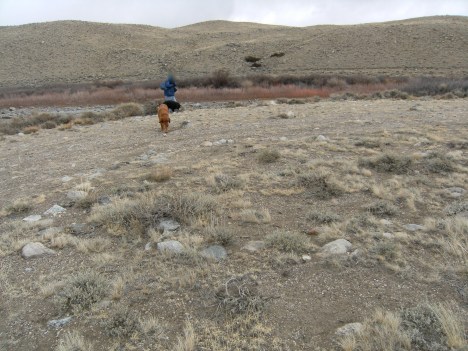
Tipi rings, as well as other Indian signs, are all over the basin from 10,000 years of habitation

Below is my letter to the BLM:

Bighorn Basin RMP and EIS

Bureau of Land Management

Worland Field Office

P.O. Box 119

Worland, WY 82401

Dear Mr. Hiner,

The Big Horn Basin is one of the most unique and special areas in the lower 48.  A traveler can walk the landscape and observe ancient seabed fossils or fossilized bones from extinct animals.  A few steps away are arrowheads or petroglyphs from the earliest Americans 10,000 years ago.  And within view are herds of pronghorn, elk, and maybe a coyote or wolf or a golden eagle.

The Basin is essential to the Greater Yellowstone Ecosystem.  It provides migration routes, calving grounds, and a necesssary corridor for resident species to maintain contact with their own kind, ensuring genetic diversity.  The Absaroka-Beartooth Front in particular is a critical component of the GYE.  This portion of the Ecosystem is predicted to be among the most resilient to climate change given the intact nature of the landscape and its topographic variability.

The future of these lands is at risk in so many ways.  Between habitat fragmentation and climate change, real estate development on adjacent lands and overpopulation, we need to ensure that our public lands serve the preservation of the limited amounts of wildlife that are left, most of which are squeezed into the GYE and its corridors.

I have been lucky enough to live in this area and view its abundance, even though, as we all know, so much has been lost over these last 200 years.  And that is really the point: What will we do, as a generation, to ensure that no more is lost?   What we will do so that our children’s children do not say “You once could see sage grouse mating here, but they are now extinct”?

The Big Horn Basin and the Greater Yellowstone Ecosystem face great challenges ahead, Climate change is a large Unknown and an unpredictable monkey wrench.  Add to that the known factors of endangered or threatened species, plants and animals.  With this in mind, Alternative C is a very dangerous and short-sighted plan.   Alternative C is all about money.  Alternative C values only profit, and what can line someone’s pocket.  One cannot put in the bank the emotional and spiritual value of Land, the sense of awe and wonder, and how much it feeds the soul.  Oil and gas development over the entire basin will compromise not only our water and air, but fragment habitat through roads and intensive use.   We will lose, even if so incrementally that people just forget as a new generation grows up, what we have today.  Memory is short, and what scientists call a shifting baseline has already happened in the Basin.  We need to return our lands to a previous, more healthy baseline, not degrade it further with an open hand to oil/gas development.

In light of these concerns it seems obvious that Alternative B would provide the best safety factor for the future of the Big Horn Basin.  We really do not know what our earth, or this area, will look like in twenty years’ time.  We cannot take into account all the rapid changes we’ll encounter.  We are losing species at an alarming rate that nobody could have predicted thirty years ago.

In terms of specifics of what is most important to me in the Basin:  I spend a lot of time in the winter hiking in the basin, particularly around Oregon Basin and the Badlands of Polecat Bench.  In the spring when the area opens up, I love to hike the Absaroka-Beartooth Front, Chapman Bench and the Clark’s Fork.  I relish observing the fossils and finding tipi rings.  In my day hikes, its now easy to avoid oil/gas development areas.  The Absaroka-Beartooth Front MUST be protected as a Management Area (AFMA).  Its abundance of wildlife, habitat quality, and scenery are unrivaled.  The oil and gas leasing restrictions for this area laid out in Alternative D appear to be impossible to manage given their checker boarded nature.  I feel that the best way the BLM can protect the world-class biological and scenic values of the Absaroka-Beartooth Front is by designating the area as unavailable for oil and gas leasing (Record #4080 alternative B).  I support the creation of the Clarks Fork Canyon ACEC, as well as the creation of the Chapman Bench ACEC (Record #s 7105-113 and #’s 7084-83 alternative B).  These areas are special to me.  Alternative B also provides the most protection for sage grouse leks, something the BLM should implement if they are serious about keeping the bird from becoming listed as endangered. (Record #4120 alternative B).

Additionally, Alternative B is the ONLY proposal that restricts grazing on portions of the Basin.  This is very important.  Cattle are extremely hard on the land, the riparian areas and the plant resources our native wildlife depend on.  We don’t need to allow cattle on all of the Basin as suggested in the other alternatives.  That is management out of the early 1900’s when cattle barons ruled Wyoming.  It’s time we think of the future of our land and begin to create a new paradigm.  It also makes no sense the amount of AUM’s it takes in this desert landscape to support a cow compared with more fertile areas in the eastern U.S where the majority of the beef is produced.  In addition, it’s not fiscally sound. Grazing fees do not cover BLM expenditures for operating the program, and they also fall far short of paying for all the environmental problems this kind of land use causes.  I also find it disturbing that the BLM is actually proposing to weaken grazing regulations for areas previously covered in the Grass Creek RMP—I find this unacceptable.  At the very least I feel that BLM should continue to follow the provisions set forth in the Grass Creek RMP for the Bighorn RMP.  This includes prohibiting livestock grazing in elk parturition habitat during the birthing season. (Record #’s 6275-6282 alternative B).

Recently I went for the first time to Fifteenmile Basin.  I was amazed.  As far as the eye could see was unobstructed wilderness.  No cattle, no oil wells.  A window into the past, I could view a landscape as people did thousands of years ago.  This special place deserves special protections.  Alternative B would create a Badlands special recreation management area and impose a NSO restriction on oil and gas development within the management area.  I feel that this would protect the Fifteenmile Basin so that generations to come can experience the same awe upon viewing this unique landscape (Record #’s 6094-114 alternative B).

May we have the wisdom to protect the last of this Specialness for generations to come.   We have an opportunity to do the best we can for our lands, our wildlife, our grandchildren.


Thank you,


Leslie Patten

Yellowstone in June

A blustery, unpredictable June brought with it fantastic wildlife watching in my three days in the Park.  I spent two nights in Mammoth and did several hikes.  On one, we ran into that herd of Rams you see.  150 years of no hunting leaves the wildlife very relaxed around people.  The rams hardly noticed us, moving slowly across the trail and up the hillside about 20 feet away.

From what I heard today, so far not too many cubs of the year (COY) have been spotted.  But I was a lucky one to get to watch a mom and 2 cubs for about fifteen minutes before they disappeared into the trees.  The cubs spent the entire time playing, rolling around, and then catching up with mom…..soooo cute!  One the way home I watched a courting pair of grizzlies.  The female was collared.  They rested together for quite some time under a tree while dozens of people watched about 100 yards away.

Yellowstone in May/June is the best time of the year.  One woman told me she spotted 71 bears last year in two weeks.  In early July grizzly bears move up into the high country to hunt for moths.  The elk follow the grasses higher up as well.  Wolves tend to follow the elk.  So although you may see these animals in summer, the sightings will be fewer and more difficult to find.

The wildlife, the thermal activity, the incredible setting–that is the magic of Yellowstone and spring is the best time of year to come.

15 Mile Basin and the BLM Plan

There is a struggle going on over our federal lands in the Bighorn Basin.  The Bureau of Land Management is taking public comments on their new draft-plan.  This plan will set the guidelines for the next 20 years of land use.  And the struggle, as I see it, is between immediate short-term gratification and greed, and open pristine lands for our wildlife and recreational and contemplative uses for human beings.

The politicians and the oil and gas companies would like the entire Bighorn Basin open to development for the next twenty years.  And as we all have seen, once that open space is gone, its marred forever.  An alternative plan of the BLM’s is for a compromise that protects and makes more pristine areas off-limits, but allows exploration in other areas.

One of these fantastic areas is called 15 mile basin, an area that right now is the largest contiguous space in the basin with no oil/gas leases.  I’d never been there and the Wyoming Outdoor Council and the GYC were sponsoring an overnight with a walk the next day with Rick Dunne, a native seed farmer.

Our leader Rick Dunne

Besides a lot of fun and meeting new people, the area was quite incredible.  Rick mostly explained the geology of the region and the Bighorn Basin in general.  First we spent some time in  Gooseberry Badlands Scenic walk-through.  I’d been there once before, but today the river was running, making this a truly magical area.

Gooseberry creek

Then Rick took us on a 14 mile drive on a 2 track near Squaw Teats, with a quarter mile hike to an overlook.  From there the basin stretched in all its colors and buttes as far as the eye could see without any roads, oil fields, or human structures.  Rick told us that this area was probably rarely seen nor accessible because of the hiking and lack of water.  It was strikingly beautiful.

The Basin--millions of years old

Many people don’t even know about BLM lands.  In the early 1900’s, when the National Parks and National Forests were being created, the Bureau of Land Management was sort of everything left over.  In those early years timber was what was of most interest to a growing country and so the National Forests were created to save our timberlands.  BLM lands usually have high and low desert communities.  These lands have their own beauty and solitude, with delicate ecosystems and unique wildlife.  These lands belong to all of us, just like our Parks and National Forests.  They are not the property of a few commissioners nor of the oil and gas industries.

Because you as an American citizen own these lands, even if you don’t live in the area, you certainly can comment on the proposed draft.  In fact, those comments from the public are really what shapes the plan.  I came to live in Wyoming because I spent every summer hiking in the Wind River Mountains outside of Pinedale.  I wanted to move to that area, until the Jonas Field, a massive oil/gas field.  Now the Pinedale area has more ozone level alerts than Los Angeles (where I grew up.  Pinedale, Wy has more smog than L.A.!!??).

Here is a link

15 Mile Basin overlook

to help you see the BLM plan and comment.  We have till July 20 to have our voices heard.

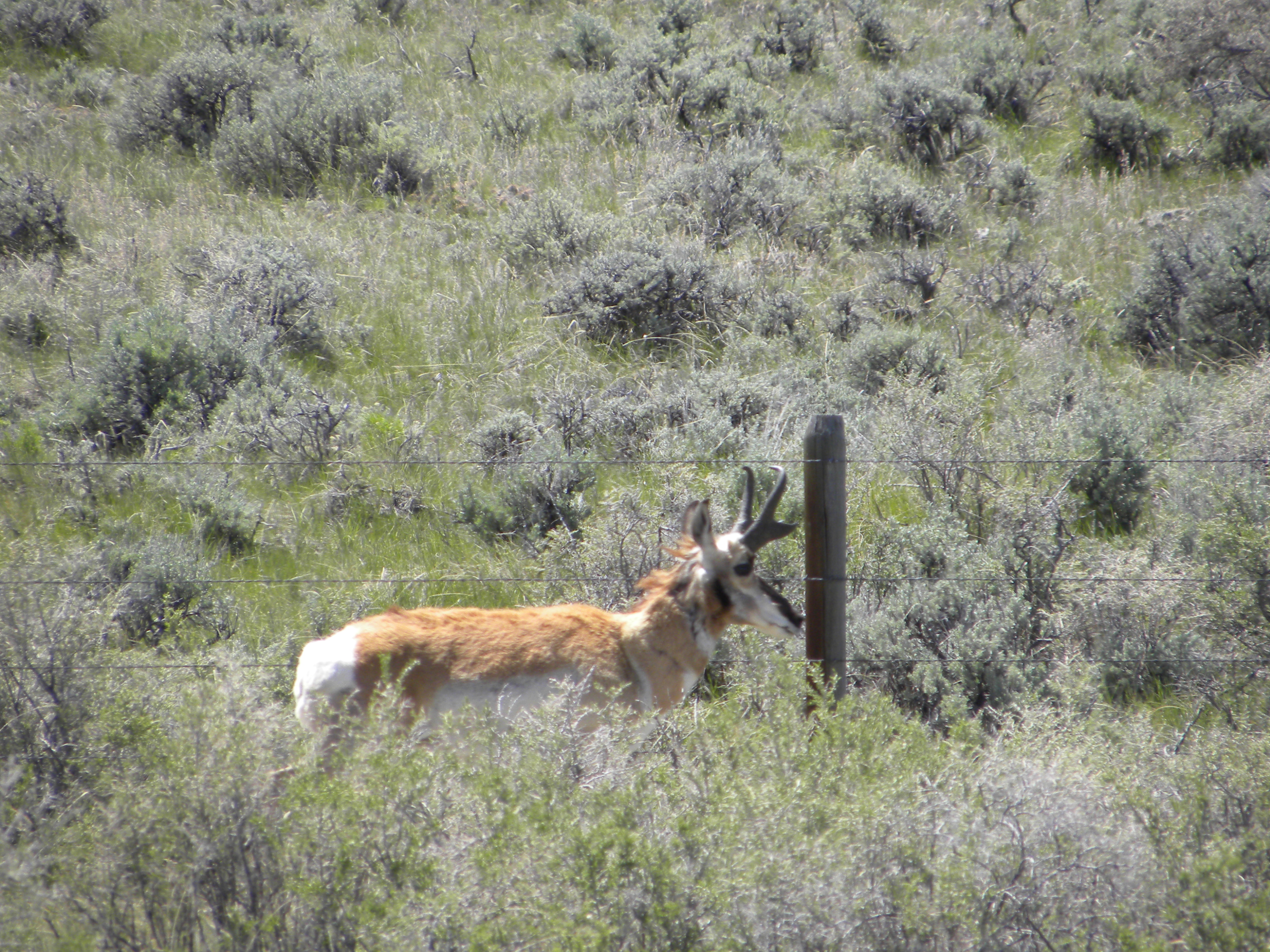
A Pronghorn struggles to find a place to go under a fence that is not wildlife friendly on BLM lands. He will be greatly impacted by oil/gas fields, new roads and fencing for development.

More elk calves and a lesson in Life and Death

“…that feeling in your stomach of “I don’t want this to be happening.” You try to escape it in some way, but if somehow you could stay present and touch the rawness of the experience, you can really learn something.”  Pema Chodron

Yesterday, this morning, and today were all one large event, the event that is Life.

In my post yesterday, I wrote about the dead elk calf.  This morning the mama spent a long time bugling for her calf behind my house on the top of the rise…a mournful sound of a mother calling desperately for her newborn calf.  I went outside and watched her.   I felt tremendous sadness for her.  I knew she didn’t know what happened to her calf, just that it was gone.

It reminded me of a time two years ago in the spring in the Beartooths.  A car hit and killed a cub of the year.  The grizzly mom spent a week roaming and calling for her cub.

There is nothing so sad in the animal world as that sound–a mother calling for her baby that is dead.  But I felt it was important for me to allow myself to feel this elk mother’s cries fully, and not push my own feelings away, even though it was difficult.

I stayed with her and listened.  And those bugles were low, guttural; not the high pitched sounds you hear in the fall from the elk.  Her cries came from a deep and ancient place, not unlike the cries of humans mourning intensely.

Today was the first really warm, beautiful day.  I decided to go up to a favorite spot, a place that overlooks a deep canyon, and have lunch there. (Unfortunately, I took my cheap camera) Its about a 2 1/2 mile hike up to the top of this ridge-line.  You pass through a forest until you top out at some high meadows.  At the end of the meadows are sheer cliff drop-offs.

View from afar of the spot where elk is. This is the meadow and cliff

As soon as I broke through the trees and began crossing the meadow to the cliff edges, I spied a lone elk.  She seemed a bit nervous at my presence (not unusual) but then I saw something else.  A calf lay nearby.  A wet calf.  She had just given birth and probably just finished licking the calf clean of the afterbirth.  I made a large circle and hid behind some rocks out of the wind.

Mom had taken off and left her baby there, probably hoping that I’d be more interested in following her and so not find her newborn.  I watched that little guy for about an hour.  Within about 10 minutes, he tried to stand up.  He struggled unsuccessfully with his weak legs.  Exhausted, he spent another 10 minutes resting.  But soon he tried again.  This time, although he still couldn’t stand up easily, he was getting stronger.

Keep trying...

First attempt to stand

I had a good feeling about this mom and her choice of a birthplace.  High up, the only entrance was on one side.  She placed the calf near a rock that had similar coloring as the calf.  And not too far beyond the calf was the cliff, where no predator could come from.  On my hike up through the trees, I saw no grizzly sign.  Grizzly sign was on the other side of the canyon down below near the creek.  If this calf makes it past a few weeks, he’ll be too fast for the bears.  But then he’ll still have to contend with wolves, who do frequent the area.

Cliff edge near where calf lies

If he makes it through a month or so, when the snows melt, his mom will probably take him up to the Absaroka Divide and head to the Lamar.  He’ll have a good year this year, more similar to what his ancestors used to experience before the long drought, because the grasses will stay greener for longer.  Then next January I might see him again when he migrates back down here for the winter.  He’ll be taller but still a youngster and still vulnerable to the wolves and the deep winter snows.  But he might just be one of the tougher ones, the lucky ones, and live into his adulthood.  Live to mate and make more elk and not be caught by a hunter’s bullet.   I surely hope so.

Grizzlies and elk calves

Its unusual to see  the Cody backcountry herd grazing every morning and night this time of year.  Usually, by now, they’re headed over the passes to calve in the Lamar. But the snows in the high country are still too deep and the melt hasn’t even begun.

I’ve been watching this small herd from my window.  They come early morning and evening.

Elk May 20, 2011 still in Sunlight

The other morning I spied a lone elk.  I watched her for a few days going back and forth between the herd in the pasture and a patch of willows in the nearby forest.  She’d disappear into the willows and the forest by the road and seemed concerned.  I had a feeling she had a calf hidden in the brush there.

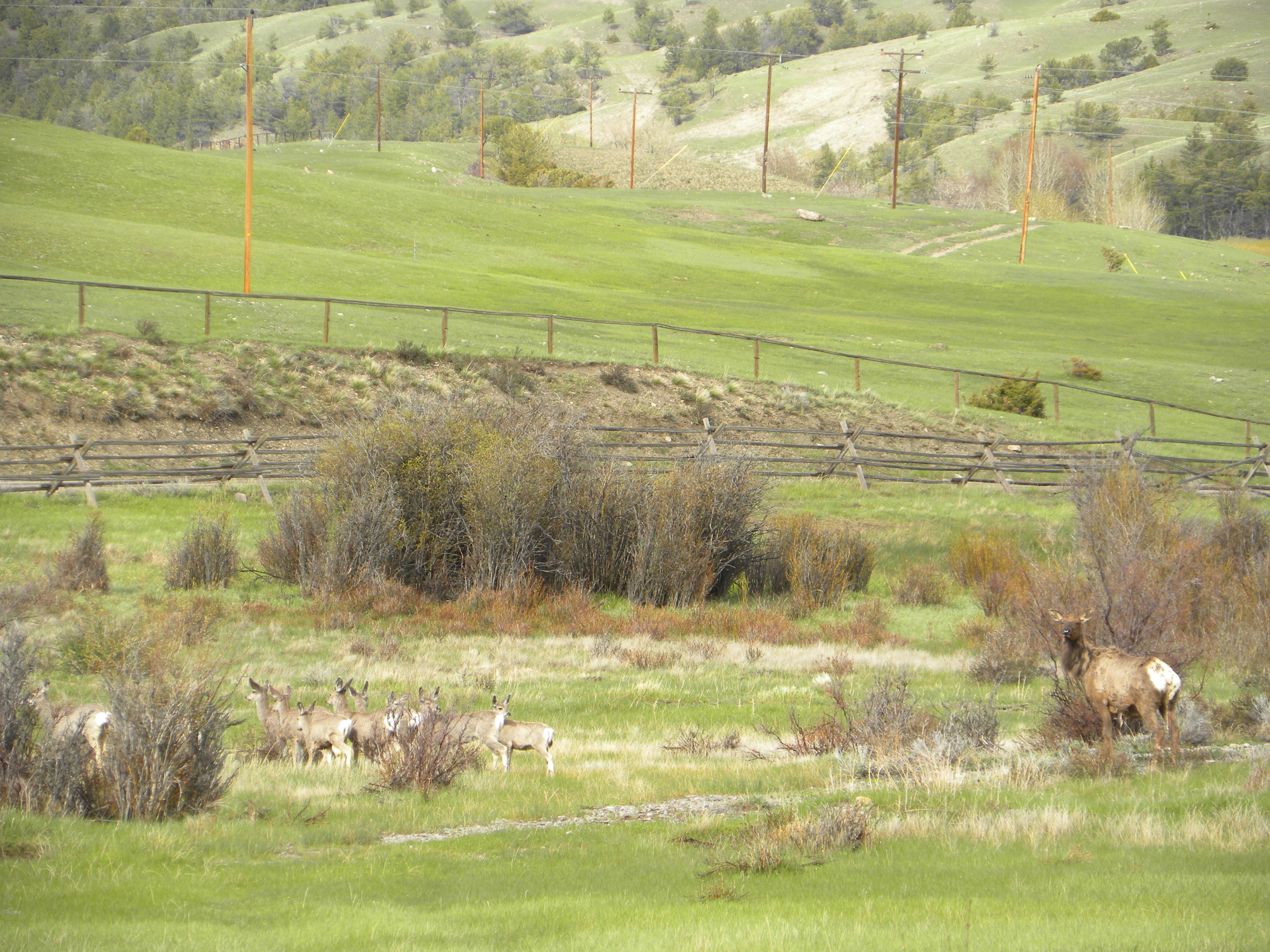
The lone cow with deer

But last night something strange happened which made me wonder if I was correct.  Instead of just this lone cow wandering over to this marshy area, a cadre of about 7 elk wandered over there with her and disappeared into the forest.

So this afternoon I took my bear spray and cautiously investigated while the elk were grazing.  In a muddy area of the creek, now widened by slash and blow downs from the logging last year, I spied a grizzly track moving in the direction of a small clearing.  A few yards up from the track, there was the calf, completely consumed.  Only the skin and legs remained.   It had been predated right where it had lain, for it was in a heap in the grass by a freshly fallen spruce bough.  I inspected the little legs and skin.  The small thing was deftly and perfectly skinned.  Certainly a bear, and my guess is it was that grizzly who made the track just a few feet away.

Grizzly in the Lamar feeding amongst the willows

I had hoped to spy a living calf, so I had a sicken and sad feeling.

Six out of 10 elk calves are predated within their first 10 days.  They are fairly helpless for those first two weeks.  Many people say the calves don’t have a scent, but I would disagree. I haven’t seen tracks in those marshy areas and this griz went directly to that calf.  The calf was not too far from the road, but at the edge of a wide swath of logged forest that includes a lot of swampy areas.  That bear did not wander about through the open woods looking for an elk, but clearly walked from the nearby meadow into the woods right to the calf.  Handling the calf’s skin, I could smell it on my hands.  It doesn’t have a strong smell, and staying on the ground low keeps it’s smell down.  But it does have a smell and to a grizzly, I’m sure its pretty strong.

I was in the Lamar Valley a few days ago and within an hour saw three grizzly boars in the valley. A friend told me in 2 days she saw 20 bears just in Lamar Valley.  The Lamar is becoming a favorite of the grizzlies.  I have wondered if these migratory elk, who usually calve in the Lamar, might have better success here.  Certainly there are bears here, but not as many as in the Lamar.  That’s a question I can’t answer.  Unfortunately for this little elk, it wasn’t the case.

And one more question I had:  Why, last night, did I see 7 or 8 elk accompany mama elk into the willows, not a route the elk ever take around here?  Was that a show of sympathy and support?  After that, the lone elk has not been alone anymore, and I haven’t seen her nor any of the others wander into the willows.

My heart felt saddened for that little calf and her mother.  But I can’t blame the grizzly.  How could I…I went home and enjoyed a BBQ’d bison steak myself.

Sleeping grizzly.

Can we really Re-Wild?

I just came back from New York where I picked up a few interesting books.   Two of them present similar science on our vanishing wildlife but different approaches.  End of the Wild by the late Stephen M. Meyer  who was a professor of Political Science at MIT, says it is just too late to save the biodiversity on this planet.  It is known that in the next 100 years, more than half the planet’s species will disappear.  Meyer’s says that there will still be plants and animals, but they will be the weedy species that survive more easily around humans–from dandelions to coyotes, mosquitos to corn–species that survive in human disturbed eco-systems.  His is a pessimistic view.

The other book I’m reading, Rewilding the World by Caroline Fraser is a fascinating read, presenting a more hopeful view that will take work, though.  Scientists concur that ecosystems, to remain intact, need three things–Cores, Corridors, and Canines (or translate top predators).  For instance, a Core would be Yellowstone Park; a Corridor would be the Yellowstone to Yukon project; and the Canine would be the wolf in this case.

Y2Y map

One of the most fascinating bits of research Fraser quotes that began this kind of thinking amongst scientists was a study done in 1990 by John Terborgh, a biologist who studied a stranded hilltop ‘island’ created by a new hydroelectric dam in Venezuela that flooded a valley.  As the new lake filled, the predators fled, leaving only smaller creatures behind on the islands.  I quote the book below:

After a team studied the islands, the data painted a horrific picture.  Safe from predators, howler monkeys proliferated on some islands, but they were not enjoying their freedom from fear.  Normally social animals, they were living alone, attacking one another, and killing their own infants.  By denuding trees, they caused surviving plants to protect themselves with toxins, so meals provoked vomiting.  Many plants are capable of deploying extraordinary chemical defenses against herbivory by inducing a rapid rise in levels of toxins that can repel or kill those feeding on them.  On islands with howler monkeys, the instability caused by the absence of predators and superabundance of herbivores set off a vicious chain reaction.  

On other islands, predators of left-cutter ants were absent (armadillos and army ants) and the ants ran amok, carrying everything green off to their underground nests, leaving a…thicket of impenetrable throny vines, destroying all remaining life, plant and animal.  Terborgh and colleagues reported that after a few years almost 75 percent of vertebrate species had been lost from the smaller islands without jaguars or pumas.”

Fraser’s book examines corridor projects around the world, successes and failures.  She looks at central and south America, and large projects in Africa.  Many of the African projects are of interest, not only because of the great diversity of megafauna (particularly elephants which reck havoc amongst farmlands and villages and need very large corridors) but because they are multi-national endeavors–huge corridors that cross nation boundaries. Like the Greater Yellowstone, these Peace Parks (a concept first begun with Waterton-Glacier Park) include protected cores, as well as corridors where people live.

I can’t begin to describe all the different approaches here, but certainly the corridor projects that have been the most successful involve the local communities and take into account their needs.  One of the most botched plans was Paseo Pantera in central America, where good intentions became convoluted by developers getting involved and local peoples weren’t taken into account from the start.  The project degraded into an “integrated conservation and development project”

Large animals need large corridors.

Large Corridor areas for large animals

 And there is also the ‘problem with predators’, a human problem that has been obvious in the GYE since the wolf was eliminated in the 30’s in Yellowstone, and millions of coyotes, bobcats and other predators have been routinely destroyed with tax dollars for decades due to cattle predation.

Yellowstone to Yukon is a corridor concept that has been around since 1997. Its a conservation vision to preserve our North American great animals for future generations and for the earth.  Some work is being done already, like over- and underpasses for wildlife; wildlife friendly fencing, and species reintroduction.  But to be successful, it will take people living within this corridor to be involved and share the same vision, to do their small part whether it be active shepherding their livestock or replacing their fences for pronghorn passage, or saying ‘no’ to intensive housing developments in corridor areas, or as small as bear-proof garbage cans.  People need to realize when they live or move to these areas that they are becoming involved in wildlife corridors, which have special requirements, different than city or suburb living.  And help and education needs to be given to those people, such as ranchers, affected by corridors. Solutions must be community based but with the greater vision in mind.

Fraser states ” ‘Carnivorous animals are important.  We have to stop thinking of them as passengers on this earth and start thinking of them as drivers.’ Inevitably, an ecosystem robbed of its top predators begins a remorseless process of impoverishment.”  If we are truly interested in saving the great animals of North America, from wolves to bison, elk and pronghorn to grizzly bears, we who live here must all become involved in the Vision of Y2Y, stop our regional bickering and look towards the wholistic future.

Fraser’s book presents a glimmer of hope for Rewilding.  We, as a world culture, are fighting a strong current of species loss.  It is a great fight not just for these species, but for ourselves and the future of mankind on this planet.  Meyer’s vision of a world of limited weedy human-adapted species may sound livable, but boring, and missing the richness of magnificent mammals such as tigers, elephants, and crocodiles.  But Fraser’s admonition of the howler monkey hell, a potential future with the absence of diversity and predators, is a world not worth living in.

Combine yourself with your Experience

Sunday was the finest day we’ve had so far this year.  Elk Creek is one of my favorite drainages in the valley and I decided to roam it for the day.  The creeks are just beginning to rise, the snow pack in the high country barely beginning to melt.

May 2011 High Country has not yet melted

The first two creek crossings I was able to use some downed trees for a crossing bridge. But the third one would require wet feet.  I decided to detour up to a secret side drainage which followed a steep game trail to a view point on the top of the divide.

As I walked, I felt how these last three years of living here had begun to change my thinking, my way of moving in nature.  I noticed the moose that had wandered from my nearby forest through an open area that I didn’t think was part of her usual rounds. Her tracks were easy to differentiate from the numerous elk tracks on the same trail.

The elk are still here. Too much snow in the high country to return to the Lamar

I stopped to run my fingers over and measure the print of a male grizzly that frequents the bottom of Elk Creek.  I got out my notepad and recorded his stride, width and length for future study. Further down the trail, a nice aspen grove I’d been watching for five years is maturing nicely, with older trees giving way to younger clones.

Mature old aspens and gazillions of young aspen clones

In brief spurts, a scent wafts through the air, similar to a skunk but not as all-pervasive.  I pause to wonder from where it came–plant or animal.  I’ve smelled this scent before in the spring only.  All the daily walking, studying and pondering over these last years has paid off in unexpected ways–I feel I can more easily piece together the puzzles of the natural world than I did several years ago.

This winter has been a hard one for deer and Elk Creek is no exception.  Everywhere I’ve hiked there’s been deer carcasses.  Interestingly enough, I’ve noticed less active signs of bears in the lower drainages than previous years at this time.  I’ve been wondering if the easy availability of winter kills upon leaving their dens has had the effect of the bears foraging elsewhere now.  I have more questions now to answer than three years ago too.

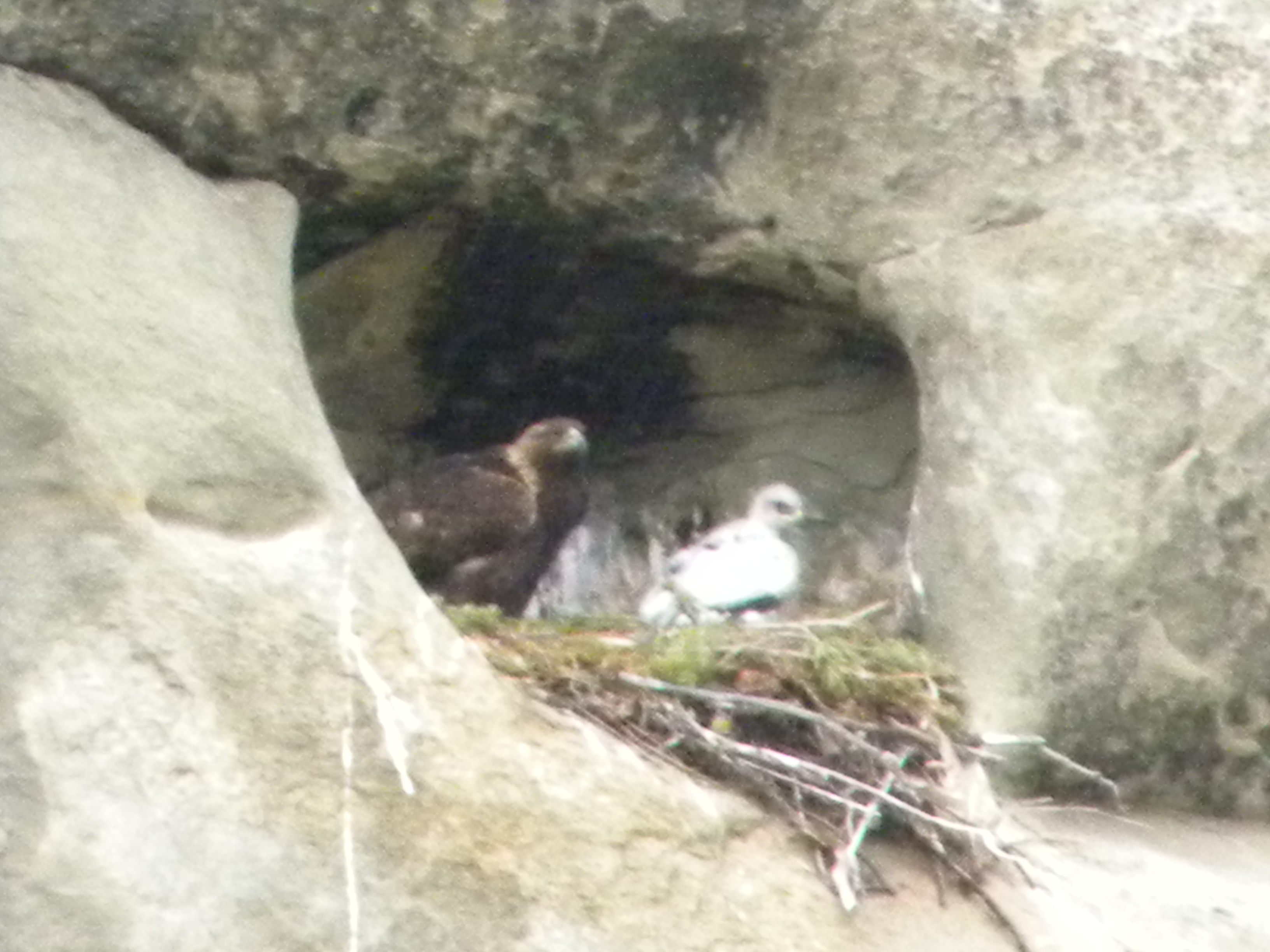
Golden eagle on nest with her young 3 week old chick

My teacher coined the term ‘Consideration’ (liberally interpreting the Sanskirt word ‘Samyama’)  to describe the action of pondering something so deeply that one combines with it completely.  By entering into this process (by deeply considering a subject from every possible angle) its truth would be known through thoroughly combining with it.

Robert Heinlein used the term ‘Grok’ in his novel ‘Stranger in a Strange Land’  in a similar way: Grok means to understand so thoroughly that the observer becomes a part of the observed—to merge, blend, intermarry, lose identity in group experience.

True knowledge and mastery of anything requires combining oneself, the observer combines with its subject.  It is not enough to be well-read on a subject, but one must completely be immersed and given over in order to master it.  Every profession requires this in order to master it, every art, even every philosophy or religion.  We must completely absorb every aspect of it, become fluid in it, become one with it to know it completely.

My experience and my wanderings in the natural world are like that.  Reading and study informs me, but it is only through continued direct experience and immersion, deep pondering and relaxed attention, samyama and continued consideration, that its secrets reveal themselves to me–slowly, ever so slowly over time.  That is why the Native Americans who lived here in times past were so intimate with nature.  They had combined so directly with the animals, the plants, the rocks and even the non-physicality of the world, that they had a supernatural and direct understanding of the world around them.  In other words, they grokked it completely.

Self-Portrait: With a saw I found on the Elk Creek trail

Goodbye to a long Winter

The snows are melting and although Sunlight creek is still not in the spring run-off phase, you can feel the weather breaking.

Last night it snowed lightly, but today its raining.  It’s a slow warm-up, but it’s coming.  My old neighbor who grew up in this valley tells me this was a normal winter in terms of snowfall, but I suspect its still not as cold as when he was growing up.  His wife says that -25 degrees was regular then.  Not now.

Several years ago I helped an elderly woman stage her landscape in order to sell her home.  Her husband had been a great friend of mine and fellow beekeeper.  Once he died Dorothy packed up the family home and moved to Idaho where her kids were. That was the year I bought my cabin in Wyoming and along with so many other strange coincidences, it turned out her father had been the Chief Engineer in Yellowstone from the spring of 1925 through the spring of 1930.  The last two years he was the Assistant Superintendent at Mammoth under Horace Albright  His name was Merrill Daum and the family had interviewed him and transcribed his memoirs. Dorothy graciously gave me a copy of the section from his time in the Park.  Here are a few of his stories of snow in those days:

There were no concessionaires living in the park in the wintertime.  They closed up everything.  We had to go down to Gardiner and Livingston to do our shopping.  We had cars and oh yes, the road was open.  We only had light snow in that country.  We could keep the road from the park open up to Mammoth with our own equipment, but from there on it was generally open.  They had a train running in there every so often, so many days a week, so we had train service at Gardiner.  So much of that country was rough and hot that the snow was not very thick on it.

I don’t know much about Middle Geyser basin.  It wasn’t a good place to stop and just put a road through to yell at Old Faithful.  That’s where we turned off from and went cross country to the Lake and Canyon or kept on going out to West Yellowstone or to Old Faithful.  We had ten cabins about every ten miles on the ranger patrol station because they would patrol all along that area, especially the southern part of the Park because there might be poachers come in to kill the game.  They’d go around in the winter time on skis.  That’s a long trip around that part.  Down towards the southern entrance there might be ten, twelve feet of snow.  I’ll never forget looking at one of the bridges; there was a stream going under and all that snow on top of the bridge.  One winter the bridge just broke.

The wintertime was mainly spent getting ready for the next year.  Then we had to get ready to remove the snow in the spring.  We started at Cody,Wyoming at the entrance.  About thirty miles from Cody up to the entrance.  We got as far as the Park with snow 12 to 15 to 20 feet deep.  We’d blast it out with TNT which Uncle Sam gave us.  That would start it thawing and then we’d take a big power shovel and shovel the stuff so we had a two-way highway through there to the east entrance of the park.  From there on we’d use our own equipment.  The deep snow was right there at the entrance.  That was the high point.  We’d generally try to get the Park open by the 1st of June.  By the 6th of June we were officially open, I believe. But you couldn’t make some of the interior trips that early.  It would be long in July before you could get away from the snow.

Here is a photo tribute to my 2010-2011 winter in Wyoming.  After this long and snowy winter, I think I am officially a Wyomingite!

The Basin in early winter from Dead Indian

This is a wolf howl machine, an experimental device to see if wolves are in the area

Two wolves side trot down the road

Coyotes on an elk kill

A coyote pair waits their turn on a nearby kill

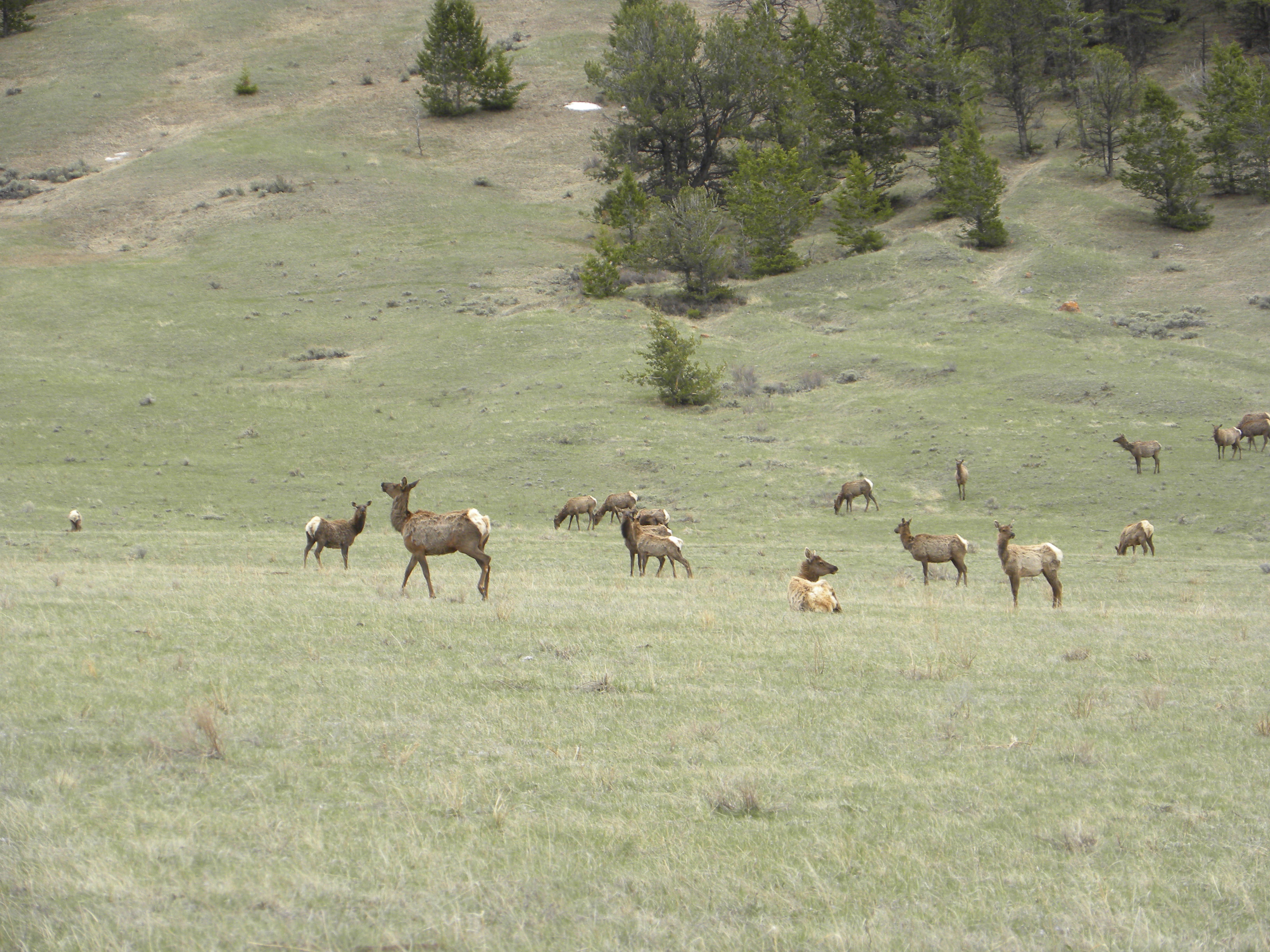
The Yellowstone migratory herd resides in the valley in winter

Black wolf resting mid-day in the sun after a morning elk meal

Moose stands in deep snow

Sunset in a 2011 winter

After a day of skiing, dog tired