• MY BOOKS ON WILDLIFE, GARDENING AND MORE

  • The Wild Excellence

  • True stories of wildlife encounters around the Greater Yellowstone
  • Award winning eBook on Decomposed Granite, tips, how to's, what to watch for
  • Children's book. True stories of a dog and wolves. In a dog's voice
  • Written for dry Mediterranean climates in California, north and south

Can we really Re-Wild?

I just came back from New York where I picked up a few interesting books.   Two of them present similar science on our vanishing wildlife but different approaches.  End of the Wild by the late Stephen M. Meyer  who was a professor of Political Science at MIT, says it is just too late to save the biodiversity on this planet.  It is known that in the next 100 years, more than half the planet’s species will disappear.  Meyer’s says that there will still be plants and animals, but they will be the weedy species that survive more easily around humans–from dandelions to coyotes, mosquitos to corn–species that survive in human disturbed eco-systems.  His is a pessimistic view.

The other book I’m reading, Rewilding the World by Caroline Fraser is a fascinating read, presenting a more hopeful view that will take work, though.  Scientists concur that ecosystems, to remain intact, need three things–Cores, Corridors, and Canines (or translate top predators).  For instance, a Core would be Yellowstone Park; a Corridor would be the Yellowstone to Yukon project; and the Canine would be the wolf in this case.

Y2Y map

One of the most fascinating bits of research Fraser quotes that began this kind of thinking amongst scientists was a study done in 1990 by John Terborgh, a biologist who studied a stranded hilltop ‘island’ created by a new hydroelectric dam in Venezuela that flooded a valley.  As the new lake filled, the predators fled, leaving only smaller creatures behind on the islands.  I quote the book below:

After a team studied the islands, the data painted a horrific picture.  Safe from predators, howler monkeys proliferated on some islands, but they were not enjoying their freedom from fear.  Normally social animals, they were living alone, attacking one another, and killing their own infants.  By denuding trees, they caused surviving plants to protect themselves with toxins, so meals provoked vomiting.  Many plants are capable of deploying extraordinary chemical defenses against herbivory by inducing a rapid rise in levels of toxins that can repel or kill those feeding on them.  On islands with howler monkeys, the instability caused by the absence of predators and superabundance of herbivores set off a vicious chain reaction.  

On other islands, predators of left-cutter ants were absent (armadillos and army ants) and the ants ran amok, carrying everything green off to their underground nests, leaving a…thicket of impenetrable throny vines, destroying all remaining life, plant and animal.  Terborgh and colleagues reported that after a few years almost 75 percent of vertebrate species had been lost from the smaller islands without jaguars or pumas.”

Fraser’s book examines corridor projects around the world, successes and failures.  She looks at central and south America, and large projects in Africa.  Many of the African projects are of interest, not only because of the great diversity of megafauna (particularly elephants which reck havoc amongst farmlands and villages and need very large corridors) but because they are multi-national endeavors–huge corridors that cross nation boundaries. Like the Greater Yellowstone, these Peace Parks (a concept first begun with Waterton-Glacier Park) include protected cores, as well as corridors where people live.

I can’t begin to describe all the different approaches here, but certainly the corridor projects that have been the most successful involve the local communities and take into account their needs.  One of the most botched plans was Paseo Pantera in central America, where good intentions became convoluted by developers getting involved and local peoples weren’t taken into account from the start.  The project degraded into an “integrated conservation and development project”

Large animals need large corridors.

Large Corridor areas for large animals

 And there is also the ‘problem with predators’, a human problem that has been obvious in the GYE since the wolf was eliminated in the 30’s in Yellowstone, and millions of coyotes, bobcats and other predators have been routinely destroyed with tax dollars for decades due to cattle predation.

Yellowstone to Yukon is a corridor concept that has been around since 1997. Its a conservation vision to preserve our North American great animals for future generations and for the earth.  Some work is being done already, like over- and underpasses for wildlife; wildlife friendly fencing, and species reintroduction.  But to be successful, it will take people living within this corridor to be involved and share the same vision, to do their small part whether it be active shepherding their livestock or replacing their fences for pronghorn passage, or saying ‘no’ to intensive housing developments in corridor areas, or as small as bear-proof garbage cans.  People need to realize when they live or move to these areas that they are becoming involved in wildlife corridors, which have special requirements, different than city or suburb living.  And help and education needs to be given to those people, such as ranchers, affected by corridors. Solutions must be community based but with the greater vision in mind.

Fraser states ” ‘Carnivorous animals are important.  We have to stop thinking of them as passengers on this earth and start thinking of them as drivers.’ Inevitably, an ecosystem robbed of its top predators begins a remorseless process of impoverishment.”  If we are truly interested in saving the great animals of North America, from wolves to bison, elk and pronghorn to grizzly bears, we who live here must all become involved in the Vision of Y2Y, stop our regional bickering and look towards the wholistic future.

Fraser’s book presents a glimmer of hope for Rewilding.  We, as a world culture, are fighting a strong current of species loss.  It is a great fight not just for these species, but for ourselves and the future of mankind on this planet.  Meyer’s vision of a world of limited weedy human-adapted species may sound livable, but boring, and missing the richness of magnificent mammals such as tigers, elephants, and crocodiles.  But Fraser’s admonition of the howler monkey hell, a potential future with the absence of diversity and predators, is a world not worth living in.

Combine yourself with your Experience

Sunday was the finest day we’ve had so far this year.  Elk Creek is one of my favorite drainages in the valley and I decided to roam it for the day.  The creeks are just beginning to rise, the snow pack in the high country barely beginning to melt.

May 2011 High Country has not yet melted

The first two creek crossings I was able to use some downed trees for a crossing bridge. But the third one would require wet feet.  I decided to detour up to a secret side drainage which followed a steep game trail to a view point on the top of the divide.

As I walked, I felt how these last three years of living here had begun to change my thinking, my way of moving in nature.  I noticed the moose that had wandered from my nearby forest through an open area that I didn’t think was part of her usual rounds. Her tracks were easy to differentiate from the numerous elk tracks on the same trail.

The elk are still here. Too much snow in the high country to return to the Lamar

I stopped to run my fingers over and measure the print of a male grizzly that frequents the bottom of Elk Creek.  I got out my notepad and recorded his stride, width and length for future study. Further down the trail, a nice aspen grove I’d been watching for five years is maturing nicely, with older trees giving way to younger clones.

Mature old aspens and gazillions of young aspen clones

In brief spurts, a scent wafts through the air, similar to a skunk but not as all-pervasive.  I pause to wonder from where it came–plant or animal.  I’ve smelled this scent before in the spring only.  All the daily walking, studying and pondering over these last years has paid off in unexpected ways–I feel I can more easily piece together the puzzles of the natural world than I did several years ago.

This winter has been a hard one for deer and Elk Creek is no exception.  Everywhere I’ve hiked there’s been deer carcasses.  Interestingly enough, I’ve noticed less active signs of bears in the lower drainages than previous years at this time.  I’ve been wondering if the easy availability of winter kills upon leaving their dens has had the effect of the bears foraging elsewhere now.  I have more questions now to answer than three years ago too.

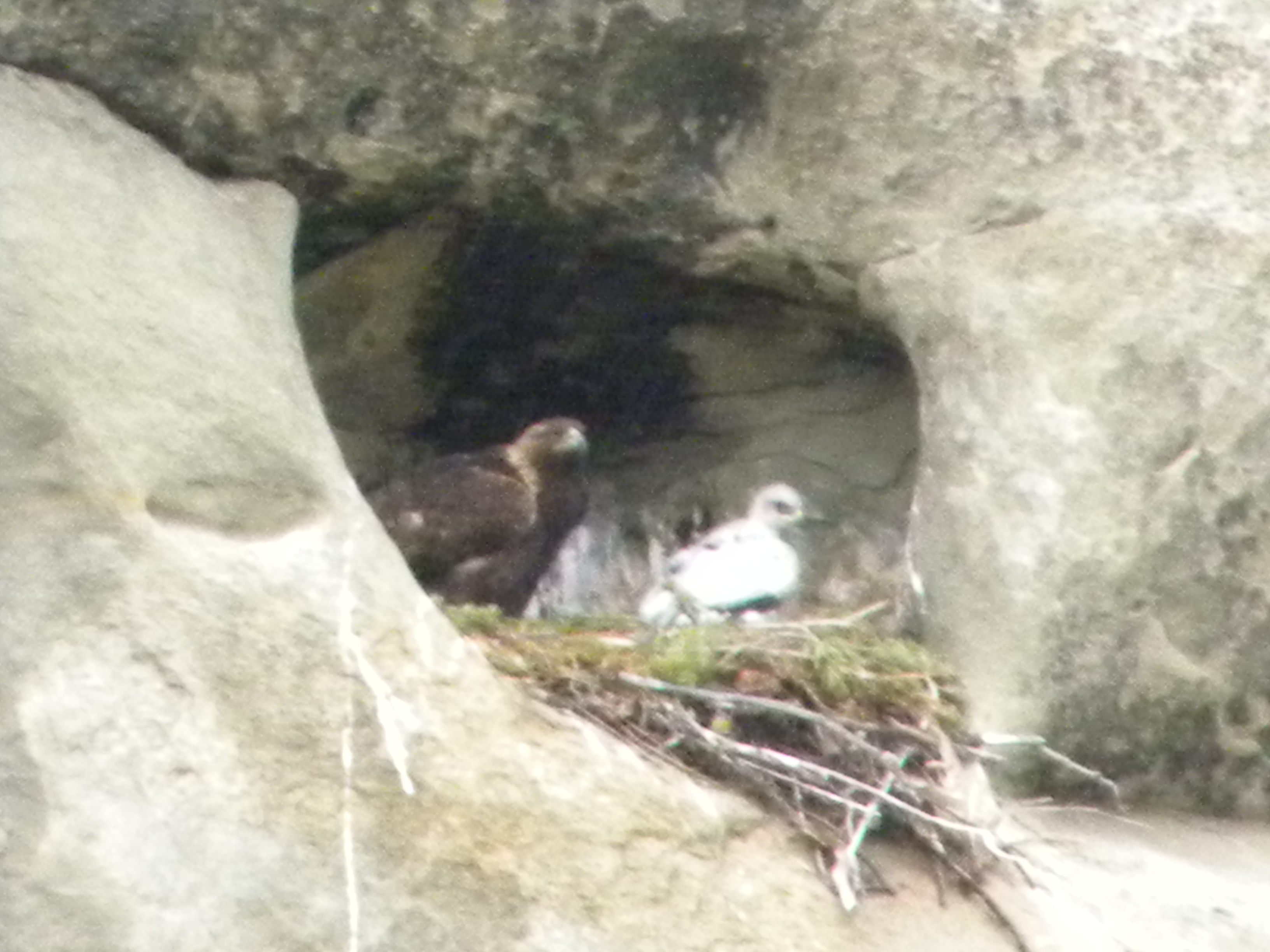
Golden eagle on nest with her young 3 week old chick

My teacher coined the term ‘Consideration’ (liberally interpreting the Sanskirt word ‘Samyama’)  to describe the action of pondering something so deeply that one combines with it completely.  By entering into this process (by deeply considering a subject from every possible angle) its truth would be known through thoroughly combining with it.

Robert Heinlein used the term ‘Grok’ in his novel ‘Stranger in a Strange Land’  in a similar way: Grok means to understand so thoroughly that the observer becomes a part of the observed—to merge, blend, intermarry, lose identity in group experience.

True knowledge and mastery of anything requires combining oneself, the observer combines with its subject.  It is not enough to be well-read on a subject, but one must completely be immersed and given over in order to master it.  Every profession requires this in order to master it, every art, even every philosophy or religion.  We must completely absorb every aspect of it, become fluid in it, become one with it to know it completely.

My experience and my wanderings in the natural world are like that.  Reading and study informs me, but it is only through continued direct experience and immersion, deep pondering and relaxed attention, samyama and continued consideration, that its secrets reveal themselves to me–slowly, ever so slowly over time.  That is why the Native Americans who lived here in times past were so intimate with nature.  They had combined so directly with the animals, the plants, the rocks and even the non-physicality of the world, that they had a supernatural and direct understanding of the world around them.  In other words, they grokked it completely.

Self-Portrait: With a saw I found on the Elk Creek trail

Goodbye to a long Winter

The snows are melting and although Sunlight creek is still not in the spring run-off phase, you can feel the weather breaking.

Last night it snowed lightly, but today its raining.  It’s a slow warm-up, but it’s coming.  My old neighbor who grew up in this valley tells me this was a normal winter in terms of snowfall, but I suspect its still not as cold as when he was growing up.  His wife says that -25 degrees was regular then.  Not now.

Several years ago I helped an elderly woman stage her landscape in order to sell her home.  Her husband had been a great friend of mine and fellow beekeeper.  Once he died Dorothy packed up the family home and moved to Idaho where her kids were. That was the year I bought my cabin in Wyoming and along with so many other strange coincidences, it turned out her father had been the Chief Engineer in Yellowstone from the spring of 1925 through the spring of 1930.  The last two years he was the Assistant Superintendent at Mammoth under Horace Albright  His name was Merrill Daum and the family had interviewed him and transcribed his memoirs. Dorothy graciously gave me a copy of the section from his time in the Park.  Here are a few of his stories of snow in those days:

There were no concessionaires living in the park in the wintertime.  They closed up everything.  We had to go down to Gardiner and Livingston to do our shopping.  We had cars and oh yes, the road was open.  We only had light snow in that country.  We could keep the road from the park open up to Mammoth with our own equipment, but from there on it was generally open.  They had a train running in there every so often, so many days a week, so we had train service at Gardiner.  So much of that country was rough and hot that the snow was not very thick on it.

I don’t know much about Middle Geyser basin.  It wasn’t a good place to stop and just put a road through to yell at Old Faithful.  That’s where we turned off from and went cross country to the Lake and Canyon or kept on going out to West Yellowstone or to Old Faithful.  We had ten cabins about every ten miles on the ranger patrol station because they would patrol all along that area, especially the southern part of the Park because there might be poachers come in to kill the game.  They’d go around in the winter time on skis.  That’s a long trip around that part.  Down towards the southern entrance there might be ten, twelve feet of snow.  I’ll never forget looking at one of the bridges; there was a stream going under and all that snow on top of the bridge.  One winter the bridge just broke.

The wintertime was mainly spent getting ready for the next year.  Then we had to get ready to remove the snow in the spring.  We started at Cody,Wyoming at the entrance.  About thirty miles from Cody up to the entrance.  We got as far as the Park with snow 12 to 15 to 20 feet deep.  We’d blast it out with TNT which Uncle Sam gave us.  That would start it thawing and then we’d take a big power shovel and shovel the stuff so we had a two-way highway through there to the east entrance of the park.  From there on we’d use our own equipment.  The deep snow was right there at the entrance.  That was the high point.  We’d generally try to get the Park open by the 1st of June.  By the 6th of June we were officially open, I believe. But you couldn’t make some of the interior trips that early.  It would be long in July before you could get away from the snow.

Here is a photo tribute to my 2010-2011 winter in Wyoming.  After this long and snowy winter, I think I am officially a Wyomingite!

The Basin in early winter from Dead Indian

This is a wolf howl machine, an experimental device to see if wolves are in the area

Two wolves side trot down the road

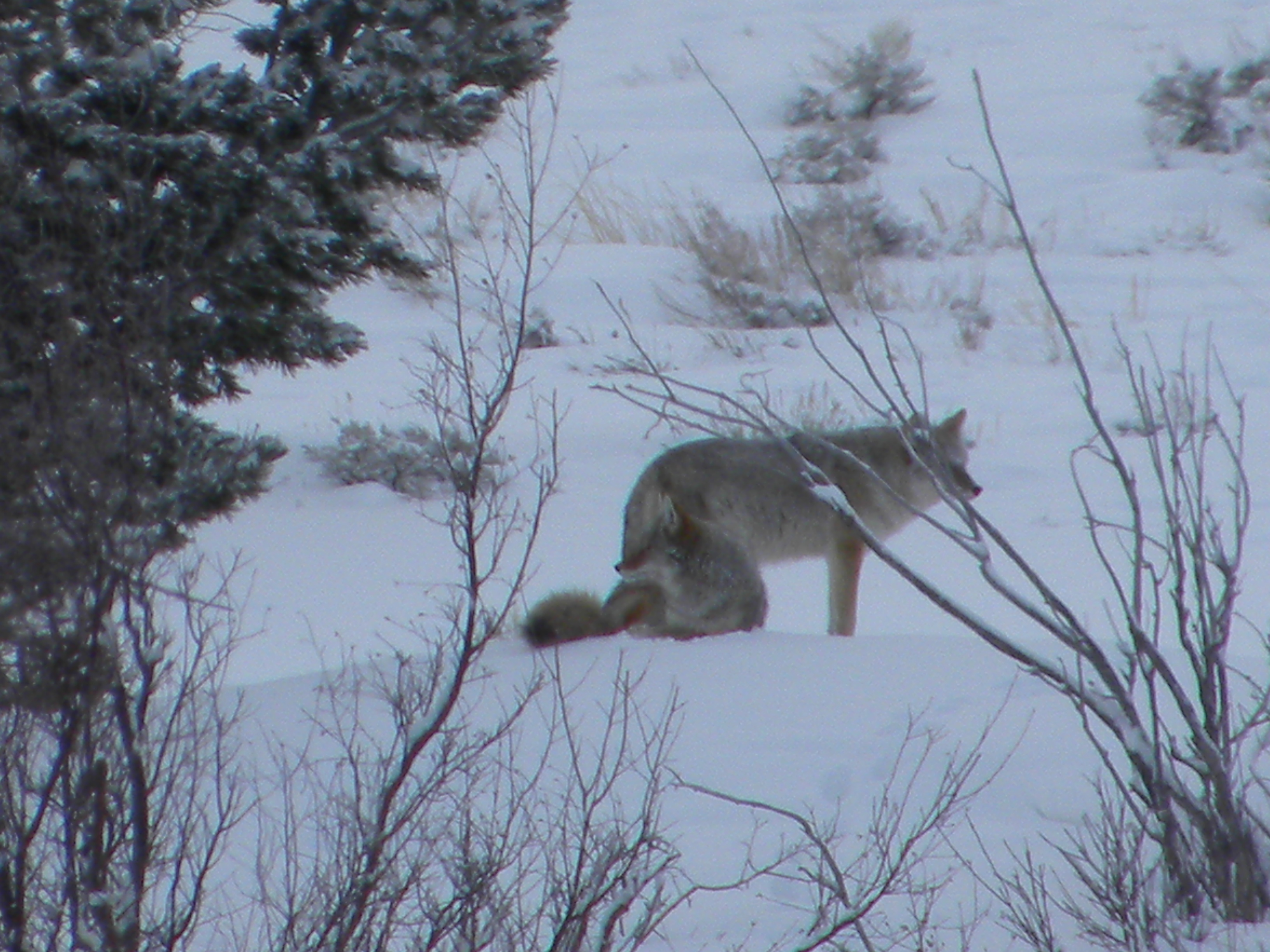
Coyotes on an elk kill

A coyote pair waits their turn on a nearby kill

The Yellowstone migratory herd resides in the valley in winter

Black wolf resting mid-day in the sun after a morning elk meal

Moose stands in deep snow

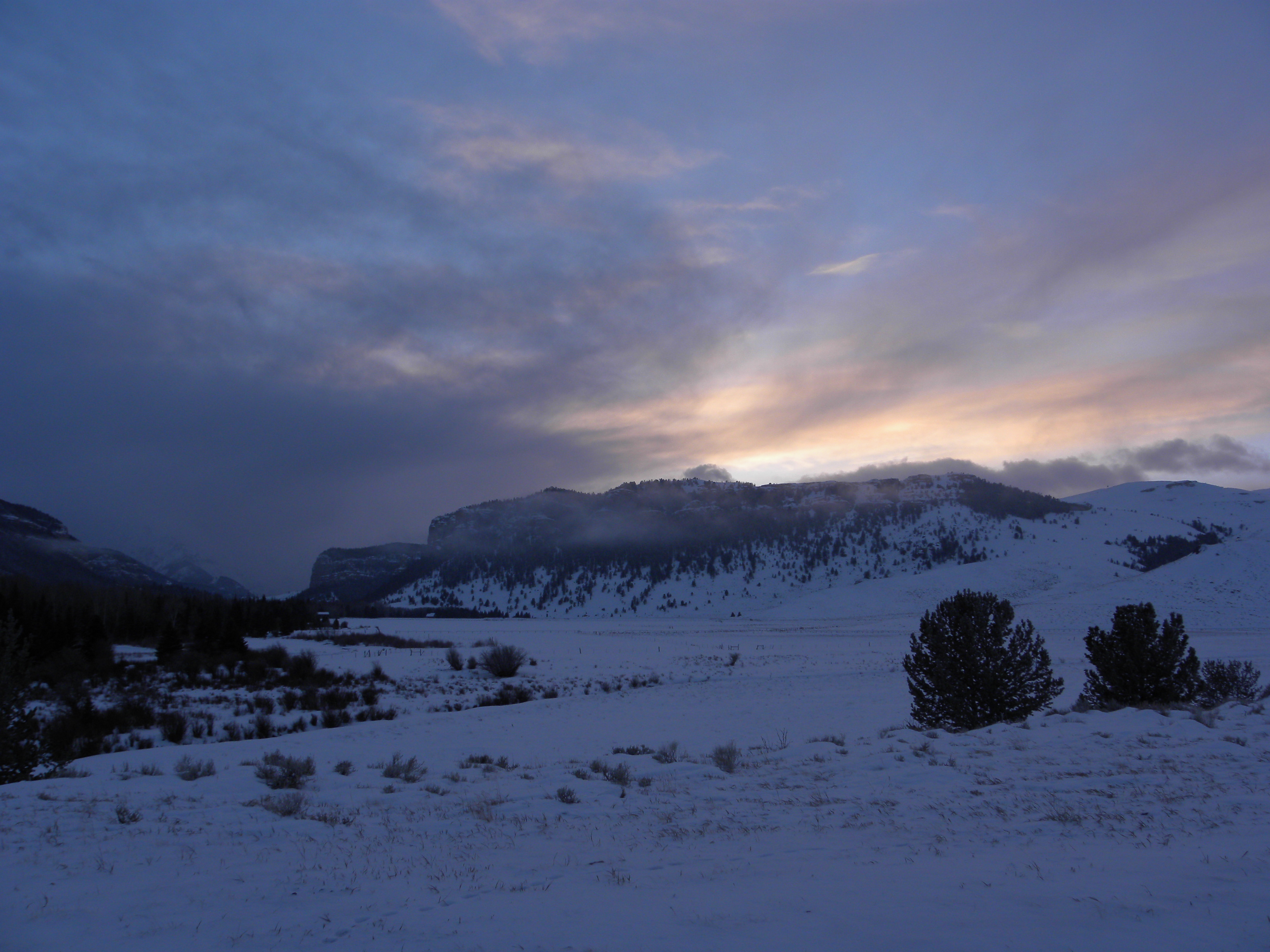
Sunset in a 2011 winter

After a day of skiing, dog tired


The Cave

Everyday spring flirts with the valley.  The last two days it snowed during the night, then melted off by noon.  Today was a glorious day with a bite in the air.  I awoke early to finish planting the 60 pine and fir liners (Thank God!  I’ve planted thousands of plants in my lifetime, but none so difficult as these in this ‘soil’ of rocks); then packed up my daypack to enjoy the rest of the day and the good weather.

I headed up a little used canyon looking for an elusive cave I’d heard references to.  I had an idea of the general area where it might be, but not the exact drainage.  There were many to choose from and I took a breath, glassed the possibilities, then used my sense and instinct.

Frankly, if I’d never found the cave, I’d have been just as happy as if I had, for it was the first time all winter I’d been able to really get out and hike without trudging through at least some snow.  There is still snow, in places in deep drifts, up in the higher areas around here.  And high up, in the Absarokas that separate the valley from the Park, white is the only color visible on the mountain tops.  The run-off still hasn’t begun and Buffalo Bill Dam is preparing by letting out water in anticipation of the raging waters soon to come.

Absarokas filled with snow viewed from near the cave

At the head of the drainage where the trees were thick, the dry creek separated into two channels.  I decided on the left, more narrow one.  As the creek steered left sharply, I saw a hole in the rock.  Right away it widened into what was obviously a massive lens-shaped cave.

View from the inside

The cave was a fantastic habitat, obviously used for thousands of years.  The dry creek probably wasn’t so dry many years ago, providing water to its inhabitants.  The cave was easily bigger than my own cabin.  At the very back of the cave was an old sifter, probably used for archaeological purposes.  But now, there were no artifacts, probably retrieved long ago by looters as well as archaeologists.  The pack rats had made a large nest in the middle of the cave, with freshly cut pieces of Douglas fir boughs and lots of old bones.

After exploring the cave and its environs for a while, I hiked up the right hand drainage to a frozen waterfall.

Frozen waterfall

To end a perfect day, on the ride home I glassed 8 rams resting on a barren hillside.

I am a Tree Hugger!

I can proudly state that ‘I’m a tree hugger’.  In Wyoming, that can be considered name calling and a put down.  But why?  I love trees and really, everyone else should.  Without them, there would be no shade, no cover for wildlife, no food nor shelter for so many animals.  Our trees high up near tree line provide protection from massive erosion and mudslides in the spring when the snow melts.  Limber, Pinyon, and White Bark provide nuts that we can eat too.  Trees impress and awe us.  Stand in an old growth Redwood forest or amongst ancient Cedars and feel their Presence.  Its is a humbling and quieting experience.

The future of our forests, in general, is in question with warming temperatures.  Yet I attempt to be an optimist when it comes to conifers.  Conifers were around before flowering plants evolved.  That’s a long long time.  Even with the planet warming, I suspect they’ll find places to retreat to and survive.  But for now, I’m doing my little part on my little patch of land,  planting trees for, hopefully, future wildlife.

This year the CCD (Cody Conservation District) had no Limber Pines (the species indigenous to my property) so I went ahead and ordered Pinyon Pines (Pinus edulis).  Its a gamble.  My forester friend says that they are out of their latitude and if they live, won’t produce nuts.  The University of Colorado says that they are reliable to 7500′, and maybe even to 9000′.  I’m at 6800′ but a higher latitude than Colorado. We don’t get the cold temperatures we used to so I’m counting on global warming to help them along.  It will be at least 20 years or more before they produce nuts, if they do.  Its a long term experiment!

Pinyon pines and Douglas fir seedlings--can you tell which is which?

I worried when I was planting them and wished the CCD had Limber Pines.  Its so rocky up there.  Probably 2/3 rock to a tiny bit of soil for each hole (these are small holes too just the size of tree liners).  And although I’ve seen Pinyons many times, I haven’t noticed them in granitic and limestone soils. But the UofC said they can take lean, dry soil on sunny slopes.

After I remove the rocks from the hole, I don’t have any soil to put back in. That’s why this year, in addition to my moisture crystals, I purchased some top soil to add in.

This is top soil? Very poor quality though its all that's available here

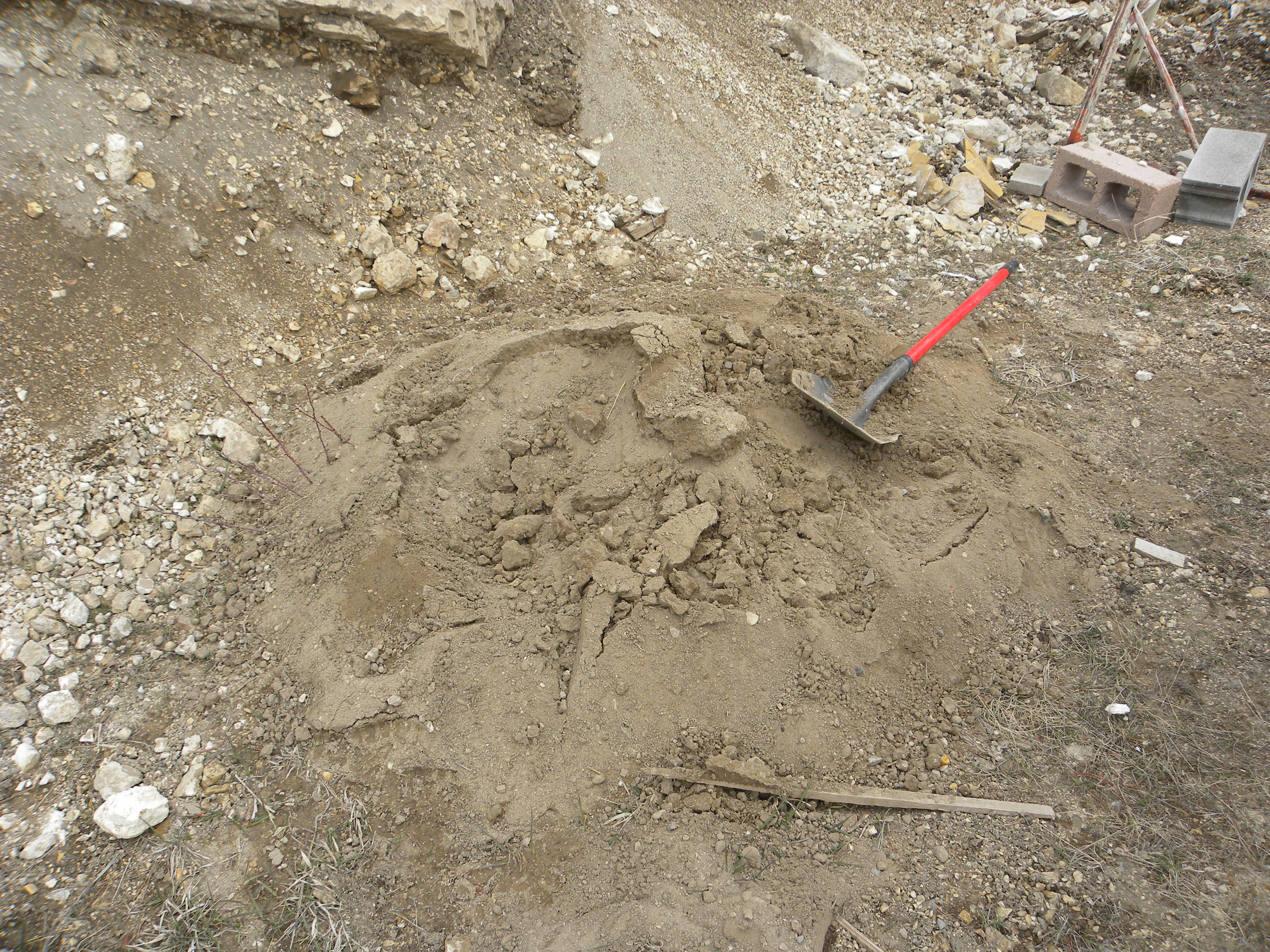
Yet I discovered another wonderful place to get soil, especially since we’ve had so much moisture this year–pocket gopher tunnels!  These wonderful little creatures tunneled under the snow and left nice rock-free dirt for me to use in my holes.  They are the rototillers of the Rockies!

Pocket gophers make these tunnels, not moles

Another thing I learned from last years planting is that the Limber Pines especially want a little shade.  Tree seedlings like the cover of nurse trees.  Since I’m trying to plant in the open where I had to cut trees down, I’ll use a bit of shade cloth on my pines.  The Douglas firs, for some reason, were a lot hardier.

I did good last year.  I figured if I had 50% loss then I was beating the odds, but after reviewing my seedlings today, I’d say I had more like 25%-30% loss.  That’s great!  I watered every 2 weeks last summer, but skipped a lot toward the end.  There’s no water up there and I was carting it up by hand.  That’s probably when I lost some, although a few were nibbled.

cages and moisture crystals

This year I’ve caged every tree (to prevent nibbling), and last years’ trees I’ll water maybe once/month.  Then, after that, on their third year, they are on their own!  I’m also going to feed last year’s trees with some nitrogen this spring.  I really like Maxsea 15-15-15.  Its a natural fertilizer that will never burn, but it’s not available around here.  So Miracle-Gro will have to do.

Sun energy and peak oil

I find this article very interesting:  Saudi Arabia, the biggest oil producer in the world with 20% of the oil reserves, is investing $100 billion in an energy plan focusing on renewables–wind, solar, geothermal, as well as nuclear.  The article states the Saudis want to use their oil for export and invest these profits at home, but I find that highly suspicious.  They wouldn’t want to alarm the world by suggesting the Ghawar oil field might have peaked, would they?

I believe in the theory of Peak oil (watch the video).  Peak oil doesn’t mean we all of a sudden run out of oil.  It means we run out of ‘easy oil’.  The U.S. used to produce all its own oil but oil reserves peaked sometime in the mid-70’s.  We still have oil, but now we have to drill miles below the ocean floor for it, or resort to oil shales.

Putting aside all the environmental concerns of our gluttonous addiction to non-renewables, oil prices are just going to go up, that’s a sure thing.  When it gets harder and harder to extract that gallon of gas, its going to cost more.  That goes for coal as well as natural gas.(again, watch the video)

My neighbor said to me, in response to the recent gasoline price hikes, “What are we going to do?  We can’t live without gas?”  And you know, she’s right.  When you start to take a look around, just about everything you see in your home environment was either made with gas or transported with gas or both.  When you get that, you understand the meaning of ‘Horse Power’ (HP), which is all we really had one hundred years ago.

Solving this problem will not be through a ‘survivalist’ mentality.  If we do attack it, (although it seems to me the U.S. is behind the times in really confronting it compared to the rest of the world), it will be through community, thinking small not big.  Putting miles and miles of solar panels on BLM lands in the desert is not the answer.  Putting wind and solar into every home is.

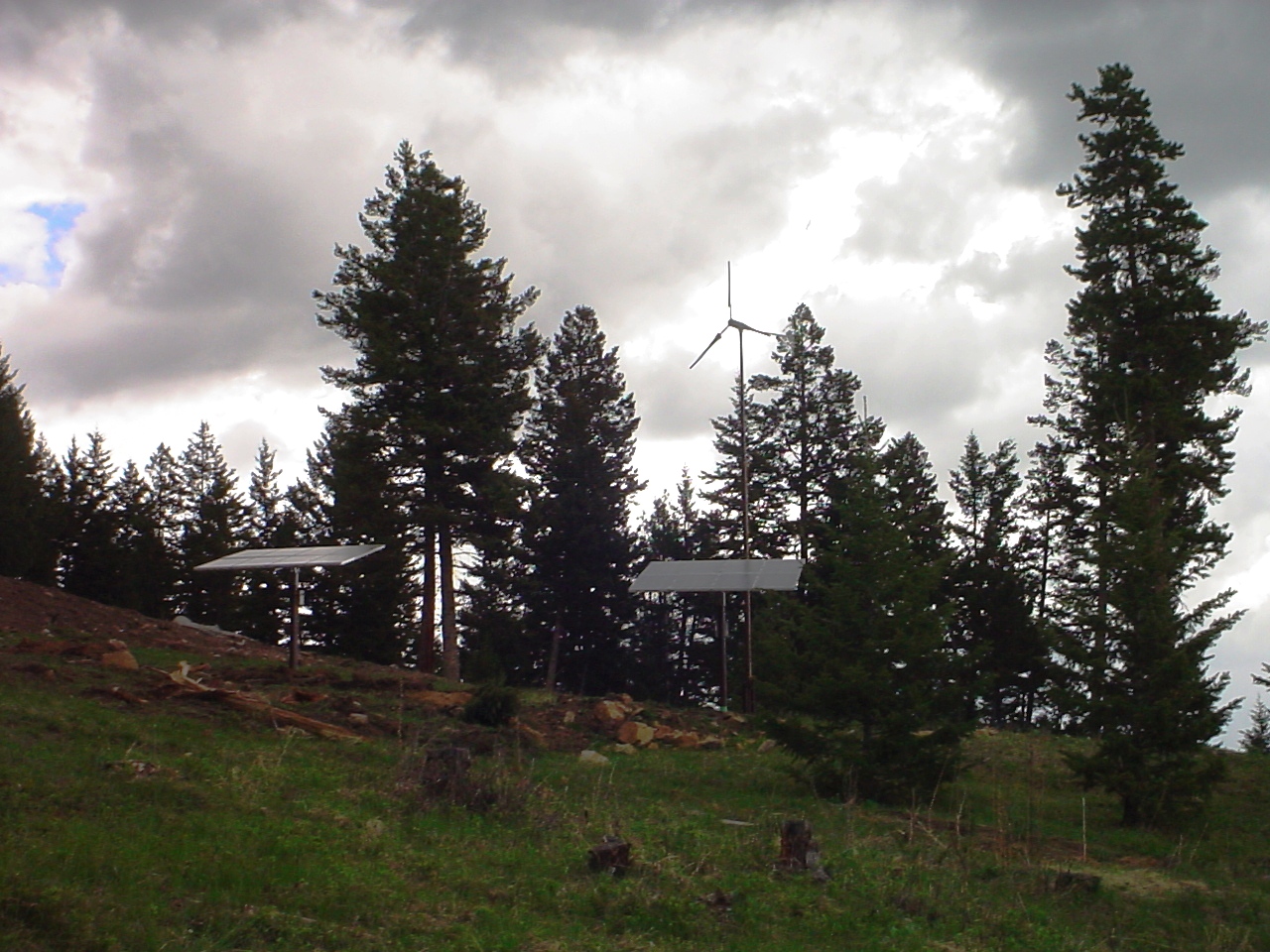
I’ve been initiating the process of installing solar and wind for my home this summer.  It’s only a small beginning really.  I live far away from town, so solar won’t help me drive there to obtain groceries.  Solar or wind won’t plow the road to town in the winter. It won’t stop the rise of food prices and using wood for heat (which I do) will become a lot more difficult when I have to fell trees with an ax. But with this beginning, I can later add on a solar greenhouse for winter food.

The Cody Enterprise had an article in this week’s paper about the local high school kids making biodiesel.  With a small grant, they’ve been learning hands-on about wind and solar as well.  In regards to their wind turbine installation, the teacher said “This is the first wind turbine installed in city limits. People may see us and see it’s a doable thing in Cody.”  I just might be the second, although I’m not in the town limits so maybe that doesn’t count.

But, like Saudi Arabia, the kids are thinking about our future.

Into the fold–working with Mother Nature’s garden

I’ve got big planting plans–at least for me, up here.  When I moved here, I was happy to NOT have a garden.  Don’t get me wrong, I love plants, designing with them and caring for them, but you know, it is work.  I grew hundreds of species of plants in my California yard for pleasure and to learn about them.  All professional gardeners, at least the good ones, need their laboratory.  I always said, it you haven’t killed dozens of plants and moved plants dozens of times, then you’re not yet initiated into the fold.

That being said, when I moved here, wild nature was my self-tending garden and Oh, what enjoyment.  It still is and forever will be.  But the itch remains, and I do believe we humans can be caretakers and tenders in a good way.  So this year, not only am I continuing the ritual of planting tree liners, but I’m adding a few things to my plant order.

First, the liners.  My elevation and environment is chock full of Limber Pines.  Douglas firs move in naturally in a process called succession as the pines die off.  Higher up on the ridges are the favorite nuts of the bears–White Bark Pine nuts.  White Bark Pines in the GYE are functionally extinct.  I think its about 70% are dead and the others are dying…first weakened and dying from Blister Rust and then the final blow is coming from the beetle infestations rampaging the West.  But the bears will resort to Limber Pine nuts (a favorite food for the Indians that lived around here as well) in poor White Bark nut years.  Limber pines are smaller, and more difficult to extract, but they’ll do to fatten the bears up.  But Limber Pines are also in the Whitebark Pine family and susceptible to the rust (a European import from the 20’s; we’ll say that’s NOT good tending and caretaking).  The beetles are killing the Limber Pines as well.

A beautiful windswept Limber Pine in the Clarks Fork Canyon

My understanding of White Bark Pines is that it takes 50 years before they make seeds!  Wow.  Probably Limber pines are similar.  So I’m trying to replant seedlings now for later with the hopes of them being around when I am not and helping future bears.

One note of worth is that my two oldest limber pines on the property, probably 200-300 years old, were riddled with beetles last summer and I wept.  Beetles like older trees.  Neither are red-needled yet so I’m dancing with prayers around them metaphorically.  One is questionable as 1/2 of it is dying, but the other, the very oldest, so far is good.  I put up a painted elk skull on it last spring to ward off evil spirits and evil beetles.  Maybe it worked.

I order my ‘liners’, essentially seedling trees about 2″ tall, from the local conservation service in town–30 in a bundle.

Last years liners Douglas firs and Limber pines

Last year they told me they didn’t have my Limber Pines in stock, but at the last minute they found some.  This year they definitely don’t have any.  So I am trying a BIG experiment.  I ordered 30 Pinyon Pines.  They say they can make it at this altitude (for sure I’ve seen them higher up in lower latitudes in Nevada), and since our winters are not as cold as they used to be, I’m giving it a shot.  Good nuts for bears in the future.

Polymer crystals are an essential when planting in dry areas without irrigation

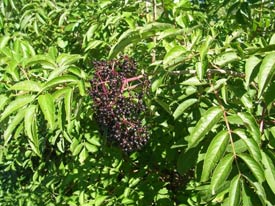
But my old gardening bug seems to be itching, and I’m purchasing 5 bare-root elderberries from the nursery, as well as, get this, 2 plum trees.  The plums are a big experiment in Bear country.  I am not crazy enough to plant apples, but my neighbor has a pear tree and not only gets pears but the bears don’t touch it.  So I’ll try two plums and see how it goes.

As for the Elderberries, they are native to around here, both black and red.  When you see them in moist locations, the deer keep them munched all summer to around 2-3′!  Elderberries can grow 10′ tall.  We have a riparian area, and I’m going to plant and cage these from the deer.  Supposedly the variety can get 10’x10′, so after 5′ I won’t have to worry.  Good food for me, the birds and the bears.

More great, reliable plants for California landscapes

Here are a few more of my favorite plants, easy, reliable, and striking, and different than the usuals out there.

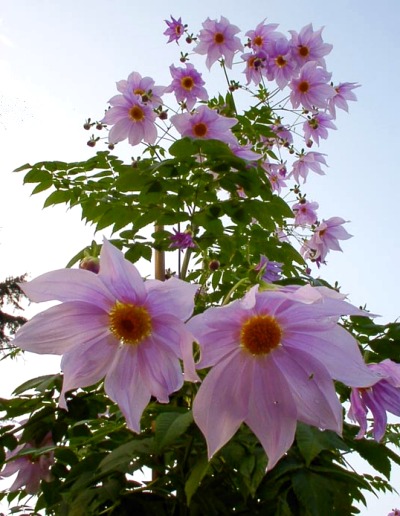
Tree Dahlia

Tree Dahlias grow 10′ tall in one season and bloom late in the fall.  Sometimes an October storm will knock off the blossoms.  But you don’t have to grow this Dahlia for the flowers.  The exotic tropical looking foliage will be a show stopper.  Cut to the ground in winter, it grows fast as soon as the earth begins to warm in the spring.  Comes in white, and rarely as a double flower.  Takes full sun and low water.  Forms a fantastically large tuber.

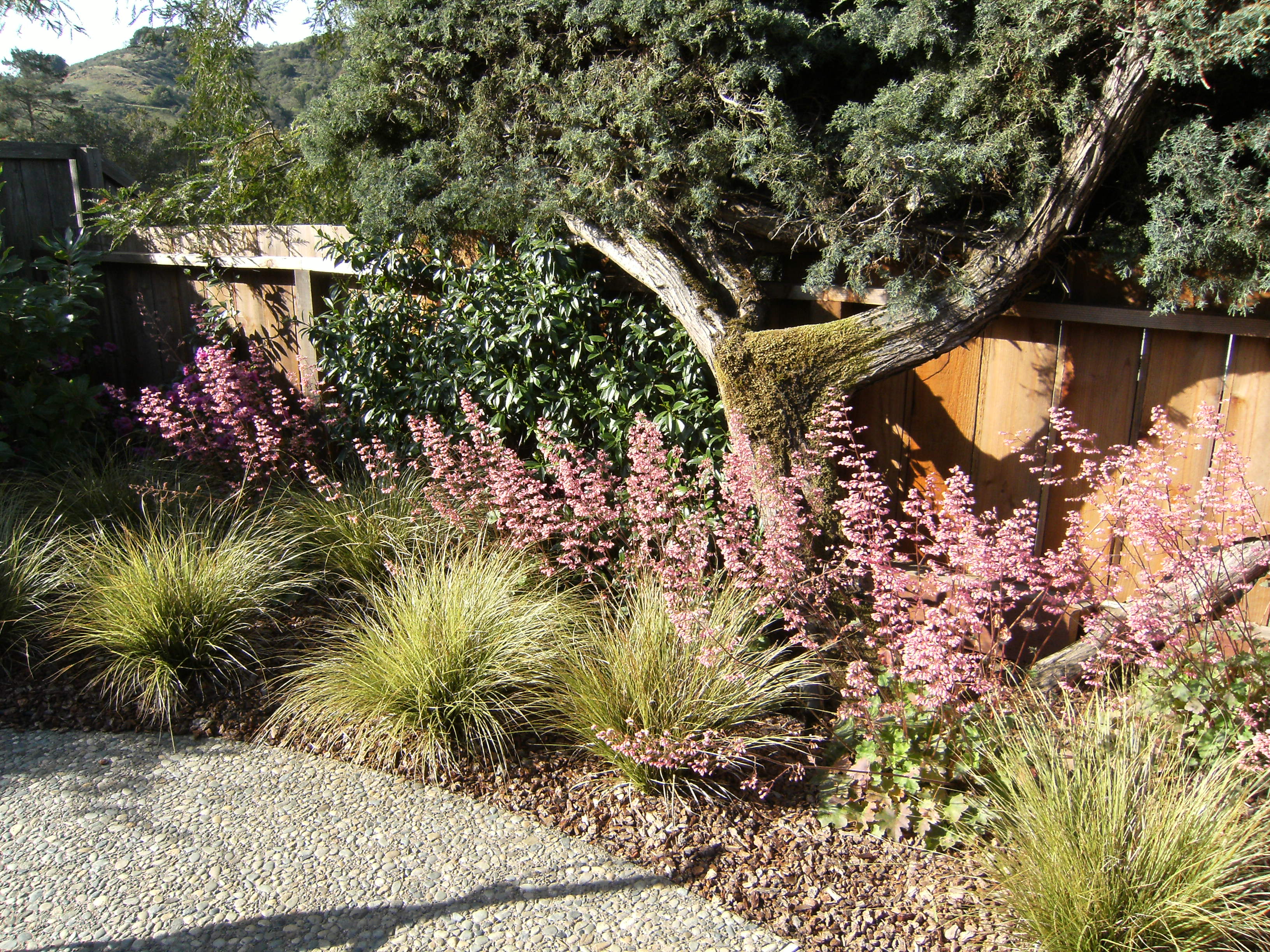
Heuchera 'Wendy'

My favorites of plants.  Heuchera ‘Wendy’ was pioneered by Rancho Santa Ana Botanical Garden, a cross between our native Heuchera maxima and Heuchera sanguinea.  I feel that ‘Wendy’ is the most spectacular of the cultivars (there are several out there).  Flowers are light pink-peach, very tall, and bloom endlessly and profusely.  The plant is tough like our native Heuchera, taking low water, dappled shade.  Put this in one of your more difficult dry shade spots and let it sing.

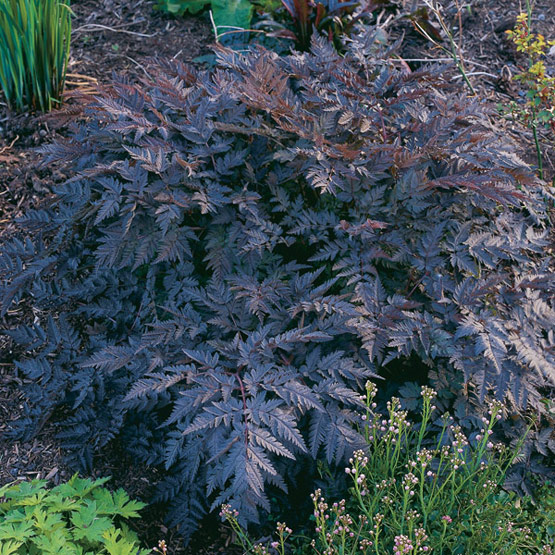
Anthriscus Ravenswing

This plant is actually a Chervil.  A low plant for shade and average water, it provides striking contrast in your combinations.  Difficult to find but very easy to grow.

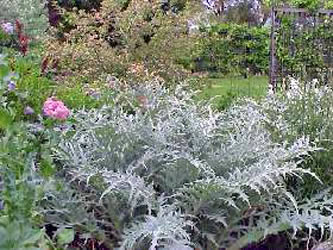
Cardoon

Wow, I love this plant.  Obviously drought tolerant, people will gawk.  Its large, bold leaves offset pinks and purples for contrast.  The thistle purple flowers in the late summer I feel take away from what I grow this for–the leaf structure.  If you let it, it will reseed generously and you will have these as long as you want.  Just transplant the seedlings where you want them and give away the extras to friends.

Crocosmia hybrids

Crocosmias are such underused bulbs.  They are heat loving, low water, summer blooming stunning flowers.  ‘Emily McKenzie’ is one of my favorites, with the double advantage of smoky foliage.  And they multiply, like bulbs do, easily.  They bloom late summer for a long time.

Epilobium californica and hybrids

These are still Zauschnerias to me, but the splitters long ago put them into the Genus Epilobium.  A wonderful California native, they bloom in the fall and are either no water or low water.  They come in different heights (6″ to 36″), some have grey foliage, and are a magnet for hummingbirds.  Can’t be beat.

More Mountain Goats of the Clark’s Fork Canyon

I took a leisurely hike the other day with a friend.  I wanted to return to a circle of rocks overlooking the Clark’s Fork Canyon and the river below.  The rocks were piled on a boulder precipice, a strange place for them.  They were large, obviously put together by people, big enough for one person to sit inside and get out of the wind, but made no sense as a blind for hunting or a camping spot.

Rock circle big enough to sit in

My neighbor had once told me he’d found places among these rocks at edges where Native Americans had made smoke signals.  I thought I’d take some photos of this rock circle and show it to him.  As I was photographing, my friend noticed a trail down to the river.  Its almost impossible to get down the sheer cliff walls most places, so this was a great find of a fairly easy access spot.  Maybe the rocks were cairns marking this?

We noticed two goats, a mother and her yearling climbing up the rock precipice nearby.  This was unusual, because both of us had only seen goats on the other side of the canyon, and in more inaccessible places.

Mother goat looks back to her yearling: "Catch up" she says.

We tried to travel out of their way and hiked through a small gully.  Looking towards the end of the swale, we spotted about 15 goats, happily grazing on the flats.  I was surprised at the size of the herd and the fact that they were hanging around, not on the cliffs, but on the bench.  Still, we were close to the very edge of the plateau; an edge that suddenly drops 1000′ feet straight down.  That’s what they usually like.  

I took some video you can watch here.  The wind was howling so the camera’s kind of shaky.

We watched the goats for a while, found some of their fur as they’re shedding now, and ate our lunch overlooking the canyon near the edges they love so much.  Those goats aren’t native to here, but they are Rocky Mountain goats, and this is the Rockies, so… go figure.

The Old Old Road

I’d heard about the route the early homesteaders and miners took into my valley.  Dead Indian Hill, the only way to get to Sunlight from the plains below, is an 8800’ pass.  It took a good two days to negotiate the trail, essentially an old Indian and game route.

The drainage beginning at lower right of photo and moving up to upper left marks the Old Old road.

The pass at Dead Indian forms a huge windswept meadow.  During the winter, up until quite recently, this area was impassible.  I just recently read a book about a forest service ranger in 1956 living in the valley year round with his family.  On valentine’s day they decided to brave the drive over Dead Indian pass for a get-together dance with other forest service employees.  It took them over 12 hours to get to Cody.   At the pass, they repeatedly had to hook up their come-along to wooden fence posts that weren’t covered by snow, and pull their car out of a drift.

At the top of the pass looking down into the valley, its’ a 2000’ drop, pretty much straight down.  The homesteaders would fell a tree at the top as heavy as their horses could drag, with all its limbs and branches, and chain it to the wagon axle before starting the descent.  This kept the wagon from running away.  I heard you could still see the old logs piled at the bottom of the hill.   Indian hunting parties also used this trail.  In those days thousands of pony tracks and travois marks were still visible.

The timeline was still sketchy for me as to all the road improvements, but I understood that around 1905 some of the residents living north of Dead Indian asked the county to help with improvements on the road.  The spring muds made for a treacherous ride.  The money was approved and a passable upgrade, an actual dirt road instead of a trail, was built, mostly by the residents in the valley.  Painter Ranch pitched in with a four-horse team, a breaking plow, and one man, and Al Beam did the same.  Miners who had claims in the Valley helped blast rocks.  By 1909 the new grade was completed, with a series of switchbacks especially on the lower end of Dead Indian.  This dirt road (with improvements added in the 1930’s) was used for the next 80 years until the early 1990’s when a paved road was constructed.

View of improved 1909 old road

I wanted to walk the old old road.  (I began calling the original game trail ‘the old old road’, while the 1909 road was the ‘old road’) The old 1909 road is easy to find.  It’s still in fair condition.  But the trail is a lot more difficult.  Its been over 100 years since it was used.  A good game trail still runs through the creek drainage and you can see the old old road follows it.  But then the game trail turns southwest up into another drainage.  At that point I couldn’t see where or even how a team of horses could go up the steep hillside.  I decided to head up to the old road.   I had to marvel at all the work.  It really was a pretty good road that required cutting into the hillside some, and all by hand and horsepower.

The old road is now what the game use.  The ‘ponies’ of today was the evidence of hundreds of elk and deer tracks.  I rounded a corner and found an old cow elk winter kill.

I hiked up to a large meadow where the road petered out.  This probably was the end of the 1909 improvements.  From here the old road may have hugged close to the paved road of today.  I headed back down, keeping an eye out for where a wagon might have veered off.  Pretty soon, I came to a gently sloping meadow and followed it, leaving the old road.

The meadow ended by a fairly steep slope, but I could see a series of young trees marking the width of a wagon.  Old ruts were even somewhat visible at times.  This was ‘the beaver slide’, where it got so steep they had to use the logs.

Notice the young trees. This is the view looking up of the beaver slide. Imagine a wagon pulled by a horse team, fully loaded, coming down this steep grade, especially in mud!

I hiked down, following a trail of young trees hugged on either side by mature trees.  Wow, I could barely imagine going down this grade with a team of horses.  At the bottom of the slide, a small meadow opened up above a fork in a dry stream.  This was the fork I missed before, where the drainage splits.  I had read descriptions of taking a drink from a crystal clear stream after the beaver slide, where the logs were unloaded.  This must have been that stream, now gone and dried up.  Lots of old dead trees were scattered around the open area.  I wouldn’t say they were piled, but upon closer inspection you could see they’d been chopped with an ax.  Here it was, the logs that had been cut by those old timers to prevent run-away wagons.

Logs cut with an ax to keep wagons from sliding down hillside

I was surprised how much of an impression this hike made upon me.  I felt the history of the place enacted before me…the cut logs holding back the wagons from tumbling down the hillside; the herculean efforts of these men to build a better and safer road with only man and horse power; the old trail used for thousands of years by Indians on foot and later with their ponies.  Though I was the only one walking these trails today, the stories and ghosts of the past walked beside me.