• MY BOOKS ON WILDLIFE, GARDENING AND MORE

  • The Wild Excellence

  • True stories of wildlife encounters around the Greater Yellowstone
  • Award winning eBook on Decomposed Granite, tips, how to's, what to watch for
  • Children's book. True stories of a dog and wolves. In a dog's voice
  • Written for dry Mediterranean climates in California, north and south

Ancient Buffalos in Sunlight

I’ve walked this drainage at least fifty times.  Its right next to my property, filled with old dying and dead aspens and young conifers. The forest service plans to cut, clear, and burn here within the next few years to encourage new aspen growth.  Its a narrow cut of a ravine, right next to the main dirt road, but hidden by shrubs and trees.  The moose hide there and deer rest inside its cover.  Basically, with all the dead fall, its a mess to walk through and few people do.

Since its low and north facing, its been full of snow all winter.  I decided to see if I could walk it, just for fun.  I enjoy its secretive quality, just like the animals do.  I needed to stay on the high south facing side to avoid the snow.  Maybe because there has been so much moisture and the slow spring melt heaves the ground, or maybe because a newly fallen tree revealed secrets underneath, I came upon an incredible find.  There, in full view, all above ground, was an ancient bison skull.  You could see it had been mostly buried by the discoloration, but it was laying as if waiting for me now.

I hauled it home, not more than 1/4 mile, but it was certainly heavy, even though it wasn’t complete.  I showed it to my old neighbor, who grew up here.  “That’s an old one.  I’ve found a few, but none with as much horn as that one.”  I told him how I’d walked there many times and seen nothing.  As if in agreement, he said “One time I was working around Spring Creek.  I’d been in this area hundreds’ of times.  But this time there was a horn sticking up from the creek bed.  I pulled it up and there was the buffalo skull.”

These finds are gifts from beyond.  I never go hunting for finds like this.  If you do, you never encounter them. They are given to you, for whatever reason.  Maybe for you to remember, to dream, to respect, and to encourage you to do the work and the magic to protect our inheritance.  I still dream of the day when bison will roam again in Sunlight Basin, even if only on the nearby ranch, replacing those funny looking bovines that reside there now, which the wolf packs in the valley can so easily pick off in the summers.  And I long to get a glimpse in my lifetime of tremendous herds once again on prairie lands.  I believe we all, together, can dream it back into existence.

Back of ancient Bison skull

Ancient bison skull. This is the front all eaten and eroded away

Map of Ancient buffalo drive area on the nearby 2 dot ranch

Stories from the field

Since last September I’ve been having troubles with my Bushnell trail camera.   After one year, the infared pooped out.  So I sent it in under their 2 year warranty.  Finally after 6 weeks, they sent me a replacement.  But come to find out they’ve been having troubles with their 2010 models and my replacement was defective.  So they sent me another replacement, which also was defective.  I decided to wait an extra six weeks for their 2011 models.  Finally one arrived last week and I’ve been anxious to use it.

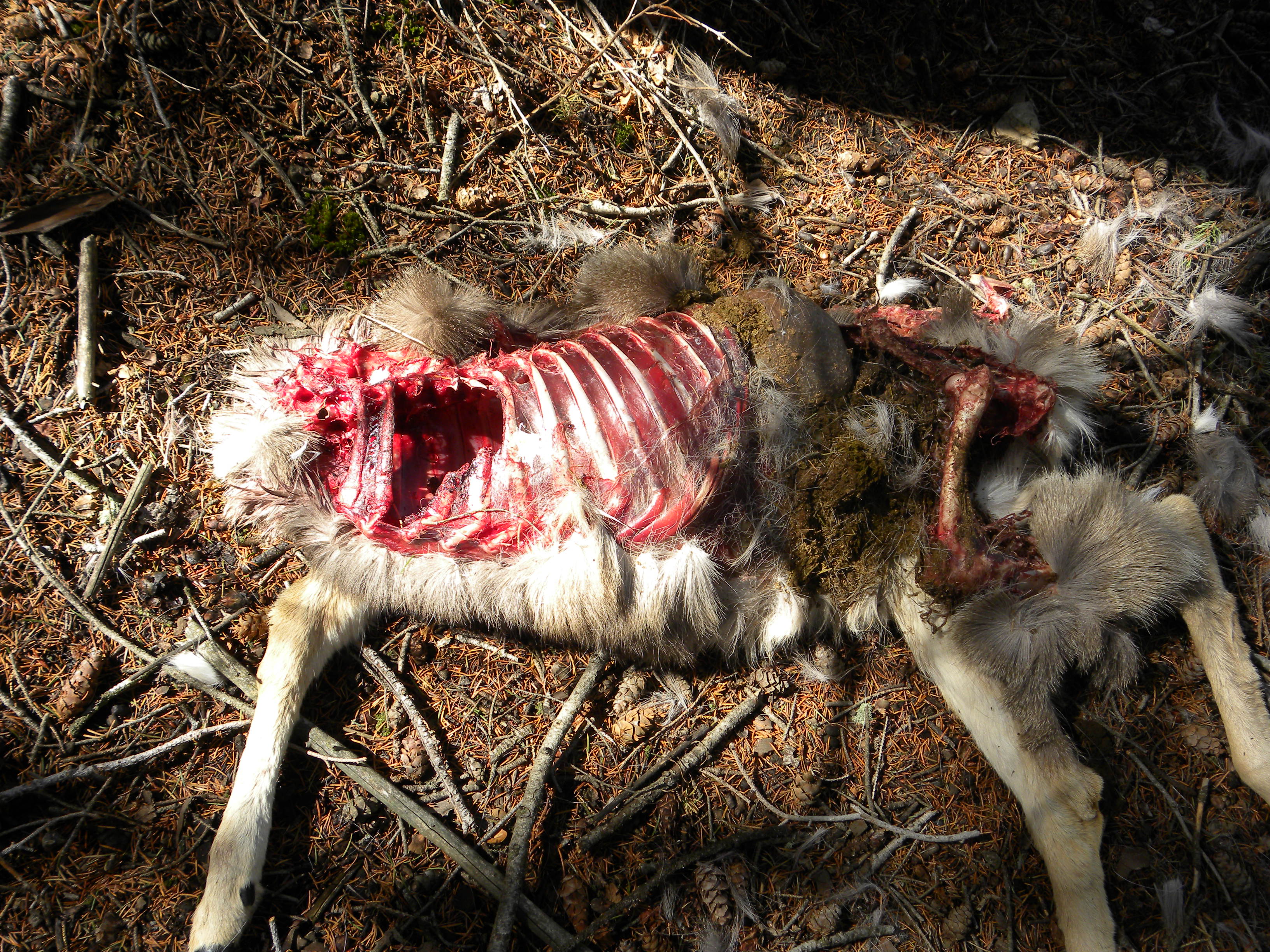
The other day I came across an odd deer kill at the meadow/forest interface.  The deer, lying on its side, had all its fur torn off on one side, a hole in its ribs, and its organs eaten out.  Its head was missing and no where to be found.  Other than that it still had lots of meat on it, the rumen was still there and it didn’t show any disturbance in its hindquarters where wolves and coyotes usually bring an animal down.

Only a hole in the ribs and the organs were eaten

The days are warming up and I’ve been sure the bears are out and about even though I hadn’t seen any sign yet.  A neighbor five miles down the road saw a grizzly last week.  I put my third replacement trail camera on the carcass and left it there for a week.  I didn’t want to disturb it much as I was afraid of running into a bear.  When I finally approached to check things out, I took my bear spray.

Lo and behold, the carcass was completely gone.  Nothing left.  I went to retrieve the trail camera and the infared cover was bashed in, like it had been pummeled by a rock.  This was perplexing.  Could a person have moved the carcass, then sent me a message about putting my trail camera on it?  Sounded weird but why would an animal move the carcass and bash my trail camera?

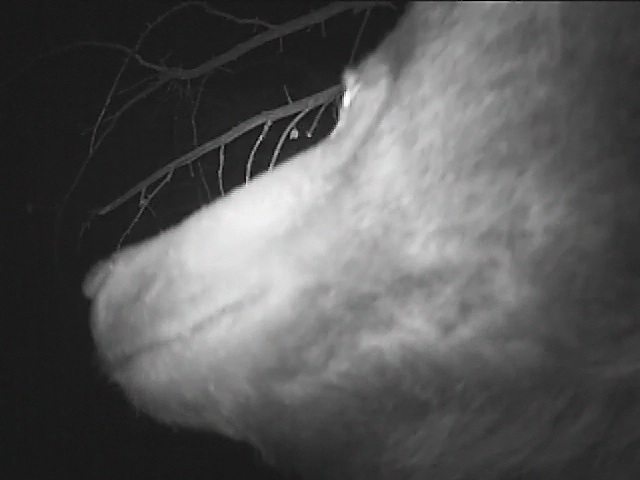
Bear eating my trail camera

The SD card was still in tact so I loaded the movies onto my computer.  I figured maybe my last photo would be the photo of the person who vandalized my camera.  Well it was there alright.  The trail camera terrorist was a bear!  (TO SEE THE WHOLE VIDEO WITH SOUND GO TO HERE)

Oddly, he decided to mess up the camera first before dragging the carcass up the hillside and far away as possible from my dogs on the other side of the meadow.  Bears are a curious lot and this just goes to prove it.  I’d been thinking it was some malicious person when it was just a curious bear, or maybe a smart one who didn’t want to be on camera.  So much for the new trail camera.

I don’t think the bear is the culprit who killed the deer, and I’m still wondering about that.  In the meantime, I better order a bear proof model for my next camera.

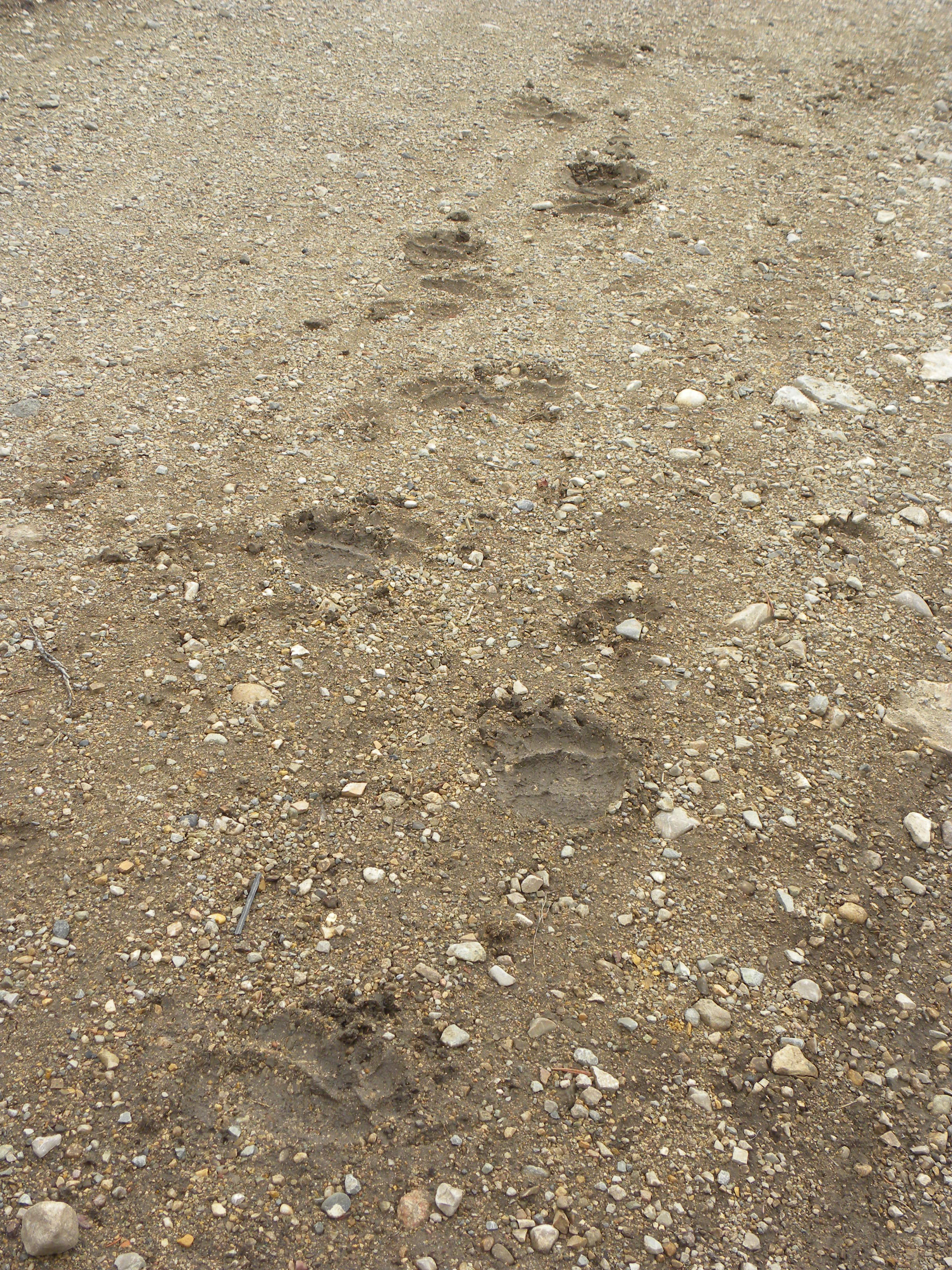
Bear ambling along. Is this my bear?

Moose, wolves, and a false spring

Yesterday was another glorious early spring day.  Some friends came up and we took a drive north towards Crandall and beyond, as far as the road is plowed.  The lonely 11 or so miles between Pilot Creek, a parking pull-out for snowmobilers, and the NE entrance to the Park won’t be open for another 5 weeks yet, but they’ll have a lot of plowing to do.  There is still an incredible amount of snow everywhere.  It will be a while before you can hike the backcountry.

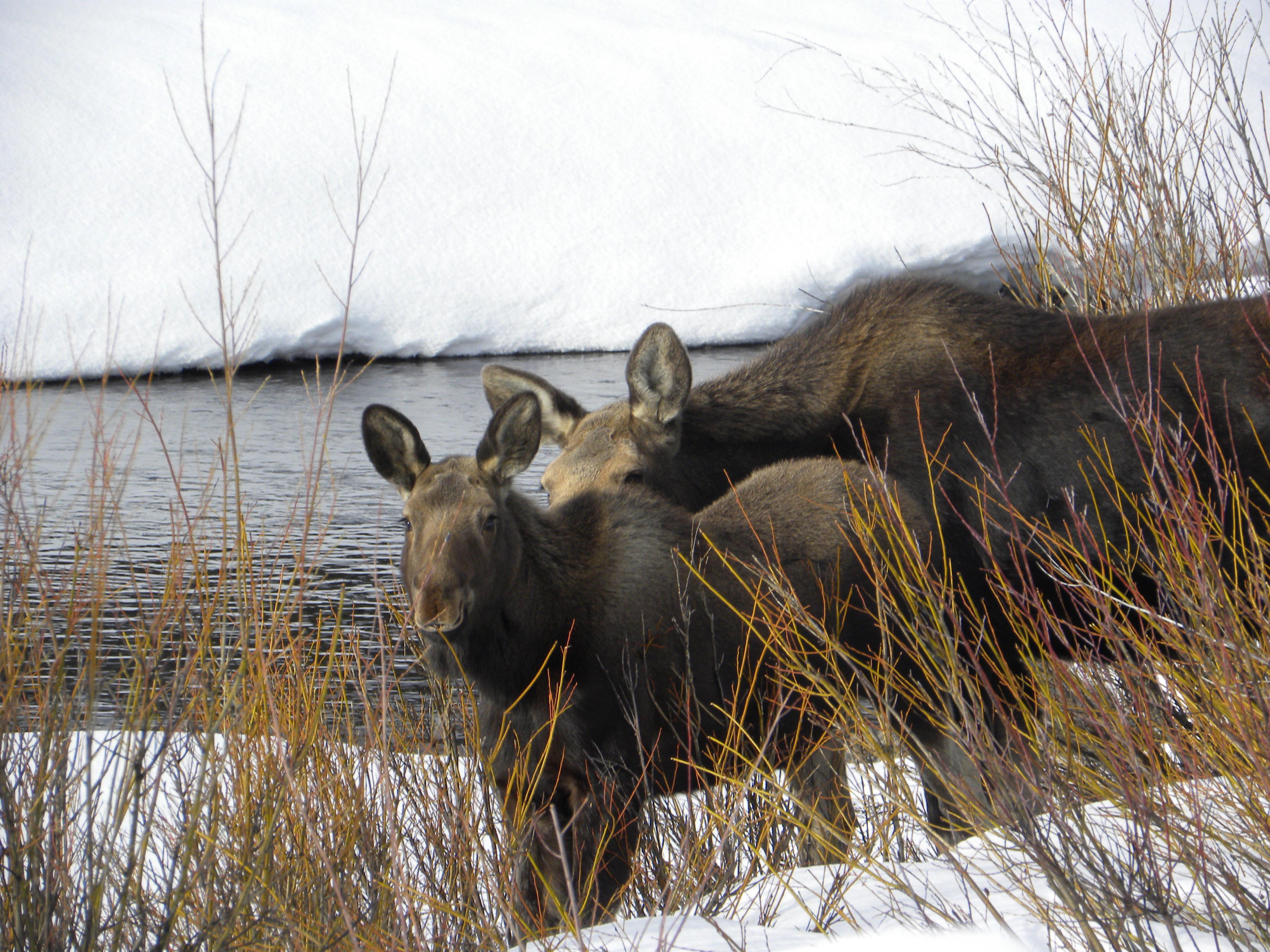
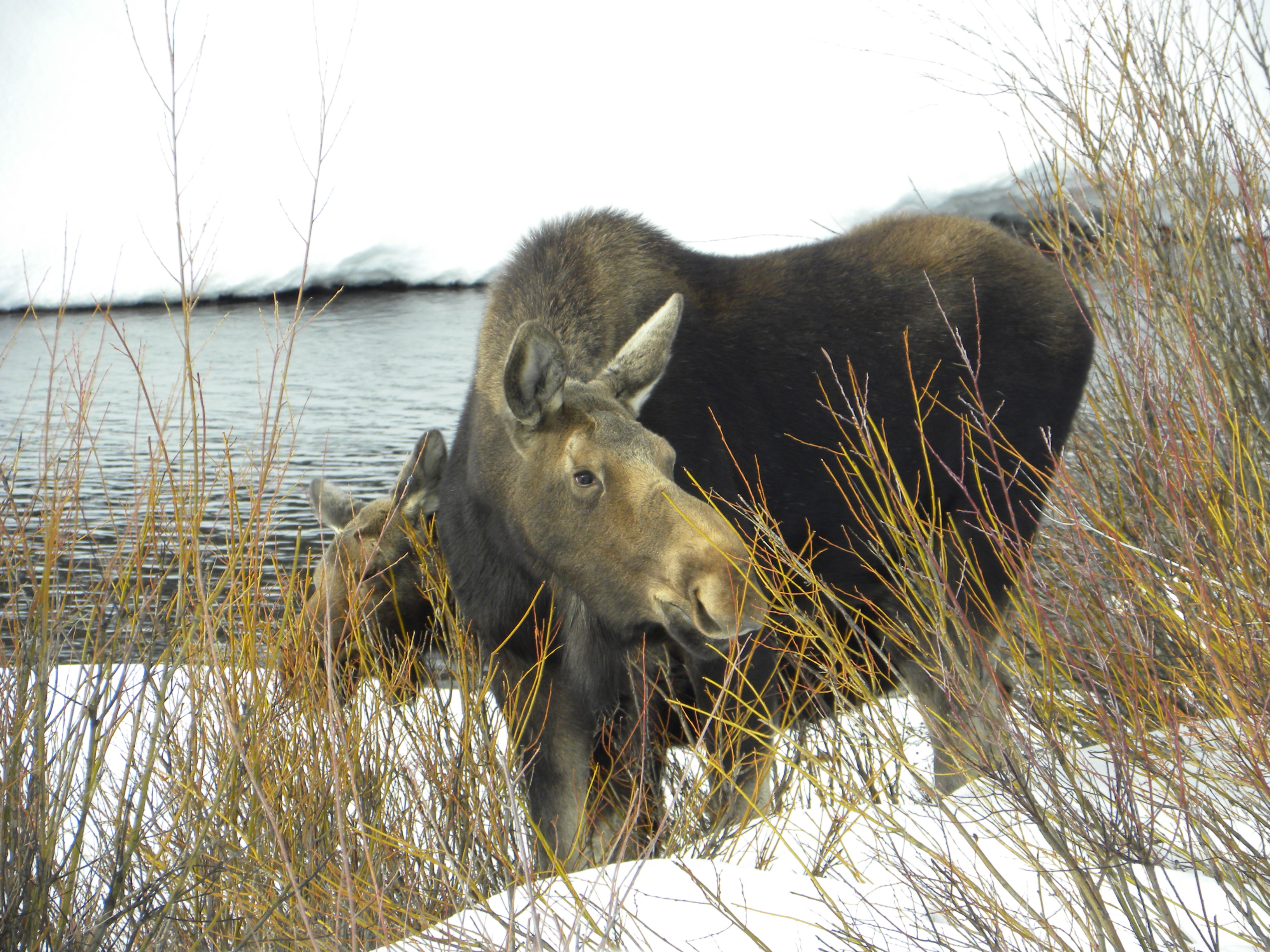
As the snowmobilers raced past us to begin their expensive thrills, we idled along looking for wildlife.  The banks by the side of the road have melted but still an easy 4′ high.  This gave good cover for a moose and her calf just on the other side of the highway along the Clark’s Fork River.

Mama with yearling


Because we could barely see over the snow bank, we quietly got out of the car to take photos.   Mama and baby kept browsing but mama moved between us and her calf.  What a good mother.

Mama Moose moves between us and her calf

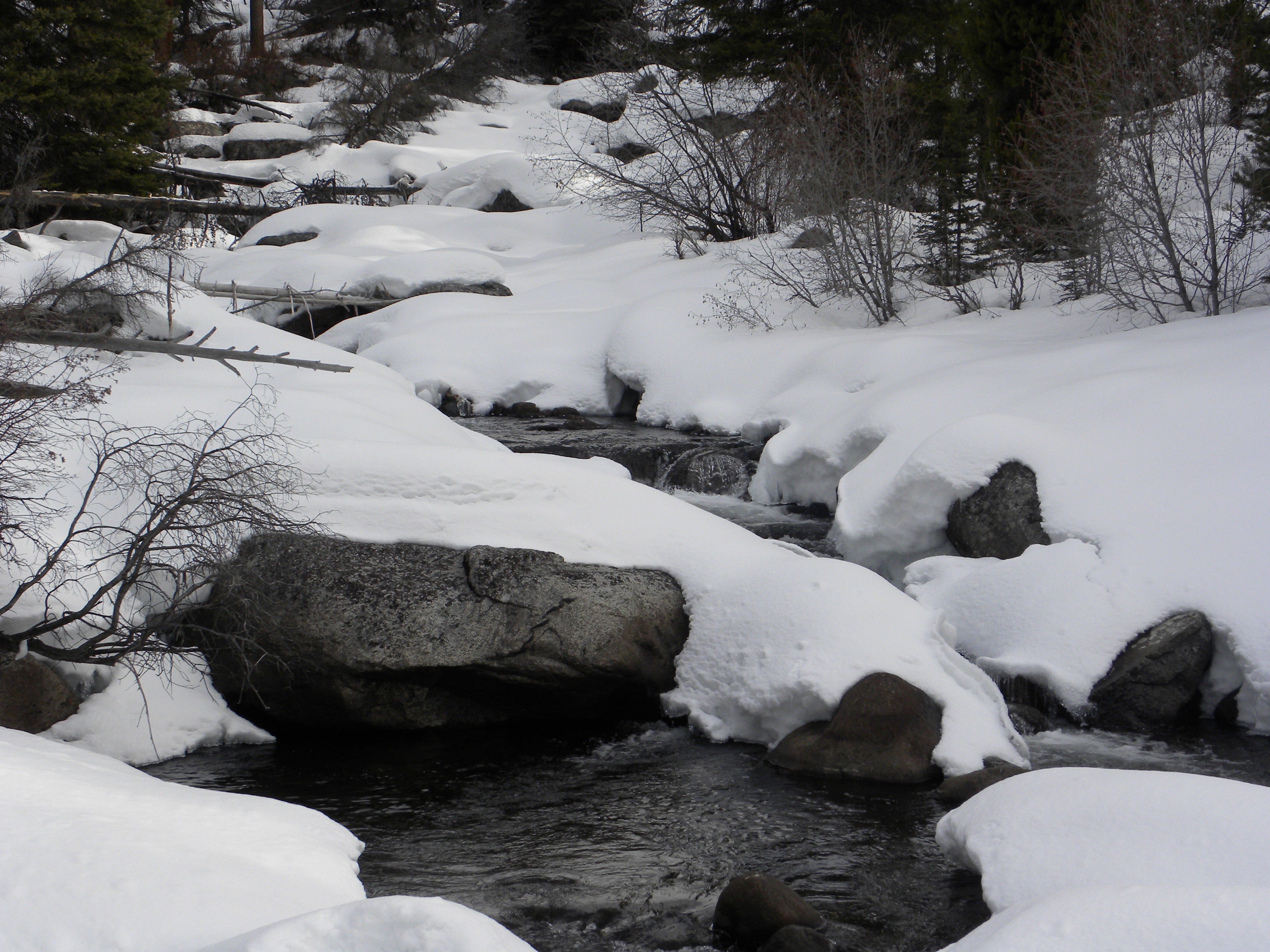
On the way back I shot a photo of Crazy Creek, still solidly covered with snow and ice.  This creek, in a few months, will be an awesome volume of water.

Crazy Creek March 2011

Almost back to Sunlight, I asked my friends, who come up regularly on weekends, if they’d seen any wolves this winter.  They are avid photographers and would like a good shot.  They told me they hadn’t.  Not more than two minutes passed when we spotted 2 wolves by the side of the highway.  This was a most unusual sighting.  Almost 11:00, I’ve almost never seen wolves hanging so near the main road.  There were elk up on the hillside, along with deer, not too far away who didn’t seem too perturbed.  Two wolves would be hard-pressed to bring down an elk, so I suspected there was a kill higher up on the hillside, or possibly down below where they were wanting to cross to.  A big grey sauntered quickly up the hill and out of sight.  But a beautiful black loitered long enough to take some good photos.  Wolves I’ve met always seem intelligently curious.  This one certainly was.

After I came home and my friends were gone, I noticed a yearling moose walking back and forth along the fenceline across the road where the horses are.  The fence has a wooden top post and is very wildlife friendly, but this yearling wasn’t that tall and was very uncertain as to whether she could make the jump.  She moved back and forth for over 15 minutes, trying to find a spot she felt comfortable to cross.  Finally, a car drove up the road, spooked her, and forced her into making the leap.  She did clear, but not without her back leg stuck for a moment.  She ran up my driveway, because its the open line in the fence and stood in front of the house for a while, seemingly perplexed.  Where was her mom, I wondered.

Yearling moose will get kicked out before the mother gives birth again, but it did seem a little soon, but what do I know.  I thought maybe she was already on her own.  She made her way through the front meadow, where I’ve taken down some posts for a winter opening in a buck and rail fence of my neighbors.  It was then I saw her mom, who’d been watching the whole thing patiently.  She was standing in the tree line.  Soon mama and baby were united again.  I had to wonder if mother was, as I would be, gnawing worriedly and wondering if her baby could make the jump successfully, or if mom was treating her offspring to just another new lesson preparing her daughter for the big wide world.

Koda bored because he couldn't get out and play with the wolves!

The Emergence of the New

Today was just one of those glorious days, the kind of day I’ve been missing and forgotten what it feels like.  A day that is the harbinger of spring. Warm in the sun, no wind, the body just responds and feels good, happy.

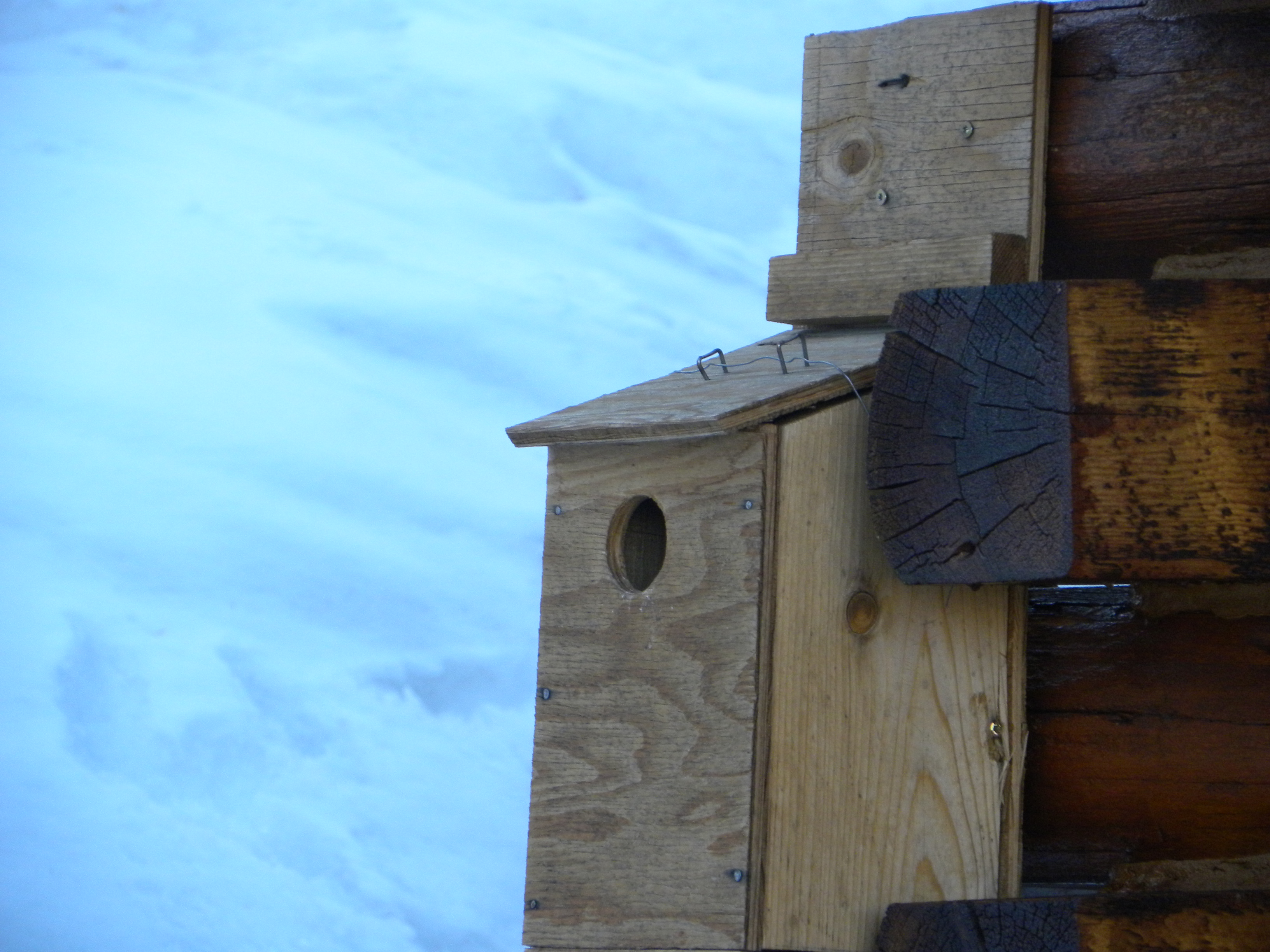
I’ve spent the last few weeks, in a random way, making 4 new bluebird houses.  I’ve gotten attached to MikethehowtoGuy whose simple guidelines I’ve followed, with a few modifications since I don’t attach my houses to poles.  Two years ago I made an observation house and took photos of eggs to babies.  That house was cruder but did the job.  The first year no birds used it, but then I heard it sometimes takes 2 years before they take up residence and sure enough it did.  These houses have a clean-out flip-out side door and are not for observation.  They take about 2 hours to make and are easy for a beginning carpenter like myself.

My new bluebird box

Another new box 5' up on a tree

Today as I was putting the finishing touches on my last house, last years’ pair of bluebirds came to inspect their old house.  What a welcome sight!  I greeted them and asked where they’d been, what mysteries they’d seen, how they’d fared on their long journey.  I felt a kinship with them for I too spend a few months in the winter working in California.

Old observation box that is in use

Just last week I saw a bluebird in the desert and my heart jumped, for I knew they’d be up here soon, the first heralds of spring.  Then I heard a chorus of Sandhill cranes, yet another indication that our long and cold winter is coming to a close.

In another month the hawks and eagles will begin nesting, along with my pretty bluebirds.

Golden eagle nest from last year with cliff swallow nest below.

The elk will move up country to calf in the Lamar; the wolves and coyotes will have their litters and settle into their dens; and the earth will be renewed once again.

Having lived all my life in California, the appreciation of new life isn’t quite as obvious there. Their seasons are wet and dry, and liveably warm all year.  The best time to plant is in their winter, and the time to rest is in the dry heat of the summer.   So I’m appreciating this obvious renewal.

In our modern world, we seem to always be on the road to ‘elsewhere’, that elusive moving target of completion of tasks, errands, or even our well-being and happiness, somehow always lies in the future.  But these little bluebirds today, back from their long sojourn, happily checking out their old home, reminded me:  Go slow, for life is a circle and all comes to pass in good time.

East of Yellowstone lies the Absarokas–Crow Country

East of Yellowstone lies the Absarokas, the Big Horn Basin, and the Big Horns.  To the southeast lie the Wind Rivers.  These were the original lands of the Crow peoples.  This is where I live. Below is a wonderful quote from a Crow Indian chief about 200 years ago.  If you stay here, you are in the Center of the Universe.  At the Center, things happen as they should and you will fare well, he says.  Wow,  two hundred years later and this is my experience too!

Big Horns from the Basin


“The Crow Country is a good country. The Great Spirit has put it in exactly the right place; while you are in it you fare well; whenever you go out of it, whichever way you may travel you fare worse.”

“If you go to the south, you have to wander far over great barren plains; the water is warm and bad and you meet with fever and ague. To the north it is cold; the winters are long and bitter and there is no grass; you can not keep horses but must travel with dogs. What is a country without horses?”

“On the Columbia they are poor and dirty, paddle about in canoes and eat fish. Their teeth are worn out; they are always taking fish bones out of their mouths; fish is poor food.”

“To the east they dwell in villages; they live well, but they drink the muddy water of the Missouri – that is bad. A Crow’s dog would not drink such water.”

“About the forks of the Missouri is a fine country; good water, good grass, plenty of buffalo. In summer it is almost as good as the Crow Country, but in winter it is cold; the grass is gone and there is no salt weed for the horses.”

“The Crow Country is in exactly the right place. It has snowy mountains and sunny plains, all kinds of climates and good things for every season.”

“When the summer heat scorches the prairies, you can draw up under the mountains, where the air is sweet and cool, the grass fresh, and the bright streams come tumbling out of the snow banks. There you can hunt the elk, the deer and the antelope when their skins are fit for dressing; there you will find plenty of white bears and mountain sheep.”

Absaroka high country

“In the autumn when your horses are fat and strong from the mountains and pastures, you can go down into the plains and hunt the buffalo, or even trap beaver on the streams.”

“And when winter comes on, you can take shelter in the woody bottoms along the rivers; there you will find buffalo meat for yourselves and cottonwood bark for your horses, or you may winter in the Wind River Valley, where there is salt in abundance.”

“The Crow Country is in exactly the right place. Everything good is to be found there. There is no country like the Crow Country.”

Arapooish, also known as Chief  Rotten Belly around 1830.

Trapping

I am not an ‘animal rights activist’, but I find the business of trapping for fur/money disgusting.  Hunting or trapping for food and survival is one thing. Hunting for trophy and trapping for the almighty dollar disregards not the ‘rights’ of an animal, but the fact that animals are conscious beings, not just some commodity.

Yesterday I ran into two trappers going out to check their American Marten traps.  I asked if I could accompany them.  They were nice guys and frankly they were trapping in a most humane way.  The type of trap they used, called a conibear, instantly kills the animal when it attempts to get the bait (a piece of beaver meat is what they used).  They set their trap far away from the road or where people might venture.  They used a trap that sits on a pole inclined against a tree; that way the Marten has to climb the pole.  In addition, their trap was inside a box too small for a lynx, a cat on the endangered species list.  We hiked up through deep snow into the trees.  I was glad nothing was in the trap, although they’d caught seven during the season,which ends tomorrow.

I asked these guys how much they were getting for a pelt.  $50 was their answer.  “Bobcats are going for $500” they volunteered.  “What drives the prices?” I asked.  “The markets mainly in China and Russia, depending upon whether their economy is up or down.”   $50 or $500, it just amazes me people are still willing to trade a life for money.

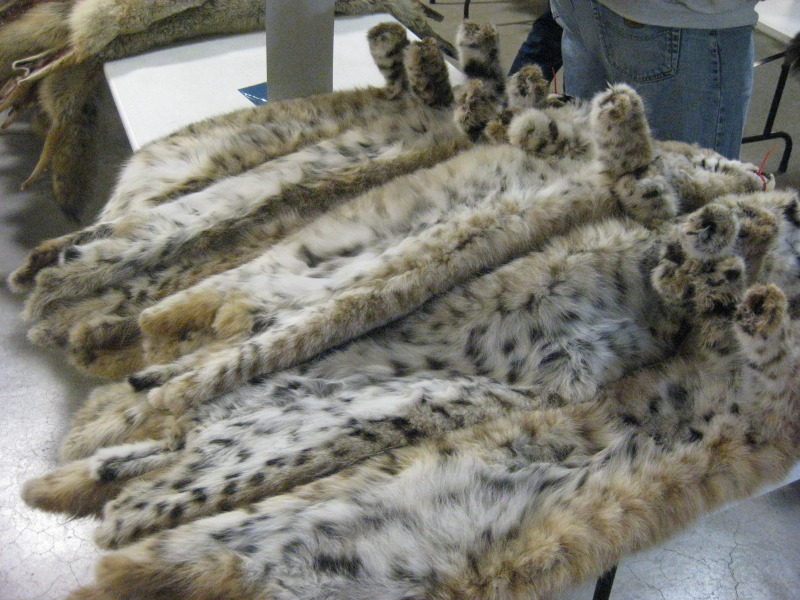
Western Fur States auction in Montana

Bobcat pelts worth $500/each

Although these trappers trapped humanely, many trappers use a leg hold type trap, which does not kill the animal but restrains it.  Animals have been known, like the movie ‘127 hours‘, to chew their leg off to get out of the trap.  Trappers are supposed to check them every three days (my God! that means an animal might be suffering in there for days!)  but many just check them weekly or so.  I have to watch my dog as we hike.  The bait they use for bobcats, rabbit plus lots of scent, is a mighty strong attractant for a dog.  Those traps are covered over by brush or snow, not even visible to me.  If he were to step in one, or even if I were, I’d never be able to open them up as they require a lot of force.  Most probably, they’d break his leg.

Trapping laws in Wyoming are still essentially the same as they’ve been for over 100 years.  If you touch a trappers set-up, you can go to jail or be fined.  If you even kill an animal suffering in a trapper’s trap, you are breaking the law.  Trapping itself is an antiquated, outdated ‘sport’.

Trappers will tell you that their job is essential to the ‘balance of nature’.  If they didn’t trap, then these animals would overpopulate and become a nuisance–animal control basically.  This, of course, is a ridiculous argument.  Nuisance animals are only a nuisance because we humans declare it so.  Nature is able to balance things out through natural cycles.  Except, of course, for us humans. There are 8 billion people on this planet, a totally out of control species.

I do have to admire these trappers in many ways:  they know their animal and understand how to trap them.  Trapping is essentially a lot harder than hunting.  You have to outsmart the animals, and animals are very smart.  I have been trying all winter to get my trail camera to photograph a bobcat and although I’ve gotten the bobcat to take the bait, no photo yet.

In todays’ world of diminishing wildlife, here are the gross receipts they’ve been reduced to for their pelts:

Marten – $35.85

Beaver – $14.41

Coyotes – $44.83

Bobcats – $572.21

Raccoon – $18.92.

Badger – $25.50

Red Fox – $31.22

Mink – $11.90

Otter – $46.63

Skunk – $7.80

Ermine – $2.31

Porcupine guard hair – $22.82

Beaver castor – $44.23

Isn’t it time we start thinking differently.  So many species have been on the brink of extinction due to fashion.  There are plenty of people but not many animals left.

Moose, snow and wind

The weather has been difficult.  We had an unusual cold snap for several days, down minus 17 at night and around 0 during the day; and now that its warming its blowing snow day and night.  The blowing snow is hard for me.  I hate that wind, and every day, sometimes twice, I have to take my new Sears snowblower and clear out the large drifts in my 500 foot long driveway.

This year I had to buy this to get out of my driveway

I’ve wondered where the animals go when its so cold.  Cold, with their winter coats, isn’t as much of a problem for them as for us.  Its that deep snow cover that is hard on the ungulates.  So when the wind blows hard, its good for them, although I might not like it.  It blows the snow clear and they can feed easier, especially in these most lean months of winter.

Yesterday I ventured out for just a short windy walk into the woods.  I like to frequent there to see what’s happening.  The other day I saw bobcat and coyote tracks, along with the usual deer.  This day I followed 2 moose tracks.

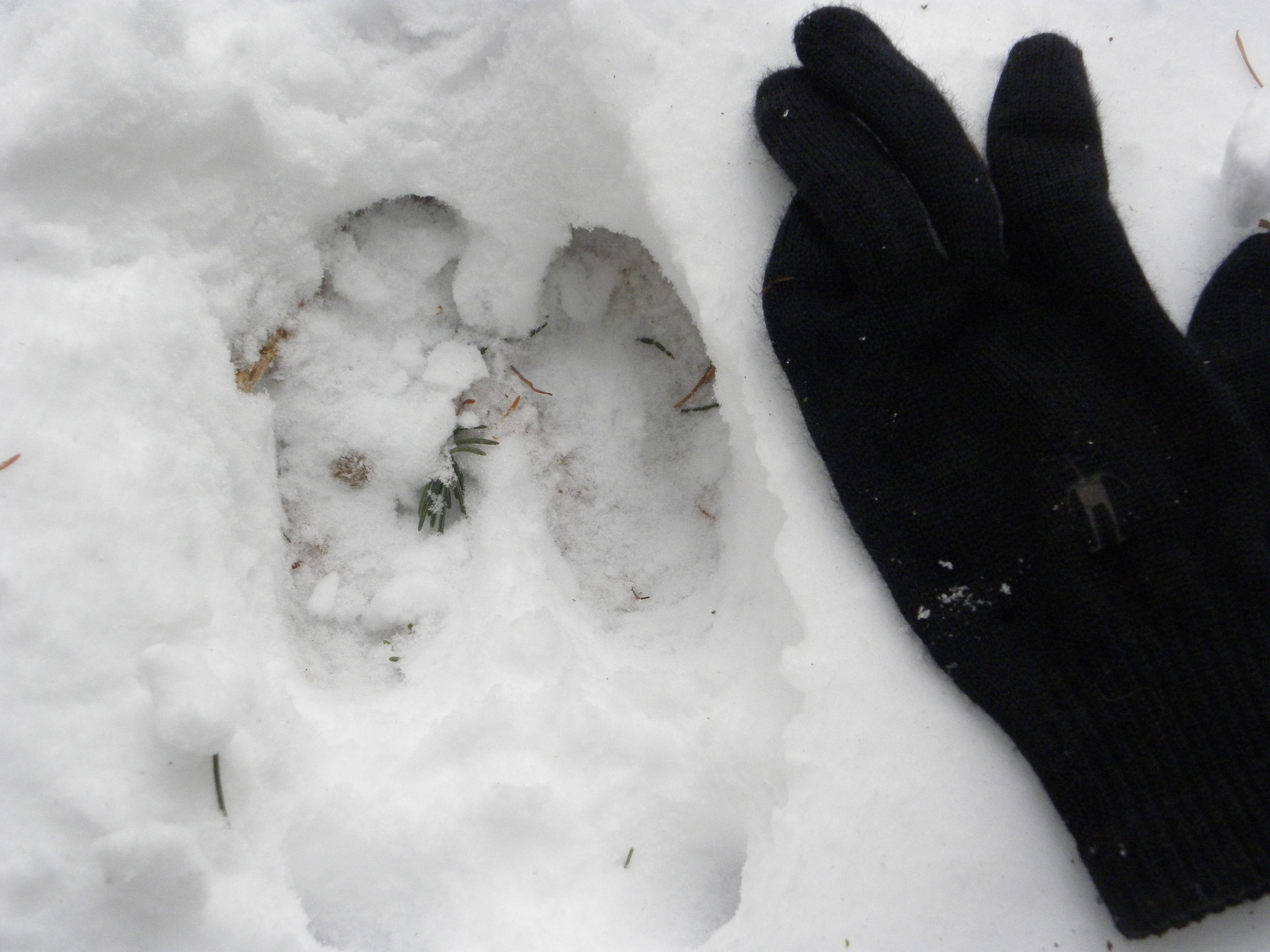
moose track

They wandered slightly up the slope.  Unlike the deer that follow under the trees in shallow snow, these moose didn’t mind the deeper drifts.  They’re well equipped with their powerful long legs.  I figured they wouldn’t head up the steep slope like the deer do.  That’s because their feed is down below, in the willows, although they do munch on conifers in the winter.

I didn’t go far when I found a fresh bed.

moose beds

beds with droppings

They’d lay down in a very deep drift, in a small clearing under a large dead conifer that had been snapped off at the trunk.  From there they had a nice view below of the forest.  Having lived all my life in a non-snow environment, in my  mind I’d thought the animals would lie more under cover with less snow.  But now it makes sense.  Snow is insulating.  I’ve seen elk and moose find deep snow, lie down and let their body heat from a deep snow cave around them.  It didn’t matter that these moose were probably being snowed on.  They were warm in their snow cave.

A Sense of Place or A Sensibility of Place

In my work I can always tell where a person is from. No, not from their accent but from what kind of landscape they desire.  Usually, this is a memory deep in their subconscious from their childhood–their initial Sense of Place.

Most city people will tell you they have no idea what a ‘Sense of Place’ is, nor do they have one.  But I’d have to disagree having dealt with hundreds of clients.  It’s there, they just don’t identify it.

I grew up in the West.  Granted, it was California West, and Los Angeles, yet I spent all my summers in the high mountains of San Bernadino.  I also grew up next door to the largest municipal park in the world–Griffith Park.  Most of Griffith Park is still undeveloped chaparral.  During the 60’s when I was growing up, I probably spent all my free time roaming the hills of the Park.  My father was an avid and very good gardener.  He loved to bring home plants from around the world and see if he could grow them.  That spurred my interest in gardening.  Along with the exotic landscape of my childhood, the dry desert environments and the mountains are my sense of Place.

That sense of environmental familiarity is like comfort food when you’re sick.  I believe that it’s hard-wired into us.  For most of our time as humans on this earth, we stayed in one area.  Even if we were nomadic, we were familiar with the environments we wandered and these environments were not too dissimilar.  But now we are on the move all the time.  Most of us are ‘not from here’, and probably grew up in a completely different landscape, with different weather patterns, plants, temperatures, and cultural elements.  All that moving around, as well as living in concrete jungles, misinforms our innate senses and leaves us Bereft of Place.

With the influx of people to California from the mid-west and East Coast in the 80’s and 90’s, these people brought their sense of Place with them.  Those clients want a landscape with plants like birches, lawns, hostas, or daffodils. One client I consulted showed me a fairly steep front yard and told me he wanted lawn.  I had to educate him on why that was not possible, nor desirable in Northern California.  He was, of course, from back East.

CA Madrones--Arbutus menziesii

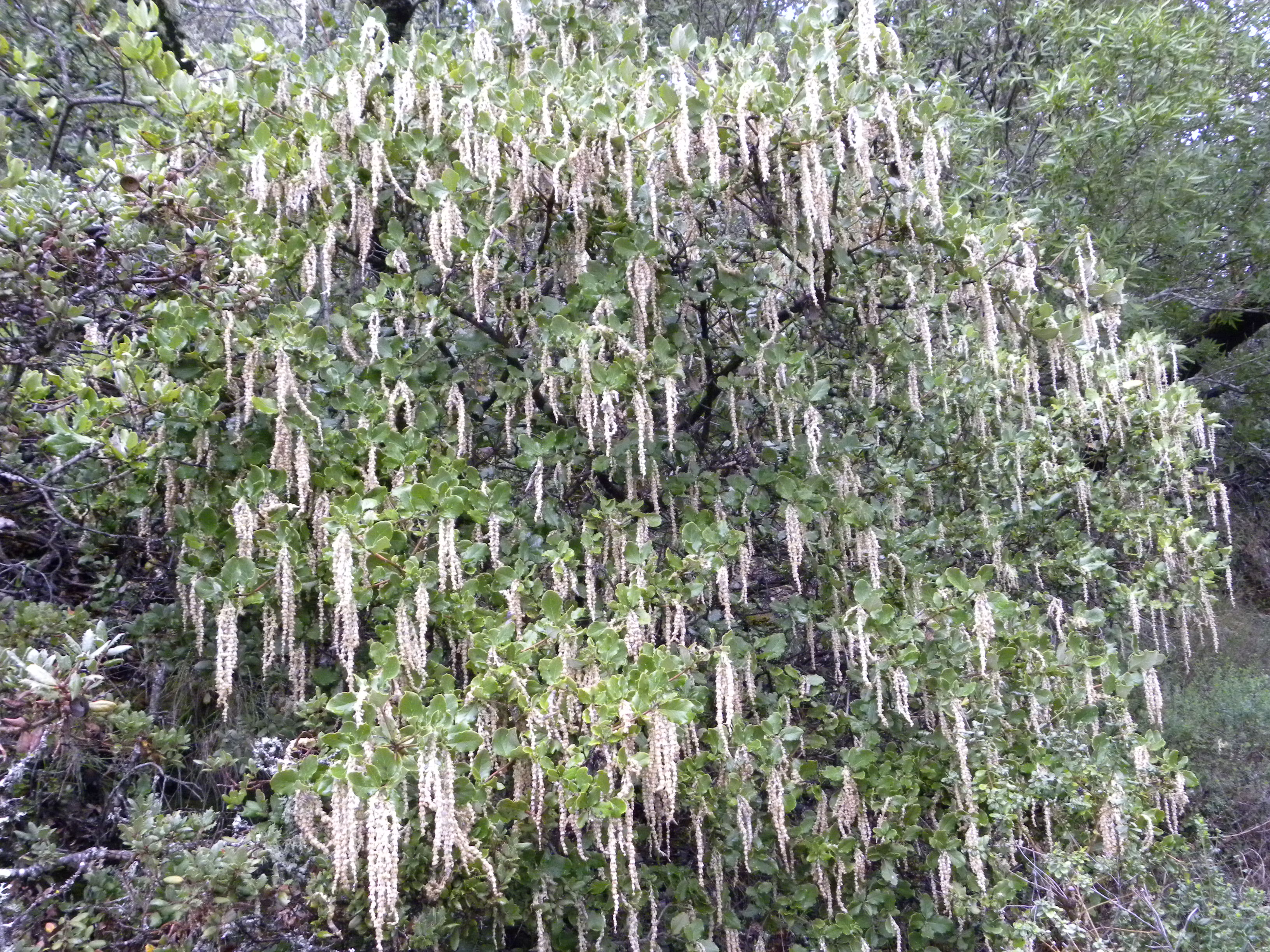
Garrya elliptica-Silk Tassle bush...a beautiful CA native

Even though each of us, subconsciously, desires the psychological comfort of our childhood home, I would advocate that we have to become adaptive to where we are, casting out our old sense of Place for a new one.  In our modern world where we are going ‘nowhere’ and from ‘nowhere’, in a world where our role as caretakers of the Earth is becoming increasingly critical, this is essential.

What I am suggesting is that we take a look at where we are living now, and live there for a time before changing things around.  Understand the weather patterns, where the winds come from, how much snow or rainfall you get. Look around at what is growing there naturally; consider what the birds are eating, the kind of cover they might need; see what is invasive, not-native and intruding on the landscape; notice your drainage patterns, or snowfall drifts; understand how the animals are moving in your landscape, their corridors.  Research the history of the area.  Search for those clues.  Understand historically what took place that co-existed and what occurred that altered.  Once you get a feeling for all that, then consider how you want to ‘improve’ your property, nudging it into a more harmonic existence with the natural landscape, removing the old scars of someone else’s Sense of Place.

Earliest city in Montana. Homesteaders sense of Place

Scars of people confusing their own sense of Place with the existing landscape are everywhere and all pervasive no matter where you live.  Where I live, it began with the homesteaders coming to get their free 160 acres at the turn of the 20th century, to work this rocky barren soil, or run sheep and cattle.  In order for these farmers and ranchers to work this land, they had to first move the native Indians onto reservations, then exterminate the Bison which would ruin their crops, build dams, kill natural predators, unearth mountains of rocks, build barbed wire fences, and plant non-native crops.  They did all this not because they were terrible people, but because this was their comfort zone, their Sense of Place which they tried to impose upon this foreign landscape.

What Lewis & Clark saw in Montana

Today people are still altering this area by building homes on windy bluffs for the view (when the smart thing to do is to build down in the bottoms for protection), or using cheap, non-native building materials, over-building such as Mc-Mansions, building on wildlife corridors and habitat, planting invasive species, irrigating in wasteful ways, building fences not friendly to wildlife, over-grazing, and other acts of insensitivity to this Place called the West.

People have a short cultural memory, a few generations at best.  Long ago our cultures of Place were passed on verbally, through story and song.  Today its’ what you see when you got there, or how long you’ve lived in a place, or maybe the story of just one past generation.  That lack of continuity of Story makes us fragmented people without true History of Place.

I guided school children in Muir Woods/Muir Beach for many years.  Muir Woods is a National Monument, and a very much altered, although breathtaking, environment.  There are asphalt pathways with railings to keep you from wandering among the trees and damaging them.  But no one remembers that in the 1930’s, the landscape was altered even more, as people picnicked by the stream, trampling the understory and planting lawns.  A railway actually went through the Park till 1929.  And before that it was a well traveled route of trade for the Miwok Indians.  What we remember though, is what we’ve seen in our lifetime.

Ancient sense of Place and Wonder

In the Greater Yellowstone Area, outfitters who came here 20 years ago remember many more elk than today.  They use that memory as a marker against which to gauge what they think the reintroduction of native wolves are doing to the population.  But with the 1988 fires, the number of elk exploded due to increased habitat.  Locals will tell you that there used to be 5000 head of elk here every winter; now there are only 1500.  But if you ask my 86 year old neighbor who grew up here, he’ll tell you that there were no overwintering elk here when he grew up.  And if you go back further, you’ll be hard-pressed to find evidence of much use of elk by the native americans who lived here. They mostly dined on deer, sheep and some bison.

What we need today is to develop a Sensibility of Present Place–the ability to appreciate and respond to all the emotional, aesthetic, scientific, historical, and environmental complexities and influences of where we are living.

“Wolfer”

I’ve just finished a great read.  Carter Niemeyer’s new memoir Wolfer.  I’d say its a must for anyone living in the West, or anyone interested in the conflicts around wolves.

Niemeyer tells his story of growing up in Iowa, learning how to trap.  He trapped for a living, got his masters in biology, then took a job in Montana where he spent the rest of his life.  He worked for over 25 years with Animal Damage Control  (that changed its name once wolves were on the scene to the more innocuous ‘Wildlife Services’), then was chosen to be a key player in the wolf re-introduction in the mid-90’s.  He’s an engaging and honest writer, weaving his personal story from a ‘killer’ of animals to a staunch and courageous supporter of wolves in the lower 48.

One of the things I love about the book is his descriptions of going out to investigate livestock damage.  Several years before re-introduction in 1995, wolves were beginning to come into the U.S. by the Montana-Canadian border.  Talk of the re-introduction stirred the rumor pot as well.  Carter was the most experienced trapper for Animal Control, and at that time he was a supervisor. So he was the one sent out on almost all of these calls.  Neimeyer describes how time after time after time, the rancher swore his cow, or sheep, or horse, or goat, was killed by wolves.  Neimeyer skinned every dead carcass to determine what killed it.  It was a rare case when wolves actually brought the animal down, although wolves might have been around feasting on the dead animal.  Many ranchers were incensed at Carter, calling him a ‘wolf lover’, because without his signature they weren’t reimbursed the $7000 from Defenders of Wildlife.  Neimeyer tells stories about how Animal Damage Control investigators, sent out to determine cause of death, just kicked the carcass and said ‘Wolf’, or even worse, identified coyote tracks as wolf tracks.  Most of the animals investigated died by disease, dehydration, neglect–yet all these deaths were blamed on wolves.

If you want to get a feeling for where your tax dollars go in support of what Wildlife Services does, listen to this statistic from the 1980’s from Neimeyer’s book:

Animal Damage Control had been putting out more than 2,000 1080 bait stations in Montana every fall, winter, and spring to kill coyotes.  Throughout the state, about 100,000 pounds of horsemeat was injected with 1080 every year and placed at these stations, resulting in 18,000 to 20,000 dead coyotes annually….Then there was strychnine.  Trappers in Montana put out 50,000 to 60,000 tablets yearly to kill coyotes.”

When helicopter killing became the norm in the late 80’s, trappers were killing around 100 coyotes a day aerially.  When wolves came along on the ESL, poison bait stations became an issue and ADC, feeling that its mission would be thwarted, was staunchly anti-wolf.

Carter was officially hired by U.S. Fish and Wildlife to work on the wolf program.  His stories of finding, darting, literally wrestling with wolves are fascinating and informative.  After working so closely with wolves for so long, he has these things to say in his book about them:

“In my simple mind, wolves weren’t anything but another majestic predator to behold and I believed they belonged back with us.”

“The problem, ultimately, is not with wolves, but with those who believe that the only good wolf is a dead one.  Inept government investigations and outright lies about the nature of these animals result in bogus statistics and ultimately, more dead wolves.  After all the time I’ve spent dealing with them in my career, I’ve come to the same kind of thinking that Betty Baker expressed:  Why did we bring wolves back if all we’re going to do is kill them?”

“Wolves, for whatever great strides they’ve made in the modern mind as well as the modern West, continue to be persecuted, and there’s truly no basis for it.”

This is an important book, written by a man who knows wolves intimately and has integrity and the courage to speak the truth.


The Past and the Present

You might say that I’m living a life many of my friends would call simple and rustic.  My cabin is small, I’m surrounded by rugged mountains, I hike and live around grizzlies and wolves.  The dangers I have to stay aware of are not car break-ins or being mugged on a dark street, but being stuck in a sudden snowstorm on a trail, or spraining an ankle in an area where no one ever comes bye, not just for days but for months or years.  Some might say ‘She’s living raw, close to the land’.

But frankly, even way out here in the Greater Yellowstone ecosystem, the wildest place in the lower 48, I feel inadequate, modern.  Sure I could probably survive for three or four days in a pinch out in the back country.  I take provisions and precautions for that.  I carry a satellite phone.  I bring bear spray.  I even know some wild foods that could tide me over.   But my upbringing and my life experiences have never prepared me for living like peoples here did hundreds of years ago.  That is cultural knowledge that was passed down generation to generation.  The Native Americans who overwintered for 5000 years at nearby Dead Indian Campground  passed on their life skills as well as their intimate relationship with the Land–lifestyles that have been lost forever.

Those skills are not learned by a single individual in a single lifetime.  Just as much as evolution is physical, those skills were a cultural evolution, breathed and lived by a community.  Larry Todd described to me that by even the very early 1800’s, the life skills and the community of the Native Americans at Dead Indian had already begun to dissolve.  Around here, that was about the time Lewis and Clark came to town.  Their expedition is still the best description of the land and the way things were ‘pre-white’ man.  The land may have not changed much, but the cultures were already disintegrating due to disease and other factors.

300 year old wikiup standing till 25 years ago when destroyed by cattle

You know how your grandparents or parents talk about the past, their past, in a longing way.  That is how I feel, but in a way that goes much farther back to an America that was ‘discovered’ long ago.  Long ago, in the 1800’s, an idea was floating around to give Native Americans the land west of the Missouri.  That, of course, was never Thomas Jefferson’s vision.

I must admit, I am weighted down with a longing for a past no longer present.  I envision the days when bison roamed freely here, when the beaver and the mink were so plentiful that people were able to trap them in the hundreds. When there were more animals than people. When animals whose mere presence in the landscape today is so controversial, such as wolves and bison, were sacred to the peoples.

In each new landscape I consider “What must this have looked like hundreds of years ago, before the white men made their mark here.  What were the native trails like?”  I walk what appear to be these pristine mountains and listen hard for ancient echoes of songs, murmurings of people long dead who knew the ways of living with the earth much better than I will ever know in my lifetime.  Their songs long gone, I wonder how we can learn the secrets it took so long for them to discover and pass on.

I am obsessed with the past and how that past might be brought into this present time. My friends tell me it will never be again and to move on.

I conjure up dreams of how to fit ‘wildness’ into the puzzle of modern existence.  Do we set aside large tracts of unmanaged lands with uncollared wildlife, leave them uncharted and unmapped, to enter at your own risk?  Or is our hope in the advocates of green renewable city living, where most of the population will live, work, and grow their own food, leaving the large acreage of rural unfettered areas?  Unfortunately, the politics of wilderness seems to always involve an uphill battle, with the needs of wildlife superseded by human needs and greed.


A mere 'blip' of the Bison there used to be

Sensitivity.  It is a attribute we must all strive to cultivate as human beings.  What we can do is walk lightly, live in wonder, become increasingly aware that all life is conscious, alive, and part of our connected existence.  If each one of us were to make that our task, then the earth might become renewed again, full of wild existence, of which we are a part.