• MY BOOKS ON WILDLIFE, GARDENING AND MORE

  • The Wild Excellence

  • True stories of wildlife encounters around the Greater Yellowstone
  • Award winning eBook on Decomposed Granite, tips, how to's, what to watch for
  • Children's book. True stories of a dog and wolves. In a dog's voice
  • Written for dry Mediterranean climates in California, north and south

My Friend

I have been pondering some seriously deep mysteries; like why the heck I need to spend 1/2 hour getting dressed to go hiking in 7 degree weather, when Koda can just dash outside stark ‘naked’, from 70 degrees inside.  Maybe we humans just weren’t made for cold.  I’m learning though:  about how the cold can freeze up the deep drifts so I can walk on top of them instead of struggling with each sinking footstep; or how the elk and deer make rutted trails making it easy to hike through the woods; or when the deep cold settles on the landscape, an icy silence settles my soul; or if I feel a bit lonely, I can walk outside and see the evidence of the nights activities as footprints in the snow.

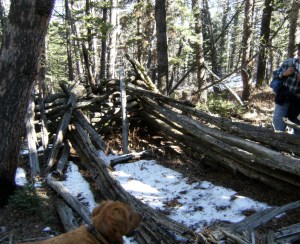
Following an elk trail

Its been cold though for a California girl.  Yesterday the mercury didn’t get above 10 during the day.  In the late afternoon, my 84, going on 85, year old neighbor came to ‘check on me’.  He walked in from down the road, told me he had planned to work on his fence that day but the wind was blowing too hard.  So instead, he got the hay set out for his horses.  He’s pretty hard of hearing, but he likes to talk and his stories are fun, so I just listen mostly.  He was born in this valley.  His family came here around 1915 to homestead.  Considering Wyoming didn’t become a state till 1890,  and that the first homesteaders in my valley came about 1903, and that the road from Cody to this area wasn’t paved until 1993, that’s a long time ago.

Last year he said to me “I’ve got an elk tag and I’m going hunting. You wanna come?”  I sure did and figured that not only does he know this country like I knew my old neighborhood back in California, but his hunting speed was probably about ‘my speed’.

Going hunting

We saddled up the horses and left about 10:30 am.  I always ride his wild horse, Wiley.  Wiley is such a great big guy, really sweet and follows you around like a dog.  My dog, Koda, and him nuzzle each other.  It was October and there’d been a snow a few days before, so we were looking for tracks.  We went up to the next valley and up to the ridgeline.  All the way J___ was pointing out tracks–of black bears, turkeys, moose.  After an hour and a half, we finally got to the ridgeline.  “Let’s rest and have lunch.”  Yep, my kind of hunting for sure.

We sat for an hour and talked.   J___  told me a story about an old timer, who, when J___was six years old, he asked him when he first came to this country.  The old- timer replied “When I got here the mountains were flat!”  We both cracked up.

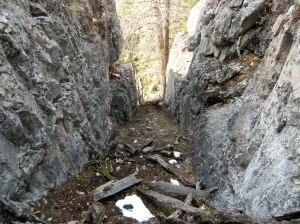
After lunch J___found some bull elk tracks.  Although all the hunters had gone west along the ridgeline, following the well worn trail,  J___ whispered “There’s a little meadow no one knows about on the east beyond those trees.  I bet they went there.”  The snow was thin, and there was bare ground in most places so it wasn’t easy to track those elk.  We slowly made our way through the timber, and sure enough, there were the elk tracks again, heading down a steep wooded ravine.  J___ said we could get rimrocked that way.

“If I didn’t have the horses, I’d go down there on foot.  But it might be too hard on the horses or get them rimrocked.”  I thought of him hiking downhill.  Yikes!  Glad we had those horses or that old codger might have gone down there.  J___ told me his rifle, which to me just looks like a 22, (As you might have guessed, I know nothing about guns) was a WWI rifle for sniper fire.  He uses sights only.  The thing is heavy.  I kept wondering how close he’d have to be to get a good shot.

We circled around for a few hours, on foot and on horse.  Finally he said “I want to watch this country for a while.”  For a moment I took him to mean “I want to live a bit longer to enjoy this place.” but he meant what he said and we hobbled the horses in an open area and walked back up to a view spot where he could see meadows to the east and west through the timber and just ‘watch this country’.  The view was breathtaking, but after a while I laid down and fell asleep, still tired from the night before, dreaming of all sorts of junk in that maddeningly beautiful country.  It was like the space of all that openness on top of the world was squeezing all the detritus out of me to allow room inside for its’ space.

"I want to look at this country for a while"

A Rant for Wolves

Its hard not to go ‘political’ when I heard about Salazar’s decision to delist wolves in Idaho and Montana (not yet Wyoming). I just need to take a moment to reflect.  Forgive me for putting on hold the post I wanted to write today, which was about the obsidian flintknapping site I found yesterday.

Obama’s penchant for compromise just seems to be getting him in trouble with both sides and no one’s happy.  In this case, compromise isn’t the basis for decision.  And compromise is really just politics.

What wildlife needs here is science melded with stewardship.  To be a steward, you have to be a lover.  As has been said before, ‘you only protect what you love’. One of the wildlife students made an interesting observation.  “I’m afraid it will take the wolf being hunted for it to be truly protected.  Hunters go to great lengths to protect what they hunt to ensure the health of its population.”  Certainly true with elk around here.

In the last few years that I’ve been looking at this issue, it seems to me there are so many areas to be addressed in a ‘delisting’ plan.  Simply putting the wolf on the hunted list with target numbers attached is a copout.

Wolves have a highly organized social system.  Packs in my area are constantly being reduced to numbers that are not viable.  When that happens, without the instruction of the Alpha, inexperienced and outnumbered wolves will go for the easiest prey–calves–in order to eat.  Taking down a larger animal like an elk requires pack coordination and is risky.  Just see my post on the coyote with hubris that was kicked and killed by an elk.  That’s just one factor.

Yesterday I found out a bit more about the calf predation that took place on the ranch down the road last spring.  Apparently, the grazing allotment rotation had been changed by the Forest Service in order to combine two ranches at once.  It was pup season, and the Forest Service told the ranchers to graze in the draw just over the hill from the den.  With the late winter the elk were still around in early May, yet farther down the valley from the den site.  That made it much easier for the wolves to go over the hill and get calves for their pups.  That predation was the forest service’s fault, not the ranchers or the wolves.  But because the forest service wasn’t thinking about the whole picture, 3 wolves were shot, one of them was from the initial introduction to Yellowstone 10 years ago!

A very large ranch over the hill has resident elk on it. In the summer, the elk graze the interface between the forest and the open meadows.  The wolves follow the elk along that ecotone.  All summer long the cattle grazed lower in their valley, while the wolves ate elk.  Then, at the end of the summer the cattle were moved near the interface, and within days some calves were killed.  Next of course came the wiping out of the entire pack by Wildlife Services.  With some responsibility on the part of this rancher, this incident would not have happened.

Delisting should require stewardship of all involved parties.  By simply compensating ranchers with money and killing wolves, there is no incentive to protect their flock, especially since so many of the ranchers in my area are the extreme wealthy looking for a tax write off, or ranching because it sounds neat (there are many ranches here owned by wealthy foreigners).

I don’t profess to understand all the problems or solutions, but I can see a few things:

1.  Requirements for ranchers in wolf areas i.e. shepherding.  I have heard about some ranches experimenting with Shepherding Programs (tourists pay to come out and Shepherd, like going to a Dude Ranch).  That’s a win-win situation.  There are many other methods being experimented with as well.

2.  Open Grazing policies need to be re-looked at.  First of all, they are too cheap. Last I heard it was $1.95/month for a Cow/Calf pair!  Wow, that 1898 prices.  You can’t have your cake and eat it too.  Open Grazing, you’re on your own with the wolves and wolves are protected.  That’s that!

3.  I would like to see some tribal involvement in these issues as well.   I’m not sure what that would look like, but I feel they’ve been stewards here for many thousands of years and the perspective they can provide is unique and in many instances is not obtainable through conventional survey techniques.  One native american said to me a lovely thing “The wolves are herding the elk” and that’s a true observation.  As a plant person, I can see that the effect the wolves have had on the aspen/willow population is only positive.

Wolves are magnificent animals.  I’ve seen them here several times in my valley while hiking around.  They are important in our ecosystem in so many ways, and deserve better.  Since I’ve been here, there is just too much killing going on in my  area of our three packs.  Summer comes, packs are wiped out and reduced, other wolves move in, packs reorganize again and shift around.  Just ‘delisting’ is not a solution.

Teepee Rings and the Spirit Wind

Someone gave me one of those mid-range expensive weather stations, the kind with an indoor readout that talks with an outdoor unit.  It also talks to a satellite for date, time, and moon phases.  There is a feature on it that tells you a forecast: an arrow up or down, sun or clouds.

This morning I looked at the forecast on the readout.  It featured clouds and the arrow was down.  Ten minutes later W___ called and asked about a hike today.  I looked at the readout and the arrow was up.

Frankly, that about says it all for Wyoming weather.  JB, my 84 year old neighbor, tells me the old saying is “If you don’t like the weather in Wyoming, wait 10 minutes.”  I think my digital weather station feels like its riding a bucking bronco sitting on my window sill forecasting mountain weather.

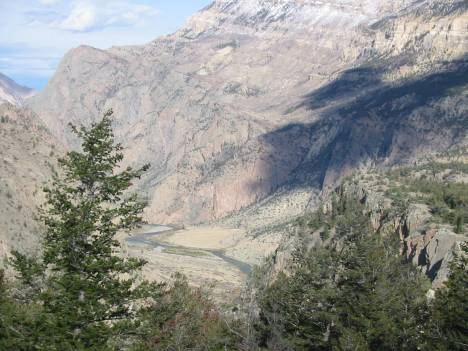
W___ and I decided to meet down the mountain and go for a hike out near the mouth of the Clark’s Fork river.   The Clark’s Fork barrels down the canyon from the Beartooths, carving a deep gorge over a mile deep in places from the high plateau where I live.  Chief Joseph led his people through here, pursued by the army, fleeing to Canada.  The reason he knew the area so well was because the Nez Perce had been coming here every fall to hunt buffalo.  By 1840, the buffalo had disappeared from Idaho.  The Nez Perce had to decide to either change their diet or migrate yearly to Wyoming to hunt.  They used traditional trails through the park and into the Great Basin of Wyoming.  Clark's Fork of the Yellowstone River

Today was incredibly windy.  The winds were traveling at breakneck speed down the canyon.  Sometimes gusts blew me off my feet.  Huge clouds of water blew like ghosts off the river.  W__ said it was a ‘spirit wind’.

We park at the end of a dirt road that once was a Ranch.  W__ tells me that about 12 years ago there was a large drug operation at the ranch, the owners were busted by the Feds, and because it was a Federal operation the ranch became federal property.  Eventually the state took the ranch over.  Now, its just old buildings boarded up.  We walk around in the hurricane force wind.  The main house is all boarded up, but several cabins are still open.  Most are filled with packrat items, but others have old signs and refrigerators in them.  One is filled with rolls of carpet.  The ‘drug ranch’ sits on the flat sagelands, next to the river, with old Cottonwoods surrounding it that some previous owner planted.  Its a perfect movie set.  The story goes that one of the druggies got out of prison early and went back to the ranch in the night to dig up drug money that they’d buried there.  Koda’s running around like crazy after jack rabbit scents.  I humorously instruct him to ‘Look for the money, Koda.”

The river, once roaring and wild, settles down here at the mouth and swings gently along a wide, broad plateau. We walk much further down the old dirt road, off the ranch, and towards the mountains.  W___ points out the numerous teepee rings.  At first I can’t see them well.  They’re old and the rocks are deeper in the dirt than ones I’ve seen before.  I kind of have to squint, unfocus my eyes and let my mind flow.  Soon, I’m spotting them too.  Their openings are to the east.  A few even have old fire rings in the middle.  We’re at the end of the plateau where W___ tells me the rings are large.  I ask him why some of the teepees are smaller and some are larger.  “I’m just guessing here, Old teepee rings.  Can you see them?but my theory is that the larger rings were for families that might have stayed longer; whereas the smaller teepees were temporary hunting parties.”  I like to try and imagine the community spirit that once was here, bustling with excitment and activity for the fall hunt.  Its in sharp contrast to the drug ranch of secrecy and isolation.

Yet all that’s left of both of them are a few signs, a desolate area, and a fierce wind–a ‘spirit wind’.  Newer teepee rings in the Bighorns

Where the Buffalo Once Roamed

I took the research students over to the dead coyote today.  The guys have quite a bit of experience, between their schooling, hunting and trapping, I thought they might know what had killed it.  They had no qualms about touching it (which I had as I am always wondering about diseases I might catch).  Since they touched it, turned it over, felt its coat–I did the same.  They also thought it looked really healthy, and said its coat was perfect.  The guys discussed the coyotes leg for a while and if that could have been made by a trap.  The upper part of the leg was exposed to the bone.  After much debate, the guys felt that neither a trap nor a snare could make that wound.  It was too high for a trap and too low for a snare.

T___ felt the coyotes’ ribcage and noticed several broken ribs on one side.  Since the coyote was lying next to a field where the elk come nightly in large numbers, he guessed the coyote, a male, might have been feeling especially hubristic, trotted through the crowd of elk, and got a good kick where he then bled internally.  The gnawing might have come after he was dead.

I took a walk with Koda in the afternoon up on Riddle flat.  The elk have been swarming around there–laying everywhere, eating everything.  Koda found several stray legs scattered around.  The other day on the flat, I bent down and picked up a buffalo horn, a smallish one, probably a calf’s.  Buffalo haven’t been in my valley in over 150 years.   The horn was so old it looked like layers of bark, peeling, with lichen on it.  But it has a point at the end and, being a landscaper, I know wood when I see it, and this ain’t wood! I thought that was just fine; an unexpected and wonderful rare find.  That was just 2 days ago.

Yet today I backtracked home across the other end of Riddle flat, bent down again and picked up another Bison horn, much more massive than the other one.  J___ was coming over for dinner.  His family homesteaded in this valley since 1915.  He was born on the mountain, his mother trying to get to Cody and never making it.  He’s even shown me the branch of the tree he was born under–he’s got it hanging in his home.  (Note:  Was I ever jealous of that.  I want a tree that I was born under!)  I got home just as J___was walking up to my door.  “I’ve got something to show you” I have to yell really loud when I speak to J__ because he’s 84 and hard of hearing.  I pulled the Bison horn out.  “That’s a Buffalo” he confirmed.  “I’ve found them all over.  They haven’t been here for a really long time.  I’ve even found whole skulls. I found one that had a bullet in it and one that was Indian killed.”  I asked how he knew the Buffalo skull he’d found had been killed by Indians.  “It was hit over the head.  They always took the brains out to eat.”

Bison Horns with matchbook for size

Finding that Bison horn, peeling, almost petrified, was like finding a little bit of left over magic–magic that might be called our North American Dreamtime.

Coyotes and Wolves

W___ says we’re having a ‘false spring’.  It was in the high 50’s today. “Don’t get too used to it” he told me.  For a Mediterranean girl like me, the 50’s are the new 70’s!  The solar and dryness made it downright hot.  Still, the snow cover makes for great tracking.  I’ve been learning about tracking for several years, and even was in a tracking club in California where, of course, they don’t have wolves and bears.

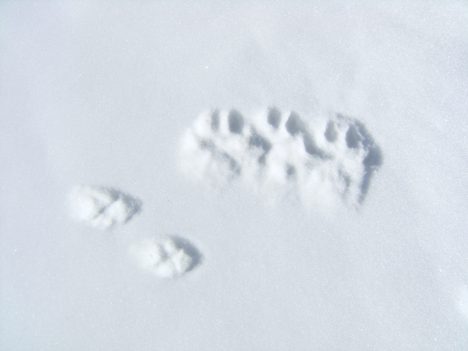
I decided to go hiking up Elk Creek.  My neighbor put down a horse last week and right away I saw tracks of two wolves.  (Note:  Tracks below are wolf and the smaller ones coyote for size.  My 85 lb. dog, Koda, would have tracks more in keeping with the coyote!  See that photo below) Wolf and coyote tracks I followed them for a while until they went down a steep wooded slope.  But later picked them up and, along with coyote tracks, they were headed straight for the dead horse.  Seemed like they weren’t too interested in much of the horse though, as just its organs were gone and the rest of the carcass remained intact.  Even the birds weren’t on it.
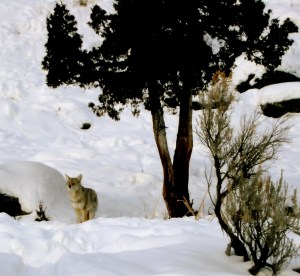
Yesterday I found a dead coyote.  It was in an area where lots of elk graze every evening.  I couldn’t find any sign of a kill, even though wolves had passed through the area not too long before.  Its front leg was exposed down to the bone.  I wondered if it had bleed to death from a trap although I couldn’t find any sign of a trap either.  I took some photos and plan to show it to the ‘elk boys’, the students who are doing the elk studies out here.  They’re very knowledgeable plus they are both hunters and trappers.  The other day when I lead them to two elk kills I found near Game and Fish, they were explaining how to age a kill, what to look for to determine what killed the animal, and what animal parts the lab needs for various stats such as age, health, and diet.

Seeing that coyote reminded me of a fellow I ran into last spring at the small campground down the valley.   This man had raised a coyote.  He knew a fellow that had killed a coyote with pups, so he took one of them.

coyote“They say you can’t raise a coyote, but I did” he told me. “The coyote used to disappear for days or a week at a time.  Sometimes other coyotes would come around and howl, trying to entice the baby out to join them, and sometimes she would.  But she’d always come back.  It was four years before I could pet her.  She’d  sleep against my leg, but wouldn’t let me touch her.  Finally, after four years, she’d let me love her. Smarter than any dog I ever had.”

“I was working with Fish and Game building a road.   My boss on the project would come up and we’d talk across in our trucks.  I didn’t like this man.  He was always down on the work I was doing, which was good work.  And the coyote didn’t like him either.  We’d be talking and when we’d finish and drive away, you know how you have your arm laying on the window.  Well, the coyote would nip at his hand when we’d pass, every time.  And she didn’t do that to no one else.  So that warden started keeping his arms inside.  One day I was working way up on the mountain and here comes the warden.  I don’t know how that coyote recognized him, but she did and she started chasing him down the mountain.  The warden ran down and into his truck and got away as fast as he could.  There was something wrong with that man and the coyote sensed it.”

I went back to look at that coyote again today.  Nothing was eating it.  I felt bad for it.  I’ve seen that coyote many times.  I feel like I’ve lost a neighbor.

The Shepherd

During the elk capture, the ranch hand from the Dude Ranch down the road offered his meadow for us to watch from.  He’s a real character with some funny stories.  I asked if those were his cattle grazing on forest service land in the summer way down towards the end of the valley.  He told me they were.

“The hunters come with their weed-free high quality expensive hay for their horses.  They leave it out in the backcountry and our cattle eat it.  Then they get angry, so I just give them some of our hay, grown here.  Not such good quality you know.  Its a good deal for me.  Then the Ranger comes and says ‘Hey, is that certified?”  And when they say it is, the ranger says ” Where’s your tags?'”  I laughed just thinking about that.

My valley runs from the main highway about 35 miles west and butts up against Yellowstone which is just over the Absaroka Mountains.  Problem grizzlies get dropped off there in the summer.  I’d seen his cattle way far back.  I asked if he’d had much cattle predation.

“Don’t have any.  Never have lost one cow.  The Fish & Game guys always ask ‘What are you doing? How come you have no losses?’ and I tell them “I don’t know why.  I don’t do anything.  Maybe it’s because the cattle are in the trees back there.”

Last summer several calves were killed on the other ranch towards the head of the Valley.  That rancher keeps his cattle mostly enclosed in one area, which is where they were predated on.  I suggested maybe it was a lot easier when you knew exactly where the cattle would be every day, like going to the refrigerator.

C___, the ranch hand, has 17 cows about to give birth and has been coming out every 2 hours in the night to keep the wolves away.  He’s shepherding them.  We asked if we could help birth the calves.  He said its easy.  He’d call us to help.  I hope he does as it sounds fun.

Ranch where cattle were predated upon

Ancient Wisdom

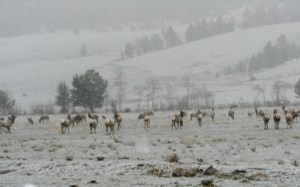
Winter is the most incredible time here in the valley.  There are just a few permanent residents.  Most of the human activity involves the students monitoring elk and wolves.   Sometimes there are helicopter captures and darting.  Yesterday I observed elk being darted for blood samples, fat content, and other indicators.  We’re on the ground calling up to the helicopter the elk locations by radio, while there’s a low flying plane above with the GPS coordinates.  The helicopter deftly flies in, keeping the elk from running either into the trees or into Wilderness areas.  The elk are running like crazy, trying to figure out which way to go.  When they go in one direction, the helicopter swoopes over them and they need to turn around.  They look like a flock of starlings turning in synchronicity.   This kind of work is only done twice a year.  Its tremendously expensive and requires a lot of coordination between many agencies.  The planes are government.  The helicopter is a private company with expert Kiwis, the best in the world.

Elk in my Valley

Continue reading

The Dreaming

This winter I went to Australia with my son.  Its the perfect place for a California Landscape Designer to explore, as its just one of the five Mediterranean climates around the world.  I use a lot of the plant material from there, and to see these plants in their native environments is interesting and instructive.

I was in Australia for several months over twenty years ago, so this was my second visit.  I planned to go back to Sydney (I almost moved there 20 years ago), then venture up to the Daintree, the world’s oldest tropical rainforest and a UNESCO site (north of Cairns) and then to Atherton Tablelands wetlands retreat in a savannah ecosystem.  My son has a teacher from Australia who said “You MUST go to Uluru.”  I hadn’t planned to go there.  I knew about Ayers Rock for a long time.  It’s a long trek, by plane or otherwise, to see ‘just a rock’ I thought.  Besides, I live in a most beautiful place, surrounded by magnificent mountains and rock features, geysers and wildlife.  I’ve visited many deserts and spent a lot of time in Death Valley and Joshua Tree.  What could one rock in the middle of the country possibly hold for me?

My travel agent also brought up the idea, and since we were in Australia over Christmas and many places were shut down for several days, Uluru seemed like a likely ‘detour’ during that lull.  We were to be there for a day and a half and then drive to Alice Springs.  But the holiday put a wrench in the travel plans…ferries didn’t run, planes had restricted schedules, etc…so we spent an extra day in Uluru/Kata Tjuta area.  It wasn’t till later that I realized things had conspired to bring us there for a fuller experience.

Uluru

Read the whole story

Welcome to Wyoming

I really like this quote from Finis Mitchell, a man who grew up since 1906 in the Wind Rivers, and was a fishing outfitter all his life.  Finis  stocked most of the lakes there, carrying them in by horseback.

Throughout this century I’ve roamed this wilderness, communing with nature, observing other creatures along with myself, merely desiring to live and let live.  Because of this aloneness, I’ve learned to love, not only those of my own kind, but all life within a wilderness; the birds, the beasts, the trees, the flowers, and the grasses of the land.  Only in wilderness, it seems, is man’s love so thoroughly and completely returned, so unselfishly shared.

I arrived here on Saturday, after driving out from the Bay Area.  I’m a real whimp when it comes to snowy roads and since Cody had a minor snowstorm on Friday, I waited till Saturday to go over the 8000 ft. pass to my cabin, choosing instead to stay in a warm house with a Cody friend.

The students who are studying elk and wolves in my valley had been staying in the cabin.  They cleaned it up real nice before I arrived and B___ will be staying here with me.  She’s temporarily hired on to follow ‘Spud’, the nickname the guys gave the Idaho wolf who’s traveled  all the way across Yellowstone to end up in my area.  He’s radio collared and she’s acting as his GPS, tracking him every 4 hours.  Apparently he’s been hanging with a female.  Maybe they’re going to mate. Continue reading