• MY BOOKS ON WILDLIFE, GARDENING AND MORE

  • Coming Fall 2024. Pre-order and use code 6AF24 for a 40% discount

  • The Wild Excellence

  • Award winning ebook on DG Primer

Goodbye to a long Winter

The snows are melting and although Sunlight creek is still not in the spring run-off phase, you can feel the weather breaking.

Last night it snowed lightly, but today its raining.  It’s a slow warm-up, but it’s coming.  My old neighbor who grew up in this valley tells me this was a normal winter in terms of snowfall, but I suspect its still not as cold as when he was growing up.  His wife says that -25 degrees was regular then.  Not now.

Several years ago I helped an elderly woman stage her landscape in order to sell her home.  Her husband had been a great friend of mine and fellow beekeeper.  Once he died Dorothy packed up the family home and moved to Idaho where her kids were. That was the year I bought my cabin in Wyoming and along with so many other strange coincidences, it turned out her father had been the Chief Engineer in Yellowstone from the spring of 1925 through the spring of 1930.  The last two years he was the Assistant Superintendent at Mammoth under Horace Albright  His name was Merrill Daum and the family had interviewed him and transcribed his memoirs. Dorothy graciously gave me a copy of the section from his time in the Park.  Here are a few of his stories of snow in those days:

There were no concessionaires living in the park in the wintertime.  They closed up everything.  We had to go down to Gardiner and Livingston to do our shopping.  We had cars and oh yes, the road was open.  We only had light snow in that country.  We could keep the road from the park open up to Mammoth with our own equipment, but from there on it was generally open.  They had a train running in there every so often, so many days a week, so we had train service at Gardiner.  So much of that country was rough and hot that the snow was not very thick on it.

I don’t know much about Middle Geyser basin.  It wasn’t a good place to stop and just put a road through to yell at Old Faithful.  That’s where we turned off from and went cross country to the Lake and Canyon or kept on going out to West Yellowstone or to Old Faithful.  We had ten cabins about every ten miles on the ranger patrol station because they would patrol all along that area, especially the southern part of the Park because there might be poachers come in to kill the game.  They’d go around in the winter time on skis.  That’s a long trip around that part.  Down towards the southern entrance there might be ten, twelve feet of snow.  I’ll never forget looking at one of the bridges; there was a stream going under and all that snow on top of the bridge.  One winter the bridge just broke.

The wintertime was mainly spent getting ready for the next year.  Then we had to get ready to remove the snow in the spring.  We started at Cody,Wyoming at the entrance.  About thirty miles from Cody up to the entrance.  We got as far as the Park with snow 12 to 15 to 20 feet deep.  We’d blast it out with TNT which Uncle Sam gave us.  That would start it thawing and then we’d take a big power shovel and shovel the stuff so we had a two-way highway through there to the east entrance of the park.  From there on we’d use our own equipment.  The deep snow was right there at the entrance.  That was the high point.  We’d generally try to get the Park open by the 1st of June.  By the 6th of June we were officially open, I believe. But you couldn’t make some of the interior trips that early.  It would be long in July before you could get away from the snow.

Here is a photo tribute to my 2010-2011 winter in Wyoming.  After this long and snowy winter, I think I am officially a Wyomingite!

The Basin in early winter from Dead Indian

This is a wolf howl machine, an experimental device to see if wolves are in the area

Two wolves side trot down the road

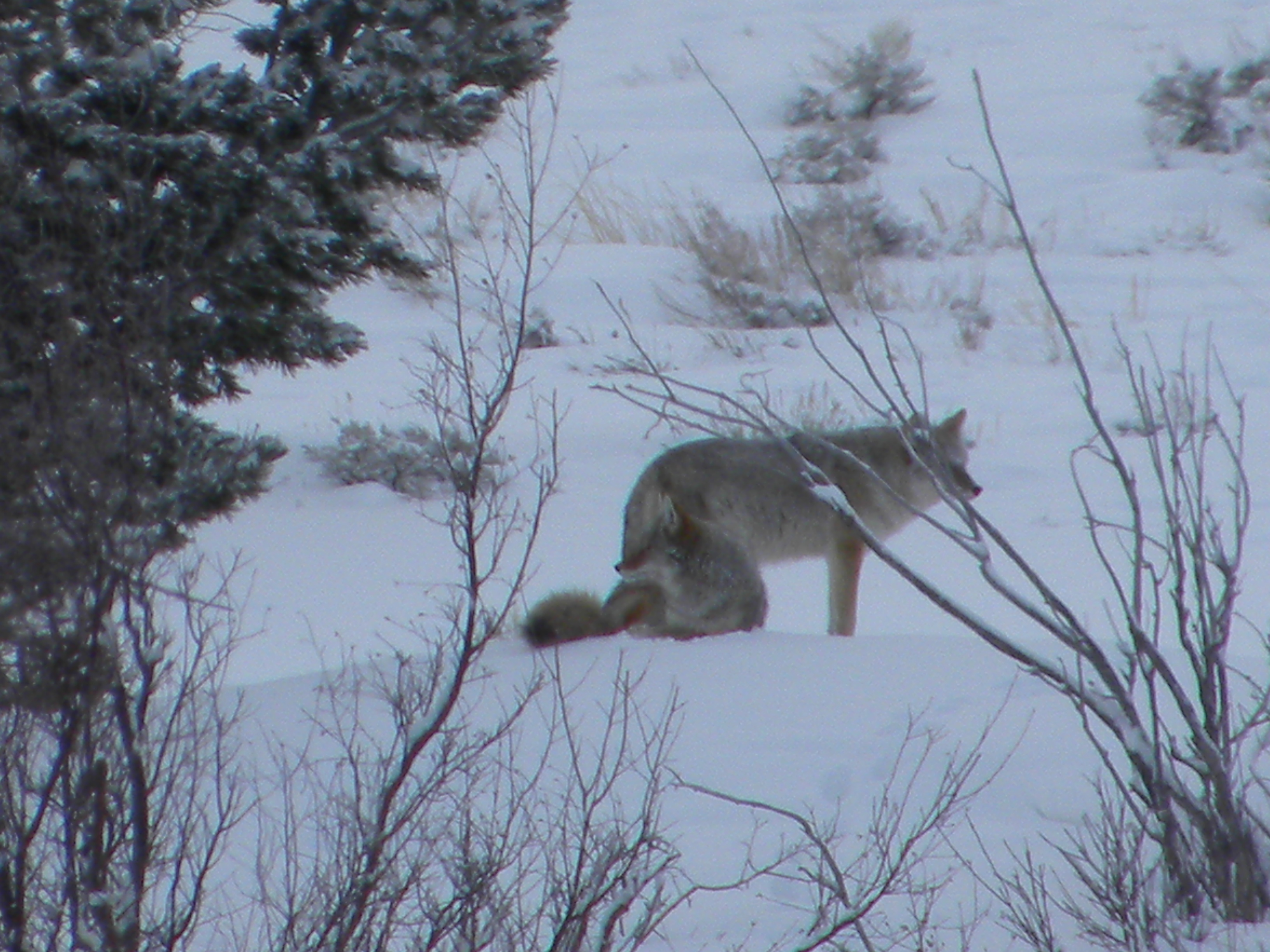
Coyotes on an elk kill

A coyote pair waits their turn on a nearby kill

The Yellowstone migratory herd resides in the valley in winter

Black wolf resting mid-day in the sun after a morning elk meal

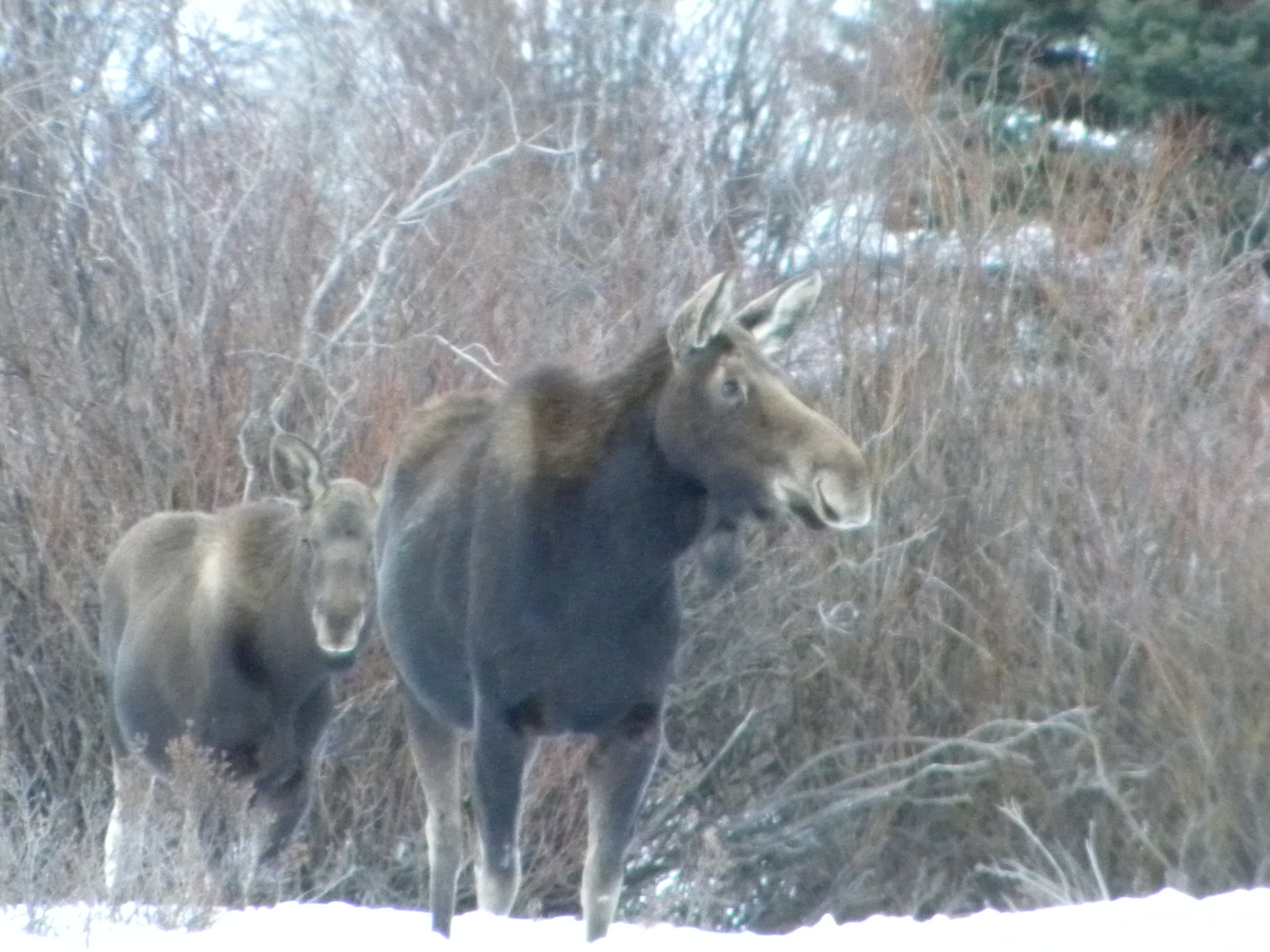
Moose stands in deep snow

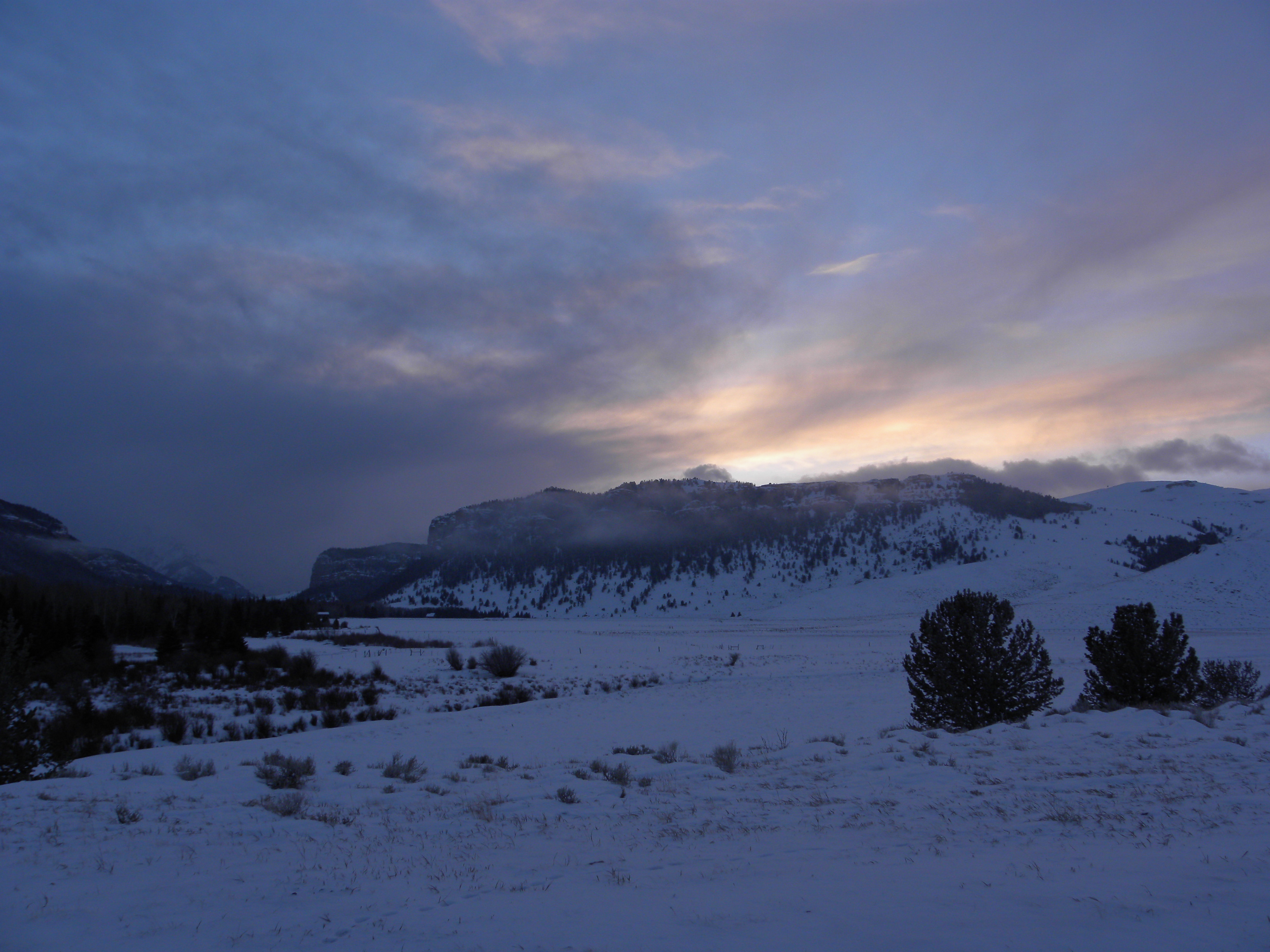
Sunset in a 2011 winter

After a day of skiing, dog tired


“Wolfer”

I’ve just finished a great read.  Carter Niemeyer’s new memoir Wolfer.  I’d say its a must for anyone living in the West, or anyone interested in the conflicts around wolves.

Niemeyer tells his story of growing up in Iowa, learning how to trap.  He trapped for a living, got his masters in biology, then took a job in Montana where he spent the rest of his life.  He worked for over 25 years with Animal Damage Control  (that changed its name once wolves were on the scene to the more innocuous ‘Wildlife Services’), then was chosen to be a key player in the wolf re-introduction in the mid-90’s.  He’s an engaging and honest writer, weaving his personal story from a ‘killer’ of animals to a staunch and courageous supporter of wolves in the lower 48.

One of the things I love about the book is his descriptions of going out to investigate livestock damage.  Several years before re-introduction in 1995, wolves were beginning to come into the U.S. by the Montana-Canadian border.  Talk of the re-introduction stirred the rumor pot as well.  Carter was the most experienced trapper for Animal Control, and at that time he was a supervisor. So he was the one sent out on almost all of these calls.  Neimeyer describes how time after time after time, the rancher swore his cow, or sheep, or horse, or goat, was killed by wolves.  Neimeyer skinned every dead carcass to determine what killed it.  It was a rare case when wolves actually brought the animal down, although wolves might have been around feasting on the dead animal.  Many ranchers were incensed at Carter, calling him a ‘wolf lover’, because without his signature they weren’t reimbursed the $7000 from Defenders of Wildlife.  Neimeyer tells stories about how Animal Damage Control investigators, sent out to determine cause of death, just kicked the carcass and said ‘Wolf’, or even worse, identified coyote tracks as wolf tracks.  Most of the animals investigated died by disease, dehydration, neglect–yet all these deaths were blamed on wolves.

If you want to get a feeling for where your tax dollars go in support of what Wildlife Services does, listen to this statistic from the 1980’s from Neimeyer’s book:

Animal Damage Control had been putting out more than 2,000 1080 bait stations in Montana every fall, winter, and spring to kill coyotes.  Throughout the state, about 100,000 pounds of horsemeat was injected with 1080 every year and placed at these stations, resulting in 18,000 to 20,000 dead coyotes annually….Then there was strychnine.  Trappers in Montana put out 50,000 to 60,000 tablets yearly to kill coyotes.”

When helicopter killing became the norm in the late 80’s, trappers were killing around 100 coyotes a day aerially.  When wolves came along on the ESL, poison bait stations became an issue and ADC, feeling that its mission would be thwarted, was staunchly anti-wolf.

Carter was officially hired by U.S. Fish and Wildlife to work on the wolf program.  His stories of finding, darting, literally wrestling with wolves are fascinating and informative.  After working so closely with wolves for so long, he has these things to say in his book about them:

“In my simple mind, wolves weren’t anything but another majestic predator to behold and I believed they belonged back with us.”

“The problem, ultimately, is not with wolves, but with those who believe that the only good wolf is a dead one.  Inept government investigations and outright lies about the nature of these animals result in bogus statistics and ultimately, more dead wolves.  After all the time I’ve spent dealing with them in my career, I’ve come to the same kind of thinking that Betty Baker expressed:  Why did we bring wolves back if all we’re going to do is kill them?”

“Wolves, for whatever great strides they’ve made in the modern mind as well as the modern West, continue to be persecuted, and there’s truly no basis for it.”

This is an important book, written by a man who knows wolves intimately and has integrity and the courage to speak the truth.


Shapeshifter

This is a great documentary, free online, by Canadian Geographic on coyotes.  Humans have been trying to eradicate coyotes for years, unsuccessfully.  In fact, whereas coyotes were confined to a small area of the West a hundred years ago, now they are ubiquitous, all over North America, from cities to suburbs, on islands and the countryside.  Why, no matter how much humans have trapped, shot,and  poisoned coyotes, do they come back in greater numbers than before?

Coyote hunting ground squirrels

Here in the GYE, wolves were eradicated by the 1930’s.  Since then, coyotes have been the bane of the sheep, cattle, chicken, and any other type of rancher.  Coyotes are considered ‘varmits’ and can be shot on sight in Wyoming.  Coyotes used to be blamed for all the troubles.  With the reintroduction of wolves, now wolves are blamed.  But if you want to keep coyotes under control, then you need to have wolves around.

According to YNP biologist Bob Crabtree who has been studying coyotes since before wolf reintroduction, since wolves came on the scene in Yellowstone, there has been an 80% reduction in the coyote population.  Coyotes are the oldest indigenous species in North America, some 3 million years old.  Their arch enemy is the Wolf.  Over the thousands of years of dealing with wolves, coyotes have become cunning and adaptable under that stress.  They have developed highly sophisticated strategies of dealing with high mortality rates.  For one, they breed rapidly when under attack and produce more litters.  For another, they can feed up and down the food chain.

Coyote pup

Each year in Yellowstone 1/3 of the coyotes are killed.  This makes the survivors much smarter:  Super Coyotes.  And although wolves are their nemesis, they also provide a smorgasbord of food.  Coyotes in Yellowstone mostly eat ground squirrels.  It takes a few to make a good meal.  But when wolves kill large prey, the wolf pack will eat their fill and leave the rest.  Coyotes can take advantage of their leftovers, which is like eating 100 ground squirrels.

Coyotes taking advantage of a wolf kill

So it pays to stick around the wolves, but not too close.  This stress has produced powerful survival skills. It seems coyotes evolved to do better in a state of flux.

Humans created conditions for coyotes that have allowed them to populate all of North America.  They’ve killed off their primary enemy, the wolf.  They’ve cultivated fields and created open spaces.  They’ve filled those open spaces with nice plump meat to raise pups with.  And by putting stress on coyotes through trapping and killing, humans are acting like wolves, making the coyotes breed more rapidly.

Everyone I know has a story about coyotes in the city and suburbs, close and strange encounters, bold coyotes.  I’ve watched coyotes kill a deer right next to a house.  I’ve  seen them lounging mid-day on the grass in a cemetery.  I know a friend whose daughter was walking her dog in the open space of Marin County who became surrounded by coyotes.  She started singing and they left.

Urban coyote rests mid-day in local cemetery


Singing brings up a good point.  Biologists who are studying coyotes in urban areas say, since we can’t eradicate them, we will need to learn to live with them.  One biologist says “They are teaching us things maybe we don’t want to learn yet.”  As top predators in an urban environment, there is a ‘nervous harmony’ that can be adapted to.  Humans need to learn to just scare coyotes away–use a hose, shout, sing, water pistols–make those coyotes think “These humans are so unpredictable”.

The documentary had some interesting things to say about the eastern coyote.  It seems they are growing bigger.  DNA studies reveals the eastern coyote is mating with the smaller Eastern (as compared with the larger grey wolf of the west) Wolf to create a super top predator–smarter, wilier, more adaptable.  It seems ancient Native Americans understood Coyote much better than us modern humans when they described him as ‘the trickster’, the ‘shapeshifter’.

I applaud Coyote.  Humans have taken over every inch of North America, as well as the entire world.  Rats, cockroaches, and a few other smaller species thrive around humans.  But Coyote is the only large predator that has adapted and fully populated all of our environments.  He truly is more cunning than us!

Coyote hunting voles

The right thing to do…Niagara falls and Yellowstone

I just returned from helping my son with location scouting at Niagara falls.  Its strikingly beautiful, especially in the winter.  The crowds are gone and its bitter cold, but there are ice floes in the river and parts of the falls are frozen.  The Canadian side still lights up the falls at night and the sheer power and magnitude of so much water flowing (in fact only 50% is allowed to release as the other 50% is used for power) overwhelms and puts us humans in our proper perspective relative to the awesome power of nature.

Falls at night

Power of the falls

But along with my visit to Sedona, Arizona last year, (which also is a natural wonder but not a National Park) what really stood out was its contrast to where I live now, the Greater Yellowstone Ecosystem.

Although I live next door to a National Park, I don’t of course live within the Park, but within what was designated a few decades ago as its larger ecosystem.  This is an actual mapped area, you could call it a ‘buffer zone’ where its recognized these large megafauna need room to roam to survive.

And, true to its name, I regularly see all the large and small animals that make up this complete ecosystem in the lower 48, which includes wolves, grizzlies, elk, and the occasional bison that is allowed to leave the Park.

So what’s so great about this area  you might say, as opposed to Niagara or Sedona?  Both have the power to overwhelm through their sheer beauty and immense landscape.  The difference are the animals.  Even the Sierras, as incredible a jewel as they are, are NOT a complete ecosystem.  Many animals that were there just 150 years ago are gone forever.

What Lewis and Clark encountered 200 years ago on their journey West is no longer, but a sliver of it can be glimpsed here in the Yellowstone Ecosystem.  Just a sliver, but that sliver is our history, our heritage.  No one would think of selling Monticello to create senior housing or a Walmart!  Why should we not value our original landscapes and the animals that were here before us in the same way?

Everywhere in the United States, with the exception of Alaska, animals have been pushed out to accommodate the biggest and toughest animal–humans.  And that is no exception in the Yellowstone ecosystem.  The controversy rages here too as to who should have primary use of the lands–hunters, atvs, developers, ranchers, oil and gas?.  Wolves are villified for killing elk that hunters could have taken.  Grizzlies are constantly moved around when they get into lands too close to homes or into unprotected garbage.  Bison are not allowed to leave the Park boundary.  Ranches are sold to developers who parcel up the land into lots, crowding out habitat for large animals.  Snowmobilers feel they should have the right to go wherever they choose, including the Park even when the science says differently.  The animals are last on the list.  And when that is how the priorities are set, what becomes of the land is Niagara Falls, Sedona, or at best a ‘safe’ wilderness like the Sierras; at worst we become like Europe, where their natural history is in the so-distant-past that its entirely unreachable in present-time.

Yellowstone and its ecosystem, unlike Alaska, is easily accessible by car to people from all walks of life, rich or poor.  It is an opportunity to view in the flesh our rich natural past.  Any person can do that from the safety of their car, and watch wolves or bears in the Lamar Valley.  Or one can take more risks and venture into the back country.  Even today, with this area protected and the reintroduction of the wolves, thereby completing the ecosystem fauna, the landscape doesn’t hold a candle to the enormous amounts of wildlife that was once beheld by the mountain men in the 1830’s.  Yet, they are all still here, thanks to the enormous efforts of many men and women conservationists through the century.

Black wolf

In the U.S., there are many unique and beautiful areas, but there is no where like this area.  Here we have the Serengeti of North America.  And in my mind, we are not valuing nor protecting it enough, nor are we holding it in the proper perspective.

Our Serengeti

The proper perspective:  This area, as well as more large tracts of contiguous land (Yellowstone to Yukon idea) is a wildlife first policy.  This is our gift to our children and the future.  This is our gift to the wildlife here.

Once we all realize what we have here, a jewel that is found no where else in the U.S. (Do we really want the last place where wild animals roam to be in Alaska, out of the reach of most ordinary folks?), we will change our approach and our views on a daily basis.  No longer will we have on the Wyoming books archaic 1890 laws that allow trapping, an indiscriminate way to kill wildlife.  No longer will we confine bison to the tiny Island of the Park because the cattle industry fears losing their brucellosis stamp.  Nor will people call for the extermination of the wolves because they are having a harder time hunting in the spots they are used to.

We will make new laws to help support the wildlife in any way we can and preserve this area; not for ourselves or for any use we desire today, but because we recognize its’ specialness, and because, frankly, its the right thing to do.

There was a time, not long ago, when out of 60 million Bison that once roamed the entire United States, only 100 survived.  In fact, it was thought that all bison were extinct, and that was what we, as a country, as a government, was trying to achieve.  But in the early 20th century, around 100 Bison were found living in Yellowstone.  An immense effort was made to bring at least some bison back and the bison that you see today living in Yellowstone are the result of that effort–the last pure genetic stand of bison living today.

When you go to Yellowstone, there is a power, a respect, a wordless reverence that wells up in your being just seeing these animals.  Something deep and ancient reverberates in their presence.  Imagine if those bison hadn’t been preserved?  Those conservationists who helped preserve the bison of Yellowstone did an incredible service to future generations.  We, living today, are the beneficiaries of their efforts.

We must make those same efforts today for generations that will be living 100 years from now, just as they did for us 100 years ago.  That is how we should be looking at the Greater Yellowstone Ecosystem.  That is how we should be making our laws, our plans, our actions.

“You may say I’m a dreamer, but I’m not the only one…”

Synchronicity: Coming to Wyoming, the final piece

Synchronicity is the experience of two or more events that are apparently causally unrelated occurring together in a meaningful manner. To count as synchronicity, the events should be unlikely to occur together by chance. The concept of synchronicity was first described by Swiss psychologist Carl Gustav Jung in the 1920s. (Wikipedia)

“When coincidences pile up in this way, one cannot help being impressed by them—for the greater the number of terms in such a series, or the more unusual its character, the more improbable it becomes.” C.G. Jung

“I know I’m supposed to be here, just give me some time to figure out why.” The Secret Life of Bees

_______________________________

I continued my life working in California, putting the finishing touches on raising my teenage son.  I was used to this life, my friends, my home, my neighborhood.  I’d grown up and lived my entire life in California, and loved all of its varied environments, from the deserts of Southern California, to the Sierras, the coastal redwoods, the wild surf of the Northern California coast.  I’d grown up surfing and swimming in Southern California, and spent my entire adult life in parts of Northern California.

How I love the ocean that I grew up with

I’d planted thousands of trees and shrubs, grown many summers worth of vegetables, picked fruit, studied oaks, madrones and manzanitas, watched baby salamanders clamber out of quiet pools, rare Coho salmon fight their way up Redwood creek, guided school children through Muir woods and Muir beach, and helped with Spotted Owl studies.  All my life-long friends were in California.  I loved my family, my friends, and most of all I loved the land.

My garden in California. I love the land there

Yet strange coincidences started reaching out and tugging me more and more in the direction of Wyoming.

For instance, soon after the purchase, I had a job in California with a wife who was a doctor and the husband a geologist.  In this case I mostly dealt with the wife relative to the design elements.  One day husband Bill and I were talking about my cabin near Yellowstone.  I was telling him about how incredible the geological features were.

“Wait, I have something I want to give you.  Janet can’t stand that I collect these.  They clutter up the house, are big.  I have no where to keep them.”

He came back with a 24×36 bound book of geological maps.  The date was 1898, so this was an original series of maps put out by the U.S. Geological Survey.

“These are original maps of the Yellowstone area.  You’ll use them more than I will.”

Later, upon inspection, I saw that the quadrant of maps he had given me wasn’t Yellowstone at all, but Sunlight Basin and the Absarokas bordering Yellowstone and my valley.  Since my neighbor in Wyoming is the Park Geologist, I gave these prints to him.

Another client gave me a section of her father’s memoirs.  He was the chief engineer in Yellowstone in ’29-‘31.

My son was looking at colleges.  He applied to Pasadena art college, a small school in Southern California.  These small schools usually have an evening get-together for questions and PR.  This was done one evening at a alumni’s office in Oakland, an architect.  After listening to the presentation I was walking around for the coffee and dessert part, when my eye caught a scale model of a museum he designed.

“That looks like the Buffalo Bill museum in Cody”, I asked.  “The Plains Indian wing.”

“It is.  I designed it five years ago.”

One afternoon I was looking at possible storage units in Northern California where I still lived.  When I came out of the 2nd floor onto the balcony, I saw a Hertz moving van in the parking lot blocking my view.  The advertisement on the side said “Visit the Buffalo Bill Museum in Cody”.  I have never seen one of these advertisements on a moving van since.

Then there were the persistent dreams.  In the winter in California, I’d have dreams of wolves and elk in the snow in Sunlight.  I dreamt quite accurately about the original owner whom I had known nothing about.  Dreams of native Americans, of new beginnings, of going to live in Wyoming; persistent, insistent dreams.

And then there were the healing forces.  After a series of deaths in my family and close friends over the course of two years, new sorrows seemed to echo old wounds.  I was spent, exhausted, and in pain emotionally.  I had been squeezing in two weeks here and there during the spring and summer, driving the 20 hours back and forth from California.  I decided to take some time off and spend September and most of October here.

Deep present loss can easily echo past losses.  I felt like I had a deep gash in my heart that had been there for a long time, even longer than these family deaths.  I came here and just ‘let the mountain work on me’.  I couldn’t do much but surrender to the Place.  Sometime in October, I had an amazing day.  I took a chair up to a high point on my property, a place with a view to the east of the entire Clark’s Fork plateau.  I sat.  After several hours, a new feeling arose, one that was recognizable yet unfamiliar at the same time.  I felt centered.  I felt my own center.  This Place itself was my center.  How could it be, but it was true, that I’d never felt this before?    I went back to California a different person.  I literally felt like someone had done heart surgery, sewing up a very old wound, healing a condition of sorrow and grief.  I was happy again.

Dawn in Yellowstone. A new day

There is something about Place, and I believe especially about the Greater Yellowstone Ecosystem, a very special Place on this Earth.  Maybe its that giant hotspot underneath us; maybe its because its one of the last places in our contiguous United States where wild is still wild, where large predators still rule the landscape and things are right; maybe its because it was the last and final stand of Native Americans and you can feel the pulse of their history as you walk around.  Whatever it is, its palpable.  The healing power of Yellowstone and my little valley is the Center of the Universe.

The Bear Facts

When I took Jim Halfpenny’s tracking class last year, he gave me a small pamphlet entitled  Bear Ecology.  Yellowstone Ecosystem. The pamphlet consists of lots of charts, so I’ll try and digest a few for you, literally.

Since I’ve been watching bear evidence and their scats a lot lately, here are a few facts:  About 80% of the nutritive value of Grizzly bear food comes from herbs. From this they get mostly protein.  Less than 20& comes from animals, where they get fat and protein.  The rest comes from shrubs and pine nuts.

Of the plants that Grizzlies in Yellowstone National Park consume:  78% or more of their plant diet comes from Sedges and grasses.  A whopping 6% comes from Claytonia lanceolata or Spring Beauties.  Further down in value importance are Cirsium (thistle), Clovers, Yampa, Biscuit root, onion grass, horsetail, and whitebark pine.  But if you look at the nutritive values of food, the only two that provide fat as well as protein are animal and pine nuts.  Therefore, they need these to increase their brown fat for winter hibernation.

On this chart, as far as animal foods, cutthroat trout are at the top of importance.  After that comes gopher, voles and marmots, elk, deer, and bison.  Below that are ants.

Another interesting chart is about the differences between Black Bear and Grizzly Bear den types.

Black Bears evenly split their types of dens between boulders, crevices, and outcrops.  They only dig 13% of their dens.

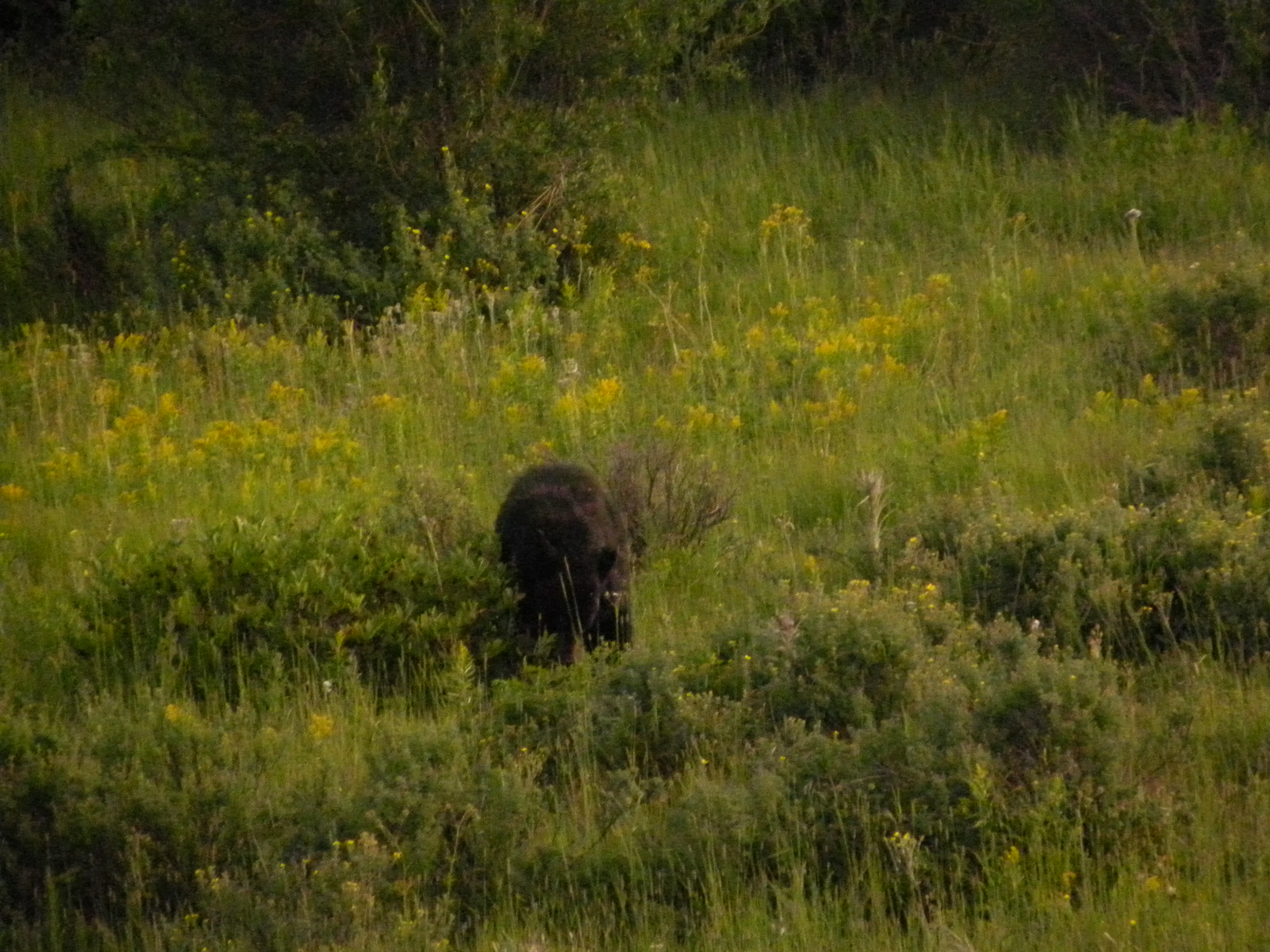
black bear digging for ?

Grizzlies, on the other hand, dig 86% of their dens and rarely use caves.  Which might explain why in these charts, which are not that up to date, Black bears were denning almost a month earlier than Grizzlies.  Grizzlies need to wait for more snow cover.

I’ve been intrigued with bear diet this year especially since I know that the White Bark Pine Crop is poor.  I keep wondering how these bears, that are so huge and strong, survive on mostly vegetarian diets.  These breakdowns help explain some of how they are able to use plants and convert them into useable proteins.  

So far, living at 7000′, we’ve had no snow yet on the eastern side of the Absarokas.  Today it rained some, October 17th.  I wonder how global warming will affect the denning times of black and grizzlies.  I wonder what plants they will find when its not cold enough to den but not warm enough, nor the days long enough, for good plant growth.

Mark Bruscino was on Wyoming PBS friday night.  He said an interesting thing.  He said that Grizzly bears are as intelligent as the Great Apes, making them the most intelligent wild animal in North America.  Surely they are an animal worth protecting, and giving more room to move into habitat that supports their needs as we, and the bears, face new challenges ahead.

The magnificent and endangered grizzly

There’s been plenty of hubbub regarding bears this summer in the Greater Yellowstone Ecosystem, mainly grizzlies.  If you haven’t followed it, we had two deaths just on the eastern side of the Absarokas from grizzlies this summer, one of them occurred just up the road from where I live.  In addition, there’s been 38 grizzly deaths just this year, 31 on those caused by humans.  And many of the bears causing trouble have been found to be underweight, or their cubs were malnourished.  Grizzlies were put back on the Endangered Species list just this summer because one of their main food sources, White Bark pine nuts, is also in trouble and in major decline.

Grizzlies have been coming down into hay fields, down into the flats where there are towns and farms.  Why? Because they need more habitat, they need food.  Let’s not forget that grizzlies were actually plains animals, following the Bison and ‘Buffalo Wolves’ on the prairie.  Grizzlies can’t climb trees and their enormous claws are adapted for digging.


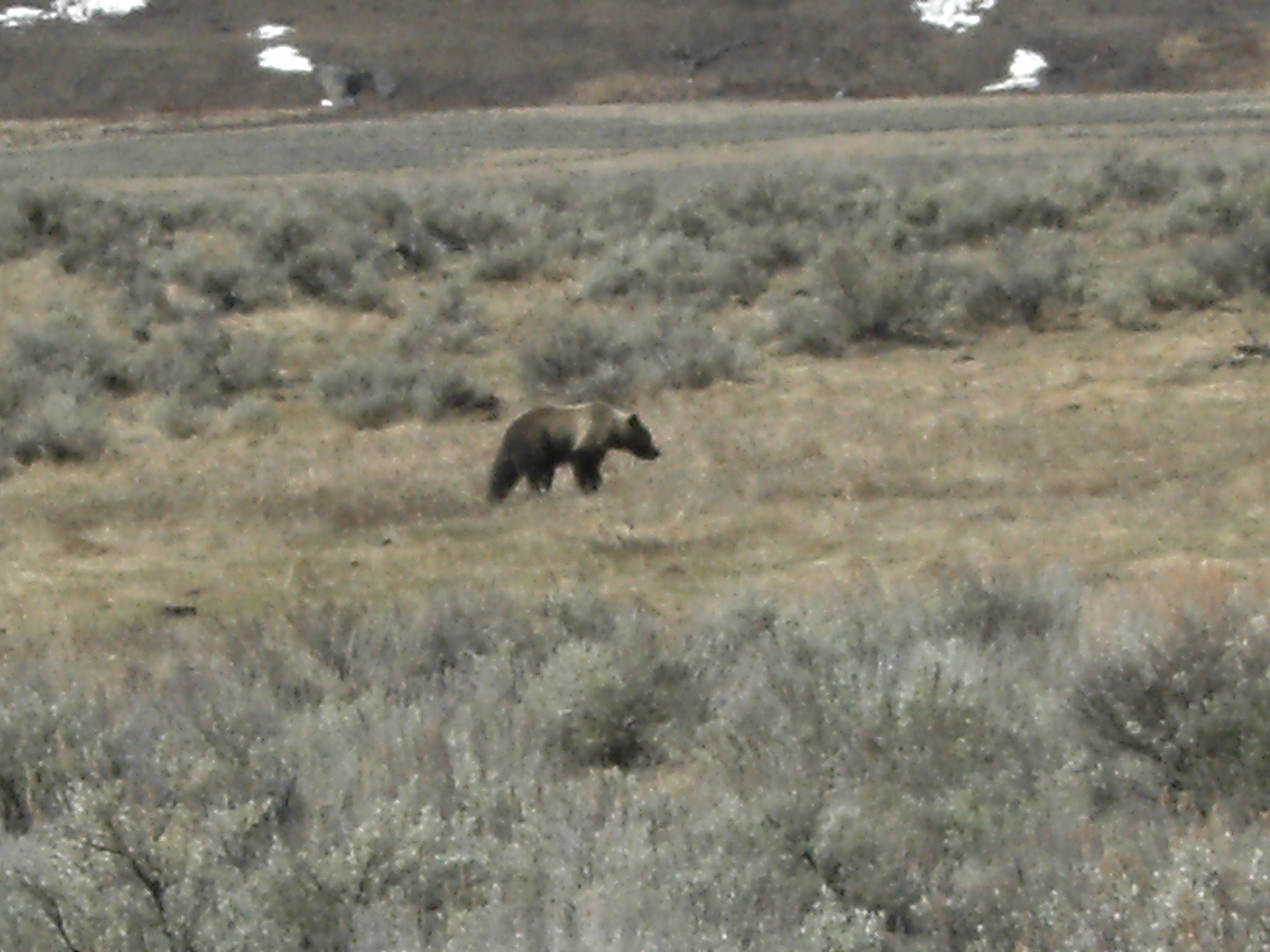
Grizzly rooting around


On the other hand, the smaller Black Bear is a forest bear.  It can climb trees.

It’s not just that ‘we have too many bears’.  Its that we’ve decided Grizzlies can only be in places where people don’t want to live year round–the high mountains–or where we’ve protected the land, such as Yellowstone Park.  And even in those places we barely tolerant them, calling on the feds to move or kill a bear (Grizzlies get three strikes before they’re out, dead out that is) that interferes with our ‘rights’.  In an area north of Gardiner, a sow with her two underweight cubs were moved for raiding a chicken coup.  Chickens are bear bait, and having one just north of the north entrance to the Park makes your chickens a restaurant for a bear.  I don’t understand why we have to waste good tax dollars and federal employees’ time on moving bears for stupid people.

My valley happens to be one of the places the U.S. Fish and Wildlife Service moves bad bears, with the hopes they’ll go into Yellowstone.  My valley has good access into the Park, but most of these bears just quickly ‘home’ or return to their territory.  This I’ve been told by one of the bear coordinators. (“You don’t have to worry about the relocated bears.  They leave fairly quickly.”)

So why relocate?  These dedicated federal employees seem to spend a lot of their summer moving ‘bad’ bears here and there–from Jackson to the East Entrance, from Dubois to Cooke City, from Cody area back to Jackson–or they have the dirty and terrible job of euthanizing ‘problem’ bears.  Problem hardly ever means human/bear conflicts, but mostly cattle/sheep/horse/chicken conflicts or just too-darn-close-for-comfort conflicts.

We just have to begin to make a concerted effort to live with bears and give them more habitat.  A few things I can suggest (and there are many more that could be added to the list by people ‘in the know’):

1.  Use bear-proof garbage cans and food containers.  Several bears were euthanized in 2010 because of ‘food rewards’.  The article above said that after euthanizing a bear roaming around West Yellowstone, the feds discovered lots of unsecured food containers.  That’s just a crime!  West Yellowstone is exactly adjacent to the Park.  If you want to live there, secure your food or pay the consequences.  Should the bears pay the consequences for stupid people?

2.  We need contiguous wildlife corridors from here to the Canadian Border, with planned wildlife crossings over highways.  This is very important.  These bears and other wildlife need to be able to migrate out into other food sources when their own territories get too cramped.  And for God’s sake, at least slow down in Yellowstone.  This summer alone there were several bears killed by cars in the Park.

California is now putting the grizzly bear on all CDL.  If you hold your license up to the light, there’s a bear there; the same bear that’s on their flag and the exact same one that was shot to extinction in the early 1900’s.  If you’re going to tout it, then bring it back.  California has good habitat for grizzlies.  Let’s move some there.

3.  We need prairie where Grizzlies and Bison and wolves can roam again.  Grizzlies are already moving into eastern Montana.  Support the American Prairie Foundation and tell them to not just bring Bison back (already beginning to happen there) but wolves and grizzlies as well.  With the extinction of the White Bark Pine by the end of this next decade, bears will need a different food source.  We need to be thinking about recreating some of the kinds of habitat they lived in when Lewis & Clark were here.  L&C didn’t find game in the mountains; the game was abundant in the prairies.  Restoring bison to the prairies along with wolves makes for more game for grizzlies, along with all the small mammals and roots they like to dig for.

This summer I was fortunate enough to see three grizzlies–2 in the Park and the other one we slowed down while the bear crossed the road near here.  What a beautiful magnificent animal.  There is nothing like hiking in grizzly county, knowing that you are not at the top of the food chain.  It makes you alert, alive and aware.  Let’s preserve that.  It keeps our human ‘hubris’ in check.


Grizzly track with penny for sizing


Yellowstone spring

I’m doing some work here, adding a utility room.  With all the noise and construction, it was a great opportunity to escape to the park and let the workers watch the dog.

Since it only takes me 40 minutes to the NE entrance, I escaped around eleven and was back by 5.  The day was overcast and on the cold side.  I’d planned to do a day hike, but chucked the idea with a cold wind blowing through the Lamar.  There was enough activity to view right from the road.

I’ts early June, the kids are still in school, and usually May and June the Park is still quiet during the week.  Yet last summer was the busiest the Park has ever seen and its predicted to be the same again this year.  The Lamar Valley had plenty of people today, but they all seemed serious wildlife watchers and so the atmosphere was calm and peaceful.

I do have to say, with all the hubbub around the ecosystem about wolves–rallies in Jackson and Cody recently, sponsored by outfitters and the Elk Foundation, complaining about wolves taking their business away [i.e. “biggest slaughter since the bison” meaning the wolves are eating all the elk, like when we killed all the bison] and wanting Wyoming wolves hunted as predators–it seems to be completely forgotten that wolves have created an incredible tourist attraction that benefits Wyoming.  I only talked with a few tourists in the valley, but they were all looking for wolves.  I ran into a carload of tourists from Oklahoma who had gotten out of their car to use the restroom when they heard a wolf howl.  They walked out to an overlook of the Lamar river and saw a black wolf–a thrilling experience for them.

Another man stopped and asked what I was looking at through my scope.  When I told him ‘a black bear’, he said “We already saw that.  We’re looking for wolves.”

It seems to be one of the main draws to the Park these days.  Wolves have fueled the attendance to record numbers!

With the Druid Pack all but gone, I didn’t expect to hear or see wolves in the Lamar, but there was a black wolf running around there, plus a tourist told me she’d seen one on a kill earlier.

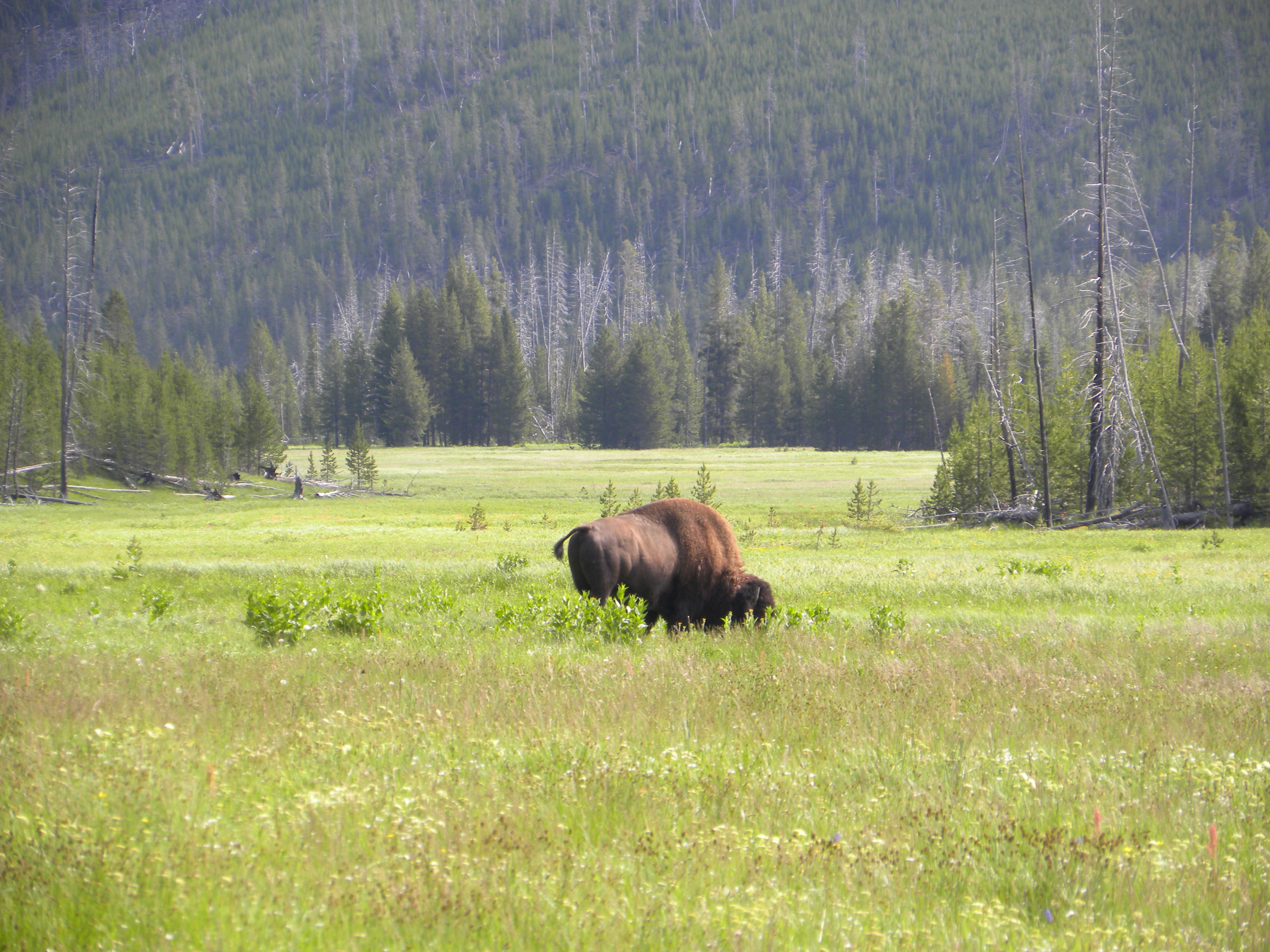
Mostly though, since I see wolves in my own valley, I love to see the Bison and especially their babies at this time of year.  They are the only wildlife that cannot leave the Park so I have none in my valley.

Error
This video doesn’t exist

There were a lot of Bison in the Lamar this day.  I always try and imagine the great herds that once roamed everywhere just a few hundred years ago.

Loads of Bison

Besides Bison, wolves, and black bears, on the way out I saw 2 beautiful old bull moose hanging by the side of the road (until a crazy tourist tried to get a close up picture.  Fortunately for the tourist, the Bulls decided to head up the hillside instead of into the tourist).

Yellowstone for mine eyes only

A friend came up late morning to help me plant more trees.  A squall came in and with it a fierce cold wind.  After several minutes the weather settled down, the sun shone through brilliant cumulus clouds but it was still hovering above freezing.  This continued several times all morning until I’d had enough.  Hungry and cold I suggested we quit for the day and head to the house for lunch.

Since I’m needing some poles to repair a gate, we decided to see if we could make it up to Beartooth Lake to cut some lodgepole poles.  The road was clear and this typical May weather had brought new snow into the mountains.  Pilot and Index Peaks were covered white in snow, the deep of the blue sky setting them off.

We got a little past the maintenance yard and then got stuck in the snow.  I let the dogs out while my friend shoveled and I pushed the truck.  The dogs, like 2 kids, went wildly romping around the deep snow pack.

That adventure foiled, my friend suggested we see how far we could get towards Cooke City.  About 5 miles from Cooke, the road was full of snow, although a plow had gone over it.  The sign said ‘Road Closed’ but we kept on.  My friend said they run a plow now so that the heat of the sun will melt the rest off.  That way there’ll be less work to do come May 7th when the NE entrance officially opens.

Once into Cooke, the road was clear and dry and we decided to head for the Lamar.  By now it was about 6:30 pm and a perfect time to catch some wildlife watching.  But as we drove into the park, a deep fog appeared and it started to snow…sleet really.  My friend commented that he’d been coming here for 50 years and during that entire time the willows had never been able to grow.

“You’d have to have come here for that long to see the difference.  The willows are growing now.  They’ve never been this big.  The elk used to use the Lamar like cattle.  They’d be down in the river bottoms.  Now the wolves keep them on the move and the brush is coming back.”

As we continued towards the Buffalo Ranch, the sky cleared.  We kept commenting that we wished we’d brought our cameras.  I thought about it as I walked out the door, but figured I was just going to cut poles.  Instead, the air, the sky, the mountains, the weather was magnificent…a special day, a special light.

We watched a grizzly for a while nosing around for food.  Three sand hill cranes hunted nearby.  Elk grazed easily in the valley, while a Bison, beginning to shed, rubbed his back on a rock.  No one was in the valley.  It was left to the wildlife.

Coming a little north of Crandall on the way home, a grizzly bounded across the road in front of us.  It was about 7:30 and I suppose he was headed out for his evening rounds.  We stopped and watched him climb up the rocky cliffs on the other side of the highway, so close to the homes around there.

A spontaneous surprise, the day was full of typical May weather, my favorite time of the year.  Snow, sleet, sun….dry, wet, foggy, brilliant need-your-sunglasses light.  And lots of wildlife. Although we kept commenting how, of course, where’s your camera when you need it, I reminded my friend “This was a day just for our eyes only.”

Our keystone species: Bison and their restoration

I’m reading a book that, for the first time for me, pops to life what it meant that there were 60 million Bison here before the white man arrived.

Bison bison, the survivor amongst many large mammals that became extinct in North America, were tough and well suited for this continent.  Surviving -50 degree winters, summer droughts and waterless days where he could drink prickly pear juice if needed.  They lived long and remained fertile into old age, were sure-footed and could swim if needed.  They lived at sea level, on the high plains, and in the high mountains.   A keystone species, their roaming and fertilizing of the soil conditioned it for native grasses as well as provided food for the bears and wolves that freely lived amongst them.

When the Spanish arrived, they found Buffalo north of the Rio Grande and inward into Florida.  Bison covered the continent from Canada to Mexico north.  Bison were in Georgia, along the Mississippi, in Pennsylvania and along the Niagara.

When spring ice floes began, Bison that had fallen through the cracks while crossing the river drowned and were carried downstream.  Thousands of carcasses floated down western rivers.  One trapper counted over 730 until he got tired and stopped counting. Rivers were a continuous brown flow and these carcasses formed complete dams.  Bodies of Bison flowed day and night in the spring.  Grizzlies waited for these spring ‘run-offs’.

Calf loss of Bison was set around 50%.  With 15 million new calves born each year, that meant 7 1/2 million calf carcasses strewn across the country.  Audubon’s party camped on a low island on the Missouri covered with dead Bison calves.

The Bison were so thick that people didn’t count them by individuals.  Instead they counted them by how many days it took to pass one point.  One trapper counted 5 days before the herd passed a point completely.  One man wrote that while traveling up the Arkansas 15 miles a day and able to see for 15 miles on each side of the trail, in 3 days he’d seen about 1350 square miles of land entirely covered with Buffalo.  The herds were “in such immense numbers as to defy computation.”

"Thick as gnats" was one expression used. Native Americans called the country "one robe".

When the buffalo were reduced to only bones covering the plains, people were making money collecting and selling them for fertilizer or glue or for sugar factories.  Railroad cars filled to the brim operated day and night hauling bones.

A few Bison escaped the slaughter by holing up in Yellowstone National Park.  In the early days of the Park, even these few animals were being poached.  By 1902, only 25 or 30 Bison remained in the herd.  An intensive protective breeding program brought these last genetically wild Bison back from the brink.

Controversy remains today.  Bison leaving the Park are subject to slaughter over brucellosis.  Only 3000  of the once 60 million of the wild herd remains, confined within Park boundaries.  If this isn’t a definition of an American tragedy…

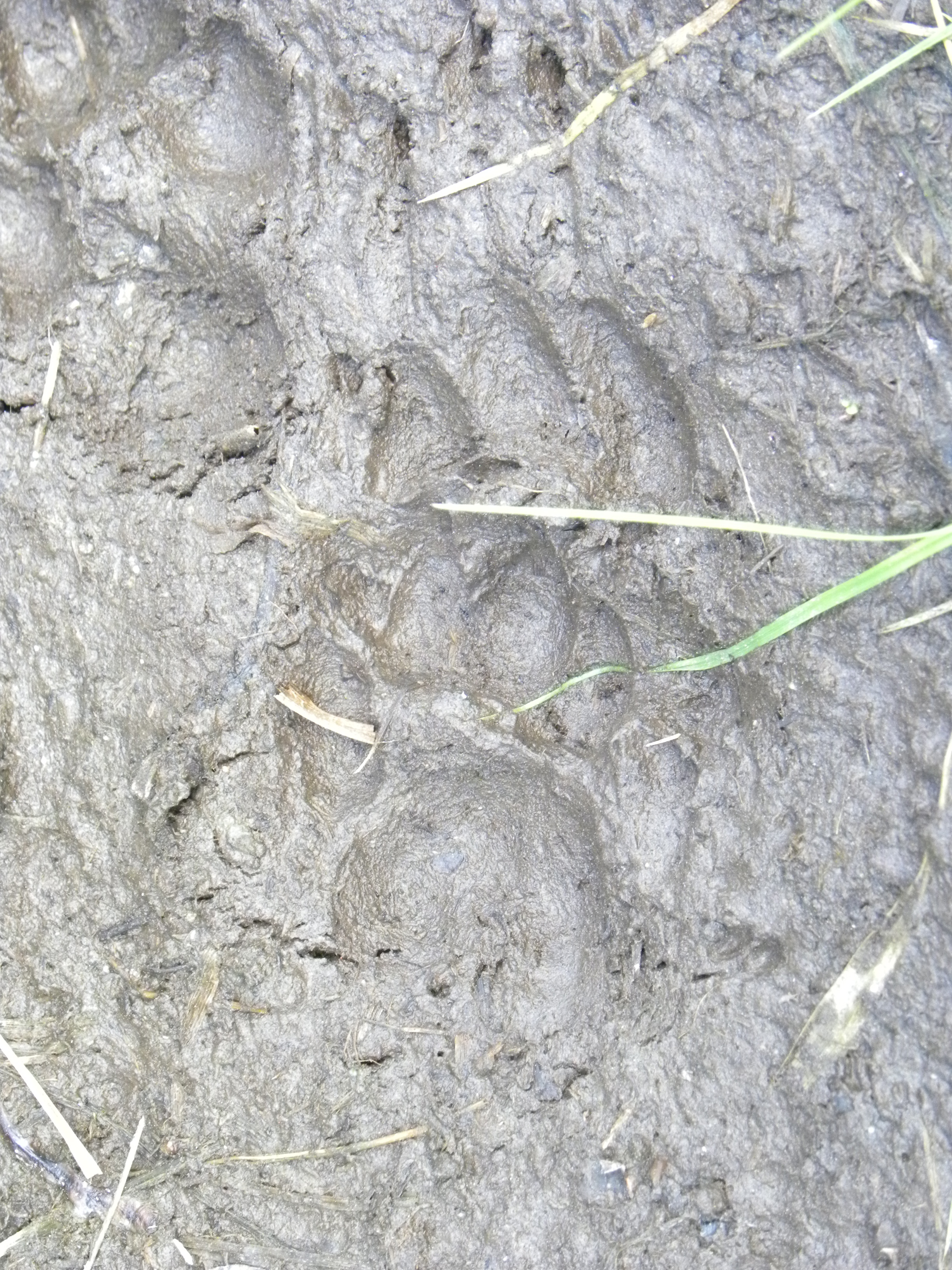
Bison footprint

Memory is short.  I suppose it could be touted as a conservation success story, saving the Bison from extinction, running them through a very narrow genetic bottleneck to pop out with 3000 in the Park in 2010.  But what of the other many millions?

An apology from the government is long overdue to the Bison.  A presidential pardon.   And then a place, a very large place in the mid-west they can call their home, should be granted to them, to let them live again and build their numbers as they please.  This idea isn’t new.  Its’ been floating around since the late 1980’s when Drs. Frank and Deborah Popper proposed The Buffalo Common, an area set aside where dying farming communities are.  The Poppers were given a lot of grief over their ideas, but it seems that, with the shrinking of family farms and many towns in the Mid-West folding up, this idea is now being considered as not only realistic, but money making (the key to everything capitalistic!).

There is not one national park in the mid-west.  Imagine herds of thousands of Bison roaming their old habitat.  The short and tall grass prairies would be restored, the soil would sing again, and tourists would come from all over the world to see these magnificent animals, found no where else on earth,  just as they now come to Yellowstone.