• MY BOOKS ON WILDLIFE, GARDENING AND MORE

  • The Wild Excellence

  • True stories of wildlife encounters around the Greater Yellowstone
  • Award winning eBook on Decomposed Granite, tips, how to's, what to watch for
  • Children's book. True stories of a dog and wolves. In a dog's voice
  • Written for dry Mediterranean climates in California, north and south

The Sheepeaters

One of the interns gave me a book of Robert Service poems.  Oh, how I like so many of them.  Here’s a few verses from one of my favorites called ‘The Spell of the Yukon”

The summer — no sweeter was ever;
The sunshiny woods all athrill;
The grayling aleap in the river,
The bighorn asleep on the hill.
The strong life that never knows harness;
The wilds where the caribou call;
The freshness, the freedom, the farness —
O God! how I’m stuck on it all.

The winter! the brightness that blinds you,
The white land locked tight as a drum,
The cold fear that follows and finds you,
The silence that bludgeons you dumb.
The snows that are older than history,
The woods where the weird shadows slant;
The stillness, the moonlight, the mystery,
I’ve bade ’em good-by — but I can’t.

There’s a land where the mountains are nameless,
And the rivers all run God knows where;
There are lives that are erring and aimless,
And deaths that just hang by a hair;
There are hardships that nobody reckons;
There are valleys unpeopled and still;
There’s a land — oh, it beckons and beckons,
And I want to go back — and I will

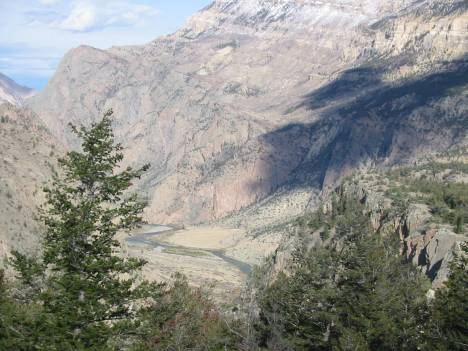
Its interesting how one can feel a place.  Up the dirt road towards Yellowstone, there’s an area that just feels good.  The wolves like to den there, the Bighorn sheep hang on the cliffs there, and the Sheepeaters had winter camp there for 5000 years.  Keep going farther up that road, about 20 miles, closer to Yellowstone, and the feeling changes.  Something about that area always feels ominous to me.  As the valley narrows, the Absarokas close in.  Volcanic in nature, the mountains tell the story of fire and ice with their knife edge ridges and slopes of scree.  I’m always a little uneasy up there.  Its beauty and wildness belie ancient and ominous secrets.  I’m wondering ‘What happened here?’

But my story is about the area that feels good.  Last summer I spent a long time looking for a ‘sheep trap’.  I’d been told about one that was a small cleft in the rock face.

W___ had told me there was a sheep trap up in the timber, yet everytime I looked I couldn’t find where he said it was at.

Sheeptraps were used by the Native Americans who lived around here.  A sub-group of the Shoshones, they were named Sheepeaters because their primary diet consisted of Bighorn Sheep.  They made the finest bows out of horn, used no horses, and went back and forth into the Park.  These sheeptraps were one of their ways of hunting.  Usually placed along a game trail and on the downhill slope (Sheep always see what’s coming from below, but never tend to look up for danger), the traps had drive lines of dead wood that lead to a pen.  Once in the corral, then animals were usually bludgeoned to death.

I spent many days looking for the trap.  My mistake really was to go on W___ ‘s advice.  There WAS a trap he knew about up there, but it wasn’t the natural rock formation one.  He’d only been there once, and since he didn’t know this area well (he’d gone with another person who did) his directions were weak.  One time I hiked way up the mountain through several meadows.  I was tired and it was getting late. Turned out I was only a few hundred yards from the trap in the woods.  But when W__ did take me there later on, I didn’t feel so badly, for I talked with several hunters who’d walked right by the trap and never saw it.
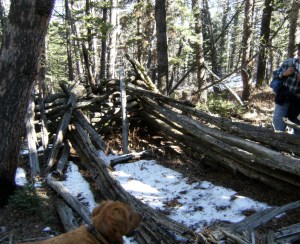
Partially buried sheep trapThe wooden trap was awfully small, but when you looked closely, it was obvious that it was buried deep.  The wood was old and it was amazing the construction was still intact.

I knew that there must be another trap somewhere else.  I decided to walk along the cliffs farther down the meadows.

Fall was in full force and the days were short.  One afternoon I took a few hours and hiked up to the bottom of the cliffline.  I walked its edge.

The view was fabulous from up high and I stopped to investigate a natural arch.  There was nothing inside but packrat remnants.

Farther along the wall, I came to an extremely narrow notch in the wall.  Some unknown force drew me to climb up it to the landing above to investigate.  I hesitated.  The light was getting low, I was running out of time, and this seemed like just a curious sidetrack.  But I couldn’t resist.  I scrambled on all fours through some snow and debris up the cleftt to small flat area above.  Walking around on top of the rock, I noticed a second but larger cleft between two gigantic boulders.  The boulders narrowed sharply and a tree was growing at the base.  It was a curious natural formation.  A few pieces of wood and debris were inside.  I looked around but saw no evidence of any drive lines.

I climbed back down the notch and continued making my way along the wall.  In short order I came upon a dry creek bed and an old game trail that led to the landing up above.  It was then that it hit me–That cleft WAS the pen, just a natural one.  It was so obvious.  I raced back up the ravine as the sun was starting to set.  Sure enough, the game trail passed a few hundred feet above that cleft.Looking from above
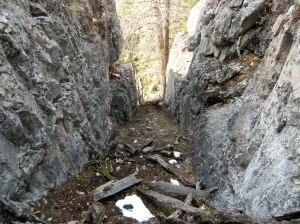
And now I noticed random wood above the cleft, probably strewn around for the last hundred and fifty years, once used as the drive line.  The whole setup seemed so ingenious to me, with the minimal expenditure of energy.  The ancient game trail right there, the Sheepeaters waiting in the timber above, the natural pen below.  If you walked from the cliff line below, you’d never notice this pen because of the tree and a good amount of debris placed there to block the exit.

I sat down at the top of the rock and watched the setting sun.  I marveled at how by trusting a feeling I found this place.  And the moment of ‘Ah ha’ that came from the inside out.    It was getting cold now.  But I took a little time to sit and say ‘thank you’ to whatever bought me here.

Teepee Rings and the Spirit Wind

Someone gave me one of those mid-range expensive weather stations, the kind with an indoor readout that talks with an outdoor unit.  It also talks to a satellite for date, time, and moon phases.  There is a feature on it that tells you a forecast: an arrow up or down, sun or clouds.

This morning I looked at the forecast on the readout.  It featured clouds and the arrow was down.  Ten minutes later W___ called and asked about a hike today.  I looked at the readout and the arrow was up.

Frankly, that about says it all for Wyoming weather.  JB, my 84 year old neighbor, tells me the old saying is “If you don’t like the weather in Wyoming, wait 10 minutes.”  I think my digital weather station feels like its riding a bucking bronco sitting on my window sill forecasting mountain weather.

W___ and I decided to meet down the mountain and go for a hike out near the mouth of the Clark’s Fork river.   The Clark’s Fork barrels down the canyon from the Beartooths, carving a deep gorge over a mile deep in places from the high plateau where I live.  Chief Joseph led his people through here, pursued by the army, fleeing to Canada.  The reason he knew the area so well was because the Nez Perce had been coming here every fall to hunt buffalo.  By 1840, the buffalo had disappeared from Idaho.  The Nez Perce had to decide to either change their diet or migrate yearly to Wyoming to hunt.  They used traditional trails through the park and into the Great Basin of Wyoming.  Clark's Fork of the Yellowstone River

Today was incredibly windy.  The winds were traveling at breakneck speed down the canyon.  Sometimes gusts blew me off my feet.  Huge clouds of water blew like ghosts off the river.  W__ said it was a ‘spirit wind’.

We park at the end of a dirt road that once was a Ranch.  W__ tells me that about 12 years ago there was a large drug operation at the ranch, the owners were busted by the Feds, and because it was a Federal operation the ranch became federal property.  Eventually the state took the ranch over.  Now, its just old buildings boarded up.  We walk around in the hurricane force wind.  The main house is all boarded up, but several cabins are still open.  Most are filled with packrat items, but others have old signs and refrigerators in them.  One is filled with rolls of carpet.  The ‘drug ranch’ sits on the flat sagelands, next to the river, with old Cottonwoods surrounding it that some previous owner planted.  Its a perfect movie set.  The story goes that one of the druggies got out of prison early and went back to the ranch in the night to dig up drug money that they’d buried there.  Koda’s running around like crazy after jack rabbit scents.  I humorously instruct him to ‘Look for the money, Koda.”

The river, once roaring and wild, settles down here at the mouth and swings gently along a wide, broad plateau. We walk much further down the old dirt road, off the ranch, and towards the mountains.  W___ points out the numerous teepee rings.  At first I can’t see them well.  They’re old and the rocks are deeper in the dirt than ones I’ve seen before.  I kind of have to squint, unfocus my eyes and let my mind flow.  Soon, I’m spotting them too.  Their openings are to the east.  A few even have old fire rings in the middle.  We’re at the end of the plateau where W___ tells me the rings are large.  I ask him why some of the teepees are smaller and some are larger.  “I’m just guessing here, Old teepee rings.  Can you see them?but my theory is that the larger rings were for families that might have stayed longer; whereas the smaller teepees were temporary hunting parties.”  I like to try and imagine the community spirit that once was here, bustling with excitment and activity for the fall hunt.  Its in sharp contrast to the drug ranch of secrecy and isolation.

Yet all that’s left of both of them are a few signs, a desolate area, and a fierce wind–a ‘spirit wind’.  Newer teepee rings in the Bighorns

The Shepherd

During the elk capture, the ranch hand from the Dude Ranch down the road offered his meadow for us to watch from.  He’s a real character with some funny stories.  I asked if those were his cattle grazing on forest service land in the summer way down towards the end of the valley.  He told me they were.

“The hunters come with their weed-free high quality expensive hay for their horses.  They leave it out in the backcountry and our cattle eat it.  Then they get angry, so I just give them some of our hay, grown here.  Not such good quality you know.  Its a good deal for me.  Then the Ranger comes and says ‘Hey, is that certified?”  And when they say it is, the ranger says ” Where’s your tags?'”  I laughed just thinking about that.

My valley runs from the main highway about 35 miles west and butts up against Yellowstone which is just over the Absaroka Mountains.  Problem grizzlies get dropped off there in the summer.  I’d seen his cattle way far back.  I asked if he’d had much cattle predation.

“Don’t have any.  Never have lost one cow.  The Fish & Game guys always ask ‘What are you doing? How come you have no losses?’ and I tell them “I don’t know why.  I don’t do anything.  Maybe it’s because the cattle are in the trees back there.”

Last summer several calves were killed on the other ranch towards the head of the Valley.  That rancher keeps his cattle mostly enclosed in one area, which is where they were predated on.  I suggested maybe it was a lot easier when you knew exactly where the cattle would be every day, like going to the refrigerator.

C___, the ranch hand, has 17 cows about to give birth and has been coming out every 2 hours in the night to keep the wolves away.  He’s shepherding them.  We asked if we could help birth the calves.  He said its easy.  He’d call us to help.  I hope he does as it sounds fun.

Ranch where cattle were predated upon

The Dreaming

This winter I went to Australia with my son.  Its the perfect place for a California Landscape Designer to explore, as its just one of the five Mediterranean climates around the world.  I use a lot of the plant material from there, and to see these plants in their native environments is interesting and instructive.

I was in Australia for several months over twenty years ago, so this was my second visit.  I planned to go back to Sydney (I almost moved there 20 years ago), then venture up to the Daintree, the world’s oldest tropical rainforest and a UNESCO site (north of Cairns) and then to Atherton Tablelands wetlands retreat in a savannah ecosystem.  My son has a teacher from Australia who said “You MUST go to Uluru.”  I hadn’t planned to go there.  I knew about Ayers Rock for a long time.  It’s a long trek, by plane or otherwise, to see ‘just a rock’ I thought.  Besides, I live in a most beautiful place, surrounded by magnificent mountains and rock features, geysers and wildlife.  I’ve visited many deserts and spent a lot of time in Death Valley and Joshua Tree.  What could one rock in the middle of the country possibly hold for me?

My travel agent also brought up the idea, and since we were in Australia over Christmas and many places were shut down for several days, Uluru seemed like a likely ‘detour’ during that lull.  We were to be there for a day and a half and then drive to Alice Springs.  But the holiday put a wrench in the travel plans…ferries didn’t run, planes had restricted schedules, etc…so we spent an extra day in Uluru/Kata Tjuta area.  It wasn’t till later that I realized things had conspired to bring us there for a fuller experience.

Uluru

Read the whole story

Welcome to Wyoming

I really like this quote from Finis Mitchell, a man who grew up since 1906 in the Wind Rivers, and was a fishing outfitter all his life.  Finis  stocked most of the lakes there, carrying them in by horseback.

Throughout this century I’ve roamed this wilderness, communing with nature, observing other creatures along with myself, merely desiring to live and let live.  Because of this aloneness, I’ve learned to love, not only those of my own kind, but all life within a wilderness; the birds, the beasts, the trees, the flowers, and the grasses of the land.  Only in wilderness, it seems, is man’s love so thoroughly and completely returned, so unselfishly shared.

I arrived here on Saturday, after driving out from the Bay Area.  I’m a real whimp when it comes to snowy roads and since Cody had a minor snowstorm on Friday, I waited till Saturday to go over the 8000 ft. pass to my cabin, choosing instead to stay in a warm house with a Cody friend.

The students who are studying elk and wolves in my valley had been staying in the cabin.  They cleaned it up real nice before I arrived and B___ will be staying here with me.  She’s temporarily hired on to follow ‘Spud’, the nickname the guys gave the Idaho wolf who’s traveled  all the way across Yellowstone to end up in my area.  He’s radio collared and she’s acting as his GPS, tracking him every 4 hours.  Apparently he’s been hanging with a female.  Maybe they’re going to mate. Continue reading