• MY BOOKS ON WILDLIFE, GARDENING AND MORE

  • The Wild Excellence

  • True stories of wildlife encounters around the Greater Yellowstone
  • Award winning eBook on Decomposed Granite, tips, how to's, what to watch for
  • Children's book. True stories of a dog and wolves. In a dog's voice
  • Written for dry Mediterranean climates in California, north and south

Clark’s Fork hike and the vilified wolf

The dump is just up the road about 20 minutes.  Its an auxiliary dump, meaning its for locals and basically a large canister with a locked fence around it.  The whole idea is to prevent bears from getting in, and to help locals with their trash and bear management.  Last year though I did see a horse that was dumped off there outside the bear management fence.  Although the bears couldn’t get into the trash, they sure did get into the horse, along with the wolves.

I really don’t know many people up in the Crandall area yet, nor do I know too many of the hikes.  I hiked with the wolf study gals last fall there a lot, but mostly that was through brush directly to GPS sites where their collared wolf had lingered for more than an hour.

So I stopped and introduced myself at the Hunter Peak Ranch.  Its an old dude ranch that now mostly houses guests and horsebackriding.  The owner, Shelley Cary, was very gracious and I talked for a while with her and her family.  They serve dinner to guests and outsiders with advance notice.  Something good to know for any guests I have.  They also had some great ancient photos on the walls of homesteaders from the Crandall area.  Several names I’d heard of.  One of them, Norman  and Mrs. Dodd, homesteaded in my area.  Apparently people always had to refer to Norman’s wife as Mrs. Dodd.  They lived ten hard miles from the meeting house, which was a one room schoolhouse, and came by a team of mules pulling a buckboard.  Another photo was of the old post office, a long wooden building in disrepair.

I took a short 5 mile hike along the Clark’s Fork trailhead. The Clark’s Fork trail is well marked and well used by horses.  Its in open sagebrush, so if a hiker does encounter a bear, there’d be plenty of room to move.
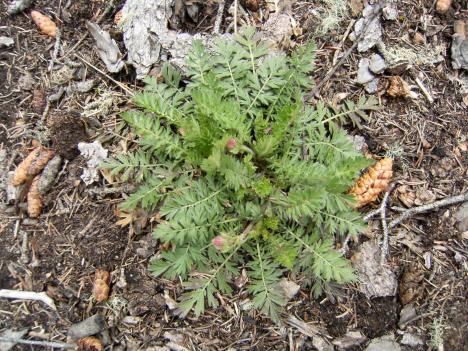
Geum triflorum.  Prairie Smoke
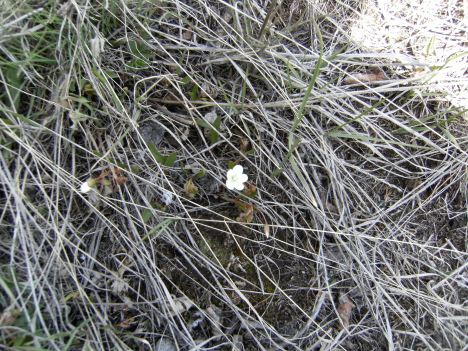
Geum triflorum. Prairie Smoke

Claytonia lanceolata.  Spring beauties.  Edibles.  Purslane family

Claytonia lanceolata. Spring beauties. Edibles. Purslane family

I’ve been on this trail before and knew of a wonderful secret spot where the river drops into a gorge.
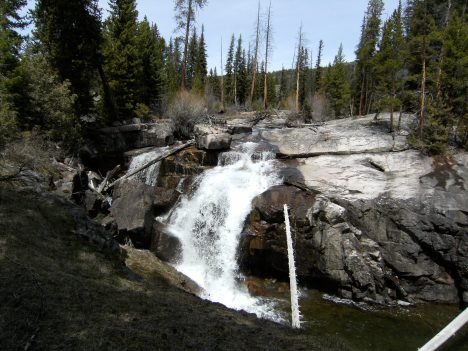
Lunch spot

Lunch spot

I wandered off-trail to the waterfall.

Allium.  Wild onion. Spicy addition to lunch.

Allium. Wild onion. Spicy addition to lunch.

There was plenty of moose sign in the willows around the river, as well as a pair of nesting ospreysKoda and I sat and hung with the fish hawks for a while.  The female was sitting on her nest, although she took some time out to try and scare me off.  The male sat nearby with a piece of fish in his talons.

Female sitting on her nest

Female sitting on her nest

Male osprey nearby nest, with fish in talons

Male osprey nearby nest, with fish in talons

There’s always a plethora of anti-wolf talk in our area.  Besides aggrieved hunters and ranchers, I once talked with a woman whose parents ran an outfitting company.  She was only 16 and hated wolves.  She told me a story about how they had taken their supplies in the fall up to a campsite in anticipation of bringing some hunters up there the next day.  They’d left three dogs with the supplies, alone, overnight, way up near the Yellowstone border.  This was something they were used to doing, for years.  But this year was different.  When they returned the following day, one of their dogs had been killed by wolves.

After lunch, on the way back to the trail, I ran into a fellow resting his horse.  I introduced myself and found out he was a local.

“Find any horns?” he asked.

Horns refers to antlers.  People around here spend lots of time looking for antler sheds in the spring.  They can be worth big money.

“Nope, wasn’t looking for any.” I replied.  “But I did find a pair of nesting ospreys and moose sign.”

“I saw four wolves up on table mountain.  They’ll eat your dog, you know.  Just like that.”

“Yep, that’s why I keep him on that electronic collar.  We have an agreement he and I.  I protect him from wolves and he watches for bears.”

“Those frickin’ wolves, they’ve ruined everything.  There used to be so many bull elk here.  I wish they’d never put them here.”

“I like them.”

“They’re everywhere.  They ran after an elk right through the trailer park the other day.”

I didn’t think he heard me so I said it again.  “I like them here.”

“There’s no more moose anymore.  They’re history.  They’ve frickin’ ruined it all.  Things used to be good.”

“I seem to be seeing a lot of moose this year.  Maybe their numbers are coming back.”

“Oh, where you live maybe, but not here.  Wolves have ruined it all.  Last year we found three bull elk kills up Crandall creek.  They just hone in and kill them.  There’s no more left around here.”

I didn’t bother to tell him that I knew the elk study coordinator had hiked up there this winter and taken samples of the bull kills he’d seen.  He said their marrow was like jelly, an indicator of poor health.  I mentioned all the grizzlies in the area.

“Oh, those grizzlies don’t do much.  Its those damn wolves.”

That’s a typical conversation I’ve had many times.  There is a lot of animosity and anger about the wolf introduction.  These are people who live on the land and know the land, at least in a certain way.  They know where the wolves are denning even though the Game & Fish keep it secret.  They see grizzlies when they’re out. They feel comfortable in the outdoors, but they have been used to not having wolves around for a very long time.  And they resent having to take them into account now.

Its a most controversial matter, wolves.  I tend to be on the side of the wolves, but I also am sympathetic towards the ranchers.  I feel that its’ important to work with ranchers and begin to develop practices that protect their livelihood.   I also know that these large ranches are one of the last ways we can protect the land here.  If the ranches and ranchers are not taken into account, if they loose their land, then those large tracts will be sold and chopped up for development.  That in itself is even more of a death blow to wildlife, especially grizzlies and wolves.  New ranching management practices are critical for wildlife protection as well.  As one of the wolf researchers said to me last year “Something’s got to change. There’s just too much killing going on” in reference to all the wolves killed by Wildlife Services in retaliation for calf predation. (For a video of wolves in my valley, click here)

Wolf on carcass

Wolves on carcass

In contrast, I was reading in the Wind River Reservation Wolf Management Plan about how some of the elders of the tribe view wolves.  There is controversy on the reservation as well, the report says, because many Native Americans have livestock.  But there is magic, wisdom, and most importantly, respect, communicated in their ancient views.   Here is an excerpt from that report.

Traditional views recognize wolves as kin, as strong, as deserving of respect and placed here by the Creator for a purpose. The Shoshone word for wolf means “big coyote.” Wolves lived a long time, were very smart and observant, and listened well. When wolves appeared in a vision, one was to follow what the wolf showed you. The wolf was secretive and special and used to talk with people through telepathy. Wolves were helpers. Wolves were sacred and to be left alone, however sometimes people had to kill them. People were to be careful around them. Wolves could teach virtuous things to people. They were an example of how to care for family members because they took good care of the young as well as the old. The packing behavior of wolves showed people that they should not go out hunting alone. Wolves also showed people to use the entire game animal (the meat, bones, hooves, marrow, skin, etc.) – not to waste any of it. Wolves wandered to wherever the food was, like earlier people did. They did not know boundaries. Now wolves are being confined to certain areas like Native Americans have been confined to Reservations.Gray wolf

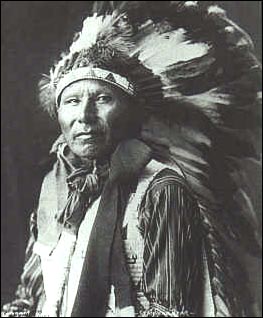
Chief Standing Bear and Grandpa

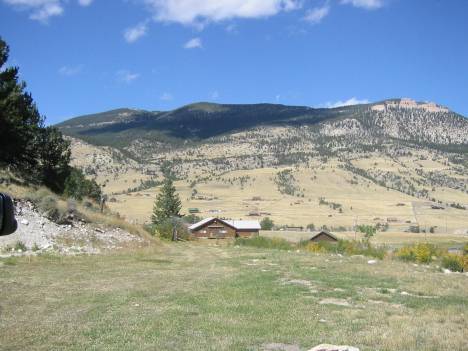
My neighbor JB was born in 1924 in my valley down by the Clark’s Fork.  His parents’ homestead is in a unique and beautiful hollow below the main road.  From this hidden depression, you can look out over the meadow where their horses graze and view Bald Ridge directly on.The flats above the gorge of the Clarks Fork

Bald Ridge

Yesterday it was snowing so I went to visit JB.  He told me this story:

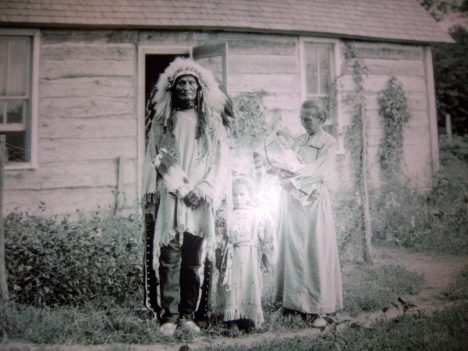
My grandfather was born in Nebraska.  When he was just nine years old, he was playing and broke his leg.  His father was a hard man and beat him for that.  My grandpa swore to himself that when he got better he was going to run away and he did, at 10 years old.  He and a friend were catching rides on freighters going down river, going West.  They hitched a ride on a wagon that was attacked by Indians.  The Indians killed everyone in that wagon train, including his friend, but my grandpa hid in a flour drum.  The flour was in 55 gallon drums and he hid behind one.   The Indian Chief and his wife found the boy and the Chief’s wife took pity on him.  They took him back to the tribe and raised him with their own child, which I think was a girl.  That Chief was Standing Bear.  My Grandpa lived with them for 5 years. Chief Standing Bear--I think its this one.

The Indians liked to gamble and compete.  There was one boy the same age as my grandfather who didn’t get along with him at all.  When my grandpa was 15, this boy challenged my grandfather to a horse race.  Grandfather was an excellent horseman and he was winning.  The Indian boy was mad and pulled out a knife.  Grandpa knocked that boy down, off his horse, and I think he killed him.  Or hurt him badly.  No, I think he killed him, but it was kill or be killed.

The whole tribe had a meeting.  Since my grandfather was white, they banished him.  Chief Standing Bear and his wife took my grandpa in the middle of the night, on horseback, and told him he should leave and go far away; far enough away so no one in the tribe would come after him.  The chief told him that he would always love him and think of him as a son, strong, brave and worthy to become a chief, but that now he must go.

Photo of Chief and family from the Buffalo Bill Historical Center

Photo of Chief and family from the Buffalo Bill Historical Center

Grandpa came out to this country and spent time here with the Shoshone as well.  He was working at Pahaska Teepee taking people into the Park when Buffalo Bill came out here.

It is true he had a wooden leg.  He was logging and in an accident.  His leg broke, a clean break right here (points to below his knee).  He knew how to set bones and had set many breaks on other people. But they took him to a doctor who cut off his leg at the knee.  That shouldn’t have been.  He’d wear lots and lots of socks over that peg to cushion it against his knee.  But he could do anything he wanted with that leg.

He lived near the mouth of the Clarks Fork.  One time us kids were down there visiting.  My sister was taking a nap in the house and all of us other kids were down at the river swimming and fishing.  Grandpa was working in his shop nearby.  In those days there was lots of sheet lightening in this country.   My sister had just gotten up from her nap and was coming down to the river, when lightening struck the house.  You couldn’t do nothing.  In an instant, the entire house was in flames.  My grandpa thought my little sister was still in the house.  You should’ve seen him run with that peg leg!

I went to live with my grandpa when I was about 12.  I had a hard time finishing up those last two years of school between the 6th and 8th grades.  I did graduate though.  I only went till 8th grade.  Sometimes I was on the other side of the mountain going to school there.  They had a better teacher.  Sometimes I had to come back home and go to school here.  There were only 3 students here and all that teacher was interested in was the ranch hands. All that back and forth on foot and horseback over Dead Indian.  There wasn’t a real good road in those days, all dirt.  The old road went straight down the mountain.  From Cody it took four stout horses to pull an empty wagon up the hill most of the day. When you got to the top of Dead Indian, a man put a roughlock shoe on his hind wheels which kept them from turning.  Then he cut a tree, left all the branches on it, and chained it behind the load.  Then he headed straight down the hill, praying that his leaders would outrun his wheelers.Atop Dead Indian.  Strap a log behind the wagon to go downhill

Grandpa had really strong hands, all his life.  It was because he had spent so much time driving teams of horses.  You have to hold those reins between each finger and use your hands to hold back the horses.  He drove hay and other goods for a living.  I think he had done just about everything.  He was an excellent blacksmith and made all his tools.

It was a good story for a snowy day.  I thought about how I was just one hair’s breath away from Chief Standing Bear.  How less than a hundred years ago men knew how to do everything in order to survive–how to set a bone, fire and hammer out their tools, drive a team of horses.  I thought how our lives had become so quickly removed from those generations– so flaccid with the advent of electricity, large machinery, computers, phones–and wondered how much lore and skills have already been buried forever.

When I talk story with JB, I can feel him reaching back in his mind.  He has an impeccable memory for details. His stories contain names and dates.  He might have only an 8th grade education, but his powers of observation far surpass many I’ve met with college degrees.  I get him to tell me stories.  I write them down.  I listen.  They need to be re-told.

The wickiup

Last week my friend W__ and I hiked up almost to the ridgeline on the steep slopes across the river from my cabin.  That entire hillside used to be owned by Doc Firor, the original owner of my cabin.  Unfortunately, it had been sold after he died and divvied up into  6 acre parcels with cabins on it.

That is the south facing side and is basically granite, which means its mostly treeless down below and there’s very little water run-off.  In fact, over these last 10 years of drought and climate change, many of the springs have dried up.We hiked almost to the ridgeline

W__ had been up there several years ago with a local and found some evidence of Sheepeater houses.  “My friend pointed to some old logs and said ‘these are them’.  I really had to use my imagination.”

The hike is tough and pretty much straight up.  You climb through a series of level meadows followed by steep ascents.  The first 2/3 consists of scattered limber pines and doug firs.  W__ couldn’t remember exactly at what height he had seen the ruins, so we wound up climbing almost to the base of the cliffs.  Several levels below the cliff-line is open forests with stunted trees.  We were right below the cliffs

Most of the time we followed deer or elk trails.  We would stop and inspect a level area, then move on to higher ground.  At one point I spotted a tiny obsidian flake.  I have no idea how I found it amidst all the duff and debris.  We joked that the obsidian flake and the crow feather we found meant we were ‘hot on the trail’.

Pretty soon, after not encountering any sheepeater evidence, I forgot all about looking for ancient artifacts and enjoyed the forest.  The rolling gurgle of Sandhill cranes in the distance, migrating in, spoke of winter breaking.  The views were magnificent as we were about 2,000 feet above the valley.The view was magnificentAfter a lunch break we began heading back.  We descended slightly down to a lower yet still forested level that we hadn’t inspected.   Suddenly W__ spotted some old timber.  In a flat clearing, butting up against the hillside, was a distinct squared off area constructed of ancient logs.Sheepeater hut

Another view

I looked around and noticed that behind me was access to the cliff areas, while in front was a complete view of the valley.Access to the cliffs behind

Site looks over the whole valley

A spring used to run nearby that’s now dry since the homeowners below diverted it for their own use.   Several hundred yards directly east we encountered an opening to a gully that ran east/west.  We walked along the top of the unusual drainage, now full of snow.  It was long and wide, narrowing into a natural boxed trap.  I could almost imagine the Sheepeaters driving Bighorn into the small canyon where they’d easily be trapped and killed.  Probably this dwelling, I thought, was just a temporary shelter used in winter.  The haul of the kill back down the valley to the Bugas-Holding site, not exactly nearby, must have been tough.  The Sheepeaters used dogs with travois to do a lot of their carrying.

The one thing that made me uncertain was that all the pictures I’d ever seen in books had Sheepeater ‘houses’ as teepee style structures, with logs piled on top of logs.  This was definitely a square structure.

When I returned I showed the photos to my old neighbor JB who grew up in the valley.  He further cast doubt on the sheepeater theory as he thought the structure looked more like an old bear trap.

“There’s a tree in the middle with only one exit.  They’d tie a horse as bait for the bear.  I bet that’s what that is. The Indian houses were teepee log structures.”

Somehow I couldn’t imagine those old homesteaders climbing way up the mountain to bait a bear.  “Heck”, I thought, “if I was going to bait a bear, I’d do it in the drainages down below where they usually hang out. And I wouldn’t have to trek way up here.”  W__ thought it was all wrong.  “No”, he said, “the logs are really old.  That’s a sheepeater’s structure.

Several days later I decided to take another look.  I found an easier route from the road.  Although not as much climbing was involved because I started higher up, I had a lot more ground to cover.  Taking another look at the structure, it had absolutely no exit.  There were four complete sides.  And the dead tree inside was too young compared to the timber used to construct the dwelling.  Still I had no way of being certain.  I don’t have the expertise and there’s always the unknown factors.

On my way down the hillside, I ran into some locals.  The woman was from the University of Wyoming extension.  They knew the area and knew of the wickiup.

“Several years ago that was discovered by one of the ranch hands doing some work on the stream.  He called George Frison who came out and looked at it.  Frison said it was the real thing–a Sheepeater dwelling.  It used to be more intact, had more height to it.  It’s deteriorated since we first saw it.”

I had to wonder how the structure had deteriorated so fast over the last 20 years compared to the fact that its probably at least 150 years old.  These are special sites and need to be watched over.  When the ’88 fires came through here, the forest service was cutting break lines.  If it hadn’t been for one of the locals pointing out a sheeptrap to them, they would have cleared it completely.

Fire is destroying the evidence of these ancient peoples.  There is a concerted effort going on to find and GPS as many of these sites as possible before they are destroyed.  Interestingly, although fire will destroy wood structures, it also clears duff and can expose artifacts buried below.  The Boulder Basin site is a perfect example.  It had been explored since the 1970’s.  Although sheep traps were evident, Archaeologists thought that the sites had been cleared and looted because little other cultural evidence was found.  After the fires, the site was re-visited and hundreds of projectile points, bone fragments, stone implements, and other important artifacts were uncovered, some simply scattered above the burned ground.

These are Americas’ Acropolis, our Pyramids.  They stir our imagination and resonant with the collective unconscious of humankind.  I see these old timbers and dream the dream of what it might have been like to be living here so long ago; to be dependent on one’s community and the earth; to be a wanderer, a hunter-gatherer; to be so intimate with the natural world.  These are important places, for us, for our children, for all mankind.

The First Peoples here

Greater Yellowstone Ecosystem has two premier archaeological sites, both on the eastern side.  One is Mummy Cave located between Cody and Yellowstone; the other is Dead Indian Campground, located along Chief Joseph Scenic Highway north of Cody.  Mummy Cave is a well-preserved site showing evidence up to 9000 years old.  It is well-known and much talked about.

On the other hand, Dead Indian site is difficult to find much information about.  The site butts up against the road, near the Dead Indian Campground.  It was discovered when someone noticed bones and artifacts slumping into the creek and a dig was lead by George Frison of The University of Wyoming beginning in 1969 and continuing through 1971. According to Frison’s Survival by Hunting, the Dead Indian site is around 4000 years old and probably a large winter campsite.

Another premier site nearby is the Bugas-Holding site.  The area is meadow, aspens, and next to the creek.  This site also was a large winter campsite where both Bighorn Sheep and Buffalo were taken.  Bugas-Holding site

In order to find out more about the Dead Indian site, I went to the Cody library and was lucky enough that they had a copy of the Wyoming Archaeologist from the 70’s when the site was excavated.  The local chapter had done the dig with help from Frison.  The frayed paperbound copy was the technical report of the findings.

Walking around the site now, my untrained eye would never know there had been a dig.  The teepee rings are no longer visible.  The only evidence I saw was a single small 1/8″ size obsidian chip.  The area though, is a perfect campsite.  It has a fairly large and flat meadow right near the creek.  It is east enough of the Absarokas that the snow accumulation is less than farther up Dead Indian drainage.  It is protected from wind and has areas for lookouts.  And it is along a major route through the Park and into the desert below.

In the dig they found antlers of mule deer laid out in ceremonial fashion.  A skeleton of a small child was uncovered.  Over 500 projectile points and hundreds of stone tools were unearthed.  It seems that mostly what these people killed and ate were mule deer and mountain sheep.  Even though they lived here during the winter, few elk were uncovered which suggests the populations of  large mammals was very different then.  George Frison thinks hunting was done singly or in a group, rather than using large scale trapping.

Just around the corner over at Bugas-Holding, mostly Buffalo and sheep were found.  The sheep were probably taken in traps right near the site.  The site is on private property but a short jaunt over the hills and there are numerous sheep traps, close enough to bring back kill to the campground.  An easy walk above the site and you can view the entire valley, east to west; a perfect place for a lookout.  Looking up the valley from the siteLarge obsidian flaking sites are around these hillsides.  It seems that this site was later than the Dead Indian and they did use large scale trapping.

George Frison wonders, and so do I, why these peoples would overwinter in and around 7,000′, when they could have easily gone down to the Big Horn Basin at around 5000′ where there is less snow cover.  He suggests the abundance of winter hunting.  You also have to wonder if the climate was different then as well.The creek in winterAs I find out more about what went on in this area east of Yellowstone, I’ll let you know.  To imagine this was a major route through the Park, and a large scale occupation area–well, its very quiet here now.  Few people live here year round; most choose to live in the lower elevations nearby.   People hunt here now, but the people who hunted here in the past also did ceremony to their prey.  When I happen to find a small piece of evidence, like a sheep trap or a piece of obsidian, there is a bit of wonder and mystery about it–and sadness.  Some principal piece that went on here for thousands of years is gone forever.
The Sheepeaters

One of the interns gave me a book of Robert Service poems.  Oh, how I like so many of them.  Here’s a few verses from one of my favorites called ‘The Spell of the Yukon”

The summer — no sweeter was ever;
The sunshiny woods all athrill;
The grayling aleap in the river,
The bighorn asleep on the hill.
The strong life that never knows harness;
The wilds where the caribou call;
The freshness, the freedom, the farness —
O God! how I’m stuck on it all.

The winter! the brightness that blinds you,
The white land locked tight as a drum,
The cold fear that follows and finds you,
The silence that bludgeons you dumb.
The snows that are older than history,
The woods where the weird shadows slant;
The stillness, the moonlight, the mystery,
I’ve bade ’em good-by — but I can’t.

There’s a land where the mountains are nameless,
And the rivers all run God knows where;
There are lives that are erring and aimless,
And deaths that just hang by a hair;
There are hardships that nobody reckons;
There are valleys unpeopled and still;
There’s a land — oh, it beckons and beckons,
And I want to go back — and I will

Its interesting how one can feel a place.  Up the dirt road towards Yellowstone, there’s an area that just feels good.  The wolves like to den there, the Bighorn sheep hang on the cliffs there, and the Sheepeaters had winter camp there for 5000 years.  Keep going farther up that road, about 20 miles, closer to Yellowstone, and the feeling changes.  Something about that area always feels ominous to me.  As the valley narrows, the Absarokas close in.  Volcanic in nature, the mountains tell the story of fire and ice with their knife edge ridges and slopes of scree.  I’m always a little uneasy up there.  Its beauty and wildness belie ancient and ominous secrets.  I’m wondering ‘What happened here?’

But my story is about the area that feels good.  Last summer I spent a long time looking for a ‘sheep trap’.  I’d been told about one that was a small cleft in the rock face.

W___ had told me there was a sheep trap up in the timber, yet everytime I looked I couldn’t find where he said it was at.

Sheeptraps were used by the Native Americans who lived around here.  A sub-group of the Shoshones, they were named Sheepeaters because their primary diet consisted of Bighorn Sheep.  They made the finest bows out of horn, used no horses, and went back and forth into the Park.  These sheeptraps were one of their ways of hunting.  Usually placed along a game trail and on the downhill slope (Sheep always see what’s coming from below, but never tend to look up for danger), the traps had drive lines of dead wood that lead to a pen.  Once in the corral, then animals were usually bludgeoned to death.

I spent many days looking for the trap.  My mistake really was to go on W___ ‘s advice.  There WAS a trap he knew about up there, but it wasn’t the natural rock formation one.  He’d only been there once, and since he didn’t know this area well (he’d gone with another person who did) his directions were weak.  One time I hiked way up the mountain through several meadows.  I was tired and it was getting late. Turned out I was only a few hundred yards from the trap in the woods.  But when W__ did take me there later on, I didn’t feel so badly, for I talked with several hunters who’d walked right by the trap and never saw it.

Partially buried sheep trapThe wooden trap was awfully small, but when you looked closely, it was obvious that it was buried deep.  The wood was old and it was amazing the construction was still intact.
I knew that there must be another trap somewhere else.  I decided to walk along the cliffs farther down the meadows.

Fall was in full force and the days were short.  One afternoon I took a few hours and hiked up to the bottom of the cliffline.  I walked its edge.

The view was fabulous from up high and I stopped to investigate a natural arch.  There was nothing inside but packrat remnants.

Farther along the wall, I came to an extremely narrow notch in the wall.  Some unknown force drew me to climb up it to the landing above to investigate.  I hesitated.  The light was getting low, I was running out of time, and this seemed like just a curious sidetrack.  But I couldn’t resist.  I scrambled on all fours through some snow and debris up the cleftt to small flat area above.  Walking around on top of the rock, I noticed a second but larger cleft between two gigantic boulders.  The boulders narrowed sharply and a tree was growing at the base.  It was a curious natural formation.  A few pieces of wood and debris were inside.  I looked around but saw no evidence of any drive lines.

I climbed back down the notch and continued making my way along the wall.  In short order I came upon a dry creek bed and an old game trail that led to the landing up above.  It was then that it hit me–That cleft WAS the pen, just a natural one.  It was so obvious.  I raced back up the ravine as the sun was starting to set.  Sure enough, the game trail passed a few hundred feet above that cleft.Looking from above

And now I noticed random wood above the cleft, probably strewn around for the last hundred and fifty years, once used as the drive line.  The whole setup seemed so ingenious to me, with the minimal expenditure of energy.  The ancient game trail right there, the Sheepeaters waiting in the timber above, the natural pen below.  If you walked from the cliff line below, you’d never notice this pen because of the tree and a good amount of debris placed there to block the exit.

I sat down at the top of the rock and watched the setting sun.  I marveled at how by trusting a feeling I found this place.  And the moment of ‘Ah ha’ that came from the inside out.    It was getting cold now.  But I took a little time to sit and say ‘thank you’ to whatever bought me here.

Teepee Rings and the Spirit Wind

Someone gave me one of those mid-range expensive weather stations, the kind with an indoor readout that talks with an outdoor unit.  It also talks to a satellite for date, time, and moon phases.  There is a feature on it that tells you a forecast: an arrow up or down, sun or clouds.

This morning I looked at the forecast on the readout.  It featured clouds and the arrow was down.  Ten minutes later W___ called and asked about a hike today.  I looked at the readout and the arrow was up.

Frankly, that about says it all for Wyoming weather.  JB, my 84 year old neighbor, tells me the old saying is “If you don’t like the weather in Wyoming, wait 10 minutes.”  I think my digital weather station feels like its riding a bucking bronco sitting on my window sill forecasting mountain weather.

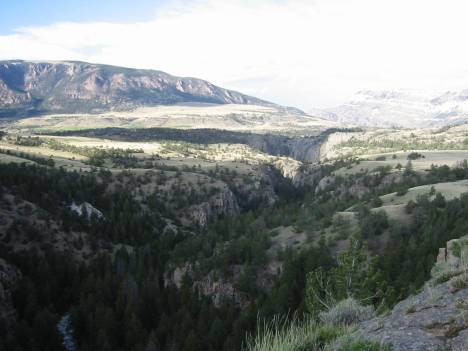
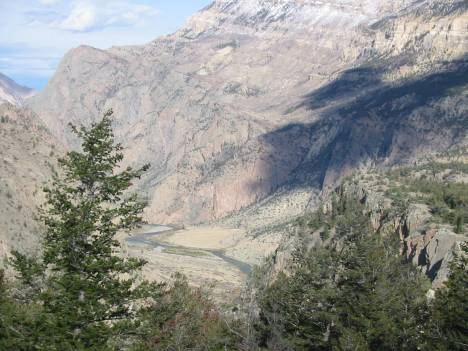
W___ and I decided to meet down the mountain and go for a hike out near the mouth of the Clark’s Fork river.   The Clark’s Fork barrels down the canyon from the Beartooths, carving a deep gorge over a mile deep in places from the high plateau where I live.  Chief Joseph led his people through here, pursued by the army, fleeing to Canada.  The reason he knew the area so well was because the Nez Perce had been coming here every fall to hunt buffalo.  By 1840, the buffalo had disappeared from Idaho.  The Nez Perce had to decide to either change their diet or migrate yearly to Wyoming to hunt.  They used traditional trails through the park and into the Great Basin of Wyoming.  Clark's Fork of the Yellowstone River

Today was incredibly windy.  The winds were traveling at breakneck speed down the canyon.  Sometimes gusts blew me off my feet.  Huge clouds of water blew like ghosts off the river.  W__ said it was a ‘spirit wind’.

We park at the end of a dirt road that once was a Ranch.  W__ tells me that about 12 years ago there was a large drug operation at the ranch, the owners were busted by the Feds, and because it was a Federal operation the ranch became federal property.  Eventually the state took the ranch over.  Now, its just old buildings boarded up.  We walk around in the hurricane force wind.  The main house is all boarded up, but several cabins are still open.  Most are filled with packrat items, but others have old signs and refrigerators in them.  One is filled with rolls of carpet.  The ‘drug ranch’ sits on the flat sagelands, next to the river, with old Cottonwoods surrounding it that some previous owner planted.  Its a perfect movie set.  The story goes that one of the druggies got out of prison early and went back to the ranch in the night to dig up drug money that they’d buried there.  Koda’s running around like crazy after jack rabbit scents.  I humorously instruct him to ‘Look for the money, Koda.”

The river, once roaring and wild, settles down here at the mouth and swings gently along a wide, broad plateau. We walk much further down the old dirt road, off the ranch, and towards the mountains.  W___ points out the numerous teepee rings.  At first I can’t see them well.  They’re old and the rocks are deeper in the dirt than ones I’ve seen before.  I kind of have to squint, unfocus my eyes and let my mind flow.  Soon, I’m spotting them too.  Their openings are to the east.  A few even have old fire rings in the middle.  We’re at the end of the plateau where W___ tells me the rings are large.  I ask him why some of the teepees are smaller and some are larger.  “I’m just guessing here, Old teepee rings.  Can you see them?but my theory is that the larger rings were for families that might have stayed longer; whereas the smaller teepees were temporary hunting parties.”  I like to try and imagine the community spirit that once was here, bustling with excitment and activity for the fall hunt.  Its in sharp contrast to the drug ranch of secrecy and isolation.

Yet all that’s left of both of them are a few signs, a desolate area, and a fierce wind–a ‘spirit wind’.  Newer teepee rings in the Bighorns

The Dreaming

This winter I went to Australia with my son.  Its the perfect place for a California Landscape Designer to explore, as its just one of the five Mediterranean climates around the world.  I use a lot of the plant material from there, and to see these plants in their native environments is interesting and instructive.

I was in Australia for several months over twenty years ago, so this was my second visit.  I planned to go back to Sydney (I almost moved there 20 years ago), then venture up to the Daintree, the world’s oldest tropical rainforest and a UNESCO site (north of Cairns) and then to Atherton Tablelands wetlands retreat in a savannah ecosystem.  My son has a teacher from Australia who said “You MUST go to Uluru.”  I hadn’t planned to go there.  I knew about Ayers Rock for a long time.  It’s a long trek, by plane or otherwise, to see ‘just a rock’ I thought.  Besides, I live in a most beautiful place, surrounded by magnificent mountains and rock features, geysers and wildlife.  I’ve visited many deserts and spent a lot of time in Death Valley and Joshua Tree.  What could one rock in the middle of the country possibly hold for me?

My travel agent also brought up the idea, and since we were in Australia over Christmas and many places were shut down for several days, Uluru seemed like a likely ‘detour’ during that lull.  We were to be there for a day and a half and then drive to Alice Springs.  But the holiday put a wrench in the travel plans…ferries didn’t run, planes had restricted schedules, etc…so we spent an extra day in Uluru/Kata Tjuta area.  It wasn’t till later that I realized things had conspired to bring us there for a fuller experience.

Uluru

Read the whole story