• MY BOOKS ON WILDLIFE, GARDENING AND MORE

  • The Wild Excellence

  • True stories of wildlife encounters around the Greater Yellowstone
  • Award winning eBook on Decomposed Granite, tips, how to's, what to watch for
  • Children's book. True stories of a dog and wolves. In a dog's voice
  • Written for dry Mediterranean climates in California, north and south

The Cave

Everyday spring flirts with the valley.  The last two days it snowed during the night, then melted off by noon.  Today was a glorious day with a bite in the air.  I awoke early to finish planting the 60 pine and fir liners (Thank God!  I’ve planted thousands of plants in my lifetime, but none so difficult as these in this ‘soil’ of rocks); then packed up my daypack to enjoy the rest of the day and the good weather.

I headed up a little used canyon looking for an elusive cave I’d heard references to.  I had an idea of the general area where it might be, but not the exact drainage.  There were many to choose from and I took a breath, glassed the possibilities, then used my sense and instinct.

Frankly, if I’d never found the cave, I’d have been just as happy as if I had, for it was the first time all winter I’d been able to really get out and hike without trudging through at least some snow.  There is still snow, in places in deep drifts, up in the higher areas around here.  And high up, in the Absarokas that separate the valley from the Park, white is the only color visible on the mountain tops.  The run-off still hasn’t begun and Buffalo Bill Dam is preparing by letting out water in anticipation of the raging waters soon to come.

Absarokas filled with snow viewed from near the cave

At the head of the drainage where the trees were thick, the dry creek separated into two channels.  I decided on the left, more narrow one.  As the creek steered left sharply, I saw a hole in the rock.  Right away it widened into what was obviously a massive lens-shaped cave.

View from the inside

The cave was a fantastic habitat, obviously used for thousands of years.  The dry creek probably wasn’t so dry many years ago, providing water to its inhabitants.  The cave was easily bigger than my own cabin.  At the very back of the cave was an old sifter, probably used for archaeological purposes.  But now, there were no artifacts, probably retrieved long ago by looters as well as archaeologists.  The pack rats had made a large nest in the middle of the cave, with freshly cut pieces of Douglas fir boughs and lots of old bones.

After exploring the cave and its environs for a while, I hiked up the right hand drainage to a frozen waterfall.

Frozen waterfall

To end a perfect day, on the ride home I glassed 8 rams resting on a barren hillside.

I am a Tree Hugger!

I can proudly state that ‘I’m a tree hugger’.  In Wyoming, that can be considered name calling and a put down.  But why?  I love trees and really, everyone else should.  Without them, there would be no shade, no cover for wildlife, no food nor shelter for so many animals.  Our trees high up near tree line provide protection from massive erosion and mudslides in the spring when the snow melts.  Limber, Pinyon, and White Bark provide nuts that we can eat too.  Trees impress and awe us.  Stand in an old growth Redwood forest or amongst ancient Cedars and feel their Presence.  Its is a humbling and quieting experience.

The future of our forests, in general, is in question with warming temperatures.  Yet I attempt to be an optimist when it comes to conifers.  Conifers were around before flowering plants evolved.  That’s a long long time.  Even with the planet warming, I suspect they’ll find places to retreat to and survive.  But for now, I’m doing my little part on my little patch of land,  planting trees for, hopefully, future wildlife.

This year the CCD (Cody Conservation District) had no Limber Pines (the species indigenous to my property) so I went ahead and ordered Pinyon Pines (Pinus edulis).  Its a gamble.  My forester friend says that they are out of their latitude and if they live, won’t produce nuts.  The University of Colorado says that they are reliable to 7500′, and maybe even to 9000′.  I’m at 6800′ but a higher latitude than Colorado. We don’t get the cold temperatures we used to so I’m counting on global warming to help them along.  It will be at least 20 years or more before they produce nuts, if they do.  Its a long term experiment!

Pinyon pines and Douglas fir seedlings--can you tell which is which?

I worried when I was planting them and wished the CCD had Limber Pines.  Its so rocky up there.  Probably 2/3 rock to a tiny bit of soil for each hole (these are small holes too just the size of tree liners).  And although I’ve seen Pinyons many times, I haven’t noticed them in granitic and limestone soils. But the UofC said they can take lean, dry soil on sunny slopes.

After I remove the rocks from the hole, I don’t have any soil to put back in. That’s why this year, in addition to my moisture crystals, I purchased some top soil to add in.

This is top soil? Very poor quality though its all that's available here

Yet I discovered another wonderful place to get soil, especially since we’ve had so much moisture this year–pocket gopher tunnels!  These wonderful little creatures tunneled under the snow and left nice rock-free dirt for me to use in my holes.  They are the rototillers of the Rockies!

Pocket gophers make these tunnels, not moles

Another thing I learned from last years planting is that the Limber Pines especially want a little shade.  Tree seedlings like the cover of nurse trees.  Since I’m trying to plant in the open where I had to cut trees down, I’ll use a bit of shade cloth on my pines.  The Douglas firs, for some reason, were a lot hardier.

I did good last year.  I figured if I had 50% loss then I was beating the odds, but after reviewing my seedlings today, I’d say I had more like 25%-30% loss.  That’s great!  I watered every 2 weeks last summer, but skipped a lot toward the end.  There’s no water up there and I was carting it up by hand.  That’s probably when I lost some, although a few were nibbled.

cages and moisture crystals

This year I’ve caged every tree (to prevent nibbling), and last years’ trees I’ll water maybe once/month.  Then, after that, on their third year, they are on their own!  I’m also going to feed last year’s trees with some nitrogen this spring.  I really like Maxsea 15-15-15.  Its a natural fertilizer that will never burn, but it’s not available around here.  So Miracle-Gro will have to do.

Sun energy and peak oil

I find this article very interesting:  Saudi Arabia, the biggest oil producer in the world with 20% of the oil reserves, is investing $100 billion in an energy plan focusing on renewables–wind, solar, geothermal, as well as nuclear.  The article states the Saudis want to use their oil for export and invest these profits at home, but I find that highly suspicious.  They wouldn’t want to alarm the world by suggesting the Ghawar oil field might have peaked, would they?

I believe in the theory of Peak oil (watch the video).  Peak oil doesn’t mean we all of a sudden run out of oil.  It means we run out of ‘easy oil’.  The U.S. used to produce all its own oil but oil reserves peaked sometime in the mid-70’s.  We still have oil, but now we have to drill miles below the ocean floor for it, or resort to oil shales.

Putting aside all the environmental concerns of our gluttonous addiction to non-renewables, oil prices are just going to go up, that’s a sure thing.  When it gets harder and harder to extract that gallon of gas, its going to cost more.  That goes for coal as well as natural gas.(again, watch the video)

My neighbor said to me, in response to the recent gasoline price hikes, “What are we going to do?  We can’t live without gas?”  And you know, she’s right.  When you start to take a look around, just about everything you see in your home environment was either made with gas or transported with gas or both.  When you get that, you understand the meaning of ‘Horse Power’ (HP), which is all we really had one hundred years ago.

Solving this problem will not be through a ‘survivalist’ mentality.  If we do attack it, (although it seems to me the U.S. is behind the times in really confronting it compared to the rest of the world), it will be through community, thinking small not big.  Putting miles and miles of solar panels on BLM lands in the desert is not the answer.  Putting wind and solar into every home is.

I’ve been initiating the process of installing solar and wind for my home this summer.  It’s only a small beginning really.  I live far away from town, so solar won’t help me drive there to obtain groceries.  Solar or wind won’t plow the road to town in the winter. It won’t stop the rise of food prices and using wood for heat (which I do) will become a lot more difficult when I have to fell trees with an ax. But with this beginning, I can later add on a solar greenhouse for winter food.

The Cody Enterprise had an article in this week’s paper about the local high school kids making biodiesel.  With a small grant, they’ve been learning hands-on about wind and solar as well.  In regards to their wind turbine installation, the teacher said “This is the first wind turbine installed in city limits. People may see us and see it’s a doable thing in Cody.”  I just might be the second, although I’m not in the town limits so maybe that doesn’t count.

But, like Saudi Arabia, the kids are thinking about our future.

Into the fold–working with Mother Nature’s garden

I’ve got big planting plans–at least for me, up here.  When I moved here, I was happy to NOT have a garden.  Don’t get me wrong, I love plants, designing with them and caring for them, but you know, it is work.  I grew hundreds of species of plants in my California yard for pleasure and to learn about them.  All professional gardeners, at least the good ones, need their laboratory.  I always said, it you haven’t killed dozens of plants and moved plants dozens of times, then you’re not yet initiated into the fold.

That being said, when I moved here, wild nature was my self-tending garden and Oh, what enjoyment.  It still is and forever will be.  But the itch remains, and I do believe we humans can be caretakers and tenders in a good way.  So this year, not only am I continuing the ritual of planting tree liners, but I’m adding a few things to my plant order.

First, the liners.  My elevation and environment is chock full of Limber Pines.  Douglas firs move in naturally in a process called succession as the pines die off.  Higher up on the ridges are the favorite nuts of the bears–White Bark Pine nuts.  White Bark Pines in the GYE are functionally extinct.  I think its about 70% are dead and the others are dying…first weakened and dying from Blister Rust and then the final blow is coming from the beetle infestations rampaging the West.  But the bears will resort to Limber Pine nuts (a favorite food for the Indians that lived around here as well) in poor White Bark nut years.  Limber pines are smaller, and more difficult to extract, but they’ll do to fatten the bears up.  But Limber Pines are also in the Whitebark Pine family and susceptible to the rust (a European import from the 20’s; we’ll say that’s NOT good tending and caretaking).  The beetles are killing the Limber Pines as well.

A beautiful windswept Limber Pine in the Clarks Fork Canyon

My understanding of White Bark Pines is that it takes 50 years before they make seeds!  Wow.  Probably Limber pines are similar.  So I’m trying to replant seedlings now for later with the hopes of them being around when I am not and helping future bears.

One note of worth is that my two oldest limber pines on the property, probably 200-300 years old, were riddled with beetles last summer and I wept.  Beetles like older trees.  Neither are red-needled yet so I’m dancing with prayers around them metaphorically.  One is questionable as 1/2 of it is dying, but the other, the very oldest, so far is good.  I put up a painted elk skull on it last spring to ward off evil spirits and evil beetles.  Maybe it worked.

I order my ‘liners’, essentially seedling trees about 2″ tall, from the local conservation service in town–30 in a bundle.

Last years liners Douglas firs and Limber pines

Last year they told me they didn’t have my Limber Pines in stock, but at the last minute they found some.  This year they definitely don’t have any.  So I am trying a BIG experiment.  I ordered 30 Pinyon Pines.  They say they can make it at this altitude (for sure I’ve seen them higher up in lower latitudes in Nevada), and since our winters are not as cold as they used to be, I’m giving it a shot.  Good nuts for bears in the future.

Polymer crystals are an essential when planting in dry areas without irrigation

But my old gardening bug seems to be itching, and I’m purchasing 5 bare-root elderberries from the nursery, as well as, get this, 2 plum trees.  The plums are a big experiment in Bear country.  I am not crazy enough to plant apples, but my neighbor has a pear tree and not only gets pears but the bears don’t touch it.  So I’ll try two plums and see how it goes.

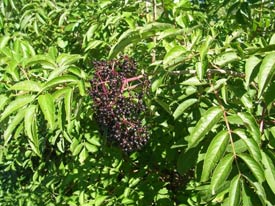
As for the Elderberries, they are native to around here, both black and red.  When you see them in moist locations, the deer keep them munched all summer to around 2-3′!  Elderberries can grow 10′ tall.  We have a riparian area, and I’m going to plant and cage these from the deer.  Supposedly the variety can get 10’x10′, so after 5′ I won’t have to worry.  Good food for me, the birds and the bears.

More great, reliable plants for California landscapes

Here are a few more of my favorite plants, easy, reliable, and striking, and different than the usuals out there.

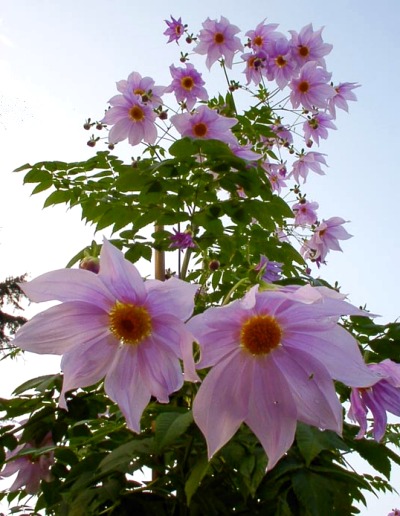
Tree Dahlia

Tree Dahlias grow 10′ tall in one season and bloom late in the fall.  Sometimes an October storm will knock off the blossoms.  But you don’t have to grow this Dahlia for the flowers.  The exotic tropical looking foliage will be a show stopper.  Cut to the ground in winter, it grows fast as soon as the earth begins to warm in the spring.  Comes in white, and rarely as a double flower.  Takes full sun and low water.  Forms a fantastically large tuber.

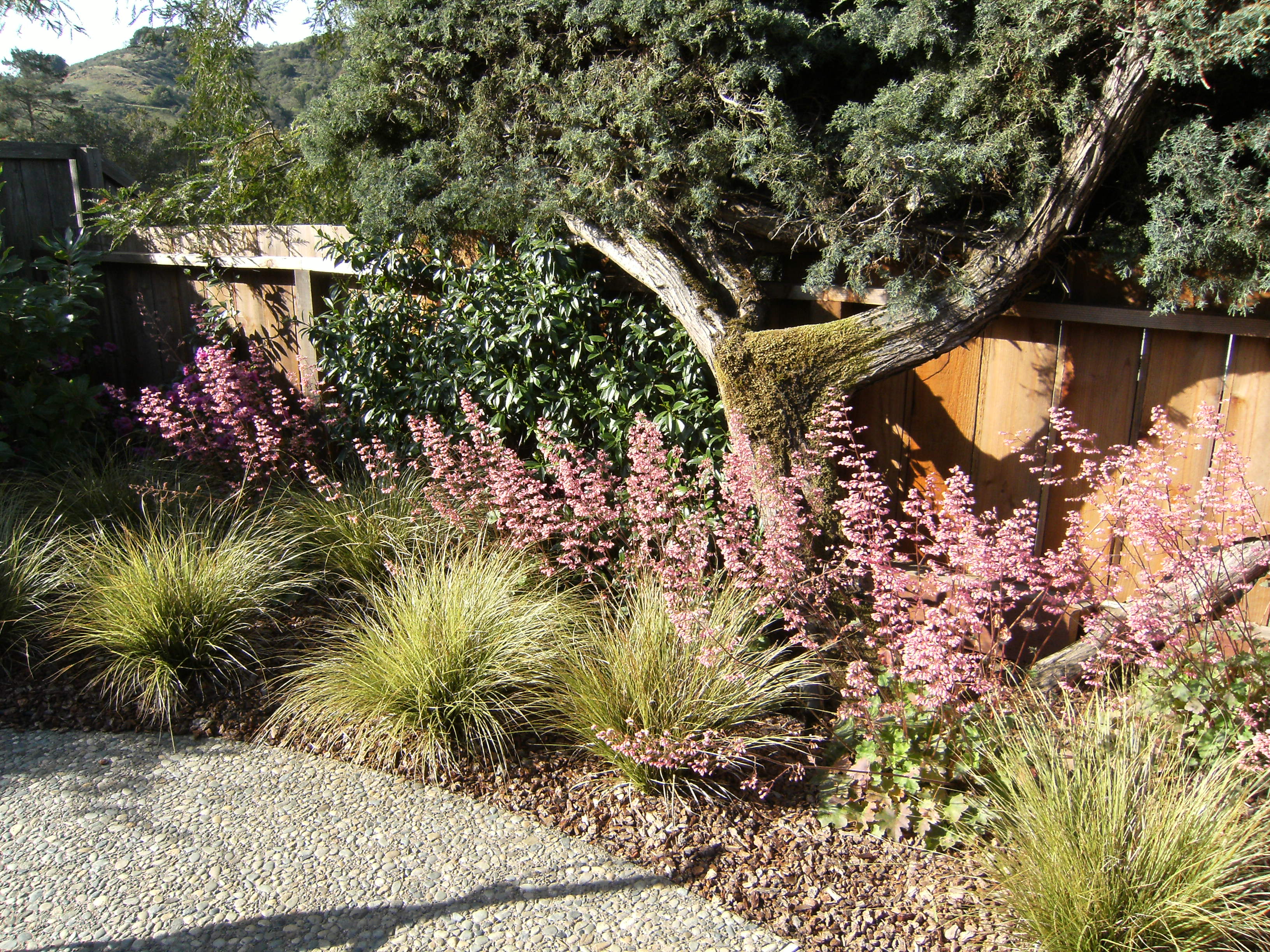
Heuchera 'Wendy'

My favorites of plants.  Heuchera ‘Wendy’ was pioneered by Rancho Santa Ana Botanical Garden, a cross between our native Heuchera maxima and Heuchera sanguinea.  I feel that ‘Wendy’ is the most spectacular of the cultivars (there are several out there).  Flowers are light pink-peach, very tall, and bloom endlessly and profusely.  The plant is tough like our native Heuchera, taking low water, dappled shade.  Put this in one of your more difficult dry shade spots and let it sing.

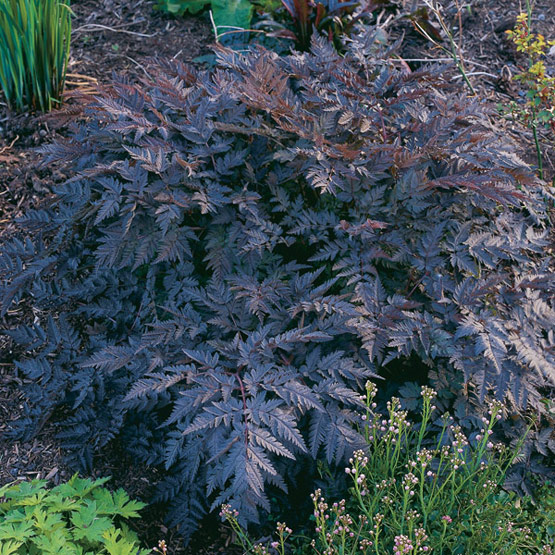
Anthriscus Ravenswing

This plant is actually a Chervil.  A low plant for shade and average water, it provides striking contrast in your combinations.  Difficult to find but very easy to grow.

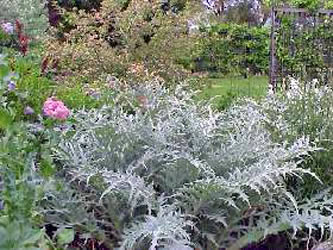
Cardoon

Wow, I love this plant.  Obviously drought tolerant, people will gawk.  Its large, bold leaves offset pinks and purples for contrast.  The thistle purple flowers in the late summer I feel take away from what I grow this for–the leaf structure.  If you let it, it will reseed generously and you will have these as long as you want.  Just transplant the seedlings where you want them and give away the extras to friends.

Crocosmia hybrids

Crocosmias are such underused bulbs.  They are heat loving, low water, summer blooming stunning flowers.  ‘Emily McKenzie’ is one of my favorites, with the double advantage of smoky foliage.  And they multiply, like bulbs do, easily.  They bloom late summer for a long time.

Epilobium californica and hybrids

These are still Zauschnerias to me, but the splitters long ago put them into the Genus Epilobium.  A wonderful California native, they bloom in the fall and are either no water or low water.  They come in different heights (6″ to 36″), some have grey foliage, and are a magnet for hummingbirds.  Can’t be beat.

More Mountain Goats of the Clark’s Fork Canyon

I took a leisurely hike the other day with a friend.  I wanted to return to a circle of rocks overlooking the Clark’s Fork Canyon and the river below.  The rocks were piled on a boulder precipice, a strange place for them.  They were large, obviously put together by people, big enough for one person to sit inside and get out of the wind, but made no sense as a blind for hunting or a camping spot.

Rock circle big enough to sit in

My neighbor had once told me he’d found places among these rocks at edges where Native Americans had made smoke signals.  I thought I’d take some photos of this rock circle and show it to him.  As I was photographing, my friend noticed a trail down to the river.  Its almost impossible to get down the sheer cliff walls most places, so this was a great find of a fairly easy access spot.  Maybe the rocks were cairns marking this?

We noticed two goats, a mother and her yearling climbing up the rock precipice nearby.  This was unusual, because both of us had only seen goats on the other side of the canyon, and in more inaccessible places.

Mother goat looks back to her yearling: "Catch up" she says.

We tried to travel out of their way and hiked through a small gully.  Looking towards the end of the swale, we spotted about 15 goats, happily grazing on the flats.  I was surprised at the size of the herd and the fact that they were hanging around, not on the cliffs, but on the bench.  Still, we were close to the very edge of the plateau; an edge that suddenly drops 1000′ feet straight down.  That’s what they usually like.  

I took some video you can watch here.  The wind was howling so the camera’s kind of shaky.

We watched the goats for a while, found some of their fur as they’re shedding now, and ate our lunch overlooking the canyon near the edges they love so much.  Those goats aren’t native to here, but they are Rocky Mountain goats, and this is the Rockies, so… go figure.

The Old Old Road

I’d heard about the route the early homesteaders and miners took into my valley.  Dead Indian Hill, the only way to get to Sunlight from the plains below, is an 8800’ pass.  It took a good two days to negotiate the trail, essentially an old Indian and game route.

The drainage beginning at lower right of photo and moving up to upper left marks the Old Old road.

The pass at Dead Indian forms a huge windswept meadow.  During the winter, up until quite recently, this area was impassible.  I just recently read a book about a forest service ranger in 1956 living in the valley year round with his family.  On valentine’s day they decided to brave the drive over Dead Indian pass for a get-together dance with other forest service employees.  It took them over 12 hours to get to Cody.   At the pass, they repeatedly had to hook up their come-along to wooden fence posts that weren’t covered by snow, and pull their car out of a drift.

At the top of the pass looking down into the valley, its’ a 2000’ drop, pretty much straight down.  The homesteaders would fell a tree at the top as heavy as their horses could drag, with all its limbs and branches, and chain it to the wagon axle before starting the descent.  This kept the wagon from running away.  I heard you could still see the old logs piled at the bottom of the hill.   Indian hunting parties also used this trail.  In those days thousands of pony tracks and travois marks were still visible.

The timeline was still sketchy for me as to all the road improvements, but I understood that around 1905 some of the residents living north of Dead Indian asked the county to help with improvements on the road.  The spring muds made for a treacherous ride.  The money was approved and a passable upgrade, an actual dirt road instead of a trail, was built, mostly by the residents in the valley.  Painter Ranch pitched in with a four-horse team, a breaking plow, and one man, and Al Beam did the same.  Miners who had claims in the Valley helped blast rocks.  By 1909 the new grade was completed, with a series of switchbacks especially on the lower end of Dead Indian.  This dirt road (with improvements added in the 1930’s) was used for the next 80 years until the early 1990’s when a paved road was constructed.

View of improved 1909 old road

I wanted to walk the old old road.  (I began calling the original game trail ‘the old old road’, while the 1909 road was the ‘old road’) The old 1909 road is easy to find.  It’s still in fair condition.  But the trail is a lot more difficult.  Its been over 100 years since it was used.  A good game trail still runs through the creek drainage and you can see the old old road follows it.  But then the game trail turns southwest up into another drainage.  At that point I couldn’t see where or even how a team of horses could go up the steep hillside.  I decided to head up to the old road.   I had to marvel at all the work.  It really was a pretty good road that required cutting into the hillside some, and all by hand and horsepower.

The old road is now what the game use.  The ‘ponies’ of today was the evidence of hundreds of elk and deer tracks.  I rounded a corner and found an old cow elk winter kill.

I hiked up to a large meadow where the road petered out.  This probably was the end of the 1909 improvements.  From here the old road may have hugged close to the paved road of today.  I headed back down, keeping an eye out for where a wagon might have veered off.  Pretty soon, I came to a gently sloping meadow and followed it, leaving the old road.

The meadow ended by a fairly steep slope, but I could see a series of young trees marking the width of a wagon.  Old ruts were even somewhat visible at times.  This was ‘the beaver slide’, where it got so steep they had to use the logs.

Notice the young trees. This is the view looking up of the beaver slide. Imagine a wagon pulled by a horse team, fully loaded, coming down this steep grade, especially in mud!

I hiked down, following a trail of young trees hugged on either side by mature trees.  Wow, I could barely imagine going down this grade with a team of horses.  At the bottom of the slide, a small meadow opened up above a fork in a dry stream.  This was the fork I missed before, where the drainage splits.  I had read descriptions of taking a drink from a crystal clear stream after the beaver slide, where the logs were unloaded.  This must have been that stream, now gone and dried up.  Lots of old dead trees were scattered around the open area.  I wouldn’t say they were piled, but upon closer inspection you could see they’d been chopped with an ax.  Here it was, the logs that had been cut by those old timers to prevent run-away wagons.

Logs cut with an ax to keep wagons from sliding down hillside

I was surprised how much of an impression this hike made upon me.  I felt the history of the place enacted before me…the cut logs holding back the wagons from tumbling down the hillside; the herculean efforts of these men to build a better and safer road with only man and horse power; the old trail used for thousands of years by Indians on foot and later with their ponies.  Though I was the only one walking these trails today, the stories and ghosts of the past walked beside me.

Earth Day countdown: Remember our Mother!

“What we call man’s power over nature turns out to be a power exercised by some men over other men with nature as its instrument.”  –C.S. Lewis “The Abolition of Man”

Bolivia is all set to pass a law that grants Mother Nature equal rights, the same rights afforded to all human beings.

“They include:  the right to life and to exist; the right to continue vital cycles and processes free from human alteration; the right to pure water and clean air; the right to balance; the right not to be polluted; and the right to not have cellular structure modified or genetically altered.”

Now, I ask you, if here in the United States corporations can have the same rights as an individual, why can’t we be as enlightened as Bolivia and grant Mother nature, our true sustenance, full rights.

I have always found sustenance and rejuvenation, spiritual and physical, in the natural world. Even before I moved to Wyoming, I was deeply attracted to its physical beauty and the richness of its wildlife.   There are so few places left where large animals still roam free, where a complete ecosystem exists, and where the natural world and its beauty awe one.

These places need special protection to continue to exist in a world that is becoming more crowded everyday, and so desperate for resources that we are willing to tear our home apart. Large animals need large spaces to forage and find food.  In our very deepest places, what some might call our sub-conscious, we share a connection with the animal world.  Whether we see it or not in our everyday lives, our lives intertwine with them.  Without them, the natural world is reduced to a nice view, humorless and cold.

I have been moved to write this blog because I am so in love with the natural world and all the wildlife it contains.  It is my small way of reminding people, in our hurried existence, of the feeling we have when we sit by a stream, or take a vacation to a lonely beach, or sit and watch bison, or get a thrilling glimpse of a wolf and her pups.   I am hopeful that people can take time from all the complex problems of todays’ society, and remember how much we need these wild places and the wildlife in them.

The legislation that is in the budget deal, and the legislation being proposed for next years’ budget, contains cuts and provisions that affect many areas.  In terms of the environment, the Republicans have an agenda to eliminate protections for these animals, and wild places, as well as the health of the natural world.   Democrats are willing to meet them more than halfway.  And our environment and its inhabitants (hey, that includes us people) are going to suffer, while oil and gas and corporate interests will be the ones to prosper.

One instance of this politicizing in this ‘compromise’ is the delisting of wolves.  This is not to say that at some point wolves should not be delisted.  But all delisting according to the Endangered Species Act, must come from scientific review, not through the politics of Congress.  This ‘rider’ to the budget would delist wolves and make that non-negotiable through the inability of the courts to challenge the legislation.  The beginning of the end for the Endangered Species Act.  When politics in Congress can decide what to delist, in what states, and where, without the courts being able to challenge it–this is a dark time.

Folks, this is only the beginning unless we wake up.  I do not usually post political statements.  My intention is to turn people on to what is good about places like the Greater Yellowstone Area where I live.  We only protect what we love, and I attempt to encourage everyone to remember our love for places like this.  But these threats are very real and will be affecting us and our children, as well as the health of the wildlife and the environment for years to come.

Earth day is coming up, April 22nd.  Let’s remember her and give her an equal vote.  Please, call your congressional leaders and tell them to give Mother Earth the same rights they have given corporations.  Tell them, Earth Day is coming and let’s legislate for Our Mother.

Fixing fence and wildlife

Its been snowing wet spring snows every day.  But this morning there was a nice break and blue sky interspersed with strange light and dark clouds over an immensely beautiful white landscape.

Gorgeous till it started snowing again around 2pm

I’ve been learning a lot about what it is to go ‘ster crazy’, ‘cabin fever’.  Its been a new experience for me being a native Californian.  So I took this opportunity to get outside, and not wanting to try my hand anymore this winter at hiking in the snow, especially wet snow, I decided to fix my fence instead.

I need a fence because I border National Forest where permittees seasonally run cattle.  In Wyoming, the law requires you to fence out.  In fact, you have to have a fence built to Wyoming state specs if you are to have any rights or say about cattle being in your yard.  If a cow is hurt while on your property, if it wasn’t fenced correctly, then you, the homeowner, are liable for that cow.

My fence in 2005. I have a smooth bottom wire now but the top 2 strands are even funkier

Frankly, I hate barbed wire.  We all know that it was the invention of barbed wire that was the final death knell of the West; what partitioned off the free range.  Besides, it tears up my pants and my hands.

Last year I removed the lowest string of wire and replaced it with a smooth wire.  Its easier on the wildlife, although the deer and elk prefer to jump the fence anyways.  I don’t have pronghorn where I live.  Pronghorn never jump fences but prefer to go under and so often die not knowing where or how to get under a tight fence.

But I have seen elk get caught up jumping a fence.  When they can’t see the top wire and they’re stressed, they might not make the leap.  This winter I watched an older elk, frightened by a car, run back and forth trying to decide where to jump a fenceline, then judge it incorrectly and break her leg.  A few days later she was a meal for the coyotes.  Last year an elk died with its leg in the top wire of a fence line.

My own fence I inherited.  The previous owners sometimes brought their mules, but they didn’t maintain the fence.  Although I’ve replaced the bottom with a smooth wire, to keep cattle out and stay legal, I need to have the middle and top wire be barbed (ugh!).  But my top wire was saggy and I’ve been wanting to stretch.  Probably one of the most dangerous things for wildlife are saggy wires.  They are easy to get caught in.  My ultimate desire would be for a post and rail fence, but, sorry, I just can’t afford that.

The super wildlife friendly fence. Costly though and I have such rocky ground

Montana Fish, Wildlife and Parks publishes on their webpage a great booklet entitled How to Build Fence with Wildlife in Mind. Its got tons of handy tips and describes lots of different styles and types of fences.  In there, for a 3 strand fence for Low or Seasonal Livestock Use, they recommend posts placed at 16.5′ apart, Top wire 40″ preferred (42″ maximum), mid wire 28-30″ from the ground, and the bottom wire at 18″.

Instructions for a 3 strand smooth wire in light stock areas

But I’m substituting from the above barbed top and middle to be Wyoming compliant, but here is one that has a smooth wire on the bottom for wildlife, but is legal and good for heavy stock use.

For heavy stock use and wildlife friendly

I’m finally starting to get pretty good at fence work.  Its taken me several years and lots of mistakes since I’ve had no fence guru to instruct me.  I unleashed the top wire for about 1/3 of the fence line and began, in shorter sections, using a stretcher.  After about 2 hours, I’d re-stretched about 1/2 the fence line to the south.  I regrouped at the cabin for lunch and supplies, then headed back to start the next section.  The weather was beginning to shift, getting cloudier and colder.

I began undoing the top wire, moving along the fence westward.  All morning I’d noticed crows cawing around the mountains.  When I returned from lunch, a golden eagle soared above.  I wondered about something dead higher up.  But the surprise was on me.  There, on the inside of my fence, right next to the fence in fact, was a fresh dead deer.   Had it misjudged or not seen the fence?  Its eyes were already poked out, eaten by the crows.

This is the second dead deer in two weeks I’ve run into.  The last one I showed a photo on my post.  This one rigor mortis hadn’t even set in.  It had been eaten on just a little from its back hind quarters.  Either it just died there and had been scavenged or possibly a coyote might have brought it down.  I was certain that bear would be back soon for another meal.

It is the toughest time of year right now for deer and elk.  They’ve had a long winter, are bony and weak.  The new grass is showing its greenery, but not much yet and certainly not much higher than a 1/2″ tall. These deer hang around here all winter long.  I’m sure I’ve seen this one many times in my yard.

I suppose I won’t be finishing fixing fence for a week or so.

A few great (and reliable) plants for California landscapes

I’m done with my California winter installations and hoping for some spring Wyoming weather.  But right now it’s the last vestiges of planting time in California before the summer heat so get going and order up some of these fantastic plants.  These are a few of the reliable, unusual, and color interesting plants I love to use in my designs.  I have two places I mail order from.  I’ve tried many mail order companies and these are three of the best.  One is Digging Dog Nursery and another is Cistus Nursery.  They have a great selection, and best of all their plants are nice and big.  One plant I get from them that I can’t get anywhere else is Acaena purpurea.

Acaena purpurea groundcover

Acaena purpurea needs average water and sun to bring out the color.  But it also comes in a grey form which is attractive as well, but usually with slightly bigger leaves.  The grey form takes heat much better and less water.  Cercis Forest Pansy is a fantastically colored Redbud.  Average water and sun again brings out the colors.  It is a small tree.  Below with the Acaena.

Here is the acaena with Cercis Forest Pansy

Let’s continue with the purple theme.  We all know Loropetalums, but if you can find it, I highly recommend Loropetalum ‘Pippin Red’.  It is a small Loropetalum, growing only to about 4-5′ (some grow 15′ so be cautious on your choices), but has a narrower leaf and retains its color year round.

Loropetalum ‘Pippin Red’

Loropetalums usually sulk for a year or two before they take off.  If you can’t find Pippin Red, there is now a dwarf red variety.

Another mail order nursery I recommend is Plants Delight.  They have fabulous plants you can’t find anywhere else, but beware, their plants are small for the price.  I used to order in the fall or winter and pot them up for spring, or grow them in pots for a year before placing in the garden.  The one plant I always get from them that I can not find anywhere else is Dahlia ‘Bishop of Llandaff’.  It is BY FAR the BEST Dahlia ever with dark red single flowers and dark purple leaves, growing 2-3′ tall.  It will ‘wow’ everyone who comes into your garden.  Don’t be without it.  Order it once and soon you’ll be able to divide it over and over.  Just remember when you divide Dahlias, you MUST have part of the root attached, not just a bulbous end.

Another couple fantastic groundcovers, reliable and neat, that I use over and over especially to accent large plants are Dymondia and Senecio serpens.

Senecio serpens in front of young succulents and bamboo

I like the smaller serpens variety as it doesn’t get large and gross but it is a bit more tender so check your zone.  Its a great blue accent and since its a succulent, low water.

Dymondia again is a workhorse.  Its a steppable that works where others will not.  Drought tolerant, likes full sun, it accents plants like this Chrondopetalum tectorum , another fantastic plant, or Phormiums.

Dymondia highlights Chrondopetalums (in background) and Libertia grandifloras (foreground)

While we are on the subject of blue, a new Podocarpus is on the market called ‘Icee Blue’.  Its a MUST HAVE.  Podocarpus are great for narrow spots, for shade, and are drought tolerant once established.

Podocarpus (in corner) with dymondia and Hellebore

Helleborus argutifolius is another drought tolerant, sun tolerant, plant I use extensively.  It is an evergreen Hellebore with chartreuse flowers in the spring which are a knockout when massed.  Also the above plants in the photo are deer proof.

Centradenia grandiflora is a new plant on the market.  It has flowers like a Bouganvillea but grows only 2′ tall.  Great tall groundcover or accent, it is evergreen and its leaves are reddish in the winter.  Here it is with another fantastic plant Cordyline ‘Festival’.

Centradenia with Cordyline ‘Festival’

Scutellaria ‘Texas Rose’ is another unusual groundcover available from Digging Dog. Also Saponaria ‘Max Frei’ is a workhorse flowering ground cover that is actually a very old cultivar but not carried by many anymore.  Digging Dog has it.

Agave ‘sharkskin’ with armerias and succulents

I, of course, could go on and on, but one more is an agave.  It is an eyestopper because it is so neat and unusual.  Agave ‘Sharkskin’, is well worth its price.  Slow so buy it in 15 gallons.

Another view of Agave Sharkskin. WOW

If you like this post of great, unusual and reliable plants, let me know and I can post some more.  If you are interested in low water gardens that still look lush and interesting, see my new eBook on Gardening for a Dry California Future.  Good Gardening!