• MY BOOKS ON WILDLIFE, GARDENING AND MORE

  • The Wild Excellence

  • True stories of wildlife encounters around the Greater Yellowstone
  • Award winning eBook on Decomposed Granite, tips, how to's, what to watch for
  • Children's book. True stories of a dog and wolves. In a dog's voice
  • Written for dry Mediterranean climates in California, north and south

Coming to Wyoming part 1

How did you get to Wyoming?

Of course, I am asked that question regularly.  And, there is the short answer and the long answer, but both replies are more full of questions than answers.

Long ago, a few lifetimes in my personal history, I spent several weeks backpacking through the Tetons with two girlfriends.  We were hitchhiking through the West in a summer between high school and college.  After a fine time, with many adventures, we were ready to put out our thumbs and head back to California, when a driver who picked us up asked “Have you girls been to the Wind Rivers?”

“No, where’s that?”

“Just an hour east of here.  You must go.  I’ll drop you off and you can backpack there.”

The Winds, as aficionados and lovers like to fondly call them, have several put-ins on their western front, all at least 10 to 15 miles from the hiker’s main destination—the rugged base of the Continental Divide.  But after several days of being eaten by mosquitoes, (with thousands of lakes the Winds are notorious for their bugs) and never quite making it to the divide, we called it quits.  But you could see those tantalizing mountains in the background and I swore to myself that I’d come back someday.

Flash forward 27 years.  I’m a single mom newly divorced with a nine-year old.  Close friends are going to visit their son in Yellowstone who is a seasonal worker.  They have a nine-year old too and invite us along.  We fly into Salt Lake and drive the rest of the way.  After a week in the Park, I see my opportunity and jump on it.  They drive home with my son and I arrange to fly out of Jackson, rent a car, and put in at Big Sandy for a modest 5-day hike.

In those 27 years inbetween, I’d had some serious back injuries and was not even sure if I can backpack anymore, but this is my first time in years so I pick a fairly easy route.  The hike is about 5 miles to Big Sandy Lake, the shortest distance to the Winds from any trailhead.  It’s a well-traveled route, because its also the quickest way to the Cirque of the Towers, a massive granite glacial cirque treasured by climbers from all over the world.

Mission accomplished, I was able to complete the trip, and so began coming back every summer for a seven day backpack over the course of more than eight years.  During that time I usually hiked about 40-50 miles and eventually completed most of the Highline Trail, a glorious trail that traverses a north/south axis through the Bridger-Teton wilderness.

When my son was about 15, and I’d finished another solo trip to the Wind Rivers, I started to wonder why I was coming home so soon.  Couldn’t I find a summer rental in Pinedale or Lander?  I tried but it wasn’t so easy.  Wyoming isn’t Tahoe and summer rentals are not the norm in these small towns.  Jackson would be out of the question over-my-head expensive.  Rental hunting led to the idea of just buying a small 2nd home or piece of land.

One time while hiking in Wyoming, a fellow hiker asked if I’d been to the Beartooths.

“Where is that?”

“Charles Kuralt called the Beartooth Highway the most beautiful highway in America.  You’ve got to drive home that way.”

But it wasn’t on my way home, and I was always in a time constraint.  So the following summer I decided to hike, with a few friends, into the Beartooth Range instead of the Winds.

It was a rainy experience and crowded, although spectacular.  But I missed my Winds.  So I decided to take a short trek to the Winds from the Eastern side, the reservation side.  This required me to head home via Cody.  I’d been thinking about towns to live in.  Pinedale had been tops on my list.  Little did I know that Pinedale can be the coldest town in America at times.  I’m really not a great researcher of these things.  I was just going on my gut and on my love affair with the Wind Rivers.

But when I drove into Cody, I immediately knew this was a town I could live in.  I was attracted to it.  It felt like a real town.

In the winter of 2005 I contacted a realtor via the internet in the Cody area.  Since I really had only been to Cody one night, I arranged to fly into town in the February break, with my son, and have him show me areas around the town.  Then my son and I would snowmobile into Yellowstone for a vacation.

I had a vision in the back of my head of what I wanted.  Either a place to fix up, or land to build.  It needed to have trees but not be ‘in the trees’;  there must be a creek on or near the property; somewhat isolated but not too isolated.  I was figuring I’d live around town on the outskirts.

My realtor Al showed me the North Fork area, which is the North Fork of the Shoshone, the road that leads into the East entrance of Yellowstone.  Expensive lots and homes abound in this breathtakingly beautiful valley.  He showed me the South Fork of the Shoshone, a massive wide valley that dead ends into trails to the Thorofare of Yellowstone.  These areas all had lots and cabins, but what I didn’t account for was that way back when, when the government was giving out homesteads and people were settling here, the government took the timbered areas while the homesteaders built and farmed in the low, open, praire parts of the valley.  All these homes, excepting the giant ranches, were subdivided 20 and 40 acre lots of bare ground usually with a well.  A housing boom of retired Floridians and Californians who’d made money selling their own homes had changed the valley as well.  The houses were in general exposed to each other, sometimes even with little subdivisions of lesser acreage.  For a million dollars plus I might find something special, but I didn’t have that kind of money.  The image in my mind of what I wanted was just not available here.

“What you want comes up every ten years or so,” Al said.

Al took me to Clark, an unincorporated town on the far outskirts, situated at the base of the Clarks’ Fork canyon, the town was smack in a wind tunnel.  It had a strange displaced aura about it, a town without a town, with stories of transients, drug runners and government haters.

He drove us to the nearby town of Powell, a farming village that felt quite settled and sensible.  Powell was a nice town but not what I had in mind.  I left feeling quite discouraged.

That summer I took my son for the first time with me to the Winds.  The whole experience had changed from one summer to the next.  Cheney had pushed through drilling on public lands without the need for the same limits and waiting periods as previously.  Wyoming was a boom state.  There was not a hotel, motel nor campground space between Salt Lake and the Pinedale turnoff at Green River.  My son and I slept on the side of the road south of Big Piney after driving for 25 hours.  The Persius meteor shower was a brilliant consolation in the clear open desert sky.

Pinedale had transformed itself as well, with large hotels.  The Jonas field was fueling the economy.  Ticky-tacky houses were springing up everywhere.  “Thank God I didn’t buy here” I told myself.

We had a rainy but beautiful adventure in the Winds, and I was reminded how much I love Wyoming, and that I hadn’t heard a peep from Al.  He had never shown me even one house, just neighborhoods.  I called him when I returned.

“Everything that was in the book last February has sold” he said.  “Like I said, what you want comes up every ten years.”

That was August.  In September I got a call from Al.  “I have a house that fell through.  It will be re-listed in a few days and its’ gonna go quick.  I think it’s what your looking for.  There’s 40 acres, a creek, cottonwoods, and an old homestead on it, a new well and electricity.  You better come right away if you’re interested in seeing it.”

I booked a flight to Cody.  Being in a busy work season, I made arrangements to come into town on the 5pm Wednesday flight, and leave the next evening back to San Francisco.

What a disappointment the property was.  Yes, it had all the elements I asked for, but the ‘feeling’ just wasn’t right.  The land was broken, neglected, desolate and tired.

The house on the neglected land

The country around the other house

“Well, I’m here and got a few more hours till my flight.  Is there anything else you want to show me while I’m here.”

“There is one place, up in Sunlight Basin, but its not on the market.  The parents died and the kids now own it.  They’ve been squabbling for over a year as to whether they want to sell or not.  But I’ll be their listing agent if they do.”

“Show it to me in case they ever do.  Where is Sunlight?”

I’d been wanting to be within 20 minutes of town.  Sunlight was an hour northwest, over an 8500 ft. pass.  I was skeptical, but I was here so why not.

As soon as we turned off 120 highway onto Chief Joseph Scenic road, I was mesmerized, hooked.  From Dead Indian pass, you could see the entire country for millions of miles.  West to Yellowstone, northeast to Beartooth Plateau, below to the stunning Clark’s fork canyon 900’ deep, and across into the wide glacier valley of Sunlight.  I’d never seen a landscape more varied geologically, nor more breathtaking that this view.

We got to the cabin—a run-down summer cabin built in 1959.  Cluttered with too many old couches and chairs, a tacked down orange shag carpet brought out from Washington state by the owners when it no longer was in style in their main home, animal heads on the wall, 50’s linoleum that was coming apart, original windows that questionably opened, and the entire back area of the house was unfinished with open joists and studs.

First glance at what would become my cabin...too much furniture

Unfinished ceiling. Warped cheap paneling

the bulging paneling alongside the shower

I stood on the porch and looked east at a massive ridge jutting into the horizon.

“I could die here.” I said aloud.

“I’d buy it if I could,” said Al.

I asked Al what the comps were, and told him to offer just a bit more, and that was my final price.  I was nervous, I was firm, I’d never put myself out on a financial limb like this before, was I making a mistake….mostly I was just going by my heart.  I’d put it out there and see what they said.  The reality was…this house wasn’t on the market and the three children hadn’t decided if they were selling.  The reality was…I’d seen only two homes around Cody, both today.  The reality was…I hadn’t even done any homework about this place, its weather, anything. But I was already in love, and when you’re in love you usually act before you think.

Living and working in California, I slowly fixed my little cabin up to be livable anytime of the year.  I dreamed of coming here in the summer, watching the weather, and when it was good, going hiking in the Winds.  I thought about spending Christmases here in the snow with family.  Oh, but I’d have to winterize it as well as lots of other things.  That meant lots of work and all that cost money, money that I had only bit by bit, little by little.   So that’s how I fixed it up, little by little, over several years.

New T&G bluestain pine with my California crew

Never did I think about moving here permanently.  But once this place was mine, strange coincidences conspired, over and over, to point the way here.  For some reason, this place in Sunlight was calling me, suggesting it was the center of my universe, the place of peace for me.  Over time it became an irresistible urge.  My journey was just beginning.

Becoming Bear

This fall I followed bears around so much I began to feel that I was becoming sympathetic with ‘bear consciousness’.

Its not that I was actually seeing lots of bears, although I did see a black bear as well as a Mama Grizzly (not Sarah Palin by the way) and her 3 cubs, but I was tracking and back-tracking them, exploring their sign and where they’d been feeding.

This fall was a lean year for the bears.  Poor pine nut crop combined with a lousy spring made for difficult foraging.  In addition, the ecosystem is full and their habitat needs to expand.  But every time a Grizzly tries to move into range not outlined in the ESA as reintroduction habitat, he gets moved.  I’d swear that the WG&F Grizzly guys must spend their entire summer moving bears–from Jackson to Crandall, Crandall to Dubois, Dubois to Gardiner.  Its really crazy, and there is plenty of good habitat beyond the designated reoccupation areas–habitat that has few people, but may have a lot of forest service grazing allotments–in other words, cattle and sheep.  Our government at work protecting cattle on our public lands.  A negative cash flow investment every year and meanwhile our nation’s grizzlies are caged in a large ‘zoo’ called the GYE.

So, that being said, there was more bear activity and close encounters reported this year than any other year.  Hungry bears were coming around looking for anything they could find.

In September, on my quest in the Wind Rivers, I had a profound dream-image of a Black bear who pointed the way for me.  Soon after that, Black bears began leaving sign everywhere around my property.  Almost every afternoon I backtracked a black bear and watched him dig up every Limber Pine middens on the flats above me.  Limber pines are not bears’ favorite pine nut.  They are smaller than White Bark Pine nuts and so carry less bang for the buck.  Also White Bark pine cones easily shatter or dehisce when they open, while Limber pine cones are difficult to open and full of sticky sap.  That means the bears must rely on the squirrels to do all the work instead of doing some of it themselves.  Robbing Limber middens in the spring is usual, but not as much in the fall when the bears prefer the White Bark at the higher elevations.  But this little black bear robbed every midden he could find.  His scat was full of pine nuts, mostly.  Occasionally I’d find one with rose hips, another favorite fall bear food.  Bears need lots of fat in the fall to get ready for hibernation.  Nuts do that, rose hips don’t.

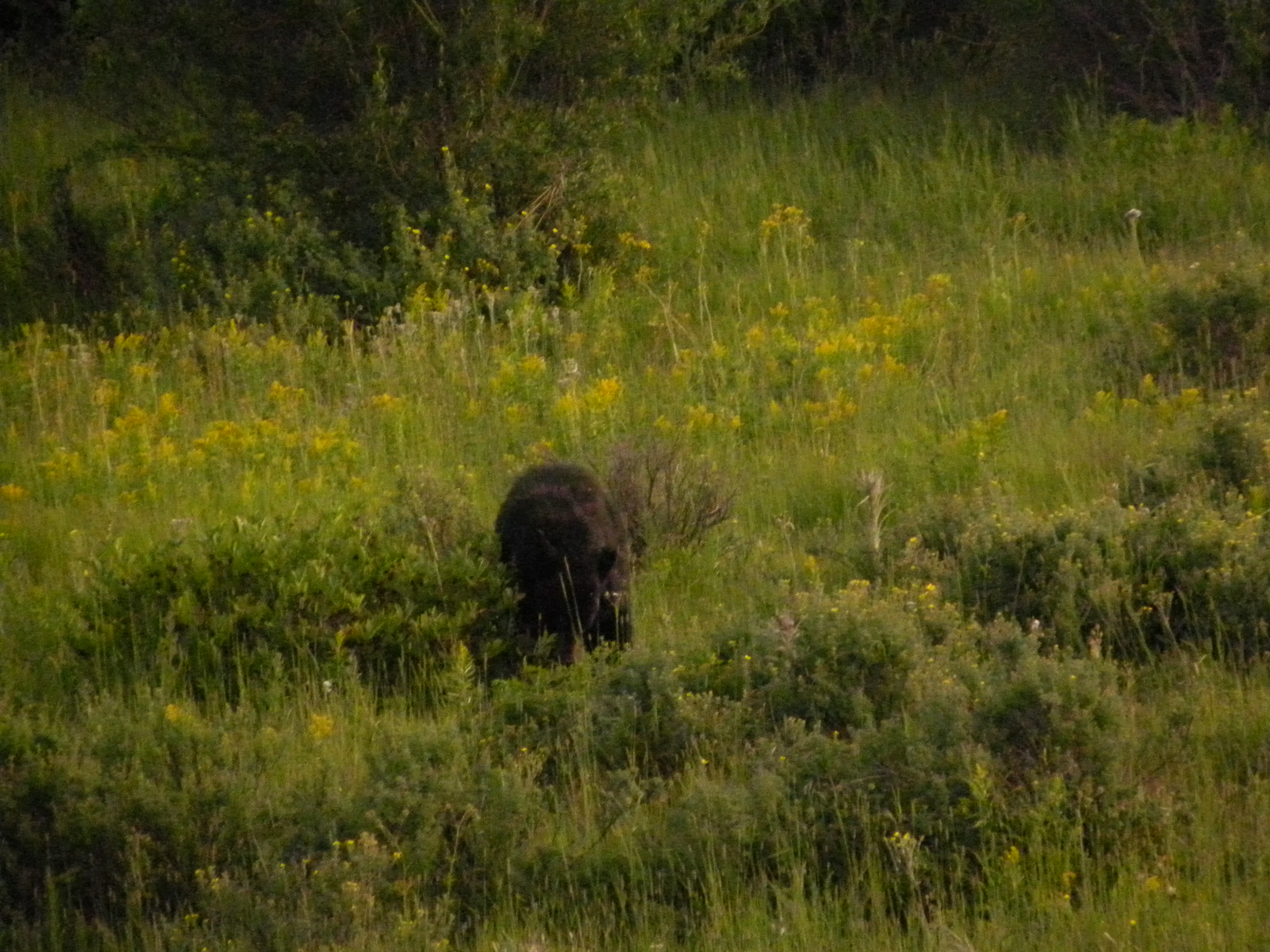
Black bear in my driveway

One evening after tracking this bear I walked up my driveway to find a roll of barbed wire in my neighbors yard displaced about 10′.  After inspection I saw some bear hair and realized the bear had gotten tangled and dragged the roll of wire along until he’d gotten loose.  I tried to haul the wire back to its location but couldn’t make it budge.  That roll must have weighed 75 pounds!  I was duly impressed with this bears strength.

On another occasion I was driving out the driveway, came around a corner and there was a huge log in the road.  I stopped and got out to move it off the driveway.  The log had obviously rolled down a steep embankment.  As I pushed it out of the way, I noticed from where it had come:  a gargantuan old midden way up at the top of the hill.  This midden was surrounded by logs and that bear had pawed his way through the stumps and completely devastated the middens.  A squirrel chattered away at me.  “I’m not your culprit”  I told her.

Those two incidents taught me about Bear Power.

October was an unusually hot month here in Sunlight and Cody.  Days were in the high 60’s.  One afternoon I took the car up a draw on a bad dirt road.  As the road got more and more rutted, I decided to walk the rest of the way. The view was wide as the gradual uphill was surrounded by sagebrush.  The road paralleled a narrow gulch where spring runoff once flowed before our 10 year drought.  A lone pine tree grew in the dry stream bed.  Koda was in front of me as we walked up the road.  Koda the sentinel, the sign talker I call him, as he is my alert signal, watching for sign along the way.

Koda suddenly stopped, sniffed the air and looked around.  I stopped too.  But after a few moments he continued on his way, and I suspected all danger had passed.  But to my right, from under that lone tree, a black bear appeared.  He must have smelled Koda and I because we had made no noise.  That bear took off roly-poly as fast as he could across the sagebrush and straight up a hill.  He was the bear of my dream from a few weeks previous.

I was at the grocery store in Cody when I ran into my neighbor.  “My son heard a noise on the porch of his cabin in the middle of the night.  He looked out and saw a grizzly and 3 cubs.”  I had heard about this bear but hadn’t seen, after over 2 months of walking my woods and land, any sign of grizzly, just sign of my black bear friend.  I doubled my attention-efforts, always mindful of sign, noise, and bear spray close bye, but saw nothing after several weeks.

One day late in October a hunter illegally shot a buck by my property (I say illegally because the buck was shot less than 25 feet from the road and dragged across my neighbors property).  Then he gutted the deer out and left the gut pile right by my mail box.  That was no picnic.  Although I enjoy tracking bears, even ones on my property, I’m not interested in feeding and drawing them here with gut piles.  Nevertheless, I saw it as a rare photo opportunity and set up my trail camera.  Next morning the gut pile was gone with bear tracks around it but the camera was conveniently broken!  That was a double cursing moment.

Bear sign was everywhere this fall hunting season.  I went with the Forest Service archeologist up a dirt road to a nearby old Indian hunting grounds.  Koda found a gut pile by the road and grizzly tracks were everywhere.

It was only at the end of October that I saw her.  It was my birthday.  Koda had finally lost all of his tennis balls.  It was near dusk and I decided to help him find balls, so we walked into the meadow by my house.  I didn’t have my bear spray with me as I wasn’t going anywhere.  I walked along the meadow, our usual route to my nearby stream when something caught the corner of my eye.  It was a stump that, like so many stumps, looked like a bear.  Usually I pay those stumps no mind and since all the logging that was done last year in those woods, there are plenty of those stumps that fool me all the time. But for some reason I morphed that peripheral glance into my full direct attention and by golly, it was a bear!  And a grizzly at that.  Then I noticed the 3 cubs with her.  They were all quietly feeding in the woods about 75 yards away.  Strangely, they hadn’t noticed me nor the dog, nor had the dog noticed or smelled them.  I called Koda to me and we began slowly and deliberately walking back towards the house.  And we were getting pretty close too, except Koda realized we were going back so soon and began to balk.  He was crying and jumping “Let’s play”, and it was then, when I had to reprimand him, that that Mama Grizzly took notice of us.

I saw at once her moment of decision.  She had that question of “Flight, or Fight” going through her body.  I could feel it.  I handled the dog and we kept slowly walking back towards the house, me without my one time of bear spray!  But she decided we weren’t a threat, her cubs were close, and they all loped towards the forest.  I got back to the house with even enough time to get a fuzzy photo of  two cubs before they disappeared into the woods.

Fuzzy Wuzzy was a bear photograph

A few days later I went to check what those bears were digging for at this time of the year.  That Mama had to feed 3 hungry cubs.  Those bears weren’t digging middens, but digging up thistle roots.  Hungry bears and not much nutrients there.

The denouement of this long story comes in CA.  Just after my birthday bear sighting, I left for 6 weeks of work in CA.  One evening I was relaying a few bear facts and stories to some friends at a party.  I then walked into their kitchen to see the headlines of the local Independent Journal:  Bear spotted at Point Reyes. Now this is a big deal because although there are bears up the coast in northern counties, there haven’t been bears around the Marin/Point Reyes area for over 100 years.  The article said not to worry, as its only one black bear and there’s thousands of wild acreage out there.

I saved the article and a few weeks later was visiting a friend who is the head of the Marin tracking club at his home in Point Reyes Station, the town near the National Seashore.  Interestingly enough, he told me that along with biologists and Forest Service people, he was called out to verify that this was a bear track (although how you can mistake a bear track for any thing else, I can’t figure).  So he actually saw the track!  In addition, two different people gave him scat that they wanted to have verified as from a bear.  One person was in Inverness which is part of Point Reyes, but the other person lived in Lagunitas, a good 15 miles away inland.  Richard brought out two baggies with the sample scats and yes, there were both bear scat.  In his analysis, the one bear from Point Reyes had lots of bird seed in his scat, probably from a bird feeder on the person’s property.  The other scat was full of apple peel and seed, from that womans orchard.  Clearly if suburbanites are going to live around bears, they are going to have to change some of their habits.

So that ends my fall bear saga.  Something about tracking bears, following their flow, gets one into a bear mindset.  One night while I lay down to sleep, after days and weeks of tracking bears and seeing bears, I almost could ‘feel’ the consciousness of a bear.  It wasn’t that I now ‘know’ about bears.  But it was more like the beginnings of a ‘feeling’ sense, a bear feeling sense.  That was good.

Sometimes the Buddha is a deer

In the Jataka stories, sometimes the Buddha appears in other forms.  In one story the Buddha appears as the king of the deer who offers his life to save a doe.

I’ve had a few unusual deer experiences since living here, but the most phantasmagorical occurred the day I returned from CA.

I was opening up the cabin after draining it for my 6 week absence.  A friend, G__. and his dog were helping me.  We’d been at it for a few hours, starting around noon, heating the cabin, turning the water and propane on, getting the water heater filled.  The two dogs were outside. It was a nice day, clear and cold, with a recent soft snow pack of around a foot or more.

The dogs began barking at something.  Usually if its just my dog, he barks but sticks around, but with the two dogs they tend to run after things.  My friend and I went outside.  We certainly didn’t want the dogs running after wolves or coyotes.  Sadie, G__’s dog, was really worked up and running into the nearby meadow, barking towards the forest.  We both saw nothing, but, as my friend noted “We’re not dogs.”

He came out of the forest and deliberately walked up to the front door as we watched

We called the dogs under control, and watched the forest for a few moments.  Nothing moved nor stirred.

“Couldn’t be deer because Sadie doesn’t bark at deer.”

I wasn’t so sure of that.

After a few minutes, out of the forest came a 2 1/2 year old buck.  The forest is a few 100 yards from the house and the buck strode slowly, every so slowly and deliberately out of the woods and into the little meadow between my house and the forest.  We were all mesmerized, as if in a trance, watching that buck, who with measured steps and struggling a bit in the deep snow, strode directly towards us.  The dogs were going wild and it took everything to control them.  But as the deer approached closer and closer, the dogs too calmed down, transfixed as the buck walked through my open gate, into the front yard, stopping 10 feet away from us.   We all stood in the front of the house, 2 dogs and 2 humans, looking eye to eye with the buck.  He just stood and stared at us.

Beautiful eye guards

G__ put the dogs in the house while I continued to stare at the buck.  He never took his eyes off me.  I couldn’t figure if he was just curious, saying hello, or displaying a bit of hubris (I suspected the later).  G__ came back out with his cell phone.

“Turn around and get over a bit.  I want to take a photo.”

Something about that broke the magic, because as soon as the photo was taken, that buck walked away as slowly and deliberately as he had come.

G__, who is a great hunter and has lived around here all his life said he’d never seen anything like that before.  “He was welcoming you back from California and wanted to see what you brought him,” he joked.

In India there is a word that describes the sighting of the Master or Teacher–Darshan.  I like to think of this beautiful buck, so fearless and calm, so regal and deliberate, as coming to give me his Darshan, the Buddha of the forest deer.

The Buddha buck, Young Prince of the Forest Deer

The Road

After a brief hiatus working in CA, I got back to Sunlight in time for the arrival of the elk from the Lamar in Yellowstone. In the early mornings I drive up the dirt road hoping to catch whatever might be out there.

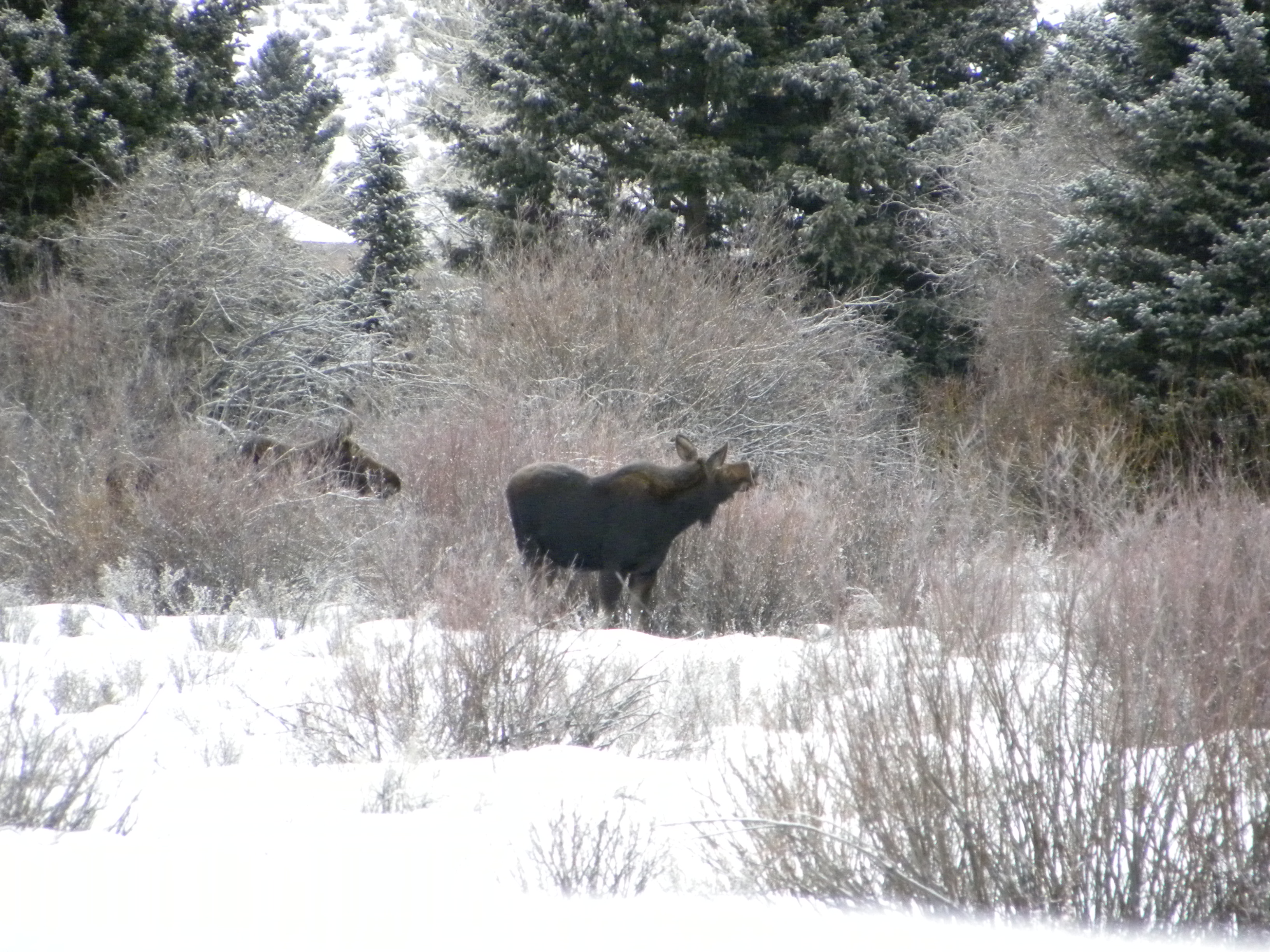
Most days I’ve seen 2 moose calves eating amongst the willows up near the ranger station.

Young moose

In the evenings several hundred elk come to graze in the open.

Elk feeding at dusk

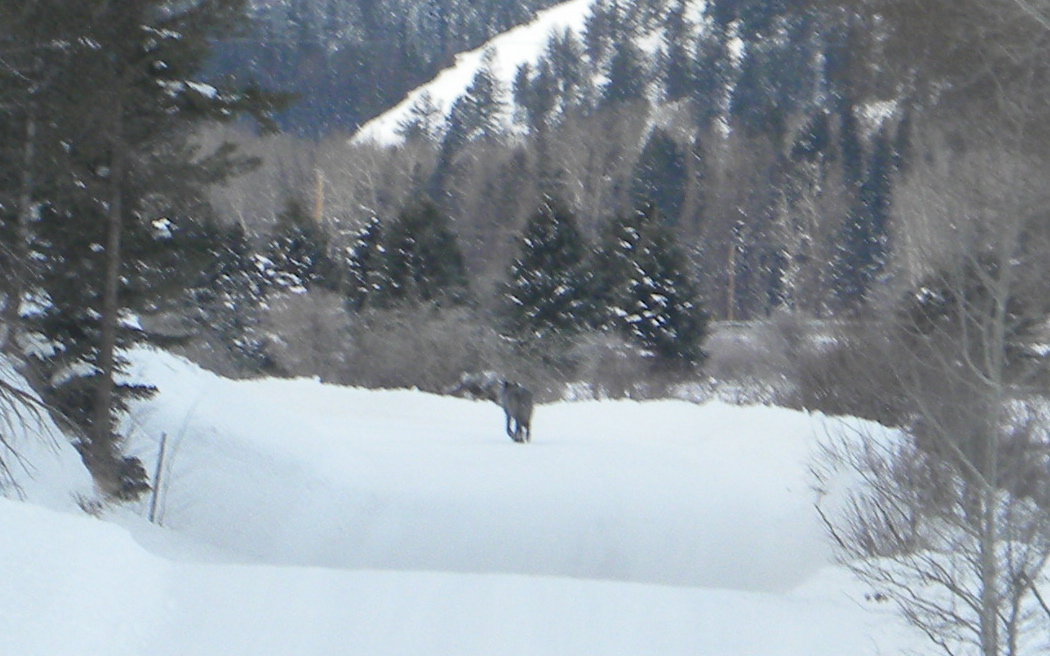
Bunnies run to the brush. Two bald eagles play overhead. The Sunlight wolves patrol the road, side trotting up and down.

Running down the road 2 blacks and a grey

Today I took a hike along a closed winter road by the river. Tons of wolf, moose, coyote, elk, deer, rabbit and mouse tracks. I could hear a few howls across the valley, and then a pack of coyotes yelping. I stopped, listened hard, and found their direction. Somewhere by the ranger station across the river the coyotes were singing, along with the crows. I suspected there was a kill there.

Driving back, I looked for the kill. I found it about 50 yards off the road, mostly picked over, probably from a few days ago. I climbed down the steep incline and over to investigate. Was it one of those young moose?

Although pretty badly chewed, the skull definitely looked like a moose, not an elk. There aren’t too many moose around here, between the long drought and the ’88 fires. Besides, moose aren’t native to these parts of WY. But I do mourn any moose that’s gone as there are so few.

Living in a complete ecosystem, with top predators, you see the full cycle of life every day, especially in the winter when the landscape is so clear and visible and the wildlife are not interfered with by atvs, hunters, cattle, campers, and all the others amusements we humans conjure up. I’m constantly confronted by my modern, linear, goal oriented thinking, as if nature were a line from beginning to end.

What is Real?

Nature is a circle of Life, of endless feeding and being fed, unedited beauty, a starkness stripped to naked Reality, though elusive and hidden at the same time.  Multi-dimensional, dispassionate,  full of the passion and energy of Life.  All Paradox and no conclusions.

Tell Bear stories

Its a perfect time to tell bear stories.  The bears have been foraging around, soon to bed down for the winter.  Last week a mama griz and her three cubs wandered through my adjacent forest.  Its been a bad year for bear food…lack of fattening pine nuts, the late cool spring, has made for poor forage.  These bears were digging up thistles and eating the tops of the roots.

But for me they were ‘birthday bears’ because I saw them on my birthday…signs of luck and power, and they all looked healthy with winter coats.  I felt as if I was walking close to a bear village, so many bears right by me and Koda.  I was reminded of this wonderful myth by the Haida peoples of Canada.

HAIDA BEAR STORY

Long ago, a group of girls of the tribe were out gathering huckleberries. One among them was a bit of a chatterbox, who should have been singing to tell the bears of her presence instead of laughing and talking. The bears, who could hear her even though some distance away, wondered if she was mocking them in her babbling. By the time the berry-pickers started home, the bears were watching.

As she followed at the end of the group, the girl’s foot slipped in some bear dung and her forehead strap, which held the pack filled with berries to her back, broke. She let out an angry laugh. The others went on. Again she should have sung, but she only complained. The bears noted this and said, “Does she speak of us?” It was growing dark. Near her appeared two young men who looked like brothers. One said, “Come with us and we will help you with your berries”. As the aristocratic young lady followed the, she saw that they wore bear robes.

It was dark when they arrived at a large house near a rock slide high on the mountain slope. All the people inside, sitting around a small fire, were wearing bearskins also. Grandmother Mouse ran up to the girl and squeaked to her that she had been taken into the bear den and was to become one of them. The hair on her robe was already longer and more like a bear’s. She was frightened. One of the young bears, the son of a chief, came up to her and said, “You will live if you become my wife. Otherwise you will die.”

She lived on as the wife of the bear, tending the fire in the dark house. She noticed that whenever the Bear People went outside they put on their bear coats and became like the animal. In the winter she was pregnant, and her husband took her to a cliff cave near the old home, where she gave birth to twins, which were half human and half bear.

One day her brothers came searching for her, and the Bear Wife knew she must reveal her presence. She rolled a snowball down the mountainside to draw their attention, and they climbed up the rock slide. The Bear Husband knew that he must die, but before he was killed by the woman’s brothers, he taught her and the Bear Sons the songs that the hunters must use over his dead body to ensure their good luck. He willed his skin to her father, who was a tribal chief. The young men then killed the bear, smoking him out of the cave and spearing him. They spared the two children, taking them with the Bear Wife back to her People.

The Bear Sons removed their bear coats and became great hunters. They guided their kinsmen to bear dens in the mountains and showed them how to set snares, and they instructed the people in singing the ritual songs. Many years later, when their mother died, they put on their coats again and went back to live with the Bear People, but the tribe continued to have good fortune with their hunting.

__________

Bear walking

“…myth-makers were trying to raise human existence to a greater level of participation in the total context of natural existence. Therefore, myths were, originally, psychic tools for the achievement of magical, mystical, and Spiritual “intoxication” and ecstasy, or the Realization of a psychic state of non-separateness, non-fear, and Ultimate Unity.”

–Adi Da Samraj

Hot off the press. More Pika news film footage!

Error
This video doesn’t exist

Mountain goat attacks and other anomalies

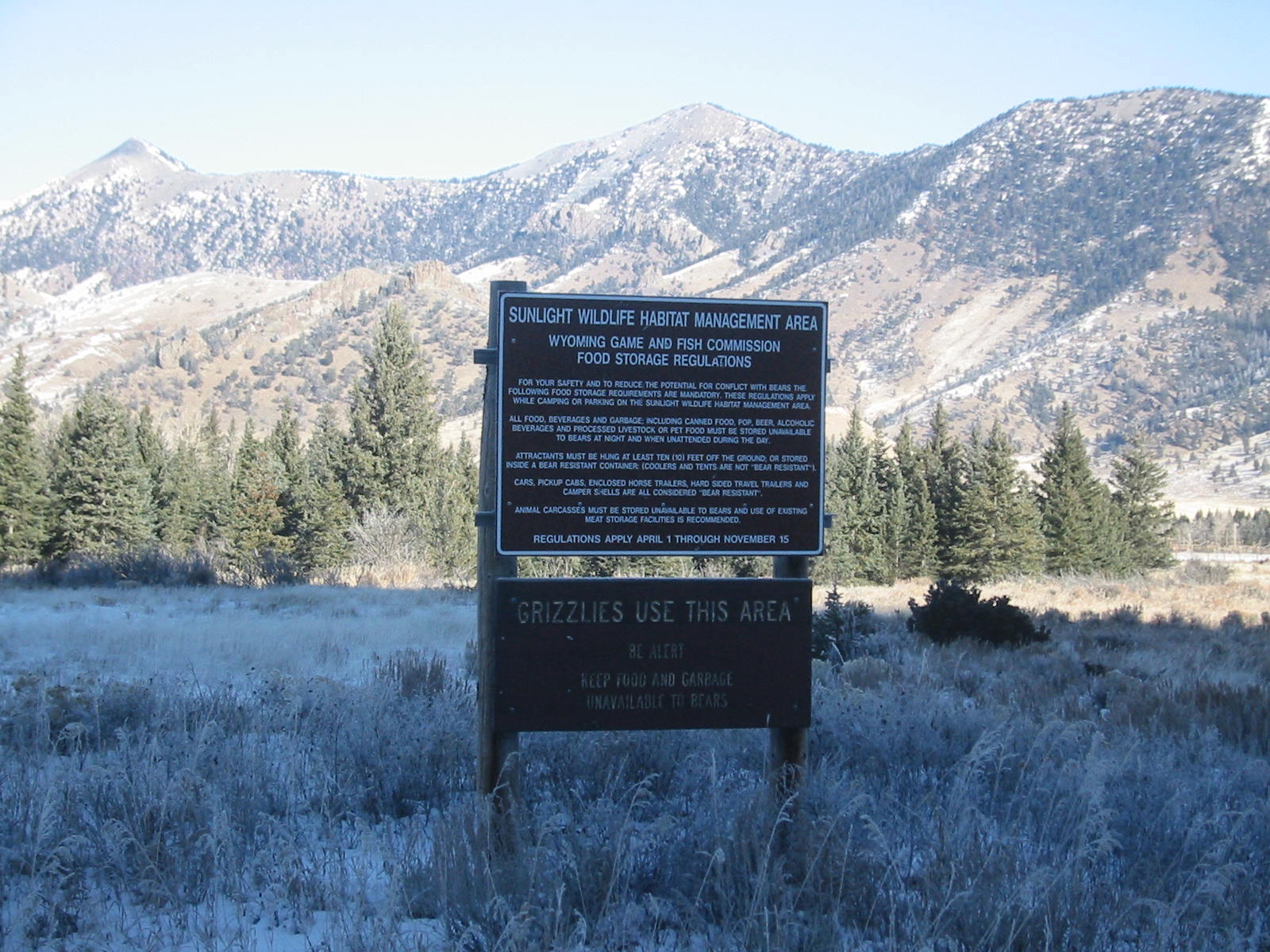
Do we usually think of mountain goats as dangerous animals?  Should we put up signs for these goats like I see here in grizzly country, with warnings for hikers to carry pepper spray even when grizzlies aren’t in the environment?

Do we need signs like these for all wildlife?

Today I was at the museum where I volunteer in their natural history lab.  My boss, the assistant curator said “Rocks would have been a good defense.  He should have thrown some rocks.  I always carry one or two when I hike.”  My boss is a seasoned veteran of wildlife, a lifelong hunter and student of nature.

The truth is there are plenty of wild animals that get aggressive given their mood and circumstance.  I’m more wary of moose than mountain lions, or of bison than bears.  Elk or deer in rut can be mighty crazy and aggressive.  Carrying ‘bear spray’ in general is a good idea.  Some people like to carry a gun when they go out.

We don’t really live with wildlife any more.  They are around, mostly in the shadows around cities and suburbs.   Or, when hikers go out in the national forests and National Parks, most trails are so crowded with people we don’t give large wildlife a second thought.  In general, most of us are more aware and know how to handle ourselves in questionable neighborhoods in cities than in the outdoors.  I certainly have more confidence using an ATM in a bad neighborhood than I do in carrying myself and being alert in nature .  In fact, most of the time when I hike with friends in areas other than grizzly country, we all fall into a chatty and fairly unconscious socializing mood.

Living close to Yellowstone, where no hunting has occurred for over 100+ years, animals large and small are easily visible from the road.  And lots of incidents occur every year.  I don’t think it’s because those people forget these are wild animals, I think it’s because they have no idea what is a right relationship to wildlife.

For instance, one early May in the Lamar, the valley looked like the Serengeti, with lots of predators and prey visible.  I watched a wolf fishing in the Lamar river about 100 feet down a hillside from the road.  There were several people watching from the road while this wolf caught a fish, then carried it over to a sand bar a bit further from the road in order to eat it.  A tourist just had to have a better photo, so he ran down the hillside and attempted to cross the shallow river, scaring the wolf away.  Rules say to stay 100 yards from a wolf.  This man was attempting to get within 25 feet!

In that case the wolf ran away and I thought:  this wolf can’t go have lunch at a fast food restaurant like this tourist can.  That man was interfering with this wolf’s opportunity to eat.

So what is the problem here?  The problem is that wildlife have become so abstracted from our everyday existence that they are an oddity, a rarity, something quite out of the ordinary.  And unless we’re wildlife biologists or have made a career of studying animals like my boss at the Draper, most animals are living creatures that we don’t really understand anymore, can’t read their signs and moods, nor can we read our own instincts of what is dangerous and how to defend ourselves in the natural world.  As a culture, as a people, we are several hundred years out of time.

Squirrels, Bears, and birds: What’s the connection?

The Clark’s Nutcrackers have been very busy over the last month.  So have the squirrels.  They’re both competing for the Limber Pine seeds that grow around here.  The birds extract and stash seeds.  The squirrels create middens with stored seeds and cones.  The bears let these animals do their work, then rob the middens.

Clark's Nutcracker

It is really amazing to watch the Nutcrackers.  They are so adept at using their beak to extract the seed.  Limber pine cones are full of sap, really sticky.  I’ve watched a bird work a cone, sometimes to just get sap or a bad seed.  The bird cleans it’s beak quickly and works another seed hole.

Squirrels too can work a cone very quickly and efficiently.  Both squirrels and Nutcrackers seem to know exactly which seed is viable or not.  I’m sure it has something to do with its weight.  Sometimes I find a cone on the ground with a few seeds left in it.  Invariably those seeds are empty, either with worm holes or they just didn’t mature.

Meanwhile, after working hard on caching all these seeds, the bears are coming around robbing all the caches they can find.

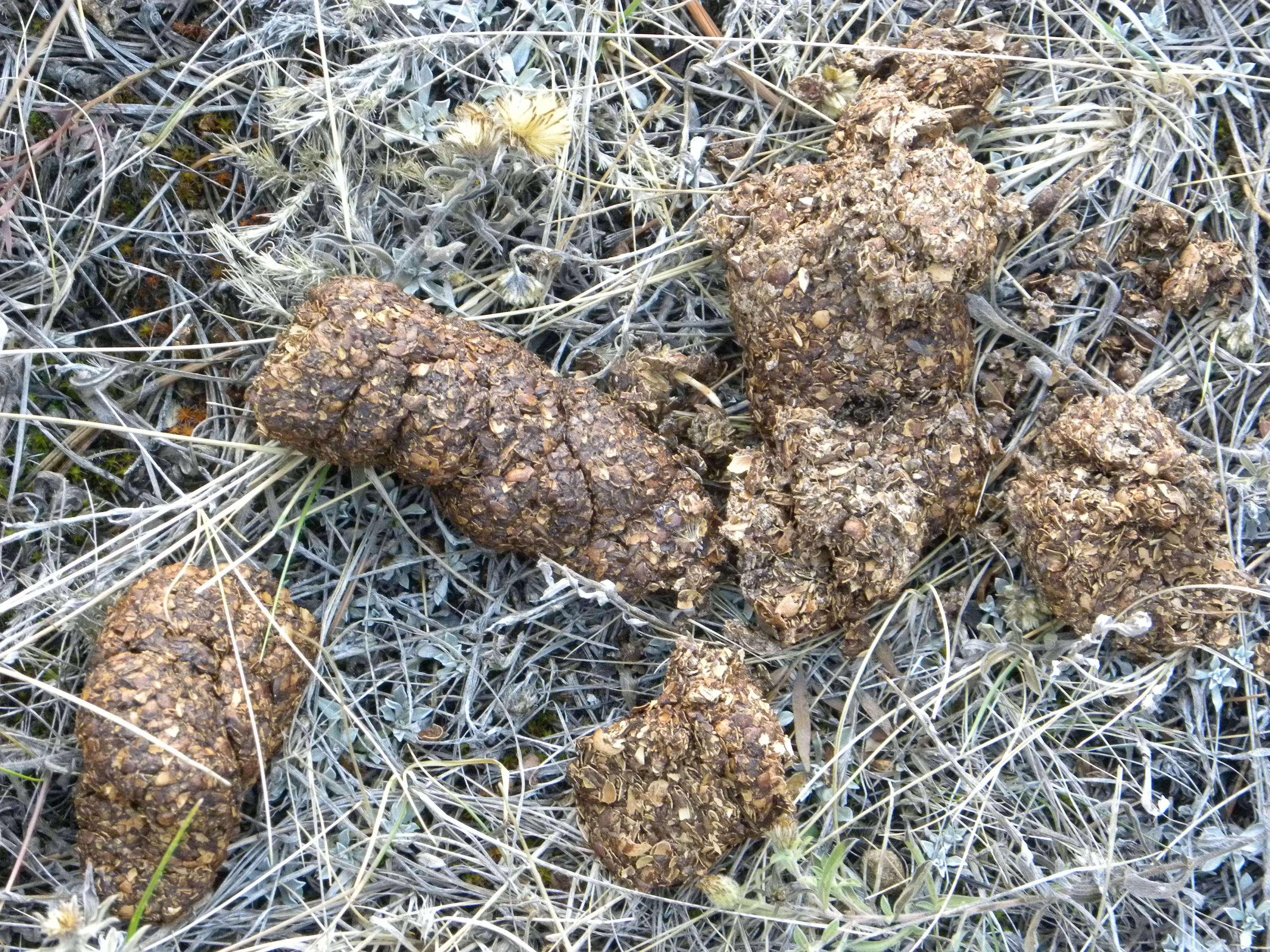
There’s a black bear working my neighborhood intensely, day after day.  His scat is everywhere,  mostly full of pine shells.  The scat even smells like pine nuts…you can smell the rich fatty odors.

Loaded with pine nut debris

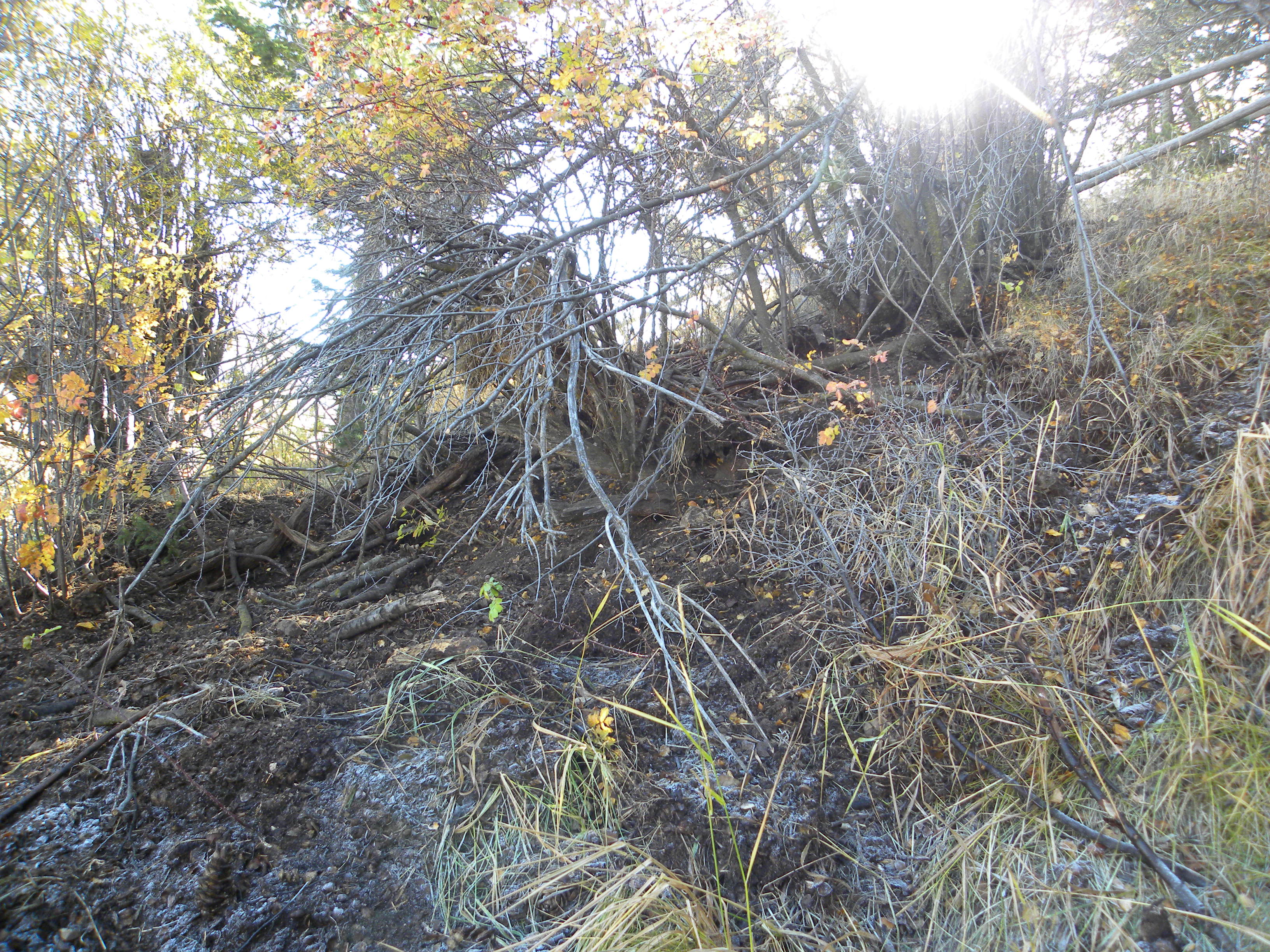
Yesterday I drove down my driveway only to find a huge stump in the middle of the road.  I got out to move it, I looked up the hillside where it had rolled down from, and saw that this bear had completely worked over an old middens.  He’d turned over the soil so much that the chickadees were having a field day.

Dug out middens on my hillside near the house

What a nice circle of feeding and robbing…birds and squirrels feed the bears who feed the birds.

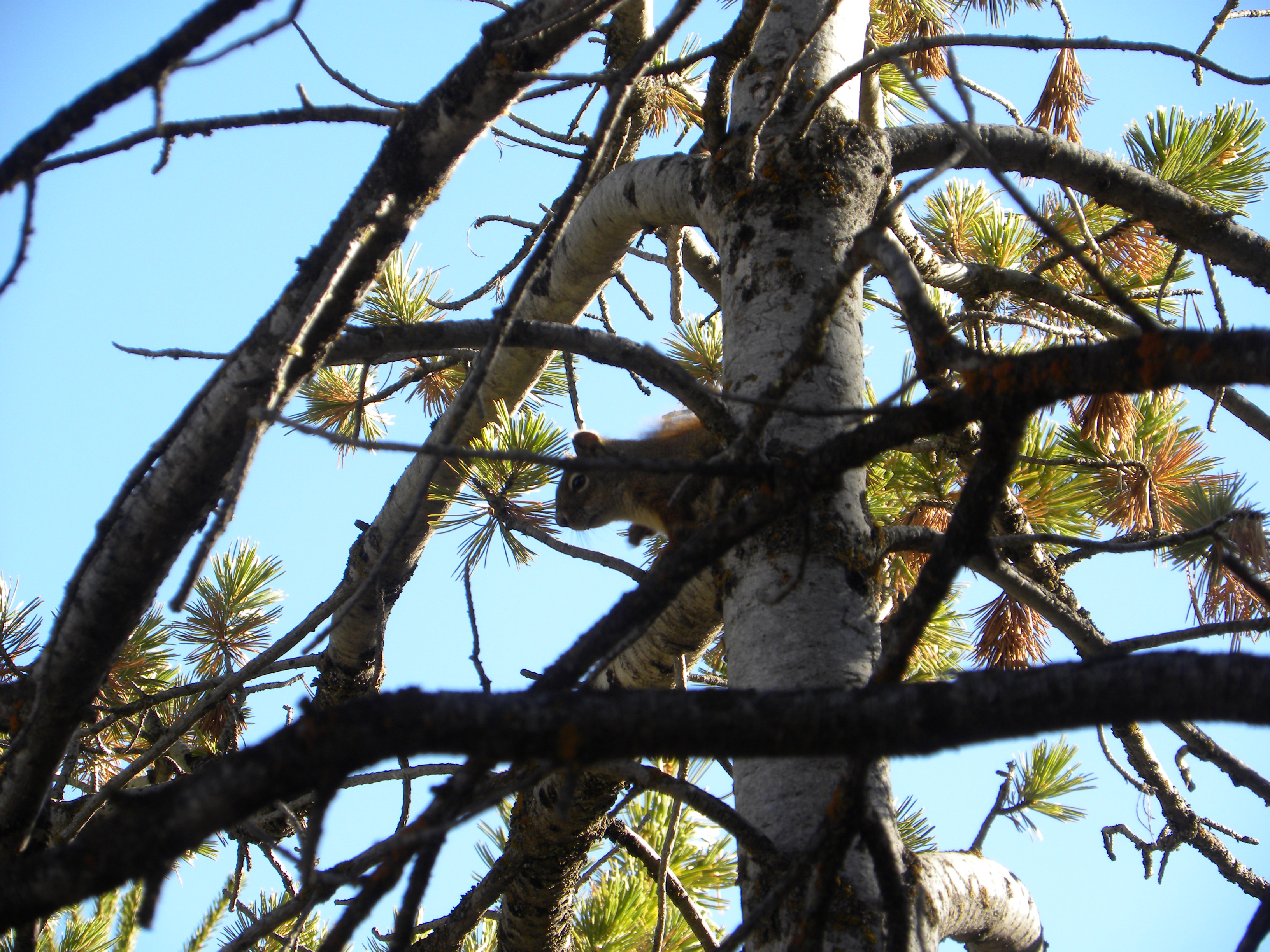
Squirrel above robbed middens angry at me. "I didn't do it" I told him

The Bear Facts

When I took Jim Halfpenny’s tracking class last year, he gave me a small pamphlet entitled  Bear Ecology.  Yellowstone Ecosystem. The pamphlet consists of lots of charts, so I’ll try and digest a few for you, literally.

Since I’ve been watching bear evidence and their scats a lot lately, here are a few facts:  About 80% of the nutritive value of Grizzly bear food comes from herbs. From this they get mostly protein.  Less than 20& comes from animals, where they get fat and protein.  The rest comes from shrubs and pine nuts.

Of the plants that Grizzlies in Yellowstone National Park consume:  78% or more of their plant diet comes from Sedges and grasses.  A whopping 6% comes from Claytonia lanceolata or Spring Beauties.  Further down in value importance are Cirsium (thistle), Clovers, Yampa, Biscuit root, onion grass, horsetail, and whitebark pine.  But if you look at the nutritive values of food, the only two that provide fat as well as protein are animal and pine nuts.  Therefore, they need these to increase their brown fat for winter hibernation.

On this chart, as far as animal foods, cutthroat trout are at the top of importance.  After that comes gopher, voles and marmots, elk, deer, and bison.  Below that are ants.

Another interesting chart is about the differences between Black Bear and Grizzly Bear den types.

Black Bears evenly split their types of dens between boulders, crevices, and outcrops.  They only dig 13% of their dens.

black bear digging for ?

Grizzlies, on the other hand, dig 86% of their dens and rarely use caves.  Which might explain why in these charts, which are not that up to date, Black bears were denning almost a month earlier than Grizzlies.  Grizzlies need to wait for more snow cover.

I’ve been intrigued with bear diet this year especially since I know that the White Bark Pine Crop is poor.  I keep wondering how these bears, that are so huge and strong, survive on mostly vegetarian diets.  These breakdowns help explain some of how they are able to use plants and convert them into useable proteins.  

So far, living at 7000′, we’ve had no snow yet on the eastern side of the Absarokas.  Today it rained some, October 17th.  I wonder how global warming will affect the denning times of black and grizzlies.  I wonder what plants they will find when its not cold enough to den but not warm enough, nor the days long enough, for good plant growth.

Mark Bruscino was on Wyoming PBS friday night.  He said an interesting thing.  He said that Grizzly bears are as intelligent as the Great Apes, making them the most intelligent wild animal in North America.  Surely they are an animal worth protecting, and giving more room to move into habitat that supports their needs as we, and the bears, face new challenges ahead.

Pika news

So my cute little friend has continued to hang around.  He/she has eaten most of the wild tomato plants around and seems to be gathering grass seed heads.  I’ve been testing him on a few foods.  So far he likes lettuce, a lot; carrot greens, why of course, he’s a lagomorph; and kale; but he doesn’t care for arugula!

Pika in my front yard at 6800'

I’m betting he’ll like sprouts, but not sure about bean sprouts or, considering he shunned my arugula, radish sprouts. He’s getting ready for winter.  Most mornings I see him meditating on a little rock by my back corner.  If he hears me snooping on him, he’s off.  But his evidence is everywhere and I have to wonder if he wonders where all this extra unharvested food is coming from.