• MY BOOKS ON WILDLIFE, GARDENING AND MORE

  • The Wild Excellence

  • True stories of wildlife encounters around the Greater Yellowstone
  • Award winning eBook on Decomposed Granite, tips, how to's, what to watch for
  • Children's book. True stories of a dog and wolves. In a dog's voice
  • Written for dry Mediterranean climates in California, north and south

Pine Beetles, Spruce Beetles, and what to do?

The County Fire Warden and the State Forester paid a visit to my neighbors last week.  There’s some money in the till to help homeowners clear dead and dying trees from their properties.  Since my area is full of beetle kill, and getting worse exponentially every year, we’re sitting ducks for a big forest fire.  The fires are going to happen, and need to happen for a variety of reasons, and the number one issue of fire fighters is saving structures (and lives of course).  If we can help out beforehand, all the better.

My neighbors and I have been talking about the little forest that surrounds us for several years.  Its mainly Spruce (Picea engelmannii)–old Spruce–and they are being hit hard by the beetles.   In fact, one of my friends counted the rings on a downed large tree–185!  That’s almost 200 years old, the average life span of a Spruce.

The Douglas Firs (Pseudotsuga menziesii) interspersed amongst them seem to be healthy for now, and all around the outskirts where there is light, as well as the areas where the spruce have fallen, Aspens are coming up.  The small forest is half private lands and half National Forest.  Its sits below a shelf of limestone where the springs run–our drinking water.  So the area is wet, and sometimes swampy.  The Spruce like this.  Upslope above the springs, it’s mainly Douglas firs.  Higher than that, there is less ground water and the forest turns into a mix of Limber Pine (Pinus flexilis) and Doug Fir.

I don’t own land in the Spruce forest so I was not a part of the walk-through, but I was told that the way the money from the State will flow is more reimbursement for the first acre around structures, and then the reimbursement percentage diminishes the further out you go from buildings.  The recommendation was to have one logging company do the whole job.  It wouldn’t be clear-cut.  They’d be taking out dead standing trees as well as clearing (probably burning) ground fuels.  The spruce are in such bad shape that there’s no money in it for useable timber.  Its good for firewood and/or log cabins.

My friend who was a forester for over 30 years cleared up some misnomers for me.  I asked him if it was true that standing dead trees were no more a fire hazard than standing live trees.

“True”, he said, “but trees with dead needles are like a torch.  Dead needleless trees are equally a fire hazard as live green ones.  What’s the real hazard is all the ground fuel.  Crown fires can’t usually continue very far unless they have fuel below to ladder them up.”

I made a point to mention to the State Forester that our small forest is home to moose, three species of owls, deer, turkeys, bears, and various obvious small birds and mammals.  Sensitive logging is imperative.

When they had finished with the Spruce forest, they showed up on my property and we walked to my upper area which is Limber Pine exclusively.  When I first got the property several years ago, there were no dead trees.  Last year I noticed I had blister rust, which I’m sure they’ve had for years.  But this winter I had several trees suddenly die on me from pine beetle.  I was anxious for the State Forester to see my trees, their health, and show me how to identify beetles and explain in detail their life cycle.

Apparently, the pine beetle has a one year life cycle as opposed to the spruce beetle which has a two year cycle.  The beetles fly sometime in the late spring, find a tree or trees (they look for larger ones), lay their eggs, and the larvae overwinter and feed on the tree.  The beetles make tunnels, called galleries, laying their eggs as they go along (and eating the tree as well).  The Forester found a cluster of infested trees on my property in one area.
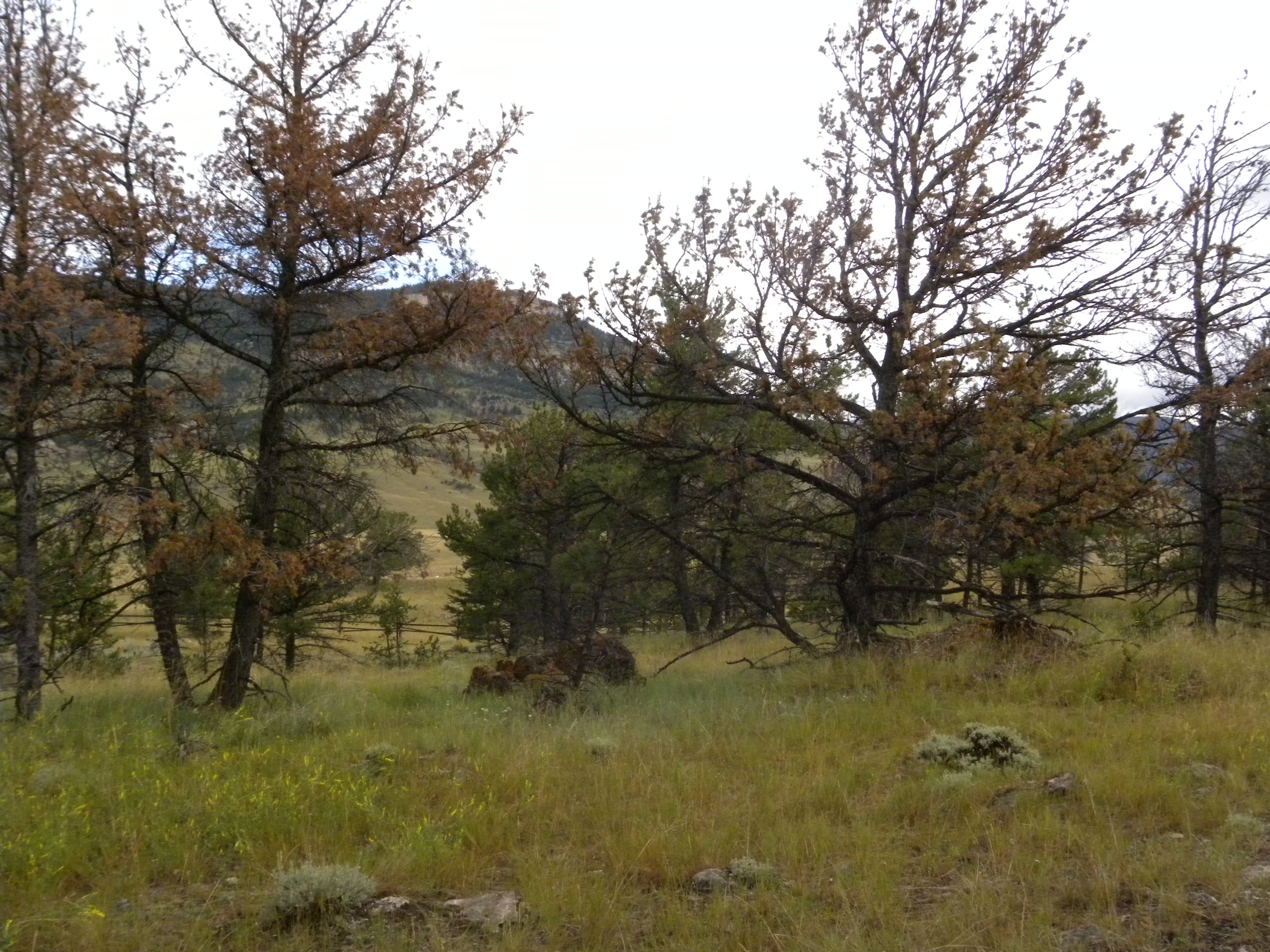
Last years kill

Last years kill

He took an axe and cut into the bark, exposing the tissue of the tree beneath and showed us the galleries along with a beetle (quite small).
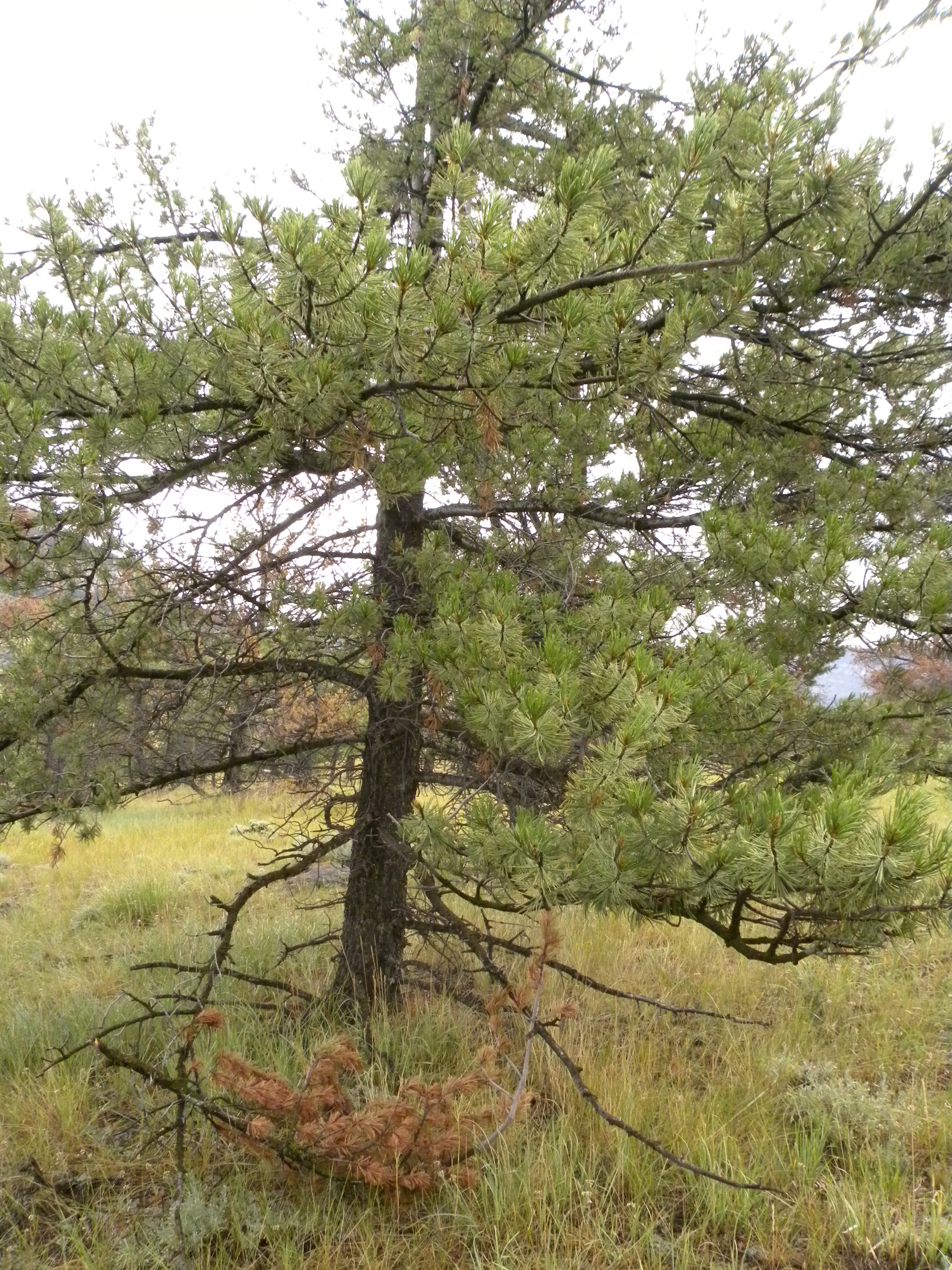
This tree is a goner

This tree is a goner

The identifying feature on my Pine trees is the frass(tissue or wood of the tree) at the base of the tree as well as the holes with pitch and frass where the beetles have bored and the tree is trying to ‘pitch’ them out.

Frass at base of tree

Frass at base of tree

If the infestation isn’t too bad, if the tree isn’t stressed by other factors such as drought or disease, then a tree can usually fend off the beetles by producing a lot of sap or pitch in the wound, just like your body might get rid of a splinter.  But between the extended drought years and the blister rust, many of my trees are succumbing.

Tree trying to pitch out beetle

Tree trying to pitch out beetle

What can I do?  Not much.  The pines that are dead no longer have beetles in them.  I can use them for firewood or leave them standing dead (better to take most of them down to reduce the fire hazard, although Limber Pines usually don’t present much of a fire hazard as they burn out).  The ones that have infestations this year I should cut down this winter and burn them onsite.  Burning will kill the larvae, insuring those beetles won’t fly next spring.  And the old specimen trees I want to save I could put pheromones on (He says that’s iffy at best) or spray with Sevin (toxic chemical) which works well.

In addition, I’ve noticed that there are very few young trees on my property, or on the Forest Service property next to mine.  This is probably due to a combination of drought, poor seed production, and blister rust, which has hit the young trees hard.  I suggested, and they agreed, that I begin a planting project of seedlings.  There’s no money for replanting in Wyoming.  Montana or Idaho might give homeowners money for that, but Wyoming doesn’t (not a heavily forested state).  I’d be planting for the future.  Pinus flexilis takes about 40 or 50 years before it begins to cone and produce.

One thing I can do is pray for 2 weeks of cold weather.  20 degrees below zero for two consecutive weeks kills the larvae.  We haven’t had that for years, and with global warming (or climate change, whatever you want to call it), that kind of cold is getting harder and harder to come by.

For now, it looks like the trees have ‘the plague’.
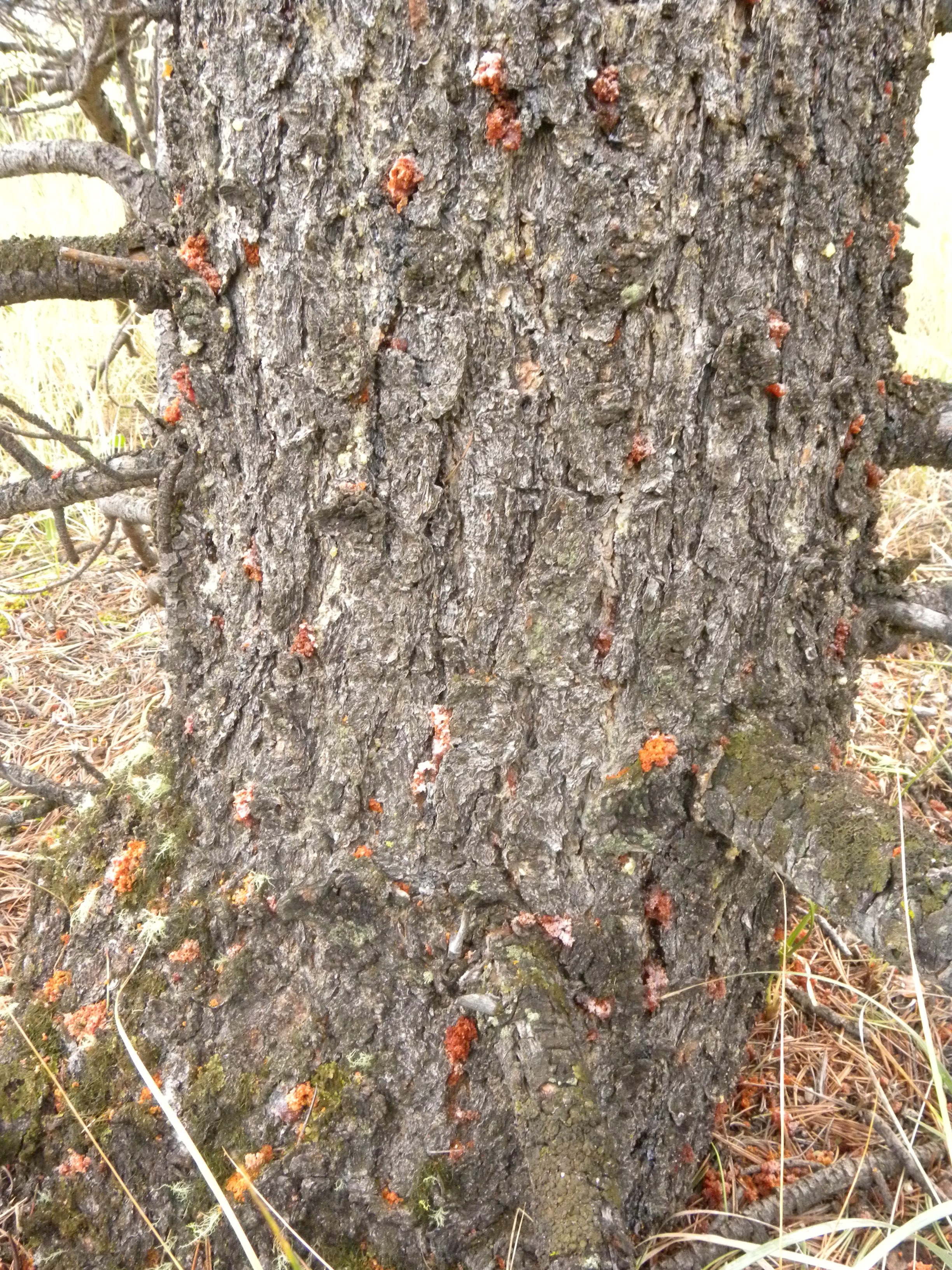
This tree looks like it has smallpox!

This tree looks like it has smallpox!

Of course, these cycles are natural in nature.  The Spruce will disappear and be replaced by Aspen, as well as young spruce and doug fir.  The Limber and White Bark are more problematic–between non-native Blister rust and native pine beetles killing whole forests, these pines contain nuts that are the fall food for Grizzlies.  They need the fat for their winter hibernation.  Pine nuts are to the Grizzlies of the Rockies as Salmon is for Grizzlies of Alaska; and as the trees disappear, another food source will be needed.  With warmer winters come shorter hibernation periods.  I suspect that will mean more Grizzly/human interactions and that, of course, means bad news for the bears.  Bears never are the winners in conflicts with humans, at least in the long run.

Last summer I spotted a government vehicle next to a nearby Aspen grove.  I stopped and chatted with the plant pathologist working on a 5 year Federally funded Aspen study in the Western U.S.

“The Aspens in Colorado are dying, by the droves, and no one knows why,”  he told me.

I asked about our trees.

“They’re just dying of the usual pests and diseases.”

Things are changing all over the West, in so many unpredictable, unusual, and new ways.  Dogwoods, Magnolias, and Redwoods once grew in Yellowstone, millions of years ago.  Twenty two different species of Redwoods were native to the United States.  Now only two species grow in just a tiny portion of California.  We’re in for some big changes.

Early fall?

Oh my God it’s the middle of August and it seems like fall already.  We did have summer…it was last week!  Apart from that, and a few hot days scattered here and there, its been a rainy pattern like the Pacific Northwest.  It is sunny till noon, then cloudy and rainy the rest of the day.

This morning there was frost on the back of my pick-up.  Last weekend I went to the end of my dirt road.  It ends just 5 or 7 walking miles from the Yellowstone border.  It was 37 degrees at 7:30 am when we started.  The road soon became impassable in anything but an ATV.  Several years ago I drove to the end in my Jeep, but with all the rain and snow over the last 2 years, the road is overgrown, the streams can be dangerous, and fallen trees have been cut by ATVer’s so only ATVs can get through.

Its so wet this summer it looks like the Northwest

Its so wet this summer it looks like the Northwest

About 70-80% of the conifers back there are dead.  All the wet weather and more trees are going to fall, making for good fire material. We drove almost up to the glacier, or at least what’s left of it before it melts completely.

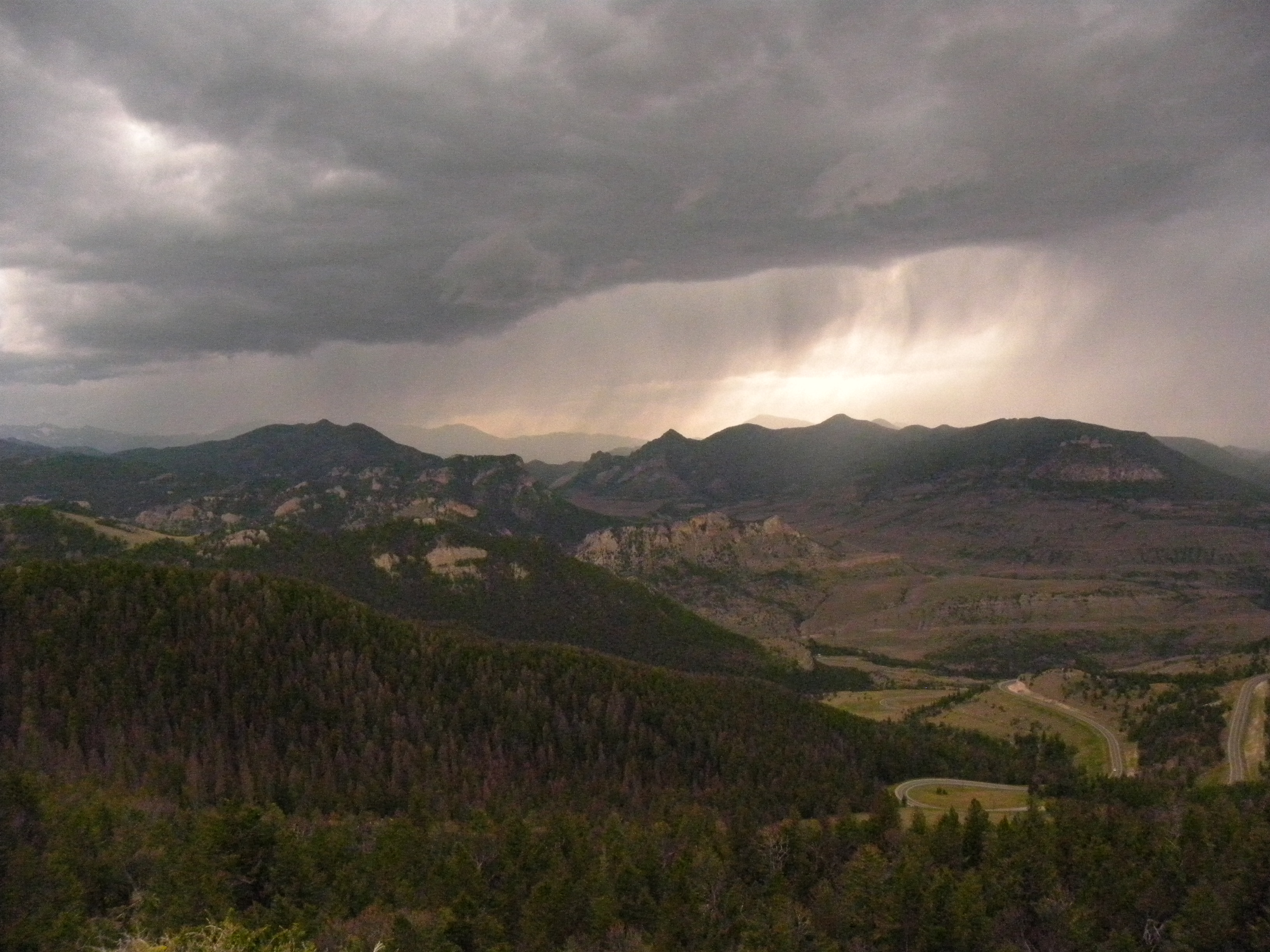
View from near the end of the dirt road in my valley

View from near the end of the dirt road in my valley

Last week my son was in town and we went to the Park.  On the way home, a hailstorm began that lasted for over an hour.  The visibility was so bad, the hail was so hard, that we had to stop the car and sit for 15 minutes.   I felt like I was inside a popcorn machine.  A motorcyclist stopped with us.  I looked at the size of those hailstones and felt sorry for him.

The gathering storm

The gathering storm

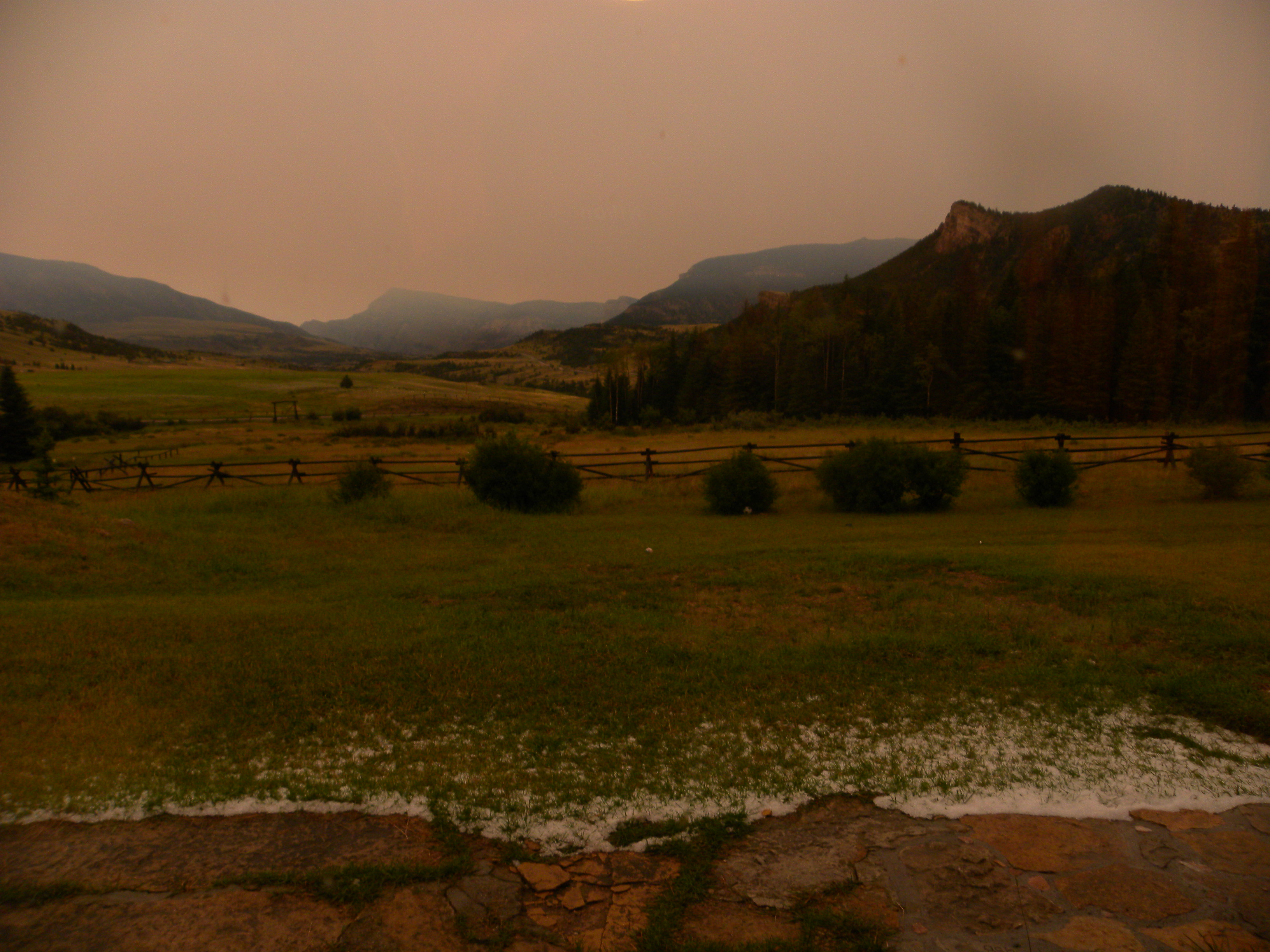
When we got home, the road was covered with inches of hail.  An eerie calm fell over the landscape.  A monotone light saturated the air.

The light is eerie

The light is eerie

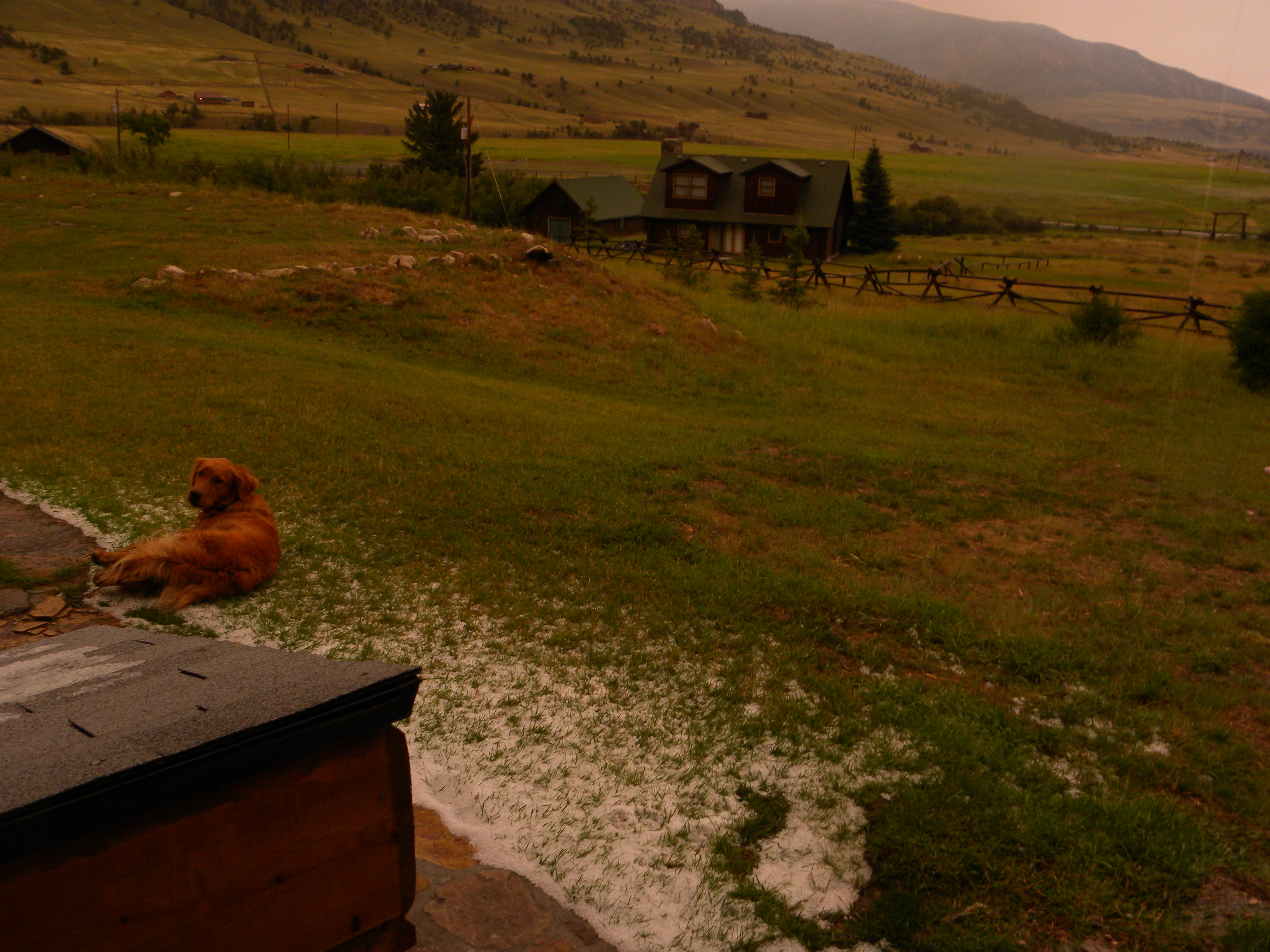
Koda sits in hail

Koda sits in hail

UFO?!  Just kidding.  Just a strange outside light reflecting the inside lamp

UFO?! Just kidding. The strange ambient light reflecting the inside lamp

I’m not ready for fall just yet.  I’m still hoping for a bit of summer to begin.

New ideas for lawn Part 2: Carex pansa, Carex texensis

As promised, here is the second of the two part series on meadow making in California.

The first of the entries covered fescue as a lawn substitute.  But I have come to prefer Carex pansa.

Carex pansa is a native sedge.  Sedges have edges, so to speak, while grasses don’t.  It is a clumper, like all the native grasses of the West, and spreads very nicely.  Once established, it requires watering only about every 3 weeks or more, depending on your site, and mowing no more than 4 times a year!  I do have clients that keep it very ‘lawn-like’ and mow it ever two weeks, but since it only grows 6″ high, that isn’t necessary.

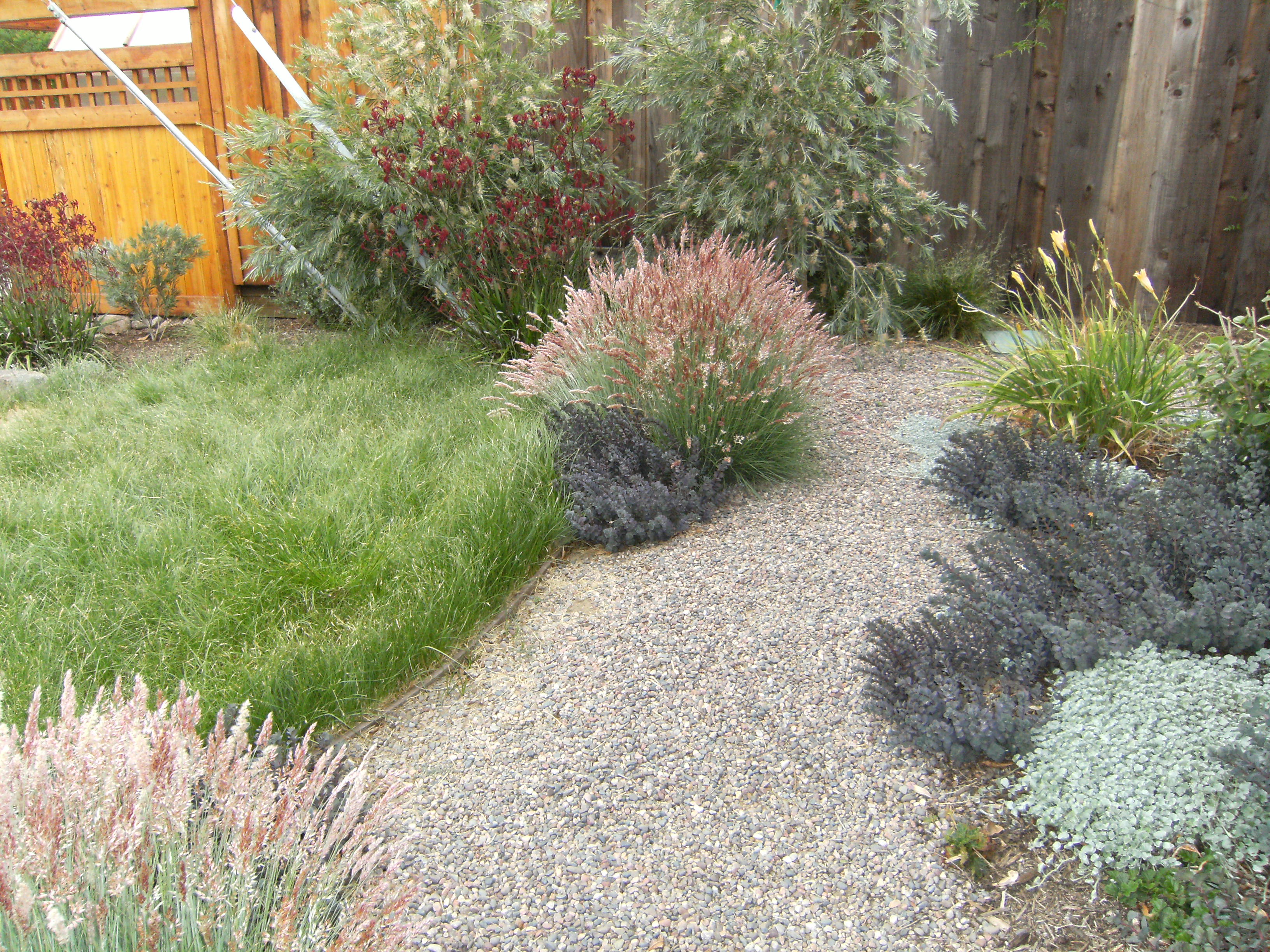
Dry Gardening lawn

Carex pansa front yard lawn

Carex pansa can tolerate traffic.  I have clients with kids who play on the lawn.  But it isn’t for intensive traffic.

The planting/preparation method is simple.  Prepare your bed as if you were going to plant a conventional lawn, in other words, good soil, lots of compost, rake out the clods, bed should be to finished height.  I always install a conventional irrigation system–better safe than sorry and its so much easier for the homeowner.  In the beginning you will need to water the plugs till established and the first summer while filling in, water a few times a week.  So a watering system on a timer is essential.  This means the pvc should be installed prior to planting.  The sprinkler heads can be installed and then adjusted to correct height once the Carex is in.

Dry gardening lawn

Carex pansa in a large backyard situation

Carex pansa needs a good edging as it will spread beyond your beds without one.  Its not a weed nor really invasive, but, like grass, it will grow outside its borders if given water and good soil.  Depending on your design, you might even want to pour a concrete edging.

Carex pansa is great for full sun and its evergreen.  But if you have a shadier spot, I put in Carex texensis.  You can mix the two in a lawn if you have sun and shade, but the Carex texensis is deciduous.  On the other hand, I’ve had some tough spots where its too shady for a lawn and the C. texensis is a life saver.

C. Texensis under tree.  Can be deciduous but was not here in the Bay Area.  Good for dry shade

C. Texansis under tree. Can be deciduous but was not here in the Bay Area. Good for dry shade

For a full discussion on soil preparation, spacing, watering schedule, mowing,and where to order plugs, see my eBook Gardening for a Dry California Future.

Bats, bats, and more Wyoming bats

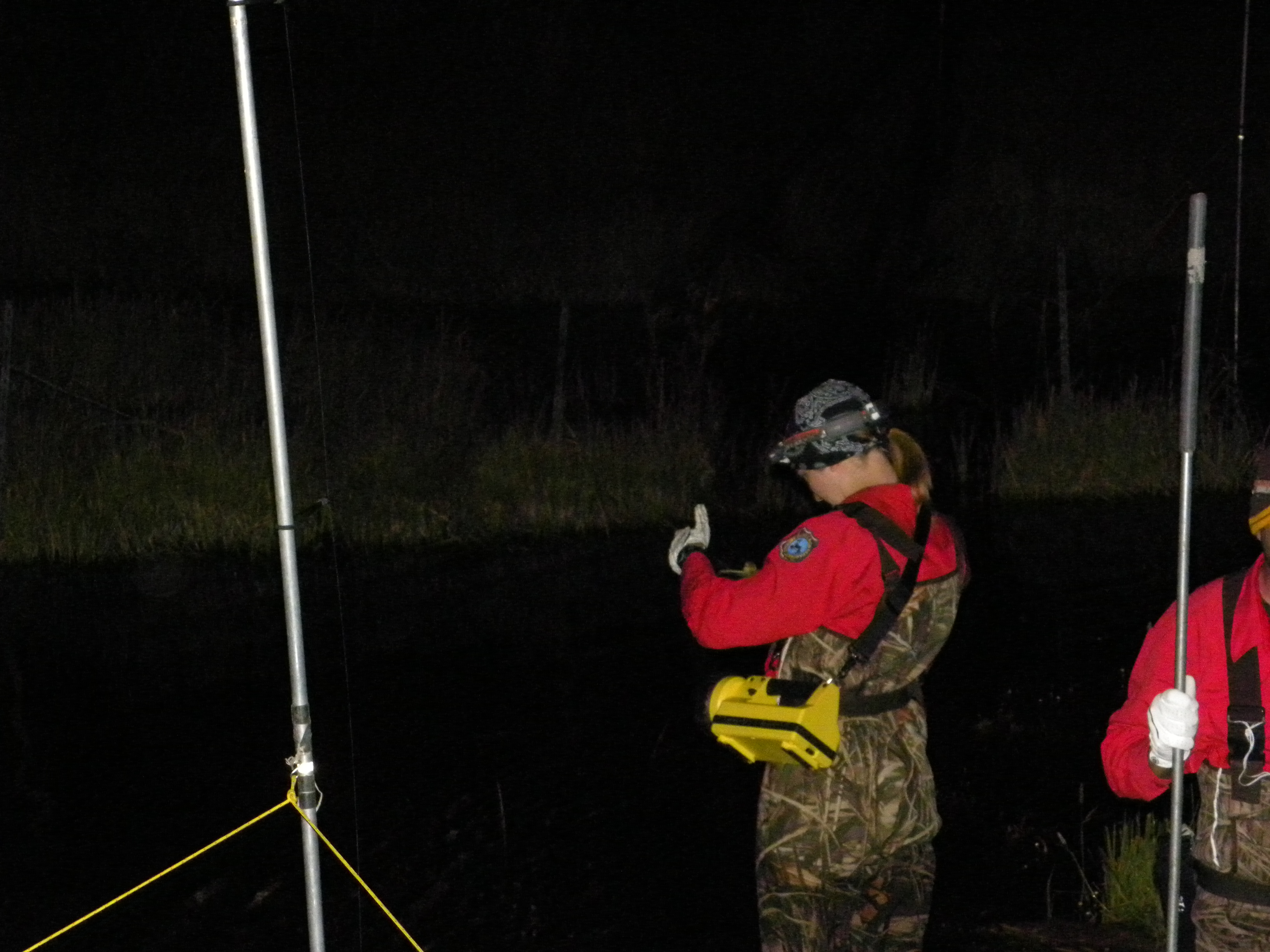
Last evening I took a short bike ride and noticed two WG&F biologists walking up the hill from the swampy area of the creek.  They said they were setting up a bat net and invited me to watch them capture between 9 and 11:30.

By 9pm it was getting dark.  I grabbed my headlamp and headed down the road.  They were already beginning to catch bats in the nets.

The net set-up was in an ‘L’ shape, with fine nets about 10′ high.  I spent the evening watching and helping a bit while they measured forearm lengths, ear lengths, weight, sex (I learned how to sex a bat!), determining juvenile or adult.  They said it was one of the most productive evenings they’d had, with their count at 27 by the time I left at 11:30.  Included in their equipment was a sonar detector, which allowed us to hear the bats at frequencies which aren’t auditory to the human ear.

Three kinds of bats were caught, and released:  Brown, Hoary, and Silver-haired.  WG&F is in their 2nd year of a four year study.  The Brown is a Wyoming resident, but the Hoary and Silver-haired are migrants (What Wyomingites might call ‘snow birds’ in reference to people who live here but leave for the winter).  I asked where they went and was told its not known.

It was such an awesome night, with the bats flying around, getting to see them up close (they are beautiful creatures), the Perseid meteor shower and clear skies, and finally around 11:30 an orange-yellow moon rising in the east.  I couldn’t ask for more.

Brown bat

Brown bat

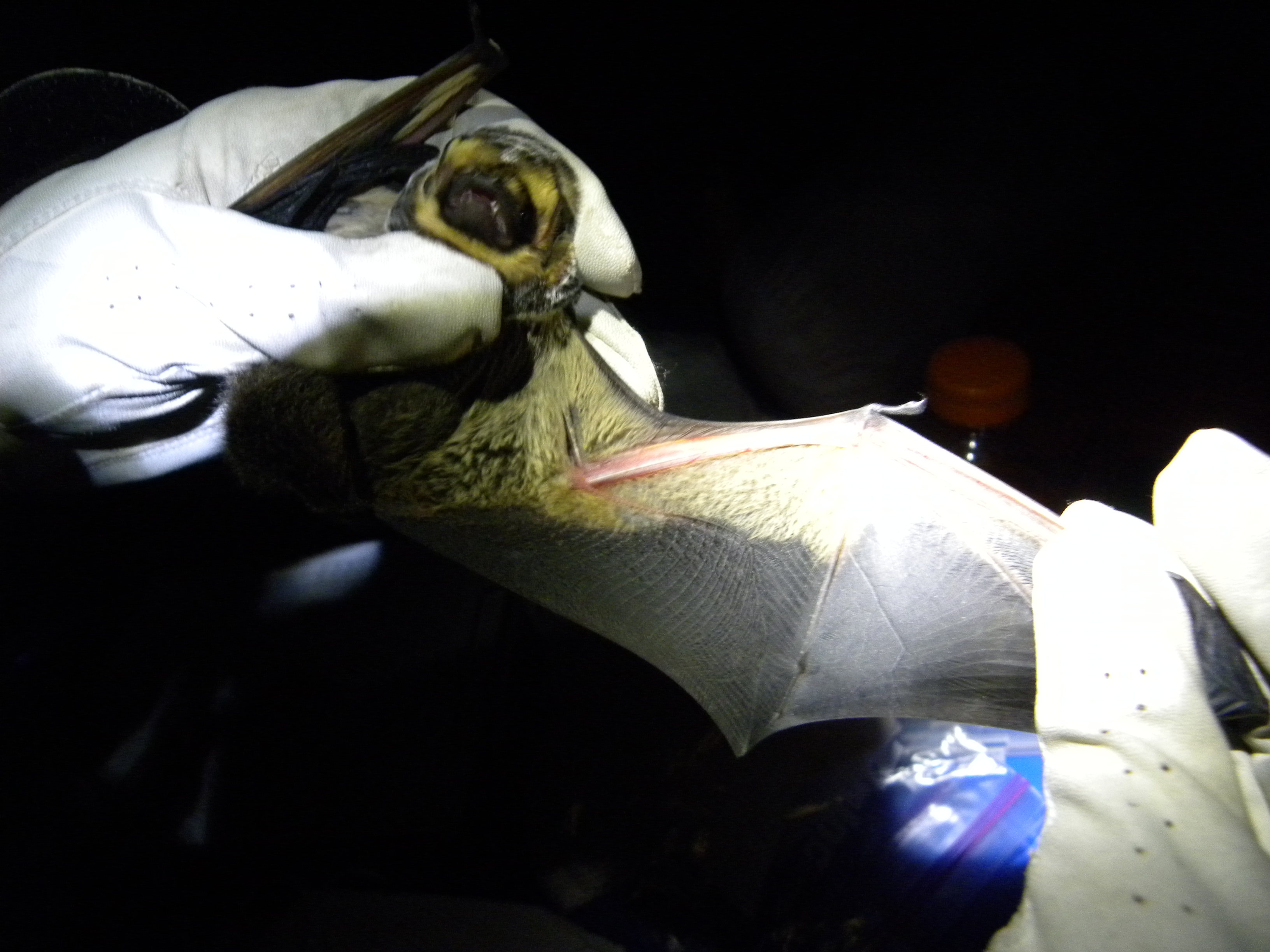
Brown bat's wing

Brown bat's wingH

Here you can see the bat’s fingers, with the thumb at the very end.  The thumb length was measured as well as the forearm.

Silver haired bat

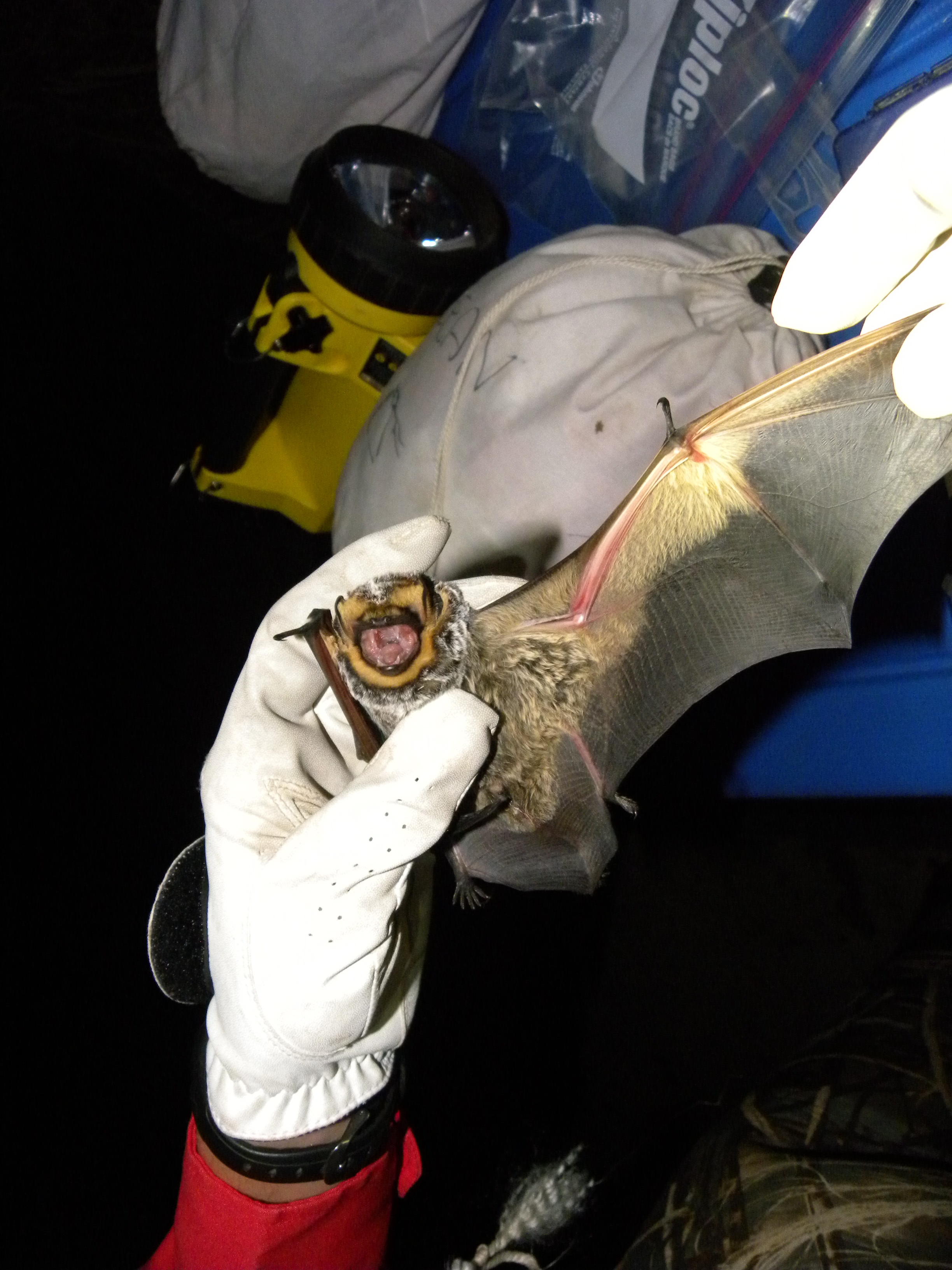
Hoary bat with wing fur and cool face

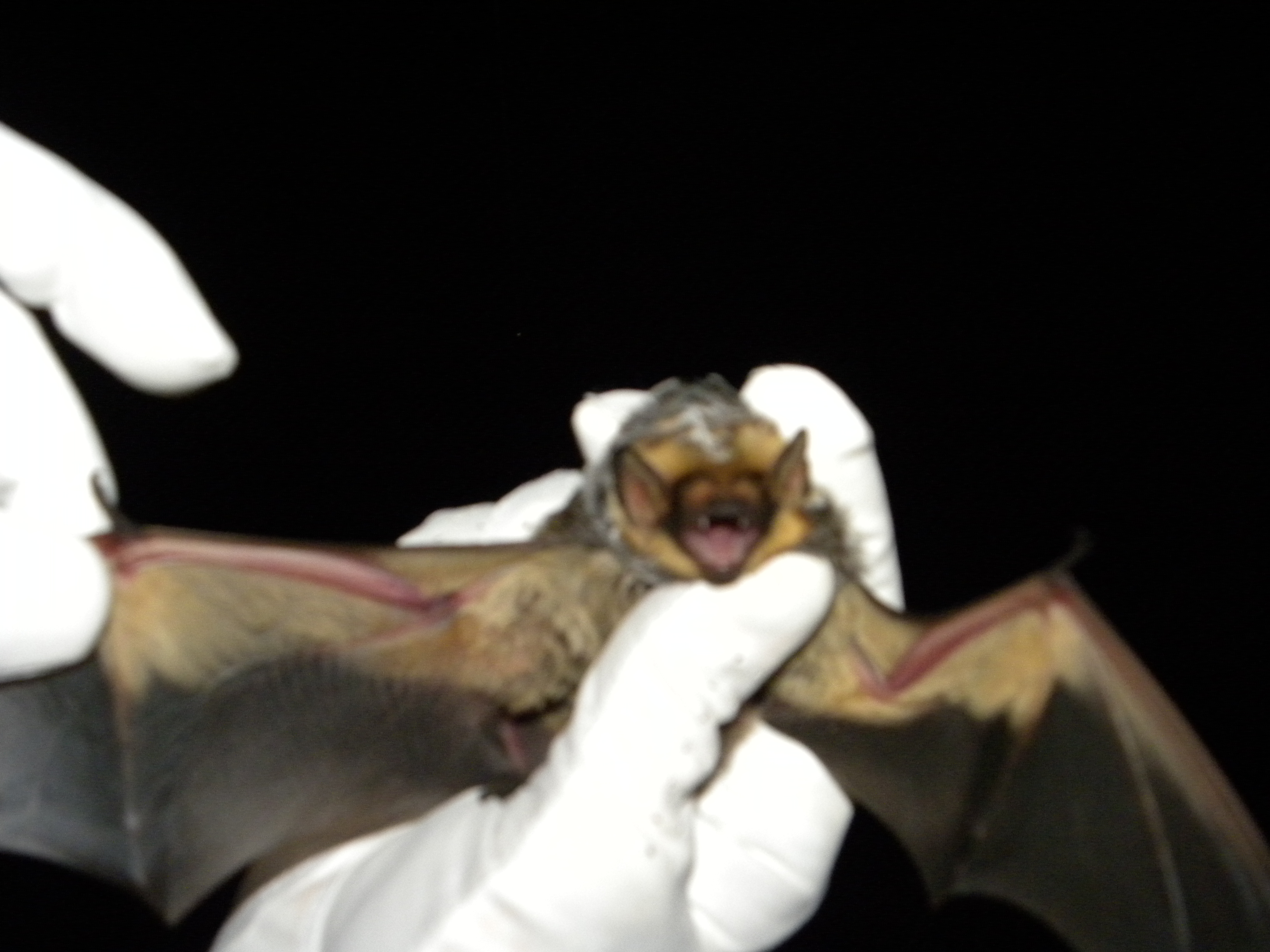
Hoary bats are big bats and low fliers.  They are moth specialists.  They were fierce little guys when caught, with astounding faces.  Their wings have hair on them.

Hoary, another pose

Hoary, another pose

Bats of different species emit sonar at different frequencies.  The frequency has to do with what their specialty food is they are catching.

These silver-haired bats were fairly calm and gentle, and small.

Silver haired bat

Silver haired bat

DSCN0876

Bats have a ‘hook’ around the outside of their ear.  The mammalogist told me that its function is unknown.

Hoary bat

Hoary bat. I love this bat. Hoaries are the coolest.

Most of the bats we caught were males.  Apparently that’s not unusual, with the females flying in a different location or tending the young.

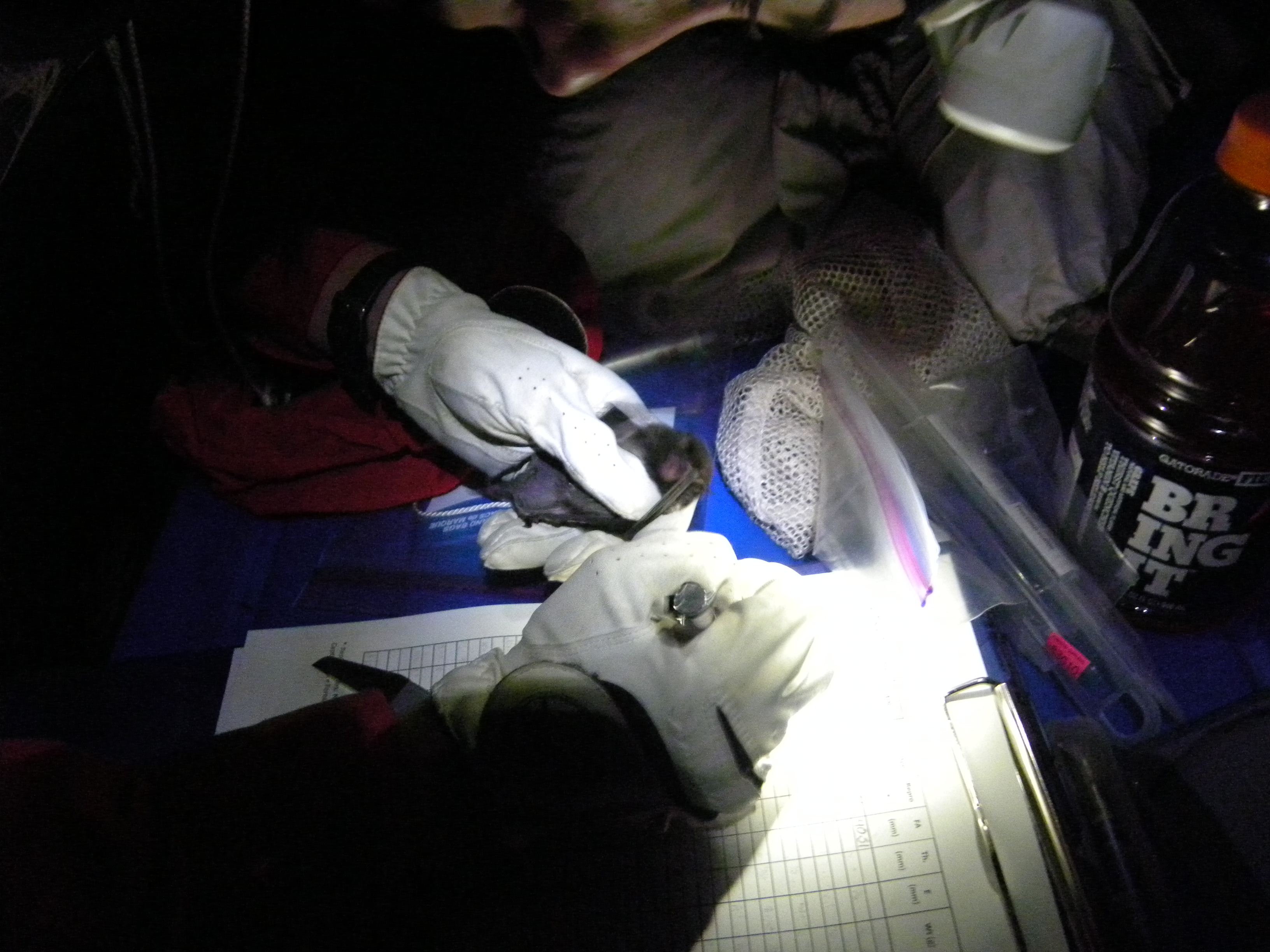
Measuring a brown bat

Measuring a brown bat's thumb!

Brown bats are generalists.  A small percentage do carry rabies, while the Hoaries do not carry rabies.

The net

The net, releasing a bat.

If they set up another night in the same area, hardy any bats would come.  The bats learn quickly how to avoid the nets.  They are smart!

More Scats and Tracks

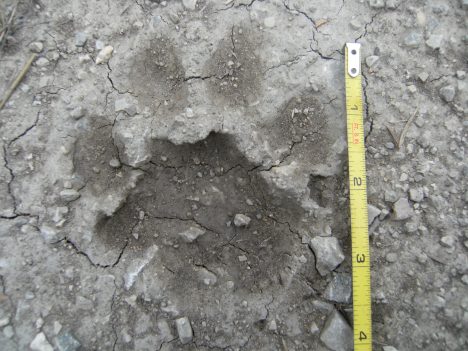
Yesterday I found a cougar track in the mud.  I know there’s a cougar on that side of the creek because a friend of mine saw one a few months ago driving from the Cody Pow Wow down Dead Indian highway.  It was around 9pm, he said, and the cougar was just standing along the side of the road.  He stopped the car and watched the impressive animal for about 10 minutes.  Only one other car, a neighbor as well, came along, stopped and watched.

The track was right along the trail, not too far from the trail head. This part of the trail is in eyeshot of the main road, which climbs steeply up the mountain.  The track, measured out about 3 3/4″ length by 4″ wide.

cougar track in mud

cougar track in mud

cougar track with penny for reference

cougar track with penny for reference

Being that the ‘Scat’ post is popular, here are a few more gems!

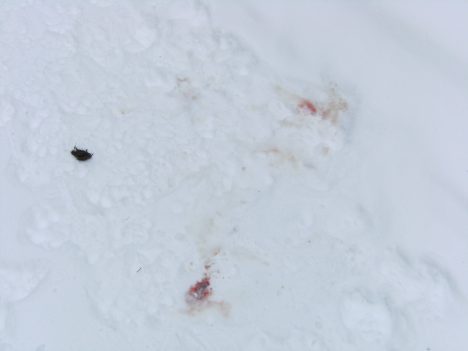
Wolf blood and urine from wolf in estrus

Wolf blood and urine from wolf in estrus

Wolf scat

Wolf scat

Comparison of elk and deer scat

Comparison of elk and deer scat

Moose scat

Moose scat

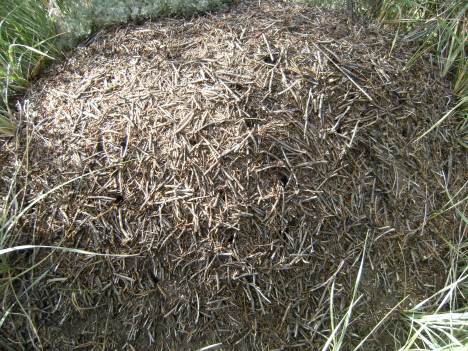
Ant hill

Ant hill

Ant hill destroyed by a grizzly looking for grubs

Ant hill destroyed by a grizzly looking for grubs

Turkey tracks

Turkey tracks

Idle thoughts and Realizing the Way

“Haven’t you met someone seasoned in the Way of Ease, a person with nothing to do and nothing to master?” …Yung Chia The Song of Realizing the Way.

I suspect it will take me a long time to actually be on mountain time–for my mind, impulses, and need for distractions to slow enough that my actual speed synchronizes with the tempo of a sunset, or the arrival of spring, or the way an elk moves across the deep snow, or press into the deep breaths of bears lumbering through forests.  I still make lists in the recesses of my brain of projects–fix the fence, clean the attic, hike those hills.

Trying to capture a full double rainbow--impossible!

Trying to capture a full double rainbow--impossible!

The best of me is spent wandering with no intention or direction.  I might begin with a ‘goal’ in mind, perhaps find some arrowheads or evidence of the nights’ activities in the woods.  Soon I’m wandering–“tooling around”  I like to call it.  My feet guide me while my mind rests, open, no thought, just present, alert for the dangers of the wilds.  Then I am my happiest.

Strangely, in those hours, I’ve accomplished nothing, built nothing, cleaned nothing, fixed nothing and probably not even seen one person.  But my body is relaxed, my mind free, and many times I’ve discovered a new flower, or scat; noticed animal evidence I might have missed or discovered obsidian shavings, maybe a buffalo tooth.

Vulture chicks

Vulture chicks

“Idle hands do the devil’s work” joked a friend with me the other day.

“Never heard that before”, I replied. Must come from deep in our puritan work ethics.

I, for one, want to become comfortable with idleness, daydreaming, and random muckiness.  Yung Chia might agree.  For me, it seems so much harder to cleave and sunder the addiction to speed our society perpetuates; to be comfortable traveling at the mph of a drying dewdrop, to sit with boredom and feel my smallness in the universe, to allow the silence of a night sky.

These are primeval rhythms, hidden deep in the recesses and folds of old human time.  I suspect that, with enough patience, these familiarities will surface and subsume me.  At least, I ride on that hope.

Occasionally my dreaming connects with these old stories–I know the future or suddenly I’m wise.  These channels are there and can be opened, but for now I am mostly like the rusty cans I find along my walks, relics of modern life lying on ancient earth.

Home

Home

The Abstract Wild

I’ve just finished reading The Abstract Wild by Jack Turner. The book is a series of essays, a ‘rant’ for wild Turner says.  Wild, as Turner defines it, is not wilderness, not a managed environment with collared animals, hunting quotas, ‘fun hogs’, 7 1/2 minute maps, gps, cell phone availability, not to mention logging, mining, open grazing or other forms of exploitation.

For Turner, and I agree, wilderness or the wild contains our place in it, not as tourists or observers, and is a sacred experience, defining our place in the world and the cosmos.

A few wonderful quotes:

Maps and guides destroy the wildness of a place just as surely as photography and mass tourism destroy the aura of art and nature.  Indeed, the three together–knowledge (speaking generally), photography, and mass tourism–are the unholy trinity that destroys the mysteries of both art and nature.

The majority of Americans no longer know this experience of the wild.  We are surrounded by national parks, wilderness areas, wildlife preserves, sanctuaries, and refuges.  We love to visit them.  We also vist foreign parks and wilderness; we visit wild exotic cultures.  We are deluged with commerical images of wildness: coffee-table books, calendars, postcards, t-shirts, and place mats….

From this we conclude that modern man’s knowledge and experience of wild nature is extensive.  But it is not.  Rather, what we have is extensive experience of a severely diminished wilderness animal or place–a caricature of its former self.  Or we have extensive indirect experience of wild nature mediated via photographic images and the written word.  But this is not experience of the wild, not gross contact.

Turner’s best essay, in my opinion, is the first one, which relays an experience he had in the 60’s in Canyonlands National Park before it was a park.  After surviving a small plane crash, he wandered around the Canyonlands for days.  One evening he came upon large ancient pictographs of life-size figures.  Their presence, spookiness and power absorbed him.  It formed a sacred and lasting impression.

Years later, he revisited the site.  But now the area was part of the Park, there was a family  picnicking nearby, and signage explained what little was known about the pictographs.  The entire area is now mapped and known.

Humans become foreigners to the wild, foreigners to an experience that once grounded their most sacred beliefs and values. In short, wilderness as relic leads to tourism, and tourism in the wilderness becomes the primary mode of experiencing a diminished wild.

Turner’s book identifies the problem eloquently and articulately.  He doesn’t present solutions.  Are there solutions?  I’ve been pondering this.  It doesn’t seem to take much more than a generation for cultural amnesia to begin settling in.  The loss of wild areas, or the loss of social freedoms, taken away bit by bit, and soon the present generation has no memory of what once was.

Just 200 years ago, not even a blink of the eye in human history, Lewis and Clark came through the West and witnessed the land filled with bison, grizzlies, elk, deer, prairie dogs, clean waters, and people living of and on the land in ways that had preserved it for hundreds if not thousands of years.  The way of life of the native americans was gone a few generations later, as well as most of the abundant wildlife.

I walk these hills and know that I am a pauper.  I have no cultural references for living in ‘wilderness’ as my home.  I have survival skills that might keep me alive for maybe a week or more, but not a lifetime.  Although many people know more wilderness skills then I do, and many know much more scientific knowledge than I do, there is no living culture here anymore that can teach us how to live in the wild, sing the songs, harvest and prepare the plants, give thanks before we hunt, or help clue us in on how to contact the sacred that imbues this place.  As a culture, we are bereft.  As individuals, we are reduced to finding our own way without cultural help.

Turner’s book is a must read for all who love nature and wilderness.  It turns conservationism on its head and offers a new definition and goal. But the vision of ’21st century wild’ must emerge from all of us.

Enjoying the sacred with an ancient poem

I settled at Cold Mountain long ago,
Already it seems like years and years.My 'Cold Mountain'
Freely drifting, I prowl the woods and streams
And linger watching things themselves
Men don’t get this far into the mountains,
White clouds gather and billow.
Thin grass does for a mattress,
The blue sky makes a good quilt.
Happy with a stone underhead
Let heaven and earth go about their changes.

–Early Tang Poet Han ShanDSCN0517

New ideas for lawns: Part 1 – Meadow-making with Red Fescue

Lawn replacements are hot!  We live in the West–a thirsty environment, so let’s adapt our plant material to our water and not the other way around.


An example of a natural bunch grass meadow--nature's perfection

An example of a natural bunch grass meadow--nature's perfection


Here is one recipe for making a meadow.  I no longer use Festuca rubra or Red Fescue as a lawn substitute in California.  I am now using, exclusively, a native Carex or sedge, which I’ll describe in Part 2, coming later.


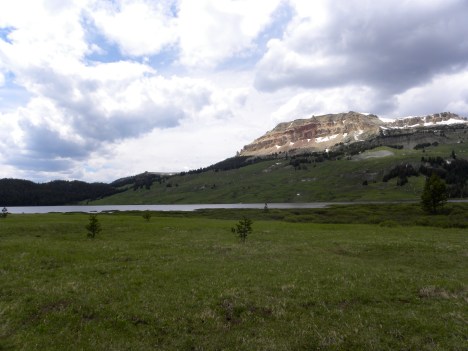
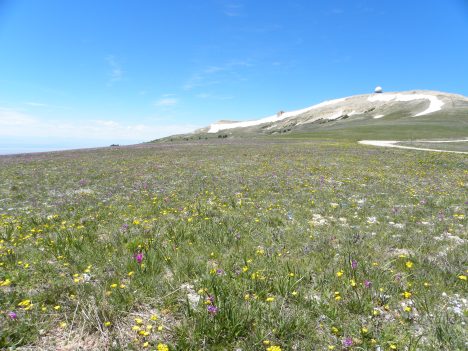
High altitude meadow

Meadow at 9000 feet with wildflowers


As a side note, my native grass mix  that I put together here in Wyoming is coming up very nicely.  I ordered a mix of Blue Bunch wheatgrass (Agropyron spicatum), Koeleria cristata, and Festuca–all natives to this area.  In early June, after I graded my new dirt road, I scattered the seed, raked it in, then watered it heavily for several days.  It rained every afternoon for several weeks and the new seed came up.  It’s still green and establishing nicely, and I haven’t watered it at all (now mid-July).  When the afternoon thunderstorms slow down, the grass might go dormant, then be covered with snow, but it will come up again thickly in the spring, and hold my steep road together.


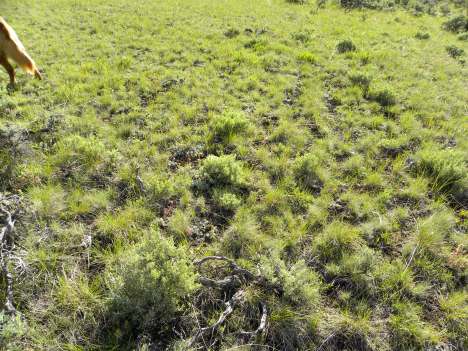
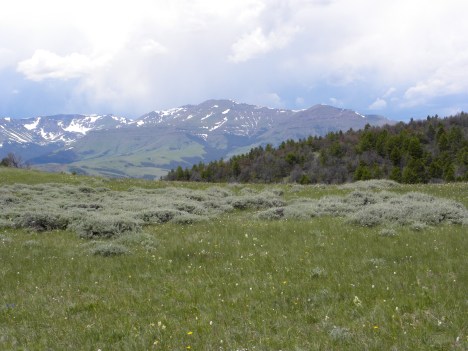
Meadow of bunchgrasses and sage

Meadow of bunchgrasses and sage


Making a native lawn or meadow requires ridding the area of non-native weeds and annual grasses.  The Wests’ native grasses are bunch grasses.  Bunch grasses give to the soil, while European annuals taketh away from the soil.  But since the annuals reseed profusely and our perennial bunch grasses take more time to establish, the annuals overwhelm the natives.  That is why this is the ONLY situation in which I use an herbicide.  Native grasses need a leg-up to establish.  I use Round-up because it breaks down fairly fast.  You may need to Round-up, water for 6 weeks, then Round-up again if you are overwhelmed with weeds.  If you don’t do this, then the natives can not get established and the ‘weeds’ will take over quickly.

Preparation of Seedbed

1. Remove weeds and non-native exotics.  This can be done by hand, preferably during winter months.  Well-established introduced exotics, e.g. broom can be cut at the base.  Apply Round-up to the woody stems.  Leaving the roots in the ground may prevent erosion until the new meadow is established.
2. If the meadow is on a steep slope (50% or more), lay down jute netting on the steepest slope sections prior to seeding.  Hold in place with irrigation pins.
3. Soil bed should be loose and friable.  If not, cultivate and add rich composted material to a depth of 2-3”, well mixed with existing soils, to a depth of 6” if possible.  If erosion control is an issue, or a leach field, you might not choose to cultivate as deep as 6”

Irrigation

1. The entire meadow area should be irrigated with pop-up spray heads that provide 100% coverage of the area to be seeded.  If this is not possible, the meadow must be seeded in the late fall/early winter and hand watered on a weekly basis for the first year.  Water regime can be adjusted based on weather, site conditions and seed germination rates.  Rely on winter rains when possible.

Seeding

1.  Festuca rubra, Red Fescue, is recommended for sun or shade.  This is a rhizomatous grass.  Allow at least 3 years to establish a thick, fully covered meadow.  Seed the first year with 5# per acre (43,00 sq. ft.  @t 400,000 seeds/lb.  Use 2 oz/1000 sq. ft. or use 3.7 oz/1000 sq. ft.)  Seed the following years as needed to fill in sparse areas.  If you want wild flowers, seed these heavily as well, 2 1/2 pounds per acre.  The grass will crowd the wildflower seeds out in subsequent years if not managed.  Grass and wildflower seeding should be done separately.  Seed grass first, taking care not to seed as heavily in areas where wildflowers are desired.  Go back and seed wildflowers, preferably by species in drifts for maximum aesthetic impact.
2. Another meadow grass seed to consider is Festuca idahoensis.  Rubra and idahoensis can be mixed.  Nasella pulchra and Melica californica can also be mixed in.  Mix Nasella at the rate of 20 lbs./acre (7.4oz. /1000sq.ft.) and Melica at 10-30lb./acre (7.4oz/1000sq.ft.) with the festuca at 3.7oz/1000sq.ft.
3. Bunch grasses can also be used such as festuca occidentalis, and festuca californica.  These can be mixed with the rhizomatous grasses to add more stabilization to a slope.
4. Seeds or seedlings of shrubby plants and/or perennials that are native can be also added.  For example, Baccharis is excellent for erosion control, as well as Toyon, Rhamnus, Artemesia, Mimulus, Lupine, Garrya, etc.  They should be seeded separately, by species, after grass and wildflowers are seeded.
5. For seeding over large areas, hydro seeding of grasses and wildflowers is recommended and hand seeding of woody shrubs and perennials.  Limit your wildflower selection to 2 or 3 species when hydro seeding.

Mulching
1. After seeding, apply 1-2” of fine mulch (forest mulch etc.).  Seed must make firm contact with the soil.  The best way to do this is either by using a roller, or laying plywood and walking over it to establish firm contact.  This can be done both before and after mulch is applied.

Maintenance

1. Irrigate immediately with a fine mist (15 minutes).  Water daily in the a.m. for 5 to 8 minutes until grass blades are visible or allow winter rains to force germination.  This must be monitored and additional water applied if rains are not forthcoming, and maximum germination is desired.  Fertilization is optional.
2. Observe closely for signs of germination.  Depending on time of year and weather, once germination is complete (6 to 8 months) reduce water to twice or three times a week for 8 to 10 minutes.
3. Pull any visible weeds, taking care not to remove wild flowers.  Don’t leave this job to a novice.  You will be sorry.
4. Continue to remove weeds, reseed in sparse areas and add more wildflower seeds in subsequent years.  Mark the areas where you newly seed.
5. This process should continue for the first 3 seasons.  Thereafter, your meadow will require little maintenance
6. Cut the meadow back 1 to 2 times per year.  If you want a green meadow 12 months a year, summer water is required.
7. Remember, meadow making is a process.  Be patient and enjoy the journey.

Part 2 will come soon.  Part two will describe using alternatives to fescues for meadow making.  I prefer these because they require very low water and do not need cutting at all.

Poised to be a dreamer for bison

Bison are on my mind.

A tiny slice of what once was

A tiny slice of what once was

There is already a lot written about Yellowstone Bison being hazed, killed, confined and abused. Our last remaining wild herd, a mere 3000 out of 60,000,000! And it is hugely controversial.

Calves and moms

Calves and moms

In my own mind, Yellowstone is not the issue. This controversy is small  (and I don’t mean to minimize it at all) compared to the largeness of what should be being addressed. I suggest the real issue begins with restoration of wild bison to larger tracts of land, rather than the confinement to a zoo-like existence.

I hike the mountains to the East side of Yellowstone and encounter old Bison bones, teeth, and sometimes skulls. This was their habitat—the mountains, valleys, and plains. It’s easy to imagine chance encounters with these beasts in the woods, or roaming the valleys where the summer herds of cattle presently reside. I watch the cows. Their presence doesn’t move me. There is a dim hint of intelligence there and no magnificence.

I move cautiously through a herd of cattle grazing on Forest Service land. Today a huge mama stood her ground on the trail, swinging her head back and forth as if to warn me not to get too close to her baby. I chided her and she sheepishly moved away into the watershed below, a product of centuries of breeding the wild out of her. A bison on the trail would have been something formidable, nothing to mess with. It would have chided me and I’d have given him large berth. Meeting a bison, my wild yet cautious nature, instead of my hubris, would have stepped forth. That is the kind of contact that serves me well, serves my depth of being.

A modern day Bison walking the road

A modern day Bison walking the road

Lewis and Clark talked of seeing 10,000 bison in one glance, at times so unfamiliar with humans that they’d come right up to investigate. One entry noted how a calf was following them back to camp. Our land grew up with bison. The bison educated the bunch grasses. Their wallows were important sources of seed banks. Their tough hides and instincts served them well in the blizzards of the Plains. Their meat fed the peoples, their skins and hides warmed them and were their shelters.

They are adapted to survive the cold of the plains

They are adapted to survive the cold of the plains

When Europeans came here, they brought what they knew, their wheat and cattle. They renamed places to remind them of their homes—New England, New Hampshire, New York. They almost brought the bison to extinction in order to exterminate the Native American population.  One hundred and fifty years later, amazingly, we are still defending our cattle instead of restoring what belongs here, what has evolved here with the grasses, the weather, the wildlife, the watersheds. We spend time, effort and money restoring damaged ecosystems, but fail to include the keystone species of the Plains. After 150 years, I am amazed that we still defend our injustices and our cattle, instead of publicly apologizing and making a way for the bison.

Footprints

Bison Footprint

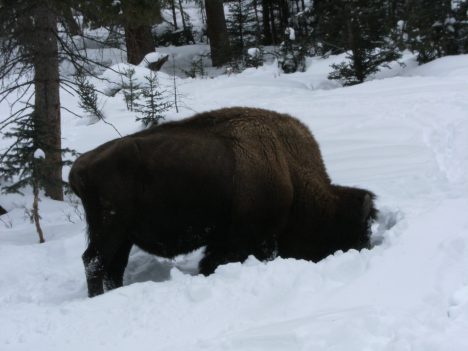
Once someone has visited the Lamar Valley in Yellowstone (or even seen a working ranch of bison) and watched the bison, they can’t tell me that they have the same pleasure sitting and watching cattle graze. There is something so primeval, so basic and ancient, in hearing the mysterious grunts and sounds of the herd, seeing a buffalo paw through snow for food, or a herd lined up following a leader making track through deep snow. This is a pleasure that needs to be reinvigorated, expanded. We can begin to make up for old transgressions and reinvigorate our connection to wild nature at the same time. We can begin a new conversation.