• MY BOOKS ON WILDLIFE, GARDENING AND MORE

  • The Wild Excellence

  • True stories of wildlife encounters around the Greater Yellowstone
  • Award winning eBook on Decomposed Granite, tips, how to's, what to watch for
  • Children's book. True stories of a dog and wolves. In a dog's voice
  • Written for dry Mediterranean climates in California, north and south

The babies and Medicine Lodge Park

Birds several days ago

Here are the baby bluebirds several days ago.  Now here they are today.  Boy do they grow fast.

Bluebirds today

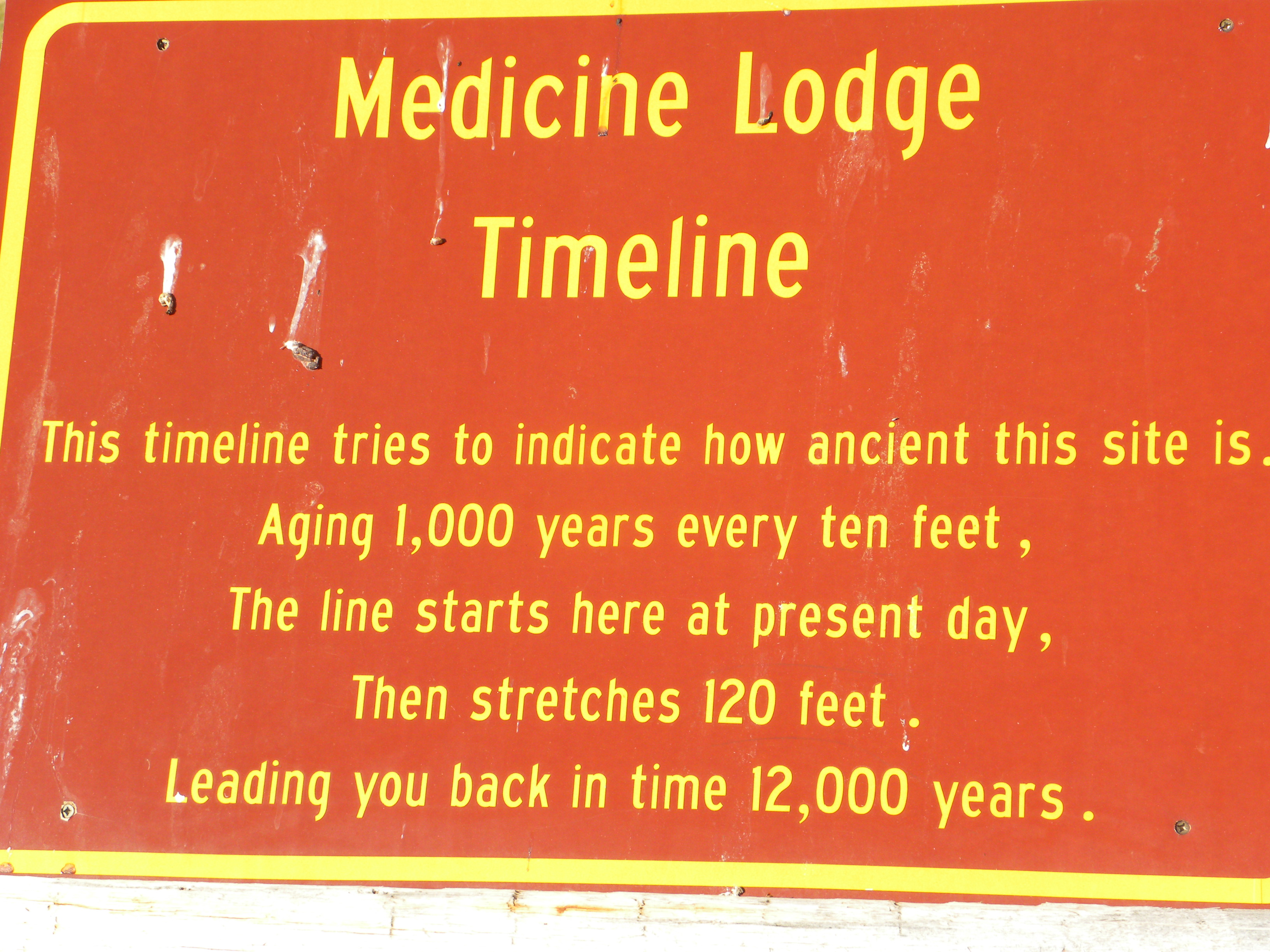
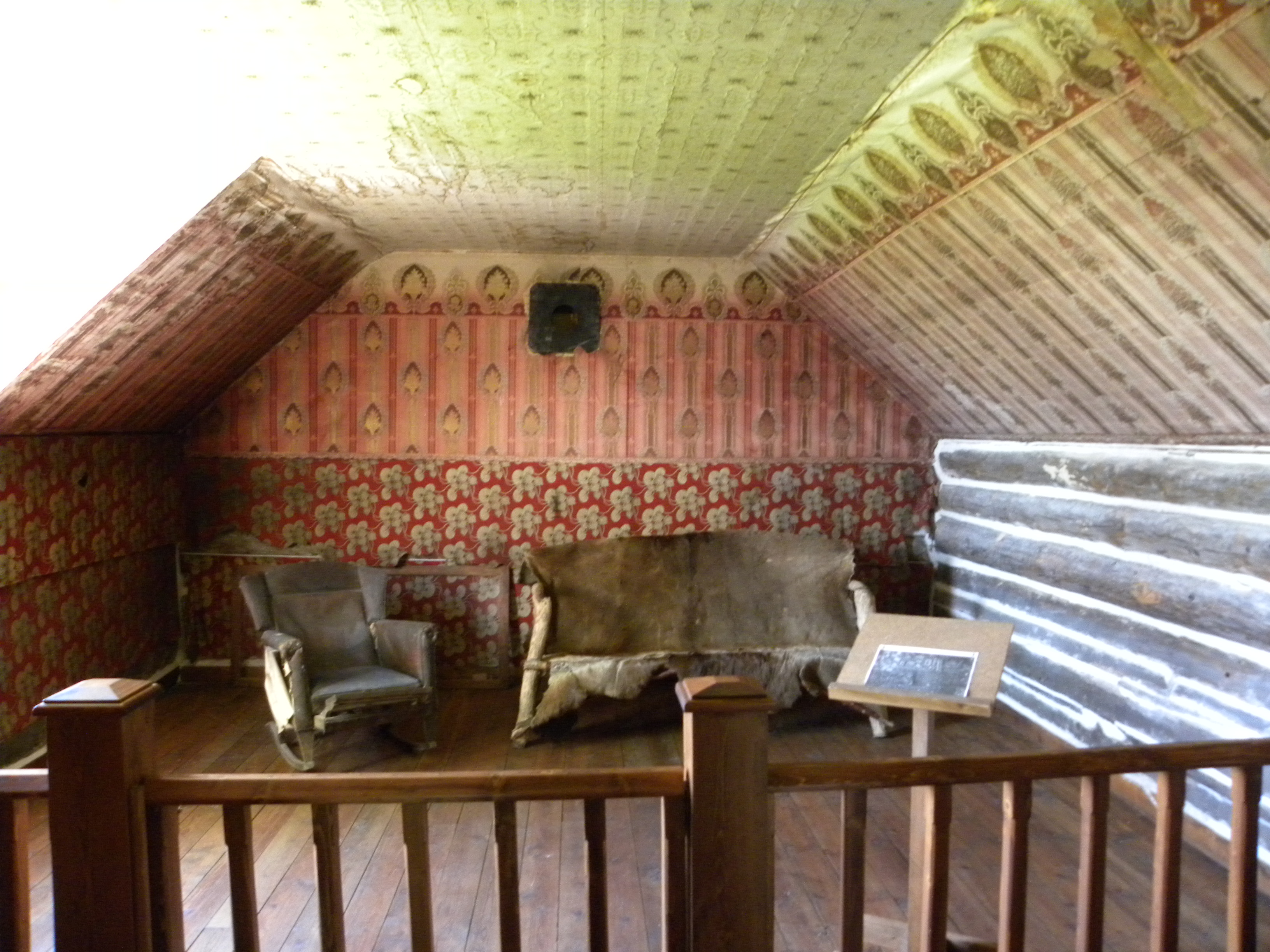
Last week I took a trip to Medicine Lodge State park near Hyattville.  A well-tended State Park, the spot is an oasis in the Big Horn Basin.  This site was excavated in the 70’s by George Frison.  Its a continuous occupation site of over 11,000 years!  Here are a few photos.

The stone wall palette

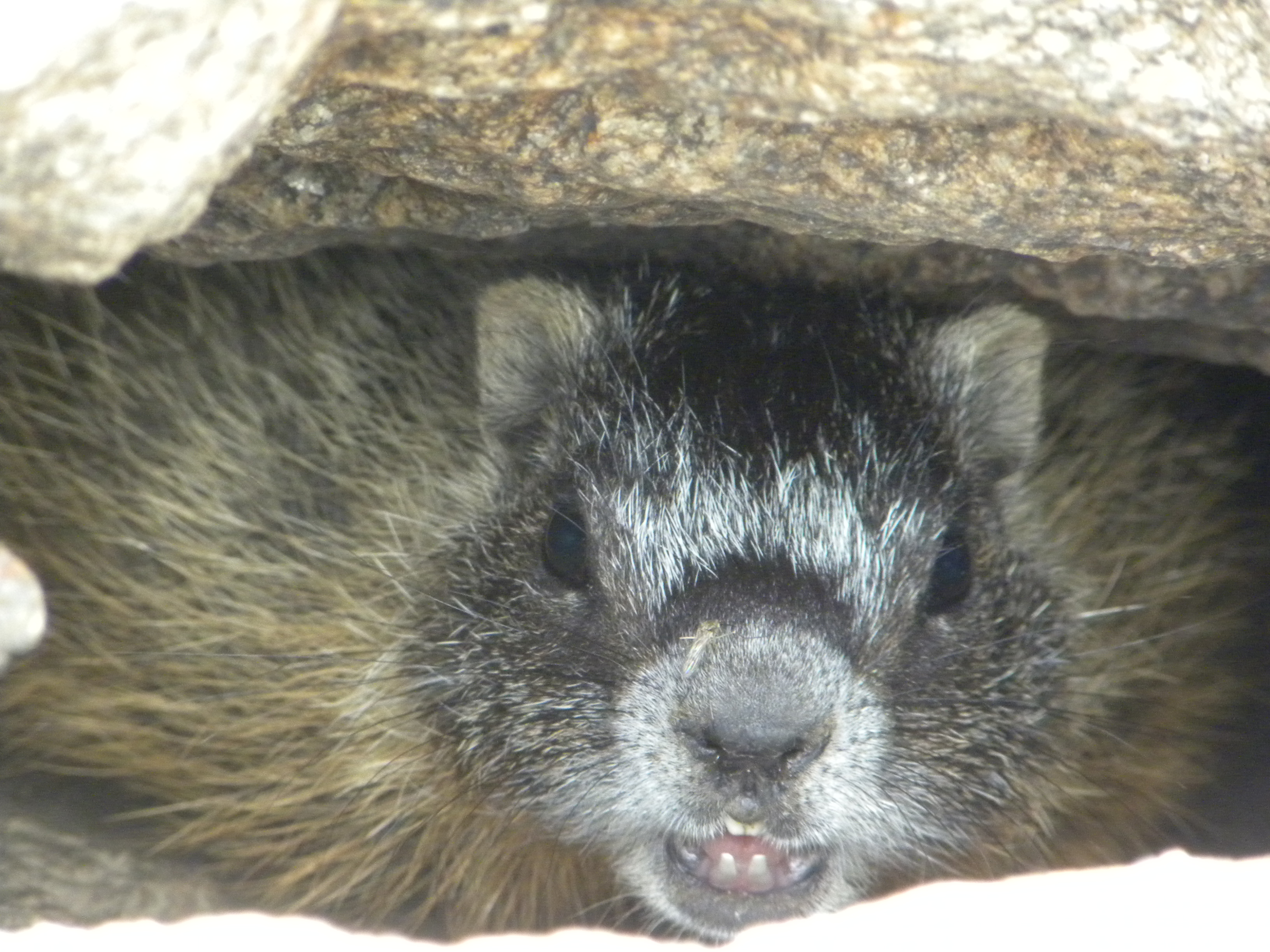
Fat marmot

Chief Plenty Coups and his vision quest

This January I had a mind stopping moment.  I’d picked up a copy of the autobiography of Chief Plenty Coups by Frank Linderman.  The Chief of the Crow Indians was over 80 years old when he relayed, by sign and through an interpreter, the story of his life to Linderman, a white man whom he trusted and was his friend.

Plenty Coups was born in the mid 1800’s, a time when the Crow were still living free, just as they’d done for thousands of years.  Buffalo, their main food source, were plentiful.    Few white men were on the land when the chief was young.  It was Plenty Coups, the last chief of the Crows, who led his people onto the reservation.7791

“After the buffalo were gone, nothing happened.” he said.  From that time on, he lived in a square house on a reservation.

One morning I awoke unable to sleep.  I picked up the book at around page 30, where Plenty Coups begins to describe his second vision quest at nine years of age.  His first one he considered unsuccessful.  Now he was determined more than ever to complete his quest.  After fasting for several days and nights, Plenty Coups cuts off a finger (a tradition among Crow men who were seeking vision), then passed out and had a detailed vision.  He was lead under the earth by a helper, through a tunnel crowded with buffalo.  After a day and a night walking crowded by buffalo under the ground, they (the Man-Person and Plenty Coups) emerged from the tunnel and sat on a knoll.

“Then he (the Man-person) shook his red rattle and sang a queer song four times. ‘Look!’ he pointed.”

Plenty Coups saw buffalo emerge from the hole, out of the ground, in great numbers.  They blackened the plains and spread wide, going in every direction.  “Everywhere I looked great herds of buffalo were…pouring out of the hole in the ground to travel on the wide plains.  When at last they ceased coming out of the hole in the ground, all were gone, all!  There was not one in sight anywhere…”

“I turned to look at the Man-person beside me.  He shook his red rattle again. ‘Look!’ he pointed.”

“Out of the hole in the ground came bulls and cows and calves past counting.  These, like the others, scattered and spread on the plains.  But they stopped in small bands and began to eat the grass.  Many lay down, not as a buffalo does but differently, and many were spotted.  Hardly any two were alike in color or size.  And the bulls bellowed differently too, not deep and far-sounding like bulls of the buffalo but sharper and yet weaker in my ears.  Their tails were different, longer, and nearly brushed the ground. They were not buffalo.  These were strange animals from another world.

“I was frightened and turned to the Man-person, who only shook his red rattle but did not sing.  He did not even tell me to look, but I did look and saw all the Spotted-buffalo go back into the hole in the ground, until there was nothing except a few antelope anywhere in sight.”

“Do you understand this which I have shown you, Plenty-coups? he asked me.”

“No! I answered.  How could he expect me to understand such a thing when I was not yet ten years old.”

Now Plenty Coups and the vision-person went back into the hole and came out again.  Now the Man-Person pointed to an old man sitting in the shade, alone, by some trees and square house.
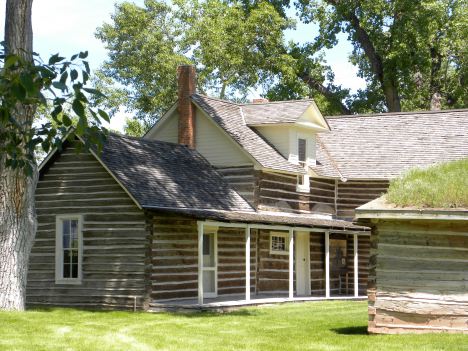
The house

“Look well upon this old man,’ said the Man person.  ‘Do you know him, Plenty-Coups?’ he asked me”

” ‘No,’

“This old man is yourself, Plenty-Coups,’ he told me.

Plenty Coups had seen, in his vision at nine years of age, himself sitting by the exact the same house (of course, he lived in a tipi at 9 years old, not a square house), the same stream, the exact same spot where he lived on the reservation as an old man.

Plenty Coups home, although most of the time he slept in a tipi outside

I read this line with goose bumps.

When Plenty Coups finished his vision quest in the Crazy Mountains, he went back to his tribe and related all of it to the elders.  Plenty Coups had never heard of nor seen cattle.  Neither had most of the Crow at that time.  But the medicine man had seen some to the east on the plains and understand Plenty Coups vision to mean that the buffalo would disappear and cattle would take their place.  Along with other elements I didn’t mention in the vision, the Medicine Man interpreted the Chief’s vision to mean he would not have children of his own and that he would be a great leader and lead his people to safety in the midst of great change.  All would come true.

The wall decorations are reminiscent of the insides of tipis

Think about it:  if Plenty Coups could see all this at age nine, in some way his life and destiny were laid out before him at birth; maybe not the details, but the broad brush strokes.  Never would a nine-year old Indian living freely in 1850, think for a moment that he would be living in a square house as white men do, with all the buffalo gone.

Sometime in the early 1900’s, Plenty Coups, now living on the reservation, visited Mt. Vernon.  He saw that Washington’s home was preserved as a park for the public.  He asked that his home be preserved after his death as a Park for all peoples.  Last month I finally visited Plenty Coups State Park.  These photos are from that visit.
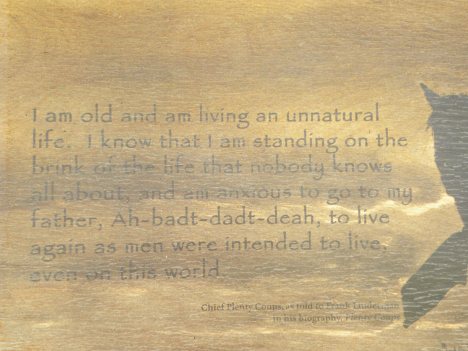
I love this quote. So true

Mystery of the Sacred

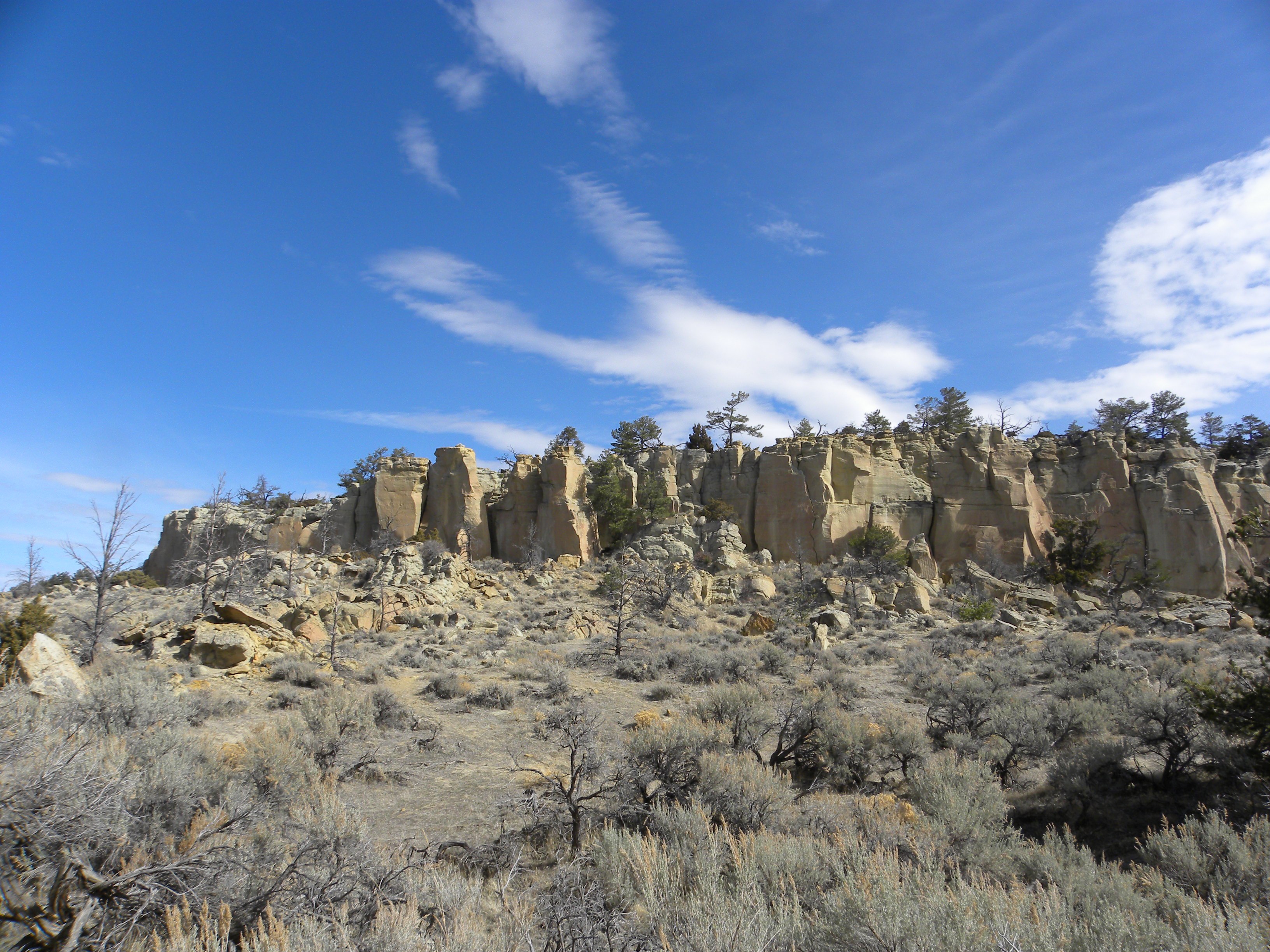
I’d been wanting to see a series of pictographs in the desert nearby.  So the other day my friend took me out to see them.  The hike is about 6 miles round trip.  The trip out there is through flat sagebrush country.  For a long ways it doesn’t seem like there’s anything of interest.  Then suddenly the landscape shifts into deep ravines and rocky cliffs.  Near the top of a series of cliffs, a narrow valley appears.  Walking through this rift in the rocky scape, there is a palpable sense of the Sacred.  The cliffs loom high and they all have excellent writing surfaces on them.  But most are empty.  Curiously, there are natural perfect circles of a different kind of rock decorating the sandstone faces.  These natural shield shapes fool you into thinking they’re manmade.

A few official signs along the way tell you these pictographs you’re approaching are special and not to be touched or defaced.  My friend says 7 years ago there was no trail nor signs.  Since then people seemed to have discovered this place because the trail is worn and shows fresh signs of footprints and horseprints.

View from the valley

The sandstone cliffs

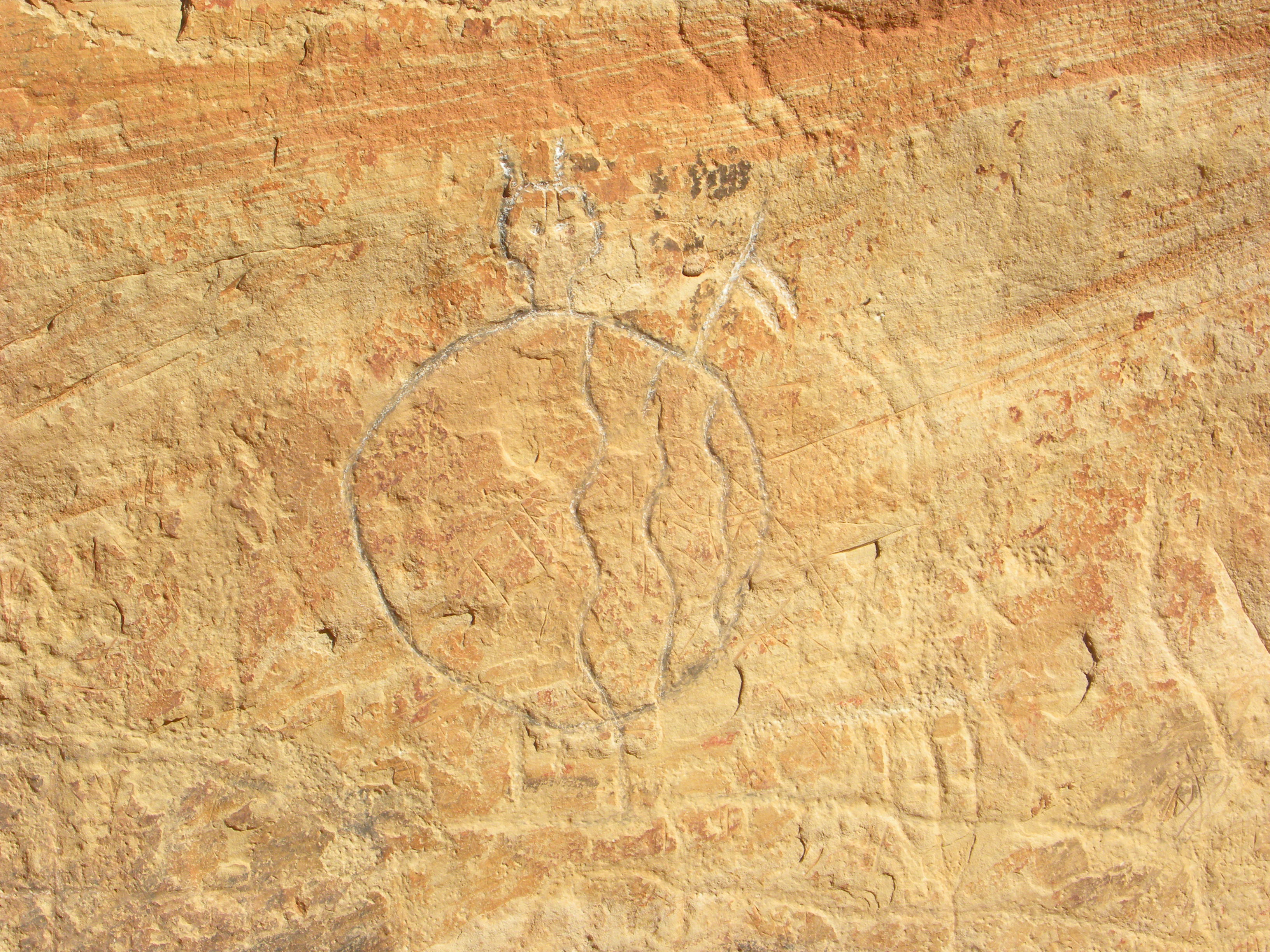
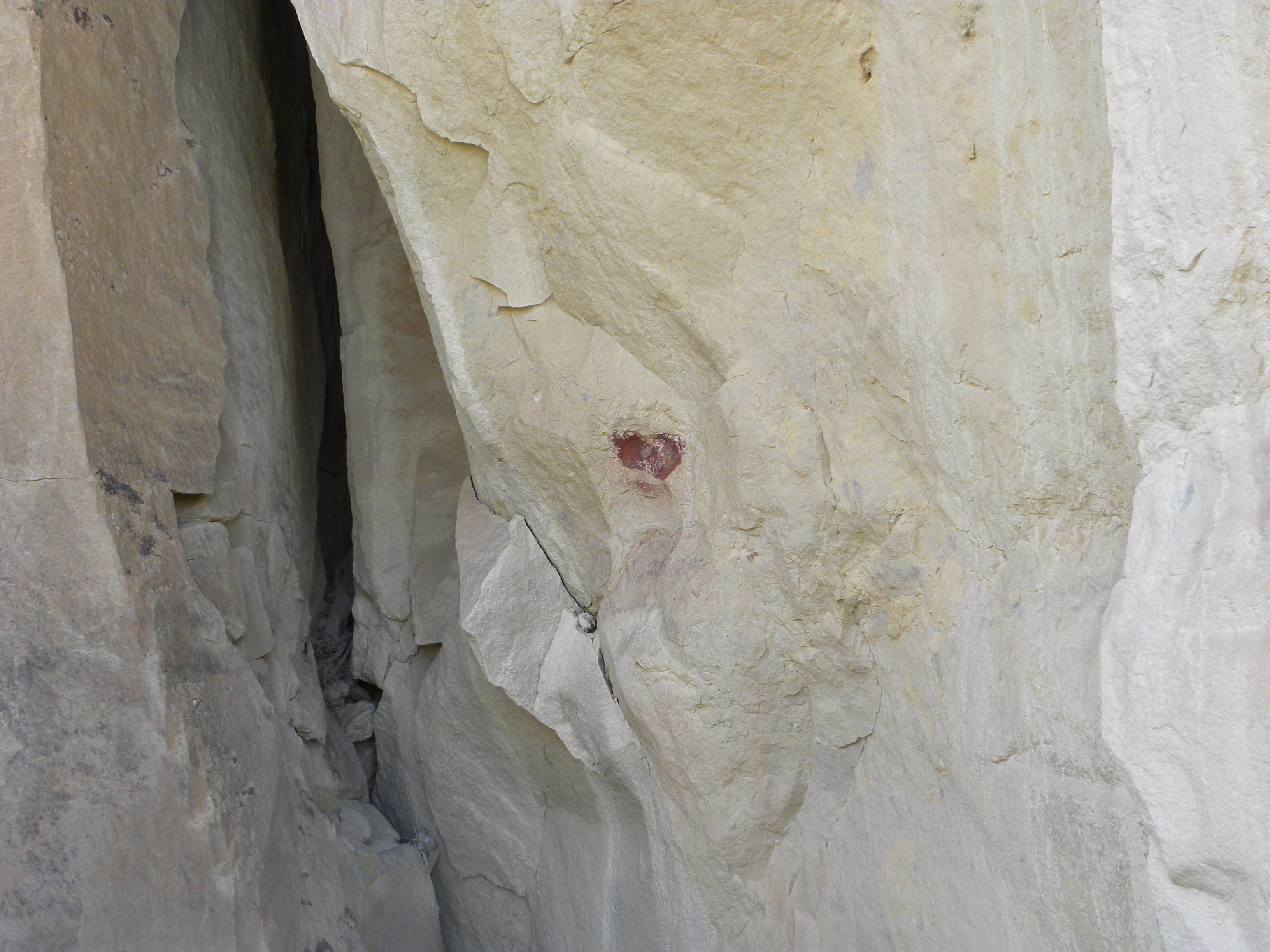
The valley is so quiet.  There is a somber aura here that evokes the sacred.  The high cliffs have a cathedral-like feel.  Finally we arrive at the rock with the pictographs.  My friend tells me they are fairly recent, within the last 500 years.  The rock faces east and is in the shade, which is a relief on this unusual 70 degree March day.  The paintings are very faint but you can make them out.

Look closely to see the figures

An area in the rock is chipped where the people who made these got the red coloring.

Where the red color comes from. Maybe why they chose this rock to paint

Down below, in another rocky outcropping, are a few more well preserved shields that lack the figures associated with the ones higher up.

Another painted rock much less eroded

These pictographs are sacred to the Crows.

Why are they here?  Curiously, there is no water nearby and the paintings are in a place that is isolated and hard to get to.  Although we can never get into the minds of the tribesmen who painted these, its fun to imagine what might have been going on there.  Were there several artists or just one?  Was this part of a vision quest or someone passing time in the shaded side of the valley waiting for game, or fellow travelers?  Was this a signpost or message on a well traveled trail?  I suppose it will forever remain a mystery.

Tipi Rings

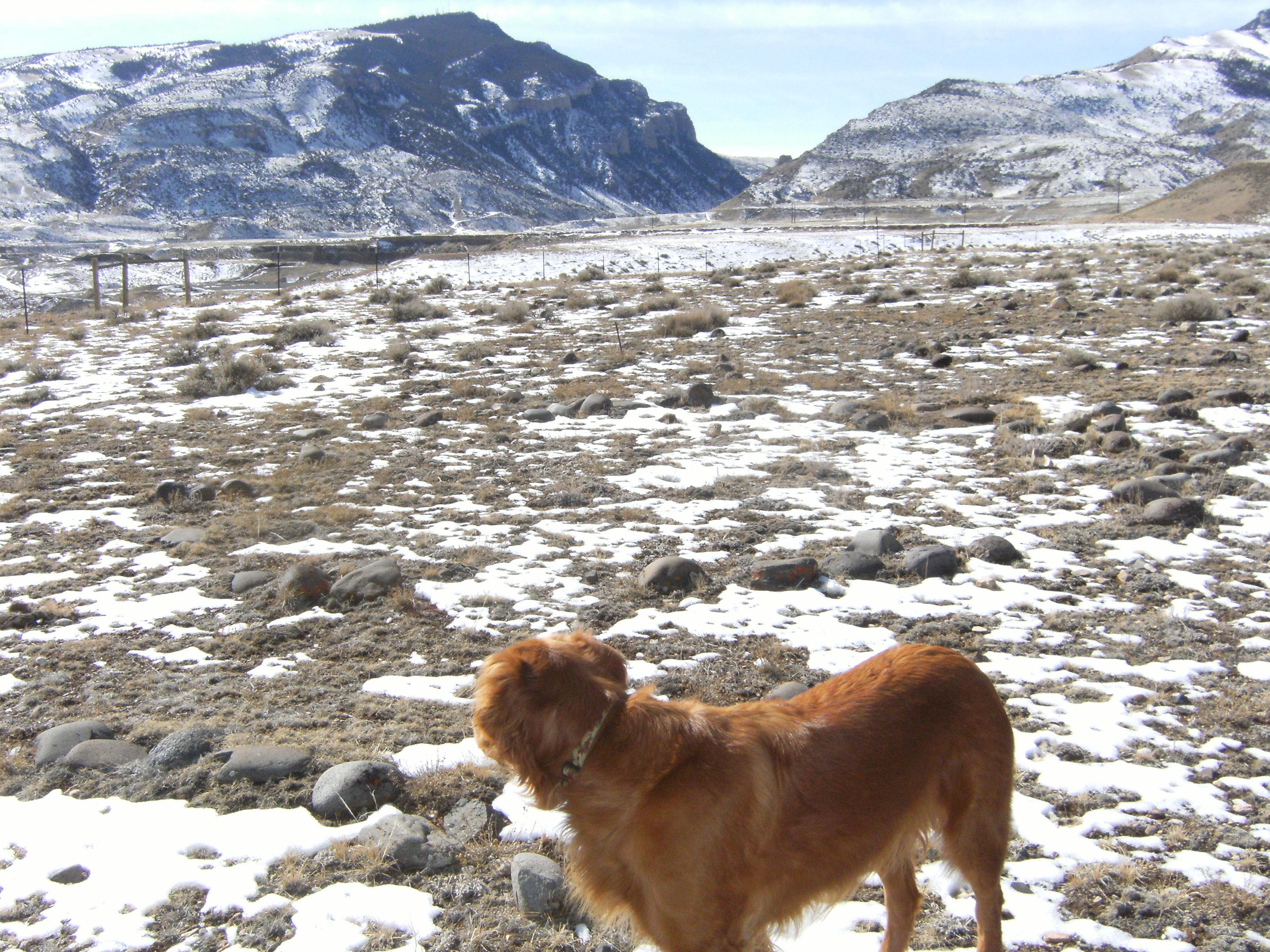
I thought I’d do a short post on a few teepee rings I’ve seen.  The other day I was in Cody with some time to kill.  I’d heard there were tipi rings on the north side of the Shoshone river by Trail Creek.  A friend told me the historical wisdom-lore was that many tribes gathered there during the winter months to camp by the hot springs.  Most of those springs are now either extinct, buried under the damn, or on private lands.  In fact, the bulk of the rings, apparently 100’s of them, are on private lands going up the traditional passage of Trail Creek.

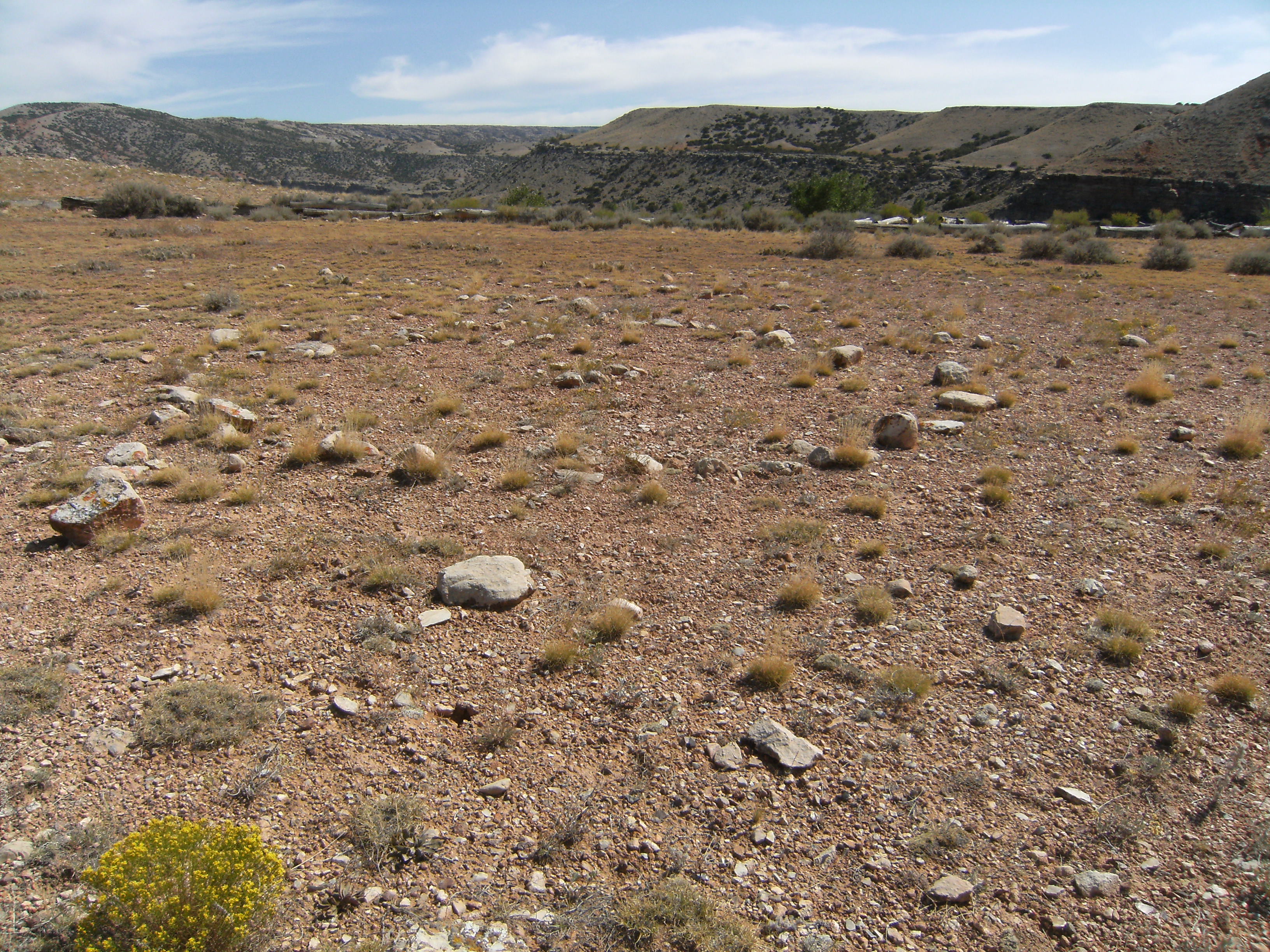
Walking along the shores of the Shoshone River (called the Stinking Water River before it was changed due to popular [and probably economic] demand)  you can still occasionally smell sulfur .  The rings are obvious, easy to pick out.  They’re incredibly close together; some even still have fire rings in the center.  Compared to the rings in other places, these looked fairly recent, maybe 150 years old.  Why?  Because the rocks are not very buried.

Cody tipi ring with fire ring in middle

Another view of several rings outside Cody

This is an excerpt from Plain Feather about the death of Crow Chief Sits in the Middle of the Land while Plain Feather was camped outside of Cody:

“About a year after the big battle on the Little Bighorn (1876), a small band of Crows went hunting from the Yellowstone to the Stinking River…The band reached the Stinking River a short distance below where the city of Cody now is located.  Here Chief Sits in the Middle announced that he was going south to a valley where there were still some buffalo left.  The other group decided to follow up the Stinking River to the big mountains where there were plenty of deer and bighorn sheep.

My family was with this latter group.  That evening we made camp at the forks of the river just above the narrow canyon where a dam is now located.  Towards evening we sighted two horseback riders galloping in our direction.  They were messengers from the other group.  They announced that the great chief and his wife suddenly became ill and soon died. They said we were to hasten over there.  It is believed that they died of pneumonia.

Immediately teepees came down and we were soon on our way.  We arrived early the next morning, just in time for the burial.  The bodies, strapped in robes, were taken to the rimrocks of the valley and put into a ledge and then covered up with slabs of rocks.  The burial mourning followed, with men and women wailing.  They recounted the many great things that the chief did for his people for many years.  At that time he was the Chief of All Chiefs, reigning over the two main bands of the Crow Nation.”**

(**Note:  In the late 1960’s, the Chiefs’ remains were relocated from nearby Meeteetsie to the Crow Agency in Montana.)

Now compare those rocks with the rocks in the rings below.  These rings were along the Bighorn River in Bighorn Canyon.  The rings are right beside the main road, which follows the ancient travel route of the Crows.

Another view along Bighorn canyon

Big Horn Canyon rings

Here are some much older rings near the town of Clark.

Clarks fork tipi rings, much older

I spent a few hours walking along the plateau near the mouth of the Clark’s Fork Canyon, an area where tribes traveled for the fall Buffalo hunt.  There are rocks galore there, and although I could pick out some rings, they couldn’t be photographed as they were very obscure and some of it might have even been my vivid imagination.  Most of the rings seemed much smaller, probably no more than 6′ in diameter compared to these larger rings.  But the setting was right–on the table above the river with a wide view of the surroundings.

I love finding these rings.  They spur my imagination and kindle a sleeping spirit.  The very soil emits stories I’m awaiting to hear.

Navajo Reservation

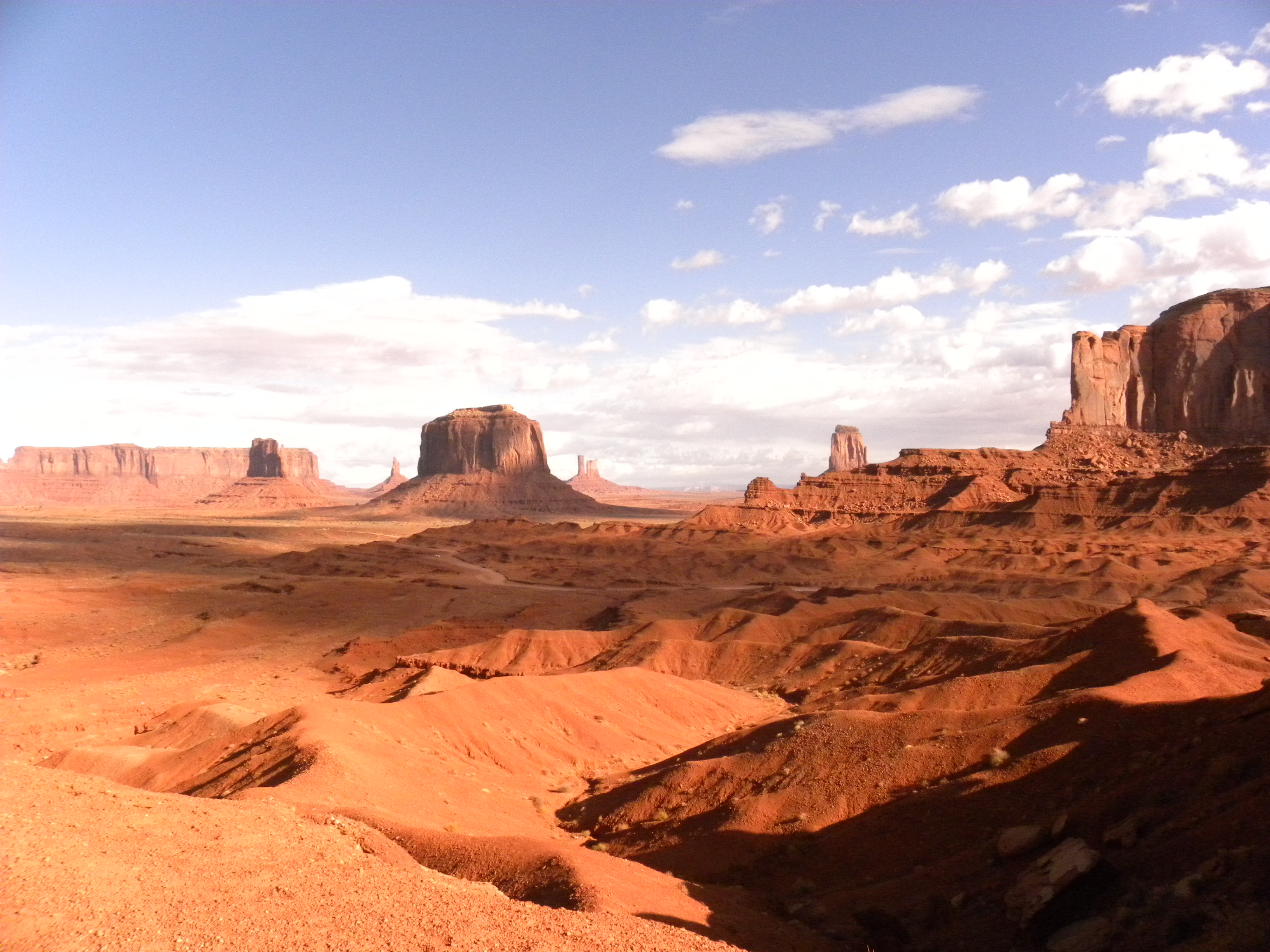
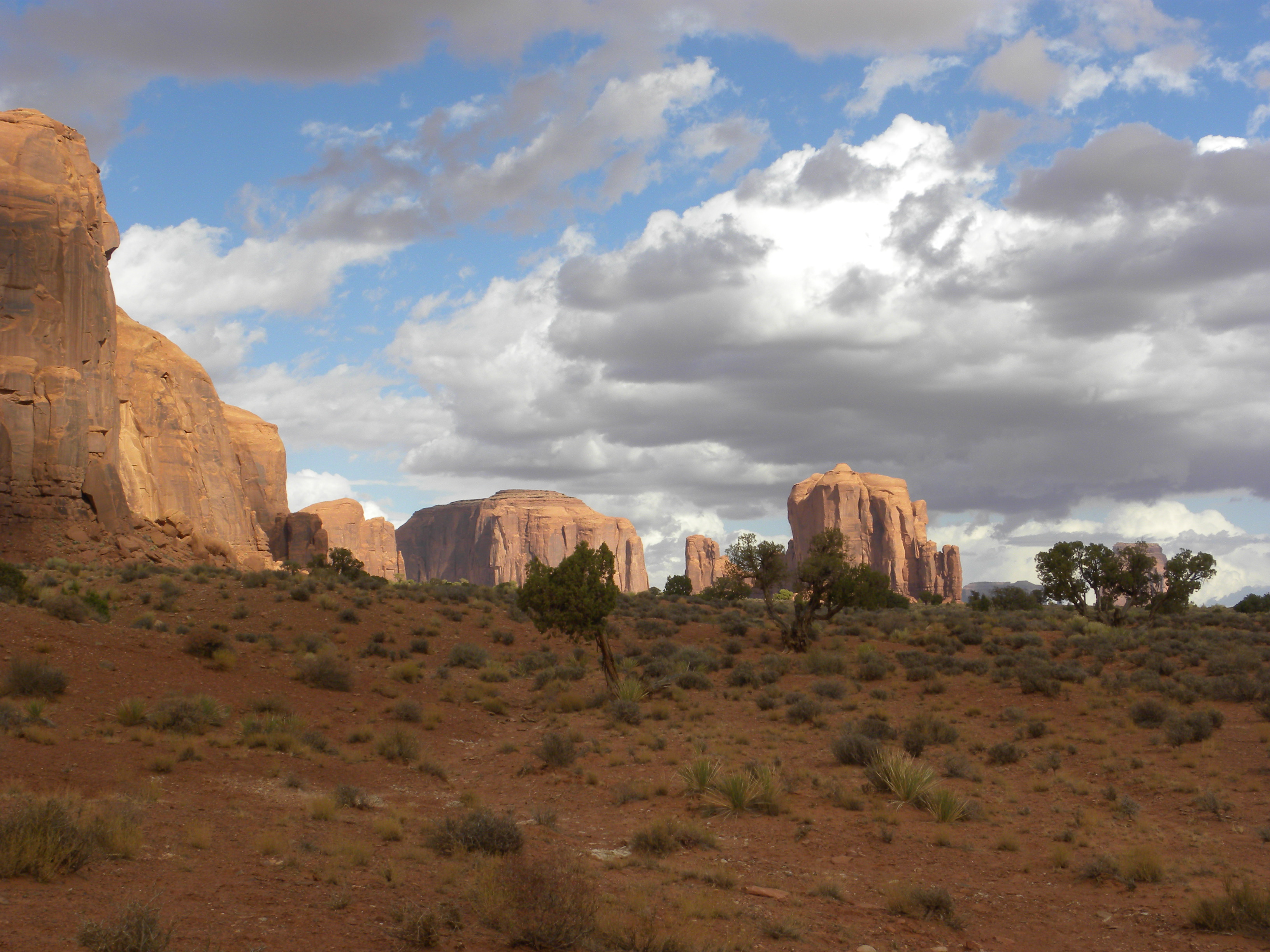
I slept in a campground at Monument Valley, got up early and made my way to the Monument for the 17 mile dirt road loop drive.  An incredibly magnificent, overwhelmingly beautiful and powerful place, Monument Valley is Tribal managed.  Since most tourists travel by large trailers and the dirt road is not recommended for RV’s, there are few cars on the road.  RV tourists take the tour ‘buses’.  Along the way at various locations are stalls with locals selling jewelry at ridiculously low prices. Monument Valley

Monument Valley2

Monument Valley3

Monument Valley4

I’d strung a necklace before I left of beads and 3 elk ivories I found on last winter elk kills, but it broke in Thermopolis and I lost most of the beads.  I had the ivories in my purse and asked a woman selling jewelry if she’d restring it for me.  I picked out a necklace of turquoise and beads and she restrung it right then and there with my ivories.

I picked out a necklace for $5 and she restrung it with my elk ivories

I picked out a necklace and she restrung it with my elk ivories

A new Navajo market trading post with indoor heated small stalls for artists that used to work alongside the main highway was a fine place to stroll for an hour.  I struck up a lengthy conversation with an older woman tending one shop.  She told me she did the original necklace design, while her daughter did the bead work.  As we talked her daughter, a very over weight young woman, came in briefly.  They exchanged a few words in Navajo, I said hello, complimented her beadwork as she left.

“She does excellent beadwork, and sitting all day, that’s why she’s so overweight”, my new friend said.  “She was even heavier”, she offered, “but I got her to use those patches to suppress her appetite and she lost 20 pounds.”

We talked about the weather and the wind outside.  I told her that we missed our fall and Indian summer in Wyoming, that I thought we were going to have a long, strong, winter.

“I think so too.  The Junipers are bearing heavy this year.  If you watch the plants, they’ll tell you about the coming winter.”

I told her about the past droughts in Wyoming, how water had become more scarce and only these past two years have been fairly normal.

“You too?  We are having so many problems here with water.  We’re having to start trucking it in.  No one has running water.  And our wells are full of uranium.  All our elders are dying–at 60 or 65 years old–all over the reservation, our elders are dying of cancers.  Our young people have bone problems, eyesight problems, cancers.  All from this uranium in our water from the mining that the government allowed.  They’ve closed the mines now and they want to compensate us.”

I said I thought there was no compensation for those horrors.  That clean-up, medical care–that was the ‘compensation’ they needed.

“That’s what I say.  We need medical care and they need to get rid of the uranium, somehow, in the water.  We don’t have good water, plus our water sources are drying up.”

The phone rang, she answered and I looked around the shop.

“That was my son.  My sister is in the hospital in a coma.  She was in a head-on collision last week.”  She told me the details.

We said our goodbyes.  She was such a warm, friendly person.  I left sad.  Here was a woman dealing with life’s difficulties not just on the personal level, but at a tribal level as well.  A hundred years later, the story hadn’t changed much, just the characters.  Land continues to be abused in the name of progress at the expense of these native peoples.

Indigenous peoples, old and new

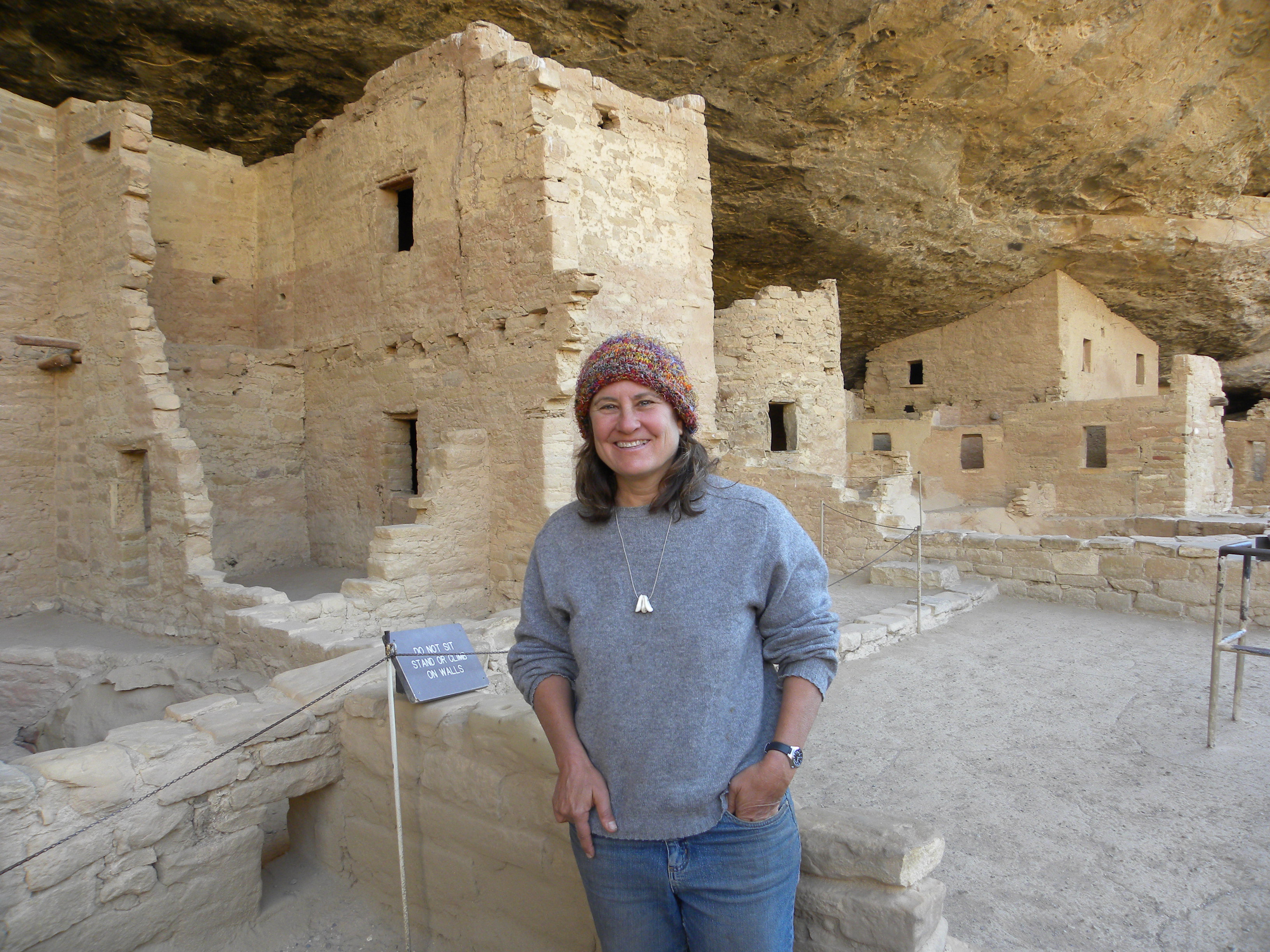
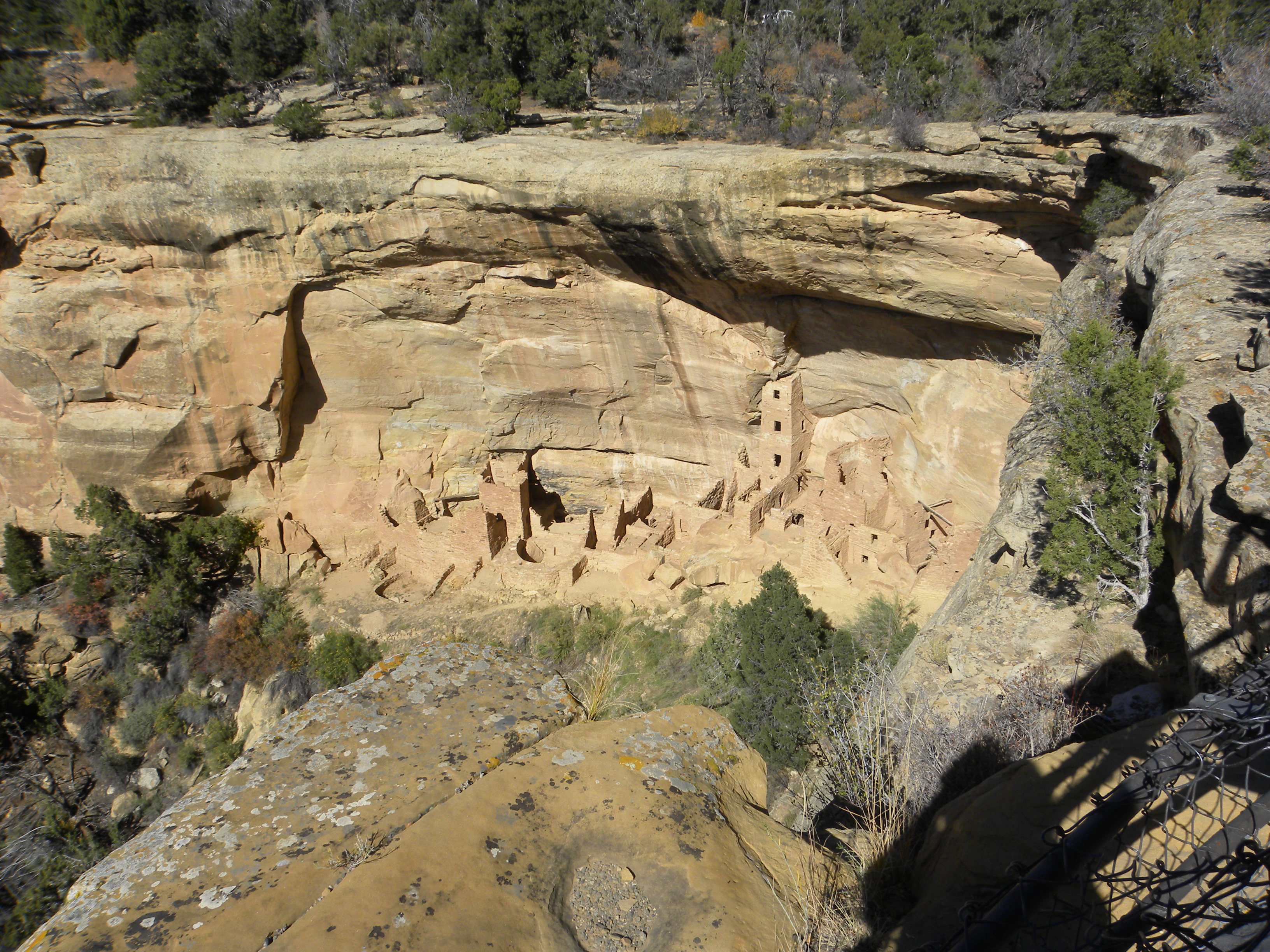
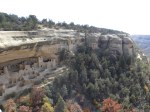
Mesa Verde, Hovenweep and Canyons of the Ancients, together, all tell a story of what the Land and the Life around the Four Corners was 1200 or more years ago.  Over 30,000 people lived in the surrounding valleys and mesas, much more than today.  Their culture and architecture slowly evolving and developing, its thought they depleted their resources, leaving it devoid of trees, soil fertility, and game.  With a severe drought of over 20 years setting in, they all had to move on to greener pastures.  Sound familiar?

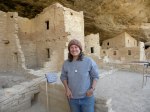
I really was at Mesa Verde.  Proof.

I really was at Mesa Verde. Proof.

Wow

Wow

Another dwelling site

Another dwelling site

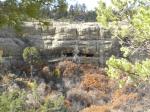
Photo taken across the canyon.  How did they get they there, let alone build it?

Photo taken across the canyon. How did they get they there, let alone build it?

Traveling to Hovenweep, the road was incredibly beautiful.  I slept under the stars at the Monument, dreaming powerful dreams of eagles and hawks.  The Monument is primitively developed.  A walking path takes you around to each ruin.  If desired, you can drive further east to several out building ruins off dirt roads and trails.  These buildings, although constructed around the same late period as Mesa Verde (and not occupied for more than a generation or two), are architecturally very different.  Their purpose was unknown, but to me they appeared as fortresses, possibly lookout towers to alert the villages of approaching marauders as food and resources became scarcer.

All buildings were built on rock ledges overlooking canyons

All buildings were built on rock ledges overlooking canyons

My very favorite.  The boulder is gigantic its built upon

My very favorite. The boulder is gigantic its built upon

Nearby, the fairly new National Monument, Canyons of the Ancients, doesn’t even yet have literature, nor thankfully, roads.  There are over 4000 archaeological sites scattered throughout BLM managed land.  I drove up to Lowry to view one of the premier ruins, which was fully excavated in the 30’s.  These ruins are from an earlier time than Mesa Verde and Hovenweep and were clearly living quarters, with one of the three underground kivas surviving intact.

Description of ruins at Canyons of the Ancients

Description of ruins at Canyons of the Ancients

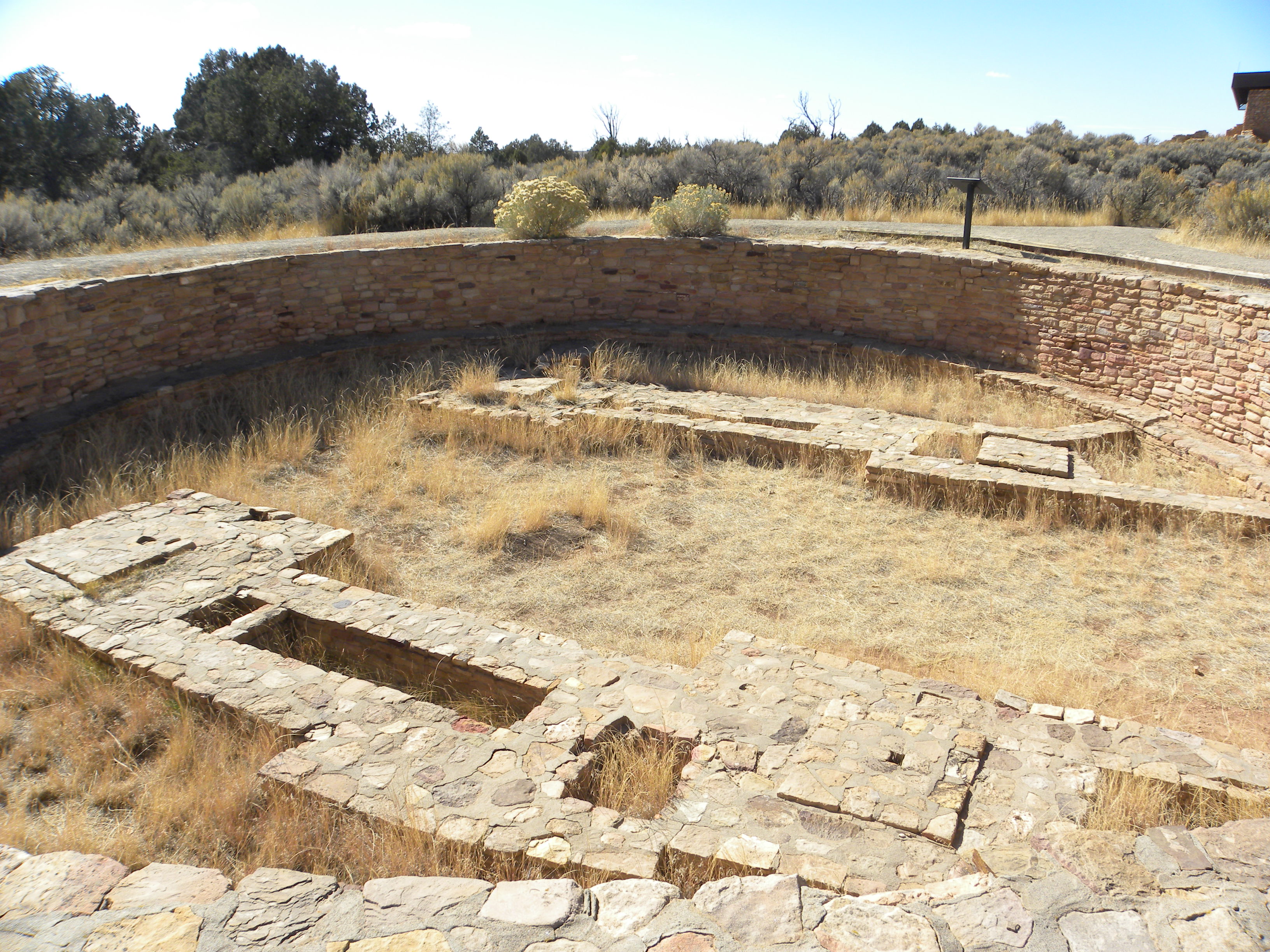
My favorite was a nearby extremely large kiva.  Clearly this kiva was used ceremonially as a gathering spot for clans and families from all around the area.  To get to these ruins, you drive a lonely dirt road through pastures and farmlands.  Nobody was there, as opposed to Mesa Verde where the walks were led by rangers with many visitors participating.

Central gathering Kiva

Central gathering Kiva

I had the wonderful opportunity to sit quietly, alone, and feel the powerful energy of that large kiva, letting my imagination fill in the gaps of wonderous gatherings of song, dance and ceremony.  That is my favorite site.

After I left Hovenweep, I headed for the Navajo reservation where I spent the night (which I’ll describe in a separate post).  I told a Navajo woman that I’d come from Mesa Verde.  We talked of these magnificent buildings and experienced builder.  I told her I wondered about how theses ancient people were able to climb down from the mesas to the buildings below (rangers say it was by handholds they made in the rock).

“Some people say they could fly.”

“That’s probably the best explanation I’ve heard”, I replied.

Blackfeet, Wolves and emblems of the Spirit

I just finished reading a wonderful little book by James Schultz.  Schultz lived with the Blackfeet Indians starting around 1880 and took an Indian wife.  He learned their language and soon, as a very young man who came out from the east coast, became accepted into the tribe as one of their own.  He, along with his friend George Grinnell, helped advocate for Glacier to become a National Park, and wrote many books about his life among the Indians and the wilds of Northern Montana. He’s providing me with a vivid sketch of life in Montana at the close of the 19th century, the final days of the free lives of the Blackfeet , as well as the last days of the Buffalo. With the recent delisting of the wolves of Montana and Idaho, and the hunts that are now taking place there, here’s a little gem of a quote from Blackfeet and Buffalo: Memories of Life among the Indians: “The big, bad wolf?  No indeed!  I once had a pet wolf, as good a friend of mine as any dog I ever owned.  But before I tell of him, I must say that, so far as I can learn, the wolves of North America never attacked human beings.  There was good reason for it:  game animals and birds, were everywhere so plentiful that they had no need to attack their great enemy, man.  The Indians have no tales about big, bad wolves.  They frighten their children into good behavior by threatening them with the bear.  Until the late 1870’s wolves fairly swarmed upon the Montana plains; their long-drawn, melancholy howls were ever  in our ears.  But lone hunters, both Indian and white, when caught out at night and far from home, lay down to sleep without the slightest fear of them.” On of the most intriguing observations about the Blackfeet is contained in the following quote: “The Blackfeet  Indians, and perhaps many others, have a peculiar habit of going up on high hills and bluffs conveniently close to camp and sitting there motionless and rigid as statues for hours.  Near the close of the day seems to be the particular time for indulging in this practice.  Why they do so is a mystery.  I have often asked them the reason, and have invariably received the reply, Kis-tohts, meaning “for nothing.”  Sometimes I have hidden myself in the coarse rye grass which grows so tall and luxuriantly in the river bottoms, and with the aid of a powerful field glass have closely scrutinized their countenances, but  to no purpose.  The expression of their faces never changed.  Their eyes had a far-off dreamy look which could not be interpreted.” Schultz speculated that maybe they were thinking about the passing away of the life they once knew.  But I have a different notion.Weather Living so close to the earth, these people keenly observed not only the animals and their movements, but the whole non-human processes–the weather, the sky, the stars. All was observed in a contemplative disposition of openness.  In their deep observations of animals, they not only learned about them for their hunt, but noticed their simplicity and ease of contemplation.   Animals were direct representations of spiritual communications and powers and so they were highly venerated and used ritually and contemplatively for various purposes.  They were emblems, doorways to Spirit.  In fact, they were a unique display of what was beyond the human, rather than lesser than human as we rate the animal world today.Deer in velvet Going and sitting on a hilltop, motionless at dusk, was a form of communion, as natural as the elk lying in the grass still and silent, or the spider who patiently sits in its web.  It was setting aside time, after the safety and the needs of the body were taken care of, to drop into contemplation.  Living with the Land as they did, there is a natural rhythm and pulse that overwhelms the body and mind when it’s still.   I believe they were just responding to that natural pulsation of contemplation that was everywhere around them, including in the animals. This is the kind of sensitivity we need today in our conversations about our ecosystems, the wolves and bears, the elk and deer and the whole animal world, including ourselves.  We are upside down.  We are not the ‘managers’.  Animals and plants are not just ‘resources’ to be exploited and managed. At one time, 100 years ago, the idea of game management was a necessity when we almost slaughtered much of our animals to extinction.  We saved our game by setting land aside, establishing hunting regulations, careful management, and educating generations of biologists. But it is a new day and a new paradigm is needed.  I don’t know the answers, but I do know where we need to begin from.   Our conversation needs to start from the assumption that all life is conscious.  That’s not an airy fairy granola eating notion.  That’s the logical application of Einsteinian physics.  And looking at animals as emblems of the sacred is a good place to start.Bison

Big Horns, Medicine Wheel, and the Pryors

Last week I took off for a few days and went to the Big Horns.  I intended to go for 3 days, but got rained out on the second evening.  I had been to the Pryors a few days before, and was quite taken with the area so I wanted to explore it more.  The Pryors are sacred to the Crow Indians.  Part of the land is on Crow Reservation and not accessible to the public.  Some of the mountains are in Montana, and some in Wyoming, with a section of it reserved for Wild Horses.  The entire area is considered a Wilderness Study Area, which means that it’s pending designated Wilderness.  Rarely visited, its a special place.  There are some old uranium mines there and mining claims.

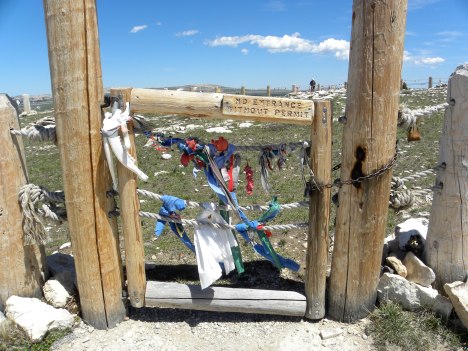
Since Day 1 was really hot, I decided to backtrack to the Pryors and head first for the Big Horns.  My main intention was to go to The Medicine Wheel.   This is a holy site for many Plains Indians tribes.  Its a place of pilgrimage.

Entrance to Medicine Wheel

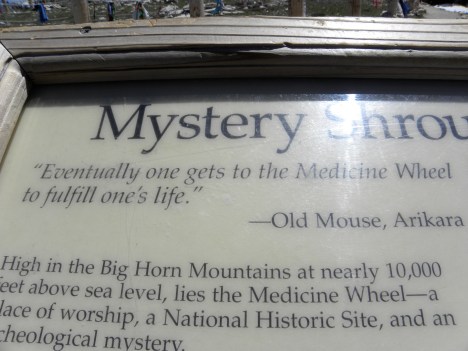
Signage at the site notes that some people can prepare for a year before making the trip.  A young Forest Ranger was stationed at the Wheel to make sure there was no vandalism, and if Native Americans wanted to go inside, he had a key.  When ceremonies are conducted, the site is closed to tourists.

He told me that years ago, before there was such tight control, tourists (not Native Americans) would take home rocks from the structure as souvenirs. In fact, he said, the height of the circle of rocks was 2′ or 3′ taller than it is today.

I was reminded that in Uluru, tourists sometimes take home pieces from the sacred site.  There is a large collection of rocks that were mailed back to Uluru because tourists went home and felt they were brought bad luck, bad karma, or whatever, from taking souvenirs from the site.Medicine Wheel signageI circumambulated the Wheel three times and left a small gift at the East facing entrance.  Its a wonderful and mysterious place.  Some say it was constructed by Sheepeaters.
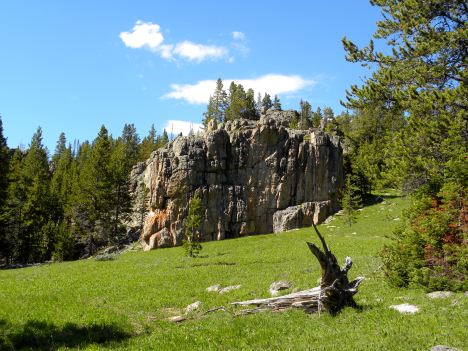
From there I took the Jaws hike down a beautiful canyon opposite the Wheel.  I saw several moose and deer with their antlers in velvet.

The jaws hike

The jaws hike

Along the canyon hike

Along the canyon hike

The next day I went to the Pryors.  It was overcast and drizzling, perfect weather for hiking in this exposed country.  The Pryors were an ancient Indian route through the Big Horn Canyon.  There are many spots right along the main road of the Recreation Area with teepee rings.  Instead of going along the main road, I took a 4×4 track.

Pryor Mountain Wild Horse RangeThe Pryors

Koda matches

Koda matches

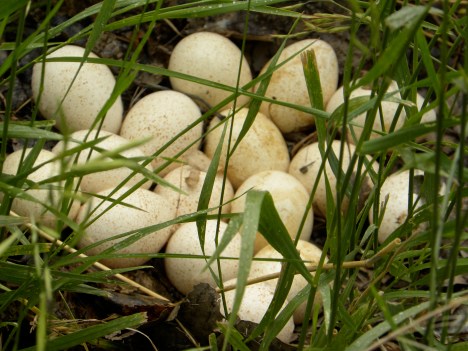
On the way out I encountered a mama wild turkey on her clutch of eggs.Wild Turkey on eggs

Wild turkey eggs

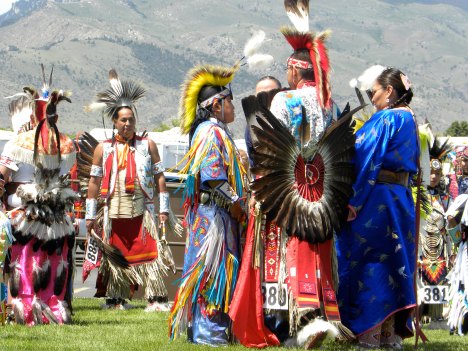
PowWow in Cody

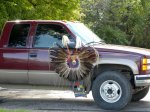
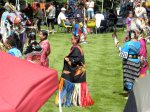
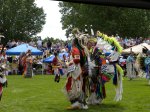
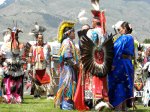
This weekend is the Powwow at the Buffalo Bill Historical Center in Cody.  It was my first powwow, if you don’t count the one I stumbled upon when I was 17 in Montana, and it was great fun.  All the colorful costumes, dancers from old to young in all different categories of dance, from fancy to traditional, competing.  I had no idea what a powwow was.  It is like a gathering of family, friends, and different tribes, dancing and having fun.  We should all dance more.

Here are a few highlight photos.

Dancer in preparation

Costumed dancers

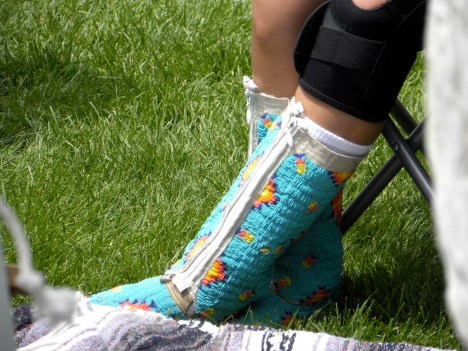
Moccasins

Only the wind sang

Yesterday I met Larry Todd over at the Dead Indian Campground site.  Larry is an archaeologist working mostly in the Greybull area.  I contacted him several months ago because he was in charge of the dig in the ’80’s at the Bugas-Holding site, a Shoshone winter campground 400 years old.  I had many questions, and Larry graciously invited me to walk around the Dead Indian site with him after he finished an outing there with Cody Middle School.

Next to a creek and protected by mountains, Dead Indian is a 5000 year old winter campground site that had continuous use.  It is one of three archaeological sites in the Cody area on the National Historic Landmarks, the other two being the Horner site and Mummy Cave.  Larry explained that some areas were early Archaic, some middle, and some late, depending upon the topography.  The lower levels around the creek were the latest periods.  He said that when they began work, the entire area had so many artifacts they had to choose specific areas to concentrate on.  The work was done in the 70’s, before he was around to participate.

Topography of the mountains around Dead Indian Historic Landmark

Topography of the mountains around Dead Indian Historic Landmark

We walked over to a large plateau, an early Archaic period.  Larry painted a picture of a campsite with upwards of several hundred people, living in family groups–a small Wyoming town so to speak.  People living in pit houses that came here winter after winter to hunt the game that was plentiful.  Mostly deer and sheep were killed at this site.  Their tools were made from local materials, sharp and new in the fall, but dulled by spring through continuous retooling.  By spring it was time to gather and trade for new raw materials for arrowheads and other necessities.

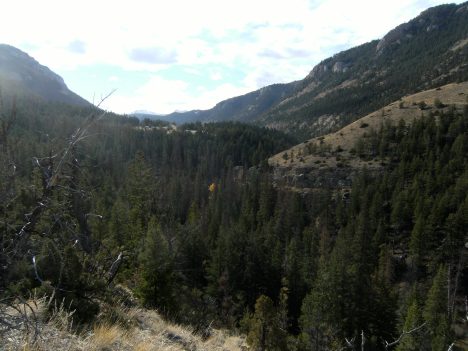
Looking into Dead Indian Valley

Looking into Dead Indian Valley

In this early Archaic period, the big game were gone and more intensive hunting and gathering was necessary  for the equivalent quality of nutrition.  People were settling down for longer periods and returning to the same sites. Deer, much easier to herd and more predictable than elk, were the main large food source, along with sheep.  At Dead Indian, large ceremonies were conducted in honor of this food source.

Larry told me that the Bugas-Holding site was like a still image.  It was used for the duration of one winter only.  Here at Dead Indian the story was more like a novel, with many chapters.  He thought Dead Indian might have gone through periods of heavy use and lighter use.  Having been used continuously for so long, probably many different periods of histories and stories had taken place here.

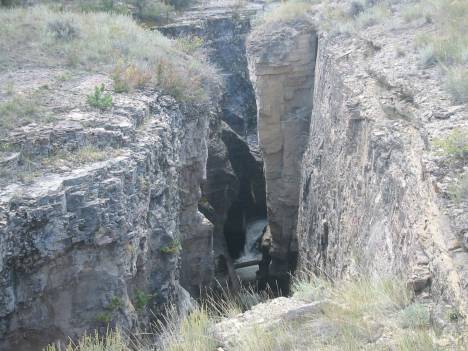
Slot Canyon in Dead Indian

Slot Canyon in Dead Indian

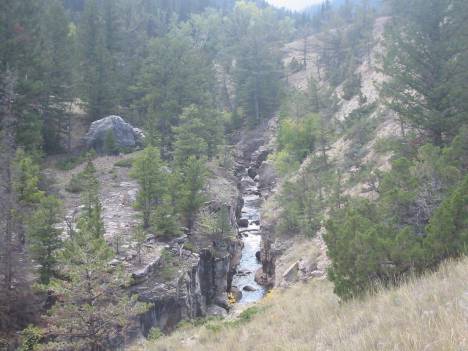
Dead Indian Creek and slot canyon

Dead Indian Creek and slot canyon

Larry talked about the interactions between the land and the peoples.  By the time Lewis and Clark appeared–what we mark as the first interactions with white men in the West–many Native Americans had already been decimated by disease and the landscapes they had shaped were already changed.  The wilderness white people saw at that time was imprinted in their minds as what the land always was. But really it was just a snapshot.   To live winter after winter in these mountains takes an enormous amount of religious, and traditional, training and knowledge.  These practical skills are a cultural phenomenon, passed on generationally.  Thousands of years of accumulated wisdom had been decimated through disease and warfare in a short time.  Larry thought that by the time Lewis and Clark came, enough of that knowledge had been wiped out so that fewer and fewer people could live in these mountains.  The land itself had changed in response. What white men saw as wilderness, was a degeneration of the land through non-use.

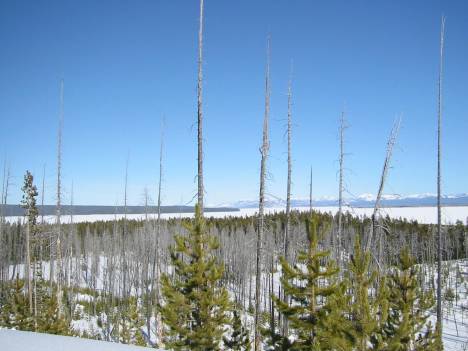
Our idea of wilderness is non-use.  Looking east across Yellowstone lake in winter

Our idea of wilderness is non-use. Looking east across Yellowstone lake in winter

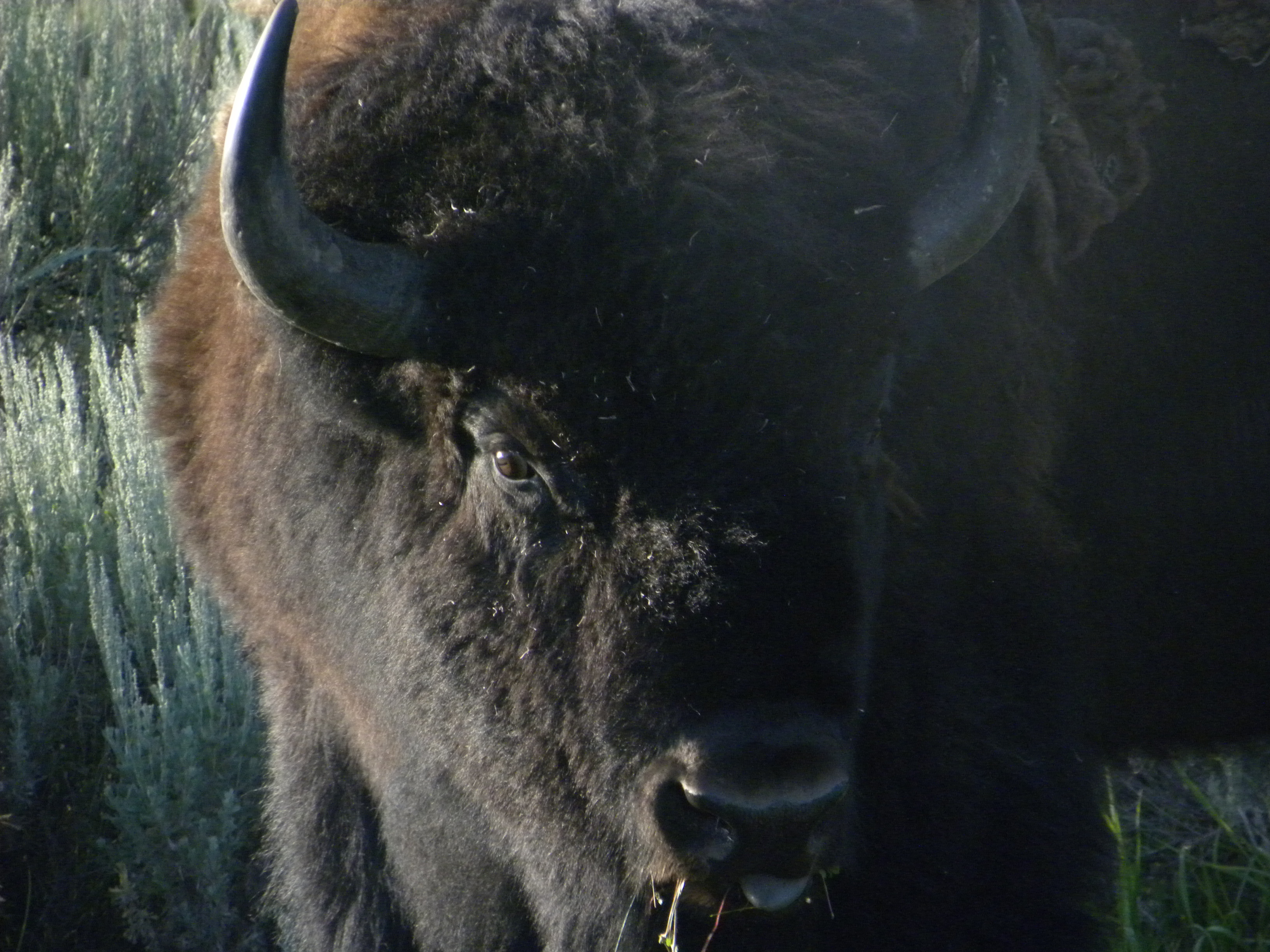
I mentioned that in Australia, after 60,000 years of aboriginals working the land with fire, botanists weren’t sure if the plants had adapted to fire because of human intervention or vice versa.  He told me that Bison antiquus was a good example of that here.  Bison antiquus, the ancestor of our modern Bison, was much larger than today’s Bison and died out about 10,000 years ago.  The theory goes that the smaller, lighter, and more streamlined buffalo could run faster, giving them a decided advantage from the top predator, man.

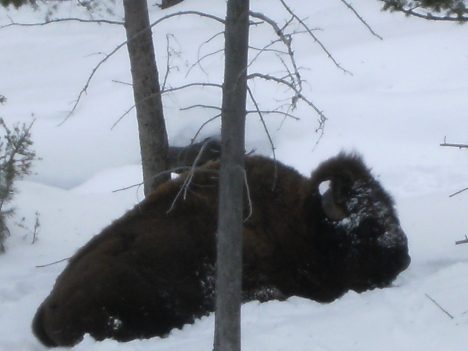
Modern day bison

Modern day bison

As we walked around the site, Larry bent down and showed me how almost every square inch, to the trained eye, contained evidence of habitation.  Chippings from chert, quarzite, chalcedon, pieces of bone, a sheep vertebrae–all this he found within a few square feet.  I hadn’t seen anything until he pointed it all out.  I could feel the vibrancy of the culture once there.  We talked about fire and how it can clear a site. He said that a fire can come through, clear all the duff and topsoil, and the site is exposed just how it was left thousands of years before, including fire pits, chippings and all.

“Its like someone’s found an original map or book that’s going to unlock all these new secrets.  But before we even have a chance to organize and fund an archaeological expedition, the looters are there within weeks, days.  The site is stripped and the information is lost forever.”

We walked back to the road while Larry told me a story about Bison, his specialty.  He said that Native Americans didn’t always use all the meat.  It was common to just take the prime parts after a kill.  One time he was talking with a Blackfoot elder about ancient hunting methods.  When he came to the part about how they left parts of the kill, a student listening nearby said “They wasted parts.”

“Would you take all of it?” asked the elder.  “Would you be that greedy?”

The student replied, “I wouldn’t waste anything.  I’d take it all.”

“You whites are so greedy.  You wouldn’t leave any meat for your brothers–the wolf, coyote, raven.”

I looked back at the site.  Only the wind sang.  I tried to imagine what once was.