• MY BOOKS ON WILDLIFE, GARDENING AND MORE

  • The Wild Excellence

  • True stories of wildlife encounters around the Greater Yellowstone
  • Award winning eBook on Decomposed Granite, tips, how to's, what to watch for
  • Children's book. True stories of a dog and wolves. In a dog's voice
  • Written for dry Mediterranean climates in California, north and south

The wickiup

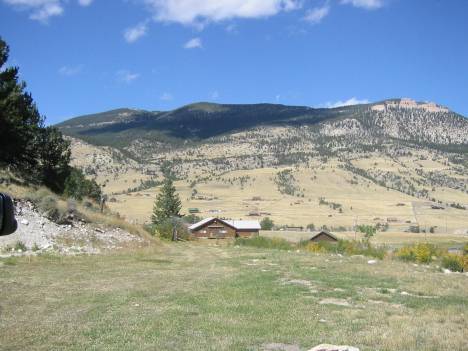
Last week my friend W__ and I hiked up almost to the ridgeline on the steep slopes across the river from my cabin.  That entire hillside used to be owned by Doc Firor, the original owner of my cabin.  Unfortunately, it had been sold after he died and divvied up into  6 acre parcels with cabins on it.

That is the south facing side and is basically granite, which means its mostly treeless down below and there’s very little water run-off.  In fact, over these last 10 years of drought and climate change, many of the springs have dried up.We hiked almost to the ridgeline
W__ had been up there several years ago with a local and found some evidence of Sheepeater houses.  “My friend pointed to some old logs and said ‘these are them’.  I really had to use my imagination.”

The hike is tough and pretty much straight up.  You climb through a series of level meadows followed by steep ascents.  The first 2/3 consists of scattered limber pines and doug firs.  W__ couldn’t remember exactly at what height he had seen the ruins, so we wound up climbing almost to the base of the cliffs.  Several levels below the cliff-line is open forests with stunted trees.  We were right below the cliffs
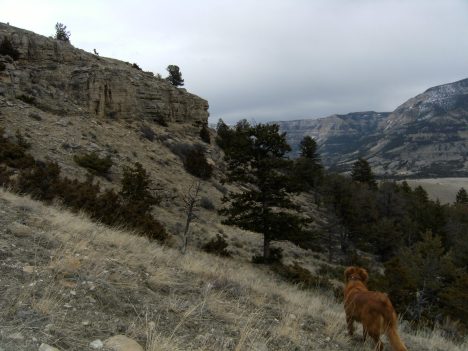
Most of the time we followed deer or elk trails.  We would stop and inspect a level area, then move on to higher ground.  At one point I spotted a tiny obsidian flake.  I have no idea how I found it amidst all the duff and debris.  We joked that the obsidian flake and the crow feather we found meant we were ‘hot on the trail’.

Pretty soon, after not encountering any sheepeater evidence, I forgot all about looking for ancient artifacts and enjoyed the forest.  The rolling gurgle of Sandhill cranes in the distance, migrating in, spoke of winter breaking.  The views were magnificent as we were about 2,000 feet above the valley.The view was magnificentAfter a lunch break we began heading back.  We descended slightly down to a lower yet still forested level that we hadn’t inspected.   Suddenly W__ spotted some old timber.  In a flat clearing, butting up against the hillside, was a distinct squared off area constructed of ancient logs.Sheepeater hut

Another view

I looked around and noticed that behind me was access to the cliff areas, while in front was a complete view of the valley.Access to the cliffs behind
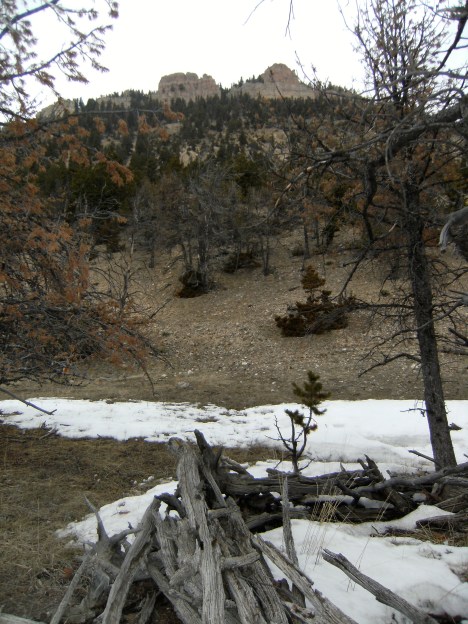
Site looks over the whole valley

A spring used to run nearby that’s now dry since the homeowners below diverted it for their own use.   Several hundred yards directly east we encountered an opening to a gully that ran east/west.  We walked along the top of the unusual drainage, now full of snow.  It was long and wide, narrowing into a natural boxed trap.  I could almost imagine the Sheepeaters driving Bighorn into the small canyon where they’d easily be trapped and killed.  Probably this dwelling, I thought, was just a temporary shelter used in winter.  The haul of the kill back down the valley to the Bugas-Holding site, not exactly nearby, must have been tough.  The Sheepeaters used dogs with travois to do a lot of their carrying.

The one thing that made me uncertain was that all the pictures I’d ever seen in books had Sheepeater ‘houses’ as teepee style structures, with logs piled on top of logs.  This was definitely a square structure.

When I returned I showed the photos to my old neighbor JB who grew up in the valley.  He further cast doubt on the sheepeater theory as he thought the structure looked more like an old bear trap.

“There’s a tree in the middle with only one exit.  They’d tie a horse as bait for the bear.  I bet that’s what that is. The Indian houses were teepee log structures.”

Somehow I couldn’t imagine those old homesteaders climbing way up the mountain to bait a bear.  “Heck”, I thought, “if I was going to bait a bear, I’d do it in the drainages down below where they usually hang out. And I wouldn’t have to trek way up here.”  W__ thought it was all wrong.  “No”, he said, “the logs are really old.  That’s a sheepeater’s structure.

Several days later I decided to take another look.  I found an easier route from the road.  Although not as much climbing was involved because I started higher up, I had a lot more ground to cover.  Taking another look at the structure, it had absolutely no exit.  There were four complete sides.  And the dead tree inside was too young compared to the timber used to construct the dwelling.  Still I had no way of being certain.  I don’t have the expertise and there’s always the unknown factors.

On my way down the hillside, I ran into some locals.  The woman was from the University of Wyoming extension.  They knew the area and knew of the wickiup.

“Several years ago that was discovered by one of the ranch hands doing some work on the stream.  He called George Frison who came out and looked at it.  Frison said it was the real thing–a Sheepeater dwelling.  It used to be more intact, had more height to it.  It’s deteriorated since we first saw it.”

I had to wonder how the structure had deteriorated so fast over the last 20 years compared to the fact that its probably at least 150 years old.  These are special sites and need to be watched over.  When the ’88 fires came through here, the forest service was cutting break lines.  If it hadn’t been for one of the locals pointing out a sheeptrap to them, they would have cleared it completely.

Fire is destroying the evidence of these ancient peoples.  There is a concerted effort going on to find and GPS as many of these sites as possible before they are destroyed.  Interestingly, although fire will destroy wood structures, it also clears duff and can expose artifacts buried below.  The Boulder Basin site is a perfect example.  It had been explored since the 1970’s.  Although sheep traps were evident, Archaeologists thought that the sites had been cleared and looted because little other cultural evidence was found.  After the fires, the site was re-visited and hundreds of projectile points, bone fragments, stone implements, and other important artifacts were uncovered, some simply scattered above the burned ground.

These are Americas’ Acropolis, our Pyramids.  They stir our imagination and resonant with the collective unconscious of humankind.  I see these old timbers and dream the dream of what it might have been like to be living here so long ago; to be dependent on one’s community and the earth; to be a wanderer, a hunter-gatherer; to be so intimate with the natural world.  These are important places, for us, for our children, for all mankind.

Grizzly and mud

Well, the first bear was spotted the other day.  I talked with the fellow who saw it.  He was driving down to the old bridge, no longer in use, to go fishing.  From the road above he saw the grizzly walking across the bridge.  It’s now a forest service campsite, rarely used except by a few fisherman.  I asked if he went fishing.  “Nope, just turned right around.”

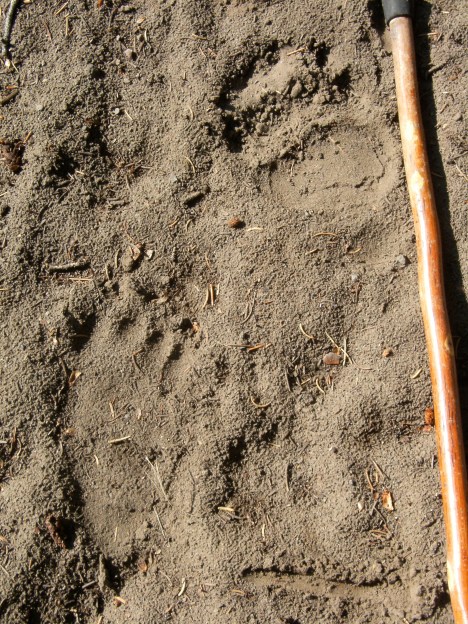
The odd thing is that I was down there twice that week and didn’t notice any bear sign, and there was plenty of snow and mud for tracks.  Grizzly track

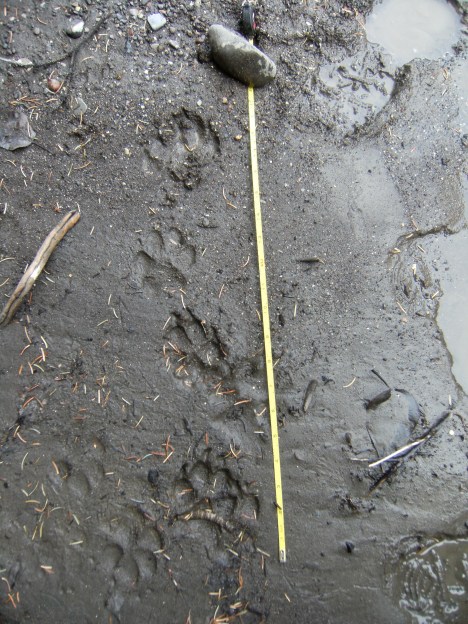
And even though we’re still getting snow, the nights aren’t too cold and some of days are actually warm.  The bears will be coming out and be hungry, so I’m keeping watch and starting to carry bear spray.  Grizzly tracks near fishing bridge

Today!

The good news is that its still so snowy and muddy that tracks will be obvious.  The bad news is that it’s so muddy.  Hiking in snow isn’t bad, but the mud here is unlike any I’ve ever seen.  In Northern California where I gardened, I spent lots of time working with tight clay.  I dug in it, I hiked in it, and I tracked lots of it indoors.  But that clay soil doesn’t hold a candle to the Bentonite clay soil around here.  Its because of all the volcanic ash that was once here.  That’s how it forms.

Just a few steps and your boots weigh twice as much.  If you’re walking on a hill, you’re likely to be sliding towards the creek or cliff.  Your horses will slip in it.  If you’re in your car on a muddy dirt road,  soon you’ll be spinning out.  That sticky mud won’t come off your soles easily and it dries into a cake.

Another interesting annoyance I’ve learned about this mud is that after its caked on my car from driving along the dirt roads here, and then freezes at night, my back doors won’t open.  The mud kicks up onto the wheel well forming a large muddy frozen mass that cements my doors tightly shut.  I’ve driven into Cody where it warms up during the day, parked my car, only to come back and find mud oozing off the wells into large pools on the parking lot.

Humans looked at this mud and said “we’ve gotta figure out a way to make money with it” and they did.  Big Horn Basin is a major producer of bentonite, used as drilling mud for the oil and gas industry, but also, and maybe more important, as a main ingredient in kitty litter.

Knowing that it’s helping indoor cats certainly doesn’t make it more appealing to me.  But I’ve decided that it can be personally useful.  My Jeep is so muddy there’s no reason to clean it yet.  Until things dry out around here, the car will just get dirty again in less than a day.  But I don’t want to wash it anyways right now. With that cakey mud you can’t read my license plates.  Now there’s a way it could actually come in handy.Muddy unreadable plates!

The Hermitage

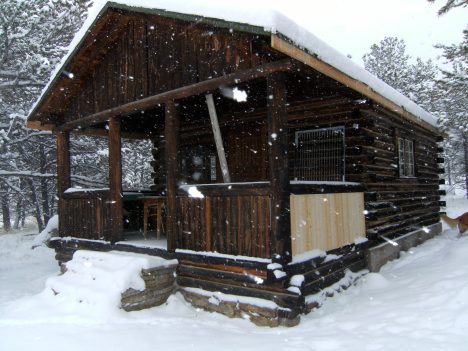
More fixing on my upper cabin, and with that comes hanging its name on a sign. I love that upper cabin. It has no water, no outhouse, and as of now, no heat. I love this little cabin! It has a dangerous oil barrel for a stove sitting directly on the wood floor with single-wall stove piping.Original wood stove and grimmy floor I’m about to change that part. I bought a used tiny Jotul and the seller threw in a whole bunch of double and triple wall pipe. Problem now is that the steep rough dirt road to the cabin is full of snow. So I’ll be waiting a few more weeks to get it up there.

The great thing about that cabin is how secluded it is; how primitive it is. Its where the forest sings its most intimate songs because nobody’s around to hear them.View from side. The forest sings.

When I first looked at this property, for all of 1/2 hour, the realtor showed me the upper cabin and told me it was built originally as a hunting cabin because the elk passed through there. Its true the elk are up there in the winter. But it wasn’t true that it was built for hunting. The previous owners simply used it to store junk. It wasn’t until 2 summers ago that I found out its true origin.

The original owner of my cabin, Doc Firor, began coming up here as a ‘dude’ to the ranch across the street. In fact, many of the long time residents started coming here to Ali Ritterbrown’s dude ranch. That was in the 30’s, when the main road was dirt.

Doc Firor was the head surgeon at Johns Hopkins in Maryland. After coming to the dude ranch a few times and falling in love with the mountains, he bought this property, which at that time was several hundred acres. There were no buildings on the property yet, and although he’d stay at the ranch when he came out, he wanted a retreat getaway. So he built the one room cabin in 1957, several years before he built the larger cabin, and he’d retreat there in the afternoons, away from the dudes.

When I finally closed escrow on my property it was December. I stayed in the main house a few nights. It was the first time I’d been here for more than an hour. I had planned to stay a week, but that was cut short to 2 days because of a family emergency. Lucky for me too, because I didn’t realize how un-winterized the place was. The water pump didn’t work so I had no hot water, and barely any cold. All the windows were single-paned and leaky. The propane heater didn’t work and the house never got above 50 degrees even with the wood stove. It was –10 degrees outside. I slept on a mousey couch by the fireplace.

The previous owners who’d lived here since the 80’s had left all their stuff—part of the deal when you buy a cabin in the sticks. You could feel they’d had wonderful, memorable times here, full of family and friends on summer vacations. In going through what was left, I found photos, stories, board games, an ice cream maker, an inflatable raft, fishing gear, books on mule care, an outdoor BBQ, and a fire pit under the stars.  All expressions of good times and warmth.

But the original owners’, the Firor’s, I knew nothing about. That first night on the creaky couch I had a powerful dream with religious symbols of the Pope and a grizzled graying man praying fervently. I awoke a bit perplexed. I am not religious and the dream, although powerful, had little meaning to me.   But it soon became quite clear when that afternoon my neighbors invited me over and told me about their friend, Doc Firor, and what a religious man he had been. He spent a lot of time in the upper cabin, studying the Bible, my neighbors said. At times he even gave the sermon at the Sunday church gatherings. The first night at my new cabin was a kind of ‘visitation’ from the ethereal leftovers of Doc Firor’s presence.'Doc' & Mrs.

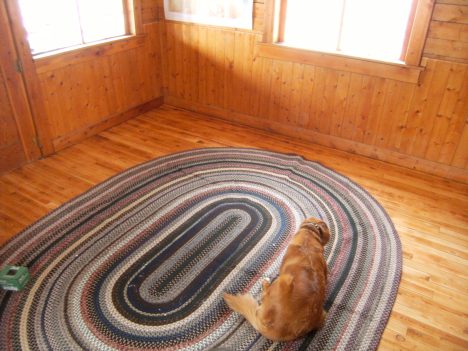
When I came back in the spring of that year, I found myself spending many afternoons at the upper cabin, taking my computer up there and writing. I had to agree with ‘ole Doc—-it’s a special spot. I decided to restore its’ spirit and began by cleaning out the junk left by the previous owners. I filled several pick-up loads with old siding, pipe, junky furniture, you name it. I rented a sander and a generator and restored the wood floor, which was full of sticky residues. I found a forest service bunk bed for guests to sleep in. Now I’m looking for book cases,  and soon I’ll replace the stove and install a proper fireproof floorboard under it. But I still didn’t know Doc Firor’s complete story until his son, Tom, now in his 70’s, paid me an unexpected visit from his Vermont home two summers ago.My refinished floors and new rug

I am not religious nor raised Christian. But I do have a background and interest in spirituality and am well-read in most religious traditions. Many years ago I had a special interest in a very famous and well-known Indian spiritual teacher named Ramana Maharshi. He lived in South India during the first half of the 20th century. I particularly remember being very influenced by a book of reminiscences written by Arthur Osborne. He related his impressions of Ramana and the life at the Ashram when he was there in the 1930’s. Anyone traveling to South India in the 1930’s would surely have heard of the great teacher, Ramana Maharshi, as he was well-known and quite revered.Classic photo of the great sage, Ramana Maharshi

Tom told me his father and mother walked every day to the upper cabin. His dad called it his ‘ashram’. I asked Tom where his father heard that Indian term. After all, Firor was a devout Christian, not a Hindu. Tom told me his father was a missionary doctor for a year in South India in 1936. That his time there was very important to him and shaped him a lot. He took from it the word ‘ashram’, which means a place of spiritual retreat, a hermitage traditionally in the forest.

I couldn’t imagine Doc Firor living in South India in 1936, a relatively sparsely populated region of India, and not going to Tiruvannamalai to see the great Master. By 1936 the world was beginning to hear about Ramana. Already by then some very famous people had come to see him.   It was a strange and unexpected connection that I had with this particular property and its history.

A little side piece to this is that one day the neighbors who bought the Ritterbrowns Dude Ranch came over.  They asked me about my upper cabin and how it was doing.  They already knew the story.  “We have our own Ashram, you know”, they told me.  “It’s a little cabin up in the back of our property with a library.”  Apparently, the Doc had popularized the Hindu word around here.

This winter I found a nice piece of wood from the forest and began burning a sign. Its simple, but a way to honor Doc Warfield Firor’s relationship with this place, as well as my own.  I’ll be hanging it at the door of the small cabin as soon as the snows melt a bit.  New sign

The First Peoples here

Greater Yellowstone Ecosystem has two premier archaeological sites, both on the eastern side.  One is Mummy Cave located between Cody and Yellowstone; the other is Dead Indian Campground, located along Chief Joseph Scenic Highway north of Cody.  Mummy Cave is a well-preserved site showing evidence up to 9000 years old.  It is well-known and much talked about.

On the other hand, Dead Indian site is difficult to find much information about.  The site butts up against the road, near the Dead Indian Campground.  It was discovered when someone noticed bones and artifacts slumping into the creek and a dig was lead by George Frison of The University of Wyoming beginning in 1969 and continuing through 1971. According to Frison’s Survival by Hunting, the Dead Indian site is around 4000 years old and probably a large winter campsite.

Another premier site nearby is the Bugas-Holding site.  The area is meadow, aspens, and next to the creek.  This site also was a large winter campsite where both Bighorn Sheep and Buffalo were taken.  Bugas-Holding site

In order to find out more about the Dead Indian site, I went to the Cody library and was lucky enough that they had a copy of the Wyoming Archaeologist from the 70’s when the site was excavated.  The local chapter had done the dig with help from Frison.  The frayed paperbound copy was the technical report of the findings.

Walking around the site now, my untrained eye would never know there had been a dig.  The teepee rings are no longer visible.  The only evidence I saw was a single small 1/8″ size obsidian chip.  The area though, is a perfect campsite.  It has a fairly large and flat meadow right near the creek.  It is east enough of the Absarokas that the snow accumulation is less than farther up Dead Indian drainage.  It is protected from wind and has areas for lookouts.  And it is along a major route through the Park and into the desert below.

In the dig they found antlers of mule deer laid out in ceremonial fashion.  A skeleton of a small child was uncovered.  Over 500 projectile points and hundreds of stone tools were unearthed.  It seems that mostly what these people killed and ate were mule deer and mountain sheep.  Even though they lived here during the winter, few elk were uncovered which suggests the populations of  large mammals was very different then.  George Frison thinks hunting was done singly or in a group, rather than using large scale trapping.

Just around the corner over at Bugas-Holding, mostly Buffalo and sheep were found.  The sheep were probably taken in traps right near the site.  The site is on private property but a short jaunt over the hills and there are numerous sheep traps, close enough to bring back kill to the campground.  An easy walk above the site and you can view the entire valley, east to west; a perfect place for a lookout.  Looking up the valley from the siteLarge obsidian flaking sites are around these hillsides.  It seems that this site was later than the Dead Indian and they did use large scale trapping.

George Frison wonders, and so do I, why these peoples would overwinter in and around 7,000′, when they could have easily gone down to the Big Horn Basin at around 5000′ where there is less snow cover.  He suggests the abundance of winter hunting.  You also have to wonder if the climate was different then as well.The creek in winterAs I find out more about what went on in this area east of Yellowstone, I’ll let you know.  To imagine this was a major route through the Park, and a large scale occupation area–well, its very quiet here now.  Few people live here year round; most choose to live in the lower elevations nearby.   People hunt here now, but the people who hunted here in the past also did ceremony to their prey.  When I happen to find a small piece of evidence, like a sheep trap or a piece of obsidian, there is a bit of wonder and mystery about it–and sadness.  Some principal piece that went on here for thousands of years is gone forever.
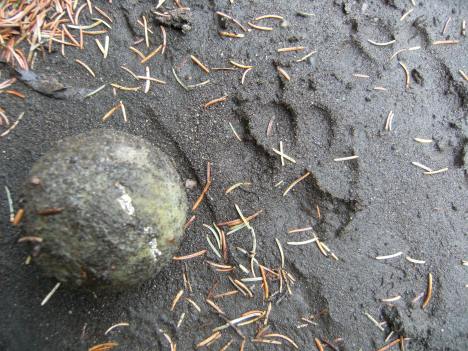
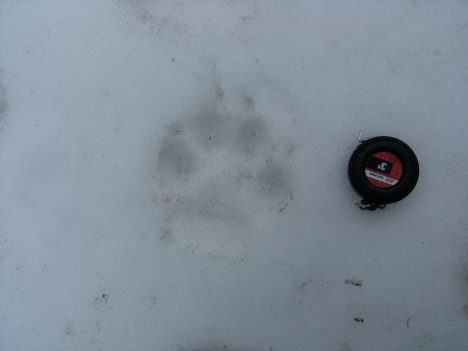
Tracks I need help with

We went down to the river yesterday, exploring, and came across these tracks.  They ended in some sand by the creek, so I backtracked them, through the snow, to where the tracks jumped across the river by way of two large boulders.  I suspected they might be fox, but wasn’t sure.  They seemed too small for a coyote.  They don’t have that classic elongated shape of dog/coyote.  The front track was 3″x 2 1/2″; while the back track was 2″x 1 1/2″.  The stride was about 11″.  I’m not very familiar with fox tracks, but when I looked them up in Elbrochs Tracking book, they seemed to have the classic roundness of a fox,  the ‘H’ in the center where they’d be more fur, and the flat line on the metacarpal pad.  So, all you trackers out there with more thoughts on these, let me know.

With Koda's tennis ball for size

Flat line at metacarpal pad

Full set

Fox?

Hopped two boulders across river

And just to keep things rolling, here’s another set of questionable tracks, ones that I can’t find in Elbroch at all.  I’ve seen these a few times.  They are very small, smaller than squirrels and so they must be something like a vole.  Got any ideas?Tiny perfect tracks

The Elk and the Artemisia

I’ve been watching the elk for weeks around here.  Not like the college kids doing the study though.  They get up and out the door at dawn (when its frigid outside), locate the collared elks they need to watch that day, set up their tripods and scopes. and observe each elk for 15 minutes.  They carry a digital voice recorder and make verbal notes–now they’re eating, now they’re sitting, now they’re chewing, etc.  They’ve really gotten to know their elks.  They call them by number, tell me if they’re too up country that day to observe, or that some have already gone back towards Yellowstone.

The study, as far as I understand it, is to try and determine what’s causing the low birth rates in the Sunlight elk herd–whether it be dietary, predators, or other factors. The interns in my valley are the ‘back country’ team.  They told me they’ve even seen the elk gnawing on antlers and bones.

I have been wondering about their diet for a while.  The sagebrush on the flats are browsed to crew-cut height.  crew-cut Big Sagebrush

Not browsed ArtemisiaApparently Big sagebrush (Artemisia tridentata) is an important food in the winter.  The guys think they eat the Sage when the snow cover is high because the Artemisias are taller. As the new grasses emerge, they migrate elevationally, eating the new growth.  The sage, though, provides protein that the grasses don’t.

I was curious about the deer and the elk and how much their diets overlap.  I see them grazing together a lot.  Elk with deerIn biology there’s a fancy term called ‘resource partitioning’, which basically means that the deer and elk just couldn’t be competing for the same foods in the same area or there wouldn’t be enough food.  Yet I watch the deer nibble the sage and eat new grasses as well.  But according to studies, grasses comprise 75% of an elks’ diet, whereas only about 25% of a mule deers. The guys were telling me that the elk get first choice from their observations.

Last year they did an aerial count and came up with around 1400 elk overwintering in the valley.  A forest service ranger told me that was carrying capacity.

Almost every hike I take I scare elk out of the trees at some point.  The funny thing is that I can be over 500 yards away,  and they still scatter.  My neighbor says they weren’t always that skittish.  He says before the wolves you could approach them fairly closely.  The deer here still can be trained to eat out of your hand.

But since I’ve lived here, the elk are sensitive to any slight movements. Last week I saw a herd high up on a rocky slope.  They watched me for a brief few moments, decided I was a threat, then took off.  Minutes later I came to a prominence that looked out over a treeless meadow.  From all sides came elk, over 150.  They gathered into a large herd and began moving like a flock of birds, turning and swaying this way and that, splitting up then coming back together.Elk beginning to gather

Deer watch us; Koda watches deer

Pheromones, Pine Beetles, and more about fires.

I talked with the Wyoming Dept. of Forestry today.  Apparently, the state deals with private landowners, not the forest service.  I’m definitely going to go for ordering pheromones for my trees. Paul in the department told me that, yes!, the grizzlies do use the Limber Pine nuts as well as the Pinus albicaulus.  He also told me that because of lack of fires, the Limber Pines have become an invasive on rangeland.  Of course, I don’t have rangeland.  I butt up to a National forest full of Limber Pines from 7000′ all the way up to 8200′ or more.

He said they’ve been doing a lot of management with the North Fork and South Fork, but up till a few years ago, my area was doing okay enough.  “Not anymore” we both acknowledged.  The south facing slopes across from me are full of beetle kill on the ridge tops.  The end of my valley that butts up against the Park is now about 50-70% dead trees. Compare that to the east entrance to the Park (up the North Fork) which is about 90% dead standing timber.

The fires of ’88 came through parts of my valley and through Crandall, which is north of me.  In fact, the tiny town of Crandall was almost entirely engulfed and thanks to a major effort, was saved.  When you drive by Crandall, you can see where the fires came down almost to the town.  Apparently, it was some of the hottest fires.  Now the hillsides are regenerating with Aspens.  Cathedral Cliffs along Chief Joseph Highway

The point is, those fires near me in ’88 helped form a buffer from the pine beetle which spared my area up till now.  But like the economy, those fires of ’88 just ‘kicked the can down the road’, and now my valley’s time is up; due for a big fire.

This winter there’s been logging trucks on my dirt road daily.  The biggest private landowner is logging beetle kill around his property for fire protection.  The Game & Fish clear-cut a big swath of spruce and fir to make way for aspen growth, and the neighbor to my east is cutting and burning beetle kill weekly.  Everyone is aware: its only a matter of time till the fires come this way.

The thing about the blister rust on my trees is that they’ve weakened the pines, along with the many years of drought.  Paul said that usually the rust doesn’t kill the trees, especially in the Rockies due to the dryness.  And I can see that’s true.  These are older pines and surviving despite the brown needles.  But then the pine beetle finishes them off.

This is not a spruce or pine beetle but a wood-eating beetle that eats dead wood. They are scary looking though and BIG!

So I have a choice.  Spray with Sevin or use the Pheromone packets.  The spray lasts for 2 to 3 years.  The Pheromones only one.  But its a no-brainer for me.  I’m just not going to use a non-targeted toxic chemical.  Non-targeted in the sense that it kills beetles, and also other insects that could be beneficial; plus the other types of toxicity.

The pheromones simply are a chemical mimic that tell the beetles “This tree is occupied with beetles already.  Go find another tree.”  If you already have beetles in a tree, neither the chemical nor the pheromones will work.

Paul will come over and look at my property.  Its fairly expensive at $7/packet; but its for a good cause.  What we discussed is instead of just tagging important trees, I’ll do a grid of packets over my 6 acres.  When he comes over, we’ll look at the density and see if I need less than the 30 pkts/acre, which I think I will.  May is the target month to put the packets on the trees.  The beetles fly in July and August.

Wolves, turkeys and free attention

A cacophony of sounds coincided this evening in one unexplainable happening.

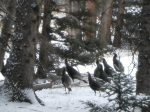
I was outside at dusk when the turkeys in the forest started making a huge ruckus.  The last time such a noise came from them, a large hawk flew out of the forest.  But tonight was crazier.  Not only were the turkeys in a frenzy, clucking and screeching, but one of them was screaming uncontrollably.  In my imagination, a turkey was being murdered while the other turkeys scolded the perpetrator.Wild turkeys, not native

In fact, I did once witness this same phenomenon with some small birds.  I walked outside to find a cat that had a wren in its mouth, while dozens of other wrens screamed from the nearby rooftop.

While the turkeys were going wild, Koda, who’d been listening to the birds, began staring westward towards Herman Mountain.  He had picked up the faint sounds of a howling wolf .  As I strained to hear the wolf, several other wolves across the valley began to answer.  The wolves began howling back and forth to each other.  This lasted several minutes–the wolves howling,  the turkeys complaining.  As the turkeys began to settle, the wolves called for a bit longer–then all was still.

Its a mystery to me if there is any connection between these two auditory events.  Its around turkey mating season, so maybe that’s what all the fuss was about.

Yesterday I took a short jaunt around Herman Mountain.  Mt. Herman from my cabinThat mountain is actually named after the man who built my cabin in the 50’s.   Herman Elsbury owned a sawmill near here.  All the logs from my two cabins were from the valley, which he milled.

It took some exploring to discover the high trail a few years ago.  I had used all the deer trails, which climbed from one steep forested area to another with several plateaud meadows between.  The high trail is reached from the backside which is gradual and climbs to the highest plateau.  Its a beautiful hike, and last summer JB showed me how to access the peak.Mt. HermanI haven’t been carrying bear spray yet, although there has been sightings in the Park and on the lower Clarks Fork.  I haven’t seen any tracks around here.  Hiking in the GYE is unlike anywhere else in the U.S.  Its not a jaunt in the woods.  Its a primeval experience.  You have to have all your senses in gear, alert, open, present.  It is a wonderous experience that takes you back to your native, most basic existence.
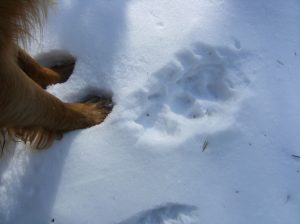
And since I wasn’t thinking about bears, well, I really wasn’t present.  I was on a little mental holiday.  Until I was jolted out of my reverie.  In the deep snow, about a mile up, suddenly huge tracks appeared.  Not of a bear, but of two, maybe three, massive wolves.  They had run easily up the steep side, my side of the mountain, and were heading I assumed towards the meadow where I’d seen 150 head of elk the other day.

I’m not worried about wolves for myself.  They’d be afraid of me.  But I need to be vigilant when I hike for my dog.  Although I’ve heard that if your dog stays close its unlikely anything will happen.  I’ve also heard otherwise.  And by the size of those tracks, those wolves were a lot bigger than Koda.  Wolf tracks with Koda

The wolf howling nearby tonight may have been the same wolves I saw tracks of yesterday on Mt. Herman.  There are supposedly five in the valley; one has a limp.  My friend saw four of them, all black, crossing the road the other evening.  They seemed to have regrouped since last summer, when the pack was mostly killed off for predation, leaving a mother and her yearling pup.

My walk, and this evening of turkeys, was just another reminder:  this place is a wild place; and it is always, in every moment, deserving of my free and total attention.

Dancing Bear

I just had to post this.  Too funny.  I always love the warnings at the end.

Several years ago they were collaring wolves in the valley and I ran into a signage on the trail that read “”Caution.  Live Traps. Gray wolves are being trapped in this area for radio collars.  The traps are leg traps.  If you see a wolf in a trap do not attempt to release it.”

Duh!  Would I really go up to a live wolf in a trap and try to set it free?

Anyways, enjoy the video and kids “Don’t attempt to be a dance partner with a bear if you see one in the wild.”

Bluebirds

I’m told we’re having typical March weather–one day its snowing and the next its 50 degrees and sunny.  But it must be spring because I’ve seen mountain bluebirds.  The previous owners built nesting boxes and put them all around.  I decided to check all the boxes, fix them up and clean them out.

I’m not a very good birder.  For some reason, bird identification is really hard for me.  I’ve done lots of walks with birders, looked at the books, listened to tapes, but I just can’t remember most birds.  Plants I only have to see once and then I’ll remember their latin and common name.  But birds are just hard for me.

I assumed that I should clean out the boxes.  There’s at least a dozen or more old boxes on the property.  I knocked the tops off to clean them, and most needed repairing.  Sure enough, when I opened them up, all were filled to the brim with twigs and nesting materials.  In one I found 2 perfect small eggs that never had hatched.

Since two boxes completely disintegrated, I decided that I was going to make replacements.  I got a plan online from the American Bluebird Society, complete with materials list and to-scale drawings.   I bought some cedar in town, and began my project with excitement.

I like carpentry and also don’t really know what I’m doing, so of course, I didn’t quite read the measurements right.  I saw the 5 1/2″ wide and assumed that every side was 5 1/2″s.  Nope, some were 7 1/4″.  My birdhouse is full of improvisions and fudging, but it didn’t come out too bad, especially for a first time carpenter.  Making the cuts with the power saw and putting something together from scratch made me feel ‘powerful’, the illusion of a self-sufficient woman.  The good thing about my birdhouse is that I can open the lid as its only attached by wires.  That way I can view the nesting process. My new deluxe box.  Not bad for an amateur carpenter!

But here’s the bad thing:  I don’t really like the birdhouse.  Its so big compared to the rustic ones that came with the house.  Even though I made it to the “professionally advised mountain bluebird specs”, its just so big and clunky.  The ones already here are funky, falling apart, have different sized holes, have pencils for perches (you’re not even supposed to have perches!), are small, but the bluebirds LOVE them!  They fill up every year; even though they’re not kosher homes.Funky houses that came with the property

So instead of making more of these ‘trophy’ homes, I found scrap pieces and fixed up the old ones best I could.  It wasn’t easy, because everytime you put a nail in, you risked the box falling to pieces.  These nest boxes were on the verge of disintegration.  In fact, one of the worst looking boxes is the most beloved of the birds.  Instead of the hole being 1 9/16″ like the drawing says, this hole has been pecked over and over again with the years so it’s 2 1/2″ wide.  There is no roof overhang and the side has a big air hole in it.  I fixed it up with scraps here and there, so at least the breeze wasn’t a gale inside and I put on a roof with an overhang.  They love the funk!

I like my bluebird ‘shanty town’.  In these hard economic times, I think the bluebirds have the right approach.  They don’t need much, they reuse, don’t really care what it looks like, and seem happy enough with the cramped quarters.  I’ll just bet that all my old boxes are filled soon. I’m not so certain about the new deluxe model.